

Gastronomy neglected
Worshipping gods in the ancient Mediterranean was a gastronomic affair. Building on wider recognition across the humanities and social sciences that patterns of production and consumption, brought to the fore of experience in foodways, could serve as important axes of differentiation or group-making,Footnote 1 a host of recent scholarship has drawn attention to cultic feasting in the Roman world, and the role this could have played in making and structuring communities.Footnote 2 Yet one moment in the gastronomic chaîne opératoire has often been downplayed: the practices (and practitioners) of food preparation between altar and dining couch. We aim not only to fill that gap, using the worship of the Persianate god Mithras in the Roman Empire as a case study, but to foreground the implications of food-making for group-making: our chief methodological and theoretical argument. Our central historical argument, built from kitchen spaces, cooking ceramics, and ecofacts, is that attention to food preparation sheds new light on the diversity of ways Mithraic communities grouped-together and sat at the intersections of other social patternings: a striking revelation as questions about the uniformity and diversity of Mithras-worship continue to percolate. In addition, we suggest that Mithraic foodways can point to how certain types of food preparation might be conceptualized as distinct from others, with meat-roasting in particular incorporated within notions of worship. A host of diverse productive chains and foodways might articulate in sanctuaries, with rather different cultic and social entailments.
Studying the role of food within Mediterranean cult is not a new endeavor. Economic studies have highlighted how meat harvested from animals offered to the gods was central to provisioning urban meat-markets (though exactly how central remains debated).Footnote 3 Social-historical accounts might stress how providing meals to worshippers offered a way for elite benefactors to acquire social capital and maintain their prestige.Footnote 4 They might speak to the ways that commensality fostered bonds among diners, creating shared experiences of grouping together, whether in the dining-rooms of a temple in Palmyra or in the clubhouse of the Arval Brethren at Rome.Footnote 5 Or they might point to the ways dining structured social relations hierarchically, depending on where diners sat or what portions they consumed.Footnote 6 This, of course, mirrors the wider significance of dining in the structuration of social relations in the Roman Empire.Footnote 7 Phenomenological accounts have even suggested that dining in cult contexts might have given “religion” a special taste for worshippers, marked by flavors that distinguished these meals from workaday, “secular” dining.Footnote 8
Yet for all of this innovative work on the intersections of food, worship, and society, two moments have occupied nearly all scholarly interest, at the expense of others: the moment of sacrifice (what was dedicated to and killed or burned for a deity) and the moment of consumption. Making an animal (or vegetal) offering sacred, the performative work done by the elite sacrificant at an altar, has long been the central focus of work on the practices of cult in the ancient Mediterranean. Dining, on the other hand, has only more recently attracted attention, both in studies of ritualized activities and in thinking about commensality in sanctuaries. But in the chains of materials, labor, persons, and savoir-faire that emerged through gastronomical worship, the preparation of food has remained stubbornly invisible in scholarship – even though, as we contend, its presence and visibility could have been key in the making of worship groups.
The historical priority awarded to sacrifice-at-altar may well have an easy explanation. Beyond a general focus in anthropology and religious studies on “sacrifice” as a core category of human action and central to “religion,”Footnote 9 textual and iconographic evidence highlights this moment, and sanctuary architecture privileges the altar as a central, monumentalized locus of activity.Footnote 10 As Richard Gordon noted long ago, the Roman image repertoire related to cult focuses overwhelmingly on the moment of preparatory offerings at altar in a way that showcases the role of the elite magistrate-sacrificer, veiling the dynamics of wealth and domination that shaped cult in the Roman world.Footnote 11 The interest in banqueting and consumption may similarly be due to its visibility in the archaeological record, despite its general invisibility in art. In contrast to the lack of textual and iconographic evidence for post-sacrificial dining – the iconographic sources on public monuments consist of a single relief showing Vestals diningFootnote 12 – interdisciplinary archaeological investigations have privileged such moments of consumption. The waste of banquets – collected and buried in commemorative deposits or favissae, or simply discarded on the edges of a sanctuary – is, like most of the archaeological record, the detritus of consumptive actions.Footnote 13 Feasting has been seen as a form of consumption, and consumption has become the center of archaeological enquiry.Footnote 14
Still, one might also recognize a more insidious reason that the work of preparing food has been downplayed in studies of ancient cult. After all, the processes and practices of food-making have not been so ignored in more “secular” contexts, where detailed analysis of spaces, of butchering marks on animal bones, of botanical samples, and of ceramic vessels has shed light on the chaîne opératoire of food-making.Footnote 15 Even within the realm of household worship, the links between cooking and gods have been noted: shrines (lararia) were often built into kitchens, serving as the locus of domestic cult in ways that materialized and naturalized familial hierarchies.Footnote 16 Nor have those laborers doing the cooking in “secular” contexts been wholly ignored.Footnote 17
Indeed, modernity has offered frameworks for interpreting the past that neatly separate “labor” – practices of producing material, economic value – from “religion,” matters of spiritual or symbolic value. Despite the host of recent scholarship on labor and laborers in antiquity – mostly aimed at moving beyond elite denigrations of banausic work and towards highlighting identification through and valorization of professional labor – matters of worship and religion are almost always left to the side.Footnote 18 Similarly, despite interest in “lived ancient religion” as a set of material practices in-the-world,Footnote 19 the intersections of production – those activities on which individuals spent the vast majority of their time and energy – and cult are almost never explored.Footnote 20 The work of worship – its physical, conceptual, and social locations – has rarely attracted sustained attention. Cooking for cult offers a unique opportunity to understand how different chains of production, and different actors, might articulate in ways that had concrete ramifications for structuring communities of worshippers.
To fill this gap, we start from a basic question: how did the places, practices, and peoples involved in food-making for use in Mithras-worship shape the social and conceptual dynamics of groups?Footnote 21
To answer this question, we synthesize and analyze data from excavations of Mithraic sanctuaries – a necessary step given how little examination of these cooking spaces has previously occurred and the difficulties in interpreting finds assemblages. We then draw on practice-based models that can bridge the gaps between labor, worship, and group-making. After all, practice-based models of social power, built from the works of Bourdieu and Giddens, have long been used to think about the making of groups and hierarchies in both archaeology and religion, especially in studies focused on “lived religion.”Footnote 22 Focusing on practices can draw attention to the ways that productive labor and symbolic consumption were interlinked and played roles in defining the boundaries of groups, how members connected to each other, and how they structured those relationships. Both work and worship involve the production of value and the transformation of material, social, and imagined worlds in ways that have entailments for the structuration of society. It is not just the patterns and practices of food consumption that materialize social relations; production, too, was an essential means of defining and structuring groups. As part of a world of shared and exchanged meals, food-making participated in the intimate economies of worship communities and, by doing so, worked to structure those communities.Footnote 23
At the same time, cooking was an activity that took place in space. Again, notions of “place” and the production of space have long been taken as central in both archaeology and religion, though only rarely combined with practice-oriented accounts. But all social activities were entangled with places (“locales,” in Giddens’s senseFootnote 24 ) that shaped (and were shaped) by those practices: made for specific acts (the way kitchens could be designed for certain forms of food-making) and offering affordances for how those acts might happen. The physical and conceptual places of food-making were central to how those practices might shape community.
A brief word is necessary on evidence and terminology. The lack of visibly designated food-making spaces in all Imperial-period contexts, including domestic structures, has long struck archaeologists:Footnote 25 some of this may be due to early excavations ignoring workaday features;Footnote 26 some to changing practices that moved away from Pompeian-style built kitchens and embraced portable (metal or clay) cooking installations;Footnote 27 some to new production patterns that saw food-making (like many parts of the Roman economy) become more specialized and commercialized; and some simply to the fact that basic cooking could demand little more than an ephemeral wood-fire, leaving very little archaeological trace save the soot on the bottoms of cooking pots.Footnote 28 Still, even in the absence of built cooking installations, ceramics and faunal assemblages can point to the locations and practices of food-making.
Given the diverse and multilingual vocabulary employed for cooking practices and materials, we attempt to use a simple set of terms here.Footnote 29 “Roasting” will be used to describe all cooking methods involving direct exposure to open flame (including on spits, over grills, or otherwise suspended over flame). “Stewpots” include the closed-form, often globular pots that could be used for cooking foodstuffs in hot liquid (sometimes referred to as ollae or jars). “Casseroles” will refer to the lidded, open-form vessels that could be used for baking or braising. “Frying” will refer to cooking on the hot surface of a lidless ceramic dish (“frying dish”). “Jugs” will describe all single-handled, closed vessels (sometimes referred to as “jars”), both those used for heating liquids and those used for pouring.
Dining in mithraea
Feasting was a central feature of Mithras-worship – perhaps even the central feature.Footnote 30 Spaces, images, structured deposits, and waste all point to both the practical and the conceptual centrality of feasts to the groups who gathered in and around mithraea. Yet despite the elevated role of food in the cult, little attention has been paid to its provision and preparation.
The “caves” and sanctuaries built for Mithras-worship were designed specifically for dining; they afforded space for one primary activity. As much as Mithraic “caves” may have held symbolic significance for at least some worshippers as microcosms or spaces within which to re-enact the transmigration of souls,Footnote 31 their structures were essentially those of biclinia or triclinia. Mithraea generally had two side benches, flanking a central space, upon which a small group of worshippers (most mithraea had the capacity for about 15–25 simultaneous diners) might recline; some of these benches were sloped down away from the aisle, with a lip upon which worshippers might place their dishes.Footnote 32 The third side of the room often had its own raised platform, set in front of the focal image of Mithras stabbing the bull: a space that, in some cases, could become a third bench. The centrality of ritualized dining to Mithras-worship emerges even more clearly when mithraea are contrasted to the scholae of collegia. Although collegia frequently dined together, few had dedicated, built dining spaces, more often relying on portable couches that could be temporarily installed in large, multipurpose rooms.Footnote 33 Feasting together was prioritized and centralized in the material fabric of Mithraic sanctuaries.
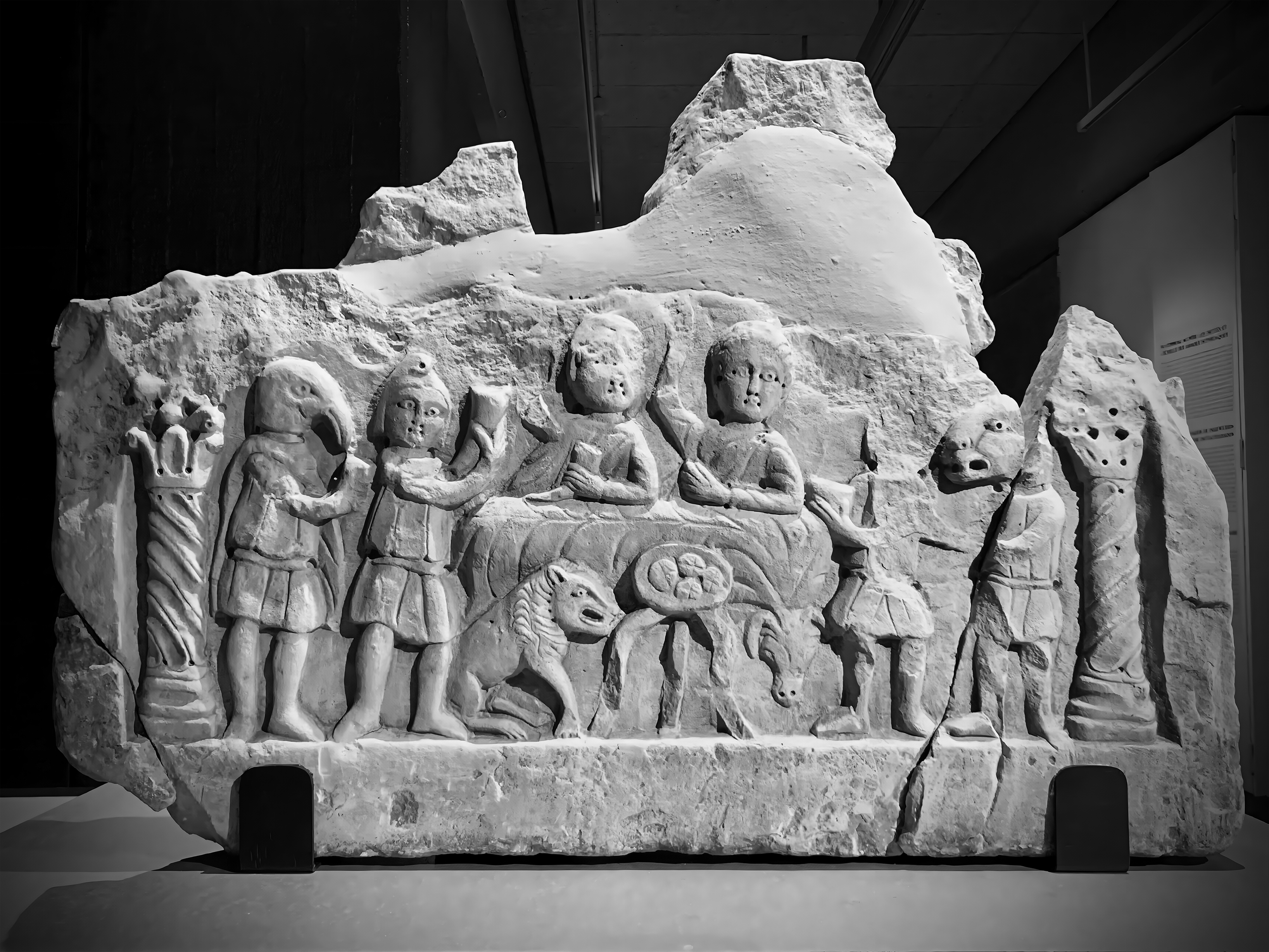
The imagescapes of mithraea also drew attention to the centrality of eating and drinking. A number of images showing scenes of Mithras’s myth-narrative from across the Roman world include Sol and Mithras banqueting together.Footnote 34 At Konjic, the central bull-stabbing scene could be spun around to reveal a scene of Mithras and Sol reclining and being served by therianthropic attendants (Fig. 1), setting the banqueting deity among his reclining worshippers in an embellishment of the more usual scene of Mithras and Sol.Footnote 35 In a cult defined by a hierarchy of ranks through which worshippers might progress (leaving aside questions about whether such ranks were shared among all Mithras-worshipping communitiesFootnote 36 ), this vertical social structure is practiced via lower-ranked figures bringing food and drink to those enjoying luxury foods, served from exotic vessels like rhyta. In other sanctuaries, smaller scenes depicting stories of Mithras’s exploits might include this banquet: perhaps given less emphasis, although on “loquacious” Danubian reliefs, it does occupy the central space in the lower register of multi-scene reliefs. At Dura-Europos, several graffiti seem to have recorded the costs of a banquet: provisioning meals was as central to the life of the community as the acclamatory nama graffiti that celebrated individual initiates.Footnote 37
Relief showing banquet of Mithras and Sol with attendants. From the mithraeum at Konjic (Bosnia). Limestone. Late 3rd/early 4th c. CE(?). Sarajevo, Archaeological Museum. (Photo: Olivier-Antoine Reynès, CC-BY-SA [https://www.mithraeum.eu/imago/IMG_0156.jpeg].)
And the ceramic and faunal assemblages of mithraea – although few have been excavated, recorded, and published in full – have served to confirm the practical and conceptual centrality of banqueting. Assemblages generally feature high numbers of tablewares and low numbers of storagewares compared to domestic contexts; drinking vessels, especially beakers, are among the most frequent vessels at those sites with fully published assemblages, like Tienen and Güglingen.Footnote 38 Drinks were served in specially made containers, pointing to investment in distinctive drinking experiences: a large jar with barbotine decoration and a propitiatory text from Tienen; kraters with symbolic appliqués at Mainz and Bornheim-Sechtem; special-effects vessels from Tienen and Hawarte, with snakes that spit their steaming contents once heated.Footnote 39 Leftover bones hint at the distinctive kinds of meat-based dishes consumed in mithraea: chicken and younger, more tender mammals (pigs and ovicaprines) than in comparable household contexts.Footnote 40 The chickens often seem to have been roasted.Footnote 41 Of course, not every portion of an animal found in mithraea was consumption waste: histotaphonomic analysis of bones at Kempraten suggest that parts of animals were left out to rot in the mithraeum,Footnote 42 and at other sites, curated parts of birds and bovines were buried in special deposits.Footnote 43 Perhaps more notably, the remains of meals seem to have been curated in special commemorative and foundational deposits: from foundation offerings consisting of the remains of one meal at Apulum Mithraeum III (APM3),Footnote 44 to the remains of a giant feasting event that may have fed hundreds of worshippers at Tienen.Footnote 45 Grouping together around food was what these worshippers marked and commemorated in the physical fabric of their sanctuaries.
But here, too, the focus of scholarship has been primarily on the acts of consumption in feasting and waste disposal, either through structured and symbolic deposition or by more workaday disposal of debris. This has gone hand-in-hand with a recent and welcome appraisal of artefactual and ecofactual assemblages in mithraea as the outcome of practices.Footnote 46 Even when observed archaeologically (and more often than not, half-formed assumptions are made about cooking practices and spaces in the absence of evidence), kitchens are an afterthought to the “real” business of cult in the dining rooms of mithraea.Footnote 47
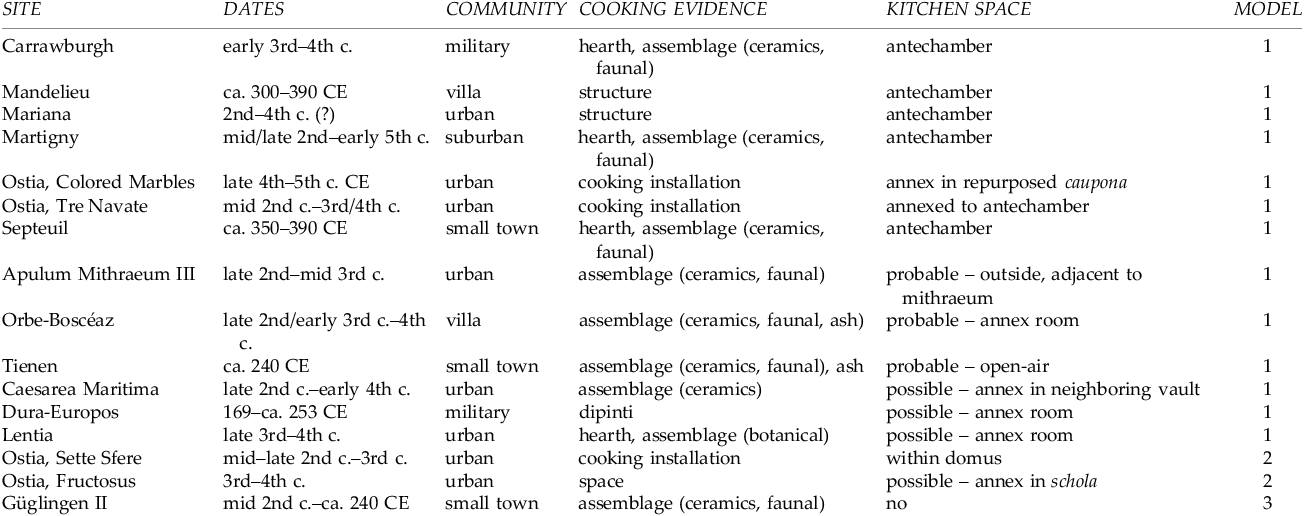
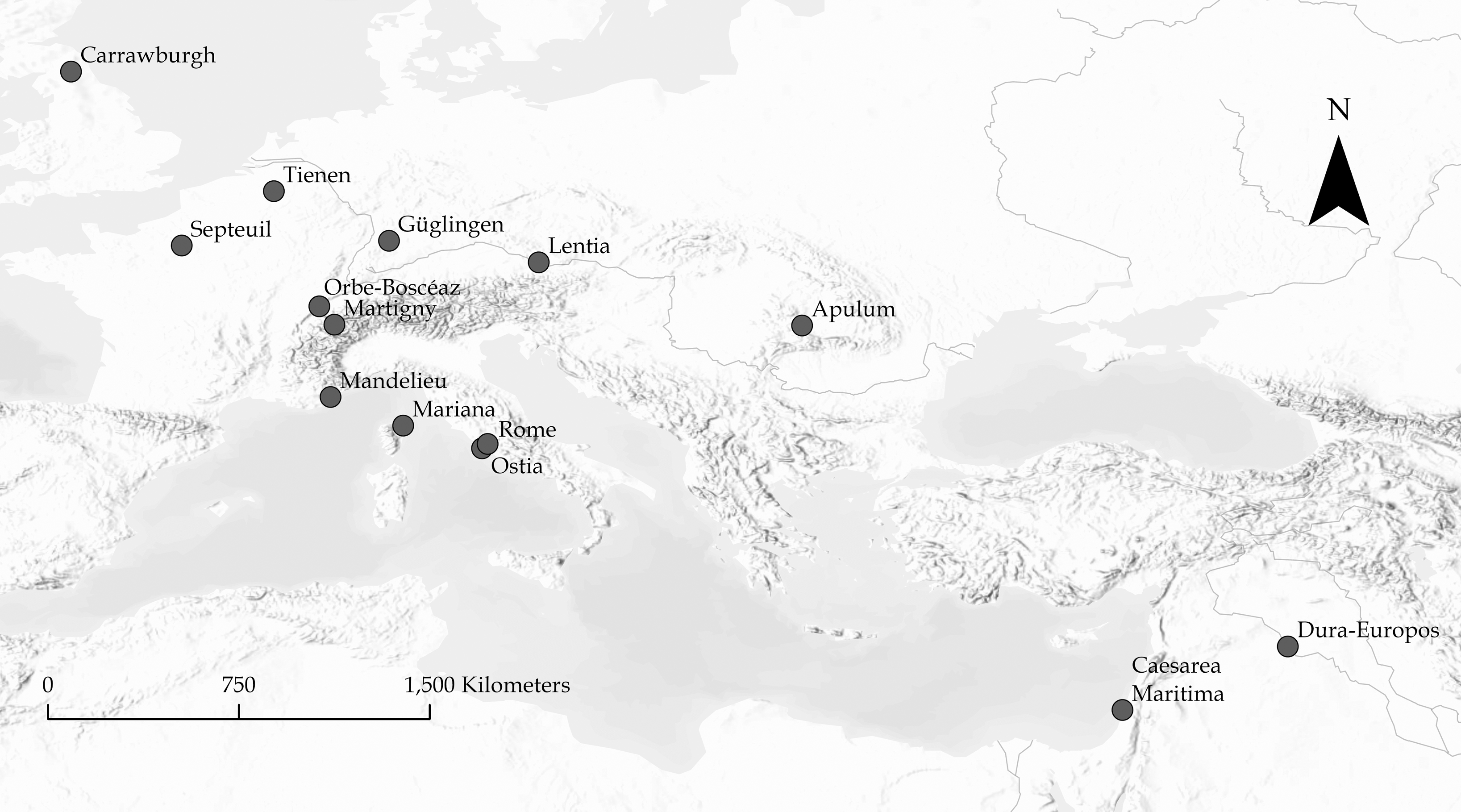
Turning attention to what, where, and who was involved in making the food that served as the basis for Mithraic meals can shed new light on the dynamics of the diversity of ways that Mithras-worshippers structured themselves into groups. Beyond textual and iconographic evidence from Dura-Europos and S. Prisca for the acquisition of foodstuffs, we suggest that there were three major modes of food provisioning for Mithraic meals, each with a distinctive set of social-structuring entailments. The most archaeologically visible took place, of course, in a dedicated cooking space (Model 1). Most often, these kitchens were set in the antechambers of Mithraic sanctuaries, the transitional space between the exterior and the main display/dining space, the bench-lined cult room. Worshippers dining in the main room would pass by hearths for roasting meat and perhaps stewing other dishes as they entered, walking by those crouching to tend the hearths and attending the diners within. Roles, positions, and postures all worked to reinforce the hierarchality of the community and the status of those within the dining room. This arrangement is especially visible at Carrawburgh, the Sacello delle Tre Navate at Ostia, Orbe-Boscéaz, Martigny, Septeuil, and Tienen. The second possibility, especially for sanctuaries that were built within elite houses or alongside scholae, was to use adjacent kitchen spaces that might otherwise serve the household or collegium (Model 2). In such cases, food provisioning further enmeshed the Mithraic worshippers into that wider social group and emphasized their dependence on the households and their owners. Such dynamics can be seen most clearly in Ostia. The final possibility is that of potluck (Model 3): practices where individuals might provision the cooked portions of a meal from home kitchens in ways that created a more horizontal community. This seems to have been the case at Güglingen II. Because of the nature of our evidence – both the lasting, physical traces created in antiquity and the way modern attention has been focused on recovering particular types of material – Model 1 is the best represented archaeologically, while the others are only faintly visible at a few sites (Table 1; Fig. 2). Still, recognizing the variety of activities, spaces, and experiences is important for understanding the dynamism of Mithras-worship. The very variety of cooking practices points to the range and fluidity of the social ties created in Mithras-worshipping communities.
Mithraea with archaeological evidence for food preparation and cooking.
Map showing sites discussed in the text. (Map: M. McCarty; basemap by ESRI, USGS.)
Documents and images of community cooking
As is true for most Mediterranean cults – especially those where commensality played a central role – we have very little documentary evidence for the processes and practices of procuring and preparing foodstuffs for Mithraic communities.Footnote 48 Yet, especially in the Roman world, great emphasis was placed on the role of those who funded sacrifice and paid for the food shared among gods and worshippers.Footnote 49 Understanding the dynamics of provisioning and paying are central to unpacking foodways and their social entailments. Some of our only evidence related to the provisioning and preparation of food comes from the mithraeum at Dura-Europos and seems to suggest a community that jointly purchased raw ingredients for their feasts and probably prepared them on-site. Iconographic sources from S. Prisca may further support this model, although with the caveat that such images present a highly idealized version of worship and hierarchy.
The Durene sanctuary was founded in 169 CE by a military community who had probably been socialized into the cult while serving elsewhere in the empire. From at least the early 3rd c. CE, when the mithraeum was rebuilt, the worshippers seem to have been drawn from the legionary community garrisoned in the city.Footnote 50 That is, the group at Dura was a primarily militarized worship community.
The evidence for food supply comes from five graffiti scratched onto walls and pillars of the sanctuary, only two of which have previously been published.Footnote 51 It is not clear what building or plaster phase any of them come from; only one can be securely located in the sanctuary, on one of the columns by the cult niche. Each is arranged as a vertical list: a column of left-justified words, followed by indicators of monetary denominations and numbers. They are, as the excavators suggest, seemingly lists of amounts paid for particular commodities.Footnote 52 While there are problems reading some of the items, most are clear: a jar of wine (danna, a local measure, x2), raw(?) meat (kreas, x2), oil (elen=elaion), fish-sauce (garelen=garelaion or garos, x3), wood (xula, x3), little radishes (rephanidia), onions (krommud=krommudion), something sweet (wine? sauce? [gl]ukudi), water (hudōr), lamp wicks (elluknin=elluknion), and paper (karta, x2). Unfortunately, nothing is said of quantities of these goods, and even at a site like Dura where we have comparatively high levels of price information, the costs cannot offer further details about the scale of the purchases.Footnote 53
The most plausible explanation for these lists is that they record expenses pertinent to the community. They resemble shopping lists or expense receipts recorded on papyrus;Footnote 54 the latter is more probable, as shopping orders were necessarily portable. These lists may offer the best evidence for shared funds held by the community of worshippers and hint at their major common expenses: mostly the raw ingredients necessary for banquets. Such meals, paid for out of funds collected from the community as a whole (and perhaps supplemented by larger benefactions), are a regular feature of collegia in the wider Roman world.Footnote 55 Although no figures in Mithraic communities are ever labeled as treasurers for the group – a role that might be expected if funds were being handled on behalf of the community – it is telling that another set of graffiti at Dura speak of the dikaioi and adikaioi,Footnote 56 a set of concepts frequently invoked by private associations around the management of their communal finances.Footnote 57
And they are ingredients, rather than fully prepared foods: meat (whether cooked or uncooked is not specified), vegetables, and condiments. The community apparently recorded the expenses of purchasing semi-processed foodstuffs, but these communally provisioned ingredients still required combining, cooking, and transformation into a meal. This was also presumably something done at the level of the community.
There is no certain evidence for a kitchen space in the sanctuary, but there may have been one in an adjacent space. The antechamber was tiny – the space was about 4 × 2m, with much of that given over to a passage between the outer door and the door to the cult room – leaving little room for food preparation. The building was bordered by a street in front, which would not have allowed outdoor space for cooking. The spaces to the north and south of the mithraeum itself in Block J7 were, however, poorly recorded. In the second phase of the building, a small passage connected the nave to a suite(?) of rooms to the north, one of which could potentially have served as a cooking space.
The receipts from Dura offer a hint that at least some Mithraic communities may have purchased raw foods as a shared expense, implying that the community was likewise responsible for turning them into a shared meal, perhaps in the rooms annexed north of the cult room.
Although not as directly documentary, the frescoes from S. Prisca showing processions of worshippers may offer some sense of how a community could imagine and represent the practices of provisioning. The processioners bring a host of objects, interpreted as offerings and as potential evidence for potluck. Some carry kraters for wine, others carry bread, while others bring live chickens or even a boar and bull, alive and on-the-hoof.Footnote 58 Bread, especially in urban contexts (and above all, in Rome itself), was often baked professionally for consumption in domestic and ritual contexts.Footnote 59 The chickens, brought whole, and other animals would have required processing. No worshippers bring stewpots; some carry containers holding bread, and one may be holding a casserole-style dish.Footnote 60 Even if some of the food was brought prepared, some (the live animals) would have required butchery and cooking prior to a banquet. While the images may be heavily idealized and conventionalized, they still hint at a model where individual worshippers provided foodstuffs in various stages of consumption-readiness – and where the meat might have required in-sanctuary killing, butchery, and cooking.
What these images hint at is the sheer complexity of foodways that met within a Mithraic sanctuary. Animals on-the-hoof, baked bread, and wine all arrived in procession to the sanctuary. Some may have come from the home kitchens of those carrying them; some from wet markets; some perhaps even from commercial bakeries. “Food preparation” for a mithraeum might have reached outward and been involved in a host of other familial, labor, and economic relationships; it was not a simple or monolithic practice.
At the same time, the S. Prisca paintings hint at a second form of complexity in Mithraic food-making. If the community at Dura seems to have purchased consumables out of common funds, leaving a record of its expenses on the sanctuary wall, the paintings at S. Prisca speak to a model of individual dedicants provisioning parts of a meal. As with so many aspects of Mithras-worship, this practice represents a near inversion of the civic norm in worship, where an elite benefactor might provision an entire meal in ways that emphasized dependence on that benefactor and the asymmetries of wealth, power, and reciprocity. Even if, in this case, the offerers were all high-ranking cult members – identified by dipinti as having achieved the grade of Lion within the community – they are shown collectively bringing forward the parts of a feast.
Still, parallels from other commensal associations suggest that a range of different food-procurement strategies might have existed side-by-side, dependent on the occasion.Footnote 61 The affordances of built food-making installations and finds assemblages may offer a better gauge of how food-making was practiced and conceptualized in making Mithraic groups.
Model 1: cooks and caterers on display
Cooking spaces have often been noted – without much comment – in Mithraic spaces.Footnote 62 Yet the construction, placement, and entailments of these kitchens played a role in shaping both the boundaries of worship practice and the shapes of Mithraic communities. Six sites in particular – from near a fort at Carrawburgh; a villa at Orbe-Boscéaz; a town at Martigny; an urban sanctuary at Ostia; a Late Antique, repurposed fountain-house at Septeuil; and a village sanctuary on the outskirts of a vicus at Tienen – offer the strongest evidence for these dynamics of practice. Because of the quality of excavations, lack of post-Antique intervention, standard of publication, and ways cooking seems to have occupied delineated spaces, much more can be said about cooking in these cases than for the other models of Mithraic cooking. They point to the ways that food-making – or at least, certain kinds of food-making – was brought into the sanctuary and set on display for worshippers, sharpening the hierarchies of the community. And they also suggest that these dynamics were not limited to one region, to sites with a single form of social background (urban, rural, or military, for example), or to one period.
The mithraeum at Carrawburgh remains one of the clearest cases of a sanctuary with its own cooking facilities in the main temple building and offers the best example of our first model of Mithraic cooking: one where gastronomic labor was put on display for diners, in ways that created a range of hierarchic experiences within the cult.
Excavated in 1950–1951, the sanctuary was built in the vicus that grew up outside a fort along Hadrian’s Wall.Footnote 63 Over its lifetime, stretching from a first phase datable to the early 3rd c. through a final Mithraic phase in the early 4th c., the building underwent at least four major rebuildings. The community who used the sanctuary seems, like the one at Dura, to have been composed primarily of soldiers. At least, the three figures who dedicated the monumental altars of the sanctuary were all prefects of the auxiliary cohort stationed in the fort.
The antechamber built during the second phase of the mithraeum’s construction seems to have been the main locus of food preparation. Although the publication of the site was far from complete – only some ceramics and faunal remains were published, and none were fully quantified – there are two major indications that cooking took place in the antechamber. The first is faunal: 61.5% of the mammalian bones recovered from the sanctuary come from the antechamber and only 32.7% from the nave.Footnote 64 This stands in marked contrast to small chicken bones, which were found throughout the sanctuary and in the wattle fronts of the benches. Chickens were cooked bone-in, as was normal practice in the Roman world, with the meat consumed off the bones and the small bones apparently discarded at the point of consumption. Larger mammals, however, had their carcasses processed for cooking, with some butchery and removal of meat from bones happening in the antechamber. The anatomical distribution of the bones also points towards butchery and carcass processing in the antechamber, with a much larger range of anatomical parts there than in the nave. There are also more extremities and animal parts usually removed prior to consumption in the antechamber: ovicaprine phalanges, and a significant number of porcine and ovicaprine jaws and other skull pieces. All of this speaks to the use of the antechamber as a space where meat was prepared for consumption.
In addition, from Phase IIA on, the antechamber possessed a built-in hearth that seems to have been used for cooking (Fig. 3). The hearth was set between the room’s entrance and a raised platform on the southwest side of the room: perhaps, based on parallels in other sanctuaries, the base for a storage cupboard.Footnote 65 The hearth, around 100 cm wide by 60 cm deep, had a stone border, and there were clear traces of burning on the walls behind it, securing its identification. In at least one phase (IIB), a raised stone “bollard” created a barrier between the door to the outside and the edge of the hearth. In Phase IIB, a stone-lined pit was set up to the west of the hearth. While the excavators saw this as an initiatory “ordeal pit,” a much more workaday interpretation seems probable: perhaps a water basin (given what seems to be a drain connected to it through the wall of the building) or a storage tank. In Phase III, the hearth shrank slightly but shows signs of having been refreshed, with multiple layers of stones and clay raising the surface.Footnote 66
Mithraeum at Carrawburgh, Phase IIA. Early 3rd c. CE. (Plan: M. McCarty, after Richmond, Reference Richmond and Pearson Gillam1951, fig. 3.)
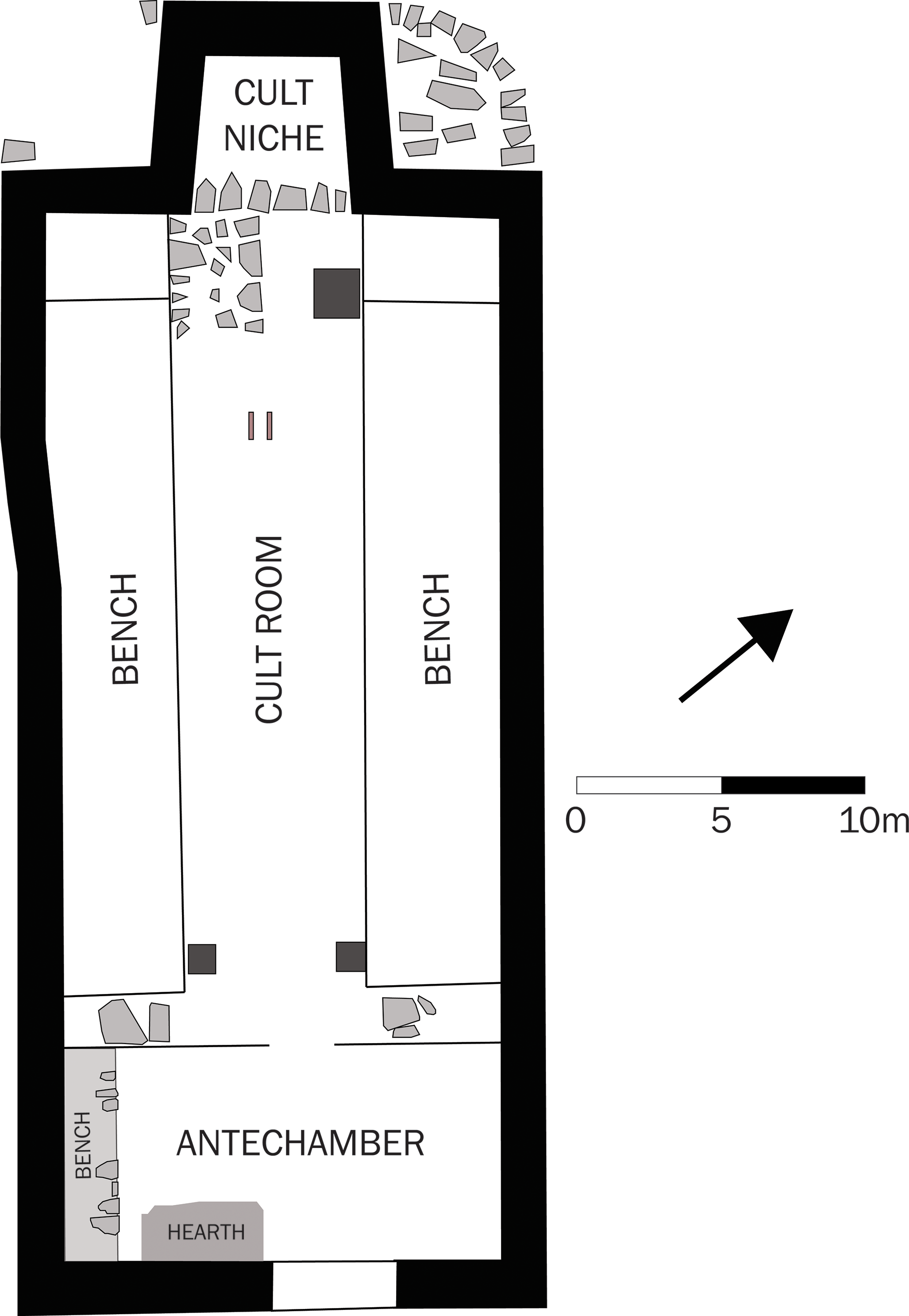
Fire-blackened stewpots were a regular feature of the ceramics assemblage, but they were found across the building in all phases. Rather than hinting at locations where cooking took place, they may instead suggest that food was both cooked and served in these vessels. That is, the find-spots of cookwares in mithraea may indicate places of food consumption as well as production, making built cooking installations the main guarantor of food-making.Footnote 67
If breaking down mammal carcasses for cooking, the roasting of chickens, the cooking of other meat-cuts, and perhaps the stewing of foods took place at the antechamber hearth, this would have had significant entailments for the experiences, practices, and social structuration of worshippers. The scale of banquets may suggest that cooking was a constant activity during gatherings of worshippers – one that distinguished those cooking from those eating in the cult room and ranked them differently. Using Michael White’s estimates for the amount of bench-space necessary for a reclining diner (0.5–0.6 m of width),Footnote 68 the Phase II Carrawburgh mithraeum – where each bench is 7 m long and 1.38 m wide – could have hosted 23–28 simultaneously reclining diners. Given the narrowness of the benches, which may have demanded that diners angle their bodies slightly, the lower end of this range seems more probable. There may even be a direct correlation between cooking space and dining space in the mithraeum; in Phase III, the benches were reduced to 5m long, decreasing the capacity of the mithraeum to 16–20 diners. At the same time, the hearth in the antechamber seems to have shrunk. In other words, the hearth size was linked to community size.
Even so, cooking almost certainly happened in stages. Marleen Martens has suggested that a reasonable portion at a Mithraic feast might have given each diner between half and a whole chicken;Footnote 69 for a full sanctuary of diners, this might have meant anywhere from 10–30 chickens being roasted to serve the community. Although it is not clear exactly how the chickens were roasted – possibly on spits, on grills (though no mithraeum to date has produced evidence of andirons, spits, or grill-bars), or simply suspended over the fire with cords (which would not leave such a trace) – there is not space on the hearth for that many chickens simultaneously, and certainly not if complemented by stewpots. Providing cooked food to the diners would have been an ongoing process.
Staged cooking has ramifications for the structure of the community. If there was not enough food cooked at the same time for every worshipper, it would either have been cooked in advance of the banquet or cooked during the banquet and served in rounds. The order of service would have highlighted the priority of certain members of the group, enhancing the hierarchality of the community. In some ways, this echoes the ordering of public, post-sacrificial banquets at Rome: these were similarly hierarchical, with gods fed first, then worshippers according to status, in ways that made vertical social relationships tangible.Footnote 70 At the same time, continuously cooking would have left those involved in food preparation isolated from the community of diners, kept in the antechamber to cater the meal of those reclining in the cult room. Those who provided the labor of cooking were, in that case, excluded from the dining. As much as Mithras-worship may have promoted modes of commensality for those consuming, these practices of labor and exclusion in production created a clear sense of hierarchy.
The hearth and southwestern side of the antechamber at Carrawburgh offered little room for maneuvering in the space, and created a juxtaposition between dynamic and static displays. A person tending the hearth and its contents, standing to the west of the fire, would – like the bollard-stone blocking the hearth itself – have stopped access to the southern half of the antechamber, which seems to have been given over primarily to storage. This may explain why the only decorative element in the antechamber – a statue of a mother-goddess – was set on the north side of the room. The space was divided into work/storage-space and display space. In practice, though, worshippers entering the cult room would have passed by the cooks preparing food: a “tableau vivant”Footnote 71 of labor for their benefit just as important as the display of fixed statuary on the other side of the room.
Laboring at a ground-level hearth also created embodied distinctions. Hearth-cooking demands crouching and bending. Elite residences might have elevated the task and its practitioners through raised countertops that allowed workers to stand,Footnote 72 but set at floor-level, the Carrawburgh hearth demanded that its cooks crouch before it, as a kind of gastronomic stoop-labor. The postures of those cooking marked them off from those who might pass through the space upright, and those reclining in the cult room beyond. The equipment entailed certain bodily postures, and those postures contributed to differentiation and ranking among the people using this space.
It may be impossible to say who exactly these cooks were – servants/enslaved persons, or simply low-ranking worshippers – but there may be reasons to suggest that those cooking for the community had some experience and practice at these tasks. Butchery and tending food on the fire required a certain level of technical skill. The cooks who catered Mithraic banquets were not, in other words, complete amateurs.
The Carrawburgh mithraeum created a space for cooking inside the sanctuary, which displayed this productive act (and the cooks performing it) to worshippers entering. Diners reclining on the sanctuary benches, resting their weight on their left elbows/sides, would face outward towards the antechamber/kitchen door: spectators to the moving tableau of staged cooking. Making food was, visually and spatially, perhaps almost as important a part of worship here as the displays of imagery in the sanctuary. And that cooking activity served to differentiate the community of diners from those doing the work of cult, and perhaps – via staged cooking and serving – from one another.
Similar dynamics can be seen at other mithraea of all periods, where fixed cooking spaces incorporated the act of meat-cooking into antechambers and set it on display for visiting worshippers. This seems to have been the case at Orbe-Boscéaz. The sanctuary has a probable food preparation and cooking space located adjacent to the main cult room that, although not as clearly a kitchen space, created similar dynamics to the Carrawburgh hearth. The Orbe-Boscéaz mithraeum was built on a rural villa estate, set about 150 m away from the pars urbana of the complex, at the end of the 2nd or beginning of the 3rd c., with perhaps some rebuilding following a fire in the mid 3rd c. CE.Footnote 73 The probable mithraeum kitchen also shows that these cooking practices were not confined to a militarized community – the Roman army often had its own distinctive foodwaysFootnote 74 – and that their visibility to a worship community stood in marked contrast to the way cooking might be concealed in elite domestic contexts.
An annex to the north of the main cult room may have served as the space for food preparation (Fig. 4). A host of additional spaces surrounded the main sanctuary, whose probable functions emerge only in different types of assemblages. There are two long rooms on either side, with a raised podium at the west end of the northernmost Room 140. Two other spaces extend outward to the north; the excavator sees these as storage spaces for ritual paraphernalia. Room 140 provided a number of finds related to food preparation: iron knives and mortaria, as well as half the total faunal remains from the site (another 31% come from the surface outside this space).Footnote 75 The walls of the space were simply whitewashed, suggesting a service function and contrasting with the painted walls of the pronaos and cult room. That said, Room 140 produced a large number of glass tesserae, which might suggest a richly decorated ceiling that connected this space more directly to the cult room, a space similarly decorated.Footnote 76 Although the excavators note the absence of hearths or cooking installations,Footnote 77 this may not preclude on-site cooking. The northern annex space also seems to have been scorched by fire, perhaps resulting in partial destruction and rebuilding: another proxy that may suggest a kitchen. Few cookwares were initially identified in the ceramic assemblage, though admittedly, few ceramics of any kind were recovered and published – 76 pieces total in the initial excavation report – and those pieces of terra sigillata that could provide dating evidence were privileged in the report. Of the published pieces whose probable function could be determined, 60% were tablewares, 16% were mortaria, and only 11% were for cooking. In later publications of the assemblage, the number of identified cookwares related to demolition debris after the fire and probably stemming from the northern annex room increases: in that context, 54% of the pottery is identified as cookware, including 19 stewpots.Footnote 78 The faunal assemblage showed an over-representation of meaty joints of mammals (pig, ovicaprine, and cattle), and a dearth of heads/necks and feet of chickens: evidence that primary butchery did not take place within the mithraeum annex itself, although it could have happened in the open areas outside the building.Footnote 79 Still, the high fragmentation of bones in the northern room may point to secondary butchery and processing in that space. The meat seems to have been grilled or roasted, based on burn marks;Footnote 80 perhaps this method of preparation, and service along with mortarium-ground condiments, accounts for the relatively low number of cookwares.
Mithraeum at Orbe-Boscéaz. Late 2nd/early 3rd–4th c. CE. (Plan: M. McCarty, after Martin-Pruvot Reference Martin-Pruvot2000, fig. 93.)
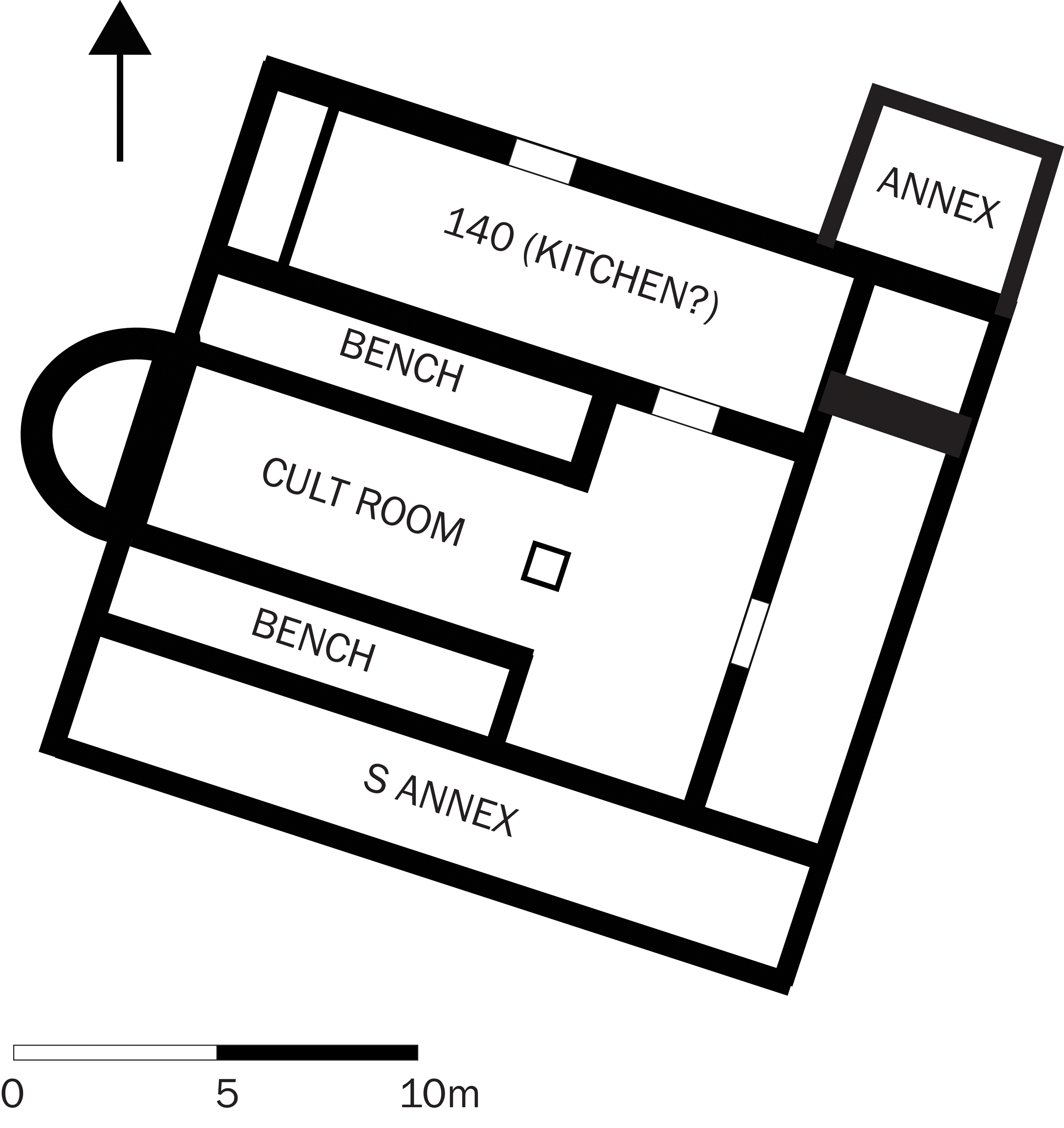
It seems most likely that at least some cooking and food preparation took place in a space next to the main sanctuary space. It is also striking that this room either had its own entrance – the only surviving threshold connecting to the outside – or provided the main entrance to the building. As at Carrawburgh, worshippers may well have passed through the kitchen space, and by the cooks preparing their meal, on their way into the sanctuary. Even if animals were killed and primary butchery happened elsewhere on the estate, this Mithraic community had its own space for food preparation and grilling.
The food preparation spaces of the mithraeum stand in marked contrast to the two kitchens of the pars urbana. In some ways, the assemblages in these spaces are quite similar: high concentrations of bones and cookwares, alongside tablewares and tools used in food preparation. There may have been a difference between the two built kitchen spaces in the pars urbana: Room L67 seems to have been used for much more butchery and even the working of animal bone, while Room L76 had less bone. Like L76, the mithraeum had a high concentration of cranial elements from bovines (62% versus 60% of the bovine bones, compared to 23% in Room L76), perhaps connected to preparation of the tongue.Footnote 81 That is, Room 140 may have, like Room L76, been a space for more delicate or finishing processes in the preparation of meals.
But there are key differences between Room 140 and Rooms L67 and L76. Both kitchens in the pars urbana had built cooking spaces – tiled hearths, ovens, fire tables – that are missing from the mithraeum complex. These spaces were set alongside the main reception/dining rooms of the villa, but hidden from sight; the main kitchen, Room L76, was accessed via a service corridor that rendered the cooking process invisible to diners, while the second kitchen, Room L67, opened towards the outside and would only have provided access to the dining room via the same service corridor. Food-making was concealed in the world of villa banquets, while in the world of Mithraic banquets, sanctuary visitors would likely have passed through the food-making room to access the sanctuary. Cooking was displayed and embedded within the experience of cult.
The mithraeum at Martigny (Fig. 5), seemingly built at the end of the 2nd c. and used through the 4th c., offers some of the best evidence for kitchen spaces related to a mithraeum and the ways that worshippers might have engaged with visible food-making as part of cult. The site may also suggest that not every type of food or every type of cooking was imagined as equally integral to worship and the spaces where worship took place. Unfortunately, the mithraeum has not been published in full, meaning that questions remain about phasing and the diachronic usage of different spaces.
Mithraeum at Martigny. 2nd–4th c. CE. (Plan: courtesy F. Wiblé.)
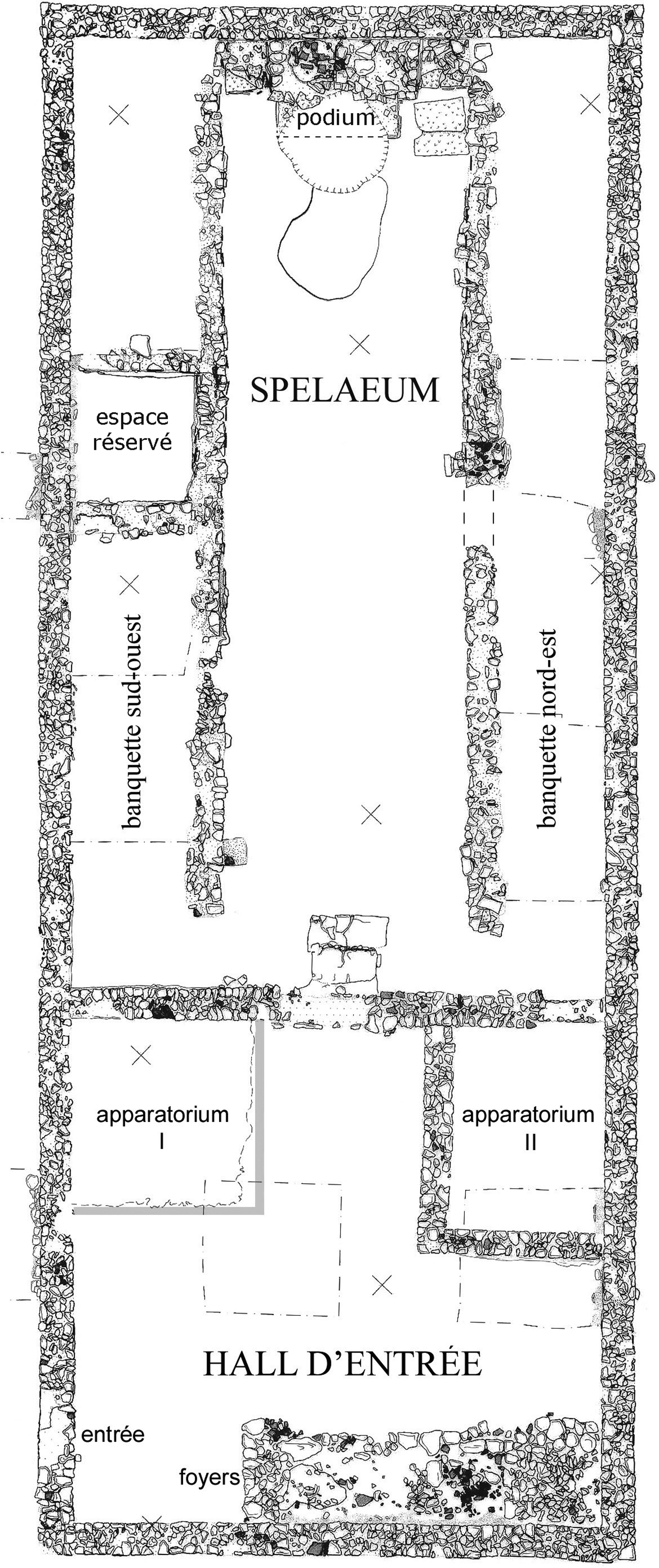
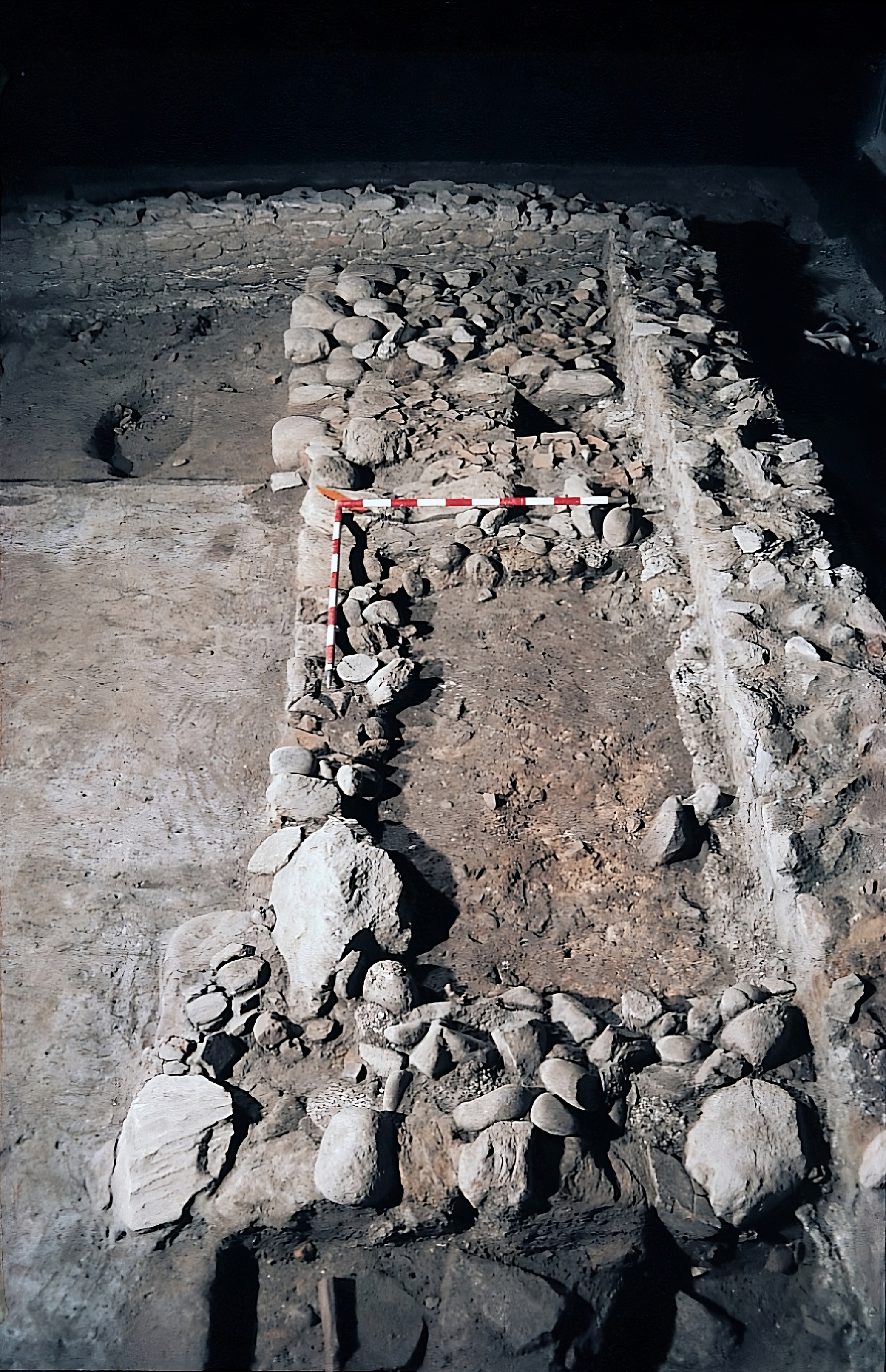
The antechamber had a clear cooking installation (Fig. 6).Footnote 82 The antechamber space was far larger than in most mithraea and contained a separate enclosed area bordering the entrance to the cult room; in the first phase of building, this was set in the southwestern corner; in the second phase, it seems to have been rebuilt on the other side. Along the southeastern wall, an enormous dry-stone hearth was built, roughly 5 m long and 1.75 m deep. Evidence for burning – deep layers of ash and rubefaction of the ground – confirm its purpose. The cooking-table has, however, not been the focus of research or publication: a clear indication of the low value placed on such structures and Mithraic cooking practices. In photographs, multiple construction techniques are visible, but no details of phasing were included.
Stove/kitchen bench in the antechamber of the mithraeum at Martigny. (Photo: courtesy F. Wiblé.)
Functional analysis of the ceramics assemblage from the mithraeum also hints at food preparation taking place in the entryway. It is the only place in the sanctuary where cookwares outnumber finewares, though they do so only slightly; in other spaces, finewares outnumber cookpots 2:1 or more.Footnote 83 The enclosed spaces in the entryway dubbed by the excavators “Apparatoria I and II” – the first used in the first phase of the mithraeum, the second after a rebuilding – have a much higher percentage of finewares (80% and 70% respectively),Footnote 84 which may suggest they served as storage spaces for dining vessels. This certainly seems to have been the case at Riegel, where stacks of tablewares were found in what the excavators interpret as a storage cupboard.Footnote 85
As at Carrawburgh, anyone entering the sanctuary would have had to pass by the stove. Cooking was built into the fabric of worship; it was not physically or conceptually separated from other cult activities. And those doing the cooking were likewise displayed to worshippers entering the main cult room.
Exterior food-making spaces may also hint at the ways some steps of food-making were physically and conceptually set outside of worship practices. An oven, identified as a possible bread oven,Footnote 86 seems to have been built just outside the fenced mithraeum precinct. It was roughly contemporary with the mithraeum, a dating supported by its alignment and its connection with the path leading into the mithraeum.Footnote 87 There is little published evidence for the precise use of the oven; still, it raises the possibility of cook-spaces outside the marked space of the sanctuary being used to provision the community inside. If the oven was primarily for bread, this may speak to the diversity of foodways and preparation patterns linked directly to worship. Not every aspect of food preparation, or every dish, was counted as integral to worship or the sanctuary itself. There was a distinction between bread – produced outside the marked sanctuary space, albeit in an oven closely linked to the mithraeum itself – and other foods cooked within. Not all foodways intersected with worship in quite the same manner.
The Sacello delle Tre Navate in Ostia also shows evidence for a dedicated cooking space, designed to provision complex, multi-dish meals, incorporated within the sanctuary (Fig. 7).Footnote 88 Nearly everything about this sanctuary is disputed: it is often studied alongside mithraea in the city, given the cult-room layout with two benches flanking a nave with a water-basin in the middle, terminating in a raised podium opposite the entrance. It boasted over 26 m of linear bench space, affording it the capacity to hold the largest number of diners of any similar sanctuary in Ostia (43–52 people). Still, the lack of iconographic or epigraphic evidence connecting the structure with Mithras-worship has led most scholars to discount its identification as a mithraeum.Footnote 89 That said, many probable Mithraic sanctuaries lack such definitive markers; were the sanctuary excavated in any province of the empire, rather than in iconography-rich Ostia, it almost certainly would have been identified as a mithraeum. The positive evidence cited for dissociating the space from Mithras-shrines includes a mosaic, showing a pig at an altar alongside a krater, and a marble head wearing a vine crown and associated with Dionysus. Neither, of course, precludes a Mithraic identification: the Dionysiac head may not be original to the sanctuary, and if it was, “guest gods,” including Dionysus, were not uncommon in mithraea;Footnote 90 similarly, kraters were regular features in Mithras-worshipFootnote 91 and piglets were frequently on the menus of Mithraic sanctuaries, including as offerings to the deity. Dating the construction is also challenging; the apse has been assigned to the Hadrianic period, but the benches were certainly a secondary addition, for they cover over a first layer of painted plaster on the wall.Footnote 92 A mid-2nd-c. date has been proposed for the creation of the sanctuary, but the nave mosaic has stylistically been dated to the very end of the 2nd or early 3rd c.Footnote 93 A Mithraic identification, based on the sanctuary layout, seems probable, at least for one phase of the sanctuary’s complex construction history.
Sacello delle Tre Navate, Ostia. Late 2nd/early 3rd c. CE. (Plan: from Becatti Reference Becatti1954, fig. 15.)

Adjoining the sanctuary’s antechamber, a kitchen space with complex built facilities was installed in a small side-room, down two steps (Fig. 8). To the left of the entrance, a cook-top with two arcuated niches below (likely for storing fuel) dominated the space, offering nearly 3 m2 of surface area for roasting, braising, frying, or stewing over coals. On the other side of the space, a semi-circular construction, with a surface for fire below and the horseshoe-shaped walls for holding a pot above, would have served as a “water-heater”: a common feature in the kitchens of elite houses, used for warming liquids in (usually metal) cauldrons that could be perched above.Footnote 94 Such installations may have been used to keep water warm for mixing with wine or a soup/stew.Footnote 95 Alongside this, there was additional counter space for food-making. The open floor area – totaling just over 3 m2 – left room for one or two people to work. The entire space was set up to cater to complex food- and drink-making of different kinds. The scale and luxuriousness of these kitchen facilities, which rivaled those of some of the more elite houses at Pompeii,Footnote 96 might partially be explained by the large size of the community hosted in the sanctuary. Still, the complexity of the built kitchen stands out from even the most elite excavated houses at Ostia. Designated cooking space was worth substantial investment for the worshippers.
Kitchen in the Sacello delle Tre Navate, Ostia. Late 2nd/early 3rd c. CE. (Photo: courtesy Alessandro Melega.)
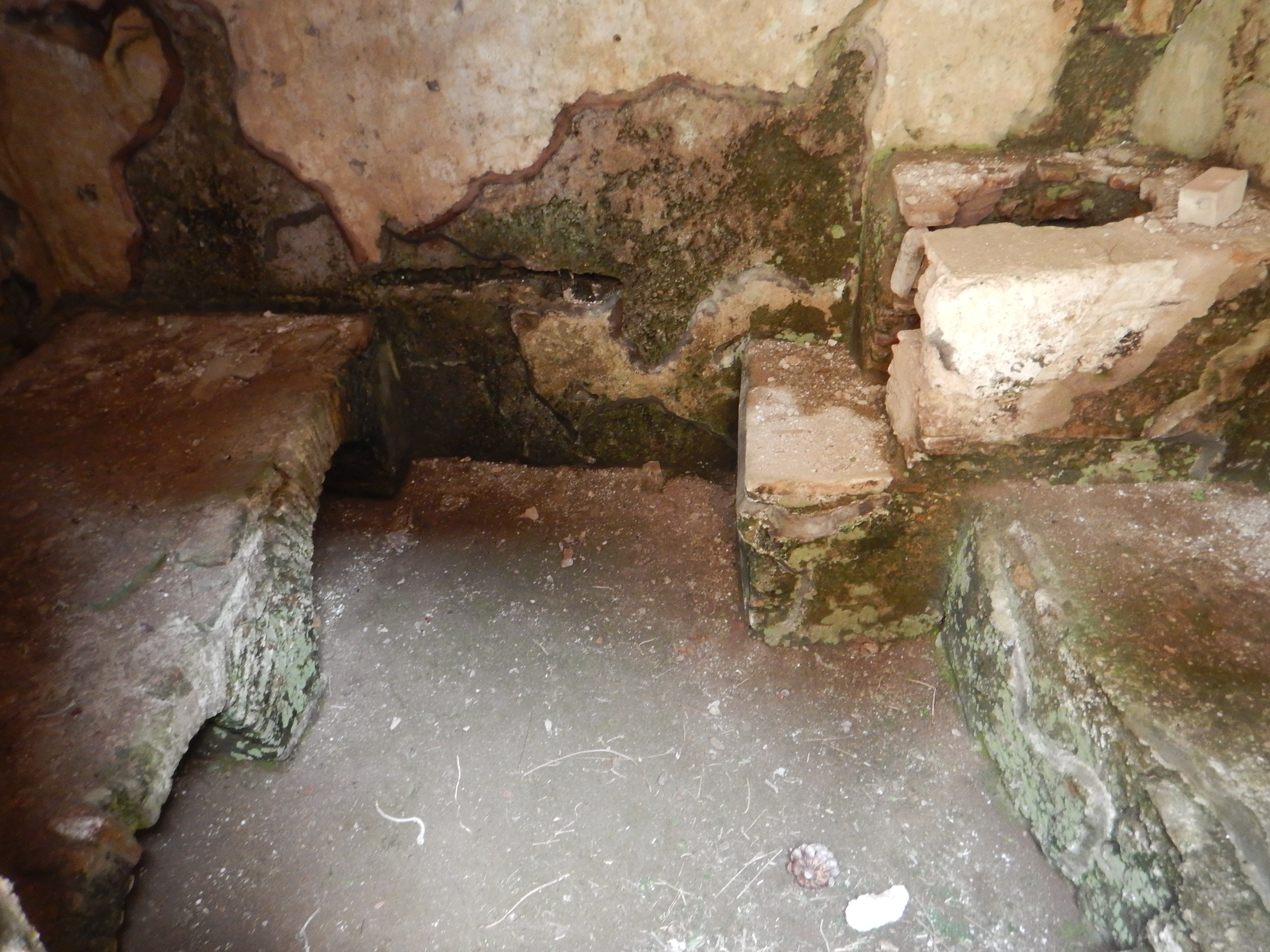
As in the other mithraea examined so far, the kitchen and its personnel were placed in a way that heightened the experience of differentiation and hierarchy within the sanctuary. Even if occupying its own room, the kitchen space was visible from the entrance, greeting worshippers with a spectacle and the smells of complex and luxurious food-making. Yet it was physically set below the floor levels of the antechamber and nave; those entering the sanctuary would look down upon the cooks. Of course, within Mithraic spaces, below-grade places might serve to create the experience of a subterranean cave: a concept central to Mithras-worship. Perhaps the sunken kitchen also served to draw cooking into the conceptual realm of Mithraic cosmologies and metaphors, imagining this labor as an integral part of cult.
Although it is often taken as an “unusual” sanctuary that shows the transformation of Mithras-worship in Late Antiquity, the sanctuary at Septeuil shows a remarkably similar set-up, which privileges the display of cooking for worshippers visiting the sanctuary (Fig. 9). In the mid 4th c. CE, a sanctuary to Mithras was installed in an earlier fountain. The transformation involved dismantlement of a colonnade and the partitioning of the nymphaeum space into a covered mithraeum to the south and an open-air, enclosed court and water-basin to the north.Footnote 97 The sanctuary’s unusual layout, with two differently sized benches that did not run the length of the cult room, was dictated, at least partially, by its insertion into a pre-existing space: an increasingly common practice in Late Antiquity.Footnote 98 The mithraeum had at least two hearths: one in the main cult room, and one set up in the fountain court that had been converted into an entryway for the mithraeum. The one in the cult room, built in front of the left bench as a square structure of mud-bound stones, is identified as serving mainly for heat, or perhaps the textually attested initiatory “fire test;”Footnote 99 very little animal bone was found in the ash fill,Footnote 100 which may suggest that it was not primarily a cooking hearth.
Mithraeum at Septeuil. 4th c. CE. (Plan: M. McCarty, after Gaidon-Bunuel Reference Gaidon-Bunuel1991, fig. 3.)
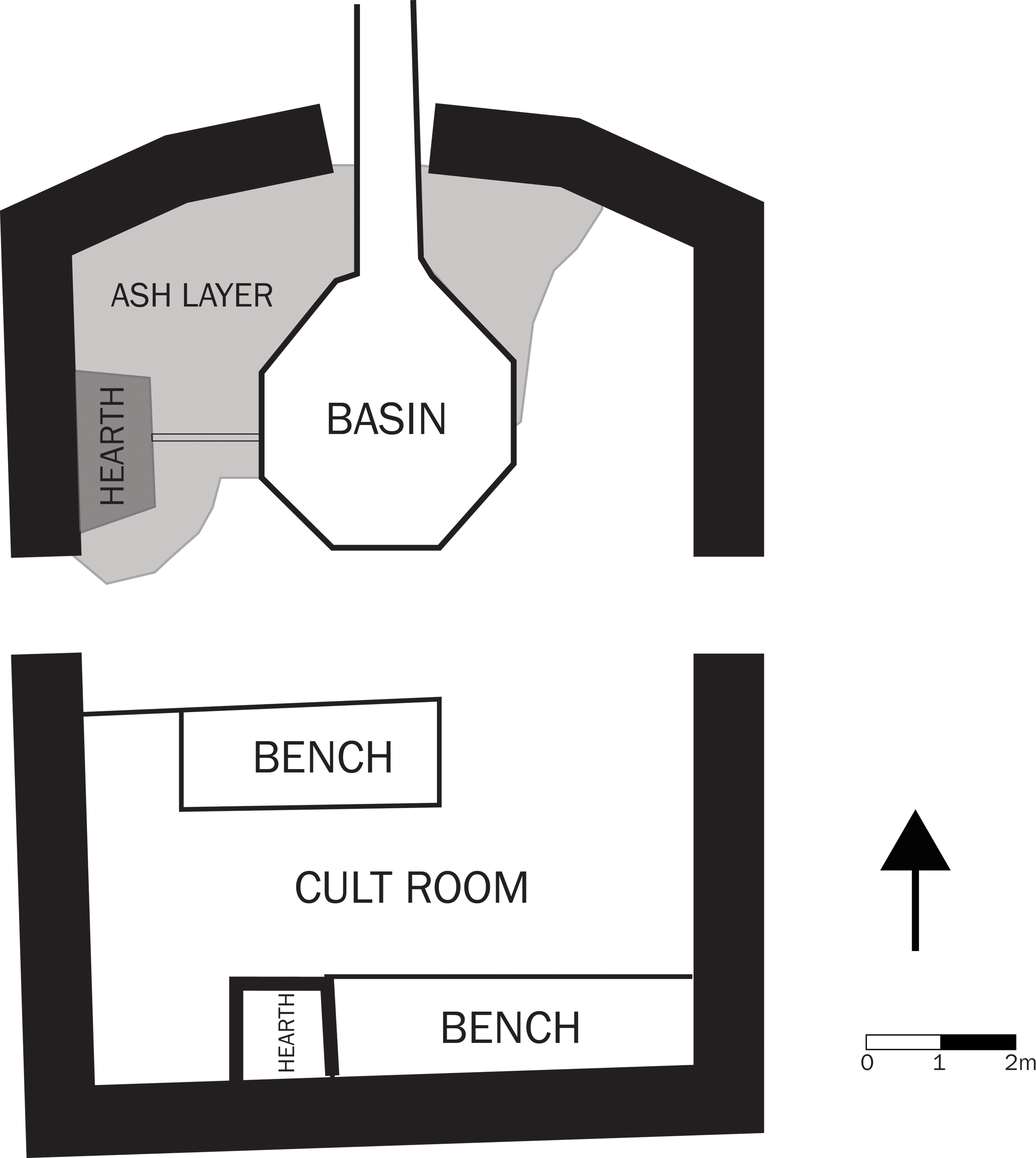
The northern part of the sanctuary, though, was converted into a kitchen space. Near one of the two entrances to this zone, whose water-basin still functioned to capture water from a natural spring, a 2 × 1.3 m hearth was built. The hearth was regularly cleaned out, with ash scattered to the north around the fountain basin. In this ash, over 14,000 fragments of animal bone were found, mostly from male chickens (the MNI for chickens is around 358) and piglets.Footnote 101
The faunal remains suggest that meat was prepared and cooked in this space. Few crania or mandibles of the chickens were found; they may have been slaughtered outside the sanctuary, or their heads discarded elsewhere. There is, however, other evidence of breaking down the chickens for cooking: most of the sternums were broken.Footnote 102 This is unusual among Mithraic assemblages; usually, the chickens were roasted whole, and the lack of cut marks suggests that meat was removed from the bone by hand. All skeletal elements of the piglets were present, suggesting that they were roasted whole. Additional ovicaprine and bovine bones suggest that these animals were brought in as portioned cuts of meat. That is, cooking took place at a designated hearth in the entryway.
The hearth also hints at the importance of this cooking installation for the rites that took place, for it showed extremely heavy use. Despite the relatively short period of use for the sanctuary – maybe 50 years at most, from around the mid 4th c. to the 380s – the hearth was rebuilt at least three times. Although the first and third phases of the hearth were heavily truncated, at least 19 different clay screed surfaces were detected, speaking to regular renewal. The hearth was, in other words, regularly used and repaired.
Although the mithraeum has long been seen as unusual in its layout, and as evidence for the transformation of Mithras-worship in Late Antiquity, the sanctuary shared a strong focus on cooking for the community of diners with other mithraea like Martigny and Carrawburgh. The northern half of the nymphaeum may largely have been an open-air space (it is also possible that light structures could have supported covering), but it functioned akin to the antechambers of these other sites. Roasting or frying split chickens was an act included in the sanctuary space, and every worshipper entering the space would have passed by the cooks busying themselves at the hearth.
The hearth may also have necessitated multiple stages of cooking to feed those worshipping in the sanctuary. The two benches offered room for 16–20 simultaneous diners: the wide benches were 3.4 m (north) and 4.5 m (south) long. Assuming a half chicken per diner, the hearth would not have been able to accommodate the necessary number of chickens simultaneously, nor does this account for any other food being cooked. That is, like at Carrawburgh, hierarchies among the community who gathered in this space could have been made evident in the division between those working to prepare food and those consuming it inside the cult room as they were served at different moments.
In short, Septeuil points to the continued importance of meat-cooking practices (rather than simply consumption) as part of Mithras-worship and as a means of shaping a hierarchical community, even into a period when many aspects of cult were changing. Despite adjustments to the “antechamber” resulting from the mithraeum being inserted into a pre-existing space, and perhaps a slightly different recipe that called for the chicken carcass to be broken down rather than roasted whole, the community at Septeuil displayed cooking labor to all who entered the sanctuary, and used staged food-making as a means of structuring the vertical hierarchies of the group.
Although not yet fully published, the similarly late Mithraeum of the Colored Marbles at Ostia may have made similar provisions for cooking.Footnote 103 With a late 4th-c. sanctuary set into the semi-sunken cellar adjacent to an earlier caupona, the community of worshippers seems to have taken advantage of the pre-existing cooking and serving facilities of the restaurant.Footnote 104 While the bar and cooking surface were later dismantled, making the precise chronological sequence difficult to ascertain, Mithraic graffiti from the room suggest that worshippers continued to use this zone.Footnote 105 The main spelaeum, however, maintained a separate entrance that would not have required worshippers to pass by the kitchen. That said, what had been the main entrance to the caupona was also blocked, creating a second access path that forced visitors entering from the south to pass by the cooking installations before reaching the spelaeum. The location for the sanctuary may even have been chosen to take advantage of the catering facilities of the earlier bar.
Finally, although no dedicated kitchen space has been identified archaeologically, finds from Tienen point to the ways that spectacles of large-scale cooking may have been central to the experience of a unique ritualized event in the mid 3rd c. Although the evidence from the site comes in the form of ritualized deposition from a consumptive event – a feast – it offers some of the best-published evidence for ritualized, Mithraic foodways. The waste from this feast, which may have lasted several days, was disposed of in a series of four pits around 230/240 CE.Footnote 106 The pits had a common closing layer over them, suggesting they were sealed at the same time; the ages of animals whose remains were found in the pits suggest that this feast happened in mid-summer. The contents of the pits clearly reflect intentional deposition commemorating consumption and include some ritual items (including ceramics decorated with symbols of the cult, a snake-pot that created special effects when heated, and cult equipment like a sword); still, there is some evidence for the dynamics of food-production as well.
The Tienen feast was massive. The faunal remains suggest that at least 285 roosters, 14 young ovicaprines, and 10 piglets were consumed. That is, it was a multi-dish feast that, conservatively, could have fed at least 285 people, assuming a whole chicken each. The ceramics deposited in the pit also speak to a significant number of diners. Indeed, there seem to be a number of personal sets of ceramics, given the near equal numbers of vessel types: between 100 and 200 single-handled jugs (“jars,” in the excavator’s terminology), with lime deposits showing they were used to heat liquids and some evidence of vegetal fats inside; 100–150 olla-style stewpots with residues of mutton and fowl fats inside; a similar number of lids (98 with diameters that matched the ollae); around 100–160 casserole-style dishes, plus nearly 100 coarseware bowls; 258 drinking beakers (many black-slipped or color-coated); and 98 incense burners.Footnote 107 There were around 100–200 kits – for drinking, cooking/eating meaty stews, warming vegetable broths or water (presumably for mixing with wine, but perhaps also for purificatory purposes), consuming or serving solid food, and offering incense. Although the excavator suggests that the potential difference between the number of kits and the number of animals slaughtered may suggest that individual diners shared kits (2–4 diners per kit),Footnote 108 the differently sized assemblages may instead hint at a multi-day event.
While the excavators postulate a potluck model as the most probable explanation for the meal,Footnote 109 there are a few indices that may instead suggest that cooking took place on-site. First, the pits had a large amount of burned wood and ash in them, which may have stemmed from cooking fires. This does not preclude such fires having been used for non-cooking purposes; they may, for example, have warmed water in the single-handled jugs. There are also other indices of food preparation on-site. The pits contained some butchery waste from processing chicken carcasses: the heads and feet that were normally removed before cooking. There are not nearly as many fragments of these as meaty portions (legs, wings) of the animal in the pits: 36 cranium fragments and 107 mandibles, as opposed to over 600 of each leg elements.Footnote 110 Nevertheless, the butchery waste suggests that at least some of the chickens were prepared for cooking – probably roasting, given evidence of burning on the bones – on-site, in the open-air; it has been suggested that the rest of the processing waste may simply have been discarded on the surface, and was thus archaeologically lost.Footnote 111 The lack of butchery marks noted on the bones may suggest that disassembly of the remaining (headless/footless) carcass happened after cooking. The chickens were presumably pulled apart by hand for eating. If they were slaughtered and prepared for roasting in the area around the sanctuary, it seems probable that they were also cooked nearby, presumably over the fires that created the charcoal found in the pits.
The final index of on-site cooking comes from the high number of coarseware mortaria found in the pits. At least 19 locally made mortaria were recovered from the pits, alongside another nine terra sigillata mortaria.Footnote 112 Mortaria could be used for serving as well as for preparing food through grinding, but the high number of them marks a contrast with Güglingen II (discussed further below). Grinding ingredients, perhaps to prepare sauces, may also have occurred on-site and been commemorated via the deposition of these objects in the pits.
Together, the charcoal, offal, and ceramics suggest that food was prepared in the vicinity of the sanctuary, in an open-air kitchen. No physical trace of the space survives; however, given that the Roman-period occupation surfaces were stripped away through erosion and ploughing before excavation, this is not surprising.Footnote 113 It is simply a reminder that the absence of fixed or monumentalized kitchen spaces does not automatically imply a potluck model of worshippers bringing cooked food to the sanctuary. Whether this kitchen was temporary – set up for this one exceptional event – or a space used more regularly by those who gathered in the mithraeum is uncertain.
Nor is it clear who provisioned the hundreds of chickens and the other animals that were roasted, or the hundreds of stews and casseroles. One might imagine a host of potential scenarios: a benefactor supplying all of the food; a benefactor supplying the animals for roasting, while diners brought pre-cooked stews and casseroles for personal consumption or sharing; diners bringing animals (alive or dead) and their own stews/casseroles, either ready for consumption or ready for cooking; a community subscription, perhaps akin to Dura. Given the diversity of the cookwares – in size, in place of production – they are unlikely to have been ordered and supplied for this banquet, and this may hint that individual worshippers brought their own stews and casseroles, or at least their own containers. In sum, there may have been several different pathways of food-production and labor, with some portions coming ready-made with worshippers, and others communally prepared on-site.
Whatever the model for provisioning the food, the roast-meat portion of the feast was apparently cooked nearby. As at Martigny, carcass-processing and meat-roasting seem to have had special status, and to have been incorporated into the worship space, even if other dishes came from elsewhere. Given the sheer number of animals being roasted, even if the work was split over several days, this must have involved a significant number of cooks. Who did the cooking for over a hundred diners is not clear; what is clear is that a significant amount of gastronomic labor was mobilized in highly visible ways as part of the ritualized event at Tienen.
A host of other probable kitchen spaces can be found in other mithraea (see Table 1); most, however, have not been fully studied or published, precluding the same level of detailed analysis as applied to these main case studies. Still, they collectively suggest that cooking was a regular practice in and around mithraea.Footnote 114
A number of Mithraic sanctuaries, from across the Roman world and from very different periods, offer positive evidence for designated cooking spaces in the sanctuary itself. Often, such a space was set in the antechamber, forcing worshippers to pass by hearths, stoves, and the cooks preparing meals for diners to enjoy within the main cult room. The space for cooking was built into the fabric of the sanctuaries; gastronomic labor was part of worship.
Still, in the complex foodways that provisioned Mithraic meals, it may be that not all foods were treated the same way. The meat portions of the meal were the ones that were almost certainly prepared on-site, occasionally involving butchery and the breaking-down of carcasses. Other dishes may have been prepared in different spaces and brought into the mithraeum, as seems to have been the case at Martigny; not every kind of food-making fell within the purview of worship. Still, many of the animals who provided meat for banquets did not arrive inside the sanctuary on-the-hoof. Animal-slaughter was not a key part of the chaîne opératoire of worship in mithraea. Whether this was the product of a hypothesized diachronic movement away from live-animal sacrifice in the Roman world,Footnote 115 or simply one of the many ways that Mithras-worship distinguished itself from forms of public/civic cult, is not clear. Animal-killing may not have been a key cult practice for many Mithras-worshipping communities, but cooking meat was a sanctuary activity.
Food-making within the sanctuary also served to structure the community of worshippers who gathered there and to promote hierarchies. The quantity of food necessary to provision diners within the sanctuary required cooking, and probably serving, in stages, given the size of sanctuary hearths. Not only would this potentially have created inequalities among the diners – those served their food first, those who would wait and watch – but it meant that some of the people present in the sanctuary would have been occupied throughout the meal with continuously cooking the next round of food. Some of the people present in the sanctuaries would not be diners, included in the commensality of the banquet. Instead, they would be laboring to serve others. Differentiation and hierarchy were made apparent in the practices and built fabric of the spaces.
Model 2: incorporating Mithras-worship into house and schola communities
The second model of Mithraic food- and group-making, where mithraea are built into houses or scholae and use domestic or collegial kitchens, entails a rather different set of social relations and forms of labor: one that sees worship communities entangled with, and dependent upon, other social units.Footnote 116 This model is often less archaeologically visible, given the frequently discrepant levels of attention paid to Mithraic cult rooms and surrounding domestic spaces.Footnote 117 Instead of making cooking and cooks visible, such sanctuaries often leave food-making hidden, as it was in houses; production is removed from the world and experience of the worship group, and predicated upon the benefaction, labor-control, and spaces of a homeowner or a guild.
This connection is seen most clearly at the Domus di Apuleio, with its adjacent Mithraeum of Seven Spheres, at Ostia, even though the physical linkages between house, kitchen-space, and mithraeum have been obscured by excavation and restoration works. During the first excavations, Rodolfo Lanciani saw a direct passage between the house and the mithraeum, controlled “per mezzo di una scaletta e di un passaggio angusto e tortuoso.”Footnote 118 Later plans treat this zone differently, and others have drawn attention to the difficulty of interpreting access paths and building layouts here.Footnote 119 A connection to (and through) the house, though, is quite probable, even though a number of recent works have discounted the possibility as the creation of modern restoration and access efforts.Footnote 120 Although some modern access paths to the mithraeum probably did not exist in antiquity, this does not preclude a connection to the house, and there are no suitable alternative proposals for primary access to the mithraeum. The modern path-making seems primarily to have created stairs and a passage from a kitchen (Fig. 10), which was destroyed in the process.Footnote 121 There was, however, still access through the large Room F, equipped with a fountain and undoubtedly tied to the house.Footnote 122 Although Van Haeperen has suggested that the mithraeum may primarily have been entered via the area of the Four Temples to the South,Footnote 123 this seems less likely for two reasons. First, given the narrow space between the mithraeum/domus façade and the podium of the Four Temples (further narrowed by the projecting molding at the top of the podium), and the way that the (poorly understood) complex to the northwest of the temples seems to preclude access to the mithraeum from the west, the most probable scenario is that the mithraeum was accessed primarily through the house. Second, the mithraeum sits atop early structures that are tied physically and by their building technique to the house; although the house and temples also shared historical and personal linkages in their construction/renovation, this suggests that the mithraeum was probably built through the support of the homeowner. Van Haeperen’s more general argument against connection to the house, that Ostian mithraea were never tied to private residences, can be rejected in light of parallels with household mithraea across the empire: as at Ostia, rare but not unknown.
Domus di Apuleio and Mithraeum of Sette Sfere, Ostia. Late 2nd/early 3rd century CE. (Plan: M. McCarty, after Pansini Reference Pansini2018, fig. 9.)

Even if a hypothesized association between the mithraeum, the “L. Apuleius Marcellus” whose name is stamped on fistulae supplying the adjacent house, and Apuleius of Madauros is highly speculative,Footnote 124 the mithraeum and its users were spatially bound to the elite residence (and residents) next door. Mithraea inserted into houses were certainly not uncommon, after all.Footnote 125 But what matters here is the way that domestic cooking spaces may also have provisioned food for the Mithraic diners in the sanctuary.
During the later 2nd-c. renovations of the domus, in a room adjacent to the mithraeum, a built counter/fire-table, with arcuated niches for storing fuel underneath, seems to have been installed. Such installations were common in high-end houses that could afford designated cooking space. Still, the difference in levels between the space in front of the mithraeum and the kitchen may have demanded that passing from kitchen to mithraeum entailed going through the large Room F, which was also equipped with a fountain that blocked the kitchen space from sight. The fountain seems to have damaged an Antonine mosaic in the room, suggesting that it was a later addition.Footnote 126 It appears unlikely, though, that the stove would have been visible from Room F; high-quality decorations, like the Antonine mosaic, were reserved for reception rather than service rooms. A dividing wall probably existed here from construction of the kitchen.
The most probable scenario, then, is one where the mithraeum was built on the edge of a private residence. The mithraeum was accessible via a long route that passed through a range of rooms in the house, including Room F. This pathway through the house to the mithraeum would have gone through nearly every richly mosaiced room in the house, showing off the homeowner’s wealth.Footnote 127 The kitchen space, complete with stovetop, sat hidden from view off this pathway; still, the kitchen was close to the mithraeum and easily accessible through Room F. There may have been a second entrance to the mithraeum from the narrow space behind the Quattro Tempietti, giving access to a small hallway “antechamber” in front of the cult room.
At any rate, the only nearby cooking facilities were those in the house. Not only were these rendered invisible to mithraeum visitors, they may have been used by a labor pool distinct from the worship community. The cooks who catered Mithraic banquets may have been the same servants who provided meals for the house in the mosaiced reception rooms nearby. Food-making for the cult was thus bound up with the patterns and personnel of household labor, rather than set within a designated worship space.
The same may also have been true of Mithraic communities set within the scholae of collegia. The close connections between collegia and Mithraic worship-groups across Ostia have long been noted;Footnote 128 at least two mithraea were certainly physically built within collegial clubhouses (Fructosus and Porta Romana), while many others have tentatively been associated with collegia (“Palazzo Imperiale,”Footnote 129 Caseggiato di Diana,Footnote 130 Felicissimus, Aldobrandini,Footnote 131 and Terme di MitraFootnote 132 ). These scholae presumably had kitchen spaces, even if they were rarely noted during excavation and cleared away; just three scholae across all of Ostia preserve visible cooking spaces.Footnote 133 Only the Mithraeum of Fructosus, set in a room under the podium of an unfinished temple in the schola of the stuppatores, offers possible evidence of a kitchen (Fig. 11).Footnote 134 The temple/mithraeum stood in the middle of a portico and annexed rooms, to the south of a battery of workshops where the stuppatores processed tow, complete with soaking tanks and pounding blocks.Footnote 135 To the north of the schola’s portico, a large room may have offered additional banqueting space; this was connected to a small service room and then a latrine under a staircase. Given its proximity to the latrine and dining hall, the northwestern room has been tentatively identified as a possible kitchen space; so, too, has a room at the northeastern corner, which also had access to a well in the adjoining room.Footnote 136
Mithraeum of Fructosus and schola of the stuppatores, Ostia. Mid 3rd c. CE. (Plan: from Becatti Reference Becatti1954, pl. 3.2.)
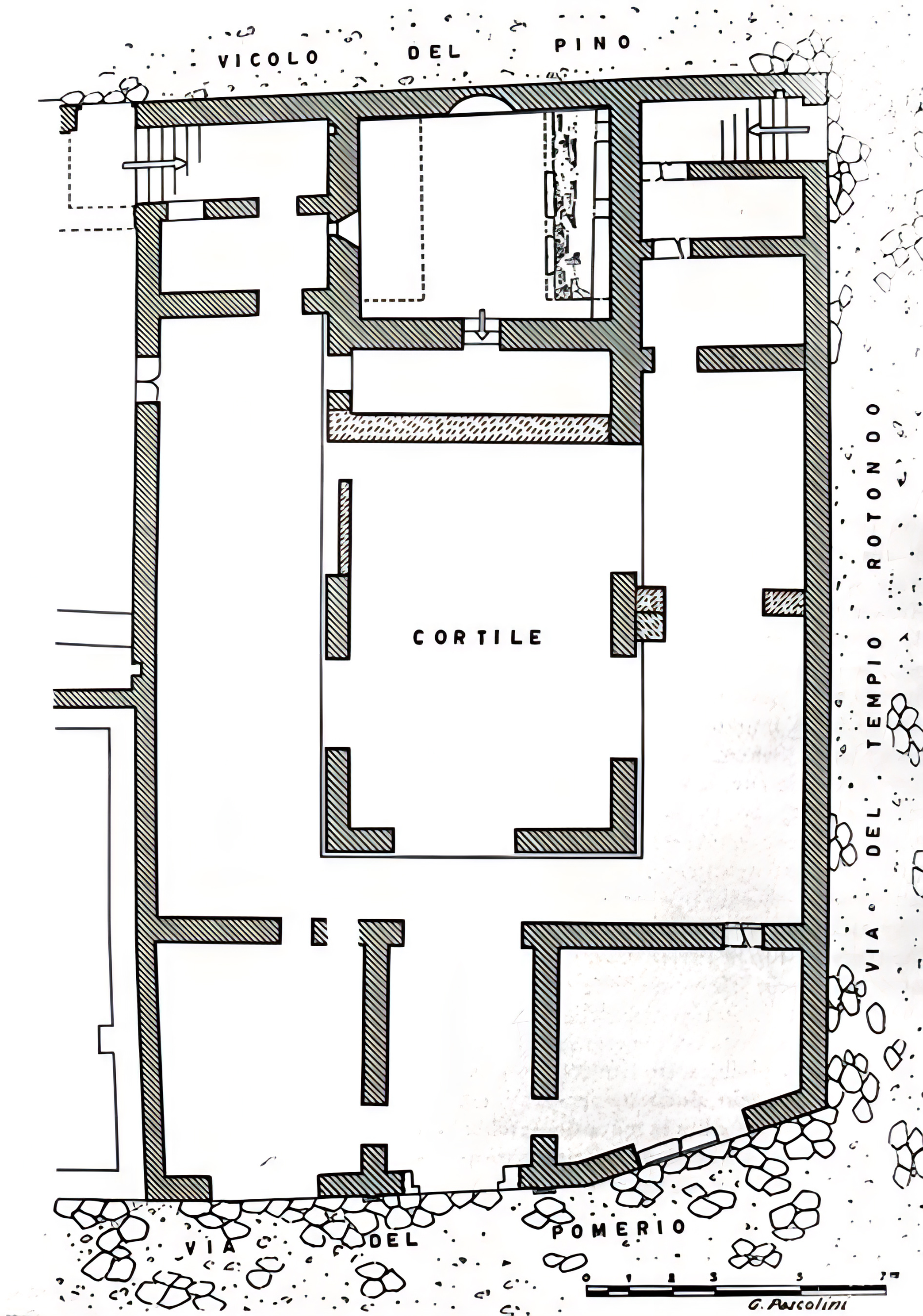
Whether located in the northeastern or northwestern room, the kitchen was tucked away from the main spaces of the schola and the mithraeum. Instead of being foregrounded and rendered visible to worshippers, instead of establishing a visible hierarchy of cooks and diners, instead of being conceptualized as part of sanctuary worship practice, food-making was displaced into the hidden spaces of another community. The place, labor, and laborers of cooking were not integral to Mithras-worship; the cooks who provided food for consumption were instead set within the household and administration of the collegium (in which context, admittedly, little attention has been paid to food-making and makers). Of course, in both settings, the Mithras-worshipping community might have overlapped quite heavily with that of the house or collegium. Mithras may even have been the tutelary deity of the stuppatores, given that work on the temple atop the podium was never completed; Mithras alone had a sanctuary within the schola.
Still, the close physical and practical connection between house(hold), collegium, and sanctuary created a very different set of social relations than those at sanctuaries with their own, visible kitchens. Sanctuaries associated with houses and scholae were nested in, and dependent upon, the largesse of a homeowner or collegial patron, and the laboring kitchen-staff were at their disposal. Effacing the acts of work to delight in the products of labor and their provisioning by elite benefactors served to highlight the central roles of such euergetes.
Model 3: absence of evidence and village cooking at Güglingen
A final model of food-making in Mithras-worship needs also to be considered: the potluck, where no food-making took place centrally or in the sanctuary, but food arrived from home(?) kitchens ready to consume. Given the general difficulty in identifying places of food-making anywhere, in the absence of built stoves, ovens, and counters, and the ways that the messy acts of carcass-preparation and smoky acts of wood-fire cooking might be non-monumental outdoor activities (especially in sub-elite, sub-urban contexts), ruling out some food-making at a given locale is nearly impossible. But one recently published, carefully excavated mithraeum may provide a hint that cooking was entirely separated from the sanctuary and entangled with the household production of individual worshippers.
Finds from Mithraeum II at Güglingen suggest that food preparation may have taken place almost entirely outside of the mithraeum and its precinct. The mithraeum was active from around 120 CE and underwent at least two major rebuildings.Footnote 137 It may have been deliberately destroyed around 230/240 CE, leaving a relatively intact assemblage of materials in situ, including metal objects used in rituals; the assemblage, in other words, may closely reflect use of the space. Not only was the mithraeum structure carefully excavated, but so, too, was the wider zone within which it sat. There were no outbuildings in the immediate vicinity, although latrines, wells, and structured deposits with the remains of ritualized meals were all found;Footnote 138 if there had been a substantial food preparation area with structures, it likely would have been detected. There was also no clear division of a precinct around the temple, as was the case at Martigny.
Several features, flagged in the site publication, point to food being processed and prepared elsewhere, then brought into the sanctuary. First, the faunal remains from the temple show that butchery probably happened elsewhere. The assemblage, composed of both commemorative deposits and banquet waste, generally tracks with other mithraea: a preference for chicken meat, alongside medium-sized mammals (pigs and ovicaprines), with a small quantity of beef and other animals.Footnote 139 There was a dearth of chicken heads and feet: the chickens were apparently killed and their carcasses processed off-site, or simply discarded on the surface near the built sanctuary. Had the butchery waste from activities at the mithraeum simply been disposed of slightly further away, a dumping pit would likely have been recorded given the overall excavation quality. Although all parts of pigs – the next most common species by the number of identified specimens (NISP) and weight – are attested, this may be because the pigs were roasted whole: at least one pig shoulder shows signs of greater exposure to heat, as one would expect if the animal was cooked on a spit.Footnote 140 The bovine bones show much more evidence for butchery and carcass processing (almost 50% of the bones by weight show butchery marks); although all parts of the animal are present, it is not surprising to see greater portioning of large animals.Footnote 141 Still, even if the animals were slaughtered and the carcasses processed elsewhere, this does not preclude on-site cooking. As at Tienen, outdoor fires to roast animals (some of which may have been processed here and waste simply thrown onto the ground nearby) cannot be excluded, especially given the ways that Roman-period occupation surfaces were eroded and not wholly visible/recorded during excavation.
The ceramic assemblage, though, may speak to cooking elsewhere. Only two fragments of storage vessels were found (0.6% of the assemblage of 334 vessels), pointing to a lack of food being kept on-site: one amphora in the fill of the rubbish tip after the building’s destruction and another in (or just below) the collapse of the tile roof in the nave.Footnote 142 By contrast, storage amphorae comprised between 3% and 8% of the contemporary domestic assemblages in the region.Footnote 143 The dearth of storage vessels also contrasts with other mithraea where, based on kitchen installations, cooking seems to have happened in or around the building, and where the percentage of storage vessels is in line with domestic contexts: 5% of the entryway assemblage at Martigny, 3% at Orbe-Boscéaz. Foodstuffs and oil were not stored on-site for cooking, at least not in large quantities in ceramic vessels. If cooking took place on-site, ingredients were brought in for the occasion.
Likewise, both the low proportion of cookwares in the mithraeum and the absence of a complete kitchen set suggest that cooking did not take place here. While cooking vessels made up a significant proportion of the overall assemblage (30%), this still reflects a much smaller proportion than in domestic cooking contexts, where cookwares formed around 60% of assemblages. Most of the cookwares from the mithraeum (59%) were coarseware stewpots; a majority had rim diameters between 14 and 16 cm, though 12 were larger. No residue analysis was performed to hint at what might have been stewed in them. Many of the pots were found in the aisle of the building, which led to the conclusion that they were used for both cooking (elsewhere) and serving (in the mithraeum).Footnote 144 The lack of coarseware lids in the assemblage is striking and may give credence to this idea; only four were found in the fill of the aisle, against the 24 jars identified as cookware in the same context, most of which were designed to hold lids.Footnote 145 If cooking was taking place nearby, one might expect breakage and discard of full cooking sets: both stewpots and their lids. Likewise, there were only two coarseware mortarium fragments (and five more in terra sigillata) in the assemblage (2%): less than half the percentage of mortaria among the total cookware assemblages found in domestic contexts (5–6%). In other words, the finds from in and around Güglingen II do not represent a complete kitchen set for the cooking of meals; they instead suggest a subset of broken and discarded kitchenwares.
Finally, there was a noted contrast between the finewares and the cookpots in the assemblage. A whole series of beakers discovered in the nave was a matched set of the same form and fabric: custom commissions for drinking. There was no such homogeneity among the cookwares. The beaker set speaks not only to the emphasis placed on drinking within the worship community, but also to the expense and valuation of shared consumption experiences, again downplaying the cooking of food as part of the foregrounded experience in the sanctuary.
In short, the worship community at Güglingen represents one of the few cases where food preparation almost certainly did not take place in or directly around the sanctuary itself, despite the centrality of feasting to the community of worshippers. The preparation of animal carcasses for meat dishes left no traces around the building; the cookpots arrived, broke, and were disposed of without lids; the rare mortaria for grinding ingredients were generally of the terra sigillata kind used for serving and display rather than preparation. The sanctuary was a consumptive space.
In a small roadside vicus like Güglingen, Mithraic practices extended outwards, into the kitchens of the houses that lined the village’s main roads. Worship was not bounded by the building and its precinct but began in the households of those who gathered in the sanctuary. Those who dined in the sanctuary may have brought food, either for their own consumption or as part of a shared potluck. The kinds of animals consumed were particularly well suited to this modality of worship. Chickens might serve a single person, or perhaps two. The contents of an average-sized stewpot (mostly of type Nb89) at the site would allow similar portioning: with a rim diameter of 14 cm, an average radius along its curve of about 6.2 cm, and heights of 18–19 cm, these pots could hold a maximum of around 2.5 L of liquid. That is, enough to feed around four people as a main course: a small-group portion.
Such potluck models, both in antiquity and in contemporary communities of worshippers, work to establish distinctively horizontal relations among worshippers:Footnote 146 diners are neither set above the cooks who labor for their benefit nor dependent upon a euergetes providing the meal. Even when differences in the food brought in, or how dishes holding portions for multiple diners were shared, might create minor distinctions among diners, the overall community shape was far less hierarchical than in house-mithraea or kitchen-mithraea. This was also recognized in antiquity. At S. Prisca, the worshippers who brought bread, wine, or animals were all labeled as holding the same rank, Lions; that is, what they brought for community consumption did not differentiate between them. Rather, bringing food contributions identified them as part of a community of leonine equals. More generally, for Athenaeus, such potluck banquets were both a particular mode of ritualized dining and one that might be equated with a horizontal community of equals: “But eranoi are dinners got together from food contributed by the diners, the word being derived from erân, because all mutually love and contribute.”Footnote 147 That is, shared contributions might qualitatively define the ties among worshippers and structure their bonds as mutual.
Although on-site butchery and roasting cannot be entirely ruled out at Güglingen, the sanctuary offers the best evidence for the absence of permanent or temporary food-making facilities in the immediate vicinity of a mithraeum. The lack of evident cooking installations at the vast majority of excavated mithraea may hint that Güglingen was not unique in having cooking done as potluck. Preparing for a feast was not the preserve of the sanctuary community or a single benefactor; rather, cooking practices at Güglingen entailed a much less hierarchical community than those at other mithraea.
Discussion: the diversities of cult cooking
If consuming together has been recognized as key to creating the social bonds of Mithras-worshipping communities, the role of cooking – together, apart, visibly, invisibly, in the sanctuary, or outside it – and its social entailments have been far less studied in ancient cult. Yet the diverse conceptual and physical locations of Mithraic food-making could create markedly different patterns of group-making. Despite the difficulties in identifying and interpreting spatial, artefactual, and ecofactual assemblages related to cooking, two key themes emerge from the data around Mithraic gastronomy: the range of possible social structures created by different practices of food-making, and the ways that some foodways were regularly incorporated within sanctuary practice (meat-roasting), while others could be entangled with chains of production that existed independently of worship.
A large number of Mithraic sanctuaries created visible spaces for meat-roasting and perhaps warming liquids (soups, stews, or simply water to mix with wine): designated kitchen spaces. Food-making was important enough in the cult to invest resources into fixed infrastructure, in ways that contrast with the lack of archaeologically detectable or monumentalized food-making spaces of many contemporary houses. Such spaces, set by the entrances of sanctuaries to ensure not only ventilation but visibility to all worshippers, created a multisensory culinary tableau, perhaps no less important than the other forms of ritualized pageantry that defined Roman Mithras-worship. This culinary spectacle stood in marked contrast to the more invisible forms of food-making that defined elite residences of the High Empire.
The practices and practitioners of food-making displayed in mithraeum antechambers worked to define and socially locate cult participants. Working on hearths too small to simultaneously cook enough food for the maximum number of diners reclining on benches, cooks would have had to busy themselves with multiple stages of cooking. Mithraic cooks not only worked to establish hierarchies among the banqueters, serving them presumably in a prescribed order, but were themselves brought into the community and used as a means of differentiation: those rushing about to labor, as opposed to those reclining to dine. These cooks were, like the popular waiting servants figured in 3rd- and 4th-c. dining images,Footnote 148 at once visibly part of the community but also a means of elevating those whom they served.
It may be impossible to identify fully those doing the cooking in mithraea, but their social places were clear. Whether they were voluntary participants in an elective cult, whether they were ascribed (or achieved) the named lower ranks of initiation (Ravens?) may have mattered less than how they were situated in relation to others within the sanctuary. Yet they were Mithras-worshippers, for their cooking practices were embraced as part of the chains of activity that constituted cult and took place within a designated sanctuary space.
Other configurations of food- and group-making were also possible in Mithras-worship, pointing to diversity in how Mithraic communities might be structured through practice. At least some sanctuaries seem to have reproduced the stark inequalities of elite, euergetic benefaction that defined many public cults. Food came out of the household kitchens of these benefactors, dependent upon them and demanding alternative forms of reciprocity. Others may have depended on the cooking-spaces of scholae, setting the Mithras-worshipping community into a dependent relationship with the collegium. And many mithraea – those without dedicated cooking locales or room for Tienen-like barbecue-fires on the surface – may have embraced a much more heterarchical, potluck model, with worshippers bringing food prepared at home either for personal consumption or for sharing. The latter seems more probable, given the capacity of most stewpots found in mithraea. Mithras-worshippers did not group together in precisely the same configuration everywhere. And even within a given community, different occasions may well have called for different forms of food preparation and provisioning.
This diversity of social structure has ramifications far beyond dining. Studies of Mithras-worship often disagree on what may have been shared across Mithras-worshipping groups, to what extent, and for how long. David Walsh has argued that a relatively homogenous set of 2nd-c. Mithras-worshipping norms began to diversify only in Late Antiquity.Footnote 149 While most acknowledge a lack of shared “doctrine” among Mithras-worshippers, some recent works have sought to tesselate Mithras-worship into cells sharing only vaguely similar practices and perhaps conceptual “axioms.”Footnote 150 Other iconographic and small-finds studies have come to stress a shared world of initiatory practices and rituals; for example, the newly studied images of initiation at Caesarea Maritima resemble those at Capua and on other Mithraic objects, and together they point to communities depicting common initiatory rites.Footnote 151 Or, in the finds assemblages from mithraea across the empire, certain objects seem to turn up physically or iconographically: fire shovels and radiate crowns tied to specific initiatory grades; arrows and swords that may have been used in initiatory “rites of terror.”Footnote 152 Questions even continue as to whether a ladder of the seven initiatory grades named by Jerome and figured on a mosaic in the Mithraeum of Felicissimus at Ostia was widely shared beyond Italy (and perhaps Dura-Europos).Footnote 153
Yet the range of cooking practices and locales embraced by Mithras-worshipping communities point to a significant degree of divergence in how these communities structured themselves. Practices beyond those normally studied as parts of Mithraic ritual worked to create everything from deeply unequal dependency on benefactors, to hierarchies of experience, to the heterarchies of potluck diners.
Such differences are not due wholly to either the location of a mithraeum or chronology. The fact that antechamber cooking occurred in a range of mithraea located in different contexts – military, urban, and rural – hints that these differences in social cooking were not the product of different external community contexts. Placing cultic cookery was tied not to communities that existed outside the mithraeum and their different expectations of group food-making and consumption, but instead to the dynamics of the worship community itself. Similarly, down through Late Antiquity, Mithraic communities like those at Septeuil and in the Mithraeum of the Colored Marbles continued to use antechamber cooking-spaces as a means of structuring their communities, even when their practices of consuming might have looked somewhat different than those in earlier mithraea, with couches laid out differently.
Conceptually, not every form of food-making was brought into the realm of worship. Roasting meat seems to have occupied a special place in the cult; bread-making seems instead to have happened elsewhere, perhaps (as possibly at Martigny) just outside the boundaries of the sanctuary. Preparing meat within the sanctuary was a cultic focus, even when live-animal killing (and carcass processing) seems not to have been a major part of Mithraic rites (despite the appropriation from public monuments, at S. Prisca, of suovetaurilia-like pre-sacrifice processional imagery).Footnote 154 With the exception of chickens and possibly piglets, most of the meat consumed seems to have arrived at the sanctuaries as processed joints; the Dura community accounts likewise call for “meat” rather than animals. Portions of prepared dishes might still have been burned for the god to enjoy,Footnote 155 but the acts of roasting and consuming replaced animal-sacrifice as the primary activities of Mithras-worship. The labor of cooking could, in other words, be an act of worship in itself.
Conclusions
Although the realms of “religion” and “labor” have long been held separate in ways that have shifted attention away from the work of worship, acts of production were integral to cult. Examining this full set of activities and their relationships as practices-in-space allows for recognition of their social entailments. Not only were practices of production necessary for worship to happen, but they could, as much as consumption, work to define physical, social, and conceptual linkages. The foodways of Mithras-worship offer a first case study in this direction, pointing not only to the ways different chains of food-making might have had rather different entailments for how worshippers came together, but also to the ways some cooking itself may have been conceptualized and valued as key to worship. Even in a cultic context where live-animal sacrifice may have played a minor role, preparing and roasting meat was often given special status and incorporated into the spaces of Mithraic sanctuaries.
Of course, studies that examine fully integrated social foodways – practices of production, consumption, and disposal together – are much needed within studies of ancient religion. In highlighting the places, practices, and peoples of food-making, and their roles in creating diverse Mithraic communities, this article offers only a preliminary hors d’oeuvre.
Acknowledgments
We are grateful to Lucinda Dirven, Tony Keddie, and Dar Brooks-Hedstrom for fruitful discussions and comments on a draft of this paper, as well as to the participants in conferences and workshops where parts of this project have been shared.
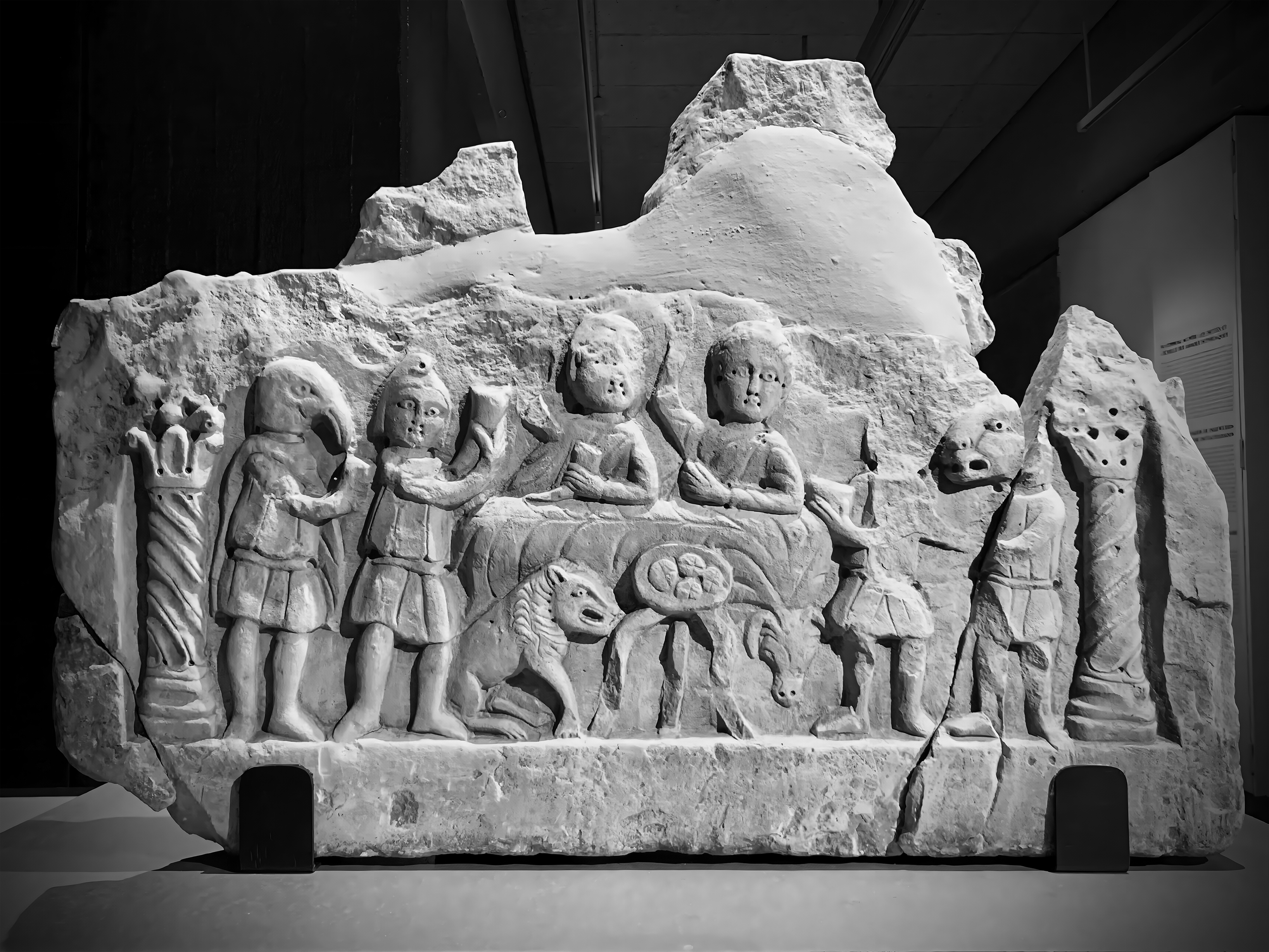
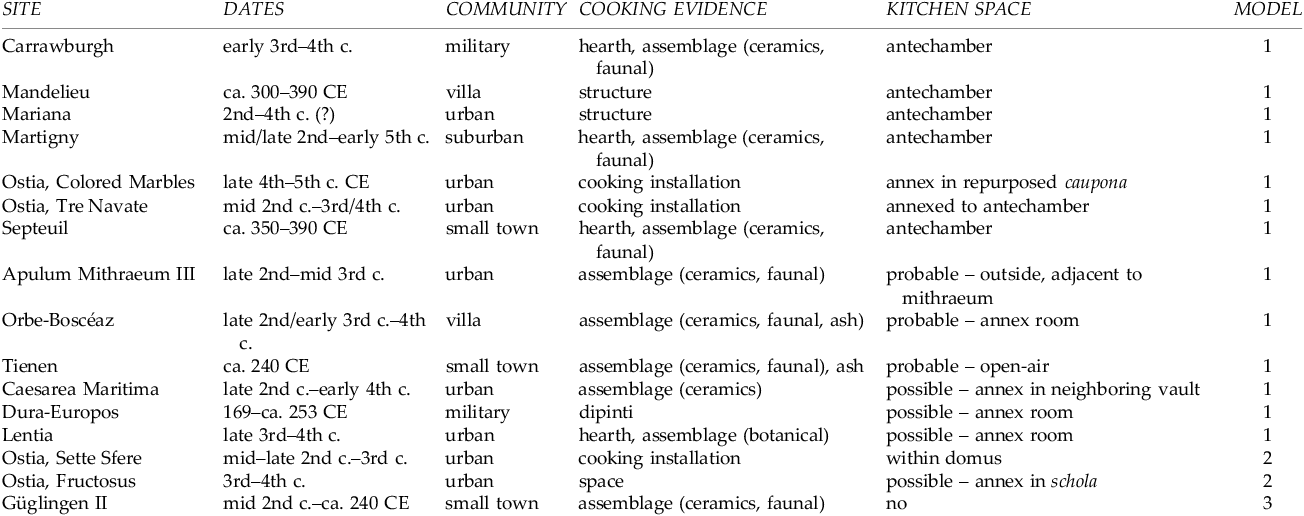
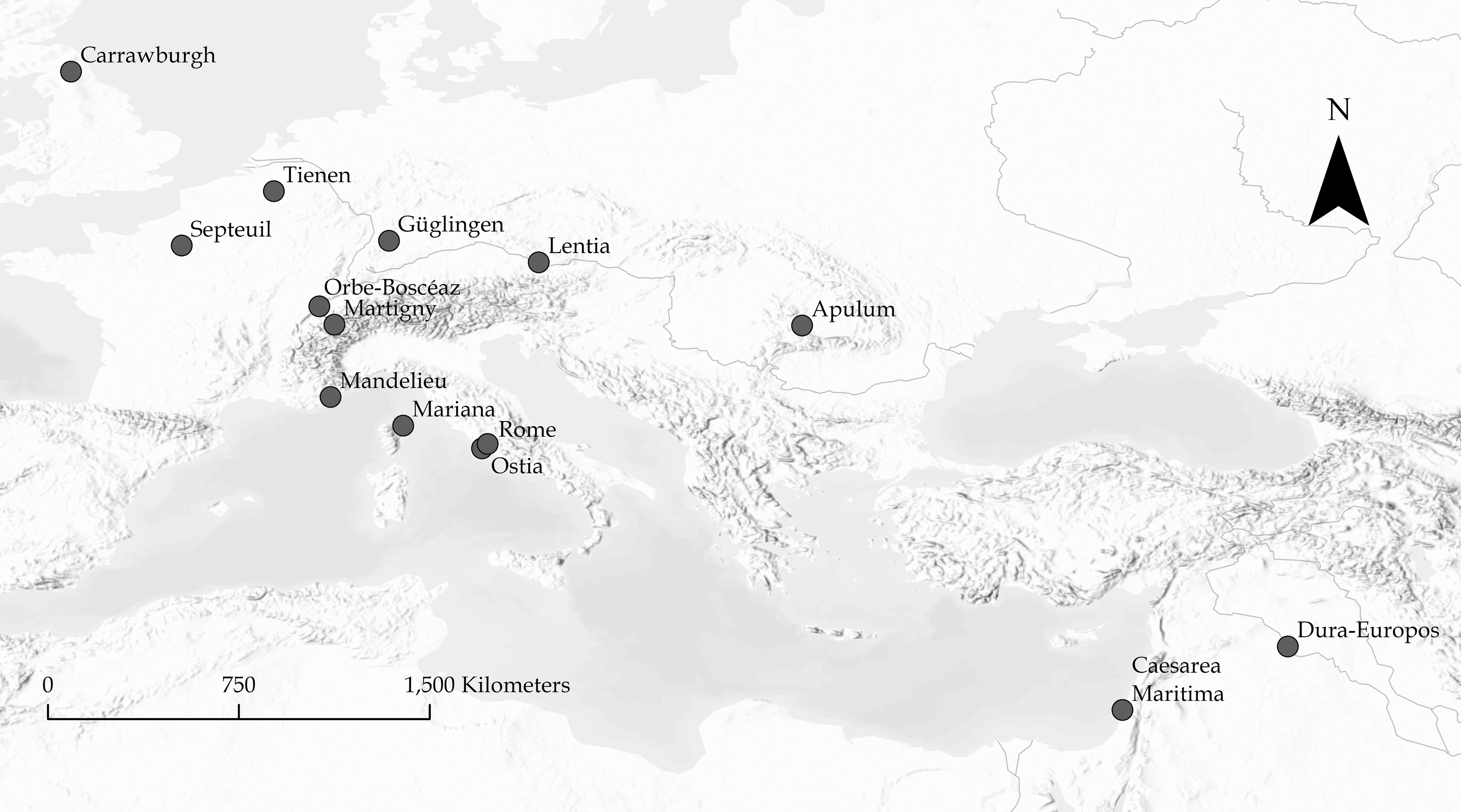
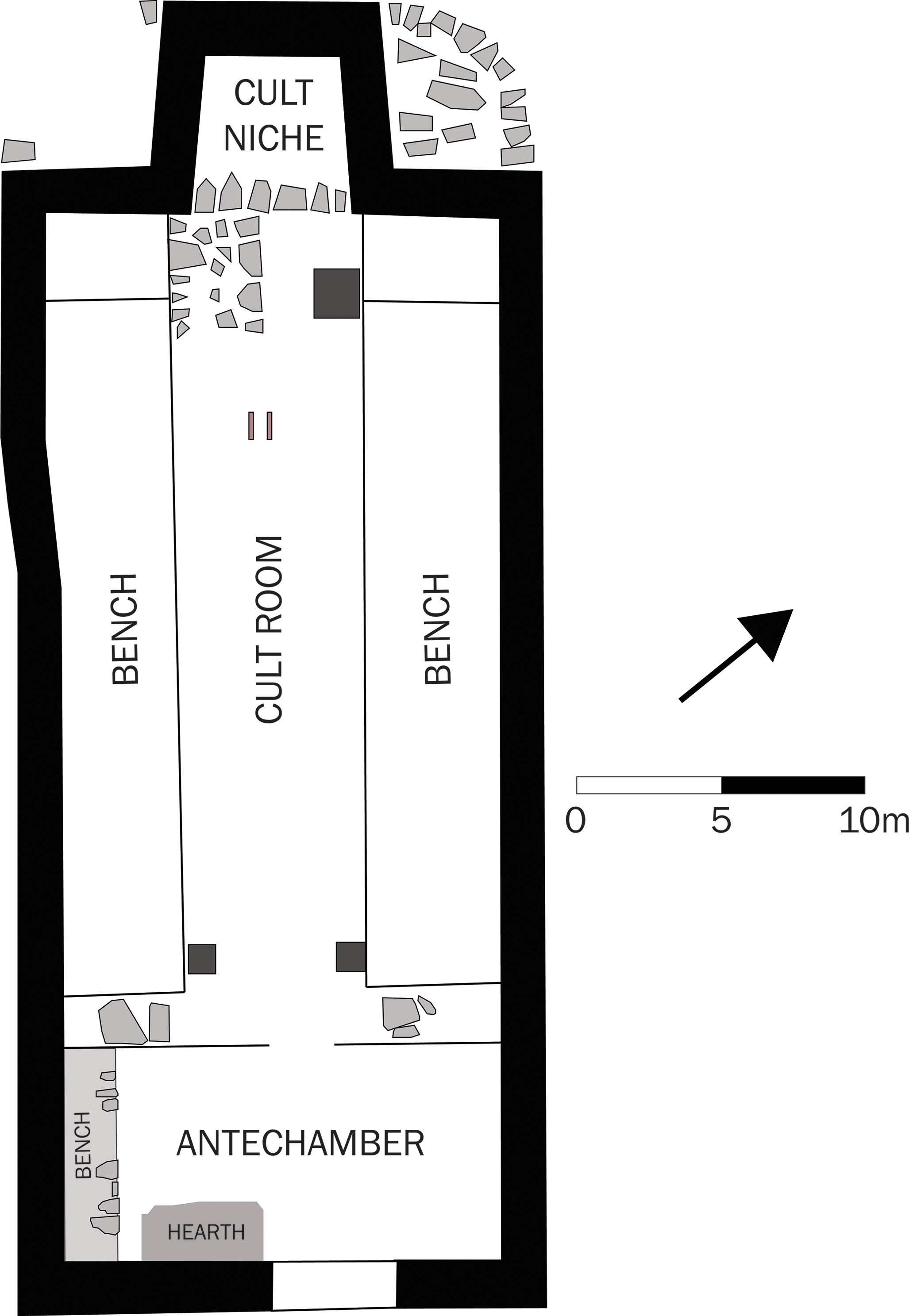
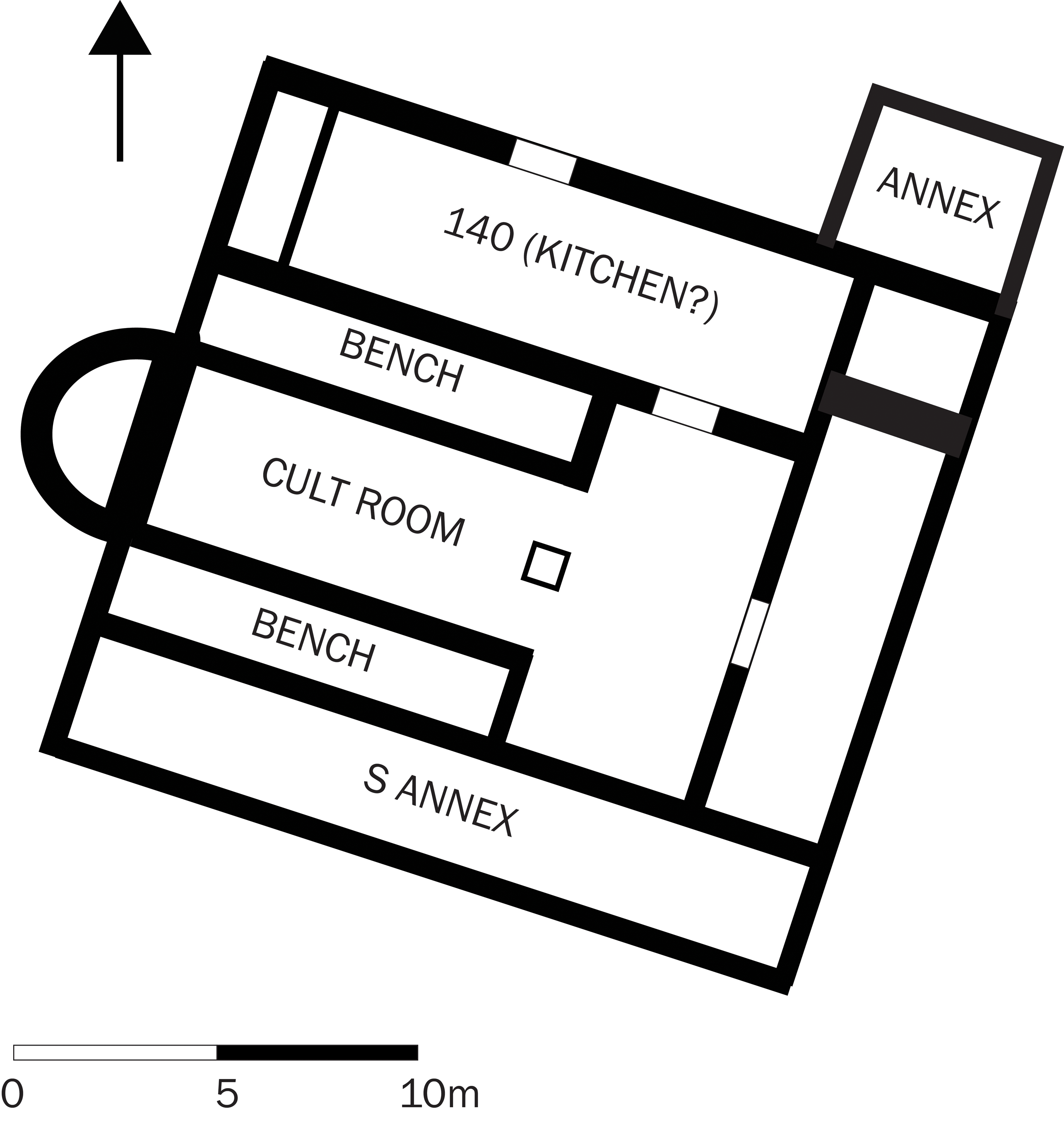
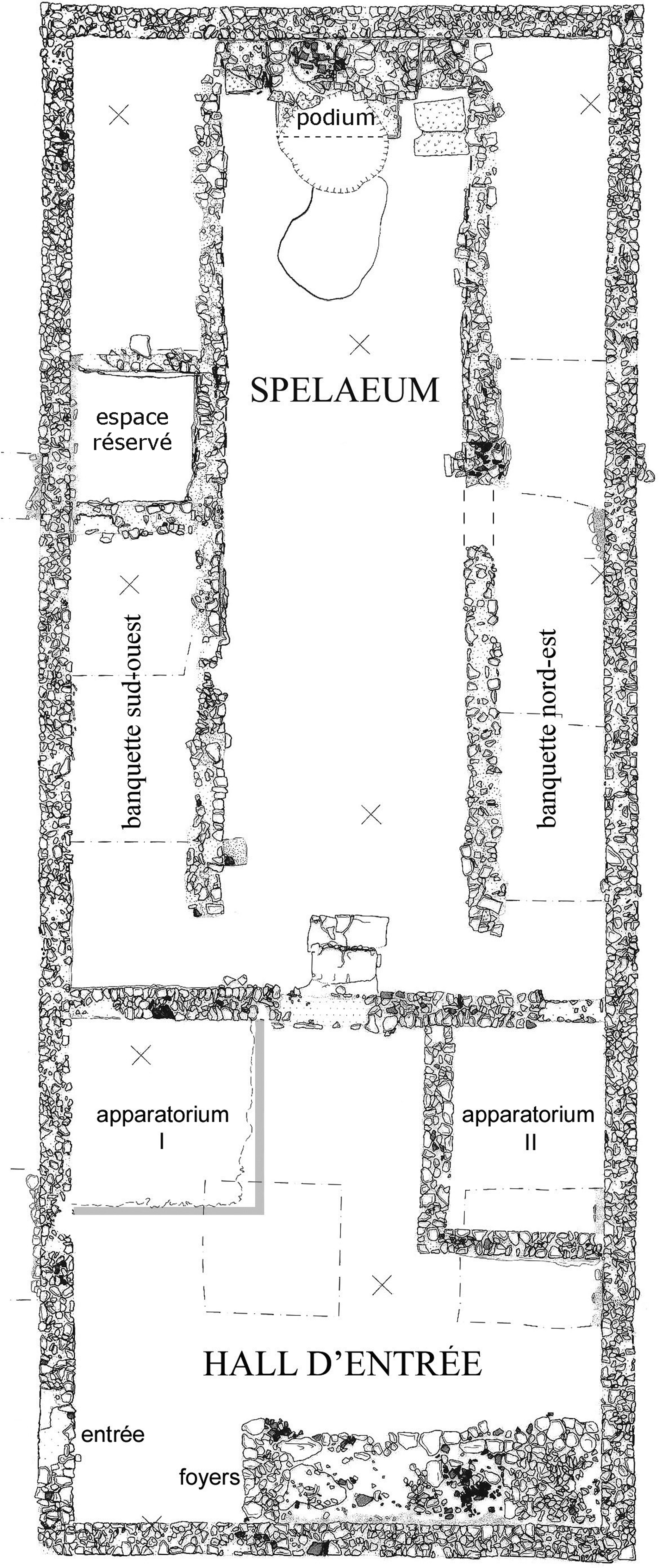
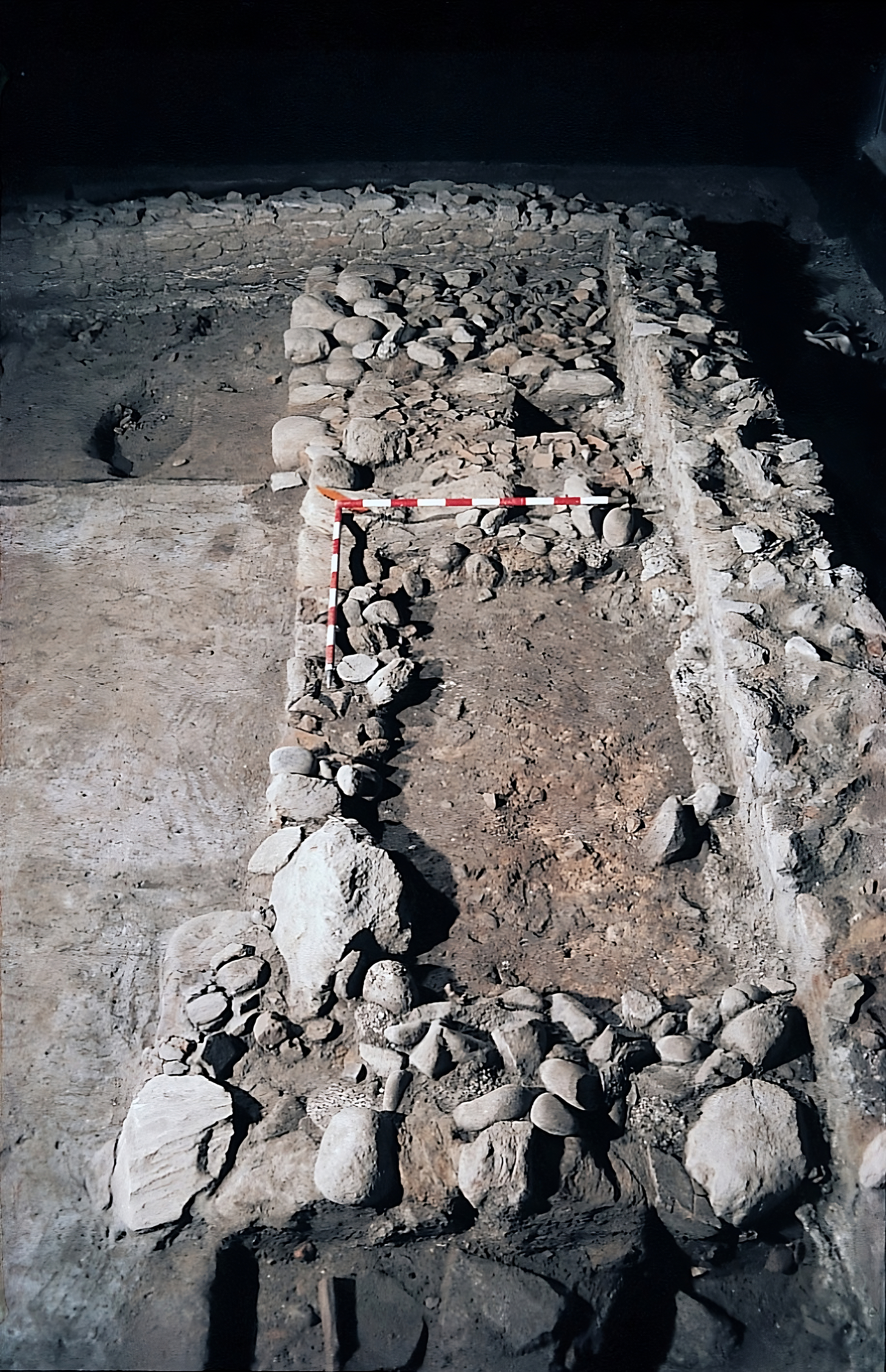
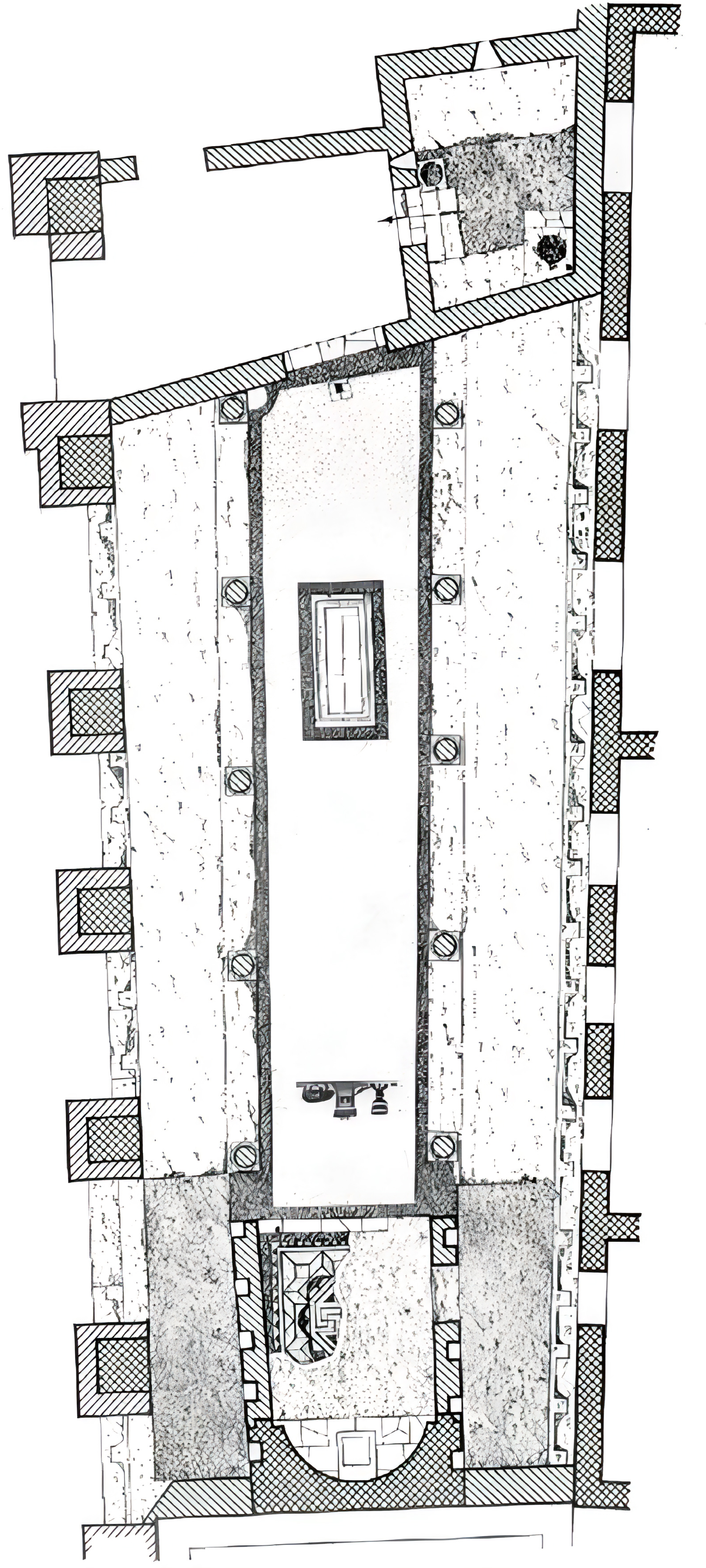
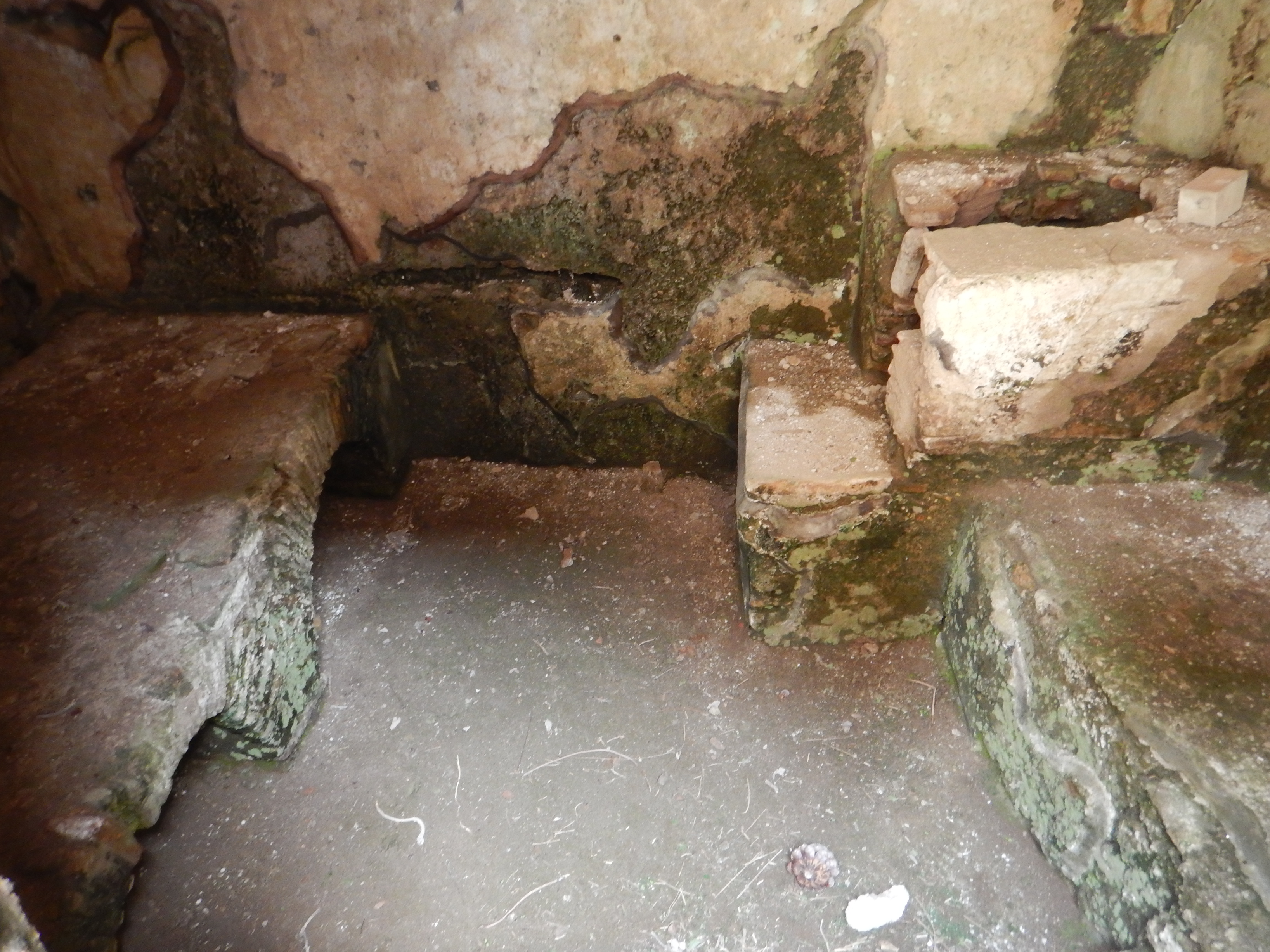
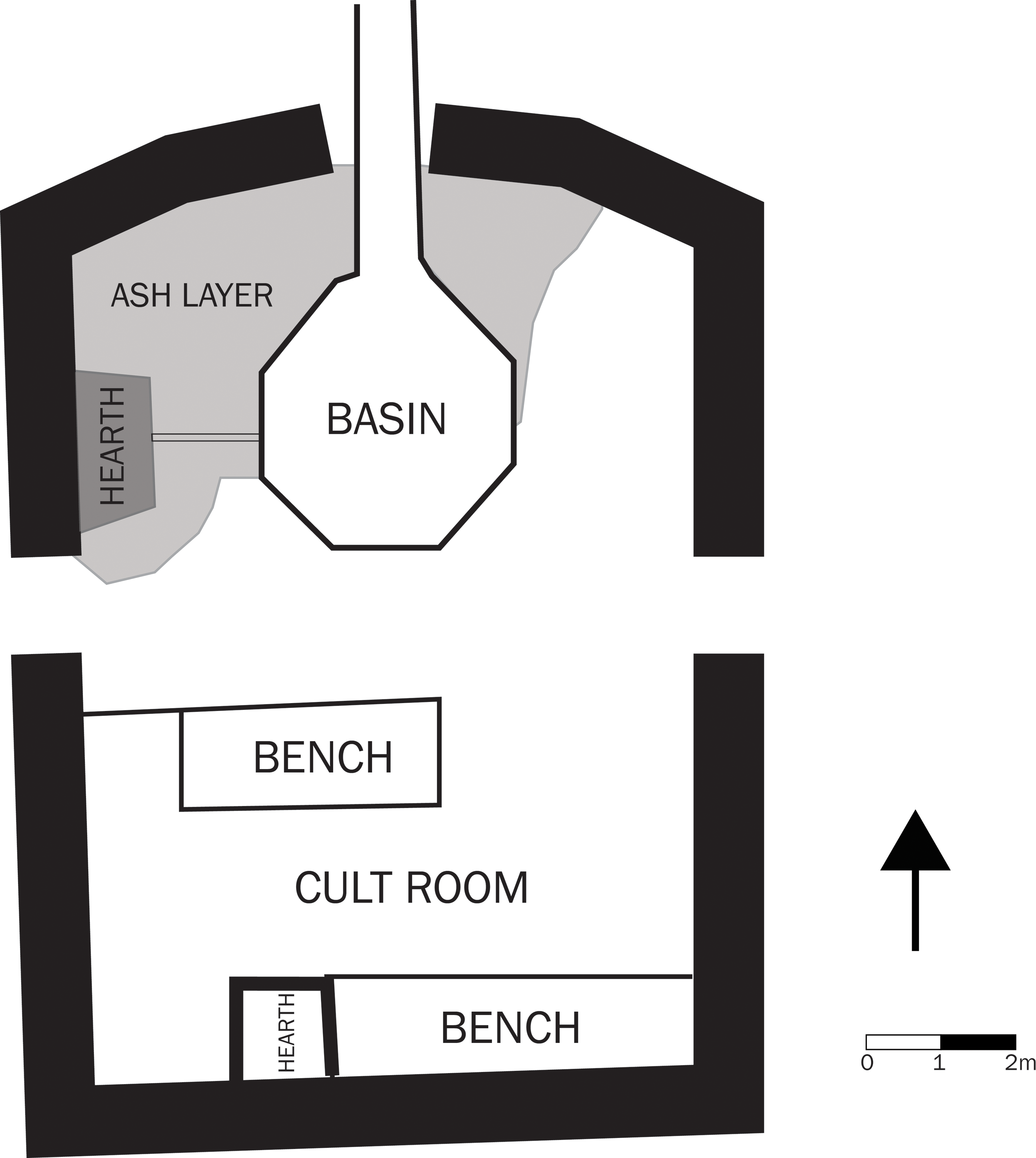
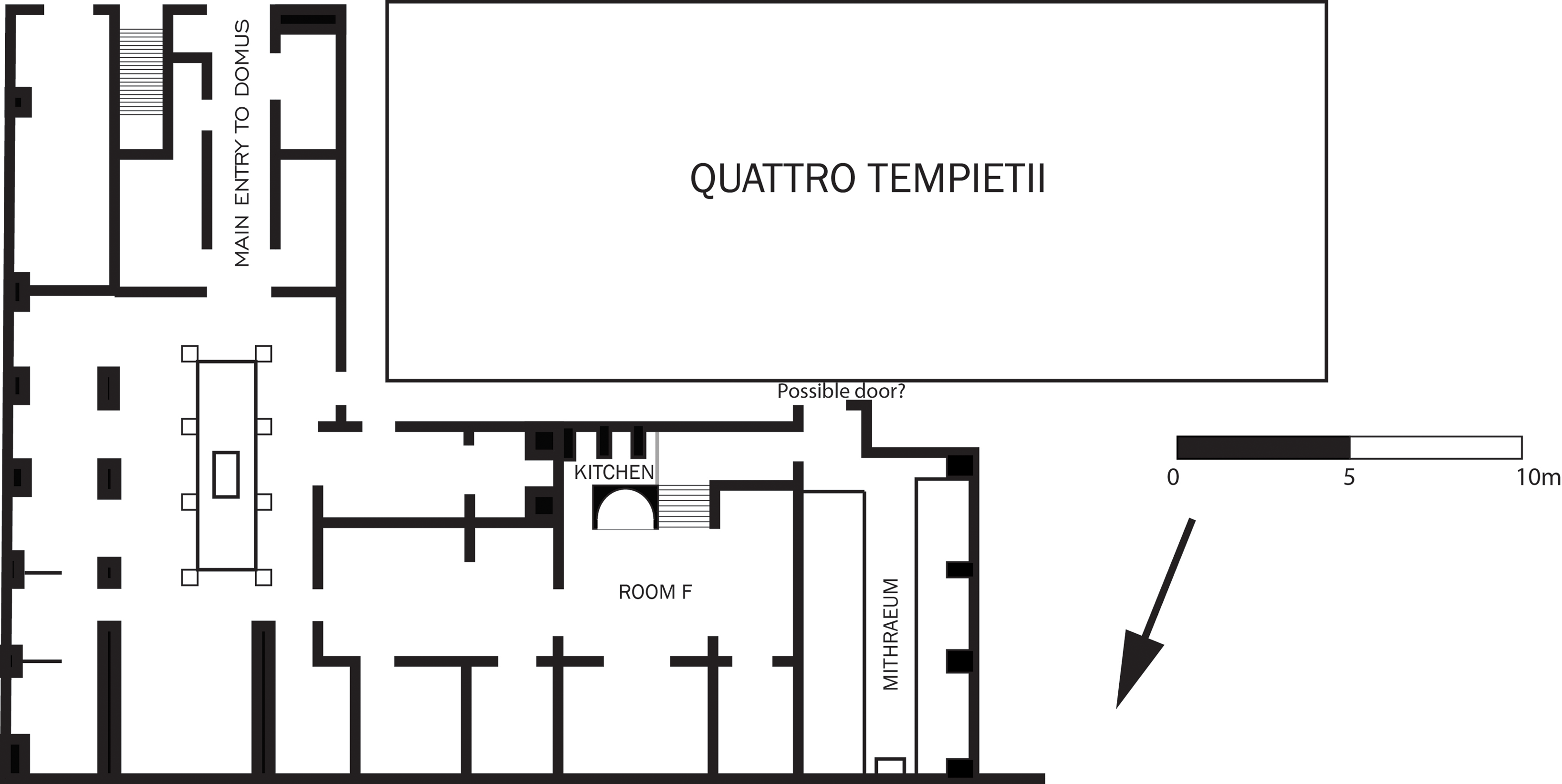
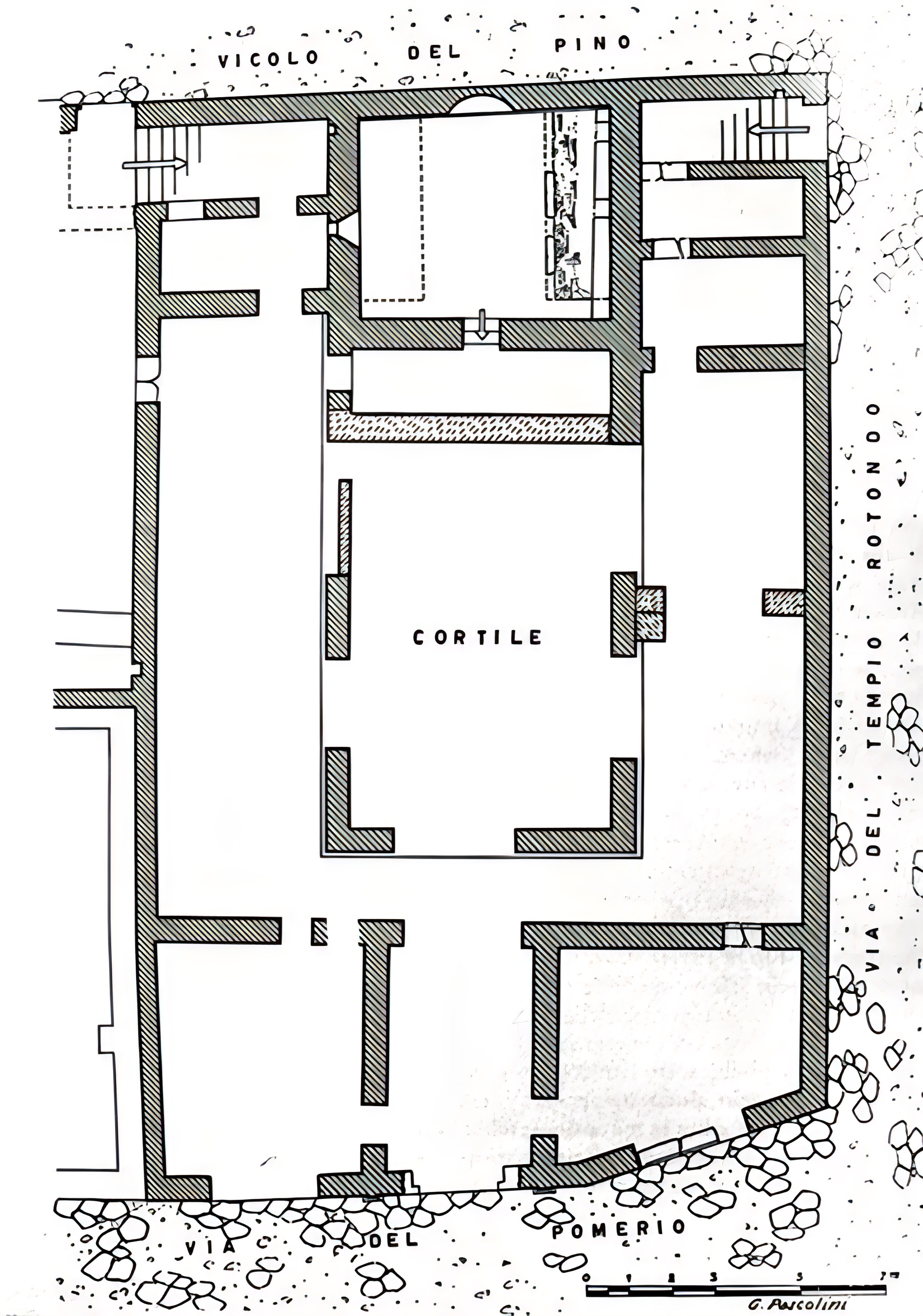

 Open access


