

Introduction
The 2007 adoption of the United Nations Declaration on the Rights of Indigenous Peoples (UNDRIP) by the UN General Assembly has been hailed as a “subtle revolution” in the area of international politics and human rights (Lightfoot, Reference Lightfoot2016). Consisting of 46 separate articles pertaining to a broad range of both individual and collective rights (e.g. self-determination and government; culture and language; land, territories and resources; health; and education), the principles outlined in the Declaration aim to ensure a minimum standard of rights protection for Indigenous peoples, contributing to their wellbeing, dignity and survival (Dept Justice, Annual Progress, 2022). As a nonbinding agreement, it is up to each state that adopts UNDRIP—or commits to its implementation—to do so via their own processes (Gunn, Reference Gunn2013: 153–4). The result is substantial variation in implementation between states since the adoption of the Declaration.
While there is a growing body of literature on UNDRIP implementation across states (Ornelas, Reference Ornelas2014; Department of Economic and Social Affairs, 2019; Scallan and Wilson, Reference Scallan and Wilson2019; Gunn, Reference Gunn2020; Côté et al., Reference Côté, Grant, Islam, McLean, Mitchell and Panagos2024b), within-state variations remain under examined. These sorts of variations are very important in federal or otherwise decentralized states. Since a number of states with significant Indigenous populations are federations (e.g. Australia, Brazil, Canada, Mexico, Russia, United States), this is a potentially serious gap in the literature. We aim to contribute to this scholarly lacuna by examining the implementation of UNDRIP in multiple jurisdictions in a specific country.
In Canada, for example, progress on UNDRIP implementation is not uniform (Platt, Reference Platt2020; Bousquet and Grant, Reference Bousquet and Andrew Grant2025; https://yellowheadinstitute.org/trc/). While some provinces and territories are trailblazers, passing significant UNDRIP-related legislation (e.g. British Columbia and the Northwest Territories), others drag their feet or refuse to engage on this issue in any meaningful way (e.g. New Brunswick and Québec). What explains this variation at the subnational level in Canada? To examine this question, we conducted a detailed review of provincial and territorial websites and collected a total of 230 pieces of legislation and regulations introduced in Canada’s ten provinces and three territories from 2007—when UNDRIP was adopted—to the end of 2023. We then analysed the role of three key variables (i.e. political ideology, resource politics and issue voting). Our findings suggest that none of these variables can explain within-state variation on their own. As such, we compared in more detail two large Canadian provinces with similar treaty histories of unceded territories which are at different stages of the UNDRIP implementation spectrum: British Columbia (i.e. the “trailblazer”) and Québec (i.e. the “laggards”). This enabled us to explore further the role of these variables, this time examining electoral platforms, press releases and government stakeholder interviews.
In doing so, this article provides a case study of how a federal, decentralized state may implement UNDRIP at the subnational level. It also helps ascertain the state of progress in Canada (specifically across subnational units) toward meeting the Truth and Reconciliation Commission of Canada’s 94 Calls to Action (C2A). This refers, most notably, to the progress concerning C2A #43 and #44 that urge federal, provincial and territorial governments to formally recognize UNDRIP and to develop strategies for its implementation, while also offering insights on how to promote reconciliation in both a feasible and equitable manner. The insights from this article ultimately aim to strengthen our understanding of theoretical, empirical and policy-related dimensions regarding the actual implementation of UNDRIP.
Before proceeding with the analysis, however, it is important to recognize that “Indigenous” is a contested term (Béteille, Reference Béteille1998; Corntassel, Reference Corntassel2003; Kenrick and Lewis, Reference Kenrick and Lewis2004). Further, those communities considered to be Indigenous can vary among national jurisdictions across the globe. Within Canada, there is some variation among subnational jurisdictions (e.g. different provinces, such as British Columbia and Québec). Who is included—and who is excluded—are fundamental political questions, which in turn influence governance strategies and outcomes. In the following section, we therefore provide a brief discussion of how the UN, Canada, British Columbia and Québec define “Indigenous” in the context of UNDRIP.
Defining “Indigenous”
Although the UN is reluctant to present an official definition of “Indigenous”—it prefers to identify rather than define Indigenous peoples—there are UN declarations and bodies that offer definitions of Indigenous as part of their global governance initiatives and operational language of relevant UN agencies. Interestingly, UNDRIP draws upon subsection 35(2) of Canada’s Constitution Act of 1982 as part of its definition of who is considered Indigenous: “aboriginal peoples of Canada.” Otherwise conceived of as peuples autochtones in French, Indigenous groups would therefore include “Indian, Inuit and Métis peoples” (Government of Canada, 1982). Subsection 2(1) of the UNDA makes particular reference to UNDRIP and recognizes the aforementioned national and subnational variation when identifying Indigenous peoples: “Recognizing that the situation of Indigenous peoples varies from region to region and from country to country and that the significance of national and regional particularities and various historical and cultural backgrounds should be taken into consideration” (United Nations General Assembly, 2007: 3, emphasis in the original).
The UN Department of Economic and Social Affairs (UNDESA) continues the convention of identifying who is Indigenous, although it offers the following definitions. To that end, Indigenous peoples are “inheritors and practitioners of unique cultures and ways of relating to people and the environment” who retain “social, cultural, economic and political characteristics” that are distinct from those of the “dominant societies in which they live” (Indigenous Peoples at the United Nations). The UN Permanent Forum on Indigenous Issues expands such definitions in a similar vein whereby Indigenous peoples are considered to be “descendants of those who inhabited a country or a geographical region at the time when people of different cultures or ethnic origins arrived” (UN Permanent Forum on Indigenous Issues). In addition to possessing a distinct language and culture, self-identification as Indigenous—and historical continuity with pre-colonial societies—are key aspects of defining a particular Indigenous group. These two latter considerations are affirmed by the UN Fight Racism initiative, as criteria for indigeneity (United Nations: Fight Racism).
Returning to Canada’s definition of Indigenous peoples, it carries the normative and legal weight of being enshrined in the country’s Constitution. To that end, First Nations, Inuit and Métis are seen as distinct groups with unique histories, languages, cultural practices and spiritual beliefs (Government of Canada, 2024a). The Canadian Charter of Rights and Freedoms (The Charter) is a segment of Canada’s Constitution and the former advances that definitions of Indigenous peoples are meant to include “a flexible interpretation that takes account of the distinctive philosophies, traditions, and cultural practices of Aboriginal peoples” (Government of Canada, 2024b). Though First Nations, Inuit and Métis are recognized by Canada’s federal government, these three Indigenous groups have heterogeneous histories, experiences and sociocultural features, respectively. Natural Resources Canada is one of the federal government agencies that is tasked with implementing UNDRIP. Natural Resources Canada (2024) emphasizes its shared priorities with UNDRIP and UNDA, and frequently refers to engaging with “First Nations, Inuit and Métis communities.” This aligns with the government of Canada’s definition of Indigenous peoples and the “aboriginal peoples of Canada” conceptualization adopted by the UNDA.Footnote 1
At Canada’s subnational level, the provincial government of British Columbia adopts the same definition of Indigenous peoples as the aforementioned federal government definitions. In their Declaration of the Rights of Indigenous Peoples Act, British Columbia defines Indigenous peoples as holding the “the same meaning as aboriginal peoples in section 35 of the Constitution Act, 1982” (Government of British Columbia, 2024a). British Columbia acknowledges that although the terms “Aboriginal” and “Indigenous” are sometimes employed interchangeably, “Indigenous” is the preferred usage. Moreover, the government of British Columbia notes that individuals might prefer to be identified in accordance with their specific Indigenous nation (e.g. Inuit) rather than “Indigenous” (Government of British Columbia, 2024b). In contrast, the provincial government of Québec does not recognize Métis as Indigenous. Québec does not conceal its divergence from the federal government:
Au Canada, “Autochtone” est un terme légal utilisé pour définir les premiers peuples et leurs descendants. La Loi constitutionnelle de 1982 reconnaît trois groupes distincts, soit les Premières Nations (avec ou sans statut), les Inuit et les Métis. Au Québec, étant donné qu’aucun groupe métis n’a été légalement reconnu, l’emploi du terme “Autochtone” renvoie généralement aux dix Premières Nations et au peuple inuit. (Québec INSPQ)
The exclusion of the Métis is based on the claim that they do not have legal standing to be an Indigenous group in Québec because they do not have a legacy of having lived on the land.Footnote 2 This position is laid out as follows:
Au Québec, le terme “communauté autochtone” est couramment employé pour désigner un lieu habité par un groupe de personnes vivant sur une parcelle de territoire et qui se reconnaît une appartenance familiale, culturelle et historique. Se distinguant les unes des autres à différents égards, les communautés autochtones ont en commun d’avoir été établies au cours de vagues de sédentarisation et d’avoir été, pour la plupart, légalement instituées par les autorités gouvernementales canadiennes. (Québec INSPQ)
This is not to say that Métis do not reside in Québec. Out of the 205,010 residents of Québec who self-identified as Indigenous, 61,015 self-identified as Métis and 15,800 self-identified as Inuit according to the most recent census data (Statistics Canada, 2021a). Even if the Métis population is roughly 50% smaller that those who identify as First Nations (116,555), Métis outnumber the Inuit population of Québec four to one.Footnote 3
UNDRIP and Its Implementation around the World
The UN General Assembly adopted UNDRIP in 2007, following almost 25 years of work by dedicated Indigenous peoples, activists and officials. While Australia, Canada, New Zealand and the United States initially opposed UNDRIP, they have all since expressed support for the Declaration. UNDRIP rapidly came to play a twofold role for Indigenous peoples: on the one hand, it has been globally recognized as an authoritative statement of human rights norms concerning Indigenous peoples around the world (i.e. the Declaration is norm-making). On the other hand, UNDRIP provides an instrument of international human rights that helps recognize and put into practice the unique rights of Indigenous peoples around the world (i.e. the Declaration is a mechanism of implementation).Footnote 4
However, UNDRIP ultimately remains a declaration of principles, and is therefore nonbinding. As such, it is up to each state that adopts UNDRIP to do this as it sees fit. According to the UN, many countries have taken actions to formally recognize Indigenous peoples’ rights and identity since UNDRIP’s adoption (Secretariat of the Permanent Forum on Indigenous Issues, 2019), and almost all states with Indigenous populations have now ratified the declaration. While UNDRIP required much robust coordination among Indigenous peoples, non-Indigenous peoples and states globally, its implementation has manifested less coordination and occurred at different rates. For example, a recent review of the literature on the global implementation of UNDRIP identified four recurring areas of contestation that have generated variations in the implementation of UNDRIP between states that have signed the declaration. This includes: (1) Indigenous self-determination versus state autonomy as a driver for potential conflict; (2) contestation over the meaning of Free, Prior and Informed Consent (FPIC) in the context of UNDRIP; (3) the centrality of the nexus between land, culture and self-determination; and (4) the problematic impact of Western legal concepts and definitions relating to the implementation of UNDRIP (Côté et al., Reference Côté, Grant, Islam, McLean, Mitchell and Panagos2024b).
However, as we note above, variations in implementation may also exist within states, especially decentralized ones. In this article, we explore numerous internal factors that could play a role in facilitating or hindering this progress.
Implementing UNDRIP in a Federal State: UNDRIP in Canada
Whether a state is centralized or decentralized affects multiple aspects of its day-to-day operations and policy practices. Federal states, where jurisdictional authority is divided between national and subnational governments, encapsulate decentralized state structures. With multiple centers of power, which can sometimes lead to jurisdictional conflicts, federal states are particularly likely to exhibit variations in policy implementation from one subnational jurisdiction to another (e.g. Broschek, Reference Broschek2024; Sapat et al., Reference Sapat, Lofaro and Trautman2022). When the concern is UNDRIP implementation, this multi-government system and its diffused authority is an important variable.
A total of 25 countries—representing 40% of the world’s population (Forum of Federations, 2023)—are federal states, and Canada, divided into 10 provinces and 3 territories, is one of them. The Government of Canada formally endorsed UNDRIP in 2016, committing to implement the Declaration into federal law. The federal government subsequently adopted Bill C-15, also known as the UNDRIP Act, which received Royal Assent and immediately came into force on June 21, 2021 (Dept Justice, Backgrounder).
Although federal agencies and departments are tasked with supporting implementation, much of what UNDRIP requires needs to be implemented at the subnational rather than the national level. As of December 2024, only one province (British Columbia) and one territory (Northwest Territories) have passed UNDRIP-related legislation. The large majority of Canadian provinces and territories are thus lagging behind. In fact, when UNDRIP implementation legislation was first put forward at the federal level, six of the country’s ten provinces (i.e. Alberta, Manitoba, New Brunswick, Ontario, Québec and Saskatchewan) co-authored a letter to the Minister of Justice and Attorney General of Canada and Minister of Crown-Indigenous Relations, citing their opposition. The then Premiers of these six provinces—all leaders of conservative-leaning political parties—urged the federal government to delay the legislation, claiming that passing such legislation would ultimately change Confederation, undermine reconciliation, create uncertainty and litigation and risk promoting deeper and broader divisions within Canada (Platt, Reference Platt2020).
What explains why some provinces and territories have taken the lead in implementing key principles embedded in UNDRIP in their legislation, whereas others have dragged their feet? To understand the differences in implementation of UNDRIP, we focus on three traditionally important variables underpinning important policy variation in Canada. First, as many scholars seeking to explain interprovincial differences in redistributive efforts (e.g. Skogstad, Reference Skogstad2023; Haddow, Reference Haddow2014; Simon and Tatalovich, Reference Simon and Tatalovich2014), we explored the role of left–right ideological orientation of provincial/territorial governments. Second, due to the prevalence of natural resources on territory inhabited by Indigenous populationsFootnote 5 and the highly contentious aspect of northern resource exploitation (e.g. Côté and Mitchell, Reference Côté and Mitchell2018, Côté et al., Reference Côté, Grant, Mitchell and Panagos2024a), we examined the salience of resource politics. Finally, in liberal democracies where one person equals one vote, issues supported by a large number of people are most likely to be picked up by political parties. For this reason, we assessed the role played by issue voting and the size of a given population. This investigation will thus explore whether conventional explanations of interprovincial variations can help explicate the new puzzle of differentiated UNDRIP implementation.
Political ideologies and political parties
Political parties in Canada vary in terms of their support for Indigenous rights. The scholarship paints a picture wherein parties on the left, with their greater emphasis on progressive and redistributive policies, tend to be more amenable to Indigenous issues than their counterparts on the right, which tend to be more socially and economically conservative (Harell and Panagos, Reference Harell and Panagos2013). This pattern also describes how politicians behave when their parties are in power and when they are not. For example, Michael Morden’s work advances that when acting as the official opposition in Parliament, the New Democratic Party (NDP) is the most likely to bring up issues relating to Indigenous peoples, the Conservative Party of Canada (CPC) is the least likely, with the Liberals somewhere in between (Morden, Reference Morden2018: 130–31).
UNDRIP is undoubtedly a useful instrument for protecting Indigenous rights. Brenda Gunn is thus correct to argue that “implementing the UN Declaration is important because it presents a roadmap of action to realize Indigenous peoples’ rights, which is critical for reconciliation in Canada pursued in a spirit of partnership and mutual respect” (Gunn, Reference Gunn2013: 159). Given the connection between UNDRIP and Indigenous rights, we expect that support for the declaration would follow the above left–right ideological and partisanship patterns. Party platforms during the 2021 federal elections illustrate this, as the Conservative Party of Canada (CPC) framed their commitment to implement UNDRIP as an economic concern (Conservative Party of Canada, 2021), whereas other, more progressive parties (New Democratic Party or NDP and the Liberal Party of Canada or LPC) pledged to implement UNDRIP without this sort of minimizing framing (Cowie and Midzain, Reference Cowie2021).
But are the left-wing versus right-wing ideologies and their amenability to UNDRIP legislative efforts reproduced at the provincial/territorial level? After all, it is important to point out that provincial political parties in Canada are independent from their national counterparts. For example, in British Columbia, until very recently, both the BC Liberals and the BC Conservatives were ideologically aligned with the federal Conservative party. The scholarship on colonial politics and transitional justice also suggests that simple narratives of left/right divides in colonial decentralized settings may in fact do little in the way of helping us understand the politics of change (e.g. Jung, Reference Jung2009).Footnote 6
Despite these caveats, we surmised that provincial and territorial political parties on the left will be more supportive of UNDRIP and its implementation than parties on the right. As a result, we expect that policies implementing UNDRIP will vary depending on each jurisdiction’s electoral history (i.e. it will depend on which political party is in power at the subnational level at the relevant time).
H1: Jurisdictions electorally dominated by parties on the left are more likely to have made meaningful progress toward the implementation of UNDRIP.
Natural resource exploitation and contentious politics
For Indigenous peoples, the land and the resources it contains are sacred. The traditional use of land and resources by Indigenous peoples, and their self-determined right to use land and resources as an expression of their culture is the foundation of Indigenous rights and critical to the wellbeing and survival of Indigenous peoples around the world (Kipuri, Reference Kipuri2009; Borrows, Reference Borrows2016).
James Anaya, former UN Special Rapporteur on the Rights of Indigenous Peoples (2008–2014), cautioned that one of most significant causes of Indigenous rights violations is the activities of resource extractive companies in or near Indigenous communities (Price, 2019: 336–7). Anaya’s concerns certainly apply to Canada, and there are innumerable instances of Indigenous communities and nations challenging the development and on-going activities of extractive resource companies on their traditional territories, be it in Québec (Korab and Renner, Reference Korab and Rener2013), in Ontario (Rajagopal, Reference Rajagopal2023; Grant et al., Reference Grant, Panagos, Hughes and Mitchell2014) or in British Columbia (Amnesty International, 2022).
As a tool to protect Indigenous rights and resources, UNDRIP may thus be seen as an obstacle to natural resource exploitation and development. This seems to be the argument made by the four states that initially voted against UNDRIP at the 2007 UN General Assembly, claiming that the Declaration “went too far in giving Indigenous Peoples ownership of their traditional lands and veto rights over national legislation and local management of resources” (Ornelas, Reference Ornelas2014: 1). Two articles were particularly controversial: (1) UNDRIP’s article 32-3 which indicates that “the approval of any project affecting their lands, territories and other resources, particularly development, utilization, or exploitation of mineral, water or other resources” shall require Free, Prior and Informed Consent (FPIC); and (2) Article 18 which states that “Indigenous People have the right to participate in decision-making in matters which would affect their rights, through representatives chosen by themselves in accordance with their own procedures, as well as to maintain and develop their own Indigenous decision-making institutions.”
If natural resource extraction is a threat to Indigenous rights, then we expect national and subnational jurisdictions that rely significantly on extractive sector activities for their economic wellbeing (e.g. mining, hydrocarbon, forestry, etcetera) to have made less progress on implementing UNDRIP than jurisdictions that rely on other sources of revenue.
H2: Jurisdictions that depend most on natural resource extraction are less likely to have made meaningful progress toward the implementation of UNDRIP.
Size of subnational Indigenous population and issue voting
It is certainly the case that some Indigenous scholars have questioned the utility of UNDRIP as a vehicle for the protection of Indigenous rights in Canada (Clifford, Reference Clifford2017). However, this is not the consensus position. Many of the people who participated in the creation of UNDRIP and its decades-long journey through the UN were Indigenous peoples from Canada (Gunn, Reference Gunn2013: 149). Not surprisingly, many Indigenous scholars advance that UNDRIP is a useful instrument for rights protection (Henderson, Reference Henderson2019). Moreover, many Indigenous political actors express significant support for the declaration. The best example of this support is the 23 mentions of UNDRIP in the final report of the Truth and Reconciliation Commission, where UNDRIP is referred to as a “framework for reconciliation” (Truth and Reconciliation Commission Canada, 2015).
Issue voting—or the assumption that people vote on the basis of the issues that are important to them—is one of the standard theories of voting behaviour in Canada and elsewhere (Gidengil, Reference Gidengil2022: 927). As a result, politicians who wish to have electoral success should prioritize the issues that are important to voters.
If UNDRIP and its implementation is an important issue for Indigenous voters, we can expect that in jurisdictions where Indigenous peoples make up a significant portion of the population, the implementation of UNDRIP will be further along than in jurisdictions where Indigenous peoples make up a small portion of the population. This expectation turns on the idea that in the former case, politicians have a strong incentive to respond to what these Indigenous voters want, while there is less incentive to do so in the latter case. But as Cowie and Midzain-Gobin (Reference Cowie2021) remind us, Indigenous peoples have a complicated engagement with the Canadian state and electoral system. For many Indigenous people, participating in the Canadian elections “continues the legitimacy of the Canadian state, a state that has unilaterally imposed its will, and its settler-colonial presence on not only their territories but also their nations and themselves” (Cowie, Reference Cowie2021). That being said, the size of a jurisdiction’s Indigenous population may also matter for its organizational capacity, and its ability to overcome collective action problems. Indeed, as a sociological study found, minority groups representing 25% or more of the total population are more likely to shift the majority viewpoint (Noonan, Reference Noonan2018).
H3: Jurisdictions with a larger proportion of the total population identifying as Indigenous are more likely to have made meaningful progress toward the implementation of UNDRIP.
Methods
To assess the progress of the implementation of UNDRIP accomplished per jurisdiction, we conducted a broad scan of provincial and territorial government websites, analysing legislation and regulations introduced between 2007 and 2023. We then reviewed each of them, searching for keywords such as “Indigenous,” “Aboriginal,” “consult,” “consent,” “engage” and “rights.” We also consulted the Indigenous Affairs page of each subnational government to find out whether they had specific policies or frameworks guiding their relationship with Indigenous right-holders. Together, these data collection strategies allowed us to gather 230 policy documents related to the implementation of UNDRIP at the subnational level in Canada.Footnote 7
The object of our study is to ascertain the progress of various provinces and territories in implementing UNDRIP’s recommendations. Here, we measure “progress” in two different ways: more superficially, progress can be measured numerically, by looking at the number of policies/recommendations adopted per jurisdiction every year (nominal progress); but it can also be measured more substantively, by assessing what these policies changed or accomplished (substantive progress). Did the policies/recommendations mandate things such as consultations with Indigenous peoples? Did they result in greater recognition of self-government? Did they lead to instances of new legislation?
To assess whether meaningful change took place, we relied on data gathered by third parties. A number of organizations track progress achieved in the implementation of the 94 C2A in Canada. For instance, the Yellowhead Institute (https://yellowheadinstitute.org/trc/) takes a mostly binary approach to UNDRIP implementation, examining whether the 94 C2A have been completed; there is no “in progress” category. While this approach is legitimate to emphasize the work that needs to be completed, it is less useful for capturing the full range of UNDRIP implementation. The Indigenous Watchdog approach (https://www.indigenouswatchdog.org/calls-to-action/) is slightly different. This approach classifies action in four different categories: not started, in progress, stalled and completed. The Indigenous Watchdog data also offer other important information such as “Who is accountable?” for every C2A, which allows us to take a more focused look at different groups (federal government, provincial governments, Indigenous governments, etc.) depending on the specific C2A.
To investigate the role of our three independent variables in all Canadian provinces and territories, we looked at the political party in power at the time the policies were adopted and measured the size of the Indigenous population using the latest census data. Finally, to measure natural resource dependency, we used the 2022 provincial data on economic sectors per provinces and territories, calculating the proportion of revenues drawn from extractive industries (e.g. mining and hydrocarbon sectors) for the province’s or territory’s total gross domestic product (GDP; Statistics Canada, 2024). Though some small variations do occur from one year to another between 2007 and 2023, this proportion remains fairly stable over time, thus making it a good measure for resource dependency over that period.
We conclude our results section by providing an in-depth exploration of the factors affecting UNDRIP implementation in two diametrically opposite cases in Canada: British Columbia—which has arguably made the most progress in passing UNDRIP legislation—and Québec—which has thus far refused to publicly engage with UNDRIP. As Flyvberg (Reference Flyvberg2006: 229) notes, cases at extreme ends from one another are particularly valuable “because they activate more actors and more basic mechanisms in the situation provided,” making them highly suitable for a study that aims to uncover what makes some subnational territories more or less likely to implement a given legislation. Electoral platforms, as well as other policy documents published by the main provincial political parties, were assessed. In the case of Québec, six interviews were also conducted in spring 2023 with key government stakeholders including members of the main political parties in the province (Coalition Avenir Québec, Liberal, Québec Solidaire, Parti Québecois), a senior government administrator and a representative from an economic interest group.Footnote 8
Results
Nominal implementation of UNDRIP
We first examine the nominal progress accomplished in implementing UNDRIP per province and territory. As Figure 1 shows, there exists substantial variation in the number of UNDRIP policies implemented between 2007 and 2023 per provinces and territories in Canada. This figure clearly highlights that the large majority of policies have been implemented since 2018, and that British Columbia has adopted by far the largest number of UNDRIP-related policies.
Cumulative Number of UNDRIP-Related Policies Adopted Per Year Per Jurisdiction in Canada (2007–2023).

A cursory examination quickly reveals, however, that none of our three independent variables affect nominal progress in UNDRIP implementation in Canada—that is, the number of UNDRIP policies adopted in a given jurisdiction.
An examination of the impact of political parties on the implementation of UNDRIP policies (see Table 1) provides interesting insights. Out of the 230 policies passed by subnational jurisdictions in Canada that were included in our analysis, 91 (about 40%) were adopted when the NDP leadership were in power, 34 (or 15%) were passed under a Liberal government and 52 (or 23%) under a Conservative government. An additional 27 (representing about 12% of all policies) were also adopted in Nunavut (NU) and Northwest Territories (NWT) under a consensus government. This would indicate that ideology may have an impact on a per-legislative item basis.
Political Party in Power at the Provincial and Territorial Levels and Number of UNDRIP-Related Policies Implemented Per Year (2007–2023)

Providing a more fine-grained look at the role of the political party in power in spearheading UNDRIP policies, we can see that provinces and territories that had a progressive/left-leaning government were not necessarily those that passed the most UNDRIP-related policies. Instead, it seems that whatever party was in power from 2018 onward—when the entire country experienced an upswing in UNDRIP-related policies (see Figure 1) is the party that was most likely to spearhead UNDRIP policies. Incumbency, not political ideology, seems to be particularly important then. This was certainly the case in the Yukon, Québec and Ontario. Given the sheer number of UNDRIP-related policies that were passed in NDP-leaning British Columbia from 2018 to 2023, it is possible that the initial assumption that progressive parties such as the NDP are more likely to implement UNDRIP-related policies may simply be explained by this one province driving this trend.
However, it is also possible that political parties matter not so much in spearheading UNDRIP policies but in not feet-dragging—or not sabotaging—UNDRIP-related efforts and initiatives and efforts to engage with Indigenous actors and community members. This can be seen in the case of the six right-leaning provincial governments (Québec, Ontario, New Brunswick, Alberta, Saskatchewan, Manitoba) that initially opposed the federal government’s Bill C-15. The role of political ideology on UNDRIP nominal implementation is clearly more nuanced than a mere yes/no answer, and will be further examined in our discussion on substantial implementation of UNDRIP.
Likewise, an examination of jurisdictions where revenues are largely drawn from extractive industries (see Table 2) does not reveal an obvious negative relationship between extractive industries and UNDRIP implementation. The six provinces and territories with the highest proportion of extractive revenue (Yukon at 10.65%, Saskatchewan at 16.10%, Northwest Territories at 17.48%, Alberta at 19.08%, Newfoundland and Labrador at 25.03% and Nunavut at 35.52%) each implemented 6, 5, 24, 16, 5, and 3 UNDRIP-related policies, respectively. In short, rather than a simple negative correlation, we observe a more complex picture.
Proportion of GDP Coming from Resource Extractive Industries (2022)

Finally, the size of the Indigenous population did not make some jurisdictions more likely to implement UNDRIP policies (see Table 3). Those provinces and territories where the Indigenous population makes up a larger portion of the total population—that is, Saskatchewan (16.6%), Manitoba, (17.7%), Yukon (21.9%), the Northwest Territories (48.8%) and Nunavut (85.2%)—were not necessarily those most likely to pass UNDRIP-related policies (with 5, 16, 6, 24, and 3 policies, respectively). In turn, some of the provinces with an Indigenous population of less than 10%—that is, Ontario (2.9%), British Columbia (5.8%), Alberta (6.7%)—passed a similar if not greater number of policies (29, 82, 16, respectively).
Indigenous Population as Proportion of the Provincial or Territorial Population (2021 census)

Yet it is important to note that three of the jurisdictions with the highest proportion of Indigenous peoples are territories. It is possible that the unique political structures and institutions operating in the Yukon, the NWT and Nunavut may matter just as much, if not more, than the size of the Indigenous population in promoting UNDRIP policies. The experience of Nunavut is revealing here. As the only jurisdiction where Indigenous populations represent the (large) majority of the total population, it is possible that in this majority context, Indigenous peoples were not simply able to advocate for UNDRIP-friendly policies, but were in fact able to shape their entire territorial government and political institutions to better reflect the concerns addressed in UNDRIP. The ability of majority Indigenous jurisdictions (e.g. Greenland) in better implementing UNDRIP policies was also found in a recent study of factors affecting implementation of UNDRIP policies at the state level (Côté et al., Reference Côté, Grant, Islam, McLean, Mitchell and Panagos2024b).
However, it is unclear whether focusing on the relative proportion of a given population tells the whole story. After all, Québec, with an overall population of only 2.4% Indigenous, has more in common with Manitoba (including both the absolute size of the Indigenous population at more than 200,000 and the amount of legislation passed) than it does with Prince Edward Island (PEI). And PEI is relevant because while PEI has an overall Indigenous population of 2.2% (i.e. similar to Quebec), this only equals 3,385 Indigenous inhabitants. Moreover, PEI has only passed four UNDRIP-related policies. A minimum absolute Indigenous population may thus be required to create the momentum necessary for the action under consideration.
Substantive implementation of UNDRIP
However, focusing solely on the number of UNDRIP policies adopted per jurisdiction over time does not capture whether these policies generate meaningful changes. What, if anything, have these numerous policies accomplished? This is why it is important to assess the substantive progress on UNDRIP implementation per province and territory via an examination of Canada’s 94 C2As. A prominent feature of the Truth and Reconciliation Commission of Canada, the C2As provide a detailed list of concrete steps aimed at promoting the process of reconciliation with Indigenous communities in Canada, with C2As #43 and #44 explicitly urging federal, provincial and territorial governments to formally recognize UNDRIP and develop strategies for its implementation.
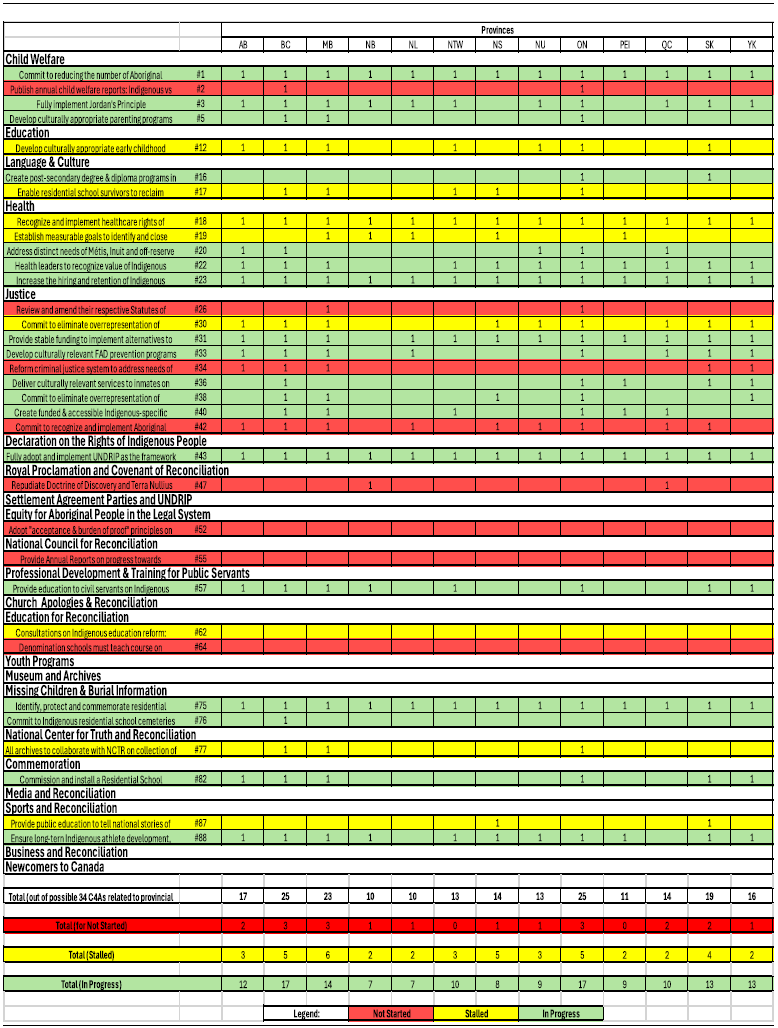
Indigenous Watchdog collects up-to-date information on progress made on all 94 C2As by various stakeholders (e.g. federal government, provincial and territorial governments, municipal governments, private sector, etc.). According to Indigenous Watchdog, 34 out of the 94 C2As fall under the jurisdiction of provinces and territories (see Table 4). Using the classification used by Indigenous Watchdog, the table presents in red calls that have “not started,” though some provinces or territories may have made statements about them. In yellow are calls where the work has “stalled,” and in green are those calls where concrete actions are “in progress.” Of note is that no call under the responsibility of provinces and territories is considered “completed.” This again underscores the amount of work that is still required for UNDRIP to be implemented in full.
Assessment of 34 Themes of C2A Falling under Provincial and Territorial Authority, and Level of Engagement

Looking at Table 4, we can see that according to Indigenous Watchdog, most of the C2As above have been initiated. Examining the substantive progress accomplished by various policies meant to promote UNDRIP at the provincial level, we can observe that, once again, British Columbia comes out on top, together with Ontario. Both provinces have made some progress on 22/34 C2As. Manitoba is not far behind at 20/34, though 6 out of the 20—the highest number of C2As—are currently classified as “stalled.” At the bottom of the list are New Brunswick and Newfoundland and Labrador, each with seven C2As currently “in progress” and two C2As “stalled.”
To capture these important variations in both substantive and nominal progress, we developed Table 5, which presents the five main types of UNDRIP implementation at the provincial/territorial levels. This typology is not linear—that is, subnational units do not necessarily move smoothly from one category to another—nor is it exhaustive—that is, provinces and territories in the “Legislation” categories have not necessarily reached the end of the journey. Much work also remains to be done there to meaningfully and substantially implement UNDRIP. That being said, the typology is useful to explore the types of UNDRIP implementation as well as the types of reconciliation pursued by various provinces and territories.
Capturing Provincial and Territorial Variations in Making Substantive Progress in Implementing UNDRIP

Rejection refers to those provinces and territories that have refused to endorse UNDRIP publicly. Undecided refers to those provinces and territories that have not publicly taken a stance either in favor or against UNDRIP. Acknowledgement refers to provinces and territories publicly referring to the existence of UNDRIP and discussing the need to make steps toward reconciliation with Indigenous populations, but failing to take actions toward implementing UNDRIP or the 94 C2As in a meaningful way. Implementation refers to provinces or territories that have committed to taking steps implementing UNDRIP through established processes, and explicitly recognize Indigenous partners as rights-holders. Finally, Legislation refers to provinces and territories making concrete steps toward reconciliation through legislation.
British Columbia stands out as the first—and thus far only—province to pass a Declaration on the Rights of Indigenous Peoples Act (DRIPA) into law, on November 28, 2019. Midzain-Gobin, Dunton and Tay-Burroughs (Reference Midzain-Gobin, Dunton and Tay-Burroughs2023: 13) advance that because DRIPA was developed in collaboration with First Nations leaders in the province (i.e. rather than being a government-only initiative) the resulting legislation creates significant legal instruments for protecting the rights and interests laid out in UNDRIP. They explain that “DRIPA requires the government to align provincial law, policy and practices with the Declaration; to develop an action plan outlining how this will be achieved; and to produce annual reports on progress, all done ‘in consultation and cooperation’ with Indigenous peoples as outlined in the Act and associated documents.” In 2023, the Northwest Territories adopted legislation that similarly recognizes UNDRIP (Government of the Northwest Territories, 2023).
Falling in the “Implementation” category, Manitoba and Prince Edward Island have both committed to implementing UNDRIP through established processes with Indigenous partners and rights-holders. PEI has passed Motion 41, which included a commitment to table an annual status report detailing the government’s progress toward implementing the TRC’s C2A, including C2A #43 and C2A #44, showing that PEI is committed to advancing UNDRIP’s key objectives (Government of Prince Edward Island, 2022). Manitoba has also published a Path to Reconciliation, Annual Progress Report (e.g. Government of Manitoba, 2022). While Nunavut and the Yukon have not formally committed to implementing UNDRIP, they have both made similar progress on issues closely related to UNDRIP, including adopting shared decision-making processes and co-management of natural resource development. These developments are significant moves toward satisfying C2A #43 to #47. Under the “Acknowledgement” classification, we find Alberta (Government of Alberta, n.d.) and Saskatchewan (Ralston and Walker, Reference Ralston and Walker2023), two provinces that have acknowledged the importance of UNDRIP, but have not committed to its full implementation. Ontario is also characterized as being in the “Acknowledgement” phase, as it has proposed Bill 76, an UNDRIP Act—though the bill has been stagnant at committee since late 2019 (Government of Ontario, 2019), which explains why, despite having made progress on one of the highest number of C2As, as presented in Table 4, the province fails to deliver on substantive progress in implementing UNDRIP.
Finally, the “laggards” include both those provinces that are undecided, and those that have outright refused to endorse UNDRIP. The provincial governments of Nova Scotia and Newfoundland and Labrador have not formally stated their positions concerning UNDRIP, though other actors in each jurisdiction have done so, such as the city of St John’s in Newfoundland and Labrador (City of St John’s, 2020). Last, but not least, the government of Québec has declared that it will not endorse UNDRIP, citing fears of an Indigenous veto power on projects (CTV, 2020). For his part, Blaine Higgs, the former Premier of New Brunswick, has been open about his government’s unwillingness to adopt UNDRIP legislation, arguing that Bill C-15 “has no impact at the provincial level” (Amador, Reference Amador2021). We shall see whether the recent elections of the Liberal Party in October 2024 will change this trajectory. All provinces in this category must adhere to the Canadian constitutional “duty to consult” (Newman, Reference Newman2014), though they make next to no mention of UNDRIP.
To provide a more in-depth exploration of the factors that influence subnational units’ decisions regarding the implementation of UNDRIP, we explore below two extreme cases: Québec (in the “rejection” category) and British Columbia (in the “legislation” category). As Table 1 presented, despite being on a similar track until 2017/8, Québec and British Columbia veered abruptly in different directions after they both elected a new government. Why did this change of direction occur? A more in-depth comparison of two diametrically opposite Canadian provinces is important given how our initial pan-Canadian analysis failed to support any of our original hypotheses. Is it possible that our independent variables do play a role at the local level? Alternatively, did our pan-Canadian analysis gloss over other factors? While British Columbia may be more of an “outlier,” Québec is more representative of the “typical” provincial experience, having implemented 15 UNDRIP-related policies from 2007 to 2023 (provincial average: 18; British Columbia: 82), though its unique culture and history may also affect its stance vis-à-vis UNDRIP. Given that these two provinces are also among the largest economically, politically and demographically in Canada, one can imagine that they are among the country’s most likely policy trendsetters.
(1) Québec
On 1 October 2018, François Legault, the leader of the then new political party, Coalition Avenir Québec (CAQ), became the Premier of the province. As the CAQ did not create a single document compiling all of their platform promises during the 2018 elections, the Université Laval Press compiled materials and press releases to capture CAQ positions on a number of issues (Université Laval, 2018). In this 149-page document, there is only one mention of Indigenous peoples, indicating that the government would implement UNDRIP and TRC recommendations broadly speaking, though without discussing the specifics. None of the documents available on the CAQ website and published at the time of the 2018 elections mentioned Indigenous peoples, UNDRIP or reconciliation (Coalition Avenir Québec, 2019b). This omission was somewhat odd given that the CAQ highlighted the importance of several issues covered in the 94 C2As in their “Orientation” document (Coalition Avenir Québec, 2019a), including Family, Education, Health, Identity & Culture and Integrity & Justice. Yet it never acknowledged the need to draw from UNDRIP nor use the language of reconciliation.
The CAQ position hardly changed over the course of its first term in power. This is evident when reviewing their 2022 electoral platform (Coalition Avenir Québec, 2022), which made only a handful of references to Indigenous peoples. This included, notably, how the CAQ has a “Grande Alliance” with the Cree and a wind energy project with the Innu, and how the CAQ government had “closely followed” the recommendations of the report on the National Inquiry into Missing and Murdered Indigenous Women and Girls. The 2022 electoral platform also refers to the death of Joyce Echaquan, indicating how it spurred the planned “Loi sur les services de santé et les services sociaux.”Footnote 9 What is notable, though, is that UNDRIP and the TRC’s 94 C2As are not mentioned once in the document.
A look at the 2021, 2023 and 2024 general council resolution booklets (Coalition Avenir Québec, 2021, 2023, 2024) show that the CAQ did not become more UNDRIP-friendly once they were elected. Out of the 26 resolutions made by the CAQ in 2023, and the 21 resolutions made in 2024, none of them addressed UNDRIP, reconciliation or the 94 C2As. Indeed, we need to go back to 2021 to find two proposed resolutions (out of 53) that pertained to Indigenous peoples—that is, one about collaborating in the management of the territory—and the other about improving public services for Indigenous populations.
However, the CAQ is not the only party that refrains from mentioning UNDRIP. While the Parti Libéral du Québec (PLQ)—historically one of the two largest parties in Québec, but which has experienced a free fall in recent years—mentions Indigenous people more frequently in their electoral platforms (e.g. in discussions of racism and the need for recognition, as well as in the justice and the healthcare systems), it also refrains from mentioning UNDRIP or the TRC (Parti Libéral du Québec, 2022). In fact, Québec Solidaire (QS), a small, relatively recently formed left-leaning party, is the only provincial political party that made multiple references to Indigenous groups, and explicitly promised the implementation of UNDRIP if elected (Québec Solidaire, 2022).
The above hints at the fact that opposition to UNDRIP in Québec may not necessarily be party-specific, but may instead reveal broader province-specific issues, especially around resource exploitation and jurisdictional authority. The numerous television shows, movies and books about the role of Hydro-Québec in the constructions of a modern Québec identity suggests a deeper emotional attachment to hydroelectric infrastructure in Northern Québec, and incidentally, why the government is reluctant to “give away” any powers that would impact this important economic and nation-building tool (Desbiens, Reference Desbiens2013). Government stakeholders interviewed for this project all suggest that, were Indigenous peoples to have veto powers, this would freeze the northern economic projects in the province.Footnote 10 Instead, as one respondent suggests, it is the CAQ that currently holds veto power, which they are not willing to surrender.Footnote 11 As a minister from the Government of Québec noted in our interview, UNDRIP is great for protecting Indigenous culture and language, but the government does not agree with the concept of a veto; they would rather focus on cooperation than giving away veto rights on projects.Footnote 12 Québec’s complicated approach to UNDRIP is also compounded by its ongoing nationalist battle with the federal government. In “Un Nouveau Projet pour les Nationalistes du Québec” (Coalition Avenir Québec, 2018), the CAQ advocates for greater cultural and economic development in Québec, while pushing Indigenous concerns aside. As Eisenberg and Spinner-Halev (Reference Eisenberg and Spinner-Halev2005) argue, minorities living within another minority group (a situation referred to as “second-order minorities” by Barter, Reference Barter2015), operate in a very constrained environment, which is made even more tenuous in secessionist or nationalist contexts. This political demographic reality may indeed bear significant relevance when considering the prospects for the implementation of UNDRIP in the province of Québec.
(2) British Columbia
BC’s involvement in reconciliation actions exploded in 2017 at the start of the BC New Democratic Party (NDP) tenure in government. The 2017 BC NDP electoral platform (BC NDP, 2017) included Indigenous peoples in virtually every issue, including housing, child care and protection, health services, skills training, education, justice, crime prevention, economic growth, infrastructure funding, environmental protection, sustainable aquaculture and commercial and recreational fishing, clean drinking water, job creation, entrepreneurship, forestry, mining, natural gas and the art industry. The document also had a dedicated section that addressed Reconciliation, Respect and a Better Future, in which the BC NDP discussed the importance of working with Indigenous peoples and their party’s willingness to implement UNDRIP at the provincial level and how they wanted to act on the TRC’s 94 C4A. This is, of course, in stark contrast with the policy pronouncements coming out of Québec.
In their 2020 electoral platform (BC NDP, 2020), the BC NDP continued in the same direction, with entire sections of their platform dedicated to UNDRIP and reconciliation. Here, the party sought to connect the interests of Indigenous peoples with “everyday issues”—for example, exploring how Indigenous peoples are affected by the housing crisis or the lack of childcare options. The party aimed for “greater self-determination for Indigenous peoples,” with long-term agreements and shared decision making.
It is difficult to assess whether the BC NDP were an anomaly in the BC provincial politics landscape. While the BC Green Party said it would recognize all Indigenous governments and provide them with funding comparable to other levels of government (CBC News. 2024), the other main provincial party, the BC Liberals, went through a metamorphosis, becoming the BC United Party in 2023, and then joining forces with the BC Conservatives in 2024. Unfortunately, the BC Liberals’ former electoral platforms as well as all of its archives are no longer available online. Still, the position of the BC United on Reconciliation matters was rapidly revealed. Former Party Leader Andrew Wilkinson said he would refuse to meet with members of the Wet’suwet’en community in regard to their protests over the pipeline in northern BC, stating that if they have issues with the company, they should take them to court “just like everyone else” (Balzer, Reference Balzer2020). In the Fall 2024 elections, the newly formed BC United and BC Conservatives combo promoted “Economic Reconciliation” with Indigenous communities that included the strategic return of lands to First Nations and support to become economically independent (CBC News, 2024). According to John Rustad, the new Party leader, the provincial legislation enshrining UNDRIP had created “obstacles to development” and “frictions” (Pawson, Reference Pawson2024). For this reason, the BC Conservatives were “not opposed to remove and replace laws that get in the way of full economic reconciliation,” thus honoring UNDRIP “as it was intended” (Greer, Reference Greer2024). Not surprisingly, this declaration, made on Reconciliation Day, was heavily criticized by the Union of British Columbia Indian Chiefs (UBCIC), who declared that it was “very counterproductive, very negative and quite frankly racist to make such an announcement, such an ambiguous announcement on Reconciliation Day,” and that we would “go back to conflict and confrontation” (Greer, Reference Greer2024).
A closer comparative examination of BC and Québec allows us to shed light on the types of reconciliation being pursued by various provincial political parties. Historically, reconciliation efforts often boiled down to cultural policies meant to preserve and promote Indigenous culture and language. However, recent policy proposals by both the BC United and the CAQ reveal a more economically oriented reconciliation, where Indigenous Peoples are mostly—if not only—included in the context of natural resource issues (BC United, 2023); a new understanding of Reconciliation that largely mimics that of the federal Conservative Party (Cyca, Reference Cyca2024). Very few but the most progressive provincial political parties (e.g. Québec Solidaire, the BC Green) are endorsing what could be seen as a mild type of Political Reconciliation; for example, nation-to-nation relations, respect for Indigenous sovereignty, etc.
What is more, British Columbia provides an example of a subnational unit where the government is actively seeking out cooperation with Indigenous peoples, even once UNDRIP has become formally implemented. For example, in a recent release, the BC minister of energy, mines and low carbon innovation stated:
BC has the critical minerals the world needs to build a clean economy. We are seizing the generational opportunity before us to create jobs, not only in northwest BC, but also in communities across the province that supply and provide services to our mining sector. Working with Tahltan and Canada, these significant investments into Highways 37 and 51 will provide safer roads for workers and residents alike, in Tahltan, Nsiga’a and Gitanyow territories, and better services for people and communities in the region. (Government of Canada, 2024)
Contrary to what has emerged from our interviews in Québec, veto power appears to be a non-issue in BC. In fact, according to Terry Teegee, the Regional Chief of BC’s Assembly of First Nations, the idea that First Nations would gain a veto right on resource exploitation projects is a misunderstanding that is used by some political parties and actors to create polarization and resistance (McKay, Reference McKay2024). Nathan Cullen, BC minister of water, land and resource stewardship agreed, noting that no veto rights were added to the Land Act amendments (McKay, Reference McKay2024). Considering how much the veto issue monopolizes the discussions of UNDRIP in Québec, the case of BC provides a much-needed counterpoint to lay some of these fears to rest, while also underscoring the role played by Indigenous actors in driving the implementation of UNDRIP in BC.
Conclusions
Assessing the progress made by any jurisdiction—let alone subnational units with different political actors, institutions and realities—toward implementing key UNDRIP principles is challenging. This study demonstrates that political ideologies, dependency on natural resource exploitation and the size of Indigenous populations do not automatically predispose a territory or a province toward implementing UNDRIP-related policies. There is clearly also something else at play. Considering the role of Indigenous actors in developing DRIPA in British Columbia and pushing for other UNDRIP-inspired provincial agreements (e.g. Pawson, 2023; Lightfoot, Reference Lightfoot2024; Stephenson, Reference Stephenson2024), future studies would do well to look at the role of Indigenous actors (e.g. organizations, leaders, elites) in shaping legislation. Alternatively, it would be important to also explore when and how Indigenous advocacy in favor of UNDRIP is thwarted at the provincial level, like it was in Québec (e.g. Cree Nation, 2021; FNQLSDI, 2024). Adding the voices of Indigenous people to those discussions is of critical importance but is beyond the scope of this particular study. It is also possible that if, on their own, our independent variables did not significantly contribute to UNDRIP implementation, interactions between our variables may have done so. For instance, the presence of both a left-leaning government and a large resource-extractive industry may explain the four UNDRIP-related policies of Alberta’s NDP government between 2015 and 2018. More fine-grained statistical analyses would help reveal potential interactive effects.
As mentioned earlier, UNDRIP implementation has clearly gained some momentum in Canada since 2018, but things can also rapidly change. It will be interesting to see what happens in Manitoba, now that it has elected its first Indigenous Premier, Wab Kinew. Will the “stalled” initiatives finally regain their momentum? In contrast, with Pierre Poilievre’s federal Conservatives surging in voter intention polls across Canada, one can also wonder whether subnational cases of momentum will soon come to an end. After all, in May 2021, Poilievre and his party voted against bill C-15, claiming that it was undemocratic if Indigenous nations who were pro-development could be derailed by others who had concerns about industrial and extractive sector projects in their territory (Abele and Macquarrie, Reference Abele and Macquarrie2023). In addition, the spectre of a global economic recession looms over all countries, including Canada, which may also affect how resources are shared when they are increasingly scarce.
Are there applicable lessons or “best practices” drawn from some of Canada’s stories that might be transferable to other jurisdictions that have underperformed in implementing UNDRIP? Clearly, British Columbia has acted as a trailblazer in Canada, opening the door—and creating precedent—for other provinces to follow. The three Canadian territories also appear better suited to integrate UNDRIP’s recommendation due to the very nature of Canadian territorial political institutions. That being said, it is important to highlight that none of these can be labelled as “success stories”: substantial work remains to be done in all provinces and territories.
What does the overall slow nominal and substantive implementation of UNDRIP across all provinces and territories—and the foot-dragging in several right-leaning provinces—tell us about the prospects for Reconciliation in Canada? The work of Corntassel (Reference Corntassel2007) on the drafting of the UNDRIP during the First Indigenous Decade (1995–2004) at the UN may hold some insights. Corntassel argues that to promote their own legitimacy, power holders worked to “co-opt Indigenous actors” (i.e. intentionally extend some form of political participation to actors who pose a threat) via the processes of blunting (i.e. shifting and altering the Indigenous political agenda to fit the dominant norms of existing institutional structure) and channeling (i.e. confining Indigenous activities to official structures) (Corntassel, Reference Corntassel2007: 139–41). The result was that “the co-optation of transnational Indigenous networks appears very effective in challenging the unity of the global Indigenous rights movement and hindering genuine dialogue regarding Indigenous self-determination and justice during the first Indigenous Decade” (Corntassel, Reference Corntassel2007: 162). The uneven and slow progress on implementing UNDRIP in Canada may be the result of the sort of co-optation described by Corntassel. If this is the case, the prospect for progress on reconciliation in Canada, at least reconciliation that turns on Indigenous self-determination, is bleak. While our findings are not able to support this conclusion in a definitive way, they do give us cause for concern.
Finally, the Canadian experience in implementing UNDRIP may not apply to other states, including its within-state variation in provincial and territorial implementation of UNDRIP. After all, Indigenous peoples across the globe have different histories, contexts, priorities and realities that define their relationship with their respective states (Secretariat of the Permanent Forum on Indigenous Issues, 2019: 4–7). However, in the context of the scarce literature on the impacts of federations/decentralized political structures in the implementation of UNDRIP, these findings, though modest, add to the pressing discussions of factors affecting UNDRIP implementation in different parts of the globe.
Supplementary material
To view supplementary material for this article, please visit https://doi.org/10.1017/S000842392500023X
Acknowledgements
An earlier version of this article was presented at the 2024 meeting of the Canadian Political Science Association. Funding from the Social Sciences and Humanities Research Council of Canada supported the article. We thank Victoria Maclean and Kai Stephenson for their important research assistance collecting primary materials. We also thank the two anonymous referees and the journal editors for their helpful comments and suggestions, which improved the article.







 Open access

