




1. Introduction
This article is concerned with the verb-meaning triad ‘to know’, ‘to teach’, and ‘to learn’ in Germanic. All three meanings can be traced to the PIE root *lei̯s- in Gothic (i.e. Go. lais, (ga)laisjan, (ga)laisjan sik), while two continue in West Germanic, namely ‘to teach’ and ‘to learn’ (OE lēran and leornian, liornan; OHG lēren and lernōn [→ lernēn, lirnēn] etc.). North Germanic has borrowed the root from Old English. The root’s basic meaning as reported by LIV2 is ‘to learn’, but arguments in favor of an original meaning ‘to follow’ have been produced over the years (chiefly Marstrander Reference Marstrander1929, Meid Reference Meid1971, Tanaka Reference Tanaka2011, and most recently Tarsi Reference Tarsi2023 with a complete critical overview of the literature and arguments in favor of a basic meaning ‘to follow a track’).Footnote 1 This analysis is based on the more economical explanation that the root in question acquired the sense ‘to learn’ by a metaphorical process from concrete to abstract (cf. also expressions such as Eng. to follow a teaching). The meaning ‘to learn’ is found at the core of both verbal and noun formations in Germanic and it is also possibly seen in Umbrian (-)lērā- ‘teaching, instruction, lore’. On the other hand, the meaning ‘to follow a track’ is attested not only in Germanic, but also indirectly in Baltic (OPr. lyso ‘flowerbed’; Lith. lýsė ‘vegetable patch’), Slavic (OCS lěxa ‘cultivated plot’), and Italic (Lat. līra ‘the earth thrown up between two furrows, ridge’; possibly Osc. luisarifs ‘the month in which furrows are traced’ (see in detail Tarsi Reference Tarsi2023, with extensive arguments and references).
The meanings ‘to know’, ‘to teach’, and ‘to learn’ are also represented by other verbs throughout Germanic in both space and time. This article explores how these words came into being in this branch of Indo-European and asks, from the standpoint of lexical typology, what “systems” these formations instantiate, and what developments they testify.Footnote 2 Such a description of lexical “systems” involves a lexical-morphological analysis of the relevant components throughout time and is aimed at assessing what kind of relationship there is between lexical items in the set of complementary meanings under focus. In particular, the analysis ought to evaluate the typology of the systems encountered, and whether a tendency towards some particular intra-systemic relationship type can be observed. Such a description is inspired by the typology of valency orientation of transitive/intransitive verb pairs developed by Nichols et al. (Reference Nichols, Peterson and Barnes2004). Here, however, the focus is on a semantically complementary verb triad and its lexical realizations. Of interest is the extent to which the addressed languages lexicalize the selected meanings from one or more roots, through which morphological processes, and whether there are any tendencies to be seen diachronically, for example towards suppletion or lability, and to evaluate contact-induced effects.Footnote 3
Furthermore, the present study also addresses the lexical make-up of ‘to know’, ‘to teach’, and ‘to learn’ in Germanic within the framework of Conceptual Metaphor Theory (Lakoff & Johnson Reference Lakoff and Johnson1980, Kövecses Reference Kövecses2002) as employed in cognitive historical linguistic studies with an etymological focus (e.g. Kölligan Reference Kölligan, Repanšek, Bichlmeier and Sadovski2020, Reference Kölligan, Giannakis, Conti, de la Villa and Fornieles2021, Reference Kölligan2022, Ginevra Reference Ginevra, de Felice and Fedriani2024a, b). The main question that this research addresses thus concerns the patterns of human conceptualization from concrete to abstract. Of interest to the enquiry is which concrete domains are selected to convey the meanings addressed and whether the same choice can be claimed to be of common Indo-European descent, polygenetic, or as arising as an effect of contact. With respect to this latter point, the present study seeks to further develop a well-known line of research within cognitive linguistics, namely the cognitively motivated lexical make-up of a selected portion of the lexicon.Footnote 4
2. “Germanic systems”
2.1. The oldest stages
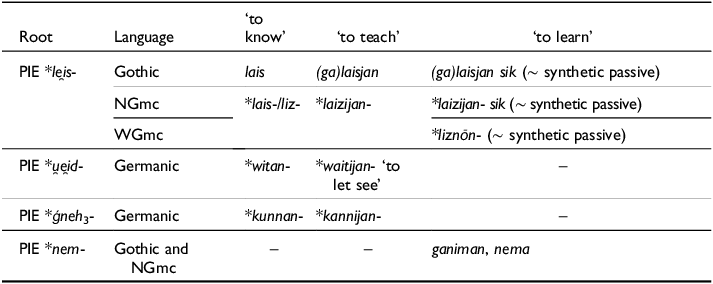
The oldest attested Germanic system encompassing the verb meaning triad ‘to know’, ‘to teach’, and ‘to learn’ is that of Gothic, where the root PIE *lei̯s- underlies verbs for all three meanings: (1) a stative verb (preterite-present) only attested twice as lais ‘oἶδα; I know’, beside witan; (2) a causative verb (ga)laisjan ‘to teach’, beside the marginal denominal (ga)talzjan; and (3) a “proto-reflexive middle” (ga)laisjan sik ‘to learn’, beside ganiman. West Germanic attests to a similar system, differing from Gothic in its formation of the verb for ‘to learn’, besides lacking a stative ‘to know’ from PIE *lei̯s- and resorting instead primarily to PIE *u̯ei̯d- ‘to see’. A summary is provided in table 1.
The system of attested verb forms based on PIE *lei̯s-

As proposed in Tarsi (Reference Tarsi2023: § 7 and summarized in § 8.1.5), stative and causative verbs formed on PIE *lei̯s-, namely PGmc *lais-/liz- and *laizijan-, were likely found prehistorically throughout the Germanic linguistic continuum, whereas the formation of a nasal present was restricted to those dialects which later gave rise to West Germanic. Revising the proposal by Lühr (Reference Lühr2008), it has been advanced in Tarsi & Zanchi (Reference Tarsi and Zanchi2025:279) that the Germanic reflexive construction is primary in respect to nō/na-verbs in being the competitor of the inherited middle, namely the synthetic passive, as the noncausal end of the anticausative alternation.Footnote 5 Hence it can be proposed that the inherited middle of PGmc *laizijan- and the reflexive form *laizijan- sik once competed with one another in East and North Germanic.
The demise of PGmc *lais-/liz- in West and North Germanic, and nearly so in East Germanic (note incidentally that we do not have the same quality sources for North and West Germanic from the same period as the Gothic Bible), was in all likelihood provoked by the synchronically synonymous verb PGmc *witan-, a formation on PIE *u̯ei̯d-, which is certainly shared by more than one branch of Indo-European (on this issue see below, section 3). On the same root, a causative is also found, namely PGmc. *waitijan- ‘to let see (vel sim.)’, attested in Old High German (weizzen ‘to show, hint, call’) and Old Icelandic (veita ‘to grant, give’) and reconstructable for Gothic, also on the basis of comparanda in Indo-Iranian and Celtic (cf. LIV2, s.r. u̯ei̯d-).
What is more, the meaning ‘to know’ was shared by another Germanic formation, also a preterite-present, namely *kunnan-, based on PIE *ǵneh 3- ‘to recognize’ and newly formed within Germanic (cf. Harðarson Reference Harðarson1993:80–81, Tanaka Reference Tanaka2011:145–180, Ringe Reference Ringe2017:178–179, and Jasanoff Reference Jasanoff, Kavitskaya and Yu2023:4), with a corresponding causative, PGmc *kannijan-, which in North Germanic acquires the meaning ‘to teach’ (OIcel. kenna etc.).Footnote 6, Footnote 7
Besides the aforementioned verbs, East and North Germanic also attest another synonym for ‘to learn’, namely PGmc *(ga)neman- (Go. ganiman, OIcel. nema), with the concrete meaning ‘to take’ (< PIE *nem- ‘to assign’ → middle ‘to assign oneself’ → PGmc ‘to take’, LIV2, s.r. footnote 2).
The overall situation reconstructable for primary verbs in the oldest stages of Germanic is summarized in table 2.
Primary verbs related to the meanings ‘to know’, ‘to teach’, and ‘to learn’ in the oldest stages of Germanic
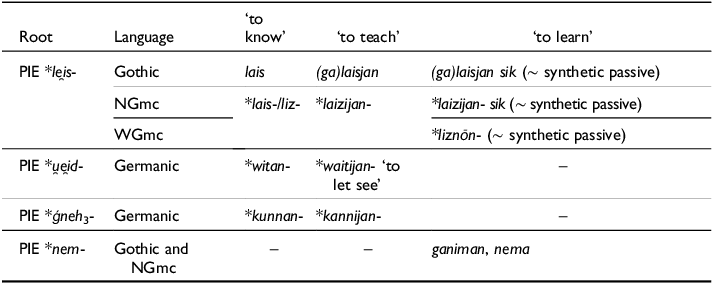
No verb meaning ‘to learn (vel sim.)’ is either attested or reconstructed for PIE *u̯ei̯d- or *ǵneh 3- for lack of comparative evidence. It is a matter of speculation whether PGmc *waitijan- and *kannijan- could convey the meaning ‘to learn’ in the passive but this issue does not affect the present argument. It appears that Germanic diverged in the realization of the verb for ‘to learn’ formed on PIE *lei̯s- in response to the gradual fall of the synthetic passive. However, stative and causative verbs were created from this root by productive patterns for whichever of the three roots in which these are found. Overall, Proto-Germanic testified to a lexical system for the meanings under scrutiny, which made use of productive morphological patterns, with the addition of an outlier, namely PGmc *(ga)neman-, whose meaning ‘to learn’ is at least shared by Gothic and North Germanic.Footnote 8
2.2. Evolution
Having seen that the situation, attested or hypothesized, is valid for the oldest layer of Germanic, one can now trace the developments in the different languages of the western and northern branches and evaluate the systematization of the lexicon with regard to the meaning triad under scrutiny. Data was sampled from the following selection of languages:
-
West Germanic: English (OE, ME, Eng.), Scots (OSc., Sc.), High German (OHG, MHG, Ger.), Old Saxon, Middle Low German, Frisian (OFris., WFris., EFris., NFris.), Old Low Franconian, Dutch (ODu., MDu., Du.), Luxembourgish, Swiss German, Cimbrian (Lusérn), Yiddish;
-
North Germanic: Danish (ODan., Dan.), Swedish (OSw., Sw.), Icelandic (OIcel., Icel.), Elfdalian.
West Germanic
In describing the situation in West Germanic, English and German are taken as main languages, but data from a range other languages is covered with reference to them.
English
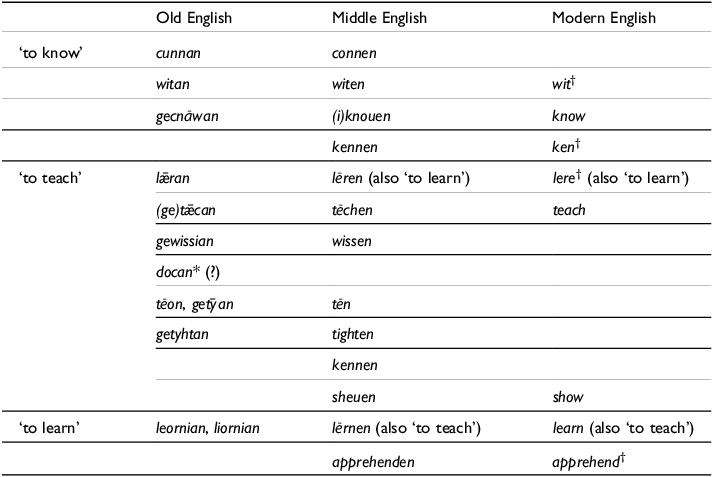
The continuants of the Proto-Germanic causative and nasal present verbs *laizijan- (OE lǣran) and *liznōn- (OE leornian, liornian) are found in Middle English (lēren and lērnen) and Modern English (though lere is nowadays obsolete). However, Old English displays a number of other synonyms for ‘to teach’, namely (ge)tǣcan, the ancestor of present-day teach; getȳan beside tēon, where the meaning ‘to teach’ is derived figuratively from ‘to train (vel sim.)’; getyhtan (‘to draw the mind to something’ → ‘to teach, instruct’); gewissian, a deadjectival formation from gewis(s) ‘certain’; and, finally, the “dubious” docan*.Footnote 9 Beside (ge)tǣcan and gewissian, continuing into Middle English as wissen before dropping out of use except in Scots (wis ‘to direct, guide, show, instruct’), the other Old English verbs, OE docan* aside, likely died out in this meaning around 1250 at the latest (cf. OED, s.vv. tee, tight, wis). In Middle English, the verb kennen is used with the meanings ‘to teach’ and ‘to know’.Footnote 10 It has sometimes been proposed that the latter meaning arose through Norse influence (e.g. OED, s.v. ken; MED, s.v. kennen v.1). However, due to the fact that the verb carries this sense in several early Middle English texts well outside of the Danelaw, recent scholarship has cast doubt on this explanation. Instead, we may have to do with an independent native development, though Norse could have supported it especially in northern and eastern dialects (see Dance et al. Reference Dance, Pons-Sanz and Schorn2019, s.v. kenne). In addition ME sheuen ‘to show’ can be used in the meaning ‘to teach’, like Eng. show today. The meaning ‘to learn’ acquires a synonym from French in the Middle English period, namely apprehenden (< Fr. appréhender, OED, s.v. apprehend), continued in the modern language (but after 1680 no longer in the meaning ‘to learn’, OED, s.v.). ME lērnen is also used in the meaning ‘to teach’, and this nonstandard use is continued in English varieties worldwide. The same tendency is found with ME lēren. Finally, ‘to know’ is conveyed by three well-known old formations beside ME kennen: OE cunnan, continued in that sense also in Middle English but not in the modern language, where it only has modal force, can; witan, whose modern continuant wit is obsolete (except in Scots and in the phrase to wit), and gecnāwan (ME [i]knouen, Eng. know). A summary is given in table 3.
Synoptic diachronic overview of verbs found in English

To complete the overview of the English situation, it needs to be said that in Old Scots (up to 1700), lere and lern(e) were used interchangeably in the respective complementary meanings (cf. the Middle English situation), and this persisted at least up to the nineteenth century (DSL, s.v. lair n.3, v.3). As for ‘to know’, Sc. ken (< ME kennen ‘to make known, teach, know’ [< PGmc *kannijan-]) replaced knaw, know in the broad variety. Wit is found in Scots up until the nineteenth and early twentieth century too (DSL, s.v. wit v.1, v.2).
Overall, the system found nowadays in English, which is one of suppletion (know ∼ teach ∼ learn), has its roots already in the Old English period (gecnāwan ∼ [ge]tǣcan ∼ leornian, liornian). The general tendency was lexical reduction en route from Middle to Modern English. Contact-induced effects are found in the form of loanwords such as Eng. apprehend and (maybe) OE docan*. Since the Middle English period, learn can carry also the meaning ‘to teach’ dialectally, hence becoming a (marginally) labile verb, the causative lere took a similar path but has since fallen out of use.
German
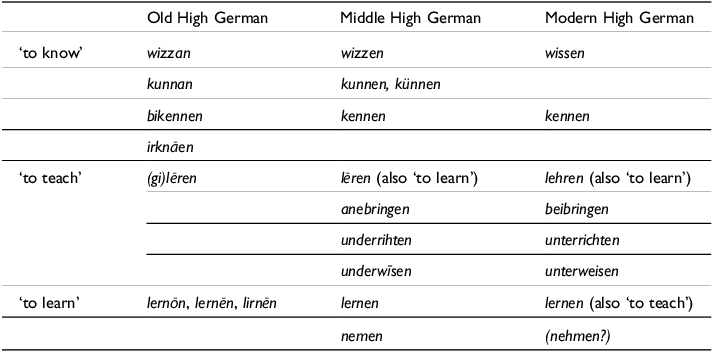
Starting from the same core West Germanic system found in English, namely that of the causative and nasal present verbs from PIE *lei̯s- and the main stative verb from PIE *u̯ei̯d-, German (table 4) displays many affinities with English in the oldest period, with the exception of bikennen ‘to know’ and a number of synonyms for ‘to teach’ only found in English. In the middle period, German solidly continues the inherited core system but adds, for ‘to teach’, the following: a preverbed form of bringen ‘to bring’, continued in the modern language with a different preverb (MHG ane- : Ger. bei-); preverbed forms of richten ‘to direct’ and weisen ‘to show’ (factitives from PGmc *rehta- ‘straight’ and PGmc *wīsa- ‘wise’, respectively), MHG underwīsen and underrihten; MHG lēren and nemen also for ‘to learn’. Modern High German is substantially in line with Middle High German, with the addition of lernen used also with the meaning ‘to teach’ in nonstandard usage (from at least the fifteenth century; see FWB, s.v.). Although Ger. nehmen does not seem to preserve the meaning ‘to learn’, it appears reasonable to assume that the verb might, in preverbed form, occasionally be used in something approaching that sense, for example, eine Gewohnheit annehmen (see also footnote 8).Footnote 11
Synoptic diachronic overview of verbs found in German

Other continental West Germanic languages generally show a conflation of the meanings ‘to learn’ and ‘to teach’ through time in verbs formed on PIE *lei̯s-, whereby it is usually the causative that takes on the meaning of the nasal present (e.g. Du. leren, WFris. leare, EFris. [Saterland] lere, NFris. [Fering-Öömrang] liar all ‘teach, learn’). However, the opposite direction of semantic coalescence is attested in Cimbrian (Lusérn) and Yiddish, the latter eventually reflexivizing the verb in the meaning ‘to learn’, namely lernen zikh.Footnote 12 Moreover, Dutch and Frisian also show a compound of ‘bring’, as well as forms akin to Ger. unterrichten and unterweisen: in Du. bijbrengen, onderrichten, onderwijzen (all attested first in Middle Dutch), WFris. bybringe, ûnderrjochtsje, ûnderwize, EFris. (Saterland) biebrange, unnergjuchte, unnerwise, NFris. (Fering-Öömrang) bibring, onerracht, onerwise (the latter verb attested in late Old Frisian). Luxembourgish also has enseignéieren ‘to teach’ from French. For ‘to know’, the sampled languages either preserve a three-verb system, such as Dutch (weten, kennen, kunnen), or have reduced it to two, such as Luxembourgish (wëssen, kennen), with the continuant of PGmc *kunnan- taking on modal functions exclusively.
In summary, German preserves the original system of West Germanic best among modern languages (wissen ∼ lehren ∼ lernen), with a mild degree of suppletion due to the early loss of PGmc *lais-/liz-. The widespread tendency of conflating the meanings ‘to teach’ and ‘to learn’ is seen already in the middle period, and this gives rise to the situation in a number of other languages and dialects, such as Cimbrian, Dutch, Luxembourgish, Swiss German, and Yiddish. Lexical borrowing aside, contact-induced effects are relevant in Yiddish, which makes use of reflexivization as a detransitivizing strategy. Although this feature was no doubt found already in the oldest period of Germanic (cf. Go. laisjan sik), its morphosyntactic use in Yiddish stems from contact with Slavic (see footnote 12).
North Germanic
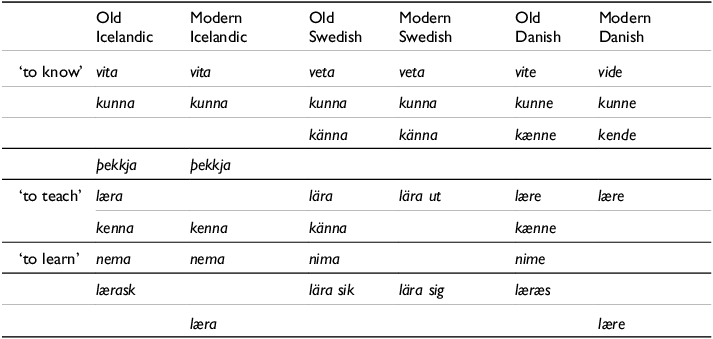
The situation in North Germanic is less varied. An overview of the relevant Icelandic, Swedish, and Danish verbs is presented in table 5. Elfdalian aligns closely with Swedish.Footnote 13
Synoptic overview of verbs found in Icelandic, Swedish, and Danish

From table 5 it is clear that not only Icelandic is semantically conservative. Icelandic preserves the meaning ‘to learn’ for nema (in line with Gothic and the other old Nordic languages), yet the continental languages preserve the original meaning in which OE lǣran was borrowed. Swedish does this entirely, whereas both meanings have coalesced in one form in Danish. Icelandic innovates by a complementary semantic change ‘to teach’ → ‘to learn’. Danish nowadays has a labile verb lære, which has arisen in all likelihood due to the loss of reflexivization, as seen in ODan. læræs and common also to Old and Modern Swedish as well as Old Icelandic and Gothic (on this issue cf. Tarsi & Zanchi Reference Tarsi and Zanchi2025:274–275). Contact-induced effects are seen in Danish and Swedish, where the causative formation is also used in the meaning ‘to know’, this likely stemming from Middle Low German (kennen). Icel. kenna only marginally attests to that meaning in Middle Icelandic, where the verb translates Eng. know in a couple of translated ævintýri (see ONP, s.v. kenna).
In summary, North Germanic shows stability in its systems throughout time. Most of all, the system of Modern Icelandic continues that of Old Icelandic with the sole, yet paramount, exception of the semantic shift of læra. In comparison to the system reconstructible for Proto-Germanic, North Germanic does not continue any of the verbs based on PIE *lei̯s-, but rather acquires the corresponding causative from Old English. The continuants of PIE *u̯ei̯d-, *ǵneh 3-, and *nem- are found everywhere, but are faithfully preserved to the fullest only in Icelandic (with the exception of PGmc *waitijan- > OIcel. veita ‘to grant, give’ rather than ‘to let know [vel sim.]’, as in Ved. -vedáya- ‘to announce’),Footnote 14 where a further lexeme for ‘to know (= Lat. cognoscere)’ is found, namely þekkja, a causative formation on PIE *teng- ‘to come to mind’ (on which see below, section 3).
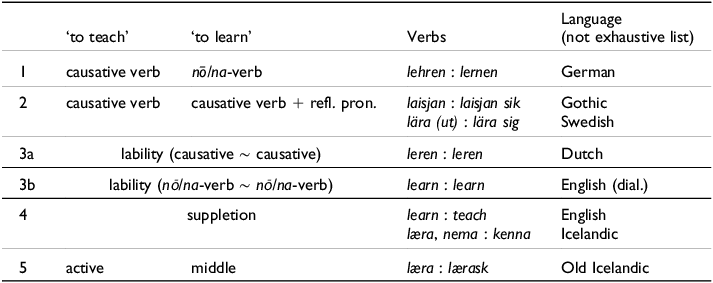
Finally, a summary of the different strategies found for the meanings ‘to teach’ and ‘to learn’ in Germanic formations based on PIE *lei̯s- is given in table 6. The verbs for ‘to know’ are consistently formed on roots other than PIE *lei̯s- from early on.
Different lexicalization strategies for ‘to teach’ and ‘to learn’ in Germanic

3. Indo-European background
In light of the current lexical typological investigation, it is worth returning to a key issue presented in section 1, namely the observable connections between the Germanic formations and their Indo-European background. This is done in two steps: firstly with a focus on the Proto-Indo-European roots involved, and secondly by looking into the conceptual metaphors instantiated. The latter issue is the focal point of the next section.
As summarized in table 2, Proto-Germanic originally had a system for the meaning triad ‘to know’, ‘to teach’, and ‘to learn’ based on at least three different roots: *ǵneh 3- ‘to recognize’, *lei̯s- ‘to follow a track’, and *u̯ei̯d- ‘to see’, to which can be added *nem- ‘to assign’ → middle ‘to assign oneself’ → PGmc ‘to take’ (LIV 2, s.r. *nem-1, footnote 2). This system is best attested in Gothic, which uniquely preserves a preterite-present lais ‘oἶδα; I know’, once very likely spread throughout Germanic (Tarsi Reference Tarsi2023: § 7), and Old Icelandic.
In addition to these three roots, Icelandic also attests to a verb for ‘to know’ formed on PIE *teng- ‘to let come to mind’ (so Add.Corr.LIV2), OIcel. þekkja, but this represents an inner-Icelandic semantic innovation ‘to think’ → ‘to know’.Footnote 15 The same formation is otherwise well attested with its basic meaning throughout Germanic (and later borrowed from Middle Low German into Icelandic as þenkja; Óskarsson Reference Óskarsson2003:343–344) and paralleled by a single verbal occurrence in Latin, namely tongēre ‘noscere’ (Ennius apud Paulus Diaconus’ Epitoma Festi; cf. furthermore tongitio* ‘notion’ and Osc. tanginom ‘sententiam’; LIV 2, s.r. *teng/ǵ-2, footnote 2). Zero-grade present formations such as Go. þugkjan ‘to seem, believe’ etc., a few verbal formations in Tocharian B, and other scattered nominal formations in Italic and Tocharian A and B complete the apparent reflexes of PIE *teng- ‘to come to mind’ (cf. LIV 2, s.r. 2.*teng/ǵ-, footnote 2, and Add.Corr.LIV2, s.r. 2.?*teng-, with lit.).
Of the roots on which Germanic forms verbs for the meaning triad under scrutiny, two may be candidates for formations of common Indo-European descent, namely *ǵneh 3- and *u̯ei̯d-. The remarkably sparse attestation of PIE *lei̯s- ‘to follow a track’ in intellectual meanings in Italic (possibly U. [-]lērā- ‘teaching, instruction, lore’) solidly backs up the thesis of polygenesis.Footnote 16 As for the intellectual meanings connected with PIE *teng-, they may also have arisen polygenetically, in particular if Seebold’s (Kluge/Seebold Reference Kluge2011, s.v. denken) proposal on the connection with PIE *tengh- ‘to weigh’ is taken as valid (see most recently and convincingly Kümmel Reference Kümmel, Hansen, Whitehead, Olander and Anette Olsen2016), and hence the semantic shift from ‘to pull, weigh’ to ‘to think’, which is somewhat paralleled, for instance, in Lat. pēnsāre from PIE *(s)pend- ‘to stretch’.Footnote 17 Evidence in favor of this proposal is, however, less compelling than that for PIE *lei̯s-. Finally, it is important to note that no contact-induced effects can be claimed for the oldest Germanic formations.
As far as PIE *ǵneh 3- is concerned, it is solidly attested throughout the Indo-European family and is therefore transparent in terms of origin. Morphologically, the attested formations continue those of the proto-language, albeit with language-specific innovations. In terms of semantics, the core meaning ‘to recognize’ underlies all semantic developments reflected in the particular languages. The semantic span of the attested formations is ‘to recognize’, ‘to teach’, ‘to understand, ‘to know’.
The canonically reconstructed core meaning for PIE *u̯ei̯d- is ‘to see’. In addition to Germanic, the root attests to perfect formations in the sense ‘to know’ in Armenian (CArm. gitem), Baltic (OPr. waist), Celtic (OIr. ro-fetar, MW gwyr, MBret. goar), Hellenic (Gk oἶδα), Indo-Iranian (Ved. véda, OAv. vaēdā), and Slavic (OCS vědě). Morphologically, LIV 2 (s.r., footnote 9) reconstructs a nonreduplicated formation, whose origin is not clear. The root is moreover apparently attested in its metaphorical sense in Tocharian B (ūwe ‘learned, skillful’),Footnote 18 and is hence well and widely enough attested that its common Indo-European origin is hardly to be disputed. Therefore, the most economical explanation available is that the specific metaphorical development related to sight was common to Indo-European in its earliest stage, and that the root was lost in AlbanianFootnote 19 and Anatolian, hence at very different times and places,Footnote 20 or, alternatively, it was not present in Anatolian and lost much later in Albanian.
4. Conceptual metaphors: Germanic and elsewhere
Finally, we can turn to the results of this research with respect to Conceptual Metaphor Theory and ask which of the identified conceptual metaphors find parallels in other Indo-European languages.
Within the oldest layer of Germanic, four main conceptual metaphors arise, namely to learn is to follow a track, to learn is to get hold of something, to know is to have seen, and to know is to recognize/have recognized.Footnote 21 All the oldest attested Germanic verbs for the meaning triad ‘to know’, ‘to teach’, and ‘to learn’ belong to one of these metaphors, namely the PIE roots *lei̯s- ‘to follow a track’, *nem- ‘to take’, *u̯ei̯d- ‘to see’, and *ǵneh 3- ‘to recognize’. In addition to these, verbs of teaching relating to activities such as pulling (whence ‘to train’ → ‘to teach’: OE tēon, ME tēn),Footnote 22 drawing (sc. the mind to something → ‘to teach’: OE getyhtan), bringing (MHG anebringen, Ger. beibringen), showing (OE [ge]tācan etc., MHG underwīsen etc.), and giving direction (MHG underrihten etc., possibly to be classified under the to learn is to follow a track metaphor) are recorded.
Quite a few etymologically unrelated parallels are found throughout Indo-European for these conceptual metaphors, besides those relating to recognition on the one hand and to bringing on the other (but see below), which would support the polygenetic hypothesis. The parallels, with short etymological discussions, are given below:
TO LEARN IS TO FOLLOW A TRACK
This conceptual metaphor is apparent in the Scottish Gaelic verb ionnsaich ‘to learn’ and, secondarily, ‘to teach, educate, instruct, train’ (Am Faclair Beag, s.v.). The verb goes back to OIr. indsaig ‘to approach, go to, reach’, a preverbed form of saig ‘to go towards, approach; to seek out, strive after’ (eDIL, s.vv. ind-saig ?, 1 saigid), which is formed on PIE *seh 2g- ‘to follow a track’, like, for example, Lat. sāgīre ‘to perceive keenly, discern acutely’; Go. sakan ‘to quarrel, scold’, sokjan ‘to search’ (and cognates) and a number of other verbs, among which are verbs of perception such as OAlb. /gjegjetë/ ‘hears’ and, in affixed form, sheh ‘to see, look’ (LIV 2, s.v. *seh 2g/ǵ-, Add.Corr.LIV2, s.v. *seh 2g-, and Imberciadori & Demiraj Reference Imberciadori and Demiraj2023).Footnote 23
TO LEARN IS TO GET HOLD OF SOMETHING
The conceptualization of learning as getting hold of something is paralleled by that of understanding.Footnote 24 In Indo-European, this is seen in Lat. apprehendere ‘to seize’ and western and central continuants, Fr. apprendre, It. apprendere, Sp. aprender etc., or with a different preverb, OIt. imprendere, Rom. imprender, here with a semantic change from ‘to undertake’ to ‘to learn’ (cf. REW, s.vv., and, for example, It. impresa ‘endeavor, undertaking, business, enterprise’). Similarly, also It. imparare (Lat. parāre ‘to procure, obtain, get’). Finally, the present conceptualization is also appreciable in (O)Alb. nxë, a prefixed form of zë ‘to seize’.Footnote 25
TO KNOW IS TO HAVE SEEN
This conceptual metaphor is mainly represented by formations on PIE *u̯ei̯d- (cf. above, section 3). In Albanian the root is not preserved but the language nevertheless attests to a verb, (O)Alb. di, instantiating the conceptual metaphor. The Albanian verb is built on PIE *dheH(i)- ‘to seize with the eye’ (cf. Khot. daiyä ‘sees’ and other forms in Iranian, EDIrV, s.v. *daiH 1). Although it constitutes a present formation, it derives its semantics from the perfect (‘to have seized with the eye’ → ‘to know’, Demiraj & Neri Reference Demiraj and Neri2020, with exhaustive discussion and literature).
TO TEACH IS TO SHOW
This conceptual metaphor is found outside of Germanic in Anatolian and Iranian. The Anatolian witness to ‘showing as a means of teaching’ is the fientive formation maniyaḫḫ-, whose core meanings cover the sphere of distributing and assigning but can secondarily mean also ‘to teach, show’ (so eCHD, s.v.), allegedly ‘to teach by showing with the hand (vel sim.)’. The Hittite formation, for which a nominal base has not (yet) been recorded, is traditionally compared to Lat. manus ‘hand’, OIcel. mund ‘id.’, OIr. muin ‘patronage, protection’ (Tischler Reference Tischler1990:120–121; cf. also Lgb.-Lat. mundium ‘id.’ and mundoaldus ‘guardian, tutor’ and Ger. -mund in Vormund ‘guardian, tutor’). The Iranian witnesses for formations on roots whose primary semantics is ‘to show’ are found at least in Avestan, namely daxš- ‘to teach’ (LIV 2, s.v. ?*dek(u̯)s-, esp. footnote 1 on the root’s semantics; EDIrV, s.v. *daxš) and, possibly, also in Av. sāh- ‘to teach’, if the PIE root *keHs- ‘to give instructions’ (on which see Kümmel Reference Kümmel1998:201–202) originally meant ‘to show’.
As for the metaphor to know is to recognize/ have recognized, the Indo-European parallels all go back to the same root as the Germanic formations, namely *ǵneh 3- (Alb. njoh, OArm. čanač‘el, OLith. žinóti, OPr. °sinnat; Go. kunnan, OIr. adgnin, Gk γιγνώσκω, Ved. jānā´ti, OAv., YAv. zā˘n-, Lat. (co)gnosco, SPic. knúskem, OCS znati).
Finally, the verbs of teaching related to the activity of bringing into proximity found in Middle and Modern High German (anebringen, beibringen) do not constitute an isolated conceptualization but can be compared to verbs and expressions meaning ‘to remember’ found throughout Indo-European and going back to the concrete idea of ‘driving to, bringing forth in the mind’ as in Toch. A opyāc kälā-/B epiyac käl- lit. ‘to bring to mind/to memory’ – the Tocharian word for ‘mind, memory’ being an Iranian loan (Adams Reference Adams2013, s.v. epiyac), Sw. komma ihåg, Rum. aducere aminte, It. portare alla mente and others, not least Eng. to call/bring to mind. Similarly, there is also OFr. amoutevoir from Lat. *ad mente habere ‘to have in mind’ (REW, s.v.).Footnote 26
5. Excursus: OE (ge)tǣcan (Eng. teach)
West Germanic attests to a possible candidate for a contact-induced semantic extension, namely OE (ge)tǣcan (and continuants, whence Eng. teach). Given the lato sensu similarity between Lat. insignāre ‘to point out, signify, indicate’ → ‘to teach’ (⇐ signum ‘sign’, It. insegnare, Lad. ensegné, Fr. enseigner, Sp. enseñar etc., REW, s.v. *insignāre), the lexical family of the Old English verb (among which is tācn ‘token, sign’), and the importance of Latin as a language of instruction in the Middle Ages, it is worth investigating whether the semantics of the Old English verb could have been influenced by Latin.
According to some scholars, the Old English lexical family apparently attests to a Proto-Indo-European root ?*dei̯g/ǵ- (e.g. Seebold Reference Seebold1970, s.v. teih-a-; Lehmann Reference Lehmann1986, s.v. taikn). This in turn is assumed to be a synonymous variant of PIE *dei̯k- ‘to show, point at’, which not infrequently shows a metaphorical semantic change towards the sphere of saying for example in Germanic and Italic.Footnote 27 Formations, such as Go. taikn(s), OHG zeihhan, OIcel. teikn ‘sign’ (tákn being an Old English loan), would then go back to PIE ?*dei̯g/ǵ-. Go. gateihan ‘to show, announce’, OHG zīhan ‘to blame, accuse’ beside zeigōn ‘to show’, OFris. tīgia ‘to blame, accuse’, ON tjá ‘to relate’ etc. are instead regular reflexes of PIE *dei̯k-. Lat. digitus ‘finger’ could go back to the same root variant (see EDLat., s.v. for an overview of the relevant literature). If the Old English verb indeed goes back to the Proto-Indo-European root hypothesized above, it would constitute a causative-iterative formation PIE ?*doi̯g/ǵ-éi̯e/o- ‘to show repeatedly (vel sim.)’. A parallel to this formation is OE rāc(e)an ‘to reach’, OFris. rētsa beside rēka ‘to give, pay’ (< PIE *roi̯g/ǵ-éi̯e/o-) beside OHG reihhōn, -ēn ‘to reach, refer’ (cf. furthermore EWAhd, s.v. reichen).
Whatever the exact background of the Old English lexical family, the formal and semantic connection between (ge)tācan and tācn was in all likelihood synchronically transparent enough to have been influenced by Latin as a form of calquing, given the semantic shift from ‘to show, point’ to ‘to teach’ with this root being isolated to the history of English (attested from the ninth century on, Bosworth/Toller, s.vv. getácan and tácan).
However, by comparing the relevant Old English attestations listed in Bosworth/Toller with their Latin equivalent, it is readily seen that OE (ge)tācan never translates Lat. insignāre, but rather corresponds to dirigere ‘to give a particular direction, direct’, indicare ‘to show’, monstrare ‘id.’, offerre ‘to present’, ostendere ‘to show, point out’, praescribere ‘to prescribe’, significare ‘to signify’.
Therefore, Latin influence seems invalidated, and the verb’s semantic extension comes via a different route and is thus not connected with “leaving a mark” – this having repercussions on the conceptual metaphorical system to which the verb belongs (see section 4 above).
From the available data, the meaning ‘to teach’ appears to have arisen in connection with the original root semantics, namely ‘to show’. This is readily seen from a handful of examples (from Bosworth/Toller, s.v. tácan):

Whence the intellectual meaning ‘to show (the direction) to the mind’ → ‘to teach’.
As for the conceptual metaphorical system involved, it seems that the Old English lexical innovation does not depart in any significant way from the original Germanic system represented by the verb triad formed on PIE *lei̯s- and exemplified by the conceptual metaphor to learn is to follow a track, if the present proposal is valid, namely that ‘to teach’ is the outcome of the following semantic extension: ‘to show’ → ‘to show the direction’ → ‘to show the direction to the mind’ (hence learning would still be following such a showed direction, and teaching would be showing the way; cf. also MHG underwīsen etc.).
6. Conclusions
In this article, the developments of the meaning triad ‘to know’, ‘to teach’, and ‘to learn’ in Germanic were traced and their Indo-European background illuminated. It was shown that Proto-Germanic devised a system which made use of productive morphological patterns, but also further supplied the meaning ‘to learn’ with PGmc *(ga)neman-, with certainty in East and North Germanic, whereas in West Germanic the verb is attested with the meaning ‘to understand’ (see footnote 8).
In West Germanic, a twofold scenario appears: Whereas English, already in its oldest stage, refashioned its system as a suppletive one, where each of the three meanings is also (and later on only) rendered by a formation based on a different root, German continues the core system inherited from West Germanic, which is mildly suppletive due to the demise of the preterite-present PGmc *lais-/liz-, once likely found throughout the Germanic language continuum (Tarsi Reference Tarsi2023: §§ 7, 8.1.5). Everywhere in West Germanic a conflation of the meanings ‘to teach’ and ‘to learn’ is appreciable at different times and places. Middle English attests ‘to teach’ → ‘to learn’ and vice versa, whereas Cimbrian and Yiddish have ‘to learn’ → ‘to teach’. Relevant contact-induced effects in the West Germanic linguistic area are a few loans, such as ME apprehenden, Lux. enseignéieren, and possibly the Frisian and Dutch equivalents of Ger. unterrichten and unterweisen, and morphosyntactic calquing from Slavic into Yiddish lernen zikh. This latter phenomenon, namely reflexivization, is of interest as it resurfaces at different times, places, and under different circumstances in Gothic and North Germanic as well.
North Germanic does not directly continue any formation on PIE * lei̯s-, but acquires the causative from Old English. The status of Icelandic is deemed to be partially conservative, as are Danish and Swedish for their part. Specifically, Icelandic preserves a no doubt very old lexical specimen in nema ‘to learn’, also found in Gothic and other old North Germanic languages, whereas primarily Swedish, but also Danish with the rise of lability, continue the original meaning in which the verb for ‘to teach’ was borrowed. Another innovation of Icelandic is a verb for ‘to know’ based on PIE *teng-, which other Germanic languages use as the main verb to express thinking. Here, we see a semantic development in Icelandic, which necessarily has gone through the stage of ‘to think’ (see section 3 and footnote 15).
As for the roots involved in shaping the portion of the lexicon under focus in the Indo-European language family, it can be claimed that those based on PIE *ǵneh 3- ‘to recognize’ and *u̯ei̯d- ‘to see’ constitute common heritage, whereas the formations on PIE * lei̯s- ‘to follow a track’ would constitute a case of polygenesis, as meanings related to cognitive activities are only reconstructible for Germanic and, in all likelihood, Italic. Similarly, those formations based on PIE *teng- could also have arisen polygenetically in Germanic and Italic, in particular if the connection with PIE *tengh- ‘to weigh’ is valid.
Finally, of the conceptual metaphors observed in the data gathered for Indo-European, only one can be claimed to be of common Indo-European descent, namely to know is to recognize/have recognized, as all formations are based on PIE *ǵneh 3- (see footnote 7). Instead, the conceptual metaphors to learn is to follow a track, to learn is to get hold of something, to know is to have seen, and to teach is to show all surface in some branches of Indo-European at some point in time in a way, which, through the use of different formations based on different roots, points to the polygenetic nature of the conceptual semantic shift.




 Open access

