



In France, in 2014, 87 % of all deaths were due to non-communicable diseases (NCD), which include CVD, cancers and diabetes( 1 ). Half of the French adult population now has overweight or obesity, a main risk factor for developing NCD( 2 ). Unhealthy diets are among the leading risk factors for NCD and are one of the first causes of disability and mortality in the country( 2 ). The increased consumption of unhealthy food products, particularly ultra-processed products marketed by large transnational food companies, is one of the main drivers of these risk factors( Reference Swinburn, Sacks and Hall 3 – Reference Monteiro, Levy and Claro 7 ). Despite strong evidence of the cost-effectiveness of policies and programmes that would limit the accessibility, affordability and availability of such products, progress has been slow to prevent and control NCD( Reference Swinburn, Kraak and Rutter 8 ).
Corporate political activity of the food industry
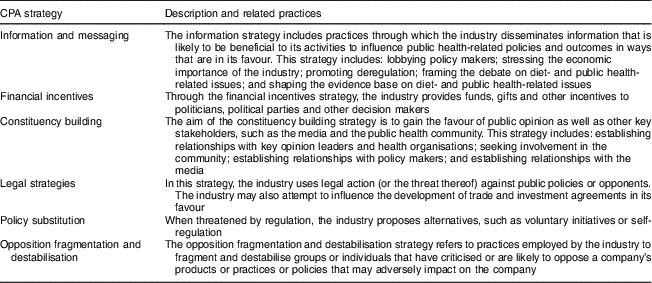
Food industry profits could be threatened if public health measures were implemented, either through regulation or taxation. There is now an increasing recognition that industries use corporate political activity (CPA) to try and mitigate such threats( Reference Mialon, Swinburn and Sacks 9 – Reference Simon 11 ). For example, in Europe, the food industry strongly lobbied against traffic light labelling that would have indicated the healthiness of its food products, resulting in a delay in the development and implementation of the labelling by several years( 12 ). The term ‘corporate political activity’ is used in the literature to describe the strategies used by the food industry to influence public policies and public opinion in ways favourable to the firm, sometimes at the expense of public health( Reference Mialon, Swinburn and Sacks 9 ). In 2015, a framework was published (details are provided in Table 1) for classifying the six political strategies of the food industry: (i) information and messaging; (ii) financial incentives; (iii) constituency building; (iv) legal strategies; (v) policy substitution; and (vi) opposition fragmentation and destabilisation( Reference Mialon, Swinburn and Sacks 9 ). This classification was based on a review that included material from the business literature and from the knowledge developed about CPA practices in the tobacco industry, for which public health researchers had access to internal documents( Reference Mialon, Swinburn and Sacks 9 ).
Description of corporate political activity (CPA) strategies and related practices of the food industry (from Mialon et al. ( Reference Mialon, Swinburn and Sacks 9 ))
Political influence of the food industry in France
We published recently a study that focused on the CPA of the dairy industry in France( Reference Mialon and Mialon 13 ). We found evidence that the dairy industry tried to shape the evidence base on diet- and public health-related issues; was involved, though different initiatives, in the community; and established relationships with health professionals, researchers and policy makers in the French government.
In the light of these findings, experts are increasingly advocating for more transparency and accountability from governments and the food industry( Reference Swinburn, Kraak and Rutter 8 , Reference Sacks, Swinburn and Kraak 14 – Reference Smith, Dorfman and Hawkins 16 ). This could be achieved by increasing the knowledge on the CPA practices used by the food industry. Our approach proposed to identify and monitor CPA at the country level( Reference Mialon, Swinburn and Sacks 9 ). This approach sought to identify publicly available information and was based on previous approaches to monitor the CPA of the tobacco industry( Reference Mialon, Swinburn and Sacks 9 ). For the present study, we implemented this approach for several actors in the food industry in France (the dairy industry was the object of a parallel study), with the aim of identifying evidence, from the public domain, of the CPA strategies and practices used in this country, over a limited period of time.
Methods
Step-by-step approach to identify and monitor corporate political activity
We followed a step-by-step approach to identify the CPA of major food industry actors in France, as proposed by Mialon et al. ( Reference Mialon, Swinburn and Sacks 9 ). The five steps were: (i) selection of food industry actors; (ii) identification of sources of information; (iii) ongoing data collection; (iv) data analysis using the framework presented in Table 1, in an iterative process; and (v) reporting of results for policy action( Reference Mialon, Swinburn and Sacks 9 ).
We used recommendations made in Mialon et al. to select our sample of food industry actors( Reference Mialon, Swinburn and Sacks 9 ). In the present study, we included the most prominent food industry actors in France in terms of market shares (for the year 2013) and from four different sectors, as classified in Euromonitor( 17 ). In addition, we included a major trade association in the food industry. Five actors were selected for the study (in alphabetical order): (i) ANIA (Association Nationale des Industries Agroalimentaires/National Association of Agribusiness Industries), a food trade association; (ii) Coca-Cola, a beverage company; (iii) McDonald’s, a fast-food restaurant chain; (iv) Nestlé, a processed food company; and (v) Carrefour, a supermarket retail chain. In the present paper, we use the term ‘food industry’ to refer collectively to the five food industry actors included in our study.
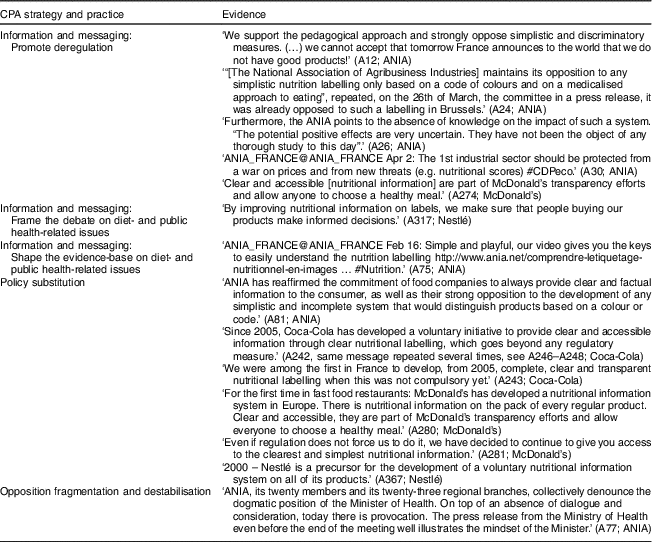
Data collection and analysis were conducted over a six-month period, between March and August 2015. During the period of data collection, there was a discussion between the Ministry of Health and the food industry on a proposed nutrition labelling of food products. We have reported on the practices related to this specific topic in Table 2, for more clarity.
Proposed nutrition labelling of food products in France: corporate political activity (CPA) strategies and practices employed by the sample of five food industry actors during data collection, March–August 2015
ANIA, Association Nationale des Industries Agroalimentaires (National Association of Agribusiness Industries).
Searches were conducted online. Different sources of information, freely accessible to the public, were monitored( Reference Mialon, Swinburn and Sacks 9 ). These sources included the food industry’s own materials, government materials, the media, major professional associations’ materials, and other materials. Details about the specific sources of information included in the present study are provided in the online supplementary material, Supplemental Table 1, and a detailed description of the methods for data collection and analysis is available elsewhere( Reference Mialon, Swinburn and Sacks 9 ). Since data retrieved online could have been posted several years ago, we limited our analysis to information that was published up to 2 years prior to the beginning of data collection, as described by Mialon et al. ( Reference Mialon, Swinburn and Sacks 9 ). We focused, for this research, on the activities of food companies in France only and monitored their national websites only. Therefore, data collected were in French only. Translation from French to English in the present paper was done by M.M. and revised by an English native speaker who teaches French. All data, in their original French version, can be viewed in the online supplementary material, Supplemental Table 2.
Data analysis
Our choice of themes and codes was based on our existing framework for classifying the CPA of the food industry( Reference Mialon, Swinburn and Sacks 9 ). J.M., a French native speaker, led the data collection and analysis. The coding was reviewed by M.M. (100 % of the data; inter-coder validation). Agreement was reached after discussion but was not quantified. No new themes emerged from the study. In the current paper we present illustrative examples of CPA practices (each allocated with an ‘A’ code from Supplemental Table 2).
We took a critical stance when conducting our research. Critical social scientists try to reduce illusions and avoidable suffering in the population( Reference Sayer 18 ). For the present study, the illusion was that the food industry is merely an economic actor, while there is evidence that it also engages in political activities. We considered that the food industry, which sells and markets some products that may be considered as unhealthy, has an inherent conflict of interest in the development of public health policies and programmes that would restrict its activities. The political practices of the food industry were therefore considered to be a potential determinant of health. Our aim was to understand if food industry actors in France used practices that could delay the development and implementation of cost-effective, evidence-based, public health policies and programmes that would prevent and control NCD.
Results
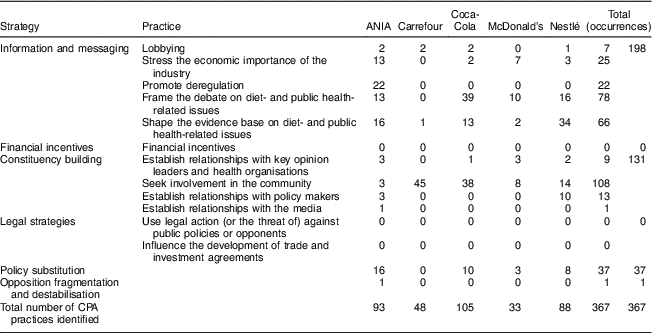
We collected 367 examples of CPA practices during a six-month period (see online supplementary material, Supplemental Table 2). Table 3 presents a summary of these examples, classified thematically using the six categories of the framework.
Summary of corporate political activity (CPA) practices identified for the sample of five food industry actors in France, March–August 2015
ANIA, Association Nationale des Industries Agroalimentaires (National Association of Agribusiness Industries).
Most examples that we identified during data collection were part of the ‘information and messaging’ and ‘constituency building’ strategies, with 198 and 131 examples for each of these strategies, respectively. We also found, to a lesser extent, examples belonging to the ‘policy substitution’ and the ‘opposition fragmentation and destabilisation’ strategies. We did not find data, for the five industry actors selected in our study, related to the ‘financial’ and ‘legal’ strategies. For the financial strategy, this could be explained by the fact that French laws prohibit policy makers and political parties from receiving money from private entities( 19 ).
Information and messaging
Through the ‘information and messaging’ strategy, the food industry selectively produces and disseminates information that would be beneficial to its activities, to influence public policies and public opinion in ways favourable to its companies( Reference Mialon, Swinburn and Sacks 9 ). We collected 198 examples pertaining to this strategy. There are five different types of practices in that strategy: (i) lobbying; (ii) stressing the economic importance of the industry; (iii) promoting deregulation; (iv) framing the debate on diet- and public health-related issues; and (v) shaping the evidence base on diet- and public health-related issues.
Lobby policy makers
During the period of data collection, we found seven examples of lobbying by the five French food industry actors included in our study. When lobbying, the industry tries to promote its interests and influence the decisions of policy makers. In 2015, ANIA officially declared spending between €10 000 and €20 000 in direct lobbying activities in the French Parliament (A60). For the same period, Carrefour was spending at least ten times that amount, with €150 000–200 000 spent on lobbying activities (A139). Coca-Cola and Nestlé used third parties, such as public relations agencies, to lobby on their behalf (A225, A328).
Stress the economic importance of the industry
The food industry actors selected for our study also stressed their economic importance, including the money and the number of jobs they generated for the French economy, on numerous occasions. This could influence the decisions of policy makers, who could favour economic interests over public health goals. We found twenty-five examples of that practice, as illustrated below, during the period of data collection:
‘The food industry in France is the first industry nationally, with, in 2013, a turnover of €160·5 billion, and the first industry employer with 492 727 employees. (…) We represent employment, life, and the future of our territories. The food industry is a strong economic, social and cultural pillar in France.’ (A33; ANIA)
‘The food industry: ultimate strength of the French economy.’ (A37; ANIA)
‘ANIA_FRANCE@ANIA_FRANCE May 10 ANIA_FRANCE retweeted France Diplomatie: A potential to preserve and support (…) The food industry is at the 2nd position for French exports!’ and several other examples. (A42; ANIA)
‘Today, the Coca-Cola Company has five factories through the French territory and contributes, through its local presence, to the development of the French economy.’ (A184; Coca-Cola)
‘An industrial and economic history: €400 million invested since 2007, more than 3000 collaborators, seven factories, two technical centres and an exclusive partnership with a recycling plant near Beaune. More than 90 % of our products consumed in the French population are produced in France from local ingredients.’ (A185; Coca-Cola)
‘McDonald’s France is an important market for French agriculture.’ (A263; McDonald’s)
‘First recruiter in France.’ (A264; McDonald’s)
‘€4876 billion in turnover, more than 16 000 collaborators, twenty-six factories divided into European centres for excellence and local centres for excellence, France has five research centres (…) €200 millions of industrial investments.’ (A309; Nestlé)
Promote deregulation
We found evidence, in our study, that the food industry promoted deregulation when being at risk of having its products or actions regulated (twenty-two examples collected for that practice):
‘We will not be able to mobilise, act, recruit, invest in our businesses, whatever their size is, if we are constantly under threat of new taxes, new regulations.’ (A14; ANIA)
‘News headlines were very intense in the fields of nutrition, regulation and food safety, with the daily involvement of ANIA to prevent the French food industry from being the subject to unjustified constraints that could harm its competitiveness.’ (A16; ANIA)
‘ANIA_FRANCE@ANIA_FRANCE Apr 2: To support the #food #industry, we must simplify the regulatory and economic environment to avoid any distortion of competitiveness.’ (A29; ANIA)
This practice was particularly used during the nutrition labelling discussion in the country, as illustrated in Table 2.
Frame the debate on diet- and public health-related issues
To shift the blame away from its products, the food industry tries to frame the debate on diet- and public health-related issues( Reference Mialon, Swinburn and Sacks 9 ). We collected seventy-eight examples of that practice, including information presented by the industry as part of the nutrition labelling discussion (Table 2). For example, several actors emphasised only the importance of individual choices and individual responsibility, while omitting to mention the role of unhealthy food products in the burden of NCD:
‘Provide a wide range of products, provide the information needed to make the right choices and promote an active lifestyle: the three keys of our commitment as responsible business.’ (A194; Coca-Cola)
‘The international network ÉPODE* (EIN) is the biggest organisation specialised in the prevention of obesity in the world (…) it is based on a positive approach focused on self-image – without stigma of foods or drinks.’ (A200; Coca-Cola)
In addition, the food industry could shift the attention on obesity, rather than on other risk factors and other related NCD, by promoting physical activity programmes and the idea that managing a person’s energy expenditure is as important as limiting his/her energy intake:
‘For Coca-Cola, our commitment to the development of an active lifestyle is a major issue.’ (A189; Coca-Cola)
‘Coca-Cola is making a public commitment to contribute concretely to the prevention of obesity through a global approach based on a balance between the calories in and calories out.’ (A194; Coca-Cola)
‘Coca-Cola has decided to commit to the prevention of childhood obesity and the practice of regular exercise.’ (A201; Coca-Cola)
‘Jo-Wilfried Tsonga [French tennis player] himself will provide #verycool advice to promote an active lifestyle.’ (A206; Coca-Cola)
‘We offer complete and simple information to help everyone make the right choices. Finally, we encourage an active lifestyle and act in the community to encourage young people to practice sports.’ (A207; Coca-Cola)
‘McDonald’s restaurants involved in the promotion of sports through their contributions to the development of local sports associations.’ (A268; McDonald’s)
‘In our restaurants, we have provided play areas so that your children could spend their energy before and after their meal. This is our new generation of playgrounds available for children: they will be able to practice climbing, cycling, basketball or athletics. With virtual routes and stopwatches, they will spend a playful time with sophisticated equipment. Relaxation and fun guaranteed to expend their energy in complete freedom!’ (A271; McDonald’s)
The food industry could also promote its good traits to gain a favourable image in the public opinion:
‘We abandoned our marketing communications in schools and strengthened our educational activities for health and well-being.’ (A316; Nestlé)
Shape the evidence base on diet- and public health-related issues
There is evidence, in the literature, that the food industry could shape the evidence base on diet- and public health-related issues( Reference Mialon, Swinburn and Sacks 9 ). When the industry uses this strategy to protect its interests, this could bias research; compromise the scientific credibility and integrity of the research and researchers, by association; create doubt in science; be misleading; and, eventually, lead to the promotion of unhealthy food products( Reference Mialon, Swinburn and Sacks 9 ). In our study, we found sixty-six examples during which the food industry shaped the evidence base in France, some of which were related to the discussion on nutrition labelling (Table 2). These examples are presented in Table 4.
Mechanisms and illustrative examples of corporate political activity practices used by the sample of five food industry actors to shape the evidence base on diet- and public health-related issues in France, March–August 2015

ANIA, Association Nationale des Industries Agroalimentaires (National Association of Agribusiness Industries).
As illustrated in Table 4, ANIA and Nestlé funded several research projects both nationally and internationally. Carrefour and Nestlé established relationships with scientists and professionals. Coca-Cola disseminated and used evidence that was unpublished or that was not peer-reviewed. ANIA, Coca-Cola, McDonald’s and Nestlé participated in or hosted scientific events. Nestlé has a specific website for health professionals (A354). ANIA and Nestlé also published educational materials for professionals, parents and schools.
The Fonds Français pour l’Alimentation et la Santé (French Fund for Food and Health), whose main mission is the ‘study and enhancement of diet as a source of pleasure and health’ (A70), received, in 2015, some of its funds from ANIA and Coca-Cola France (A72, A237). This organisation had board members from the industry and from the academic/researcher sector( 20 ). During the period of data collection, Nestlé collaborated with the research centre Oqali (Observatoire de la Qualité de l’Alimentation/Food Quality Observatory) (A297). Oqali was set up in 2008 by the Ministries responsible for agriculture, health and consumption. It was jointly implemented by ANSES (French Agency for Food, Environmental and Occupational Health & Safety) and INRA (French National Institute for Agricultural Research)( 21 ). It works in partnership with other actors in the food industry( 21 ).
Constituency building
In our review( Reference Mialon, Swinburn and Sacks 9 ) of corporate practices, we explained that the industry tries to establish relationships with health professionals, key leaders in the community, policy makers and journalists, in its attempts to influence public opinion and public policies and programmes. We found 131 examples of the ‘constituency building’ strategy in France.
Establish relationships with key opinion leaders and health organisations
We found nine examples of the relationships established between the industry and health professionals. McDonald’s, especially, had several connections with health professionals. For example, the McDonald’s Foundation publicised some experts’ testimonies online. One medical doctor, ‘Patrick Lutz, paediatrician, oncologist, and head of the paediatric department at the Hautepierre hospital in Strasbourg’, for example, praises the actions of the Foundation in the hospital where he works: ‘The McDonald’s House represents a significant medical progress’ (A258). Another medical doctor, Martine Cochon, a ‘paediatrician, medical officer in the maternal and child protection service in Paris, board member of the Ronald McDonald’s Foundation’, explains that she engaged with the Foundation as part of her role to prevent and protect childhood (A258).
‘The Ronald McDonald Foundation became, in two decades, a recognised partner in hospitals for its role in helping sick children and their families.’ (A255; McDonald’s)
‘They support McDO KIDS SPORT: The AFPA [Association de Pédiatrie Ambulatoire/Ambulatory Paediatric Association].’ (A259; McDonald’s)
‘McDonald’s innovates for its Happy Meal and launches the project “Wednesdays to chew”. Every first Wednesday of the month; McDonald’s gives children a bag of chewable fruits or chewable pineapple when you buy a Happy Meal. This project seeks to encourage the consumption of fruit in children and is supported the Association des Pédiatres de Ville [AFPA, Association of City Paediatricians].’ (A260; McDonald’s)
Seek involvement in the community
In the present study, we found 108 examples of the food industry’s involvement in the community. There is evidence, in the literature( Reference Mialon, Swinburn and Sacks 9 ), that some of these activities may be considered a way to market its products while shaping public opinion and deflecting criticism away.
‘In 2013, Mécénat France [France Philanthropy] supported forty-three projects, supported thirty recipient charities, eleven national actions in stores.’ (A97; Carrefour)
‘Carrefour wants to help in the fight against inequalities for the access to the most basic need: food. To this end, the foundation organises the most important part of its philanthropic activities around this theme, through different routes such as food donations, the development of solidarity projects but also a promotion of a good and better diet.’ (A121; Carrefour)
‘Being engaged in charities to support beautiful causes is a favoured means for Coca-Cola to build lasting relationships with the community.’ (A153; Coca-Cola)
‘Coca-Cola France, supported by the Comité National Olympique et Sportif Français [French National Olympic and Sports Committee], is committed, since 2008, alongside city councils, to help them develop physical activity programmes for young people.’ (A151; Coca-Cola)
‘The 2015 McDo Kids Sport is coming near you, to teach different Olympic sports to kids aged 5 to 12, for free! (…) [Supported by] Le CNOSF [Comité National Olympique et Sportif Français/French National Olympic and Sports Committee].’ (A257; McDonald’s)
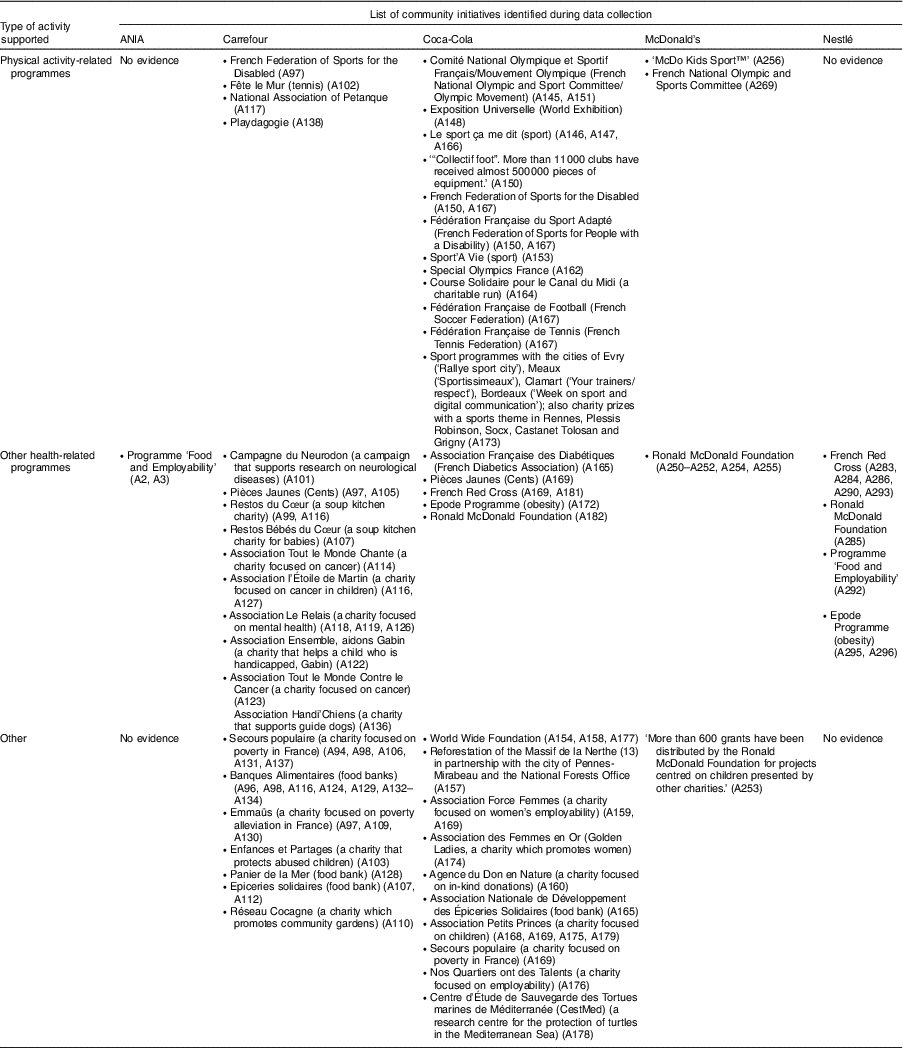
Other examples of initiatives supported by the food industry in France are provided in Table 5. These included the support of physical activity programmes, health-related programmes and charities, particularly those focused on poverty alleviation.
Community initiatives supported by the sample of five food industry actors in France, March–August 2015
ANIA, Association Nationale des Industries Agroalimentaires (National Association of Agribusiness Industries).
Most funds of the Ronald McDonald’s Houses (RMH) were generated through a single event, the Act Big Mac™. For five days, McDonald’s promoted its charity and said that it would give it a certain amount of money for each Big Mac burger sold. This means that the activities of the RMH depended on how many burgers the fast-food restaurant was able to sell during that week: the more people consume, the more money is generated for the charity.
In addition, McDonald’s and Coca-Cola are international partners of the Olympics Games (see Table 5). At the local level, the French National Olympic and Sports Committee supports McDonald’s and Coca-Cola’s physical activity programmes such as McDo Kids Sport (see Table 5).
We also found evidence that Bernadette Chirac, a former first lady, had relationships with the industry through a programme where she raised funds for children in hospitals (‘Pièces Jaunes’/‘Cents’) and she was a recipient of the trophy ‘Femmes de Cœur’ from the Association de Femmes en Or (Golden Ladies; see Table 5).
Establish relationships with policy makers
We found evidence that the food industry in France also established relationships with policy makers (thirteen examples collected for that practice). For example, ANIA and Nestlé were members involved in the working group entitled ‘nutrition policy’ of the Conseil National de l’Alimentation (French National Food Council). The ‘CNA is an independent advisory body, under the auspice of the Ministries of agriculture, health and consumer affairs. It is consulted in the development of food policy and shares its opinions with public decision makers and different stakeholders in the food system, on issues such as food quality, information for consumers, nutrition, food security, food accessibility, risk management’ (A4–A6, A298). We found other examples where the industry tried to establish links with policy makers, directly or indirectly:
‘The Foundation Nestlé France is committed to French food culture, by sponsoring the TV show Eating is voting hosted Périco Légasse [a renowned journalist and food critic, particularly critical of ultra-processed foods; this TV show is broadcast on the French Senate TV channel and invites French senators to meet with people who work in the food system in France( 22 )].’ (A287; Nestlé)
‘During [the International Food Exhibition], we had the pleasure to meet several policy makers at our ANIA booth: François HOLLANDE, Manuel VALLS, Stéphane LE FOLL, Georges-Paul LANGEVIN, François BROTTES or Jean-Claude LENOIR, to only cite a few, and with whom we have shared the values, the commitments and the fears of our companies. All have confirmed their willingness to support the first French industry.’ (A8; ANIA)
‘TV advertising: signature of a new Memorandum of Understanding [MoU]: the new MoU to promote a healthy lifestyle and physical activity in TV shows and TV ads was signed on Thursday 21 November 2013, for a period of 5 years. (…) Six Ministries have signed this MoU: the Ministries of Health and Social Affairs; of Culture and Communication; of Sports and Youth; of Agriculture and Agrobusiness; of Overseas Territories and Education. This document has thirty-three signatories including ANIA, UDA [Union des Annonceurs/Union of Advertisers] and ARPP [Autorité de Régulation Professionnelle de la Publicité/Professional Authority for the Regulation of Advertising].’ (A9; ANIA)
This latest example could also be considered a ‘policy substitution’ strategy, a practice that is discussed in further detail in the section below.
In addition, seven of the ANSES experts declared a conflict of interest with Nestlé: for example, some wrote scientific articles for the company, while others directly provided their expertise to the company (A301–A307).
Although this was not considered a political practice per se, we also found evidence that some French senators own shares in some food companies:
Bonhomme, Francois [senator] is a shareholder in Carrefour and other companies for a total of €103 400. (A142)
Debre, Isabelle [senator] is a shareholder in Carrefour (€2851·71) and Danone (€5081). (A143)
Sutour, Simon [senator] is a shareholder in Carrefour for a total of €1378·80 with a return of €37·20 in 2014. (A144)
Policy substitution
When at risk of having its products regulated, the food industry has tried to propose alternatives, such as self-regulation and voluntary codes of conduct, which are considered as less stringent, but also less effective in preventing and controlling the NCD epidemic( Reference Mialon, Swinburn and Sacks 9 , Reference Knai, Petticrew and Durand 23 ). We found thirty-seven examples of that strategy in France:
‘As part of its actions to be involved in the improvement of a balanced diet, ANIA is committed, through the adoption of rules of ethics, to develop and promote self-regulation when it comes to nutritional and health information on food products.’ (A87; ANIA)
‘A policy to protect children: Coca-Cola has always been committed to have a responsible marketing policy.’ (A245; Coca-Cola)
Nestlé, in particular, said that it was engaged in improving the healthiness of its products, using its own criteria. It is in charge of the implementation, monitoring and evaluation of this initiative:
‘Five key brands, covering two thirds of our turnover … is voluntarily committed, alongside national authorities, through MoU to nutritional improvement signed in 2010 and 2011 as part of the PNNS [National Programme for Nutrition and Health].’ (A365; Nestlé)
‘At the end of 2014, 98 % of our products for kids meet the criteria of the Nestlé Nutritional Foundation applicable to children.’ (A368; Nestlé)
‘Our commitments… Reduce sodium (salt) in our products… Remove sugar in our products… (…) Ensure that 100 % of our products for kids meet the criteria of the Nestlé Nutritional Foundation.’ (A369; Nestlé)
In France, there was evidence that the industry used its voluntary initiatives as a tool against regulation:
‘The new document that seeks to promote a healthy lifestyle and physical activity on TV shows and TV ads was signed on Thursday 21 November 2013 (…) Its introduction says ‘(…) [The companies] are willing to adopt a more ambitious MoU for five years, as long as the regulatory and legal system remains identical to the one in place when the MoU was signed.’ (A82; ANIA)
We found several examples of the ‘policy substitution’ strategy specifically related to the nutrition labelling of food products, and these are presented in Table 2.
Opposition fragmentation and destabilisation
‘Opposition fragmentation and destabilisation’ is a strategy described in the literature when a company attacks individuals or groups of individuals known to be sceptical of the company’s products, practices or policies( Reference Mialon, Swinburn and Sacks 9 ). In one instance, we found during data collection that ANIA criticised the Ministry of Health for being too dogmatic in its approach to the nutrition labelling of food products (A77).
Discussion
The present study reports on the political activity of the food industry in France from a public health perspective. We found 367 examples of CPA practices during the period of data collection (March–August 2015) for five actors of the food industry in France. A majority of these examples belong to the ‘information and messaging’ and ‘constituency building’ strategies. The actors for whom we found the most examples of CPA were Coca-Cola (105 examples), ANIA (ninety-three examples) and Nestlé (eighty-eight examples). The main practice used by Coca-Cola and McDonald’s was framing diet- and public health-related issues, by promoting their role in obesity prevention and in helping individuals to make healthier choices, but also by stressing the importance of physical activity in the prevention and control of obesity. This support of physical activity also translated into an involvement in the community, with several examples where these companies supported physical activity programmes or sports institutions. This practice could confuse the public on the role of ultra-processed food products as obesogenic and diabetogenic, and instead contribute to the belief that NCD prevalence is due to a lack of physical activity; this allows the industry to continue to sell its products. These results are consistent with previous findings about the activities of the same companies in the Western Pacific region( Reference Mialon, Swinburn and Wate 24 , Reference Mialon, Swinburn and Allender 25 ). ANIA primarily used the ‘information and messaging’ strategy, for example by promoting deregulation and shaping the evidence base on diet- and public health-related issues, as well as the ‘policy substitution’ strategy. Nestlé framed diet- and public health-related issues in ways favourable to the company, and shaped the evidence base on diet- and public health-related issues through its provision of small grants to early career researchers, its collaborations with academia and its participation in major scientific events. Again, this reinforces findings our from previous studies of Nestlé’s CPA( Reference Mialon, Swinburn and Wate 24 , Reference Mialon, Swinburn and Allender 25 ). During the period of data collection, Carrefour mainly sought involvement in the community, a practice employed by food retailers in other regions of the globe( Reference Mialon, Swinburn and Wate 24 , Reference Mialon, Swinburn and Allender 25 ).
These findings are consistent with our other publications about the CPA of the food industry, which could be explained by the fact that most actors included in our study are large transnational companies that were also included in previous studies( Reference Mialon, Swinburn and Wate 24 – Reference Mialon, Allender and Swinburn 26 ). Nestlé, for example, continues to try and shape the evidence base on diet- and public health-related issues at the global level, as described in our study. Such companies develop and market ultra-processed food products and might try to contradict evidence suggesting that the level of food processing could be linked with an increased risk of having obesity and suffering from NCD. We note that, in our study, and as with other studies on the CPA of the food industry in the Pacific region and France (focused on the dairy industry only), we found limited evidence of the ‘opposition fragmentation and destabilisation’ strategy and no evidence of the ‘legal’ strategies( Reference Mialon and Mialon 13 , Reference Mialon, Swinburn and Wate 24 , Reference Mialon, Swinburn and Allender 25 ). This could be explained by the fact that the food industry has, so far, successfully built alliances with health professionals, communities and policy makers, and promoted the ‘policy substitution’ strategy in many parts of the world( Reference Mialon, Swinburn and Sacks 9 , Reference Mialon and Mialon 13 , Reference Mialon, Swinburn and Wate 24 – Reference Brownell and Warne 27 ). This could mean that, in France, it has not yet needed to attack its opponents or to challenge regulation in court.
There is currently a need to increase the transparency and accountability of the food industry( Reference Swinburn, Kraak and Rutter 8 , Reference Brownell and Warne 27 , Reference Kraak, Swinburn and Lawrence 28 ) and, by providing evidence of the CPA of the food industry in France, the present study contributes to that objective. More could be learned about the CPA of the food industry if additional information was made available to the public. In France, this would include, for example, a list and all minutes of meetings and correspondence (including emails) between food industry representatives and policy makers and/or representatives of the government. The register of lobbyists could be more detailed and include the topics discussed when lobbying or the number of lobbyists employed by a certain company.
We found that the food industry in France was using, in 2015, practices that were also used by other industries in the past, such as the tobacco and alcohol industries( Reference Moodie, Stuckler and Monteiro 4 , Reference Brownell and Warne 27 , Reference Wiist 29 – Reference Savell, Fooks and Gilmore 32 ). Because most, if not all, of these practices proved detrimental when used by the tobacco industry( Reference Moodie, Stuckler and Monteiro 4 , Reference Brownell and Warne 27 , Reference Wiist 29 – Reference Savell, Fooks and Gilmore 32 ), we propose that the precautionary principle should be guiding decisions when engaging or interacting with the food industry. For example, public health policies could be developed independently, with no interference from food industry actors. Funding of research could be made through independent third parties, who could manage funds received from taxes or money directly received from the industry, and who would then decide on the types of projects to be funded. Charities, professionals’ organisations and universities could have their own policies for engaging with food industry actors.
The current study has several limitations, which have been stressed in previous studies( Reference Mialon and Mialon 13 , Reference Mialon, Swinburn and Wate 24 , Reference Mialon, Swinburn and Allender 25 ) that have implemented the same approach to identify the CPA of the food industry.
First, the practices presented herein reflect only the information that is readily available in the public domain. The industry might also seek to influence public opinion, health professionals, journalists and policy makers in more subtle ways, such as through the provision of free lunches or the distribution of gifts at conferences. We were not able to collect that type of information. We also selected a limited number of sources for our data collection( Reference Mialon, Swinburn and Sacks 9 ), which means that we could have missed some practices if they were disclosed on other websites (such as third parties’ website, including public relations or communication companies, or front groups). Previous research( Reference Mialon, Swinburn and Wate 24 , Reference Mialon, Allender and Swinburn 26 ) included interviews with key informants from and outside the food industry. That could be replicated and triangulated with our findings for France.
There is also the possibility that the practices described herein are no longer in use and that the food industry has developed other practices since then. Changes of practices over time should therefore be monitored. It could be expected that the food industry in France, for example, now makes greater use of the ‘policy substitution’ strategy in the light of the recent dialogue on nutrition labelling on food products.
In addition, we proposed here an examination of CPA practices from a public health perspective. Many of the practices described in the present paper, such as the involvement of the food industry in the community, or the use of the ‘policy substitution’ strategy, are a normal part of any business activity and are usually promoted as corporate social responsibility. Many are legitimate activities and some are even promoted by the UN( 33 ). We should not forget, however, that many of these activities served only to distract opponents and influence decision makers in the case of the tobacco industry and tobacco control( Reference Fooks, Gilmore and Collin 34 – 36 ).
Finally, we collected data at a specific point in time, confined to the French language, and we focused on five food industry actors only. Further studies should investigate the use of these practices over time, as well as the practices of other companies.
More investigation is needed to understand if the practices presented in the current paper have an influence on public opinion, public health policies and programmes and, in the long term, a negative impact on the health of the French population.
Conclusion
In conclusion, we found many examples of the CPA of the food industry in France. While there are cost-effective solutions for the prevention and control of NCD, these diseases continue to increase dramatically( 37 ). There is increased recognition, globally, that the practices of the food industry may contribute to this problem( Reference Mialon, Swinburn and Sacks 9 ). There is, in parallel, a risk that the government could favour the economic importance of the industry to the detriment of health. An inherent conflict exists between the food industry, whose main legal goal is to increase its profits, and public health, whose main goal is to prevent and control NCD, which would include a restriction on the availability, affordability and accessibility of some products sold by these same companies. The information presented in the current study sheds light on what could be otherwise seen as innocuous practices of the food industry. The study could contribute to the increased knowledge of these issues not only for the general population, but also among public health professionals and policy makers.
Acknowledgements
Financial support: M.M. was supported by the São Paulo Research Foundation (FAPESP), Brazil (grant number 2017/24744-0). The authors are solely responsible for the opinions, hypotheses and conclusions or recommendations expressed in this publication, and they do not necessarily reflect FAPESP vision. Conflict of interest: None. Authorship: M.M. participated in the formulation of the research question and design of the study, supervised data collection and analysis, and drafted the manuscript. J.M. participated in the design of the study, carried out the data collection and analysis, and critically reviewed the manuscript. Ethics of human subject participation: Not applicable.
Supplementary material
To view supplementary material for this article, please visit https://doi.org/10.1017/S1368980018001763



