





Highlights
-
• We use two different analysis approaches: continuous and dichotomous
-
• We examine the visual and auditory modalities of language processing
-
• L2 proficiency and AoA affect visual and auditory inhibition, respectively
-
• Bilingualism mainly influences S-S inhibition, not S-R inhibition
-
• Results underscore the value of continuous over dichotomous bilingual measures
1. Introduction
The question as to whether bilingual experience benefits individuals in terms of certain aspects of executive function has received much attention in recent years (Bialystok, Reference Bialystok2017; Paap et al., Reference Paap, Johnson and Sawi2014, Reference Paap, Johnson and Sawi2015; Valian, Reference Valian2015). Cognitive effects associated with bilingualism have been reported across the lifespan (from infancy to older age) with speakers of diverse language pairs (from Chinese-English to German-English) on a variety of executive function tasks (e.g., Stroop, Simon and Flanker tasks; see reviews in Bialystok et al., Reference Bialystok, Craik and Luk2012, Kroll et al., Reference Kroll, Dussias, Bice and Perrotti2015). These benefits are assumed to stem from bilinguals’ lifelong experience in managing the simultaneous activation of their two languages, especially when switching between languages, selecting a target language and inhibiting the non-target language (Bialystok et al., Reference Bialystok, Craik, Green and Gollan2009; Costa et al., Reference Costa, Hernández and Sebastián-Gallés2008; Thierry & Wu, Reference Thierry and Wu2007). However, failures to replicate the abovementioned effects have raised concerns regarding the reliability and robustness of the bilingual effects (Paap et al., Reference Paap, Johnson and Sawi2014, Reference Paap, Johnson and Sawi2015).
The controversy regarding the bilingual effects might be primarily rooted in oversimplified comparisons between monolinguals and bilinguals, often overlooking the complexity and diversity within the bilingual population. Moreover, the lack of replication in research findings might be attributed to overlooking the within-group heterogeneity of bilingualism, as highlighted in Reference Bak, Long, Vega-Mendoza and SoraceBak (2016a). Bilingualism is a multifaceted experience encompassing the continual management of two languages, which demands cognitive resources for language control processes. In the study of bilingualism, two fundamental constructs are L2 proficiency and L2 AoA. L2 proficiency directly impacts how bilinguals manage interference between languages during language control processes. Meanwhile, L2 AoA signifies the age at which individuals first started using their second language, shaping their cognitive flexibility and language processing abilities over time. The two variables are critical for understanding how bilinguals’ language experience influences cognitive functions. The current study emphasised the significance of within-group heterogeneity, aiming to explore how specific facets of bilingualism influence different aspects of executive control. This investigation is contexed within the theoretical and methodological frameworks of previous research (Bak, Reference Bak2016a; Bialystok, Reference Bialystok2020). Specifically, we used two different analysis approaches (i.e., continuous versus dichotomous) to examine the impacts of L2 proficiency and L2 AoA on cognitive control in young adult bilinguals. We aim to serve as a methodological contribution to understanding the cognitive consequences of bilingual experience from diverse bilingual experiences.
1.1. The role of language experience in bilingualism
Language proficiency is a core aspect of bilingualism (Mishra, Reference Mishra2015). A growing body of evidence has demonstrated that higher proficiency in the second language (L2) predicts better executive control, including attentional monitoring (Singh & Mishra, Reference Singh and Mishra2015), reactive inhibition (Khare et al., Reference Khare, Verma, Kar, Srinivasan and Brysbaert2013), endogenous disengagement of attention in Hindi-English adults (Mishra et al., Reference Mishra, Hilchey, Singh and Klein2012), conflict monitoring in Chinese-English adults (Xie & Pisano, Reference Xie and Pisano2019) and auditory inhibition and switching in English-Spanish adults (Vega-Mendoza et al., Reference Vega-Mendoza, West, Sorace and Bak2015). In contrast, other studies have reported no effects of language proficiency on executive control (Dong & Xie, Reference Dong and Xie2014; Rosselli et al., Reference Rosselli, Ardila, Lalwani and Vélez-Uribe2016; Verreyt et al., Reference Verreyt, Woumans, Vandelanotte, Szmalec and Duyck2016). For instance, Verreyt et al. (Reference Verreyt, Woumans, Vandelanotte, Szmalec and Duyck2016) compared three groups of bilinguals differing in language proficiency and switching experience (i.e., unbalanced versus balanced non-switching versus balanced switching bilinguals) performing the Flanker and Simon tasks. The distinction between balanced and unbalanced bilinguals lies in their language proficiency levels: balanced bilinguals exhibit high proficiency in both languages, while unbalanced bilinguals have lower proficiency in their L2. The primary difference between balanced non-switching bilinguals and balanced switching bilinguals pertains to the frequency of language switching, with balanced switching bilinguals engaging in frequent language switching. The results showed better executive performance in the switching bilinguals than in non-switching bilinguals but no group differences between unbalanced and balanced switching bilinguals. This indicates that high proficiency in L2 enhances the impact of language-switching experience on executive control. Conversely, when accounting for language-switching frequency, L2 proficiency alone does not predict differences in cognitive performance between the two groups. Given that the level of language proficiency may dynamically change with specific learning experiences (e.g., consistent language learning, daily language use and language switching frequency), it could be possible that the emergence of monolingual-bilingual group differences was only observed when bilinguals reached a relatively high level of proficiency (Vega-Mendoza et al., Reference Vega-Mendoza, West, Sorace and Bak2015; Xia et al., Reference Xia, Bak, Sorace and Vega-mendoza2022).
The age of acquisition (AoA) of L2 is another crucial factor for understanding the consequences of bilingualism at the behavioural level (Kousaie et al., Reference Kousaie, Chai, Sander and Klein2017; Luk et al., Reference Luk, De Sa and Bialystok2011; Yow & Li, Reference Yow and Li2015) as well as the neuroanatomical level (Gullifer et al., Reference Gullifer, Chai, Whitford, Pivneva, Baum, Klein and Titone2018; Sulpizio et al., Reference Sulpizio, Del Maschio, Fedeli and Abutalebi2020). Existing evidence on the role of L2 AoA in modulating executive control is limited and mixed: some studies suggest that early L2 AoA is associated with better inhibitory control (Kousaie et al., Reference Kousaie, Chai, Sander and Klein2017; Luk et al., Reference Luk, De Sa and Bialystok2011) and attentional monitoring (Kapa & Colombo, Reference Kapa and Colombo2013), other studies report an opposite pattern (Tao et al., Reference Tao, Marzecová, Taft, Asanowicz and Wodniecka2011), and yet others find null results (Pelham & Abrams, Reference Pelham and Abrams2014). While these studies found that bilingualism influences visual attention, Bak et al. (Reference Bak, Vega-Mendoza and Sorace2014) reported similar effects of AoA on auditory attention: early bilinguals showed the greatest benefit from bilingualism in the attention-switching task, whereas late bilinguals primarily benefited in the inhibition task. It could be possible that the late bilinguals exercise stronger inhibitory control on the L1 at least in the early stages of L2 learning, which leads to improved inhibitory control.
It is worth noting that the definitions of “early” and “late” bilinguals varied across studies, which might account for these mixed findings. For example, Luk et al. (Reference Luk, De Sa and Bialystok2011) divided college-aged bilinguals into early versus late based on the age at which bilinguals started actively using two languages (i.e., using both languages daily) before or after the age of 10 years. They found that early bilinguals performed the best in the Flanker effect with no difference between monolinguals and late bilinguals. Tao et al. (Reference Tao, Marzecová, Taft, Asanowicz and Wodniecka2011) defined the age of onset of bilingualism based on the age at which bilinguals are immersed in the L2 environment. Bilinguals consisted of those who arrived in English-speaking countries at or before the age of 6 (i.e., early bilinguals) or at or after the age of 12 (i.e., late bilinguals). The results were mixed: early bilinguals showed more efficient monitoring (as indexed by overall RTs) than late bilinguals; the ERP measures showed better conflict resolution for late bilinguals than for monolinguals; when controlling for the language proficiency and language usage, there were no differences between early and late bilinguals. Pelham and Abrams (Reference Pelham and Abrams2014) categorised bilinguals as early or late bilinguals based on the age at which they became fluent in their L2. They categorised early bilinguals as those who became fluent in L2 no later than the age of 7 and late bilinguals as those who became fluent in L2 no earlier than the age of 13. The results found a comparable performance between early and late bilinguals. Although not explicitly, most studies used the six years of age as the cut-off age to define early and late bilinguals (see details discussion in Cargnelutti et al., Reference Cargnelutti, Tomasino and Fabbro2019). Given the differences in definitions and age of AoA cut-offs, the AoA in bilingualism is better treated as a continuum (Yow & Li, Reference Yow and Li2015).
Additionally, other aspects of the bilingual experience have been reported to affect executive control, including the similarity between language pairs, referred to as linguistic distance (Coderre & Van Heuven, Reference Coderre and van Heuven2014; Ljungberg et al., Reference Ljungberg, Elbe and Sörman2020; Yang et al., Reference Yang, Yang and Hartanto2017), and the intensity of daily usage of each of the two languages (Luk & Bialystok, Reference Luk and Bialystok2013; Pot et al., Reference Pot, Keijzer and de Bot2018), and the interactional contexts in which both languages are used (e.g., code-switching; Green & Abutalebi, Reference Green and Abutalebi2013; Hofweber et al., Reference Hofweber, Marinis and Treffers-Daller2020; Ooi et al., Reference Ooi, Goh, Sorace and Bak2018). The heterogeneity of bilingualism arises from the interplay of these diverse factors, each contributing uniquely to the complexity of the bilingual experience. Our study, while focusing on specific facets (i.e., L2 AoA and proficiency), acknowledges the interconnectedness and dynamic nature of these variables within the broader context of bilingualism.
Given that bilingualism is a multidimensional, continuous, and dynamic phenomenon, it cannot be assumed that the differences in cognitive performance between monolinguals and bilinguals with diverse language experience can be consistently observed (Bak, Reference Bak2016a). Disentanglement of how each of the aspects selectively affects executive control in a single study is challenging and often impossible. Among the various aspects of bilingualism, both L2 proficiency and L2 AoA are critical variables to understanding the influence of language acquisition and language control on executive control. Bilingual individuals continually engage in the ongoing monitoring of their two languages, a process that demands the selection of the target language while concurrently inhibiting the non-target language. The level of L2 proficiency is presumed to directly impact the degree of interference experienced within the individual’s primary language during language control processes. Moreover, L2 AoA refers to the onset age when an individual was initially exposed to or immersed in using their L2. It signifies the duration of simultaneous exposure to two languages and the development history of using both languages. Consequently, L2 AoA assumes a significant role in modulating the extent of executive control. Therefore, examining the two facets of bilingualism can provide valuable insights into how bilinguals manage and process language information shedding light on the nuanced interplay between the bilingual experience and cognitive processes.
1.2. Different statistical analysis approaches in bilingualism
Recently, researchers have highlighted the limitations of grouping heterogeneous linguistic profiles into a dichotomous classification (e.g., early versus late; high-proficient versus low-proficient; balanced versus unbalanced), as it might obscure the impact of critical aspects of bilingual experience on cognitive control (Chung-Fat-Yim et al., Reference Chung-Fat-Yim, Sorge and Bialystok2020; DeLuca et al., Reference DeLuca, Rothman, Bialystok and Pliatsikas2019; Grundy et al., Reference Grundy, Pavlenko and Bialystok2020; Sulpizio et al., Reference Sulpizio, Del Maschio, Fedeli and Abutalebi2020, Thomas-Sunesson et al., Reference Thomas-Sunesson, Hakuta and Bialystok2018). The dichotomous analysis approach is complicated by a variety of confounding variables (i.e., social, environmental and educational factors) at the individual and group levels, all of which can potentially affect cognitive performance and lead to mixed findings (Bak, Reference Bak2016b).
Indeed, the mixed results reported in previous research could be partly due to the statistical analysis used. Different approaches to conceptualising bilingualism, whether treated as a continuous or dichotomous variable, may lead to distinct results and different interpretations regarding the cognitive effects of bilingualism. For example, Grundy et al. (Reference Grundy, Pavlenko and Bialystok2020) used a multivariate event-related potential (ERP) investigation to examine the influence of bilingualism on the disengagement of attention in the inhibition of return (IOR) paradigm. They used language proficiency as a dichotomous variable (i.e., high-proficient versus low-proficient bilinguals) to analyse and found no reliable group differences. However, using language proficiency as a continuous variable revealed that higher language proficiency predicted more rapid disengagement of attention. Therefore, the different statistical analysis approaches across studies could be one of the reasons for the inconsistency of the bilingual effects in the literature.
This specific example serves as a compelling illustration highlighting the importance of considering bilingualism as a continuous variable rather than relying on oversimplified monolingual-bilingual comparisons. The choice of statistical analysis approaches across studies could be a key factor contributing to the inconsistency of bilingual effects documented in the literature. The inherent complexity of bilingual experiences demands a more nuanced approach, one that recognises the diverse linguistic backgrounds, varying degrees of language proficiency, and the multifaceted language use patterns among bilingual individuals. Embracing bilingualism as a continuous variable rather than a categorical distinction enables researchers to capture the spectrum of bilingual proficiency and the dynamic interplay between languages. This shift in approach may provide more comprehensive insights into the true nature and impact of bilingualism on cognitive processes.
1.3. The stimulus–stimulus and stimulus–response types of tasks
Another potential reason behind the inconsistency of the bilingual effect in the literature could be due to the variations of the selected cognitive tasks across studies (Valian, Reference Valian2015). The cognitive processes required to perform different tasks differ from each other, as is reflected in the different patterns of brain activations (Kousaie & Phillips, Reference Kousaie and Phillips2012). More specifically, different tasks differ in the source of conflicts; that is, Stimulus–Stimulus (S-S) conflicts versus Stimulus–Response (S-R) conflicts (Blumenfeld & Marian, Reference Blumenfeld and Marian2014; Hilchey & Klein, Reference Hilchey and Klein2011; Wang et al., Reference Wang, Li, Zheng, Wang and Liu2014).
Blumenfeld and Marian (Reference Blumenfeld and Marian2014) hypothesised that bilingualism might engage S-S cognitive control mechanisms more than S-R mechanisms. They conducted two experiments comparing monolinguals to bilinguals on two non-linguistic tasks (i.e., Stroop task versus Simon task) tapping into the two types of conflict. Specifically, the S-S conflict in the Stroop task was created by two stimulus dimensions: arrow direction (i.e., leftward-facing versus rightward-facing) and location (i.e., left versus right). The S-R conflict in the Simon task was created by irrelevant stimulus dimension (i.e., upward-pointing versus downward-pointing) and response dimension (i.e., left-key press versus right-key press). The results confirmed their hypothesis that bilinguals would demonstrate a more efficient Stroop performance than Simon performance. They explained that the activation of S-S inhibition appears to be a predominant mechanism in comprehension and production. This mechanism arises due to the cross-linguistic co-activation and competition at the lexical level. Conversely, S-R inhibition might be limited to production contexts where both languages remain active until the response stage.
Recently, empirical studies have been increasingly conducted to examine the role of S-S inhibition versus S-R inhibition in bilingual language control. Wu et al. (Reference Wu, Struys and Lochtman2019), for example, found that Uyghur-Chinese bilinguals showed a trade-off strategy in inhibition during an S-S conflict (Flanker task) but not an S-R conflict (Simon task). This finding suggests that inhibition during an S-S conflict contributes significantly to the mechanism of bilingual language control. Moreover, Xia et al. (Reference Xia, Bak, Sorace and Vega-mendoza2022) compared English monolinguals to bilinguals on both S-S tasks (i.e., ANT) and S-R tasks (i.e., Number Stroop task and Simon task) and observed group differences in tasks involving S-S conflict, but not S-R conflict. While it is acknowledged that S-R inhibition may be observed in the comparisons between monolinguals and bilinguals, the consensus from these studies underscores the heightened frequency and significance of S-S inhibition in bilingual language control. This is particularly evident in scenarios where selecting the target language while inhibiting interference from the non-target language. Consequently, it is proposed that S-S inhibition is more likely to account for bilingual competition. Green’s Inhibitory Control model (Reference Green1998) provides a theoretical foundation for S-S inhibition in bilingualism. The model posits competition between languages at the level of word representations (stimuli–stimuli; S-S), which aligns with the phenomenon of automatic activation of cross-language counterparts during bilingual processing. This framework suggests that bilinguals actively suppress non-target language representations during language selection. Consequently, the IC model predicts a stronger role for S-S inhibition, compared to S-R inhibition, in explaining the observed bilingual effects. However, Paap et al. (Reference Paap, Anders-Jefferson, Mikulinsky, Masuda and Mason2019) reported comparable performance between 104 bilinguals and 62 monolinguals in four non-linguistic tasks with varied S-S and S-R competitions, namely, the Simon, Spatial Stroop, Vertical Stroop and Flanker tasks. Therefore, it is unclear whether the differences among interference tasks would influence the emergence of the effects of bilingualism.
1.4. The current study
The current study focusses on how L2 proficiency and L2 AoA modulate different aspects of executive control while considering different interference tasks and statistical analyses that could lead to different results. We used two different analysis approaches (i.e., continuous versus dichotomous) to investigate these effects in young adult bilinguals with diverse linguistic profiles. The predictions were as follows:
1) If it is assumed that a higher level of L2 proficiency will elicit stronger interference in the first language than lower L2 proficiency and early AoA indicates a long history of using two languages (Bak et al., Reference Bak, Vega-Mendoza and Sorace2014; Lehtonen et al., Reference Lehtonen, Soveri, Laine, Järvenpää, De Bruin and Antfolk2018; Vega-Mendoza et al., Reference Vega-Mendoza, West, Sorace and Bak2015), then a greater degree of bilingualism (i.e., higher level of L2 proficiency and earlier L2 AoA) will be associated with better executive performance (e.g., better inhibition);
2) If the continuous measure of bilingualism is more sensitive than the dichotomous measure in detecting the cognitive consequences of bilingualism (Grundy et al., Reference Grundy, Pavlenko and Bialystok2020), then the relationship between bilingual experience and cognitive control will be more likely to be found using the continuous measure, not using the dichotomous measure;
3) If S-S inhibition is more frequently involved in bilingual language control and is more likely to account for the bilingual effect (Blumenfeld & Marian, Reference Blumenfeld and Marian2014; Xia et al., Reference Xia, Bak, Sorace and Vega-mendoza2022), then the effects of bilingualism are more likely to be detected in the S-S competition task (i.e., ANT) than in the S-R competition task (i.e., Stroop and Simon tasks).
The selection of the experimental tasks also considers the fact that language learning involves multiple fundamental and interactive attention domains, such as visual (i.e., reading and writing) and auditory ones (i.e., speaking and listening). Furthermore, a growing number of studies have demonstrated positive cognitive effects associated with bilingualism that extend from the visual domain to the auditory domain (Bak et al., Reference Bak, Long, Vega-Mendoza and Sorace2016; Bak et al., Reference Bak, Vega-Mendoza and Sorace2014; Ooi et al., Reference Ooi, Goh, Sorace and Bak2018; Vega-Mendoza et al., Reference Vega-Mendoza, West, Sorace and Bak2015; Xia et al., Reference Xia, Bak, Sorace and Vega-mendoza2022). Hence, the current study also adopts the Test of Everyday Attention (TEA) from previous studies as a measure of cognitive control in the auditory domain.
2. Method
2.1. Participants
A total of 246 participants from the psychology undergraduate volunteer pool at the University of Edinburgh, UK, participated in the experiment for course credit. Most of them were first-year undergraduates (1st year: 172; 2nd year: 59; 3rd year: 12; 4th year: 1); due to the variability of chronological age, six were excluded as outliers due to age over 27.Footnote 1 One participant who did not report L2 proficiency was excluded. The authors assert that all procedures contributing to this work comply with the ethical standards of the relevant national and institutional committees on human experimentation and with the Helsinki Declaration of 1975, as revised in 2008. The study was approved by the Psychology Ethics Committees from the University of Edinburgh.
Among the remaining 239 participants (M age = 19.05, age range: 18–24), 115 participants had English as their first language (L1) and had learnt one of the following languages as their main second language (L2): Afrikaans (1), Malay (2), Mandarin Chinese (14), Danish (2), French (47), German (9), Greek (1), Hebrew (1), Indonesian (1), Italian (2), Japanese (3), Korean (1), Norwegian (1), Russian (3), Slovak (1), Spanish (23), Swedish (1) and Welsh (2). The remaining 124 participants had English as their main L2 and their L1s was one of the following languages: Afrikaans (1), Arabic (2), Bulgarian (1), Mandarin and Cantonese (50), Danish (2), Darija (1), Dutch (2), Finnish (2), French (4), German (6), Greek (4), Hindi (2), Italian (5), Japanese (1), Korean (2), Lithuanian (1), Malay (2), Malayalam (1), Norwegian (1), Polish (5), Portuguese (2), Pashto (1), Romanian (1), Russian (1), Slovenian (1), Spanish (7), Swedish (4), Turkish (1), Urdu (1), Vietnamese (1) and Welsh (1). Regarding the immigration experience, among the 239 participants, 138 participants immigrated to the UK for higher education and 101 participants did not have any immigration experience.
Following Grundy et al. (Reference Grundy, Pavlenko and Bialystok2020), we divided individuals into two groups based on L2 proficiency, creating by averaging self-rated L2 proficiency (i.e., the sum score of four sub-categories of language: reading, writing, speaking and listening) and then doing a median split (Mdn = 12): high-proficient group (High proficient group: n = 138, M proficiency = 14.05) and low-proficient group (Low proficient group: n = 101, M proficiency = 7.79). Following the previous study (Cargnelutti et al., Reference Cargnelutti, Tomasino and Fabbro2019), we used six years of age as the L2-AoA cut-off point (i.e., participants with an age lower than or equal to 6 years are early bilinguals) and divided bilinguals into early bilinguals (n = 102, M AoA = 3.96) and late bilinguals (n = 137, M AoA = 10.11). In the last decades, there has been an ongoing discourse on determining the AoA cut-off. While some advocate the puberty period, attributing it to the maturation of language skills, others propose a critical age around 6–7 years when the acquisition of certain linguistic skills becomes challenging. Although there is no universal consensus, many studies adopt six years of age as the AoA cut-off point for analysis. In the current study, many bilingual individuals commence significant exposure to their L2 upon entering school at approximately age 6. This early immersion could exert a profound influence on their language development and cognitive processes. Therefore, we have chosen to adopt six years of age as the Age of Acquisition (AoA) cut-off in this investigation.
2.2. Background measures
2.2.1. The Raven’s advanced progressive matrices (APM)
The APM (Raven & Foulds, Reference Raven and Foulds1962) was used as a control of nonverbal general intelligence. We adopted Set I (i.e., Item 5 and Item 7) as practice and Set II as experimental testing with a total of 36 items. The design of the Matrices ensures that the demand of the level gradually increases with the items. The participants were instructed to complete the matrices item by item in 10 minutes and told that if they were having difficulty with a specific item, they could guess the answer and proceed to the next. They started with Item 1 and had to accurately answer as many items as they could. The results were scored as the number of correct items for each participant.
2.2.2. Corsi tapping task (CTT)
The Corsi Tapping task (Wechsler Memory Scale-III, Wechsler, Reference Wechsler1997) was administered as a measure of working memory (forward and backward conditions), to match basic cognitive abilities among the participants (Luo, Luk, & Bialystok, Reference Luo, Luk and Bialystok2010). This task was presented on a plastic whiteboard (27.5 cm × 21 cm) with 10 blue cube-shaped numbered blocks (3 cm × 3 cm; from 1 to 10). During the testing, the board was placed between the experimenter and the participant, and the numbers were only visible to the experimenter. In the forward condition, the experimenter tapped a sequence of blocks at a rate of approximately one second per block in a predetermined order and participants had to reproduce the tapping sequence with the same blocks and same order. In the backward condition, all procedures were the same except that the participants had to reproduce the tapping in reverse order. There were eight items in both the forward and backward conditions, varying from two two-block trials to two nine-block trials. Accuracy was calculated as the percentage of correct trials.
2.2.3. Questionnaire
Participants completed a questionnaire, including demographic and language-related information. Consistent with the previous study (Xia et al., Reference Xia, Bak, Sorace and Vega-mendoza2022), using 4-point scales (i.e., 1–4, marked from “poor” to “excellent”), participants rated their speaking, understanding, reading and writing skills in all languages they had learntFootnote 2. Factors that have previously been reported as confounding variables that highly correlate with cognitive performance were also collected, including socioeconomic status (SES indexed as the average education level; Xie & Pisano, Reference Xie and Pisano2019), immigration statusFootnote 3 (Paap et al., Reference Paap, Johnson and Sawi2015), musical experience (Bialystok & DePape, Reference Bialystok and DePape2009) and video game experience (Bialystok, Reference Bialystok2006). The latter three variables were reported by the participants through yes/no questions.
2.3. Experimental tasks
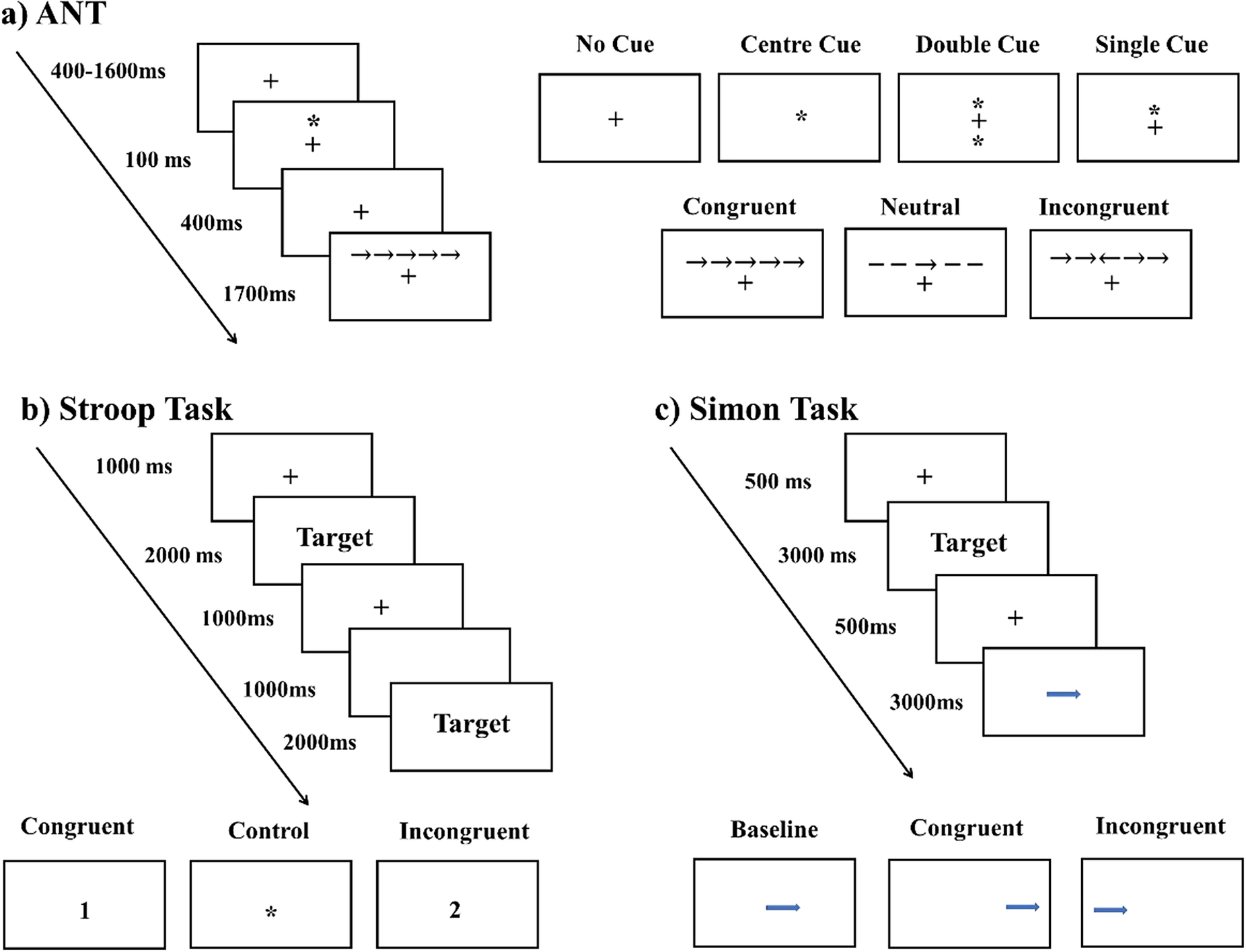
To investigate the role of conflict type in modulating bilinguals’ performance on interference tasks (i.e., S-S versus S-R conflicts), we employed three non-linguistic interference tasks: The Attention Network Task (ANT; Costa et al., Reference Costa, Hernández and Sebastián-Gallés2008) taps into S-S inhibition, while the Number Stroop task (adapted from Hernández et al., Reference Hernández, Costa, Fuentes, Vivas and Sebastián-Gallés2010) and the Simon task tap into S-S conflict (Xia et al., Reference Xia, Bak, Sorace and Vega-mendoza2022). While the three tasks were used to measure visual attention, the auditory Elevator subtests of the Test of Everyday Attention (TEA) were employed to measure auditory attention control. Importantly, the four tasks were widely used in previous studies on the cognitive effects of bilingualism. In the three computerised tasks (i.e., the ANT, Stroop, and Simon tasks), all stimuli were presented on E-Prime (version 2.0) on a 17-inch computer screen. Figure 1 shows a schematic representation of the three tasks.
Schematic representation of the three RT-based interference tasks: (A) ANT; (B) the Number Stroop task; and (C) the Simon task.
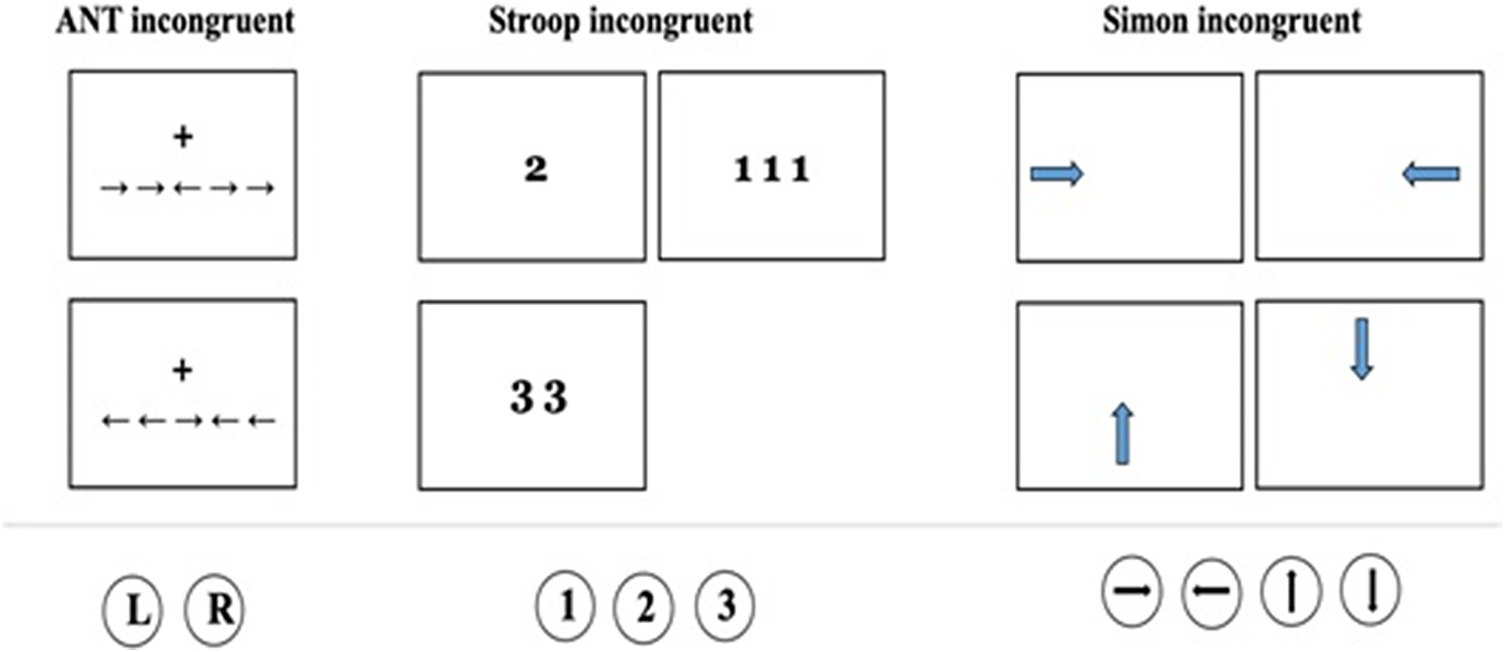
The ANT, Stroop and Simon tasks vary in conflict resolution in incongruent trials, reflecting different conflict sources. The ANT reflects the S-S conflict that stems from the same stimulus category (i.e., leftward-facing versus rightward-facing), while the Stroop and Simon tasks reflect the S-R conflict that stems from competition between the task-relevant (i.e., number of digits in the Stroop task and the direction arrow pointed in the Simon task), task-irrelevant stimuli and response tendencies (Tiego et al., Reference Tiego, Testa, Bellgrove, Pantelis and Whittle2018). Figure 2 illustrates a visual representation of the three tasks that involve S-S and S-R conflicts.
Illustration of the three RT-based non-linguistic cognitive tasks used in the present study. The top panel shows the incongruent conditions in each task, and the bottom panel shows the possible alternative responses in each task.
2.3.1. Attention network task (ANT)
This task is a well-established assessment of attentional capacities, that is, alerting, orienting and inhibition (Fan et al., Reference Fan, McCandliss, Sommer and Posner2002) and has been widely used to investigate the cognitive effects of bilingualism (e.g., Costa et al., Reference Costa, Hernández and Sebastián-Gallés2008; Ooi et al., Reference Ooi, Goh, Sorace and Bak2018; Xia et al., Reference Xia, Bak, Sorace and Vega-mendoza2022). We used it to measure S-S conflict effects in the current study. Participants were instructed to respond to the central arrow of the five horizontal arrows presented in the middle of the screen either below or above a fixation cross by clicking the mouse (i.e., left and right). In congruent conditions (e.g., →→→→→), the five arrows pointed in the same direction. In incongruent conditions (e.g., →→←→→), the central arrow conflicted with the other arrows, creating interference. Before the presence of arrows, there are four types of cue (i.e., *) signalling the forthcoming appearance or locations of the arrows (i.e., above or below the cross): the centre cue (i.e., cue is presented on the cross), the double cue (i.e., two cues are presented both above AND below the cross), the single cue (i.e., solely one cue presented either above OR below the cross) and no cue (i.e., the absence of any cue). While the centre and double cues signify that the arrows will be presented soon, the single cue specifies the location where the arrows will appear.
Three attentional indices were obtained calculating the difference in RTs/Accuracy rate between the following trials: ANT conflict (congruent versus incongruent trials); ANT alerting (double-cue versus no-cue trials); ANT orienting (centre-cue versus single-cue trials). Participants started with a practice block consisting of 24 trials followed by three experimental blocks of 96 trials each. All stimuli were presented randomly at an equal number of times in each block (i.e., 32 trials for each Flaker type and 24 trials for each Cue type). Participants could take a break between the blocks and press the “SPACE” key to continue. Feedback on performance was only provided in the practice block.
2.3.2. Number Stroop task
To avoid any linguistic influence, we used a numerical version of the Stroop task adapted from Hernández et al. (Reference Hernández, Costa, Fuentes, Vivas and Sebastián-Gallés2010), which was intended to measure the effects of the S-R conflict in the current study. Participants were asked to count digits or symbols presented in the centre of the screen by pressing the keys 1, 2, or 3 on the keyboard while ignoring the numerical value of the digits. In the congruent condition (e.g., 22), the numerical value matched the number of digits. In the incongruent condition (e.g., 222), the correct response conflicted with the numerical value. The Stroop effect was assessed by the RTs and accuracy differences between incongruent and congruent trials (Stroop, Reference Stroop1935). Participants received a practice block with 18 trials which were followed by two experimental blocks of 90 trials each. All trials were mixed and randomly presented at an equal number of times in each block (i.e., 30 trials for each Stroop type). Participants could take a break between the two experimental breaks and press the “Space” key to continue. Feedback on performance was only provided in the practice block.
2.3.3. Simon task
We used an arrow version of the Simon task, which was intended to measure S-R conflicts. There was one arrow that appeared on the screen at one of five possible locations of the screen (centre, left, right, up or down), pointing in one of four possible directions (left, right, up or down). Participants were instructed to respond to the direction of the arrow by pressing the corresponding arrow buttons on the keyboard. There were three types of trials: baseline, congruent and incongruent. In the baseline condition, the arrow appeared in the centre of the screen, pointing to one of the four possible directions. In the congruent condition, the location of the arrow was the same as the pointing direction of the arrow. In the incongruent condition, the location of the arrow conflicted with the pointing direction of the arrow. Executive functioning was assessed by computing the RTs and accuracy differences between incongruent and congruent trials (Simon Effect; Simon & Rudell, Reference Simon and Rudell1967). Participants started with a practice block consisting of 10 trials followed by three experimental blocks of 60 trials each in the following order: baseline block, congruent block and incongruent block. Participants could take a break between blocks and press the “ENTER” key to continue.
2.3.4. Test of everyday attention (TEA)
The TEA (Robertson et al., Reference Robertson, Ward, Ridgeway and Nimmo-smith1994) is a well-established clinical assessment of attention, which has also been used in previous bilingualism research (Bak et al., Reference Bak, Vega-Mendoza and Sorace2014; Vega-Mendoza et al., Reference Vega-Mendoza, West, Sorace and Bak2015; Xia et al., Reference Xia, Bak, Vega-Mendoza and Sorace2023). We selected the three auditory subtests of the Elevator Tasks to measure executive control in the auditory domain. All tasks were presented through a media player with a headset.
-
a) Elevator with Counting (EC: 7 trials): This task assesses sustained attention. Participants were asked to count tones of the same pitch presented at irregular intervals. There were two practice trials before testing trials.
-
b) Elevator with Distraction (ED: 10 trials): This task assesses auditory selective attention/inhibition. Participants were asked to count low tones while ignoring interspersed high tones. There were two practice trials before testing trials.
-
c) Elevator with Reversal (ER: 10 trials): This task assesses auditory attentional switching. Participants were presented with high-, middle- and low-pitched tones. The middle tones were to be counted, while the high and low tones indicated the counting direction (upward and downwards, respectively). There were three practice trials before the test trials.
2.4. Statistical analyses
All analyses were performed by fitting models from lme4 packages (Bates et al., Reference Bates, Mächler, Bolker and Walker2015) in R (Version 3.6.1, The R Foundation for Statistical Computing, 2019).
In the initial analyses, the background measures with continuous variables were tested with the Shapiro–Wilk test for normality. Non-normally distributed variables (e.g., SES and age) were analysed using the Kruskal–Wallis test, and other frequency measures (i.e., gender, immigration status, musical experience and video-gaming experience) were analysed using the chi-squared test.
In the main analyses, mixed effect models were employed. Before the analyses of RT data, we excluded trials for which RTs were outside of 3-SD of each participant mean across all trial types and RTs associated with incorrect responses. Thus, the total trials excluded in each task were as follows: 1.87% in the ANT, 4.47% trials in the Stroop, and 2.84% trials in the Simon. In the RT analyses, linear mixed-effect models were conducted, with RT as a dependent variable. Fixed effects consisted of L2 proficiency, L2 AoA and Trial Type (e.g., congruent versus incongruent in the conflict effect model), and random variables consisted of participants and items (e.g., including random intercepts for each participant and item). To examine the differences between using a dichotomous approach and using a continuous measure of bilingualism (i.e., proficiency as a continuous variable), we ran the models twice. In Model 1, both L2 proficiency and L2 AoA were entered as continuous variables. In Model 2, both L2 proficiency and L2 AoA were entered as dichotomous variables: Group proficiency (i.e., high-proficient versus low-proficient bilinguals) and Group AoA (i.e., early versus late bilinguals).
The Trial Type was varied according to the effects that we were interested in; there were four models in the ANT (i.e., overall RTs, Conflict, Alerting and Orienting) and two models in the Stroop task (i.e., overall RTs and Stroop effect) and the Simon task (i.e., overall RTs and Simon effect). Only two-way interactions were modelled to avoid reduced precision in model estimates for higher-order interactions. All participants showed comparable performance and a relatively high accuracy rate (i.e., ANT: 97.74%; Stroop: 95.54%; and Simon: 97.16%); therefore, we did not analyse it. We checked the model by adding slopes or not to select the best-fitted models (Baayen et al., Reference Baayen, Davidson and Bates2008). The results showed that only adding a slope for each participant fitted the best model. The outputs of the main fixed effects of interest for each model are presented in the Supporting Materials (Supplementary Materials).
Linear models were used for the three subtests of the TEA, with accuracy rate (i.e., obtained based on the number of correct responses) as a dependent variable, L2 proficiency and L2 AoA as fixed variables. To control potential confounding variables, other background measures were entered into models, namely, age, Ravens, age of entering primary school, working memory, SES, immigration status and gender. For reasons of relevance to the research questions, background measures were added to the models without interaction with the other fixed variables. Following Xie and Pisano (Reference Xie and Pisano2019), further multiple stepwise regression analyses were conducted to explore the relationships between individuals’ demographic measures (e.g., non-verbal IQ, SES, working memory, gender), bilingual experience and their performance on these attention tasks. These analyses were conducted through the “olsrr” package (Hebbali, Reference Hebbali2020).
3. Results
3.1. Initial analyses
When dividing the participants depending on their L2 proficiency (i.e., high-proficient versus low-proficient group) and the L2 AoA (i.e., early versus late group), there were no group differences in gender distribution, video-gaming experience, and handedness distribution (all ps > .05); and no group differences were found in Raven’s scores (i.e., non-verbal intelligence; IQ) and the Corsi Tapping task (forward and backward conditions; working memory) (all ps > .05) were found either, suggesting comparable basic cognitive abilities between groups. The high-proficient group was older than the low-proficient group (p = .003) and the reported earlier L2 AoA (p < .001). The early group and late group were comparable in age (p = .49) but the early group had a higher L2 proficiency than the late group (p < .05). The high-proficient group and the early group had a higher proportion of immigration experience than the Low proficient group and the Late group, respectively (all ps < .05). Therefore, to control the potential influence of the immigration experience, it was entered as a categorical variable in the models in the main analyses. Participants’ demographic information is presented in Table 1.
Participants’ background measures. SDs are given in parentheses
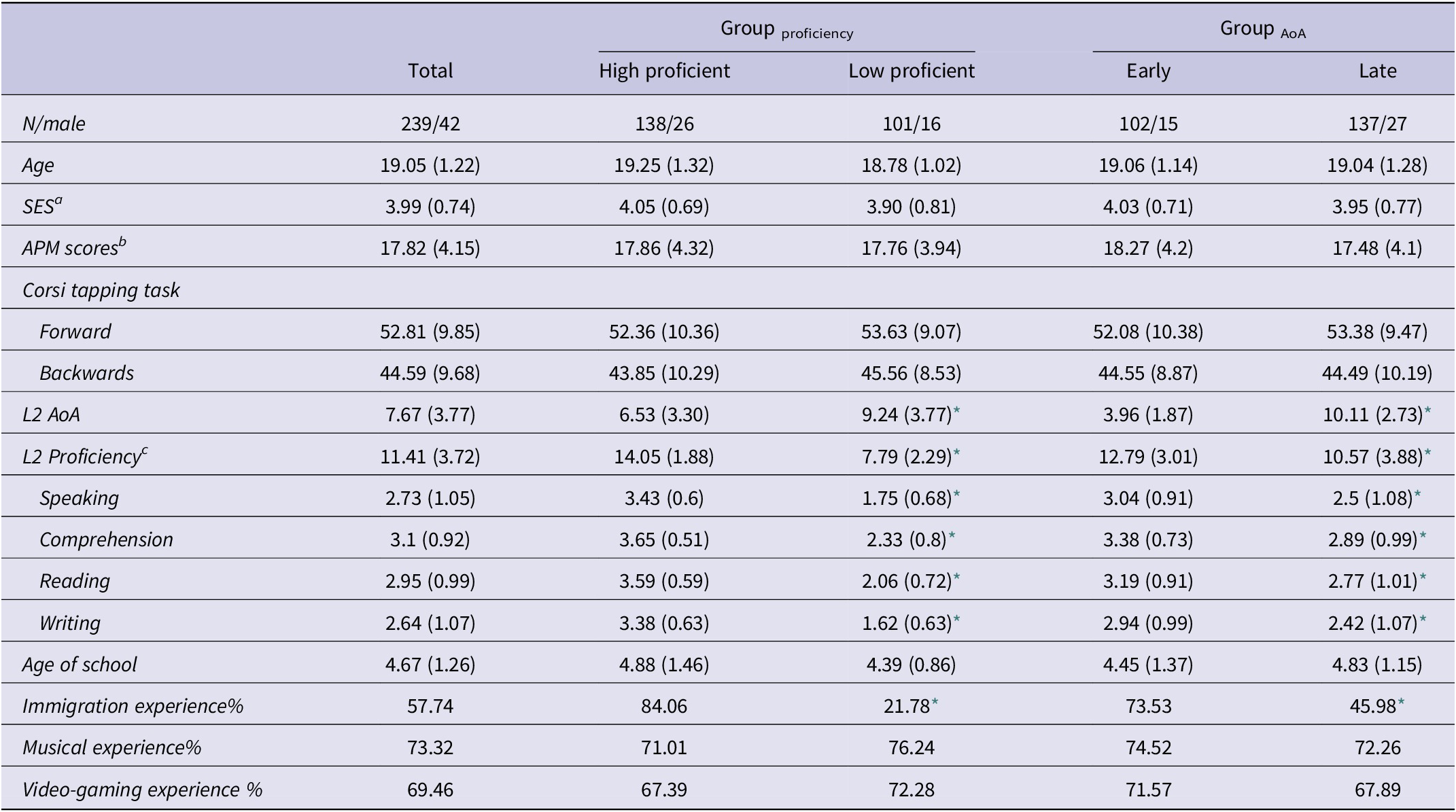
Note: High and low proficiency groups were created by L2 proficiency sum scores (i.e., sum score of the four sub-categories of language) and then doing a median split (Mdn = 12). The cut-off age for categorising bilinguals as early or late was chosen to be six years old.
a This is an average score based on the level of parental education. The scale ranged from 1: primary school, 2: O level or equivalent, 3: A level, 4: Bachelor’s or equivalent to 5: postgraduate, 6: Ph.D.
b The APM scores were the number of correct items (the total number was 36)
c This is a sum score based on four sub-categories of language (i.e., reading, writing, speaking, and listening) and the scale of self-reported L2 proficiency ranged from 1–4, marked by “poor” to “excellent”
* The difference between the groups was statistically significant
3.2. Main analysis
The descriptive statistics of performance on the four tasks are presented in Supplementary Table S1. Bilingualism predictors (i.e., L2 proficiency and L2 AoA) as continuous variables and dichotomous variables are listed.
3.2.1. ANT
Model 1 includes each bilingualism indicator as continuous variables and Model 2 includes each bilingualism indicator as dichotomous variables. Table 2 lists estimates for Model 1 and Model 2 on each sub-component of attentional control of the interest in the ANT. Immigration experience was not a predictor of performance in the ANT in both models. Hence, only the variables relevant to the research questions were listed here. Generally, both Models 1 and 2 showed similar results patterns, but the results regarding the interaction between the L2 proficiency and the Conflict effect were different: in Model 1, there was a significant interaction between the L2 proficiency and the Conflict effect (β = −4.75 [−8.72, −0.78], t = −2.34, p = 0.02) (Marginal R2 = 0.131, Conditional R2 = 0.444), indicating that the L2 proficiency was associated with the magnitude of the conflict effect, with higher proficiency showing smaller conflict effects; in Model 2, the interaction between the L2 proficiency and the Conflict effect was not significant (β = 5.44 [−2.57, 13.46], t = 1.33, p = 0.18) (Marginal R2 = 0.130, Conditional R2 = 0.443). In both models, L2 AoA was not a significant predictor of performance in the ANT.
Fixed effects in the linear mixed effects models in the ANT
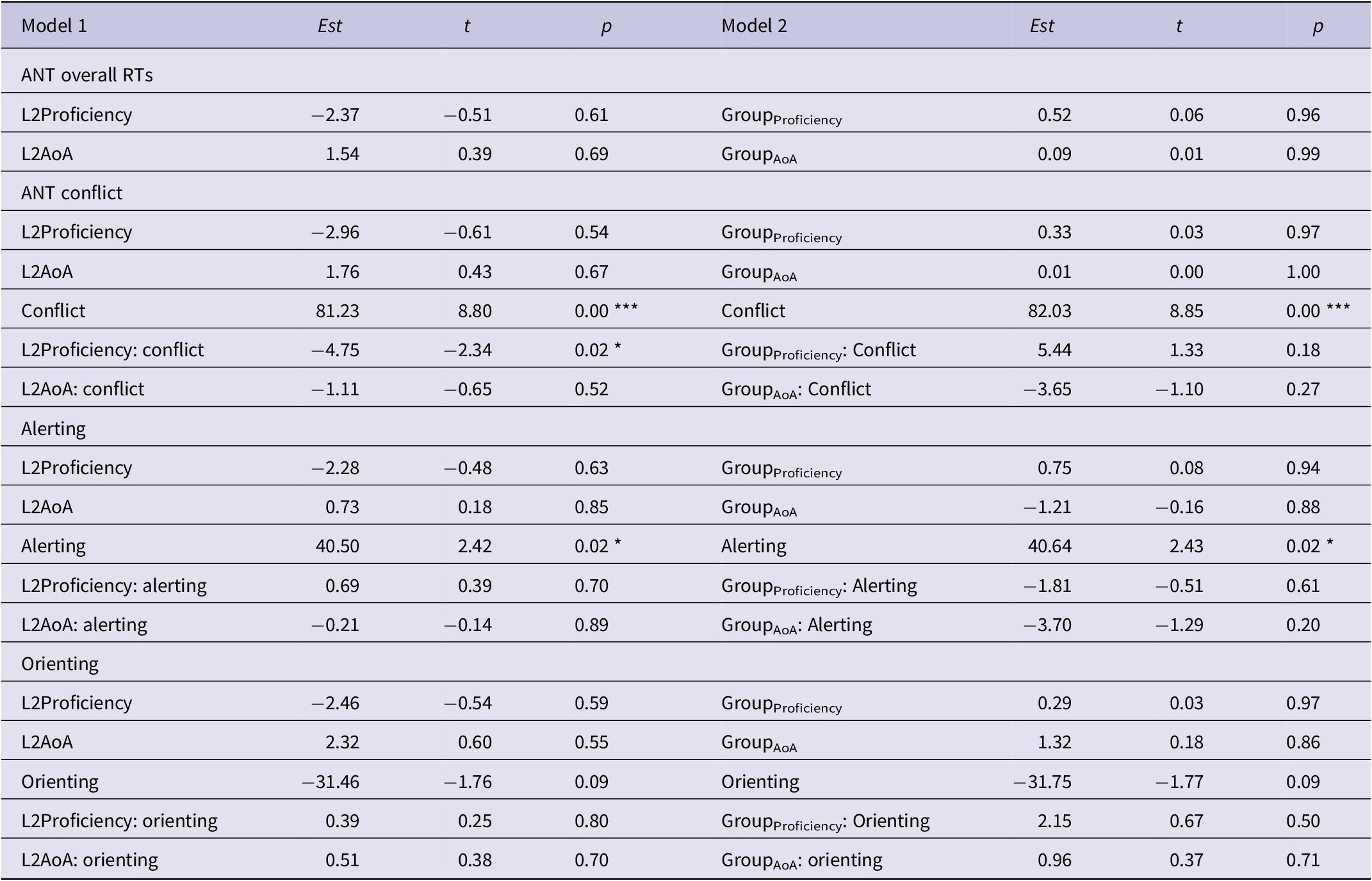
*** p < 0.001; ** p < 0.01; * p < 0.05.
3.2.2. Stroop
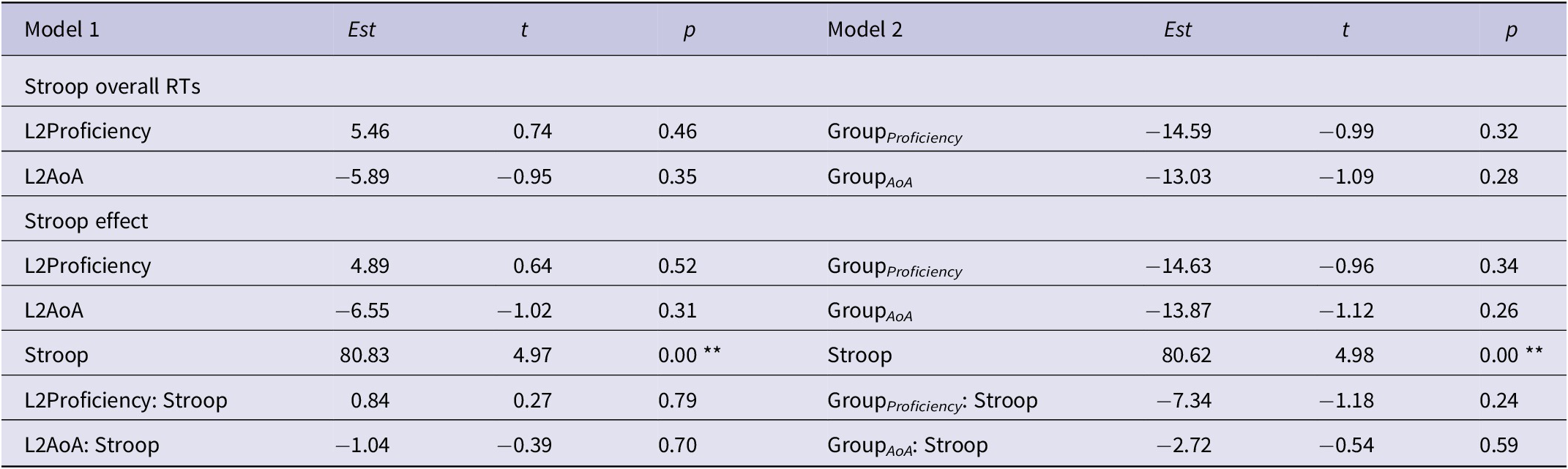
The same analyses were conducted on the Stroop task and only variables relevant to the research questions were presented in Table 3. Models 1 and 2 showed the same patterns: L2 proficiency and L2 AoA were not significant predictors of performance in the Stroop task. No interactions were found to be significant.
Fixed effects in the linear mixed effects models in the Stroop task
*** p < 0.001; ** p < 0.01; * p < 0.05.
3.2.3. Simon
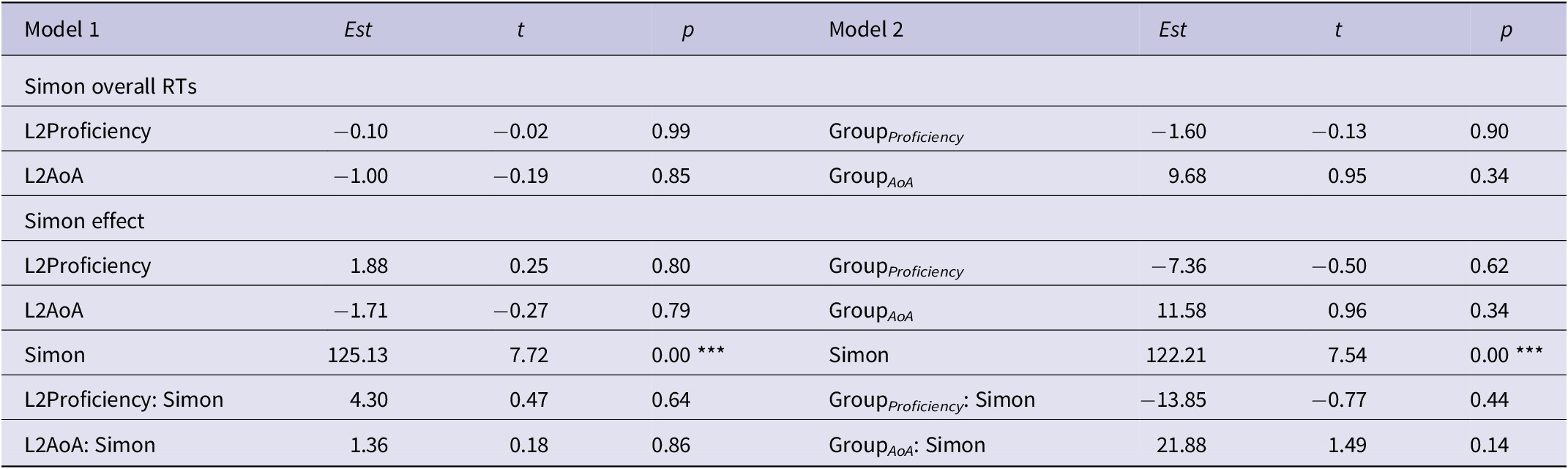
As shown in Table 4, Models 1 and 2 showed the same patterns: L2 proficiency and L2 AoA were not significant predictors of performance in the Simon task. No interactions were found to be significant.
Fixed effects in the linear mixed effects models in the Simon task
*** p < 0.001; ** p < 0.01; * p < 0.05.
3.2.4. TEA
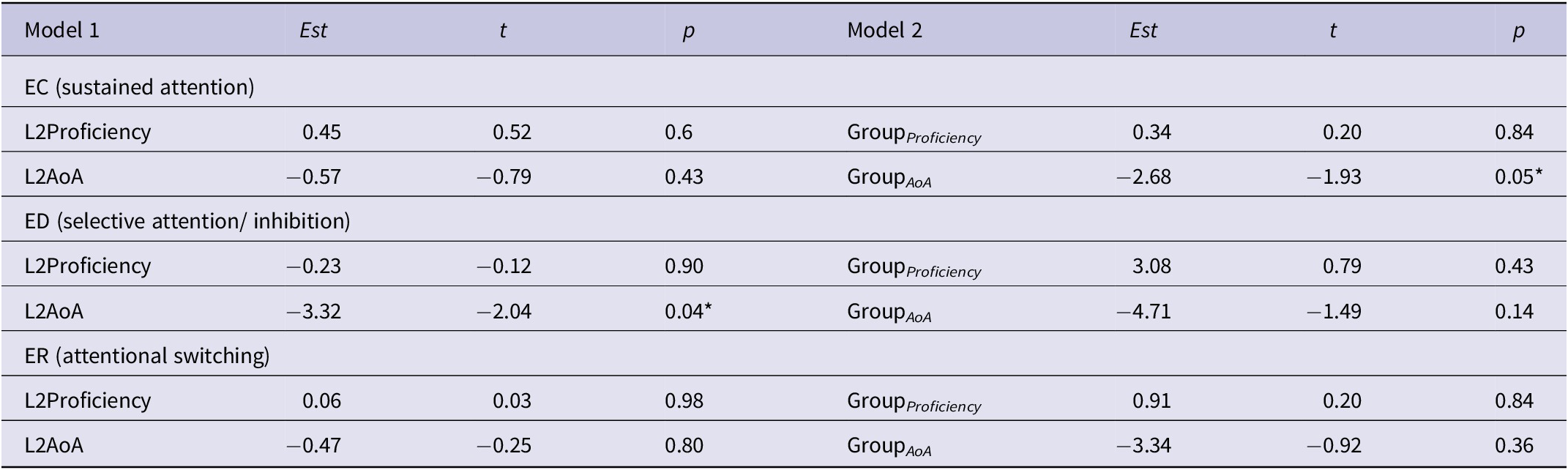
Multivariable linear regression models were conducted in the analyses of the TEA and results related to the research question are shown in Table 5 (i.e., only researched predictors: L2 proficiency and L2 AoA were shown). In Model 1, L2 AoA was a significant predictor (β = −3.32 [−6.52, −0.12], t = −2.04, p = 0.42), with earlier L2 AoA showing higher scores in the ED, indicating better auditory inhibition; L2 proficiency was not a significant predictor in any of the three subtests (β = −0.23 [−4.02, 3.56], t = −0.12, p = 0.81) (R2 = 0.019, R2adjusted = 0.006). In Model 2, early bilinguals outperformed late bilinguals in the EC, indicating better sustained attention (β = −2.68 [−5.42, 0.05], t = −1.93, p = 0.05) (R2 = 0.016, R2adjusted = 0.004). No other group differences were found in the ED or the ER (all ps > .05).
Fixed effects in linear regression models in the TEA
3.2.5. Further multiple stepwise regression analyses
Following Xie and Pisano (Reference Xie and Pisano2019), we conducted multiple stepwise regression analyses by entering bilingualism predictors (i.e., L2 proficiency and L2 AoA) and other control variables (i.e., IQ, SES, working memory, age, sex, age of attending school and immigration status) in the multivariable linear regression models for the cognitive performance across the four non-linguistic cognitive tasks (the outputs of linear regression models and stepwise regression models were presented in the Supplementary Materials). The entry of bilingualism predictors using continuous variables or dichotomous variables showed the same results; therefore, the tables presented in the Supporting Materials were entered as continuous variables. The results were presented in tables, only showing the significant predictors with ranked significance (i.e., the top one is the strongest predictor). To summarise, working memory was the strongest predictor of most cognitive performance across the four tasks, while other factors (i.e., IQ, sex, and SES) were the second significant predictors. The age of entry into primary school was a significant predictor of performance in the Simon task ranking as the least significant. The factors of age and immigration status were not significant predictors of cognitive performance in the current study. Regarding the predictors of bilingualism, L2 proficiency was the strongest predictor of performance in the ANT conflict and L2 AoA was the third strongest predictor of performance in the ED.
4. Discussion
Researchers have highlighted the potential oversimplification in grouping heterogeneous bilingual linguistic profiles under a dichotomous condition, which might mask the cognitive effects of bilingualism. The present study used two approaches (i.e., continuous versus dichotomous measure) to quantitatively investigate the effects of L2 proficiency and L2 AoA on executive control in young adult bilinguals. Moreover, to explore whether these effects would be modulated by different types of conflict tasks, three well-established and widely used non-linguistic tasks (i.e., ANT, the Stroop task, and the Simon task) were included, tapping into Stimulus–Stimulus conflict and Stimulus–Response conflict (i.e., S-S versus S-R conflict), respectively. Given the fact that the nature of language learning entails multiple domains, such as visual (e.g., reading and writing) and auditory (e.g., listening and speaking) domains, three elevator subtests of the Test of Everyday Attention (TEA; Elevator with Counting, Elevator with Distraction, and Elevator with Reversal; EC, ED and ER) were employed as a measure of attentional control in the auditory domain.
4.1. The effect of language experience on visual and auditory cognitive control
The results suggested specific cognitive effects of bilingualism: higher L2 proficiency predicted better visual inhibitory control, while earlier L2 AoA was associated with better auditory inhibitory control and sustained attention. Further multiple stepwise regression analysis suggested that some background measures, namely, working memory, IQ, sex and SES, were highly correlated with different aspects of cognitive performance. Interestingly, the status of the L2 immigration experience was not significantly related to cognitive performance, and the age at which the individuals began to attend pre-primary school and primary school was closely correlated with the performance on the Simon task. With respect to the bilingual experience, L2 proficiency was the strongest predictor of inhibitory control, as measured by the ANT, while L2 AoA was the third strongest predictor of performance in the ED. These observations suggested that different facets of bilingual experience affect specific aspects of executive control after controlling the potential confounding variables.
Our findings support the notion that the effects associated with bilingualism are attributed to continuous mental training in the management of different languages (Lehtonen et al., Reference Lehtonen, Soveri, Laine, Järvenpää, De Bruin and Antfolk2018; Schroeder & Marian, Reference Schroeder and Marian2017): a longer and more intensive bilingual experience is supposed to be associated with greater gains. From this point of view, early L2 AoA, indicating the longer duration of simultaneous exposure to two languages and the long history of using two languages, has been proposed to show greater cognitive benefits (Luk et al., Reference Luk, De Sa and Bialystok2011). Similarly, a strong L2 (i.e., higher proficiency) is assumed to elicit stronger interference on the first language (L1) than a weak L2 (i.e., lower proficiency), resulting in increased cognitive demands (e.g., inhibitory control) (Green, Reference Green1998; Lehtonen et al., Reference Lehtonen, Soveri, Laine, Järvenpää, De Bruin and Antfolk2018). According to the supply–demand framework (Schroeder & Marian, Reference Schroeder and Marian2017), these increased demands could lead to a supply increase in cognitive control in bilinguals with higher L2 proficiency, resulting in a stronger bilingual effect.
4.2. Different approaches to statistical analysis
As researchers have argued that bilingualism is not a categorical variable (Luk & Bialystok, Reference Luk and Bialystok2013), recent studies have further highlighted the limitations of grouping heterogeneous linguistic profiles into a dichotomous classification (Chung-Fat-Yim et al., Reference Chung-Fat-Yim, Sorge and Bialystok2020; DeLuca et al., Reference DeLuca, Rothman, Bialystok and Pliatsikas2019; Grundy et al., Reference Grundy, Pavlenko and Bialystok2020; Sulpizio et al., Reference Sulpizio, Del Maschio, Fedeli and Abutalebi2020; Thomas-Sunesson et al., Reference Thomas-Sunesson, Hakuta and Bialystok2018). We analysed bilingualism as both continuous and dichotomous variables based on L2 proficiency and L2 AoA, respectively. The dichotomous measure based on L2 proficiency and L2 AoA was not sufficiently sensitive, in the current sample, to reliably detect group differences in inhibitory control. In contrast, the continuous measure, where both L2 proficiency and L2 AoA were analysed as continuous variables, revealed a significant relationship between bilingual experience and inhibitory control. Specifically, higher L2 proficiency and earlier L2 AoA were associated with better inhibitory control in both the visual domain (i.e., the ANT) and the auditory domain (i.e., ED) using a continuous approach, while early bilinguals outperformed late bilinguals in sustained attention (i.e., EC) using a dichotomous approach. Unexpectedly, group differences were observed in the EC, where participants tended to show ceiling performance in previous research (Bak et al., Reference Bak, Long, Vega-Mendoza and Sorace2016; Bak et al., Reference Bak, Vega-Mendoza and Sorace2014; Long et al., Reference Long, Vega-mendoza, Rohde, Sorace and Bak2019; Ooi et al., Reference Ooi, Goh, Sorace and Bak2018; Vega-Mendoza et al., Reference Vega-Mendoza, West, Sorace and Bak2015).
The pattern of results in the current study was consistent with the patterns of results reported by Grundy et al. (Reference Grundy, Pavlenko and Bialystok2020); namely, a continuous measure of bilingualism was relatively more reliable and sensitive in detecting the potential cognitive consequences of bilingualism than the dichotomous measure. This could partly explain the reasons for the inconsistency in the literature. Given that bilingual experience shows remarkable inter-individual variability and changes dynamically throughout an individual’s lifespan, a dichotomous grouping approach may obscure the critical aspects of language experience underlying cognitive changes (Bak, Reference Bak2016b; Long et al., Reference Long, Vega-mendoza, Rohde, Sorace and Bak2019). Therefore, researchers have strongly suggested shifting from traditional comparisons between monolinguals and bilinguals toward an approach of focusing on individual language experience within bilinguals (DeLuca et al. Reference DeLuca, Rothman, Bialystok and Pliatsikas2019; Sulpizio et al., Reference Sulpizio, Del Maschio, Fedeli and Abutalebi2020).
4.3. The role of task variability in bilingual effect
In the current study, the cognitive effects associated with bilingualism were only observed in the ANT, but not in the Stroop and Simon tasks. This inconsistency could be due to the different types of inhibition involved in the three tasks. The ANT reflects an S-S conflict, while both the Stroop and Simon tasks reflect S-R conflicts. The results are consistent with previous research (Blumenfeld & Marian, Reference Blumenfeld and Marian2014) that bilingualism might engage S-S inhibition mechanisms more than the S-R mechanism as a result of bilingual language experience in the cross-linguistic co-activation and competition in language comprehension and competition processes; however, the S-R inhibition might be limited to language production processes. Moreover, the S-S type of interference task is more likely to be affected by the bilingual experience, in that bilinguals have to select between two active and viable alternative languages while inhibiting the non-target language (Martin-Rhee & Bialystok, Reference Martin-Rhee and Bialystok2008, Nicolay & Poncelet, Reference Nicolay and Poncelet2013, Esposito et al., Reference Esposito, Baker-Ward and Mueller2013). Therefore, the effects of bilingualism might be limited to the S-S type of interference task (i.e., ANT), but not the S-R type of interference tasks (i.e., the Stroop and Simon tasks).
An alternative explanation is that this could be due to the different types of inhibitory control involved in the three tasks. Studies have suggested that bilingualism is more likely to influence interference suppression, but not response inhibition (Bialystok & Viswanathan, Reference Bialystok and Viswanathan2009; Esposito et al., Reference Esposito, Baker-Ward and Mueller2013; Luk et al., Reference Luk, Anderson and Craik2010; Martin-Rhee & Bialystok, Reference Martin-Rhee and Bialystok2008). However, the influence of bilingualism on the two types of inhibitory control can be modulated by other factors, such as the level of task (Jiao et al., Reference Jiao, Liu, Wang and Chen2019). While ANT was widely used as a measurement of interference suppression (i.e., it refers to the capacity to detect and filter out irrelevant information in the environment), the Stroop and Simon tasks have been used as a measurement of response inhibition (i.e., it refers to the capacity to inhibit inappropriate, but prepotent, response tendencies) in bilingualism research (Incera & McLennan, Reference Incera and McLennan2018; Yow & Li, Reference Yow and Li2015) and other cognitive research (Forstmann et al., Reference Forstmann, Jahfari, Scholte, Wolfensteller, van den Wildenberg and Ridderinkhof2008; Tiego et al., Reference Tiego, Testa, Bellgrove, Pantelis and Whittle2018). This could explain why the effects of bilingualism were limited in the ANT.
While Green’s Inhibitory Control model (Reference Green1998) provides a valuable framework for understanding inhibition in bilingualism, it is important to recognise that inhibition may only partially explain the phenomenon. Recent research suggests that attentional control offers a more comprehensive explanation. Bialystok and Craik (Reference Bialystok and Craik2022) propose that differences in behaviour between monolingual and bilingual individuals stem from variations in the efficiency and deployment of attentional control across the two language groups. This underscores the significance of attentional mechanisms in the context of bilingual language processing.
The main limitation of this study is the lack of a formal test for L2 proficiency. However, previous studies have confirmed the validity of self-reported language proficiency and usage (Luk & Bialystok, Reference Luk and Bialystok2013; Vega-Mendoza et al., Reference Vega-Mendoza, West, Sorace and Bak2015). For instance, Vega-Mendoza et al. (Reference Vega-Mendoza, West, Sorace and Bak2015) used both formal language tests (i.e., the picture name verification task and verbal fluency task) and a self-report questionnaire to measure language proficiency. Group differences in the formal language tests and participant self-reported language proficiency were used as the main criterion for the level of language proficiency. Therefore, the self-reported language proficiency in the current study is likely to be reliable.
To conclude, the current study offers compelling evidence supporting the necessity of a continuous approach rather than a simplistic dichotomous one in detecting the cognitive effects of bilingualism. This further confirms the limitations of oversimplified comparisons between monolinguals and bilinguals, shedding light on the need to emphasise the within-group heterogeneity of bilingualism in various studies. Importantly, the results suggest that the observed effects might be task-specific, potentially attributed to the engagement of distinct conflict resources. Specifically, the differentiation between S-S (stimulus–stimulus) and S-R (stimulus–response) conflict, in conjunction with the involvement of various types of inhibitory control, such as interference suppression versus response inhibition. Notably, the current study provides preliminary evidence for the significant relationship between L2 AoA and auditory inhibition. Although most previous studies predominantly focused on visual attention, this study makes auditory attention more special. These findings confirm that different aspects of the bilingual experience impact specific domains of executive control and hence justify a shift away from traditional cross-sectional design (i.e., monolinguals versus bilinguals) and toward an approach that views bilingualism as a continuum. This shift is crucial in comprehensively understanding the complex interplay between bilingual experiences and cognitive processes.
Supplementary material
The supplementary material for this article can be found at http://doi.org/10.1017/S1366728924001019.
Acknowledgments
This work was supported by the National Social Science Fund of China under Grant 22CYY016; the Independent Innovation Fund of Huazhong University of Science and Technology under Grant 2022WKYXQN005; and the School of Philosophy, Psychology & Language Sciences (PPLS) Research Support Grants.


 Open access

