




1. Introduction
Interdisciplinary study programmes are under increased scrutiny at both university (James Jacob Reference James Jacob2015) and governmental levels (Rhoten Reference Rhoten2004; Science Europe Symposium 2018). This has been driven by numerous factors, including the demand to develop more industry-oriented curricula to solve complex, dynamic, interconnected and ‘wicked’ social problems [Schön Reference Schön1983; cf ‘The Future of Jobs Report’ from the World Economic Forum (2019) also emphasised the importance of having multiple skills for future career development]. Policymakers and influential actors in the scientific world have criticised single disciplinary silo education, calling for the creation of interdisciplinary programmes (Brown, Deletic & Wong Reference Brown, Deletic and Wong2015). They claim that the current disciplinary education is disconnected from other curricular components, and future students are not encouraged to reflect upon or apply what they have learned in other areas of their degrees (Graham Reference Graham2018).
Klein & Newell (Reference Klein and Newell1997, p. 393) defined interdisciplinarity as ‘a process of answering a question, solving a problem, or addressing a concept that is too broad or complex to be not dealt with adequately by a single discipline or profession’. Thus, many universities have turned their attention towards creating new interdisciplinary study programmes that address complex societal problems, such as energy saving, food distribution, climate change and public health (Sá Reference Sá2008; Ferguson et al. Reference Ferguson, Barzilai, Ben-Zvi, Chinn, Herodotou, Hod and Rienties2017; Brambila-Macias, Sakao & Kowalkowski Reference Brambila-Macias, Sakao and Kowalkowski2018; Kelly & Gero Reference Kelly and Gero2021). For instance, the Singapore University of Technology and Design’s (SUTD) curriculum is primarily taught through multidisciplinary design projects, which encourage students to contextualise and integrate their learning across different courses and years of study. Similarly, University College London’s (UCL) engineering curriculum structures the first 2 years of study as 5-week cycles, whereby students can acquire extensive engineering knowledge and skills that are contextualised and applied across disciplines in order to gain a complete set of heterogeneous rules and behaviours.
These successful interdisciplinary programmes were initially proposed by top-down decision makers, rather than a bottom-up consensus of individual departments (Ferguson et al. Reference Ferguson, Barzilai, Ben-Zvi, Chinn, Herodotou, Hod and Rienties2017). An MIT report on Engineering Education (Graham Reference Graham2018) stated that UCL’s interdisciplinary programme (i.e., ‘Integrated Engineering Programme’; IEP) was launched by the then Dean. Similarly, an interdisciplinary postgraduate programme, ‘Arts & Technology’, at Hanyang University in Korea, where the authors of this article are currently working, was also initiated by the then-President of the university in 2016 to transform the traditional disciplinary silo education system. Given this top-down decision making, UCL Engineering took 3 years to fully implement the IEP, whilst Hanyang’s Arts & Technology still struggles to recruit volunteering academics from across the arts-related departments (e.g., Department of Music and Department of Fine Arts). Both cases imply that the need to innovate the traditional discipline-focused study is well-perceived by universities’ top decision-makers, although how this can be achieved at a practical level is still elusive. In fact, as pointed out by an anonymous reviewer of an earlier draft of this article, facilitating bottom-up discussions to create common ground across disciplines is important (cf, Appendix of part ‘8. Challenges Faced’ in Graham’s (Reference Graham2018) report cited the difficulty of integrating curricular components across the university).
Thus, this study focuses on the latter, using a data-driven methodology that can allow curriculum designers to analyse and identify the departments or courses that are to be shared, and determine which interdisciplinary programme can extend current disciplinary conditions. The methodology is centred on an empirically built network map of all courses and various network analyses that position possible interdisciplinary programmes, navigate courses in the neighbouring departments, and identify feasible paths for novel interdisciplinary opportunities. This would facilitate bottom-up discussions between departments; the data-driven visual analytic approach employed in this study easily guides positioning, neighbouring department searches and interdisciplinary curricular directions across courses.
Repko & Szostak (Reference Repko and Szostak2016) stated that interdisciplinarity is two-fold: narrow and wide. Narrow interdisciplinarity is a collaborative commitment among closely related disciplines, whose primary purpose is the productive synthesis of scholarship within related departments; for instance, the common curricular structure applied across all engineering departments at UCL. In contrast, wide interdisciplinarity, in which many disciplines are built on different concepts (e.g., arts and engineering), does not readily conceive this kind of simple extension. Kelly (Reference Kelly1996) stated that wide interdisciplinarity draws upon disciplines that are epistemologically distant. Therefore, a primary challenge in enforcing wide interdisciplinarity is making congruent common ground and integrating concepts from different disciplines to propose interdisciplinary coursework (Graham Reference Graham2018). Further, it is not strange that the ‘design’ discipline comes to the fore in reducing such epistemological distances in disciplinary education. SUTD includes design-based active learning (Telenko et al. Reference Telenko, Wood, Otto, Rajesh Elara, Foong, Leong Pey, Tan, Camburn, Moreno and Frey2016), and UCL’s IEP course asks students to complete at least 10 intensive collaborative design projects before graduation. Our data-driven methodology follows suit, exemplifying how ‘design’ is key to developing interdisciplinary programmes in this regard.
Our research aims to find a data-driven approach to developing interdisciplinary programmes by combining current curricula offerings across departments, to facilitate bottom-up discussions on potential interdisciplinary programmes. The central tenet of our study is that the course keywords from disciplinary education contain sufficient concepts that can be modified to propose new interdisciplinary insights, which seem radical but worth attempting. Therefore, we first build a concept network with courses from each department and then determine how the network of related concepts could connect multiple disciplines, which can naturally facilitate bottom-up discussions.
Network analysis is widely used to reveal a set of all proximate or distant entities in the relevant design space. For instance, Luo, Yan & Wood (Reference Luo, Yan and Wood2017) employed network analysis for designers to conduct more grounded and informed searches to determine what technologies they should design for the next autonomous vehicle in the patent network. To this end, they analysed the technologies that had already been mastered relative to those technologies that cannot currently be designed to explore new autonomous car design opportunities. Particularly, a few network-based analysis functions (e.g., centrality, betweenness and concept space) and visualisation tools also help positioning and finding neighbouring items and direction, as well as identifying potential new opportunities (Willcox & Huang Reference Willcox and Huang2017; Huang & Willcox Reference Huang and Willcox2021). The following sections explain how we applied network analysis to posit possible interdisciplinary programmes, navigating the course spaces in neighbouring departments and identifying feasible paths for novel interdisciplinary opportunities.
2. Measuring interdisciplinarity using network analysis
2.1. The two-mode curriculum network mapping
Network analysis has been used to interpret complex systems from multiple perspectives, ranging from social systems to shared knowledge networks (e.g., Aldrich Reference Aldrich2015; Ouyang & Scharber Reference Ouyang and Scharber2017; Willcox & Huang Reference Willcox and Huang2017; Israel, Koester & McKay Reference Israel, Koester and McKay2020; Huang & Willcox Reference Huang and Willcox2021). Applications of network analysis, which reveal the hidden features and relationships in higher education systems, have also been developed (Willcox & Huang Reference Willcox and Huang2017; Huang & Willcox Reference Huang and Willcox2021). University course catalogues have similar features to a social network (Willcox & Huang Reference Willcox and Huang2017), in that course levels, offering departments, prerequisites, expected learning outcomes and a network of the courses can be used to create a certain programme. By analysing this, Aldrich (Reference Aldrich2015) provided a method to reduce attrition rates and improve students’ performance with the curriculum prerequisite network. Willcox & Huang (Reference Willcox and Huang2017) introduced an interactive curriculum map on the MIT university website (ocw.mit.edu/courses/curriculum-map) to help students create a solid curriculum path and browse similar or alternative classes. More recently, Israel et al. (Reference Israel, Koester and McKay2020) investigated student and course networks in higher education to reveal campus connections.
Curriculum data are often drawn by the two-mode network (Figure 1), where ‘mode’ refers to a class of entities, typically called ‘node’. The two-mode network (also known as bipartite networks) refers to the network formed with more than two types of nodes (e.g., department name, course title or course keywords), and all the links connect between two nodes rather than within them.
A two-mode curriculum network of the course offerings per department (left: a general ontology; right: an example case).
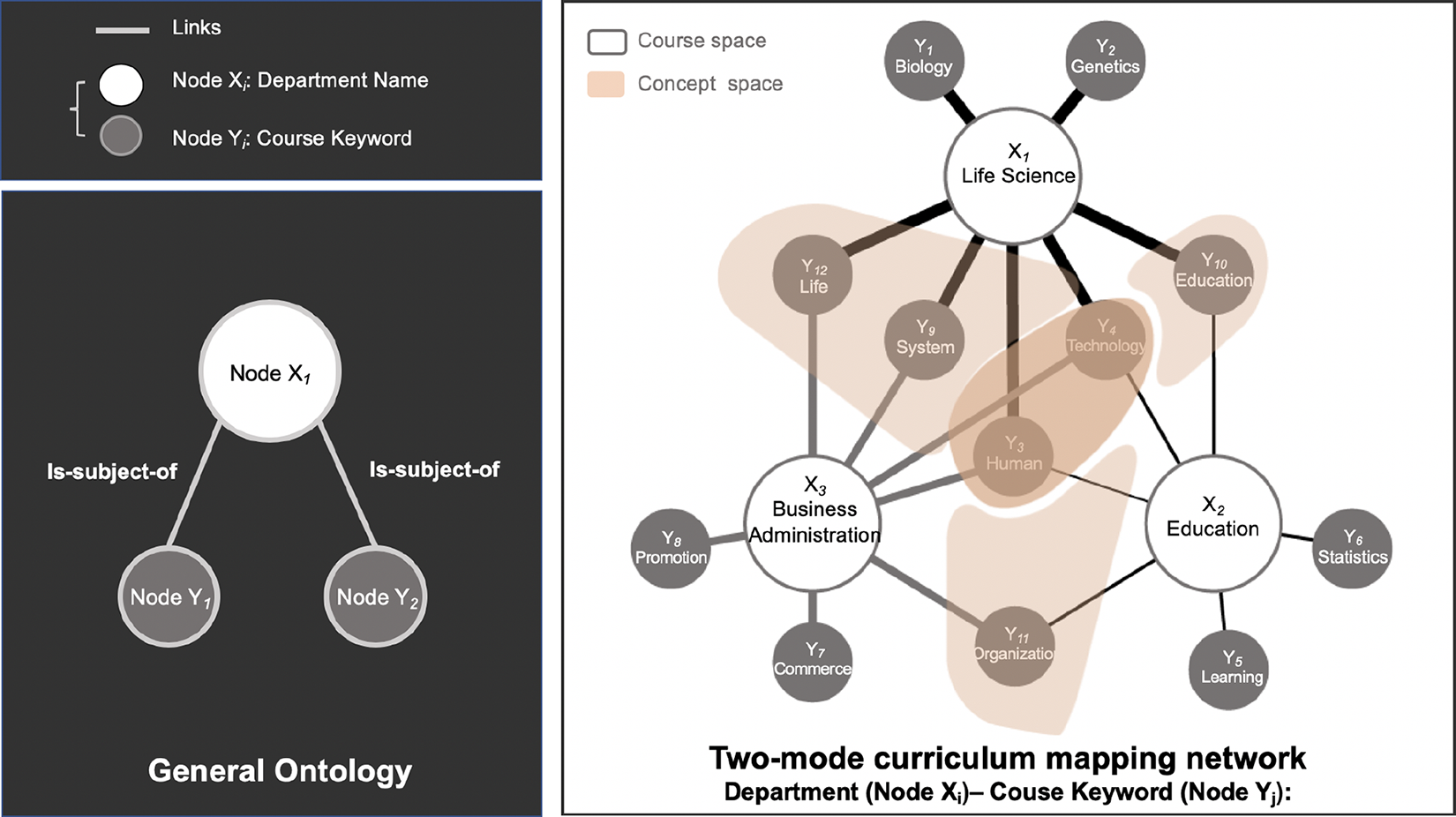
Node Xi represents the department name, whereas Node Yj represents the course keywords extracted from the course title and descriptions. The links show only the is-subject-of relationship that ensues if a course keyword node (Node Yj) is offered by the department node (Node Xi). The example on the right-hand side of Figure 1 only shows the links between the department name and the course keywords (one-to-many mapping).
The two-mode network used in this study is empirically built by collecting potential node data (e.g., department and course keywords in this study) from the course catalogue, excluding some general courses (e.g., maths, physics and English). Our initial two-mode network used all the information from the course catalogue (including course objectives and weekly lecture topics) in the node selection. However, the network did not form an interpretative two-mode network, because it appeared to have too many general terms in the syllabus (e.g., ‘to be able to read, understand, and apply published research’ or ‘to be able to design and construct a communication system’), or included overly specific terms (e.g., ‘Vestibular system and Hypothalamus in Neuro-marketing’) that do not have co-occurrence; this resulted in either a very sparse or a very dense ‘all-linked’ two-mode network. Therefore, we mined and parsed the curriculum catalogue data at a mid-level granularity, and then computed them using the department names and course titles (e.g., HR Development in the Department of Business Administration: Human + Resource + Development + Business + Administration) for statistically approximate proximity in the two-mode network. Particularly, the normalised co-occurrence measure was selected at the mid-level granularity level of 0.2 (Yan & Luo Reference Yan and Luo2017). All the pairs of department-course keywords were then fed into a network analysis programme (Gephi v.0.9.1) and depicted through two-mode network mapping. Section 3.1 presents a more detailed explanation of the method of data preparation.
2.2. From course space to concept space
Two different spaces can be formed from the curriculum network: the ‘course space’ and the ‘concept space’. A course space is where one-department node (Node Xi) and multiple course keyword nodes (Node Yj) are grouped together based on direct links of the is-subject-of relationship. Contrastingly, the concept space seeks indirect connections among the course keywords (Node Yj) by considering the number of department nodes (Node Xi) that share the same course keywords (see Figures 1 and 2).
From course space to concept space: a projection.

The left-hand side of Figure 2 can be projected onto the right-hand side by eliminating and rearranging the nodes among the course space. This alternatively suggests that an interlocking course may be proposed by an interdisciplinary concept space that is vague due to the disciplinary departmentalisation (i.e., Theory of Conceptual Integration; Lakoff Reference Lakoff1987; Fauconnier Reference Fauconnier1994; Repko & Szostak Reference Repko and Szostak2016). Our hypothesis is that a concept network derived from the course keyword node (Yj) might reveal a new concept space that be established as a common ground by departments; however, the potential interdisciplinary concept should be thoroughly and qualitatively reviewed by interdisciplinary programme developers. As our research aim is to find a practical way (i.e., network analysis with both the course and concept space) to develop potential interdisciplinary programmes based on current course offerings, the concept space is central in our discussion as it can begin creating common ground among the different disciplines, thereby facilitating collaborative course sharing or design.
The epistemological closeness (or distance) is represented by the number of sharing departments (or normalised co-occurrences). To investigate the weighted concept space formed, the two-mode course-keyword-department network needs to be projected onto a one-mode course keyword network (see Figure 2, right), where Node Yj presents only the course keywords, and the link weight shows the number of keywords shared by the departments. Thus, a higher link weight means the course keywords frequently co-occur in the different departments. Hence, the more the concurring keywords, the more likely it is that these departments share an interdisciplinary concept space. Indeed, the keywords cannot be a unique criterion to build an interdisciplinary concept, and the outcomes from our network analysis should be re-examined by the adjoining departments or interdisciplinary programme designers. However, this network information on the concept space is extremely valuable to facilitate a discussion among related departments.
This study thus poses three research questions: First, which sets of the course keywords suggest an interdisciplinary concept space? Second, can the interdisciplinary concept space be offered by neighbouring departments? Finally, if that is the case, which departments or subjects can sketch out invisible interrelations within a university? Particularly, for the last question, we would like to see why the design discipline has been at the forefront of developing interdisciplinary programmes. To address these questions, we conducted a comprehensive network analysis on one of the biggest departmentalised universities in Korea.
3. Method
3.1. Data preparation
The course catalogue was sourced from Hanyang University in Seoul, Korea. The university consists of 24 colleges (or faculties), 57 departments and 21 graduate schools, with around 33,000 students (around 25,000 undergraduates and 8200 graduates in 2017). We selected this university for two reasons: first, all course catalogues were freely available owing to University Data Regulations. The authors submitted the research objectives and the data protection procedures that were fully reviewed by the Office of Academic Affairs. Second, this university is now trying to extend several new interdisciplinary programmes such as those at SUTD (design-focussed education), UCL Engineering (engineering education innovation) and Arizona State University (hybrid mode on-offline pedagogy). Although the university is comprehensive with 57 departments, the strong influence of engineering-oriented culture seems to hinder the creation of new interdisciplinary programmes.
A total of 3725 courses (from the undergraduate course catalogue of 2016–2019) from 57 departments were examined in this study. Table 1 illustrates a part of the raw input data, as well as the nodes that were transformed into the two-mode network structure (Figure 1). During data preparation, the course keywords were mined and parsed and the noun forms were changed. Further, the general descriptors of the course keywords (e.g., introduction, study, series and topics) were eliminated as discussed in Section 2.1, thereby setting the criterion of the normalised co-reference at 0.2. Our network model consisted of 57 department nodes (Node Xi), 1124 course keyword nodes (Node Yj) and 3979 links.
Data preprocessing: input data (examples from Figure 1)

3.2. Degree centrality, modularity and projection
To study a complex set of relationships at all scales, three measures were employed: centrality, modularity and projection. First, centrality is the most popular and widely used measure to understand the power and structure of a node in a network (Borgatti Reference Borgatti2005; Prell Reference Prell2012). It can be examined using a variety of vantage points, such as ‘which department (or a course keyword) shows the highest number of connections to others’, ‘which department plays the important role of brokerage in a network’ or ‘which department can quickly diffuse information through the entire network?’ Each question offers a unique perspective on the different types of centrality (degree centrality, betweenness centrality and closeness centrality), more details of which are elaborated by Prell (Reference Prell2012).
Second, a more sophisticated measure, modularity, was used to measure the strength of clusters and to detect the density of the links between the nodes within clusters (Newman Reference Newman2004). This measure detects structural clusters in the network, which correspond to the close subject interest and potential interdisciplinarity of departments. The modularity of a partition is a scalar value between −1 and 1 that shows the density of the links inside communities, in comparison to the links between communities. It is hypothesised that the departments in the same cluster correspond to epistemologically closer fields, where narrow interdisciplinary study programmes might be introduced (Blondel et al. Reference Blondel, Guillaume, Lambiotte and Lefebvre2008).
Another important technique in network analysis is projection, which can reveal hidden features in the network. For each cluster, the original network with the two types of nodes (department and course keywords) could be recoded as a single weighted one-mode network (Opsahl Reference Opsahl2013; Ouyang & Scharber Reference Ouyang and Scharber2017). We are interested in determining which course keywords could form a particular concept space; therefore, it is important to determine the course keyword network that can clearly reveal their relational structures. In this compressed type of one-mode network, two nodes Yj (course keywords) are tied to one another via Node Xi (department), where they are assigned. Similarly, the departments can be closely linked together via the shared course keywords. Figure 3 shows a general ontology about projecting the one-mode network from the original two-mode network and calculating the link weights.
Calculation for deriving the weight link in the projected one-mode network.

The weighted link (Wj) in the projected one-mode network can be achieved by multiplying the weighted link of each course keyword node in the original two-mode network (wi) (Opsahl Reference Opsahl2013). For instance, we can calculate the weight of Node Y 1 − Y 2 (W1) by multiplying the weights of Y 1 − X 1 (w 1) and Y 2 − X 1 (w2) from the initial two-mode network. In cases where a course keyword (e.g., Y 2 − Y 3) has more than two connections with departments (e.g., X 1 − X 2), the weight of Y 2 − Y 3 (W 2) is the sum of the new projected weights, Y 2 − X 1 − Y 3 (w 2  $ \times $ w 3) and Y 2 − X 2 − Y 3 (w 4 $ \times $ w 5). The weighted links were calculated using Gephi v.0.9.1.
3.3. Mapping concept and course spaces using a nonlinear regression model
Nonlinear regression illustrates the discrepancies of the degree centrality of the course keywords between the two-mode (course space) and the projected one-mode (concept space) networks (see Figure 4). The Y-axis of the graph represents the degree centrality of the course keywords in the two-mode network; that is, it shows the connected keyword in the course space. The X-axis of the graph represents the degree centrality of the course keywords in the one-mode projection analysis (i.e., the concept space).
Course keywords in the projected one-mode network (concept space) against that of the two-mode network (course space).

The nonlinear regression in Figure 4 allows one to examine the course keywords in several ways. Generally, the higher connected course keywords would generate more course and concept spaces. However, some course keywords (e.g., the triangle point in Figure 4) are placed under the regression line at the 95% confidence intervals, which indicates that more concept space rather than course space tends to be created. This implies that the course keywords have stronger interdisciplinary connections. Conversely, the course keywords (e.g., the rectangle point in Figure 4) above the regression line are more sparsely connected (in other words, they are more unique). This means that the potential for interdisciplinarity based on the course keywords is much weaker than other course keywords (i.e., the off-diagonal point analysis of the plot; Burchard & Cornwell Reference Burchard and Cornwell2018).
4. Results and discussion
4.1. Centrality measures of departments and course keywords
Table 2 shows the three centrality measures of the departments in the two-mode network (i.e., course space). The 10 departments with the highest degree centrality are Applied Humanities (degree centrality = 149), Business Administration (104), Korean Language and Literature (88), Medicine (87), Physical Education (88), Economics and Finance (84), English Language and Literature (78), Education (76), Chinese Language and Literature (76) and Computer Science (73). The greater the number of courses offered by a department, the higher its centrality. Additionally, departments with higher degrees of centrality tend to have a higher betweenness and closeness centrality; however, they are neither proportionally correlated nor do they have the same meaning. For instance, whilst the degree centrality of the departments of History and Philosophy is not highly ranked, their betweenness and closeness centrality are relatively high. Even though these departments do not offer as many courses as the 10 departments with the highest degree centrality, they play a crucial intermediary role in the course network, which is able to control the flow of information and reach out to other departments in a relatively short path length. Indeed, the departments that rank high across all the centrality measures are often courses of general study (e.g., Korean, English, Sports and Programming), except in the case of Medicine; therefore, all the department-course catalogues include such courses in their curriculum offerings. It is interesting to note that Medicine is also highly ranked in terms of centrality, and it can be seen that the first 2-years of medical study code-share with the Department of Biology and Biological Engineering. This confirms that degree and betweenness centrality are ranked higher than the closeness centrality measure.
Centrality measures of departments

Paradoxically, the departments that are considered interdisciplinary programmes (Fusion Marine Science, Electrical Bio-Engineering and IT Convergence) show the least value in almost every centrality measure. These departments were created to support a certain level of interdisciplinarity, but they seem to operate as a single silo departmentalised unit resulting in a low betweenness centrality.
Figure 5 illustrates the proportion of the degree centrality of the course keyword in the two-mode network (course space, Figure 5a) and the projected one-mode network (concept space, Figure 5b). In the course space, the mean of the degree centrality is 3.65 (SD = 15.36). Around half of the course keywords (47.78%, n = 537) have one degree of centrality, meaning that the course keyword is used only once by a single department. As shown in Table 3, course keywords with high degree centrality tend to have high betweenness and closeness centrality (e.g., business) with few exceptions. For instance, some keywords, such as a model, theory, practice, analysis and research, show the highest betweenness and closeness centrality, whereas their degree centralities are relatively low. In contrast to the topic-related course keywords, the keywords relating to methodologies (e.g., model, theory, analysis and statistics) and course activities (e.g., practice and writing) are frequently interposed to other keywords (i.e., high betweenness centrality) and are placed in more central positions in the course space (i.e., high closeness centrality). Notably, the course keywords education and design are highly ranked in the three-course centrality measures, which will be further discussed in Section 5.
Degree centrality of course keywords: (a) two-mode network (min/max, 1/54) and (b) projected one-mode network (min/max, 5/1060).

Centrality measures of course keywords

The original two-mode network (course keywords and departments) was projected onto the one-mode network to calculate the degree centrality of the course keywords in the concept space (Figure 5b). The degree centrality in the concept space is only formed and weighed when the two-course keyword nodes have at least one common neighbouring department node. The projected one-mode network (i.e., the concept space) shows that it has a significantly higher degree (from 5 to 1060, mean 136.62, SD = 135.54), which indicates that some keywords frequently co-occur across several departments and are not limited to the traditional one-course-one-department relationship.
Interestingly, we found that keywords such as business, education, human and design have over 20 times greater degree centrality in the concept space. These keywords may be crucial to create the foundation of interdisciplinary programmes. Thus, the course-concept spaces of these keywords will also be further discussed.
4.2. Mapping neighbouring departments: modularity
Modularity is a widely used metric to estimate the extent to which a network is clustered within subgroups or communities (Blondel et al. Reference Blondel, Guillaume, Lambiotte and Lefebvre2008). This quantifies the density of links within communities compared to links between communities (ranges from −1 to 1). Figure 6 and Table 4 show the six clusters of neighbouring departments and closely related course keywords. The network’s modularity is 0.50, which indicates a very strong group classified structure in the network (Valente et al. Reference Valente, Palinkas, Czaja, Chu and Brown2015). The number of departments in each cluster varies from 2 departments in Cluster 6 to 16 departments in Cluster 2. The four major clusters (Clusters 1, 2, 3 and 5) cover a total of 84.95% of the 57 departments and 1124 course keywords (see Table 4).
Visualisation of the two-mode network with nodes separated into six clusters on a modularity measure (Gephi v.0.9.1 and the Yifan Hu layout; the full list of department codes is shown in Table 4).

Discovered clusters with the neighbouring departments in the two-mode network

Cluster 1 has 13 departments (29.01%) that are all related to either humanities or social sciences. For the university being analysed in this study, the departments could have been grouped into a single larger college or faculty (for instance, Department of History, Department of Language and Literature, and Department of Philosophy are under the College of Humanities and Literature. In contrast, both the Communication and Sociology departments fall under the Faculty of Social Sciences). Indeed, these colleges may be able to propose an interdisciplinary programme, as our network analysis implies that they have strong similarities.
Cluster 2 (made up of 16 departments, accounting for 27.02%) includes business, economics and many prestigious engineering departments (e.g., Computer Science and Electronics), as well as applied art departments (e.g., Design, Architecture, Clothing and Textiles). The most mentioned course keywords in Cluster 2 include ‘business’, ‘statistics’, ‘computing’, ‘design’ and ‘information’. Interestingly, when interpreted with Cluster 1, though many students from the College of Humanities and Literature (35.5%) and the College of Social Sciences (45.7%) did a double major in Business Administration, the concept space of Cluster 1 does not overlap much with Cluster 2. This explains why their completion rate is relatively low (14.7% in 2019). The adjoining departments from Cluster 2 also confirm that the ‘Engineering and Systems Design’ programme at SUTD is a way forward as it can reconnect several disciplinary learnings to a broad range of industries (transportation, manufacturing, process industries, telecommunications, healthcare, retail and banking and finance).
Many natural science disciplines (e.g., chemistry, physics, material and life science) and their related material engineering (e.g., energy, chemical engineering and bio-engineering) belong in Cluster 3 (18.87%). The primary problem is that many departments in this cluster offer similar courses (this will be discussed further through the one-mode concept network). For instance, ‘Introduction to Chemistry and Materials’ is simultaneously offered by six departments (the Departments of Chemistry, Chemical Engineering, Energy Engineering, Nano Engineering, Mechanical Engineering and Material Science and Engineering). Such cases demonstrate an inefficiency in terms of financial governance.
The modularity analysis confirmed that the university being analysed in this article is heavily departmentalised, though each cluster overlaps in terms of its epistemology. Conversely, it also indicated a possibility of offering interdisciplinary programmes by applying the modularity analysis to the course keywords, as departments in the same cluster share similar epistemological assumptions, concepts and theories (e.g., the SUTD programme showcases Cluster 2).
4.3. Mapping degree centrality from course space to concept space: projection and nonlinear regression models
In Figure 7, the best-fit nonlinear regression models of the course keywords for each cluster are drawn to examine the noteworthy relationships between the course space (Y-axis, two-mode course network) and the concept space (X-axis, projected one-mode concept network). The lower slope of the regression line means that the cluster has greater potential for interdisciplinary studies (i.e., Clusters 2, 4, 5 and 6), and the higher slope reflects a cluster that is more departmentalised (i.e., Clusters 1 and 3). We highlighted some course keywords, which placed those above the regression line in red and those below the line in blue.
Nonlinear regression models of the six clusters.

In Cluster 1, which is highly departmentalised, the course keywords in red include writing, culture, technology and science. The keywords with a high degree of centrality in the course space reflect that there are many courses associated with the keyword. For instance, there are 48 courses with the keyword ‘writing’ that are offered across 27 departments (e.g., news writing and reporting, writing for science and technology communication writing and reading a modern novel); however, only 24.63 times greater degree centrality in the concept space is found (30 versus 739). Similarly, the keyword ‘business’ in Cluster 2 is used in 240 courses across 54 departments in the course space and expands the connections in the projected one-mode network with 1060 degree centralities.
The aforementioned keywords tend to be used in many courses offered by different departments, which shows that these departments are unknowingly running similar (or exactly the same) courses. This was evident in the example of business, as different courses are being offered in neighbouring departments within Cluster 2 (e.g., IT Business and New Business Development, Business Strategy in China by the Department of Business Administration), as well as in other clusters (e.g., Business in China by the Department of Chinese Language and Literature in Cluster 1, International Business by the Department of International Studies in Cluster 1, Creative Business Engineering by the Department of Material Science and Engineering in Cluster 3 and Healthcare Business by the Department of Sport Industry in Cluster 4).
Contrastingly, the keywords placed in the lower area of the regression line, which is marked in blue, have a higher probability of integrating and influencing the concept of wider interdisciplinarity. They have a relatively small degree centrality in the course space, meaning that few departments’ open courses contain these keywords; however, they tend to have wider epistemological connections among keywords in the concept space. In Cluster 1, keywords such as ‘economy’ (22 versus 606), ‘human’ (20 versus 611) and ‘communication’ (15 versus 564) show more than 25 times greater connectedness in the concept space. The keywords from Cluster 2 that appear in blue include ‘design’ (35 versus 798).
Both the projection and regression analysis offer interesting insights into the university being examined. First, the lower slope of the regression line at Cluster 1 shows that its concept space has a higher degree of centrality than its course space; furthermore, it has a higher potential to offer an interdisciplinary programme, despite currently being highly departmentalised. Further, the steeper slope of the regression line implies that some clusters (e.g., Clusters 1 and 3) offer more courses than the concept space they cover; Redundant or similar courses are the main reason for this, which requires further review by curriculum designers. Second, some keywords (e.g., ‘communication’ in Cluster 1 and ‘design’ in Cluster 2) that have gradual slopes may have wide interdisciplinarity. Finally, some concepts (e.g., ‘writing’ in Cluster 1, ‘business’ in Cluster 2 and ‘engineering’ in Cluster 3) ought to be reviewed to ensure that there are enough conceptual differences to justify all the specialised course offerings. Indeed, some engineering courses from Cluster 3 (e.g., the triad department – Chemical Engineering, Energy Engineering, Material Science and Engineering; and the pair department – Mechanical Engineering and Nuclear Engineering) have no such conceptual disparity. For instance, ‘Engineering Thermodynamics’ and ‘Chemical Engineering Thermodynamics’ both teach thermodynamics. A similar phenomenon can be observed in the case of ‘Reliability Engineering’ courses in the Department of Mechanical Engineering and ‘Risk and Reliability in Mechanics’ in the Department of Nuclear Engineering.
In effect, the analyses above have confirmed that the university examined herein needs to increase its interdisciplinarity and limit departmentalisation. The narrow interdisciplinarity within clusters or between neighbouring departments should not be the primary focus. The more profound and comprehensive reason for wider interdisciplinarity is that knowledge itself is marked by heterogeneity, complexity and hybridity (Easton & Schelling Reference Easton and Schelling1991). Correspondingly, how we can ensure such ‘blurred disciplinary boundaries’ when designing the curricula is examined in the following section.
5. Deriving interdisciplinary programmes from the course and concept spaces
The primary challenge in developing interdisciplinary programmes is deciding which disciplines are potentially relevant to societal problems on a wider scale. Our data-driven methodology revealed the epistemological connections in both the course and concept spaces. In the case of the keyword ‘design’, it was highly ranked in the three-course centrality measures and also heavily connected in the concept space (keywords such as business, education, human and design showed more than 20 times greater degree centrality in the concept space; see Section 4.1 for more details). Figure 8 shows a Sankey diagram where the design discipline is posited and juxtaposed with the additional keyword ‘digital’ (this keyword was deliberately inserted to showcase its connections with Cluster 1 – the Humanities and Social Sciences).
From course space to concept space using a Sankey diagram: design (cluster 2).

In Section 1, we discussed how various successful interdisciplinary programmes have been initiated based on top-down decisions, such as UCL Engineering’s IEP and the SUTD-MIT programme (Graham Reference Graham2018). Our research aimed to partly confirm this decision, especially because the university we were analysing could also use the design discipline to facilitate interdisciplinary programme development. Additionally, this analysis can also encourage disciplinary professors to have further discussions on designing an interdisciplinary curriculum in a bottom-up way.
Consider the keyword ‘design’ in Cluster 2 (Figure 8). The course space reveals that the keyword ‘design’ is interconnected with the adjoining departments in Cluster 2 (51.72%, blue-coloured band), such as the Departments of Applied Art, Architecture, Urban Planning and Engineering, and IT Convergence in their courses such as ‘Understanding the World through Design’ (Department of Applied Art), ‘Art and Design’ (Department of Architecture), ‘Urban Design Theory’ (Department of Architecture) and ‘Computer Graphics and Design’ (Department of IT Convergence). In comparison, the data in the concept space revealed that the departments in Cluster 2 are only conceptually connected to the keyword ‘design’ (25.12%). This means that some departments from Cluster 2 simply offer courses including ‘design’ (51.72%), but their interconnectedness in the concept space makes up only about half of the total (25.12%). This indicates that more design practice or practical work, such as that done by UCL Engineering and SUTD, would help them reconnect the adjoining departments in Cluster 2, thereby increasing their wide interdisciplinarity.
More insight can be derived from other clusters. Cluster 1 can also join the keyword design concept (37.31%, red-coloured band), whereby wider connections to the keyword ‘design’ can indicate ways to build a design-oriented interdisciplinary programme across Clusters 1 and 2. Similarly, our data-driven network analysis can easily link the disciplines from the course space to the concept space, enabling us to propose a new wide interdisciplinary programme and suggest disciplines that could be part of the programme.
Indeed, such proposals for wider interdisciplinary programmes seem to be made on a reflective basis. The current course offering dictates the course keywords and other concept connectedness. However, our data-driven approach can make this more easily manipulatable to understand the narrow or wide epistemological connections occurring in the two spaces, thereby providing more pragmatic suggestions for discussing interdisciplinary programmes by disciplinary professors. For instance, consider a potential interdisciplinary programme called ‘The Future of Communication’. Figure 9 shows another visualisation layout centred on the keyword ‘communication’. Our data-centric approach shows that Cluster 1 has 50% course proximity in terms of the keyword ‘communication’. However, in the concept space, Cluster 2 can contribute 30.08% with the current course offering. This means that Clusters 1 and 2 are key to the interdisciplinary programme offering, though other Clusters can also marginally contribute. Based on this visual analysis, we reported these findings to the relevant department professors (Applied Humanities in Cluster 1 and Computer Science in Cluster 2), who have started creating a new partnership course called ‘AI-human Communication’ at the university.
From the course space to the concept space using Sankey diagram: communication (Clusters 1 and 2).

6. Conclusions and limitations
This study examined a Korean university’s course catalogue using network analysis and visualisation tools and quantified the epistemological connections across the various departments and courses. The study’s first concern was to identify the close neighbouring departments and the common areas of study subjects in the course space. Additionally, this study aimed to explore the hidden interrelations across the departments beyond the course space and the extent to which an emergent integration can sketch out wide interdisciplinarity within the university based on the epistemological concept space.
In order to answer the first concern, the two-mode course keyword-department network analysis was conducted. The results revealed six clusters of 57 departments and closely related course keywords, whereby each cluster represented groups of similar departments and disciplines where the same course keywords co-occur. This finding, though not very significant, showed that many departments in the university offer courses that address similar epistemology. Such disciplinary departmentalisation is an obstacle to interdisciplinary deduction (Ferguson et al. Reference Ferguson, Barzilai, Ben-Zvi, Chinn, Herodotou, Hod and Rienties2017; Graham Reference Graham2018).
Whilst many senior managements or governments have facilitated the reform of the traditionally solid departmental education system (e.g., the Korean Government Initiatives of the Tertiary Education Reforms for 2021 allow undergraduate students to transfer to other degree programmes after being admitted into the university), it is still unclear how an interdisciplinary programme can be proposed and on what basis. In this sense, Shulman & Shulman (Reference Shulman and Shulman2004) claimed the continuing relevance of the question ‘Where are the joints in disciplinary and interdisciplinary topics along which jigsawable divisions may be drawn?’ Hence, university administrators and curriculum committees need to ensure a continuous pool of courses or topics, and our data-driven methodology seems to fit this purpose.
In many curricular projects, the locus of expertise has shifted from a single worldview towards a focus on a complex problem or topic at hand (World Economic Forum 2021). In this context, synthesis and conceptualisation of things as a whole is as important as the analysis and understanding of their components. To address the complex problems of interdisciplinary studies, a wider perspective with inputs from conflicting or distant disciplines is necessary (Schön Reference Schön1983). This reflective practice has been illustrated in the analysis of the projected one-mode network (i.e., course keyword–course keyword). The results showed hidden relationships between the course keywords that were not visible in the two-mode network analysis; this essentially opens up the potential for inter-cluster connections, which might indicate new concept spaces that can embrace departments that are traditionally considered epistemologically far apart.
Our method suggests that university administrators and curriculum committees can offer new interdisciplinary programmes by proposing new course spaces that are made up of many departmentalised courses. One example worth noting is Tilburg University’s interdisciplinary programme titled ‘Individual Differences’ that combines several department programmes (e.g., Human Resource, Health Promotion, Psychology and Clinical Research). Such interdisciplinary programmes focus on inclusivity and diversity in disciplines based on a complex or adaptive problem (i.e., a wicked problem from Schön Reference Schön1983).
Based on these findings and discussions, our study provides practical suggestions for an informed search of narrow and wide interdisciplinary concepts and potential departments to join the interdisciplinary programme. It also shows that the current departmental curriculum has the potential to provide wide interdisciplinarity. Further, more discussion from disciplinary departments is essential to create substantial interdisciplinary programmes that can accommodate such a possibility.
Our study intended to provide pragmatic guidance on innovating the tertiary education system by developing more interdisciplinary studies. Whilst the study makes contributions that suggest possible wide interdisciplinarity from different departments across the university, several limitations should be acknowledged. First, as keywords were taken from the course catalogue of one university, we are yet to gain any direct evidence on the applicability of the proposed interdisciplinary study programmes to other universities in different educational contexts. Additionally, our assumption that the keyword itself can define the nature of the course or concept may also be radical. However, Graham’s (Reference Graham2018) report reconnoitred that, for example, SUTD and UCL Engineering had set up such programmes based on the ‘design’ keyword, which was also confirmed in our network analysis. Second, even though our study is highly beneficial in understanding the nature of the course offering to create a larger pool of interdisciplinary programmes, the pivotal components such as university administrators, counsellors and disciplinary professors must be fully engaged in this interdisciplinarity development. This bottom-up approach may warrant the success and sustainability of interdisciplinary programmes. Finally, several other methods, such as influence diagrams and structural equation model, are also promising in terms of developing the course space. However, the network analysis employed in this study is highly visual and easily applied to the development of an interdisciplinary programme. We hope that the exercise conducted in this study will empower curriculum designers to make better decisions in order to offer a larger variety of interdisciplinary programmes within each context, and facilitate their collaborative work.
Acknowledgment
Funding was provided by the National Research Foundation of Korea (Grant no. NRF-2021R1A4A5033480).


 Open access

