




Introduction
For decades, Japan and Myanmar maintained what scholars have characterized as a “special relationship”—a diplomatic partnership marked by unique continuity and strategic engagement that significantly diverged from approaches taken by other countries (Hartley Reference Hartley, Sudo and Yamahata2023). In Myanmar, Japan consistently prioritized dialogue and economic cooperation over isolation, notably maintaining development assistance even during periods when the country faced international sanctions. The February 2021 military coup d’état, however, fundamentally challenged this long-standing relationship, compelling Japan to critically reassess elements of its decades-long diplomatic and economic strategy toward the country.
This study examines how Japan’s traditionally accommodative approach underwent a significant recalibration in response to the coup, analyzing the evolution of its diplomatic engagement from 2021 to 2024 under the administrations of Prime Ministers Yoshihide Suga and Fumio Kishida. In doing so, it addresses a central research question: “Did the 2021 military coup compel Japan to reassess elements of its established diplomatic approach with Myanmar, and if so, what structural and strategic pressures prompted such shifts from its long-standing policy of engagement?”
While Japan had historically maintained a distinctively pragmatic strategy that prioritized engagement over condemnation—an open-minded and tolerant approach uniquely provided to Myanmar, the 2021 coup introduced unprecedented complexity. The event and its subsequent aftermath exposed the inherent tensions in Japan’s existing policy approach, a delicate balancing act between maintaining strategic economic interests, upholding democratic principles, and navigating Southeast Asia’s volatile geopolitical landscape.
Crucially, Japan’s response to the 2021 coup differed markedly from its handling of previous military takeovers in Myanmar. Following the 1988 military crackdown that ended decades of socialist rule under Ne Win, for example, Japan adopted a steadfast ‘realpolitik’ approach, continuing economic engagement and infrastructure investment despite widespread Western condemnation and sanctions. This consistent pragmatism allowed Japan to maintain unique access and influence during Myanmar’s subsequent military era (1988–2011).
By 2021, however, Japan’s approach had evolved considerably, as Tokyo had invested substantial diplomatic and economic capital in Myanmar’s democratic transition, attempting to integrate the country into liberal institutional frameworks. Two competing strategic orientations emerged within Japan’s foreign policy establishment: the traditional realpolitik approach favoring continued engagement with the military, and a newer “liberal” stance aligned with the promotion of Western democracy. The 2021 coup thus produced a far more conflicted response; with some policymakers favoring continued engagement with the military while others embraced “megaphone diplomacy” in support of Myanmar’s democracy movement. This fundamental shift in Japan’s strategic orientation—from consistent realpolitik to a tension between realpolitik and liberal—helps to explain why the 2021 coup presented such a complex challenge for Japanese policymakers and led to a significant recalibration of its longstanding approach.
Analytical framework
To examine the evolution of Japan’s diplomatic approach, we employ a three-dimensional analytical framework that focuses on some of the key factors that shaped Japan’s response: (1) Geopolitical Strategy: Following the coup, Japan balanced multiple strategic imperatives: maintaining regional influence, upholding democratic principles, protecting substantial economic investments, and addressing China’s growing influence in Myanmar. Japan’s engagement with international forums like the G7 and ASEAN further shaped its calculations, requiring a delicate balance between alignment with Western partners and sensitivity to regional dynamics. (2) Bureaucratic Politics: Different agencies within the Japanese government—notably the Ministry of Foreign Affairs, Ministry of Defense, and economic ministries pursued their institutional mandates in responding to the coup. Within the Ministry of Foreign Affairs, the International Cooperation Bureau and the First Southeast Asia Division of the Asian and Oceanian Affairs Bureau played particularly influential roles in shaping diplomatic and aid-related initiatives. These bureaucratic actors operated according to institutional procedures that significantly influenced policy outcomes, particularly regarding aid suspension and military training programs. (3) Informal Actors: Japan’s Myanmar policy has long incorporated what Japanese diplomatic circles term “fat pipes,” unofficial conduits of engagement operated by individuals and organizations with historical ties to Myanmar’s military leadership. Key figures like Yōhei Sasakawa (Nippon Foundation) and Hideo Watanabe (Japan–Myanmar Association) maintained relationships with Myanmar’s military leadership which provided Japan with unique access unavailable to Western nations.
Methodology
This study employs a mixed-method approach drawing on multiple sources:
-
• declassified diplomatic communications obtained through formal information disclosure requests to Japan’s Ministry of Foreign Affairs under the Information Disclosure Law,
-
• official governmental documents and policy statements, and
-
• extensive Japanese-language media and scholarly materials that offer insights often missing from English-language analysis
Our research draws extensively on declassified diplomatic communications and internal records obtained through formal information disclosure requests to Japan’s Ministry of Foreign Affairs. We conducted an analysis of 112 declassified MOFA documents dated from 2010 to 2024, providing a unique insight into Japan’s diplomatic interactions with Myanmar amid shifting political contexts. The declassified MOFA documents provide a rare window into Japan’s internal diplomatic machinery, revealing inter-ministerial dynamics that are otherwise obscured in publicly available sources. These documents—ranging from internal cables and briefing notes to confidential policy memos—enable us to trace how Japan’s foreign policy toward Myanmar was negotiated within and across bureaucratic domains. In particular, they illuminate the tension between Japan’s stated commitment to democratic norms and its cautious engagement with Myanmar’s military leadership. By triangulating these materials with secondary data, we are able to uncover not only what Japan did in response to the 2021 coup but, crucially, how and why it chose to pursue a calibrated form of engagement that diverged from the more punitive stance of Western democracies.
While we were comprehensive in our approach, we acknowledge several important limitations. First, we could not delve into all aspects of the Japan–Myanmar relationship with equal depth. The study prioritizes high-level diplomatic and strategic considerations over detailed examination of specific humanitarian aid programs, grassroots initiatives, or the full spectrum of business ties between the two countries. Second, the contemporary nature of this analysis means that certain government documents remain classified, limiting our access to the complete decision-making process, particularly regarding sensitive intelligence sharing and security cooperation. Third, the ongoing political instability in Myanmar constrains our ability to fully assess the totality of Japan’s diplomatic approach, as the situation continues to evolve. Despite these limitations, we believe our analysis sheds new light into Japan’s diplomatic recalibration in the aftermath of the coup and presents new material absent from the existing literature on the Japan–Myanmar relationship.
Structure of the analysis
The study first provides a brief literature review on Japan’s relationship with Myanmar, focusing on its distinctive approach of economic engagement. The core analytical sections then examine each dimension of Japan’s Myanmar policy in depth, addressing critical developments such as the suspension of new Official Development Assistance (ODA), changes to military training programs, and diplomatic engagement patterns. The article concludes with an overall assessment of how Japan’s diplomatic strategy was influenced by the 2021 coup and a short forward-looking assessment of how Japan’s approach may further evolve as the junta’s grip on power continues to weaken.
Through this three-dimensional analytical framework, we demonstrate how Japan’s response to the Myanmar coup represents not just a policy adjustment but a ‘rethinking’ of its special relationship—a sophisticated recalibration balancing geopolitical interests, bureaucratic realities, and the distinctive informal channels that have long characterized Japan’s diplomatic approach toward the country.
A brief history of the special relationship
Japan’s diplomatic engagement with Myanmar has been shaped by a historically rooted “special relationship” distinct from Western approaches. This relationship stems from both sentimental and pragmatic considerations among Japan’s political elites, who demonstrate particular affinity toward Myanmar that is not shared to the same degree toward many of Myanmar’s Southeast Asian neighbors. Sentimentally, memories of Japan sponsoring Burma’s independence movement with Aung San and the Thirty Comrades, Burma’s sending of rice to support starving Japan after World War II, and the vicious frontline battles against the British in the Burma campaign resonate strongly. Pragmatically, Myanmar’s uranium holding position in Japan’s early nuclear program (Wilcox Reference Wilcox1985), its geographical position as a buffer state between China and India (Myint-U Reference Myint-U2018), its function as a site for practicing Japan’s post-war identity as exporter of the developmental “Japan model,” and the substantial natural resources including rare earth minerals available for extraction, give Myanmar the aura of Asia’s “final frontier” (Lam Reference Lam2016)
There are a multitude of reasons for Japanese policymakers to keep Myanmar at the top of the agenda. Following World War II, Japan provided war reparations and became a major development partner, establishing a framework for quiet dialogue and economic cooperation that persisted even during Myanmar’s periods of authoritarian rule (Seekins Reference Seekins2007). This relationship, characterized by dialogue and economic cooperation rather than isolation, has been a defining feature of Japan’s foreign policy in Southeast Asia (Black Reference Black2023). Japan’s consistent prioritization of engagement over condemnation reflects a pragmatic strategy that has distinguished its approach from Western nations, particularly during periods when Myanmar faced international sanctions.
This is evident simply in the nomenclature for referring to the country. Japan changed from “Burma” to “Myanmar” when the Tatmadaw decided to change, with the Japan Burma Association (founded in 1988) being renamed the Japan Myanmar Association (in 2012), while Western countries stubbornly held on to “Burma.” This continuity was most evident after the 1988 military crackdown, when Western governments imposed sanctions but Japan adopted a more pragmatic stance by suspending new aid but continuing humanitarian assistance and technical cooperation. Rather than isolating the regime, Japan emphasized long-term engagement, believing that economic development could facilitate gradual political reform (Kudo Reference Kudo2021).
This approach reflected not only Tokyo’s strategic interest in maintaining regional influence but also a humanitarian rationale: avoiding harm to the civilian population by keeping aid channels open. Japan’s divergence from the West during the military era (1962–2011) established a pattern of diplomatic engagement that balanced multiple imperatives: maintaining regional influence, upholding democratic principles, protecting economic investments, and addressing China’s growing presence in the region.
Following the establishment of a pseudo-civilian democracy in Myanmar in 2011, Japan’s involvement and investment intensified significantly. This period marked what Hartley (Reference Hartley2018) characterized as a “rush to rejuvenate” bilateral relations, driven by Myanmar’s desire to internationalize and Japan’s eagerness to enhance its regional influence. This was only made possible because Japan never actually stopped providing ODA but simply downplayed and reduced it in order to appear to align with its Western partners. This pattern persisted even after the 2021 coup.
Over the course of that decade, over 430 Japanese companies entered Myanmar and Japan–Myanmar relations strengthened considerably, creating substantial economic stakes. This expansion of economic ties was facilitated through what Japanese diplomatic circles term “fat pipes,” unofficial conduits of engagement maintained by key figures and organizations with historical ties to Myanmar’s leadership such as Japan’s sogo shosha (general trading companies) locally resident and civil society insiders from Japan.
The Abe administration made particularly significant diplomatic efforts to support Myanmar’s development. In January 2013, his government canceled Myanmar’s existing debt of ¥500 billion and appointed Yōhei Sasakawa as Japan’s special envoy for reconciliation between the Myanmar government and ethnic armed organizations (EAOs) (MOFA 2013b). Abe’s state visit to Myanmar in 2013 was a landmark event, with a pledge to provide more than ¥91 billion in ODA focused principally on civilian improvement, poverty reduction, human resource development, and infrastructure building (MOFA 2013a). This marked a turning point in the Japan–Myanmar bilateral relationship, with Japan becoming Myanmar’s largest ODA donor and a significant investor in the economy: Japan provided 756.93 million dollars to Myanmar in 2019, accounting for approximately one-third of Myanmar’s total ODA received globally (MOFA 2020).
Japan’s commitment to Myanmar extended beyond political and economic considerations to include ethnic harmony, demonstrating the multidimensional nature of its engagement. In 2018, Yōhei Sasakawa played a crucial role in facilitating a ceasefire agreement with ten EAOs, exemplifying how informal actors have long served as distinctive channels in Japan’s diplomatic approach to Myanmar. This engagement reflected Japan’s broader strategy of maintaining influence in Southeast Asia through both official and informal diplomatic channels (Kitagawa Reference Kitagawa2021). This is especially important in Myanmar given the diarchic structure of the country’s governance. By the mid-2010s, civil–military relations had stabilized, and Japan’s nemawashi multi-track engagement strategy sought to establish connections across all sectors.
Throughout Myanmar’s period of civilian rule, Japanese policymakers maintained close ties with Senior General Min Aung Hlaing, the Tatmadaw’s Commander-in-Chief, who later led the 2021 coup d’état. This relationship was exemplified by meetings with high-ranking Japanese officials, including Prime Minister Abe and then-Chief Cabinet Secretary Yoshihide Suga (MOFA 2017b). Despite a UN investigation revealing human rights abuses against the Rohingya and travel bans imposed by the US and European countries on Min Aung Hlaing, Japan continued to engage with him and did not impose sanctions. As Hartley (Reference Hartley, Sudo and Yamahata2023) points out, Japan’s approach was consistently more accommodating than Western nations.
Leading up to the 2020 general election, Japan also pledged significant ODA to Myanmar, including grants for navigation aid, water purification, security measures, and coronavirus response (Potter Reference Potter and Yamahata2022). Japan also sent an election observation mission led by Sasakawa including the provision of special ink for voting in the election that was eventually overturned. Despite Japan’s congratulations on the NLD’s victory, the Tatmadaw perceived the election as a threat when ASSK began talking about constitutional change. Moreover, communications had broken down between Hlaing and ASSK despite smiling fronts. Japan appeared to be engaging comprehensively across multiple fronts while potentially overlooking the critical relationship between the NLD and the Tatmadaw. As the adage says: “if you drive in the middle of the road, get ready to be hit by both sides.”
Geopolitical strategy: Strategic recalibration under pressure
Japan’s geopolitical response to the February 2021 Myanmar coup represented a fundamental test of the strategic framework Tokyo had carefully constructed over the preceding decade. Between 2011 and 2020, Japan developed a comprehensive engagement strategy with Myanmar that transcended conventional diplomatic relations, embedded within Prime Minister Abe’s broader Free and Open Indo-Pacific (FOIP) framework. During a 2016 meeting with Aung San Suu Kyi, Abe explicitly positioned Myanmar as a “strategic linchpin” for Japan in the region (MOFA 2016a).
Prime Minister Abe’s geopolitical vision was operationalized through substantial economic investment, with Japanese companies rapidly expanding their footprint to over 430 firms by early 2021. The flagship Thilawa Special Economic Zone (SEZ) exemplified Japan’s distinctive approach. Unlike Western donors who maintained more conditional engagement, Japan invested heavily in infrastructure development, viewing economic development and regional integration as the primary mechanism for social goals such as poverty reduction and ultimately also, political transformation (Yamada Reference Yamada2021). The Abe administration’s substantial ODA commitments, often exceeding $200 million annually, focused on civilian infrastructure, poverty reduction, and human resource development. Significantly, Japan maintained this economic engagement even as human rights concerns mounted during the Rohingya crisis, demonstrating Tokyo’s willingness to prioritize strategic interests over human rights accountability (MOFA 2017a).
The military takeover fundamentally challenged this calibrated approach, forcing a strategic recalibration that would unfold across three distinct phases from 2021 to 2024. This evolution, shaped by escalating violence, international pressure, and shifting regional dynamics demonstrates how geopolitical imperatives drove Japan’s gradual transformation from its historically accommodative stance toward a more conditional engagement strategy. This section examines how geopolitical considerations shaped Japan’s evolving policy approach, revealing the tension between the strategic continuity and adaptive necessity that characterized Tokyo’s post-coup approach.
Strategic positioning and international isolation
When the Tatmadaw detained State Counselor Aung San Suu Kyi and other NLD leaders on February 1, 2021, Japan’s initial response established a pattern of strategic ambiguity that would define its approach throughout the early parts of the crisis. The coup caught even Japan’s most experienced Myanmar specialists off-guard—Ambassador Ichirō Maruyama later admitted his surprise at the military takeover, revealing just how unpredictable the regime could be despite his reputation as Japan’s foremost “Burma hand” (Tokyo Shimbun 2021). Foreign Minister Toshimitsu Motegi’s measured statement expressing “grave concern” while calling for the release of detained officials represented neither an embrace nor a complete rejection of the military takeover (Motegi Reference Motegi2021).
Japan’s commitment to maintaining communication channels distinguished its response from Western allies from the earliest moments. When Western ambassadors issued a joint statement condemning the coup on February 14, Maruyama notably abstained from joining (Asahi Shimbun, 2021a). Even more controversially, Japan proceeded with the Seventh Japan–Myanmar Human Rights Dialogue in Naypitaw on February 21, a decision that raised serious questions about Japan’s diplomatic priorities. This pattern of continued engagement culminated on March 8, 2021, when Maruyama met with Wunna Maung Lwin, the military-appointed Foreign Minister, becoming one of the first democratic nations to engage officially with the regime. During this meeting, Maruyama reiterated Japan’s three core demands: the cessation of violence against civilians, release of detained leaders, and restoration of democratic governance. Japan’s diplomatic calculations came under increasing pressure as violence escalated (MOFA 2021a; 2021f).
Following the deadliest day of the crackdown on March 27, Foreign Minister Motegi issued an emphatic condemnation, stating: “The Government of Japan strongly condemns the situation in Myanmar where the use of force against civilians by the Myanmar military and police continues to cause a large number of deaths and injuries in the country” (MOFA 2021b). Despite this strengthened rhetoric, Japan remained exceptionally cautious about imposing sanctions. When Myanmar’s ambassador to the United Nations, Kyaw Moe Tun, appealed for Japan to “suspend investment until the civilian government is restored,” Motegi maintained Japan’s measured approach, stating that Japan would “carefully consider what response will be effective while monitoring the developments in the situation” without committing to additional measures (Nihon Keizai Shimbun, 2021a; MOFA 2021g).
This restraint contrasted sharply with Western partners who imposed immediate sanctions. The United States implemented Executive Order 14014 on February 12, while the European Union, United Kingdom, and Canada also introduced comprehensive sanctions measures. Japan became the only G7 nation to avoid imposing sanctions. However, Japan’s approach faced mounting domestic criticism. On May 26, 2021, the Japanese Parliamentary Group for Supporting Democratization of Myanmar emerged in the Diet, chaired by opposition leader Masaharu Nakagawa. This group issued a joint statement with Myanmar’s National Unity Government calling for a weapons embargo, going beyond the government’s cautious condemnations (National Unity Government and Japan Parliamentary Group Supporting Democratization in Myanmar 2021). Prime Minister Yoshihide Suga, elected only five months before the coup, now faced criticism from both international partners and domestic opposition while attempting to maintain Abe’s “proactive peace” approach in Southeast Asia.
The geopolitical stakes underlying Japan’s calculations centered on preventing Myanmar from falling entirely into China’s sphere of influence. Chief Cabinet Secretary Katsunobu Kato explicitly articulated this concern at an April 3 press conference, warning that total ODA suspension would strengthen China’s influence over Myanmar (Nihon Keizai Shimbun 2021b). This anxiety about creating a geopolitical vacuum that Beijing might fill represented the core strategic logic driving its resistance to Western-style sanctions.
The culmination of this initial response came during the 14th Japan–Mekong Foreign Ministers’ Conference on August 6, 2021, where Japan’s geopolitical calculations crystallized into policy. Despite initial reluctance about legitimizing the regime, Japan invited the Tatmadaw-appointed Minister Ko Ko Hlaing, using the platform to press for democratic restoration while maintaining official engagement. This diplomatic balancing act epitomized Japan’s early post-coup strategy: leveraging continued engagement to preserve influence while avoiding actions that might push Myanmar closer to China or completely eliminate Japan’s diplomatic leverage.
ODA as geopolitical leverage
Japan’s management of Official Development Assistance emerged as the primary instrument through which Tokyo navigated its post-coup geopolitical strategy. On March 9, 2021, the Suga administration announced it would suspend new—keyword “new”—non-humanitarian ODA projects requiring cabinet approval, while explicitly avoiding framing this as a “sanction” and continuing support for ongoing initiatives already underway before the coup. This approach represented a carefully calibrated middle path between Western sanctions and China’s unconditional engagement (MOFA 2021e).
The scale of Japan’s economic investment made this development particularly significant. From 2016 until the coup in 2021, Japan’s public and private sectors had invested 800 billion Japanese yen ($5.6 billion) into Myanmar, creating substantial economic stakes that complicated any dramatic policy shift. The continuation of existing ODA projects—many of which remain active as of 2024—allowed Japan to maintain economic leverage while avoiding actions that might push Myanmar closer to China or cause humanitarian harm to the general population (MOFA 2016b).
This ODA strategy faced growing scrutiny regarding potential support for military-affiliated enterprises. Myanmar’s military operates two major conglomerates Myanmar Economic Holdings Limited (MEHL) and Myanmar Economic Cooperation (MEC), both potential beneficiaries of ongoing Japanese assistance. Scholar Toshihiro Kudo observed that Japan’s cautious approach to ODA suspension reflected concerns about negative economic impact on both Myanmar’s population and Japanese companies operating in the country. An abrupt halt to ODA would not only deprive Myanmar’s population of critical infrastructure and services but could potentially bankrupt local businesses and increase unemployment (Kudo Reference Kudo2021). Additionally, many private companies contracted for ODA projects were contractually obligated to bear the risk of business interruption, creating both legal and moral dilemmas for the Japanese government regarding project suspensions.
Evolution of strategic engagement
By late 2022, Japan’s geopolitical approach had evolved toward a more nuanced strategy of conditional engagement. Several developments signaled this strategic recalibration in response to the military regime’s escalating violence and the deteriorating human rights situation in Myanmar. These adjustments occurred against the backdrop of changing regional dynamics, particularly China’s and Russia’s deepening engagement with the military junta. Whereas Japan’s pre-coup strategy had emphasized economic development as a path to political liberalization, its post-coup approach became more explicitly geopolitical, with greater emphasis on maintaining regional strategic balance while incrementally adjusting to new political realities.
An analysis of all diplomatic statements from Japan’s MOFA since the coup reveals a pattern indicating policy evolution within Japan’s establishment (see Appendix). First, an annual routine developed around anniversary condemnations each February, featuring consistent language of “condemnations,” “deep concern,” and “strongly urges,” followed by relative silence in the second half of each year. The MOFA’s Diplomatic Bluebooks for 2021–2024 reflect this same equivocal approach.
Second, humanitarian assistance continued through rebranded previous ODA projects, maintaining economic connections at reduced levels, which was fully consistent with Japan’s strategy during previous periods of instability in Myanmar. This approach of reducing engagement on one side while emphasizing support for “the people of Myanmar” provided flexible justification for continued involvement.
Third, emergency assistance for disasters continued, allowing ODA to be rebranded while Myanmar’s frequent natural disasters provided ongoing opportunities for political engagement. Fourth, Japan’s MOFA began emphasizing channeling support through multilateral entities, UN and NGO actors at the global level, ASEAN and Mekong frameworks at the regional level. This represented a shift from direct bilateral engagement toward top-down diffusion through international organizations and bottom-up engagement through NGOs. Finally, Japan’s condemnations became more aligned with international partners than in the early stages of the crisis, with joint G7 and International Chiefs of Defense Staff statements becoming more common.
This evolution culminated in Japan’s decision to downgrade its diplomatic representation to Myanmar when Ambassador Maruyama ended his term in Yangon at the end of 2024, with Japan joining other nations in maintaining only a second-ranked chargé d’affaires. This diplomatic adjustment reflected Japan’s calculation that the cost of supporting Myanmar in the face of broader strategic concerns—particularly regarding a rising China—was no longer diplomatically cost-effective.
Bureaucratic politics: Institutional dynamics and policy formation
The bureaucratic dimensions of Japan’s Myanmar policy reveal critical institutional dynamics that shaped Tokyo’s response to the 2021 coup. While geopolitical considerations provided the strategic backdrop, it was through inter-governmental bureaucratic processes and institutional interactions that Japan’s policy was formulated and implemented. This is where the non-public but most important element is within Japan–Myanmar relations. This section examines how organizational politics within Japan’s foreign policy establishment influenced its evolving approach to post-coup Myanmar, highlighting the inherent tension between institutional continuity and policy adaptation.
Pre-coup bureaucratic consensus
Prior to the February 2021 coup, Japan’s Myanmar policy was characterized by a relatively cohesive bureaucratic consensus that prioritized economic engagement and maintained a pragmatic approach to political developments. The Japan International Cooperation Agency (JICA) played a central role in this pre-coup consensus, functioning as a key institutional actor in Japan’s Myanmar strategy. Managing public funds, JICA’s extensive portfolio of development projects in infrastructure, education, and economic development served as sophisticated instruments of diplomatic soft power. Operating under the principle of providing “request-based ODA”—requests that frequently align with Tokyo’s strategic objectives—the agency maintained remarkable continuity of engagement, even during periods of political uncertainty in Myanmar. This reflected the bureaucratic commitment to long-term economic partnership regardless of political fluctuations.
Continuity is important, as the “A” in “ODA” stands for “assistance” and not “aid.” Japan’s bureaucratic goals in Myanmar are to develop Myanmar over the long-term, as it achieved in Thailand. Within this long-term goal, coups d’état, also as in Thailand’s, are a temporary blip to be weathered. Together with the Japan External Trade Organization (JETRO) who handle public funds but with a private sector focus, and in consort with Japan’s mega sogo shosha trading companies, coordinated by Japan’s local embassy, this “international bureaucratic complex” in Japan’s economic power in Myanmar as well as other Southeast Asian countries tends to confuse many observers. Japan’s bureaucratic relations with Myanmar, unlike those of Western actors, operate inside rather than between. In the field of Organization Studies, Japan’s activities can be characterized as a form of “institutional entrepreneurship” that Maguire, Hardy and Lawrence (Reference Maguire, Hardy and Lawrence2004) define as: “activities of actors who have an interest in particular institutional arrangements and who leverage resources to create new institutions or to transform existing ones.” Continuity is maintained through maintaining JICA/JETRO bureaucrats within all of Myanmar’s bureaucratic ministries.
This commitment to continuity became controversial following the coup. A July 2022 Toyo Keizai report, for example, revealed that JICA planned to dispatch dozens of experts to Myanmar for technical cooperation in agriculture and infrastructure development, despite ongoing military violence against civilians. Internal JICA documents obtained by the publication acknowledged significant risks, including concerns that expert activities “may be used for propaganda purposes by the military” and that safety could not be guaranteed in areas experiencing bombings and violence. The documents also revealed that JICA experts who refused assignments risked contract termination, creating an ethical dilemma for staff caught between professional obligations and human rights concerns (Okada Reference Okada2022).
This situation exemplified the tensions within Japan’s bureaucratic approach, as JICA attempted to maintain engagement while acknowledging the potential risks of appearing to legitimize the military regime. JICA’s response of having “experts work as inconspicuously as possible”highlighted the delicate balance Japanese institutions struck between continuing development assistance and avoiding explicit support for the junta (Okada Reference Okada2022).
Within Japan’s MOFA in Tokyo, bureaucrats had developed a nuanced approach to managing the inherent tensions in Myanmar policy. While maintaining an official stance supporting democratic transition, bureaucratic actors simultaneously pursued a pragmatic strategy of continued engagement with existing political structures. This balance allowed Japan to navigate Myanmar’s complex political landscape while avoiding the more conditional approach adopted by Western powers.
Institutional dynamics after the coup
The military takeover fundamentally disrupted many of these established bureaucratic patterns. Different institutional actors within the Japanese government began reassessing their approaches, creating internal tensions that had been largely absent during the pre-coup period. The Prime Minister’s Office, MOFA, and economic ministries found themselves navigating increasingly complex diplomatic terrain with divergent institutional perspectives and what inter-governmental “bureaucratic complex” institutional entrepreneurship systems prefer, is a lack of sunlight. While they may not mind coups d’état, the public, politicians, and Western governments do.
In the immediate aftermath of the coup, the MOFA’s Asian and Oceanian Affairs Bureau, and particularly its First Southeast Asia Division, emerged as the central bureaucratic actor crafting Japan’s response. As scholar Lindsay Black notes, regional bureaus typically assume prominence during political crises such as coups, superseding functional bureaus like the International Cooperation Bureau that oversees ODA implementation (Black Reference Black2023). The First Southeast Asia Division coordinated critical diplomatic interactions, including communications between Japanese Ambassador to Myanmar Ichirō Maruyama—who maintained close relationships with both military leaders and NLD officials and various other Myanmar stakeholders.
Meanwhile, divisions within MOFA’s functional bureaus, including the Country Assistance Planning Division and the Humanitarian Assistance and Emergency Relief Division, focused on specific policy questions surrounding the administration of humanitarian aid across the Thailand–Myanmar border and implementation of existing ODA projects without financially supporting the military regime. This bureaucratic division of labor created multiple centers of policy influence, each with different institutional priorities and perspectives (Hattori and Khai Reference Hattori and Khai2025).
The role of Ambassador Maruyama himself also highlights the significant influence of individual bureaucratic actors. His fluency in Burmese and established relationships with key figures across Myanmar’s political spectrum allowed him to serve as a crucial diplomatic bridge. When American and European ambassadors issued a joint statement condemning the coup on February 14, 2021, Maruyama’s notable absence reflected not just geopolitical calculations but was also representative of the distinctive bureaucratic culture within Japan’s foreign service, which has historically prioritized relationship maintenance over public diplomatic stances (Asahi Shimbun, 2021a).
On the Myanmar side, bureaucratic changes were afoot too. Myanmar has a ‘change management’ entity that is like most of the world’s most powerful institutions: the General Administration Department (GAD). This is possibly the most powerful institution in the country and is the civil service for all districts and townships, centralized power, reaching bureaucratically further than even Tatmadaw can. In 2018, the NUF moved the GAD to the Ministry of the Office of the Union Government, but after the coup the Tatmadaw moved it to the Home Ministry that is chaired by Lt. Gen Soe Htut. In 2019 Japan’s self-described “tech nerd” Kono Taro as Foreign Minister met with Union Minister Min Thu (MOFA 2019). Given how important the GAD is, evidenced by how seriously Myanmar’s military takes it, when foreign actors connect with the GAD there is something going on.
Bureaucratic evolution under changing political leadership
The political leadership transition from Yoshihide Suga to Fumio Kishida in October 2021 created space for bureaucratic adaptation in Japan’s Myanmar policy. While the Suga administration had taken few notable policy actions beyond suspending new non-humanitarian ODA projects in March 2021, the bureaucracy began facing increased scrutiny under Kishida, particularly regarding Japan’s longstanding policy of training Myanmar military cadets at the National Defense Academy in Tokyo.
The Ministry of Defense (MOD) became a focal point of bureaucratic politics as criticism mounted over its continued military exchanges with the Tatmadaw. In April 2022, Defense Minister Nobuo Kishi disclosed in a hearing of the Committee on National Security that Japan would admit four additional military students to its pre-existing training program, defending the decision by arguing that “cultivating even one person who understands civilian control and democracy will hopefully contribute to Myanmar’s future” (Narisawa Reference Narisawa2022). This justification reflected the bureaucratic tendency toward continuity, even as political pressures for change intensified.
However, the bureaucratic calculus shifted dramatically after the junta’s execution of four political activists in July 2022, and following the arrest of Japanese documentary filmmaker Toru Kubota that same month. In September 2022, the MOD reversed its previous policy, announcing it would no longer accept Myanmar military students in its training program beginning in 2023, though currently enrolled officers would be allowed to complete their education. The Ministry explicitly cited the executions as a motivating factor, stating it was “decided it is not appropriate to continue the military cooperation and exchange in its current form” (Tokyo Shimbun 2022). This reversal represented a significant bureaucratic adaptation in response to changing political circumstances.
The MOFA’s bureaucratic approach also evolved during this period. On October 5, 2022, Foreign Minister Yoshimasa Hayashi excluded the junta-appointed Ambassador to Japan from a meeting with other ASEAN ambassadors regarding the 50th Anniversary of Japan’s bilateral relationship with ASEAN. This diplomatic exclusion occurred just one day before a military court sentenced documentary filmmaker Toru Kubota to seven years in prison on sedition charges, highlighting how bureaucratic decisions were increasingly responsive to the deteriorating political and human rights situation.
Institutional memory and diplomatic continuity
Despite some of these policy shifts, bureaucratic actors continued to view Myanmar through a long-term strategic lens shaped by institutional memory and diplomatic continuity. The remarkable capacity of Japanese bureaucratic institutions to adapt to rapidly changing political environments while maintaining core strategic objectives became a defining feature of Japan’s approach.
This institutional flexibility was particularly evident in MOFA’s handling of diplomatic recognition. When two secretaries working at the Myanmar embassy in Japan were dismissed by the military junta in March 2021 for protesting against civilian repression and joining the Civil Disobedience Movement, the First Southeast Asia Division allowed them to maintain their diplomatic status after they expressed concerns for their safety (MOFA 2021d). This decision represented a subtle form of bureaucratic resistance to the junta’s authority while avoiding outright confrontation.
At the same time, the MOFA remained reluctant to formally engage with or recognize the National Unity Government (NUG) of Myanmar, despite the Diet having passed a resolution in June 2021 stating that Japan would not recognize the legitimacy of the Tatmadaw’s rule (MOFA 2021c). This cautious approach reflected the bureaucracy’s preference for maintaining strategic ambiguity rather than adopting clear-cut diplomatic positions that might limit future options.
The post-coup period also saw increasingly complex interactions between different ministries and agencies involved in Japan’s Myanmar policy. The Ministry of Economy, Trade and Industry (METI) and the Ministry of Finance found themselves balancing economic interests against diplomatic considerations. METI in particular faced pressure from Japanese companies with significant investments in Myanmar, introducing private sector perspectives into bureaucratic decision-making processes.
This inter-ministerial coordination was tested during debates over continuing ODA projects that potentially benefited military-affiliated entities. The Y Complex development in Yangon City, financed by the Japan Overseas Infrastructure Investment Corporation for Transport and Urban Development (under the Ministry of Land, Infrastructure, Transport, and Tourism) and the Japan Bank for International Cooperation (under the Ministry of Finance), became a focal point of controversy (Reuters 2021b). The project involved payments to the Tatmadaw, which owned the development site, raising questions about the coordination between MOFA’s diplomatic approach and the economic priorities of other ministries.
When opposition lawmaker Yukihiko Akutsu raised concerns about these “economic pipes” between Japanese agencies and the Tatmadaw during an April 2, 2021, Committee on Foreign Affairs meeting, Foreign Minister Motegi’s response was tellingly noncommittal: “There are no new ODA projects that have been decided with the regime led by Myanmar’s military since the coup of February 1, and no projects need to be decided urgently at this point” (House of Representatives, Diet of Japan 2021). This carefully calibrated statement reflected the bureaucratic balancing act between competing institutional priorities.
By 2023, this bureaucratic approach had evolved into a more nuanced strategy of conditional engagement. Different institutional actors developed sophisticated mechanisms for maintaining diplomatic channels while incrementally distancing from the military regime. This approach reflected the complex institutional dynamics that had long characterized Japan’s foreign policy apparatus. Several factors drove this bureaucratic evolution.
First, the decline of politicians who publicly advocated for human rights in Myanmar during the period of civilian rule created space for bureaucratic agencies to take a more active role in regional policymaking. This allowed for greater bureaucratic influence in policy formulation, particularly within MOFA’s regional bureaus.
Second, mounting international and domestic criticism of Japan’s engagement with the military junta created pressure for bureaucratic adaptation. Human Rights Watch, opposition lawmakers, and civil society groups increasingly scrutinized Japan’s military training programs, business activities, and diplomatic engagement with the regime, forcing bureaucratic actors to justify their continued interactions.
Lastly, specific incidents, particularly the junta’s execution of democracy activists and the detention of Japanese nationals provided focusing events that catalyzed bureaucratic reassessment. The MOD’s policy reversal on military training and MOFA’s exclusion of Myanmar’s junta-appointed ambassador from ASEAN meetings demonstrated how these incidents prompted bureaucratic adaptation.
Dual diplomacy: Private actors as ‘fat pipes’
The evolution of Japan’s Myanmar policy following the February 2021 coup reveals a distinctive third dimension beyond geopolitical strategy and bureaucratic politics: the critical role of informal actors operating in the ambiguous space between official and unofficial diplomacy. These private individuals and organizations, what Japanese diplomatic circles term “fat pipes” or unofficial conduits of engagement, maintained relationships with Myanmar’s military leadership that predated the coup and continued well afterward, providing Japan with unique diplomatic channels (Lam Reference Lam2016). This section examines how these informal actors shaped Japan’s evolving approach to post-coup Myanmar, highlighting the complex interplay between official policy and unofficial engagement that has long characterized Japan’s regional diplomacy.
Japan’s reliance on private actors to supplement its official Myanmar policy has deep historical roots, reflecting a distinctive approach to regional engagement that predates the country’s democratic transition. Two figures in particular have played outsized roles in this informal diplomatic ecosystem: Yōhei Sasakawa, Chairman of the Nippon Foundation, and Hideo Watanabe, Chairman of the Japan–Myanmar Association (JMA).
The Nippon Foundation’s engagement in Myanmar dates back to 1976, when it first began working with General Ne Win’s military government on leprosy control programs. This early health-focused engagement established a pattern of cooperation that would continue through multiple political transitions. Over subsequent decades, the foundation expanded its activities to include school construction, sanitation projects, and most controversially, military training initiatives. Between 2014 and 2020, with cooperation from Japan’s Ministry of Defense, the Nippon Foundation invited Myanmar military generals to Japan, arranging visits to Self-Defense Forces (SDF) bases with the stated aim of introducing concepts of civilian control and democratic governance (Nippon Foundation, 2021).
Hideo Watanabe’s connections with Myanmar similarly span decades, originating during his tenure as Deputy Chief Cabinet Secretary in Prime Minister Yasuhiro Nakasone’s administration in the 1980s, when he invited military-backed Prime Minister Maung Maung Kha to Japan (Black Reference Black2023). These early connections laid the groundwork for Watanabe’s later establishment of the Japan Burma Association in 1988, later renamed the Japan–Myanmar Association in 2012, following Myanmar’s limited democratic opening under President Thein Sein.
By 2021, the JMA had grown into a powerful economic conduit representing approximately 150 Japanese corporations, trading companies, and banks as members, while maintaining close ties to influential politicians within the LDP, including former Prime Minister Taro Asō, who served as the Association’s chief advisor (JMA 2016). These historical foundations provided Japan with established channels of communication that transcended formal diplomatic structures. While official policy operated through MOFA and traditional diplomatic protocols, these informal actors maintained parallel relationships that allowed for distinctive forms of engagement during periods of political transition and crisis including the 2021 coup.
Informal actors’ response to the coup
Following the February 2021 coup, these informal channels became particularly valuable as Japan sought to navigate the complex diplomatic terrain between condemning the military takeover and maintaining strategic engagement. When Ambassador Maruyama abstained from joining Western ambassadors in their February 14 joint statement condemning the coup, this diplomatic restraint reflected not just official policy calculations but also a recognition of the alternative channels available through figures like Sasakawa and Watanabe (Reuters 2021a).
The case of Japanese journalist Yūki Kitazumi illustrates the practical value of these informal channels. After the coup, Kitazumi, an independent journalist formerly with the Nihon Keizai Shimbun, reported on pro-democracy demonstrations and shared information about the protests on social media. On April 18, 2021, the Tatmadaw detained him in Yangon on bogus charges of “propagating fake news” and later secured his conviction in court. Both Sasakawa and Ambassador Maruyama subsequently urged the Tatmadaw to free Kitazumi, resulting in his release on May 14 and return to Japan. According to a MOFA cable, Sasakawa described his intervention as “silent diplomacy,” though he declined to specify exactly how or with whom he has initiated contact (MOFA 2021c). This outcome demonstrated the practical effectiveness of these informal channels for addressing specific diplomatic incidents and challenges.
Sasakawa’s approach continued when he visited Myanmar in November 2021, meeting with both Tatmadaw leadership and NLD representatives—a dual engagement that formal diplomatic channels could not easily replicate. During meetings with Senior General Min Aung Hlaing on November 13 and Health Minister Thet Khain Win on November 14, Sasakawa operated entirely outside official diplomatic protocols. He traveled to Myanmar as Chairman of the Nippon Foundation rather than as a government envoy, leading the MOFA to take the unusual stance of maintaining communication with Sasakawa while declining to share information about his visit because he was not traveling in an official capacity. While the specific content of these meetings remains unclear, available evidence indicates they encompassed Myanmar’s political situation, peace processes, humanitarian aid related to COVID-19, and hospital construction (MOFA 2021c).
Hideo Watanabe similarly maintained his connections with Myanmar’s military leadership following the coup. Having met with both Aung San Suu Kyi and Min Aung Hlaing shortly before the military takeover, Watanabe remained one of the few Japanese figures with direct access to the military leader after he became Chairman of the State Administration Council (Asahi Shimbun 2021b). This access gave Watanabe significant influence as an unofficial diplomatic intermediary, even as Japan’s official position became increasingly critical of the military regime.
The business dimension of informal diplomacy
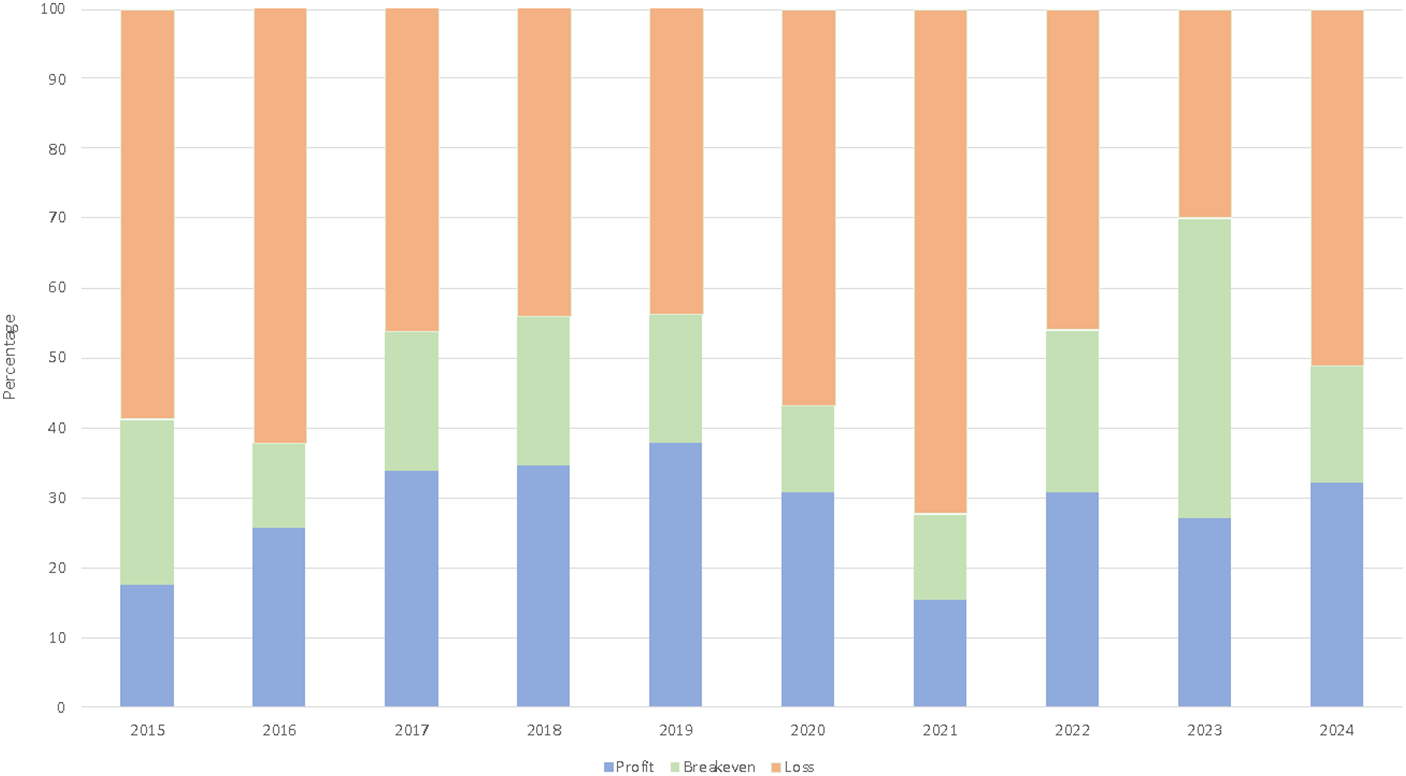
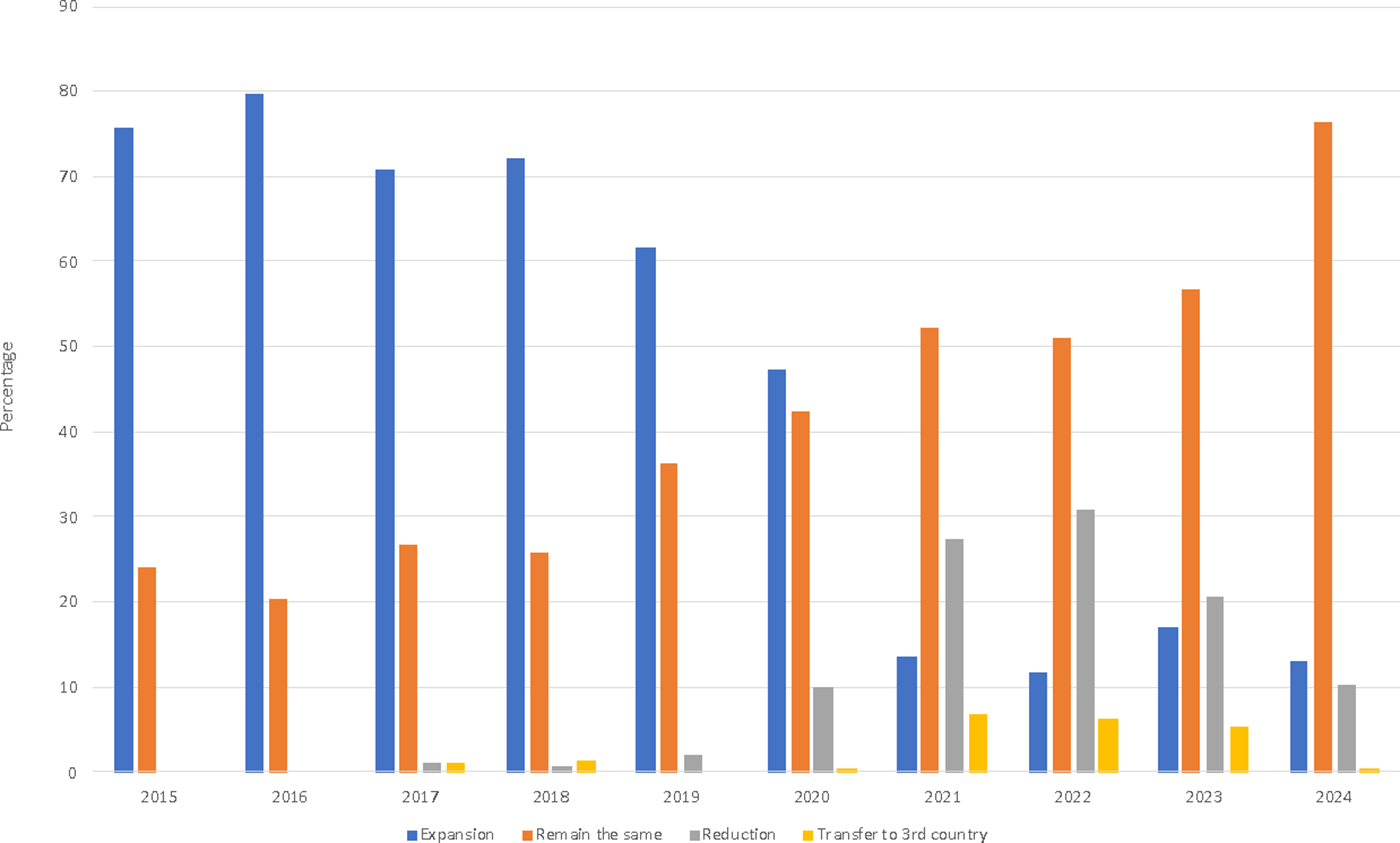
Since 2015, JETRO—a key informal actor in its own right—has commissioned a business survey on Japanese companies across the world with the most relevant one here being the “Survey on Business Conditions of Japanese Companies in Asia and Oceania.” It is a very detailed survey but there are two questions that stand out: “profit forecast” and “approach to future business plans/activates” (JETRO 2015).
Bearing in mind sample sizes for such surveys, and despite being consistently bottom of the list in all of Asian countries in profitability, Japanese companies remain bullish on Myanmar. Observing the two summary charts below, the coup d’état had a measurable impact on profitability but it recovered. Simultaneously, businesses made a marked shift from “expansion plans” to “remaining the same” (JETRO 2021). In the first few years after the coup there was a relatively large number who said they would leave but most did not and instead opted for a hunker-down approach (JETRO 2024).
These numbers may be deceptive, however, as JETRO’s Myanmar Trade and Investment Annual Report from 2023/2024 reports that Myanmar’s investment environment—“excluding Thilawa SEZ”—remains severe. This is the key caveat in the report—“excluding Thilawa.” It is unclear in their general businesses surveys where JETRO is surveying; the general companies out in the economy or the ones bubbled away south of Yangon in Thilawa. Figures 1 and 2 might reflect Japanese companies that are protected in Thilawa SEZ and therefore more willing to hunker down, just as the Japanese government did with regards to Western sanctions.
JETRO Survey: Operating Profit Forecast (for the year).
Source: Authors, data from JETRO business survey 2015–2024.

JETRO Survey: Approach to future business plans/activities in the next 1–2 years.
Source: Authors, data from JETRO business survey 2015–2024.

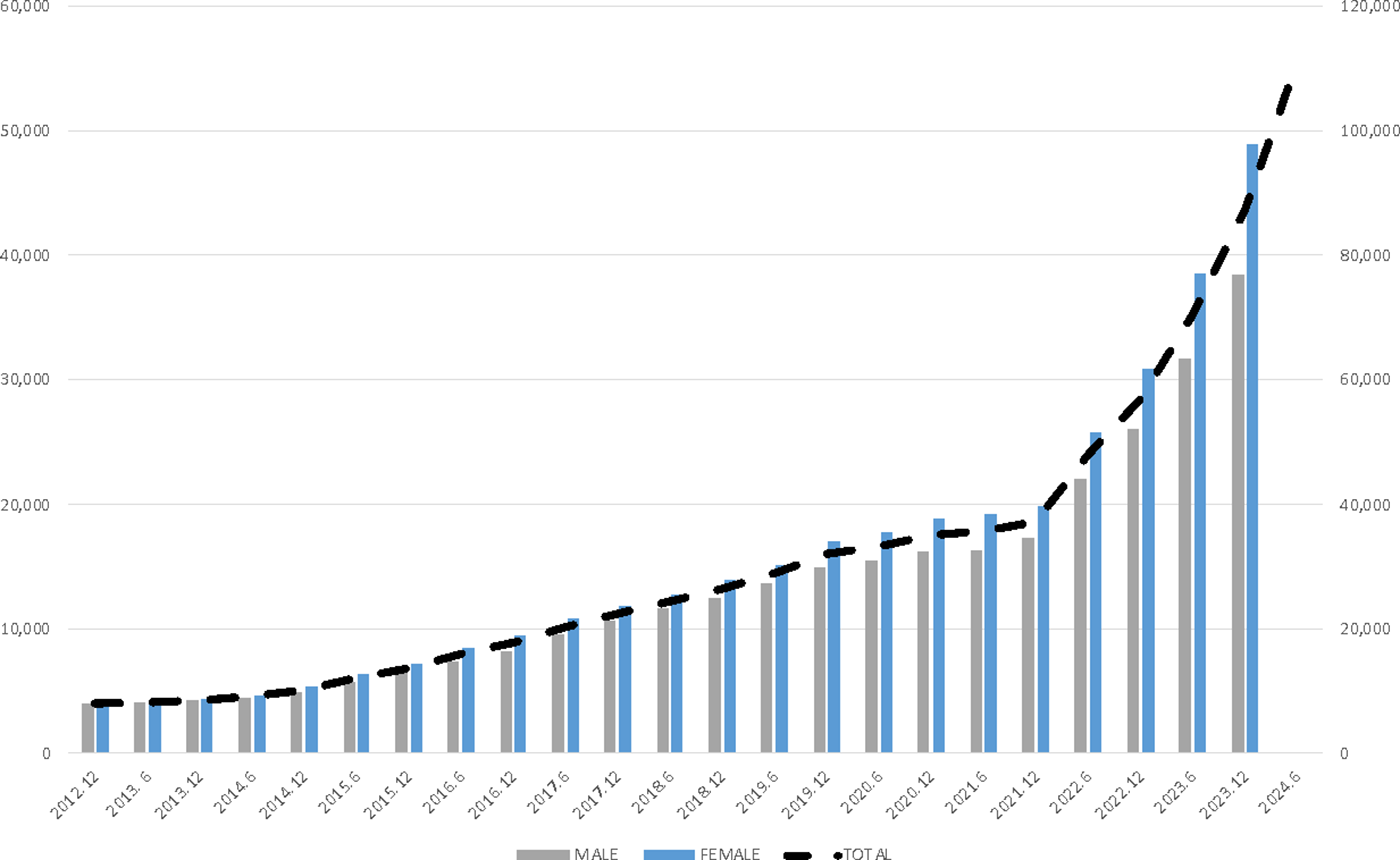
Burmese Foreign Residents of Japan 2012–2024.
Source: Immigration Service Agency, Japan.

Peering behind the data to cases, Japan’s informal actors who are linked to a shadow economy that Tatmadaw are also adept at operating in, creates potential conflicts between diplomatic objectives and economic motivations. This dimension was particularly evident in Watanabe’s case, where his business activities directly intersected with military-affiliated entities (Kyodo News Reference Kudo2021).
The Japan Myanmar Development Institution, Inc., controlled by Watanabe, maintained a joint venture with a military-linked company to develop land owned by Myanmar’s Defense Ministry. This commercial relationship continued despite a 2019 UN report identifying commercial ties with military-affiliated companies as potential sources of funding for human rights violations against the Rohingya (“Firm led by former Japan minister in joint venture linked with Myanmar military,” 2021). According to Myanmar government documents, Watanabe’s company had registered this joint venture with a military-affiliated entity in 2016, establishing a business relationship that would continue throughout the post-coup period.
In May 2022, 15 months after the coup, Watanabe met with Min Aung Hlaing and six ministers, including Union Minister for Planning and Finance U Win Shein and USDP Chairman Than Htay, to discuss economic cooperation and investment in the Thilawa SEZ. Ambassador Maruyama was notably absent from these meetings, merely relaying local news to Tokyo (MOFA 2022). This business-focused engagement occurred entirely outside official diplomatic channels, yet had significant implications for Japan’s broader relationship with the military regime.
Similarly, the Y Complex development in Yangon, which involved payments to the Tatmadaw for land owned by the Defense Ministry, represented another instance where business relationships maintained by Japanese actors potentially undermined efforts to isolate the military regime economically. Opposition lawmaker Yukihiko Akutsu highlighted these concerns during an April 2, 2021, Committee on Foreign Affairs meeting, criticizing what he termed “economic pipes” between the Tatmadaw and Japanese public-private alliances.
These business relationships raised significant questions about whether informal actors were undermining Japan’s official diplomatic positions and potentially providing financial resources to a government engaged in widespread human rights violations. The economic dimension of these informal channels thus created tensions not just with international pressure campaigns but also with Japan’s stated commitment to democratic principles.
Growing scrutiny and adaptation
As international pressure mounted, these informal channels became increasingly controversial. Civil society organizations, human rights advocates, and opposition lawmakers in the Diet began scrutinizing these relationships more closely, questioning whether they provided legitimacy to the military regime while undermining Japan’s official diplomatic positions. Human Rights Watch and other civil society groups argued that Japan should end military exchanges with the Tatmadaw, identifying a fundamental contradiction in continuing such programs while simultaneously criticizing the coup (Kasai Reference Kasai2021; Kasai Reference Kasai2022a). These criticisms extended to the informal channels maintained by figures like Sasakawa and Watanabe, particularly regarding their business relationships with military-affiliated entities.
The role of Sasakawa as Special Envoy for National Reconciliation in Myanmar came under particular scrutiny. Having been appointed to the position in 2015, Sasakawa had operated in the ambiguous space between official and unofficial diplomacy (MOFA 2015). Following the coup, his continued engagement with military leadership, while potentially valuable for specific diplomatic objectives like securing Kitazumi’s release, raised questions about whether such engagement implicitly legitimized the regime.
The growing controversy surrounding these informal channels introduced new domestic political considerations into Japan’s Myanmar policy. Opposition lawmakers increasingly questioned the government about these relationships, forcing greater transparency regarding the activities of figures like Sasakawa and Watanabe. This scrutiny gradually pushed informal diplomacy toward greater alignment with official policy positions, constraining the independence that had previously characterized these channels.
By 2024, the role of these informal actors had evolved in response to both international pressure and the changing regional landscape. While still maintaining unique channels of communication, their activities became subject to greater public scrutiny and diplomatic oversight. This evolution reflected the broader recalibration of Japan’s Myanmar policy: a complex balancing act between maintaining strategic engagement and responding to unprecedented humanitarian and political challenges.
Several factors drove this evolution. First, the increasing international isolation of Myanmar’s military regime complicated the operation of some informal diplomatic channels. As Western nations implemented sanctions and cut diplomatic ties, the activities of Japanese informal actors became more visible and controversial, forcing greater alignment with official policy positions.
Second, the military junta’s escalating human rights violations, particularly the high-profile executions of four democracy activists in July 2022, created domestic political pressure within Japan for a clearer stance against the regime. This pressure constrained the operational freedom of informal actors and pushed them toward greater coordination with official diplomatic initiatives.
Third, the detention of Japanese nationals like documentary filmmaker Toru Kubota highlighted the limitations of informal engagement in protecting Japanese interests. While Sasakawa’s “silent diplomacy” had helped secure Kitazumi’s release in May 2021, Kubota remained imprisoned until November 2022, when he was released alongside other foreign detainees in a broader prisoner amnesty. This demonstrated that informal channels, while valuable, could not consistently deliver diplomatic outcomes, particularly as the military regime became increasingly entrenched due to pressures on the battlefield and at home.
Lastly, Japan has become a major emigration destination for Myanmar nationals since the coup occurred in 2021. Among Southeast Asian foreign residents in Japan, Vietnamese are by far the largest population, followed by Philippinos and Indonesians, with Burmese now fourth (Figure 3). The sharp post-coup increase in the data indicates a significant shift in migration patterns with Japan accepting many more Burmese immigrants as residents. So much so that the Tokyo neighborhoods of Otsuka and Takadanobaba have become “Little Yangons.” With 350,000 Burmese as of 2020 living in China’s Yunnan, and Japan’s 111,000 Myanmar residents (as of 2024), two-thirds of whom are post-coup residents, inevitably such acceptance of Burmese immigrants has made Japan a major hub for Burmese expat politics.
Conclusion
This study has examined how Japan’s response to the 2021 Myanmar coup represents not just a policy adjustment but a sophisticated recalibration of Tokyo’s “special relationship” with the country. Through our three-dimensional analytical framework, we have leveraged declassified MOFA documents to uncover the behind-the-scenes bureaucratic negotiations and strategic calculations that drove Japan’s policy evolution, demonstrating how geopolitical interests, bureaucratic mechanisms, and informal diplomatic channels resulted in a distinctive post-coup approach.
Japan’s geopolitical strategy following the coup reflected a delicate balancing act between maintaining regional influence, upholding democratic principles, and protecting substantial economic investments, while attempting to simultaneously address China’s growing influence in Myanmar. The suspension of new ODA projects while continuing existing initiatives exemplified this approach—signaling diplomatic disapproval while maintaining political and economic engagement. As Chief Cabinet Secretary Katsunobu Kato explicitly acknowledged, a total suspension of ODA “would strengthen China’s influence over Myanmar” (Nihon Keizai Shimbun 2021b). This geopolitical calculation fundamentally shaped Japan’s post-coup policy decisions and distinguished its approach from Western nations.
Within Japan’s bureaucratic apparatus, different institutional actors developed sophisticated mechanisms for maintaining diplomatic channels while incrementally distancing themselves from the military regime. The Ministry of Foreign Affairs’ First Southeast Asia Division assumed a central role in coordinating critical diplomatic interactions, while the Ministry of Defense gradually reassessed its engagement with the Tatmadaw, ultimately suspending a military training program in September 2022 following the junta’s high-profile executions of four democracy activists (Kasai Reference Kasai2022b).
Perhaps the most distinctive factor was Japan’s cultivation of “fat pipes,” informal diplomatic channels maintained by figures like Yōhei Sasakawa and Hideo Watanabe that provided unique access to Myanmar’s military leadership. The case of Japanese journalist Yūki Kitazumi illustrated the practical value of these channels, with Sasakawa’s “silent diplomacy” contributing to his release in May 2021. These informal channels, however, also created tensions with Japan’s stated commitment to democratic principles, particularly regarding business relationships with military-affiliated entities like the Y Complex development in Yangon, which generated revenue for the Tatmadaw through land lease payments.
These three dimensions operated in many respects as an integrated system with important points of interaction. Geopolitical considerations regarding China’s regional influence directly shaped bureaucratic decisions on ODA suspension, while informal actors operated within the space created by Tokyo’s strategic ambiguity. Japan’s cautious diplomatic positioning—neither embracing nor completely rejecting the military regime—enabled a nuanced form of engagement through which these dimensions reinforced one another, creating an approach that evolved in response to changing circumstances following the coup.
The evolution of Japan’s foreign policy toward Myanmar between 2021 and 2024 demonstrates a pattern of incremental adjustment rather than wholesale transformation. The initial suspension of new ODA projects in March 2021 was followed by the Ministry of Defense’s decision to end its military training program in September 2022 and Foreign Minister Hayashi’s exclusion of the junta-appointed Ambassador from ASEAN meetings in October 2022. In 2024, Ambassador Maruyama was not replaced at the Japanese Embassy in Yangon; and the position of Japanese Ambassador to Myanmar now remains vacant.
Instead of abandoning its “special relationship,” it is clear that Tokyo has reimagined or “rethought” many aspects of its previous approach in the face of a new and challenging political landscape brought about by the 2021 coup—distinct from its previous ‘realpolitik’ approach following the military takeover in 1988.
Looking ahead, Japan’s Myanmar policy faces increasingly complex challenges as the military regime becomes more entrenched while simultaneously losing territorial control to opposition forces. The junta’s proposed elections for December 2025, widely dismissed by the international community and opposition groups as lacking legitimacy, present Tokyo with a particularly difficult diplomatic test (Kasai Reference Kasai2025). Japan will need to navigate maintaining its strategic ambiguity and taking a clearer stance on electoral legitimacy, especially in view of the regime’s continued violence against civilians and the growing strength of the National Unity Government and ethnic armed organizations.
Moreover, as China’s influence continues to expand through infrastructure projects and resource extraction deals with the junta, Japan’s calculus about maintaining engagement to counter Chinese influence may prove untenable. The coming years will test whether Japan’s incremental adjustment strategy can adapt to a scenario where the military regime’s survival appears increasingly uncertain, potentially forcing Tokyo to choose between its traditional preference for quiet diplomacy and the need for more decisive action in support of Myanmar’s democratic aspirations.
The broader implications of this research extend beyond the Japan–Myanmar relationship to fundamental questions about Southeast Asia’s future, Japan’s foreign policy, and international relations theory. Myanmar’s position as both bridge and frontier in Southeast Asia makes it a critical test case for how liberal democracies engage with authoritarian regimes in an era of great power competition. As realpolitik considerations increasingly compete with liberal frameworks, Japan’s Myanmar policy also serves as a weathervane for broader shifts in regional diplomatic engagement.
The tension between realpolitik and liberal frameworks of engagement that have informed Japan’s post-coup approach reflect wider debates about engagement versus isolation strategies toward authoritarian regimes. Japan’s experience demonstrates both the possibilities and limitations of maintaining middle-ground approaches in an increasingly polarized international system. How Tokyo ultimately manages these tensions will have implications not only for Myanmar’s future—but for the broader Indo-Pacific region.
Competing interests
The authors declare none.
Appendix
Timeline of Japan–Myanmar Relations (2021–2024)


 Open access

