


Introduction
Cassava is extensively cultivated in the humid and subhumid tropical regions of Africa (Lebot Reference Lebot2009), which produces more than 54% of the worldʼs cassava output (FAOSTAT 2014). This crop is cultivated mainly by smallholders and medium-scale farmers in 37 countries (FAOSTAT 2011). Nigeria is a global leader in cassava production with an output of approximately 59.5 million tonnes from 6.79 million hectares under cassava cultivation (FAOSTAT 2017). This output accounts for approximately 62% of cassava production in West Africa (FAOSTAT 2011). Cassava is an important crop in sub-Saharan Africa (Nweke Reference Nweke2004), where it is a major staple food for more than 200 million people (Nweke and Emete Reference Nweke and Emete1999). It is the second most important staple food crop after maize in terms of calories consumed (Nweke Reference Nweke1994). Cassava plays a vital role in the food economy of many African countries, including Nigeria, where it remains a strategic crop for both food security and poverty alleviation (Donkor et al. Reference Donkor, Onakuse, Bogue and de Los Rios2017; FAO 2011). This crop is now also an essential source of industrial raw material for the production of starch, bioethanol, high-quality flour for pharmaceuticals, food, and beverages and has the potential to contribute to the economic growth of Nigeria and most cassava-producing countries in sub-Saharan Africa.
A major challenge to cassava production in Nigeria is the low root yield (8 to 12.6 tonnes ha−1) obtained by smallholders and medium-scale farmers (Donkor et al. Reference Donkor, Onakuse, Bogue and de Los Rios2017; Ekeleme et al. Reference Ekeleme, Hauser, Atser, Dixon, Weller, Olorunmaiye, Usman, Olojede and Chikoye2016; FAOSTAT 2017) compared with yields ranging from 20 to >35 tonnes ha−1 from Asian and Caribbean countries (Donkor et al. Reference Donkor, Onakuse, Bogue and de Los Rios2017; Hauser and Ekeleme Reference Hauser, Ekeleme and Hershey2017). Yields higher than 25 tonnes ha−1 have been achieved in Nigeria on research plots with appropriate crop management (Ekeleme et al. Reference Ekeleme, Hauser, Atser, Dixon, Weller, Olorunmaiye, Usman, Olojede and Chikoye2016; Hauser and Ekeleme Reference Hauser, Ekeleme and Hershey2017).
Poor weed control has been identified as a major cause of low yields in farmers’ fields (Chikoye et al. Reference Chikoye, Ekeleme and Udensi2001; Ekeleme et al. Reference Ekeleme, Hauser, Atser, Dixon, Weller, Olorunmaiye, Usman, Olojede and Chikoye2016; Howeler Reference Howeler2007). Although competition from weeds occurs at all periods of growth, the most damaging effects of weeds on cassava occur during two specific periods: the first 3 to 12 wk after planting (WAP) when the crop is in its early canopy-formation stage and the third month after planting when the storage roots commence bulking (Akobundu Reference Akobundu1980; Chikoye et al. Reference Chikoye, Ekeleme and Udensi2001; Melifonwu Reference Melifonwu1994; Onochie Reference Onochie1975). Several studies have stressed the importance of early weed control in the first 1 to 3 mo after planting to achieve high yields (Aye Reference Aye2011; Howeler Reference Howeler2007; Tongglum et al. Reference Tongglum, Phornpromprathaan, Tiraporn and Sinthuprama1992).
Manual weeding is the most common method of weed control in cassava cultivation in Nigeria. Farmers carry out two to three hoe-weedings in the first growth cycle of cassava, but in areas where rhizomatous perennial weeds such as cogon grass (Imperata cylindrica L.) or sedges are dominant, additional hoe-weeding may be required. Generally, manual hoe-weeding is labor-intensive and time-consuming, and in most cases, farmers do not follow the recommended weeding regimes of 3, 6, and 9; or 4, 8, and 12 WAP (Adigun and Lagoke Reference Adigun and Lagoke2003; Ekeleme et al. Reference Ekeleme, Hauser, Atser, Dixon, Weller, Olorunmaiye, Usman, Olojede and Chikoye2016; Joshua and Gworgwor Reference Joshua and Gworgwor2000).
Smallholders and medium-scale farmers increasingly use herbicides to control weeds in cassava due to reduced manpower availability and high labor costs. Odoemenem and Otanwa (Reference Odoemenem and Otanwa2011) reported that 68.9% of smallholder farmers used herbicides to control weeds in cassava in north central Nigeria. Of those farmers, 9.5% used a variety of PRE herbicide formulations, whereas 69.0% used POST herbicides such as glyphosate (52.6%) and paraquat (16.4%). Currently, a limited number of herbicides are registered for use in cassava production in Nigeria.
The most common PRE herbicides currently used by cassava farmers are formulations containing atrazine, diuron, and S-metolachlor. These herbicides are usually applied at high doses that are prohibitively expensive for smallholder farmers. It is therefore essential to provide farmers with efficient and sustainable weed management to enhance cassava yields. This could be achieved with PRE herbicides that are effective against weeds and environmentally safe. The objective of this research was to identify additional PRE herbicide options for weed control in cassava production ecosystems in Nigeria.
Materials and Methods
Site Description and Treatment Application
Trials were conducted in two cropping seasons (first season, April to December 2014; second season, August 2014 to April 2015) at five locations representing three agroecologies in Nigeria: Humid Forest, Humid Forest Transition (Derived Savanna), and Southern Guinea Savanna (Figure 1). The Humid Forest and Humid Forest Transition agroecologies have a growing season rainfall of >1,300 mm with a growing period of 211 to 270 d and a window for two planting periods (referred to here as “seasons”). The Southern Guinea Savanna has a growing season rainfall of 1,200 to 1,500 mm with a shorter growing period of 181 to 210 d and a single planting window (Ekeleme et al. Reference Ekeleme, Akobundu, Fadayomi, Chikoye and Abayomi2003). The first season trials were established in April 2014 at three locations and the second season in August 2014 at two locations (Table 1).
The study sites in Abia, Benue, Ogun, and Oyo states in Nigeria.

Description of experiment sites in Nigeria in the first and second cropping seasons.

a Abbreviations: FUNAAB, Federal University of Agriculture Abeokuta; IITA, International Institute of Tropical Agriculture; NRCRI, National Root Crops Research Institute; UAM, University of Agriculture Makurdi.
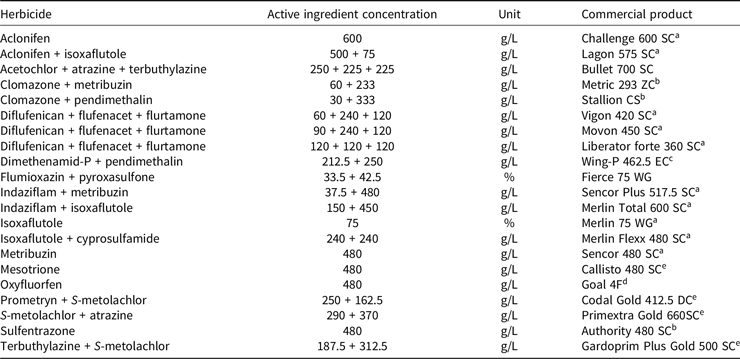
Nineteen PRE herbicides (Table 2) and manual hoe-weeding at 4, 8, and 12 WAP were evaluated for weed control efficacy. A weedy check was included for determination of weed control (%) values. Except for isoxaflutole and metribuzin, which had only one recommended application rate, the other herbicides were evaluated at two or three rates. Application rates were selected to represent lower label-recommended rates and 1.5 times the recommended application rate except for herbicides supplied by Bayer Crop Science, which provided application rates for its products. In total, 49 PRE herbicide treatments were evaluated. At each site, trials were established in a randomized complete block design with three replications. All herbicide treatments were commercial formulations and S-metolachlor + atrazine, which is commonly used by farmers, was included for comparison.
Herbicide treatments and rates used in cassava experiments.
a Provided by Bayer Crop Science, Alfred-Nobel-Str. 50, Monheim, Germany https://www.cropscience.bayer.com/en.
b Provided by FMC Corporation, Market Street, PA, USA https://www.fmctechnologies.com.
c Provided by BASF Corporation, Research Triangle Park, NC, USA http://agrproducts.basf.us.
d Provided by SaroAgroscience, Amuwo-Odofin, Lagos, Nigeria http://saroafrica.com.ng.
e Provided by Syngenta Crop Protection AG, Basel, Switzerland https://www4.syngenta.com.
The treated plot size at each location was a 4.0 × 4.0 m square. An erect cassava variety, TME 419, was used in the trial. The planting material consisted of cassava stem cuttings measuring 25 cm—known as cassava stakes. The first season trial was on a scale of 10,000 plants ha−1 and 20,000 plants ha−1 were used in the second season trial. The increase in cassava plant numbers for the second planting season was aimed at achieving early canopy closure before the dry season commenced. Every site was treated with glyphosate to control perennial grasses and broadleaf weeds at 2 to 3 wk before field plowing. The experimental site was plowed and then harrowed 2 wk after plowing. The PRE herbicide treatments were applied 1 or 2 d after planting (DAP) with a hand-pumped CP 15 (COOPER PEGLER®) knapsack sprayer calibrated to deliver 250 L ha−1 of water at 240 kPa through a Cooper Pegler Hypro Polijet nozzle AN1.2 Green (EXEL GSA, ZI NORS ARNAS – BP 30 424, 69653 Villefranche Cedex). The overall herbicide efficacy in each plot was visually assessed at 8 wk after treatment (WAT) using a 0 to 100 scale, where 0 = no weed control, 10 to 49 = poor control, 50 to 69 = moderate control, 70 to 79 = fair/acceptable control, 80 to 89 = good control, and 90 to 100 = excellent control. Weed species in each plot were identified and counted in two 1-m2 quadrants placed along a diagonal transect in each plot at each herbicide efficacy rating period. Weed species density data were used to estimate herbicide efficacy on major species as follows:
 $${{WS{P_{untreated}} - WS{P_{treated}}} \over {WS{P_{untreated}}}} \times 100$$
Where WSP untreated and WSP treated is the weed species population in untreated plots and treated plots, respectively. To evaluate crop selectivity, phytotoxicity was assessed by visually rating crop damage on a scale of 0 (no phytotoxicity) to 10 (total plant death) at 2 and 4 WAT. All plots treated with herbicides were hoe-weeded at 10 wk after PRE herbicide treatment. Cassava stand establishment was assessed at 8 WAP and calculated as a percentage of planted stakes that sprouted. Cassava stakes that failed to sprout after the application of herbicides were not replaced. Fresh roots were harvested at 9 mo after planting at each site.
Statistical Analysis
Analysis of variance was used to examine the differences in treatment effects of two key yield variables: cassava stand count at 8 WAP and cassava fresh root yield at crop harvest. Significant treatment means were separated using the LSD at 5% probability. Where a location-by-treatment interaction effect was significant (P < 0.05), simple effect differences were evaluated among treatments to understand the nature of the interactions. Also, evaluated were Pearson linear correlation coefficients of cassava fresh root yield with herbicide control efficacy on various weed types (broadleaf weeds, grassy weeds, and all weeds) to discern the level of association between cassava root yield and weed control measures. Heat map presentation of the estimates of herbicide efficacy on all weeds, dominant weed species, cassava stand establishment, and root yield was used to strengthen the understanding and interpretation of the data matrix. Data on cassava stand establishment (%) was log10(x + 1) transformed before analysis to stabilize the variance. All data analyses were performed using SAS software (version 9.4; SAS Institute Inc., Cary, NC).
Results and Discussion
There was a strong seasonal influence on herbicide efficacy, cassava stand establishment, and root yield. In the first cropping season, location-by-treatment interaction was significant (P < 0.01) for herbicide efficacy, cassava stand establishment, and root yield; therefore, data are presented separately by season and location. In the second cropping season, location by treatment was not significant (P > 0.20) for cassava stand establishment (%) or cassava stand population at crop harvest; therefore, data were pooled over location for these variables and combined data are presented. Data on herbicide efficacy against major weeds are presented by location.
Herbicide Efficacy: First Cropping Season
Herbicide Efficacy at the Abia State Site
At the National Root Crops Research Institute (NRCRI) site in Abia State, herbicide treatments varied considerably in broadleaf and grass weed control (Table 3). Overall, indaziflam + metribuzin provided superior (90%) broadleaf weed control at 8 WAT (Table 3, dark green). Similarly, grassy weeds were controlled more than 90% by indaziflam + metribuzin, indaziflam + isoxaflutole, and flumioxazin + pyroxasulfone (Table 3, dark green). Indaziflam + metribuzin, acetochlor + atrazine + terbuthylazine, sulfentrazone, isoxaflutole, isoxaflutole + cyprosulfamide, oxyfluorfen, and mesotrione (Table 3, dark green) showed excellent efficacy on hemorrhage plant [Aspilia africana (Pers.) C.D.]. Yellow tassel flower [Emilia coccinea (Sims) G. Don] was effectively controlled (>95%) by most of the herbicides. Diflufenican + flufenacet + flurtamone, clomazone + metribuzin, flumioxazin + pyroxasulfone, sulfentrazone, aclonifen + isoxaflutole, S-metolachlor + atrazine, mesotrione, and indaziflam + metribuzin (dark green in Table 3) provided excellent control of Siam weed [Chromolaena odorata (L.) R.M. King & Robinson]. Indaziflam + metribuzin, oxyfluorfen, and sulfentrazone (also coded dark green in Table 3) provided >90% control of giant potato (Ipomoea mauritiana Jacq.). The giant sensitive plant (Mimosa diplotricha C. Wright ex Sauuville) was controlled by acetochlor + atrazine + terbuthylazine, S-metolachlor + atrazine, diflufenican + flufenacet + flurtamone, and flumioxazin + pyroxasulfone (Table 3, dark green). The most efficient treatments on girdlepod [Mitracarpus villosus (Sw.) Cham. & Schltdl. ex DC.] were aclonifen, clomazone + pendimethalin, dimethenamid-P + pendimethalin, flumioxazin + pyroxasulfone, indaziflam + isoxaflutole, indaziflam + metribuzin, oxyfuorfen, and terbuthylazine + S-metolachlor (Table 3, dark green, Table 3). Hemorrhage plant, Siam weed, giant sensitive plant, and giant potato are prominent weeds in cassava fields (Alabi et al. Reference Alabi, Ayeni, Agboola and Majek2001, Reference Alabi, Ayeni, Agboola and Majek2004a; Nzegbule and Ogunremi Reference Nzegbule and Ogunremi1995; Tarawali et al. Reference Tarawali, Ilona, Ojiako, Iyangbe, Ogundijo, Asumugha, Udensi and Dialo2013; Wakjira Reference Wakjira2011). Siam weed and giant sensitive plant are reported as invasive species (Ikuenobe and Ayeni Reference Ikuenobe and Ayeni1998; Uyi et al. Reference Uyi, Ekhator, Ikuenobe, Borokimi, Aigbokhan, Egbon, Adebayo, Igbinosa, Okeke, Igbinosa and Omokhua2014) that reduce cassava root yield in the Humid Forest and Derived Savanna agroecologies in Nigeria. Alabi et al. (Reference Alabi, Ayeni, Agboola and Majek2001) reported up to 85% root yield loss due to competition from giant sensitive plant and Nzegbule and Ogunremi (Reference Nzegbule and Ogunremi1995) reported significant cassava root yield reduction from competition with Siam weed. The most effective treatments on tropical carpet grass [Axonopus compressus (Sw.) P. Beauv.] and scrobic paspalum (Paspalum scrobiculatum L.) were indaziflam + metribuzin, indaziflam + isoxaflutole, and flumioxazin + pyroxasulfone (Table 3, dark green).
Percentage of broadleaf and grass weeds controlled by different herbicide treatments at 8 wk after treatment in the first cropping season at the National Root Crops Research Institute site in Nigeria.

 = Excellent weed control (90% to 100%),
  = Good weed control (80% to 89%),
  = Fair/acceptable weed control (70% to 79%),
  = moderate weed control (50% to 69%),
  = poor weed control (10% to 49%).
a Abbreviations: APIAL, hemorrhage plant; AXOCO, tropical carpet grass; EMICO, yellow tassel flower; EUPOD, Siam weed; IPOMT, giant potato; MIMIN, giant sensitive plant; MITCVI, girdlepod; PASSC, scrobic paspalum.
b Hoe-weeded once at the time of assessment.
Although some herbicide treatments had generally poor to moderate control of broadleaf weeds and grasses, they were effective against specific weed species. For example, mesotrione generally showed poor control of most broadleaf weeds but excellent control of hemorrhage plant, Siam weed, and yellow tassel flower.
Herbicide Efficacy at the Benue State Site
At this site, indaziflam + isoxaflutole and indaziflam + metribuzin (Table 4, dark green) provided superior (>90%) broadleaf weed control at 8 WAT compared with the other treatments. Indaziflam + isoxaflutole and indaziflam + metribuzin (Table 4, dark green) provided excellent control of coat buttons (Tridax procumbens L.), mint weed (Hyptis suaveolens Poit.), and ironweed (Vernonia ambigua Kotschy & Peyr). Similarly, acetochlor + atrazine + terbuthylazine, flumioxazin + pyroxasulfone, isoxaflutole + cyprosulfamide, and oxyfluorfen (Table 4, dark green) showed excellent control of coat buttons and ironweed. Flumioxazin + pyroxasulfone, indaziflam + isoxaflutole, indaziflam + metribuzin, isoxaflutole, isoxaflutole + cyprosulfamide, and terbuthylazine + S-metolachlor (Table 4, dark green) provided excellent control of crabgrass (Digitaria horizontalis Willd.), goosegrass [Eleusine indica (L.) Gaertn.], and itchgrass [Rottboellia cochinchinensis (Lour.) Clayton].
Percentage of broadleaf and grass weeds controlled by different herbicide treatments at 8 wk after treatment in the first cropping season at the University of Agriculture Makurdi site in Nigeria.

= Excellent weed control (90% to 100%), = Good weed control (80% to 89%), = Fair/acceptable weed control (70 to 79%), = moderate weed control (50% to 69%), = poor weed control (10% to 49%).
a Abbreviations: DIGHO, crabgrass; ELEIN, goosegrass; HYPSU, mint weed; ROOEX, itchgrass; TRQPR, coat buttons; VENAM, ironweed.
b Hoe-weeded once at the time of assessment.
Coat buttons, mint weed, ironweed, crabgrass, goosegrass, and itchgrass are important competitive weed species that are difficult to control with the herbicides currently used by smallholder farmers in Nigeria (Olorunmaiye and Olorunmaiye Reference Olorunmaiye and Olorunmaiye2008; Olorunmaiye et al. Reference Olorunmaiye, Lagoke, Adigun and Orija2013). In north central Nigeria, which shares similar ecology with this site (Southern Guinea Savanna), Olorunmaiye and Olorunmaiye (Reference Olorunmaiye and Olorunmaiye2008) observed that coat buttons, crabgrass, and itchgrass were not controlled by S-metolachlor + atrazine or by metolachlor + metobromuron when applied PRE alone or when followed by one or two manual hoe-weedings at 6 and 12 WAP in a cassava/maize intercrop. Several studies have identified resistance in some populations of itchgrass to some acetyl coenzyme-A carboxylase-inhibiting herbicides in Bolivia and Costa Rica (Avila et al. Reference Avila, Bolaños and Valverde2007; Castillo-Matamoros et al. Reference Castillo-Matamoros, Brenes-Angulo, Herrera-Murillo and Gómez-Alpízar2016). At the International Center for Tropical Agriculture in Colombia, oxyfluorfen did not control goosegrass at the label rate of 0.5 kg ai ha−1 (Tonggulum and Leihner Reference Tonggulum and Leihner2015). In the aforementioned study, goosegrass was controlled at a higher oxyfluorfen rate, but this caused unacceptable damage to cassava at 28 d after application. Flumioxazin + pyroxasulfone provided excellent control of coat buttons, mint weed, ironweed, crabgrass, goosegrass, and itchgrass.
Herbicide Efficacy at the Ogun State Site
The most effective herbicide treatments with 90% efficacy on all broadleaf weeds at the Federal University of Agriculture Abeokuta (FUNAAB) site in Ogun State at 8 WAT were indaziflam + isoxaflutole, isoxaflutole, and sulfentrazone (Table 5, dark green). At this site, flumioxazin + pyroxasulfone, indaziflam + isoxaflutole, indaziflam + metribuzin, and isoxaflutole (Table 5, dark green) use resulted in excellent control of red fruit passionflower (Passiflora foetida L.) and coat buttons compared with the other treatments. The majority of these treatments controlled hemorrhage plant and milkweed (Euphorbia heterophylla L.) effectively. Aclonifen + isoxaflutole, diflufenican + flufenacet + flurtamone, dimethenamid-P + pendimethalin, flumioxazin + pyroxasulfone, indaziflam + isoxaflutole, isoxaflutole, and prometryn + S-metolachlor provided excellent control of crabgrass and scrobic paspalum (Table 5, dark green).
Percentage of broadleaf and grass weeds controlled by different herbicide treatments at 8 wk after treatment in the first cropping season at the Federal University of Agriculture Abeokuta site in Nigeria.

= Excellent weed control (90% to 100%), = Good weed control (80% to 89%), = Fair/acceptable weed control (70% to 79%), = moderate weed control (50% to 69%), = poor weed control (10% to 49%).
a Abbreviations: APIAL, hemorrhage plant; DIGHO, crabgrass; EPHHL, milkweed; PAQFO, red fruit passionflower; PASSC, scrobic paspalum; TRQPR, coat buttons.
b Hoe-weeded once at the time of assessment.
Weed Control Efficacy: Second Cropping Season
Herbicide Efficacy at the Abia State Site
At the NRCRI site, the most effective herbicide treatments were mesotrione, indaziflam + metribuzin, indaziflam + isoxaflutole, isoxaflutole, flumioxazin + pyroxasulfone, and diflufenican + flufenacet + flurtamone (Table 6, coded yellow), which controlled broadleaf weeds 70% to 77% at 8 WAT. At this location, sulfentrazone controlled grasses by 82% at 8 WAT (Table 6, light green).
Percentage of broadleaf and grass weeds controlled by different herbicide treatments at 8 wk after treatment in the second cropping season at two sites in Nigeria.

= Excellent weed control (90 to 100%), = Good weed control (80 to 89%), = Fair/acceptable weed control (70 to 79%), = moderate weed control (50 to 69%), = poor weed control (10 to 49%).
a Abbreviations: IITA, International Institute of Tropical Agriculture; NRCRI, National Root Crops Research Institute.
b Hoe-weeded once at the time of assessment.
Herbicide Efficacy at the Oyo State Site
At the International Institute of Tropical Agriculture (IITA) site in Oyo State, indaziflam + metribuzin, terbuthylazine + S-metolachlor, sulfentrazone, S-metolachlor + atrazine, and acetochlor + atrazine + terbuthylazine provided excellent (90% to 97%) control of grasses up to 8 WAT (Table 6, dark green).
Indaziflam + isoxaflutole and indaziflam + metribuzin consistently had the highest efficacy against broadleaf and grass weeds relative to other tested herbicides at most locations. This trend may be attributed to indaziflam, which has been reported to provide season-long residual control of annual grasses and broadleaf weeds in many crops when applied PRE (Sebastian et al. Reference Sebastian, Fleming, Patterson, Sebastian and Nissen2017; Singh et al. Reference Singh, Ramirez and Edenfield2011). In Florida, Singh et al. (Reference Singh, Ramirez and Edenfield2011) reported that indaziflam applied as a PRE herbicide provided 3 to 4 mo of residual weed control in citrus groves.
In general, flumioxazin + pyroxasulfone consistently provided very good to excellent control of broadleaf and grass weeds at all sites (Table 6, dark green). Flumioxazin + pyroxasulfone has been reported to provide excellent weed control at rates similar to those evaluated in this study. This herbicide has been shown to be effective in soybean fields against broadleaf weeds such as velvetleaf (Abutilon theophrasti Medik), redroot pigweed (Amaranthus retroflexus L.), smooth pigweed (Amaranthus hybridus L.), and lambsquarter (Chenopodium album L.; Mahoney et al. Reference Mahoney, Shropshire and Sikkema2014). Curtis et al. (Reference Curtis, Roerig, Hulting and Mallory-Smith2011) reported its effectiveness against grasses such as annual bluegrass (Poa annua L.), perennial ryegrass (Lolium perenne L.), and tall fescue [Lolium arundinaceum (Schreb.)]. Long soil residual activity has been reported for flumioxazin + pyroxasulfone (Bernards et al. Reference Bernards, Dale, Hartzler, Owen, Peterson, Shoup, Gunsolus, Knezevic, Wilson, Zollinger, Moeching, Refsell and Pawlak2010).
Cassava Stand Establishment and Selectivity
First Cropping Season
In the first cropping season, a significant treatment effect on cassava stand establishment was observed at the NRCRI (P = 0.0246), University of Agriculture Makurdi (UAM; P < 0.0001), and FUNAAB (P < 0.0001) sites (Table 7). Cassava establishment among herbicide treatments at the three sites (NRCRI, UAM, and FUNAAB; coded yellow in Table 7) was below 80%. At the NRCRI and UAM sites, cassava establishment in the other herbicide treatments ranged from 80% to 98% except for dimethenamid-P + pendimethalin treatment at the NRCRI site (Table 7, light brown). Cassava stakes in plots treated with all herbicides that contained indaziflam exhibited delayed sprouting at all sites. Delay in cassava sprouting was consistent in plots treated with indaziflam + isoxaflutole and indaziflam + isoxaflutole (Table 7, coded yellow). These two herbicide treatments contain a higher concentration of indaziflam. In the majority of the plots treated with indaziflam-containing herbicides, we noted that buds on the exposed part of unsprouted cassava stakes were still fresh and green in color when they were scratched. Still, when the stakes were inspected at 3 WAP, we observed cassava shoots emerging from the buried portion of the stake. A possible explanation is that cassava shoots sprouting from the buried buds on the stake required more time to emerge, and in clay soil, emergence may be prolonged or hindered. Indaziflam has been shown to inhibit cellulose biosynthesis in plants (Brabham et al. Reference Brabham, Lei, Gu, Stork, Barrett and DeBolt2014), and this may be responsible for the delayed sprouting. At the FUNAAB site, cassava establishment was generally poor due to poor soil drainage.
Effect of herbicide treatment on cassava stand establishment at 8 wk after planting in the first and second cropping seasons.

a Abbreviations: FUNAAB, Federal University of Agriculture Abeokuta; IITA, International Institute of Tropical Agriculture; NRCRI, National Root Crops Research Institute; UAM, University of Agriculture Makurdi.
b Values followed by the same letter within a column are not significantly different at α = 0.05.
c Hoe-weeded at 4, 8, and 12 wk after planting.
Second Cropping Season
In the second cropping season, cassava establishment was >80% at the NRCRI and IITA sites except in plots treated with indaziflam + isoxaflutole and indaziflam + metribuzin, which had 73% to 79% of the expected cassava population of 20,000 plants ha−1 (Table 7, yellow). In both cropping seasons, diflufenican + flufenacet + flurtamone caused temporary leaf bleaching for 2 to 3 wk. Sulfentrazone caused prolonged leaf crinkling at the tip of the cassava shoot. Legleiter and Johnson (Reference Legleiter and Johnson2013) reported similar symptoms on soybean leaves in fields treated with sulfentrazone as a PRE herbicide. Crop injury from sulfentrazone has often been attributed to such conditions as wet soil or heavy rainfall (Legleiter and Johnson Reference Legleiter and Johnson2013; Swantek et al. Reference Swantek, Sneller and Oliver1998). Swantek et al. (Reference Swantek, Sneller and Oliver1998) noted that several heavy rainfall events totaling 170 mm in 16 DAP caused significant injury to soybean in Keiser, Florida. Our study was conducted in areas that received a total annual rainfall of 1,100 to 1,500 mm.
Cassava Fresh Root Yield
Cassava fresh root yield in the first cropping season varied with location (P = 0.0047). The location-by-treatment effect was significant only in the first cropping season (P = 0.0084).
First Cropping Season
A significant 7.72 to 12.3 tonnes ha−1 increase in fresh root yield was observed in herbicide-treated plots compared with hoe-weeded plots at the NRCRI site. This result occurred in plots treated with terbuthylazine + atrazine (Table 8, dark and light codes), and acetochlor + atrazine + terbuthylazine, diflufenican + flufenacet + flurtamone, oxyfluorfen, and indaziflam + isoxaflutole (Table 8, light green). Indaziflam + metribuzin, isoxaflutole, S-metolachlor + atrazine, flumioxazin + pyroxasulfone, aclonifen + isoxaflutole, clomazone + pendimethalin, dimethenamid-P + pendimethalin, and diflufenican + flufenacet + flurtamone had a 4 to 7.3 tonnes ha−1 yield advantage over the hoe-weeded treatment (Table 8, light green). Overall, uncontrolled weed growth in the untreated plots led to a reduction in root yield of 28.5% to 66.4%. Cassava fresh root yield at the NRCRI site in 23 out of 45 herbicide treatments was 1.5 to more than 2 times the Nigerian national root yield average. FAOSTAT (2017) reports a national yield average of 8.76 tonnes ha−1 for Nigeria, which is lower than the 22 tonnes ha−1 average yields currently obtained in Asia.
Cassava fresh root yield as influenced by herbicide treatment and manual hoe-weeding in first and second cropping seasons 9 mo after planting.

a Values followed by the same letter within a column are not significantly different at α = 0.05.
b Abbreviations: FUNAAB, Federal University of Agriculture Abeokuta; IITA, International Institute of Tropical Agriculture; NRCRI, National Root Crops Research Institute; NA, data not available; UAM, University of Agriculture Makurdi.
c Average cassava fresh root yield from the International Institute of Tropical Agriculture, Research Farm and National Root Crops Research Institute Research Farm site.
d Hoe-weeded at 4, 8, and 12 wk after planting.
Cassava root yield at the UAM site was generally lower than yields obtained from the other locations, mainly due to poor soil drainage at the site after rain (Table 8). Cassava root yield from plots treated with isoxaflutole + cyprosulfamide, indaziflam + isoxaflutole, prometryn + S-metolachlor, and diflufenican + flufenacet + flurtamone (Table 8, yellow) more than doubled the yield from the hoe-weeded plot.
At the FUNAAB site, plots treated with dimethenamid-P + pendimethalin, indaziflam + metribuzin, and acetochlor + atrazine + terbuthylazine (Table 8, light green) produced yields that were significantly increased by 13.1 to 16.7 tonnes ha−1 over the hoe-weeded plot. Plots treated with flumioxazin + pyroxasulfone, diflufenican + flufenacet + flurtamone, dimethenamid-P + pendimethalin, and aclonifen + isoxaflutole (Table 8, yellow) yielded 8 to 10.7 tonnes ha−1 more than the hoe-weeded treatment.
Second Cropping Season
Cassava root yield in the second cropping season was not affected by location (P = 0.2671). Location-by-treatment interaction did not affect root yield (P = 0.7145). A significant treatment effect was observed when treatments were averaged across location (P = 0.0011) mainly due to root yield from plots treated with aclonifen (Table 8, yellow) and the weedy treatment. Aclonifen was not effective in controlling weeds at this site, resulting in severe weed competition with cassava. Cassava root yields in 24 out of 45 herbicide treatments in the second cropping season were comparable to those in hoe-weeded treatments. Cassava root yield in plots treated with isoxaflutole, indaziflam + isoxaflutole, sulfentrazone, and terbuthylazine + S-metolachlor (Table 8, dark green) was significantly higher by 8.7 to 13.7 tonnes ha−1 than for plots treated with S-metolachlor + atrazine at both rates. Cassava root yield in both seasons correlated positively with herbicide efficacy against broadleaf and grass weeds (Table 9). Generally, cassava root yield from the second cropping season was higher than the yield from the first cropping season. The cassava population was modeled after farmers’ practice especially in the Humid Forest and Humid Forest Transition Savanna where small-hold farmers intercrop cassava with maize and vegetables in the first planting period (April to June), which usually receives more rainfall. In the planting period (August to October) with less rainfall, farmers tend to increase cassava population to compensate for the absence of a second crop in the season. Ekeleme et al. (Reference Ekeleme, Hauser, Atser, Dixon, Weller, Olorunmaiye, Usman, Olojede and Chikoye2016) reported a similar season-dependent trend in the same agroecology in southwestern Nigeria where our study was conducted. Cassava yield from the second cropping season exceeded the national yield average by 1.8 to 3 times.
Correlation of cassava root yield with herbicide efficacy against broadleaf and grass weeds.

a Number of observations.
Cassava root yield in the hoe-weeded plots exceeded the average national yield of 8.76 tonnes ha−1 (FAOSTAT 2017) except at Benue and Ogun states. There, root yields from most herbicide-treated plots remained below the average national yield, suggesting that selection of an appropriate herbicide and dose rate for weed control in cassava may require the consideration of site-specific conditions. Manual weeding with appropriate timing, especially in the first cropping season, resulted in root yields that were equivalent to those from most herbicide treatments. In this study, hoe-weeding was conducted at 4, 8, and 12 WAP. Several weeding regime recommendations (Alabi et al. Reference Alabi, Ayeni and Agboola2004b; NACWC 1994) exist for smallholder cassava production systems, however, farmers often do not follow them because of scarcity and the high cost of labor, or lack of awareness of the scale of yield damage caused by weed competition with crops. Farmers often perform their first weeding via hoe after the period when cassava should be free of weeds (critical period); this can result in severe yield loss due to competition from weeds. A critical period of 2 to 6 and 8 to 12 WAP is when cassava should be free of weed competition in Nigeria (Akobundu Reference Akobundu1980; Melifonwu Reference Melifonwu1994). These periods correspond to early canopy formation and initiation of the storage roots.
In conclusion, our work identified several PRE herbicides (indaziflam + isoxaflutole, indaziflam + metribuzin, flumioxazin + pyroxasulfone, isoxaflutole, acetochlor + atrazine + terbuthylazine, terbuthylazine + S-metolachlor, and aclonifen + isoxaflutole) with excellent efficacy against broadleaf weeds and grasses for up to 8 WAT. These treatments plus one hoe-weeding at 10 WAP resulted in root yields that more than doubled the national root yield average in Nigeria. Because cassava is a long-duration crop, PRE herbicides at use rates that are safe on cassava do not provide season-long control through harvest at 12 mo after planting. Cassava requires POST weed control to supplement PRE herbicide treatments. In this experiment, plots treated with herbicides received one hoe-weeding at 10 wk after the PRE herbicide treatment. This suggests the need to screen potential POST herbicides for use together with the PRE herbicides identified here for weed control in cassava. Several PRE herbicide treatments plus one hoe-weeding at 10 WAP gave superior cassava root yield compared with hoe-weeding at 4, 8, and 12 WAP. We attributed this trend to early weed emergence in the hoe-weeded treatment. Although hoe-weeding at 4, 8, and 12 WAP is usually recommended to smallholder farmers as the appropriate weeding regime in cassava, field observation at all sites showed that the first hoe weeding at 4 WAP was too late for effective weed control. At 4 WAP, perennial and fast-growing weed species such as Mexican sunflower [Tithonia diversifolia (Hemsl.) A. Gray], cogon grass, giant potato, passionflower, guineagrass (Panicum maximum Jacq.), and woodrose [Merremia cissoides (Lam.) Hallier f.] had infested the field, resulting in intense competition with cassava. Cassava is susceptible to weed competition, especially at 2 to 3 WAP when the growth rate is slow and at the root formation stage. A first hoe-weeding at 3 WAP in the plowed and ridged field and at 2 WAP in the plowed but unridged field may result in better weed control and root yield than a first hoe-weeding at 4 WAP. The need for early and timely weed control in cassava makes the use of PRE herbicide a better option than manual hoe-weeding.
Acknowledgments
We thank the Bill & Melinda Gates Foundation for funding the project ‘Sustainable Weed Management Technologies for Cassava Systems in Nigeria’; Grant ID: OPP1079000, under which this study was carried out. We are grateful to AgShare. Today for reviewing the manuscript. No conflicts of interest have been declared.


 Open access

