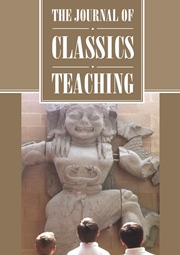


Evelien Bracke’s The Meaning of Myth in Uncertain Times aims to answer a question that many of us might ponder each time we encounter myth in contemporary culture: why and how do myths still exercise such power over our 21st-century lives? Like Theseus with Ariadne’s string, Bracke guides us through a maze of more than a dozen case studies of deployments of classical mythology in politics and popular culture. Each chapter provides a carefully balanced exposition of how different groups have used the same myths for good and ill. Readers will leave with a fresh awareness of how ‘people on the entire political spectrum are claiming the same stories but interpret them differently’. For example, using the image of Medusa from Berlin graffiti, Renaissance painting, and contemporary US political cartoons, Bracke argues persuasively that Medusa has always been divided between her role as ‘the monstrous female or the victim of male violence’. Her discussion of the Trojan conflict raises the interesting question of what happens when multiple sides of potential conflict believe they have an Agamemnon on their side (the British have named a nuclear submarine ‘Agamemnon’, and Putin is frequently described as an Agamemnon in the Russian press; Zelensky, meanwhile, is portrayed as Hector, the reluctant hero).
Throughout the book, Bracke’s conviction that myths provide us with tools with which to confront the challenges of our day is made clear. Hers is a message of hope, not despair. This was particularly prominent in her discussions of the eco-crisis (where she drew links with Hesiod’s Works and Days), her anger at the concentration of power in the hands of billionaires (which she discussed through Prometheus), and her nuanced portrayal of young eco-activists like Greta Thunberg. Thunberg’s heroic media portrayal and her propulsion into the role of a young figurehead, like Antigone, are contrasted with Ismene’s quieter collective works of resistance (as the probable instigator of Polyneices’ first burial). Also evident is Bracke’s wide research on global mythologies that provide interesting counterpoints to her Greco-Roman case studies.
At times, myth’s therapeutic potential is perhaps overstated for the average reader (for example, the use of an ancient wisdom self-help app, or her revelation that ‘when I notice I’m succumbing to the temptation of ‘fast thinking’ again, it helps me to think of Oedipus’). At one point, Bracke seems almost to propose Gandalf as her guide for life: ‘all we have to decide is what to do with the time that is given us’ (admittedly, there are worse thinkers into whose hands to place your principles). But these potentially saccharine moments are largely diluted by the thorough analysis of the myths in various historical and contemporary contexts that pervades the book.
In such an ambitious project, it is unsurprising that not all chapters demonstrate the same mix of political and literary analysis. For example, though the novelisations of these myths are mentioned, they are perhaps not fully scrutinised for what they add to the conversation (for example, Miller’s influential novel The Song of Achilles, though footnoted, was absent from the discussion of Achilles’ portrayal as a queer icon). Likewise, in the Oedipus chapter, which references Freud and Robert Icke’s reworkings of Sophocles, there are scant other contemporary references that a school or undergraduate student might be able to grasp more immediately. These omissions were not so frequent as to detract from the overall discussion, they do, however, point forward to questions that can be asked in further research into classical reception in popular culture.
School and university teachers will benefit from this succinct look at the power of myth in contemporary culture. Bracke provides a library of examples that will transfer easily to classroom discussions about the cultural power of myth from GCSE onwards. Her study of the digital ‘mythscape’ might be particularly useful when forming points of connection with students’ online experiences. Bracke provides a comprehensive toolkit for demonstrating the power of myth in cultural imaginations. However, the book is also well suited to school and university students themselves and would be a particularly useful introduction to scholarship for A Level students. It establishes the relevance of myth to a turbulent 21st-century world for those in need of convincing and provides depth and nuance for those already sold. Every student of Classics will find a chapter that interests them in particular as Bracke manages to cover many of the myths that loom largest in people’s imaginations (as well as those mentioned above, she covers Talos, Odysseus, Penelope, Hephaestus, Zeus, Europa, Sisyphus, and Pandora). The index is well organised making navigation straightforward. The prose is light and lucid, stringing the reader along with ease as she ‘zigzags’ from ancient to modern and back again providing fresh insights each time. Chapters are short and concise and peppered with images of sources both ancient and modern to illustrate how myths have been received and adapted over time, and the whole book is well under 200 pages.
Having demonstrated the ‘ideological tug-of-war’ that characterises society’s use of myth, Bracke’s conviction that myths must be approached critically is clear in her concluding chapter on Pandora, where she urges us to ‘guard against binary thinking’. She provides an excellent blueprint for how to engage in this kind of critical reading of mythology, making her book an entertaining and enlightening resource for students and teachers interested in Classical Reception. It is no surprise that the Dutch version of this book (Liedraad door het labyrint [Guide through the Labyrinth]) was awarded the ‘Impact and Outreach Prize’ from OIKOS, the Netherlands Research Institute for Classical Antiquity Studies. The jury described Bracke as a ‘bridge builder between science and society, between antiquity and the present, between education and research’, and this is certainly true in the newly expanded English version of her book. This sparky monograph, which demonstrates a decidedly human and humane perspective on our contemporary crises, forms a valuable contribution to the ongoing conversation around the power of myth in our globalised world.

 Open access

