

At a press conference in Austin, Texas, in the late summer of 1966, the media posed a question to then governor John Connally that was likely on the minds of many Americans: Did the heinous acts of Charles Whitman, who had just killed thirteen people at the University of Texas at Austin (UT, or the University), remind him of another tragedy perpetrated by a fellow Texan?Footnote 1 Just three years earlier, in November 1963, Lee Harvey Oswald had shot Governor Connally while attempting to assassinate President John F. Kennedy. Although gravely wounded, Connally had, unlike President Kennedy, survived the shooting and now had to usher his home state through another terrifying event of gun violence: Whitman’s deadly ascent to UT’s iconic bell tower. The media’s question to Governor Connally, while personal, touched on deeper concerns about the growing number of incidents of violence at the hands of lone gunmen. If a single person with a gun could assassinate the most powerful person in the world or turn their weapon on an unsuspecting public, were Americans safe?
The responses from politicians and institutions in the aftermath of the UT shooting would set America on a decades-long hunt for the specter of the lone gunman in the hopes that the danger he posed could be foreseen and contained. Restoring safety at UT and other institutions of higher learning, along with society as a whole, depended on the social and political insistence of locating the cause of such violence within the psyche of the perpetrator. The UT shooter’s irrational behavior was assumed to have resulted from his abnormal psychology, especially after autopsy findings revealed that Whitman had a brain tumor. Thus, politicians and administrators came to rely on the disciplines of psychology and psychiatry to provide an explanatory framework, hereafter referred to as the psychopathological framework, that would use insights from the shooter’s mind to predict and prevent future danger.
The problem was that a psychopathological framework had rarely worked that well in the past; psychiatry, in particular, had not been able to deliver on its promises to predict who would become dangerous. Despite the field’s failures, politicians and educators eagerly accepted the flawed supposition that the framework, updated with fresh insights from a new generation of mental health experts, would succeed where others had failed. Therefore, in the aftermath of the shooting, I argue that mental health care at UT was redesigned under the psychopathological framework to unearth dangerous individuals even though its practitioners did not possess the ability to find them. This article explores how the inherently faulty logic of the framework was built into the updated mental health care system at UT and had very real effects on campus, including an escalation of surveillance, increased pressures on students and faculty to conform to the University’s values, and a proliferation of guns on campus with more displays of force by the University. The cost of attempting to eliminate danger by expanding mental health care at UT was an environment of heightened security and control that had questionable impact on campus safety and student mental health.
Since 1966, the specter of the irrationally dangerous person—especially the lone gunman—has come to affect not only colleges and universities but also K-12 institutions. Understanding why, despite efforts to predict and prevent violence, the number of mass shootings in the United States is higher than in all other developed nations requires a hard look at efforts to manage such violence by leaning into the flawed psychopathological framework used to make psychiatric assessments of dangerousness, or the capacity to harm oneself or others.Footnote 2 To better understand the establishment and consequences of that framework, this article will look at political and institutional responses to the 1966 school shooting at UT that included overhauling the Student Counseling Center and providing additional justification for the arming of campus police. The Tower Tragedy, as it is known colloquially, is widely regarded as the first mass shooting to occur at an American university. Aside from this sad distinction, it stands out as a bellwether worthy of deeper historical analysis, since the model UT advanced has stubbornly persisted in some form despite its flaws.
Right, The Tower at the University of Texas at Austin; left, Dobie Center. Photograph courtesy of Wikimedia Commons.

The bulk of evidence for this essay comes from two archives, the Briscoe Center for American History and the Lyndon Baines Johnson Presidential Library, both located on the UT campus in the shadow of the bell tower. Each repository hosts collections dedicated primarily to the lives of public figures—politicians, journalists, prominent activists, and high-level bureaucrats. Rare deviations from this archival mandate often entailed correspondence from people who took it upon themselves to communicate with someone in a position of authority. Voices of students and parents, for example, most commonly appear in letters responding to public statements from UT. The limits of this study are connected to the narrow purview of the sources, but they serve well to understand the mindset of institutional leaders and their political representatives. The aim is not to explore whether students or parents found the institutional responses convincing or effective; it is to shed light on the process by which the psychopathological framework for achieving safety, no matter how well-intentioned, justified surveillance in order to satisfy UT’s goal of molding the University community around a narrow set of values while promoting the weaponization of law enforcement on campus.Footnote 3
The Public University and Student Counseling Before the Tower Tragedy
About six months before the shooting, UT, like universities across the country, was in the midst of a significant transformation. The 1960s were filled with a radical sense of possibility propelled by advancements in civil rights and a broad commitment to social activism but were also a decade of turmoil and unrest marred by threats of force, both real and imagined, and highly visible acts of violence. Postsecondary institutions had become sites for responding to the seismic political and social changes playing out on the national stage, because those changes often manifested so visibly on college campuses.
Universities stood out thanks in part to their increased size and stature following World War II. Historian Roger Geiger calls the postwar boom in university enrollment a “tidal wave of students” that was buoyed by high birth rates during and immediately after the war and legislation like the 1944 Servicemen’s Readjustment Act (GI Bill) that helped military veterans go to college.Footnote 4 Universities were also churning out scientific research at a fever pitch following an unparalleled increase in public and private grant funding.Footnote 5 Between higher enrollment and plentiful grant dollars, a new level of prestige could be fastened to the public university, as it offered access to premier educational and employment opportunities that had long been the province of Ivy League private universities.
Beyond sheer growth in the number of students, the overall student population had also become more diverse. Integration efforts following the landmark Brown v. Board of Education case increased the racial and ethnic diversity of incoming cohorts. Total numbers of Black students at universities climbed throughout the period. By 1967, Texas universities accounted for nearly a quarter of the entire population of Black students enrolled in higher education.Footnote 6 People from diverse backgrounds intersected with growing nontraditional social and political movements to form a lively counterculture.Footnote 7 Historian John Moretta points to Austin as a “haven for hippies and other Texas participants in the 1960s counterculture.”Footnote 8 Many young people were introduced to different ideas and communities in an environment supported by inquiry and research. It was a time of both great expansion and great adjustment in higher education.
Changes on campus were not always welcomed by the administrators and boards who oversaw the many policy and budgetary decisions that also shaped university culture. Concern over diversity and protests dominated the responses of UT during the 1960s. Throughout the early sixties, UT students had become more involved in nonviolent demonstrations to end all forms of racial discrimination on and around campus, including participating in lunch counter sit-ins and civil rights marches. Although desegregation of the classroom took place at UT in the 1950s, it was not until 1965 that the dorm rooms would be integrated, for example, as a result of student activism.Footnote 9 Also by 1965, UT students had expanded their protest efforts to include anti-war demonstrations backed by the national network of Students for a Democratic Society (SDS). Escalation of US involvement in the Vietnam War had brought more and more young Americans into contact with state-sponsored violence and spurred many of them to speak out against the war. While these student efforts would not reach their zenith for a few years, their growing presence on campus and integration with a broader network of student activists across the country raised concerns among members of the UT community.Footnote 10
Vietnam-era protests were becoming particularly problematic for UT administrators as students staged larger and more public demonstrations. The increased anti-war activity, led predominantly by the UT chapter of SDS, triggered counterprotests and drew ire from local politicians and community members. In one telling incident, SDS students had planned a protest against American aggression in Southeast Asia as part of the International Days of Protest, a coordinated demonstration against US military action in Vietnam taking place on campuses across the globe. The Austin City Council, however, denied SDS a permit to lead the planned “death” march off campus from a rally starting at UT. The City Council’s move sparked backlash from other UT-based student groups that garnered the support of the Texas chapter of the American Civil Liberties Union. Despite the City Council’s rejection, about 150 student protesters proceeded down the streets of Austin, coming face-to-face with counterprotesters. The heated exchange and violation of the City Council’s orders led the Austin City Police to break up the protests and arrest some of the students.Footnote 11 Coverage of the event was far-reaching at a time of growing community polarization over the Vietnam War, and it placed more pressure on UT leadership to address the protest activities of its students, which people around Austin saw as increasingly provocative.
One response to the changes proposed by the UT board was to refine the University’s Student Counseling Center. The Student Counseling Center had functioned as a voluntary testing and academic advising center since the 1920s and was designed to help students understand and hone their academic abilities. At the beginning of 1966, the UT’s Board of Regents via its Committee on Academic and Developmental Affairs commissioned an interdisciplinary Ad Hoc Committee on Student Counseling (hereafter referred to as the Counseling Committee) to “bring about optimum conditions for [students’] learning and maturing in such a heterogenous and yet specialized community.”Footnote 12 The Board appeared hopeful that the Counseling Committee could take on new responsibilities that would contribute to the building of a homogenous, acquiescent student body.
The Counseling Committee was interdisciplinary and consisted of thirteen faculty members from various academic departments as well as two students. The fifteen-member group was led by Dr. Robert Sutherland, a sociology professor and the founding director of the University of Texas Hogg Foundation for Mental Health (Hogg Foundation), a grantmaking organization created in 1940 with a mission to promote community mental health care throughout Texas and the Southwest.Footnote 13 The Counseling Committee was tasked with outlining a comprehensive plan for student counseling at UT to be presented to the Board of Regents in October 1966.Footnote 14 Counseling Committee members saw in this mandate that the primary purpose of counseling was the elevation of character-building through education. Learning took on a moral dimension as it was tied to proper maturation and socialization, which was regarded as especially important for students coming from previously underrepresented racial and ethnic backgrounds. The work of the Counseling Committee would take on new significance, however, when it was thrust into the limelight after the deadly actions of a lone gunman on campus.
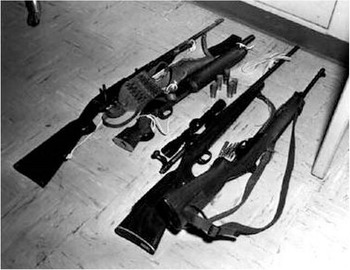
Charles Whitman’s arsenal. Photograph courtesy of Wikimedia Commons.

Psychopathology as a Framework for Dangerousness
On August 1, 1966, Charles Whitman, a twenty-five-year-old White male student at UT, climbed the bell tower at the center of campus with a cache of guns and began shooting indiscriminately at people below. Over the course of ninety-six minutes, Whitman, a former Marine and experienced marksman, murdered thirteen people and injured thirty-one others until he was killed by Austin police. Once Whitman’s body was identified, police officers visited his home where they found his wife, Kathleen Whitman, stabbed to death. It is likely Whitman had murdered her in the early hours before the shootings. The police then proceeded to the home of Whitman’s mother, Margaret Whitman, whom they also found dead from knife wounds and a gunshot to the back of her head. Whitman had killed fifteen people in total.Footnote 15
Efforts to unpack what might have caused Whitman to unleash such deadly violence picked up quickly after the discovery of the bodies of his wife and mother. In short order, reports were released about Whitman’s visit to a University Student Health Center staff psychiatrist, Dr. Maurice Heatly, on March 29, 1966, four months before the murders.Footnote 16 During the session, Whitman admitted to having intrusive, hostile thoughts and expressed a wish to kill people on campus. He also indicated that his father, an abusive figure, was calling him obsessively, contributing to his feelings of stress. He expressed a desperation to not become violent toward his loved ones like his father had been, but he also revealed that he had beaten his own wife. Sadly, the abuse committed against his wife did not register with Dr. Heatly as indicative of Whitman’s dangerousness or cause for his removal from campus.Footnote 17 In fact, Dr. Heatly took no further steps to address either Whitman’s clear distress or the threat he posed to his wife or community. Dr. Heatly suggested that Whitman return for further appointments but did not make a diagnosis.Footnote 18 Neither Dr. Heatly nor the staff from the University Student Health Center made any documented attempts to follow up with Whitman.
At that time, psychiatric concepts of dangerousness were predominately grounded in the diagnoses of major psychiatric disorders, in particular schizophrenia, psychopathy, and major depression (for suicide), none of which Whitman had received. Despite what seem like clear failings of the psychiatrist to identify and treat a potentially violent student, the University almost immediately cleared Dr. Heatly of any wrongdoing. The failure, as the University saw it, was not that its psychiatrists were unable to discern when threats warranted action, but that diagnosing someone required multiple interactions between the patient and doctor. Whitman had only gone to speak with Dr. Heatly once and had not returned for a suggested follow-up, which made issuing a full diagnosis difficult.Footnote 19 The fault laid with Whitman for having decided not to return for additional sessions.
Read today, the University’s reactions may seem chiefly an exercise in defending the institution against accusations that its staff had not done its job. But in important ways, its defense also reflected the uncertain state of psychiatric certainty. Since the early 1900s, psychiatrists had attempted to expand their reach into everyday life by emphasizing their ability to predict, explain, and manage troublesome behaviors and difficult people. As historian Elizabeth Lunbeck has pointed out, in the first half of the twentieth century American psychiatry sought to push its cultural influence beyond the institution by defining and cataloging “the ‘normal’ which … existed only as a foil to the psychopathic.”Footnote 20 With intimate knowledge of the insane, psychiatrists could more easily discern the difference between people who were and were not deviant, especially those that posed a risk to the social order.
By the 1950s, however, more leading authorities had begun to acknowledge openly the limits of their ability to predict which individuals had truly dangerous impulses and would act on them. In a 1958 seminal study on suicide, psychologist Dr. Albert Rosen showed critical obstacles for psychiatrists and psychologists in their quest to predict dangerousness. Rosen argued that it was difficult to discern statistically who among patients that were labeled suicidal would actually commit suicide. Existing data provided no clear evidence of psychology’s predictive powers for preventing danger to the self, which raised questions about its ability to predict dangerousness to others.Footnote 21 Despite the ambiguity, psychiatry and psychology were becoming increasingly tethered to this practice.
Historian Janet Collaizzi has shown that the 1960s marked a critical turning point for the practice of psychiatric prediction of dangerousness. Before this period, psychiatrists mostly operated under the assumption that restraint or seclusion of the mentally ill was sufficient for preventing harm to the self or the community. Around the sixties, however, views began changing about the ethics and efficacy of sequestration for those suffering from mental illness. Advocates pushed for dramatic changes in the treatment of America’s mentally ill that resulted in closures of many mental institutions throughout the country. As care for people with mental illness moved out of the institution and back into the community, Colaizzi writes, “the sole criterion for restraint [became] dangerousness.”Footnote 22 Institutions and workplaces that employed psychiatrists and psychologists followed this trend and began relying more heavily on in-house expertise to determine appropriate defenses against supposedly dangerous individuals.Footnote 23 It is against this backdrop that UT invested more heavily in its mental health services, which relied on unsupported powers of medical prediction to ensure a safer campus.
The Expansive Origins of Whitman’s Psychopathology
The growing doubts about prediction occurred at a time when psychiatrists and psychologists were also working to reconcile biological and psychoanalytic explanations of human behavior in general and for mental illness in particular. Was a killer like Whitman driven by his warped biology or deeply rooted neurosis? It hardly mattered, as nearly every interpretation reinforced the belief that it was Whitman’s psychology—his brain or his mind—that contained the true cipher for understanding his violent actions. The competing explanations for psychopathology further obscured the empirical weaknesses of mental health prediction just as it was becoming an ascendant method for establishing security and order beyond the mental asylum.
Starting in the mid-twentieth century, psychiatrists had lost ground to psychologists as the latter moved beyond their limited role with IQ testing into more prominent clinical and institutional positions. As this shift became more pronounced, psychiatry, drawing on its medical origins, became more reliant on biological models for understanding and treating mental illness. Psychologists, armed with decades of statistical data from psychological testing, leaned into psychoanalytic theories and practices that they claimed offered a more thorough picture of the human experience.Footnote 24 Such a clean division between psychoanalytic psychologists and biological psychiatrists was of course not true in every case, but it indicated a gnawing ambiguity that lay beneath the professional expertise of both.Footnote 25 Instead of one theory of behavior unseating the other, however, the theoretical ambiguity expanded the influence of the psych disciplines, whose practitioners drew from the widening array of ideas to explain the motives of people who behaved like Whitman.
Within the nebulous theoretical bounds of mental health care, various medical professionals offered numerous, sometimes competing explanations of Whitman’s behavior. Shortly after the mass shooting, the Travis County medical examiner, Dr. Coleman de Chenar, a pathologist, performed an autopsy and toxicology report on Whitman.Footnote 26 While the toxicology report came back clean, the autopsy revealed that Whitman had a highly malignant tumor in the white matter above his amygdala.Footnote 27 The discovery of the brain tumor lent support to a biological explanation for his terrible deed, an explanation that mirrored the recent penchant for exploration of physiological catalysts of human behavior. After the advancement of psychotropic drugs in the mid-1950s, pharmaceutical interventions had breathed new life into the idea that the brain, where the drugs were understood to be operating, may have more impact on the development and course of mental illness.Footnote 28 In particular, brain chemistry might have special significance for more entrenched mental disorders like schizophrenia and psychopathy, the diagnoses most closely associated with antisocial behaviors. Scientists of the era hoped that new insights into the biological antecedents of mental illness would also unearth the roots of more threatening and violent symptoms of antisocial disorders.Footnote 29 Throughout the 1960s, leading neurosurgeons like Vernon Mark and Frank Ervin put forward a series of studies about the causes of aggressive behavior that emphasized brain dysfunction over environmental or social factors. Their findings added brain abnormalities to the vast array of theories purporting to explain violence and mental illness.Footnote 30
Despite their provocative claims, the relationship between the brain and behavior was not very well understood, making conclusive proclamations about the impact of brain defects highly contentious. Dr. de Chenar concluded that while Whitman’s brain pathology may have contributed to an experience of physical pain that caused emotional distress, “in his opinion … [the] tumor did not directly affect [Whitman’s] actions … [because] the thinking part of the brain, the frontal lobe, was not directly affected by the tumor.”Footnote 31 Others in the medical community were not as convinced. Dr. Gary Miller, director of the Texas State Adult Mental Health Clinic at Harlingen, in a letter to Governor Connally, directly contradicted Dr. de Chenar’s findings by declaring that the tumor was absolutely at fault for Whitman’s actions.Footnote 32 Members of the Austin community called to serve on the grand jury investigating the Whitman shootings agreed that the brain cancer diagnosis was a significant finding if not a total explanation; they declared that the brain tumor “undoubtedly caused him much mental pain and possibly contributed to his insane actions.”Footnote 33 While the grand jurors’ conclusion was not as definitive as Dr. Gary Miller’s, the expository power of the tumor was difficult to shake.
The presence of the tumor, however alluring, did not minimize other explanations for Whitman’s behavior but served as further rationale for the continued emphasis on his mental pathology as the site of understanding for such a terrifying act. For those that doubted the impact of the tumor, psychoanalytic explanations that delved into Whitman’s personal life, his past and relationships, offered equally sagacious answers. Detailed accounts of Whitman’s life history were circulated among the press and brought into sharp focus by people investigating the murders. Austin Police Chief Bob Miles spoke about “the stress [Whitman] was obviously under” regarding his life circumstances, evidence of which had been gleaned from highly personal sources including his diaries and suicide notes.Footnote 34 Even the pathologist who found the tumor was unwilling to view Whitman’s actions as the result of mere biology, preferring to pin his motives to his psychopathology. In other statements to the press, Dr. de Chenar labeled Whitman an “antisocial psychopath” and called such individuals “the worst kind” of psychopaths.Footnote 35 Psychopathy, unlike a tumor, was a total impurity—Whitman was a fundamentally bad person, so he did bad things and thus bore sole responsibility for the bad outcomes. In this instance, biology as cause was almost too forgiving.
In the view of many weighing in publicly, Whitman’s psychological abnormalities were the decisive factor in his willingness to commit violence, and any difference in the genesis of those abnormalities was merely a matter of opinion. The psychopathological framework, with its ability to offer multiple, even contradictory explanations, proved particularly useful for politicians and administrators looking to allay fears about violence by keeping the focus on the mental state of the dangerous individual. Identifying a dysfunctional psyche became the preferred path to securing campuses and promoting public safety.
Governor Connally’s Fact-Finding Commission
Texas governor Connally was a major acolyte of the psychopathological framework and believed that psychiatry and psychology offered foresight into dangerousness. During a press conference that the governor held two days after the shooting, he denounced the murders and affirmed the University’s position that its psychiatrist had done nothing wrong. He also expressed fears that requiring medical professionals to report every threat verbalized or enacted in the course of psychiatric care might dissuade people from seeking help. He speculated that “no one would want to go [to the psychiatrist] even though he was in need of some minor help if he thought that his visit to a psychiatrist was going to be immediately reported to a police official.”Footnote 36 The governor’s position reflected a faith in the perfectibility of scientific knowledge and psychological ways of understanding motive and treating aberrant behavior that needed to be protected. As a result, the primary focus of politicians and administrators turned further away from the potential limits of psychological insight and toward the idea that Whitman had made choices that proved his psychopathology.
Connally further legitimized the psychopathological framework in the committee he created to investigate the Whitman incident. Within days of the shootings, Connally had put together a fact-finding committee (FFC) to probe the circumstances and potential causes of Whitman’s violent actions. The FFC consisted almost entirely of neurophysiologists, psychologists, and psychiatrists.Footnote 37 Stacked with medical professionals specializing in the brain and the mind, the terms upon which to describe the mass shooting were destined to remain couched in the language of the dangerous individual. Connally further tasked the FFC with outlining ways to prevent this kind of tragedy from happening again. Psychopathology would not only explain the murders, but it would also offer a way to stop their recurrence.
In an ironic turn, however, the FFC issued a report with a set of recommendations that called for institutional and community measures rather than more focus on medical diagnosis and treatment. While the first half of the report consisted of a review of the autopsy findings followed by a postmortem psychiatric profile of Whitman, its authors concluded that the impact of the tumor was inconclusive and refused to make a formal psychiatric diagnosis. Instead, the utility of their study lay primarily in suggestions for various institutional and legislative improvements. Prevention, from the point of view of the medical professionals involved, required systemic change that did not hinge entirely on an understanding of Whitman’s medical conditions. Their recommendations included the development of a re-learning process for combat-trained military personnel, improved privacy for health records, and an admonition of the news media for its handling of the tragedy.Footnote 38 The FFC medical professionals were among the only groups willing to look beyond the psychopathological framework by acknowledging structural factors in the very serious problem of violence.
To that end, the FFC’s most extensive recommendations were reserved for the University. The FFC report suggested that the University should develop system-wide medical programs for students and faculty that utilized its considerable medical education departments. Even though most of the medical programs were based at the University of Texas campus in Houston, the University’s medical resources and knowledge, the report argued, ought to be transmitted across its campuses so that they could be used to support the health and mental health needs of the entire student population. The FFC recommended that student and faculty health care, both physical and mental, were best served under the auspices of the University’s Student Health Center. Investing in “good mental health of the student today,” the report stated, would result in “the adjusted and productive adult citizen of tomorrow.”Footnote 39
The FFC also encouraged expansion of student counseling services, which it saw as a separate program but one that was integral to the success of student mental health. The student counseling services should be “of such depth and scope as to personalize the abilities and educational and life goals of, and provide counsel and aid to, each student in need at any time.”Footnote 40 The FFC strongly believed in the benefits of University-operated health care while recognizing that to prevent future threats, such care could not function in isolation. The UT Student Counseling Center would serve within the broader university health care system as a front line for mental health care with a sweeping mandate to reach every student and set them on the course for academic achievement and productive citizenship. Even though UT leadership had already initiated a review of its counseling services, it would now have to contend with the FFC’s recommendations.
The Student Counseling Committee Deliberates
The work of the Counseling Committee was catapulted into the public eye after University officials issued a press release about its existence as part of their public relations response in the days after the Whitman murders. The press release made clear that the work of the Counseling Committee had started several months prior to the tragedy, and that it was a sign of the University’s ongoing commitment to the safety and well-being of its students. Although the original mandate for the Counseling Committee was to enhance learning and maturation, the University’s media strategy, in conjunction with the FFC report, put intense pressure on the Counseling Committee to now address issues of abnormal mental states seen as integral to Whitman’s actions. An effective student counseling program would thus expand its original parameters to include psychological monitoring of potentially dangerous students by either preventing their slide into mental illness or, if “sick,” triaging them into other aspects of the health care system on campus or in the community.Footnote 41
Meeting notes of the Counseling Committee show that members were wary of the added responsibilities outlined by the FFC and the University to address the more serious aspects of students’ mental health. Members feared the new obligations might cannibalize efforts to help the majority of students. Dr. Sutherland was explicit in a letter to University Chancellor Harry Ransom that although “the Whitman case has direct implications for the work of the Counseling Committee … the broader and even more imperative mandate of our committee has to do with the educational progress and counseling needs of 25,600 students.”Footnote 42 Committee member Dr. Wolfe, a Special Education professor, expressed his concerns that the direction of the Counseling Committee’s work was “shifting to the sick student.”Footnote 43 Members saw counseling approaches as linked to the intellectual priorities of the University, which must not be jeopardized by focusing on management of the mentally ill, “since the grand majority of the students were not suffering severe mental problems.”Footnote 44 The Counseling Committee ultimately agreed that the educational counseling approach must prevail and the final report “should have an academic flavor as opposed to a health approach to the problems of students.”Footnote 45
Although it remained undeterred in its commitment to pre-Whitman educational goals, the Counseling Committee still needed to contend with the preventative function that the University administration, Texas politicians, and the public was expecting after the tragedy. To this end, committee members argued that “the committee, realizing that it must commit itself to one approach or the other, has decided to concentrate on the educational and academic viewpoint, while entrusting the health counseling aspect to a more qualified group” like the Student Health Center. Counseling Committee members hoped for “excellent coordination between the student health center and the counseling center in the handling of potential psychotics,” but reasserted that “counseling should be directed more towards students without problems,” by which they meant diagnosable mental illnesses.Footnote 46 Whether it was acknowledged or not, however, the counseling center by virtue of acting as an early warning system for troubled students also widened its mission through its oversight of the mental health of the entire student population. The revised system gave its staff new power to determine which student ailments that cropped up during academic counseling indicated serious mental illness.
The reality of seeing a student as a “health organism” or an “educational organism,” as committee head Dr. Robert Sutherland had suggested, proved much more complicated in practice.Footnote 47 By orienting themselves toward the majority of students, Counseling Committee members demonstrated that it would be difficult “to separate academic and domestic problems.” And much of the content of their work included outlining a wide range of counseling activities that influenced the “maturation of students” via educational improvements.Footnote 48 In a letter to University president Norman Hackerman, Dr. Sutherland shared notes taken by another committee member, Dr. Bryce Jordan, a music professor, from a conference on student counseling where Jordan commented that “like it or not, we are in the character building business.”Footnote 49 Academic success was seen as fundamentally linked to maturity and character so that one could not be attained without attending to the other.
The counseling approach would also be applied to enforce University values beyond academic success. The committee’s use of developmental and moral terminology provided the University and its counseling services much wider latitude in determining the problems of students and encouraging the right responses to them. In meetings Dr. Sutherland reiterated his belief that students like those represented on the Counseling Committee could help the counseling center so long as they continued expressing their grievances through the proper channels instead of protesting.Footnote 50 Counseling Committee member Dr. Jordan referenced the “crisis of drug use” plaguing American campuses.Footnote 51 The committee delineated a number of similar “impediments to learning” like “alienation of students [to] the university value system” and “the problem of student sexual morality.”Footnote 52 Any student who did not progress, show sufficient character, excel academically, or adequately display University values became a target for counseling.
With the counseling center’s expanded mandate to filter out those with serious mental illnesses, students who did not respond to counseling services were at risk of being labeled sick, a classification that connoted a potential capacity for danger and pathology. The Counseling Committee, after the shootings, combined a desire for student conformity rooted in ideas of maturity, character, and academic achievement with the responsibility to sort out which students were suffering from mental illness. The result was to isolate and relegate students with serious mental issues outside of the University community unless they adhered to its values. By the 1970s, for example, the counseling center had forced an undisclosed number of students showing signs of severe mental illness to withdraw from the University. The only path for reinstatement of these students at UT involved not their recovery but academic performance. They had to maintain a “B” average or higher at another large school or at UT night school for one semester before being able to re-enroll.Footnote 53 Students proved that they were no longer a potential source of violence on campus by embodying the University’s idea of academic achievement, which symbolized improved character and sound mental health.
The New Student Counseling Center
Such an exhaustive program required an equally ambitious infrastructure. To achieve its goals, the Counseling Committee recommended that the University create a high-level position, Vice Chancellor of Student Affairs, whose primary responsibility would be “seeking ways to eliminate barriers interfering with effective learning,” which included “the many types of University demands … extra-academic involvement problems, and personal identification/social relationship problems.” Committee members hoped this new person would “be able to bring together in a cooperative effort all agencies and units concerned with students.” The University also hired additional counselors, each of whom, as one University Board of Regents member described it, would act as “the creator of an atmosphere in which a man grows and develops.”Footnote 54 The counselors were to be trained in psychology and would help students when they lacked the “ability to make decisions.”Footnote 55
Counseling was not just a job for a select few professionals. It was also the responsibility of every member of the University community. The Counseling Committee wanted to create “a coherent counseling program based not only on professional counselors, but the coordinated effort of faculty, staff and students.”Footnote 56 Members recommended that the faculty be trained in the basics of counseling, that graduate students working as resident assistants provide counseling to undergraduates, and that an orientation seminar for incoming students about available counseling services be created. Administrators, especially academic deans, would need basic counseling training to ensure that student needs were being met. The goal of this diffuse operation was to create an “academic climate that supports the diverse personal goals of students, faculty and administration by imaginative action designed to bring daily operations into closer relationship with the broad educational goals espoused by the University.”Footnote 57
The University Board of Regents ultimately agreed to most of the Counseling Committee’s requests and appropriated $103,000 of the University’s budget for implementation.Footnote 58 As a result, the existing Student Counseling Center was split into two departments, with a director for testing and a director for counseling. Psychologist Dr. Ira Iscoe, Counseling Committee member and consultant to the FFC, assumed the counseling director role. Liaison personnel were retained for the Dean of Students Office and Housing and Food Services to aid in counseling. Graduate students were hired to operate as live-in residential counselors for various student residences. A twenty-four-hour counseling and informational hotline was established in the Dean of Students office.Footnote 59 Three new professional counselors were added, all from the fields of counseling psychology, an emerging sub-discipline that focused specifically on non-serious mental health issues that occurred in organizational settings.Footnote 60
After its reorganization, the Student Counseling Center eventually lost the battle over terminology and embraced the idea of educational counseling as first and foremost a form of mental health care. In fact, after implementation of the Counseling Committee’s recommendations, the twenty-four-hour crisis hotline received notable press attention and inquiry from other universities for its alleged success in enhancing safety and preventing suicide. In 1969, the Student Counseling Center was mentioned in the Congressional Record for maintaining statistically low suicide rates for a university.Footnote 61 The success would prove to be a pyrrhic victory, however, as internal reports emerged about the number of suicides among University students. Confidential letters between Dr. Ira Iscoe and Counseling Committee member and now Vice President for Student Affairs Dr. Bryce Jordan showed that the actual number of suicides (eight) was higher than publicly reported (one). The dominant concern expressed in the letters was about the potential for public fallout from misinformation related to the success of the hotline and not about the overall incidence of suicide on campus. As a result, the Student Counseling Center pulled back its press access and canceled all meetings with other universities interested in learning about the program.Footnote 62 It made no additional changes to its counseling services even as several students jumped to their deaths from the observation deck of the bell tower where Whitman had committed his heinous crime. The University Board of Regents instead closed the observation deck, which had reopened to the public in 1967, for the next thirty years.Footnote 63
More Weapons on Campus
The psychopathological framework did more than attempt to suppress internal opportunities for violence by watching and molding the community at UT; it also added legitimacy to the University’s expansion in the number of weapons and displays of force on campus. Both prominent politicians and UT administrators failed to promote a gun-free campus but instead committed to a new pursuit of self-defense against the enemy within by arming campus police officers. If mental health services were directed to find the dangerous person on campus, the University would be armed and ready to remove them. Again, the quixotic chase for the irrationally dangerous individual, whether they be a lone gunman or some other imagined archetype of menace, provided a permanent rationale for more guns on campus: guns in the “right” hands (campus police and law enforcement) would protect the community from those in the “wrong” hands (deranged students).
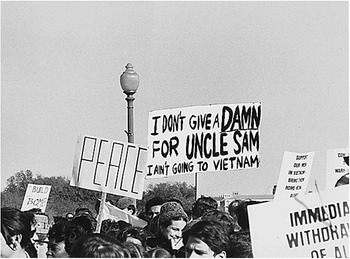
The UT board and administration soon applied their new coercive power to another kind of supposed danger growing on campus: the propagation of organized groups of the New Left like SDS and the Black Power Movement and threats of retaliation from reactionary, anti-communist factions like the Minutemen.Footnote 64 As military losses in Vietnam inspired larger and more organized anti-war demonstrations, and Black students came out in greater force to demand equal participation and recognition at universities across the country, student-led protests and counterprotests had become sites for politically charged violence and skirmishes on and off campus.Footnote 65
Protest in Washington, DC, against American involvement in the Vietnam War. Photograph courtesy of Wikimedia Commons.

In response, the UT President and Chancellor strengthened ties with local law enforcement to keep tabs on suspected political violence happening on the UT campus and at other universities. The UT chapter of SDS was officially removed from the list of campus-approved organizations in 1967 because of an unsubstantiated rumor from Austin police that SDS planned to commit violence at an upcoming rally.Footnote 66 Internal memos from 1968 to UT President Norman Hackerman discussed recently detonated car bombs set off by the Minutemen at the University of Houston, south of Austin.Footnote 67 The University’s investment in the belief that violence could be predicted was pushing it to expand further its definitions of dangerousness to include students whose political activities raised suspicion.Footnote 68
Therefore, in the wake of the Whitman shooting as campus tensions and fears of violence proliferated, the Texas legislature ramped up the presence of guns on campus by sanctioning certain University police officers to carry sidearms. In 1967, the Sixtieth Texas Legislature passed Senate Bill 162, which “provide[d] for the protection, safety and welfare of students and employees” by allowing certain campus police officers to carry weapons. It also granted campus police broader jurisdiction over criminal affairs on campus, including the ability to arrest individuals for trespassing and damaging property.Footnote 69 Additionally, the law granted University administrators on governing boards the authority to remove “undesirable” persons from campus. Students, faculty, and administrators varied in their responses to the bill, but some recognized the potential for misuse. In a May 1967 article in The Daily Texan, the UT student publication, junior Sandra Jones is quoted as highlighting that “undesirable is such a loose term. It could be used to describe anyone they want too [sic]. Everyone will fit into that category at one time or another.”Footnote 70 The political response had deftly deflected attention away from the potential problems stemming from more guns on campus and onto the dangerous individuals lurking among the students.
Texas and UT proved to be leaders at diffusing fears over the misuse of firearms that had sparked much national debate over the preceding decade. Federal legislation aimed at gun control, which had become a widespread political issue in large part through the efforts of President Johnson, was backed by much of the voting public, even in Texas.Footnote 71 Despite popular support for the recent advancements in federal firearm regulation including passage of the 1968 Gun Control Act, the administration was unable to sway Texas politicians to curb state-level gun violence through legislation. Texas legislators defeated a bevy of proposed gun control measures after having sanctioned gun use at UT, signaling a growing commitment to firearms as a necessary means of control. In a 1968 special session of the Sixtieth Texas Legislature, a gun control bill favored by Governor Connally that included stricter punishments for the misuse of firearms failed to pass.Footnote 72 With further gun control measures politically anesthetized at the state level, politicians and campus leadership were able to justify institutional reliance on weapons and threats of violence to maintain power and order.
As a result, the University, backed by Texas legislators, was better armed and able to weed out whomever it deemed dangerous. Despite concerns expressed by some students and faculty about potential abuses of power by the newly armed campus police officers, UT ultimately assumed its own dangerous position when faced with students demanding change on and off campus.Footnote 73 Combined with the predictive logic embedded in its revamped student counseling system, the University’s additional security measures enabled school administrators to target people prejudicially for removal, by force if necessary, based on highly speculative assessments of dangerousness.
Conclusion
What happened at the University of Texas after the Whitman murders is just one example of how the disciplines of psychiatry and psychology were deployed in the 1960s and after to ensure peace and tranquility on American campuses. Ironically, their reliance on a psychopathological framework did not achieve that goal; instead, the changes to mental health care at UT were followed by a rise in campus turmoil as student protests escalated across the country, resulting in heightened tensions and forceful efforts by universities to suppress them. Beyond the campus agitation, the failures of the framework were clearest when measured against the more common consequence of mental illness—danger to self—as seen in the spate of student suicides that rocked the UT community after the Tower shooting. The loss of additional students from suicide was one of the most heartbreaking unintended consequences of orienting the school’s resources toward the often hopeless pursuit of the dangerous individual.Footnote 74
Instead, student mental health became a secondary concern in the rush to eliminate threats of violence and enhance safety on campus. The sought-after safety hinged on faulty mechanisms of prediction that pushed conformity and fear but ultimately obfuscated more nuanced instances of mental illness. Mental health professionals at UT insisted on a prominent role in defining and enforcing the boundary between normal and mentally ill students that enabled them to develop a prototypical “mentally healthy” student and citizen—someone unfettered by personal problems that might otherwise prevent them from achieving academic excellence. The model student could thus never be mentally ill, while mental illness became a mark of difference that contained what administrators saw as the true threat of dangerousness. Within this binary, investments in mental health services could do little more than attempt to churn out students who would get good grades and not sow discord.
In turn, UT attempted to suppress internal opportunities for violence through an expansion of force that was armed and ready to turn on students if necessary. The gun-wielding campus police were a felt presence at UT, as they were often asked to monitor events and protests. These newly armed campus police were reassured by the psychopathological framework’s notion that the assumed capacity to spot undesirable individuals resided with those in positions of authority, and that the only threat of irrational violence came from those being surveilled, not representatives of the institution. The false sense of security created by the framework with its outfitted security force was a factor in preventing universities from foreseeing future calamities.
The ensuing decades after the Whitman murders have wrought more, not less, violence on campuses as the danger of shooters has spread from colleges to high schools to elementary schools. Many educational institutions have responded similarly to UT by increasing mental health services and security measures on campuses. As of 2021, 96 percent of American public schools offered mental health care to students, while nearly every American university provides student counseling services.Footnote 75 Although these services are expanding, their focus on safety over improvements in student well-being is marred by the continued false promise of psychiatric prediction. In fact, the American Psychiatric Association affirmed as recently as 2017 in a position statement on the subject that psychiatrists “cannot predict dangerousness with definitive accuracy.”Footnote 76 Similarly, other security measures aimed at prevention have also seen little success despite their amplification in recent decades. By 2016, 71 percent of high schools were partnering with armed law enforcement officers to monitor campuses.Footnote 77 Public universities have become notoriously weaponized environments, with 91 percent of campuses making use of armed police officers.Footnote 78 These efforts have proven inadequate at predicting and preventing the next shooter from ravaging a community or adequately addressing the growing mental health crisis facing young people in America.
Elevating the psychopathological framework with its emphasis on exploring individual pathology as a means of prediction has turned schools into haunted spaces forever stalked by a chimera. With university efforts tied up in their portentous affairs, American gun laws have become more permissive and community mental health care options have dwindled. Institutions of higher education have merely mirrored these policy changes by militarizing their own spaces and compensating for threadbare public health care options by setting up internal systems of medical and mental health services. The justification for these moves is rooted in safety, but their effectiveness is built on shaky evidence. It is time to dispel the myth that safety can be achieved through psychological foresight and its attendant reliance on surveillance, conformity, and weapons. Perhaps with fewer guns and more freedom on and off campus, communities might see beyond mental illness to address the scourge of American gun violence.
Megan Knighton Scofield (megan.knighton@stonybrook.edu) is a PhD student at Stony Brook University specializing in American medical history and the history of public education. She expresses deep gratitude to her adviser, Dr. Nancy Tomes, and Drs. Yalile Suriel, Shobana Shankar, Kathleen Wilson, and Christopher Sellers for their support. A special thanks goes out to her partner Will, family, and friends for their encouragement.