





Introduction
Nematodes of the genus Rhabdias are lung-dwelling parasites of amphibians and some reptiles. Amphibians become infected when the parasites actively penetrate their skin, while reptiles are infected through oral transmission (Kuzmin and Tkach, Reference Kuzmin and Tkach2025). These parasites have a monoxenous life cycle, comprising a parasitic generation of hermaphroditic females and a free-living generation with separate male and female adults (Kuzmin, Reference Kuzmin2013; Langford and Janovy, Reference Langford and Janovy2013). Rhabdias was the first genus described within the family Rhabdiasidae and currently includes approximately 100 species with a global distribution (Kuzmin and Tkach, Reference Kuzmin and Tkach2025).
Twenty five species of Rhabdias have been described from the Neotropical region (Alcantara et al., Reference Alcantara, Müller, Úngari, Ferreira-Silva, Emmerich, Giese, Morais, Santos, O’Dwyer and Silva2023; Euclydes et al., Reference Euclydes, Melo, da Justa Hc, Jesus, Gremski, Veiga and Campião2024), of which 15 occur in Brazil: Rhabdias androgyna (Kloss, Reference Kloss1971); R. breviensis (Nascimento et al., Reference Nascimento, Gonçalves, Melo, Giese, Furtado and Santos2013); R. elegans (Kloss, Reference Kloss1971); R. fuelleborni (Travassos, Reference Travassos1926); R. galactonoti (Kuzmin et al., Reference Kuzmin, Melo, da Silva Filho and Santos2016); R. glaurungi (Willkens et al., Reference Willkens, Rebêlo, Santos, Furtado, Vilela, Tkach, Kuzmin and Melo2019); R. guaianensis (Alcantara et al., Reference Alcantara, Müller, Úngari, Ferreira-Silva, Emmerich, Giese, Morais, Santos, O’Dwyer and Silva2023); R. hermaphrodita (Kloss, Reference Kloss1971), R. matogrossensis (Alcantara et al., Reference Alcantara, Müller, Úngari, Ferreira-Silva, Emmerich, Giese, Morais, Santos, O’Dwyer and Silva2023); R. megacephala (Euclydes et al., Reference Euclydes, Melo, da Justa Hc, Jesus, Gremski, Veiga and Campião2024); R. paraensis (Santos et al., Reference Santos, Melo, Nascimento, Nascimento, Giese and Furtado2011); R. pocoto (Morais et al., Reference Morais, Müller, Melo, Aguiar, Willkens, De Sousa, Giese, Ávila and da Silva2020); R. pseudosphaerocephala (Kuzmin et al., Reference Kuzmin, Tkach and Brooks2007); R. stenocephala (Kuzmin et al., Reference Kuzmin, Melo, da Silva Filho and Santos2016) and R. waiapi (Tavares-Costa et al., Reference Tavares-Costa, Rebêlo, Müller, Jesus, Nandyara, Silva, Costa-Campos, Santos and Melo2022).
Integrating molecular and morphological approaches provides crucial data for taxonomic descriptions. However, few studies have used integrative methods for the genus Rhabdias (Tkach and Snyder, Reference Tkach, Kuzmin and Snyder2014; Müller et al., Reference Müller, Morais, Costa-Silva, Aguiar, Ávila and da Silva2018; Morais et al., Reference Morais, Müller, Melo, Aguiar, Willkens, De Sousa, Giese, Ávila and da Silva2020). Among the 15 species reported in Brazil, only 9 have been analysed using such approaches: R. breviensis, R. fuelleborni, R. glaurungi, R. guaianensis, R. matogrossensis, R. megacephala, R. pocoto, R. pseudosphaerocephala, and R. waiapi.
Dendrobates tinctorius (Cuvier, 1797) is an anuran species from the family Dendrobatidae that lives in the dense, humid tropical forests of the eastern Guiana Shield. Its range of distribution includes southern southeastern Guyana, northern Brazil, French Guiana, and southern Suriname (Rojas and Pašukonis, Reference Rojas and Pašukonis2019; Frost, Reference Frost2025). The species is diurnal and terrestrial, and feeds mainly on insects and small arachnids (Rojas and Pašukonis, Reference Rojas and Pašukonis2019; Moskowitz et al., Reference Moskowitz, D’Agui and O’Connell2022). Despite researchers having studied this species due to its high toxicity (Moskowitz et al., Reference Moskowitz, D’Agui and O’Connell2022), there are still no reports on its helminth fauna.
During a biodiversity survey of amphibian helminth fauna in the state of Amapá, we identified nematodes belonging to the genus Rhabdias, characterized by morphological features distinct from those of known species. Based on morphological, molecular, and phylogenetic analyses of mitochondrial COI gene, we propose that these nematodes represent a new species.
Materials and methods
Host collection and morphological study of parasites
During a survey of the parasitic fauna of anurans in the ‘Beija-flor Brilho de Fogo’ Extractive Reserve, located in Pedra Branca do Amapari municipality, state of Amapá, Brazil (0°47′30·6″N, 51°58′42 1″W) in September 2021, 29 specimens of D. tinctorius were manually captured through an active visual search. After collection, the specimens were anesthetized with 2% lidocaine hydrochloride (CFMV, 2013), measured, weighed, and necropsied. The internal organs were removed, dissected, and analysed under a stereomicroscope. The nematodes found in the lungs were collected, cleaned in saline solution, sacrificed in heated 70% ethanol, and preserved in microtubes containing 70% ethanol at room temperature.
For morphological and morphometric analyses, the nematodes were clarified in Aman’s lactophenol 20%, mounted on temporary slides, and observed using an Olympus BX41 (Olympus, Tokyo, Japan) microscope equipped with a camera lucida for drawings and take measurements. The illustrations were prepared using CorelDRAW 2024 and processed with Adobe Photoshop 21.0.2. Prevalence and mean intensity were calculated according to Bush et al., (Reference Bush, Laferty, Lotz and Shostak1997). The morphological measurements of the specimens are presented as the values of the holotype, followed by the mean of the paratypes and range in parentheses (reported in micrometres, except where indicated), following the standardization proposed by Willkens et al., (Reference Willkens, Rebêlo, Santos, Furtado, Vilela, Tkach, Kuzmin and Melo2019).
Three specimens were prepared for scanning electron microscopy (SEM) to examine external ultrastructural features. The nematodes were post-fixed in 1% osmium tetroxide (OsO4), dehydrated through a graded ethanol series (30–100%), dried using a CO₂ critical point dryer, mounted on aluminium stubs with carbon tape, and sputter-coated with gold/palladium. The specimens were then examined using a Vega3 scanning electron microscope (TESCAN, Brno, Czech Republic) operating at 10–20 kV in the Laboratory of Cellular Structural Biology (LBE) at the Federal University of Pará (UFPA).
Molecular analyses and phylogenetic study
For molecular analysis, nematode specimens were placed in microtubes with absolute ethanol (100%) and stored at −20°C for preservation. To verify specimen identity, the anterior and posterior regions were separated and stored individually in ethanol, while the central region of the body was designated for DNA analysis. The hologenophore, following Pleijel et al., (Reference Pleijel, Jondelius, Norlinder, Nygren, Oxelman, Schander, Sundberg and Thollesson2008), was preserved and deposited in a helminthological reference collection as a voucher specimen. Genomic DNA extraction utilized 200 µL of a 5% Chelex® solution (prepared in deionized water) and 2 µL of proteinase K, adhering to the manufacturer’s instructions. Samples were incubated at 56 °C for 14 hours, followed by heating at 90 °C for 8 minutes and centrifugation at 14 000 rpm for 10 minutes.
A partial fragment of the mitochondrial cytochrome c oxidase subunit I (COI) gene was amplified by PCR using specific primers (Forward primer Rhabdias COI1F 5’-GGKTTTTTTATGGGTAAYGGTC-3’ and reverse primer Rhabdias COIR 5’-GCNCCAGCYAANACWGGNAAAG-3’) described by Müller et al., (Reference Müller, Morais, Costa-Silva, Aguiar, Ávila and da Silva2018) and thermal cycling conditions described by Müller et al., (Reference Müller, Morais, Costa-Silva, Aguiar, Ávila and da Silva2018). The PCR products were visualized on 1% agarose gels to assess amplification success and fragment size, then purified using the QIAquick PCR Purification Kit (Qiagen®).
The purified products were sequenced using the Big Dye® Terminator v3.1 Cycle Sequencing Kit on an ABI 3730 DNA Analyzer at the Human Genome and Stem Cell Research Center, Institute of Biosciences, University of São Paulo. The resulting sequences were assembled with Sequencher v.5.2.4 and compared to reference sequences in the NCBI database using the BLASTn tool.
For the outgroup in the phylogenetic analysis, the species Serpentirhabdias fuscovenosa (Railliet, 1899) (accession number MH281971) and Serpentirhabdias atroxi (Kuzmin et al., Reference Kuzmin, Melo, da Silva Filho and Santos2016) (MH281969) were selected. Sequence alignment was performed using MUSCLE (Edgar, Reference Edgar2004), with the default settings in Geneious 7.1.3 software. After alignment, terminal regions were trimmed, and the presence of stop codons was checked using the second translation frame for invertebrate mitochondrial code, also in Geneious 7.1.3 (Kearse et al., Reference Kearse, Moir, Wilson, Stones-Havas, Cheung, Sturrock and Drummond2012).
To evaluate substitution saturation in the aligned dataset, the Iss index was calculated using DAMBE 7 (Xia, Reference Xia2018). Estimates of genetic divergence, including pairwise base substitution rates per site, were obtained in MEGA11 (Kimura, Reference Kimura1980; Tamura et al., Reference Tamura, Stecher and Kumar2021), with standard errors generated through a bootstrap procedure with 1000 replicates. The best nucleotide substitution model was identified as GTR + I + G, based on the Akaike Information Criterion (AIC) using jModelTest (Posada, Reference Posada2008), and this model was subsequently used in the phylogenetic reconstructions.
Phylogenetic reconstructions were performed using Maximum Likelihood (ML) in RAxML 8.2.12 and Bayesian Inference (BI) in MrBayes 3.2.7a software, respectively (Guindon and Gascuel, Reference Guindon and Gascuel2003; Ronquist et al., Reference Ronquist, Huelsenbeck, Teslenko, Zhang and Nylander2003). Both analyses were conducted in CIPRES Science Gateway (Miller et al., Reference Miller, Pfeifer and Schwartz2010). Maximum likelihood inference (ML) was performed using bootstrap support values of 1000 repetitions, and only nodes with a bootstrap percentage (BP) greater than 70% were considered well-supported.
Bayesian analyses employed the following settings for the dataset: Iset nst = 6, rates = invgamma, ngammacat = 4, nucmodel = 4by4, code = universal, prset statefreqpr = dirichlet (1,1,1,1). For the Markov Chain Monte Carlo (MCMC), search chains were run with 10 000 000 generations, saving 1 tree every 1500 generations. The first 25 000 generations were discarded on the burn-in. The consensus tree (majority rule) was estimated using the remaining topologies, and we added commands sumt relburnin = yes, and sump relburnin = yes. Only nodes with Bayesian posterior probabilities greater than 90% were considered well-supported. The trees were visualised and edited in the software FigTree v1.3.3 (Rambaut, Reference Rambaut2009).
Results
Systematics
Family: Rhabdiasidae Railliet, 1915
Genus: Rhabdias Stiles & Hassall, 1905
Species: Rhabdias camposi n. sp. Tavares-Costa and Melo
Taxonomic summary
Type host: Dendrobates tinctorius (Cuvier, 1797) (Amphibia: Dendrobatidae)
Type locality: Beija-Flor Brilho de Fogo Extractive Reserve, Pedra Branca do Amapari municipality, state of Amapá, Brazil (0°47′30·6″N, 51°58′42·1″W).
Site of infection: Lungs.
Numbers of specimens/hosts, prevalence, mean infection intensity, and range: A total of 24 nematodes were found in 29 frogs, P = 51·7%; 1·6 (1–5).
Type material: One holotype and 11 paratypes were deposited at the Museum Emílio Goeldi, under numbers: Holotype: (MPEG 000324), hologenophore (MPEG 000323) and paratypes: (MPEG 000325).
GenBank Accession number: PX509145 and PX509146
ZooBank registration:The Life Science Identifier for R. camposi n. sp. is urn:lsid:zoobank.org:act:AB0746D2-66E4-4965-A2DA-AE5465DB0B3F
Etymology: The specific epithet camposi is dedicated to Professor Dr. Carlos Eduardo Costa Campos, in recognition of his invaluable contributions to studies of the Amazonian herpetofauna. During his lifetime, Dr. Carlos Eduardo played a fundamental role in the development of this and many other works, leaving a lasting legacy in adivancing zoological research in the Brazilian Amazon.
Description
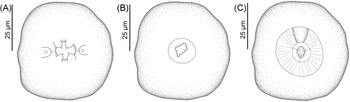
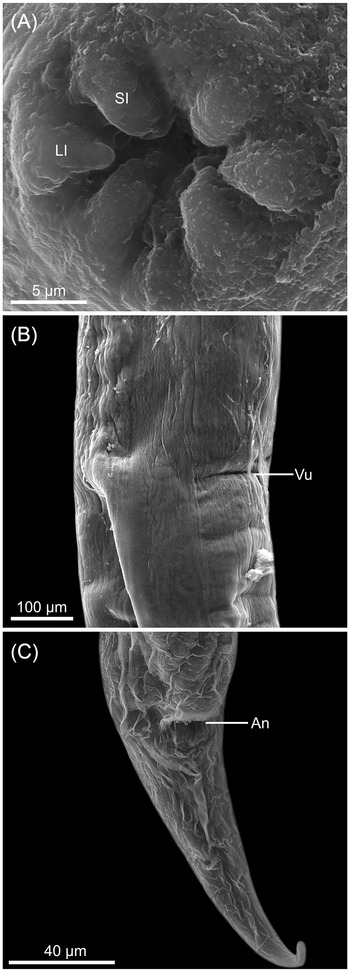
See Figures 1-3 and Table 1 (based on the holotype and 11 paratypes, all gravid hermaphrodites). Body slender, elongated, 4·4; 4·6 (3·7–5·3) mm. Body surface covered by prominent cuticular inflation, uniform along body and attenuated at extremities (Fig. 1A). Lateral pores and ducts present along body length. Body width at vulva 188; 217 (158–258), width at oesophagus-intestine junction 108; 110 (101–123). Oral opening, round in shape, surrounded by 6 lips, 4 lips, close to the edge of the oral opening and projecting inward of oral opening (toward the oral lumen), and 2 larger lateral lips, located farther from opening (Figs 2A, 3A). Each lip bears a papilla on its inner edge, amphids located posterior to lateral lips (Fig. 2A). Buccal capsule cup-shaped with 10; 9 (8–10) deep and 14; 14 (13–16) wide, depth/width ratio 0·7; 0·68 (0·6–0·7). Buccal capsule walls consist of larger anterior portion and smaller posterior portion, both with irregular folds on internal surface of wall (Fig. 2B). Buccal capsule close to entrance of oesophagus lumen with serrated internal surface and squared margins. Entrance of oesophageal lumen triangular, with rounded edges and oesophageal gland, located in the dorsal region of oesophagus (Fig. 2C). Oesophagus length 467; 484 (427–509), representing 11%; 10% (9–12%) of body length, claviform with rounded apex and with distinctly rounded dilation at anterior region (Fig. 1B). Width at anterior end of oesophagus 29; 31 (28–33), width at anterior dilation of oesophagus 34; 38 (35–40), width after dilation 32; 36 (34–37), bulb width 53; 59 (53–64). Nerve-ring surrounding oesophagus posterior to dilation located at 151; 154 (134–168) from anterior end (Fig. 1B). Excretory pore not observed. Genital system typical of Rhabdiasidae, amphidelphic with anterior and posterior ovaries, transverse vagina, post-equatorial vulva, located at 2·4; 2·5 (2·1–2·9) mm from anterior extremity (representing 55%; 54% (51–56%) of the body length). Vulvar lips slightly protruding (Fig. 3B). Uterus thin-walled, with numerous eggs (> 100), embryonated eggs close to vulva. Egg size 76; 80 (75–85) × 43; 45 (39–49) (N = 10 eggs measured from uterus of holotype and each paratype) (Fig. 1C). Female reproductive system flexed in ‘U’ shape at 1·100; 1273 (987–1447) from anterior extremity (near oesophagus–intestine junction) and 585; 613 (561–647) of posterior region (close to rectum). Intestine thick-walled. Rectum short, funnel-shaped, and lined with thin cuticle (Fig. 1D). Contents of intestine brown throughout length. Tail long, gradually tapering 187; 210 (177–251) and 4·3%; 5% (3·7–5·3%) of body length (Fig. 3C).
Line drawings of Rhabdias camposi n. sp. from Dendrobates tinctorius. (A) Entire body, lateral view; (B) anterior end of the body, lateral view; (C) vulva region, lateral view; (D) caudal end, lateral view.

Line drawings of cross sections of anterior end and face view of Rhabdias camposi n. sp. from Dendrobates tinctorius. (A) Anterior extremity end face view; (B) optical section through anterior part of buccal capsule; (C) optical section through posterior part of buccal capsule.

Scanning electron micrographs of Rhabdias camposi n. sp. from Dendrobates tinctorius. (A) Apical view (Ll – lateral lips; Sl – submedian lips); (B) mid-body region with partially latero-ventral view of the vulva (Vu – vulva); (C) posterior end, ventro-lateral view (An – anus).

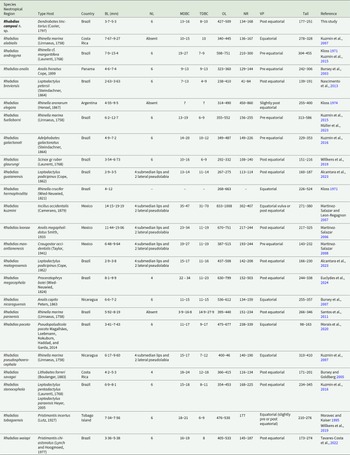
Selected morphological characters of Rhabdias spp. From the Neotropical region. Morphological measurements are given in micrometres, unless otherwise indicated. Bold indicates the new species. Abbreviations: BL = body length; BWV = body width at vulva; NL = number of lips; MDBC = maximum diameter of the buccal capsule; TDBC = total depth of the buccal capsule; OL = oesophagus length; NR = nerve ring; VP = vulva position

Remarks
The new species was assigned to the genus Rhabdias based on molecular data and the following morphological characteristics: inflated body cuticle, a cup-shaped buccal capsule, amphidelphic reproductive system with a short transverse vagina, morphology of the oral opening, and tail morphology. Additionally, it was found parasitizing the lungs of anurans. According to Kuzmin (Reference Kuzmin2013), Müller et al., (Reference Müller, Morais, Costa-Silva, Aguiar, Ávila and da Silva2018) and Tavares-Costa et al., (Reference Tavares-Costa, Rebêlo, Müller, Jesus, Nandyara, Silva, Costa-Campos, Santos and Melo2022), those morphological traits are the main characteristics for this genus.
Rhabdias camposi n. sp. differs from other species reported in the Neotropical region by a unique combination of morphological features, including the position of the nerve ring, dimensions of the buccal capsule, shape of the cuticular inflation, oesophagus length, lip position and size, and tail length. Therefore, based on the distinctive set of morphological traits observed in Rhabdias camposi n. sp., we propose it as a new species.
We compared this new taxon with Rhabdias species reported in Neotropical anurans (Table 1). However, as suggested by Willkens et al., (Reference Willkens, Rebêlo, Santos, Furtado, Vilela, Tkach, Kuzmin and Melo2019), Rhabdias mucronata Schuurmans-Stekhoven, 1952 and Rhabdias truncata Schuurmans-Stekhoven, 1952 are excluded from the comparison, as morphological data for their mature forms are unavailable and their descriptions were based on juvenile specimens found in the host’s body cavity. In addition, we compare the new taxon with R. hermaphrodita (Kloss, Reference Kloss1971), a Neotropical species for which the original description lacks information regarding the arrangement of the oral structures.
Based on the morphology and arrangement of the oral opening structures, Rhabdias camposi n. sp. is part of the group of Netropic species that have 6 lips (4 submedial and 2 lateral). This group is composed of 10 species: Rhabdias androgyna (Kloss, Reference Kloss1971); R. breviensis (Nascimento et al., Reference Nascimento, Gonçalves, Melo, Giese, Furtado and Santos2013); R. fuelleborni (Travassos, Reference Travassos1926); R. galactonoti (Kuzmin et al., Reference Kuzmin, Melo, da Silva Filho and Santos2016); R. glaurungi (Willkens et al., Reference Willkens, Rebêlo, Santos, Furtado, Vilela, Tkach, Kuzmin and Melo2019); R. manantlanensis (Martinez-Salazar, Reference Martinez-Salazar2008); R. pocoto (Morais et al., Reference Morais, Müller, Melo, Aguiar, Willkens, De Sousa, Giese, Ávila and da Silva2020); R. stenocephala (Kuzmin et al., Reference Kuzmin, Melo, da Silva Filho and Santos2016); R. tobagoensis (Moravec and Kaiser, Reference Moravec and Kaiser1995) and R. waiapi (Tavares-Costa et al., Reference Tavares-Costa, Rebêlo, Müller, Jesus, Nandyara, Silva, Costa-Campos, Santos and Melo2022) (Table 1).
Rhabdias androgyna (Kloss, Reference Kloss1971) was described in Rhinella gr. margaritifera (Laurenti, 1768) (Bufonidae) differ from the new species by the total length (7·9–15 mm R. androgyna νs. 3·36–5·38 mm Rhabdias camposi n. sp.), by morphology of the buccal capsule, in R. camposi n. sp., the capsule walls consist of a larger anterior portion and a smaller posterior portion, both of which display irregular folds on the inner surface. In contrast, R. androgyna lacks a defined posterior segment and exhibits a serrated inner wall along almost its entire length, except at the base (Kuzmin et al., Reference Kuzmin, Du Preez and Junker2015). Additionally, R. androgyna has a wider oral capsule (19–27 R. androgyna νs 13-16 R. camposi n. sp.) and longer oesophagus (598–751 R. androgyna vs. 427-509 R. camposi n. sp.). Position of the vulva also differs, R. androgyna has a pre-equatorial vulva located 3·7–7·2 mm from the anterior end (44·5–50·8% of the body length), while the new species has a post-equatorial vulva located 2·1–2·9 mm from the anterior end (51–56% of the body length). In addition, the anterior region of the R. androgyna body has a characteristic shape, which consists of a rounded dilation of the inflation with 2 layers, with the innermost layer connecting to the body wall in a body dilation like a ‘shoulder’ (Kloss, Reference Kloss1971; Kuzmin et al., Reference Kuzmin, Du Preez and Junker2015); this characteristic is not observed in R. camposi n. sp.
In comparison to the new species, Rhabdias breviensis (Nascimento et al., Reference Nascimento, Gonçalves, Melo, Giese, Furtado and Santos2013) described in Leptodactylus petersii (Steindachner, 1864) (Leptodactylidae), has a smaller and wider body (2·63–3·63 mm × 370–543 R. breviensis νs. 3·7–5·3 mm × 158–258 R. camposi n. sp.) and has a body curvated dorsally. In addition, R. breviensis has a smaller dimensions of oral capsule (7–13 × 4–9 R. breviensis νs. 8–10 × 13–16 R. camposi n. sp.), shorter oesophageal length (238–410 R. breviensis vs. 427–509 R. camposi n. sp.), and a shorter distance from the anterior end to the nerve ring (41–84 R. breviensis νs. 134–168 R. camposi n. sp.). The vulva in R. breviensis is similar to that in the new taxon (post-equatorial), but also differs because in the former species, the vulva is far posterior to the anterior end (65–71% of the body length R. breviensis vs. 51–56% of the body length R. camposi n. sp.) and the tail is shorter (139–191 R. breviensis νs. 177–251 R. camposi n. sp.) (Nascimento et al., Reference Nascimento, Gonçalves, Melo, Giese, Furtado and Santos2013).
Rhabdias fuelleborni (Travassos, Reference Travassos1926), originally described in Rhinella diptycha (= Bufo marinus) (Schneider, 1799) (Bufonidae), is longer than the new taxon (6·1–12·7 mm R. fuelleborni vs 3·7–5·3 mm R. camposi n. sp. in total length), and has a buccal capsule morphology composed of a smooth anterior wall and a posterior wall with irregular folds (Müller et al., Reference Müller, Morais, Tavares-Costa, de Vasconcelos Melo, Giese, Ávila and da Silva2023), whereas in R. camposi, both walls of the capsule have irregular folds on their inner surface. Vulva equatorial 3·1–6·3 mm from the anterior end (49·4–52% of the body length in R. fuelleborni vs. 51–56% of the body length in R. camposi n. sp.), and a longer tail (454–586 R. fuelleborni vs. 177–251 R. camposi n. sp.) (Travassos, Reference Travassos1926; Kuzmin et al., Reference Kuzmin, Du Preez and Junker2015; Müller et al., Reference Müller, Morais, Tavares-Costa, de Vasconcelos Melo, Giese, Ávila and da Silva2023).
Although also described in a dendrobatid anuran, Rhabdias galactonoti (Kuzmin et al., Reference Kuzmin, Melo, da Silva Filho and Santos2016), from Adelphobates galactonotus (Steindachner, 1864) (Dendrobatidae), presents several morphological differences when compared to the new taxon. It has a prominent cuticular inflation along the body, has larger body dimensions (5·6–6·04 mm in R. galactonoti vs. 3·7–5·3 mm in R. camposi n. sp.), the buccal capsule walls exhibit regular folds on the anterior wall and a posterior part that is shallow, thin-walled, and surrounded by the apex of the oesophagus (Kuzmin et al., Reference Kuzmin, Melo, da Silva Filho and Santos2016). In R. camposi, both walls of the capsule display irregular folds on their inner surface. R. galactonoti has smaller relative proportions of the oesophagus (6·3–8·2% of body length in R. galactonoti vs. 9–12% in R. tinctorii n. sp.), and a greater distance from the anterior end to the nerve ring (184–226 in R. galactonoti vs. 134–168 in R. tinctorii n. sp.). Additionally, the position of the vulva also differs: R. galactonoti has a pre-equatorial vulva (representing 43–50% of body length) (Kuzmin et al., Reference Kuzmin, Melo, da Silva Filho and Santos2016), while the new species has a post-equatorial vulva (51–56% of body length).
The new species can be distinguished from Rhabdias glaurungi (Willkens et al., Reference Willkens, Rebêlo, Santos, Furtado, Vilela, Tkach, Kuzmin and Melo2019), described from Scinax gr. ruber (Laurenti, 1768) (Hylidae), by the arrangement of the lips: in the new species, 6 lips are present, 4 situated at the edge of the oral opening and 2 lateral lips positioned farther apart, whereas in R. glaurungi all 6 lips are positioned close to the oral opening (Willkens et al., Reference Willkens, Rebêlo, Santos, Furtado, Vilela, Tkach, Kuzmin and Melo2019). In addition, R. glaurungi exhibits the opposite pattern in buccal capsule morphology, consisting of a smooth anterior part wall and a posterior part wall with an irregularly folded inner surface, and has a smaller oesophagus (427–509 in R. camposi n. sp. vs. 292–332 in R. glaurungi) (Willkens et al., Reference Willkens, Rebêlo, Santos, Furtado, Vilela, Tkach, Kuzmin and Melo2019).
The description of Rhabdias hermaphrodita (Kloss, Reference Kloss1971) from Rhinella crucifer (Wied-Neuwied, 1821) (= Bufo crucifer) (Bufonidae) is superficial and incomplete; the author did not provide any morphometric or morphologic information on the buccal capsule or apical structures, as discussed by Willkens et al., (Reference Willkens, Rebêlo, Santos, Furtado, Vilela, Tkach, Kuzmin and Melo2019). However, it is possible to differentiate the 2 species by body length, R. hermaphrodita measures up to 12 mm in total length, while the new species has 3·7–5·3 mm in total length. In addition, R. hermaphrodita does not present dilation of the cuticular inflation in the anterior region (Kloss, Reference Kloss1971), while the new species has a very characteristic anterior end cuticular inflation.
Compared to the new taxon, Rhabdias manantlanensis (Martinez-Salazar, Reference Martinez-Salazar2008) of Craugastor occidentalis (Taylor, 1941) (Craugastoridae) has a longer body length (6·48–9·64 mm R. manantlanensis νs. 3·7–5·3 mm R. camposi n. sp.), larger bucal capsule diameter (19–27 R. manantlanensis νs. 13–16 R. camposi n. sp.), greater distance from the anterior end to the nerve ring (193–244 R. manantlanensis νs. 134–168 R. camposi n. sp.), slightly pre-equatorial vulva vs. post-equatorial vulva (41·66–51·59% of the body length in R. manantlanensis νs. 51–56% of the body length in R. camposi n. sp.), and shorter tail (143–232 or 1·5–3·3% of the body length in R. manantlanensis νs. 177–251 or 3·7–5·3% of the body length in R. camposi n. sp.) .
Rhabdias pocoto (Morais et al., Reference Morais, Müller, Melo, Aguiar, Willkens, De Sousa, Giese, Ávila and da Silva2020), a parasite of Pseudopaludicola pocoto (Magalhães, Loebmann, Kokubum, Haddad & Garda, 2014) (Leptodactylidae), differs from R. camposi n. sp. in several morphological and morphometric aspects. The former species is larger (3·41–7·43 mm in R. pocoto vs. 3·7–5·3 mm in R. camposi n. Sp. in total length), exhibits the opposite pattern in buccal capsule morphology, consisting of a smooth anterior part wall and a posterior part wall with an irregularly folded inner surface, and has a deeper buccal capsule (9–17 R. pocoto vs. 8-10 R. camposi n. sp.), a longer oesophagus (475–677 or 8·9–13·9% of body length R. pocoto vs. 427–509 or 9–12% R. camposi n. sp.) and a shorter tail (98–163 R. pocoto vs. 177–251 R. camposi n. sp.). Additionally, R. pocoto has 2 subapical lateral pores connected to an amorphous gland-like structure in the anterior region (Morais et al., Reference Morais, Müller, Melo, Aguiar, Willkens, De Sousa, Giese, Ávila and da Silva2020), which is absent in R. camposi n. sp.
Rhabdias stenocephala (Kuzmin et al., Reference Kuzmin, Melo, da Silva Filho and Santos2016), described from Leptodactylus pentadactylus (Laurenti, 1768) and Leptodactylus paraensis (Heyer, 2005) (Leptodactylidae), can be easily distinguished from the new species by the presence of a prominent anterior constriction of the body, followed by a sudden expansion of the body wall posterior to this region (Kuzmin et al., Reference Kuzmin, Melo, da Silva Filho and Santos2016), features not observed in R. camposi n. sp. Furthermore, compared with R. stenocephala, the new species differs in buccal capsule wall structure: in R. stenocephala, the anterior portion is transparent, whereas the posterior portion is denser, with a circular thickening clearly visible in apical view. In addition, R. stenocephala is larger (6·9–8·1 mm in R. stenocephala vs. 3·7–5·3 mm in R. camposi n. sp.) (Kuzmin et al., Reference Kuzmin, Melo, da Silva Filho and Santos2016).
The new species can be easily distinguished from Rhabdias tobagoensis (Moravec and Kaiser, Reference Moravec and Kaiser1995), parasite of Pristimantis incertus (Lutz, 1927) (= Eleutherodactylus terraebolivaris) (Craugastoridae), by having a smaller body (7·34–7·56 mm in R. tobagoensis vs. 3·7–5·3 mm in R. camposi n. sp.), a smaller buccal capsule (6–9 × 18–21 R. tobagoensis vs. 8–10 × 13–16 R. camposi n. sp.), and the position of the vulva, which is equatorial in R. tobagoensis (Moravec and Kaiser, Reference Moravec and Kaiser1995), while in the new species it is post-equatorial (representing 45–49% of body length in R. tobagoensis vs. 51%–56% representing of body length in R. camposi n. sp). In addition, Willkens et al., (Reference Willkens, Rebêlo, Santos, Furtado, Vilela, Tkach, Kuzmin and Melo2019) re-examined deposited paratypes and added new morphological data. According to the authors, the posterior end of the oesophagus in R. tobagoensis is distinctly flattened and even concave, whereas it is rounded in R. camposi n. sp. This latter feature was not mentioned in the original description of R. tobagoensis (Moravec and Kaiser, Reference Moravec and Kaiser1995).
Rhabdias waiapi (Tavares-Costa et al., Reference Tavares-Costa, Rebêlo, Müller, Jesus, Nandyara, Silva, Costa-Campos, Santos and Melo2022), from Pristimantis chiastonotus (Lynch & Hoogmoed 1977), differs from the new taxon in having a deeper, more prominent cup-shaped buccal capsule (16–19 R. waiapi vs. 13–16 R. camposi n. sp.) with the posterior part smooth (Tavares-Costa et al., Reference Tavares-Costa, Rebêlo, Müller, Jesus, Nandyara, Silva, Costa-Campos, Santos and Melo2022), whereas in R. camposi n. sp. it bears irregular folds. Moreover, the internal surface adjacent to the oesophageal entrance is serrated in R. camposi, while it is smooth in R. waiapi. Furthermore, R. waiapi has a greater width at the oesophageal–intestine junction (130–173 in R. waiapi vs. 101–123 in R. camposi n. sp.), and a greater distance from the anterior end to the nerve ring (145–187 in R. waiapi vs. 134–168 in R. camposi n. sp.) (Tavares-Costa et al., Reference Tavares-Costa, Rebêlo, Müller, Jesus, Nandyara, Silva, Costa-Campos, Santos and Melo2022).
The buccal capsule morphology of Rhabdias camposi n. sp. is distinctive, and the unique combination of its morphological and morphometric features constitutes the diagnostic character set that supports R. camposi n. sp. as a distinct taxon. The morphology of the buccal capsule has been used and represents one of the most informative traits for species identification and differentiation within the genus (Kuzmin, Reference Kuzmin2013). Although the morphology of the buccal capsule is not known for all Rhabdias species, we reinforce that a detailed analysis of this structure is essential for the accurate recognition and delimitation of Rhabdias spp.
Additional morphological and metrical differences between the new species and Rhabdias spp. from the Neotropical realm can be observed in Table 1.
Molecular analyses and phylogenetic study
Mitochondrial COI sequencing of R. camposi n. sp. resulted in 2 sequences of 345 bp (haplotype 1) and 338 bp (haplotype 2), while a BLASTn search revealed no identical (with 100% of identity) match with any other Rhabdiasid available in the NCBI database. The alignment of our sequences with those available in GenBank generated a matrix of 324 base pairs.
The Iss index indicated no saturation in the transitions or transversions; Iss.c values were greater than the Iss values. Pairwise genetic divergence comparison, considering Rhabdias spp. and Serpentirhabdias fuscovenosa (MH281971) and Serpentirhabdias atroxi (MH281969) (the outgroup for phyllogenetic analysis), revealed that R. camposi n. sp. has the lowest genetic differences with R. waiapi n. sp., (4% of genetic divergence) (see Supplementary Material Table 1).
Maximum-likelihood and Bayesian inference analyses based on 46 taxa revealed similar topologies. Two well-supported monophyletic lineages were consistently recovered, herein designated as Clade A and Clade B (Fig. 4).
Maximum likelihood phylogenetic topology of Rhabdias spp. of COI gene using Serpentirhabdias atroxi and Serpentirhabdias fuscovenosa as outgroup, indicating the position of Rhabdias camposi n. sp. (represented in bold italics). GenBank accession numbers follow each taxon. Support values are above or below nodes: posterior probabilities <0·90 and bootstrap scores <70 are not shown, or are represented by a dash. Branch-length scale bar indicates number of substitutions per site.

Clade A comprises a strongly supported subclade grouping 2 sequences of Rhabdias waiapi, a parasite of Pristimantis chiastonotus (Lynch & Hoogmoed, 1977) (Strabomantidae), and 2 sequences of Rhabdias camposi n. sp., parasitic in D. tinctorius (Dendrobatidae). This subclade is, in turn, recovered as sister to a larger clade, which is divided into 2 subclades: the first includes sequences of Rhabdias megacephala, a parasite of Proceratophrys boiei (Wied-Neuwied, 1824) (Odontophrynidae) and Rhabdias fuelleborni, associated with Rhinella spp. (Bufonidae); the second subclade comprises Rhabdias guaianensis, a parasite of Leptodactylus podicipinus (Cope, 1862) and Rhabdias cf. stenocephala, parasitic in Leptodactylus pentadactylus (Laurenti, 1768), both members of the Leptodactylidae family (Fig. 4).
Clade B includes sequences of Rhabdias breviensis Nascimento, 2013, which are arranged into 2 well-defined subclades. This clade groups, also with strong nodal support, together with sequences of Rhabdias matogrossensis, a parasite of Leptodactylus macrosternum Miranda-Ribeiro, 1926 (all Leptodactylidae). In addition, phylogenetic analyses resolved Rhabdias pseudosphaerocephala (Kuzmin et al., Reference Kuzmin, Tkach and Brooks2007) into 2 well-supported and distinct clades: One comprising individuals from the northern, southeastern, and southern regions of Brazil, and another composed of individuals from the northeastern region (Fig. 4).
The latter clade formed a well-supported monophyletic group with Rhabdias glaurungi, a parasite of Scinax gr. ruber (Hylidae), and Rhabdias pocoto, parasitic in Pseudopaludicola pocoto Magalhães, Loebmann, Kokubum, Haddad & Garda, 2014 (Leptodactylidae).
Discussion
Rhabdias camposi n. sp. represents the 26th species of Rhabdias described in the Neotropical region, the 15th in Brazil, and the second species recorded in amphibians from the state of Amapá, Brazil. The primary morphological features distinguishing the new taxon from its congeners include the morphology of cuticular inflation, arrangement and number of lips, buccal capsule dimensions, oesophagus length, and tail length.
The disposition, organization, and number of circumoral structures are key morphological traits for distinguishing species within the genus (Kuzmin, Reference Kuzmin2013; Kuzmin et al., Reference Kuzmin, Svitin, McAllister, Guderyahn and Tkach2024). In the Neotropical region, 25 species (23 of which parasitize amphibians) are recognized based on distinct oral arrangements, categorized into 4 main types: (1) 4 submedian lips and 2 lateral pseudolabia (R. guaianensis, R. kuzmini, R. savagei, R. pseudosphaerocephala); (2) 6 lips (R. androgyna, R. breviensis, R. fuelleborni, R. galactonoti, R. glaurungi, R. manantlanensis, R. matogrossensis, R. nicaraguensis, R. pocoto, R. stenocephala, R. tobagoensis, R. waiapi); (3) 4 lips (R. leonae, R. megacephala, R. savagei); and (4) absent lips (R. alabialis, R. elegans, R. paraensis) (Tavares-Costa et al., Reference Tavares-Costa, Rebêlo, Müller, Jesus, Nandyara, Silva, Costa-Campos, Santos and Melo2022; Alcantara et al., Reference Alcantara, Müller, Úngari, Ferreira-Silva, Emmerich, Giese, Morais, Santos, O’Dwyer and Silva2023; Euclydes et al., Reference Euclydes, Melo, da Justa Hc, Jesus, Gremski, Veiga and Campião2024). R. mucronata, R. truncata and R. hermaphrodita were excluded due to the lack of information on oral structure in their original descriptions (Willkens et al., Reference Willkens, Rebêlo, Santos, Furtado, Vilela, Tkach, Kuzmin and Melo2019).
Despite belonging to the second group, Rhabdias camposi n. sp. can be distinguished from its congeners by a unique combination of morphometric and morphological features, including buccal capsule dimensions, morphology of both anterior and posterior portions of the buccal capsule, the shape of the cuticular inflation, oesophagus length, lip arrangement, and tail length. Furthermore, we found significant genetic divergence between the new taxon and sequences of Rhabdias species for which molecular data are available. Thus, the combination of morphology and molecular data supports the recognition of R. camposi n. sp. as a distinct taxon.
Although oral structures are widely used as diagnostic characters in Rhabdias, molecular evidence suggests that such features do not necessarily reflect monophyletic groupings (Tkach and Snyder, Reference Tkach, Kuzmin and Snyder2014; Müller et al., Reference Müller, Morais, Costa-Silva, Aguiar, Ávila and da Silva2018; Tavares-Costa et al., Reference Tavares-Costa, Rebêlo, Müller, Jesus, Nandyara, Silva, Costa-Campos, Santos and Melo2022). Our data support this, demonstrating that closely related phylogenetic species can differ considerably in apical structures, whereas distantly related species may exhibit convergent morphologies.
Phylogenetic analyses placed Rhabdias camposi n. sp. in a strongly supported clade with R. waiapi, a species described by Tavares-Costa et al., (Reference Tavares-Costa, Rebêlo, Müller, Jesus, Nandyara, Silva, Costa-Campos, Santos and Melo2022) using an integrative approach combining morphological and molecular data from specimens parasitizing Pristimantis chiastonotus. According to these authors, R. waiapi displays the second oral pattern (6 lips, 4 submedians, and 2 laterals), which was also observed in Rhabdias camposi n. sp. The morphological and phylogenetic affinities between the 2 species may be associated with the overlapping geographic distributions of their respective hosts, P. chiastonotus and D. tinctorius, which co-occur in the Guiana region and northern Brazil (Frost, Reference Frost2025). Moreover, both nematode species were recorded in geographically close municipalities in Amapá state, Brazil.
These findings suggest sympatric distribution and a possible shared evolutionary origin between R. waiapi and Rhabdias camposi n. sp., potentially shaped by similar selective pressures in the Amazonian environment. Moravec and Sey (Reference Moravec and Sey1990), Tkach and Snyder (Reference Tkach, Kuzmin and Snyder2014) and Müller et al., (Reference Müller, Morais, Costa-Silva, Aguiar, Ávila and da Silva2018), also argued that parasite specificity and host distribution should be considered complementary parameters for evaluating taxonomic affinities within Rhabdias. The results of this study are in agreement with previous findings (Tkach and Snyder, Reference Tkach, Kuzmin and Snyder2014; Müller et al., Reference Müller, Morais, Costa-Silva, Aguiar, Ávila and da Silva2018; Tavares-Costa et al., Reference Tavares-Costa, Rebêlo, Müller, Jesus, Nandyara, Silva, Costa-Campos, Santos and Melo2022; Alcantara et al., Reference Alcantara, Müller, Úngari, Ferreira-Silva, Emmerich, Giese, Morais, Santos, O’Dwyer and Silva2023; Euclydes et al., Reference Euclydes, Melo, da Justa Hc, Jesus, Gremski, Veiga and Campião2024) and reinforce the importance of integrative approaches combining morphological, molecular, and biogeographic data for robust species delimitation, especially among morphologically conserved or cryptic groups.
Phylogenetic and biogeographic studies of Rhabdias spp. have revealed cryptic diversity among Neotropical species, with 3 species complexes exhibiting high genetic diversity: R. breviensis, R. pseudosphaerocephala, and R. stenocephala (Müller et al., Reference Müller, Morais, Costa-Silva, Aguiar, Ávila and da Silva2018, Reference Müller, Morais, Tavares-Costa, de Vasconcelos Melo, Giese, Ávila and da Silva2023). We also observed the same species complexes, even after including sequences of the new species. These findings support the hypotheses that host specificity within Rhabdias varies widely and is influenced by multiple ecological and evolutionary factors. Among these factors, ecological fitting deserves particular attention, as a central element in the establishment and maintenance of these associations, potentially allowing the progressive adaptation to novel hosts (Langford and Janovy, Reference Langford and Janovy2013).
We also found a well-supported monophyletic clade composed of sequences from R. matogrossensis. R. breviensis has been reported from various host families: Bufonidae, Odontophrynidae, Leptodactylidae, and Hylidae (Nascimento et al., Reference Nascimento, Gonçalves, Melo, Giese, Furtado and Santos2013; Müller et al., Reference Müller, Morais, Costa-Silva, Aguiar, Ávila and da Silva2018; Da Silva et al., Reference Da Silva, Soares, Miguel, Couto, Miranda, Alves and Paiva2019), while R. matogrossensis has only been found in leptodactylid hosts (Alcantara et al., Reference Alcantara, Müller, Úngari, Ferreira-Silva, Emmerich, Giese, Morais, Santos, O’Dwyer and Silva2023). These data suggest that the R. breviensis forms a complex of species that exhibits lower host specificity and was found infecting species from multiple anuran families.
Furthermore, we found that the genetic divergence between R. breviensis and R. matogrossensis ranged from 1·89% to 2·21%, indicating a close genetic relationship. Thus, we conclude that R. matogrossensis may represent a species that diverged recently within the R. breviensis complex. These findings support the existence of recently diverged cryptic species and reinforce the central role of ecological fitting in modulating host specificity (Langford and Janovy, Reference Langford and Janovy2013; Müller et al., Reference Müller, Morais, Costa-Silva, Aguiar, Ávila and da Silva2018).
We recovered a monophyletic group (with low support) composed of 2 subclades: one formed by R. fuelleborni, parasitic in Rhinella spp. and R. megacephala, parasitic in Proceratophrys boiei; the other comprising R. cf. stenocephala, parasitic in Leptodactylus spp., and R. guaianensis, parasitic in Leptodactylus podicipinus (Cope, 1862). These results support the hypothesis raised by Müller et al., (Reference Müller, Morais, Tavares-Costa, de Vasconcelos Melo, Giese, Ávila and da Silva2023), who suggested that R. fuelleborni may represent a distinct lineage within the R. cf. stenocephala complex, found in the Caatinga biome, that resulted from ecological fitting. Furthermore, R. cf. stenocephala, R. fuelleborni, and R. megacephala exhibit unique morphological traits, which are absent in other congeners. These morphological characters potentially represent characters that have some phylogenetic signal and are important for understanding the evolutionary patterns of this group. For instance, R. fuelleborni shows slight constriction at the oesophageal apex (Müller et al., Reference Müller, Morais, Tavares-Costa, de Vasconcelos Melo, Giese, Ávila and da Silva2023); R. stenocephala exhibits a distinct constriction at the anterior body near the oesophageal apex (Kuzmin et al., Reference Kuzmin, Melo, da Silva Filho and Santos2016); and R. megacephala has shoulder-like expansions at the level of the nerve ring (Euclydes et al., Reference Euclydes, Melo, da Justa Hc, Jesus, Gremski, Veiga and Campião2024).
Host phylogeny is a key determinant of parasite community structure, as host evolutionary history influences parasite dispersal and host-switching (Poulin, Reference Poulin2007). Host traits, such as physiology, behaviour, and ecology, also facilitate parasite colonization (Rezende et al., Reference Rezende, Albert, Fortuna and Bascompte2009; Dormann et al., Reference Dormann, Von and Scherer-Lorenzen2017; D’Bastiani et al., Reference D’Bastiani, Campião, Boeger and Araújo2020; Tavares-Costa et al., Reference Tavares-Costa, Rebêlo, Müller, Jesus, Nandyara, Silva, Costa-Campos, Santos and Melo2022). Thus, the close phylogenetic relationship between the sister families Odontophrynidae and Bufonidae, both part of the monophyletic group Commutibirana (Hime et al., Reference Hime, Lemmon, Lemmon, Prendini, Brown, Thomson, Kratovil, Noonan, Pyron, Peloso, Kortyna, Keogh, Donnellan, Mueller, Raxworthy, Kunte, Ron, Das, Gaitonde, Green, Labisko, Che and Weisrock2021; Portik et al., Reference Portik, Streicher and Wiens2023), reflects the evolutionary proximity of their respective parasites. This suggests that the observed parasite subclade formation was likely influenced by host phylogeny.
Furthermore, it is important to highlight that Tkach and Snyder, (Reference Tkach, Kuzmin and Snyder2014) proposed that multiple colonization events occurred throughout Rhabdias evolution, with host-switching being a recurrent feature. They suggested that host-switching and ecological adaptation provided more evolutionary advantages to Rhabdias spp. than the association with 1 host taxon. Thus, the observed zoogeographic patterns and the restriction to Rhabdias spp. to specific biogeographic regions are, in part, a result of these parasites’ abilities to successfully colonize new hosts as they become available in different areas.
Species differentiation/diversification in Rhabdias is a complex process influenced by a combination of mechanisms, including intrinsic and host-related processes (Tkach and Snyder, Reference Tkach, Kuzmin and Snyder2014; Müller et al., Reference Müller, Morais, Costa-Silva, Aguiar, Ávila and da Silva2018, Reference Müller, Morais, Tavares-Costa, de Vasconcelos Melo, Giese, Ávila and da Silva2023). Some studies have explored these mechanisms using morphology, genetic, ecological adaptations, and parasite functional traits (Poulin, Reference Poulin2011; Kamiya et al., Reference Kamiya, O’Dwyer, Nakagawa and Poulin2014). The observed patterns, so far, highlight that ecological fitting and host-switching are also key factors in the speciation ot lung-dwelling nematodes. These mechanisms are crucial for understanding the origin and diversification of parasite lineages in Neotropical amphibian hosts.
Fifteen nominal Rhabdias species are recognized in Brazilian anurans (Euclydes et al., Reference Euclydes, Melo, da Justa Hc, Jesus, Gremski, Veiga and Campião2024). However, considering the 5 known Dendrobates species and over 200 species in Dendrobatidae (Frost, Reference Frost2025), the diversity of Rhabdias in these hosts remains poorly understood. To date, only 2 dendrobatid hosts have been recorded for Rhabdias spp.: R. galactonoti in Adelphobates galactonotus (Kuzmin et al., Reference Kuzmin, Melo, da Silva Filho and Santos2016) and Rhabdias sp. in Ameerega pulchripecta (Tavares-Costa et al., Reference Tavares-Costa, Dias-Souza, Costa-Campos and Melo2019). Thus, Dendrobates tinctorius represents the third dendrobatid host for Rhabdias.
The knowledge of Rhabdias diversity has advanced in recent years with new species descriptions, phylogeny studies, and biogeographic surveys (Müller et al., Reference Müller, Morais, Costa-Silva, Aguiar, Ávila and da Silva2018; Tavares-Costa et al., Reference Tavares-Costa, Rebêlo, Müller, Jesus, Nandyara, Silva, Costa-Campos, Santos and Melo2022; Alcantara et al., Reference Alcantara, Müller, Úngari, Ferreira-Silva, Emmerich, Giese, Morais, Santos, O’Dwyer and Silva2023; Euclydes et al., Reference Euclydes, Melo, da Justa Hc, Jesus, Gremski, Veiga and Campião2024). It is important to highlight that most Brazilian species have been described in the Northern region, particularly in the Amazon. Our research group has described 7 species of the Rhabdiasidae to date (Santos et al., Reference Santos, Melo, Nascimento, Nascimento, Giese and Furtado2011; Nascimento et al., Reference Nascimento, Gonçalves, Melo, Giese, Furtado and Santos2013; Kuzmin et al., Reference Kuzmin, Melo, da Silva Filho and Santos2016; Machado et al., Reference Machado, Kuzmin, Tkach, Santos, Gonçalves and Melo2018; Willkens et al., Reference Willkens, Rebêlo, Santos, Furtado, Vilela, Tkach, Kuzmin and Melo2019; Tavares-Costa et al., Reference Tavares-Costa, Rebêlo, Müller, Jesus, Nandyara, Silva, Costa-Campos, Santos and Melo2022), using integrative studies of helminths from Amazonian amphibians and reptiles. Therefore, the predominance of known species in the Northern region may reflect a sampling bias, driven by intensive research efforts in this area and the presence of a core group of taxonomists dedicated exclusively to studying these parasites in amphibians and reptiles.
Until now, only 1 Rhabdias species has been formally described from a dendrobatid host, suggesting these associations are rare or have been historically underestimated. We propose 2 hypotheses for this gap: (1) a historical lack of parasitological surveys targeting Dendrobatidae; (2) potentially high host specificity in Rhabdias, limiting colonization of chemically defended hosts; and the possible inhibitory role of host alkaloids. Additionally, all known records were made in Brazil, which could reflect the emergence of new parasitology researchers in the area in the recent 20 years.
Dendrobatids, or poison frogs, are chemically defended Neotropical anurans that produce potent skin alkaloids (Daly et al., Reference Daly, Spande and Garraffo2005; Saporito et al., Reference Saporito, Donnelly, Spande and Garraffo2012). These compounds are important modulators of skin microbiota and aid frogs to escape from predators (Johnson et al., Reference Johnson, Calhoun, Stokes, Susbilla, McDevitt‐Galles, Briggs, Hoverman, Tkach and Roode2018; Christian et al., Reference Christian, Shine, Day, Kaestli, Gibb, Shilton and Brown2021; Caty et al., Reference Caty, Alvarez-Buylla, Vasek, Tapia, Martin, McLaughlin, Weber, Mayali, Coloma, Morris and O’Connell2024), however, it is still unclear how skin-penetrating parasites, such as Rhabdias spp., overcome this chemical barrier. This is particularly interesting, since dendrobatids hosts only a few species of Rhabdias, suggesting that these alkaloids may act as defense mechanisms for these parasites. Additionally, we still have little information on the excretory/secretory system and life cycle of Rhabdias spp. (Melo et al., Reference Melo, Nascimento, Macedo, Santos and Kuzmin2016). The molecules produced by nematodes may act during skin penetration, leading to successfully infecting some hosts.
Considering that Dendrobates species secrete toxic skin alkaloids as a defense mechanism, infection by Rhabdias suggests potential parasite adaptations to overcome such chemically hostile environments, offering a promising model to study resistance to bioactive compounds. Thus, investigating these interactions will provide valuable insights into host–parasite coevolution and the ecological constraints shaping parasitic specificity in Neotropical systems.
The new species described herein represents the eighth Rhabdias species reported from the Amazon region and the first documented in a Dendrobates host. This finding adds new data to Rhabdiasidae diversity in Amazonian amphibians and raises new questions about parasite interactions with chemically defended anurans. Furthermore, given the ecological complexity and immense biological potential of the Amazon biome, additional studies integrating taxonomic, ecological, and physiological approaches are crucial to uncover the hidden diversity of nematodes parasitizing Neotropical amphibians.
Supplementary material
The supplementary material for this paper can be found at https://doi.org/10.1017/S003118202510108X.
Data availability statement
Not applicable.
Acknowledgements
We are grateful to students from the Laboratory of Cellular Biology and Helminthology ‘Profa. Dra. Reinalda Marisa Lanfredi’ (Federal University of Pará, Belém, Brazil); the students from the Laboratory of Herpetology of the Federal University of Amapá; the professionals from the Chico Mendes Institute for Biodiversity Conservation for granting the necessary collection permit; PROPESP/UFPA; the Dra. Edilene Oliveira da Silva, from Laboratory of Cellular Structural Biology at he Federal University of Pará, Belém for her technical support with the SEM analyses and Dr. Edson Adriano from the Laboratory of Ecology and Evolution at the Federal University of São Paulo (UNIFESP) for their support in conducting the molecular analyses. This study is part of the Ph.D thesis of Lorena Freitas Souza Tavares da Costa in Postgraduate Program in the Biology of Infectious and Parasitic Agents (ICB-UFPa).
Author’s contribution
L.F.S. Tavares-Costa and T.P. Ribeiro wrote the main manuscript. R.F. Jesus prepared the figures and created the line drawings. L.F.S. Tavares-Costa performed the phylogenetic analyses and prepared the phylogenetic tree image. M.I. Müller carried out DNA extraction, PCR and sequencing. F. Haick collected the host specimens. F.T.V. Melo contributed to the revision of the manuscript, its content and the line drawings. All authors reviewed the final version of the manuscript.
Financial support
This work was supported by Coordination for the Improvement of High Higher Education Personnel, Brazil (CAPES); Graduate Program in Biology and Epidemiology of Infectious and Parasitic Agents (PPGBAIP); University Federal of Pará (UFPA); PROPESP/UFPA; Amazon Foundation for Research and Studies Support (FAPESPA)/CNPq-PRONEM (01/2021); The National Council for Scientific and Technological Development (CNPq) Productivity Scholarship Grant (CNPq) F.T.V. Melo CNPq (process: 310825/2025-3). M.I. Müller was supported by a postdoctoral fellowship from the Fundação de Amparo à Pesquisa do Estado de São Paulo (FAPESP) (fellowship #2017/16546-3).
Competing interests
The authors declare there are no conflicts of interest.
Ethical standards
All applicable institutional, national and international guidelines for the care and use of animals were followed. Host specimens were collected under permits Institute for the Environment and Renewable Resources – IBAMA/ICMBio (SISBIO: Nº 53527-4) and the Ethics Committee on the Use of Animals of the Federal University of Pará (CEUA/UFPA: Nº 8341260821).



 Open access

