




1. Introduction
This article addresses how and why auxiliaries combine into complex verb constructions in Old West Germanic. It builds upon Coussé (Reference Coussé2020), which systematically explored the combination of all potential auxiliaries in Old Dutch, that is, of all verbs that take a nonfinite verbal complement, such as a past participle or infinitive. Among nineteen potential auxiliaries in Old Dutch, only a handful combine into complex verb constructions. Examples (1a) to (1c) illustrate such constructions in Old Dutch (highlighted in bold).

As the examples demonstrate, the combinatorial patterns of the auxiliaries are very limited. There are only combinations of two auxiliaries ‒ one finite and the other nonfinite ‒ which modify the same main verb. The finite auxiliary in the construction is invariably a modal. The nonfinite auxiliary may be a passive, a perfect, or another modal auxiliary.
This limited range of auxiliary combinations contrasts with the wealth of combinatorial patterns in contemporary Dutch. Coussé & Bouma (Reference Coussé and Bouma2022) have shown that more than thirty auxiliaries and other verbs taking nonfinite verbal complements readily combine into complex verb constructions in Dutch (see also Broekhuis & Corver Reference Broekhuis and Corver2015 for similar findings based on introspection). The combinatorial patterns of these verbs also prove to be highly diverse. For instance, the finite verb in complex verb constructions is not confined to modal verbs; perfect auxiliaries and evidential verbs are also possible. Furthermore, the range of nonfinite auxiliaries includes not only passive, perfect, and modal auxiliaries but also aspectual and causative auxiliaries, as well as verbs of perception. This contrast between the past and the present raises the question: Why are there so few auxiliary combinations in Old Dutch? I explore two explanations in this article.
One explanation is rooted in the limited availability of texts in Old Dutch. There exist only three texts of sufficient length in Old Dutch to study auxiliaries and auxiliary combinations. Together, they constitute a rather small corpus of approximately 20,000 words. In comparison, the study by Coussé & Bouma (Reference Coussé and Bouma2022) is based on a corpus comprising 2 million words in total. Given the infrequent occurrence of complex verb constructions, there exists a risk that a limited corpus might fail to contain all possible combinatorial patterns. To mitigate the risk of a small corpus, the present study broadens the empirical basis from Old Dutch to other contemporaneous varieties of Old West Germanic, specifically Old English, Old Saxon, and Old High German. This broader empirical perspective enables us to gain insight into the historical roots of auxiliary combinations in Old West Germanic.
Another explanation pertains to the nature of auxiliaries in Old Dutch. Coussé & Bouma (Reference Coussé and Bouma2022) find that auxiliaries do not freely combine in contemporary Dutch; rather, their combinatorial potential is constrained by their form and meaning. It is known from grammaticalization research that the forms and meanings of auxiliaries are not stable over time but are subject to change in the course of their grammaticalization. I therefore explore whether the grammaticalization of auxiliaries could insightfully be related to the combinatorial patterns found in Old West Germanic. I scrutinize, more specifically, the forms and meanings of auxiliaries in these varieties, both when used in complex verb constructions and outside them. In doing so, this study aims to sketch the broader grammatical context in which auxiliaries grammaticalize and combine in Old West Germanic.
This article investigates auxiliaries and their combinations in Old West Germanic through a systematic corpus approach. Some auxiliary combinations, particularly finite modals combining with nonfinite passive or perfect auxiliaries, are addressed in historical grammars of languages. The focus of these grammars is, however, on the infinitive form of these auxiliaries ‒ known as “passive infinitives” and “perfect infinitives” ‒ rather than on the combinatorial patterns they engage in. Moreover, these grammars do not provide a systematic survey of the distribution of auxiliary combinations over space and time. Hence, this study adopts a corpus perspective to uncover when the first auxiliary combinations emerged, what these combinations were, and how the combinational patterns changed in the course of the Old Germanic period. It integrates findings from prior corpus studies on Old Dutch (Coussé Reference Coussé2020) and Old English (Koopman Reference Koopman1990) with novel corpus research on the German varieties that are contemporary with Old Dutch and Old English, namely Old Saxon, Old High German, and Early Middle High German, until 1150.
The structure of the article is as follows. Section 2 elaborates on the theoretical framework of this article and reviews the state-of-the-art research on the grammaticalization of auxiliaries and their combinatorial patterns in Old West Germanic. Section 3 details the corpus and method used to extract all auxiliary combinations in Old Saxon, Old High German, and Early Middle High German (up to 1150). Section 4 presents and analyzes the results of the corpus study. Section 5 synthesizes the observations from the literature review and the corpus study, offering a historical overview of combinatorial patterns in Old West Germanic. Section 6 outlines how the grammaticalization of auxiliaries shapes the semantic and formal preconditions for their combination. Section 7 proposes a historical scenario for the emergence of complex verb constructions in the context of their surrounding grammatical network. This wider network perspective offers a fresh look into the grammaticalization of auxiliaries, highlighting the innovative combination of auxiliaries as a catalyst for their further development. Section 8 concludes with a summary of the study’s findings.
2. Literature review
This section delves more deeply into the research presented in the introduction.
2.1 Semantic and structural restrictions on auxiliary combinations
I begin by reviewing the principles governing the combinatorial potential of auxiliaries. As noted in the introduction, auxiliaries do not combine freely; rather, their combinatorial potential is restricted by their form and meaning.
The formal restrictions on complex verb constructions relate to the fact that they include both a finite and a nonfinite auxiliary. The inclusion of a nonfinite auxiliary is a distinctive feature of complex verb constructions (see section 3); however, not all auxiliaries have nonfinite forms. It is well known, for instance, that English modals lack nonfinite forms and can only function as the finite verb in a verb phrase (Quirk et al. Reference Quirk, Greenbaum, Leech and Svartvik1985:127‒128; Huddleston & Pullum Reference Huddleston and Pullum2002:106‒107). Teleman et al. (Reference Teleman, Hellberg and Andersson1999:281), similarly, lists several Swedish auxiliaries (e.g. lär ‘is said to be’ and torde ‘should’) that have defective paradigms with only finite forms, which thus cannot be used as nonfinite verbs in longer verb chains. My hypothesis is that these formal restrictions are also at work in Old West Germanic.
The semantic restrictions concern the semantic relations between the two auxiliaries in a complex verb construction. These verbs are organized in a scope relationship. Consider the contemporary Dutch example in (2), which combines the same auxiliaries as the Old Dutch example in (1a).

In this example, the nonfinite auxiliary hebben ‘have’ functions as a perfect auxiliary, adding past tense meaning to the main verb gehad ‘had’. The finite auxiliary zal ‘shall’ is a modal verb, expressing the speaker’s epistemic judgment that the past state hebben gehad is probable. Thus, the finite auxiliary has a higher semantic scope than the nonfinite auxiliary in this relationship.
Coussé & Bouma (Reference Coussé and Bouma2022) have demonstrated that the relative scope relations of auxiliaries align with the hierarchies of functional categories proposed in both the functional and generative traditions. These hierarchies capture the insight that grammatical elements expressing meanings such as tense, aspect, or modality vary in their scope over (parts of) the clause. Coussé & Bouma’s work is grounded in the hierarchy of qualificational categories developed by Nuyts (Reference Nuyts2001, Reference Nuyts, Marín-Arrese, Haßler and Carretero2017), as depicted in (3).Footnote 2 This hierarchy organizes semantic categories such that meanings higher in the hierarchy have semantic scope over meanings lower in the hierarchy, but not vice versa. Climbing up the hierarchy implies a gradual widening of perspective on the state of affairs.

Applied to example (2), this implies that the meaning of the finite modal zal is situated higher up the hierarchy than the meaning of the nonfinite perfect auxiliary hebben. Indeed, the epistemic modal meaning of zal occupies a higher position in the hierarchy, whereas the perfect meaning of hebben is situated lower, at the level of time. The precise semantic value of the qualificational categories in (3) is further elucidated in the analysis of the corpus results in section 4.
The relative scope relations between auxiliaries are not unique to Dutch. Similar patterns have been observed in complex verb constructions in other Germanic languages, such as English (Ramchand & Svenonius Reference Ramchand and Svenonius2014) and Swedish (Loman Reference Loman1958, Teleman et al. Reference Teleman, Hellberg and Andersson1999). The working hypothesis of this article is that these semantic relations are also at work in earlier stages of the West Germanic languages.
It should be noted that, while the restrictions on auxiliary combinations have been observed crosslinguistically, their impact in a particular language depends on the formal and semantic characteristics of the specific auxiliaries involved. A complicating factor for Old West Germanic is that the forms and meanings of the auxiliaries have undergone change as a result of grammaticalization. The next section therefore reviews the grammaticalization of auxiliaries in Old West Germanic.
2.2 The grammaticalization of auxiliaries in Old West Germanic
Grammaticalization is defined as the process by which “lexical items or constructions come in certain linguistic contexts so serve grammatical functions” or “grammatical items develop new grammatical functions” (Hopper & Traugott Reference Hopper and Traugott2003:1). The grammaticalization of auxiliaries involves a lexical verb which, together with a nonfinite verbal complement, comes to serve a functional meaning such as tense, aspect, or modality. These semantic categories are part of the hierarchy of qualificational categories given in (3). As auxiliaries further grammaticalize, they may develop new grammatical functions, which crosslinguistically tend to be situated higher in the hierarchy (Bybee Reference Bybee1985, Bybee et al. Reference Bybee, Perkins and Pagliuca1994). It is also important to note that the meaning of potential auxiliaries may be hard to determine in context. Contextual ambiguity between the original lexical meaning and the new grammaticalized meaning is actually an important step in the grammaticalization process (e.g. “bridging context” in Heine Reference Heine, Wischer and Diewald2002).
The review below discusses how auxiliaries are grammaticalized in Old West Germanic. Given the extensive scope of this research area, it departs from the overviews provided in historical grammars ‒ Denison (Reference Denison1993) for Old English, Schrodt (Reference Schrodt2004) for Old High German, and Van der Horst (Reference Van der Horst2008) for Old Dutch ‒ and complements it with more specialized literature on particular (categories of) auxiliaries when relevant. I begin by reviewing the verbs listed in Table 1, which frequently take nonfinite verbal complements in all Old West Germanic varieties. These verbs correspond to contemporary modal verbs, perfect auxiliaries, and passive auxiliaries.
Potential auxiliaries in Old West Germanic. PG = Proto-Germanic (lemmata taken from Kroonen Reference Kroonen2013), OD = Old Dutch (Old Dutch Dictionary 2018), OE = Old English (Mitchell Reference Mitchell1985), OS = Old Saxon (Behaghel Reference Behaghel1897), OHG = Old High German (Schrodt Reference Schrodt2004), PDE = Present-day English cognate. Reconstructed forms are not explicitly marked

The first set of verbs takes bare infinitives and corresponds to contemporary modal verbs. Denison (Reference Denison1993:303‒304) notes that these verbs are very common in Old English and typically express “root meanings,” corresponding to dynamic modality in Nuyts’ framework. Schrodt (Reference Schrodt2004) considers only mugan, sculan, and wellen to be modal verbs in Old High German, while muozzan, thurfan, kunnan, and giturran are categorized as lexical verbs, following Diewald (Reference Diewald1999:297). Diewald posits that mugan, sculan, and wellen get nonepistemic modal interpretations in Old High German, whereas muozzan, thurfan, and kunnan predominantly retain their original meaning, with their grammaticalized meanings only emerging in rudimentary form. Byloo & Nuyts (Reference Byloo and Nuyts2014:102) examine the core modals kunnan, muotan, and mugan in Old Dutch. They find that kunnan is the sole modal still used with its lexical meaning in Old Dutch, albeit relatively infrequently. All three modals primarily convey dynamic modality, although muotan and mugan are also used with postmodal meanings (e.g. serving as conditional markers) and as such are beyond the hierarchy.Footnote 4 Breitbarth (Reference Breitbarth2011:141) argues that since “all of the six pre-modals are able to take bare infinitival complements in Old Low German, expressing a modal meaning, they will be treated as modal verbs here.”
The meaning potential of modal verbs is very broad in Old West Germanic. Modals commonly express dynamic modality, which occupies a relatively low position in Nuyts’ semantic scope hierarchy. Instances of epistemic modality, positioned higher up the hierarchy, are rarely found in Old West Germanic (Denison Reference Denison1993:298‒303 for Old English; Diewald Reference Diewald1999:297 for Old High German; Byloo & Nuyts Reference Byloo and Nuyts2014:96‒98 for Old Dutch; Breitbarth Reference Breitbarth2011:141 for Old Saxon). A select few modal verbs ‒ notably sculan and willan in Old English (Denison Reference Denison1993:304), sculan in Old High German (Schrodt Reference Schrodt2004:6), and sullan in Old Dutch (Van der Horst Reference Van der Horst2008:202) ‒ express future tense meaning, positioned as the intermediate level of time in the hierarchy. Some usages fall outside this hierarchy, notably the intersubjective meanings reported in Byloo & Nuyts (Reference Byloo and Nuyts2014). Coussé & Bouma (Reference Coussé and Bouma2022) suggest that these meanings have very high semantic scope and should be situated above the hierarchy. In summary, the meaning of modal verbs spans various levels of Nuyts’ semantic scope hierarchy and even extends beyond it.
The subsequent set of verbs takes a past participle and corresponds to contemporary perfect auxiliaries. Denison (Reference Denison1993:352) suggests that the have perfect had grammaticalized into an auxiliary by late Old English, when it had extended to all past participles that were not selected by the be perfect. The be perfect, more specifically, combines with intransitive verbs, typically with meanings of movement or change of state (Denison Reference Denison1993:344). Schrodt (Reference Schrodt2004:16) emphasizes the original resultative sense of constructions with have plus a past participle in Old High German, noting that past participles did not extend beyond nonresultative contexts, as revealed by Grønvik (Reference Grønvik1986). Van der Horst (Reference Van der Horst2008:198) suggests that the perfect emerged shortly before or around the time of the earliest sources in Old Dutch, but acknowledges that this must have been a long process. Indeed, Coussé (Reference Coussé2014) shows that both the be and have perfects continued to expand their collocational range for several centuries after the Old Dutch period. Arnett (Reference Arnett1997:33) indicates that in Old Saxon, the perfect combines with past participles both with and without adjectival subject agreement, the latter being indicative of grammaticalization. However, “the fact that both forms are found in the Heliand suggests that the periphrastic perfect form was not fully established in Old Saxon.” I consider perfect auxiliaries to potentially express a resultative or perfect meaning. In Nuyts’ hierarchy, the resultative meaning is situated at the level of phasal aspect, whereas the perfect meaning is positioned at the level of time.
The next set of verbs consists of potential passive auxiliaries combined with past participles. Denison (Reference Denison1993:414, 423) observes that in Old English, beon, wesan, and weorþan were used with a past participle to convey passive meaning. He notes, however, that distinguishing the grammaticalized passive meaning from the original stative meaning of these constructions is challenging. Schrodt (Reference Schrodt2004:9‒10) questions whether wesan, sīn, and werdan were already forming passives in Old High German. He sees the nearly complete loss of subject agreement on the past participle with werdan in late Old High German as an early indicator of their grammaticalization. Similarly, Van der Horst (Reference Van der Horst2008) expresses doubts about the grammaticalization of wesan, sīn, and werthan as passive auxiliaries in Old Dutch, citing instances where these verbs appear with inflected past participles. Arnett (1997:31) notes that, in Old Saxon, “A participle with uuesan can have an adjectival interpretation, or it can be used to form the statal passive.” Once again, there is ambiguity between the original and the grammaticalized meaning. Coussé (Reference Coussé2011) argues that this ambiguity persists to the present day and often remains unresolved in actual utterances. Coussé & Bouma (Reference Coussé and Bouma2022) propose that the passive voice, which reduces the valency of the predicate, should be situated at the bottom of the hierarchy, at the level of the state of affairs.
The list of verbs in Table 1 that take an infinitive or a past participle is not exhaustive. Table A1 in the Appendix provides an additional thirty verbs reported to combine with nonfinite verbal complements in Old Saxon (Behaghel Reference Behaghel1897:184‒190, 211‒212; see also Watts Reference Watts, Watts, West and Solms2001:123) and Old High German (Schrodt Reference Schrodt2004:4‒18). All of these verbs are combined with bare infinitives. As for meaning, only biginnan ‘begin’ and stān/stantan ‘begin’ have a potential aspectual meaning that is part of Nuyts’ hierarchy. As such, most of the additional verbs do not exhibit the semantic changes typically associated with grammaticalization. Schrodt (Reference Schrodt2004) considers them as lexical verbs.
Nevertheless, these verbs can be argued to have undergone “clause fusion,” which creates a monoclausal surface structure from a biclausal one (Harris & Campbell Reference Harris and Campbell1995:172). Specifically, the verb and its nonverbal complement may have merged into a single clausal structure, forming one syntactic unit. This syntactic unity is evident from their adjacent positioning in verb clusters in contemporary Continental West Germanic (Wurmbrand Reference Wurmbrand, Everaert and van Riemsdijk2006). Indeed, verb clustering is considered a key criterion for determining whether a verb and its nonfinite verbal complement are part of the same clause (e.g. Haeseryn et al. Reference Haeseryn, Romijn, Geerts, De Rooij and Van den Toorn1997, Broekhuis & Corver Reference Broekhuis and Corver2015 for Dutch). However, word order in Old West Germanic is not as rigid as it is today and could be influenced by the constraints of the alliterative verse (e.g. in the Old Saxon Heliand), end rhyme (e.g. in the Old High German Evangelienbuch of Otfrid), or interlinear translation (e.g. in the Old Dutch Wachtendonck Psalter) in the available texts. Consequently, determining the exact grammaticalization status of these verbs remains challenging. I propose that these verbs have the potential to form a syntactic unit with their verbal complement when combined with one and appearing adjacent to it.
To summarize, modal and perfect auxiliaries demonstrate the highest potential scope. As such, they can be expected to serve as finite verbs in complex verb constructions, having scope over other auxiliaries. In contrast, passive auxiliaries and other verbs exhibit only low scope and are therefore not expected to act as finite verbs in complex verb constructions.
Regarding the form of potential auxiliaries, it is necessary to investigate whether they have nonfinite forms that enable them to be used in the scope of another auxiliary. Among the verbs listed in Table 1 and Table A1 in the Appendix, modal verbs stand out for their lack of nonfinite forms. Specifically, modal verbs that originate in present preterites (i.e. the cognates of Proto-Germanic durzan, kunnan, mōtan, mugan, skulan, and þurfan) rarely appear with nonfinite forms in Old West Germanic (Birkmann Reference Birkmann1987, Coupé & Van Kemenade Reference Coupé, van Kemenade, Crisma and Longobardi2009). This observation leads me to hypothesize that these modal verbs resist appearing as nonfinite verbs in complex verb constructions in Old West Germanic. It remains to be seen how this formal restriction interacts with the semantic changes in auxiliaries described above, considering that modal infinitives do emerge in the scope of other modals in Old Dutch.
2.3 Combinatorial patterns in Old West Germanic
This section moves from reviewing auxiliaries on their own to how they were combined in Old West Germanic. As mentioned in the introduction, Coussé (Reference Coussé2020) provides a systematic corpus study of auxiliary combinations in Old Dutch. This study looks, more particularly, at auxiliary combinations in the Old Dutch Corpus (Schoonheim Reference Schoonheim, Mooijaart and van der Wal2008), which contains three longer texts: the Wachtendonck Psalter (WP) from the tenth century, the Leiden Willeram (LW) from around the year 1100, and the Central Franconian Rhyming Bible (CF) from the first half of the twelfth century.
Auxiliary combinations in Old Dutch (based on Coussé Reference Coussé2020:295)

The table 2 shows how the auxiliaries combine within these three texts. The table reveals that complex verb constructions in the Wachtendonck Psalter, the oldest text in the Old Dutch Corpus, invariably combine finite sullan with nonfinite werthan. This particular auxiliary combination is illustrated in example (1a). Coussé (Reference Coussé2020) shows that all six attestations of sullan werthan in the Wachtendonck Psalter correspond to Latin verbs with future passive inflections in the Vulgate source text. The construction in (1a), for instance, translates the Latin verb form convertentur, the future passive indicative of convertō ‘to return’. Thus, the auxiliary combination sullan werthan can be assumed to compositionally render this meaning: sullan expresses the future tense and werthan the passive meaning.
The two younger texts show a diversification of auxiliaries in complex verb constructions. The modal willen is used alongside sullan as the finite auxiliary. Coussé (Reference Coussé2020) indicates that these finite modals are employed with various meanings: both modal verbs are found with dynamic modal meanings, while sullan additionally serves as a marker of future tense, and its preterit form may express irrealis, as in (1b) and (1c). These meanings have a high semantic scope. Among the nonfinite auxiliaries, there are werthan, wesan, and sīn (a variant of wesan), used to indicate the passive voice. Additionally, the first instance of a nonfinite perfect plus a modal auxiliary can be found in the scope of irrealis sullan. These nonfinite auxiliaries have relatively high scope: The perfect auxiliary hebben in (1b) conveys past tense, while the modal mugan in (1c) expresses dynamic modality. The finite modal sullan, however, exhibits an even higher scope when functioning as an irrealis marker.
Coussé (Reference Coussé2020:295) suggests that Table 2 can be read as a tentative timeline for the rise of complex verb constructions in Old Dutch. A modal is found with scope over a passive auxiliary from the earliest text in the tenth century onwards. Modals with scope over perfect auxiliaries or other modal verbs (also known as a “double modal”) are younger combinatorial patterns that only show up from the first half of the twelfth century. There is thus a gradual expansion of combinatorial patterns in the course of the Old Dutch period. Coussé (Reference Coussé2020:299) relates this expansion to the grammaticalization and overall frequency of auxiliaries. An analysis of the overall token frequency of all potential auxiliaries in the Old Dutch Corpus indicates that “verbs are only recruited in complex verb constructions once they are well-established as auxiliaries and have developed a relatively high frequency.”
Moving to Old English, Denison (Reference Denison, Fischer, Rosenbach and Stein2000:138) provides a first glimpse of the range of auxiliary combinations, stating that a “modal can be followed by an auxiliary of the perfect, the progressive or the passive, and this has been the case since Old English,” but giving no further details that would allow for a reconstruction of the timeline for the emergence of these combinatorial patterns. The corpus study of Koopman (Reference Koopman1990), however, provides some information about auxiliary combinations and their relative frequency. Koopman’s (Reference Koopman1990) focus is on exploring and explaining the internal word order of complex verb constructions in the Microfiche Concordance to Old English (Venezky & Healey Reference Venezky and Di Paolo Healey1980). The concordance is based on all Old English texts, from the earliest recorded sources in the eighth century until the twelfth century, totaling almost 3 million words. Koopman collects from this corpus 944 instances of complex verb constructions consisting of two auxiliaries and a main verb. No mention is made of longer constructions.
Table 3 presents the distribution of auxiliary combinations as given by Koopman (Reference Koopman1990). It shows that the finite auxiliaries in all complex verb constructions in Old English are modal verbs. Koopman (Reference Koopman1990) does not specify what modal verbs these are, but his examples indicate that a rather wide range of modals can be found in this position, more specifically magan, motan, sculan, þurfan, and willan.
Auxiliary combinations in Old English (based on Koopman Reference Koopman1990:39‒40)

Koopman (Reference Koopman1990) discusses the first three combinatorial patterns as one group. As demonstrated by the contemporary translations of examples (4a) to (4c), the nonfinite auxiliaries are compatible with a passive interpretation. Table 3 indicates that the most common potential passive auxiliary is beon (4a), but weorþan (4b) and wesan (4c) also occur. This difference in relative frequency is also reported by Callaway (Reference Callaway1913:83‒88), who offers an extensive inventory of examples. Fischer (Reference Fischer and Kastovsky1991:143) infers from this inventory that the modals with scope over passive auxiliaries are cunnan, durran, magan, motan, sculan, þurfan, and willan.

As passive auxiliaries in the scope of a modal take the form of an infinitive, they are often referred to in the literature as “passive infinitives” (e.g. Callaway Reference Callaway1913, Mitchell Reference Mitchell1985, Fischer Reference Fischer and Kastovsky1991). The passive infinitive in Old English often corresponds to a passive infinitive in Latin. Koopman (Reference Koopman1990:41), more specifically, notes that passive infinitives in Latin are systematically translated into Old English with beon/weorþan + past participle. This can be a sign of the fact these verbs have the potential to carry a passive reading. However, a stative interpretation cannot be ruled out, especially in cases where the past participles show subject agreement (see Mitchell Reference Mitchell1985:388 for a few examples). Both the passive and stative interpretations have low semantic scope.
Denison (Reference Denison1993:424) indicates that modals with scope over passives occur from early Old English onwards. They are “very rare” in poetry, as Callaway (Reference Callaway1913:83) notes, and are chiefly found in prose translations from Latin. Callaway (Reference Callaway1913:238) therefore attributes the use of passive infinitives in the scope of modals to Latin influence. Fischer (Reference Fischer and Kastovsky1991:144‒146) softens this claim by showing that passive auxiliaries in the scope of modals are distributed across almost all extant prose texts in Old English and are occasionally even found in poetry. She also points out that the pattern “(pre)modal and passive infinitive fitted comfortably in the existing grammar because of the availability of constructions consisting of a (pre)modal followed by a copula/stative verb and an adjective.”
The fourth pattern consists of a finite modal with scope over the nonfinite auxiliary beon and a present participle. This kind of pattern has not received so much attention in the literature, most probably because the nonfinite auxiliary does not correspond to a Latin infinitive. Denison (Reference Denison1993:383) reports that this pattern most commonly appears with the finite modal sculan, as illustrated in example (5a), but also with magan (5b) and willan (5c).

The auxiliary beon and a present participle potentially express progressive meaning, although the precise function and meaning of this construction in Old English is contested (Mitchell Reference Mitchell1985:273‒277, Denison Reference Denison1993:381‒238, Smith Reference Smith2007). The progressive meaning is situated at the level of phasal aspect in Nuyts’ hierarchy.
The final pattern is a finite modal with scope over the auxiliary habban and a past participle, as illustrated in (6a) to (6c).

The exact interpretation of habban in these examples is a matter of debate. Mitchell (Reference Mitchell1985:388) considers the infinitive of habban an example “of what were to become” the perfect infinitive. Kilpiö (Reference Kilpiö, Diewald, Kahlas-Tarkka and Wischer2013) argues that this is a causative passive construction, corresponding to the present-day construction I had my shoes repaired, in which the subject of the clause is the causer rather than the agent of the event described in the main verb. Indeed, this is the most plausible interpretation for (6a) and (6b), as indicated by the glosses. Kilpiö considers the causative interpretation of habban a pragmatic implicature that arises in the scope of a modal verb. This modal is most often willan, expressing volitional modality, and occasionally sculan, used with deontic modal meaning. This analysis is consistent with the observation in Coussé & Bouma (Reference Coussé and Bouma2022:163) that these types of modality have a lower scope than past tense but higher than causality (which is situated at the bottom of the hierarchy, at the level of the state of affairs). Kilpiö admits that a perfect interpretation is not excluded for infinitive habban in the scope of a modal, illustrating this with (6c), in which the subject of the clause is also the agent of the main verb. This example is also cited in the Dictionary of Old English as an early perfect infinitive. Interestingly, it has, as the finite modal, shall with a future tense meaning, which has scope over past tense (Coussé & Bouma Reference Coussé and Bouma2022:163). Kilpiö (Reference Kilpiö, Diewald, Kahlas-Tarkka and Wischer2013) indicates that modals with scope over habban are found both in early and late Old English, but that there is only one observation before 950, from King Alfred’s preface to Pastoral Care (late ninth century), given in (6b). This suggests that the pattern is younger than the modal + passive pattern, which was found from early Old English onwards.
To my knowledge, there is no corpus research on auxiliary combinations in either Old Saxon or Old High German. Historical grammars of these varieties, however, do offer a first glance at the available patterns in their discussions of the formal paradigm of passive and perfect auxiliaries.
Behaghel (Reference Behaghel1897:188‒189), in his classic study of the Old Saxon Heliand, observes that the passive auxiliary uuesan can take the form of an infinitive, as shown in (7a) and (7b). In addition, Behaghel (Reference Behaghel1924:204) provides an example with the infinitive of the passive auxiliary uuerđan, presented here as (7c). These examples reveal that the passive auxiliaries uuesan and uuerđan could be used in the scope of the finite modals sculan and motan in Old Saxon.

Behaghel (Reference Behaghel1897:188) indicates that uuesan with a past participle can be used with both stative and passive meanings in the Heliand. Example (7b) illustrates that the past participle can still show agreement with a plural subject. Note, however, that the past participle in (7c) lacks agreement with the plural subject.
Historical grammars of Old High German mention that the passive auxiliaries wesan and werdan can take the infinitive form (Grimm Reference Grimm1837:57, Wilmanns Reference Wilmanns1897:165, Behaghel Reference Behaghel1924:204‒205). Behaghel (Reference Behaghel1924) specifies that these passive infinitives are found in the scope of modals, such as sculan, as illustrated in (8a), and mugan, as in (8b).

Wilmanns (Reference Wilmanns1897) observes that passive infinitives have been used in the scope of finite modals since the earliest Old High German sources, but that their frequency seems to have increased over time. All of the above historical grammars note that Old High German passive infinitives often translate Latin passive infinitives, which can be interpreted as a sign that they are compatible with a passive reading. Dal (Reference Dal2014:150) points out that sculan followed by a passive auxiliary may express future tense, as illustrated in (8a).
2.4 Research aims
The above review suggests that the limited range of auxiliary combinations observed in Old Dutch is not unique but is rather a recurring trend in Old West Germanic varieties. However, our understanding of the full spectrum of auxiliary combinations in Old West Germanic remains incomplete. For Old English, the corpus data provided by Koopman (Reference Koopman1990) is limited to the combinatorial patterns of modal, passive, perfect, and progressive auxiliaries, which mirrors the contemporary set of auxiliaries in English.Footnote 8 For Old Saxon and Old High German, our understanding of combinatorial patterns is even more restricted, including only passive auxiliaries in the scope of finite modals. What about the perfect and modal auxiliaries, found in the scope of finite modals in Old Dutch, and the numerous other verbs that take nonfinite verbal complements, as listed in the Appendix? To address this gap, I undertake a systematic corpus study of auxiliary combinations in Old Saxon and Old High German, focusing on the following research questions: What combinations of potential auxiliaries are found? What is their timing? What is their frequency? What is their meaning?
3. Corpus and method
This section outlines the corpora and methodology used to systematically search for all auxiliary combinations in Old Saxon, Old High German, and Early Middle High German (until 1150). Note that Early Middle High German is included in the corpus search to ensure data collection until the end of the Old Dutch and Old English periods in 1150.
The study relies on two reference corpora from the Deutsch Diachron Digital (DDD) initiative. The Referenzkorpus Altdeutsch (ReA version 1.1) ‘Reference Corpus of Old German’ (Linde & Mittmann Reference Linde, Mittman, Bennett, Durell, Scheible and Whitt2013) contains Old Saxon and Old High German texts from the period 750 to 1050. The Referenzkorpus Mittelhochdeutsch (ReM) ‘Reference Corpus of Middle High German’ (Petran et al. Reference Petran, Bollmann, Dipper and Klein2016) was used to search High German texts dating from 1050 to 1150.
Both corpora are enriched with linguistic information on lemmata, parts of speech, inflections, and clause boundaries. To extract potential auxiliary combinations from them, this study builds on the method developed by Coussé (Reference Coussé2020), which searches for nonfinite auxiliaries in complex verb constructions. This procedure exploits the fact that the presence of nonfinite auxiliaries is a distinctive feature of complex verb constructions (see section 2.1). The corpus study more specifically searches for the nonfinite forms of verbs that are reported to combine with infinitives or past participles in Old Saxon (Behaghel Reference Behaghel1897:184‒190, 211‒212) and Old High German (Schrodt Reference Schrodt2004:4‒18). The entire list of verbs is given in Table A1 in the Appendix.
Figure 1 presents the morphological annotations of verbs in the ReA and ReM. The tags for infinitives (inf) and past participles (pp) allow us to search directly for nonfinite verb forms in complex verb constructions. The tagset in Figure 1 also distinguishes between lexical verbs (vv), auxiliaries (va), and modal verbs (vm). The ReA manual (Linde n.d.) indicates that these three tags were first assigned to verbs on the basis of their lemmas and were then manually checked against the data for their accuracy. It is not entirely clear what the criteria were for this manual check, but one of the examples given in the ReA manual suggests that verbs labeled as auxiliaries (va) or modal verbs used without nonfinite verbal complements were relabeled as lexical verbs (vv). The tags vm and va thus seem suitable to identify verbs that are used in potential modal, passive, or passive constructions. The tag vv is too broad to identify all other potential auxiliaries in the Appendix, however, as it targets all lexical verbs. The tag is therefore complemented with lemma information on the verbs in the Appendix.
Annotation of verbs in HiTS-tagset (Dipper et al. Reference Dipper, Donhauser, Klein, Linde, Müller and Wegera2013:132).

Figure 2 presents the queries executed in the ANNIS3 search interface (Krause & Zeldes Reference Krause and Zeldes2016), targeting all nonfinite verb forms in complex verb constructions. The variable x is to be replaced by the lemmas listed in Table A2 in the Appendix.Footnote 9
Queries in ANNIS3.

The numbers of hits resulting from these queries are given in Table 4 for texts written in Old Saxon (OS), Old High German (OHG), and Early Middle High German (EMHG). Note that the last two lemma-based queries were not executed for the EMGH data, due to its time-consuming nature. This lack of data is marked in Table 4 with a dash.
Nonfinite verbs in ReA and ReM

The hits require manual inspection in order to determine whether they contain a complex verb construction or something else. Given the large number of hits for the tags vainf, vvinf, and vvpp, a second query was run for the cells marked with an asterisk to help separate the wheat from the chaff. The second query more specifically searches for clauses that combine a nonfinite verb with another nonfinite verb. This type of restricted query is only possible in the ReA, which comes with the annotation of clause boundaries. The restricted queries are given in Figure 3.
Restricted queries in ANNIS3.

The numbers of hits for the restricted query are given in Table 5. Manual inspection of the final output reveals that the combined queries are successful in targeting complex verb constructions, but that they also generate false hits. One type of false hit is where the nonfinite verb is not part of a complex verb construction, but is used as the main verb in a two-verb construction, as in (9a) to (9c). In these cases, the corpus annotators have failed to adjust the automatically assigned labels va or vm to vv.
Nonfinite verbs in ReA (restricted query)


Another type of false hit is cases where the nonfinite verb is used in the scope of a lexical verb, as in (10a), or as part of an accusative and infinitive construction, as in (10b). These verb combinations do not correspond to complex verb constructions in contemporary German, and I assume that they are part of a biclausal structure. Behaghel (Reference Behaghel1924:205) suggests that such cases of “un-German” usage are due to Latin influence.

All false hits were removed from the results. Ten hits from the ReM turned out to be already represented in the ReA, due to some overlap in texts between the two corpora. These doubles were removed from the Early Middle High German dataset. Table 6 gives an overview of the final dataset, in which all observed nonfinite verbs are part of complex verb constructions. It reveals that all complex verb constructions found in Old Saxon, Old High German, and Early Middle High German are of the same type: They all contain an infinitive. Section 4 further explores these infinitives and the complex verb constructions they appear in more closely.
Final dataset extracted from ReA and ReM

4. Corpus analysis
This section presents and analyses the auxiliary combinations identified in the Old Saxon, Old High German, and Early Middle High German datasets in three separate subsections.
4.1 Old Saxon
I begin by examining the complex verb constructions found in Old Saxon. The majority of attestations are found in the Heliand; four cases stem from Genesis. These two texts constitute the largest portion of the Old Saxon corpus and were both written in the ninth century (Sanders Reference Sanders, Besch, Betten, Reichmann and Sonderegger2000). The finite auxiliaries in all of the Old Saxon observations are modal verbs.
Table 7 provides details of combinations where the nonfinite auxiliary is annotated as a passive or perfect infinitive (vainf). The first column lists the lemma of the finite auxiliary, while the first row indicates the lemma of the nonfinite auxiliary. The numbers in parentheses represent the total frequency of the verbs used with nonfinite verbal complements in the entire Old Saxon material (see also Table A2 in the Appendix, which provides the token frequency of all thirty-three potential auxiliaries in Old Saxon).
Auxiliary combinations with vainf in Old Saxon

The nonfinite auxiliaries in these combinations turn out to be passive. This pattern corresponds with the examples of Behaghel (Reference Behaghel1897, Reference Behaghel1924) showing that a finite modal can have scope over the passive auxiliaries wesan and werđan. The corpus results indicate that combinations with passive werđan are much more frequent than with wesan, even though werđan is less frequent than wesan in general. Among the finite modals, sculan is most frequent, before mugan and motan, which reflects their differences in frequency in general. The cases with finite modal mugan were not mentioned by Behaghel (Reference Behaghel1897, Reference Behaghel1924) and thus complement the state of the art. Examples (11a) and (11b) provide some corpus attestations that are not cited in the literature.

As the glosses indicate, the finite modals in the above examples are used with a dynamic modal meaning, as in (11a), or an irrealis meaning, as in (11b). The nonfinite auxiliaries are compatible with a passive meaning, but may also be interpreted as stative verbs that take an adjectival past participle. The past participle giboran ‘born’ in (11b) might, for instance, very well be used as an adjective.
Table 8 lists auxiliary combinations in which the nonfinite auxiliary is annotated as a lexical infinitive (vvinf). Again, the numbers in parentheses indicate the overall frequency of the verbs in the corpus. The table reveals that this pattern consists of finite modals with scope over verbs that form an accusative and infinitive construction (AcI), such as the causative verbs latan and gidon, the verbs of perception sehan, gisehan, and gihorian, and the ordering verb hetan. These patterns are not mentioned in the literature. The AcI verbs have a relatively low frequency overall in the corpus, much lower than the passive auxiliaries discussed in Table 7, but also lower than some other verbs listed in the Appendix, such as gangan (175) and kuman (267). In light of this, it is remarkable that they appear in the scope of finite modals.
Auxiliary combinations with vvinf in Old Saxon

Examples (12a) and (12b) illustrate the pattern of a modal with scope over the potential causative verbs latan and gidon.

Both uuillian and mugan are used in this pattern, expressing modal notions such as volition, in (12a), and ability, in (12b). Hans-Bianchi (Reference Hans-Bianchi2011:37) indicates that latan already was compatible with both permissive and directive causative readings in the Heliand. The translation of latan with let in (12a) points to a permissive reading. The meaning and grammaticalization status of gidon in Old Saxon is contested. Langer (Reference Langer2001:31‒32) notes that don is infrequent in Old Saxon, and argues that the verb in example (12b) “clearly has a causative reading” but that it is uncertain whether it should be interpreted as an auxiliary. He suggests it is more likely that “the verb doon is still to be analysed as a lexical verb that takes an infinitival clause (eft standan) as its complement”. In this view, the verbs in (12b) should be considered to have a biclausal structure rather than forming one syntactic unit.
Examples (13a) and (13b) illustrate a finite modal having scope over the perception verbs sehan and gihorian.

It is difficult to assess whether the modal and the perception verb are part of a complex verb construction or not. Perception verbs do not develop a grammaticalized meaning, which implies that inspecting the meaning of the verbs is not very instructive. Verb clustering does occur, but not consistently. The absence of verb clustering, as seen in (13b), may point to a lack of clause fusion, but it may also depend on the alliterative verse of the Heliand (cf. the absence of verb clustering in 11a).
4.2 Old High German
We now move on to an overview of complex verb constructions in Old High German. These constructions are found both in early texts, such as the Evangelienbuch of Otfrid, the Isidor, Tatian, and Benediktiner Regel (eighth to ninth century), as well as later texts, such as the works of Notker (eleventh century). As was the case with Old High German, all finite auxiliaries are modal verbs.
Table 9 presents the auxiliary combinations with nonfinite auxiliaries annotated as passive or perfect infinitives (vainf). It shows that the auxiliary combinations consist of a finite modal with scope over the potential passive auxiliaries werdan, wesan, and sīn, the formal variant of wesan. These findings confirm the observations in the literature (Grimm Reference Grimm1837, Wilmanns Reference Wilmanns1897, Behaghel Reference Behaghel1924) that the passive auxiliaries werdan, wesan, and sīn are found in the scope of modals. Some examples of this pattern are given in (14a) to (14c), taken from both early and later Old High German texts.
Auxiliary combinations with vainf in Old High German


Table 9 indicates that werdan is more frequent in the scope of finite modals than wesan/sīn, despite its lower overall frequency. As the translations indicate, the three auxiliaries are compatible with a passive interpretation, although a stative reading cannot be ruled out. The finite modals in Table 9 include the frequent mugan and sculan, which were explicitly mentioned in the literature, as well as the less frequent wellen and muozzan. The most frequent modals mugan, sculan, and wellen are considered fully grammaticalized auxiliaries by Schrodt (Reference Schrodt2004), whereas the least frequent modal mouzzan is a lexical verb in Schrodt’s view. Interestingly, finite mouzzan in (13b) is used with a grammaticalized meaning, expressing necessity. The other finite modals express dynamic modality, as with mugan in (13c), and future/irrealis, as with sculan in (13a).
Table 10 gives an overview of the auxiliary combinations with nonfinite auxiliaries annotated as lexical infinitives (vvinf).
Auxiliary combinations with vvinf in Old High German

It shows that finite modals have scope over both verbs forming AcI constructions (lāzan, sehan, and horen), and over the aspectual verb beginnan. These combinatorial patterns are not reported in the literature. The overall frequency of lāzan, sehan, horen, and biginnan is relatively low, especially in relation to the highly frequent passive auxiliaries discussed in Table 10 and some other frequent verbs in the Appendix, such as the causative verb tuon (1,507) and the motion verb queman (960).
Let us first look somewhat more deeply into the combinatorial patterns with the causative verb lāzan, illustrated in (15a) and (15b), and the perception verbs sehan and horen, illustrated in (15c).

Hans-Bianchi (Reference Hans-Bianchi2011:37) states that lāzan could be used with a (permissive and directive) causative reading in Old High German. This causative interpretation is also available for (15a). Another sign of the grammaticalization of lāzan is that the verb is placed adjacent to the nonfinite main verb in both (15a) and (15b), forming a verb cluster. The perception verbs sehan and horen in (15c) are used with their lexical meaning, but they show verb clustering with the nonfinite main verb, pointing to clause fusion.
The other pattern consists of a finite modal with scope over the potential aspectual auxiliary biginnan. This pattern, illustrated in (16a) and (16b), is not attested in Old Saxon and is confined to the Evangelienbuch of Otfrid (ninth century) in Old High German.

The grammaticalization status of biginnan is unclear. Schrodt (Reference Schrodt2004:8) posits that the verb in combination with an infinitive expresses the inchoative aspectual meaning of ‘begin’, but considers it nevertheless as a lexical verb. Gaeta (Reference Gaeta2002:6) translates biginnan in (16b) as ‘attempt’ rather than ‘begin’, highlighting the lexical rather than the aspectual reading of the verb. The Old High German Dictionary of Köbler (Reference Köbler2014b) includes both the lexical and aspectual readings of biginnan, suggesting that the verb might be in the process of acquiring a grammaticalized aspectual meaning. The nonadjacent position of biginnan and the nonfinite main verbs in both (16a) and (16b) points to a lack of grammaticalization. However, their position may also be attributed to the rhyming structure of the text, where both verbs are placed at the end of two verses (a couplet) for the end rhyme.
4.3 Early Middle High German
Table 11 gives an overview of auxiliary combinations in Early Middle High German texts up to 1150. Recall that the EMHG dataset does not include verbs that were annotated as lexical verbs (vv) in the ReM corpus, such as causative verbs or perception verbs.
Auxiliary combinations with vainf in Early Middle High German (until 1150)

Early Middle High German shows similar auxiliary combinations to Old High German, namely, a finite modal having scope over a potential passive auxiliary. Examples (17a) to (17c) illustrate some of these auxiliary combinations.

The finite modals include only sculan, wellen, and mugan, which are the most frequent overall, and which were assumed to be the most grammaticalized in Old High German. As passive auxiliaries, there is predominantly werdan, but also sīn. The Early Middle High German dataset does not contain cases of the passive auxiliary wesan. The continued dominance of the passive auxiliary werdan is interesting in the light of the observation made by Behaghel (Reference Behaghel1924:205) that werdan gets pushed back by sīn as a passive infinitive, particularly in Middle High German. No such tendency can be observed in the dataset.
5. Distribution of combinatorial patterns in time and space
This section brings together the observations gathered from the literature review (section 2) and the new complementary corpus research (section 4) in a comprehensive overview of auxiliary combinations in Old West Germanic. Table 12 summarizes the wealth of auxiliary combinations observed by aggregating the frequencies of combinatorial patterns that convey similar potential meanings. The dashes indicate when there is no corpus data available for a pattern in a particular variety.
Auxiliary combinations in Old West Germanic

The first pattern in Table 12, a finite modal with scope over a nonfinite passive auxiliary, is found in all Old West Germanic varieties. This pattern was the oldest and most frequent one in Old Dutch, and the combined literature review and corpus study show that this is also the case in the other Old West Germanic varieties. There is evidence for this pattern from the eighth century onwards for Old English and Old High German, from the ninth century in Old Saxon, and from the tenth century in Old Dutch. There is actually one piece of evidence that suggests that the historical roots of this pattern go back as far as Gothic. Miller (Reference Miller2019:224) cites example (18) in his reference grammar of Gothic and calls it “a unique example, and certainly not grammaticalized, … a periphrastic construction that would become a passive infinitive elsewhere in Germanic.”

The range of modals in this pattern was limited in Old Dutch, primarily featuring sullan and occasionally willen. The complementary corpus studies of Old Saxon and Old High German reveal two additional modals: mugan and motan/muozzan. Interestingly, these four modals are among the most frequent and most grammaticalized modals in Old Dutch and Old High German. The broadest range of modals is found in Old English, which features all seven available modals in this pattern.
Table 12 indicates that modals with scope over passive auxiliaries are far more frequent in Old English than in any other variety of Old West Germanic. Does this imply that the pattern was more established in Old English? To meaningfully compare frequencies across varieties, one needs to consider the fact that the body of texts available for Old English is much larger than for all other varieties taken together. The corpus data collected in this article allow us to calculate the relative frequency of the pattern modal + passive in Old Dutch, Old English, Old Saxon, and Old High German, as shown in Table 13.Footnote 12
Frequencies of the pattern modal + passive across language varieties

The table reveals that the relative frequency of the pattern modal + passive in all four language varieties lies around a few observations per 10,000 words. This suggests that this pattern, relatively speaking, is comparable in frequency across the language varieties and that its high absolute frequency in Old English should be attributed to a high overall corpus size.Footnote 13
The second pattern in the table, a finite modal with scope over a nonfinite perfect auxiliary, is much less prevalent in Old West Germanic. In Old Dutch, there is a single instance recorded in a text from the first half of the twelfth century. The only other variety exhibiting this pattern is Old English. Interestingly, this pattern is also younger, with the earliest attestation in Old English dating to the late ninth century. The pattern does not surface in the German dataset. This lack of observations is confirmed for Old Saxon by Behaghel (Reference Behaghel1897:184‒185), who explicitly mentions that modal verbs take scope over all kinds of verbs except for hebbian with a past participle. Wilmanns (Reference Wilmanns1897:168) and Paul (Reference Paul2007:293) indicate that the pattern modal + perfect first emerged in Middle High German in the middle of the twelfth century. Interestingly, the range of finite modals in this pattern is restricted. Old Dutch has willen; Old English predominantly uses willan alongside sculan.
The final pattern observed in Old Dutch features a finite modal with scope over another nonfinite modal. This attestation dates back to the first half of the twelfth century. This particular pattern has not been documented in the other Old Germanic varieties. The lack of cases in Old English is confirmed by Nagle (Reference Nagle, Aertsen and Jeffers1993), who does not find any instances of double modals in the Microfiche Concordance to Old English. The first examples of the double modal constructions in English are found in the Ormulum, an Early Middle English text from the late twelfth century (Visser Reference Visser1963‒Reference Visser1973 III: 2404, Ogura Reference Ogura1993). Coupé & Kemenade (Reference Coupé, van Kemenade, Crisma and Longobardi2009:262) find evidence for double modals in Middle High German, illustrating the pattern with an example from the Prosa-Lancelot (mid-thirteenth century). This implies that Old Dutch holds the earliest recorded instance of a double modal construction in Old West Germanic.
Table 12 also reveals patterns absent in Old Dutch. Specifically, Old English features modals that have scope over progressive auxiliaries, a construction that was disregarded for Dutch or other West Germanic varieties. In Old High German, several instances were identified where a modal scopes over the aspectual verb biginnan. Old Saxon and Old High German revealed some other additional patterns, including instances where a finite modal scopes over a causative auxiliary and a perception verb.
In summary, the combined literature review and corpus study sheds new light on the limited auxiliary combinations in Old Dutch. It confirms the finding that complex verb constructions in Old West Germanic consist solely of two auxiliaries, with no longer combinations reported in any variety. Furthermore, it demonstrates that all complex verb constructions involve a finite modal, with constructions featuring a finite perfect or another finite auxiliary not documented. The study also highlights that the oldest and most prevalent pattern in Old Dutch ‒ modals with scope over passive auxiliaries ‒ is similarly found in all other varieties and appears to be the oldest and most common pattern across them. Additionally, studying auxiliary combinations in the other varieties adds nuance to the observations offered by Old Dutch. The range of finite modal verbs was very limited in Old Dutch but proved to be broader in the other varieties. Moreover, the combined literature review and corpus study broadens the observations on Dutch, showing that modal verbs can have scope over other types of nonfinite auxiliaries, notably aspectual auxiliaries, causative auxiliaries, and perception verbs. Nevertheless, Old Dutch itself also showed some patterns that were rare or absent in other varieties, particularly the use of double modals. This finding underscores the fact that the distribution of combinatorial patterns varies across the different regional varieties.
To gain deeper insight into the distribution of combinatorial patterns across regions, Table 14 presents a timeline of the three patterns for which there is data for all Old West Germanic varieties. The first row represents the introduction of the pattern modal + passive in Old West Germanic. This pattern was first observed in the earliest texts in Old English (OE) and Old High German (OHG), from the eighth century. The first attestations in Old Saxon (OS) date from the ninth century and in Old Dutch (OD) from the tenth century. All of these attestations are found in the earliest texts in these varieties, which I have marked in Table 14 by adding an opening square bracket before the varieties involved. The second row visualizes the introduction of the pattern modal + perfect. The pattern was not found in the eighth century in any variety. The first case is observed in an Old English text from the late ninth century. It first appeared in Old Dutch in a text from the first half of the twelfth century. It is also reported to appear in Middle High German (MHG) from the middle of the twelfth century onwards, which is just beyond the Old Germanic period covered in this article (ending in 1150). The third row marks the introduction of double modals. The first and only case in the Old Germanic period is in an Old Dutch text from the first half of the twelfth century. Later cases are reported for Middle English (ME) in the late twelfth century and for Middle High German in the middle of the thirteenth century, beyond the Old Germanic period.
Timeline for the introduction of combinatorial patterns

The timeline reveals a gradual expansion of combinatorial patterns across time and regions. The pattern modal + passive is the oldest pattern, found in all language varieties from the earliest sources onwards. The pattern modal + perfect emerges later. It appears first in Old English, then in Old Dutch, and finally in Middle High German. This regional spread is consistent with a recurrent gradual pattern in the West Germanic languages, known as the Germanic Sandwich, whereby linguistic innovations tend to be most advanced in English and least so in High German, with Dutch taking an in-between position (Van Haeringen Reference Van Haeringen1956, Hüning et al. Reference Hüning, Vogl, Wouden and Verhagen2006). Double modals are the youngest combinatorial pattern in the study, first appearing in Old Dutch, shortly thereafter in Middle English, and finally in Middle High German. This regional spread does not fully pattern with the Germanic Sandwich, as Dutch seems to be slightly ahead of English, but it is consistent with the tendency that High German lags behind in the overall development.
6. Semantic and structural preconditions for auxiliary combinations
The preceding section has complemented the combinatorial patterns found in Old Dutch with cases of auxiliary combinations in other Old West Germanic language varieties. The present section goes more deeply into the motivations underlying the observed auxiliary combinations across these varieties, building on the theoretical framework introduced in section 2.1. The central claim of that section was that, for auxiliaries to combine in a complex verb construction, the finite auxiliary must have a high semantic scope, while the nonfinite auxiliaries must possess nonfinite forms.
I begin with an examination of the finite auxiliaries within the complex verb constructions documented. The integrated literature review and corpus study revealed that these finite auxiliaries were invariably modal verbs. This finding makes sense given the high semantic scope of modal verbs in Old West Germanic. The survey of historical grammars indicated that modal verbs are highly grammaticalized in Old West Germanic, though some modal verbs are considered to lag in this process in Old High German and Old Dutch. Interestingly, the less grammaticalized modal verbs (notably the cognates of Proto-Germanic gidurran, kunnan, and þurfan) are absent from the complex verb constructions observed in Old High German, Old Dutch, and Old Saxon. They also turned out to be the least frequent modals, giving support to the claim by Coussé (Reference Coussé2020) that potential auxiliaries need to be sufficiently frequent to start combining. The analysis of complex verb constructions demonstrated that the finite modal verbs in these structures express grammaticalized meanings such as dynamic modality, future tense, and irrealis. These grammaticalized meanings have a relatively high semantic scope, enabling them to have scope over other auxiliaries situated lower in the quantificational hierarchy.Footnote 14 The lexical use of modals in complex verb constructions was not attested.
The high degree of grammaticalization in modals contrasts with that of other potential auxiliaries in Old West Germanic. The historical grammar survey indicated that potential passive and perfect auxiliaries may retain their original stative and resultative meanings to some extent. This ambiguity between the original and grammaticalized meanings also surfaced in the analysis of these potential auxiliaries in complex verb constructions. It also proved difficult to establish the grammaticalization status of aspectual, causative, and perception verbs in the corpus attestations. What is more, even when these potential auxiliaries are used with grammaticalized meanings, they tend to be relatively low in the qualificational hierarchy of Nuyts. Passive and causative auxiliaries, for instance, alter the valency of the predicate, and are therefore situated at the level of the state of affairs. Aspectual auxiliaries occupy a slightly higher position in the hierarchy, at the level of phasal aspect, right above the state of affairs. Only perfect auxiliaries, when used the refer to the past, take a mid-level position in the hierarchy. It is noteworthy that this specific usage only emerges in the later texts in Old Dutch and Old English. The relatively low semantic scope of these verbs may account for their absence as finite verbs in complex verb constructions.
Interestingly, the overall frequency of these low-scope verbs does not clearly correlate with their use in complex verb constructions. The perfect auxiliaries hebbian in Old Saxon and habēn in Old High German turned out to be frequent overall, more frequent than some of the causative verbs and verbs of perception in these varieties, yet they do not appear as nonfinite verbs in complex verb constructions. This suggests that high frequency alone is not sufficient for a potential auxiliary to be recruited in complex verb constructions.
Let us now examine the nonfinite verbs in complex verb constructions more closely. Passive auxiliaries were attested within the scope of modals from the earliest sources across all varieties. These auxiliaries appear to have had both the structural and semantic potential for use in the scope of modals from early on. Primarily, they must possess the infinitive form to do so, not only in complex verb constructions, but also in other syntactic contexts, as illustrated in (10b). Additionally, their low semantic scope, both in their original and grammaticalized meanings, implies that they fit within the scope of modals, even those that are only grammaticalized at the level of dynamic modality.
Perfect auxiliaries appear later within the scope of finite modals. They have essentially the same structural and semantic potential as passive auxiliaries for appearing in the scope of modals. They possess the required infinitive forms, as illustrated in (9b) and (10) in a syntactic context other than complex verb constructions, and they are often used with meanings situated low on the hierarchy. Consequently, modals do not need to be highly grammaticalized to have scope over them. A case in point is the perfect auxiliaries with causative readings in Old English, which were attested in the scope of modals with volitional and directive meanings. However, when perfect auxiliaries grammaticalize to express past tense, which is situated in the middle of the hierarchy, the modals must have undergone more advanced grammaticalization. Corpus examples demonstrate that modals with scope over past tense express higher meanings, such as future tense or irrealis. Determining the reason for the later occurrence of perfect auxiliaries in the scope of finite modals is challenging. On the one hand, modals can only begin to have scope over past tense perfect auxiliaries once they are sufficiently grammaticalized. On the other hand, the use of perfect auxiliaries to express the past tense represents a case of advanced grammaticalization, which occurs at a later stage.
Modal verbs are only attested once in the scope of a finite modal in the entire Old West Germanic dataset, specifically in an Old Dutch text from the first half of the twelfth century. The very late appearance of double modals in Old West Germanic may be related to their advanced grammaticalization. As argued earlier, modals in Old West Germanic are highly grammaticalized, expressing meanings situated from the middle to the upper end of the hierarchy. For another modal to have scope over such a modal, it must possess an even higher semantic scope. This condition is met in the Old Dutch attestation, where the finite modal expresses irrealis, which has a very high semantic scope. Therefore, for modals to have scope over another modal, they must have attained a very high degree of grammaticalization. Another reason for their late appearance is that modals, as preterit presents, lack nonfinite forms. Coupé & Van Kemenade (Reference Coupé, van Kemenade, Crisma and Longobardi2009) highlight that the development of nonfinite modals is an innovation that first takes off in the early stages of Middle English, Middle Dutch, and Middle High German.
7. The rise of complex modal constructions in Old West Germanic: implications for the grammaticalization of auxiliaries
The previous section has focused on the structural, semantic, and frequency preconditions for auxiliaries to combine. We are now in the position to answer the initial question of this article: Why and how do auxiliaries combine in Old West Germanic? Given the historical observations gathered from the literature review and corpus study, the question should be restricted as follows: Why and how do modal verbs start taking scope over passive, perfect, modal, and other potential auxiliaries? Or, in other words: What motivates the rise of complex modal constructions in Old West Germanic?
I elaborate on the scenario presented in Coussé (Reference Coussé2015) for the rise of double modal constructions in Dutch. Coussé (Reference Coussé2015), in line with Coupé (Reference Coupé2015), argued that the development of double modal constructions can be interpreted as a case of host-class expansion (Himmelmann Reference Himmelmann, Bisang, Himmelmann and Wiemer2004), a process accompanying advanced grammaticalization, whereby the grammaticalizing element gradually expands its collocational range. The host-class expansion posited by Coussé (Reference Coussé2015) accompanies the grammaticalization of modal verbs, which expand their collocational range from lexical verbs to verb constructions. I argue here that this process of host-class expansion in modal verbs did not happen in one step, but rather was gradual, and was embedded in the surrounding contextual network, guided by analogical thinking (Fischer Reference Fischer2007, De Smet Reference De Smet2015, Diessel Reference Diessel2019).
The first step in the host-class expansion of modals was to include passive auxiliaries. The analysis of modals with scope over passives revealed that it was often challenging to determine whether the passive auxiliary was a copula with an adjectival past participle or an auxiliary with a verbal participle. This ambiguity may actually have contributed to the emergence of the pattern where modals take scope over a passive auxiliary. Recall Fischer’s (Reference Fischer and Kastovsky1991:146) suggestion that the “(pre)modal and passive infinitive fitted comfortably in the existing grammar because of the availability of constructions consisting of a (pre)modal followed by a copula/stative verb and an adjective.” I assume that these copular constructions formed an analogical model for the passives in the scope of modal verbs.
We have observed similar ambiguities in most of the complex modal constructions found in Old West Germanic. For example, the past participle in perfect constructions appeared to accommodate both adjectival and verbal readings, similar to the past participle in passive constructions. Additionally, we have posited that causative and perception verb constructions can be part of the same clause as the finite modal or not. This extensive ambiguity, where it remains inconclusive whether the finite modal has scope over one verb or a verb construction, might have provided a bridging context for the host-class expansion of modal verbs. It is only when there is a finite modal with scope over another modal that no ambiguity is at play. Indeed, the modals in the double modal construction are only compatible with a grammaticalized meaning. This implies that double modals constitute the first incontestable case of the host-class expansion of the finite modal from having scope over a single verb to having scope over a verb construction.
Coupé (Reference Coupé2015:192) suggests that the analogical source of double modals lies in finite modals having scope over causatives. Indeed, the constructions [Modal Modal inf] and [Modal Causative inf] are formally rather similar, as both nonfinite auxiliaries have infinitival complements. This hypothesis is consistent with the early timing of modal + causative constructions in both the Old Saxon and Old High German datasets. This article, however, has revealed that the range of potential source constructions in Old West Germanic is much wider than only [Modal Causative inf]. Notably, [Modal Perception inf] is formally similar to double modals, as perception verbs also take infinitives. Additionally, [Modal Passive pp] and [Modal Perfect pp] might have provided more distant analogical models for double modals. All of the complex modal constructions observed collectively constitute the broader grammatical network in which the emergence of double modals constructions should be understood.
The emergence of double modals can be considered a watershed moment in the host-class expansion of modal verbs: Their collocational range has now undoubtedly expanded from individual verbs to verb constructions. Coussé (Reference Coussé2015:171) argues that this development ultimately results in the creation of a complex modal construction with a schematic position for modal verbs. This schematic position (also known as an “open slot” in Construction Grammar) offers a shared syntactic context for modal verbs. Such a shared syntactic context is “not trivial,” as Coussé (Reference Coussé2015) points out, as it “indicates that modals both formally and semantically behave as one category.” This leads me to assume that the category of modal verbs, and by extension of all auxiliaries, is not given a priori, but rather emerges gradually thanks to similarities in meaning and contextual distribution.Footnote 15
The above scenario for the rise of complex modal constructions suggests a bidirectional relationship between the grammaticalization of modal verbs and their combinatorial potential.Footnote 16 On the one hand, the ongoing grammaticalization of modals expands their potential to take scope over other verbs as they develop meanings that are positioned higher in the hierarchy of quantificational categories. On the other hand, the rise of complex modal constructions spurs the further development of modals by adding the innovative infinitive form to their formal paradigm, and by creating a shared syntactic context which distinguishes them as a separate category. This dual relationship also seems to be at work in later stages of the development of auxiliaries and their combinations. Van Bree (Reference Van Bree2024:46), for instance, explains the expanding range of nonfinite verbs in complex perfect constructions (also known as IPP constructions, emerging from the thirteenth century onwards in all West Germanic varieties) through a “reciprocal causal relationship” between the grammaticalization of the verbs involved and their use as infinitives in complex perfect constructions.
8. Conclusion
This article investigated how and why auxiliaries combine into complex verb constructions in Old West Germanic. It departs from Coussé (Reference Coussé2020), who observed very few combinatorial patterns in Old Dutch. In this variety, only combinations of two auxiliaries were found: The finite auxiliary is always a modal; the nonfinite auxiliary is a passive, perfect, or another modal auxiliary.
The article complemented the observations for Old Dutch with a literature review of auxiliary combinations in Old English and an original corpus study of Old Saxon, Old High German, and Early New High German (until 1150). The integrated results confirmed and nuanced the observations for Old Dutch, revealing that all Old West Germanic varieties exclusively featured combinations of two auxiliaries, with the finite auxiliary invariably being a modal. Thus, the initial auxiliary combinations in West Germanic were fundamentally complex modal constructions. Furthermore, the study revealed that finite modals in Old West Germanic could have scope over a relatively wide range of potential auxiliaries, including aspectual, causative, and perception verbs, in addition to the passive, perfect, and modal auxiliaries observed in Old Dutch.
The study found temporal and regional variations in the distribution of combinatorial patterns. It reconstructed a timeline for three patterns common across all the varieties examined. The oldest and most frequent pattern was a finite modal with scope over a passive auxiliary. Modals with scope over potential perfect auxiliaries appeared less frequently, first emerging in English, then in Dutch, and finally in High German. This regional spread displays the Germanic Sandwich pattern, where innovations are most advanced in English, least in German, with Dutch somewhere in between. A modal with scope over another modal was rare in Old West Germanic, initially found in Dutch, and later appearing in English and German. The combined history of these three combinatorial patterns is one of gradual expansion in time and space.
The observed auxiliary combinations and their relative timing were explained by drawing on the semantic and structural restrictions proposed by Coussé & Bouma (Reference Coussé and Bouma2022) for contemporary Dutch. According to this theoretical model, for auxiliaries to form complex verb constructions, the finite auxiliary must exhibit a high semantic scope, while the other auxiliary must have a nonfinite form. The structural restriction on the nonfinite auxiliaries explains the late introduction of modals in the scope of other modals in Old West Germanic. As modal verbs derived from preterit presents lack nonfinite forms, they cannot readily be inserted into the scope of finite modals. The semantic restriction on finite auxiliaries explains why only modal auxiliaries are used as finite verbs in complex verb constructions in Old West Germanic. Modal auxiliaries were demonstrated to have developed grammaticalized meanings with high semantic scope, both when used on their own and in the context of complex verb constructions. This high semantic scope enables them to take scope over many other auxiliaries with lower semantic scope. In contrast, the other potential auxiliaries included in this study exhibit both lexical and grammaticalized meanings with a generally lower semantic scope. This precludes them from being used as finite verbs in complex verb constructions. These findings demonstrate that the semantic and structural restrictions governing auxiliary combinations in contemporary Dutch also hold in historical stages of West Germanic.
The article concluded with a scenario for the emergence and rise of complex modal constructions in Old West Germanic, and its implications for the grammaticalization of auxiliaries. Elaborating on Coussé (Reference Coussé2015) and Coupé (Reference Coupé2015), it posited that the development of complex modal constructions represents a case of host-class expansion of modal verbs, whereby they expand their collocational range from lexical verbs to verb constructions. This expansion was argued to be gradual and embedded in the surrounding grammatical network, guided by analogical thinking. The scenario sketched suggests a bidirectional relationship between the grammaticalization of auxiliaries and their combinatorial potential: (a) the ongoing grammaticalization of auxiliaries creates and expands their combinatorial potential, while (b) the combination of auxiliaries into complex verb constructions in turn stimulates the emergence of auxiliaries as a category of their own. This dual relationship has implications for our understanding of the grammaticalization of auxiliaries in West Germanic. More specifically, the rise of complex verb constructions cannot only be considered a symptom or sign of the ongoing grammaticalization of auxiliaries, but also a catalyst for their further development.
Appendix
Table A1 gives an overview of all verbs that are reported to combine with an infinitive or past participle in Old Saxon (Behaghel Reference Behaghel1897:184‒190, 211‒212) and Old High German (Schrodt Reference Schrodt2004:4‒18). The table also specifies the nonfinite verbal complements these verbs combine with, their glosses in this context (based on the Old Saxon and Old High German dictionaries of Köbler Reference Köbler2014a, Reference Köbler2014b), and their potential meaning.
Verbs included in the corpus study

Table A2 lists the lemmata used in the Referenzkorpus Altdeutsch (ReA) and Referenzkorpus Mittelhochdeutsch (ReM). The frequencies of these lemmata (Freq) are retrieved via the ANNIS3 search interface using the queries in Figure A1. The variable x is to be replaced by the lemmas listed in Table A2.
Annotations and frequencies of verbs in the ReA and ReM

Queries in ANNIS3.
Note that frequencies for verbs annotated as vm and va only include uses of these verbs with nonfinite verbal complements. Other uses were manually relabeled as vv by the corpus compiler (Linde n.d.). No such manual filtering has been performed for verbs annotated as vv. Recall that the corpus study of Early Middle High German does not include verbs annotated as vv; this is marked by a dash in Table A2.

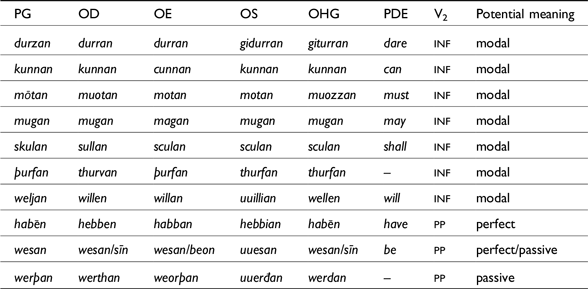
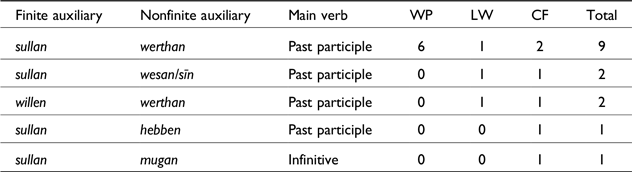
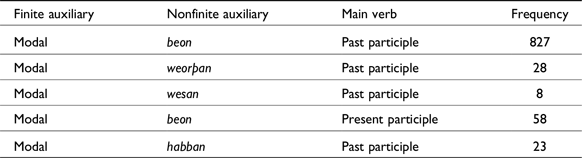
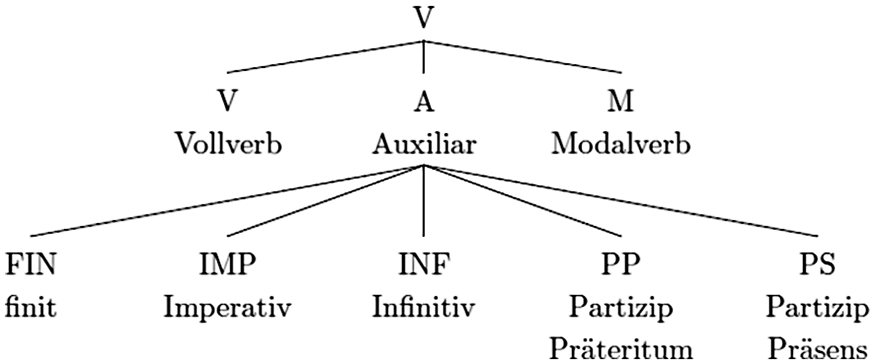
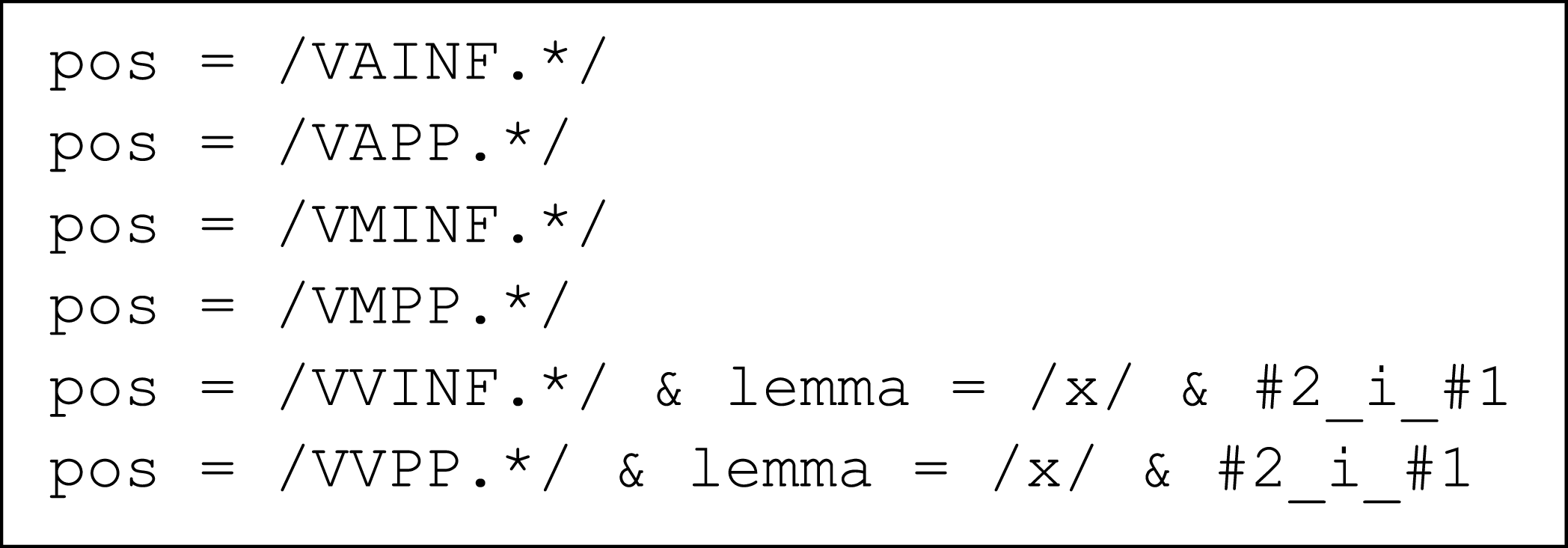




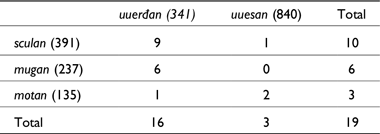
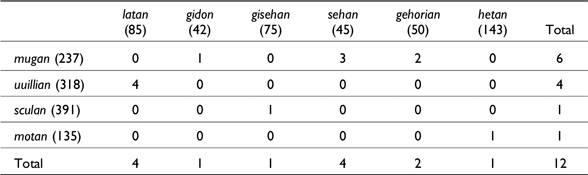
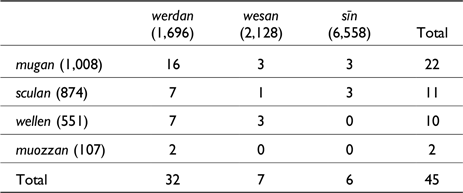
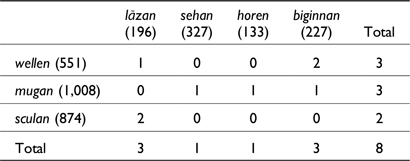
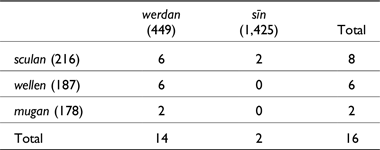
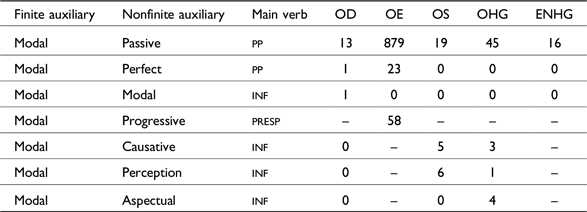
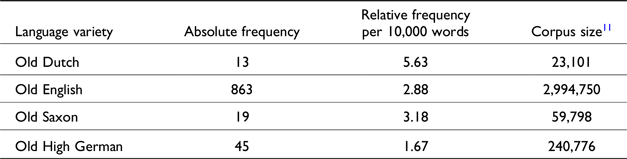
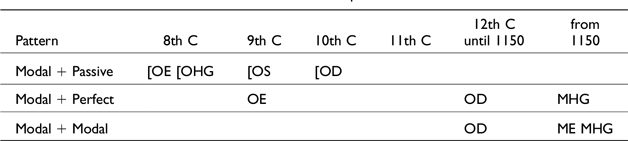
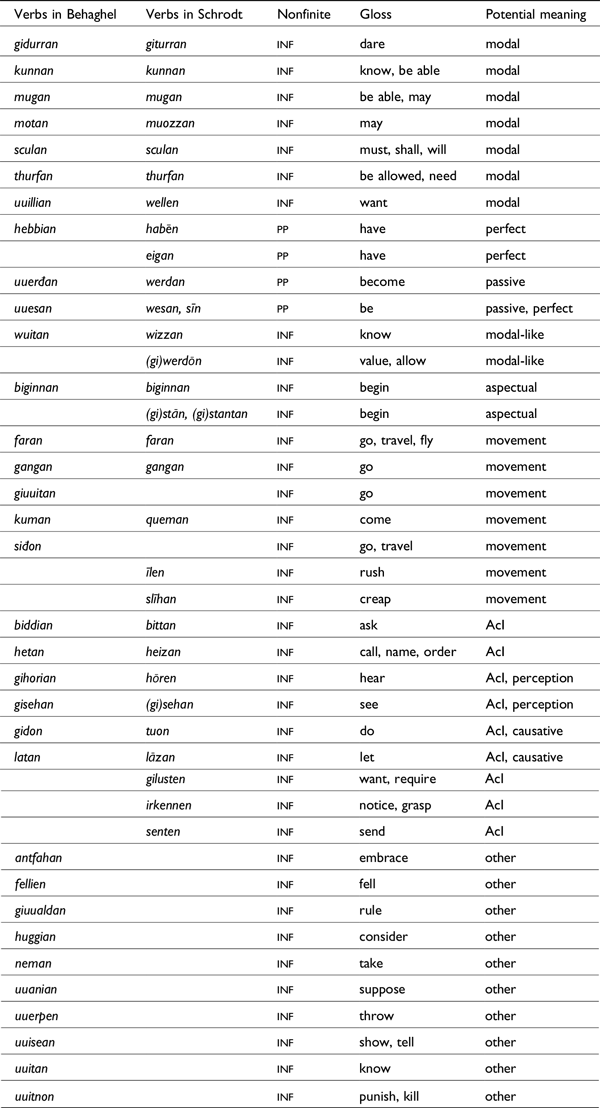
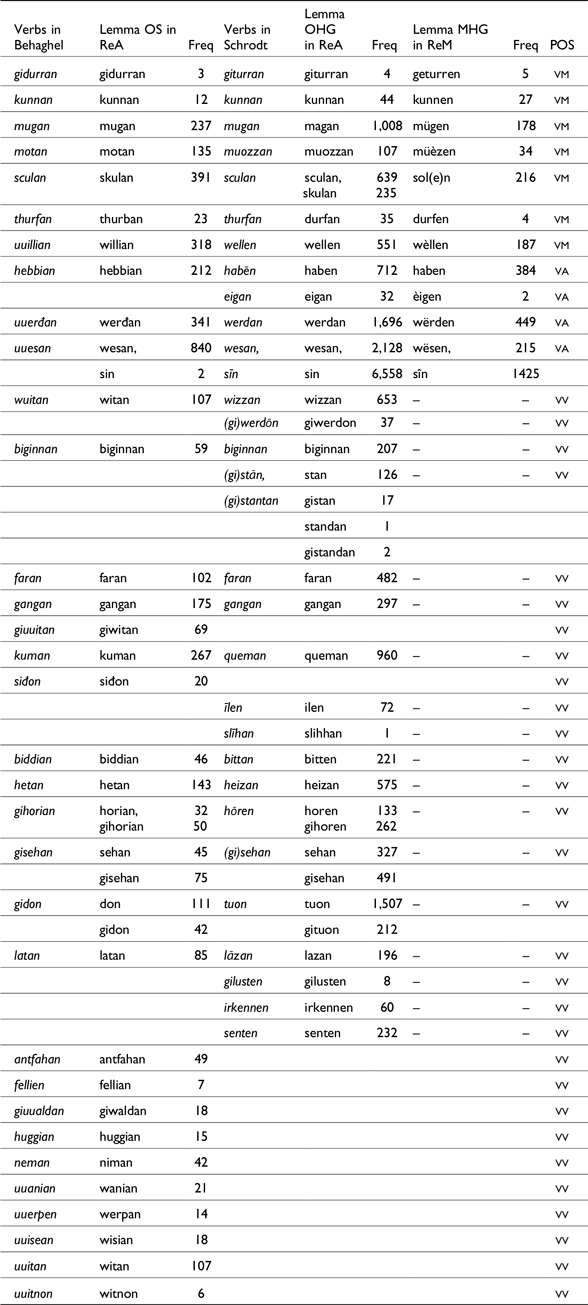


 Open access

