




1. Introduction
A key learning challenge for learners of a foreign language is limited exposure to authentic language data input. To address this gap, applied linguists have sought to employ language corpora and corpus technology as pedagogical aids, now widely recognised for their potential to foster inductive, discovery-based and, ultimately, independent language learning, commonly known as data-driven learning (DDL) (Boulton, Reference Boulton2017; Johns, Reference Johns, Johns and King1991). However, while corpus tools are increasingly prevalent in language research, and despite a wealth of research on pedagogical corpus use in higher education, corpora remain unfamiliar to many primary and secondary school teachers given the limited focus on their use in teacher-education programmes (Boulton, Reference Boulton2017; Callies, Reference Callies, Götz and Mukherjee2019; Chambers, Reference Chambers2019).
Existing research (Crosthwaite, Luciana & Wijaya, Reference Crosthwaite and Wijaya2023; Ma, Tang & Lin, Reference Ma, Tang and Lin2022; Ma, Yuan, Cheung & Yang, Reference Ma, Yuan, Cheung and Yang2024a; Schmidt, Reference Schmidt2023) confirms language teachers’ insufficient technological pedagogical content knowledge (TPACK; Mishra & Koehler, Reference Mishra and Koehler2006) for integrating corpus technology into their ongoing professional development, with teachers struggling to understand why and how to structure corpus activities within their lesson planning. TPACK extends Shulman’s (Reference Shulman1987) concept of pedagogical content knowledge (PCK) by integrating technology. In the context of corpus technology, TPACK involves combining language pedagogy and technological competence in corpus use, forming what Ma et al. (Reference Ma, Tang and Lin2022) described as corpus-based language pedagogy (CBLP). This approach emphasises the importance of corpus literacy (CL; Mukherjee, Reference Mukherjee, Connor and Upton2004) involving technological content knowledge essential for operating corpus tools.
Another key concept for successful CBLP is teachers’ teaching ability, or teachers’ self-efficacy (TSE; Tschannen-Moran, Hoy & Hoy, Reference Tschannen-Moran, Hoy and Hoy1998). TSE refers to teachers’ beliefs in their ability to organise and conduct teaching successfully and significantly influences teaching effectiveness and student learning outcomes (Caprara, Barbaranelli, Steca & Malone, Reference Caprara, Barbaranelli, Steca and Malone2006; Tschannen-Moran & Hoy, Reference Tschannen-Moran and Hoy2001a).
However, there remains a gap in understanding pre-service TSE for independent teaching involving CBLP. Given that TPACK and TSE are potentially correlated (Joo, Park & Lim, Reference Joo, Park and Lim2018; Lee & Tsai, Reference Lee and Tsai2010), this study aims to explore how student TESOL teachers’ TPACK for corpus technology relates to their self-efficacy in independent language learning and teaching – a link not yet fully examined in the DDL or CBLP literature. This study specifically focuses on non-native TESOL pre-service teachers from Hong Kong who were both language learners and prospective language teachers.
2. Corpora and language learning
Corpora and corpus technology offer rich language resources that enable students to explore language inductively and address their own language queries in situ (Boulton, Reference Boulton2017; Johns, Reference Johns, Johns and King1991). The benefits of using corpora and corpus technology in language learning are now widely recognised via DDL, as advocated by Johns (Reference Johns, Johns and King1991) and others (Boulton, Reference Boulton and Goźdź-Roszkowski2011, Reference Boulton2017; O’Keeffe, Reference O’Keeffe2021). DDL promotes inductive, discovery-based, and autonomous language learning (Boulton, Reference Boulton2017; Crosthwaite & Boulton, Reference Crosthwaite, Boulton, Tyne, Bilger, Buscail, Leray, Curry and Pérez-Sabaterin press; Lee, Warschauer & Lee, Reference Lee, Warschauer and Lee2019). Research suggests that corpus consultation supports the development of various language skills such as vocabulary knowledge (Huang & Ma, Reference Huang and Ma2025; Lee et al., Reference Lee, Warschauer and Lee2019), academic writing (Chen & Flowerdew, Reference Chen and Flowerdew2018), rhetorical skills (Yan & Ma, Reference Yan and Ma2024), and syntactic features (Lee et al., Reference Lee, Warschauer and Lee2019). As O’Keeffe (Reference O’Keeffe2021) noted, “the long-held and widespread consensus is that the core pedagogical benefit of corpus use lies in its potential to encourage learners to construct their L2 knowledge independently by exploring the linguistic data from corpus input” (p. 261). However, empirical research on the impact of corpus technology on learners’ ability to learn independently remains limited (Boulton, Reference Boulton and Goźdź-Roszkowski2011; Crosthwaite & Boulton, Reference Crosthwaite, Boulton, Tyne, Bilger, Buscail, Leray, Curry and Pérez-Sabaterin press).
3. Applications of corpora in language teaching
Despite a wealth of studies on corpora for language learning, evidence of ordinary teachers’ use of corpora in mainstream classroom settings remains limited (Boulton, Reference Boulton2017; Callies, Reference Callies, Götz and Mukherjee2019; Crosthwaite et al., Reference Crosthwaite and Wijaya2023). Several barriers hinder the adoption of corpora in classroom teaching. First, few teachers or student teachers have received adequate corpus technology training, leaving them unaware of its classroom potential (Boulton, Reference Boulton2017; Callies, Reference Callies, Götz and Mukherjee2019; Chambers, Reference Chambers2019; Karlsen & Monsen, Reference Karlsen and Monsen2020). Second, even after training, some teachers lack the pedagogical skills to use corpora effectively when teaching (Chung, Crosthwaite, Cao & de Carvalho, Reference Chung, Crosthwaite, Cao and de Carvalho2024); many teachers view corpora solely as a research tool rather than a valuable classroom resource (Karlsen & Monsen, Reference Karlsen and Monsen2020). Third, most corpus research is conducted in tertiary contexts with a focus on English for academic or specific purposes, often by researchers with advanced expertise in corpus-based research (Chen & Flowerdew, Reference Chen and Flowerdew2018). Moreover, limited attention has been paid to developing corpora for younger learners attending primary and secondary schools (Meunier, Reference Meunier and Crosthwaite2019), further discouraging teachers from adopting corpus-based approaches (Boulton, Reference Boulton2017; Callies, Reference Callies, Götz and Mukherjee2019).
Scholars have sought to address these challenges by promoting CL amongst pre-service and in-service teachers. Mukherjee (Reference Mukherjee, Connor and Upton2004) defined CL as the ability to understand what a corpus is, its affordances and limitations, how to analyse concordance lines, and how to interpret corpus data effectively. While this foundational knowledge is essential, it mainly prepares teachers to understand corpus tools, not necessarily to teach with them. DDL refers to the direct use of corpora by learners themselves to discover language patterns independently (Johns, Reference Johns, Johns and King1991), which can be seen as an application of CL (Farr & Leńko-Szymańska, Reference Farr and Leńko-Szymańska2024), while the pedagogical integration of corpus technology into classroom teaching is less emphasised. In this regard, DDL alone does not equip teachers with the pedagogical strategies required to scaffold corpus use in diverse classroom contexts.
To address this gap, Ma et al. (Reference Ma, Tang and Lin2022, Reference Ma, Yuan, Cheung and Yang2024a, Reference Ma, Lee, Gao and Chai2024b) introduced the concept of CBLP, a more comprehensive framework that combines corpus technology with language teaching expertise. CBLP represents a targeted application of TPACK for language education, enabling teachers not only to use corpora but also to integrate them meaningfully into instruction. CBLP thus extends beyond both CL and DDL by focusing on pedagogical integration. Training in CBLP is particularly important for pre- and in-service teachers in school contexts, where corpus tools remain underutilised (Boulton, Reference Boulton2017; Callies, Reference Callies, Götz and Mukherjee2019; Chambers, Reference Chambers2019) without sufficient pedagogical support.
4. CBLP: TPACK for corpus technology
The TPACK framework, developed by Mishra and Koehler (Reference Mishra and Koehler2006), extended Shulman’s (Reference Shulman1987) PCK by including technological knowledge. Traditionally, teacher education has focused on either subject content or general pedagogy, often treating them as separate domains (Shulman, Reference Shulman1986). Shulman’s PCK bridged this gap, emphasising the need to blend content and pedagogy for effective teaching. TPACK further integrated technology with PCK, guiding how to use specific technologies to teach particular subjects.
It is contended that TPACK in general domains may not sufficiently prepare teachers to use specific educational technologies for particular subjects (Graham, Borup & Smith, Reference Graham, Borup and Smith2012; Lee & Tsai, Reference Lee and Tsai2010; Tseng, Chai, Tan & Park, Reference Tseng, Chai, Tan and Park2022). Thus, specialised training linking specific technologies (such as corpus tools) to specific subjects (such as English language teaching) is required (Graham et al., Reference Graham, Borup and Smith2012). This specific form of language pedagogy refers to CBLP, defined as the ability to integrate corpus-based technologies for effective classroom language teaching (Ma et al., Reference Ma, Tang and Lin2022). Corpus technology has been defined as the use and application of technology associated with corpus linguistics and corpora for language learning and teaching (Ma et al., Reference Ma, Yuan, Cheung and Yang2024a). In this context, corpus technology – representing a specific form of technological content knowledge – is combined with language pedagogy to form a subject-specific TPACK for corpus technology. In practice, a validated two-step CBLP training framework has been developed (Ma et al., Reference Ma, Tang and Lin2022, Reference Ma, Lee, Gao and Chai2024b), with the first phase building teachers’ CL and the second enhancing their pedagogical skills for effective classroom integration.
However, assessing teacher TPACK can be challenging because much of it is tacit and is reflected in actions and reasoning rather than via explicit statements (Sloan, Allen, Bass & Milligan-Mattes, Reference Sloan, Allen, Bass, Milligan-Mattes, Uzzo, Graves, Shay, Harford and Thompson2018). While Shulman’s (Reference Shulman1987) model of pedagogical reasoning offers a useful guide, it is necessary to consider how to evaluate teachers’ abilities to demonstrate sufficient TPACK for CBLP in order to understand what TESOL student teachers need to know to implement CBLP effectively. For example, attempts have been made to assess teachers’ lesson-planning activities involving corpora for TPACK following CBLP training (Chung et al., Reference Chung, Crosthwaite, Cao and de Carvalho2024), but this approach concerns the product rather than the process. Therefore, teachers’ ongoing process of learning and implementing CBLP also needs to be considered.
5. TSE and TPACK
TSE is a crucial motivational factor affecting classroom effectiveness and students’ outcomes. TSE is defined as “a teacher’s belief in her or his ability to organise and execute the courses of action required to successfully accomplish a specific teaching task in a particular context” (Tschannen-Moran et al., Reference Tschannen-Moran, Hoy and Hoy1998: 223). Thus, TSE is task- and context-specific, as it is influenced by subject matter, teaching environment, and students’ characteristics. High TSE is associated with positive classroom behaviours, including enhanced teaching goals, planning, organisation, and effort (Tschannen-Moran & Hoy, Reference Tschannen-Moran and Hoy2001a; Tseng et al., Reference Tseng, Chai, Tan and Park2022).
TPACK and TSE are two key constructs for evaluating teachers’ instructional capacity, and they share attributes linked to teaching performance. Tseng et al. (Reference Tseng, Chai, Tan and Park2022) concluded that teachers with high TSE were more skilful in integrating technology into classroom pedagogy. Studies also indicate that TPACK development is related to TSE (Joo et al., Reference Joo, Park and Lim2018; Lee & Tsai, Reference Lee and Tsai2010; Tseng et al., Reference Tseng, Chai, Tan and Park2022). For example, Joo et al. (Reference Joo, Park and Lim2018) showed that Korean student teachers with higher TPACK reported higher TSE.
However, non-native English-speaking student teachers may find it particularly difficult to develop TSE, as their linguistic abilities are often compared to native norms in teaching situations (Wyatt, Reference Wyatt2016). Understanding the factors that contribute to their TSE is important because, in comparison to research on experienced teachers, there is limited focus on TESOL student teachers’ self-efficacy in independent teaching in general and concerning CBLP in particular. Sevimel and Subasi (Reference Sevimel and Subasi2018) highlighted the lack of research on how student teachers developed self-efficacy for language teaching. Therefore, this study aims to examine how student TESOL teachers progressed towards independent teaching by developing TPACK for corpus technology. Our research explored the co-development of CL, CBLP, and independent learning self-efficacy (ISE), ultimately supporting self-efficacy for independent language teaching.
6. Theoretical model, hypotheses, and research questions
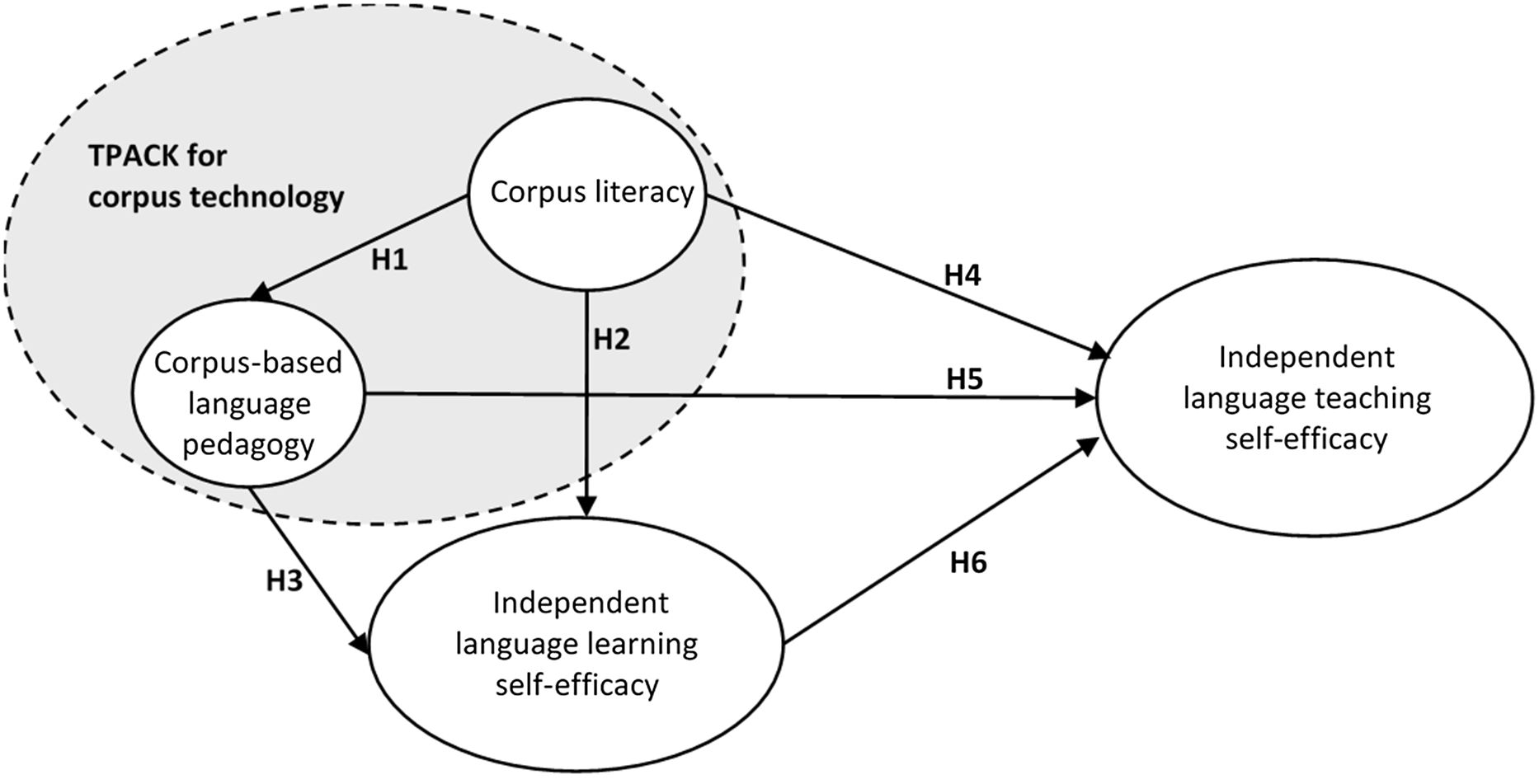
Based on the existing literature, we proposed a theoretical model (see Figure 1) that connected four key constructs of CL, CBLP, ISE, and TSE. ISE and TSE should be treated as distinct constructs in the context of non-native English-speaking student TESOL teachers because the former reflects teachers’ confidence in managing their own autonomous language learning, while the latter pertains to their perceived ability to facilitate their target students’ learning in the classroom effectively. According to Ma et al. (Reference Ma, Tang and Lin2022), CL – understanding and using corpus technology – is the basis for developing CBLP. Thus, Hypothesis 1 (H1) states that CL will have a positive influence on CBLP.
Theoretical model of TPACK for corpus technology and self-efficacy in independent language learning and teaching.

Scholars (e.g. Boulton, Reference Boulton2017; Crosthwaite & Boulton, Reference Crosthwaite, Boulton, Tyne, Bilger, Buscail, Leray, Curry and Pérez-Sabaterin press; Lee et al., Reference Lee, Warschauer and Lee2019) have suggested that engaging with corpora fosters independent and autonomous language learning, although robust empirical support remains limited. To address this gap, our model examines how pre-service TESOL teachers’ TPACK for corpus technology (encompassing both CL and CBLP) affects their ISE, defined as their perceived capacity for autonomous language learning. Given that most of our participants (from Hong Kong and/or mainland China) were non-native English speakers, it was essential to explore how they independently enhanced their subject knowledge for future teaching. Accordingly, Hypothesis 2 and Hypothesis 3 (H2–H3) state that both CL and CBLP will have positive influences on ISE.
Finally, we proposed that three of the components – CL, CBLP, and ISE – would contribute to self-efficacy for independent language teaching (Hypotheses 4–6; H4–H6). Therefore, the present study aims to validate this theoretical model in light of these hypotheses via an empirical study that included a CBLP intervention, a survey, and interview data.
Using the model, we investigated the following six hypotheses:
-
1. H1: CL will have a positive influence on CBLP.
-
2. H2: CL will have a positive influence on self-efficacy in independent language learning.
-
3. H3: CBLP will have a positive influence on self-efficacy for independent language learning.
-
4. H4: CL will have a positive influence on TSE for independent language teaching.
-
5. H5: CBLP will have a positive influence on TSE for independent language teaching.
-
6. H6: ISE will have a positive influence on TSE for independent language teaching.
Specifically, our study was guided by the following two research questions (RQs):
RQ1. How does student teachers’ TPACK development for corpus technology influence their self-efficacy for independent language learning and teaching, respectively?
RQ2. How do student teachers perceive their TPACK learning experience for corpus technology?
7. Methodology
7.1. Context and participants
We used convenience sampling and invited 120 senior-year, pre-service TESOL student teachers (third year or above) from a university in Hong Kong to participate in the study. Our pre-survey showed that all participants had very limited experience of corpus technology, since it was not included in their prior education programme training. All participants were non-native English speakers with dual identities as English learners and prospective English teachers.
First, the participants were invited to attend a four-week training programme in TPACK for corpus technology. At the end of the training programme, they were invited to complete a survey covering CL, CBLP, ISE, and TSE. As a follow-up procedure, eight participants agreed to participate in interviews to understand their perceptions and perspectives on their learning experience. Ethical procedures were followed by obtaining consent from all participants who completed the survey and interview, guaranteeing their understanding through clear communication and ensuring data privacy and anonymity.
7.2. Training in TPACK for corpus technology (CBLP)
The first two weeks of training focused on developing foundational corpus knowledge, while the next two weeks focused on practical pedagogical applications. In Week 1, the participants were introduced to the core concepts in corpus linguistics, including the nature and functions of corpora. Week 2 provided hands-on experience with a range of free, user-friendly online corpus tools, such as Lextutor (https://www.lextutor.ca/), COCA (https://www.english-corpora.org/coca/), SKELL (https://skell.sketchengine.eu/#home?lang=en), and Versatext (https://versatext.versatile.pub/) to equip them with the essential corpus query skills and strategies. The participants briefly explored the pedagogical potential of each platform, learned how to extract authentic language data, and designed some short, corpus-based learning activities. Weeks 3 and 4 shifted the focus to learning CBLP. The participants developed skills in creating corpus-based teaching materials, guided by the two-step CBLP training model (Ma et al., Reference Ma, Tang and Lin2022, Reference Ma, Lee, Gao and Chai2024b), where Step 1 focused on improving the teachers’ CL and Step 2 their pedagogical skills for classroom integration. The training assisted the student teachers to adapt and transform teaching materials to suit their learners’ needs. They also studied sample CBLP lesson materials in texts and videos hosted on the CAP website (https://corpus.eduhk.hk/cap/), which was developed by the lead author. Trainees were guided in the design of CBLP materials, both individually and in collaboration with their peers.
7.3. Research instruments
7.3.1. Survey
The measurement survey used a six-point Likert scale and consisted of 25 items across four dimensions: CL, CBLP, ISE, and TSE. The CL section included five items that were aligned with the five core components – understanding, searching, analysis, advantages, and limitations – as described by Ma, Chiu, Lin and Mendoza (Reference Ma, Chiu, Lin and Mendoza2023). The CBLP dimension featured five items that were adapted from the TPACK surveys by Chai, Koh and Tsai (Reference Chai, Koh and Tsai2011). For ISE, five items were adapted from the Independence of Learning survey by Macaskill and Taylor (Reference Macaskill and Taylor2010). The TSE section consisted of 10 items that were selected and adapted from the Ohio State Teacher Efficacy Scale (Tschannen-Moran & Hoy, Reference Tschannen-Moran and Hoy2001b), with the first five items measuring teacher self-efficacy for instructional strategies (TIS) and the remaining five focusing on teacher self-efficacy in student engagement (TSEN). See Part A in the supplementary materials for the survey questions.
7.3.2. Interview
Following the survey, eight participants agreed to participate in the semi-structured interviews, which consisted of three parts: (1) general background information, (2) CL and independent language learning, and (3) CBLP and independent language teaching. During the interviews, the student teachers reflected on how the training in TPACK for corpus technology influenced their self-efficacy in independent language learning and teaching, as well as the potential links between these two forms of self-efficacy. Sample interview questions included:
-
1. To what extent do you think that learning about corpora has helped you to become an independent language learner? (CL)
-
2. To what extent do you think that learning about corpus technology has helped you to learn how to design a corpus-based English lesson independently? (CBLP and independent language teaching)
Some self-reflection questions were also included; for example, Reflecting on your own language learning, what do you think a language teacher should do to engage students inside or outside of the classroom?
7.4. Data analysis
After data cleaning and accounting for missing values, 96 valid survey responses were retained for the analysis. Following Kline (Reference Kline2015), the survey data were processed using reliability analysis, confirmatory factor analysis (CFA), and structural equation modelling (SEM) analyses using the R statistical environment (R Core Team, Reference Core Team2021) to confirm the five constructs, to test the theoretical model, and to verify the hypotheses (see Figure 1).
The analysis of the interview data involved several iterations of reading and coding to identify themes and patterns (Miles, Huberman & Saldaña, Reference Miles, Huberman and Saldaña2020). Using the constant comparative method (Denzin & Lincoln, Reference Denzin and Lincoln2000), all the data sources were coded and analysed independently for each selected student TESOL teacher. Two researchers coded the data independently and achieved an interrater reliability of 0.91; any disputed cases were resolved following a discussion and reaching mutual agreement. The in-depth analyses were then reviewed by each corresponding student teacher to allow for member checking (Miles et al., Reference Miles, Huberman and Saldaña2020) and to ensure accurate analyses.
8. Results
8.1. Validation of the theoretical model (RQ1)
The reliability analysis of the five constructs indicated strong internal consistency, with all Cronbach’s α and composite reliability (CR) values exceeding 0.9 (see Part B in the supplementary materials). ISE and CL attained the highest mean scores (4.80 and 4.73 out of 6.00, respectively), reflecting greater self-perceived efficacy in these areas. By contrast, CBLP had the lowest mean (4.14), suggesting that the teachers considered developing pedagogical skills to be more challenging than acquiring subject knowledge or technological skills. In summary, these findings confirmed that all the constructs were measured reliably, thus supporting the robustness of the instrument that was used in this study. However, the high reliability coefficients for CBLP and TSEN (α and CR exceeding 0.95) indicated potential redundancy issues. To address this, adding covariances between several items may be necessary, as discussed in the subsequent paragraphs.
With regard to the CFAs for the five constructs, several fit indices for the original CBLP and the teachers’ TSEN did not meet the recommended thresholds (see Part C in the supplementary materials). This indicated the need for model modifications, a standard practice in SEM analyses to enhance the model fit and is widely adopted in empirical studies (Kline, Reference Kline2015). After adopting the recommendations generated by the fit modification function in R, several error covariances were added to CBLP (CBLP4 ↔ CBLP5) and TSEN (TSEN2 ↔ TSEN3; TSEN4 ↔ TSEN5). These modifications may have reflected the participants’ status as pre-service teachers. They understood the ideas behind CBLP implementation and knew theoretically how to engage students, but they did not have real teaching experience in the classroom. This discrepancy is likely to have contributed to the observed covariances between the items in the two constructs. In future study, we will consider merging these similar items.
After the above-mentioned revisions, the CFA results indicated that most fit indices for the five constructs met the recommended thresholds (Kline, Reference Kline2015). Specifically, χ2/df values for all the constructs were below 3.0, and comparative fit index (CFI) and Tucker–Lewis index (TLI) values were all above 0.90, reflecting a strong model fit. The standardised root-mean-square residual (SRMR) values were well below 0.05 for each construct, further supporting an excellent fit. However, the root-mean-square error of approximation (RMSEA) values for CL and TIS were 0.11 and 0.12, respectively, which exceeded the recommended cut-off of 0.08. As Kline (Reference Kline2015) stated, RMSEA is sensitive to sample size and can be decreased by increasing the sample size; the model remains acceptable if other fit indices, such as CFI and SRMR, meet acceptable thresholds. Therefore, the overall CFA results suggested that the measurement models for the constructs were well supported.
The next step was to finalise the model. First, CFAs were used to evaluate two models: a four-construct model with all items under TSE as one construct, and a five-construct model with the items under TSE divided into TSEN and TIS. As shown in Part C in the supplementary materials, the five-construct model demonstrated a better performance, with two of the five indices meeting the recommended standards, including χ2/df ratio (2.19; lower than 3.00) and CFI (0.90; higher than 0.90). This suggests that treating TSEN and TIS as independent constructs enhanced the measurement model’s goodness of fit, aligning with Tschannen-Moran and Hoy (Reference Tschannen-Moran and Hoy2001b).
Second, a CFA was conducted on the five-construct model by adding the modifications for CBLP and TSEN, as mentioned previously. The result indicated that this model demonstrated a largely satisfactory goodness of fit and could thus be accepted as the final model. Most indices met the recommended standards: the χ2/df ratio was 1.93 (well below the cut-off of 3.00); CFI was 0.92, and TLI was 0.91, both above the recommended 0.90 threshold. The SRMR value was 0.04, reflecting an excellent fit (< 0.05). The sample-sensitive RMSEA value was 0.09, above the recommended value of 0.08, yet below the poor fit threshold of 0.10, which might be resolved through increasing the sample size in the future. Although the RMSEA was slightly elevated, the model showed a good fit for the other indices, supporting the overall adequacy of the revised model (Kline, Reference Kline2015).
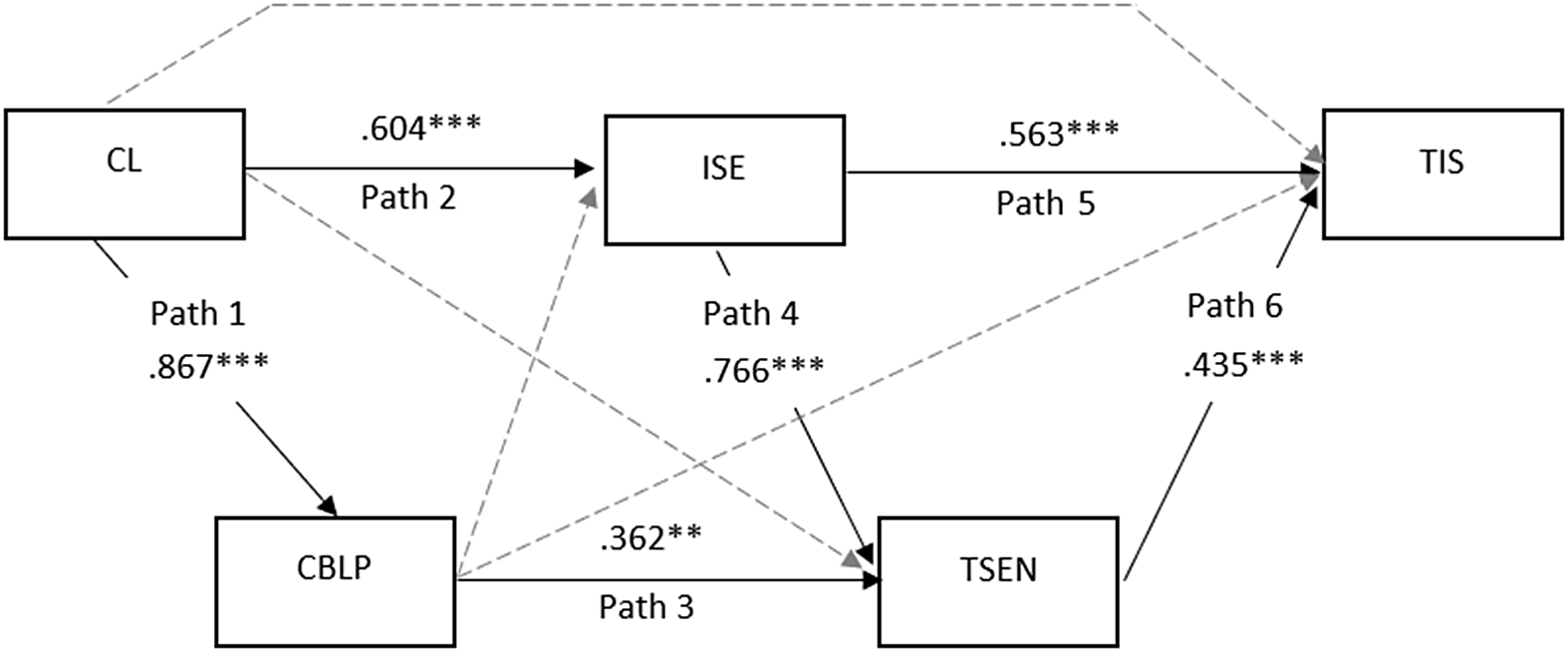
After confirming the goodness of fit of the model through CFA, we conducted SEM analysis to investigate the path coefficients and examine the proposed hypotheses. As shown in Figure 2, several hypothesised paths were rejected due to insignificant coefficients. First, the paths from CL to TSEN and TIS were insignificant because CL only represented technological knowledge about corpus use, which may not have had a direct influence on the strategies for students’ engagement and instruction. However, CL exerted strong and significant total effects on TSEN (β = .753, p < .001) and TIS (β = .770, p < .001). This emphasised that CL was a fundamental component in student teachers’ TPACK for corpus technology to enhance their self-efficacy of engaging students and promoting instructional strategies. Second, although the hypothesis from CBLP to TIS was rejected, CBLP still exhibited a significant total effect on TIS (β = .475, p = .003) and an indirect effect through TSEN (β = .158, p = .032). This highlighted CBLP’s pivotal role in fostering student engagement, which in turn enhances the effectiveness of instructional strategies, suggesting that engagement efficacy mediates the influence of CBLP on instructional strategies. Third, the insignificant path of CBLP to ISE indicated that CBLP related more to teaching self-efficacy than it did to learning self-efficacy. See Part C in the supplementary materials for the direct and total effects for all the paths.
Final model of TPACK for corpus technology and self-efficacy in independent language learning and teaching.
Note . CL = corpus literacy; CBLP = corpus-based language pedagogy; ISE = independent language learning self-efficacy; TSEN = teacher self-efficacy for student engagement; TIS = teacher self-efficacy for instructional strategies.
***p < 0.001. **p < 0.01.

The finalised SEM model, as illustrated in Figure 2, represented a well-supported and interpretable model for TPACK in the context of corpus technology and self-efficacy in language learning. Of the initial 10 hypotheses, six were supported, thus highlighting key pathways within the model. CL exerted strong, direct effects on both CBLP (β = .867, p < .001) and ISE (β = .604, p < .001). This indicates that higher CL not only enhanced the student teachers’ ability to apply corpus technology in pedagogy but also increased their confidence in independent language learning.
ISE itself played a central role in this model, as it directly predicted both TIS (β = .563, p < .001) and TSEN (β = .766, p < .001). This suggests that the student teachers with higher self-efficacy in language learning tended to be better equipped to engage learners and to implement instructional strategies effectively. CBLP further contributed to TSEN (β = .362, p < .01), signifying that pedagogical skills in corpus-based methods can enhance efficacy in engaging students. In turn, TSEN exerted a significant, direct effect on TIS (β = .435, p < .001), highlighting that strong self-efficacy to engage students is essential for promoting broader instructional language strategies.
Overall, this final model demonstrated that foundational skills in CL and pedagogy laid the foundation for developing instructional efficacy, which ultimately leads to better student engagement. The interconnections highlight the importance of TPACK as a precursor to effective teaching and student-centred outcomes. These findings suggest that professional development for TESOL student teachers or in-service teachers should focus on strengthening both their CL and their self-efficacy to maximise both teaching strategies and students’ engagement in technology-enhanced language classrooms.
8.2. Interview results (RQ2)
The analysis of the interview results added further support to the relationships that were identified amongst the different constructs (as shown above), corresponding to the six paths verified in the final model (Figure 2) across six broad themes, which were further divided into 13 subthemes.
8.2.1. Theme 1: CL contributing to CBLP (Path 1)
The participants stated that improved CL could help teachers teach students to correct their language mistakes (Subtheme 1.1), particularly in word choice and grammatical accuracy. As one student teacher explained, “I may use corpus tools to address students’ confusion regarding word choice in writing. […] allowing them to see which option is more frequently used” [S07]. This demonstrates how CL can empower student teachers to provide data-driven, authentic language examples, thereby making abstract rules more concrete and accessible for students.
Moreover, the interviews revealed that CL could consolidate students’ prior knowledge and promote deeper learning (Subtheme 1.2). As a participant shared, “I believe that using a corpus can deepen students’ understanding of what they have learned, enabling them to learn more effectively” [S01]. Such insights illustrate how corpus-based methods can not only correct misunderstandings but also assist students to build on what they know, thus supporting more meaningful and long-lasting language learning.
8.2.2. Theme 2: CL contributing to self-efficacy for independent language learning (Path 2)
Under the subtheme of improving language accuracy (Subtheme 2.1), the participants described how corpus tools helped resolve uncertainties about word forms and usage. One participant shared, “If I am not sure about the comparative form of a word, […], I will type them separately and then look at their frequency” [S08]. This approach, made possible by CL, empowered learners to make informed, data-driven decisions in their language use. The same participant emphasised, “Utilising corpora can enhance students’ ability to explore language learning independently” [S08], highlighting how corpus tools could foster learner autonomy.
Improving language learning efficiency (Subtheme 2.2) was also mentioned frequently in the interviews. One participant reflected, “I can search for the collocations […], which improves the efficiency of my language learning” [S02]. This demonstrates that CL not only increases accuracy but also streamlines the learning process by allowing learners to access and apply authentic language data more efficiently.
8.2.3. Theme 3: CBLP contributing to TSE for engaging students (Path 3)
Three subthemes emerged from the participants’ reflections. First, providing hands-on opportunities to search corpora (Subtheme 3.1) empowered the students to take charge of their classroom learning. As one participant noted, “This approach [independent corpus search] empowers students to take ownership of the learning process and promotes deep understanding” [S04]. This suggests that CBLP shifts the role of the teacher to that of a facilitator, enabling students to become active, autonomous learners.
Second, creating a student-centred classroom (Subtheme 3.2) was identified as a key benefit. A participant explained, “[T]the classroom can be student-centred in which students discover and summarise language rules by themselves” [S06]. This transformation fosters engagement and participation, as students are more involved in constructing their own knowledge.
Third, combining corpus use with fun elements (Subtheme 3.3) was seen as essential for sustaining students’ interest. As one student teacher described, “We must incorporate as many engaging elements as possible, such as games and videos, and combine games and videos with corpus usage to create a more interesting classroom environment” [S01]. This approach not only makes learning enjoyable but also enhances students’ motivation.
8.2.4. Theme 4: Self-efficacy for independent language learning contributing to teachers’ instructional strategies (Path 4)
The first subtheme emphasised the teacher providing a role model for independent language learning in the classroom and helping learners become independent language learners (Subtheme 4.1). One participant stated, “The role of a teacher is to empower students to become independent learners” [S03]. This highlights the importance of teachers modelling autonomous learning behaviours, which in turn inspires and equips students to adopt similar strategies for their own language development.
The second subtheme focused on selecting online resources carefully and converting them into suitable teaching materials for classroom use (Subtheme 4.2). As one student teacher expressed, “I believe it is a relatively important skill for teachers to search for, filter, and retrieve information from the internet, and transform it into teaching materials in class” [S08]. This demonstrates that teachers with strong self-efficacy in independent learning will be adept at navigating digital resources, customising them, and integrating them into their instructional practices.
8.2.5. Theme 5: Self-efficacy for independent language learning contributing to teachers’ strategies to engage students (Path 5)
The first subtheme discussed using various resources and activities to engage students in classroom learning (Subtheme 5.1). One student teacher commented, “By utilising various resources and offering diverse activities, students can be motivated and become more engaged in learning” [S04]. This highlights the motivational benefits for students when teachers diversify instructional content. This approach demonstrates how teachers who are confident in their independent learning skills actively seek out and integrate diverse learning resources/activities, resulting in more dynamic and engaging classroom experiences.
The second subtheme was connecting learning to students’ real lives to engage them in classroom learning (Subtheme 5.2). Another interviewee explained, “We may use vocabulary that students are already familiar with, connecting learning to the students’ real-life experiences” [S03]. This strategy not only makes lessons more relevant and relatable but also increases students’ interest and participation.
8.2.6. Theme 6: Self-efficacy for student engagement contributing to teachers’ instructional strategies (Path 6)
One subtheme involved using corpus resources to increase students’ interaction and enrich students’ classroom learning (Subtheme 6.1). As one participant shared, “To motivate students to actively participate in class, we incorporated pair and group corpus-based activities to enhance interaction among students” [S08]. This illustrates how student teachers can feel confident about engaging students to use corpus activities not just for individual learning but also as a foundation for dynamic, interactive group tasks, fostering a more collaborative classroom environment.
The second subtheme centred on the idea that CBLP and task-based language teaching (TBLT) could be combined to improve classroom teaching (Subtheme 6.2). As one participant noted, “I believe corpus-based teaching can incorporate elements of task-based instruction” [S05]. This highlights the value of integrating CBLP with TBLT (or other relevant pedagogical approaches) to provide innovative instructional strategies that enhance students’ engagement and learning outcomes.
9. Discussion
In the present study, we sought to empirically verify the linking of TPACK, CBLP, and student teachers’ TSE. Following a survey validating and confirming the hypotheses in our theoretical model linking these concepts, interview data further revealed latent subthemes underlying student teachers’ responses. The following discussion outlines the study’s main contributions in more detail.
9.1. A verified framework of TPACK for corpus technology
The final theoretical model suggests that improved CL may be associated with greater self-efficacy for independent language learning. This finding lends some empirical support to the widely held view that corpus use may contribute to the development of learner autonomy (Boulton, Reference Boulton2017; Lee et al., Reference Lee, Warschauer and Lee2019; O’Keeffe, Reference O’Keeffe2021). The model also highlights the crucial role of CBLP in shaping instructional efficacy, which shows that strong pedagogical skills in corpus-based methods enhance self-efficacy regarding student engagement, and support the creation of interactive, student-centred learning environments (Lee et al., Reference Lee, Warschauer and Lee2019; Ma et al., Reference Ma, Yuan, Cheung and Yang2024a; Schmidt, Reference Schmidt2023). This is likely due to the inherently participatory and inquiry-driven nature of corpus-based activities, which actively involve students in language exploration (Boulton, Reference Boulton and Goźdź-Roszkowski2011; Johns, Reference Johns, Johns and King1991; Meunier, Reference Meunier and Crosthwaite2019). Furthermore, CBLP has an indirect effect on self-efficacy for instructional strategies. This underscores that pedagogical expertise in corpus methods strengthens teachers’ overall instructional strategies through its positive influence on engagement efficacy. The central role of ISE is also evident in the model; it directly predicts both self-efficacy for instructional strategies and student engagement (Karatas & Arpaci, Reference Karatas and Arpaci2021). This highlights that teachers who are confident about their own autonomous learning through corpus are better positioned to engage students’ corpus use and implement a diverse range of instructional strategies. This dynamic chain of influence highlights the essential function of self-efficacy in facilitating effective teaching and learning processes.
Several hypotheses were not supported by the findings. As a pedagogical approach, CBLP may not directly enhance ISE. In addition, while CL encompasses the technological knowledge required to understand and use corpora, it does not directly influence TSE regarding instructional strategies or students’ engagement. However, CL may affect self-efficacy indirectly by strengthening both CBLP and ISE. Although the overall effect is significant, the lack of a direct effect of CBLP on TIS is unexpected, which indicates the need for further research on the relationship between CBLP and teachers’ instructional strategies.
9.2. Impact of TPACK training for corpus technology on TESOL student teachers
Integrating TPACK training for corpus technology significantly enhances TESOL student teachers’ professional development by equipping them with innovative tools and strategies to foster student engagement and independent learning. By receiving targeted training in corpus tools, teachers gain confidence and improve their self-efficacy in designing hands-on activities, thus encouraging their students to actively explore authentic language data (Crosthwaite et al., Reference Crosthwaite and Wijaya2023; Ma et al., Reference Ma, Yuan, Cheung and Yang2024a). The student teachers’ appreciation of hands-on corpus searches when enacting CBLP in lesson design also echoes the concept of mastery experiences, a core component in developing self-efficacy (Mohammed, Reference Mohammed2021). The emphasis on hands-on activities also promotes a shift from teacher-centred methods towards a student-centred environment where discovery learning is emphasised. Additionally, when corpus use is combined with fun elements, such as games, collaborative searches, or multimedia activities, it can further increase students’ interest and motivation (Crosthwaite & Boulton, Reference Crosthwaite, Boulton, Tyne, Bilger, Buscail, Leray, Curry and Pérez-Sabaterin press; Meunier, Reference Meunier and Crosthwaite2019). These approaches help to create a dynamic classroom atmosphere conducive to deeper learning and sustained engagement.
Second, the study highlights that self-efficacy for independent language learning fosters the development of effective teaching strategies. When student teachers themselves are confident in their ability to learn independently using digital resources, they are more likely to integrate diverse online materials and activities into their instruction. This includes the exploration and incorporation of various online learning resources, which will not only enrich the lesson content, but will also expose students to multiple perspectives and authentic language contexts. Importantly, the ability to connect classroom learning to students’ real-life experiences, such as through relevant topics or familiar vocabulary, helps bridge the gap between academic content and everyday usage (O’Neill & Short, Reference O’Neill and Short2025).
Third, enhancing self-efficacy for student engagement leads to significant improvements in instructional strategies. Student teachers who feel equipped to engage learners are more likely to adopt interactive practices, such as using corpus resources for pair and group work, thereby increasing students’ interaction and participation (Liu & Ma, Reference Liu and Ma2025; Ma & Mei, Reference Ma and Mei2021; O’Keeffe, Reference O’Keeffe2021). Furthermore, the combination of corpus-based teaching and TBLT empowers teachers to design lessons that are both data-driven and communicative. This hybrid approach not only supports language learning through authentic tasks but also provides students with opportunities to engage in practical, goal-oriented activities (Zare, Noughabi & Al-Issa, Reference Zare, Noughabi and Al-Issa2024).
Finally, our study provides rich, interview-based evidence regarding student teachers’ reflective practice of CBLP, emphasising its crucial role in teacher education, alongside CL and pedagogical skills (Farr & Leńko-Szymańska, Reference Farr and Leńko-Szymańska2024). Thematic analysis revealed the significance of reflective engagement with CBLP, where student teachers not only deepened their understanding of corpus tools and language instruction but also developed greater self-efficacy and autonomy in both learning and teaching. The participants described how CBLP empowered them to design more interactive, student-centred lessons, to model independent learning behaviours, and to integrate diverse digital resources effectively. Eventually, the reflective practice of CBLP fosters both teachers’ professional growth and more engaging, authentic classroom experiences for their students.
Our study provides valuable guidance for the integration of corpus technology into TESOL teacher education, which should focus on the cultivation of CL and ISE, in addition to explicit training in CBLP. By doing so, TESOL educators can maximise the impact of technological and pedagogical knowledge on student engagement and instructional efficacy. This helps TESOL and teachers of other languages prepare effectively for the demands of technology-enhanced classrooms.
9.3. TESOL student teachers’ perceived impact of teacher TPACK for corpus technology on their target language learners
The interview data showed that the TESOL student teachers hold positive perceptions regarding their enhanced TPACK for corpus technology, which they believe can subsequently influence their target students’ language learning outcomes in the future. First, CBLP provides student teachers with powerful tools to present language rules in authentic, context-rich ways. By drawing on real-life examples from corpora, teachers can move beyond abstract explanations and rote memorisation and can provide students with concrete data that support and deepen their existing language knowledge (Boulton, Reference Boulton2017; Meunier, Reference Meunier and Crosthwaite2019). This approach not only clarifies grammatical structures and word usage but also helps learners internalise language patterns through repeated exposure to authentic usage (Crosthwaite & Boulton, Reference Crosthwaite, Boulton, Tyne, Bilger, Buscail, Leray, Curry and Pérez-Sabaterin press; Yan & Ma, Reference Yan and Ma2024). Therefore, the use of corpus data bridges the gap between theoretical knowledge and practical application, making language learning more meaningful and effective for students.
Second, the utilisation of corpus tools as a result of TPACK training fosters greater self-efficacy for independent language learning. When the student teachers incorporate corpus technology into their future instruction, they will empower learners to investigate language questions autonomously, such as exploring word frequency and authentic collocations. This process will not only improve the learners’ language accuracy but also enhance their learning efficiency, as they will be able to access and verify language patterns quickly and independently.
Third, the influence of TPACK training extends beyond direct instruction to the modelling of effective learning strategies by teachers. In this study, the student teachers who demonstrated independent language learning behaviours, such as searching for, evaluating, and integrating online resources, may serve as role models for their students in the future. This modelling effect is particularly important for promoting autonomy, as learners are more likely to adopt similar strategies when they observe their teachers engaging in independent learning and resource selection. Moreover, when teachers carefully curate and adapt online materials for classroom use, they ensure that learning resources are relevant and accessible, further supporting students’ engagement and independent learning (Lasekan, Pachava, Godoy Pena, Golla & Raje, Reference Lasekan, Pachava, Godoy Pena, Golla and Raje2024).
10. Conclusion
In conclusion, our study establishes an empirically verified framework for integrating TPACK and corpus technology into TESOL teacher education. The model demonstrates that CL can lead to students’ autonomy and proficiency in CBLP, significantly increase self-efficacy for student engagement, and empower teachers to create interactive, student-centred, and enjoyable learning environments. When teachers have high self-efficacy in both independent learning and student engagement, they are better equipped to design lessons that leverage online resources and real-world contexts, thereby motivating and engaging students more effectively. These insights highlight the transformative potential of TPACK training for corpus technology in TESOL teacher preparation. Embedding CL, the development of self-efficacy, and CBLP in teacher-education programmes is essential for preparing future language teachers to meet the demands of dynamic, technology-enhanced classrooms. This integration will not only promote pedagogical innovation but also foster a culture of independent, lifelong learning amongst both teachers and students.
Despite the valuable insights offered by this study, there are two main limitations. First, there are minor limitations of the model, such as the relatively high RMSEA. Although student teacher cohorts are usually small internationally, future studies could increase the sample size to improve model fit indices. Second, the study focused exclusively on pre-service TESOL teachers, which may limit the generalisability of the results to in-service TESOL teachers or teachers of other languages. Future research should involve a larger and more diverse participant pool, including in-service TESOL teachers or those teaching different languages to further validate the theoretical model, thereby increasing its robustness and generalisability across diverse educational contexts and professional experience levels.
Supplementary material
To view supplementary material for this article, please visit https://doi.org/10.1017/S0958344025100347
Data availability statements
The data supporting the findings of this study are available within the supplementary materials.
Authorship contribution statement
Qing Ma: Conceptualisation, Data curation, Formal analysis, Funding acquisition, Investigation, Methodology, Project administration, Supervision, Validation, Visualisation, Writing – original draft, Resources, Writing – review & editing. Jiahao Yan: Data curation, Formal analysis, Methodology, Visualisation, Writing – review & editing. Peter Crosthwaite: Investigation, Validation, Writing – review & editing. John Chi-Kin Lee: Validation, Writing – review & editing.
Funding disclosure statement
This article is supported by the GRF grant (18600123), funded by the Research Grants Committee of Hong Kong, and the SoLT project (02A13), funded by the Education University of Hong Kong.
Competing interests statement
The authors declare no competing interests.
Ethical statement
This study was conducted in accordance with the ethical standards of the Education University of Hong Kong and received approval from the Human Research Ethics Committee at the Education University of Hong Kong (approval number: 2022-2023-0110). All participants participated voluntarily in this research, and appropriate ethical procedures were followed to obtain participant consent.
GenAI use disclosure statement
The authors declare no use of generative AI.
About the authors
Qing Ma is a Professor at the Department of Linguistics and Modern Language Studies and Associate Dean (Research) at the Faculty of Humanities, the Education University of Hong Kong. Her research focuses on second language vocabulary acquisition, corpus linguistics, corpus-based pedagogy and literature, CALL, MALL, and AI in language education.
Jiahao Yan is a Postdoctoral Fellow at the Department of Linguistics and Modern Language Studies, the Education University of Hong Kong. His main research interests include English for academic purposes, corpus linguistics, corpus-based language pedagogy, and generative AI in language learning and learning.
Peter Crosthwaite is an Associate Professor in the School of Languages and Cultures at the University of Queensland. His areas of research include corpus linguistics and the use of corpora for language learning (i.e. data-driven learning), as well as computer-assisted language learning, and English for general and specific academic purposes.
John Chi-Kin Lee is the President and Chair Professor of Curriculum and Instruction of the Education University of Hong Kong. His research interests are curriculum and instruction and geographical and environmental education. He was named among the top 2% most-cited scientists in the world in terms of career-long impact released by Stanford University.


 Open access

