


Be it for a hobby or a cherished food, some people can trace the origins of their personal tastes. In most cases, however, tastes develop over time, progressively and rarely noticed. Akin to more profane preferences, some citizens develop a taste for politics; they find pleasure in talking about or reading about political matters. Because valuing something for its inherently rewarding qualities foreshadows frequent and sustained enactment, whether members of a particular society find pleasure in engaging politics has profound societal implications. If we consider engagement in politics a quality of good citizenship, and if we seek to promote such proclivities, then it is crucial to understand how to foster the taste for politics so that people will fulfill their duties as good citizens, not merely as a chore but as a source of joy.
Admittedly, political engagement out of joy and pleasure is not the only pathway to political action. For instance, a large body of literature highlights the role of social pressures (Panagopoulos, Reference Panagopoulos2013), perceived civic duties (Blais & Daoust, Reference Blais and Daoust2020), and internalized identities (Klandermans et al., Reference Klandermans, Sabucedo, Rodriguez and Weerd2002) in fostering political engagement. Personality (Duncan & Stewart, Reference Duncan and Stewart2007), prospective benefits (Finkel & Muller, Reference Finkel and Muller1998), and individual grievances (Basta, Reference Basta2020) are other well-established motivators underlying citizen engagement, as is mobilization (Green & Gerber, Reference Green and Gerber2015) or the availability of personal resources (Brady et al., Reference Brady, Verba and Schlozman1995). Political science has much to say about these and other motivational pathways to political engagement, most of which presume goals that are separable from the behavior itself.
In contrast, the taste for politics and, more specifically, political engagement as an inherently rewarding experience is not well understood. Although political engagement for its own sake is a powerful motivator (Prior, Reference Prior2019), dedicated studies of political engagement as an end in itself are rare (Hamlin & Jennings, Reference Hamlin and Jennings2011; Opp, Reference Opp and Wright2015; Prior, Reference Prior2019). As a consequence, political science struggles to explain situational and individual variation in intrinsically motivated engagement. That is, we do not have a good understanding of why citizens uniformly experience political action in some environments as more satisfying than in others or why some citizens experience a given encounter with politics as more enjoyable than other citizens.
The line of literature that is closest to systematically examining the role of joy and other self-sustained drivers in politics includes studies on political interest. Political interest is attracting increasing attention as of late, contributing to an empirical and theoretical groundwork for the study of political engagement as its own reward (Bougher, Reference Bougher2017; Shani, Reference Shani2009). For instance, recent studies have shown that curiosity about politics is rather stable and might have nonpolitical roots (Prior, Reference Prior2019; Shani, Reference Shani2009; Wuttke, Reference Wuttke2020). What is more, evidence suggests that proclivities toward politics may result from initially fleeting but repeatedly confirmed situational experiences that make political encounters feel rewarding (Prior, Reference Prior2019). While these studies help us understand the transition from situational to dispositional political interest, the concept of political interest is not a perfect fit to approach political activities that are enacted for their own sake. Political interest is too broad a concept as it also subsumes attention to politics for instrumental material considerations (Prior, Reference Prior2019). It is also too narrow a concept as interest is not the only conceivable motivator with inherently satisfying conditions that may drive self-sustained behaviors. Therefore, I suggest taking advantage of the conceptual toolkit of motivation science and employ the concept of intrinsic motivation for understanding self-sustained engagement in the political domain.
Intrinsic motivation has long been used as a concept in motivation science to study action for its own sake (Kruglanski et al., Reference Kruglanski, Fishbach, Woolley, Bélanger, Chernikova, Molinario and Pierro2018). In the tradition of self-determination theory, for instance, intrinsic motivation is used to describe behaviors that are conducted for their “inherently satisfying conditions” (Ryan & Deci, Reference Ryan and Deci2017). Similarly, means-ends fusion theory conceptualizes a behavior’s degree of intrinsicality as the perceived fusion between the activity and its end (Kruglanski et al., Reference Kruglanski, Fishbach, Woolley, Bélanger, Chernikova, Molinario and Pierro2018). Adopting this perspective may help overcome conceptual problems inherent in previous attempts to get a grasp of self-sustained behaviors in the political domain.
For instance, one conceptualization brought forward to approach inherently satisfying behaviors is the distinction between instrumental and expressive behavior (Hamlin & Jennings, Reference Hamlin and Jennings2011). However, because any intentionality-based explanation ultimately presumes instrumental motives (Marx & Tiefensee, Reference Marx, Tiefensee, Faas, Frank and Schoen2015), separating instrumental from noninstrumental motives inadvertently renders intrinsic action inaccessible to all inquiries that presuppose intentional actors. In contrast, the concept of intrinsic motivation acknowledges that intrinsic behaviors do provide instrumental value but merely considers these outcomes as inseparable from the behavior itself and as materializing during the behavior. From this perspective, intrinsically motivated behaviors no longer pose conceptual problems and may also be enacted by intentional actors with instrumental motives. Another prominent distinction is between internal and external motivators (Opp, Reference Opp and Wright2015). Yet this distinction entails unclear conceptual boundaries because all motivators must be processed internally for eliciting behavioral ramifications. Therefore, the concept of intrinsic motivation avoids theoretical pitfalls compared with other concepts that have previously been used.
What is more, the concept of intrinsic motivation provides distinct explanatory value as it helps distinguish intrinsic motivation from other motivational pathways and thus predict their specific behavioral outcomes. For instance, a large body of psychological literature has shown that additional extrinsic incentives, such as the provision of monetary rewards, often increase the propensity to conduct a behavior, but at the expense of undermining the afforded efforts (Deci et al., Reference Deci, Koestner and Ryan1999; Kruglanski et al., Reference Kruglanski, Fishbach, Woolley, Bélanger, Chernikova, Molinario and Pierro2018; Kurzban et al., Reference Kurzban, Duckworth, Kable and Myers2013). In contrast, a distinctive property of intrinsic motivation is to stipulate both the quantity and quality of behavior (Cerasoli et al., Reference Cerasoli, Nicklin and Ford2014). Therefore, understanding how to increase intrinsic political motivation may help cultivate environments in which citizens not only superficially engage with politics but fully embrace engagement with politics.
The explanation of the origins of intrinsic political motivation proposed in this study departs from the simple idea, often referred to as the pleasure principle (Freud, Reference Freud1961; Higgins, Reference Higgins2012), that human beings enact activities they previously experienced as satisfying. Yet the pleasure principle poses the question of which conditions render an activity more or less pleasurable.
Building on existing motivation theories that employ basic psychological needs for identifying the properties of inherently satisfying behaviors (Dweck, Reference Dweck2017; Maslow, Reference Maslow1970; Ryan & Deci, Reference Ryan and Deci2017), this study relies on basic psychological needs as the theoretical centerpiece to deduct conditions under which humans experience a behavior as pleasurable. Joining a growing political science literature that identifies nonpolitical origins of political engagement (Bougher, Reference Bougher2017; Galais, Reference Galais2018; Holbein, Reference Holbein2017; Holbein et al., Reference Holbein, Schafer and Dickinson2019; Prior, Reference Prior2019; Shani, Reference Shani2009), the proposed need-based theory of political motivation posits that seemingly apolitical processes of need satisfaction predict which political acts citizens experience as inherently satisfying. Specifically, political activities are expected to elicit sensations of joy or gratification when conducted in need-satisfying contexts. Individual differences in intrinsic motivation, then, result from past need-related experiences with politics and reflect a person’s expectations about the anticipated need satisfaction that future encounters will provide. In this vein, a taste for politics echoes whether people experienced previous encounters with politics as satisfying their basic psychological needs.
To test the predictions of the need-based model of political motivation, a survey was employed to induce differences in need satisfaction before and during an encounter with politics to then assess consequences on political engagement. Against expectations, respondents in the need-supportive and need-thwarting experimental conditions did not differ substantially in the quality or quantity of political engagement. Although not all experimental conditions could be shown to meet the conditions for an informative hypothesis test, multiple follow-up analyses indicate that the reported findings decisively weaken the confidence in elements of the proposed theory. Showcasing how to engage with null results in hypothesis-testing research, these post hoc analyses show that the absence of the expected findings cannot be explained by imperfect measurement of outcomes, treatment heterogeneity, low power, or survey attrition. Overall, it thus is to be concluded that under the circumstances of the given study, the theory failed to predict individual differences in intrinsic motivation and related behavioral outcomes, suggesting theory refutation or revision. The closing section discusses how the presented findings can help future research avoid dead ends and how this study’s propositions may serve as a stepping stone to inform further theorizing on political engagement as its own reward.
Political motivation and basic needs
We seek activities that made us feel good in the past (Higgins, Reference Higgins2012; Silvia, Reference Silvia2005). Different lines of psychological literature acknowledge the relevance of the pleasure principle in both classical (Freud, Reference Freud1961; Skinner, Reference Skinner1976) and contemporary work (e.g., Milyavskaya, Inzlicht et al., Reference Milyavskaya, Galla, Inzlicht and Duckworth2018). While useful as a starting point, viewing behavior through the conceptual lens of the pleasure principle pushes the explanatory burden one rung down the ladder as it begs the question of why some activities are experienced as pleasurable and others are not. Also, the crucial aspect of individual differences remains unresolved. As a response, I propose to combine the pleasure principle with additional insights from motivation science on core desires that drive human behavior.
What kinds of behaviors do human beings find satisfying and will, therefore, likely be pursued again? Along with a burgeoning literature on human universals in other life domains (Bloom, Reference Bloom2011; Christakis, Reference Christakis2019; Mehr et al., Reference Mehr, Singh, Knox, Ketter, Pickens-Jones, Atwood, Lucas, Jacoby, Egner, Hopkins, Howard, Hartshorne, Jennings, Simson, Bainbridge, Pinker, O’Donnell, Krasnow and Glowacki2019), there is a growing consensus that human beings share certain “core motives” (Fiske, Reference Fiske2014) or “psychological needs” (Ryan & Deci, Reference Ryan and Deci2017). While disagreement persists about essential concept characteristics and the resulting list of supposedly universal motivational propensities (Dweck, Reference Dweck2017; Higgins, Reference Higgins2012; Kruglanski et al., Reference Kruglanski, Fishbach, Woolley, Bélanger, Chernikova, Molinario and Pierro2018; Ryan & Deci, Reference Ryan and Deci2017; Sheldon et al., Reference Sheldon, Elliot, Kim and Kasser2001), a functionalist definition of basic needs has proven useful for exploiting universal motivators in applied research. Understanding basic psychological needs as “areas of chronically high value that are critical to well-being and optimal development” (Dweck, Reference Dweck2017, p. 697) allows the abduction of a list of needs based on observed empirical regularities. Human desires thus qualify as basic psychological needs if they are found to be irreducible to other needs and if they can be shown to be of high value for optimal functioning and well-being across cultures and life stages (Dweck, Reference Dweck2017; Ryan & Deci, Reference Ryan and Deci2017).
One basic need that is acknowledged by most motivation theories (Bandura, Reference Bandura2010; Dweck, Reference Dweck2017; Higgins, Reference Higgins2012; Ryan & Deci, Reference Ryan and Deci2017) is the need for competence, which goes back to early work by White (Reference White1959) and Piaget (Reference Piaget1952), who argued that from childhood onward, human beings express the desire to feel efficacious and impactful in the world. Another need that has roots in early writings on the human condition is the need for autonomy (Ryan & Deci, Reference Ryan and Deci2017). Particularly relevant for human action in political contexts (Blühdorn, Reference Blühdorn2019), the human “desire to self-organize experience and behavior and to have activity be concordant with one’s integrated sense of self” (Deci & Ryan, Reference Deci and Ryan2000, p. 231) is argued to drive human behavior across cultures and life stages (Chen et al., Reference Chen, Vansteenkiste, Beyers, Boone, Deci, van der Kaap-Deeder, Duriez, Lens, Matos, Mouratidis, Ryan, Sheldon, Soenens, Petegem and Verstuyf2014; Sheldon et al., Reference Sheldon, Elliot, Kim and Kasser2001). Although no list of basic needs is definitive, a large body of research suggests the existence of universal needs for competence and autonomy so that, all else being equal, human beings should experience activities that are coupled with need-satisfying elements more positively compared with activities that do not fulfill any psychological needs.
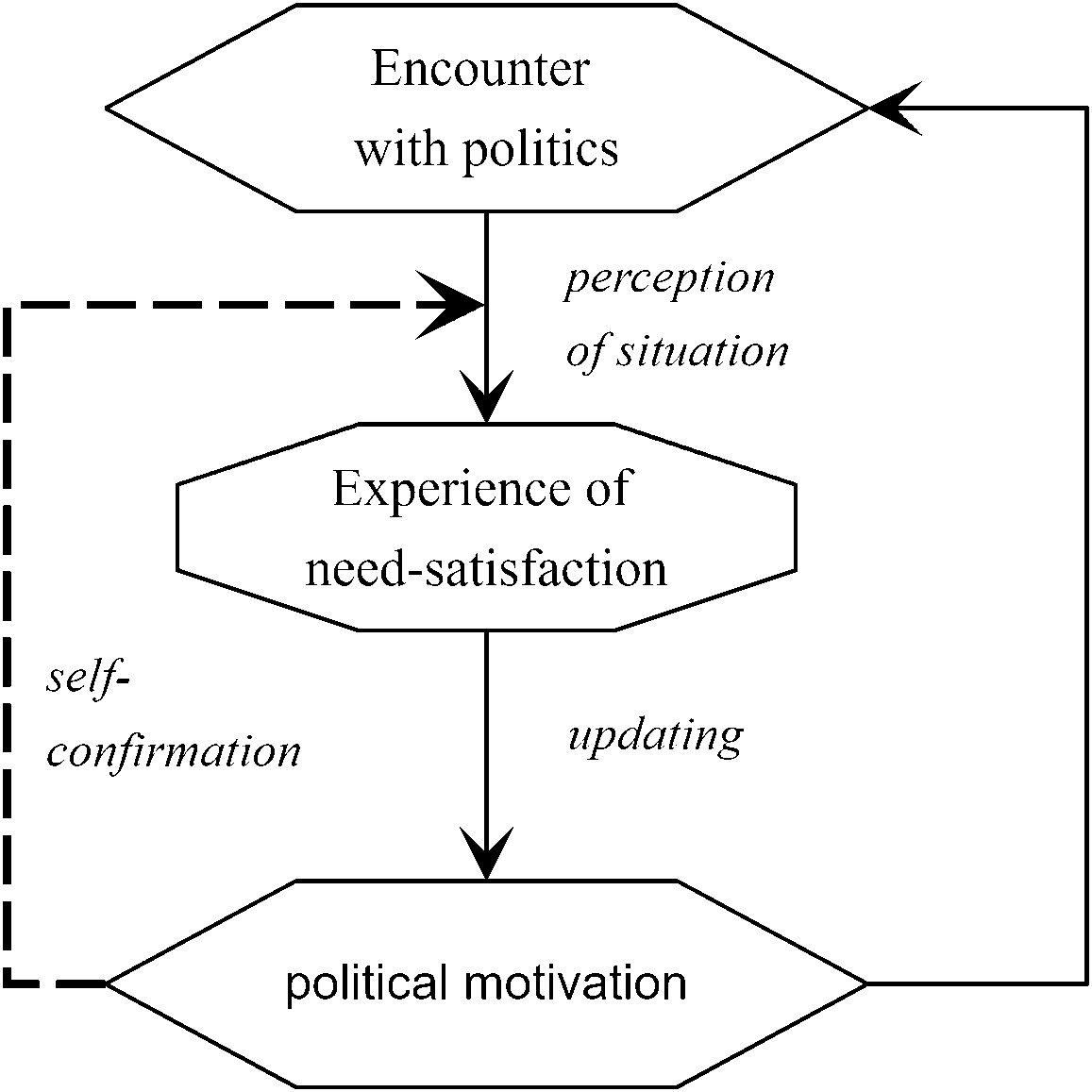
Based on the idea that need-satisfying activities are experienced as more pleasurable and therefore are more likely to be reenacted in various life domains, it is conceivable that the degree to which activities fulfill basic psychological needs may also help explain inherently gratifying behaviors in the political domain. In this vein, the origins of intrinsic political motivation—that is, the propensity to embrace and enjoy an activity—is argued to lie in previous need-related political experiences (see Figure 1). More specifically, the expectations and beliefs derived from previous need-related encounters with politics feed into a person’s level of political motivation and determine one’s approach to politics in the future (Dweck, Reference Dweck2017).
Need-based model of political motivation.
Previous political science findings support this notion and can be reinterpreted along the lines of a need-based model of political motivation. For instance, multiple political science findings have shown that respondents who were randomly induced to fail political knowledge questions subsequently reported lower levels of political interest (Bishop, Reference Bishop and Hippler1987; Prior, Reference Prior2019; Schwarz & Schuman, Reference Schwarz and Schuman1997). From a need-based perspective, these findings can be understood as previous experiences with the political domain that thwarted or satisfied the need for competence (Dweck, Reference Dweck2017; Higgins, Reference Higgins2012; Ryan & Deci, Reference Ryan and Deci2017), thereby fostering or undermining a person’s intrinsic motivation toward that domain. Consequently, when political engagement has previously contributed to satisfying our basic needs, such as the need for competence, we will want more of it.
How can we reconcile the proposition that universal basic needs determine the degree of pleasure provided by an activity with the observation that the motivation is not universal but varies remarkably between individuals? Notably, specific situational characteristics uniformly facilitate need satisfaction, suggesting that they are more or less conducive to need satisfaction. For instance, providing a rationale or giving a sense of choice generally contributes to the satisfaction of a person’s need for autonomy (Chatzisarantis et al., Reference Chatzisarantis, Hagger, Kamarova and Kawabata2012; Deci et al., Reference Deci, Eghrari, Patrick and Leone1994; Nelson et al., Reference Nelson, Della Porta, Jacobs Bao, Lee, Choi and Lyubomirsky2015; Patall et al., Reference Patall, Cooper and Robinson2008; Spray et al., Reference Spray, John Wang, Biddle and Chatzisarantis2006). Importantly, however, individuals have different experiences with politics. Some will experience politics in a more need-satisfying context than others. These prior experiences will then feed into the tally of politics-related beliefs and expectations that form a person’s level of domain-specific motivation. Cohort studies suggest that these mechanisms are most forceful during the impressionable years of adolescence, when individuals do not yet hold crystallized attitudes toward the political domain (Prior, Reference Prior2019; Wuttke, Reference Wuttke2020). Yet there is no reason not to assume that, to a lower degree, these mechanisms will continue throughout the entire life course, changing one’s level of political motivation in reaction to new need-supportive or need-thwarting experiences with politics.
What is more, once motivational proclivities toward politics have crystallized in a person, we may expect a self-confirmatory psychological tendency through which expectations create perceived reality (Murayama, Reference Murayama2019), thereby exacerbating already existing differences in political motivation (self-confirmation, see Figure 1). It is well known that individuals experience a glass of wine as more delightful when they have been manipulated to believe they are tasting a high-quality wine (Bloom, Reference Bloom2011). Similarly, citizens who have developed favorable attitudes toward politics may be more likely than others to see their expectations of political engagement as an enjoyable activity confirmed even when engaging in the same political activity. This proposition is consistent with political science evidence that exogenously induced political encounters stimulate political interest more strongly among individuals with favorable predispositions toward politics (Prior, Reference Prior2019). Hence, a self-reinforcing feedback loop may foster the polarization of individual differences of political motivation, seemingly confirming a person’s expectations about whether it is valuable to engage with politics.
Because individual differences in political motivation are argued to be ultimately rooted in need-related experiences, need-satisfying experiences with politics help explain why individuals want to engage with politics for its own sake. As need-satisfying experiences give more reason to again experience the satisfaction associated with a particular behavior, need-related activities change a person’s goals. In the wake of perceiving a behavior as serving need-fulfilling goals, fusion occurs between the general goal of need fulfillment and the specific reasons for conducting the behavior. Notably, the degree to which fusion occurs between goals and reasons for action is the definition of intrinsicality of action (Kruglanski et al., Reference Kruglanski, Fishbach, Woolley, Bélanger, Chernikova, Molinario and Pierro2018). In other words, the more a person perceives political engagement as serving need-fulfilling goals, the more political engagement is enacted for no other reason than the behavior’s inherent need-satisfying conditions. Hence, intrinsic political motivation is at its maximum when need-fulfilling goals and behavioral reasons fully align, for instance, when someone watches a political television show solely for the activity’s inherently need-satisfying properties.
Understanding the link between need satisfaction and intrinsic motivation paves the way to explain not only whether but also how behavior is enacted. According to the law of low effort, when facing otherwise identical behavioral choices, individuals usually opt for the more effortless route (Kurzban, Reference Kurzban2016). However, as intrinsic motivation is characterized by the fusion between an activity and its end, the logic of effort minimization does not apply to intrinsically motivated individuals. Instead of minimizing the invested effort, individuals embrace the activity they engage in for its inherently satisfying conditions. This is consistent with political science evidence that curiosity about politics goes along with more effortful processing and a deeper understanding of political affairs (Prior, Reference Prior2019). Consequently, intrinsic motivation not only goes along with a strong inclination to enact a behavior, but enacting a behavior for its own sake entails doing it effortfully and attentively rather than superficially.
The present study
Procedures
The need-based theory of political motivation is tested in a survey experiment in which participants’ motivation to engage with politics is assessed in varying situational contexts that provide higher or lower degrees of need satisfaction. In the experiment, political engagement refers to the consumption of political media—more specifically, to an online video that respondents watch during survey participation. Quantity refers to the participants’ choice of watching political media content over seemingly nonpolitical alternatives. Quality refers to the level of cognitive involvement when processing political media content.
The experiment consists of a two-arm design, in which those two basic psychological needs are manipulated that studies have identified as crucial for fostering intrinsic motivation (Ryan & Deci, Reference Ryan and Deci2017): (1) the need for autonomy, which seeks self-endorsed and volitional action and is thwarted in the face of external coercion, and (2) the need for competence, which seeks the experience of effectance and mastery and is thwarted in the face of pervasive overload.
At the beginning of the survey, respondents participated in a political knowledge quiz with manipulated difficulty and manipulated competence feedback (need for competence manipulation). Following the knowledge quiz, participants had the chance to watch a video during the survey, receiving four media options to choose from (two political, two seemingly apolitical). Each video option is described verbally, containing ostensibly different media content (e.g., political option: “Political Video on Social Policy”; seemingly apolitical option: “YouTube-Video: Funny Old Man”). Importantly, despite the four options, all individuals watched the identical video because the different choice descriptors merely refer to different facets of one video (a comedian delivering a 30-second stand-up set on a political topic: https://youtu.be/mQHHb0l105Y). Therefore, indicators measured after media consumption are not influenced by differences in media choices but only by differences in how the content was individually processed, depending on the experimentally manipulated need-related situational characteristics. The questionnaire page to choose the media content also contained the need for autonomy manipulation, which frames the respondents’ choice as either volitional or externally enforced. After choosing and watching the video, the outcome variables were measured and the respondents were debriefed.
Experimental conditions
Need for competence manipulation
Participants in the need-for-competence-supportive (thwarting) condition were induced to feel efficacious (inefficacious) with regard to the political domain, thereby facilitating (undermining) situational satisfaction of the need for competence (Milyavskaya, Galla et al., Reference Milyavskaya, Galla, Inzlicht and Duckworth2018). Following previous work (Bishop, Reference Bishop and Hippler1987; Bowey et al., Reference Bowey, Birk and Mandryk2015; Preece, Reference Preece2016; Schwarz & Schuman, Reference Schwarz and Schuman1997), a politics quiz and competence feedback were used to induce domain-related satisfaction of the need for competence. Specifically, participants in the need-for-competence-supportive (thwarting) condition received easier (more difficult) questions. In addition, they were given manipulated feedback that their level of domain-related knowledge was allegedly far above (below) average.
Need for autonomy manipulation
When offering the choice between media options, participants assigned to the control group received no further information other than the instruction to choose a video. Following previous work (Kadous & Zhou, Reference Kadous and Zhou2019), on the preceding questionnaire page, participants in the autonomy-supportive condition were prompted to explain the importance of political awareness, which should raise the salience of self-endorsed reasons for political media consumption and thus facilitate volitional choices of political media content. Following previous work (Grant & Berry, Reference Grant and Berry2011; Patall et al., Reference Patall, Cooper and Robinson2008), participants in the no-choice condition read that they were assigned to a group of respondents that was not allowed to choose from all videos freely but must watch a political video to receive the monetary incentive for survey participation.
Hypotheses
Importantly, all respondents watched the identical political video and received identical descriptions of the media content. Therefore, on the surface, the value of watching the political video should not differ across experimental conditions. From a rational choice perspective with narrow rationality (Hamlin & Jennings, Reference Hamlin and Jennings2011; Marx & Tiefensee, Reference Marx, Tiefensee, Faas, Frank and Schoen2015; Opp, Reference Opp and Wright2015), one might expect that participants make identical media choices independent of experimental conditions and process the video in the same way. One might even expect higher motivation to watch and process political content in need-thwarting conditions as individuals who are induced to perceive themselves as having below-average political knowledge should derive higher marginal utilities from information acquisition. In contrast, the need-based theory of political motivation predicts that political encounters in need-supportive contexts will stimulate a person’s intrinsic motivation to reengage with politics, thereby promoting whether and with how much effort they will engage with politics in the future.
Both the competence and autonomy manipulations are predicted to influence respondents’ need-related expectations and beliefs about whether politics serves need-fulfilling goals, which will then materialize as individual differences in intrinsic motivation to opt for and effortfully process the political media content. Hence, depending on these previous need-related experiences with politics, participants in each experimental condition should experience the video differently, although they are watching identical content. Specifically, the competence manipulation can be understood as changing prior need-related experiences with politics. The autonomy manipulation can be understood as changing need-related perceptions of the current situation in which the political activity unfolds. Both experimental arms have in common that respondents in the respective need-satisfying conditions will perceive the political media content as more in line with need-fulfilling goals than respondents in the need-thwarting conditions. As a consequence, by manipulating previous domain-related experiences or current situational perceptions, both manipulations should change the perceived intrinsicality of the political activity under observation.
H1: Need-supportive situational contexts increase intrinsic political motivation.
Because need-supportive experiences shape beliefs and expectations, need-supportive experiences also shape whether a future activity is anticipated to serve need-fulfilling goals. Reflecting motivation’s self-confirmatory tendency, individuals who previously experienced their encounters with politics as need-satisfying should be more likely to seek encounters with politics than individuals with previous need-thwarting experiences.
H2a: Individuals who previously experienced the political domain as satisfying their need for competence want to engage with politics more frequently than individuals with need-thwarting domain-related experiences.
Similarly, we should expect a positive effect of the autonomy-supportive priming on the frequency of political engagement compared with the control group.
H2b: Individuals in an autonomy-supportive context want to engage with politics more frequently than individuals in neutral situational contexts.
Resembling most everyday situations of political media consumption, the experiment’s video does not convey information of immediate relevance or severe personal importance. As the personal stakes are not very high, outcome-oriented considerations might not carry much weight in the inclination to invest cognitive efforts into watching the experiment’s political video (Green & Shapiro, Reference Green and Shapiro1994), giving more room for intrinsic motivation to play a role in determining how participants process the video’s content. In particular, the degree of intrinsicality of the behavior is likely to matter for effortful processing, because individuals who experience the activity as aligned with need-fulfilling goals will engage in the activity for its own sake. Therefore, they should be more likely to overcome the human inclination for effort minimization.
H3a: Individuals who previously experienced the political domain as satisfying their need for competence are more inclined to effortfully process the political information conveyed in the video than individuals with need-thwarting domain-related experiences.
H3b: Individuals in autonomy-supportive contexts are more inclined to effortfully process the political information conveyed in the video than individuals in neutral situational contexts.
The no-choice condition plays a unique role as the manipulation serves to test the relevance of distinguishing quantity and quality of motivation. Here, we expect that coercion into political engagement will be effective in increasing the frequency of political engagement among respondents. Yet, compared with the control group, individuals in the no-choice experimental group are expected to invest fewer efforts into the political activity they feel coerced into. In other words, need-thwarting motivational stimuli should increase the quantity of political engagement, but at the cost of undermining its quality.
H4: Forcing individuals into political engagement will increase the frequency of political engagement but will decrease the level of cognitive involvement.
Methods
Ethics statement
This study was approved by the Ethics Board of the University of Mannheim. Participants provided informed consent and were debriefed at the conclusion of the study (see Supplement 1 for study materials).
Measures
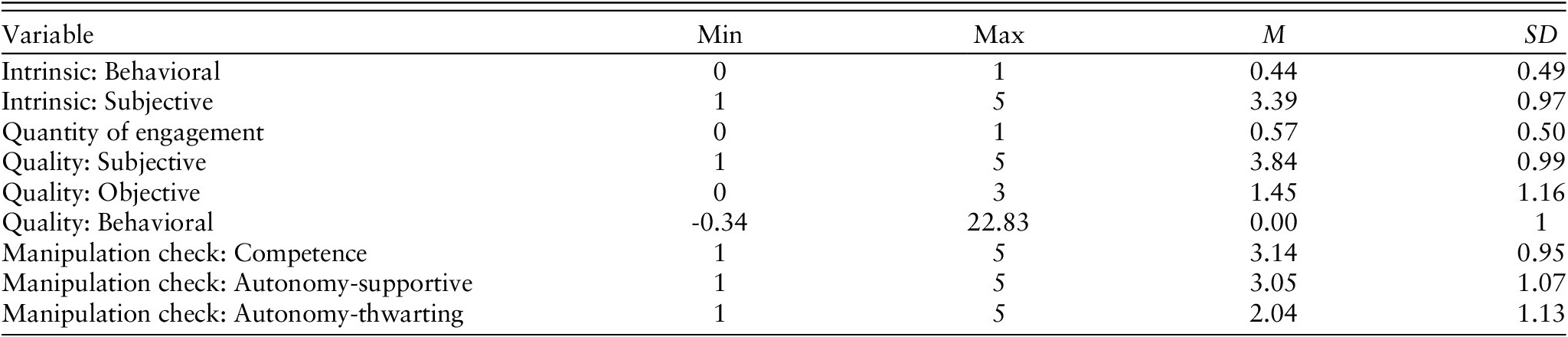
See Table 1 for an overview of descriptive statistics.
Descriptive statistics of the primary variables.
Dependent variables
To strengthen the robustness of the statistical tests, this study complements self-reported measures with cognitive and behavioral measures to assess the motivational processes that underlie the participants’ choices for or against political engagement during the survey (see Supplement 1: Questionnaires). While these measures tap into different mental representations and cognitive processes, there is no reason to expect effects of varying strength across types of measurement.
Intrinsic motivation
To assess intrinsic motivation, one behavioral and one self-reported measure are used. Four items adopted from the Intrinsic Motivation Inventory (Sample item: “I enjoyed watching this video very much”) were aggregated into an unweighted summary index of self-reported intrinsic motivation. Following the free-choice paradigm (Cerasoli et al., Reference Cerasoli, Nicklin and Ford2014), the behavioral measurement queries whether respondents voluntarily opt to watch another similar video after the survey is concluded.
Quantity of political engagement
Measured as the respondent’s choice to watch either a video with political content or a video seemingly without any political content.
Quality of political engagement
Quality of political engagement is assessed with a subjective measure, an objective measure, and a behavioral measure. The subjective measure is the unweighted summary index of two items assessing respondents’ perception of the invested efforts while watching the video (sample item: “I watched the video very attentively”). As objective measurement on the quality of cognitive processing, the number of correct answers to three open-response questions about the video is used. Based on a detailed codebook (see Supplement 2), the open-ended responses were classified by a coder who was unaware of the respondents’ treatment conditions. As behavioral measurement, whether respondents prematurely skipped the video is used (time on questionnaire page).
Manipulation checks
Competence treatment
Unweighted summary index of two items measuring internal political efficacy (sample item: “It is often difficult for me to understand political issues in detail”). The manipulation check was successful, demonstrating clear differences between the both experimental groups (t[1558] = 3.03, p = .003).
Autonomy treatment
On the no-choice treatment, one item assesses whether respondents felt pressured to watch the video. On the autonomy-supportive treatment, one item assesses whether respondents feel they can recall many reasons for engaging with politics. Notably, the manipulation checks for both autonomy-related manipulations were not successful, showing no significant differences when comparing participants in the control conditions to those in the autonomy-supportive (t[1443] = 0.74, p = .46) and autonomy-thwarting conditions (t[1441] = –0.09, p = .93). The implications of these findings are discussed in greater detail later.
Power analysis
Preregistered power analyses suggest that with a total sample size of N = 1,500, effects can be detected at power at or greater than .95 even when effects size are considerably smaller than suggested by previous studies. Detailed information is reported in Supplement 3.
Preregistered analysis plan
To estimate treatment effects, linear regression analyses with robust standard errors and one-sided hypothesis tests were conducted. To reduce variance of the dependent variables and thus to increase the efficiency of the effect estimates (Lin, Reference Lin2013), the following pre-treatment covariates are included in all analysis models along with multiplicative terms with the treatment indicator: Pre-treatment levels of self-reported political motivation, attitudes toward civic norms, device type, device operating system, and rank of political knowledge within the experimental group. In the case of missing values on any covariate, sample means (continuous variables)/modes (categorical variables) were used for imputation.Footnote 1 As linear regressions give unbiased experimental treatment effects for binary outcome variables and as their results are easier to interpret than coefficients from logistic regressions (Gomila, Reference Gomila2019), linear regressions were conducted for all outcome variables (results do not change substantively using logistic regression analyses, see Supplement 4).
Because multiple measurement instruments were employed to assess the concepts of interest and because multiple hypotheses will be tested, 16 statistical tests are conducted in total. Supplement 5 documents which indicators and statistical tests are employed for testing each hypothesis. Whereas the expected positive effect of the no-choice conditions on the quantity political engagement does not entail a need-related test, the 15 remaining tests can be understood as testing the tenet that need-related experiences predict whether and how a person will engage with politics.
The survey questionnaire and the stimulus were programmed using the software UniPark (files attached as Supplementary Material). Based on simulated responses on the survey questionnaire, an analysis pipeline was pre-preregistered, see https://osf.io/24xyq and Supplement 6. The analysis pipeline contains all data processing steps and pre-specifies the data analysis, thereby largely eliminating researchers’ degree of freedom (Wuttke, Reference Wuttke2019). Deviations from the preregistered analysis pipeline that became necessary after data collection due to errors in the original scripts are documented in Supplement 7.
Participants
The target population is the German online population who is entitled to vote. Aiming at a sample size of 1,500 respondents, participants were drawn from the Respondi Panel, which is a heterogeneous online access panel with about 70,000 active participants who were recruited offline and online. Sociodemographic quotas (age, education, and gender) were employed so that the sample more closely resembles the target population. Among participants with completed interviews, 50% were female. Concerning formal education, 25% of participants had a university-entrance diploma, 33% had no degree or only at the lowest formal level (“Hauptschule”), and the remaining participants had intermediary formal levels of education. Age quotas ensured an equal distribution of participants in groups of 18–29, 30–39, 40–49, 50–59, and 60 or more years of age. While the obtained sample cannot be considered a random draw of the German population, these quotas ensure variance on basic sociodemographic variables.
Exclusion criteria
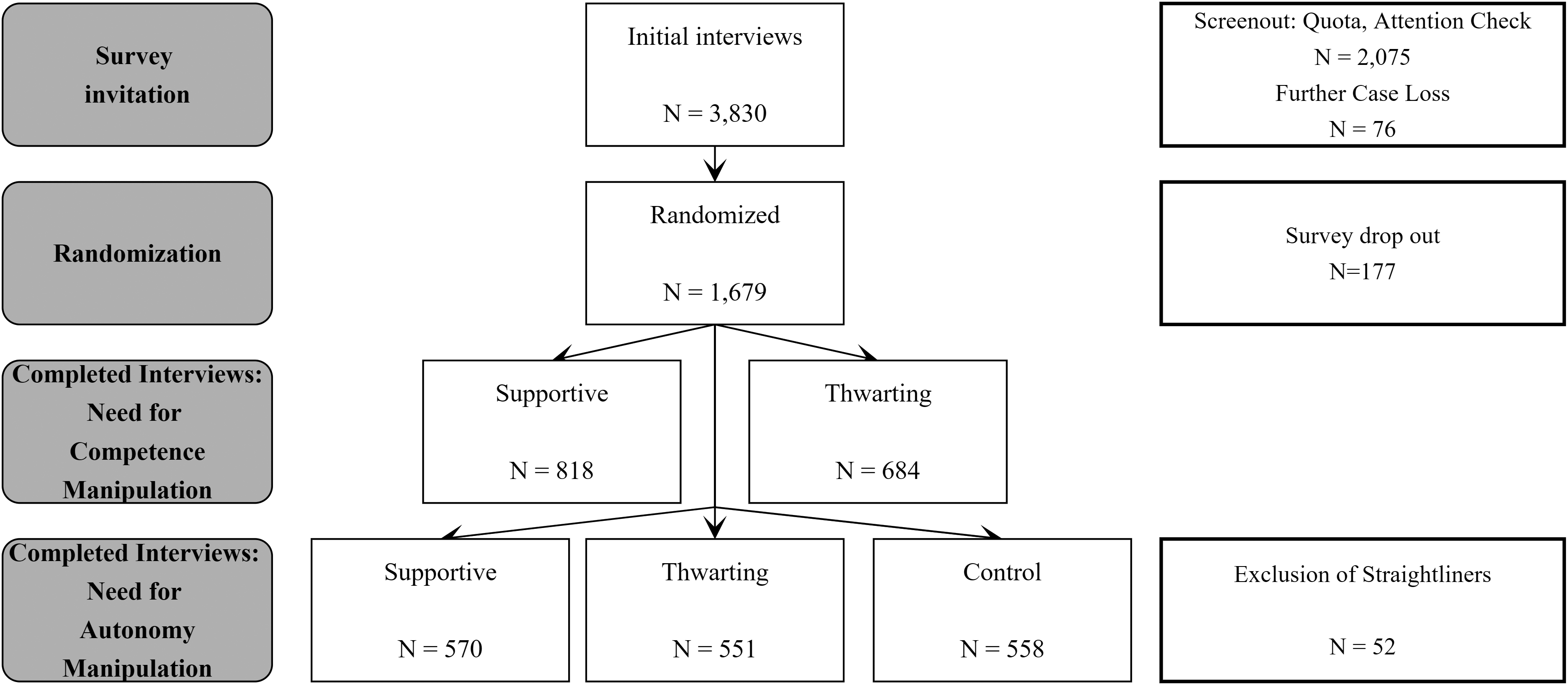
All respondents with completed interviews were included except straightliners who, on all matrix batteries, selected all responses from the same row. The survey included an attention check to filter out respondents who did not select the instructed response option in one of the survey questions (see Figure 2).
Consort diagram of experimental design.
Results
To examine whether need-supportive or need-thwarting experiences with politics affect whether and how citizens engage with politics, treatment effects are examined separately for the various outcome variables. Starting with intrinsic motivation, Figure 3 shows how experimentally induced satisfaction of the needs for competence and autonomy affects self-reported and behavioral measures of intrinsic motivation for political engagement. Based on linear regression models, Figure 3 shows predicted mean differences between the need-supportive and need-thwarting treatment groups in each experimental arm. Against expectations, no statistically significant differences between the treatment conditions emerge. The consistent lack of treatment effects across conditions and outcome measures on intrinsic motivation casts doubts on H1, according to which need-supportive situational contexts would increase intrinsic political motivation. Apparently, whether individuals recently had a positive experience with the political domain had no ramifications on the intrinsic motivation for subsequent encounters with politics. Because increased intrinsic motivation was anticipated to function as the psychological precursor to hypothesized downstream effects on the quality and quantity of engagement, these null effects may also foreshadow absent effects of need satisfaction on the remaining outcome variables.
Need-related treatment effects on intrinsic motivation. Predicted mean differences from linear regression analyses. Behavioral measure: dummy variable; self-reported measure: z-score standardized.

Figure 4 shows whether previous domain-related need satisfaction affected the quantity of political engagement, that is, the decision for or against watching a video with political content. Whether respondents were induced to receive political knowledge feedback that did or did not satisfy their need for competence apparently made no discernible difference in their inclination to choose political over nonpolitical media content. Similarly, the confidence interval of the autonomy-supportive treatment effect’s estimate also includes zero.
Need-related treatment effects on the quantity of political engagement. Predicted mean differences from linear regression analyses. Outcome variable is dichotomous.

However, for the autonomy-supportive treatment, a one-tailed significance test yields a statistically significant difference compared with the control group (p = .041). A bit more than half (53.9%, 95% CI [49.6, 58.2]) of respondents in the autonomy-supportive condition who were prompted to rehears intrinsic reasons for political engagement chose the political media option. In comparison, a slightly lower share of control respondents (47.0% [39.6, 58.2]) chose the nonpolitical options. These mean differences correspond to Cohen’s d = 0.14, a small effect size by conventional standards that corresponds to having to treat 24 individuals in order to stipulate one additional person in the autonomy-supportive condition to choose a political video compared with the control group (Gruijters & Peters, Reference Gruijters and Peters2017). There is thus partial evidence for behavior-eliciting effects of the autonomy-supportive stimulus, but these effects are not robust and smaller than expected. In combination with the expected but absent effect of the competence-related manipulation, overall, these results do not yield consistent evidence for the notion that individuals with previous need-supportive experiences with politics are more likely to seek political encounters than individuals who experienced politics as undermining their basic psychological needs.
Effect sizes are considerably larger and clearly distinguishable from zero for the third treatment condition, in which respondents were told that other media options existed but which they were not allowed to choose for reasons outside their control. Respondents in the forced-choice (need-thwarting) condition opted for a political video much more frequently than the control group (70.2%, 95% CI [66.2, 74.3] versus 47.0% [42.7, 51.2], p ˂ .001). Note that this analysis does not serve as a test of the need-based model of political motivation. Our main interest in the effects of the autonomy-thwarting condition was on potential downstream consequences on how a behavior is conducted when it is enacted against the person’s authentic will. Figure 5 reports on these downstream effects on the quality of behavior.
Need-related treatment effects on quality of political engagement. Predicted mean differences from linear regression analyses. Scale of subjective measure: 1–5, objective measure: 0–3, behavioral measure: z-score standardized.

Figure 5 shows effects on the depth of respondents’ engagement with the video using three different outcome measures. Eight of nine experimental tests do not show the expected effects of need-related experiences on the quality of a person’s engagement with politics. No statistically significant effects emerge on self-reported levels of effortful engagement (subjective measure). Similarly, there is no evidence that prior need-related experiences with politics had any discernable consequences for whether respondents skipped the political video or watched it at full length (behavioral), again suggesting that need-related experiences had no ramifications for how the video was processed cognitively. The exception from the array of null effects is that respondents in the competence-supportive condition could more accurately recall political arguments from the video compared with respondents who were induced to feel politically incompetent. Out of three knowledge questions, respondents in the need-supportive condition accurately respond to 1.6 [1.5, 1.7] questions about the video compared with 1.4 (95% CI [1.3, 1.5]) in the need-thwarting condition (p < .001, one-sided). This corresponds to an effect size of Cohen’s d = 0.17, which indicates a small treatment effect. The rather small effect size is also apparent when considering that differences of this size imply that the distribution of the number of correct responses overlaps for 93% of respondents in both treatment conditions. Another way to get a grasp of the effect size is to consider that there is a 55% probability that a person picked at random from the treatment group will have a higher score than a person picked at random from the control group—only slightly larger than chance. Notwithstanding this one significant, small effect, the bigger picture emerging from these findings does not show much evidence for the hypothesis that previous need-supportive experiences with politics foster the inclination for deeper cognitive involvement when processing political information.
What are we to make of the two significant findings against the broader pattern of null results? Considering that multiple tests were conducted for each hypothesis, the question is whether the two successful tests are to be acknowledged as meaningful signals or disregarded as statistical flukes. With the preregistered alpha of 0.05,Footnote 2 the probability of incorrectly rejecting one true null hypothesis with 15 tests is  $ 1-{\left(1-0.05\right)}^{15}=53.7\%. $ Hence, without accounting for multiple comparisons, it is more likely than not to observe a statistically significant effect estimate even when all hypothesized effects are truly absent. When employing the conservative Holm-Bonferroni strategy to adjust for multiple comparisons, the previously significant p-value of autonomy-supportive treatment on video choice increases to p = .57. Yet, the effect of the competence-supportive treatment on the objective measure of behavioral quality remains significant at p = .001. Altogether, in 14 out of 15 decisive tests the null hypothesis of no effects of need-related treatments on political motivation could not be refuted. Only one test yields findings that are in line with the proposed theory. What does this large array of null results imply for the credibility of the proposed theory?
Interestingly, post hoc analyses show strong correlations between intrinsic motivation and the quantity and quality of engagement (e.g., Pearson’s r of self-reported intrinsic motivation and subjective quality of engagement = .67), suggesting that intrinsic motivation indeed elicits the expected downstream effect on whether and how political behavior is conducted. Yet the theory’s central tenet, that need-satisfying previous encounters stimulated intrinsic political motivation, and the respective behavioral outcomes received little empirical support. Considering that only one small, theory-congruent effect was found while one test after the other failed to provide the hypothesized evidence for the need-based model of political motivation, the most straightforward conclusion is to consider the derived theory as refuted. However, as no empirical test can prove a hypothesis correct, no pattern of null results necessarily commands the refutation of a hypothesis as long as explanations other than the absence of real effects can also explain a failure to observe such effects (Oreskes, Reference Oreskes2019).
In the remainder of this article, I systematically test measurement problems, design deficiencies, lack of statistical power, and treatment heterogeneity as potential sources of type II errors. The more certain we can be that none of these issues prematurely lead to falsely reject the theorized hypotheses, the more confident we can be that, indeed, the presented null findings warrant the conclusion that the proposed theory does not adequately describe how intrinsic motivation comes about.
Alternative Explanations of Null Results
Measurement considerations concern the notion that the experiment might have elicited real theory-consistent effects, yet the measurement instruments failed to capture these effects, rendering the experiment unhelpful in disentangling whether the hypothesized effects exist.
One plausible scenario is that treatment effects were present, and even so consequential that they caused some individuals to prematurely terminate the survey before the outcome variable was measured. As these attrition biases are well documented in the field-experimental literature (Gerber & Green, Reference Gerber and Green2012), the preregistration plan contained the presumption that the no-choice condition might lead some participants to cancel survey participation. However, there is no evidence for differences in survey completion between respondents in the no-choice or the control group (p = .91).
Yet differences in survey completion become apparent when comparing the need-for-competence manipulations (p < .001). Among respondents who received encouraging feedback, 92.7% (95% CI [91.0, 95.0]) completed the survey. When respondents were told that their political knowledge was far below average, only 85.1% [82.6, 87.6] made it to the end of the survey. To the extent that attrition is correlated with the respondent’s potential outcomes, the excludability assumption is violated, and the experimental estimates are biased (Gerber & Green, Reference Gerber and Green2012). Potentially, the treatment could have driven those respondents to terminate the survey early who would also have been most susceptible to treatment effects on substantive outcome variables. Whereas attrition may have biased treatment estimates, it is unlikely that these survey dropouts explain most of the null effects because the difference in attrition rates by competence conditions is so low. Therefore, average treatment effects would remain insignificant or small even if we impute extreme treatment effects on the outcome variables instead of missing values, as can be shown with simulation analysis. For instance, simulating that all respondents in the need-thwarting conditions with outcome missing values would have decided against watching political content (N = 37), the competence manipulation would have yielded a small, barely significant effect on engagement frequency (Cohen’s d = 0.06, imputed p-value = .04 ; original p-value = .26; both one-sided). The effect on the behavioral measure of intrinsic motivation remains just above the significance threshold after replacing missing values among need-thwarted respondents by low motivation scores of 0 (imputed p-value = .06; original p-value = .21). Value imputation on continuous outcome variables shows that in extreme scenarios, treatment-induced attrition could have hidden highly significant treatment effects, but these scenarios with extreme value imputation are unlikely and the effect sizes would remain small (see Supplement 8 for analysis on continuous variables). Altogether, there is the possibility that attrition bias may have caused false negatives as systematic survey dropout could have rendered some truly statistically significant treatment effects as non-significant, but attrition bias seems unlikely to have overshadowed substantive treatment effects with meaningful effect sizes.
A second measurement problem that might overshadow true treatment effects is an unreliable measurement of the relevant outcomes. Although the study relied on established and validated measurement approaches to assess intrinsic motivation (self-reported intrinsic motivation: Ryan et al., Reference Ryan, Koestner and Deci1991, behavioral intrinsic motivation: Ryan & Deci, Reference Ryan and Deci2017), it is possible that these measures were less reliable in the present survey context. Low reliability rates would be problematic because they add noise to the observed values, which impair the capacity to find traces of treatment effects in the outcome measures. Specifically, multi-item measures could suffer from low internal consistency, but analyses show high reliability scores of the self-reported intrinsic motivation measures (Omega total: .87 [.85, .88], Cronbach’s alpha: .86 [.85, .87]; see McNeish, Reference McNeish2018). The objective measure of behavioral quality is particularly vulnerable to reliability problems as it required manual coding of the participants’ open-ended responses. To assess coding reliability, 270 randomly selected responses were classified by a second coder. A comparison of both coders’ classification yields very high reliability rates (agreement rates for each response item: 93%, 93%, 98%; kappa: 0.86, 0.86, 0.96). Altogether, these results foster our confidence that low reliability of the outcome measures appears not to be a major problem for capturing potential treatment effects. Up to now, therefore, the analysis demonstrated the possibility that measurement issues may have slightly biased the experimental findings in one way or another, but neither survey attrition nor instrument reliability is likely to have introduced major biases.
All preceding analyses focused on average treatment effects, yet it is conceivable that treatment effects materialized only in some subgroups. At the extreme, the experiment could have yielded opposite effects depending on a background variable that offset each other when analyzing the sample as a whole. For instance, the susceptibility to situational influences on political motivation might depend on a person’s dispositional motivational propensities. To examine potential treatment heterogeneity based on these and other potential moderators, one option is to run a vast number of regression analyses with various model specifications that account for the numerous possible interacting influences of the variables of interest. However, such an approach runs into problems of overfitting and statistical power and exacerbates the problem of multiple comparisons (van Klaveren et al., Reference van Klaveren, Balan, Steyerberg and Kent2019).
Data-driven strategies make more efficient use of the data and are thus better suited for this kind of exploratory analysis. Therefore, I employ a machine learning technique—causal forests (Athey et al., Reference Athey, Tibshirani and Wager2019; Wager & Athey, Reference Wager and Athey2018)—that was specifically developed for the purpose of discovering treatment heterogeneity in experimental settings. As an ensemble model, causal forests consist of decision trees that partition the data on relevant covariates by their ability to explain heterogeneity in a quantity of interest such as the treatment effect. Like other random forests models, causal forests split the data into training and test data sets. In addition, the causal forests model entails another split of the training data set called the honesty approach, which enables the calculation of asymptotically normal estimates and thus reporting of 95% confidence intervals. Due to the sample splits, causal forests thus work best with large sample sizes, yet it is the best available option to explore potential treatment effects also in medium-sized samples as it does not overfit the data and yields interpretable and reliable estimates.
To implement causal forest models, I assigned 60% of respondents to a training data set with 12 attitudinal variables (four dimensions of political motivation, seven indicators of citizenship norms, and political knowledge), three sociodemographic variables (age, sex, and education) and two technical para variables (device type and operating system), all of which were measured before a treatment was administered. The learned model is then applied on the test data set to predict heterogeneous treatment effects on unused data (for more information on model specification, see Supplement 9; I follow the implementations by Reimer & Chelton, Reference Reimer and Chelton2019; White, Reference White2018).
To demonstrate how the method reveals treatment heterogeneity, I first examine treatment effects of the no-choice condition on the frequency of political engagement in the experiment. Figure 6 shows the relative importance of each variable in explaining variation in treatment effects. Political motivation variables are among the variables with most explanatory power, a finding that replicates with other outcome variables.
Relative variable importance for treatment heterogeneity.

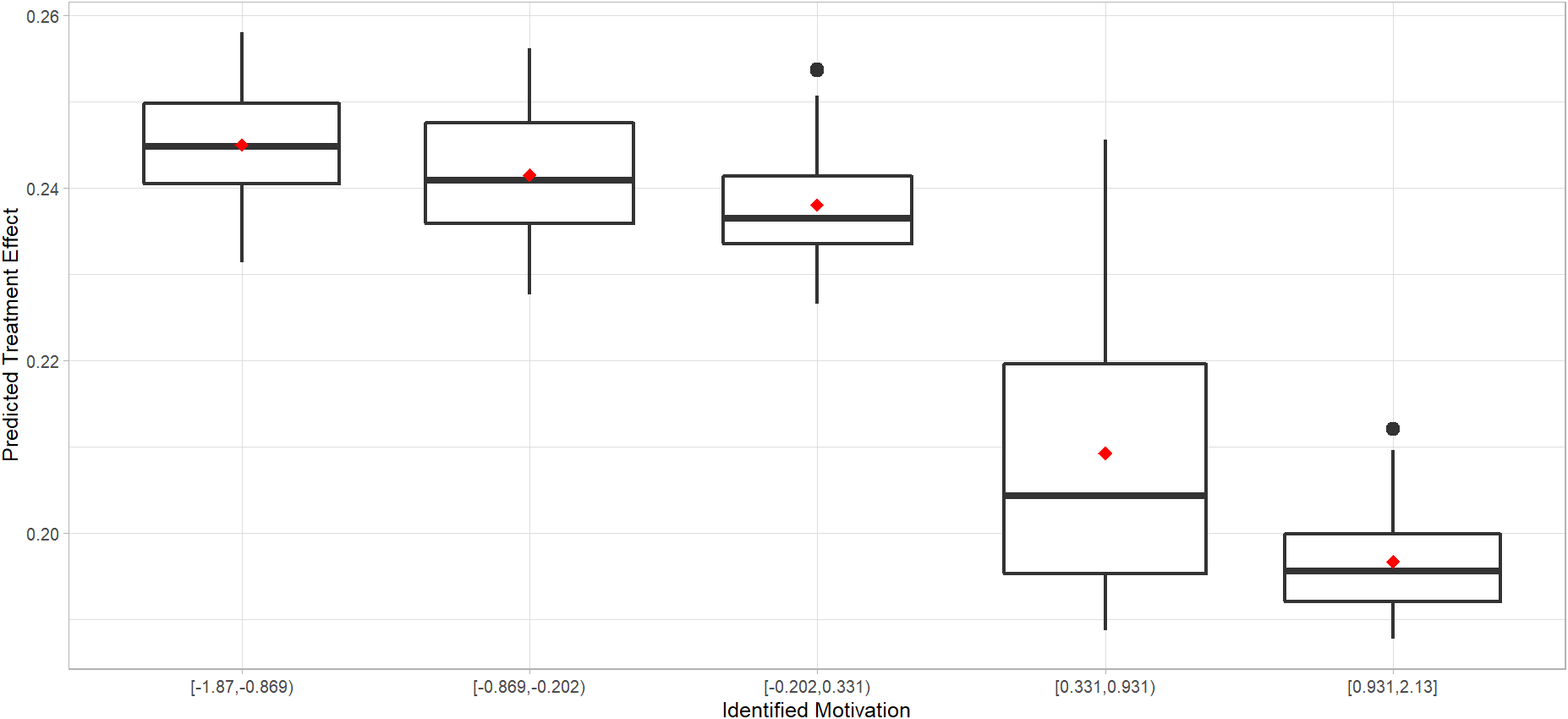
However, Figure 6 does not inform about the magnitude of treatment heterogeneity as a whole, and it is thus unclear whether the heterogeneity is substantively meaningful. When conducting an omnibus test on the presence of treatment heterogeneity, the test fails to reject the null hypothesis of no treatment heterogeneity (p = .80). The lack of significant heterogeneity also becomes apparent in Figure 7, which displays the substantive magnitude of subgroup differences.Footnote 3 For the strongest predictor of treatment heterogeneity, Figure 7 shows how predicted treatment effects differ at selected values of identified political motivation, indicating no substantial heterogeneity. Meaningful heterogeneity cannot be detected for other outcome variables either (see Supplement 9).Footnote 4 Altogether, therefore, even an exploratory method to recover any potential treatment heterogeneity that makes efficient use of the available data reveals no evidence of meaningful treatment effects that were hidden in the data. Therefore, treatment heterogeneity seems not to have overshadowed true effects, strengthening the confidence that the experiment simply did not elicit theory-consistent effects in any portion of the sample.
Heterogeneous treatment effects by identified political motivation. Predicted treatment effects for five equally sized subgroups by pre-treatment levels of identified political motivation, using grf package for R.
A final test was conducted to assess whether the reported null results warrant refutation of the formulated hypothesis or whether an alternative theory-consistent explanation could account for the absence of effects. The possibility remains that the expected effects did occur but were too small to detect statistically. By calculating whether an estimate achieves a practically meaningful effect size, equivalence tests allow distinguishing whether a null effect is either inconclusive or too small to make a substantial difference (Lakens et al., Reference Lakens, Scheel and Isager2018). Even though it is impossible to prove the absence of an effect, we can establish whether an effect is practically absent and thus statistically equivalent to zero using equivalence tests.
Distinguishing whether a null effect is either inconclusive or practically insignificant requires specifying the smallest effect size of interest (SESOI) for a given test. Consider the effect on the behavioral measure of intrinsic motivation, that is whether respondents chose to watch yet another political video after the survey questionnaire is completed. We might categorize treatment effects as negligible when the shares of respondents choosing to watch another political video do not differ by more than 10 percentage points between experimental conditions. An equivalence test of the need for competence manipulation on the behavioral measure of intrinsic motivation shows that the reported effect estimate of –2.4% with 95% confidence intervals from –7.2% to 2.4% is statistically equivalent to zero because with great certainty we can rule out that the true population estimate entails effect sizes above SESOI (see Supplement 10 for graphs). As documented in Supplement 10, we reach the same conclusion of statistical equivalence for all conducted tests using reasonable thresholds. Therefore, even though some theory-consistent effects might have occurred, we can confidently reject that the need-related treatment elicited practically meaningful effects on the relevant outcome measures.
What does the absence of meaningful theory-consistent effects imply for the proposed need-based model of political motivation? The informational value of the presented findings for judging the tested theory depends on the experiment’s internal and external validity. In this study, each experimental condition was intended to induce a certain psychological state among respondents that then was expected to elicit motivational downstream effects in line with the theory. Internal validity is thus impaired when the stimuli failed to elicit the intended psychological state. Therefore, in the following, I test for each experimental condition whether these requirements for an informative hypothesis test were met.
The autonomy-supportive condition was intended to remind respondents of good reasons to engage with politics and thus more closely align political engagement with the respondents’ sense of selves so that a decision for political engagement seems concordant with the respondents’ need for autonomy (similar: Kadous & Zhou, Reference Kadous and Zhou2019). However, the manipulation check indicates that the experimental manipulation did not succeed in making respondents more aware of reasons for political engagement.Footnote 5 Respondents in the autonomy-supportive condition did not report at higher rates that they could name many reasons for why politics is enjoyable compared with the control group (t[1443] = 0.74, p = .46). The failed manipulation check thus casts doubt that the autonomy-supportive manipulation worked as intended.Footnote 6 Importantly, if the priming paradigm was ineffective in stimulating autonomous reasons for political engagement, then the insignificant test result cannot be considered informative tests on the hypotheses under investigation, because one would not have expected the hypotheses to hold if respondents do not differ in how autonomous they experience their own behavior.
The autonomy-thwarting manipulation was intended to make respondents feel that political engagement is not a matter of choice but was required even against their will so that the enforced political engagement is experienced as undermining respondents’ need for autonomy. However, the evidence suggests that this manipulation did not have the intended effect either. First, even though respondents in the autonomy-thwarting conditions were 2.3 times more likely to choose a political video than other respondents, 29.7% of respondents still resisted the instructions and chose a nonpolitical video. Apparently, a substantial segment of the respondents did not consider the survey instructions binding. Second, respondents in the autonomy-thwarting conditions did not report more often that they felt under pressure to watch the video compared with the control condition (t[1441] = –0.09, p = .93). To conclude, the experimental manipulation apparently failed to elicit the perception of autonomy-undermining pressure.
Considering that both autonomy-related conditions failed to facilitate or undermine need satisfaction, it is thus little wonder that no downstream effect on political engagement occurred. With the available data, we cannot know whether an effect would have been observed if the treatment succeeded in manipulating situational need satisfaction. Hence, whether satisfaction of the need for autonomy affects political motivation remains unanswered and the autonomy-related experiments thus do not qualify as informative tests of the hypotheses under observation.
Things stand differently for the competence manipulation. As intended, the difficulty of the knowledge quiz varied between treatment conditions. Respondents in the need-for-competence supportive conditions accurately responded more frequently to questions in the easier knowledge quiz than respondents in the need-thwarting condition with more difficult questions (t[1626] = 9.84, p < .001). More importantly, after having received the manipulated quiz feedback, respondents in the need-supportive condition reported higher levels of internal political efficacy (t[1558] = 3.03, p = .003). So, respondents were successfully induced to feel more or less competent with regard to the political domain and thus the experiment succeeded in manipulating the theorized need-based precursor to political engagement. On average, respondents in both need-for-competence conditions differ in whether they recently experienced the political domain as either satisfying or undermining their need for competence so that the expected downstream effects on political engagement should have occurred. Hence, the experiment’s competence-related manipulation meets the condition of an informational theory test as the experimentally induced differences between respondents in need satisfaction have not led to the motivational and behavioral outcomes that were predicted by the need-based model of political motivation.
Discussion
To understand why some people develop a taste for politics while others find it boring or burdensome, this study has laid out a theoretical framework for understanding the motivational processes driving political engagement as its own reward. This synthesis of existing motivation theories enhances the conceptual political science toolkit, sheds new light on previous findings, and contributes novel ideas for the explanation of a poorly understood political phenomenon, based on insights that have proven useful in other domains of life. Starting from the pleasure principle’s notion that individuals will reengage with activities they have previously experienced as positive and rewarding, the proposed theory builds on the concept of basic psychological needs to predict which situational features people find satisfying. In this vein, the taste for politics should reflect universal desires and experiences that are deeply ingrained in the human psyche. Specifically, the need-based theory of political motivation posits that citizens will be intrinsically motivated to engage with politics when they previously experienced political activities as satisfying basic psychological needs.
The theory’s prediction was put to an empirical test in a preregistered, high-powered survey experiment with two experimental arms that were intended to induce experiential differences in domain-related need satisfaction. The autonomy-related conditions apparently failed to induce need-thwarting or need-satisfying experiences. Therefore, the requirements for an informational hypothesis test are not met in this experimental arm and it remains unclear whether previous autonomy-related experiences with politics affect subsequent political behavior. However, considering that the experimental design was carefully crafted and built on previous literature with similar manipulations, the failed induction attempts still teach about the difficulty of deliberately inducing need-related psychological states. As argued in the article, the effect of an objectively given situation on a person’s need satisfaction depends on the subjective perception and experience of the particular situation. Hence, if need satisfaction is difficult to manipulate systematically even in a controlled survey-experimental environment, then need satisfaction may be considered even less predictable in the real world (e.g., van Loon et al., Reference van Loon, Baekgaard and Moynihan2019), suggesting that need-based theories and applications of it may be more precarious and context-dependent than previous literature suggests.
The need-for-competence manipulation succeeded as an informative theory test but casted further doubt on the usefulness of basic needs to explain political motivation. In five out of six analytical tests, the need manipulation did not bring about the expected motivational or behavioral outcomes. Notably, the negative findings hold across different measurement strategies and after conducting extensive exploratory analyses to minimize the likelihood of false-negative conclusions. While it remains possible that treatment-induced attrition may have hidden small treatment effects, overall the exploratory analyses suggest that treatment heterogeneity, measurement reliability, and statistical power are not likely to have caused type II errors, thus strengthening the confidence that the expected effects of the need-related manipulation simply did not reliably materialize. Altogether, the available data thus suggests refuting the hypotheses that need-for-competence supportive experiences will lead to higher levels of intrinsic motivation, which, in turn, will stimulate political engagement among respondents. Similarly, there is only limited and less than expected evidence that need-related experiences have ramifications for the quality by which political behavior is conducted.
What does the fact that most hypotheses were not supported when put to an empirical test imply for the credibility of the need-based theory of political motivation? The epistemological principle of under-determination implies that single experiments cannot verify or refute any particular theory (Oreskes, Reference Oreskes2019). Yet failed experiments provide signals for the need to abandon or revise elements of a theory. Most clearly, the proposed theory does not yield accurate predictions concerning the need for competence. This is particularly surprising when considering the previous literature on political efficacy (e.g., Bandura, Reference Bandura2010; Preece, Reference Preece2016; Prior, Reference Prior2019; Schwarz & Schuman, Reference Schwarz and Schuman1997), which has rendered need for competence a likely candidate for theory-consistent effects in the political domain. Nonetheless, it remains possible that the theory would receive empirical support when tested with other need candidates. For instance, Han (Reference Han2016) reported evidence from multiple field experiments that can be interpreted as suggesting that organizations are more successful in stimulating political engagement among their members when organizational contexts help satisfy the need for belonging, which is the most widely accepted basic need in psychological science.
Next to testing the proposed theory with other basic needs, another strategy for theory revision could entail maintaining the basic tenets of the pleasure principle but abandoning the need-based concepts and, instead, building on other concepts such as core motives (Fiske, Reference Fiske2014) or insights from Gestalt psychology (Kruglanski et al., Reference Kruglanski, Fishbach, Woolley, Bélanger, Chernikova, Molinario and Pierro2018) to explain the conditions under which people perceive politics as pleasurable. Finally, future theory revisions could combine the idea of the pleasure principle with other insights from motivation science. For instance, regulatory focus theory (Higgins, Reference Higgins2012) enables individuals to distinguish different systems of goal pursuit that could help to refine predictions about whether positive or negative experiences with politics shape future motivation, depending on one’s initial approach to politics. Altogether, the demonstrated results undermine confidence in the proposed need-based theory of political motivation, suggesting either narrower boundary conditions or revising some of its elements.
One final aspect worth mentioning concerns the experiment’s external validity. Survey- and laboratory experiments often face the criticism that the psychological processes elicited in an artificial environment might not resemble those in the real world. As a case in point, the failed autonomy manipulation indicates that many respondents perceived the video and the following instructions as yet another survey task, suggesting that respondents might not have perceived the situation as resembling real-world scenarios. Still, only survey and laboratory experiments allow the manipulation of distinct psychological states in a controlled environment, rendering the inquiry and manipulation of such psychological processes in the field even more difficult. Altogether, these difficulties show why the study of political engagement as an end in itself has still received relatively scant attention compared with the relevance of intrinsic motivation for an active citizenry. In this vein, by having shown what works and what does not work, the empirical strategy and the theoretical discussions presented in this study may have demonstrated dead ends and fruitful avenues for further research on political engagement for its own reward.
Supplementary Materials
To view supplementary material for this article, please visit http://dx.doi.org/10.1017/pls.2020.18.


 Open access

