





1. Introduction
Heritage speakers (HSs) are bilinguals raised with a language at home (HL), different from the dominant societal language (SL) around them (Benmamoun, Montrul & Polinsky, Reference Benmamoun, Montrul and Polinsky2013; Scontras, Fuchs & Polinsky, Reference Scontras, Fuchs and Polinsky2015; Montrul, Reference Montrul2016; Rothman, Reference Rothman2009). In recent decades, the unique linguistic systems of HSs, which diverge from those of both monolinguals and L2 learners of a given language (Rakhilina, Vyrenkova & Polinsky, Reference Rakhilina, Vyrenkova and Polinsky2016), have drawn the interest of both applied and theoretical linguists. Numerous studies of HL grammars have focused primarily on the domain of morphosyntax (for an overview see Montrul, Reference Montrul2016; Polinsky, Reference Polinsky2018a, Reference Polinsky2018b; Montrul & Polinsky, Reference Montrul, Polinsky, Montrul and Polinsky2021). While some research examines the HL lexicon, as well (see, for example, Fridman & Meir, Reference Fridman and Meir2023; Garcia & Gollan, Reference Garcia and Gollan2022; Chappell, Reference Chappell2018; Montanari, Abel, Graßer & Tschudinovski, Reference Montanari, Abel, Graßer and Tschudinovski2018), there is quite limited work comparing the HL lexicon across different language environments and focusing on typologically distinct languages.
The current study aims to expand upon the existing body of literature on the HL lexicon and contributes primarily through the scale of the work. We examine the lexical abilities of child and adult HSs of HL-Russian in contact with two SLs – American English and Hebrew – as compared to child and adult monolingual baseline speakers residing in countries of the former USSR. We consider noun and verb vocabulary in HSs across both age groups and different SLs, and investigate production accuracy, the effects of word frequency and age of acquisition, and lexical non-target response patterns. To our knowledge, this is the first study of HSs to compare performance among six groups, and in doing so we hope to shed light on trajectories of HL lexical development.
1.1. Trajectories of HL development
HSs’ linguistic abilities in the HL vary widely, from near-native fluency to quite limited competence (Montrul & Polinsky, Reference Montrul, Polinsky, Montrul and Polinsky2021). Regardless of where they fall on this spectrum, HSs’ grammars tend to diverge from the monolingual baseline. Different accounts have emerged over the last two decades to attempt to capture the phenomenon of HSs’ divergent grammars and their linguistic development trajectories.
One of these accounts is attrition, the process by which HL proficiency decreases as HSs age. The input to which HSs are exposed in the HL differs from that accessible to monolinguals, and diminishes over time (Polinsky, Reference Polinsky2018a). As HSs progress through school and lead their social and academic lives primarily in their SL, they bring that SL home with them and begin actively code-switching, or, in some cases, shifting away from HL use entirely. As literacy develops in the SL, many HSs do not maintain literacy in the HL, if it had been acquired in the first place, marking another key point of divergence from their monolingual peers. For example, a recent study of Russian child HSs found that only half were literate in the HL, compared to 90% that could speak and understand it (Otwinowska, Meir, Ringblom, Karpava & La Morgia, Reference Otwinowska, Meir, Ringblom, Karpava and La Morgia2021). At the same time that input quantity in the HL decreases, input quality diverges, as well. HSs’ immigrant parents undergo a parallel process of assimilation and may themselves show elements of code-switching and influence from the SL (Daskalaki, Elma, Chondrogianni & Paradis, Reference Daskalaki, Elma, Chondrogianni and Paradis2020; Montrul & Sánchez-Walker, Reference Montrul and Sánchez-Walker2013), thereby providing input to their children which diverges from a monolingual-like baseline. Based on these patterns, linguistic phenomena fully acquired by HSs in early childhood, at levels on par with monolingual children, are lost over time due to diminished input, leading to lower proficiency in adult HSs compared to child HSs (Schmid & Köpke, Reference Schmid and Köpke2019).
Directly contrasting the account of attrition is that of frozen lexical development, which suggests that HSs do not fully develop the robust linguistic systems of their monolingual counterparts and retain only early-acquired lexical elements (previously referred to as “incomplete acquisition”; see Montrul, Reference Montrul2008). HSs’ use of the HL is almost exclusively limited to the home context, constricting the lexical domains in which the HSs will be proficient (Polinsky, Reference Polinsky2018b). Without expanding their vocabularies further, adult HSs do not advance past the proficiency level of monolingual children. This account, including the term “incomplete acquisition” itself, has been widely debated, with some arguing in favor of its use (Domínguez, Hicks & Slabakova, Reference Domínguez, Hicks and Slabakova2019; Montrul & Silva-Corvalán, Reference Montrul and Silva-Corvalán2019) and others contesting it (Kupisch & Rothman, Reference Kupisch and Rothman2018; Otheguy, Reference Otheguy2016; Bayram, Kupisch, Pascual y Cabo & Rothman, Reference Bayram, Kupisch, Pascual y Cabo and Rothman2019). Despite the controversy surrounding this trajectory, we believe it is an important theoretical framework to consider, although we emphasize that we refer here to the development of the lexicon, and this pattern may not hold for other linguistic domains.
Researchers who reject the term “incomplete acquisition,” and its premise comparing HSs to monolingual ultimate attainment, propose instead the account of new language variety in a contact situation (Kupisch & Rothman, Reference Kupisch and Rothman2018; Rothman & Treffers-Daller, Reference Rothman and Treffers-Daller2014). They contend that, rather than being underdeveloped versions of monolinguals, HSs actually speak a new and valid dialect of the HL with its own systematic rules and grammar. Thus, the HL is likened to a language variety that develops over generations as the result of transfer from or contact with other languages, and HSs are native speakers of this new variety. Following this account, HSs diverge from the baseline from the early stages of HL acquisition, and this divergence persists into adulthood.
Studies aiming to add weight to one or another of these accounts are especially abundant in the field of morphosyntax and present mixed results (Cuza, Pérez-Tattam, Barajas, Miller & Sadowski, Reference Cuza, Pérez-Tattam, Barajas, Miller and Sadowski2013; Montrul, Reference Montrul2018; Polinsky, Reference Polinsky2011). For example, Montrul (Reference Montrul2013) found that child monolingual Spanish speakers in Mexico and both child and adult Spanish HSs in the US show significant gaps in differential object marking compared to monolingual adults, providing evidence for frozen development. On the other hand, a study of child and adult Spanish tense and aspect marking found that younger children and adults exhibit analogous tendencies, while older children stand apart, suggesting evidence for attrition (Cuza et al., Reference Cuza, Pérez-Tattam, Barajas, Miller and Sadowski2013). Meir, Avramenko and Verkhovtceva (Reference Meir, Avramenko and Verkhovtceva2021a) found that both child and adult Russian HSs of Hebrew differed from child and adult monolinguals on the production of the accusative case. These results support theories of language variation in a contact situation. Such inconclusive and seemingly contradictory findings can also be presumed for the lexical domain, which has been found to be even more susceptible to changes in input than morphosyntactic features (Gharibi & Boers, Reference Gharibi and Boers2017; Montrul, Reference Montrul2008).
All the trajectories of HL development listed above implicate input. Whether HL input diminished over time, leading to attrition, or input prior to SL onset was insufficient, leading to frozen development, or it blended with SL input to create a new language variety, it is clear that understanding HL divergence in input is the key to determining which of these accounts is most applicable for HL lexical knowledge.
1.2. HL divergence in input: sociolinguistic differences between Israel and the USA
HL input divergence can stem from language-internal attributes or from language-external attributes at the societal level. To understand how input affects HL development in contact with different SLs, we must consider input differences at a macroscopic level and assess the status of the HL in a given country.
We hone in on HSs of Russian in Israel and in the United States. In Israel, Russian is the top HL, and the third most spoken language after Hebrew and Arabic (Meir, Joffe, Shabtaev, Walters & Armon-Lotem, Reference Meir, Joffe, Shabtaev, Walters, Armon-Lotem, Montrul and Polinsky2021b). Russian is ubiquitously found in all arenas of public life and all government and social services are available in Russian. A 2017 study approximated that Russian-speakers make up 15% of the total Israeli population, or over 1 million people (Konstantinov, Reference Konstantinov2017), not including non-citizen students, workers, and tourists. Additionally, during the 2022 Ukraine war, Israel saw an inflow of over 40,000 refugees and repatriates from Ukraine and Russia, and based on rising demands, the government anticipates this number to continue to grow in the coming months (Etiel, Reference Etiel2022). Thus, the actual number of Russian-speakers in Israel, and the Russian-language resources made available to them, is considerably higher. Statistics published by the Ministry of Immigration and Absorption in 2016 showed that over 70% of adult Russian-speakers report using mostly or exclusively Russian at home, and about 50% report using Russian at work equally or more than Hebrew (Chanin, Reference Chanin2016).
By contrast, there are approximately 900,000 Russian speakers in the US (U.S. Census Bureau, 2012), or around .3% of the total US population. While small Russian-speaking communities exist in most big cities, Russian-speakers do not gravitate towards ethnic residential enclaves (Laleko, Reference Laleko2013) and thus struggle to create an immersive environment. Kagan and Dillon (Reference Kagan and Dillon2010) report that, while HSs speak in Russian with their parents and grandparents over 80% of the time, they use Russian with peers less than 15% of the time, as English dominates their interactions. While there are community schools that serve to strengthen HSs’ ties to Russian language and culture, these schools are few and far between: out of a sample of 254 Russian HSs, 84% reported having never attended one (National Heritage Language Survey, 2012). Thus, we see that the status of, and access to, Russian in the US and Israel differ starkly, which we expect will trigger differences in trajectories of lexical acquisition.
1.3. HL divergence in input: word frequency and age of acquisition
Language-internally, input quantity and quality at the lexical level are modulated by various psycholinguistic factors, which play a significant role in HL divergence. The two factors we will discuss here are age of acquisition (AoA) of a word, and word frequency. AoAFootnote 1, the age at which a word is acquired, is a psycholinguistic factor that affects accuracy on various productive lexical tasks (Cameirão & Vicente, Reference Cameirão and Vicente2010). Studies have found effects of AoA independent of word frequency and have demonstrated that adults have greater ease and higher accuracy in accessing words with earlier AoAs than later (Bonin, Barry, Méot & Chalard, Reference Bonin, Barry, Méot and Chalard2004). One potential explanation for this phenomenon is that words acquired earlier form stronger representations in the mental lexicon, leading to increased preservation over time compared to later-learned words (Hernandez, Reference Hernandez2013). Montrul and Foote (Reference Montrul and Foote2014) noted this effect for both Spanish HSs and for second language learners, and similar results have been observed for child HSs of Russian in their SL-Hebrew (Altman, Goldstein & Armon-Lotem, Reference Altman, Goldstein and Armon-Lotem2017) and for adult Spanish–English bilinguals tested in both languages (Izura & Ellis, Reference Izura and Ellis2002, Reference Izura and Ellis2004).
Word frequency information is usually calculated as the number of occurrences of a word in large written or spoken corpora (Akinina, Malyutina, Ivanova, Iskra, Mannova & Dragoy, Reference Akinina, Malyutina, Ivanova, Iskra, Mannova and Dragoy2015). Multilinguals have been found to be most successful on picture-naming tasks with high-frequency stimuli, although they still score lower than monolinguals (Sullivan, Poarch & Bialystok, Reference Sullivan, Poarch and Bialystok2018). In free-form production, Gharibi and Boers (Reference Gharibi and Boers2019) found that young Farsi HSs in New Zealand use less diverse vocabulary and strongly prefer high-frequency words on a narrative task, as compared to monolinguals. Polinsky and Kagan (Reference Polinsky and Kagan2007) describe a phenomenon of fossilization, wherein high-frequency expressions are fossilized in heritage speech, such that they transform into the lexical or morphosyntactic representation of their respective concepts. Thus, a HS could say “We have a blue on the couch” instead of “we have a blue couch” or “let's go at home” instead of “let's go home,” using the memorized forms in place of their accurate nouns. Overall, child HSs achieve lower accuracy than monolingual children on words with low frequency and with high AoA, demonstrating a sensitivity to these psycholinguistic factors in bilinguals, to which monolinguals are less susceptible, as evidenced by work on heritage Polish (Łuniewska, Wójcik, Kołak, Mieszkowska, Wodniecka & Haman, Reference Łuniewska, Wójcik, Kołak, Mieszkowska, Wodniecka and Haman2021).
1.4. Lexical knowledge of HSs: quantitative competence
HSs’ tendencies to select for more frequent or earlier-mastered words make sense when considering the added load they experience. Bilinguals tend to know fewer words in each language than monolingual speakers of one of those languages (Oller, Pearson & Cobo-Lewis, Reference Oller, Pearson and Cobo-Lewis2007). Some words are encountered in only one of the bilingual's languages, as language-use time is divided between different contexts. The phenomenon of limited vocabulary in each of the bilingual's languages has been demonstrated for both children (Bialystok, Luk, Peets & Yang, Reference Bialystok, Luk, Peets and Yang2010) and adults (Bialystok & Luk, Reference Bialystok and Luk2012). Polinsky (Reference Polinsky2006) found that American adult HSs exhibit major gaps in their HL vocabulary – both productive and receptive – compared to monolinguals, and they compensate for these gaps by code-switching and borrowing from their SL. These findings were corroborated in a study of HL-Hebrew in the US, where participants relied on their SL both explicitly (code-switching, or borrowing directly from the SL) and implicitly (calquing, or translating from the SL) in HL narrative production (Fridman & Meir, Reference Fridman and Meir2023). Within this already limited HL vocabulary, the current study narrows in on productive knowledge, associated with the active lexicon. Productive vocabulary knowledge requires speakers to select, retrieve, and produce an appropriate term associated with the meaning they want to convey (Cameron, Reference Cameron2002). Gollan, Slattery, Goldenberg, Van Assche, Duyck and Rayner (Reference Gollan, Slattery, Goldenberg, Van Assche, Duyck and Rayner2011) found that production in bilinguals is more sensitive to frequency than comprehension and is especially vulnerable to influence from the dominant language. In a four-year longitudinal study of Russian and Turkish child HSs in Germany, Czapka, Topaj and Gagarina (Reference Czapka, Topaj and Gagarina2021) found that, at around age 3, Turkish HSs outperformed Russian HSs in their respective HL lexicon. However, by the end of the study, no significant differences between the groups were observed, showing that the HL lexical proficiency of the Russian HSs grew much more and faster than that of the Turkish HSs. These differences were ascribed to levels of home input. Likewise, no significant differences in HL noun-naming were found between Russian and Chinese child HSs in South Korea (Kim & Kim, Reference Kim and Kim2022).
These and other studies of HSs with distinct SLs test performance on nouns, as nouns are ubiquitous, tend to be concrete, imageable, and specific, and are reportedly acquired very early (Altman et al., Reference Altman, Goldstein and Armon-Lotem2017). Verbs are similarly present in all languages and are also acquired in early development, although exact timing compared to nouns has been debated (Haman, Łuniewska & Pomiechowska, Reference Haman, Łuniewska and Pomiechowska2015). Therefore, assessment of verb knowledge in addition to noun knowledge provides a broader picture of lexical proficiency. Despite the tendency towards noun-naming, HSs have actually been found to have better control of verbs than of nouns of the same frequency (Polinsky, Reference Polinsky2005). A study of Russian child HSs in Germany found that nouns are more fragile than verbs in bilinguals and are therefore more susceptible to language variation or loss (Klassert, Gagarina & Kauschke, Reference Klassert, Gagarina and Kauschke2014). A possible explanation for this is that verbs are less sensitive to frequency effects than nouns (Goodman, Dale & Li, Reference Goodman, Dale and Li2008). Sandhofer, Smith and Luo (Reference Sandhofer, Smith and Luo2000) reported different frequency distributions for nouns and verbs, with nouns converging around medium frequency and verbs exhibiting a steep distribution with a few highly-frequent verbs and the rest fairly infrequent. Thus, for high-to-moderately frequent verbs, there are fewer competitors for lexical access than for similarly frequent nouns, leading bilinguals to retain them better and perform more successfully on naming tasks. Alternately, Polinsky (Reference Polinsky2005) suggested that losing verbs is more conceptually costly for a bilingual than losing nouns, as a given verb is more versatile and can be used across multiple contexts with multiple predicate-dependents, while nouns are more specialized and can usually be replaced with a generic placeholder (that). Following this explanation, bilinguals retain verbs better than nouns as a way of maximizing linguistic utility. Still, findings on this subject are far from unanimous, with other studies (Montrul & Foote, Reference Montrul and Foote2014; Altman et al., Reference Altman, Goldstein and Armon-Lotem2017) demonstrating an advantage of nouns over verbs. Thus, no definitive consensus on noun and verb performance in HSs has been reached, and this topic requires further research.
1.5. Lexical knowledge of HSs: qualitative competence
While assessing target accuracy of HSs’ lexical knowledge can reveal valuable quantitative information, examining the content of non-target responses can be informative in and of itself. Specifically, a methodical consideration of non-target-response types can provide insight on claims that HSs are native speakers of a robust variant of their HL (Rothman, Reference Rothman2007; Kupisch & Rothman, Reference Kupisch and Rothman2018). Rakhilina et al. (Reference Rakhilina, Vyrenkova and Polinsky2016) argue that HSs’ divergence from the monolingual baseline, wherein they produce novel lexical and grammatical constructions not found in monolingual speech, points to a systematic restructuring of the HL lexicon. Studying lexical non-target response patterns sheds light on strategies used by multilinguals (Altman et al., Reference Altman, Goldstein and Armon-Lotem2017), and comparing these patterns to those of monolinguals helps tease these lexicons apart.
In a study of narrative production among Canadian child Russian HSs, Makarova and Terekhova (Reference Makarova and Terekhova2020) found that HSs produce considerably more lexical non-target responses than their monolingual counterparts. A considerable portion of those lexical non-target responses were phonological, suggesting that HSs can retrieve lexical items but falter at the production stage. These findings contrast earlier work on monolingual children, where semantic non-target responses outnumbered phonological ones at a rate of about 20-1 (McGregor, Newman, Reilly & Capone, Reference McGregor, Newman, Reilly and Capone2002). Associative responses (e.g., ‘orange’ instead of ‘lemon’) may point to the existence of a concept, rather than a specific word, in the lexicon (Altman et al., Reference Altman, Goldstein and Armon-Lotem2017). Additionally, both HSs and monolinguals produced innovative lexical forms and often employed hyponyms (Makarova & Terekhova, Reference Makarova and Terekhova2020).
HSs are known to use overgeneralizations, such as hypernyms, to indicate a target concept, favoring more generic terms over more precise ones (Kopotev, Kisselev & Polinsky, Reference Kopotev, Kisselev and Polinsky2020). Klapicová (Reference Klapicová2018) similarly found that bilingual children use more non-specific nouns and verbs compared to monolinguals, directly contradicting the tendency toward hyponyms observed by Makarova and Terekhova (Reference Makarova and Terekhova2020). By contrast, Ringblom and Dobrova (Reference Ringblom and Dobrova2019) found analogous patterns – the use of co-hyponyms, holonyms, and definitions – in all child production, both HS and monolingual. They did, however, observe the preservation of baby-talk and diminutive forms only in older child HSs, noting that lexical items learned in early childhood do not get replaced by more conventional forms, as is the case in monolingual language development.
The dominant language can also trigger HSs’ divergence from the lexical baseline. A study of teenage Spanish HSs in Chicago found considerably fewer uses of code-switching than was predicted (Moreno-Fernández, Reference Moreno-Fernández2007). Similarly, Rakhilina et al. (Reference Rakhilina, Vyrenkova and Polinsky2016) found that, rather than diverting to explicit borrowing from the SL, or producing words or phrases directly in the SL, Russian HSs in the US opted for calques or novel expressions. Unlike direct borrowing, calques are phrases in the HL which rely on grammatical or lexical forms from the SL and are thus direct translations which are not considered compatible with the standard baseline. In a study of HL-Russian, Kagan, Minkov, Protassova and Schwartz (Reference Kagan, Minkov, Protassova and Schwartz2021) found that adolescent HSs of English, Hebrew, German, and Finnish all exhibit cases of borrowings and calques, without significant distinctions by SL. Anecdotally, they observed a tendency towards borrowing among English HSs and more calquing from Hebrew HSs. Matras (Reference Matras2007) suggested that nouns would be more susceptible to borrowing than verbs, due to verbs’ greater morphosyntactic complexity. Contradicting this theory, Johannessen (Reference Johannessen2018) found more cases of borrowing for verbs in HL-Norwegian.
It becomes apparent that lexical production studies of HSs are fraught with contradictory findings. Thus, a thorough analysis of multiple lexical categories, age groups, and SLs can help elucidate previous results and lead the field towards a clearer understanding of the HL lexicon.
1.6. Research questions and hypotheses
Bearing in mind the sociolinguistic distinctions between Israeli and American HL-Russian, the different accounts of HL lexical development across age groups, the divergent performances of HSs on noun and verb production as compared to their monolingual counterparts, and the mixed findings on HS lexical non-target response patterns, we posed the following research questions:
(1) Do child and adult Russian HSs differ from each other and from a monolingual baseline (child and adult) on the production accuracy of nouns and verbs?
We consider possible group comparisons in the context of the different trajectories of HL development described in Section 1.1: monolingual-like development, attrition, frozen lexical development, and new language variety in a contact situation.
The null hypothesis is that HSs will mimic monolingual development, with child HSs performing on par with monolingual children and adult HSs performing on par with monolingual adults. Another scenario we might expect to see is a monolingual-like trajectory among the HSs, wherein adults outperform children, but still underperform monolinguals due to lower levels of HL input. Under attrition, we expect child HSs to perform similarly to monolingual children and better than adult HSs, demonstrating that HL lexical knowledge deteriorated over time. Under frozen lexical development, we expect both adult and child HSs to perform on par with monolingual children, as adults would not develop their lexical skills beyond the child level. Finally, under a new language variety, we expect child HSs to diverge from their monolingual peers. We expect to see adult HSs advance beyond the child HS level within this new variety. This divergence will likely present through qualitative processing tendencies.
(2) Do Russian HSs with different SLs (dominant in SL-Hebrew, dominant in SL-English) differ from each other on the production accuracy of nouns and verbs?
We test whether the above trajectories are generalizable across different SLs. The null hypothesis is that there is no performance difference between the SL groups, echoing findings from Czapka et al. (Reference Czapka, Topaj and Gagarina2021) and Kim and Kim (Reference Kim and Kim2022). Alternatively, we expect to see greater accuracy in the Israeli groups, due to increased exposure to Russian at the societal level in Israel compared to the US.
(3) Do word frequency and subjective AoA (hereafter SAoA) affect production accuracy of Russian HSs with different SLs and age groups, as well as their monolingual counterparts?
We expect word frequency and SAoA to have significant effects on performance of all the HS groups, regardless of age or SL. For monolinguals, we expect children to be similarly susceptible to input at the lexical level, while monolingual adults will reach ceiling performance. This pattern suggests semblance with the proposed trajectory of frozen lexical development, as the effect on HSs across the board is expected to be on par with that of child monolinguals.
(4) What qualitative non-target response patterns do Russian HSs with different SLs and age groups exhibit at a group level, and how do these patterns compare to those of monolinguals?
Previous findings on HSs’ lexical non-target response patterns are mixed and inconclusive. Thus, we hoped our larger and broader sample would provide greater insights into these patterns and increase the generalizability of the findings. Comparisons of these results between our six groups are expected to shed further light on HL development trajectories. The sets of results we might expect to see are as follows: (a) patterns from child HSs mimic those of child monolinguals and patterns from adult HSs mimic those of adult monolinguals, lending support to the trajectory of monolingual-like development; (b) patterns from all HSs mimic those of child monolinguals and differ from those of adult monolinguals, lending support to the trajectory of frozen lexical development; (c) patterns from child monolinguals align with those of child HSs, but differ from those of both adult monolinguals and adult HSs, suggesting support for attrition; (d) patterns are distinct between groups, lending support for the birth of a new language variety in a contact situation.
2. Methods
2.1. Participants
Data were collected from 202 Russian-speaking participants across 6 groups. For our baseline, we surveyed 36 monolingual adults (24 females, 12 males; MAge = 36, SD = 12; 28 via Zoom, 8 face-to-face) and 22 monolingual children (12 females, 10 males; MAge = 6, SD = 1; 14 via Zoom, 8 face-to-face) from Russia, Ukraine, Kazakhstan, and Belarus. As our HSs grew up in families from across the former USSR, it was important to us to include a sample of Russian-speaking monolinguals beyond just the Russian Federation.
For the experimental portion of our study, we surveyed 36 American adults (18 females, 18 males; MAge = 24, SD = 4; MAoO = .8, SD = 1.3; all via Zoom), 36 American children (20 females, 16 males; MAge = 7, SD = 2; MAoO=.3, SD = .8; all via Zoom), 36 Israeli adults (18 females, 18 males; MAge = 25, SD = 4; MAoO = 1.3, SD = 1.6; 30 via Zoom, 6 face-to-face), and 36 Israeli children (22 females, 14 males; MAge = 6, SD = 2; MAoO = .4, SD = 1.1; 27 via Zoom, 9 face-to-face). All participants were of mid-high SES. All child participants ranged in age from 4–10, the adult HSs from 18–36 and the adult monolinguals from 18–66. Of the American adult participants, 3 had been born in Russia, 9 in Ukraine, 1 in Belarus, and the rest in the US. Of the Israeli adult participants, 5 had been born in Russia, 7 in Ukraine, 1 each in Moldova, Kazahstan, and Azerbaijan, and the rest in Israel. Four of the American children were born in Russia, and 4 were born outside of both the US and the former USSR, although parents reported exposure exclusively to Russian and English prior to immigration to the US. The rest were born in the US. One Israeli child was born in Georgia and the rest in Israel. All participants born outside of the US/Israel immigrated prior to age 5. Of the participants born in the US/Israel, we do not have data as to the country of origin of their families. However, all of the HS participants, as well as the monolinguals, are ethnic native Russian speakers, such that we do not expect significant variation between the Russian language spoken in their households, regardless of their Russian-speaking country of originFootnote 2.
The data presented in the current study were part of several larger projects on heritage grammars. Therefore, the adult and child background questionnaires featured slight variations on questions. Here, we provide an overview of the measures which overlap the most.
The American adults reported using Russian at home 68% of the time (SD: 24.7%, Range: 0%–100%) and at work 7% (SD: 14%, Range: 0%–50%) of the time. They self-rated their Russian proficiency at an average level of 72% (SD: 19.1%, Range: 0%–100%) and their English at 98% (SD: 4.6%, Range: 75%–100%). They rated their Russian reading level at an average of 45.6% (SD: 25.6%, Range: 0%–100%) and their Russian writing level at an average of 33.4% (SD: 25%, Range: 0%–100%). The Israeli adults reported using Russian at home 66% (SD: 24.4%, Range: 25%–100%) of the time and at work 18% (SD: 19.2%, Range: 0%–75%) of the time. They self-rated their Russian proficiency at 66% (SD: 19.8%, Range: 0%–100%) and their Hebrew at 98% (SD: 4.6%, Range: 75%–100%). They rated their Russian reading level at an average of 50.1% (SD: 26%, Range: 0%–100%) and their Russian writing level at an average of 30% (SD: 27.6%, Range: 0%–100%). These self-reports align with previous research on HS literacy (Otwinowska et al., Reference Otwinowska, Meir, Ringblom, Karpava and La Morgia2021). Notably, the adult HS groups were matched on all measures except Russian use at work (t(70) = 2.78, p = .007), which reflects the social status of Russian in the US and Israel, respectively.
According to reports from parents, among the American children, 42% speak only Russian at home, 56% speak both Russian and English, and only 1 child was reported to use only English. On a scale of 0–100% (very poor-very good), parents rated their children's Russian level at an average of 73% (SD: 20.1%, 0%–100%) and their English level at an average of 85% (SD: 20.6%, Range: 0%–100%)Footnote 3. For the Israeli children, 57% speak only Russian at home and 43% speak both Hebrew and Russian. Parents rated their children's Russian level at an average of 88%)SD: 17.6%, Range: 0%–100%) and their Hebrew level at an average of 75% (SD: 20.3%, Range: 33%–100%). The child HSs differed significantly only on age of immigration (t(70) = 3.99, p = .0002) and on reported Russian Level (t(67) = 3.17, p = .002).
2.2. Procedure and task
On a computer screen, participants were shown 102 images, taken from the “Verb and action: stimuli database” and “Noun and object: stimuli database” (Akinina et al., Reference Akinina, Malyutina, Ivanova, Iskra, Mannova and Dragoy2015). These databases also contain supplementary information for the stimuli, including word frequency and SAoA. For 51 of these images, we asked participants to name the object, or noun, (“What is this?”), and in the remaining 51 we asked them to name the action, or verb, (“What is happening here? / What is X doing?”). All prompting was done in Russian. The task was not timed, and we continued to the next prompt once the participant had answered. We included an approximately even mix of words from different frequency bands (low, mid, high) to ensure a diverse distribution. No significant differences were found between nouns and verbs on SAoA (t(100) = .57, p = .57) or on frequency (t(100) = 0.94, p = .35). Additionally, these databases contain a stability metric – the number of monolinguals out of 100 that produced the target response. For nouns, we used only stimuli with a stability above 90 (average of 97), and for verbs – above 80 (average of 92). We did not expect the medium of data collection (in-person or virtual) to affect the experiment, as the stimuli were always shown on a computer screen, the prompts were identical, and the testing researcher was always visible. For a full list of supplementary information on the stimuli, see Tables S1A and S1B, Supplementary Materials.
2.3 Coding schemata
We coded our data in multiple layers, based on paradigms defined by Foygel and Dell (Reference Foygel and Dell2000), Altman et al. (Reference Altman, Goldstein and Armon-Lotem2017), and Ramsay, Nicholas, Au, Obler and Albert (Reference Ramsay, Nicholas, Au, Obler and Albert1999). Responses were first coded binarily as target (1) and non-target (0). For non-target responses, we coded whether the wrong part of speech was used (i.e., a non-noun in the Nouns assessment or a non-verb in the Verbs assessment). Next, the non-target responses, including those from non-target parts of speech, were further divided into types and then subtypes (Table 1). Noun diminutives (i.e., svecha ‘candle’ – svechka ‘candle.DIM’) and plurals (i.e., glaz ‘eye’ – glaza- ‘eyes’) were counted as correct but marked for further analysis. Words using the incorrect inflection (i.e. glaz ‘eye’ – *glazy ‘eyes.FEM’) were similarly counted as target. Negations (i.e., stol ‘table’ – ne stul ‘not chair’) were coded without accounting for the “not,” as they still reflect the first-retrieved lexical item. In cases with multiple responses, the following general system was used: if one of the responses was correct, the item would be coded as correct; if one response was “I don't know” and another was a word, the word was coded. Overall, 20,604 responses were analyzed across nouns and verbs. “Unrelated” and “Unknown” responses were included in the analysis as independent response types, as they speak to the participants’ linguistic competence.
Response Coding (with examples from the data)

2.4 Inter- and intra-rater reliability
To evaluate indices of inter- and intra-rater reliability, a randomly chosen sample of 30 participants, split equally across the 6 groups, was cleaned of all categorizations and assessed again both by the primary coder and by a research assistant unassociated with the experiment. Intra-rater reliability was 98.8% for nouns and 97.4% for verbs and inter-rater reliability was 98.5% for nouns and 97.2% for verbs.
3. Results
The target accuracies of all groups on both tasks are depicted in Figure 1. All HS groups exhibited huge variability in production accuracy on both nouns and verbs, while monolingual adults predictably showed a near-ceiling effect. Monolingual children showed some variability, but considerably less than any HS group. The ranges exhibited on target accuracy echo the within-group variability observed in the participant groups on background and use measures. When considering individual performance (indicated by dots in Figure 1), very few HS participants achieved the accuracy of monolingual adult controls, while approximately half of HS participants scored within the range of monolingual children.
Quantitative Results for Production Accuracy on Nouns and Verbs

To address RQs 1-3, we analyzed data for nouns and verbs separately. Using R (R Core Team, 2012), binomial mixed-effects logistic regression models were fitted separately with noun accuracy and verb production accuracy as the dependent variables (coded as 1 = target; 0 = non-target). The models were built by adding the random and fixed variables in a step-by-step procedure, starting with an intercept-only model as the baseline. The null models included both by-subject random intercepts and by-stimulus random intercepts. Random slopes were not added to the final models, as with their inclusion the models failed to converge. The fixed effects incorporated into the models were age group (Adult, Child), SL (RUS, ENG, HEB), word AoA, word Frequency, and their interactions. Variables and their interactions were kept in the model only if they significantly improved the fit of the model and resulted in a reduced AIC-value. We report the minimally adequate models that performed significantly better than the intercept-only baseline. We then conducted pair-wise post-hoc comparisons with Tukey adjusted significance levels.
Our results indicated that both age group and SL significantly improved the fit of the model on the production accuracy of both nouns and verbs. We additionally observed interaction effects between age group and SL (Table 2). These interaction effects were analyzed through pairwise post-hoc tests (Table S2, Supplementary Materials).
Parameters of the linear mixed effects analyses for nouns and verbs.

Pairwise post-hoc comparisons found significant differences between HSs and monolinguals in both age groups, on both nouns and verbs. Within age-groups, there were no significant differences between American and Israeli HSs. Within SLs, a significant difference was found between adults and children on all tasks and SLs with one key exception: American adult HSs and American child HSs performed analogously on nouns (p = .11). Finally, although monolingual children significantly outperformed both groups of HS children, they differed significantly from only American adult HSs on nouns (p = .003), while no significant difference was found with Israeli adult HSs on nouns, or either adult group on verbs.
To address RQ3, we evaluated the effects of word frequency and SAoA. Our fixed effects model (Table 2) found significant effects of both. For both of these factors, on both nouns and verbs, we observe very similar effects in adult and child HSs, while the monolingual adults and children differ from each other (Figure S3, Supplementary Materials). We do not observe an effect of word frequency in monolingual adults due to their near-ceiling production accuracy.
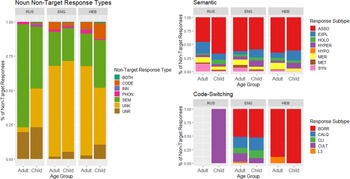
To address RQ4, we assessed non-target performance on nouns and verbs. Figure 2 shows a breakdown of each group's proportional non-target response type usage, in addition to non-target response subtypes for the “Semantic” and “Code-Switching” categories. The most common non-target response type for all HSs was “Unknown,” followed by “Semantic,” while the most common non-target response type for monolinguals was “Semantic,” followed by “Unrelated” for adults and “Unknown” for children.
Qualitative Non-Target Response Patterns on Nouns

The top three response types for each group within the “Semantic” non-target response category were as follows: Monolingual Adults: “Associative,” “Explanation,” “Synonym”. Monolingual Children: “Associative,” “Explanation,” “Holonym”. All adult HSs: “Associative,” “Meronym,” “Explanation”. All child HSs: “Associative,” “Explanation,” “Hypernym”. Thus, we observe that lexical strategies have both striking similarities and key differences between SLs and age groups.
Within the “Code-Switching” category, the most common response type for all HS groups was “Borrowing”. However, while among Israeli HSs this type contributed to 100% of all code-switching by children and an only slightly lower proportion for adults, American HSs used all subtypes of “Code-Switching” with only 50% “Borrowing”. Code-switching was not observed in monolingual adults, while one monolingual child used a “Culturalism” (dreidel instead of jula ‘a spinning top’).
Of note, while there were only a few noun innovations across all groups, they spanned several different forms of constructions, such that no two creative strategies were the same. These innovations include kran korovy ‘cow faucet’ for the target vymja ‘udder’’; sobach'ja mordnik ‘dog mordnik’ for namordnik ‘muzzle’; takaja maxalka ‘a waver like that’ for veer ‘fan’; trubilka, trubit’ derevo ‘trubilka, to trubit’ a tree’ for topor ‘ax’ (likely blending the ‘t’ sound in topor and the word rubit’ ‘to hew’, with the suffix ‘ka’ to form an instrument or tool). Thus, we observe that creative non-native-like responses span semantic and phonological associations, as well as mixed combinations therewithin.
Table 3 presents the results of Poisson regressions conducted on count data from the noun non-target response types. Effects of age and SL were found for “Semantic” and “Code-Switching” non-target responses. SL alone predicted “Phonological” and “Unknown” responses, while age alone predicted “Both phonological and semantic” and “Unrelated” responses. Neither age nor SL predicted “Innovations”. Subsequent Kruskal-Wallis non-parametric tests conducted on the two HS groups found a significant difference on the “Unknown” non-target response type. On all others, the groups did not differ.
Poisson Regressions for Noun Non-Target Response Types

*Fitted by the model: glm([Error Type] ~ Age_Group + SL, family = poisson, data = dataset))
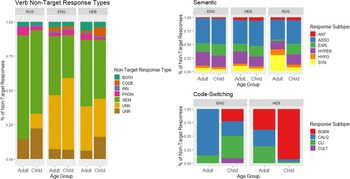
Figure 3 shows a breakdown of non-target response types, as well as “Semantic” and “Code-Switching” subtypes, for verbs. The top non-target response type for both monolinguals and Israeli HSs was “Semantic,” with “Unknown'' being the default non-target response for American HSs.
Qualitative Non-Target Response Patterns on Verbs

The top three response types for each group within the “Semantic” non-target response category were as follows: Monolingual Adults: “Associative,” “Synonym,” “Hypernym”. Adult HSs: “Associative,” “Hypernym,” “Explanation”. All Children, monolingual and HS: “Associative,” “Explanation,” “Hypernym”. As with nouns, only the monolingual adults resorted to synonyms in their top response inclinations, and “Associative” and “Hypernym” responses were common for all six groups.
For the “Code-Switching” non-target response type, Israeli child HSs once again dominated in “Borrowing,” while adults had nearly equal amounts of “Borrowing,” “Calques,” and “CLI”. This trend diverges from Israeli adult HSs’ performance on nouns, where they exhibited “Borrowing” almost exclusively. American adult HSs, in contrast, had 0 cases of “Borrowing,” and tended primarily towards “Calques,” while the top non-target response subtype for American child HSs was “CLI,” closely followed by “Calques” and “Borrowing,” with a few cases of “Culturalisms”.
The innovations provided by all groups on verbs indicate competence in Russian standard verb formation and creative attempts to fill in lexical gaps. Several participants added correct prefixes to semantically-related roots with a correct verb form (e.g. tochit’ ‘to sharpen’ – podostrevat’ ‘to make sharper’ with the prefix pod indicating ‘a little’ and the root ostriy ‘sharp’). Other examples used only a new root and a correct verb form, without the addition of prefixes (e.g. sushit’ ‘to dry’ – fenevat’ fenom ‘to fan with a fan’; zharit’ ’to fry’ – shashlikivat’ ‘to kebab’). The generic term delat’ was observed over 100 times (e.g. parit'sa ‘to steam’ – delat’ saunu ‘to do a sauna’; sushit’ ‘to dry’ – delat volosy ‘to do hair’ (calque from English) / delat’ fen ‘to do blowdryer’ (calque from Hebrew)). Several creative alternatives were presented for doit’ ‘to milk [a cow]’, including vysasyvat’ moloko iz korovy ‘to suck milk out of the cow’; vyduvat’ moloko iz korovy ‘to blow milk out of the cow’; vyzhymat’ korovu ‘to wring out the cow’; dobivat’ moloko ot korovy, where the word dobivat’ ‘to finish off’ or ‘to kill’ might alternately be a phonological error on the word dobyvat’ ‘to extract’; and krovtet’, a novel verb derived from the root korova ‘cow’.
Table 4 presents the results of Poisson regressions conducted on count data from the verb non-target response types. Both age and SL predicted “Semantic” and “Unknown” non-target responses. An exclusive effect of age was observed for “Code-Switching” and “Unrelated” non-target responses, while “Phonological,” “Both phonological and semantic,” and “Innovation” non-target responses were predicted only by SL. Subsequent Kruskal-Wallis non-parametric tests run on the HS groups found a significant difference only on “Code-Switching”.
Poisson Regressions for Verb Non-Target Response Types

*Fitted by the model: glm([Error Type] ~ Age_Group + SL, family = poisson, data = dataset))
3.1. Additional qualitative findings
No notable differences were observed between age groups or SLs on diminutive response forms or on responses of the incorrect lexical category. We did, however, note distinctions in performance across individual stimuli: Across the four HS groups, the top three nouns with the highest accuracy were glaz ‘eye’ (99% of responses were on target), jabloko ‘apple’ (98%), and ryba ‘fish’ (98%), while the bottom three were kobura ‘holster’ (5% of responses were on target), vymja ‘udder’ (7%), and venok ‘wreath’ (14%). For verbs, the top three most accurate stimuli were spat’ ‘to sleep’ (98%), smotret’ ‘to watch’ (95%) and igrat’ ‘to play’ (94%), while the bottom three were izvergat'sa ‘to erupt’ (4%), podmigivat’ ‘to wink’ (8%), and vysizhivat’ ‘to brood [eggs]’.
4. Discussion
Our study compared child and adult Russian HSs from Israel and the US on their noun and verb production accuracy. We investigated the effects of age group, SL, and psycholinguistic factors on quantitative and qualitative performance. Taking into consideration monolingual production trends, we further contextualized the HSs’ outcomes in terms of three accounts of HL development trajectories- attrition, frozen lexical development, and new language variety in a contact situation- as compared to a monolingual-like trajectory, wherein a child's lexical competencies advance and develop into adulthood.
The HS participants were matched between SL groups to age-corresponding peers, with few differences at a group level (see Section 2.1). Despite average uniformity at a group level, participants spanned the full available range (0%–100%) of nearly every background measure, with the following exceptions: SL level, use of Russian at work, and Israeli use of Russian at home. While we did not collect self-rating information from monolingual participants, we assume a considerably smaller span of variability in Russian use and proficiency across contexts, with children showing more variability than adults.
Our quantitative and qualitative analyses suggest that HL development trajectories may differ by SL and, more broadly, the sociolinguistic context in which the HL develops. Our findings show that previously proposed accounts of HL development are not mutually exclusive, and we observe aspects of the monolingual-like trajectory, frozen lexical development, and new language variety in a contact situation. No support was found at the group level for attrition, under which adult HSs lose previously developed vocabulary as HL input diminishes. We found no evidence that adult HSs significantly underperformed child HSs. It is possible that individual cases do exhibit attrition, but they would need to be investigated in a longitudinal study.
Additionally, we found an unexpected effect of lexical category in our results. While we did not initially intend to compare performance between nouns and verbs, we consistently found divisions in trajectory trends precisely along this categorical distinction. We generally observed that noun performance was more likely to diverge from the baseline, while verb performance followed a more monolingual-like trend. As our noun and verb stimuli were matched for SAoA and frequency, our results seem to support the explanation from Polinsky (Reference Polinsky2005) that verbs provide greater linguistic utility and are therefore preserved better, while nouns are more fragile and more easily replaced with generic placeholders. Below, we contextualize our findings regarding effects on performance accuracy, as they pertain to potential trajectories of HL development, while emphasizing the importance of input.
4.1. The importance of input
As we have shown in Section 1.1, input lies at the heart of each potential account of HL development. The primary factor which differentiates HSs from native monolinguals is the SL spoken in their environment: for monolinguals, the same language is used both at home and in their social/professional lives. For HSs, these languages are distinct, leading to comparatively less input in the HL, the use of which is restricted in time, context, and conversation partners (Polinsky, Reference Polinsky2018a). Understanding the state of HL input at both macroscopic and lexical levels presents a context through which we can tease apart different trajectories of HL development.
When considering input at the societal level, it suffices to examine the population proportions of Russian-speakers in Israel as compared to the US: in Israel, at least 15% of the national population speaks Russian. By contrast, in the US, Russian-speakers make up only .3%, with much less support for language maintenance at the societal level (see section 1.2). Despite these clear differences in input between the two sociolinguistic contexts, our results found that, when it comes down to input at the lexical level, all HSs and monolingual children follow well-documented trends in lexical acquisition.
On both nouns and verbs, we found that both word frequency and SAoA affected the likelihood of successful lexical acquisition in child and adult HSs, similarly to monolingual children, whereas monolingual adults maintained ceiling-level accuracy at all frequency levels. Monolingual children were less accurate on low frequency words but showed a near-ceiling effect on high frequency words. By contrast, HSs presented a clear effect of frequency, with below-50% accuracy at the lowest frequency levels and stronger performance at the highest. These findings were further corroborated qualitatively, as the stimuli with the least number of accurate responses on both nouns and verbs were also the least frequent (see section 3.1). The HSs’ divergence from the monolingual baseline and higher accuracy on higher-frequency stimuli supports findings from multiple studies reporting distinctions between monolingual and bilingual performance (Sullivan et al., Reference Sullivan, Poarch and Bialystok2018; Gharibi & Boers, Reference Gharibi and Boers2019).
On SAoA, our results showed that monolingual adults strayed slightly from the baseline on stimuli with high SAoAs, but otherwise maintained ceiling level. By contrast, monolingual children and all HSs exhibited an effect of SAoA, performing better on earlier-acquired stimuli, echoing previous findings from HSs and sequential bilinguals (Montrul & Foote, Reference Montrul and Foote2014; Altman et al., Reference Altman, Goldstein and Armon-Lotem2017; Izura & Ellis, Reference Izura and Ellis2004). Child and adult HS performance was similarly predicted across the board, but especially on nouns, suggesting that susceptibility to SAoA effects varies by lexical category.
The patterns exhibited by HSs on both frequency and SAoA in the present study underscore the central role input plays in lexical development and maintenance, as words acquired earlier and encountered more frequently are maintained better than those acquired later and encountered less often. Bearing in mind these input effects, we stratify the rest of our results by the best-fitting account of HL lexical development.
4.2. Monolingual-like trajectory
Starting with the null hypothesis, which stated that HL development would parallel monolingual patterns, our results showed that, indeed, all HSs exhibit a monolingual-like trajectory on verbs, with adults outperforming children. This trajectory, however, is a protracted version of the process undergone by monolinguals, as it is still susceptible to input limitations. Similar observations of protracted monolingual-like development were previously reported on various grammatical properties (Shin, Reference Shin and Potowski2018; Cuza & Miller, Reference Cuza, Miller, Klasen, Liceras and Valenzuela2015; Kupisch, Akpınar & Stöhr, Reference Kupisch, Akpınar and Stöhr2013).
Child HSs, as a groupFootnote 4, underperform monolingual children, but, as they grow older and their exposure to HL input increases, they eventually produce vocabulary at monolingual child accuracy levels in adulthood. This process occurs in parallel with increased SL input, as can be seen in the trajectory of the monolingual Russian speakers. As bilinguals age, they are introduced to new concepts and thus require terms for these concepts in both of their languages. Despite the competition between HL and SL input, and the nominally and relatively lower amounts of HL input as compared to that received by monolinguals, this trajectory still holds for HSs. Notably, these values are reported at an average, group-based level; HSs exhibit high heterogeneity in their proficiency, with some performing much better than others.
It appears that for verbs, where there is more exposure to Russian at the societal level, HSs will ultimately attain monolingual child levels. Where this level of input is not reached, as was the case for American HSs on nouns (subsection 4.4), baseline-level proficiency won't be, either. These findings echo results from Polinsky (Reference Polinsky2005) and Klassert et al. (Reference Klassert, Gagarina and Kauschke2014), who found that HSs exhibit a higher mastery of verbs than of nouns in the HL. Verbs in both groups show stable performance patterns and are less sensitive to societal input, while nouns demonstrate fragility for HS groups with less exposure to the HL.
In addition to quantitative results, we also observed qualitative findings supporting the monolingual-like trajectory. Although the number of “Semantic” non-target responses in both SL groups differs significantly from monolinguals, the overall tendencies for verbs clearly follow the monolingual trend. All six groups shared two out of their top three “Semantic” non-target response subtypes, suggesting that all speakers, regardless of age or SL, universally employ similar strategies of lexical retrieval in the face of uncertainty.
At all levels of analysis, from quantitative comparisons to qualitative non-target response types, and even within non-target response subtypes, we can find evidence for monolingual-like performance, whether expressed as a developmental trajectory in which adults outperform children on certain lexical categories, as a tendency to produce proportionately similar non-target response patterns, or as a shared preference for particular non-target response subtypes. Not all results pointed to this account of HL development, however, and below we discuss additional evidence from our results.
4.3. Frozen lexical development
Although Israeli HSs generally, and American HSs on verbs, exhibit a monolingual-like development trajectory, it is important to note that, as a group, adult HSs only achieve the level of monolingual children; they do not exceed it. Thus, following our predictions for this trajectory, this appears to be a form of frozen development, as even with increased input over time, the HSs’ lexicon flatlines upon reaching the monolingual child level.
Qualitatively, on nouns, the top two “Semantic” non-target response subtypes for monolinguals and for both sets of child HSs were “Associative” and “Explanation”. Altman et al. (Reference Altman, Goldstein and Armon-Lotem2017) explain that associative non-target responses are likely the result of a struggle to express a term for which a representation exists in the lexicon. Thus, it is logical that this would be the top non-target response subtype in all six groups, regardless of age or SL. Our findings mirror results from Ringblom and Dobrova (Reference Ringblom and Dobrova2019), who found that both HSs and monolingual children produce “Associative,” “Explanation,” and “Holonym” non-target responses. Our child participants’ use of generalizations and less-specific terms across the board echoes findings from Kopotev et al. (Reference Kopotev, Kisselev and Polinsky2020) and Klapicová (Reference Klapicová2018), who identified this effect in HSs. Interestingly, in children, we do not find the inclination toward overly-specific terms as was observed by Makarova and Terekhova (Reference Makarova and Terekhova2020). We do, however, find this tendency in adult HSs, for whom “Meronym” is a top non-target response subtype.
On verbs, the top three “Semantic” non-target response subtypes were shared amongst all child participants. This was the exact same set exhibited by child HSs on nouns. As with nouns, this finding supports previous research (mentioned above) demonstrating a penchant for over-generalizations. For all adult HSs, the top three subtypes matched the child HSs in a slightly different order. This is a clear distinction from the adult HSs’ performance on nouns, where they opted for “Meronyms,” a more specific term, over a generalization. By contrast, monolingual adults’ top three non-target response subtypes included “Synonyms,” which demonstrates linguistic mastery, expected from monolinguals at ceiling proficiency. Thus, the uniform patterns of monolingual children and all HSs in their “Semantic” non-target response patterns demonstrate frozen development, rather than a monolingual trend.
We begin to see that the divide between the different accounts is not clearly delineated as, quantitatively, Israeli HSs (and American HSs on verbs) exhibit both a monolingual-like trajectory and frozen development. Qualitatively, although two out of the top three “Semantic” non-target response subtypes were common to all six groups including monolinguals, the third sheds light on a new pattern: all children, HS and monolingual, tend to use generalizations. On verbs, this tendency proceeded into adulthood, while on nouns it evolved in a new direction. In the following section, we explore results where not only adults, but also children, diverge from the monolingual baseline.
4.4. New language variety in a contact situation
While in the previous two sections we discussed two clearly-defined potential trajectories of HL development, there is no single path to divergence within the account of a new language variety in a contact situation. Rather than looking for a specific set of results, we sought findings that characterized divergence (a) between the two SL groups and (b) between HS age groups and monolingual-like trends. Indeed, quantitatively, on nouns, we see a divergence by SL. While Israeli HSs perform analogously on nouns and verbs, American adults do not outperform American children, their noun lexicons remaining frozen at a level below that of monolingual children. Recall that the two groups of adult HSs were matched on our input measure “Russian Use at Home,” but diverged on “Russian Use at Work”. This latter measure serves as an approximation for input at the societal level. We attribute the divergent performance between the Israeli and American groups to these societal input differences, combined with the challenges posed in noun production (Polinsky, Reference Polinsky2005; Klassert et al., Reference Klassert, Gagarina and Kauschke2014).
Qualitatively, we begin by considering “Code-Switching” non-target response subtypes, as these patterns most clearly point to the development of a new language variety in a contact situation. Recall that this category included the subtypes “Borrowing,” “Calque,” “Culturalism,” and “L3”. On “Code-Switching” non-target responses on nouns, 100% of Israeli child HSs used “Borrowing,” wherein they responded to a prompt directly in their SL. For Israeli adult HSs this tendency was almost identical, with a few instances of L3 influence (from English). American HSs of all age groups, by contrast, presented a fairly even distribution of all non-target response subtypes. These results appear to contradict cross-linguistic comparisons from Kagan et al. (Reference Kagan, Minkov, Protassova and Schwartz2021), who did not find that “Code-Switching” patterns differ by SL. On “Code-Switching” non-target responses on verbs, Israeli child HSs again tended overwhelmingly toward “Borrowing,” while Israeli adult HSs were more balanced across the non-target response subtypes. Interestingly, this tendency was reversed for American HSs: children produced all the non-target response subtypes evenly, while adults showed a clear dominant trend. However, unlike Israeli child HSs who used “Borrowing,” American adult HSs almost exclusively used “Calques,” or direct translations from English expressions. This latter finding supports observations from Rakhilina et al. (Reference Rakhilina, Vyrenkova and Polinsky2016), who also noticed a trend in American adult HSs to choose “Calques” over “Borrowing”. This clearly demonstrates the evolution of a new language variety in a contact situation, as the same concept yields a new HL output under the influence of the SL. Matras (Reference Matras2007) suggested that nouns would be more susceptible to “Borrowing” than verbs, and indeed, we found that, on nouns, “Borrowing” constituted the vast majority of non-target response subtypes of all HSs across age groups and SLs, while on verbs, only Israeli child HSs exceeded 50%. In large part due to this high prevalence of “Borrowing”, “Code-Switching” was the only non-target response type that Israeli HSs produced significantly more than American HSs.
The patterns of “Code-Switching” non-target response subtypes on verbs alone do not lend themselves to generalization across either axis- SL or age group. When combined with patterns from nouns, we see a clear preference for “Borrowing” among Israeli HSs, and no overarching preference among American HSs. The tendency for “Borrowing” among Israeli HSs fits the thoroughly-documented phenomenon of Hebrew penetration into HL-Russian speech (Remennick, Reference Remennick2003). This phenomenon has been observed at all proficiency levels among both HSs and Russian-dominant immigrant and is highly characteristic of the strong influence of Hebrew over its contact languages in Israel (Meir et al., Reference Meir, Joffe, Shabtaev, Walters, Armon-Lotem, Montrul and Polinsky2021b).
We thus find both quantitative and qualitative evidence to support the account of a new language variety in a contact situation. Diverse “Code-Switching” patterns in both groups of HSs point to a clear shift away from the monolingual baseline in light of SL influence to varying degrees (Israeli HSs code-switched significantly more than Americans). Quantitatively, divergence from the baseline was observed only on nouns and only among Americans, suggesting a divide in trajectory as a function of lexical category and sociolinguistic context, in tandem.
4.5. Future directions
As part of the present work, we analyzed over 20,000 individual naming responses. At this scale, our study was not without its limitations, which could be built upon in future iterations of this work.
First, it may be worthwhile to expand the experimental task beyond picture-naming alone, something we were unable to include considering the already-large scope of the current study. For example, such a project could include narrative production data or comprehension tasks. Within the picture-naming task itself, when participants misunderstood the stimulus, they were not prompted further, as was done by Ramsay et al. (Reference Ramsay, Nicholas, Au, Obler and Albert1999). Prompting would likely reduce the number of “Unrelated” responses, leading to either a better representation of accuracy or a more representative distribution of other non-target response types.
Our results found a significant effect of input on quantitative and qualitative performance. We presented major differences between Standard Russian and the HL-Russian in Israel and in the US and connected these distinctions with the two input metrics we collected in our questionnaire- Russian Use at Home and Russian Use at Work. While these metrics are aligned with the macroscopic picture, a deeper investigation into various levels of input at the individual level will provide a more precise view of participants’ exposure to and interactions with the HL.
Further considering our participant population, the age range of our child participants, while controlled across age-matched groups, was quite wide, and it is therefore plausible that the older children would have shifted to SL dominance while the younger children were still HL-dominant or more balanced. Thus, in a future iteration of this study, the age range could be further constricted. In the same vein, future iterations should collect data on the origins of the parents of HSs born in their SL-speaking countries. In this way, we could better match the participants’ language experiences to those of our monolinguals. An additional consideration would be matching the monolingual and bilingual groups. In such an iteration, we would collect additional data from the monolinguals (on language exposure, SES, etc) to confirm between-group matching.
Finally, while we focus on language proficiency characteristics among child and adult HSs from different countries, a notable factor to consider is the impact of generational change. Trends in immigration waves and societal attitudes of the HL are likely to differ in the US and Israel between the upbringing of the adult HSs and the child HSs.
5. Conclusion
The present work investigated quantitative and qualitative production accuracy of nouns and verbs in HL-Russian among adult and child monolinguals, and among HSs in Israel and the US. We considered the effects of age, SL, and input factors, as well as multiple diverging accounts of the trajectory of HL development. Combining all these variables in one comprehensive study allowed us to paint a sweeping picture of HL development and determine which findings can be generalized and which are unique to a specific group.
We concluded that accounts of HL development trajectories are not mutually exclusive and can vary by both SL and by lexical category. While we did not find evidence to support the account of attrition, we did find quantitative and qualitative examples of a monolingual-like trajectory (wherein adults outperform children), frozen lexical development (wherein child HSs match both adult HSs and monolingual children), and the emergence of a new language variety in a contact situation (wherein HSs diverge from monolingual performance). Specifically, we found that societal input and lexical categories modulate the extent to which one or another of these trajectories is observed.
Building on our findings, we recommend that HL programs focus on strengthening noun vocabulary, as we found it is more susceptible to SL influence than verb vocabulary. To further assess the generalizability of our findings, we recommend replicating our study in other pairs of countries with more and less prominent HL-Russian communities (e.g., Germany and Spain, respectively). Doing so will provide a broad and data-backed perspective on divergent trends in HL lexical development around the world.
Acknowledgements
The authors would like to thank all the participants of the study for their participation. We also thank Leah Moiseev and Tatiana Verkhovtceva for their help with data collection. This study was supported by the Israel Science Foundation (ISF) Grant No. 552/21 “Towards Understanding Heritage Language Development: The Case of Child and Adult Heritage Russian in Israel and the USA” granted to Dr. Natalia Meir.
Data Availability Statement
Data will be made available upon request.
Supplementary Material
For supplementary material accompanying this paper, visit https://doi.org/10.1017/S1366728923000147
Table S1A. Nouns, taken from Akinina et al. (Reference Akinina, Malyutina, Ivanova, Iskra, Mannova and Dragoy2015)'s “Noun and object: stimuli database”
A table with the selected noun stimuli, translation, stability, frequency, and age of acquisition.
Table S1B.Verbs, taken from Akinina et al. (Reference Akinina, Malyutina, Ivanova, Iskra, Mannova and Dragoy2015)'s “Verb and action: stimuli database”
A table with the selected verb stimuli, translation, stability, frequency, and age of acquisition.
Table S2. Post-hoc Pairwise Comparisons for Nouns and Verbs Testing Age Group * SL Interactions
A table comparing HSs’ noun and verb performance within age groups, within SLs, and with monolingual children.
Figure S3: Predicted Effects of Lexical Frequency and SAoA on Noun and Verb Production Accuracy
A figure showing results of a logistic regression measuring the noun and verb production accuracies based on lexical frequency and SAoA for each SL group.





 Open access

