





1. Introduction
The Fermat threefold of degree $q+1$
is perhaps the most familiar example of a q-bic threefold, that is, a hypersurface in projective
$q+1$
is perhaps the most familiar example of a q-bic threefold, that is, a hypersurface in projective $4$
-space of the form
$4$
-space of the form

where q is a power of the ground field characteristic $p> 0$
. Such hypersurfaces have long been of recurring interest due to, for example: idiosyncrasies in their differential projective geometry [Reference Beauville3], [Reference Hefez21], [Reference Kleiman and Piene31], [Reference Noma40], [Reference Wallace56]; their abundance of algebraic cycles and relation to supersingularity [Reference Hotta and Matsui25], [Reference Shimada48], [Reference Shioda and Katsura50], [Reference Tate53], [Reference Weil57]; and their unirationality and geometry of rational curves [Reference Bridges, Datta, Eddy, Newman and Yu6], [Reference Conduché12], [Reference Shen47], [Reference Shioda49]. They classically arise in relation to finite Hermitian geometries [Reference Bose and Chakravarti4], [Reference Hirschfeld22], [Reference Hirschfeld23], [Reference Segre46]; the study of unitary Shimura varieties [Reference Li and Zhang35], [Reference Liu, Tian, Xiao, Zhang and Zhu36], [Reference Vollaard55]; and Deligne–Lusztig theory for finite unitary groups [Reference Deligne and Lusztig14], [Reference Hansen19], [Reference Li34], [Reference Lusztig37]. Such hypersurfaces are distinguished in [Reference Kadyrsizova, Kenkel, Page, Singh, Smith, Vraciu and Witt29] from the point of view of singularity theory as those with the lowest possible F-pure threshold. See [Reference Cheng8, pp. 7–11] for a more extensive survey.
$p> 0$
. Such hypersurfaces have long been of recurring interest due to, for example: idiosyncrasies in their differential projective geometry [Reference Beauville3], [Reference Hefez21], [Reference Kleiman and Piene31], [Reference Noma40], [Reference Wallace56]; their abundance of algebraic cycles and relation to supersingularity [Reference Hotta and Matsui25], [Reference Shimada48], [Reference Shioda and Katsura50], [Reference Tate53], [Reference Weil57]; and their unirationality and geometry of rational curves [Reference Bridges, Datta, Eddy, Newman and Yu6], [Reference Conduché12], [Reference Shen47], [Reference Shioda49]. They classically arise in relation to finite Hermitian geometries [Reference Bose and Chakravarti4], [Reference Hirschfeld22], [Reference Hirschfeld23], [Reference Segre46]; the study of unitary Shimura varieties [Reference Li and Zhang35], [Reference Liu, Tian, Xiao, Zhang and Zhu36], [Reference Vollaard55]; and Deligne–Lusztig theory for finite unitary groups [Reference Deligne and Lusztig14], [Reference Hansen19], [Reference Li34], [Reference Lusztig37]. Such hypersurfaces are distinguished in [Reference Kadyrsizova, Kenkel, Page, Singh, Smith, Vraciu and Witt29] from the point of view of singularity theory as those with the lowest possible F-pure threshold. See [Reference Cheng8, pp. 7–11] for a more extensive survey.
The purpose of this work is to further develop a striking analogy between the geometry of lines in q-bic and cubic hypersurfaces, and also to suggest a flexible framework with which to understand some of the resulting phenomena. To explain, let $\mathbf {k}$
be, here and throughout, an algebraically closed field of characteristic
$\mathbf {k}$
be, here and throughout, an algebraically closed field of characteristic $p> 0$
, and q a fixed power of p. Let X be a smooth q-bic threefold over
$p> 0$
, and q a fixed power of p. Let X be a smooth q-bic threefold over $\mathbf {k}$
, and write S for its Fano scheme of lines. The main results of [Reference Cheng10], specialized to dimension
$\mathbf {k}$
, and write S for its Fano scheme of lines. The main results of [Reference Cheng10], specialized to dimension $3$
, are as follows.
$3$
, are as follows.
Theorem. The scheme S of lines of a smooth q-bic threefold X is an irreducible, smooth, projective surface of general type. The Fano correspondence $S \leftarrow \mathbf {L} \rightarrow X$
induces purely inseparable isogenies
$S \leftarrow \mathbf {L} \rightarrow X$
induces purely inseparable isogenies
 $$\begin{align*}\mathbf{Alb}_S \xrightarrow{\mathbf{L}_*} \mathbf{Ab}_X^2 \xrightarrow{\mathbf{L}^*} \mathbf{Pic}_{S,\mathrm{red}}^0 \end{align*}$$
amongst supersingular abelian varieties of dimension $\frac {1}{2}q(q-1)(q^2+1)$
.
$\frac {1}{2}q(q-1)(q^2+1)$
.
Here, $\mathbf {Ab}_X^2$
is the intermediate Jacobian of X, taken to be the algebraic representative for algebraically trivial
$\mathbf {Ab}_X^2$
is the intermediate Jacobian of X, taken to be the algebraic representative for algebraically trivial $1$
-cycles in X, in the sense of Samuel and Murre, see [Reference Beauville2], [Reference Murre39], [Reference Samuel44]; see [Reference Cheng10, Section 6.9] for a resumé. The statement is analogous to the classical result [Reference Clemens and Griffiths11, Theorem 11.19] of Clemens and Griffiths, which states that the Hodge-theoretic intermediate Jacobian of a complex cubic threefold is isomorphic to the Albanese variety of its Fano surface of lines. The geometry underlying the proofs also shares many analogies; compare especially with [Reference Huybrechts27, Chapter 5]. Note that when
$1$
-cycles in X, in the sense of Samuel and Murre, see [Reference Beauville2], [Reference Murre39], [Reference Samuel44]; see [Reference Cheng10, Section 6.9] for a resumé. The statement is analogous to the classical result [Reference Clemens and Griffiths11, Theorem 11.19] of Clemens and Griffiths, which states that the Hodge-theoretic intermediate Jacobian of a complex cubic threefold is isomorphic to the Albanese variety of its Fano surface of lines. The geometry underlying the proofs also shares many analogies; compare especially with [Reference Huybrechts27, Chapter 5]. Note that when $q = 2$
, X is a cubic threefold in characteristic
$q = 2$
, X is a cubic threefold in characteristic $2$
, and this gives a version of the theorem of Clemens and Griffiths, which is, in fact, new.
$2$
, and this gives a version of the theorem of Clemens and Griffiths, which is, in fact, new.
The Fano scheme S is the primary object of study in this work and is henceforth referred to as the Fano surface of lines of X. To begin, refining the general techniques developed in [Reference Cheng10] gives explicit computations of some basic invariants of S. In the following statement, $\mathcal {S}$
denotes the tautological rank
$\mathcal {S}$
denotes the tautological rank $2$
subbundle, and
$2$
subbundle, and $\mathcal {O}_S(1)$
is the Plücker line bundle on S.
$\mathcal {O}_S(1)$
is the Plücker line bundle on S.
Theorem A. The tangent bundle $\mathcal {T}_S$
of the Fano surface S of a smooth q-bic threefold X is isomorphic to
$\mathcal {T}_S$
of the Fano surface S of a smooth q-bic threefold X is isomorphic to $\mathcal {S} \otimes \mathcal {O}_S(2-q)$
. Basic numerical invariants of S are
$\mathcal {S} \otimes \mathcal {O}_S(2-q)$
. Basic numerical invariants of S are
 $$\begin{align*}\begin{gathered} c_1(S)^2 = (q+1)^2(q^2+1)(2q-3)^2,\;\;\;\; c_2(S) = (q+1)^2(q^4 - 3q^3 + 4q^2 - 4q + 3),\;\text{and} \\ \chi(S,\mathcal{O}_S) = \frac{1}{12}(q+1)^2(5q^4 - 15q^3 + 17q^2 - 16q + 12). \end{gathered} \end{align*}$$
If $q> 2$
, then S lifts neither to the second Witt vectors nor to characteristic
$q> 2$
, then S lifts neither to the second Witt vectors nor to characteristic $0$
.
$0$
.
This is an amalgamation of 2.11, 2.12, and 2.13. The identification of $\mathcal {T}_S$
is an analog of the tangent bundle theorem [Reference Clemens and Griffiths11, Proposition 12.31] of Clemens and Griffiths (see also [Reference Altman and Kleiman1, Theorem 1.10]). That S does not lift to the Witt vectors is because it violates Kodaira–Akizuki–Nakano vanishing, and not to characteristic
$\mathcal {T}_S$
is an analog of the tangent bundle theorem [Reference Clemens and Griffiths11, Proposition 12.31] of Clemens and Griffiths (see also [Reference Altman and Kleiman1, Theorem 1.10]). That S does not lift to the Witt vectors is because it violates Kodaira–Akizuki–Nakano vanishing, and not to characteristic $0$
because it violates the Bogomolov–Miyaoka–Yau inequality
$0$
because it violates the Bogomolov–Miyaoka–Yau inequality $c_1(S)^2 \leq 3c_2(S)$
. As such, S is a purely positive characteristic phenomenon, and the analogy with cubics serves as a valuable guide in a setting where classical geometric intuitions are less potent.
$c_1(S)^2 \leq 3c_2(S)$
. As such, S is a purely positive characteristic phenomenon, and the analogy with cubics serves as a valuable guide in a setting where classical geometric intuitions are less potent.
Non-liftability also means that few vanishing theorems are available, presenting a major difficulty in coherent cohomology computations. Nonetheless, when q is the prime p itself, cohomology of the structure sheaf $\mathcal {O}_S$
behaves as well as possible.
$\mathcal {O}_S$
behaves as well as possible.
Theorem B. Let X be a smooth q-bic threefold and S its Fano surface. If $q = p$
, then
$q = p$
, then
 $$ \begin{align*} \dim_{\mathbf{k}}\mathrm{H}^1(S,\mathcal{O}_S) & = \frac{1}{2}p(p-1)(p^2+1) = \frac{1}{2}\dim_{\mathbf{Q}_\ell}\mathrm{H}^1_{\mathrm{\acute{e}t}}(S,\mathbf{Q}_\ell), \;\text{and} \\ \dim_{\mathbf{k}}\mathrm{H}^2(S,\mathcal{O}_S) & = \frac{1}{12}p(p-1)(5p^4 - 2p^2 - 5p - 2). \end{align*} $$
In particular, the Picard scheme of S is smooth.
First cohomology is computed in 8.7, at which point second cohomology is determined by the Euler characteristic computation above. This result, together with the methods developed, provides a first step toward understanding the precise relationship amongst the abelian varieties $\mathbf {Alb}_S$
,
$\mathbf {Alb}_S$
, $\mathbf {Ab}_X^2$
, and
$\mathbf {Ab}_X^2$
, and $\mathbf {Pic}^0_{S,\mathrm {red}} = \mathbf {Pic}^0_S$
appearing in the analog of the Clemens–Griffiths theorem quoted above.
$\mathbf {Pic}^0_{S,\mathrm {red}} = \mathbf {Pic}^0_S$
appearing in the analog of the Clemens–Griffiths theorem quoted above.
The method involves a delicate degeneration argument. General considerations show that the dimension of $\mathrm {H}^1(S,\mathcal {O}_S)$
is at least half the first Betti number. A corresponding upper bound might be obtained via upper semicontinuity as follows: Specialize S to a singular surface
$\mathrm {H}^1(S,\mathcal {O}_S)$
is at least half the first Betti number. A corresponding upper bound might be obtained via upper semicontinuity as follows: Specialize S to a singular surface $S_0$
by specializing X to a q-bic threefold
$S_0$
by specializing X to a q-bic threefold $X_0$
with the mildest possible singularities; precisely, in terms of the classification of [Reference Cheng9, Theorem A],
$X_0$
with the mildest possible singularities; precisely, in terms of the classification of [Reference Cheng9, Theorem A], $X_0$
is of type
$X_0$
is of type $\mathbf {1}^{\oplus 3} \oplus \mathbf {N}_2$
, and there is a choice of coordinates such that
$\mathbf {1}^{\oplus 3} \oplus \mathbf {N}_2$
, and there is a choice of coordinates such that

Although $S_0$
is quite singular, its normalization is quite manageable. The result is as follows.
$S_0$
is quite singular, its normalization is quite manageable. The result is as follows.
Theorem C. The Fano surface $S_0$
of a q-bic threefold
$S_0$
of a q-bic threefold $X_0$
of type
$X_0$
of type $\mathbf {1}^{\oplus 3} \oplus \mathbf {N}_2$
is nonnormal, and its normalization
$\mathbf {1}^{\oplus 3} \oplus \mathbf {N}_2$
is nonnormal, and its normalization $S_0^\nu $
is a projective bundle over a smooth q-bic curve C. There is a commutative diagram
$S_0^\nu $
is a projective bundle over a smooth q-bic curve C. There is a commutative diagram

where $\phi _C \colon C \to C$
is conjugate to the
$\phi _C \colon C \to C$
is conjugate to the $q^2$
-power geometric Frobenius morphism of C. If
$q^2$
-power geometric Frobenius morphism of C. If $q = p$
, then
$q = p$
, then
 $$ \begin{align*} \dim_{\mathbf{k}} \mathrm{H}^1(S_0,\mathcal{O}_{S_0}) & = \frac{1}{2}p(p-1)(p^2+1) + \frac{1}{6}p(p-1)(p-2),\;\;\text{and}\\ \dim_{\mathbf{k}} \mathrm{H}^2(S_0,\mathcal{O}_{S_0}) & = \frac{1}{12}p(p-1)(5p^4 - 2p^2 - 5p - 2) + \frac{1}{6}p(p-1)(p-2). \end{align*} $$
This collects 5.8, 5.13, and 7.12. See also 7.13 for remarks about extending the calculation to general q. The normalization $S_0^\nu $
is constructed, roughly, as the space of lines in
$S_0^\nu $
is constructed, roughly, as the space of lines in $X_0$
that project to a tangent of C. Cohomology of
$X_0$
that project to a tangent of C. Cohomology of $\mathcal {O}_{S_0}$
is determined by using the diagram to relate it to a vector bundle computation C; using group schemes
$\mathcal {O}_{S_0}$
is determined by using the diagram to relate it to a vector bundle computation C; using group schemes $\mathbf {G}_m$
and
$\mathbf {G}_m$
and $\boldsymbol {\alpha }_p$
in the automorphism group of
$\boldsymbol {\alpha }_p$
in the automorphism group of $S_0$
to reduce to a manageable set of computations; and using modular representation theory of the finite unitary group
$S_0$
to reduce to a manageable set of computations; and using modular representation theory of the finite unitary group $\mathrm {U}_3(p)$
, essentially the automorphism group of C, to make explicit identifications.
$\mathrm {U}_3(p)$
, essentially the automorphism group of C, to make explicit identifications.
Alarmingly, upon comparing Theorems B and C, one finds that the cohomology groups of the special fiber $S_0$
are much larger than one would hope. Upper semicontinuity therefore only shows
$S_0$
are much larger than one would hope. Upper semicontinuity therefore only shows
 $$\begin{align*}\frac{1}{2}p(p-1)(p^2+1) \leq \dim_{\mathbf{k}}\mathrm{H}^1(S,\mathcal{O}_S) \leq \frac{1}{2}p(p-1)(p^2+1) + \frac{1}{6}p(p-1)(p-2). \end{align*}$$
The upper bound can be refined by carefully analyzing a specially chosen degeneration $S \rightsquigarrow S_0$
. Specifically, there exists a flat family
$S \rightsquigarrow S_0$
. Specifically, there exists a flat family $\mathfrak {S} \to \mathbf {A}^1$
in which all fibers away from the central fiber
$\mathfrak {S} \to \mathbf {A}^1$
in which all fibers away from the central fiber $S_0$
are isomorphic to S, and which carries a
$S_0$
are isomorphic to S, and which carries a $\mathbf {G}_m$
action compatible with the weight
$\mathbf {G}_m$
action compatible with the weight $q^2-1$
homothety on the base
$q^2-1$
homothety on the base $\mathbf {A}^1$
. The geometric theory of filtrations—the correspondence between filtrations and
$\mathbf {A}^1$
. The geometric theory of filtrations—the correspondence between filtrations and $\mathbf {G}_m$
-equivariant objects over
$\mathbf {G}_m$
-equivariant objects over $\mathbf {A}^1$
as pioneered in Simpson’s work [Reference Simpson51] on nonabelian Hodge theory—endows
$\mathbf {A}^1$
as pioneered in Simpson’s work [Reference Simpson51] on nonabelian Hodge theory—endows $\mathrm {H}^1(S,\mathcal {O}_S)$
with a filtration whose graded pieces are various graded pieces of
$\mathrm {H}^1(S,\mathcal {O}_S)$
with a filtration whose graded pieces are various graded pieces of $\mathrm {H}^1(S_0,\mathcal {O}_{S_0})$
. A careful analysis identifies
$\mathrm {H}^1(S_0,\mathcal {O}_{S_0})$
. A careful analysis identifies $\frac {1}{6}p(p-1)(p-2)$
cohomology classes on
$\frac {1}{6}p(p-1)(p-2)$
cohomology classes on $S_0$
that do not lift to classes on S. With this, the upper semicontinuity bound becomes tight, completing the calculation. This use of the geometric theory of filtrations in determining cohomology appears to be new, and I expect that the method can be generalized and refined to be applied in other settings.
$S_0$
that do not lift to classes on S. With this, the upper semicontinuity bound becomes tight, completing the calculation. This use of the geometric theory of filtrations in determining cohomology appears to be new, and I expect that the method can be generalized and refined to be applied in other settings.
Crucial to the degeneration argument is the construction of a fibration $\varphi \colon S \to C$
on the smooth Fano surface that specializes to
$\varphi \colon S \to C$
on the smooth Fano surface that specializes to $\varphi _- \colon S_0 \to C$
as in Theorem C. This is done using a general projective geometry method, which may be adapted to other settings, exploiting the presence of cone points: points at which the tangent space intersects the hypersurface X at a cone over a curve C; these generalize Eckardt points of cubic hypersurfaces, and are sometimes also called star points. A combination of projection and intersection with a hyperplane induces a rational map
$\varphi _- \colon S_0 \to C$
as in Theorem C. This is done using a general projective geometry method, which may be adapted to other settings, exploiting the presence of cone points: points at which the tangent space intersects the hypersurface X at a cone over a curve C; these generalize Eckardt points of cubic hypersurfaces, and are sometimes also called star points. A combination of projection and intersection with a hyperplane induces a rational map $S \dashrightarrow C$
, which can be resolved in this setting using global methods made possible by the intrinsic theory of q-bic forms developed in [Reference Cheng9]. A summary of the geometric situation is as follows.
$S \dashrightarrow C$
, which can be resolved in this setting using global methods made possible by the intrinsic theory of q-bic forms developed in [Reference Cheng9]. A summary of the geometric situation is as follows.
Theorem D. Let X be a q-bic threefold either smooth or of type $\mathbf {1}^{\oplus 3} \oplus \mathbf {N}_2$
, and S its Fano surface. A choice of cone point in X over a smooth q-bic curve C induces a canonical diagram
$\mathbf {1}^{\oplus 3} \oplus \mathbf {N}_2$
, and S its Fano surface. A choice of cone point in X over a smooth q-bic curve C induces a canonical diagram

where $\varphi _*\mathcal {O}_S \cong \pi _*\mathcal {O}_T \cong \mathcal {O}_C$
,
$\varphi _*\mathcal {O}_S \cong \pi _*\mathcal {O}_T \cong \mathcal {O}_C$
, $b \colon \tilde {S} \to S$
is a blowup along
$b \colon \tilde {S} \to S$
is a blowup along $q^3+1$
smooth points, and
$q^3+1$
smooth points, and $\rho \colon \tilde {S} \to T$
is a quotient by either
$\rho \colon \tilde {S} \to T$
is a quotient by either $\mathbf {F}_q$
or
$\mathbf {F}_q$
or $\boldsymbol {\alpha }_q$
depending on whether X is smooth or singular. Furthermore, T is an explicit rank
$\boldsymbol {\alpha }_q$
depending on whether X is smooth or singular. Furthermore, T is an explicit rank $1$
degeneracy locus in a product of projective bundles over C.
$1$
degeneracy locus in a product of projective bundles over C.
This is a summary of 3.5, 3.10, 4.4, 4.5, 4.7, 4.9, and 4.10. The techniques developed here, and more generally in [Reference Cheng8, Appendix A], may be adapted to study linear spaces in other projective varieties. For instance, projection from a cone point maps the scheme of r-planes in an n-fold to the scheme of $(r-1)$
-planes in an
$(r-1)$
-planes in an $(n-2)$
-fold, providing an inductive method to study Fano schemes. This method gives a geometric construction of some classically known structures, such as the fibration constructed in [Reference Roulleau43, Section 3.2].
$(n-2)$
-fold, providing an inductive method to study Fano schemes. This method gives a geometric construction of some classically known structures, such as the fibration constructed in [Reference Roulleau43, Section 3.2].
To close the Introduction, I would like to sketch a perspective with which to contextualize the results at hand. As the prime power q varies, q-bic hypersurfaces are of different degrees and are even defined over different characteristics. Yet in many respects, they ought to be viewed as constituting a single family. One way to make sense of this might be to say that they are constructed “uniformly with respect to q.” This may be formulated in terms of the shape of the defining equations, but perhaps a more flexible and geometric way is to realize a q-bic hypersurface X as the intersection
 $$\begin{align*}X = \Gamma_q \cap Z \subset \mathbf{P}^n \times_{\mathbf{k}} \mathbf{P}^n \end{align*}$$
between the graph $\Gamma _q$
of the q-power Frobenius morphism, and a
$\Gamma _q$
of the q-power Frobenius morphism, and a $(1,1)$
-divisor Z. The Fano surface S also fits into this point of view: take the ambient variety to be the Grassmannian
$(1,1)$
-divisor Z. The Fano surface S also fits into this point of view: take the ambient variety to be the Grassmannian $\mathbf {G}$
, and take Z to be the zero locus in
$\mathbf {G}$
, and take Z to be the zero locus in $\mathbf {G} \times _{\mathbf {k}} \mathbf {G}$
of a general section of the vector bundle
$\mathbf {G} \times _{\mathbf {k}} \mathbf {G}$
of a general section of the vector bundle $\mathcal {S}^\vee \boxtimes \mathcal {S}^\vee $
.
$\mathcal {S}^\vee \boxtimes \mathcal {S}^\vee $
.
This point of view highlights the prime power q and the scheme Z as the parameters of construction. What should it mean that varying q yields schemes of the same family? Consider the more familiar matter of fixing q and varying Z: Traditionally, those deformations of X or S that are of the same family are those obtained by flatly varying Z, and this is justified in part by the constancy of geometric invariants. When varying q, it is generally too much to ask for invariants to remain constant, but one could hope that invariants vary in a simple way with respect to q. One particularly pleasant, albeit optimistic, condition would be to ask for Euler characteristics or, stronger, for dimensions of cohomology groups to vary as a polynomial in q. This is true of q-bic hypersurfaces, and Theorems B and C may be understood as saying the stronger condition of constancy of cohomological invariants holds also for the Fano surfaces of q-bic threefolds, at least when q varies only over primes p. I believe it is an interesting problem to find more examples of this type of phenomenon.
Finally, observe that if $\mathbf {P}^n$
and
$\mathbf {P}^n$
and $\mathbf {G}$
were to be replaced by more general ambient varieties
$\mathbf {G}$
were to be replaced by more general ambient varieties $\mathrm {P}$
, and Z allowed to be subschemes not necessarily cut out by sections of vector bundles, even Euler characteristics cannot vary as simply as a polynomial in q: indeed, by taking Z to be the diagonal, this would count points of
$\mathrm {P}$
, and Z allowed to be subschemes not necessarily cut out by sections of vector bundles, even Euler characteristics cannot vary as simply as a polynomial in q: indeed, by taking Z to be the diagonal, this would count points of $\mathrm {P}$
over finite fields. However, the Weil conjectures show that, even then, there is structure amongst the numbers and, taken together, they give insight into the geometry of
$\mathrm {P}$
over finite fields. However, the Weil conjectures show that, even then, there is structure amongst the numbers and, taken together, they give insight into the geometry of $\mathrm {P}$
. My hope is that, by circumscribing the class of ambient schemes
$\mathrm {P}$
. My hope is that, by circumscribing the class of ambient schemes $\mathrm {P}$
and subschemes Z, this line of study may lead to new and interesting structures in positive characteristic geometry.
$\mathrm {P}$
and subschemes Z, this line of study may lead to new and interesting structures in positive characteristic geometry.
Outline: Section 2 begins with a summary of the theory of q-bic forms and hypersurfaces, as developed in [Reference Cheng9], [Reference Cheng10]; the latter half refines these methods in order to establish Theorem A. Sections 3 and 4 construct and study a rational map $S \dashrightarrow C$
from the Fano surface to a q-bic curve, establishing Theorem D. These methods are applied to study q-bic threefolds of type
$S \dashrightarrow C$
from the Fano surface to a q-bic curve, establishing Theorem D. These methods are applied to study q-bic threefolds of type $\mathbf {1}^{\oplus 3} \oplus \mathbf {N}_2$
in Section 5. Sections 6 and 7 are where most of the cohomology computation for singular q-bics takes place, and completes the proof of Theorem C. Finally, Section 8 puts everything together to prove Theorem B.
$\mathbf {1}^{\oplus 3} \oplus \mathbf {N}_2$
in Section 5. Sections 6 and 7 are where most of the cohomology computation for singular q-bics takes place, and completes the proof of Theorem C. Finally, Section 8 puts everything together to prove Theorem B.
2. q-bic hypersurfaces
The first half of this section summarizes some of the theory and results developed in [Reference Cheng9], [Reference Cheng10] regarding q-bic forms and q-bic hypersurfaces that will be freely used in this article. The second half of this section, starting in 2.10, develops a few basic results pertaining to the Fano surface of a q-bic threefold. Throughout this article, denote by $\mathbf {k}$
an algebraically closed field of characteristic
$\mathbf {k}$
an algebraically closed field of characteristic $p> 0$
,
$p> 0$
,  for some $e \in \mathbf {Z}_{> 0}$
, and V a
$e \in \mathbf {Z}_{> 0}$
, and V a $\mathbf {k}$
-vector space of dimension
$\mathbf {k}$
-vector space of dimension $n+1$
.
$n+1$
.
2.1. q-bic forms and hypersurfaces
A q-bic form on V is a nonzero linear map
 $$\begin{align*}\beta \colon V^{[1]} \otimes_{\mathbf{k}} V \to \mathbf{k}, \end{align*}$$
where here and elsewhere,  is the q-power Frobenius twist of V. Let $\mathbf {P} V$
be the projective space of lines associated with V. The q-bic equation associated with
$\mathbf {P} V$
be the projective space of lines associated with V. The q-bic equation associated with $\beta $
is the map
$\beta $
is the map

obtained by pairing the canonical section $\mathrm {eu} \colon \mathcal {O}_{\mathbf {P} V}(-1) \to V \otimes _{\mathbf {k}} \mathcal {O}_{\mathbf {P} V}$
with its q-power via
$\mathrm {eu} \colon \mathcal {O}_{\mathbf {P} V}(-1) \to V \otimes _{\mathbf {k}} \mathcal {O}_{\mathbf {P} V}$
with its q-power via $\beta $
. The q-bic hypersurface associated with the q-bic form
$\beta $
. The q-bic hypersurface associated with the q-bic form $\beta $
is the hypersurface defined by
$\beta $
is the hypersurface defined by $f_\beta $
and may be identified as the space of lines in V isotropic for
$f_\beta $
and may be identified as the space of lines in V isotropic for $\beta $
:
$\beta $
:

A choice of basis $V = \langle e_0, \ldots , e_n \rangle $
makes this more explicit: Writing
$V = \langle e_0, \ldots , e_n \rangle $
makes this more explicit: Writing  for the corresponding projective coordinates on $\mathbf {P} V \cong \mathbf {P}^n$
, and
$\mathbf {P} V \cong \mathbf {P}^n$
, and  for the $(i,j)$
th entry of the Gram matrix of
$(i,j)$
th entry of the Gram matrix of $\beta $
with respect to the given basis, as in [Reference Cheng9, Section 1.2], the q-bic equation
$\beta $
with respect to the given basis, as in [Reference Cheng9, Section 1.2], the q-bic equation $f_\beta $
is the homogeneous polynomial of degree
$f_\beta $
is the homogeneous polynomial of degree $q+1$
given by
$q+1$
given by

From any of the descriptions, it is easy to check that a hyperplane section of a q-bic hypersurface is a q-bic hypersurface (see [Reference Cheng10, Lemma 1.9]).
To illustrate the utility of distinguishing the shape of the q-bic equation  , and to record the computation for later use, the following shows that the action of the q-power absolute Frobenius morphism $\operatorname {\mathrm {Fr}} \colon X \to X$
is zero on higher cohomology.
$\operatorname {\mathrm {Fr}} \colon X \to X$
is zero on higher cohomology.
Lemma 2.2. If $\dim X \geq 1$
, then the map
$\dim X \geq 1$
, then the map $ \operatorname {\mathrm {Fr}} \colon \mathrm {H}^{n-1}(X,\mathcal {O}_X) \to \mathrm {H}^{n-1}(X,\mathcal {O}_X) $
is zero.
$ \operatorname {\mathrm {Fr}} \colon \mathrm {H}^{n-1}(X,\mathcal {O}_X) \to \mathrm {H}^{n-1}(X,\mathcal {O}_X) $
is zero.
Proof. Consider the commutative diagram of abelian sheaves on $\mathbf {P} V$
given by
$\mathbf {P} V$
given by

where $\operatorname {\mathrm {Fr}}$
acts on local sections by
$\operatorname {\mathrm {Fr}}$
acts on local sections by $s \mapsto s^q$
. Taking cohomology yields a commutative diagram
$s \mapsto s^q$
. Taking cohomology yields a commutative diagram

Compute the map $f^{q-1} \operatorname {\mathrm {Fr}}$
on the right as follows: Upon choosing coordinates
$f^{q-1} \operatorname {\mathrm {Fr}}$
on the right as follows: Upon choosing coordinates $(x_0:\cdots :x_n)$
for
$(x_0:\cdots :x_n)$
for $\mathbf {P} V = \mathbf {P}^n$
, a basis for
$\mathbf {P} V = \mathbf {P}^n$
, a basis for $\mathrm {H}^n(\mathbf {P} V, \mathcal {O}_{\mathbf {P} V}(-q-1))$
is given by elements
$\mathrm {H}^n(\mathbf {P} V, \mathcal {O}_{\mathbf {P} V}(-q-1))$
is given by elements

Monomials appearing in $f^{q-1}$
are of the form
$f^{q-1}$
are of the form $a^q b$
, where a and b are themselves monomials of degree
$a^q b$
, where a and b are themselves monomials of degree $q-1$
. Write
$q-1$
. Write $a = x_0^{a_0} \dots x_n^{a_n}$
with
$a = x_0^{a_0} \dots x_n^{a_n}$
with $a_0 + \cdots + a_n = q-1$
. Then
$a_0 + \cdots + a_n = q-1$
. Then $f^{q-1}\operatorname {\mathrm {Fr}}(\xi )$
is a sum of terms
$f^{q-1}\operatorname {\mathrm {Fr}}(\xi )$
is a sum of terms
 $$\begin{align*}a^q b \cdot (x_0^{i_0} \dots x_n^{i_n})^{-q} = b \cdot (x_0^{i_0 - a_0} \dots x_n^{i_n - a_n})^{-q}. \end{align*}$$
Since $(i_0 - a_0) + \cdots + (i_n - a_n) = 2 \leq n$
, there is some index j such that
$(i_0 - a_0) + \cdots + (i_n - a_n) = 2 \leq n$
, there is some index j such that $i_j - a_j \leq 0$
, and so this is
$i_j - a_j \leq 0$
, and so this is $0$
. Each potential contribution to
$0$
. Each potential contribution to $f^{q-1}\operatorname {\mathrm {Fr}}(\xi )$
vanishes, and so
$f^{q-1}\operatorname {\mathrm {Fr}}(\xi )$
vanishes, and so $f^{q-1}\operatorname {\mathrm {Fr}}(\xi ) = 0$
.
$f^{q-1}\operatorname {\mathrm {Fr}}(\xi ) = 0$
.
2.3. Classification
Isomorphic q-bic forms yield projectively equivalent q-bic hypersurfaces. Over an algebraically closed field $\mathbf {k}$
, [Reference Cheng9, Theorem A] shows that there are finitely many isomorphism classes of q-bic forms on V, and that they may be classified via their Gram matrices: there exists a basis
$\mathbf {k}$
, [Reference Cheng9, Theorem A] shows that there are finitely many isomorphism classes of q-bic forms on V, and that they may be classified via their Gram matrices: there exists a basis $V = \langle e_0,\ldots ,e_n \rangle $
and integers
$V = \langle e_0,\ldots ,e_n \rangle $
and integers $a, b_m \in \mathbf {Z}_{\geq 0}$
such that
$a, b_m \in \mathbf {Z}_{\geq 0}$
such that
 $$\begin{align*}\operatorname{\mathrm{Gram}}(\beta;e_0,\ldots,e_n) = \mathbf{1}^{\oplus a} \oplus \Big(\bigoplus\nolimits_{m \geq 1} \mathbf{N}_m^{\oplus b_m}\Big), \end{align*}$$
where $\mathbf {1}$
is the
$\mathbf {1}$
is the $1$
-by-
$1$
-by- $1$
matrix with unique entry
$1$
matrix with unique entry $1$
,
$1$
, $\mathbf {N}_m$
is the m-by-m Jordan block with
$\mathbf {N}_m$
is the m-by-m Jordan block with $0$
’s on the diagonal, and
$0$
’s on the diagonal, and $\oplus $
denotes block diagonal sums of matrices. The tuple
$\oplus $
denotes block diagonal sums of matrices. The tuple $(a; b_m)_{m \geq 1}$
is called the type of
$(a; b_m)_{m \geq 1}$
is called the type of $\beta $
, and is the fundamental invariant of the form; the sum
$\beta $
, and is the fundamental invariant of the form; the sum $\sum _{m \geq 1} b_m$
is its corank. When q-bic forms are varied in a family, the corank can jump and the type can change; the Hasse diagram of specialization relations is not linear in general, and some partial relations are given in [Reference Cheng9, Theorem C].
$\sum _{m \geq 1} b_m$
is its corank. When q-bic forms are varied in a family, the corank can jump and the type can change; the Hasse diagram of specialization relations is not linear in general, and some partial relations are given in [Reference Cheng9, Theorem C].
Of note is the $\mathbf {N}_1^{\oplus b_1}$
piece, which is a
$\mathbf {N}_1^{\oplus b_1}$
piece, which is a $b_1$
-by-
$b_1$
-by- $b_1$
zero matrix, and will sometimes denoted by
$b_1$
zero matrix, and will sometimes denoted by $\mathbf {0}^{\oplus b_1}$
. Its underlying subspace is the radical of
$\mathbf {0}^{\oplus b_1}$
. Its underlying subspace is the radical of $\beta $
:
$\beta $
:

It is straightforward to check that X is a cone if and only if $b_1 \neq 0$
, and that the vertex is the projectivization of the radical (see also [Reference Cheng8, Section 2.4] for an invariant treatment).
$b_1 \neq 0$
, and that the vertex is the projectivization of the radical (see also [Reference Cheng8, Section 2.4] for an invariant treatment).
2.4. q-bic points and curves
In low-dimensions, the classification and specialization relations are quite simple and, especially when combined with the fact that hyperplane sections of q-bics are q-bics, are geometrically very useful (see [Reference Cheng8, Chapter 3] for more). When V has dimension $2$
, the possible types of q-bic forms and their specialization relations are
$2$
, the possible types of q-bic forms and their specialization relations are
 $$\begin{align*}\mathbf{1}^{\oplus 2} \rightsquigarrow \mathbf{N}_2 \rightsquigarrow \mathbf{0} \oplus \mathbf{1}, \end{align*}$$
corresponding to the subschemes in $\mathbf {P}^1$
defined by
$\mathbf {P}^1$
defined by $x_0^{q+1} + x_1^{q+1}$
,
$x_0^{q+1} + x_1^{q+1}$
, $x_0^q x_1$
, and
$x_0^q x_1$
, and $x_1^{q+1}$
. Thus, q-bic points are either
$x_1^{q+1}$
. Thus, q-bic points are either $q+1$
reduced points, a reduced point with a q-fold point, or one point of multiplicity
$q+1$
reduced points, a reduced point with a q-fold point, or one point of multiplicity $q+1$
.
$q+1$
.
When V is three-dimensional, the types and specializations excluding cones over points are
 $$\begin{align*}\mathbf{1}^{\oplus 3} \rightsquigarrow \mathbf{1} \oplus \mathbf{N}_2 \rightsquigarrow \mathbf{N}_3. \end{align*}$$
The corresponding subschemes of $\mathbf {P}^2$
may be described as: a smooth curve of degree
$\mathbf {P}^2$
may be described as: a smooth curve of degree $q+1$
; an irreducible, geometrically rational curve with a single unibranch singularity; and a reducible curve with a linear component meeting an irreducible, geometrically rational component of degree q at its unique unibranch singularity.
$q+1$
; an irreducible, geometrically rational curve with a single unibranch singularity; and a reducible curve with a linear component meeting an irreducible, geometrically rational component of degree q at its unique unibranch singularity.
2.5. Smoothness
A q-bic hypersurface X is smooth if and only if its underlying q-bic form $\beta $
is nonsingular in the sense that one—equivalently, both—of the maps
$\beta $
is nonsingular in the sense that one—equivalently, both—of the maps $\beta \colon V \to V^{[1],\vee }$
or
$\beta \colon V \to V^{[1],\vee }$
or $\beta ^\vee \colon V^{[1]} \to V^\vee $
is an isomorphism; with a choice of basis, this is equivalent to invertibility of a Gram matrix. The singular locus of X is supported on the projectivization of the subspace
$\beta ^\vee \colon V^{[1]} \to V^\vee $
is an isomorphism; with a choice of basis, this is equivalent to invertibility of a Gram matrix. The singular locus of X is supported on the projectivization of the subspace

the Frobenius descent of the left kernel  (see [Reference Cheng10, Corollary 2.6]). The embedded tangent space $\mathbf {T}_{X,x} \subset \mathbf {P} V$
to X at a point
$\mathbf {T}_{X,x} \subset \mathbf {P} V$
to X at a point $x = \mathbf {P} L$
is the projectivization of
$x = \mathbf {P} L$
is the projectivization of

the right orthogonal of L (see [Reference Cheng10, Proposition 2.2]).
2.6. Hermitian structures
A vector $v \in V$
is said to be Hermitian if
$v \in V$
is said to be Hermitian if
 $$\begin{align*}\beta(u^{[1]}, v) = \beta(v^{[1]}, u)^q \;\;\text{for all}\; u \in V. \end{align*}$$
A subspace $U \subset V$
is Hermitian if it is spanned by Hermitian vectors. The Hermitian equation implies that the left and right orthogonals of U,
$U \subset V$
is Hermitian if it is spanned by Hermitian vectors. The Hermitian equation implies that the left and right orthogonals of U,

coincide. When $\beta $
is nonsingular, there are only finitely many Hermitian vectors, whence finitely many Hermitian subspaces, and they span V (see [Reference Cheng9, Sections 2.1–2.6]).
$\beta $
is nonsingular, there are only finitely many Hermitian vectors, whence finitely many Hermitian subspaces, and they span V (see [Reference Cheng9, Sections 2.1–2.6]).
Continuing with $\beta $
nonsingular, there is a canonical
$\beta $
nonsingular, there is a canonical $\mathbf {k}$
-vector space isomorphism
$\mathbf {k}$
-vector space isomorphism

between the $q^2$
-Frobenius twist of V and V itself; this is an
$q^2$
-Frobenius twist of V and V itself; this is an $\mathbf {F}_{q^2}$
descent datum on V. Pre-composing with the universal
$\mathbf {F}_{q^2}$
descent datum on V. Pre-composing with the universal $q^2$
-linear map
$q^2$
-linear map $V \to V^{[2]}$
yields a
$V \to V^{[2]}$
yields a $q^2$
-linear endomorphism
$q^2$
-linear endomorphism $\phi \colon V \to V$
. It preserves isotropicity so it induces an endomorphism
$\phi \colon V \to V$
. It preserves isotropicity so it induces an endomorphism $\phi _X \colon X \to X$
. In a basis
$\phi _X \colon X \to X$
. In a basis $V = \langle e_0, \ldots , e_n \rangle $
of Hermitian vectors, the Gram matrix of
$V = \langle e_0, \ldots , e_n \rangle $
of Hermitian vectors, the Gram matrix of $\beta $
is Hermitian in the sense that
$\beta $
is Hermitian in the sense that
 $$\begin{align*}\operatorname{\mathrm{Gram}}(\beta; e_0,\ldots,e_n)^\vee = \operatorname{\mathrm{Gram}}(\beta; e_0,\ldots,e_n)^{[1]}, \end{align*}$$
from which it follows that $\sigma _\beta $
is represented by the identity matrix, and
$\sigma _\beta $
is represented by the identity matrix, and $\phi _X$
is the
$\phi _X$
is the $q^2$
-power geometric Frobenius morphism in the corresponding coordinates (see [Reference Cheng10, Section 4.3]).
$q^2$
-power geometric Frobenius morphism in the corresponding coordinates (see [Reference Cheng10, Section 4.3]).
By [Reference Cheng10, Lemma 1.3], the fixed set of $\phi _X$
is the subset
$\phi _X$
is the subset $X_{\mathrm {Herm}}$
of Hermitian points of X, consisting of those points
$X_{\mathrm {Herm}}$
of Hermitian points of X, consisting of those points $x = \mathbf {P} L,$
where L is spanned by a Hermitian vector. Comparing with the construction of
$x = \mathbf {P} L,$
where L is spanned by a Hermitian vector. Comparing with the construction of $\phi _X$
, this implies that the set of Hermitian points of X is the zero locus of the map
$\phi _X$
, this implies that the set of Hermitian points of X is the zero locus of the map
 $$\begin{align*}\tilde\theta \colon \mathcal{O}_X(-q^2) \stackrel{\mathrm{eu}^{[2]}}{\longrightarrow} V^{[2]} \otimes_{\mathbf{k}} \mathcal{O}_X \stackrel{\sigma_\beta}{\longrightarrow} V \otimes_{\mathbf{k}} \mathcal{O}_X \longrightarrow \mathcal{T}_{\mathbf{P} V}(-1)\rvert_X, \end{align*}$$
where the final arrow arises from the dual Euler sequence. The following shows that this map factors through the tangent bundle of X. A geometric description of $\phi _X(x)$
may be extracted from the proof below, as can be found in [Reference Cheng8, Lemma 2.9.9], and this is most clear when X is a curve: the tangent line
$\phi _X(x)$
may be extracted from the proof below, as can be found in [Reference Cheng8, Lemma 2.9.9], and this is most clear when X is a curve: the tangent line $\mathbf {T}_{X,x}$
intersects X at x with multiplicity q, and the residual point of intersection is
$\mathbf {T}_{X,x}$
intersects X at x with multiplicity q, and the residual point of intersection is $\phi _X(x)$
.
$\phi _X(x)$
.
Lemma 2.7. Hermitian points of X are cut out by a map $\theta \colon \mathcal {O}_X(-q^2) \to \mathcal {T}_X(-1)$
.
$\theta \colon \mathcal {O}_X(-q^2) \to \mathcal {T}_X(-1)$
.
Proof. The tangent bundle of X is the kernel of the normal map $\delta \colon \mathcal {T}_{\mathbf {P} V}(-1)\rvert _X \to \mathcal {N}_{X/\mathbf {P} V}(-1)$
, induced via the dual Euler sequence by the map
$\delta \colon \mathcal {T}_{\mathbf {P} V}(-1)\rvert _X \to \mathcal {N}_{X/\mathbf {P} V}(-1)$
, induced via the dual Euler sequence by the map $\tilde \delta \colon V \otimes _{\mathbf {k}} \mathcal {O}_X \to \mathcal {N}_{X/\mathbf {P} V}(-1)$
which takes directional derivatives of a fixed equation of X. A simple computation shows that there is a commutative diagram
$\tilde \delta \colon V \otimes _{\mathbf {k}} \mathcal {O}_X \to \mathcal {N}_{X/\mathbf {P} V}(-1)$
which takes directional derivatives of a fixed equation of X. A simple computation shows that there is a commutative diagram

and so $\delta \circ \tilde \theta $
factors through the map
$\delta \circ \tilde \theta $
factors through the map
 $$\begin{align*}\tilde\delta \circ \sigma_\beta \circ \mathrm{eu}^{[2]} = \mathrm{eu}^{[1],\vee} \circ \beta^{[1],\vee} \circ \mathrm{eu}^{[2]} = \beta(\mathrm{eu}^{[1]}, \mathrm{eu})^q = 0, \end{align*}$$
see [Reference Cheng9, Section 1.7] for the penultimate relation. Thus, $\tilde {\theta }$
factors through
$\tilde {\theta }$
factors through $\mathcal {T}_X(-1)$
.
$\mathcal {T}_X(-1)$
.
2.8. Scheme of lines
The Fano scheme  of lines of a q-bic hypersurface X may be viewed as the space of two-dimensional subspaces in V which are totally isotropic for the q-bic form $\beta $
:
$\beta $
:

This description exhibits $\mathbf {F}$
as the zero locus in the Grassmannaian
$\mathbf {F}$
as the zero locus in the Grassmannaian  of
of
 $$\begin{align*}\beta_{\mathcal{S}} \colon \mathcal{S}^{[1]} \otimes_{\mathcal{O}_{\mathbf{G}}} \mathcal{S} \to \mathcal{O}_{\mathbf{G}} \end{align*}$$
induced by restricting $\beta $
to the universal rank
$\beta $
to the universal rank $2$
subbundle
$2$
subbundle $\mathcal {S} \subset V \otimes _{\mathbf {k}} \mathcal {O}_{\mathbf {G}}$
. A direct construction shows that
$\mathcal {S} \subset V \otimes _{\mathbf {k}} \mathcal {O}_{\mathbf {G}}$
. A direct construction shows that $\mathbf {F}$
is nonempty whenever
$\mathbf {F}$
is nonempty whenever $n \geq 3$
, so this implies that
$n \geq 3$
, so this implies that $\dim \mathbf {F} \geq 2n-6$
(see [Reference Cheng10, Sections 1.10–1.12]). Furthermore,
$\dim \mathbf {F} \geq 2n-6$
(see [Reference Cheng10, Sections 1.10–1.12]). Furthermore, $\mathbf {F}$
is connected whenever
$\mathbf {F}$
is connected whenever $n \geq 4$
(see [Reference Cheng10, Proposition 2.9]).
$n \geq 4$
(see [Reference Cheng10, Proposition 2.9]).
When $\mathbf {F}$
is generically smooth and of expected dimension
$\mathbf {F}$
is generically smooth and of expected dimension $2n-6$
, it is a local complete intersection scheme whose structure sheaf admits a Koszul resolution by
$2n-6$
, it is a local complete intersection scheme whose structure sheaf admits a Koszul resolution by $\wedge ^* \mathcal {S}^{[1]} \otimes _{\mathcal {O}_{\mathbf {G}}} \mathcal {S}$
, and its dualizing sheaf may be computed to be
$\wedge ^* \mathcal {S}^{[1]} \otimes _{\mathcal {O}_{\mathbf {G}}} \mathcal {S}$
, and its dualizing sheaf may be computed to be
 $$\begin{align*}\omega_{\mathbf{F}} \cong \mathcal{O}_{\mathbf{F}}(2q+1-n) \otimes_{\mathbf{k}} \det(V)^{\vee, \otimes 2}, \end{align*}$$
where the twist by $\det (V)$
is useful for tracking weights of algebraic group actions (see [Reference Cheng10, Corollary 2.4]). Here,
$\det (V)$
is useful for tracking weights of algebraic group actions (see [Reference Cheng10, Corollary 2.4]). Here, $\mathcal {O}_{\mathbf {F}}(1)$
is the Plücker line bundle; its degree is computed in [Reference Cheng10, Proposition 1.15] as
$\mathcal {O}_{\mathbf {F}}(1)$
is the Plücker line bundle; its degree is computed in [Reference Cheng10, Proposition 1.15] as
 $$\begin{align*}\deg\mathcal{O}_{\mathbf{F}}(1) = \frac{(2n-6)!}{(n-1)!(n-3)!} (q+1)^2\big((n-1)q^2 + (2n-8)q + (n-1)\big). \end{align*}$$
The Fano scheme $\mathbf {F}$
is singular along the subscheme of lines through the singular locus of X:
$\mathbf {F}$
is singular along the subscheme of lines through the singular locus of X:

In particular, $\mathbf {F}$
is smooth if and only if X itself is smooth, or equivalently, when
$\mathbf {F}$
is smooth if and only if X itself is smooth, or equivalently, when $\beta $
is nonsingular (see [Reference Cheng10, Corollary 2.7]). This description moreover implies that
$\beta $
is nonsingular (see [Reference Cheng10, Corollary 2.7]). This description moreover implies that $\mathbf {F}$
is of expected dimension if and only if the locus of lines through the singular locus of X has dimension at most
$\mathbf {F}$
is of expected dimension if and only if the locus of lines through the singular locus of X has dimension at most $2n-6$
.
$2n-6$
.
2.9. q-bic surfaces
To complete the tour in low dimensions, consider a q-bic hypersurface X of dimension $2$
, or briefly, a q-bic surface. Classification and specialization of types look like
$2$
, or briefly, a q-bic surface. Classification and specialization of types look like

where, notably, the Hasse diagram of specialization relations is not linear (see [Reference Cheng8, Section 3.8] for more).
The general statements of 2.8 show that X always contains lines, and that its Fano scheme $\mathbf {F}$
has degree
$\mathbf {F}$
has degree $(q+1)(q^3+1)$
when it is of expected dimension
$(q+1)(q^3+1)$
when it is of expected dimension $0$
. This means, in particular, that a smooth q-bic surface has exactly
$0$
. This means, in particular, that a smooth q-bic surface has exactly $(q+1)(q^3+1)$
distinct lines. The configuration of these lines is fascinating and is well-studied (see, e.g., [Reference Brosowsky, Page, Ryan and Smith7], [Reference Hirschfeld23], [Reference Schütt, Shioda and van Luijk45]). Other aspects of the geometry of smooth q-bic surfaces may be found, for example, in [Reference Ojiro41], [Reference Shioda49].
$(q+1)(q^3+1)$
distinct lines. The configuration of these lines is fascinating and is well-studied (see, e.g., [Reference Brosowsky, Page, Ryan and Smith7], [Reference Hirschfeld23], [Reference Schütt, Shioda and van Luijk45]). Other aspects of the geometry of smooth q-bic surfaces may be found, for example, in [Reference Ojiro41], [Reference Shioda49].
2.10. q-bic threefolds
In the remainder of the article, X denotes a three-dimensional q-bic hypersurface, or a q-bic threefold for short. The classification and specialization relations of q-bic threefolds, at least up to the first few cones, look as follows:

Notice that all non-cones have corank at most $2$
, which by the discussion of 2.5, implies that the singular locus of a q-bic threefold which is not a cone has dimension at most
$2$
, which by the discussion of 2.5, implies that the singular locus of a q-bic threefold which is not a cone has dimension at most $1$
.
$1$
.
The Fano scheme  of lines of a q-bic threefold has expected dimension $2$
by 2.8. It is easy to check that when X has corank at most
$2$
by 2.8. It is easy to check that when X has corank at most $1$
and is not a cone, the singular locus of S has dimension at most
$1$
and is not a cone, the singular locus of S has dimension at most $1$
. Thus, in all such cases, and also in the case X is smooth, S is generically smooth of expected dimension
$1$
. Thus, in all such cases, and also in the case X is smooth, S is generically smooth of expected dimension $2$
(see also [Reference Cheng10, Lemma 2.8]). In any of these cases, but especially when X is either smooth or of type
$2$
(see also [Reference Cheng10, Lemma 2.8]). In any of these cases, but especially when X is either smooth or of type $\mathbf {1}^{\oplus 3} \oplus \mathbf {N}_2$
, S will be referred to as the Fano surface of X.
$\mathbf {1}^{\oplus 3} \oplus \mathbf {N}_2$
, S will be referred to as the Fano surface of X.
Begin by considering the Fano surface S of a smooth q-bic threefold X, describing the tangent bundle $\mathcal {T}_S$
, and computing its Chern numbers.
$\mathcal {T}_S$
, and computing its Chern numbers.
Lemma 2.11. If X is smooth, then $\mathcal {T}_S \cong \mathcal {S} \otimes _{\mathcal {O}_S} \mathcal {O}_S(2-q)$
and the Chern numbers of S are
$\mathcal {T}_S \cong \mathcal {S} \otimes _{\mathcal {O}_S} \mathcal {O}_S(2-q)$
and the Chern numbers of S are
 $$\begin{align*}c_1(S)^2 = (q+1)^2(q^2+1)(2q-3)^2 \;\;\text{and}\;\; c_2(S) = (q+1)^2(q^4 - 3q^3 + 4q^2 - 4q + 3). \end{align*}$$
Proof. Identify the tangent bundle of S as in [Reference Cheng10, Proposition 2.2] as $\mathcal {T}_S \cong {\mathcal {H}\!\mathit {om}}_{\mathcal {O}_S}(\mathcal {S},\mathcal {S}^{[1],\perp }/\mathcal {S})$
, where the sheaf in the target of the
$\mathcal {T}_S \cong {\mathcal {H}\!\mathit {om}}_{\mathcal {O}_S}(\mathcal {S},\mathcal {S}^{[1],\perp }/\mathcal {S})$
, where the sheaf in the target of the ${\mathcal {H}\!\mathit {om}}$
is characterized by the short exact sequence
${\mathcal {H}\!\mathit {om}}$
is characterized by the short exact sequence
 $$\begin{align*}0 \to \mathcal{S}^{[1],\perp}/\mathcal{S} \to \mathcal{Q} \xrightarrow{\beta} \mathcal{S}^{[1],\vee} \to 0, \end{align*}$$
where $\mathcal {Q}$
is the tautological quotient sheaf. Taking determinants shows
$\mathcal {Q}$
is the tautological quotient sheaf. Taking determinants shows $\mathcal {S}^{[1],\perp }/\mathcal {S} \cong \mathcal {O}_S(1-q)$
, and combined with the wedge product isomorphism
$\mathcal {S}^{[1],\perp }/\mathcal {S} \cong \mathcal {O}_S(1-q)$
, and combined with the wedge product isomorphism $\mathcal {S}^\vee \cong \mathcal {S} \otimes _{\mathcal {O}_S} \mathcal {O}_S(1)$
gives the identification of
$\mathcal {S}^\vee \cong \mathcal {S} \otimes _{\mathcal {O}_S} \mathcal {O}_S(1)$
gives the identification of $\mathcal {T}_S$
. To compute the first Chern number, note that the Plücker line bundle
$\mathcal {T}_S$
. To compute the first Chern number, note that the Plücker line bundle $\mathcal {O}_S(1)$
has degree
$\mathcal {O}_S(1)$
has degree $(q+1)^2(q^2+1)$
by taking
$(q+1)^2(q^2+1)$
by taking $n = 4$
in the formula given in 2.8. Combined with the identification of
$n = 4$
in the formula given in 2.8. Combined with the identification of $\mathcal {T}_S$
, this gives
$\mathcal {T}_S$
, this gives

For the second Chern number, observe that
 $$ \begin{align*} c_2(\mathcal{T}_S) & = c_2(\mathcal{S}^\vee) + c_1(\mathcal{S}^\vee) c_1(\mathcal{O}_S(1-q)) + c_1(\mathcal{O}_S(1-q))^2 \\ & = c_2(\mathcal{S}^\vee) + (q-2)(q-1) c_1(\mathcal{O}_S(1))^2. \end{align*} $$
Since a general section of $\mathcal {S}^\vee $
cuts out the scheme of lines contained in a general hyperplane section of X, which is but a smooth q-bic surface by 2.1 and 2.3, the degree of
$\mathcal {S}^\vee $
cuts out the scheme of lines contained in a general hyperplane section of X, which is but a smooth q-bic surface by 2.1 and 2.3, the degree of $c_2(\mathcal {S}^\vee )$
is
$c_2(\mathcal {S}^\vee )$
is $(q+1)(q^3+1)$
by 2.9. Combining with the degree computation for
$(q+1)(q^3+1)$
by 2.9. Combining with the degree computation for $\mathcal {O}_S(1)$
gives
$\mathcal {O}_S(1)$
gives $c_2(S)$
.
$c_2(S)$
.
This computation implies that the Fano surface S cannot lift to either the second Witt vectors of $\mathbf {k}$
or any characteristic
$\mathbf {k}$
or any characteristic $0$
base as soon as
$0$
base as soon as $q> 2$
. By contrast, observe that S does lift when
$q> 2$
. By contrast, observe that S does lift when $q = 2$
, as is seen by taking any lift of X and by applying the Fano scheme construction in families.
$q = 2$
, as is seen by taking any lift of X and by applying the Fano scheme construction in families.
Proposition 2.12. If X is smooth and $q> 2$
, then S lifts neither to
$q> 2$
, then S lifts neither to $\mathrm {W}_2(\mathbf {k})$
nor to characteristic
$\mathrm {W}_2(\mathbf {k})$
nor to characteristic $0$
.
$0$
.
Proof. Dualizing the tangent bundle computation of 2.11 shows $\Omega ^1_S \cong \mathcal {S}^\vee \otimes _{\mathcal {O}_S} \mathcal {O}_S(q-2)$
. Since
$\Omega ^1_S \cong \mathcal {S}^\vee \otimes _{\mathcal {O}_S} \mathcal {O}_S(q-2)$
. Since $\mathcal {S}^\vee $
has sections, this implies that Kodaira–Akizuki–Nakano vanishing fails on S, so [Reference Deligne and Illusie13, Corollaire 2.8] shows that S cannot lift to
$\mathcal {S}^\vee $
has sections, this implies that Kodaira–Akizuki–Nakano vanishing fails on S, so [Reference Deligne and Illusie13, Corollaire 2.8] shows that S cannot lift to $\mathrm {W}_2(\mathbf {k})$
. The Chern number computation of 2.11 gives
$\mathrm {W}_2(\mathbf {k})$
. The Chern number computation of 2.11 gives
 $$\begin{align*}c_1(S)^2 - 3c_2(S) = q^2(q+1)^2(q^2-3q+1). \end{align*}$$
The quadratic formula shows that this is positive whenever $q> 2$
, and so the Bogomolov–Miyaoka–Yau inequality of [Reference Miyaoka38, Theorem 4] is not satisfied on S. Since Chern numbers are constant in flat families, this implies that S cannot lift to characteristic
$q> 2$
, and so the Bogomolov–Miyaoka–Yau inequality of [Reference Miyaoka38, Theorem 4] is not satisfied on S. Since Chern numbers are constant in flat families, this implies that S cannot lift to characteristic $0$
.
$0$
.
The Chern number computation also gives a simple way to compute the Euler characteristic of the structure sheaf $\mathcal {O}_S$
whenever S is smooth; this holds more generally, whenever S has expected dimension, by comparing with the Koszul resolution of
$\mathcal {O}_S$
whenever S is smooth; this holds more generally, whenever S has expected dimension, by comparing with the Koszul resolution of $\mathcal {O}_S$
on
$\mathcal {O}_S$
on $\mathbf {G}$
.
$\mathbf {G}$
.
Proposition 2.13. If S is of its expected dimension $2$
, then
$2$
, then
 $$\begin{align*}\chi(S,\mathcal{O}_S) = \frac{1}{12}(q+1)^2(5q^4 - 15q^3 + 17q^2 - 16q + 12). \end{align*}$$
Proof. When X is a smooth, so is S, and so Noether’s formula, as in [Reference Fulton16, Example 15.2.2], applies to give the first equality in
 $$\begin{align*}\chi(S,\mathcal{O}_S) = \frac{1}{12} (c_1(S)^2 + c_2(S)) = \sum\nolimits_{i = 0}^4 (-1)^i \chi(\mathbf{G}, \wedge^i \mathcal{S}^{[1]} \otimes_{\mathcal{O}_{\mathbf{G}}} \mathcal{S}). \end{align*}$$
Substituting the Chern number computations from 2.11 gives the formula in the statement. The second equality arises from taking the Koszul resolution of $\mathcal {O}_S$
on
$\mathcal {O}_S$
on $\mathbf {G}$
. Since the Koszul resolution persists whenever S is of dimension
$\mathbf {G}$
. Since the Koszul resolution persists whenever S is of dimension $2$
, this gives the general case.
$2$
, this gives the general case.
3. Cone situation
Study the Fano scheme S by fibering it over a q-bic curve C. This is easy to arrange rationally, as is promptly explained in 3.5, and the main content of this section is to construct a canonical resolution of the rational map $S \dashrightarrow C$
using a mixture of projective geometry techniques and the intrinsic theory of q-bic forms from [Reference Cheng9] (see 3.11 for a summary). The setting in this section is quite general; the most important situations for the main computations of the article—where additional smoothness hypotheses are satisfied—are classified in 3.3(ii) and are further studied in Section 4.
$S \dashrightarrow C$
using a mixture of projective geometry techniques and the intrinsic theory of q-bic forms from [Reference Cheng9] (see 3.11 for a summary). The setting in this section is quite general; the most important situations for the main computations of the article—where additional smoothness hypotheses are satisfied—are classified in 3.3(ii) and are further studied in Section 4.
3.1. Cone situation
A triple $(X,\infty ,\mathbf {P}\breve {W})$
consisting of a q-bic threefold X, a point
$(X,\infty ,\mathbf {P}\breve {W})$
consisting of a q-bic threefold X, a point $\infty = \mathbf {P} L$
of X, and a hyperplane
$\infty = \mathbf {P} L$
of X, and a hyperplane $\mathbf {P}\breve {W}$
such that
$\mathbf {P}\breve {W}$
such that $X \cap \mathbf {P}\breve {W}$
is a cone with vertex
$X \cap \mathbf {P}\breve {W}$
is a cone with vertex $\infty $
over a reduced q-bic curve
$\infty $
over a reduced q-bic curve $C \subset \mathbf {P}\overline {W}$
is called a cone situation; here and later,
$C \subset \mathbf {P}\overline {W}$
is called a cone situation; here and later,  and
and  . This is sometimes considered with some of the following additional geometric assumptions:
-
(i) there does not exist a $2$
-plane contained in X which passes through
$\infty $
; or
$2$
-plane contained in X which passes through
$\infty $
; or -
(ii)
$\infty $
is a smooth point of X; or -
(iii) C is a smooth q-bic curve.


Conditions (ii) and (iii) together imply (i). That $\infty $
is a vertex for
$\infty $
is a vertex for $X \cap \mathbf {P}\breve {W}$
means that L lies in the radical of
$X \cap \mathbf {P}\breve {W}$
means that L lies in the radical of $\beta \rvert _{\breve {W}}$
, so that
$\beta \rvert _{\breve {W}}$
, so that $\breve {W}$
is contained in both orthogonals of L (see 2.3). In particular, this means that
$\breve {W}$
is contained in both orthogonals of L (see 2.3). In particular, this means that $\mathbf {P}\breve {W}$
is contained in the embedded tangent space
$\mathbf {P}\breve {W}$
is contained in the embedded tangent space $\mathbf {T}_{X,\infty } = \mathbf {P} L^{[1],\perp }$
of X at
$\mathbf {T}_{X,\infty } = \mathbf {P} L^{[1],\perp }$
of X at $\infty $
(see 2.5); and if (ii) is satisfied, then equality
$\infty $
(see 2.5); and if (ii) is satisfied, then equality $\mathbf {P}\breve {W} = \mathbf {T}_{X,\infty }$
necessarily holds.
$\mathbf {P}\breve {W} = \mathbf {T}_{X,\infty }$
necessarily holds.
3.2. Examples
The following are some examples of cone situations:
-
(i) Let X be a smooth q-bic threefold and let
$\infty \in X$
be a Hermitian point. Then
$(X,\infty ,\mathbf {T}_{X,\infty })$
is a cone situation, and it follows from 2.3 and 2.6 that all cone situations for smooth X arise this way. All the conditions (i)–(iii) are satisfied.


The next three examples pertain to q-bic threefolds of type $\mathbf {1}^{\oplus 3} \oplus \mathbf {N}_2$
. For concreteness, let
$\mathbf {1}^{\oplus 3} \oplus \mathbf {N}_2$
. For concreteness, let
 $$\begin{align*}X = \mathrm{V}(x_0^q x_1 + x_0 x_1^q + x_2^{q+1} + x_3^q x_4) \subset \mathbf{P}^4, \end{align*}$$
and set  in the $\mathbf {P}^2$
in which
$\mathbf {P}^2$
in which $x_3$
and
$x_3$
and $x_4$
are projected out. Write
$x_4$
are projected out. Write  ,
,  , and
, and  .
.
-
(ii)
$(X,x_-,\mathbf {T}_{X,x_-})$
is a cone situation over C satisfying each of the conditions (i–(iii). -
(iii)
$(X,x_+,\mathrm {V}(x_3))$
is a cone situation over the C satisfying (i) and (iii), but not (ii). -
(iv)
$(X,\infty ,\mathbf {T}_{X,\infty })$
is a cone situation over
$\mathrm {V}(x_2^{q+1} + x_3^q x_4)$
satisfying (i) and (ii), but not (iii).


The remaining examples illustrate the range of possibilities for the cone situation.
-
(v) Let
and . Then
$(X,\infty ,\mathbf {T}_{X,\infty })$
is a cone situation over
$\mathrm {V}(x_0^q x_1 + x_1^q x_2)$
satisfying (ii), but not (i) nor (iii). -
(vi) Let X be of type
$\mathbf {0} \oplus \mathbf {1}^{\oplus 4}$
,
$\infty $
the vertex of X, and
$\mathbf {P}\breve {W}$
a general hyperplane through
$\infty $
. Then
$(X,\infty ,\mathbf {P}\breve {W})$
is a cone situation satisfying (iii), but not (i) nor (ii). -
(vii) Let X be of type
$\mathbf {0}^{\oplus 2} \oplus \mathbf {1} \oplus \mathbf {N}_2$
,
$\infty $
any point of the vertex of X, and
$\mathbf {P}\breve {W}$
be any hyperplane intersecting the vertex of X exactly at
$\infty $
. Then
$(X,\infty ,\mathbf {P}\breve {W})$
is a cone situation satisfying none of (i), (ii), nor (iii).
 and
and  . Then


The following illustrates how the hypotheses of 3.1 translate to geometric consequences on X and its Fano scheme S of lines; the first statement gives sufficient conditions—although not necessary, as shown by 3.2
(ii)—for when S is of expected dimension $2$
, whereas the second classifies cone situations satisfying the two smoothness hypotheses on
$2$
, whereas the second classifies cone situations satisfying the two smoothness hypotheses on $(X,\infty ,\mathbf {P}\breve {W})$
.
$(X,\infty ,\mathbf {P}\breve {W})$
.
Lemma 3.3. If the cone situation $(X,\infty ,\mathbf {P}\breve {W})$
furthermore satisfies:
$(X,\infty ,\mathbf {P}\breve {W})$
furthermore satisfies:

Proof. Suppose that $(X, \infty , \mathbf {P}\breve {W})$
satisfies 3.1(i) and 3.1(ii). Then X is not a cone: otherwise, its vertex x, which is different from the smooth point
$(X, \infty , \mathbf {P}\breve {W})$
satisfies 3.1(i) and 3.1(ii). Then X is not a cone: otherwise, its vertex x, which is different from the smooth point $\infty $
, would span a plane
$\infty $
, would span a plane $\langle x, \ell \rangle $
through
$\langle x, \ell \rangle $
through $\infty $
with any line
$\infty $
with any line $\ell \subset X \cap \mathbf {P}\breve {W}$
through
$\ell \subset X \cap \mathbf {P}\breve {W}$
through $\infty $
and not passing through x. The comments in 2.10 show that
$\infty $
and not passing through x. The comments in 2.10 show that $\dim \operatorname {\mathrm {Sing}} X \leq 1$
. Suppose
$\dim \operatorname {\mathrm {Sing}} X \leq 1$
. Suppose $x \in X$
is a singular point with underlying linear space
$x \in X$
is a singular point with underlying linear space $K \subset V$
. Lines in X through x are contained in
$K \subset V$
. Lines in X through x are contained in
 $$\begin{align*}X \cap \mathbf{P} K^{[1],\perp} \cap \mathbf{P} K^{\perp,[-1]} = X \cap \mathbf{T}_{X,x} \cap \mathbf{P} K^{\perp,[-1]} = X \cap \mathbf{P} K^{\perp, [-1]} \end{align*}$$
since the underlying linear space pairs to $0$
with K on either side of
$0$
with K on either side of $\beta $
(see also [Reference Cheng10, Lemma 3.1]). Since x is not a vertex, this is a surface which is a cone with vertex x over a q-bic curve. Thus, the locus of lines through x is of dimension
$\beta $
(see also [Reference Cheng10, Lemma 3.1]). Since x is not a vertex, this is a surface which is a cone with vertex x over a q-bic curve. Thus, the locus of lines through x is of dimension $1$
. Therefore, discussion of 2.8 implies that
$1$
. Therefore, discussion of 2.8 implies that $\dim S = 2$
.
$\dim S = 2$
.
Suppose now that $(X,\infty , \mathbf {P}\breve {W})$
furthermore satisfies 3.1(iii). If X itself is smooth, then it must be 3.2(i), so suppose X is singular. Since
$(X,\infty , \mathbf {P}\breve {W})$
furthermore satisfies 3.1(iii). If X itself is smooth, then it must be 3.2(i), so suppose X is singular. Since $\infty $
is a smooth point, and since
$\infty $
is a smooth point, and since $\mathbf {P}\breve {W} = \mathbf {T}_{X,\infty }$
intersects X at a cone with a smooth base, the singular locus of X must be a single point
$\mathbf {P}\breve {W} = \mathbf {T}_{X,\infty }$
intersects X at a cone with a smooth base, the singular locus of X must be a single point $x = \mathbf {P} K$
disjoint from
$x = \mathbf {P} K$
disjoint from $\mathbf {P}\breve {W}$
. But
$\mathbf {P}\breve {W}$
. But $W = L^{[1],\perp }$
, so this means that the natural map
$W = L^{[1],\perp }$
, so this means that the natural map $K \to L^{[1],\vee }$
is nonzero, whence an isomorphism. Splitting
$K \to L^{[1],\vee }$
is nonzero, whence an isomorphism. Splitting $V = \breve {W} \oplus K$
, it now follows that
$V = \breve {W} \oplus K$
, it now follows that
 $$\begin{align*}V^{[1],\perp} = \ker(\breve{W} \oplus K \to \breve{W}^{[1],\vee}) = \ker(\breve{W} \to \overline{W}^{[1],\vee}) = L. \end{align*}$$
Thus, the restriction of $\beta $
to
$\beta $
to  is of type $\mathbf {N}_2$
. Since
$\mathbf {N}_2$
. Since $U^{[1],\perp } = L^{[1],\perp }$
and
$U^{[1],\perp } = L^{[1],\perp }$
and $U^\perp = K^\perp $
are distinct hyperplanes, their intersection in V gives the orthogonal complement to U. Whence X is of type
$U^\perp = K^\perp $
are distinct hyperplanes, their intersection in V gives the orthogonal complement to U. Whence X is of type $\mathbf {1}^{\oplus 3} \oplus \mathbf {N}_2$
and
$\mathbf {1}^{\oplus 3} \oplus \mathbf {N}_2$
and $\infty $
is the smooth point of the subform
$\infty $
is the smooth point of the subform $\mathbf {N}_2$
.
$\mathbf {N}_2$
.
Let $(X,\infty ,\mathbf {P}\breve {W})$
be a cone situation over the q-bic curve C and let S be the Fano scheme of lines of X. Then there is a canonical closed immersion
$(X,\infty ,\mathbf {P}\breve {W})$
be a cone situation over the q-bic curve C and let S be the Fano scheme of lines of X. Then there is a canonical closed immersion $C \hookrightarrow S$
identifying it with the closed subscheme
$C \hookrightarrow S$
identifying it with the closed subscheme

of lines containing $\infty $
and contained in
$\infty $
and contained in $X \cap \mathbf {P}\breve {W}$
, so that the Plücker polarization
$X \cap \mathbf {P}\breve {W}$
, so that the Plücker polarization $\mathcal {O}_S(1)$
pulls back to the planar polarization
$\mathcal {O}_S(1)$
pulls back to the planar polarization $\mathcal {O}_C(1)$
. The hypotheses of 3.1 affect
$\mathcal {O}_C(1)$
. The hypotheses of 3.1 affect $C_{\infty ,\mathbf {P}\breve {W}}$
as follows.
$C_{\infty ,\mathbf {P}\breve {W}}$
as follows.
Lemma 3.4. Suppose the cone situation $(X,\infty ,\mathbf {P}\breve {W})$
furthermore satisfies:
$(X,\infty ,\mathbf {P}\breve {W})$
furthermore satisfies:
-
(i) 3.1(i), then the closed subsets
$\{[\ell ] \in S : \infty \in \ell \}$
and
$\{[\ell ] \in S : \ell \subset \mathbf {P}\breve {W}\}$
coincide; -
(ii) 3.1(ii), then
$C_{\infty ,\mathbf {P}\breve {W}}$
coincides with the subscheme
$C_\infty $
of lines in X through
$\infty $
; -
(iii) 3.1(ii) and 3.1(iii), then
$\mathcal {N}_{C_{\infty ,\mathbf {P}\breve {W}}/S} \cong \mathcal {O}_C(-q+1)$
.


Proof. Establish (i) through its contrapositive: To see “ $\supseteq $
,” if there were a line
$\supseteq $
,” if there were a line $\ell \subset X \cap \mathbf {P}\breve {W}$
not containing
$\ell \subset X \cap \mathbf {P}\breve {W}$
not containing $\infty $
, then the cone
$\infty $
, then the cone $X \cap \mathbf {P}\breve {W}$
would contain the plane
$X \cap \mathbf {P}\breve {W}$
would contain the plane $\langle \infty , \ell \rangle $
spanned by
$\langle \infty , \ell \rangle $
spanned by $\infty $
and
$\infty $
and $\ell $
. To see “
$\ell $
. To see “ $\subseteq $
,” if there were a line
$\subseteq $
,” if there were a line $\ell \ni \infty $
not contained in
$\ell \ni \infty $
not contained in $\mathbf {P}\breve {W}$
, then the orthogonals of L contain not only
$\mathbf {P}\breve {W}$
, then the orthogonals of L contain not only $\breve {W}$
, by the comments of 3.1, but also the subspace underlying
$\breve {W}$
, by the comments of 3.1, but also the subspace underlying $\ell $
. Therefore, L lies in the radical of
$\ell $
. Therefore, L lies in the radical of $\beta $
, so X is a cone over a q-bic surface with vertex containing
$\beta $
, so X is a cone over a q-bic surface with vertex containing $\infty $
. The result now follows since every q-bic surface contains a line by 2.9.
$\infty $
. The result now follows since every q-bic surface contains a line by 2.9.
For (ii), the comments following 3.1 imply that $\mathbf {P}\breve {W}$
is the embedded tangent space of X at
$\mathbf {P}\breve {W}$
is the embedded tangent space of X at $\infty $
. Since any line in X through
$\infty $
. Since any line in X through $\infty $
is necessarily contained in
$\infty $
is necessarily contained in $\mathbf {T}_{X,\infty }$
, the moduli problem underlying
$\mathbf {T}_{X,\infty }$
, the moduli problem underlying $C_\infty $
is a closed subfunctor of that of
$C_\infty $
is a closed subfunctor of that of $C_{\infty , \mathbf {P}\breve {W}}$
. Since the reverse inclusion is clear, equality holds.
$C_{\infty , \mathbf {P}\breve {W}}$
. Since the reverse inclusion is clear, equality holds.
For (iii), observe that there is a short exact sequence of locally free sheaves
 $$\begin{align*}0 \to \mathcal{T}_C \to \mathcal{T}_S\rvert_C \to \mathcal{N}_{C/S} \to 0, \end{align*}$$
where $C_{\infty ,\mathbf {P}\breve {W}}$
is identified with C: indeed, this is because the assumptions together with the discussion in 2.8 imply that S is smooth along C. Taking determinants then gives the normal bundle.
$C_{\infty ,\mathbf {P}\breve {W}}$
is identified with C: indeed, this is because the assumptions together with the discussion in 2.8 imply that S is smooth along C. Taking determinants then gives the normal bundle.
The cone situation gives a way of transforming lines in X to points of C, inducing a rational map $S \dashrightarrow C$
in good cases. Some hypothesis on
$S \dashrightarrow C$
in good cases. Some hypothesis on $(X,\infty ,\mathbf {P}\breve {W})$
is necessary to exclude, for instance, example 3.2
(iv), wherein the locus of lines through
$(X,\infty ,\mathbf {P}\breve {W})$
is necessary to exclude, for instance, example 3.2
(iv), wherein the locus of lines through $\infty $
forms an irreducible component of S. In the following, write
$\infty $
forms an irreducible component of S. In the following, write $\operatorname {\mathrm {proj}}_\infty \colon \mathbf {P} V \dashrightarrow \mathbf {P}\overline {V}$
for the linear projection away from
$\operatorname {\mathrm {proj}}_\infty \colon \mathbf {P} V \dashrightarrow \mathbf {P}\overline {V}$
for the linear projection away from $\infty $
, and let
$\infty $
, and let  .
.
Lemma 3.5. If the cone situation $(X,\infty ,\mathbf {P}\breve {W})$
satisfies 3.1(i), then there is a rational map
$(X,\infty ,\mathbf {P}\breve {W})$
satisfies 3.1(i), then there is a rational map $\varphi \colon S \dashrightarrow C$
given on points
$\varphi \colon S \dashrightarrow C$
given on points $[\ell ] \in S^\circ $
by
$[\ell ] \in S^\circ $
by
 $$\begin{align*}\varphi([\ell]) = \operatorname{\mathrm{proj}}_\infty(\ell \cap \mathbf{P}\breve{W}) = \operatorname{\mathrm{proj}}_\infty(\ell) \cap \mathbf{P}\overline{W}. \end{align*}$$
3.6. Projection and intersection
Toward a resolution of $\varphi $
, consider the scheme parameterizing triples
$\varphi $
, consider the scheme parameterizing triples

consisting of a point $y \in \mathbf {P}\breve {W}$
, a line
$y \in \mathbf {P}\breve {W}$
, a line $\ell _0 \subset \mathbf {P}\overline {V}$
, and a point
$\ell _0 \subset \mathbf {P}\overline {V}$
, and a point $y_0 \in \ell _0 \cap C$
, such that y is contained in the line in
$y_0 \in \ell _0 \cap C$
, such that y is contained in the line in $\mathbf {P}\breve {W}$
determined by
$\mathbf {P}\breve {W}$
determined by $y_0$
. Equivalently,
$y_0$
. Equivalently, $\mathbf {P}$
is the product
$\mathbf {P}$
is the product $\mathbf {P} \mathcal {V}_1 \times _C \mathbf {P} \mathcal {V}_2$
of projective bundles over C, where
$\mathbf {P} \mathcal {V}_1 \times _C \mathbf {P} \mathcal {V}_2$
of projective bundles over C, where $\mathcal {V}_1$
and
$\mathcal {V}_1$
and $\mathcal {V}_2$
are defined via pullback of the left square and pushout of the right square, respectively, of the following commutative diagram:
$\mathcal {V}_2$
are defined via pullback of the left square and pushout of the right square, respectively, of the following commutative diagram:

where  ,
,  , and similarly for the others. In particular, there are split short exact sequences
 $$\begin{align*}0 \to L_C \to \mathcal{V}_1 \to \mathcal{O}_C(-1) \to 0 \quad\text{and}\quad 0 \to \mathcal{T} \to \mathcal{V}_2 \to (V/\breve{W})_C \to 0. \end{align*}$$
Let $\mathbf {P}^\circ $
be the open subscheme of
$\mathbf {P}^\circ $
be the open subscheme of $\mathbf {P}$
, where
$\mathbf {P}$
, where $y \neq \infty $
and
$y \neq \infty $
and $\ell _0 \not \subset \mathbf {P}\overline {W}$
. Its closed complement is the union of two effective Cartier divisors, with points
$\ell _0 \not \subset \mathbf {P}\overline {W}$
. Its closed complement is the union of two effective Cartier divisors, with points

An equation of  is as follows: Let $\pi _i \colon \mathbf {P}\mathcal {V}_i \to C$
and
$\pi _i \colon \mathbf {P}\mathcal {V}_i \to C$
and $\pi \colon \mathbf {P} \to C$
be the structure morphisms, let
$\pi \colon \mathbf {P} \to C$
be the structure morphisms, let $\operatorname {\mathrm {pr}}_i \colon \mathbf {P} \to \mathbf {P} \mathcal {V}_i$
be the projections, and for any
$\operatorname {\mathrm {pr}}_i \colon \mathbf {P} \to \mathbf {P} \mathcal {V}_i$
be the projections, and for any $\mathcal {O}_{\mathbf {P}}$
-module
$\mathcal {O}_{\mathbf {P}}$
-module $\mathcal {F}$
and
$\mathcal {F}$
and $a,b \in \mathbf {Z}$
, write
$a,b \in \mathbf {Z}$
, write

Then  , where $u_i$
is the map obtained by composing the Euler section
$u_i$
is the map obtained by composing the Euler section $\mathrm {eu}_{\pi _i}$
with the quotient map for
$\mathrm {eu}_{\pi _i}$
with the quotient map for $\mathcal {V}_i$
in the two sequences above:
$\mathcal {V}_i$
in the two sequences above:
 $$\begin{align*}u_1 \colon \mathcal{O}_{\mathbf{P}}(-1,0) \hookrightarrow \pi^*\mathcal{V}_1 \twoheadrightarrow \pi^*\mathcal{O}_C(-1) \quad\text{and}\quad u_2 \colon \mathcal{O}_{\mathbf{P}}(0,-1) \hookrightarrow \pi^*\mathcal{V}_2 \twoheadrightarrow (V/\breve{W})_{\mathbf{P}}. \end{align*}$$
Returning to $\varphi $
, observe that the morphism of 3.5 factors through a morphism
$\varphi $
, observe that the morphism of 3.5 factors through a morphism $S^\circ \to \mathbf {P}^\circ $
given by
$S^\circ \to \mathbf {P}^\circ $
given by
 $$\begin{align*}[\ell] \mapsto \big(\ell \cap \mathbf{P}\breve{W} \mapsto \varphi([\ell]) \in \operatorname{\mathrm{proj}}_\infty(\ell)\big). \end{align*}$$
The image of this morphism can be described in terms of the geometry of  , where
  is the plane in $\mathbf {P} V$
spanned by
$\mathbf {P} V$
spanned by $\infty $
and a line
$\infty $
and a line $\ell _0 \subset \mathbf {P}\overline {V}$
.
$\ell _0 \subset \mathbf {P}\overline {V}$
.
Lemma 3.7. The image of $S^\circ \to \mathbf {P}^\circ $
is the scheme
$S^\circ \to \mathbf {P}^\circ $
is the scheme

If $(X,\infty ,\mathbf {P}\breve {W})$
satisfies 3.1(i), then the morphism
$(X,\infty ,\mathbf {P}\breve {W})$
satisfies 3.1(i), then the morphism $S^\circ \to T^\circ $
is quasi-finite of degree q.
$S^\circ \to T^\circ $
is quasi-finite of degree q.
Proof. A point $(y \mapsto y_0 \in \ell _0) \in \mathbf {P}^\circ $
lies in the image
$(y \mapsto y_0 \in \ell _0) \in \mathbf {P}^\circ $
lies in the image $T^\circ $
if and only if there is a line
$T^\circ $
if and only if there is a line $\ell $
contained in
$\ell $
contained in  through y. If $P_{\ell _0} \subset X$
, then any y is a vertex of the plane
$P_{\ell _0} \subset X$
, then any y is a vertex of the plane $X_{\ell _0}$
, and any line in
$X_{\ell _0}$
, and any line in $X_{\ell _0}$
through y and not passing through
$X_{\ell _0}$
through y and not passing through $\infty $
witnesses membership in
$\infty $
witnesses membership in $T^\circ $
. Otherwise,
$T^\circ $
. Otherwise, $X_{\ell _0}$
is a q-bic curve which contains the line
$X_{\ell _0}$
is a q-bic curve which contains the line
 $$\begin{align*}\langle y,\infty \rangle = \operatorname{\mathrm{proj}}_\infty^{-1}(y_0) = \operatorname{\mathrm{proj}}_\infty^{-1}(\ell_0 \cap \mathbf{P}\overline{W}) = P_{\ell_0} \cap \mathbf{P}\breve{W} \end{align*}$$
spanned by y and $\infty $
as an irreducible component. Thus,
$\infty $
as an irreducible component. Thus, $(y \mapsto y_0 \in \ell _0)$
is contained in
$(y \mapsto y_0 \in \ell _0)$
is contained in $T^\circ $
if and only if the residual curve
$T^\circ $
if and only if the residual curve $X_{\ell _0} - \ell _{y,\infty }$
contains a line passing through y. Classification of q-bic curves, as in 2.4, shows that this happens if and only if
$X_{\ell _0} - \ell _{y,\infty }$
contains a line passing through y. Classification of q-bic curves, as in 2.4, shows that this happens if and only if $X_{\ell _0}$
is a cone with vertex y. Finally, if the cone situation satisfies 3.1(i), then only this second case occurs, and this analysis shows that the fibers of
$X_{\ell _0}$
is a cone with vertex y. Finally, if the cone situation satisfies 3.1(i), then only this second case occurs, and this analysis shows that the fibers of $S^\circ \to T^\circ $
are the length q schemes parameterizing the lines in
$S^\circ \to T^\circ $
are the length q schemes parameterizing the lines in $X_{\ell _0} - \ell _{y,\infty }$
.
$X_{\ell _0} - \ell _{y,\infty }$
.
3.8. Closure of
$T^\circ $

To describe the closure of $T^\circ $
in
$T^\circ $
in $\mathbf {P}$
, first extend the moduli description in 3.7 to all of
$\mathbf {P}$
, first extend the moduli description in 3.7 to all of $\mathbf {P}$
by considering the locally free
$\mathbf {P}$
by considering the locally free $\mathcal {O}_{\mathbf {P}}$
-module
$\mathcal {O}_{\mathbf {P}}$
-module $\mathcal {P}$
of rank
$\mathcal {P}$
of rank $3$
defined by the diagram
$3$
defined by the diagram

where the upper sequence is as in 3.6. The fiber at a point $(y \mapsto y_0 \in \ell _0) \in \mathbf {P}$
of
$(y \mapsto y_0 \in \ell _0) \in \mathbf {P}$
of
-
•
$\mathcal {P}$
is the subspace of V underlying the plane
$P_{\ell _0}$
; -
•
$\pi ^*\mathcal {V}_1$
is the line ; -
• the tautological subbundle
$\mathcal {O}_{\mathbf {P}}(-1,0) \hookrightarrow \pi ^*\mathcal {V}_1$
is the point y.


 ;
;
Let $\beta _{\mathcal {P}} \colon \mathcal {P}^{[1]} \otimes \mathcal {P} \to \mathcal {O}_{\mathbf {P}}$
be the restriction of the q-bic form
$\beta _{\mathcal {P}} \colon \mathcal {P}^{[1]} \otimes \mathcal {P} \to \mathcal {O}_{\mathbf {P}}$
be the restriction of the q-bic form $\beta $
. Since
$\beta $
. Since $\mathcal {V}_1$
is isotropic—it parameterizes lines in X!—the adjoints of
$\mathcal {V}_1$
is isotropic—it parameterizes lines in X!—the adjoints of $\beta _{\mathcal {P}}$
induce maps
$\beta _{\mathcal {P}}$
induce maps
 $$\begin{align*}\beta^\vee_{\mathcal{P}} \colon \pi^*\mathcal{V}_1^{[1]} \xrightarrow{\beta^\vee\rvert_{\mathcal{V}_1}} \pi^*\mathcal{V}_2^\vee \xrightarrow{\mathrm{eu}_{\pi_2}^\vee} \mathcal{O}_{\mathbf{P}}(0,1) \quad\text{and}\quad \beta_{\mathcal{P}} \colon \pi^*\mathcal{V}_1 \xrightarrow{\beta\rvert_{\mathcal{V}_1}} \pi^*\mathcal{V}_2^{[1],\vee} \xrightarrow{\mathrm{eu}_{\pi_2}^{[1],\vee}} \mathcal{O}_{\mathbf{P}}(0,q). \end{align*}$$
Set  and
and  . Then
  vanishes at points where the line in $\mathcal {P}$
given by
$\mathcal {P}$
given by $\mathrm {eu}_{\pi _1}$
lies in the radical of
$\mathrm {eu}_{\pi _1}$
lies in the radical of $\beta _{\mathcal {P}}$
, or, geometrically:
$\beta _{\mathcal {P}}$
, or, geometrically:

In particular, $T^\circ = T' \cap \mathbf {P}^\circ $
.
$T^\circ = T' \cap \mathbf {P}^\circ $
.
This contains too much: for instance, $T'$
contains the intersection of the irreducible components of
$T'$
contains the intersection of the irreducible components of  , consisting of $(\infty \mapsto y_0 \in \ell _0),$
where
$(\infty \mapsto y_0 \in \ell _0),$
where $\ell _0 \subset \mathbf {P}\overline {W}$
. In fact, the map
$\ell _0 \subset \mathbf {P}\overline {W}$
. In fact, the map $v = (v_1,v_2)^\vee $
often factors through
$v = (v_1,v_2)^\vee $
often factors through  . To explain, given splittings $\mathcal {V}_1 \cong \mathcal {O}_C(-1) \oplus L_C$
and
$\mathcal {V}_1 \cong \mathcal {O}_C(-1) \oplus L_C$
and $\mathcal {V}_2 \cong \mathcal {T} \oplus (V/\breve {W})_C$
, write
$\mathcal {V}_2 \cong \mathcal {T} \oplus (V/\breve {W})_C$
, write
 $$\begin{align*}u_1' \colon \mathcal{O}_{\mathbf{P}}(-1,0) \stackrel{\mathrm{eu}_{\pi_1}}{\longrightarrow} \pi^*\mathcal{V}_1 \longrightarrow L_{\mathbf{P}} \quad\text{and}\quad u_2' \colon \mathcal{O}_{\mathbf{P}}(0,-1) \stackrel{\mathrm{eu}_{\pi_2}}{\longrightarrow} \pi^*\mathcal{V}_2 \longrightarrow \pi^*\mathcal{T} \end{align*}$$
for the projection of the Euler sections to the subbundle.
Lemma 3.9. Assume there exists a two-dimensional subspace $U \subset V$
such that:
$U \subset V$
such that:
-
(i)
$U \cap \breve {W} = L$
, and -
(ii) U admits an orthogonal complement W in V.

Then the induced splittings $\mathcal {V}_1 \cong \mathcal {O}_C(-1) \oplus L_C$
and
$\mathcal {V}_1 \cong \mathcal {O}_C(-1) \oplus L_C$
and $\mathcal {V}_2 \cong \mathcal {T} \oplus (V/\breve {W})_C$
are such that the adjoint maps
$\mathcal {V}_2 \cong \mathcal {T} \oplus (V/\breve {W})_C$
are such that the adjoint maps

are diagonal, and there exists a factorization $v = v' \circ (u_1,u_2)^\vee $
, where
$v = v' \circ (u_1,u_2)^\vee $
, where
 $$\begin{align*}v' \colon \mathcal{O}_{\mathbf{P}}(1,0) \otimes \pi^*\mathcal{O}_C(-1) \oplus \mathcal{O}_{\mathbf{P}}(0,1) \otimes (V/\breve{W})_{\mathbf{P}} \to \mathcal{O}_{\mathbf{P}}(q,1) \oplus \mathcal{O}_{\mathbf{P}}(1,q) \end{align*}$$
is the map given by the matrix
 $$\begin{align*}\begin{pmatrix} u_2' \cdot \beta_1^\vee \cdot u_1^{q-1} & \beta_2^\vee \cdot u_1^{\prime{q}} \\ u_2^{\prime{q}} \cdot \beta_1 & u_2^{\prime{q-1}} \cdot \beta_2 \cdot u_1' \end{pmatrix}. \end{align*}$$
Proof. The decomposition $V = W \oplus U$
induces splittings
$V = W \oplus U$
induces splittings $\mathcal {V}_1 \cong \mathcal {O}_C(-1) \oplus L_C$
and
$\mathcal {V}_1 \cong \mathcal {O}_C(-1) \oplus L_C$
and $\mathcal {V}_2 \cong \mathcal {T} \oplus (V/\breve {W})_C$
by intersecting
$\mathcal {V}_2 \cong \mathcal {T} \oplus (V/\breve {W})_C$
by intersecting $\mathcal {V}_1$
with
$\mathcal {V}_1$
with $W_C$
as subbundles of
$W_C$
as subbundles of $V_C$
, and by projecting
$V_C$
, and by projecting $U_C$
to
$U_C$
to $\mathcal {V}_2$
, respectively. The adjoint maps of
$\mathcal {V}_2$
, respectively. The adjoint maps of $\beta $
are now diagonal since W and U are orthogonal complements. The Euler sections split as
$\beta $
are now diagonal since W and U are orthogonal complements. The Euler sections split as $\mathrm {eu}_{\pi _1} = (u_1,u_1')^\vee $
and
$\mathrm {eu}_{\pi _1} = (u_1,u_1')^\vee $
and $\mathrm {eu}_{\pi _2} = (u_2',u_2)^\vee $
, and so
$\mathrm {eu}_{\pi _2} = (u_2',u_2)^\vee $
, and so
 $$ \begin{align*} v_1 & = \mathrm{eu}_{\pi_2}^\vee \cdot \beta^\vee\rvert_{\mathcal{V}_1} \cdot \mathrm{eu}_{\pi_1}^{[1]} = u_2' \cdot \beta_1^\vee \cdot u_1^q + u_2 \cdot \beta_2^\vee \cdot u_1^{\prime{q}},\;\text{and} \\ v_2 & = \mathrm{eu}_{\pi_2}^{[1],\vee} \cdot \beta\rvert_{\mathcal{V}_1} \cdot \mathrm{eu}_{\pi_1} = u_2^{\prime{q}} \cdot \beta_1 \cdot u_1 + u_2^q \cdot \beta_2 \cdot u_1'. \end{align*} $$
Since $u_1$
and
$u_1$
and $u_2$
are locally multiplication by a scalar, their action commutes with the others, and a direct computation shows that there is a factorization
$u_2$
are locally multiplication by a scalar, their action commutes with the others, and a direct computation shows that there is a factorization $v = v \circ (u_1,u_2)^\vee $
.
$v = v \circ (u_1,u_2)^\vee $
.
The hypotheses of 3.9 are satisfied, for example, in all of the cone situations 3.2(i)–3.2, so, in particular, in all smooth cone situations as in 3.3(ii): in 3.2(i), U may be taken to be the span of L with any other isotropic Hermitian vector not lying in $\breve {W}$
; in 3.2
3.2 and 3.2
3.2, U is necessarily the subspace supporting the subform of type
$\breve {W}$
; in 3.2
3.2 and 3.2
3.2, U is necessarily the subspace supporting the subform of type $\mathbf {N}_2$
. In contrast, no U exists in 3.2
(v).
$\mathbf {N}_2$
. In contrast, no U exists in 3.2
(v).
This provides a candidate for the Zariski closure of $T^\circ $
in
$T^\circ $
in $\mathbf {P}$
. To state the result, write
$\mathbf {P}$
. To state the result, write

and $\wedge u \colon \mathcal {E}_2 \to \det (\mathcal {E}_2)$
for the natural surjection to the torsion-free quotient of
$\wedge u \colon \mathcal {E}_2 \to \det (\mathcal {E}_2)$
for the natural surjection to the torsion-free quotient of $\operatorname {\mathrm {coker}}(u \colon \mathcal {O}_{\mathbf {P}} \to \mathcal {E}_2)$
.
$\operatorname {\mathrm {coker}}(u \colon \mathcal {O}_{\mathbf {P}} \to \mathcal {E}_2)$
.
Proposition 3.10. In the setting of 3.9, the scheme  contains the Zariski closure of $T^\circ $
in
$T^\circ $
in $\mathbf {P}$
and is the rank
$\mathbf {P}$
and is the rank $1$
degeneracy locus of
$1$
degeneracy locus of

If furthermore $\dim S^\circ = 2$
, then
$\dim S^\circ = 2$
, then $\dim T = 2$
, T is connected, Cohen–Macaulay, and there is an exact complex of sheaves on
$\dim T = 2$
, T is connected, Cohen–Macaulay, and there is an exact complex of sheaves on $\mathbf {P}$
given by
$\mathbf {P}$
given by
 $$\begin{align*}0 \longrightarrow \mathcal{E}_2(-q-1,-q-1) \stackrel{\phi}{\longrightarrow} \mathcal{E}_1(-q-1,-q-1) \stackrel{\wedge^2\phi^\vee}{\longrightarrow} \mathcal{O}_{\mathbf{P}} \longrightarrow \mathcal{O}_T \longrightarrow 0. \end{align*}$$
Proof. By 3.8, $T^\circ $
is the vanishing locus of
$T^\circ $
is the vanishing locus of $v = v' \circ u$
on the open subscheme
$v = v' \circ u$
on the open subscheme $\mathbf {P}^\circ $
where neither
$\mathbf {P}^\circ $
where neither $u_1$
nor
$u_1$
nor $u_2$
vanish. Therefore,
$u_2$
vanish. Therefore, $v'$
has rank at most
$v'$
has rank at most $1$
on
$1$
on $T^\circ $
, meaning
$T^\circ $
, meaning $\det (v')\rvert _{T^\circ } = 0$
and
$\det (v')\rvert _{T^\circ } = 0$
and $T^\circ \subseteq T$
. To express T as a degeneracy locus, restrict first to the vanishing locus of
$T^\circ \subseteq T$
. To express T as a degeneracy locus, restrict first to the vanishing locus of $\det (v')$
, which is but the rank
$\det (v')$
, which is but the rank $1$
locus of
$1$
locus of $v' \colon \mathcal {E}_2 \to \mathcal {O}_{\mathbf {P}}(q,1) \oplus \mathcal {O}_{\mathbf {P}}(1,q)$
. Now the factorization
$v' \colon \mathcal {E}_2 \to \mathcal {O}_{\mathbf {P}}(q,1) \oplus \mathcal {O}_{\mathbf {P}}(1,q)$
. Now the factorization $v = v' \circ u$
means that T is the locus where
$v = v' \circ u$
means that T is the locus where $\operatorname {\mathrm {im}}(u) \subseteq \ker (v')$
. On the one hand,
$\operatorname {\mathrm {im}}(u) \subseteq \ker (v')$
. On the one hand, $\ker (\wedge u)$
is the saturation in
$\ker (\wedge u)$
is the saturation in $\mathcal {E}_2$
of
$\mathcal {E}_2$
of $\operatorname {\mathrm {im}}(u)$
. On the other hand,
$\operatorname {\mathrm {im}}(u)$
. On the other hand, $v'$
is a map between locally free sheaves, and so
$v'$
is a map between locally free sheaves, and so $\ker (v')$
is saturated. Therefore, T is equivalently the locus in
$\ker (v')$
is saturated. Therefore, T is equivalently the locus in $\mathrm {V}(\det (v')),$
where
$\mathrm {V}(\det (v')),$
where $\ker (\wedge u) \subseteq \ker (v')$
. Altogether, this means that T is the locus in
$\ker (\wedge u) \subseteq \ker (v')$
. Altogether, this means that T is the locus in $\mathbf {P}$
, where
$\mathbf {P}$
, where  has rank at most $1$
.
$1$
.
For the remainder, note that its description as a degeneracy locus implies $\dim T \leq 2$
. If
$\dim T \leq 2$
. If $\dim S^\circ = 2$
, then its image
$\dim S^\circ = 2$
, then its image $T^\circ $
has dimension at most
$T^\circ $
has dimension at most $2$
. Since
$2$
. Since  , it follows that $\dim T = 2$
. Since the base curve C is reduced, it is Cohen–Macaulay, and thus so is
$\dim T = 2$
. Since the base curve C is reduced, it is Cohen–Macaulay, and thus so is $\mathbf {P}$
. With this, the remaining properties follow from the fact that T is a degeneracy locus of expected dimension: see [Reference Hochster and Eagon24, Theorem 1], or also [Reference Fulton16, Theorem 14.3(c)], for Cohen–Macaulayness; see [Reference Lazarsfeld33, Theorem B.2.2(ii)] for exactness of the Eagon–Northcott complex
$\mathbf {P}$
. With this, the remaining properties follow from the fact that T is a degeneracy locus of expected dimension: see [Reference Hochster and Eagon24, Theorem 1], or also [Reference Fulton16, Theorem 14.3(c)], for Cohen–Macaulayness; see [Reference Lazarsfeld33, Theorem B.2.2(ii)] for exactness of the Eagon–Northcott complex $(\mathrm {EN}_0)$
associated with
$(\mathrm {EN}_0)$
associated with $\phi $
. Finally, connectedness of T follows from that of S (see 2.8).
$\phi $
. Finally, connectedness of T follows from that of S (see 2.8).
In many cases, T is the closure of $T^\circ $
. This is verified for smooth cone situations in 4.2.
$T^\circ $
. This is verified for smooth cone situations in 4.2.
3.11.
Write $\mathcal {T}_{\pi _i}$
for the pullback to
$\mathcal {T}_{\pi _i}$
for the pullback to $\mathbf {P}$
of the relative tangent bundle of
$\mathbf {P}$
of the relative tangent bundle of $\pi _i \colon \mathbf {P}\mathcal {V}_i \to C$
, and set
$\pi _i \colon \mathbf {P}\mathcal {V}_i \to C$
, and set

where $\mathcal {H}$
extracts the homology sheaf, and
$\mathcal {H}$
extracts the homology sheaf, and $\mathcal {P}$
is as in 3.8. Its associated
$\mathcal {P}$
is as in 3.8. Its associated $\mathbf {P}^1$
-bundle is
$\mathbf {P}^1$
-bundle is

Extracting the line $[\ell ]$
yields a birational morphism
$[\ell ]$
yields a birational morphism $\mathbf {P}\mathcal {V} \to \mathbf {G}$
which is an isomorphism away from the locus where either
$\mathbf {P}\mathcal {V} \to \mathbf {G}$
which is an isomorphism away from the locus where either $\infty \in \ell $
or
$\infty \in \ell $
or $\ell \subset \mathbf {P}\breve {W}$
. The discussion preceding 3.7 implies that S is contained in the image of
$\ell \subset \mathbf {P}\breve {W}$
. The discussion preceding 3.7 implies that S is contained in the image of $\mathbf {P}\mathcal {V}$
and is not completely contained in the non-isomorphism locus, so it has a well-defined strict transform
$\mathbf {P}\mathcal {V}$
and is not completely contained in the non-isomorphism locus, so it has a well-defined strict transform $\tilde S$
along
$\tilde S$
along $\mathbf {P}\mathcal {V} \to \mathbf {G}$
that has a morphism
$\mathbf {P}\mathcal {V} \to \mathbf {G}$
that has a morphism $\tilde S \to T$
; when
$\tilde S \to T$
; when $(X,\infty ,\mathbf {P}\breve {W})$
satisfies 3.1(i), this resolves the rational map
$(X,\infty ,\mathbf {P}\breve {W})$
satisfies 3.1(i), this resolves the rational map $\varphi \colon S \dashrightarrow T$
from 3.5. In summary, there is a commutative diagram:
$\varphi \colon S \dashrightarrow T$
from 3.5. In summary, there is a commutative diagram:

From now on, assume that $(X,\infty ,\mathbf {P}\breve {W})$
satisfies 3.1(i). The remainder of this section is dedicated to constructing equations for
$(X,\infty ,\mathbf {P}\breve {W})$
satisfies 3.1(i). The remainder of this section is dedicated to constructing equations for $\tilde {S}$
by describing it as a bundle of q-bic points over T. Write
$\tilde {S}$
by describing it as a bundle of q-bic points over T. Write $\rho \colon \mathbf {P}\mathcal {V}_T \to T$
for the projection of
$\rho \colon \mathbf {P}\mathcal {V}_T \to T$
for the projection of $\mathbf {P}\mathcal {V} \to \mathbf {P}$
restricted to T. Then 3.7 implies that
$\mathbf {P}\mathcal {V} \to \mathbf {P}$
restricted to T. Then 3.7 implies that $\tilde {S}$
is a hypersurface in
$\tilde {S}$
is a hypersurface in $\mathbf {P}\mathcal {V}_T$
. Let
$\mathbf {P}\mathcal {V}_T$
. Let $(\mathcal {P}_T,\beta _{\mathcal {P}_T})$
be the restriction to T of the q-bic form
$(\mathcal {P}_T,\beta _{\mathcal {P}_T})$
be the restriction to T of the q-bic form $(\mathcal {P},\beta _{\mathcal {P}})$
from 3.8. As a first step, we have the following.
$(\mathcal {P},\beta _{\mathcal {P}})$
from 3.8. As a first step, we have the following.
Lemma 3.12. The q-bic form $\beta _{\mathcal {P}_T}$
induces a q-bic form
$\beta _{\mathcal {P}_T}$
induces a q-bic form $\beta _{\mathcal {V}_T} \colon \mathcal {V}_T^{[1]} \otimes \mathcal {V}_T \to \mathcal {O}_T$
whose q-bic equation
$\beta _{\mathcal {V}_T} \colon \mathcal {V}_T^{[1]} \otimes \mathcal {V}_T \to \mathcal {O}_T$
whose q-bic equation
 $$\begin{align*}\beta_{\mathcal{V}_T}(\mathrm{eu}_\rho^{[1]}, \mathrm{eu}_\rho) \colon \mathcal{O}_\rho(-q-1) \hookrightarrow \rho^*\mathcal{V}_T^{[1]} \otimes \rho^*\mathcal{V}_T \rightarrow \mathcal{O}_{\mathbf{P}\mathcal{V}_T} \end{align*}$$
vanishes at $((y \in \ell ) \mapsto (y_0 \in \ell _0)) \in \mathbf {P}\mathcal {V}_T$
if and only if
$((y \in \ell ) \mapsto (y_0 \in \ell _0)) \in \mathbf {P}\mathcal {V}_T$
if and only if $\ell $
is an isotropic line for
$\ell $
is an isotropic line for $\beta $
. In particular, this section vanishes on the strict transform
$\beta $
. In particular, this section vanishes on the strict transform $\tilde {S}$
of S.
$\tilde {S}$
of S.
Proof. By 3.8, the intersection $X_{\ell _0} = X \cap P_{\ell _0}$
is a cone with vertex y for every
$X_{\ell _0} = X \cap P_{\ell _0}$
is a cone with vertex y for every $(y \mapsto y_0 \in \ell _0) \in T$
. The description of the fibers of
$(y \mapsto y_0 \in \ell _0) \in T$
. The description of the fibers of $\mathcal {P}_T$
from 3.8 implies that the tautological subbundle
$\mathcal {P}_T$
from 3.8 implies that the tautological subbundle $\mathcal {O}_T(-1,0) \hookrightarrow \mathcal {P}_T$
lies in the radical of the form
$\mathcal {O}_T(-1,0) \hookrightarrow \mathcal {P}_T$
lies in the radical of the form $\beta _{\mathcal {P}_T}$
, and so it induces a q-bic form
$\beta _{\mathcal {P}_T}$
, and so it induces a q-bic form $\beta _{\mathcal {V}_T}$
on the quotient
$\beta _{\mathcal {V}_T}$
on the quotient $\mathcal {V}_T$
. Comparing again with the description of the fibers of
$\mathcal {V}_T$
. Comparing again with the description of the fibers of $\mathcal {P}_T$
shows that the fiber of the tautological subbundle
$\mathcal {P}_T$
shows that the fiber of the tautological subbundle $\mathcal {O}_\rho (-1)$
at
$\mathcal {O}_\rho (-1)$
at $((y \in \ell ) \mapsto (y_0 \in \ell _0))$
extracts the subspace of V underlying
$((y \in \ell ) \mapsto (y_0 \in \ell _0))$
extracts the subspace of V underlying $\ell $
, whence the latter statement.
$\ell $
, whence the latter statement.
3.13.
Comparing the homology sheaf construction of $\mathcal {V}$
from 3.11 with the sequences for
$\mathcal {V}$
from 3.11 with the sequences for $\mathcal {V}_1$
and
$\mathcal {V}_1$
and $\mathcal {V}_2$
from 3.6 gives a canonical short exact sequence
$\mathcal {V}_2$
from 3.6 gives a canonical short exact sequence
 $$\begin{align*}0 \to \mathcal{T}_{\pi_1}(-1,0) \to \mathcal{V} \to \mathcal{O}_{\mathbf{P}}(0,-1) \to 0. \end{align*}$$
The subbundle may be identified via the Euler sequence for $\mathbf {P}\mathcal {V}_1 \to C$
as
$\mathbf {P}\mathcal {V}_1 \to C$
as
 $$\begin{align*}\mathcal{T}_{\pi_1}(-1,0) = \operatorname{\mathrm{coker}}(\mathrm{eu}_{\pi_1} \colon \mathcal{O}_{\mathbf{P}}(-1,0) \to \pi^*\mathcal{V}_1) \cong \det(\pi^*\mathcal{V}_1)(1,0) \cong \mathcal{O}_{\mathbf{P}}(1,0) \otimes \pi^*\mathcal{O}_C(-1) \otimes L. \end{align*}$$
Its inverse image under the quotient map $\mathcal {P} \to \mathcal {V}$
is the subbundle
$\mathcal {P} \to \mathcal {V}$
is the subbundle $\pi ^*\mathcal {V}_1$
, so its points are
$\pi ^*\mathcal {V}_1$
, so its points are
 $$\begin{align*}\mathbf{P}(\mathcal{T}_{\pi_1}(-1,0)) = \{((y \in \ell) \mapsto (y_0 \in \ell_0)) \in \mathbf{P}\mathcal{V} : \ell = \langle y_0, \infty\rangle\}. \end{align*}$$
Since $\ell = \langle y_0,\infty \rangle \subset \mathbf {P}\breve {W}$
whenever
$\ell = \langle y_0,\infty \rangle \subset \mathbf {P}\breve {W}$
whenever $(y \mapsto y_0 \in \ell _0) \in T$
, this subbundle is isotropic for
$(y \mapsto y_0 \in \ell _0) \in T$
, this subbundle is isotropic for $\beta _{\mathcal {V}_T}$
by 3.12, yielding the following observation.
$\beta _{\mathcal {V}_T}$
by 3.12, yielding the following observation.
Lemma 3.14. The q-bic equation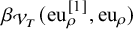 $\beta _{\mathcal {V}_T}(\mathrm {eu}_\rho ^{[1]}, \mathrm {eu}_\rho )$
from 3.12 vanishes on
$\beta _{\mathcal {V}_T}(\mathrm {eu}_\rho ^{[1]}, \mathrm {eu}_\rho )$
from 3.12 vanishes on $\mathbf {P}(\mathcal {T}_{\pi _1}(-1,0)\rvert _T)$
, and so it factors through the section
$\mathbf {P}(\mathcal {T}_{\pi _1}(-1,0)\rvert _T)$
, and so it factors through the section

where $u_3 \colon \mathcal {O}_\rho (-1) \to \rho ^*\mathcal {V}_T \to \rho ^*\mathcal {O}_T(0,-1)$
is the equation of the subbundle.
$u_3 \colon \mathcal {O}_\rho (-1) \to \rho ^*\mathcal {V}_T \to \rho ^*\mathcal {O}_T(0,-1)$
is the equation of the subbundle.
Lemma 3.15. The section $v_3$
vanishes on
$v_3$
vanishes on $\tilde {S}$
, and
$\tilde {S}$
, and $\tilde {S} \to T$
is finite flat of degree q onto its image.
$\tilde {S} \to T$
is finite flat of degree q onto its image.
Proof. The discussion of 3.11 and 3.14 together with 3.4
(i) implies that the intersection of $\tilde S$
with the exceptional locus of
$\tilde S$
with the exceptional locus of $\mathbf {P}\mathcal {V} \to \mathbf {G}$
is contained in
$\mathbf {P}\mathcal {V} \to \mathbf {G}$
is contained in $\mathbf {P}(\mathcal {T}_{\pi _1}(-1,0)\rvert _T)$
. Therefore,
$\mathbf {P}(\mathcal {T}_{\pi _1}(-1,0)\rvert _T)$
. Therefore, $v_3$
vanishes on
$v_3$
vanishes on $\tilde {S}$
if and only if it vanishes on
$\tilde {S}$
if and only if it vanishes on  . Since $u_3$
is invertible on the latter open subscheme,
$u_3$
is invertible on the latter open subscheme, $v_3$
vanishes on
$v_3$
vanishes on $S^\circ $
by 3.12.
$S^\circ $
by 3.12.
Since $S^\circ \to T$
is quasi-finite of degree q by 3.7, the final statement follows upon showing that
$S^\circ \to T$
is quasi-finite of degree q by 3.7, the final statement follows upon showing that $\mathrm {V}(v_3) \to T$
is finite flat of degree q. Since
$\mathrm {V}(v_3) \to T$
is finite flat of degree q. Since $v_3$
is degree q on each fiber of
$v_3$
is degree q on each fiber of $\mathbf {P}\mathcal {V}_T \to T$
by 3.14, it suffices to see that
$\mathbf {P}\mathcal {V}_T \to T$
by 3.14, it suffices to see that $v_3$
does not vanish on an entire fiber. But if
$v_3$
does not vanish on an entire fiber. But if $v_3$
did vanish on the fiber over
$v_3$
did vanish on the fiber over $(y \mapsto y_0 \in \ell _0) \in T$
, 3.12 would imply that all lines
$(y \mapsto y_0 \in \ell _0) \in T$
, 3.12 would imply that all lines $\ell \subset P_{\ell _0}$
passing through y are isotropic for
$\ell \subset P_{\ell _0}$
passing through y are isotropic for $\beta $
, and hence
$\beta $
, and hence $P_{\ell _0}$
would be contained in X. This is impossible with 3.1(i).
$P_{\ell _0}$
would be contained in X. This is impossible with 3.1(i).
4. Smooth cone situation
The most useful cone situations that arise when studying q-bic threefolds which are either smooth or of type $\mathbf {1}^{\oplus 3} \oplus \mathbf {N}_2$
are the smooth cone situations: those
$\mathbf {1}^{\oplus 3} \oplus \mathbf {N}_2$
are the smooth cone situations: those $(X,\infty ,\mathbf {P}\breve {W})$
which satisfy 3.1(ii) and 3.1(iii), and which were classified in 3.3(ii) to be as in either example 3.2(i) or 3.2
(ii). In this setting, the scheme T constructed in 3.10 is the Zariski closure of
$(X,\infty ,\mathbf {P}\breve {W})$
which satisfy 3.1(ii) and 3.1(iii), and which were classified in 3.3(ii) to be as in either example 3.2(i) or 3.2
(ii). In this setting, the scheme T constructed in 3.10 is the Zariski closure of $T^\circ $
and also a quotient of
$T^\circ $
and also a quotient of $\tilde {S}$
by a finite group scheme of order q (see 4.2 and 4.5). Furthermore,
$\tilde {S}$
by a finite group scheme of order q (see 4.2 and 4.5). Furthermore, $\tilde {S}$
is a blowup of S along smooth points (see 4.7); this implies that
$\tilde {S}$
is a blowup of S along smooth points (see 4.7); this implies that $\varphi $
from 3.5 extends to a morphism
$\varphi $
from 3.5 extends to a morphism $S \to C$
and that the sheaf
$S \to C$
and that the sheaf $\mathbf {R}^1\varphi _*\mathcal {O}_S$
carries a canonical filtration, crucial for the computations that follow (see 4.9 and 4.10).
$\mathbf {R}^1\varphi _*\mathcal {O}_S$
carries a canonical filtration, crucial for the computations that follow (see 4.9 and 4.10).
Throughout, let $(X,\infty ,\mathbf {P}\breve {W})$
be a smooth cone situation, fix an orthogonal decomposition
$(X,\infty ,\mathbf {P}\breve {W})$
be a smooth cone situation, fix an orthogonal decomposition $V \cong W \oplus U$
as in 3.9, and write
$V \cong W \oplus U$
as in 3.9, and write $\mathcal {V}_1 \cong \mathcal {O}_C(-1) \oplus L_C$
and
$\mathcal {V}_1 \cong \mathcal {O}_C(-1) \oplus L_C$
and $\mathcal {V}_2 \cong \mathcal {T} \oplus (V/\breve {W})_C$
for the induced splittings. The Euler sections decompose as
$\mathcal {V}_2 \cong \mathcal {T} \oplus (V/\breve {W})_C$
for the induced splittings. The Euler sections decompose as $\mathrm {eu}_{\pi _1} = (u_1,u_1')^\vee $
and
$\mathrm {eu}_{\pi _1} = (u_1,u_1')^\vee $
and $\mathrm {eu}_{\pi _2} = (u_2',u_2)^\vee $
, and their vanishing loci are
$\mathrm {eu}_{\pi _2} = (u_2',u_2)^\vee $
, and their vanishing loci are

Begin by describing the boundary of $T^\circ $
in T.
$T^\circ $
in T.
Proposition 4.1. The boundary  is the union of the effective Cartier divisors

Furthermore, $C'$
is a purely inseparable multisection of degree q, and D is a disjoint union of
$C'$
is a purely inseparable multisection of degree q, and D is a disjoint union of $q^3 + 1$
smooth rational curves.
$q^3 + 1$
smooth rational curves.
Proof. Consider the intersection between $T' = \mathrm {V}(v)$
with the irreducible components
$T' = \mathrm {V}(v)$
with the irreducible components  of
of  . The computation of 3.9 gives the first equalities in
 $$ \begin{align*} T' \cap Z_1 & = (u_1 = u_2 \cdot \beta_2^\vee \cdot u_1^{\prime{q}} = u_2^q \cdot \beta_2 \cdot u_1' = 0) = Z_1 \cap Z_2 \;\text{and} \\ T' \cap Z_2 & = (u_2 = u_2' \cdot \beta_1^\vee \cdot u_1^q = u_2^{\prime{q}} \cdot \beta_1 \cdot u_1 = 0) = (Z_1 \cap Z_2) \cup (u_2 = u_2' \cdot \beta_1^\vee = u_2^{\prime{q}} \cdot \beta_1 = 0). \end{align*} $$
The second equality is then clear for $T' \cap Z_2$
. As for
$T' \cap Z_2$
. As for $T' \cap Z_1$
, it is because
$T' \cap Z_1$
, it is because $u_1'$
and
$u_1'$
and $u_1$
do not vanish simultaneously, and
$u_1$
do not vanish simultaneously, and $\beta _2^\vee \colon L_C^{[1]} \to (V/\breve {W})_C^\vee $
is an isomorphism by 3.1(ii). Next, 3.9 implies that
$\beta _2^\vee \colon L_C^{[1]} \to (V/\breve {W})_C^\vee $
is an isomorphism by 3.1(ii). Next, 3.9 implies that
 $$\begin{align*}-\det(v')\rvert_{T' \cap Z} = u_2^{\prime{q}} \cdot \beta_1 \cdot \beta_2^\vee \cdot u_1^{\prime{q}}. \end{align*}$$
This cuts out the locus $(u_1 = u_2 = u_2^{\prime {q}} \cdot \beta _1 = 0)$
on
$(u_1 = u_2 = u_2^{\prime {q}} \cdot \beta _1 = 0)$
on $Z_1 \cap Z_2$
and vanishes on the second component of
$Z_1 \cap Z_2$
and vanishes on the second component of $T' \cap Z_2$
. It remains to identify these with
$T' \cap Z_2$
. It remains to identify these with $C'$
and D, respectively. The value of
$C'$
and D, respectively. The value of
 $$\begin{align*}u_2^{\prime{q}} \cdot \beta_1 \colon \mathcal{O}_C(-1) \to \mathcal{T}^{[1],\vee} \to \mathcal{O}_{\mathbf{P}}(0,q) \end{align*}$$
at a point $(y \mapsto y_0 \in \ell _0)$
is determined as follows: a local generator of
$(y \mapsto y_0 \in \ell _0)$
is determined as follows: a local generator of $\mathcal {O}_C(-1)$
corresponds to a basis vector v of the subspace
$\mathcal {O}_C(-1)$
corresponds to a basis vector v of the subspace $L_0 \subset \overline {W}$
underlying
$L_0 \subset \overline {W}$
underlying $y_0$
;
$y_0$
; $\beta _1$
maps this to the linear functional
$\beta _1$
maps this to the linear functional $\beta _{\overline {W}}(-,v)$
on
$\beta _{\overline {W}}(-,v)$
on $\overline {W}^{[1]}$
; and the quotient map corresponds to restricting this to the linear space underlying
$\overline {W}^{[1]}$
; and the quotient map corresponds to restricting this to the linear space underlying $\ell _0$
. Thus, this vanishes if and only if
$\ell _0$
. Thus, this vanishes if and only if $\ell _0 = \mathbf {P} L_0^{\perp ,[-1]}$
, and so
$\ell _0 = \mathbf {P} L_0^{\perp ,[-1]}$
, and so
 $$\begin{align*}(u_1 = u_2 = u_2^{\prime{q}} \cdot \beta_1 = 0) = \big\{ (\infty \mapsto y_0 \in \ell_0) \in \mathbf{P} : y_0 = \mathbf{P} L_0 \in C \;\text{and}\; \ell_0 = \mathbf{P} L_0^{\perp,[-1]} \big\}, \end{align*}$$
which is precisely $C'$
. Similarly,
$C'$
. Similarly, $u_2' \cdot \beta _1^\vee $
vanishes at points
$u_2' \cdot \beta _1^\vee $
vanishes at points $(y \mapsto y_0 \in \ell _0)$
when
$(y \mapsto y_0 \in \ell _0)$
when $\ell _0 = \mathbf {P} L_0^{[1],\perp }$
. Therefore, the vanishing locus
$\ell _0 = \mathbf {P} L_0^{[1],\perp }$
. Therefore, the vanishing locus $u_2 = u_2' \cdot \beta _1^\vee = u_2^{\prime {q}} \cdot \beta _1 = 0$
is
$u_2 = u_2' \cdot \beta _1^\vee = u_2^{\prime {q}} \cdot \beta _1 = 0$
is
 $$\begin{align*}\big\{ (y \mapsto y_0 \in \ell_0) \in \mathbf{P} : y_0 = \mathbf{P} L_0 \in C\;\text{and}\; \ell_0 = \mathbf{P} L_0^{[1],\perp} = \mathbf{P} L_0^{\perp,[-1]} \big\}. \end{align*}$$
This is D since $L_0^{[1],\perp } = L_0^{\perp ,[-1]}$
if and only if
$L_0^{[1],\perp } = L_0^{\perp ,[-1]}$
if and only if $y_0$
is a Hermitian point of C (see 2.6).
$y_0$
is a Hermitian point of C (see 2.6).
Both $C'$
and D are effective Cartier divisors on T: The analysis shows that
$C'$
and D are effective Cartier divisors on T: The analysis shows that $C' = T \cap Z_1$
and
$C' = T \cap Z_1$
and $C' + D = T \cap Z_2$
; since D is the difference of effective Cartier divisors, it is Cartier itself. The moduli description easily shows that D is a union of fibers of
$C' + D = T \cap Z_2$
; since D is the difference of effective Cartier divisors, it is Cartier itself. The moduli description easily shows that D is a union of fibers of $\mathbf {P}\mathcal {V}_1$
over the
$\mathbf {P}\mathcal {V}_1$
over the $q^3 + 1$
Hermitian points of C. To see that
$q^3 + 1$
Hermitian points of C. To see that $C'$
is a multisection, let
$C'$
is a multisection, let $\phi _C \colon C \to C$
be the map that sends a point
$\phi _C \colon C \to C$
be the map that sends a point $y_1$
to the residual intersection point with its tangent line
$y_1$
to the residual intersection point with its tangent line $\mathbf {T}_{C,y_1}$
, as in 2.6. I claim that there exists a morphism
$\mathbf {T}_{C,y_1}$
, as in 2.6. I claim that there exists a morphism
 $$\begin{align*}\phi_C' \colon C \to C' \colon y_1 \mapsto (\infty \mapsto \phi_C(y_1) \in \mathbf{T}_{C,y_1}). \end{align*}$$
If $y_1 = \mathbf {P} L_1$
, then
$y_1 = \mathbf {P} L_1$
, then  underlies $\phi _C(y_1)$
. Since
$\phi _C(y_1)$
. Since $\sigma _\beta = \beta ^{-1} \circ \beta ^{[1],\vee }$
, the diagram
$\sigma _\beta = \beta ^{-1} \circ \beta ^{[1],\vee }$
, the diagram

commutes, and it follows that $\mathbf {T}_{C,y_1}^{[1]}$
has underlying linear space
$\mathbf {T}_{C,y_1}^{[1]}$
has underlying linear space $L_0^\perp $
and that
$L_0^\perp $
and that $\phi _C'$
exists. Observe that the projection
$\phi _C'$
exists. Observe that the projection $C' \to C$
and
$C' \to C$
and $\phi _C'$
are both of degree q, the latter because
$\phi _C'$
are both of degree q, the latter because $\mathbf {T}_{C,y_1}$
intersects C at
$\mathbf {T}_{C,y_1}$
intersects C at $y_1$
generically with multiplicity q. Since
$y_1$
generically with multiplicity q. Since $\phi _C$
is of purely inseparable of degree
$\phi _C$
is of purely inseparable of degree $q^2$
, it follows that
$q^2$
, it follows that $\phi _C'$
is surjective, and so
$\phi _C'$
is surjective, and so $C'$
is a purely inseparable multisection.
$C'$
is a purely inseparable multisection.
Corollary 4.2.
T is the Zariski closure of $T^\circ $
in
$T^\circ $
in $\mathbf {P}$
.
$\mathbf {P}$
.
Proof. If not, then some irreducible component of  would be an irreducible component of T. But this is impossible: on the one hand,
  is of pure dimension $1$
by 4.1; on the other hand, T is connected and Cohen–Macaulay by 3.10 and is therefore equidimension
$1$
by 4.1; on the other hand, T is connected and Cohen–Macaulay by 3.10 and is therefore equidimension $2$
by [54, Tag 00OV].
$2$
by [54, Tag 00OV].
Corollary 4.3. The map $\rho \colon \tilde {S} \to T$
is surjective and finite flat of degree q,
$\rho \colon \tilde {S} \to T$
is surjective and finite flat of degree q, $\tilde {S}$
is the vanishing locus of
$\tilde {S}$
is the vanishing locus of $v_3$
in
$v_3$
in $\mathbf {P}\mathcal {V}_T$
, and there is a short exact sequence of bundles on T given by
$\mathbf {P}\mathcal {V}_T$
, and there is a short exact sequence of bundles on T given by
 $$\begin{align*}0 \to \mathcal{O}_T \to \rho_*\mathcal{O}_{\tilde{S}} \to \operatorname{\mathrm{Div}}^{q-2}(\mathcal{V}_T)(1,-2) \otimes \pi^*\mathcal{O}_C(-1) \otimes L \to 0. \end{align*}$$
In particular, $\rho _*\mathcal {O}_{\tilde {S}}$
has an increasing filtration whose graded pieces are
$\rho _*\mathcal {O}_{\tilde {S}}$
has an increasing filtration whose graded pieces are
 $$\begin{align*}\operatorname{\mathrm{gr}}_i(\rho_*\mathcal{O}_{\tilde{S}}) = \begin{cases} \mathcal{O}_T & \text{ if } i = 0, \\ (\pi^*\mathcal{O}_C(-q+i) \otimes L^{\otimes q-i})(q-i,-i-1) & \text{if } 1 \leq i \leq q - 1. \end{cases} \end{align*}$$
Proof. Since T is the closure of $T^\circ $
by 4.2, the map
$T^\circ $
by 4.2, the map $\rho \colon \tilde {S} \to T$
is proper and dominant, whence surjective; 3.15 now implies that
$\rho \colon \tilde {S} \to T$
is proper and dominant, whence surjective; 3.15 now implies that $\rho $
is flat of degree q, and that
$\rho $
is flat of degree q, and that $\tilde {S}$
is the vanishing locus of
$\tilde {S}$
is the vanishing locus of $v_3$
. Then 3.14 gives a short exact sequence of sheaves on
$v_3$
. Then 3.14 gives a short exact sequence of sheaves on $\mathbf {P}\mathcal {V}_T$
 $$\begin{align*}0 \to \mathcal{O}_\rho(-q) \otimes \rho^*\mathcal{O}_T(0,-1) \xrightarrow{v_3} \mathcal{O}_{\mathbf{P}\mathcal{V}_T} \to \mathcal{O}_{\tilde{S}} \to 0. \end{align*}$$
Pushing this along $\rho $
gives a short exact sequence of
$\rho $
gives a short exact sequence of $\mathcal {O}_T$
-modules
$\mathcal {O}_T$
-modules
 $$\begin{align*}0 \to \mathcal{O}_T \to \rho_*\mathcal{O}_{\tilde{S}} \to \mathbf{R}^1\rho_*\mathcal{O}_\rho(-q) \otimes \mathcal{O}_T(0,-1) \to 0. \end{align*}$$
The Euler sequence gives $\omega _\rho \cong \rho ^*\det (\mathcal {V}_T^\vee ) \otimes \mathcal {O}_\rho (-2)$
and so by Grothendieck duality
$\omega _\rho \cong \rho ^*\det (\mathcal {V}_T^\vee ) \otimes \mathcal {O}_\rho (-2)$
and so by Grothendieck duality
 $$ \begin{align*} \mathbf{R}^1\rho_*\mathcal{O}_\rho(-q) \cong \mathbf{R}\rho_* \mathbf{R}\mathcal{H}\!\mathit{om}_{\mathcal{O}_{\mathbf{P}\mathcal{V}_T}}( \mathcal{O}_\rho(q) \otimes \omega_\rho, \omega_\rho) & \cong \mathbf{R}\mathcal{H}\!\mathit{om}_{\mathcal{O}_T}( \mathbf{R}\rho_*\mathcal{O}_\rho(q-2) \otimes \det(\mathcal{V}_T^\vee), \mathcal{O}_T) \\ & \cong \operatorname{\mathrm{Div}}^{q-2}(\mathcal{V}_T) \otimes \det(\mathcal{V}_T). \end{align*} $$
Since $\det (\mathcal {V}_T) \cong (\pi ^*\mathcal {O}_C(-1) \otimes L)(1,-1)$
, this gives the claimed exact sequence; the filtration comes from applying divided powers to the short exact sequence for
$\det (\mathcal {V}_T) \cong (\pi ^*\mathcal {O}_C(-1) \otimes L)(1,-1)$
, this gives the claimed exact sequence; the filtration comes from applying divided powers to the short exact sequence for $\mathcal {V}_T$
preceding 3.14.
$\mathcal {V}_T$
preceding 3.14.
The map $\rho \colon \tilde {S} \to T$
is a quotient map. To explain, let G be the subgroup scheme of
$\rho \colon \tilde {S} \to T$
is a quotient map. To explain, let G be the subgroup scheme of $\mathbf {GL}_V$
which preserves both the flag
$\mathbf {GL}_V$
which preserves both the flag $L \subset \breve {W} \subset V$
and the q-bic form
$L \subset \breve {W} \subset V$
and the q-bic form $\beta $
, and induces the identity on
$\beta $
, and induces the identity on $\breve {W}$
and
$\breve {W}$
and $V/\breve {W}$
.
$V/\breve {W}$
.
Lemma 4.4. If $(X,\infty ,\mathbf {P}\breve {W})$
is a smooth cone situation, then
$(X,\infty ,\mathbf {P}\breve {W})$
is a smooth cone situation, then
 $$\begin{align*}G \cong \begin{cases} \mathbf{F}_q & \text{ if } (X,\infty,\mathbf{P}\breve{W}) \text{ is as in } {{3.2}}{(i)}, and \\ \boldsymbol{\alpha}_q & \text{ if } (X,\infty,\mathbf{P}\breve{W}) \text{ is as in } {{3.2}}{(ii)}. \end{cases} \end{align*}$$
Proof. A point g of G induces the identity on $\breve {W}$
, so
$\breve {W}$
, so  descends to a map $V/\breve {W} \to V$
; since g also induces the identity on
$V/\breve {W} \to V$
; since g also induces the identity on $V/\breve {W}$
,
$V/\breve {W}$
, $\delta _g$
factors as a map
$\delta _g$
factors as a map $V/\breve {W} \to \breve {W}$
. Thus, the assignment
$V/\breve {W} \to \breve {W}$
. Thus, the assignment $g \mapsto \delta _g$
yields a closed immersion
$g \mapsto \delta _g$
yields a closed immersion $\delta \colon G \to {\mathbf {Hom}}(V/\breve {W}, \breve {W})$
, the latter viewed as a vector group. In fact,
$\delta \colon G \to {\mathbf {Hom}}(V/\breve {W}, \breve {W})$
, the latter viewed as a vector group. In fact, $\delta $
factors through the algebraic subgroup
$\delta $
factors through the algebraic subgroup ${\mathbf {Hom}}(V/\breve {W},L)$
: that G preserves
${\mathbf {Hom}}(V/\breve {W},L)$
: that G preserves $\beta $
and acts as the identity on
$\beta $
and acts as the identity on $\breve {W}$
together means that
$\breve {W}$
together means that
 $$\begin{align*}\beta(\delta_g(v)^{[1]}, w) = \beta(w', \delta_g(v)) = 0 \end{align*}$$
for every $\mathbf {k}$
-algebra A,
$\mathbf {k}$
-algebra A, $g \in G(A)$
,
$g \in G(A)$
, $v \in V \otimes _{\mathbf {k}} A$
,
$v \in V \otimes _{\mathbf {k}} A$
, $w \in \breve {W} \otimes _{\mathbf {k}} A$
, and
$w \in \breve {W} \otimes _{\mathbf {k}} A$
, and $w' \in (\breve {W} \otimes _{\mathbf {k}} A)^{[1]}$
. Splitting
$w' \in (\breve {W} \otimes _{\mathbf {k}} A)^{[1]}$
. Splitting $\breve {W} \cong W \oplus L$
as in 3.9 then shows that
$\breve {W} \cong W \oplus L$
as in 3.9 then shows that $\delta _g(v) \in L \otimes _{\mathbf {k}} A$
.
$\delta _g(v) \in L \otimes _{\mathbf {k}} A$
.
Construct an equation of G in ${\mathbf {Hom}}(V/\breve {W},L)$
as follows: Fix a nonzero
${\mathbf {Hom}}(V/\breve {W},L)$
as follows: Fix a nonzero $w \in L$
, and choose
$w \in L$
, and choose $v \in V$
such that its image
$v \in V$
such that its image $\bar {v} \in V/\breve {W}$
is nonzero, so that
$\bar {v} \in V/\breve {W}$
is nonzero, so that $(\bar {v} \mapsto t \cdot w) \mapsto t$
is an isomorphism
$(\bar {v} \mapsto t \cdot w) \mapsto t$
is an isomorphism ${{\mathbf {Hom}}(V/\breve {W},L) \cong \mathbf {G}_a}$
. If
${{\mathbf {Hom}}(V/\breve {W},L) \cong \mathbf {G}_a}$
. If $\delta _g$
corresponds to
$\delta _g$
corresponds to $t \in \mathbf {G}_a(A)$
in this way, then
$t \in \mathbf {G}_a(A)$
in this way, then
 $$\begin{align*}0 = \beta((g \cdot v)^{[1]}, g \cdot v) - \beta(v^{[1]},v) \pm \beta(v^{[1]}, g \cdot v) = \beta(w^{[1]},v) t^q + \beta(v^{[1]}, w) t. \end{align*}$$
Since $\infty $
is a smooth point,
$\infty $
is a smooth point, $L^{[1],\perp } = \breve {W}$
as explained in 3.1, and so
$L^{[1],\perp } = \breve {W}$
as explained in 3.1, and so $\beta (w^{[1]},v)$
is a nonzero scalar. The scalar
$\beta (w^{[1]},v)$
is a nonzero scalar. The scalar $\beta (v^{[1]},w)$
is nonzero in 3.2(i), and so
$\beta (v^{[1]},w)$
is nonzero in 3.2(i), and so $G \cong \mathbf {F}_q$
; whereas it is zero in 3.2
(ii), and so
$G \cong \mathbf {F}_q$
; whereas it is zero in 3.2
(ii), and so $G \cong \boldsymbol {\alpha }_q$
.
$G \cong \boldsymbol {\alpha }_q$
.
The linear action of G on V induces an action on the schemes under consideration. First, it is straightforward that this action is trivial on C and T: For C, this is because G acts trivially on $\breve {W}$
and fixes L. For T, its points are triples
$\breve {W}$
and fixes L. For T, its points are triples $(y \mapsto y_0 \in \ell _0),$
where
$(y \mapsto y_0 \in \ell _0),$
where $y_0 \in C$
,
$y_0 \in C$
, $y \in \mathbf {P}\breve {W}$
, and
$y \in \mathbf {P}\breve {W}$
, and $\ell _0 \subset \mathbf {P}\overline {V}$
intersects C at
$\ell _0 \subset \mathbf {P}\overline {V}$
intersects C at $y_0$
; since G moves neither
$y_0$
; since G moves neither $y_0$
nor y, and since G maps
$y_0$
nor y, and since G maps $V/\breve {W}$
to L as in the proof of 4.4, it does not move
$V/\breve {W}$
to L as in the proof of 4.4, it does not move $\ell _0$
. Next, comparing with the description in 3.14, this implies that G fixes the subbundle
$\ell _0$
. Next, comparing with the description in 3.14, this implies that G fixes the subbundle $\mathbf {P}(\mathcal {T}_{\pi _1}(-1,0))$
in
$\mathbf {P}(\mathcal {T}_{\pi _1}(-1,0))$
in $\mathbf {P}\mathcal {V}_T$
. Finally, the action of G on
$\mathbf {P}\mathcal {V}_T$
. Finally, the action of G on $\tilde {S}$
is as follows.
$\tilde {S}$
is as follows.
Lemma 4.5. The morphism $\rho \colon \tilde {S} \to T$
is the quotient map for G.
$\rho \colon \tilde {S} \to T$
is the quotient map for G.
Proof. The unipotent algebraic group ${\mathbf {Hom}}(V/\breve {W},L)$
acts freely on the open subscheme of
${\mathbf {Hom}}(V/\breve {W},L)$
acts freely on the open subscheme of $\mathbf {G}$
parameterizing lines
$\mathbf {G}$
parameterizing lines $\ell $
satisfying
$\ell $
satisfying $\infty \notin \ell $
and
$\infty \notin \ell $
and $\ell \not \subset \mathbf {P}\breve {W}$
. The proof of 4.4 shows that G is a closed subgroup scheme of this unipotent group, and so G acts freely on the open subscheme
$\ell \not \subset \mathbf {P}\breve {W}$
. The proof of 4.4 shows that G is a closed subgroup scheme of this unipotent group, and so G acts freely on the open subscheme $S^\circ $
of S. The result follows upon identifying
$S^\circ $
of S. The result follows upon identifying $S^\circ $
with the open subscheme
$S^\circ $
with the open subscheme $\tilde {S}$
consisting of points
$\tilde {S}$
consisting of points $((y \in \ell ) \mapsto (y_0 \in \ell _0)),$
where
$((y \in \ell ) \mapsto (y_0 \in \ell _0)),$
where $y \neq \infty $
and
$y \neq \infty $
and $\ell \not \subset \mathbf {P}\breve {W}$
: Indeed the canonical morphism
$\ell \not \subset \mathbf {P}\breve {W}$
: Indeed the canonical morphism $\tilde {S}/G \to T$
is an isomorphism over
$\tilde {S}/G \to T$
is an isomorphism over $T^\circ $
. Since
$T^\circ $
. Since $\tilde {S} \to T$
is surjective and finite of degree q by 4.3, and lengths of fibers of finite morphisms are upper semicontinuous by Nakayama,
$\tilde {S} \to T$
is surjective and finite of degree q by 4.3, and lengths of fibers of finite morphisms are upper semicontinuous by Nakayama, $\tilde {S}/G \to T$
has degree
$\tilde {S}/G \to T$
has degree $1$
, and so is an isomorphism.
$1$
, and so is an isomorphism.
Putting 3.7, 4.1, and 4.3 together identifies the points of the complement  as follows.
Lemma 4.6. The complement of $S^\circ $
in
$S^\circ $
in $\tilde {S}$
is the union of effective Cartier divisors
$\tilde {S}$
is the union of effective Cartier divisors

Proof. It remains to prove that $\tilde {C}_\infty $
and E are Cartier in
$\tilde {C}_\infty $
and E are Cartier in $\tilde {S}$
. Let
$\tilde {S}$
. Let $C_\infty $
be the closed subscheme of S parameterizing lines through
$C_\infty $
be the closed subscheme of S parameterizing lines through $\infty $
; it follows from 3.4
(ii) that it is isomorphic to the smooth q-bic curve C, and that, by 2.8, S is smooth along
$\infty $
; it follows from 3.4
(ii) that it is isomorphic to the smooth q-bic curve C, and that, by 2.8, S is smooth along $C_\infty $
. Therefore, the description of its points shows that
$C_\infty $
. Therefore, the description of its points shows that $\tilde {C}_\infty $
is the strict transform of the effective Cartier divisor
$\tilde {C}_\infty $
is the strict transform of the effective Cartier divisor $C_\infty $
, and so it, too, is an effective Cartier. Since
$C_\infty $
, and so it, too, is an effective Cartier. Since $\tilde {C}_\infty + E$
is the vanishing locus of the section
$\tilde {C}_\infty + E$
is the vanishing locus of the section $u_3$
from 3.14, it follows that E is also Cartier.
$u_3$
from 3.14, it follows that E is also Cartier.
Observing that the Hermitian points of $C_\infty $
parameterize lines
$C_\infty $
parameterize lines $\ell $
in X which project to Hermitian points of C and comparing with 4.6 essentially gives the following.
$\ell $
in X which project to Hermitian points of C and comparing with 4.6 essentially gives the following.
Corollary 4.7. The morphism $\tilde {S} \to S$
is a blowup along the Hermitian points of
$\tilde {S} \to S$
is a blowup along the Hermitian points of $C_\infty $
.
$C_\infty $
.
Proof. The Hermitian points of $C_\infty $
pullback to the effective Cartier divisor E in
$C_\infty $
pullback to the effective Cartier divisor E in $\tilde {S}$
, so the blowup
$\tilde {S}$
, so the blowup $S' \to S$
along these points admits a canonical morphism
$S' \to S$
along these points admits a canonical morphism $S' \to \tilde {S}$
. Since S is smooth along
$S' \to \tilde {S}$
. Since S is smooth along $C_\infty $
, Zariski’s main theorem as in [Reference Hartshorne20, Corollary III.11.4] applies to show that
$C_\infty $
, Zariski’s main theorem as in [Reference Hartshorne20, Corollary III.11.4] applies to show that $\tilde {S} \to S'$
is an isomorphism.
$\tilde {S} \to S'$
is an isomorphism.
In particular, this implies that $\tilde {S}$
and T are smooth along their boundary.
$\tilde {S}$
and T are smooth along their boundary.
Corollary 4.8. $\tilde {S}$
is smooth along
$\tilde {S}$
is smooth along $\tilde {C}_\infty \cup E$
, and T is smooth along
$\tilde {C}_\infty \cup E$
, and T is smooth along $C' \cup D$
.
$C' \cup D$
.
Proof. Smoothness of $\tilde {S}$
along
$\tilde {S}$
along $\tilde {C}_\infty \cup E$
follows from that of S along
$\tilde {C}_\infty \cup E$
follows from that of S along $C_\infty $
; that of T along
$C_\infty $
; that of T along $C' \cup D$
is because
$C' \cup D$
is because $\rho \colon \tilde {S} \to T$
is flat by 4.3, and smoothness descends along flat morphisms (see [54, Tag 05AW]).
$\rho \colon \tilde {S} \to T$
is flat by 4.3, and smoothness descends along flat morphisms (see [54, Tag 05AW]).
Corollary 4.9. The rational map $S \dashrightarrow T$
is defined away from the Hermitian points of
$S \dashrightarrow T$
is defined away from the Hermitian points of $C_\infty $
, and the rational map
$C_\infty $
, and the rational map $\varphi \colon S \dashrightarrow C$
extends to a morphism.
$\varphi \colon S \dashrightarrow C$
extends to a morphism.
Proof. The rational maps from S to both T and C are resolved up on $\tilde {S}$
, so the statement about
$\tilde {S}$
, so the statement about $S \dashrightarrow T$
follows directly from 4.7, and that about
$S \dashrightarrow T$
follows directly from 4.7, and that about $\varphi \colon S \dashrightarrow C$
follows from 4.6 which implies that each component of the exceptional divisor E is mapped to a single point along
$\varphi \colon S \dashrightarrow C$
follows from 4.6 which implies that each component of the exceptional divisor E is mapped to a single point along $\tilde {S} \to C$
.
$\tilde {S} \to C$
.
Since the boundary divisor Z in $\mathbf {P}$
is relatively ample and since
$\mathbf {P}$
is relatively ample and since $T \cap Z \to C$
has connected fibers by 4.1, the fibers of
$T \cap Z \to C$
has connected fibers by 4.1, the fibers of $T \to C$
are connected. Using 4.5 and 4.6 then implies the same about the fibers of
$T \to C$
are connected. Using 4.5 and 4.6 then implies the same about the fibers of $\tilde {S} \to C$
, and then 4.7 implies the same for
$\tilde {S} \to C$
, and then 4.7 implies the same for $S \to C$
. This almost implies that, for instance,
$S \to C$
. This almost implies that, for instance, $\varphi _*\mathcal {O}_S \cong \mathcal {O}_C$
, but there is the matter of reduced fibers and the possibility of a factoring through a purely inseparable cover of C. At any rate, the following clarifies the structure of
$\varphi _*\mathcal {O}_S \cong \mathcal {O}_C$
, but there is the matter of reduced fibers and the possibility of a factoring through a purely inseparable cover of C. At any rate, the following clarifies the structure of $\mathbf {R}\varphi _*\mathcal {O}_S$
.
$\mathbf {R}\varphi _*\mathcal {O}_S$
.
Lemma 4.10. The natural maps give isomorphisms
 $$\begin{align*}\varphi_*\mathcal{O}_S \cong (\pi \circ \rho)_*\mathcal{O}_{\tilde{S}} \cong \pi_*\mathcal{O}_T \cong \mathcal{O}_C, \end{align*}$$
and $\mathbf {R}^1\varphi _*\mathcal {O}_S$
is locally free and carries a filtration with graded pieces
$\mathbf {R}^1\varphi _*\mathcal {O}_S$
is locally free and carries a filtration with graded pieces
 $$\begin{align*}\mathrm{gr}_i(\mathbf{R}^1\varphi_*\mathcal{O}_S) \cong \begin{cases} \mathbf{R}^1\pi_*\mathcal{O}_T & if i = 0, \text{ and} \\ \mathcal{O}_C(-q+i) \otimes L^{\otimes q-i} \otimes \mathbf{R}^1\pi_*\mathcal{O}_T(q-i,-i-1) & \text{if } 1 \leq i \leq q-1. \end{cases} \end{align*}$$
Proof. By 3.10, the structure sheaf of T admits a resolution on $\mathbf {P}$
of the form
$\mathbf {P}$
of the form
 $$\begin{align*}0 \to \mathcal{E}_2(-q-1,-q-1) \to \mathcal{E}_1(-q-1,-q-1) \to \mathcal{O}_{\mathbf{P}} \to \mathcal{O}_T \to 0. \end{align*}$$
The twists of $\mathcal {E}_1$
and
$\mathcal {E}_1$
and $\mathcal {E}_2$
are sums of negative line bundles on a
$\mathcal {E}_2$
are sums of negative line bundles on a $\mathbf {P}^1 \times \mathbf {P}^2$
-bundle over C, and so cohomology is in degree
$\mathbf {P}^1 \times \mathbf {P}^2$
-bundle over C, and so cohomology is in degree $3$
. Therefore, the spectral sequence computing cohomology of
$3$
. Therefore, the spectral sequence computing cohomology of $\mathcal {O}_T$
shows that the natural map
$\mathcal {O}_T$
shows that the natural map $\mathcal {O}_C \to \pi _*\mathcal {O}_T$
is an isomorphism.
$\mathcal {O}_C \to \pi _*\mathcal {O}_T$
is an isomorphism.
By 4.3, $\rho _*\mathcal {O}_{\tilde {S}}$
has a filtration with graded pieces
$\rho _*\mathcal {O}_{\tilde {S}}$
has a filtration with graded pieces $\mathcal {O}_T$
and
$\mathcal {O}_T$
and $\mathcal {O}_T(q-i,-i-1) \otimes \pi ^*\mathcal {O}_C(-q+i),$
where
$\mathcal {O}_T(q-i,-i-1) \otimes \pi ^*\mathcal {O}_C(-q+i),$
where $1 \leq i \leq q-1$
. The resolution above implies that the latter terms have vanishing pushforward:
$1 \leq i \leq q-1$
. The resolution above implies that the latter terms have vanishing pushforward: $\mathcal {E}_1(-i-1,-q-i-2)$
consists of line bundles which are negative on the
$\mathcal {E}_1(-i-1,-q-i-2)$
consists of line bundles which are negative on the $\mathbf {P}^2$
-side of
$\mathbf {P}^2$
-side of $\mathbf {P} \to C$
, so cohomology is supported in degrees
$\mathbf {P} \to C$
, so cohomology is supported in degrees $2$
and
$2$
and $3$
; whereas
$3$
; whereas $\mathcal {E}_2(-i-1,-q-i-2)$
is negative on both factors and so cohomology is supported in degree
$\mathcal {E}_2(-i-1,-q-i-2)$
is negative on both factors and so cohomology is supported in degree $3$
. Therefore,
$3$
. Therefore, $\mathcal {O}_C \to (\pi \circ \rho )_*\mathcal {O}_{\tilde {S}}$
is an isomorphism. Finally, since
$\mathcal {O}_C \to (\pi \circ \rho )_*\mathcal {O}_{\tilde {S}}$
is an isomorphism. Finally, since $\tilde {S} \to S$
is a blowup at smooth point by 4.7, it follows that
$\tilde {S} \to S$
is a blowup at smooth point by 4.7, it follows that $\mathbf {R}\varphi _*\mathcal {O}_S \cong \mathbf {R}(\pi \circ \rho )_*\mathcal {O}_{\tilde {S}}$
and so
$\mathbf {R}\varphi _*\mathcal {O}_S \cong \mathbf {R}(\pi \circ \rho )_*\mathcal {O}_{\tilde {S}}$
and so $\mathcal {O}_C \to \varphi _*\mathcal {O}_S$
is an isomorphism,
$\mathcal {O}_C \to \varphi _*\mathcal {O}_S$
is an isomorphism, $\mathbf {R}^1\varphi _*\mathcal {O}_S$
is locally free by cohomology and base change, and carries the filtration by 4.3.
$\mathbf {R}^1\varphi _*\mathcal {O}_S$
is locally free by cohomology and base change, and carries the filtration by 4.3.
5.
q-bic threefolds of type
$\mathbf {1}^{\oplus 3} \oplus \mathbf {N}_2$

This and the following two sections are concerned with the geometry of mildly singular q-bic threefolds, namely, those of type $\mathbf {1}^{\oplus 3} \oplus \mathbf {N}_2$
. The purpose of this section is to construct the normalization
$\mathbf {1}^{\oplus 3} \oplus \mathbf {N}_2$
. The purpose of this section is to construct the normalization $\nu \colon S^\nu \to S$
of the Fano surface, see 5.7, and to relate the cohomology of
$\nu \colon S^\nu \to S$
of the Fano surface, see 5.7, and to relate the cohomology of $\mathcal {O}_S$
with that of an
$\mathcal {O}_S$
with that of an $\mathcal {O}_C$
-module
$\mathcal {O}_C$
-module $\mathcal {F}$
related to the quotient
$\mathcal {F}$
related to the quotient $\nu _*\mathcal {O}_{S^\nu }/\mathcal {O}_S$
, see 5.13 and 5.14.
$\nu _*\mathcal {O}_{S^\nu }/\mathcal {O}_S$
, see 5.13 and 5.14.
5.1.
Throughout Sections 5–7, let $(V,\beta )$
be a q-bic form of type
$(V,\beta )$
be a q-bic form of type $\mathbf {1}^{\oplus 3} \oplus \mathbf {N}_2$
, and let X be the associated q-bic threefold. The two kernels
$\mathbf {1}^{\oplus 3} \oplus \mathbf {N}_2$
, and let X be the associated q-bic threefold. The two kernels  and
and  of
of $\beta $
underlie the singular point
$\beta $
underlie the singular point $x_+$
and the special smooth point
$x_+$
and the special smooth point $x_-$
of X. Setting
$x_-$
of X. Setting  , the classification of q-bic forms provides a canonical orthogonal decomposition $V = W \oplus U,$
where
$V = W \oplus U,$
where $\beta _W$
is of type
$\beta _W$
is of type $\mathbf {1}^{\oplus 3}$
. The plane
$\mathbf {1}^{\oplus 3}$
. The plane $\mathbf {P} W$
intersects X at the smooth q-bic curve C defined by
$\mathbf {P} W$
intersects X at the smooth q-bic curve C defined by $\beta _W$
; this curve is canonically identified as the base of the cones
$\beta _W$
; this curve is canonically identified as the base of the cones $X_-$
and
$X_-$
and $X_+$
in the cone situations
$X_+$
in the cone situations
 $$\begin{align*}(X,x_-,\mathbf{P} L_-^{[1],\perp}) \quad\text{and}\quad (X,x_+,\mathbf{P} L_+^{\perp,[-1]}) \end{align*}$$
The Fano scheme S of lines in X is of expected dimension $2$
: this follows, for example, from 3.3(i) applied to either cone situation above. Alternatively, by 3.4(i) and 3.4(ii), the subschemes
$2$
: this follows, for example, from 3.3(i) applied to either cone situation above. Alternatively, by 3.4(i) and 3.4(ii), the subschemes $C_\pm \subset S$
parameterizing lines through the special points
$C_\pm \subset S$
parameterizing lines through the special points $x_\pm \in X$
are supported on a scheme isomorphic to C, so the singular locus of S has dimension
$x_\pm \in X$
are supported on a scheme isomorphic to C, so the singular locus of S has dimension $1$
, and the discussion of 2.8 shows that S is a surface.
$1$
, and the discussion of 2.8 shows that S is a surface.
5.2. Automorphisms
Consider the automorphism group scheme ${\mathbf {Aut}}(V,\beta )$
of the q-bic form, as introduced in [Reference Cheng9, Section 5.1]. Specializing the computation of [Reference Cheng8, Proposition 1.3.7] with
${\mathbf {Aut}}(V,\beta )$
of the q-bic form, as introduced in [Reference Cheng9, Section 5.1]. Specializing the computation of [Reference Cheng8, Proposition 1.3.7] with $a = 1$
and
$a = 1$
and $b = 3$
gives the following explicit description as a closed sub-group scheme of
$b = 3$
gives the following explicit description as a closed sub-group scheme of $\mathbf {GL}_5$
:
$\mathbf {GL}_5$
:

A particularly useful subgroup is that which preserves the orthogonal decomposition $V = W \oplus U$
:
$V = W \oplus U$
:

Observe that the torus $\mathbf {G}_m$
in
$\mathbf {G}_m$
in ${\mathbf {Aut}}(V,\beta )$
acts, in particular, on X and the Fano surface S; it is straightforward to check that its fixed schemes are
${\mathbf {Aut}}(V,\beta )$
acts, in particular, on X and the Fano surface S; it is straightforward to check that its fixed schemes are $X^{\mathbf {G}_m} = \{x_-, x_+\} \cup C$
and
$X^{\mathbf {G}_m} = \{x_-, x_+\} \cup C$
and $S^{\mathbf {G}_m} = C_- \cup C_+$
, respectively.
$S^{\mathbf {G}_m} = C_- \cup C_+$
, respectively.
5.3. Cone situations
Both cone situations in 5.1 associated with the special points $x_\mp \in X$
satisfy 3.1(i) and 3.1(iii), so 3.5 gives rational maps
$x_\mp \in X$
satisfy 3.1(i) and 3.1(iii), so 3.5 gives rational maps
 $$\begin{align*}\varphi_- \colon S \longrightarrow C \quad\text{and}\quad \varphi_+ \colon S \dashrightarrow C, \end{align*}$$
where the orthogonal decomposition $V = W \oplus U$
identifies the target as the curve
$V = W \oplus U$
identifies the target as the curve $C = X \cap \mathbf {P} W$
. Since
$C = X \cap \mathbf {P} W$
. Since $\varphi _-$
arises from a smooth cone situation, it extends to a morphism by 4.9, whereas
$\varphi _-$
arises from a smooth cone situation, it extends to a morphism by 4.9, whereas $\varphi _+$
is defined only away from
$\varphi _+$
is defined only away from $C_+$
. Writing
$C_+$
. Writing $\operatorname {\mathrm {proj}}_{\mathbf {P} U} \colon X \dashrightarrow \mathbf {P} W$
for the rational map induced by linear projection centered at
$\operatorname {\mathrm {proj}}_{\mathbf {P} U} \colon X \dashrightarrow \mathbf {P} W$
for the rational map induced by linear projection centered at $\mathbf {P} U$
, the specific geometry of X offers an alternative description of the maps
$\mathbf {P} U$
, the specific geometry of X offers an alternative description of the maps $\varphi _\mp $
.
$\varphi _\mp $
.
Lemma 5.4. Let $\ell \subset X$
be a line not passing through either
$\ell \subset X$
be a line not passing through either $x_\mp $
. Then
$x_\mp $
. Then  is a line in $\mathbf {P} W$
tangent to C at the point
$\mathbf {P} W$
tangent to C at the point $\operatorname {\mathrm {proj}}_{\mathbf {P} U}(\ell \cap X_+)$
with residual intersection point
$\operatorname {\mathrm {proj}}_{\mathbf {P} U}(\ell \cap X_+)$
with residual intersection point $\operatorname {\mathrm {proj}}_{\mathbf {P} U}(\ell \cap X_-)$
, so
$\operatorname {\mathrm {proj}}_{\mathbf {P} U}(\ell \cap X_-)$
, so
 $$ \begin{align*} \varphi_+([\ell]) & = \text{point of tangency between } \ell_0 \text{ and } C, \\ \varphi_-([\ell]) & = \text{residual point of intersection between } \ell_0 \text{ and } C. \end{align*} $$
Proof. Projection from $\mathbf {P} U$
contracts only lines through
$\mathbf {P} U$
contracts only lines through $x_\mp $
, so
$x_\mp $
, so $\ell _0$
is a line in
$\ell _0$
is a line in $\mathbf {P} W$
. Since
$\mathbf {P} W$
. Since $\mathbf {P} U$
intersects X only at the vertices
$\mathbf {P} U$
intersects X only at the vertices $x_\mp $
of the two cones over C, and since
$x_\mp $
of the two cones over C, and since $x_+$
is a singular point of multiplicity q,
$x_+$
is a singular point of multiplicity q,
 $$\begin{align*}C \cap \ell_0 = \operatorname{\mathrm{proj}}_{\mathbf{P} U}\big(\ell \cap \operatorname{\mathrm{proj}}_{\mathbf{P} U}^{-1}(C)\big) = \operatorname{\mathrm{proj}}_{\mathbf{P} U}\big(\ell \cap (X_- \cup q X_+)\big). \end{align*}$$
Thus, $\ell _0$
and C are tangent at
$\ell _0$
and C are tangent at $\operatorname {\mathrm {proj}}_{\mathbf {P} U}(\ell \cap X_+)$
and have residual point of intersection at
$\operatorname {\mathrm {proj}}_{\mathbf {P} U}(\ell \cap X_+)$
and have residual point of intersection at $\operatorname {\mathrm {proj}}_{\mathbf {P} U}(\ell \cap X_-)$
. On the other hand, the definition of
$\operatorname {\mathrm {proj}}_{\mathbf {P} U}(\ell \cap X_-)$
. On the other hand, the definition of $\varphi _\mp $
from 3.5 gives
$\varphi _\mp $
from 3.5 gives
 $$\begin{align*}\varphi_\mp([\ell]) = \operatorname{\mathrm{proj}}_{x_\mp}(\ell \cap X_\mp) = \operatorname{\mathrm{proj}}_{\mathbf{P} U}(\ell \cap X_\mp) \end{align*}$$
with the second equality because $x_\pm \notin X_\mp $
.
$x_\pm \notin X_\mp $
.
With more notation, the proof works for families of lines in  . This leads to another proof of 4.9, that $\varphi _-$
extends over
$\varphi _-$
extends over $C_-$
: 5.4 means that
$C_-$
: 5.4 means that $\varphi _-([\ell ])$
is the residual intersection point of C with its tangent line at
$\varphi _-([\ell ])$
is the residual intersection point of C with its tangent line at $\operatorname {\mathrm {proj}}_{\mathbf {P} U}(\ell \cap X_+)$
, and this makes sense even when
$\operatorname {\mathrm {proj}}_{\mathbf {P} U}(\ell \cap X_+)$
, and this makes sense even when $x_- \in \ell $
. More interestingly, this gives an alternative moduli interpretation of
$x_- \in \ell $
. More interestingly, this gives an alternative moduli interpretation of  as a scheme over C via $\varphi _+$
. To describe it, let
$\varphi _+$
. To describe it, let $\mathcal {E}_C$
be the embedded tangent bundle C in
$\mathcal {E}_C$
be the embedded tangent bundle C in $\mathbf {P} W$
, which is defined via pullback of the right square in the following commutative diagram of short exact sequences:
$\mathbf {P} W$
, which is defined via pullback of the right square in the following commutative diagram of short exact sequences:

where, as in 3.6,  . The fiber of $\mathcal {E}_C$
over a point
$\mathcal {E}_C$
over a point $y_0 = \mathbf {P} L_0$
is the subspace
$y_0 = \mathbf {P} L_0$
is the subspace $L_0^{[1],\perp }$
in W underlying the embedded tangent space
$L_0^{[1],\perp }$
in W underlying the embedded tangent space $\mathbf {T}_{C,y_0}$
(see 2.5). The subbundle
$\mathbf {T}_{C,y_0}$
(see 2.5). The subbundle  of
of $V_C$
defines the family
$V_C$
defines the family $\mathbf {P}\mathcal {W} \to C$
of hyperplanes in
$\mathbf {P}\mathcal {W} \to C$
of hyperplanes in $\mathbf {P} V$
spanned by the tangent lines to C and U. Let
$\mathbf {P} V$
spanned by the tangent lines to C and U. Let  be the corresponding family of hyperplane sections of X. A reformulation of 5.4 in these terms is as follows.
Corollary 5.5. Let $\mathbf {L}^\circ $
be the restriction of the Fano correspondence
$\mathbf {L}^\circ $
be the restriction of the Fano correspondence $S \leftarrow \mathbf {L} \rightarrow X$
to
$S \leftarrow \mathbf {L} \rightarrow X$
to  . Then the morphism $\mathbf {L}^\circ \to X$
factors through
$\mathbf {L}^\circ \to X$
factors through $X_{\mathbf {P}\mathcal {W}}$
and fits into a commutative diagram
$X_{\mathbf {P}\mathcal {W}}$
and fits into a commutative diagram

Proof. Away from $C_- \subset S$
, this follows from 5.4. It remains to observe that the lines through
$C_- \subset S$
, this follows from 5.4. It remains to observe that the lines through $x_-$
correspond to the subbundle
$x_-$
correspond to the subbundle $\mathcal {O}_C(-1) \oplus L_{-,C}$
of
$\mathcal {O}_C(-1) \oplus L_{-,C}$
of $\mathcal {W}$
.
$\mathcal {W}$
.
A line  such that $\varphi _+([\ell ]) = y_0$
intersects
$\varphi _+([\ell ]) = y_0$
intersects $X_+$
along the line
$X_+$
along the line $\langle x_+, y_0 \rangle $
. These lines are globally parameterized by the subbundle
$\langle x_+, y_0 \rangle $
. These lines are globally parameterized by the subbundle  ; together with 5.4 and 5.5, this implies that $\mathbf {L}^\circ \times _{X_{\mathbf {P}\mathcal {W}}} \mathbf {P}\mathcal {W}'$
projects isomorphically to
$\mathbf {L}^\circ \times _{X_{\mathbf {P}\mathcal {W}}} \mathbf {P}\mathcal {W}'$
projects isomorphically to  . This suggests that $\varphi _+$
may be resolved by considering all lines in
$\varphi _+$
may be resolved by considering all lines in $X_{\mathbf {P}\mathcal {W}}$
that pass through
$X_{\mathbf {P}\mathcal {W}}$
that pass through $\mathbf {P}\mathcal {W}'$
. To proceed, consider the morphism
$\mathbf {P}\mathcal {W}'$
. To proceed, consider the morphism $X_{\mathbf {P}\mathcal {W}} \to C$
.
$X_{\mathbf {P}\mathcal {W}} \to C$
.
Lemma 5.6. $X_{\mathbf {P}\mathcal {W}} \to C$
is a family of corank
$X_{\mathbf {P}\mathcal {W}} \to C$
is a family of corank $2 q$
-bic surfaces with singular locus
$2 q$
-bic surfaces with singular locus $\mathbf {P}\mathcal {W}'$
.
$\mathbf {P}\mathcal {W}'$
.
Proof. This family of q-bic surfaces over C is determined by the q-bic form $\beta _{\mathcal {W}} \colon \mathcal {W}^{[1]} \otimes \mathcal {W} \to \mathcal {O}_C$
obtained by restricting
$\beta _{\mathcal {W}} \colon \mathcal {W}^{[1]} \otimes \mathcal {W} \to \mathcal {O}_C$
obtained by restricting $\beta $
to
$\beta $
to $\mathcal {W}$
. The orthogonal splitting
$\mathcal {W}$
. The orthogonal splitting $V = W \oplus U$
restricts to a decomposition
$V = W \oplus U$
restricts to a decomposition
 $$\begin{align*}(\mathcal{W},\beta_{\mathcal{W}}) = (\mathcal{E}_C, \beta_{W,\mathrm{tan}}) \oplus (U_C, \beta_U), \end{align*}$$
where $\beta _{W,\mathrm {tan}}$
is q-bic form induced by
$\beta _{W,\mathrm {tan}}$
is q-bic form induced by $\beta _W$
on the embedded tangent spaces to C. Observe that
$\beta _W$
on the embedded tangent spaces to C. Observe that $\beta _U$
is of constant type
$\beta _U$
is of constant type $\mathbf {N}_2$
, and
$\mathbf {N}_2$
, and $\beta _{W,\mathrm {tan}}$
is of type
$\beta _{W,\mathrm {tan}}$
is of type $\mathbf {0} \oplus \mathbf {1}$
or
$\mathbf {0} \oplus \mathbf {1}$
or $\mathbf {N}_2$
depending on whether or not the point of tangency is a Hermitian point of C; in particular,
$\mathbf {N}_2$
depending on whether or not the point of tangency is a Hermitian point of C; in particular, $\beta _{\mathcal {W}}$
is everywhere of corank
$\beta _{\mathcal {W}}$
is everywhere of corank $2$
. By [Reference Cheng10, Corollary 2.6], the nonsmooth locus of
$2$
. By [Reference Cheng10, Corollary 2.6], the nonsmooth locus of $X_{\mathbf {P}\mathcal {W}} \to C$
corresponds to the subbundle
$X_{\mathbf {P}\mathcal {W}} \to C$
corresponds to the subbundle
 $$\begin{align*}\mathcal{W}^\perp = \mathcal{E}_C^{\perp_{\beta_{W,\mathrm{tan}}}} \oplus U_C^{\perp_{\beta_U}} = \mathcal{O}_C(-q) \oplus L_{+,C}^{[1]} \subset \mathcal{W}^{[1]}, \end{align*}$$
where the two orthogonals can be computed geometrically by noting that $X \cap \mathbf {P} U$
is singular at
$X \cap \mathbf {P} U$
is singular at $x_+$
, and the intersection between C and its tangent line at
$x_+$
, and the intersection between C and its tangent line at $y_0$
is singular at
$y_0$
is singular at $y_0$
. This bundle descends through Frobenius to
$y_0$
. This bundle descends through Frobenius to $\mathcal {W}'$
as in the statement, and so
$\mathcal {W}'$
as in the statement, and so $X_{\mathbf {P}\mathcal {W}}$
is singular thereon.
$X_{\mathbf {P}\mathcal {W}}$
is singular thereon.
Construct the family of lines in $X_{\mathbf {P}\mathcal {W}}$
over C through
$X_{\mathbf {P}\mathcal {W}}$
over C through $\mathbf {P}\mathcal {W}'$
as follows: Set
$\mathbf {P}\mathcal {W}'$
as follows: Set  , let
, let  be the associated $\mathbf {P}^1$
-bundle, and write
$\mathbf {P}^1$
-bundle, and write $\tilde \varphi _+ \colon S^\nu \to C$
for the structure map. Linear projection over C with center
$\tilde \varphi _+ \colon S^\nu \to C$
for the structure map. Linear projection over C with center $\mathbf {P}\mathcal {W}'$
produces a rational map
$\mathbf {P}\mathcal {W}'$
produces a rational map $X_{\mathbf {P}\mathcal {W}} \dashrightarrow S^\nu $
which is resolved on the blowup
$X_{\mathbf {P}\mathcal {W}} \dashrightarrow S^\nu $
which is resolved on the blowup $\tilde {X}_{\mathbf {P}\mathcal {W}}$
along
$\tilde {X}_{\mathbf {P}\mathcal {W}}$
along $\mathbf {P}\mathcal {W}'$
. Since
$\mathbf {P}\mathcal {W}'$
. Since $X_{\mathbf {P}\mathcal {W}}$
is a family of q-bic surfaces over C, its singular locus has multiplicity q, the fibers of
$X_{\mathbf {P}\mathcal {W}}$
is a family of q-bic surfaces over C, its singular locus has multiplicity q, the fibers of $\tilde {X}_{\mathbf {P}\mathcal {W}} \to S^\nu $
are curves of degree
$\tilde {X}_{\mathbf {P}\mathcal {W}} \to S^\nu $
are curves of degree $1$
in
$1$
in $\mathbf {P} V$
. In other words, this is a family of lines in X, and so defines a morphism
$\mathbf {P} V$
. In other words, this is a family of lines in X, and so defines a morphism $\nu \colon S^\nu \to S$
.
$\nu \colon S^\nu \to S$
.
Proposition 5.7. The morphism $\nu \colon S^\nu \to S$
is the normalization, fits into a commutative diagram
$\nu \colon S^\nu \to S$
is the normalization, fits into a commutative diagram

and satisfies $\nu ^*\mathcal {O}_S(1) = \tilde \varphi _+^*\mathcal {O}_C(1) \otimes \mathcal {O}_{\tilde \varphi _+}(q+1) \otimes L_+^\vee $
.
$\nu ^*\mathcal {O}_S(1) = \tilde \varphi _+^*\mathcal {O}_C(1) \otimes \mathcal {O}_{\tilde \varphi _+}(q+1) \otimes L_+^\vee $
.
Proof. Note $\mathcal {W}" \cong \mathcal {T}_C(-1) \oplus L_{-,C}$
and the fibers of
$\mathcal {W}" \cong \mathcal {T}_C(-1) \oplus L_{-,C}$
and the fibers of $\tilde {X}_{\mathbf {P}\mathcal {W}} \to S^\nu $
over
$\tilde {X}_{\mathbf {P}\mathcal {W}} \to S^\nu $
over  are those lines through $x_+ \in X$
. The statement of and the comments following the corollary 5.5 imply that
$x_+ \in X$
. The statement of and the comments following the corollary 5.5 imply that  and
and  represent the same moduli problem over C, and this implies the first two statements.
To compute the pullback of the Plücker line bundle, describe the $\mathbf {P}^1$
-bundle
$\mathbf {P}^1$
-bundle $\tilde {X}_{\mathbf {P}\mathcal {W}} \to S^\nu $
more precisely: The blowup of
$\tilde {X}_{\mathbf {P}\mathcal {W}} \to S^\nu $
more precisely: The blowup of $\mathbf {P}\mathcal {W}$
along
$\mathbf {P}\mathcal {W}$
along $\mathbf {P}\mathcal {W}'$
is canonically the
$\mathbf {P}\mathcal {W}'$
is canonically the $\mathbf {P}^2$
-bundle over
$\mathbf {P}^2$
-bundle over $S^\nu $
associated with
$S^\nu $
associated with $\tilde {\mathcal {W}}$
formed in the pullback diagram
$\tilde {\mathcal {W}}$
formed in the pullback diagram

and so the exceptional divisor of $\mathbf {P}\tilde {\mathcal {W}} \to \mathbf {P}\mathcal {W}$
is the subbundle
$\mathbf {P}\tilde {\mathcal {W}} \to \mathbf {P}\mathcal {W}$
is the subbundle $\mathbf {P}(\tilde \varphi _+^*\mathcal {W}') \subset \mathbf {P}\tilde {\mathcal {W}}$
. The inverse image
$\mathbf {P}(\tilde \varphi _+^*\mathcal {W}') \subset \mathbf {P}\tilde {\mathcal {W}}$
. The inverse image  of
of $X_{\mathbf {P}\mathcal {W}}$
along this blowup is the bundle of q-bic curves over
$X_{\mathbf {P}\mathcal {W}}$
along this blowup is the bundle of q-bic curves over $S^\nu $
defined by the q-bic form
$S^\nu $
defined by the q-bic form $ \beta _{\tilde {\mathcal {W}}} \colon \tilde {\mathcal {W}}^{[1]} \otimes \tilde {\mathcal {W}} \to \mathcal {O}_{S^\nu } $
obtained by restricting
$ \beta _{\tilde {\mathcal {W}}} \colon \tilde {\mathcal {W}}^{[1]} \otimes \tilde {\mathcal {W}} \to \mathcal {O}_{S^\nu } $
obtained by restricting $\tilde \varphi ^*_+\beta _{\mathcal {W}}$
. Since
$\tilde \varphi ^*_+\beta _{\mathcal {W}}$
. Since $\mathcal {W}^\perp = \mathcal {W}^{\prime [1]}$
by 5.6, the diagram above implies that
$\mathcal {W}^\perp = \mathcal {W}^{\prime [1]}$
by 5.6, the diagram above implies that $\tilde \varphi _+^*\mathcal {W}^{\prime [1]} = \tilde {\mathcal {W}}^\perp $
. Thus, by [Reference Cheng9, Lemma 1.5], there is an exact sequence
$\tilde \varphi _+^*\mathcal {W}^{\prime [1]} = \tilde {\mathcal {W}}^\perp $
. Thus, by [Reference Cheng9, Lemma 1.5], there is an exact sequence
 $$\begin{align*}0 \to \mathcal{K} \to \tilde{\mathcal{W}} \xrightarrow{\beta_{\tilde{\mathcal{W}}}} \tilde{\mathcal{W}}^{[1],\vee} \to \tilde\varphi_+^*\mathcal{W}^{\prime[1],\vee} \to 0, \end{align*}$$
where $\mathcal {K}$
is the rank
$\mathcal {K}$
is the rank $2$
subbundle defining the
$2$
subbundle defining the $\mathbf {P}^1$
-bundle
$\mathbf {P}^1$
-bundle $\tilde {X}_{\mathbf {P}\mathcal {W}} \to S^\nu $
. So since
$\tilde {X}_{\mathbf {P}\mathcal {W}} \to S^\nu $
. So since $\nu ^*\mathcal {S} = \mathcal {K}$
,
$\nu ^*\mathcal {S} = \mathcal {K}$
,
 $$ \begin{align*} \nu^*\mathcal{O}_S(1) \cong \nu^*\det(\mathcal{S})^\vee \cong \det(\mathcal{K})^\vee & \cong \det(\tilde{\mathcal{W}})^{\vee,\otimes q+1} \otimes \tilde\varphi^*_+\det(\mathcal{W}')^{\otimes q} \\ & \cong \tilde\varphi^*_+\det(\mathcal{W}')^\vee \otimes \mathcal{O}_{\tilde\varphi_+}(q+1) \\ & \cong \tilde\varphi^*_+\mathcal{O}_C(1) \otimes \mathcal{O}_{\tilde\varphi_+}(q+1) \otimes L_+^\vee \end{align*} $$
since $\mathcal {W}' = \mathcal {O}_C(-1) \oplus L_{+,C}$
.
$\mathcal {W}' = \mathcal {O}_C(-1) \oplus L_{+,C}$
.
The following statement summarizes 5.4 and 5.7 and gives a direct geometric relationship between the maps $\tilde \varphi _+$
and
$\tilde \varphi _+$
and $\varphi _-$
. For this, let
$\varphi _-$
. For this, let $\phi _C \colon C \to C$
be the endomorphism that sends a point x to the residual intersection point between C and its tangent line at x, as described in 2.6.
$\phi _C \colon C \to C$
be the endomorphism that sends a point x to the residual intersection point between C and its tangent line at x, as described in 2.6.
Corollary 5.8. There is a commutative diagram of morphisms

5.9. Conductors
Consider the conductor ideals associated with the normalization $\nu \colon S^\nu \to S$
:
$\nu \colon S^\nu \to S$
:

The corresponding conductor subschemes $D \subset S$
and
$D \subset S$
and $D^\nu \subset S^\nu $
are thickenings of the curves
$D^\nu \subset S^\nu $
are thickenings of the curves $C_+$
and
$C_+$
and $C_+^\nu $
, respectively, and fit into a commutative diagram
$C_+^\nu $
, respectively, and fit into a commutative diagram

where the vertical maps are finite by properness of S and $S^\nu $
over C. Algebraically, the conductor ideal of S is characterized as the largest ideal of
$S^\nu $
over C. Algebraically, the conductor ideal of S is characterized as the largest ideal of $\mathcal {O}_S$
which is also an ideal of
$\mathcal {O}_S$
which is also an ideal of $\nu _*\mathcal {O}_{S^\nu }$
, so there is a commutative diagram of exact sequences of sheaves on S:
$\nu _*\mathcal {O}_{S^\nu }$
, so there is a commutative diagram of exact sequences of sheaves on S:

Duality theory for $\nu \colon S^\nu \to S$
identifies the conductor ideal
$\nu \colon S^\nu \to S$
identifies the conductor ideal $\operatorname {cond}_{\nu ,S^\nu }$
with the relative dualizing sheaf
$\operatorname {cond}_{\nu ,S^\nu }$
with the relative dualizing sheaf $\omega _{S^\nu /S} \cong \omega _{S^\nu } \otimes \nu ^*\omega _S^\vee $
, compare [54, Tag 0FKW] and [Reference Reid42, Proposition 2.3].
$\omega _{S^\nu /S} \cong \omega _{S^\nu } \otimes \nu ^*\omega _S^\vee $
, compare [54, Tag 0FKW] and [Reference Reid42, Proposition 2.3].
Proposition 5.10. The conductor ideal of $S^\nu $
is isomorphic to
$S^\nu $
is isomorphic to

In particular, the conductor subscheme $D^\nu $
is the
$D^\nu $
is the $\delta $
-order neighborhood of
$\delta $
-order neighborhood of $C_+^\nu $
.
$C_+^\nu $
.
Proof. Since $S^\nu $
is the
$S^\nu $
is the $\mathbf {P}^1$
-bundle on
$\mathbf {P}^1$
-bundle on $\mathcal {W}" \cong \mathcal {T}_C(-1) \oplus L_{-,C}$
, as in 5.7, the relative Euler sequence gives
$\mathcal {W}" \cong \mathcal {T}_C(-1) \oplus L_{-,C}$
, as in 5.7, the relative Euler sequence gives
 $$\begin{align*}\omega_{S^\nu} \cong \omega_{S^\nu/C} \otimes \tilde\varphi_+^*\omega_C \cong \mathcal{O}_{\tilde\varphi_+}(-2) \otimes \tilde\varphi^*_+(\omega_C^{\otimes 2} \otimes \mathcal{O}_C(1)) \otimes L_-^\vee. \end{align*}$$
By 2.8, $\omega _S \cong \mathcal {O}_S(2q - 3) \otimes (L_+\otimes L_-)^{\vee ,\otimes 2}$
, so 5.7 gives
$\omega _S \cong \mathcal {O}_S(2q - 3) \otimes (L_+\otimes L_-)^{\vee ,\otimes 2}$
, so 5.7 gives
 $$ \begin{align*} \nu^*\omega_S & \cong \nu^*\mathcal{O}_S(2q-3) \otimes (L_+ \otimes L_-)^{\vee, \otimes 2} \\ & \cong \tilde\varphi_+^*\mathcal{O}_C(2q-3) \otimes \mathcal{O}_{\tilde\varphi_+}\big((2q-3)(q+1)\big) \otimes L_+^{\vee, \otimes 2q-1} \otimes L_-^{\vee,\otimes 2}. \end{align*} $$
Since C is a plane curve of degree $q+1$
,
$q+1$
, $\omega _C^{\otimes 2} \otimes \mathcal {O}_C(1) \cong \mathcal {O}_C(2q-3)$
, and so
$\omega _C^{\otimes 2} \otimes \mathcal {O}_C(1) \cong \mathcal {O}_C(2q-3)$
, and so
 $$\begin{align*}\omega_{S^\nu/S} \cong \omega_{S^\nu} \otimes \nu^*\omega_S^\vee \cong \mathcal{O}_{\tilde\varphi_+}(-\delta-1) \otimes (L_+^{\otimes 2q-1} \otimes L_-). \end{align*}$$
5.11. The sheaf
$\mathcal {F}$

Let $\mathcal {D}$
and
$\mathcal {D}$
and $\mathcal {D}^\nu $
be the coherent
$\mathcal {D}^\nu $
be the coherent $\mathcal {O}_C$
-algebras by pushing structure sheaves along the finite morphisms
$\mathcal {O}_C$
-algebras by pushing structure sheaves along the finite morphisms $\varphi _- \colon D \to C$
and
$\varphi _- \colon D \to C$
and $\phi _C \circ \tilde \varphi _+ \colon D^\nu \to C$
, respectively. Restricting
$\phi _C \circ \tilde \varphi _+ \colon D^\nu \to C$
, respectively. Restricting $\nu $
to the conductors induces an injective map
$\nu $
to the conductors induces an injective map $\nu ^\# \colon \mathcal {D} \to \mathcal {D}^\nu $
of
$\nu ^\# \colon \mathcal {D} \to \mathcal {D}^\nu $
of $\mathcal {O}_C$
-algebras. Its cokernel
$\mathcal {O}_C$
-algebras. Its cokernel

identifications arising from the diagram of 5.9, is an $\mathcal {O}_C$
-module related to S as follows.
$\mathcal {O}_C$
-module related to S as follows.
Lemma 5.12. There is an exact sequence of finite locally free $\mathcal {O}_C$
-modules
$\mathcal {O}_C$
-modules
 $$\begin{align*}0 \to \mathcal{O}_C \to \phi_{C,*} \mathcal{O}_C \to \mathcal{F} \to \mathbf{R}^1\varphi_{-,*}\mathcal{O}_S \to 0 \end{align*}$$
in which the map $\mathcal {F} \to \mathbf {R}^1\varphi _{-,*}\mathcal {O}_S$
splits.
$\mathcal {F} \to \mathbf {R}^1\varphi _{-,*}\mathcal {O}_S$
splits.
Proof. Push the middle row in the diagram of 5.9 along $\varphi _-$
to obtain the sequence, noting that
$\varphi _-$
to obtain the sequence, noting that $\varphi _{-,*}\mathcal {O}_S \cong \tilde \varphi _{+,*}\mathcal {O}_{S^\nu } \cong \mathcal {O}_C$
by 4.10, and that
$\varphi _{-,*}\mathcal {O}_S \cong \tilde \varphi _{+,*}\mathcal {O}_{S^\nu } \cong \mathcal {O}_C$
by 4.10, and that $\mathbf {R}^1\tilde \varphi _{+,*}\mathcal {O}_{S^\nu } = 0$
since
$\mathbf {R}^1\tilde \varphi _{+,*}\mathcal {O}_{S^\nu } = 0$
since $\tilde \varphi _+$
is a projective bundle over C. Observe that
$\tilde \varphi _+$
is a projective bundle over C. Observe that $\mathcal {F}$
is locally free since it is an extension of the locally free
$\mathcal {F}$
is locally free since it is an extension of the locally free $\mathcal {O}_C$
-modules
$\mathcal {O}_C$
-modules $\mathbf {R}^1\varphi _{-,*}\mathcal {O}_S$
and
$\mathbf {R}^1\varphi _{-,*}\mathcal {O}_S$
and $\phi _{C,*}\mathcal {O}_C/\mathcal {O}_C$
: the former is locally free by 4.10; for the latter, this follows by Kunz’s theorem [Reference Kunz32, Theorem 2.1] or [54, Tag 0EC0], since
$\phi _{C,*}\mathcal {O}_C/\mathcal {O}_C$
: the former is locally free by 4.10; for the latter, this follows by Kunz’s theorem [Reference Kunz32, Theorem 2.1] or [54, Tag 0EC0], since $\phi _C$
is, up to an automorphism, the
$\phi _C$
is, up to an automorphism, the $q^2$
-Frobenius of the regular curve C by 2.6. The
$q^2$
-Frobenius of the regular curve C by 2.6. The $\mathbf {G}_m$
-action from 5.2 provides
$\mathbf {G}_m$
-action from 5.2 provides $\mathcal {D}$
and
$\mathcal {D}$
and $\mathcal {D}^\nu $
with gradings such that
$\mathcal {D}^\nu $
with gradings such that $\mathcal {O}_C$
and
$\mathcal {O}_C$
and $\phi _{C,*}\mathcal {O}_C$
, being the constant functions, make up the degree
$\phi _{C,*}\mathcal {O}_C$
, being the constant functions, make up the degree $0$
components. Therefore, the positively graded components of
$0$
components. Therefore, the positively graded components of $\mathcal {F}$
map isomorphically to
$\mathcal {F}$
map isomorphically to $\mathbf {R}^1\varphi _{-,*}\mathcal {O}_S$
and provide the desired splitting.
$\mathbf {R}^1\varphi _{-,*}\mathcal {O}_S$
and provide the desired splitting.
The importance of $\mathcal {F}$
is in the following relation with the cohomology of the structure sheaf of S.
$\mathcal {F}$
is in the following relation with the cohomology of the structure sheaf of S.
Proposition 5.13. The cohomology of $\mathcal {O}_S$
is given by
$\mathcal {O}_S$
is given by
 $$\begin{align*}\mathrm{H}^i(S,\mathcal{O}_S) \cong \begin{cases} \mathrm{H}^0(C,\mathcal{O}_C) & \text{if}\; i = 0, \\ \mathrm{H}^0(C,\mathcal{F}) & \text{if}\; i = 1,\;\text{and} \\ \mathrm{H}^1(C,\mathcal{F})/\mathrm{H}^1(C,\mathcal{O}_C) & \text{if}\; i = 2. \end{cases} \end{align*}$$
Proof. Consider the cohomology sequence associated with the exact sequence
 $$\begin{align*}0 \to \mathcal{O}_S \to \nu_*\mathcal{O}_{S^\nu} \to \nu_*\mathcal{O}_{S^\nu}/\mathcal{O}_S \to 0. \end{align*}$$
Note that $\varphi _{-,*}\mathcal {O}_S \cong \mathcal {O}_C$
by 4.10 and, for each
$\varphi _{-,*}\mathcal {O}_S \cong \mathcal {O}_C$
by 4.10 and, for each $i = 0,1,2$
,
$i = 0,1,2$
,
 $$\begin{align*}\mathrm{H}^i(S,\nu_*\mathcal{O}_{S^\nu}/\mathcal{O}_S) \cong \mathrm{H}^i(C,\mathcal{F}) \quad\text{and}\quad \mathrm{H}^i(S^\nu,\mathcal{O}_{S^\nu}) \cong \mathrm{H}^i(C,\mathcal{O}_C) \end{align*}$$
since $\nu _*\mathcal {O}_{S^\nu }/\mathcal {O}_S$
is supported on D and
$\nu _*\mathcal {O}_{S^\nu }/\mathcal {O}_S$
is supported on D and $D \to C$
is affine, and the fact that
$D \to C$
is affine, and the fact that $\tilde \varphi _+\colon S^\nu \to C$
is a projective bundle. Thus,
$\tilde \varphi _+\colon S^\nu \to C$
is a projective bundle. Thus, $\mathrm {H}^0(S,\mathcal {O}_S) \cong \mathrm {H}^0(S^\nu ,\mathcal {O}_{S^\nu }) \cong \mathrm {H}^0(C,\mathcal {O}_C)$
and there is an exact sequence
$\mathrm {H}^0(S,\mathcal {O}_S) \cong \mathrm {H}^0(S^\nu ,\mathcal {O}_{S^\nu }) \cong \mathrm {H}^0(C,\mathcal {O}_C)$
and there is an exact sequence
 $$\begin{align*}0 \to \mathrm{H}^0(C,\mathcal{F}) \xrightarrow{a} \mathrm{H}^1(S,\mathcal{O}_S) \xrightarrow{b} \mathrm{H}^1(S,\nu_*\mathcal{O}_{S^\nu}) \to \mathrm{H}^1(C,\mathcal{F}) \to \mathrm{H}^2(S,\mathcal{O}_S) \to 0. \end{align*}$$
The result will follow upon verifying that $b \colon \mathrm {H}^1(S,\mathcal {O}_S) \to \mathrm {H}^1(S,\nu _*\mathcal {O}_{S^\nu })$
vanishes. Since
$b \colon \mathrm {H}^1(S,\mathcal {O}_S) \to \mathrm {H}^1(S,\nu _*\mathcal {O}_{S^\nu })$
vanishes. Since $\varphi _{-,*}\mathcal {O}_S \cong \mathcal {O}_C$
, the Leray spectral sequence gives a short exact sequence
$\varphi _{-,*}\mathcal {O}_S \cong \mathcal {O}_C$
, the Leray spectral sequence gives a short exact sequence
 $$\begin{align*}0 \to \mathrm{H}^1(C,\mathcal{O}_C) \xrightarrow{c} \mathrm{H}^1(S,\mathcal{O}_S) \xrightarrow{d} \mathrm{H}^0(C,\mathbf{R}^1\varphi_{-,*}\mathcal{O}_S) \to 0. \end{align*}$$
The splitting in 5.12 implies that the composite $ d \circ a \colon \mathrm {H}^0(C,\mathcal {F}) \to \mathrm {H}^0(C,\mathbf {R}^1\varphi _{-,*}\mathcal {O}_S) $
is a surjection. So the exactness of the long sequence means it remains to show that
$ d \circ a \colon \mathrm {H}^0(C,\mathcal {F}) \to \mathrm {H}^0(C,\mathbf {R}^1\varphi _{-,*}\mathcal {O}_S) $
is a surjection. So the exactness of the long sequence means it remains to show that $ b \circ c \colon \mathrm {H}^1(C,\mathcal {O}_C) \to \mathrm {H}^1(S,\nu _*\mathcal {O}_{S^\nu }) $
vanishes. Pushing down to C along
$ b \circ c \colon \mathrm {H}^1(C,\mathcal {O}_C) \to \mathrm {H}^1(S,\nu _*\mathcal {O}_{S^\nu }) $
vanishes. Pushing down to C along $\varphi _-$
and applying 5.8 shows that this is
$\varphi _-$
and applying 5.8 shows that this is
 $$\begin{align*}\phi_C \colon \mathrm{H}^1(C,\mathcal{O}_C) \to \mathrm{H}^1(C,\phi_{C,*}\mathcal{O}_C) \end{align*}$$
which, as in 5.12, is the map induced by the $q^2$
-power Frobenius up to an automorphism, and this is the zero map by 2.2.
$q^2$
-power Frobenius up to an automorphism, and this is the zero map by 2.2.
Structure sheaf cohomology of S is therefore reduced to that of $\mathcal {F}$
, which will be computed when
$\mathcal {F}$
, which will be computed when $q = p$
in 7.12. Combined with the Euler characteristic computation in 2.13, this gives Theorem B. In turn, cohomology of
$q = p$
in 7.12. Combined with the Euler characteristic computation in 2.13, this gives Theorem B. In turn, cohomology of $\mathcal {F}$
is determined by describing its structure, and this is achieved in the next section via the following duality relationship with the algebra
$\mathcal {F}$
is determined by describing its structure, and this is achieved in the next section via the following duality relationship with the algebra $\mathcal {D}$
.
$\mathcal {D}$
.
Proposition 5.14. There is a canonical isomorphism of graded $\mathcal {O}_C$
-modules
$\mathcal {O}_C$
-modules
 $$\begin{align*}\mathcal{F} \cong \mathcal{D}^\vee \otimes \mathcal{O}_C(-q+1) \otimes L_+^{\otimes 2q-1} \otimes L_-^{\otimes 2}. \end{align*}$$
Proof. Applying $\mathbf {R}\mathcal {H}\!\mathit {om}_{\mathcal {O}_S}(-,\mathcal {O}_S)$
to the ideal sheaf sequence of the conductor
$\mathbf {R}\mathcal {H}\!\mathit {om}_{\mathcal {O}_S}(-,\mathcal {O}_S)$
to the ideal sheaf sequence of the conductor $D \hookrightarrow S$
yields a triangle in the derived category of S
$D \hookrightarrow S$
yields a triangle in the derived category of S
 $$\begin{align*}\mathbf{R}\mathcal{H}\!\mathit{om}_{\mathcal{O}_S}(\mathcal{O}_D,\mathcal{O}_S) \to \mathcal{O}_S \to \nu_*\mathcal{O}_{S^\nu} \xrightarrow{+1} \end{align*}$$
since $\mathbf {R}\mathcal {H}\!\mathit {om}_{\mathcal {O}_S}(\mathcal {O}_S,\mathcal {O}_S) = \mathcal {O}_S$
and
$\mathbf {R}\mathcal {H}\!\mathit {om}_{\mathcal {O}_S}(\mathcal {O}_S,\mathcal {O}_S) = \mathcal {O}_S$
and $\mathbf {R}\mathcal {H}\!\mathit {om}_{\mathcal {O}_S}(\operatorname {cond}_{\nu ,S},\mathcal {O}_S) = \nu _*\mathcal {O}_{S^\nu }$
, upon identifying
$\mathbf {R}\mathcal {H}\!\mathit {om}_{\mathcal {O}_S}(\operatorname {cond}_{\nu ,S},\mathcal {O}_S) = \nu _*\mathcal {O}_{S^\nu }$
, upon identifying $\operatorname {cond}_{\nu ,S}$
with
$\operatorname {cond}_{\nu ,S}$
with $\nu _*\omega _{S^\nu /S}$
as in 5.9 and using duality for
$\nu _*\omega _{S^\nu /S}$
as in 5.9 and using duality for $\nu $
. The map
$\nu $
. The map $\mathcal {O}_S \to \nu _*\mathcal {O}_{S^\nu }$
is dual to evaluation at
$\mathcal {O}_S \to \nu _*\mathcal {O}_{S^\nu }$
is dual to evaluation at $1$
, and hence is the
$1$
, and hence is the $\mathcal {O}_S$
-module map determined by
$\mathcal {O}_S$
-module map determined by $1 \mapsto 1$
; in other words, this is the map
$1 \mapsto 1$
; in other words, this is the map $\nu ^\#$
, and so
$\nu ^\#$
, and so
 $$\begin{align*}\nu_*\mathcal{O}_{S^\nu}/\mathcal{O}_S \cong \mathbf{R}\mathcal{H}\!\mathit{om}_{\mathcal{O}_S}(\mathcal{O}_D,\mathcal{O}_S)[1] \end{align*}$$
in the derived category of S. Applying $\mathbf {R}\varphi _{-,*}$
and applying relative duality for
$\mathbf {R}\varphi _{-,*}$
and applying relative duality for $\varphi _- \colon S \to C$
yields
$\varphi _- \colon S \to C$
yields
 $$\begin{align*}\mathcal{F} \cong \mathbf{R}\varphi_{-,*}\mathbf{R}\mathcal{H}\!\mathit{om}_{\mathcal{O}_S}(\mathcal{O}_D,\mathcal{O}_S)[1] \cong \mathbf{R}\mathcal{H}\!\mathit{om}_{\mathcal{O}_C}(\mathbf{R}\varphi_{-,*}(\mathcal{O}_D \otimes \omega_{\varphi_-}), \mathcal{O}_C)[1], \end{align*}$$
where $\omega _{\varphi _-} = (\omega _S \otimes \varphi _-^*\omega _C^\vee )[1]$
. By 2.8,
$\omega _{\varphi _-} = (\omega _S \otimes \varphi _-^*\omega _C^\vee )[1]$
. By 2.8,
 $$\begin{align*}\mathcal{O}_D \otimes \omega_S \cong \mathcal{O}_S(2q-3)\rvert_D \otimes L_+^{\vee, \otimes 2} \otimes L_-^{\vee, \otimes 2} \cong \varphi_-^*\mathcal{O}_C(2q-3)\rvert_D \otimes L_+^{\vee,\otimes 2q-1} \otimes L_-^{\vee, \otimes 2}, \end{align*}$$
where $\mathcal {O}_S(1)\rvert _D = \varphi _-^*\mathcal {O}_C(1)\rvert _D \otimes L_+^\vee $
since
$\mathcal {O}_S(1)\rvert _D = \varphi _-^*\mathcal {O}_C(1)\rvert _D \otimes L_+^\vee $
since $\varphi _- \colon D \to C$
is induced by the line subbundle of
$\varphi _- \colon D \to C$
is induced by the line subbundle of $\mathcal {S}\rvert _D$
obtained by intersecting with
$\mathcal {S}\rvert _D$
obtained by intersecting with $(L_- \oplus W)_D$
by 3.5, so there is a short exact sequence
$(L_- \oplus W)_D$
by 3.5, so there is a short exact sequence
 $$\begin{align*}0 \to \varphi_-^*\mathcal{O}_C(-1)\rvert_D \to \mathcal{S}\rvert_D \to L_{+,D} \to 0, \end{align*}$$
and taking determinants yields the desired identification. Combining with $\omega _C \cong \mathcal {O}_C(q-2)$
gives
$\omega _C \cong \mathcal {O}_C(q-2)$
gives
 $$\begin{align*}\mathbf{R}\varphi_{-,*}(\mathcal{O}_D \otimes \omega_{\varphi_-}) = (\mathbf{R}\varphi_{-,*}\mathcal{O}_D) \otimes \mathcal{O}_C(q-1) \otimes L_+^{\vee,\otimes 2q-1} \otimes L_-^{\vee,\otimes 2}[1]. \end{align*}$$
Since $D \to C$
is of relative dimension
$D \to C$
is of relative dimension $0$
,
$0$
, $\mathbf {R}\varphi _{-,*}\mathcal {O}_D = \varphi _{-,*}\mathcal {O}_D = \mathcal {D}$
, yielding the result.
$\mathbf {R}\varphi _{-,*}\mathcal {O}_D = \varphi _{-,*}\mathcal {O}_D = \mathcal {D}$
, yielding the result.
5.15. The algebra
$\mathcal {D}^\nu $

Before turning to $\mathcal {D}$
, consider the simpler algebra
$\mathcal {D}$
, consider the simpler algebra $\mathcal {D}^\nu $
associated with
$\mathcal {D}^\nu $
associated with $\phi _C \circ \tilde \varphi _+ \colon D^\nu \to C$
. Since
$\phi _C \circ \tilde \varphi _+ \colon D^\nu \to C$
. Since $D^\nu $
is disjoint from the curve
$D^\nu $
is disjoint from the curve $C_-^\nu = \mathbf {P} L_{-,C}$
parameterizing lines through
$C_-^\nu = \mathbf {P} L_{-,C}$
parameterizing lines through $x_- \in X$
, it is contained in the
$x_- \in X$
, it is contained in the $\mathbf {A}^1$
-bundle over C given by
$\mathbf {A}^1$
-bundle over C given by

the identification obtained by taking graphs of a linear function $\mathcal {T}_C(-1) \to L_{-,C}$
. Then 5.10 means that
$\mathcal {T}_C(-1) \to L_{-,C}$
. Then 5.10 means that $D^\nu $
is the
$D^\nu $
is the $\delta $
-order neighborhood of the zero section
$\delta $
-order neighborhood of the zero section $C_+^\nu $
, so this identifies the graded
$C_+^\nu $
, so this identifies the graded $\mathcal {O}_C$
-module underlying the algebra of
$\mathcal {O}_C$
-module underlying the algebra of $D^\nu $
as
$D^\nu $
as
 $$\begin{align*}\mathcal{D}^\nu = (\phi_C \circ \tilde\varphi_+)*\mathcal{O}_{D^\nu} \cong \phi_{C,*}\big(\bigoplus\nolimits_{i = 0}^\delta (\mathcal{T}_C(-1) \otimes L_-^\vee)^{\otimes i}\big). \end{align*}$$
6. Structure of
$\mathcal {D}$
and
$\mathcal {F}$


The purpose of this section is to describe the structure of the sheaves $\mathcal {D}$
and—especially!—
$\mathcal {D}$
and—especially!— $\mathcal {F}$
in terms of more familiar sheaves on the curve C. To give the main statement regarding
$\mathcal {F}$
in terms of more familiar sheaves on the curve C. To give the main statement regarding $\mathcal {F}$
, some notation: View the restricted Euler sequence
$\mathcal {F}$
, some notation: View the restricted Euler sequence
 $$\begin{align*}0 \to \Omega_{\mathbf{P} W}^1\rvert_C \to W^\vee \otimes \mathcal{O}_C(-1) \to \mathcal{O}_C \to 0 \end{align*}$$
as a $2$
-step filtration on
$2$
-step filtration on $W^\vee \otimes \mathcal {O}_C(-1)$
, with the sheaf of differentials as the
$W^\vee \otimes \mathcal {O}_C(-1)$
, with the sheaf of differentials as the $0$
th filtered piece. This induces a
$0$
th filtered piece. This induces a $(d+1)$
-step filtration on the symmetric powers
$(d+1)$
-step filtration on the symmetric powers $\operatorname {\mathrm {Sym}}^d(W^\vee ) \otimes \mathcal {O}_C(-d)$
with graded pieces
$\operatorname {\mathrm {Sym}}^d(W^\vee ) \otimes \mathcal {O}_C(-d)$
with graded pieces
 $$\begin{align*}\operatorname{\mathrm{gr}}_i(\operatorname{\mathrm{Sym}}^d(W^\vee) \otimes \mathcal{O}_C(-d)) \cong \operatorname{\mathrm{Sym}}^{d-i}(\Omega_{\mathbf{P} W}^1\rvert_C) \;\;\text{for}\; 0 \leq i \leq d. \end{align*}$$
Generally, given any locally free sheaf $\mathcal {E}$
and
$\mathcal {E}$
and $d \geq q$
,
$d \geq q$
, $\operatorname {\mathrm {Sym}}^d(\mathcal {E})$
contains a subsheaf
$\operatorname {\mathrm {Sym}}^d(\mathcal {E})$
contains a subsheaf $\mathcal {E}^{[1]} \otimes \operatorname {\mathrm {Sym}}^{d-q}(\mathcal {E})$
consisting of products of q-powers and monomials of degree
$\mathcal {E}^{[1]} \otimes \operatorname {\mathrm {Sym}}^{d-q}(\mathcal {E})$
consisting of products of q-powers and monomials of degree $d-q$
. Write
$d-q$
. Write

for the quotient, with the convention that $\operatorname {\mathrm {Sym}}^d_{\mathrm {red}} = \operatorname {\mathrm {Sym}}^d$
when
$\operatorname {\mathrm {Sym}}^d_{\mathrm {red}} = \operatorname {\mathrm {Sym}}^d$
when $d < q$
. Finally, write
$d < q$
. Finally, write  for the reduced dth divided power of $\mathcal {E}$
. The result is as follows.
$\mathcal {E}$
. The result is as follows.
Proposition 6.1. The graded $\mathcal {O}_C$
-module
$\mathcal {O}_C$
-module $\mathcal {F}$
carries a q-step filtration such that
$\mathcal {F}$
carries a q-step filtration such that
 $$\begin{align*}\operatorname{\mathrm{Fil}}_0\mathcal{F} \cong \bigoplus\nolimits_{b = 0}^{q-2} \bigoplus\nolimits_{a = 0}^{q-1} \operatorname{\mathrm{Div}}^{q-2-b}(\mathcal{T}) \otimes \mathcal{O}_C(-a) \otimes L_+^{\otimes b} \otimes L_-^{\vee, \otimes a}. \end{align*}$$
For each $0 \leq b \leq 2q-3$
, there is a canonical short exact sequence of filtered bundles
$0 \leq b \leq 2q-3$
, there is a canonical short exact sequence of filtered bundles
 $$\begin{align*}0 \to \operatorname{\mathrm{Div}}^{2q-3-b}_{\mathrm{red}}(W) \otimes \mathcal{O}_C \to \mathcal{F}_{bq + q -1} \to \operatorname{\mathrm{Div}}^{q-3-b}(W) \otimes \mathcal{O}_C(q-1) \to 0. \end{align*}$$
There is a degree $-q-1$
map
$-q-1$
map $\partial \colon \mathcal {F} \to \mathcal {F}$
such that, for each
$\partial \colon \mathcal {F} \to \mathcal {F}$
such that, for each $0 \leq i \leq q-1$
and
$0 \leq i \leq q-1$
and $0 \leq d \leq \delta -q-1$
,
$0 \leq d \leq \delta -q-1$
, $\partial (\operatorname {\mathrm {Fil}}_i\mathcal {F}) \subseteq \operatorname {\mathrm {Fil}}_{i-1}\mathcal {F}$
and
$\partial (\operatorname {\mathrm {Fil}}_i\mathcal {F}) \subseteq \operatorname {\mathrm {Fil}}_{i-1}\mathcal {F}$
and $\operatorname {\mathrm {gr}}_i\partial \colon \operatorname {\mathrm {Fil}}_i\mathcal {F}_{d+q+1} \to \operatorname {\mathrm {Fil}}_{i-1}\mathcal {F}_d$
is an isomorphism if
$\operatorname {\mathrm {gr}}_i\partial \colon \operatorname {\mathrm {Fil}}_i\mathcal {F}_{d+q+1} \to \operatorname {\mathrm {Fil}}_{i-1}\mathcal {F}_d$
is an isomorphism if $p \nmid i$
and zero otherwise.
$p \nmid i$
and zero otherwise.
This is proved in 6.13 at the end of the section.
6.2. Affine bundles
The duality relation 5.14 relates $\mathcal {F}$
with
$\mathcal {F}$
with $\mathcal {D}$
, and the latter is a quotient of coordinate rings of schemes affine over C: namely,
$\mathcal {D}$
, and the latter is a quotient of coordinate rings of schemes affine over C: namely,  and
and $T^\circ $
as in 3.7 with respect to the smooth cone situation
$T^\circ $
as in 3.7 with respect to the smooth cone situation $(X,x_-,\mathbf {P} L_-^{[1],\perp })$
. These lie in affine space bundles
$(X,x_-,\mathbf {P} L_-^{[1],\perp })$
. These lie in affine space bundles

with $\mathcal {V}_1$
and
$\mathcal {V}_1$
and $\mathcal {V}_2$
as in 3.6, and
$\mathcal {V}_2$
as in 3.6, and $\mathcal {V}$
is as in 3.11; set
$\mathcal {V}$
is as in 3.11; set  . Comparing the diagram in 3.6 with the description of the boundaries
  from 4.1 implies that there is a commutative diagram of affine schemes over C given by

Observe that the relative Euler sequences for these affine bundles give canonical isomorphisms
 $$ \begin{align*} \mathcal{O}_{\mathbf{A}}(-1,0) & \cong \pi^*\mathcal{O}_C(-1), & \mathcal{T}_{\pi_2}(0,-1)\rvert_{\mathbf{A}} & \cong \pi^*\mathcal{T}, & \mathcal{O}_\rho(-1) & \cong \rho^*\mathcal{O}_{\mathbf{A}}(0,-1) \cong L_{+,\mathbf{B}}, \\ \mathcal{T}_{\pi_1}(-1,0)\rvert_{\mathbf{A}} & \cong L_{-,\mathbf{A}}, & \mathcal{O}_{\mathbf{A}}(0,-1) & \cong L_{+,\mathbf{A}}, & \mathcal{T}_\rho(-1)\rvert_{\mathbf{B}} & \cong \rho^*\mathcal{T}_{\pi_1}(-1,0)\rvert_{\mathbf{B}} \cong L_{-,\mathbf{B}}. \end{align*} $$
This identifies the $\mathcal {O}_C$
-algebras
$\mathcal {O}_C$
-algebras  and
and  as follows.
Lemma 6.3. The q-bic form $\beta $
induces an isomorphism
$\beta $
induces an isomorphism
 $$\begin{align*}\mathcal{A} \cong \operatorname{\mathrm{Sym}}^*(\mathcal{O}_C(-1) \otimes L_-^\vee) \otimes \operatorname{\mathrm{Sym}}^*(\Omega_{\mathbf{P} W}^1(1)\rvert_C \otimes L_+), \end{align*}$$
and endows the $\mathcal {A}$
-algebra
$\mathcal {A}$
-algebra $\mathcal {B}$
with an increasing filtration whose associated graded pieces are
$\mathcal {B}$
with an increasing filtration whose associated graded pieces are

Proof. The splittings $\mathcal {V}_1 \cong \mathcal {O}_C(-1) \oplus L_{-,C}$
and
$\mathcal {V}_1 \cong \mathcal {O}_C(-1) \oplus L_{-,C}$
and $\mathcal {V}_2 \cong \mathcal {T} \oplus L_{+,C}$
as in Section 4 give canonical relative projective coordinates on
$\mathcal {V}_2 \cong \mathcal {T} \oplus L_{+,C}$
as in Section 4 give canonical relative projective coordinates on $\mathbf {P}\mathcal {V}_i$
over C, and identify the associated affine bundles as
$\mathbf {P}\mathcal {V}_i$
over C, and identify the associated affine bundles as
 $$\begin{align*}\mathbf{A} \cong \mathbf{A}(\mathcal{O}_C(1) \otimes L_-) \times_C \mathbf{A}(\mathcal{T} \otimes L_+^\vee). \end{align*}$$
This identifies $\mathcal {A} = \pi _*\mathcal {O}_{\mathbf {A}}$
as claimed.
$\mathcal {A} = \pi _*\mathcal {O}_{\mathbf {A}}$
as claimed.
For $\mathcal {B}$
, begin with the affine bundle
$\mathcal {B}$
, begin with the affine bundle $\rho \colon \mathbf {B} \to \mathbf {A}$
obtained as the complement of
$\rho \colon \mathbf {B} \to \mathbf {A}$
obtained as the complement of $\mathbf {P}(\mathcal {T}_{\pi _1}(-1,0))$
in
$\mathbf {P}(\mathcal {T}_{\pi _1}(-1,0))$
in $\mathbf {P}\mathcal {V}$
over
$\mathbf {P}\mathcal {V}$
over $\mathbf {A}$
. Dualizing the short exact sequence in 3.13 and restricting to
$\mathbf {A}$
. Dualizing the short exact sequence in 3.13 and restricting to $\mathbf {A}$
gives a sequence
$\mathbf {A}$
gives a sequence
 $$\begin{align*}0 \to \mathcal{O}_{\mathbf{A}}(0,1) \to \mathcal{V}^\vee\rvert_{\mathbf{A}} \to \Omega^1_{\pi_1}(1,0)\rvert_{\mathbf{A}} \to 0. \end{align*}$$
View $\mathcal {V}^\vee \rvert _{\mathbf {A}}$
as the linear functions on
$\mathcal {V}^\vee \rvert _{\mathbf {A}}$
as the linear functions on $\mathbf {P}\mathcal {V}\rvert _{\mathbf {A}}$
over
$\mathbf {P}\mathcal {V}\rvert _{\mathbf {A}}$
over $\mathcal {A}$
. A local generator for the subbundle
$\mathcal {A}$
. A local generator for the subbundle $\mathcal {O}_{\mathbf {A}}(0,1)$
is then a linear equation defining
$\mathcal {O}_{\mathbf {A}}(0,1)$
is then a linear equation defining $\mathbf {P}(\mathcal {T}_{\pi _1}(-1,0)\rvert _{\mathbf {A}})$
, and so becomes invertible on
$\mathbf {P}(\mathcal {T}_{\pi _1}(-1,0)\rvert _{\mathbf {A}})$
, and so becomes invertible on $\mathbf {B}$
. Therefore,
$\mathbf {B}$
. Therefore,
 $$\begin{align*}\rho_*\mathcal{O}_{\mathbf{B}} \cong \operatorname{\mathrm{colim}}_n \operatorname{\mathrm{Sym}}^n(\mathcal{V}^\vee(0,-1))\rvert_{\mathbf{A,}} \end{align*}$$
where the transition maps are induced by multiplication by a local generator for the subbundle $\mathcal {O}_{\mathbf {A}} \hookrightarrow \mathcal {V}^\vee (0,-1)\rvert _{\mathbf {A}}$
. The
$\mathcal {O}_{\mathbf {A}} \hookrightarrow \mathcal {V}^\vee (0,-1)\rvert _{\mathbf {A}}$
. The $2$
-step filtration on
$2$
-step filtration on $\mathcal {V}^\vee (0,-1)\rvert _{\mathbf {A}}$
starting with
$\mathcal {V}^\vee (0,-1)\rvert _{\mathbf {A}}$
starting with $\mathcal {O}_{\mathbf {A}}$
and followed by the entire bundle induces filtrations on the symmetric powers, compatible with the transition maps, whence a filtration on
$\mathcal {O}_{\mathbf {A}}$
and followed by the entire bundle induces filtrations on the symmetric powers, compatible with the transition maps, whence a filtration on $\rho _*\mathcal {O}_{\mathbf {B}}$
with graded pieces
$\rho _*\mathcal {O}_{\mathbf {B}}$
with graded pieces
 $$\begin{align*}\operatorname{\mathrm{gr}}_i\rho_*\mathcal{O}_{\mathbf{B}} \cong \Omega^1_{\pi_1}(1,-1)\rvert_{\mathbf{A}}^{\otimes i} \cong \mathcal{O}_{\mathbf{A}} \otimes (L_-^\vee \otimes L_+)^{\otimes i} \;\;\text{for all } i \in \mathbf{Z}_{\geq 0} \end{align*}$$
upon applying the identifications of 6.2. Pushing along $\pi \colon \mathbf {A} \to C$
then gives the result.
$\pi \colon \mathbf {A} \to C$
then gives the result.
6.4. Symmetries
Consider the linear algebraic subgroup of ${\mathbf {GL}}(V)$
which preserves the decomposition
${\mathbf {GL}}(V)$
which preserves the decomposition $V = W \oplus U$
, fixes the point
$V = W \oplus U$
, fixes the point $x_- = \mathbf {P} L_-$
, and acts via automorphisms on C:
$x_- = \mathbf {P} L_-$
, and acts via automorphisms on C:

Via its natural linear action on V, it acts on each of the sheaves $\mathcal {V}_1$
,
$\mathcal {V}_1$
, $\mathcal {V}_2$
, and
$\mathcal {V}_2$
, and $\mathcal {V}$
, and preserves the subbundles excised in defining the tower of affine bundles
$\mathcal {V}$
, and preserves the subbundles excised in defining the tower of affine bundles $\mathbf {B} \to \mathbf {A} \to C$
. As such, the
$\mathbf {B} \to \mathbf {A} \to C$
. As such, the $\mathcal {O}_C$
-algebras
$\mathcal {O}_C$
-algebras $\mathcal {A}$
and
$\mathcal {A}$
and $\mathcal {B}$
are equivariant for this group. Two pieces of structure now leap to the forefront.
$\mathcal {B}$
are equivariant for this group. Two pieces of structure now leap to the forefront.
First, the action of the maximal torus $(\lambda _-^{-1}, \lambda _+)$
endows
$(\lambda _-^{-1}, \lambda _+)$
endows $\mathcal {A}$
and
$\mathcal {A}$
and $\mathcal {B}$
with a bigrading, normalized so that
$\mathcal {B}$
with a bigrading, normalized so that $L_-^{\vee , \otimes a} \otimes L_+^{\otimes b}$
has weight
$L_-^{\vee , \otimes a} \otimes L_+^{\otimes b}$
has weight $(a,b) \in \mathbf {Z}_{\geq 0}^2$
. The bigraded pieces are as follows.
$(a,b) \in \mathbf {Z}_{\geq 0}^2$
. The bigraded pieces are as follows.
Lemma 6.5. The form $\beta $
induces isomorphisms of filtered bundles
$\beta $
induces isomorphisms of filtered bundles
 $$\begin{align*}\mathcal{B}_{(a,0)} \cong \mathcal{A}_{(a,0)} \cong \mathcal{O}_C(-a), \;\; \mathcal{B}_{(0,b)} \cong \mathcal{A}_{(0,b)} \cong \operatorname{\mathrm{Sym}}^b(\Omega_{\mathbf{P} W}(1))\rvert_C, \;\; \mathcal{B}_{(1,1)} \cong W^\vee \otimes \mathcal{O}_C(-1), \end{align*}$$
and $\mathcal {B}_{(a,b)} \cong \operatorname {\mathrm {Fil}}_a(\operatorname {\mathrm {Sym}}^b(W^\vee ) \otimes \mathcal {O}_C(-a))$
for all
$\mathcal {B}_{(a,b)} \cong \operatorname {\mathrm {Fil}}_a(\operatorname {\mathrm {Sym}}^b(W^\vee ) \otimes \mathcal {O}_C(-a))$
for all $a,b \in \mathbf {Z}_{\geq 0}$
.
$a,b \in \mathbf {Z}_{\geq 0}$
.
Proof. Matching weights in 6.3 identifies the bigraded pieces of weights $(a,0)$
and
$(a,0)$
and $(0,b)$
as claimed, and shows that the
$(0,b)$
as claimed, and shows that the $(1,1)$
piece of
$(1,1)$
piece of $\mathcal {B}$
sits as an extension
$\mathcal {B}$
sits as an extension
 $$\begin{align*}0 \to \Omega^1_{\mathbf{P} W}\rvert_C \to \mathcal{B}_{(1,1)} \to \mathcal{O}_C \to 0. \end{align*}$$
Begin by considering the extension class of $\mathcal {V}$
in the sequence 3.13: By its construction in 3.11, the class
$\mathcal {V}$
in the sequence 3.13: By its construction in 3.11, the class $[\mathcal {V}]$
is the image under the map, induced by pullback and pushforward along tautological maps,
$[\mathcal {V}]$
is the image under the map, induced by pullback and pushforward along tautological maps,
 $$\begin{align*}\operatorname{\mathrm{Ext}}^1_{\mathbf{P}}(\pi^*\mathcal{V}_2, \pi^*\mathcal{V}_1) \to \operatorname{\mathrm{Ext}}^1_{\mathbf{P}}(\mathcal{O}_{\mathbf{P}}(0,-1), \pi^*\mathcal{V}_1) \to \operatorname{\mathrm{Ext}}^1_{\mathbf{P}}(\mathcal{O}_{\mathbf{P}}(0,-1), \mathcal{T}_{\pi_1}(-1,0)) \end{align*}$$
of the class of $[V_{\mathbf {P}}]$
from the top sequence in the diagram 3.6. The kernels of the two maps in question are
$[V_{\mathbf {P}}]$
from the top sequence in the diagram 3.6. The kernels of the two maps in question are $\operatorname {\mathrm {Ext}}^1_{\mathbf {P}}(\mathcal {T}_{\pi _2}(0,-1), \pi ^*\mathcal {V}_1)$
and
$\operatorname {\mathrm {Ext}}^1_{\mathbf {P}}(\mathcal {T}_{\pi _2}(0,-1), \pi ^*\mathcal {V}_1)$
and $\operatorname {\mathrm {Ext}}^1_{\mathbf {P}}(\mathcal {O}_{\mathbf {P}}(0,-1), \mathcal {O}_{\mathbf {P}}(-1,0))$
, both of which vanish. Therefore, the class
$\operatorname {\mathrm {Ext}}^1_{\mathbf {P}}(\mathcal {O}_{\mathbf {P}}(0,-1), \mathcal {O}_{\mathbf {P}}(-1,0))$
, both of which vanish. Therefore, the class $[\mathcal {V}]$
is nonzero and is the image of the class of the dual Euler sequence on
$[\mathcal {V}]$
is nonzero and is the image of the class of the dual Euler sequence on $\mathbf {P} W$
. Since
$\mathbf {P} W$
. Since $\mathcal {B}_{(1,1)}$
is obtained by pushing a twist of the dual of the sequence for
$\mathcal {B}_{(1,1)}$
is obtained by pushing a twist of the dual of the sequence for $\mathcal {V}$
in 3.13, its extension class is that of the Euler sequence, so
$\mathcal {V}$
in 3.13, its extension class is that of the Euler sequence, so $\mathcal {B}_{(1,1)} \cong W^\vee \otimes \mathcal {O}_C(-1)$
.
$\mathcal {B}_{(1,1)} \cong W^\vee \otimes \mathcal {O}_C(-1)$
.
The remaining bigraded pieces are obtained via multiplication: Since $\mathcal {B}$
is locally a polynomial algebra with two generators of degree
$\mathcal {B}$
is locally a polynomial algebra with two generators of degree $(0,1)$
, one of degree
$(0,1)$
, one of degree $(1,0)$
, and one of degree
$(1,0)$
, and one of degree $(1,1)$
, it follows that the multiplication maps, for
$(1,1)$
, it follows that the multiplication maps, for $d,e \in \mathbf {Z}_{\geq 0}$
,
$d,e \in \mathbf {Z}_{\geq 0}$
,
 $$\begin{align*}\operatorname{\mathrm{Sym}}^d(\mathcal{B}_{(1,1)}) \to \mathcal{B}_{(d,d)}, \quad \mathcal{B}_{(d,d)} \otimes \mathcal{B}_{(e,0)} \to \mathcal{B}_{(d+e,d)}, \quad \mathcal{B}_{(d,d+e)} \otimes \mathcal{B}_{(e,0)} \to \mathcal{B}_{(d+e,d+e)} \end{align*}$$
are isomorphisms in the first two cases, and an isomorphism onto the dth filtered piece of $\mathcal {B}_{(d+e,d+e)}$
. Combined with the identification of the low degree pieces completes the proof.
$\mathcal {B}_{(d+e,d+e)}$
. Combined with the identification of the low degree pieces completes the proof.
Second, the additive group $\mathbf {G}_a$
acts through
$\mathbf {G}_a$
acts through $\epsilon $
, the unipotent radical of
$\epsilon $
, the unipotent radical of ${\mathbf {Aut}}(L_- \subset U)$
. This action sends
${\mathbf {Aut}}(L_- \subset U)$
. This action sends $L_+$
to
$L_+$
to $L_-$
, so it is trivial on
$L_-$
, so it is trivial on $\mathcal {V}_1$
and
$\mathcal {V}_1$
and $\mathcal {V}_2$
, whence on
$\mathcal {V}_2$
, whence on $\mathcal {A}$
. Therefore,
$\mathcal {A}$
. Therefore, $\mathcal {B}$
is
$\mathcal {B}$
is $\mathcal {A}$
-linearly
$\mathcal {A}$
-linearly $\mathbf {G}_a$
-equivariant. This structure is described algebraically via an
$\mathbf {G}_a$
-equivariant. This structure is described algebraically via an $\mathcal {A}$
-comodule structure
$\mathcal {A}$
-comodule structure
 $$\begin{align*}\mathcal{B} \to \mathcal{B} \otimes \mathbf{k}[\epsilon] \colon z \mapsto \sum\nolimits_{j = 0}^\infty \partial_j(z) \otimes \epsilon^j, \end{align*}$$
where  , and the $\partial _j \colon \mathcal {B} \to \mathcal {B}$
are
$\partial _j \colon \mathcal {B} \to \mathcal {B}$
are $\mathcal {A}$
-linear maps such that a given local section z lies in the kernel of all but finitely many
$\mathcal {A}$
-linear maps such that a given local section z lies in the kernel of all but finitely many $\partial _j$
,
$\partial _j$
, $\partial _0 = \operatorname {\mathrm {id}}$
, and
$\partial _0 = \operatorname {\mathrm {id}}$
, and
 $$\begin{align*}\partial_j \circ \partial_k = \binom{j+k}{j}\, \partial_{j+k} \;\;\text{for all}\;j,k \in \mathbf{Z}_{\geq 0}. \end{align*}$$
See [Reference Jantzen28, Examples I.7.3, I.7.8, and I.7.12] for details. Of particular importance is the operator  , and its salient features are as follows.
Lemma 6.6. The map $\partial \colon \mathcal {B} \to \mathcal {B}$
is of bidegree
$\partial \colon \mathcal {B} \to \mathcal {B}$
is of bidegree $(-1,-1)$
and satisfies
$(-1,-1)$
and satisfies
 $$\begin{align*}\partial(\operatorname{\mathrm{Fil}}_i \mathcal{B}) \subseteq \operatorname{\mathrm{Fil}}_{i-1}\mathcal{B} \;\;\text{for each}\;i \in \mathbf{Z}_{\geq 0}. \end{align*}$$
The associated graded map $\operatorname {\mathrm {gr}}_i\partial \colon \operatorname {\mathrm {gr}}_i\mathcal {B} \to \operatorname {\mathrm {gr}}_{i-1}\mathcal {B}$
is an isomorphism if
$\operatorname {\mathrm {gr}}_i\partial \colon \operatorname {\mathrm {gr}}_i\mathcal {B} \to \operatorname {\mathrm {gr}}_{i-1}\mathcal {B}$
is an isomorphism if $p \nmid i$
and is zero otherwise.
$p \nmid i$
and is zero otherwise.
Proof. The action of $\mathbf {G}_a$
on V corresponds in degree
$\mathbf {G}_a$
on V corresponds in degree $1$
to the linear map
$1$
to the linear map $\partial \colon V \to V$
which is an isomorphism between the components
$\partial \colon V \to V$
which is an isomorphism between the components $L_+ \to L_-$
, and zero elsewhere. Tracing through the construction of
$L_+ \to L_-$
, and zero elsewhere. Tracing through the construction of $\mathcal {V}$
from 3.6 and 3.11, it is straightforward that upon restricting to
$\mathcal {V}$
from 3.6 and 3.11, it is straightforward that upon restricting to $\mathbf {A}$
and in using the identifications in 6.2 to write the short exact sequence in 3.13 as
$\mathbf {A}$
and in using the identifications in 6.2 to write the short exact sequence in 3.13 as
 $$\begin{align*}0 \to \mathcal{O}_{\mathbf{A}} \to \mathcal{V}^\vee(0,-1)\rvert_{\mathbf{A}} \to \mathcal{O}_{\mathbf{A}} \otimes (L_-^\vee \otimes L_+) \to 0, \end{align*}$$ $\partial $
acts on
$\partial $
acts on $\mathcal {V}^\vee (0,-1)\rvert _{\mathbf {A}}$
as
$\mathcal {V}^\vee (0,-1)\rvert _{\mathbf {A}}$
as $0$
on the subbundle
$0$
on the subbundle $\mathcal {O}_{\mathbf {A}}$
, and sends the quotient
$\mathcal {O}_{\mathbf {A}}$
, and sends the quotient $\mathcal {O}_{\mathbf {A}} \otimes (L_-^\vee \otimes L_+)$
isomorphically to the subbundle via the isomorphism
$\mathcal {O}_{\mathbf {A}} \otimes (L_-^\vee \otimes L_+)$
isomorphically to the subbundle via the isomorphism $\partial \colon L_-^\vee \otimes L_+ \to \mathbf {k}$
. Taking symmetric powers shows that
$\partial \colon L_-^\vee \otimes L_+ \to \mathbf {k}$
. Taking symmetric powers shows that
 $$\begin{align*}\partial(\operatorname{\mathrm{Fil}}_i \operatorname{\mathrm{Sym}}^n(\mathcal{V}^\vee(0,-1))\rvert_{\mathbf{A}}) \subseteq \operatorname{\mathrm{Fil}}_{i-1} \operatorname{\mathrm{Sym}}^n(\mathcal{V}^\vee(0,-1))\rvert_{\mathbf{A}}\;\; \text{for each}\; 0 \leq i \leq n, \end{align*}$$
and that the associated graded map $ \operatorname {\mathrm {gr}}_i \partial \colon \mathcal {O}_{\mathbf {A}} \otimes (L_-^\vee \otimes L_+)^{\otimes i} \to \mathcal {O}_{\mathbf {A}} \otimes (L_-^\vee \otimes L_+)^{\otimes i-1} $
is multiplication by i. Passing to the colimit as in 6.3 and pushing along
$ \operatorname {\mathrm {gr}}_i \partial \colon \mathcal {O}_{\mathbf {A}} \otimes (L_-^\vee \otimes L_+)^{\otimes i} \to \mathcal {O}_{\mathbf {A}} \otimes (L_-^\vee \otimes L_+)^{\otimes i-1} $
is multiplication by i. Passing to the colimit as in 6.3 and pushing along $\pi \colon \mathbf {A} \to C$
gives the lemma.
$\pi \colon \mathbf {A} \to C$
gives the lemma.
6.7. Coordinate rings
The coordinate rings of $T^\circ $
and
$T^\circ $
and $S^\circ $
over C as quotients of
$S^\circ $
over C as quotients of $\mathcal {A}$
and
$\mathcal {A}$
and $\mathcal {B}$
: By 3.8,
$\mathcal {B}$
: By 3.8, $T^\circ \subset \mathbf {A}$
is the codimension
$T^\circ \subset \mathbf {A}$
is the codimension $2$
complete intersection cut out by the sections
$2$
complete intersection cut out by the sections

restricted to $\mathbf {A}$
. By 3.14,
$\mathbf {A}$
. By 3.14, $S^\circ $
is the hypersurface in
$S^\circ $
is the hypersurface in $\mathbf {B} \times _{\mathbf {A}} T^\circ $
cut out by the restriction of the section
$\mathbf {B} \times _{\mathbf {A}} T^\circ $
cut out by the restriction of the section

Pushing forward to C and using the identifications from 6.2 then gives presentations

The coordinate rings carry a grading induced by the torus in the group $\mathrm {G}$
from 5.2. This torus is the subgroup
$\mathrm {G}$
from 5.2. This torus is the subgroup $(\lambda ^{-1}, \lambda ^q)$
of the
$(\lambda ^{-1}, \lambda ^q)$
of the $\mathbf {G}_m^2$
from 6.4, meaning that the gradings on
$\mathbf {G}_m^2$
from 6.4, meaning that the gradings on $\pi _*\mathcal {O}_{T^\circ }$
and
$\pi _*\mathcal {O}_{T^\circ }$
and $\varphi _*\mathcal {O}_{S^\circ }$
are related to the bigradings of
$\varphi _*\mathcal {O}_{S^\circ }$
are related to the bigradings of $\mathcal {A}$
and
$\mathcal {A}$
and $\mathcal {B}$
via
$\mathcal {B}$
via
 $$\begin{align*}\mathcal{A}_d = \bigoplus\nolimits_{a + bq = d} \mathcal{A}_{(a,b)} \quad\text{and}\quad \mathcal{B}_d = \bigoplus\nolimits_{a + bq = d} \mathcal{B}_{(a,b)}. \end{align*}$$
Similarly, the action of $\mathbf {G}_a$
on
$\mathbf {G}_a$
on $\mathbf {B}$
is related to that of
$\mathbf {B}$
is related to that of $\boldsymbol {\alpha }_q$
on
$\boldsymbol {\alpha }_q$
on $S^\circ $
; in particular, the operator
$S^\circ $
; in particular, the operator $\partial \colon \mathcal {B} \to \mathcal {B}$
from 6.6 induces a
$\partial \colon \mathcal {B} \to \mathcal {B}$
from 6.6 induces a $\pi _*\mathcal {O}_{T^\circ }$
-module endomorphism
$\pi _*\mathcal {O}_{T^\circ }$
-module endomorphism $\partial \colon \varphi _*\mathcal {O}_{S^\circ } \to \varphi _*\mathcal {O}_{S^\circ }$
which is of degree
$\partial \colon \varphi _*\mathcal {O}_{S^\circ } \to \varphi _*\mathcal {O}_{S^\circ }$
which is of degree $-q-1$
and shifts the induced filtration down by
$-q-1$
and shifts the induced filtration down by $1$
.
$1$
.
To proceed, examine the equations $v_1$
,
$v_1$
, $v_2$
, and
$v_2$
, and $v_3$
in detail. Begin with
$v_3$
in detail. Begin with $v_1$
: This is of degree q and of the form
$v_1$
: This is of degree q and of the form $x^q + \delta $
, where x is the degree
$x^q + \delta $
, where x is the degree $1$
generator of
$1$
generator of $\mathcal {B}$
and
$\mathcal {B}$
and $\delta $
involves the degree q generators. Using this to eliminate the qth power of the degree
$\delta $
involves the degree q generators. Using this to eliminate the qth power of the degree $1$
coordinate results in the following.
$1$
coordinate results in the following.
Lemma 6.8. Let  . Then for $b \in \mathbf {Z}_{\geq 0}$
and
$b \in \mathbf {Z}_{\geq 0}$
and $0 \leq a < q$
,
$0 \leq a < q$
,
 $$\begin{align*}\mathcal{B}^{\prime}_{bq + a} \cong \operatorname{\mathrm{Fil}}_a(\operatorname{\mathrm{Sym}}^b(W^\vee) \otimes \mathcal{O}_C(-a)). \end{align*}$$
Proof. More globally, $v_1$
is obtained by pairing q-powers of the coordinates of
$v_1$
is obtained by pairing q-powers of the coordinates of $\mathbf {P}\mathcal {V}_1$
with the coordinates of
$\mathbf {P}\mathcal {V}_1$
with the coordinates of $\mathbf {P}\mathcal {V}_2$
via
$\mathbf {P}\mathcal {V}_2$
via $\beta $
, so it acts as the isomorphism
$\beta $
, so it acts as the isomorphism $\beta _U \colon L_+ \to L_-^{\vee , \otimes q}$
on the components in U, and as
$\beta _U \colon L_+ \to L_-^{\vee , \otimes q}$
on the components in U, and as
 $$\begin{align*}\delta = \beta_W^\vee \circ \mathrm{eu}_{\mathbf{P} W}^{[1]} \colon \mathcal{O}_C(-q) \to W^{[1]}\otimes \mathcal{O}_C \xrightarrow{\sim} W^\vee \otimes \mathcal{O}_C \end{align*}$$
on the components in W; furthermore, since C is the locus over which $\mathrm {eu}_{\mathbf {P} W}$
is isotropic for
$\mathrm {eu}_{\mathbf {P} W}$
is isotropic for $\beta _W$
,
$\beta _W$
, $\delta $
factors through
$\delta $
factors through $\Omega ^1_{\mathbf {P} W}(1)\rvert _C \subset W^\vee \otimes \mathcal {O}_C$
. Therefore,
$\Omega ^1_{\mathbf {P} W}(1)\rvert _C \subset W^\vee \otimes \mathcal {O}_C$
. Therefore, $v_1$
is induced by the map
$v_1$
is induced by the map
 $$\begin{align*}(\beta_U, \delta) \colon \mathcal{O}_C(-q) \otimes L_+ \to \mathcal{O}_C(-q) \otimes L_-^{\vee,\otimes q} \oplus \Omega_{\mathbf{P} W}^1(1)\rvert_C \otimes L_+, \end{align*}$$
and generally maps the degree $(d,e-1)$
bigraded piece of
$(d,e-1)$
bigraded piece of $\mathcal {B}$
to the degrees
$\mathcal {B}$
to the degrees $(d+q,e-1)$
and
$(d+q,e-1)$
and $(d,e)$
pieces. But
$(d,e)$
pieces. But $\mathcal {B}_{(d,e-1)}$
and
$\mathcal {B}_{(d,e-1)}$
and $\mathcal {B}_{(d+q,e-1)}$
differ only by a twist of
$\mathcal {B}_{(d+q,e-1)}$
differ only by a twist of $\mathcal {O}_C(-q) \otimes L_-^{\vee ,\otimes q}$
by 6.5, so
$\mathcal {O}_C(-q) \otimes L_-^{\vee ,\otimes q}$
by 6.5, so $v_1$
followed by projection yields an isomorphism between the two sheaves. Considering now all bigraded pieces that lie in total degree
$v_1$
followed by projection yields an isomorphism between the two sheaves. Considering now all bigraded pieces that lie in total degree $bq+a$
, this implies that the map
$bq+a$
, this implies that the map
 $$\begin{align*}\mathcal{B}_{(b-1)q+a}(-q) \otimes L_+ \xrightarrow{v_1} \mathcal{B}_{bq+a} \twoheadrightarrow \bigoplus\nolimits_{e = 0}^{b-1} \mathcal{B}_{((b-e)q+a, e)} \end{align*}$$
obtained by composing $v_1$
with projection to its first d bigraded components is an isomorphism, and so
$v_1$
with projection to its first d bigraded components is an isomorphism, and so $\mathcal {B}^{\prime }_{bq+a} \cong \mathcal {B}_{(a,b)}$
. The result now follows from 6.5.
$\mathcal {B}^{\prime }_{bq+a} \cong \mathcal {B}_{(a,b)}$
. The result now follows from 6.5.
The same argument shows that $\operatorname {\mathrm {coker}}(v_1 \colon \mathcal {A}(-q) \otimes L_+ \to \mathcal {A})_{bq+a} \cong \mathcal {A}_{(a,b)}$
. Since
$\operatorname {\mathrm {coker}}(v_1 \colon \mathcal {A}(-q) \otimes L_+ \to \mathcal {A})_{bq+a} \cong \mathcal {A}_{(a,b)}$
. Since $v_2$
and
$v_2$
and $v_3$
have degrees at least
$v_3$
have degrees at least $q^2$
, this identifies the low degree components of
$q^2$
, this identifies the low degree components of $\pi _*\mathcal {O}_{T^\circ }$
and
$\pi _*\mathcal {O}_{T^\circ }$
and $\varphi _*\mathcal {O}_{S^\circ }$
.
$\varphi _*\mathcal {O}_{S^\circ }$
.
Corollary 6.9. For each $0 \leq a, b \leq q - 1$
, there are canonical identifications
$0 \leq a, b \leq q - 1$
, there are canonical identifications
 $$\begin{align*}(\pi_*\mathcal{O}_{T^\circ})_{bq+a} \cong \operatorname{\mathrm{Sym}}^b(\Omega_{\mathbf{P} W}(1))\rvert_C \otimes \mathcal{O}_C(-a) \;\;\text{and}\;\; (\varphi_*\mathcal{O}_{S^\circ})_{bq + a} \cong \operatorname{\mathrm{Fil}}_a(\operatorname{\mathrm{Sym}}^b(W^\vee) \otimes \mathcal{O}_C(-a)). \end{align*}$$
Consider the equation $v_3$
next: By its construction in 3.14, it arises from a map induced by the q-bic form
$v_3$
next: By its construction in 3.14, it arises from a map induced by the q-bic form $\beta _{\mathcal {V}_T}$
. However, the identifications from 6.2 together with the sequence from 3.13 show that
$\beta _{\mathcal {V}_T}$
. However, the identifications from 6.2 together with the sequence from 3.13 show that $\mathcal {V}\rvert _{\mathbf {A}}$
is canonically identified as an extension
$\mathcal {V}\rvert _{\mathbf {A}}$
is canonically identified as an extension
 $$\begin{align*}0 \to L_{-,\mathbf{A}} \to \mathcal{V}_{\mathbf{A}} \to L_{+,\mathbf{A}} \to 0. \end{align*}$$
Therefore, $\beta $
already induces a q-bic form on
$\beta $
already induces a q-bic form on $\mathcal {V}_{\mathbf {A}}$
, meaning that
$\mathcal {V}_{\mathbf {A}}$
, meaning that $v_3$
extends to all of
$v_3$
extends to all of $\mathbf {A}$
. From now on, view
$\mathbf {A}$
. From now on, view $v_3$
as a map
$v_3$
as a map $\mathcal {B}' \otimes L_+^{\otimes q+1} \to \mathcal {B}'$
. Since
$\mathcal {B}' \otimes L_+^{\otimes q+1} \to \mathcal {B}'$
. Since $v_3$
is locally a degree q polynomial in the fiber coordinate of
$v_3$
is locally a degree q polynomial in the fiber coordinate of $\rho \colon \mathbf {B} \to \mathbf {A}$
, and since the filtration of
$\rho \colon \mathbf {B} \to \mathbf {A}$
, and since the filtration of $\mathcal {B}$
from 6.3 is by degree of the fiber coordinate of
$\mathcal {B}$
from 6.3 is by degree of the fiber coordinate of $\rho $
, it follows that
$\rho $
, it follows that $v_3$
shifts the filtration up by q steps. In fact, we have the following lemma.
$v_3$
shifts the filtration up by q steps. In fact, we have the following lemma.
Lemma 6.10. The section $v_3$
maps
$v_3$
maps $\mathcal {B}' \otimes L_+^{\otimes q+1}$
isomorphically onto
$\mathcal {B}' \otimes L_+^{\otimes q+1}$
isomorphically onto $\mathcal {B}'/\operatorname {\mathrm {Fil}}_{q-1}\mathcal {B}'$
.
$\mathcal {B}'/\operatorname {\mathrm {Fil}}_{q-1}\mathcal {B}'$
.
Proof. If x and y are local coordinates of the subbundles $\mathbf {P} L_{-,\mathbf {A}}$
and
$\mathbf {P} L_{-,\mathbf {A}}$
and $\mathbf {P} L_{+,\mathbf {A}}$
in
$\mathbf {P} L_{+,\mathbf {A}}$
in $\mathbf {P}\mathcal {V}_{\mathbf {A}}$
, then
$\mathbf {P}\mathcal {V}_{\mathbf {A}}$
, then $x/y$
is the local fiber coordinate of the affine bundle
$x/y$
is the local fiber coordinate of the affine bundle $\mathbf {B}$
, and
$\mathbf {B}$
, and $v_3$
is
$v_3$
is $(x/y)^q$
. Globally, this means that
$(x/y)^q$
. Globally, this means that $v_3$
acts through the isomorphism
$v_3$
acts through the isomorphism $\beta _U \colon L_+ \to L_-^{\vee , \otimes q}$
, and that it maps
$\beta _U \colon L_+ \to L_-^{\vee , \otimes q}$
, and that it maps $\rho _*\mathcal {O}_{\mathbf {B}} \otimes L_+^{\otimes q+1}$
onto the principal ideal of
$\rho _*\mathcal {O}_{\mathbf {B}} \otimes L_+^{\otimes q+1}$
onto the principal ideal of $\rho _*\mathcal {O}_{\mathbf {B}}$
generated in degree q by
$\rho _*\mathcal {O}_{\mathbf {B}}$
generated in degree q by $(L_-^\vee \otimes L_+)^{\otimes q}$
. Comparing with 6.3 gives the result.
$(L_-^\vee \otimes L_+)^{\otimes q}$
. Comparing with 6.3 gives the result.
Finally, consider the equation $v_2$
. Arguing as in 6.8 shows that it is induced by the map
$v_2$
. Arguing as in 6.8 shows that it is induced by the map
 $$\begin{align*}\beta_W \circ \mathrm{eu}_{\mathbf{P} W} \colon \mathcal{O}_C(-1) \otimes L_+^{\otimes q} \to \Omega_{\mathbf{P} W}(1)\rvert_C^{[1]} \otimes L_+^{\otimes q}. \end{align*}$$
This makes higher degree components of $\varphi _*\mathcal {O}_{S^\circ }$
less straightforward to describe. Components of the form
$\varphi _*\mathcal {O}_{S^\circ }$
less straightforward to describe. Components of the form $(\varphi _*\mathcal {O}_{S^\circ })_{dq+q-1}$
for
$(\varphi _*\mathcal {O}_{S^\circ })_{dq+q-1}$
for $d < 2q$
are a notable and useful exception, as they may be exhibited as an extension of two rather simple bundles.
$d < 2q$
are a notable and useful exception, as they may be exhibited as an extension of two rather simple bundles.
Proposition 6.11. For each $q \leq b \leq 2q-1$
, there are short exact sequences of filtered bundles
$q \leq b \leq 2q-1$
, there are short exact sequences of filtered bundles
 $$\begin{align*}0 \to \operatorname{\mathrm{Sym}}^{b-q}(W^\vee) \otimes \mathcal{O}_C(-2b+q) \to (\varphi_*\mathcal{O}_{S^\circ})_{bq+q-1} \to \operatorname{\mathrm{Sym}}^b_{\mathrm{red}}(W^\vee) \otimes \mathcal{O}_C(-2b+2q-1) \to 0. \end{align*}$$
Proof. Consider the degree $b(q+1)$
component of
$b(q+1)$
component of $\varphi _*\mathcal {O}_{S^\circ }$
: First, the degree
$\varphi _*\mathcal {O}_{S^\circ }$
: First, the degree $b(q+1)$
component of
$b(q+1)$
component of $\mathcal {B}$
modulo
$\mathcal {B}$
modulo $v_1$
and
$v_1$
and $v_3$
is identified with
$v_3$
is identified with $\operatorname {\mathrm {Fil}}_{q-1}(\operatorname {\mathrm {Sym}}^b(W^\vee ) \otimes \mathcal {O}_C(-b))$
using 6.3, 6.8, and 6.10. Next, there is a short exact sequence
$\operatorname {\mathrm {Fil}}_{q-1}(\operatorname {\mathrm {Sym}}^b(W^\vee ) \otimes \mathcal {O}_C(-b))$
using 6.3, 6.8, and 6.10. Next, there is a short exact sequence
 $$ \begin{align*} 0 \to \operatorname{\mathrm{Fil}}_{q-1}(\operatorname{\mathrm{Sym}}^{b-q}(W^\vee) \otimes \mathcal{O}_C(-b+q-1)) \\ \to \operatorname{\mathrm{Fil}}_{q-1}(\operatorname{\mathrm{Sym}}^b(W^\vee) \otimes & \mathcal{O}_C(-b)) \to (\varphi_*\mathcal{O}_{S^\circ})_{b(q+1)} \to 0, \end{align*} $$
where the first map is induced by $v_2$
and multiplication. Since Frobenius stretches filtrations by a factor of q, the inclusion
$v_2$
and multiplication. Since Frobenius stretches filtrations by a factor of q, the inclusion $\Omega _{\mathbf {P} W}^1(1)\rvert _C^{[1]} \hookrightarrow W^{\vee ,[1]} \otimes \mathcal {O}_C$
induces an equality
$\Omega _{\mathbf {P} W}^1(1)\rvert _C^{[1]} \hookrightarrow W^{\vee ,[1]} \otimes \mathcal {O}_C$
induces an equality
 $$ \begin{align*} \operatorname{\mathrm{Fil}}_{q-1}\big(\Omega_{\mathbf{P} W}^1(1)\rvert_C^{[1]} \otimes \operatorname{\mathrm{Sym}}^{b-q}(W^\vee) \otimes & \mathcal{O}_C(-b+q)\big) \\ & = \operatorname{\mathrm{Fil}}_{q-1}\big(W^{\vee,[1]} \otimes \operatorname{\mathrm{Sym}}^{b-q}(W^\vee) \otimes \mathcal{O}_C(-b+q)\big). \end{align*} $$
Factoring the first map in the short exact sequence through $v_2$
, using this identification of filtered pieces, and applying the snake lemma with
$v_2$
, using this identification of filtered pieces, and applying the snake lemma with $\operatorname {\mathrm {coker}}(v_2) \cong \mathcal {O}_C(-q+1)$
yields a short exact sequence
$\operatorname {\mathrm {coker}}(v_2) \cong \mathcal {O}_C(-q+1)$
yields a short exact sequence
 $$ \begin{align*} 0 \to \operatorname{\mathrm{Fil}}_{q-1}(\operatorname{\mathrm{Sym}}^{b-q}(W^\vee) \otimes\mathcal{O}_C(-b+1)) & \to (\varphi_*\mathcal{O}_{S^\circ})_{q(b+1)} \\ & \to \operatorname{\mathrm{Fil}}_{q-1}(\operatorname{\mathrm{Sym}}^b_{\mathrm{red}}(W^\vee) \otimes \mathcal{O}_C(-b+q)) \to 0. \end{align*} $$
Since $b - q < q$
,
$b - q < q$
, $\operatorname {\mathrm {Fil}}_{q-1}$
gives the entire subbundle. Since
$\operatorname {\mathrm {Fil}}_{q-1}$
gives the entire subbundle. Since $\Omega ^1_{\mathbf {P} W}(1)\rvert _C$
lies in the
$\Omega ^1_{\mathbf {P} W}(1)\rvert _C$
lies in the $0$
th step of the filtration of
$0$
th step of the filtration of $W^\vee \otimes \mathcal {O}_C(-1)$
, the linear algebra fact 6.12 shows the same for the quotient. Finally, multiplication with
$W^\vee \otimes \mathcal {O}_C(-1)$
, the linear algebra fact 6.12 shows the same for the quotient. Finally, multiplication with $(\varphi _*\mathcal {O}_{S^\circ })_1^{\otimes b - q + 1} \cong \mathcal {O}_C(b-q+1)$
maps
$(\varphi _*\mathcal {O}_{S^\circ })_1^{\otimes b - q + 1} \cong \mathcal {O}_C(b-q+1)$
maps $(\varphi _*\mathcal {O}_{S^\circ })_{bq+q-1}$
injectively into
$(\varphi _*\mathcal {O}_{S^\circ })_{bq+q-1}$
injectively into $(\varphi _*\mathcal {O}_{S^\circ })_{b(q+1)}$
, and this is an isomorphism because the relations of
$(\varphi _*\mathcal {O}_{S^\circ })_{b(q+1)}$
, and this is an isomorphism because the relations of $\varphi _*\mathcal {O}_{S^\circ }$
lie in degrees q,
$\varphi _*\mathcal {O}_{S^\circ }$
lie in degrees q, $q^2$
, and
$q^2$
, and $q(q+1)$
, meaning that the ranks of the two bundles match. Twisting then gives the result.
$q(q+1)$
, meaning that the ranks of the two bundles match. Twisting then gives the result.
The following is a simple observation about how Frobenius twists interact with filtrations.
Lemma 6.12. Let V be a finite-dimensional vector space with a two-step filtration $\operatorname {\mathrm {Fil}}_0 V \subseteq \operatorname {\mathrm {Fil}}_1 V = V$
. If
$\operatorname {\mathrm {Fil}}_0 V \subseteq \operatorname {\mathrm {Fil}}_1 V = V$
. If $\operatorname {\mathrm {gr}}_1 V$
is one-dimensional, then, for all integers
$\operatorname {\mathrm {gr}}_1 V$
is one-dimensional, then, for all integers $b \geq q$
, the map
$b \geq q$
, the map
 $$\begin{align*}V^{[1]} \otimes \operatorname{\mathrm{Sym}}^{b-q}(V) \to \operatorname{\mathrm{Sym}}^b(V)/\operatorname{\mathrm{Fil}}_{q-1}\operatorname{\mathrm{Sym}}^b(V) \end{align*}$$
induced by multiplication is surjective, and it induces a canonical isomorphism
 $$\begin{align*}\operatorname{\mathrm{Fil}}_{q-1}\operatorname{\mathrm{Sym}}^b(V)/\operatorname{\mathrm{Fil}}_{q-1}(V^{[1]} \otimes \operatorname{\mathrm{Sym}}^{b-q}(V)) \cong \operatorname{\mathrm{Sym}}^b_{\mathrm{red}}(V). \end{align*}$$
Proof. Choose a basis $\operatorname {\mathrm {Fil}}_0 V = \langle v_1,\ldots ,v_n \rangle $
and extend it to a basis of V with a lift
$\operatorname {\mathrm {Fil}}_0 V = \langle v_1,\ldots ,v_n \rangle $
and extend it to a basis of V with a lift $w \in V$
of a basis vector of
$w \in V$
of a basis vector of $\operatorname {\mathrm {gr}}_1 V$
. Then
$\operatorname {\mathrm {gr}}_1 V$
. Then $\operatorname {\mathrm {Sym}}^b(V)$
has a basis given by the monomials of degree b in the
$\operatorname {\mathrm {Sym}}^b(V)$
has a basis given by the monomials of degree b in the $v_1,\ldots ,v_n,w$
, and the
$v_1,\ldots ,v_n,w$
, and the $(q-1)$
th piece of the induced filtration is
$(q-1)$
th piece of the induced filtration is
 $$\begin{align*}\operatorname{\mathrm{Fil}}_{q-1}\operatorname{\mathrm{Sym}}^b(V) = \langle v_1^{i_1} \dots v_n^{i_n} w^j \mid i_1 + \cdots i_n + j = b\; \text{and}\; j \leq q-1 \rangle. \end{align*}$$
Therefore, each member of the monomial basis of $\operatorname {\mathrm {Sym}}^b(V)/\operatorname {\mathrm {Fil}}_{q-1}\operatorname {\mathrm {Sym}}^b(V)$
is a product of
$\operatorname {\mathrm {Sym}}^b(V)/\operatorname {\mathrm {Fil}}_{q-1}\operatorname {\mathrm {Sym}}^b(V)$
is a product of $w^q$
with an element of
$w^q$
with an element of $\operatorname {\mathrm {Sym}}^{b-q}(V)$
, so the multiplication map in question is surjective. Since
$\operatorname {\mathrm {Sym}}^{b-q}(V)$
, so the multiplication map in question is surjective. Since
 $$\begin{align*}\operatorname{\mathrm{Fil}}_{q-1}(V^{[1]} \otimes \operatorname{\mathrm{Sym}}^{b-q}(V)) = \ker\big(V^{[1]} \otimes \operatorname{\mathrm{Sym}}^{b-q}(V) \to \operatorname{\mathrm{Sym}}^b(V)/\operatorname{\mathrm{Fil}}_{q-1}\operatorname{\mathrm{Sym}}^b(V)\big) \end{align*}$$
the second statement now follows from the five lemma.
6.13. Proof of 6.1
It remains to put everything together. First, by 5.10, the coordinate ring $\mathcal {D}$
of the conductor subscheme
$\mathcal {D}$
of the conductor subscheme $D \hookrightarrow S$
is the truncation of
$D \hookrightarrow S$
is the truncation of $\varphi _*\mathcal {O}_{S^\circ }$
at degrees larger than
$\varphi _*\mathcal {O}_{S^\circ }$
at degrees larger than $\delta = 2q^2-q-2$
. Second, 5.14 gives a canonical isomorphism
$\delta = 2q^2-q-2$
. Second, 5.14 gives a canonical isomorphism
 $$\begin{align*}\mathcal{F} \cong \mathcal{D}^\vee \otimes \mathcal{O}_C(-q+1) \otimes L_+^{\otimes 2q-1} \otimes L_-^{\otimes 2}. \end{align*}$$
Gradings are related by $\mathcal {F}_d \cong \mathcal {D}_{\delta - d}^\vee \otimes \mathcal {O}_C(-q+1)$
, so since
$\mathcal {F}_d \cong \mathcal {D}_{\delta - d}^\vee \otimes \mathcal {O}_C(-q+1)$
, so since $\delta - (bq+q-1) = (2q-b-1)q-q-1$
, combined with 6.11, this gives the exact sequence of 6.1. Third, since the filtration on
$\delta - (bq+q-1) = (2q-b-1)q-q-1$
, combined with 6.11, this gives the exact sequence of 6.1. Third, since the filtration on $\mathcal {D}$
has only q steps by 6.10, it induces a filtration on
$\mathcal {D}$
has only q steps by 6.10, it induces a filtration on $\mathcal {F}$
via
$\mathcal {F}$
via

In particular, $\operatorname {\mathrm {Fil}}_0\mathcal {F}$
is related to the
$\operatorname {\mathrm {Fil}}_0\mathcal {F}$
is related to the $(q-1)$
th graded piece of
$(q-1)$
th graded piece of $\mathcal {D}$
, which by 6.9 is
$\mathcal {D}$
, which by 6.9 is
 $$ \begin{align*} \operatorname{\mathrm{gr}}_{q-1}\mathcal{D} & \cong (\pi_*\mathcal{O}_{T^\circ} \otimes (L_-^\vee \otimes L_+)^{\otimes q-1})_{\leq 2q^2-q-2} \cong (\pi_*\mathcal{O}_{T^\circ})_{\leq q^2-q-1} \\ & \cong \bigoplus\nolimits_{b = 0}^{q-2} \bigoplus\nolimits_{a = 0}^{q-1} \operatorname{\mathrm{Sym}}^b(\Omega_{\mathbf{P} W}^1(1))\rvert_C \otimes \mathcal{O}_C(-a) \otimes L_+^{\otimes b} \otimes L_-^{\vee, \otimes a}. \end{align*} $$
Dualizing, twisting, inverting summation indices, and effacing a global factor of $(L_+ \otimes L_-)^{\otimes q+1}$
identifies
$(L_+ \otimes L_-)^{\otimes q+1}$
identifies $\operatorname {\mathrm {Fil}}_0\mathcal {F}$
as in 6.1. Finally,
$\operatorname {\mathrm {Fil}}_0\mathcal {F}$
as in 6.1. Finally, $\partial \colon \mathcal {D} \to \mathcal {D}$
from the
$\partial \colon \mathcal {D} \to \mathcal {D}$
from the $\boldsymbol {\alpha }_q$
-action fits into a commutative diagram
$\boldsymbol {\alpha }_q$
-action fits into a commutative diagram

and so there is an induced map $\partial \colon \mathcal {F} \to \mathcal {F}$
which, by 6.6, is of degree
$\partial \colon \mathcal {F} \to \mathcal {F}$
which, by 6.6, is of degree $-q-1$
, satisfies
$-q-1$
, satisfies $\partial (\operatorname {\mathrm {Fil}}_i\mathcal {F}) \subseteq \operatorname {\mathrm {Fil}}_{i-1}\mathcal {F}$
for each
$\partial (\operatorname {\mathrm {Fil}}_i\mathcal {F}) \subseteq \operatorname {\mathrm {Fil}}_{i-1}\mathcal {F}$
for each $0 \leq i \leq q-1$
, and such that
$0 \leq i \leq q-1$
, and such that $\operatorname {\mathrm {gr}}_i\partial \colon \operatorname {\mathrm {gr}}_i\mathcal {F}_{d+q+1} \to \operatorname {\mathrm {gr}}_{i-1}\mathcal {F}_d$
is an isomorphism if
$\operatorname {\mathrm {gr}}_i\partial \colon \operatorname {\mathrm {gr}}_i\mathcal {F}_{d+q+1} \to \operatorname {\mathrm {gr}}_{i-1}\mathcal {F}_d$
is an isomorphism if $p \nmid i$
and zero otherwise. This completes the proof of 6.1.
$p \nmid i$
and zero otherwise. This completes the proof of 6.1.
7. Cohomology of
$\mathcal {F}$

The purpose of this section is to compute the cohomology of $\mathcal {F}$
when
$\mathcal {F}$
when $q = p$
using the results of Section 6 (see 7.11). The strategy is to identify each graded component
$q = p$
using the results of Section 6 (see 7.11). The strategy is to identify each graded component $\mathrm {H}^0(C,\mathcal {F}_i)$
as a representation of the special unitary group
$\mathrm {H}^0(C,\mathcal {F}_i)$
as a representation of the special unitary group  , and this is achieved in three steps: First, many global sections are constructed for pieces of the form $\mathcal {F}_{bp+p-1}$
using the exact sequence in 6.1. Second, the action of
$\mathcal {F}_{bp+p-1}$
using the exact sequence in 6.1. Second, the action of $\boldsymbol {\alpha }_p$
on
$\boldsymbol {\alpha }_p$
on $\mathcal {F}$
gives maps
$\mathcal {F}$
gives maps
 $$\begin{align*}\mathcal{F}_{bp+p-1} \xrightarrow{\partial} \mathcal{F}_{bp+p-1-(p+1)} \xrightarrow{\partial} \cdots \xrightarrow{\partial} \begin{cases} \mathcal{F}_{p-1-b} & \text{ if } 0 \leq b \leq p-2, \text{ and } \\ \mathcal{F}_{(b-p+1)p} & \text{ if } p-1 \leq b \leq 3p-3. \end{cases} \end{align*}$$
Each of the maps is injective on global sections by 7.2, and so this gives a lower bound on the space of sections of each component (see 7.3). Third, a corresponding upper bound is determined for those rightmost sheaves (see 7.8 and 7.10).
Begin with a simple computation of sections lying in the $0$
th filtered piece of
$0$
th filtered piece of $\mathcal {F}$
:
$\mathcal {F}$
:
Lemma 7.1. $ \mathrm {H}^0(C,\operatorname {\mathrm {Fil}}_0\mathcal {F}) \cong \bigoplus \nolimits _{b = 0}^{p-2} \operatorname {\mathrm {Div}}^{p-2-b}(W) \otimes L_+^{\otimes b} $
.
$ \mathrm {H}^0(C,\operatorname {\mathrm {Fil}}_0\mathcal {F}) \cong \bigoplus \nolimits _{b = 0}^{p-2} \operatorname {\mathrm {Div}}^{p-2-b}(W) \otimes L_+^{\otimes b} $
.
Proof. The filtration statement of 6.1 shows that
 $$\begin{align*}\mathrm{H}^0(C, \operatorname{\mathrm{Fil}}_0\mathcal{F}) \cong \bigoplus\nolimits_{b = 0}^{p-2} \bigoplus\nolimits_{a = 0}^{p-1} \mathrm{H}^0(C, \operatorname{\mathrm{Div}}^{p-2-b}(\mathcal{T}) \otimes \mathcal{O}_C(-a)) \otimes L_+^{\otimes b} \otimes L_-^{\vee, \otimes a}. \end{align*}$$
All divided powers appearing have exponent less than p, so may be replaced by symmetric powers. Then Griffith’s Borel–Weil–Bott vanishing A.4 applies to give the result.
Consider now the operator $\partial \colon \mathcal {F} \to \mathcal {F}$
induced by the action of
$\partial \colon \mathcal {F} \to \mathcal {F}$
induced by the action of $\boldsymbol {\alpha }_p$
on S. The final statement of 6.1 implies that
$\boldsymbol {\alpha }_p$
on S. The final statement of 6.1 implies that
 $$\begin{align*}\ker(\partial \colon \mathcal{F} \to \mathcal{F}) = \bigoplus\nolimits_{i = 0}^p \mathcal{F}_i \oplus \bigoplus\nolimits_{i = p+1}^\delta \operatorname{\mathrm{Fil}}_0\mathcal{F}_i. \end{align*}$$
Taking global sections and comparing with 7.1 shows that $\partial $
acts injectively on most of the graded components of
$\partial $
acts injectively on most of the graded components of $\mathrm {H}^0(C,\mathcal {F})$
.
$\mathrm {H}^0(C,\mathcal {F})$
.
Lemma 7.2. $\displaystyle \ker \big (\partial \colon \mathrm {H}^0(C,\mathcal {F}) \to \mathrm {H}^0(C,\mathcal {F})\big ) = \bigoplus \nolimits _{a = 0}^{p-1} \mathrm {H}^0(C,\mathcal {F}_a) \oplus \bigoplus \nolimits _{b = 1}^{p-2} \mathrm {H}^0(C,\operatorname {\mathrm {Fil}}_0\mathcal {F}_{bp}).$
Iterating $\partial $
gives a lower bound on the sections of the
$\partial $
gives a lower bound on the sections of the $\mathcal {F}_i$
.
$\mathcal {F}_i$
.
Lemma 7.3. For each $0 \leq b \leq 2p-3$
and
$0 \leq b \leq 2p-3$
and $0 \leq a \leq \min (b,p-1)$
,
$0 \leq a \leq \min (b,p-1)$
,
 $$\begin{align*}\operatorname{\mathrm{Div}}^{2p-3-b}_{\mathrm{red}}(W) \subseteq \mathrm{H}^0(C,\mathcal{F}_{bp+p-1-a(p+1)}). \end{align*}$$
Proof. When $a = 0$
, this concerns
$a = 0$
, this concerns $\mathcal {F}_{bp+p-1}$
, and the statement follows from the exact sequence in 6.1. Iteratively applying
$\mathcal {F}_{bp+p-1}$
, and the statement follows from the exact sequence in 6.1. Iteratively applying $\partial $
then gives the result for
$\partial $
then gives the result for $a> 0$
in view of injectivity from 7.2.
$a> 0$
in view of injectivity from 7.2.
It remains to give a matching upper bound. Generic injectivity of $\partial \colon \mathrm {H}^0(C,\mathcal {F}) \to \mathrm {H}^0(C,\mathcal {F})$
from 7.2 means it suffices to determine
$\partial \colon \mathrm {H}^0(C,\mathcal {F}) \to \mathrm {H}^0(C,\mathcal {F})$
from 7.2 means it suffices to determine $\mathrm {H}^0(C,\mathcal {F}_i)$
when
$\mathrm {H}^0(C,\mathcal {F}_i)$
when $0 \leq i \leq p - 1$
, and when
$0 \leq i \leq p - 1$
, and when $i = jp$
for
$i = jp$
for $0 \leq j \leq 2p-2$
. The cases
$0 \leq j \leq 2p-2$
. The cases $0 \leq i \leq p$
are dealt with an explicit cohomology computation (see 7.7 and 7.8); the remaining cases then follow from this explicit calculation by further analyzing the action of
$0 \leq i \leq p$
are dealt with an explicit cohomology computation (see 7.7 and 7.8); the remaining cases then follow from this explicit calculation by further analyzing the action of $\partial $
on global sections (see 7.10).
$\partial $
on global sections (see 7.10).
7.4.
Consider the degree $0 \leq i \leq p$
components of the defining presentation of
$0 \leq i \leq p$
components of the defining presentation of $\mathcal {F}$
from 5.11:
$\mathcal {F}$
from 5.11:
 $$\begin{align*}0 \to \mathcal{D}_i \xrightarrow{\nu_i^\#} \mathcal{D}^\nu_i \to \mathcal{F}_i \to 0. \end{align*}$$
Identifying low degree pieces of $\mathcal {D}$
and
$\mathcal {D}$
and $\mathcal {D}^\nu $
via 6.11 and 5.15, respectively, and taking the long exact sequence in cohomology shows that
$\mathcal {D}^\nu $
via 6.11 and 5.15, respectively, and taking the long exact sequence in cohomology shows that
 $$\begin{align*}\mathrm{H}^0(C,\mathcal{F}_i) \cong \begin{cases} \ker\big(\nu_i^\# \colon \mathrm{H}^1(C,\mathcal{O}_C(-i)) \to \mathrm{H}^1(C,\phi_{C,*}(\mathcal{T}_C(-1)^{\otimes i})) \big) & \text{ if } 0 \leq i \leq p-1, \text{ and } \\ \ker\big(\nu_p^\# \colon \mathrm{H}^1(C,\Omega_{\mathbf{P} W}^1(1)\rvert_C) \to \mathrm{H}^1(C,\phi_{C,*}(\mathcal{T}_C(-1)^{\otimes p})) \big) & \text{ if } i = p. \end{cases} \end{align*}$$
An explicit description of $\nu _1^\#$
can be given in terms of the section
$\nu _1^\#$
can be given in terms of the section $\theta \colon \mathcal {O}_C(-p^2) \to \mathcal {T}_C(-1)$
from 2.7 determining the Hermitian points of C.
$\theta \colon \mathcal {O}_C(-p^2) \to \mathcal {T}_C(-1)$
from 2.7 determining the Hermitian points of C.
Lemma 7.5. The sheaf map $\nu _1^\# \colon \mathcal {D}_1 \to \mathcal {D}_1^\nu $
is identified with
$\nu _1^\# \colon \mathcal {D}_1 \to \mathcal {D}_1^\nu $
is identified with
 $$\begin{align*}\phi_{C,*}(\theta) \circ \phi_C^\# \colon \mathcal{O}_C(-1) \to \phi_{C,*}\phi_C^*(\mathcal{O}_C(-1)) \to \phi_{C,*}(\mathcal{T}_C(-1)). \end{align*}$$
Proof. The degree $1$
generators of
$1$
generators of $\mathcal {D}$
and
$\mathcal {D}$
and $\mathcal {D}^\nu $
correspond to the fiber coordinates over C of the affine bundles
$\mathcal {D}^\nu $
correspond to the fiber coordinates over C of the affine bundles $\mathbf {A}_1$
from 6.2 and
$\mathbf {A}_1$
from 6.2 and $S^{\nu ,\circ }$
from 5.15, respectively. So consider the commutative diagram
$S^{\nu ,\circ }$
from 5.15, respectively. So consider the commutative diagram

obtained by putting 3.6 and 5.8 together. The rational map $\psi $
restricts to a morphism
$\psi $
restricts to a morphism $S^\circ \to \mathbf {A}_1$
and sends a line
$S^\circ \to \mathbf {A}_1$
and sends a line  to its point of intersection $\ell \cap \mathbf {P} L_-^{[1],\perp }$
with the tangent hyperplane to X at
$\ell \cap \mathbf {P} L_-^{[1],\perp }$
with the tangent hyperplane to X at $x_-$
. Thus, the pullback of
$x_-$
. Thus, the pullback of $\mathcal {O}_{\pi _1}(-1)$
via
$\mathcal {O}_{\pi _1}(-1)$
via $\psi $
, at least on
$\psi $
, at least on $S^\circ $
, is identified with the subsheaf
$S^\circ $
, is identified with the subsheaf

Moreover, $\mathcal {L}$
lies inside
$\mathcal {L}$
lies inside $\varphi _-^*\mathcal {V}_1 = \varphi _-^*\mathcal {O}_C(-1) \oplus L_{-,S}$
, the subbundle of
$\varphi _-^*\mathcal {V}_1 = \varphi _-^*\mathcal {O}_C(-1) \oplus L_{-,S}$
, the subbundle of $V_S$
parameterizing the lines spanned by points of C and
$V_S$
parameterizing the lines spanned by points of C and $x_-$
, and projection away from the
$x_-$
, and projection away from the $L_{-,S}$
factor yields the identification between the fiber coordinate of
$L_{-,S}$
factor yields the identification between the fiber coordinate of $\mathcal {A}_1$
with
$\mathcal {A}_1$
with $\varphi _-^*\mathcal {O}_C(-1)$
on
$\varphi _-^*\mathcal {O}_C(-1)$
on $S^\circ $
, as explained in 6.2.
$S^\circ $
, as explained in 6.2.
Pulling back to $S^\nu $
produces a subsheaf
$S^\nu $
produces a subsheaf $\nu ^*\mathcal {L} \hookrightarrow \mathcal {K}$
, where
$\nu ^*\mathcal {L} \hookrightarrow \mathcal {K}$
, where $\mathcal {K}$
is as in the proof of 5.7. The map
$\mathcal {K}$
is as in the proof of 5.7. The map $\nu _1^\#$
in question is obtained from the composition
$\nu _1^\#$
in question is obtained from the composition
 $$\begin{align*}\nu^*\mathcal{L} \hookrightarrow \mathcal{K} \twoheadrightarrow \mathcal{O}_{\tilde\varphi_+}(-1) \end{align*}$$
by projecting out $L_-$
and restricting to
$L_-$
and restricting to $S^{\nu ,\circ }$
. Projection away from
$S^{\nu ,\circ }$
. Projection away from $L_-$
maps
$L_-$
maps $\mathcal {K}$
onto the subbundle of
$\mathcal {K}$
onto the subbundle of $(W \oplus L_+)_{S^\nu }$
underlying planes spanned by the tangent lines to C and
$(W \oplus L_+)_{S^\nu }$
underlying planes spanned by the tangent lines to C and $x_+$
; since
$x_+$
; since $\nu ^*\mathcal {L}$
and
$\nu ^*\mathcal {L}$
and $\mathcal {O}_{\tilde \varphi _+}(-1)$
project to line bundles on C, the map in question is pulled back via
$\mathcal {O}_{\tilde \varphi _+}(-1)$
project to line bundles on C, the map in question is pulled back via $\tilde \varphi _+^*$
of the map
$\tilde \varphi _+^*$
of the map
 $$\begin{align*}\phi_C^*(\mathcal{O}_C(-1)) \hookrightarrow \mathcal{E}_C \twoheadrightarrow \mathcal{T}_C(-1) \end{align*}$$
which, as explained in 2.7, is given by $\theta $
. Pushing along
$\theta $
. Pushing along $\phi _C \colon C \to C$
now gives the result.
$\phi _C \colon C \to C$
now gives the result.
7.6.
Since $\nu ^\#$
is a map of algebras, the composition
$\nu ^\#$
is a map of algebras, the composition $\nu ^\#_i \circ \mu _i \colon \mathcal {D}_1^{\otimes i} \hookrightarrow \mathcal {D}_i \to \mathcal {D}^\nu _i$
of the i-fold multiplication map
$\nu ^\#_i \circ \mu _i \colon \mathcal {D}_1^{\otimes i} \hookrightarrow \mathcal {D}_i \to \mathcal {D}^\nu _i$
of the i-fold multiplication map $\mu _i$
followed by
$\mu _i$
followed by $\nu ^\#_i$
is given by the ith power
$\nu ^\#_i$
is given by the ith power $\phi _{C,*}(\theta ^i) \circ \phi _C^\#$
of the map appearing in 7.5. The action of this map on
$\phi _{C,*}(\theta ^i) \circ \phi _C^\#$
of the map appearing in 7.5. The action of this map on $\mathrm {H}^1(C,\mathcal {O}_C(-i))$
can be determined as follows. Let
$\mathrm {H}^1(C,\mathcal {O}_C(-i))$
can be determined as follows. Let
 $$\begin{align*}f \in \mathrm{H}^0(\mathbf{P} W, \mathcal{O}_{\mathbf{P} W}(p+1)) \quad\text{and}\quad \tilde\theta \in \mathrm{H}^0(\mathbf{P} W,\mathcal{O}_{\mathbf{P}^2}(p^2-p+1)) \end{align*}$$
be an equation for C and any lift of $\theta \in \mathrm {H}^0(C,\mathcal {O}_C(p^2-p+1))$
, respectively. Then there is a commutative diagram of sheaves on
$\theta \in \mathrm {H}^0(C,\mathcal {O}_C(p^2-p+1))$
, respectively. Then there is a commutative diagram of sheaves on $\mathbf {P} W$
with exact rows given by
$\mathbf {P} W$
with exact rows given by

Taking cohomology and explicitly computing with the cohomology of $\mathbf {P} W$
gives the following.
$\mathbf {P} W$
gives the following.
Lemma 7.7. $ \phi _{C,*}(\theta ^i) \circ \phi _C^\# \colon \mathrm {H}^1(C,\mathcal {O}_C(-i)) \to \mathrm {H}^1(C,\phi _{C,*}(\mathcal {T}_C(-1)^{\otimes i})) $
is nonzero for
$ \phi _{C,*}(\theta ^i) \circ \phi _C^\# \colon \mathrm {H}^1(C,\mathcal {O}_C(-i)) \to \mathrm {H}^1(C,\phi _{C,*}(\mathcal {T}_C(-1)^{\otimes i})) $
is nonzero for $2 \leq i \leq p$
.
$2 \leq i \leq p$
.
Proof. Choose coordinates $(x:y:z)$
on
$(x:y:z)$
on $\mathbf {P} W = \mathbf {P}^2$
so that
$\mathbf {P} W = \mathbf {P}^2$
so that $f = x^p y + x y^p - z^{p+1}$
. The following is a lift of
$f = x^p y + x y^p - z^{p+1}$
. The following is a lift of $\theta $
, as can be verified by showing it vanishes on the
$\theta $
, as can be verified by showing it vanishes on the $\mathbf {F}_{p^2}$
points of C, as done in [Reference Cheng8, Lemma 3.5.4]:
$\mathbf {F}_{p^2}$
points of C, as done in [Reference Cheng8, Lemma 3.5.4]:

View the cohomology groups of $\mathbf {P}^2$
as a module over its homogeneous coordinate ring as explained in [54, Tag 01XT], and consider a class
$\mathbf {P}^2$
as a module over its homogeneous coordinate ring as explained in [54, Tag 01XT], and consider a class

This acts on homogeneous polynomials by contraction (see [54, Tag 01XV]). Observe that $\xi \cdot f = 0$
since f does not contain a pure power of x, and so
$\xi \cdot f = 0$
since f does not contain a pure power of x, and so $\xi $
represents a class in
$\xi $
represents a class in $\mathrm {H}^1(C,\mathcal {O}_C(-i))$
. I claim that
$\mathrm {H}^1(C,\mathcal {O}_C(-i))$
. I claim that $\phi _{C,*}(\theta ^i)(\xi ) \neq 0$
. Indeed, since f is a Hermitian q-bic equation,
$\phi _{C,*}(\theta ^i)(\xi ) \neq 0$
. Indeed, since f is a Hermitian q-bic equation, $\phi _C$
is the
$\phi _C$
is the $p^2$
-power Frobenius by 2.6, and the diagram of 7.6 shows that
$p^2$
-power Frobenius by 2.6, and the diagram of 7.6 shows that $\phi _{C,*}(\theta ^i)(\xi )$
is represented by the product
$\phi _{C,*}(\theta ^i)(\xi )$
is represented by the product
 $$\begin{align*}\xi^{p^2} \cdot (f^{p^2-1} \tilde\theta^i) = \Big(\frac{1}{xyz} \frac{1}{x^{d+p-2}}\Big)^{p^2} \cdot \Big((x^p y + x y^p - z^{p+1})^{p^2 - 1} \Big(\frac{x^{p^2} y - x y^{p^2}}{x^p y + x y^p}\Big)^i z^i\Big). \end{align*}$$
Consider the coefficient of $z^{(p+1)(p-2)+i}$
in
$z^{(p+1)(p-2)+i}$
in $f^{p^2-1}\tilde \theta ^i$
: Since
$f^{p^2-1}\tilde \theta ^i$
: Since $0 < i < p+1$
, this is the coefficient of
$0 < i < p+1$
, this is the coefficient of $z^i$
in
$z^i$
in $\tilde \theta ^i$
multiplied by the coefficient of
$\tilde \theta ^i$
multiplied by the coefficient of $z^{(p+1)(p-2)}$
in
$z^{(p+1)(p-2)}$
in $f^{p^2-1}$
. Writing
$f^{p^2-1}$
. Writing
 $$\begin{align*}f^{p^2-1} = \big((x^p y + x y^p)^p - z^{p(p+1)}\big)^{p-1} \big((x^p y + x y^p) - z^{p+1}\big)^{p-1} \end{align*}$$
shows that the latter is $-(x^p y + x y^p)^{p^2-p+1}$
. Therefore,
$-(x^p y + x y^p)^{p^2-p+1}$
. Therefore, $\xi ^{p^2} \cdot (f^{p^2-1} \tilde \theta ^i)$
has as a summand
$\xi ^{p^2} \cdot (f^{p^2-1} \tilde \theta ^i)$
has as a summand
 $$ \begin{align*} & \frac{1}{x^{(i+p-1)p^2} y^{p^2} z^{p+2-i}} \cdot \Big(-(x^p y + x y^p)^{p^2-p+1} \Big(\frac{x^{p^2} y - x y^{p^2}}{x^p y + x y^p}\Big)^i\Big) \\& \qquad \qquad \quad = \frac{-1}{x^{(i+p-2)p^2 + p - 1} y^{p-1} z^{p+2-i}} \cdot \Big((x^{p-1} + y^{p-1})^{p^2 - p + 1 - i} (x^{p^2 - 1} - y^{p^2-1})^i\Big). \end{align*} $$
Since all monomials in y involve at least $y^{p-1}$
, the only potentially nonzero contribution is the pure power of x, so this is equal to
$y^{p-1}$
, the only potentially nonzero contribution is the pure power of x, so this is equal to
 $$\begin{align*}\frac{-1}{x^{(i+p-1)p^2 + p - 1} y^{p-1} z^{p+2-i}} \cdot x^{(p-1)(p^2-p+1-i) + (p^2-1)i} = \frac{-1}{x^{(i-1)p} y^{p-1} z^{p+2-i}}. \end{align*}$$
This is nonzero in $\mathrm {H}^2(\mathbf {P}^2,\mathcal {O}_{\mathbf {P}^2}(-(i+1)(p+1)))$
if
$\mathrm {H}^2(\mathbf {P}^2,\mathcal {O}_{\mathbf {P}^2}(-(i+1)(p+1)))$
if $2 \leq i \leq p$
, so
$2 \leq i \leq p$
, so $\phi _{C,*}(\theta ^i)(\xi ) \neq 0$
.
$\phi _{C,*}(\theta ^i)(\xi ) \neq 0$
.
The following three statements now determine the crucial components of $\mathrm {H}^0(C,\mathcal {F})$
.
$\mathrm {H}^0(C,\mathcal {F})$
.
Proposition 7.8. $\displaystyle \mathrm {H}^0(C,\mathcal {F}_i) \cong \begin {cases} \operatorname {\mathrm {Div}}^{p+i-2}_{\mathrm {red}}(W) & \text { if }\ 0 \leq i \leq p - 1, \text { and } \\ \operatorname {\mathrm {Div}}^{p-3}(W) & \text { if }\ i = p. \end {cases} $
Proof. Applying 7.3 with $a = b = p-i-1$
when
$a = b = p-i-1$
when $i \neq p$
, and
$i \neq p$
, and $a+1 = b = p$
when
$a+1 = b = p$
when $i = p$
shows that
$i = p$
shows that $\mathrm {H}^0(C,\mathcal {F}_i)$
contains the representation L appearing on the right side of the purported isomorphism. The exact sequence
$\mathrm {H}^0(C,\mathcal {F}_i)$
contains the representation L appearing on the right side of the purported isomorphism. The exact sequence
 $$\begin{align*}0 \to \mathrm{H}^0(C,\mathcal{F}_i) \to \mathrm{H}^1(C,\mathcal{D}_i) \xrightarrow{\nu^\#_i} \mathrm{H}^1(C,\mathcal{D}_i^\nu) \to \mathrm{H}^1(C,\mathcal{F}_i) \to 0 \end{align*}$$
then implies the statement in the case $0 \leq i \leq 1$
since
$0 \leq i \leq 1$
since $\mathrm {H}^1(C,\mathcal {D}_i) = L$
by 6.11 and A.11(i). When
$\mathrm {H}^1(C,\mathcal {D}_i) = L$
by 6.11 and A.11(i). When $2 \leq i \leq p$
, 6.11 and A.11(ii)-(iv) together show that
$2 \leq i \leq p$
, 6.11 and A.11(ii)-(iv) together show that $\mathrm {H}^1(C,\mathcal {D}_i)/L$
is a simple
$\mathrm {H}^1(C,\mathcal {D}_i)/L$
is a simple $\mathrm {SU}_3(p)$
-representation, so to conclude, it suffices to show that
$\mathrm {SU}_3(p)$
-representation, so to conclude, it suffices to show that $\nu ^\#_i$
is nonzero. As explained in 7.6, there is a factorization
$\nu ^\#_i$
is nonzero. As explained in 7.6, there is a factorization
 $$\begin{align*}\phi_{C,*}(\theta^i) \circ \phi_C^\# \colon \mathrm{H}^0(C,\mathcal{D}_1^{\otimes i}) \xrightarrow{\mu_i} \mathrm{H}^0(C,\mathcal{D}_i) \xrightarrow{\nu_i^\#} \mathrm{H}^0(C,\mathcal{D}_i^\nu). \end{align*}$$
Observe that $\mu _i$
is surjective on global sections: When
$\mu _i$
is surjective on global sections: When $i < p$
, this is because
$i < p$
, this is because $\mu _i \colon \mathcal {D}^{\otimes i} \to \mathcal {D}_i$
is already an isomorphism; when
$\mu _i \colon \mathcal {D}^{\otimes i} \to \mathcal {D}_i$
is already an isomorphism; when $i = p$
, this follows from
$i = p$
, this follows from $\operatorname {\mathrm {coker}}(\mu _p \colon \mathcal {O}_C(-p) \to \Omega ^1_{\mathbf {P} W}(1)\rvert _C) = \mathcal {O}_C(p-1)$
. Since
$\operatorname {\mathrm {coker}}(\mu _p \colon \mathcal {O}_C(-p) \to \Omega ^1_{\mathbf {P} W}(1)\rvert _C) = \mathcal {O}_C(p-1)$
. Since $\phi _{C,*}(\theta ^i) \circ \phi _C^\#$
is nonzero by 7.7,
$\phi _{C,*}(\theta ^i) \circ \phi _C^\#$
is nonzero by 7.7, $\phi $
is also nonzero.
$\phi $
is also nonzero.
Corollary 7.9. $ \mathrm {H}^0(C,\mathcal {F}_{bp+p-1}) \cong \operatorname {\mathrm {Div}}^{2p-3-b}_{\mathrm {red}}(W) $
for
$ \mathrm {H}^0(C,\mathcal {F}_{bp+p-1}) \cong \operatorname {\mathrm {Div}}^{2p-3-b}_{\mathrm {red}}(W) $
for $0 \leq b \leq 2p-3$
.
$0 \leq b \leq 2p-3$
.
Proof. When $p-2 \leq b \leq 2p-3$
,
$p-2 \leq b \leq 2p-3$
, $\mathcal {F}_{bp+p-1} \cong \operatorname {\mathrm {Div}}^{2p-3-b}_{\mathrm {red}}(W) \otimes \mathcal {O}_C$
by the sequence in 6.1 yielding the conclusion in this case. When
$\mathcal {F}_{bp+p-1} \cong \operatorname {\mathrm {Div}}^{2p-3-b}_{\mathrm {red}}(W) \otimes \mathcal {O}_C$
by the sequence in 6.1 yielding the conclusion in this case. When $0 \leq b \leq p-3$
, 7.2, 7.3, and 7.8 together give a sequence of inclusions
$0 \leq b \leq p-3$
, 7.2, 7.3, and 7.8 together give a sequence of inclusions
 $$\begin{align*}\operatorname{\mathrm{Div}}^{2p-3-b}_{\mathrm{red}}(W) \subseteq \mathrm{H}^0(C,\mathcal{F}_{bp+p-1}) \stackrel{\partial^b}{\hookrightarrow} \mathrm{H}^0(C,\mathcal{F}_{p-1-b}) = \operatorname{\mathrm{Div}}^{2p-3-b}_{\mathrm{red}}(W). \end{align*}$$
Therefore, equality holds throughout.
Proposition 7.10. $\displaystyle \mathrm {H}^0(C,\mathcal {F}_{bp}) \cong \begin {cases} \operatorname {\mathrm {Div}}^{p-2-b}(W) & \text { if }\ 0 \leq b \leq p-2, \text { and } \\ 0 & \text { if }\ p-1 \leq b \leq 2p-2. \end {cases} $
Proof. When $0 \leq b \leq 1$
, this is 7.8. Assume that
$0 \leq b \leq 1$
, this is 7.8. Assume that $2 \leq b \leq 2p-2$
. The final statement of 6.1 implies that there is an exact sequence
$2 \leq b \leq 2p-2$
. The final statement of 6.1 implies that there is an exact sequence
 $$\begin{align*}0 \to \operatorname{\mathrm{Fil}}_0\mathcal{F}_{bp} \to \mathcal{F}_{bp} \xrightarrow{\partial} \mathcal{F}_{(b-2)p+p-1} \to \operatorname{\mathrm{gr}}_{p-1}\mathcal{F}_{(b-2)p+p-1} \to 0. \end{align*}$$
Since $\mathrm {H}^0(C,\operatorname {\mathrm {Fil}}_0\mathcal {F}_{bp}) = \operatorname {\mathrm {Div}}^{p-2-b}(W)$
by 7.1, where negative divided powers are taken to be zero, it suffices to show that
$\mathrm {H}^0(C,\operatorname {\mathrm {Fil}}_0\mathcal {F}_{bp}) = \operatorname {\mathrm {Div}}^{p-2-b}(W)$
by 7.1, where negative divided powers are taken to be zero, it suffices to show that $\partial $
vanishes on global sections. Exactness of the sequence means this is equivalent to the injectivity of
$\partial $
vanishes on global sections. Exactness of the sequence means this is equivalent to the injectivity of $\mathcal {F}_{(b-2)p+p-1} \to \operatorname {\mathrm {gr}}_{p-1}\mathcal {F}_{(b-2)p+p-1}$
on global sections. So consider the composite
$\mathcal {F}_{(b-2)p+p-1} \to \operatorname {\mathrm {gr}}_{p-1}\mathcal {F}_{(b-2)p+p-1}$
on global sections. So consider the composite
 $$\begin{align*}\operatorname{\mathrm{Div}}^{2p-1-b}_{\mathrm{red}}(W) \otimes \mathcal{O}_C \subset \mathcal{F}_{(b-2)p+p-1} \twoheadrightarrow \operatorname{\mathrm{gr}}_{p-1}\mathcal{F}_{(b-2)p+p-1,} \end{align*}$$
where the first map is the inclusion of the subbundle from the sequence of 6.1. The first map is an isomorphism on global sections by 7.9. Comparing with A.7 shows that
 $$\begin{align*}\operatorname{\mathrm{Div}}^{2p-1-b}_{\mathrm{red}}(W) = \begin{cases} L(p-b, b-1) & \text{ if } 2 \leq b \leq p-1 \text{ and } \\ L(0,2p-1-b) & \text{ if } p \leq b \leq 2p-1, \end{cases} \end{align*}$$
so it is a simple $\mathrm {SU}_3(p)$
representation. Thus, it suffices to see that the composite is a nonzero map of sheaves. Since the maps respect filtrations, it suffices to observe that
$\mathrm {SU}_3(p)$
representation. Thus, it suffices to see that the composite is a nonzero map of sheaves. Since the maps respect filtrations, it suffices to observe that
 $$\begin{align*}\operatorname{\mathrm{gr}}_{p-1}\big(\operatorname{\mathrm{Div}}^{2p-1-b}_{\mathrm{red}}(W) \otimes \mathcal{O}_C\big) = \operatorname{\mathrm{Fil}}_0(\operatorname{\mathrm{Sym}}^{2p-1-b}_{\mathrm{red}}(W^\vee) \otimes \mathcal{O}_C)^\vee = \operatorname{\mathrm{Div}}^{2p-1-b}_{\mathrm{red}}(\mathcal{T}) \end{align*}$$
is nonzero. The result now follows.
Theorem 7.11. $\mathrm {H}^0(C,\mathcal {F}) \cong \Lambda _1 \oplus \Lambda _2$
as a representation of
$\mathrm {H}^0(C,\mathcal {F}) \cong \Lambda _1 \oplus \Lambda _2$
as a representation of $\mathrm {G}$
, where
$\mathrm {G}$
, where

Proof. Begin by identifying each $\mathrm {H}^0(C,\mathcal {F}_i)$
as a representation for
$\mathrm {H}^0(C,\mathcal {F}_i)$
as a representation for $\mathrm {SU}_3(p)$
. The claim is that the inclusions from 7.3 are equalities: that
$\mathrm {SU}_3(p)$
. The claim is that the inclusions from 7.3 are equalities: that
 $$\begin{align*}\mathrm{H}^0(C,\mathcal{F}_{bp+p-1-a(p+1)}) = \operatorname{\mathrm{Div}}^{2p-3-b}_{\mathrm{red}}(W) \end{align*}$$
if $0 \leq b \leq 2p-3$
and
$0 \leq b \leq 2p-3$
and $0 \leq a \leq \min (b,p-1)$
, and that the group vanishes otherwise. Choose
$0 \leq a \leq \min (b,p-1)$
, and that the group vanishes otherwise. Choose $0 \leq b \leq 3p-3$
. Starting from
$0 \leq b \leq 3p-3$
. Starting from $\mathrm {H}^0(C,\mathcal {F}_{bp+p-1})$
and successively applying
$\mathrm {H}^0(C,\mathcal {F}_{bp+p-1})$
and successively applying $\partial $
a total of
$\partial $
a total of $\min (b,p-1)$
times produces, thanks to 7.2, a chain of inclusions
$\min (b,p-1)$
times produces, thanks to 7.2, a chain of inclusions
 $$\begin{align*}\mathrm{H}^0(C,\mathcal{F}_{bp+p-1}) \subseteq \cdots \subseteq \begin{cases} \mathrm{H}^0(C,\mathcal{F}_{p-1-b}) & \text{ if } 0 \leq b \leq p-2, \text{ and } \\ \mathrm{H}^0(C,\mathcal{F}_{(b-p+1)p}) & \text{ if } p-1 \leq b \leq 3p-3. \end{cases} \end{align*}$$
By convention, set $\mathrm {H}^0(C,\mathcal {F}_i) = 0$
whenever
$\mathrm {H}^0(C,\mathcal {F}_i) = 0$
whenever $i> \delta $
. The spaces on the left are given by 7.9 whereas the spaces on the right are given by 7.8
7.8 and 7.10, and for each fixed a, the lower and upper bounds match. Therefore, equality holds throughout. The
$i> \delta $
. The spaces on the left are given by 7.9 whereas the spaces on the right are given by 7.8
7.8 and 7.10, and for each fixed a, the lower and upper bounds match. Therefore, equality holds throughout. The ${\mathbf {Aut}}(L_- \subset U,\beta _U)$
factor of
${\mathbf {Aut}}(L_- \subset U,\beta _U)$
factor of $\mathrm {G}$
of the representation is obtained by matching weights and using 7.2 to identify the action of the unipotent radical.
$\mathrm {G}$
of the representation is obtained by matching weights and using 7.2 to identify the action of the unipotent radical.
Corollary 7.12. $\displaystyle \dim _{\mathbf {k}}\mathrm {H}^0(C,\mathcal {F}) = (p^2 + 1)\binom {p}{2} + \binom {p}{3} $
.
$\displaystyle \dim _{\mathbf {k}}\mathrm {H}^0(C,\mathcal {F}) = (p^2 + 1)\binom {p}{2} + \binom {p}{3} $
.
Proof. Sum the cohomology groups in 7.11 column-wise, summing over residue classes modulo p:
 $$ \begin{align*} \dim_{\mathbf{k}}\mathrm{H}^0(C,\mathcal{F}) & = \sum\nolimits_{a = 0}^{p-1} \sum\nolimits_{b = 0}^{a+p-2} \dim_{\mathbf{k}}\mathrm{H}^0(C,\mathcal{F}_{(a+p-2-b)p + a}) \\ & = \sum\nolimits_{a = 0}^{p-1} \sum\nolimits_{b = 0}^{a+p-2} \dim_{\mathbf{k}} \operatorname{\mathrm{Div}}^b_{\mathrm{red}}(W) \\ & = \sum\nolimits_{a = 0}^{p-1} \sum\nolimits_{b = 0}^{a+p-2} \big(\dim_{\mathbf{k}} \operatorname{\mathrm{Div}}^b(W) - \dim_{\mathbf{k}} (W^{[1]} \otimes \operatorname{\mathrm{Div}}^{b-p}(W))\big). \end{align*} $$
Since W is a three-dimensional vector space, $\operatorname {\mathrm {Div}}^b(W)$
is
$\operatorname {\mathrm {Div}}^b(W)$
is $\binom {b+2}{2}$
dimensional for all
$\binom {b+2}{2}$
dimensional for all $b \geq 0$
, so using standard binomial coefficient identities gives
$b \geq 0$
, so using standard binomial coefficient identities gives
 $$ \begin{align*} \dim_{\mathbf{k}}\mathrm{H}^0(C,\mathcal{F}) & = \sum\nolimits_{a = 0}^{p-1} \sum\nolimits_{b = 0}^{a+p-2} \binom{b+2}{2} - 3\sum\nolimits_{a = 2}^{p-1} \sum\nolimits_{b = 0}^{b-2} \binom{b+2}{2} \\ & = \sum\nolimits_{a = 0}^{p-1} \binom{a+p+1}{3} -3 \sum\nolimits_{a = 2}^{p-1} \binom{a+1}{3} = \binom{2p+1}{4} - 4\binom{p+1}{4}. \end{align*} $$
It can now be directly verified that $\binom {2p+1}{4} - 4\binom {p+1}{4} = (p^2+1)\binom {p}{2} + \binom {p}{3}$
.
$\binom {2p+1}{4} - 4\binom {p+1}{4} = (p^2+1)\binom {p}{2} + \binom {p}{3}$
.
7.13. Remarks toward general q
The assumption that $q = p$
was used in at least three ways: First, to apply the Borel–Weil–Bott theorem in A.4 and to identify divided powers with symmetric powers in 7.1; second, to reduce the action of
$q = p$
was used in at least three ways: First, to apply the Borel–Weil–Bott theorem in A.4 and to identify divided powers with symmetric powers in 7.1; second, to reduce the action of $\boldsymbol {\alpha }_q$
to the action of the single operator
$\boldsymbol {\alpha }_q$
to the action of the single operator $\partial $
which enjoys the injectivity property 7.3; and third, to show in A.11 that the
$\partial $
which enjoys the injectivity property 7.3; and third, to show in A.11 that the $\mathrm {SU}_3(q)$
representations appearing are either simple or have very short composition series.
$\mathrm {SU}_3(q)$
representations appearing are either simple or have very short composition series.
In any case, part of the difficulty to extending the computation past the prime case is that the formula 7.12 does not hold for general q, and there may be some dependence on the exponent of q. A computer computation shows that
 $$\begin{align*}\dim_{\mathbf{k}} \mathrm{H}^0(C,\mathcal{F}) = \begin{cases} 106 \\ 2,096 \\ 3,231 \\ \end{cases} \quad\text{whereas}\quad (q^2+1)\binom{q}{2} + \binom{q}{3} = \begin{cases} 106 & \text{ if } q = 4, \\ 1,876 & \text{ if } q = 8, \text{ and } \\ 3,036 & \text{ if } q = 9. \end{cases} \end{align*}$$
The dimensions of $\mathrm {H}^0(C,\mathcal {F}_i)$
in the cases
$\mathrm {H}^0(C,\mathcal {F}_i)$
in the cases $q = 8$
and
$q = 8$
and $q = 9$
are given in Figure 1. Certain general features from the prime case hold true—for instance, the action of
$q = 9$
are given in Figure 1. Certain general features from the prime case hold true—for instance, the action of $\boldsymbol {\alpha }_q$
still relates graded components which differ in weight by
$\boldsymbol {\alpha }_q$
still relates graded components which differ in weight by $q-1$
—but are jumps in certain entries, related to jumps in cohomology of homogeneous bundles on
$q-1$
—but are jumps in certain entries, related to jumps in cohomology of homogeneous bundles on $\mathbf {P} W$
.
$\mathbf {P} W$
.
The dimensions of the $\mathrm {H}^0(C,\mathcal {F}_i)$
are displayed with
$\mathrm {H}^0(C,\mathcal {F}_i)$
are displayed with $q = 8$
on the left, and
$q = 8$
on the left, and $q = 9$
on the right. The numbers are arranged so that the first row displays the dimensions of
$q = 9$
on the right. The numbers are arranged so that the first row displays the dimensions of $\mathrm {H}^0(C,\mathcal {F}_i)$
for
$\mathrm {H}^0(C,\mathcal {F}_i)$
for $0 \leq i \leq q-1$
. These were obtained from computer calculations done with Macaulay2 [Reference Grayson and Stillman17].
$0 \leq i \leq q-1$
. These were obtained from computer calculations done with Macaulay2 [Reference Grayson and Stillman17].

8. Smooth q-bic threefolds
Finally, return to a smooth q-bic threefold X in $\mathbf {P} V$
, and S its Fano surface of lines. The aim of this section is to compute the cohomology of
$\mathbf {P} V$
, and S its Fano surface of lines. The aim of this section is to compute the cohomology of $\mathcal {O}_S$
when
$\mathcal {O}_S$
when $q = p$
, thereby proving Theorem B. The proof is contained in 8.7 at the end of the section and is achieved through a careful degeneration argument. Specifically, the cohomology of S is related to the cohomology of the Fano scheme
$q = p$
, thereby proving Theorem B. The proof is contained in 8.7 at the end of the section and is achieved through a careful degeneration argument. Specifically, the cohomology of S is related to the cohomology of the Fano scheme $S_0$
of a q-bic threefold of type
$S_0$
of a q-bic threefold of type $\mathbf {1}^{\oplus 3} \oplus \mathbf {N}_2$
via a special
$\mathbf {1}^{\oplus 3} \oplus \mathbf {N}_2$
via a special $1$
-parameter degeneration of the q-bic threefold X; this family carries additional symmetries that allow one to bootstrap the results of Sections 5–7 to complete the computation in the smooth case. The construction is as follows.
$1$
-parameter degeneration of the q-bic threefold X; this family carries additional symmetries that allow one to bootstrap the results of Sections 5–7 to complete the computation in the smooth case. The construction is as follows.
Proposition 8.1. Let $x_-, x_+ \in X$
be Hermitian points such that
$x_-, x_+ \in X$
be Hermitian points such that $\langle x_-,x_+ \rangle \not \subset X$
. Then there exists a q-bic threefold
$\langle x_-,x_+ \rangle \not \subset X$
. Then there exists a q-bic threefold $\mathfrak {X} \subset \mathbf {P} V \times \mathbf {A}^1$
over
$\mathfrak {X} \subset \mathbf {P} V \times \mathbf {A}^1$
over $\mathbf {A}^1$
such that:
$\mathbf {A}^1$
such that:
-
(i) the constant sections
$x_\pm \colon \mathbf {A}^1 \to \mathbf {P} V \times \mathbf {A}^1$
factor through
$\mathfrak {X}$
; -
(ii)
$(X_t, x_-, \mathbf {T}_{X_t,x_-})$
is a smooth cone situation for all
$t \in \mathbf {A}^1$
; -
(iii) the projection
$\mathfrak {X} \to \mathbf {A}^1$
is smooth away from
$0 \in \mathbf {A}^1$
and
$X = \mathfrak {X}_1$
; -
(iv)
$X_0$
is of type
$\mathbf {1}^{\oplus 3} \oplus \mathbf {N}_2$
with singular point
$x_+$
.


Moreover, there exists a choice of coordinates $(x_0:x_1:x_2:x_3:x_4)$
on
$(x_0:x_1:x_2:x_3:x_4)$
on $\mathbf {P} V \cong \mathbf {P}^4$
such that
$\mathbf {P} V \cong \mathbf {P}^4$
such that
 $$\begin{align*}\mathfrak{X} = \mathrm{V}(x_0^q x_1 + t x_0 x_1^q + x_2^{q+1} + x_3^{q+1} + x_4^{q+1}) \subset \mathbf{P}^4 \times \mathbf{A}^1, \end{align*}$$ $x_- = (1:0:0:0:0)$
, and
$x_- = (1:0:0:0:0)$
, and $x_+ = (0:1:0:0:0)$
.
$x_+ = (0:1:0:0:0)$
.
Property 8.1(iii) means that $\mathfrak {X}$
together with the section
$\mathfrak {X}$
together with the section $x_-$
defines a family of smooth cone situations, degenerating the situation 3.2(i) to 3.2(ii). It is straightforward to see that the explicit q-bic threefold
$x_-$
defines a family of smooth cone situations, degenerating the situation 3.2(i) to 3.2(ii). It is straightforward to see that the explicit q-bic threefold $\mathfrak {X}$
over
$\mathfrak {X}$
over $\mathbf {A}^1$
has the advertised properties. However, to pin down the dependencies and automorphisms of the situation, it is useful to give an invariant construction of
$\mathbf {A}^1$
has the advertised properties. However, to pin down the dependencies and automorphisms of the situation, it is useful to give an invariant construction of $\mathfrak {X}$
.
$\mathfrak {X}$
.
Proof. Let $(V,\beta )$
be a q-bic form defining X and write
$(V,\beta )$
be a q-bic form defining X and write $x_\pm = \mathbf {P} L_\pm $
. The assumption that
$x_\pm = \mathbf {P} L_\pm $
. The assumption that $\langle x_-, x_+ \rangle = \mathbf {P} U$
is not contained in X means that the restriction
$\langle x_-, x_+ \rangle = \mathbf {P} U$
is not contained in X means that the restriction $\beta _U$
of
$\beta _U$
of $\beta $
to U is nondegenerate. Since U is Hermitian, it has a unique orthogonal complement W.
$\beta $
to U is nondegenerate. Since U is Hermitian, it has a unique orthogonal complement W.
Set  , and similarly for $U[t]$
and
$U[t]$
and $W[t]$
. Let
$W[t]$
. Let $\beta _{W} \otimes \operatorname {\mathrm {id}}_{\mathbf {k}[t]}$
be the constant extension of
$\beta _{W} \otimes \operatorname {\mathrm {id}}_{\mathbf {k}[t]}$
be the constant extension of $\beta _{W}$
to a q-bic form over
$\beta _{W}$
to a q-bic form over $\mathbf {k}[t]$
on
$\mathbf {k}[t]$
on $W[t]$
, and let
$W[t]$
, and let
 $$\begin{align*}\beta_U^{L_\pm} \colon U[t]^{[1]} \otimes_{\mathbf{k}[t]} U[t] \to \mathbf{k}[t] \end{align*}$$
be the unique q-bic form over $\mathbf {k}[t]$
with
$\mathbf {k}[t]$
with $\operatorname {Gram}(\beta _U^{L_\pm }; e_-\otimes 1, e_+\otimes 1) = \left (\begin {smallmatrix} 0 & 1 \\ t & 0 \end {smallmatrix}\right )$
, where
$\operatorname {Gram}(\beta _U^{L_\pm }; e_-\otimes 1, e_+\otimes 1) = \left (\begin {smallmatrix} 0 & 1 \\ t & 0 \end {smallmatrix}\right )$
, where $e_-$
and
$e_-$
and $e_+$
are a basis of U satisfying
$e_+$
are a basis of U satisfying $\beta _U(e_-^{[1]}, e_+) = \beta _U(e_+^{[1]}, e_-) = 1$
. Thus, its restriction to
$\beta _U(e_-^{[1]}, e_+) = \beta _U(e_+^{[1]}, e_-) = 1$
. Thus, its restriction to $t = 1$
is
$t = 1$
is $\beta _U$
, and its restriction to
$\beta _U$
, and its restriction to $t = 0$
is of type
$t = 0$
is of type $\mathbf {N}_2$
. Let
$\mathbf {N}_2$
. Let $\beta ^{L_\pm }$
be a q-bic form on
$\beta ^{L_\pm }$
be a q-bic form on $V[t]$
given by the orthogonal sum of
$V[t]$
given by the orthogonal sum of $\beta _{W}[t]$
and
$\beta _{W}[t]$
and $\beta _U^{L_\pm }$
. Then the q-bic
$\beta _U^{L_\pm }$
. Then the q-bic $\mathfrak {X} \subset \mathbf {P} V \times \mathbf {A}^1$
over
$\mathfrak {X} \subset \mathbf {P} V \times \mathbf {A}^1$
over  defined by $(V[t],\beta ^{L_\pm })$
is the desired threefold.
$(V[t],\beta ^{L_\pm })$
is the desired threefold.
8.2. Group scheme actions
Two group schemes act on the situation $\mathfrak {X} \to \mathbf {A}^1$
from 8.1: First,
$\mathfrak {X} \to \mathbf {A}^1$
from 8.1: First, $\mathfrak {X}$
admits an action over
$\mathfrak {X}$
admits an action over $\mathbf {A}^1$
by the automorphism group scheme
$\mathbf {A}^1$
by the automorphism group scheme ${\mathbf {Aut}}(V[t],\beta ^{L_\pm })$
of the q-bic form over
${\mathbf {Aut}}(V[t],\beta ^{L_\pm })$
of the q-bic form over $\mathbf {k}[t]$
, as defined in [Reference Cheng9, Section 5.1]. The finite flat subgroup scheme
$\mathbf {k}[t]$
, as defined in [Reference Cheng9, Section 5.1]. The finite flat subgroup scheme $\mathfrak {G}$
that respects the orthogonal decomposition
$\mathfrak {G}$
that respects the orthogonal decomposition $\beta ^{L_\pm } = \beta _W[t] \oplus \beta _U^{L_\pm }$
and leaves the section
$\beta ^{L_\pm } = \beta _W[t] \oplus \beta _U^{L_\pm }$
and leaves the section $x_- \colon \mathbf {A}^1 \to \mathfrak {X}$
invariant furthermore acts on the family of smooth cone situations, and may be presented as
$x_- \colon \mathbf {A}^1 \to \mathfrak {X}$
invariant furthermore acts on the family of smooth cone situations, and may be presented as

Second, consider the $\mathbf {G}_m$
-action on
$\mathbf {G}_m$
-action on $\mathbf {P} V \times \mathbf {A}^1$
with weights
$\mathbf {P} V \times \mathbf {A}^1$
with weights
 $$\begin{align*}\mathrm{wt}(W) = 0, \quad \mathrm{wt}(L_-) = -1, \quad \mathrm{wt}(L_+) = q, \quad \mathrm{wt}(t) = q^2-1. \end{align*}$$
This leaves the q-bic form $\beta ^{L_\pm }$
defining
$\beta ^{L_\pm }$
defining $\mathfrak {X}$
invariant, and so it induces an action on both
$\mathfrak {X}$
invariant, and so it induces an action on both $\mathfrak {X}$
and
$\mathfrak {X}$
and $\mathfrak {G}$
over
$\mathfrak {G}$
over $\mathbf {A}^1$
such that the action map
$\mathbf {A}^1$
such that the action map $\mathfrak {G} \times _{\mathbf {A}^1} \mathfrak {X} \to \mathfrak {X}$
is
$\mathfrak {G} \times _{\mathbf {A}^1} \mathfrak {X} \to \mathfrak {X}$
is $\mathbf {G}_m$
-equivariant over
$\mathbf {G}_m$
-equivariant over $\mathbf {A}^1$
.
$\mathbf {A}^1$
.
8.3. Family of Fano schemes
Let $\mathfrak {S} \to \mathbf {A}^1$
be the relative Fano scheme of lines associated with the family of q-bic threefolds
$\mathfrak {S} \to \mathbf {A}^1$
be the relative Fano scheme of lines associated with the family of q-bic threefolds $\mathfrak {X} \to \mathbf {A}^1$
. The projective geometry constructions of Sections 3 and 4 work in families and, applied to the family of smooth cone situations in 8.1(ii), yields a commutative diagram
$\mathfrak {X} \to \mathbf {A}^1$
. The projective geometry constructions of Sections 3 and 4 work in families and, applied to the family of smooth cone situations in 8.1(ii), yields a commutative diagram

of morphisms of schemes over $\mathbf {A}^1$
, where C is the smooth q-bic curve in
$\mathbf {A}^1$
, where C is the smooth q-bic curve in $\mathbf {P} W$
;
$\mathbf {P} W$
; $\mathfrak {T}$
is the degeneracy locus in
$\mathfrak {T}$
is the degeneracy locus in $\mathbf {P} \times \mathbf {A}^1$
as in 3.6 and 3.10; and
$\mathbf {P} \times \mathbf {A}^1$
as in 3.6 and 3.10; and $\widetilde {\mathfrak {S}}$
is q-fold covering of
$\widetilde {\mathfrak {S}}$
is q-fold covering of $\mathfrak {T}$
as in 3.14. The key properties are:
$\mathfrak {T}$
as in 3.14. The key properties are: $\widetilde {\mathfrak {S}} \to \mathfrak {S}$
is a blowup along
$\widetilde {\mathfrak {S}} \to \mathfrak {S}$
is a blowup along $q^3 + 1$
smooth sections of
$q^3 + 1$
smooth sections of $\Phi \colon \mathfrak {S} \to C \times \mathbf {A}^1$
by 4.7; and
$\Phi \colon \mathfrak {S} \to C \times \mathbf {A}^1$
by 4.7; and $\mathrm {P} \colon \widetilde {\mathfrak {S}} \to \mathfrak {T}$
is a quotient by a unipotent group scheme of order q as in 4.5. In particular, this implies that there is an isomorphism
$\mathrm {P} \colon \widetilde {\mathfrak {S}} \to \mathfrak {T}$
is a quotient by a unipotent group scheme of order q as in 4.5. In particular, this implies that there is an isomorphism
 $$\begin{align*}\mathbf{R}^1\Phi_*\mathcal{O}_{\mathfrak{S}} \cong \mathbf{R}^1\Pi_* \mathrm{P}_*\mathcal{O}_{\widetilde{\mathfrak{S}}} \end{align*}$$
of locally free $\mathcal {O}_{C \times \mathbf {A}^1}$
-modules. The unipotent group quotient induces a q-step filtration on the right, and so this isomorphism puts a q-step filtration on
$\mathcal {O}_{C \times \mathbf {A}^1}$
-modules. The unipotent group quotient induces a q-step filtration on the right, and so this isomorphism puts a q-step filtration on $\mathbf {R}^1\Phi _*\mathcal {O}_{\mathfrak {S}}$
, globalizing that from 4.10.
$\mathbf {R}^1\Phi _*\mathcal {O}_{\mathfrak {S}}$
, globalizing that from 4.10.
The family $\Phi \colon \mathfrak {S} \to C \times \mathbf {A}^1$
relates the cohomology of the singular
$\Phi \colon \mathfrak {S} \to C \times \mathbf {A}^1$
relates the cohomology of the singular $\varphi _0 \colon S_0 \to C$
and smooth
$\varphi _0 \colon S_0 \to C$
and smooth $\varphi \colon S \to C$
fibers above
$\varphi \colon S \to C$
fibers above $0 \in \mathbf {A}^1$
and
$0 \in \mathbf {A}^1$
and $1 \in \mathbf {A}^1$
, respectively, in a rather subtle way: On the one hand, recall that
$1 \in \mathbf {A}^1$
, respectively, in a rather subtle way: On the one hand, recall that $\mathbf {R}^1\varphi _{0,*}\mathcal {O}_{S_0}$
is a graded
$\mathbf {R}^1\varphi _{0,*}\mathcal {O}_{S_0}$
is a graded $\mathcal {O}_C$
-module which, as shown in 5.12, coincides with the positively graded parts of the
$\mathcal {O}_C$
-module which, as shown in 5.12, coincides with the positively graded parts of the $\mathcal {O}_C$
-module
$\mathcal {O}_C$
-module $\mathcal {F}$
introduced in 5.11. Comparing 5.2 with 8.2 shows that this grading coincides with the grading induced by the
$\mathcal {F}$
introduced in 5.11. Comparing 5.2 with 8.2 shows that this grading coincides with the grading induced by the $\mathbf {G}_m$
action on the family
$\mathbf {G}_m$
action on the family $\mathfrak {X}$
. On the other hand, taking the fiber at
$\mathfrak {X}$
. On the other hand, taking the fiber at $1$
of the group scheme
$1$
of the group scheme $\mathfrak {G}$
shows that
$\mathfrak {G}$
shows that $\varphi \colon S \to C$
is equivariant only for the finite étale group scheme
$\varphi \colon S \to C$
is equivariant only for the finite étale group scheme $\boldsymbol {\mu }_{q^2-1}$
, meaning that
$\boldsymbol {\mu }_{q^2-1}$
, meaning that $\mathbf {R}^1\varphi _*\mathcal {O}_S$
admits only a weight decomposition by
$\mathbf {R}^1\varphi _*\mathcal {O}_S$
admits only a weight decomposition by $\mathbf {Z}/(q^2-1)\mathbf {Z}$
. That these fit into one family gives the following relation between the decompositions.
$\mathbf {Z}/(q^2-1)\mathbf {Z}$
. That these fit into one family gives the following relation between the decompositions.
Proposition 8.4. The choice of $x_-, x_+ \in X$
as in 8.1 induces a canonical weight decomposition
$x_-, x_+ \in X$
as in 8.1 induces a canonical weight decomposition
 $$\begin{align*}\mathbf{R}^1\varphi_*\mathcal{O}_S = \bigoplus\nolimits_{\alpha \in \mathbf{Z}/(q^2-1)\mathbf{Z}} (\mathbf{R}^1\varphi_*\mathcal{O}_S)_\alpha \end{align*}$$
into subbundles, each of which fits into a short exact sequence
 $$\begin{align*}0 \to \mathcal{F}_\alpha \to (\mathbf{R}^1\varphi_*\mathcal{O}_S)_\alpha \to \mathcal{F}_{\alpha+q^2-1} \to 0. \end{align*}$$
Proof. It remains to produce the short exact sequences. Since $\Phi \colon \mathfrak {S} \to C \times \mathbf {A}^1$
is equivariant for the action of
$\Phi \colon \mathfrak {S} \to C \times \mathbf {A}^1$
is equivariant for the action of $\mathbf {G}_m$
as described in 8.2,
$\mathbf {G}_m$
as described in 8.2, $\mathbf {R}^1\Phi _*\mathcal {O}_{\mathfrak {S}}$
is
$\mathbf {R}^1\Phi _*\mathcal {O}_{\mathfrak {S}}$
is $\mathbf {G}_m$
-equivariant. The Rees construction, as in [Reference Simpson51, Lemma 19], endows the unit fiber
$\mathbf {G}_m$
-equivariant. The Rees construction, as in [Reference Simpson51, Lemma 19], endows the unit fiber $\mathbf {R}^1\varphi _*\mathcal {O}_S$
with a filtration whose graded pieces are weight components of the central fiber
$\mathbf {R}^1\varphi _*\mathcal {O}_S$
with a filtration whose graded pieces are weight components of the central fiber $\mathbf {R}^1\varphi _{0,*}\mathcal {O}_{S_0}$
which successively increase by the weight
$\mathbf {R}^1\varphi _{0,*}\mathcal {O}_{S_0}$
which successively increase by the weight $q^2-1$
of the
$q^2-1$
of the $\mathbf {G}_m$
action on the base
$\mathbf {G}_m$
action on the base $\mathbf {A}^1$
. Identifying
$\mathbf {A}^1$
. Identifying $\mathbf {R}^1\varphi _{0,*}\mathcal {O}_{S_0}$
with the positively graded parts of
$\mathbf {R}^1\varphi _{0,*}\mathcal {O}_{S_0}$
with the positively graded parts of $\mathcal {F}$
as in the proof of 5.12, and noting that the weights appearing in
$\mathcal {F}$
as in the proof of 5.12, and noting that the weights appearing in $\mathcal {F}_{>0}$
lie in
$\mathcal {F}_{>0}$
lie in $[1,2q^2-q-2]$
by 5.10 and 5.14, it follows that this filtration has only two steps, and so reduces to a short exact sequence
$[1,2q^2-q-2]$
by 5.10 and 5.14, it follows that this filtration has only two steps, and so reduces to a short exact sequence
 $$\begin{align*}0 \to \bigoplus\nolimits_{\alpha = 1}^{q^2-1} \mathcal{F}_\alpha \to \mathbf{R}^1\varphi_*\mathcal{O}_S \to \bigoplus\nolimits_{\alpha = 1}^{q^2-q-1} \mathcal{F}_{\alpha + q^2-1} \to 0. \end{align*}$$
Finally, since the action of the group scheme $\mathfrak {G}$
is equivariant for the
$\mathfrak {G}$
is equivariant for the $\mathbf {G}_m$
action, this sequence furthermore respects the
$\mathbf {G}_m$
action, this sequence furthermore respects the $\mathbf {Z}/(q^2-1)\mathbf {Z}$
weight decomposition described above, yielding the short exact sequences in the statement.
$\mathbf {Z}/(q^2-1)\mathbf {Z}$
weight decomposition described above, yielding the short exact sequences in the statement.
For indices $\alpha = bq$
with
$\alpha = bq$
with $1 \leq b \leq q-2$
, 6.1 identifies the quotient in this sequence as
$1 \leq b \leq q-2$
, 6.1 identifies the quotient in this sequence as
 $$\begin{align*}\mathcal{F}_{q^2 + bq - 1} \cong \operatorname{\mathrm{Div}}^{q-2-b}(W) \otimes \mathcal{O}_C. \end{align*}$$
When $q = p$
, this makes it easy to show that its corresponding exact sequence is not split.
$q = p$
, this makes it easy to show that its corresponding exact sequence is not split.
Lemma 8.5. If $q = p$
, then for each
$q = p$
, then for each $1 \leq b \leq p-2$
, the sequence
$1 \leq b \leq p-2$
, the sequence
 $$\begin{align*}0 \to \mathcal{F}_{bp} \to (\mathbf{R}^1\varphi_*\mathcal{O}_S)_{bp} \to \operatorname{\mathrm{Div}}^{p-2-b}(W) \otimes \mathcal{O}_C \to 0 \end{align*}$$
is not split and $\mathrm {H}^0(C,\mathcal {F}_{bp}) \cong \mathrm {H}^0(C,(\mathbf {R}^1\varphi _*\mathcal {O}_S)_{bp})$
.
$\mathrm {H}^0(C,\mathcal {F}_{bp}) \cong \mathrm {H}^0(C,(\mathbf {R}^1\varphi _*\mathcal {O}_S)_{bp})$
.
Proof. That the diagram in 8.3 is equivariant for the $\mathbf {G}_m$
action together with the isomorphism
$\mathbf {G}_m$
action together with the isomorphism $\mathbf {R}^1\Phi _*\mathcal {O}_{\mathfrak {S}} \cong \mathbf {R}^1\Pi _*\mathrm {P}_*\mathcal {O}_{\widetilde {\mathfrak {S}}}$
means that the sequences in 8.4 are compatible with the p-step filtrations from 4.10. Therefore, projection to the top graded piece gives a commutative square
$\mathbf {R}^1\Phi _*\mathcal {O}_{\mathfrak {S}} \cong \mathbf {R}^1\Pi _*\mathrm {P}_*\mathcal {O}_{\widetilde {\mathfrak {S}}}$
means that the sequences in 8.4 are compatible with the p-step filtrations from 4.10. Therefore, projection to the top graded piece gives a commutative square

where the bottom right term is computed as in 7.10.
Suppose now that the sequence in the statement was split. Global sections would then lift on the $(p-1)$
th graded pieces. However, combined with the Borel–Weil–Bott computation in A.4, 8.6 below shows that the bottom left term has no sections:
$(p-1)$
th graded pieces. However, combined with the Borel–Weil–Bott computation in A.4, 8.6 below shows that the bottom left term has no sections:
 $$\begin{align*}\mathrm{H}^0(C,\operatorname{\mathrm{gr}}_{p-1}(\mathbf{R}^1\varphi_*\mathcal{O}_S)_{bp}) = \mathrm{H}^0(C,\operatorname{\mathrm{Div}}^{2q-2-b}(\mathcal{T}) \otimes \mathcal{O}_C(-1)) = 0. \end{align*}$$
This gives a contradiction since, either by Borel–Weil–Bott or simplicity of $\operatorname {\mathrm {Div}}^{p-2-b}(W)$
as a
$\operatorname {\mathrm {Div}}^{p-2-b}(W)$
as a $\mathrm {U}_3(p)$
-representation, the right-hand map is an isomorphism on global sections. Thus, the sequence is not split, and
$\mathrm {U}_3(p)$
-representation, the right-hand map is an isomorphism on global sections. Thus, the sequence is not split, and $\mathcal {F}_{bp} \to (\mathbf {R}^1\varphi _*\mathcal {O}_S)_{bp}$
is an isomorphism on global sections.
$\mathcal {F}_{bp} \to (\mathbf {R}^1\varphi _*\mathcal {O}_S)_{bp}$
is an isomorphism on global sections.
It remains to determine the top graded piece of the $bq$
weight component of
$bq$
weight component of $\varphi _*\mathcal {O}_S$
with respect to the filtration from 4.10.
$\varphi _*\mathcal {O}_S$
with respect to the filtration from 4.10.
Lemma 8.6. $\operatorname {\mathrm {gr}}_{q-1}(\mathbf {R}^1\varphi _*\mathcal {O}_S)_{bq} \cong \operatorname {\mathrm {Div}}^{2q-2-b}(\mathcal {T}) \otimes \mathcal {O}_C(-1)$
for each
$\operatorname {\mathrm {gr}}_{q-1}(\mathbf {R}^1\varphi _*\mathcal {O}_S)_{bq} \cong \operatorname {\mathrm {Div}}^{2q-2-b}(\mathcal {T}) \otimes \mathcal {O}_C(-1)$
for each $1 \leq b \leq q-2$
.
$1 \leq b \leq q-2$
.
Proof. Taking $i = q-1$
in 4.10 shows
$i = q-1$
in 4.10 shows
 $$\begin{align*}\operatorname{\mathrm{gr}}_{q-1}(\mathbf{R}^1\varphi_*\mathcal{O}_S) = \mathbf{R}^1\pi_*(\operatorname{\mathrm{gr}}_{q-1}(\rho_*\mathcal{O}_{\tilde{S}})) = \mathbf{R}^1\pi_*(\mathcal{O}_T(1,-q) \otimes \pi^*\mathcal{O}_C(-1) \otimes L_-). \end{align*}$$
By 3.10, $\mathcal {O}_T(1,-q)$
is resolved by a complex
$\mathcal {O}_T(1,-q)$
is resolved by a complex $[\mathcal {E}^{\prime }_2 \to \mathcal {E}^{\prime }_1]$
of
$[\mathcal {E}^{\prime }_2 \to \mathcal {E}^{\prime }_1]$
of $\mathcal {O}_{\mathbf {P}}$
-modules with
$\mathcal {O}_{\mathbf {P}}$
-modules with
 $$ \begin{align*} \mathcal{E}_2' & = \mathcal{O}_{\mathbf{P}}(-q+1,-2q-1) \otimes \pi^*\mathcal{O}_C(-1) \oplus \mathcal{O}_{\mathbf{P}}(-q,-2q) \otimes L_+, \;\text{and}\\ \mathcal{E}_1' & = \mathcal{O}_{\mathbf{P}}(0,-2q) \oplus \mathcal{O}_{\mathbf{P}}(-q+1,-q-1) \oplus \mathcal{O}_{\mathbf{P}}(-q+1,-2q) \otimes \pi^*\mathcal{O}_C(-1) \otimes L_+. \end{align*} $$
The resolution provides a spectral sequence computing $\mathbf {R}^1\pi _*\mathcal {O}_T(1,-q)$
with
$\mathbf {R}^1\pi _*\mathcal {O}_T(1,-q)$
with $E_1$
page
$E_1$
page

and with all other terms vanishing. Since $\boldsymbol {\mu }_{q^2-1}$
acts through linear automorphisms of
$\boldsymbol {\mu }_{q^2-1}$
acts through linear automorphisms of $\mathbf {P}$
over C, the differentials of the spectral sequence are compatible with the
$\mathbf {P}$
over C, the differentials of the spectral sequence are compatible with the $\mathbf {Z}/(q^2-1)\mathbf {Z}$
-gradings on each term.
$\mathbf {Z}/(q^2-1)\mathbf {Z}$
-gradings on each term.
Let $1 \leq b \leq q-2$
and consider the weight
$1 \leq b \leq q-2$
and consider the weight $bq$
components of the spectral sequence: Recalling from 3.6 that
$bq$
components of the spectral sequence: Recalling from 3.6 that $\mathbf {P} = \mathbf {P}\mathcal {V}_1 \times _C \mathbf {P}\mathcal {V}_2$
with
$\mathbf {P} = \mathbf {P}\mathcal {V}_1 \times _C \mathbf {P}\mathcal {V}_2$
with $\mathcal {V}_1 \cong \mathcal {O}_C(-1) \oplus L_{-,C}$
and
$\mathcal {V}_1 \cong \mathcal {O}_C(-1) \oplus L_{-,C}$
and $\mathcal {V}_2 \cong \mathcal {T} \oplus L_{+,C}$
, it follows that the relative dualizing sheaves of the projective bundle factors are
$\mathcal {V}_2 \cong \mathcal {T} \oplus L_{+,C}$
, it follows that the relative dualizing sheaves of the projective bundle factors are
 $$\begin{align*}\omega_{\mathbf{P}\mathcal{V}_1/C} \cong \mathcal{O}_{\pi_1}(-2) \otimes \pi_1^*\mathcal{O}_C(1) \otimes L_-^\vee \;\;\text{and}\;\; \omega_{\mathbf{P}\mathcal{V}_2/C} \cong \mathcal{O}_{\pi_2}(-3) \otimes \pi_2^*\mathcal{O}_C(-1) \otimes L_+^\vee, \end{align*}$$
and that $\omega _{\mathbf {P}/C} \cong \mathcal {O}_{\mathbf {P}}(-2,-3) \otimes L_-^\vee \otimes L_+^\vee $
. Using this, a direct computation gives
$\omega _{\mathbf {P}/C} \cong \mathcal {O}_{\mathbf {P}}(-2,-3) \otimes L_-^\vee \otimes L_+^\vee $
. Using this, a direct computation gives
 $$ \begin{align*} (\mathbf{R}^3\pi_*(\mathcal{E}_2' \otimes \pi^*\mathcal{O}_C(-1) \otimes L_-))_{bq} & \cong \operatorname{\mathrm{Div}}^{2q-2-b}(\mathcal{T}) \otimes \mathcal{O}_C(-1) \otimes L_-^{\otimes q} \otimes L_+^{\otimes b+1}, \\ (\mathbf{R}^3\pi_*(\mathcal{E}_1' \otimes \pi^*\mathcal{O}_C(-1) \otimes L_-))_{bq} & \cong 0, \\ (\mathbf{R}^2\pi_*(\mathcal{E}_1' \otimes \pi^*\mathcal{O}_C(-1) \otimes L_-))_{bq} & \cong \operatorname{\mathrm{Div}}^{q-2-b}(\mathcal{T}) \otimes L_- \otimes L_+^{\otimes q+b}, \;\text{and} \\ (\mathbf{R}^2\pi_*(\mathcal{O}_{\mathbf{P}}(1,-q) \otimes \pi^*\mathcal{O}_C(-1) \otimes L_-))_{bq} & \cong \operatorname{\mathrm{Div}}^{q-2-b}(\mathcal{T}) \otimes L_+^{\otimes b}. \end{align*} $$
The differential $\wedge ^2\phi ^\vee $
between the latter two sheaves is given by
$\wedge ^2\phi ^\vee $
between the latter two sheaves is given by $u_1 v_{21}' + u_2 v_{22}'$
, where
$u_1 v_{21}' + u_2 v_{22}'$
, where $u_1$
and
$u_1$
and $u_2$
are as in 3.6, and
$u_2$
are as in 3.6, and $v_{21}'$
and
$v_{21}'$
and $v_{22}'$
are the bottom components of
$v_{22}'$
are the bottom components of $v'$
from 3.9. The section
$v'$
from 3.9. The section $v_{21}'$
contains
$v_{21}'$
contains $u_2^{\prime {q}}$
, where
$u_2^{\prime {q}}$
, where $u_2'$
is constructed in 3.8 as the coordinate function to the subbundle
$u_2'$
is constructed in 3.8 as the coordinate function to the subbundle $\mathcal {T} \subset \mathcal {V}_2$
. Since the divided powers of
$\mathcal {T} \subset \mathcal {V}_2$
. Since the divided powers of $\mathcal {T}$
appearing have exponent strictly less than q, multiplication by
$\mathcal {T}$
appearing have exponent strictly less than q, multiplication by $u_2^{\prime {q}}$
is the zero map. A similar analysis then shows that the remaining component
$u_2^{\prime {q}}$
is the zero map. A similar analysis then shows that the remaining component $u_2 v_{22}' = u_2^q \cdot \beta _2 \cdot u_1'$
acts via the isomorphism
$u_2 v_{22}' = u_2^q \cdot \beta _2 \cdot u_1'$
acts via the isomorphism $\beta _2 \colon L_- \to L_+^{\vee ,\otimes q}$
. This implies that, at least on weight
$\beta _2 \colon L_- \to L_+^{\vee ,\otimes q}$
. This implies that, at least on weight $bq$
components, the spectral sequence degenerates on this page and that
$bq$
components, the spectral sequence degenerates on this page and that
 $$\begin{align*}\operatorname{\mathrm{gr}}_{q-1}(\mathbf{R}^1\varphi_*\mathcal{O}_S)_{bq} \cong (\mathbf{R}^3\pi_*(\mathcal{E}_2' \otimes \pi^*\mathcal{O}_C(-1) \otimes L_-))_{bq} \cong \operatorname{\mathrm{Div}}^{2q-2-b}(\mathcal{T}) \otimes \mathcal{O}_C(-1).\\[-40pt] \end{align*}$$
8.7. Proof of Theorem B
Since $\mathrm {H}^1(S,\mathcal {O}_S)$
is canonically the Lie algebra of
$\mathrm {H}^1(S,\mathcal {O}_S)$
is canonically the Lie algebra of $\mathbf {Pic}_S$
, and, for any prime
$\mathbf {Pic}_S$
, and, for any prime $\ell \neq p$
,
$\ell \neq p$
, $\mathrm {H}^1_{\mathrm {\acute {e}t}}(S,\mathbf {Z}_\ell )$
is the
$\mathrm {H}^1_{\mathrm {\acute {e}t}}(S,\mathbf {Z}_\ell )$
is the $\ell $
-adic Tate module of
$\ell $
-adic Tate module of $\mathbf {Pic}_S$
, there is always an inequality
$\mathbf {Pic}_S$
, there is always an inequality
 $$\begin{align*}\dim_{\mathbf{k}}\mathrm{H}^1(S,\mathcal{O}_S) \geq \dim \mathbf{Pic}_S = \frac{1}{2} \operatorname{\mathrm{rank}}_{\mathbf{Z}_\ell} \mathrm{T}_\ell \mathbf{Pic}_S = \frac{1}{2} \dim_{\mathbf{Q}_\ell}\mathrm{H}^1_{\mathrm{\acute{e}t}}(S,\mathbf{Q}_\ell). \end{align*}$$
By the étale cohomology computation for S in [Reference Cheng10, Theorem B]—which may also be deduced from the Theorem recalled in the Introduction—the dimension of $\mathrm {H}^1(S,\mathcal {O}_S)$
is always at least
$\mathrm {H}^1(S,\mathcal {O}_S)$
is always at least $q(q-1)(q^2+1)/2$
with no assumption on q.
$q(q-1)(q^2+1)/2$
with no assumption on q.
Assume $q = p$
is prime. The corresponding upper bound follows by semicontinuity of cohomology, see [54, Tag 0BDN], for the flat family
$q = p$
is prime. The corresponding upper bound follows by semicontinuity of cohomology, see [54, Tag 0BDN], for the flat family $\Phi \colon \mathfrak {S} \to \mathbf {A}^1$
from 8.3, the cohomology computation for the singular surface
$\Phi \colon \mathfrak {S} \to \mathbf {A}^1$
from 8.3, the cohomology computation for the singular surface $S_0$
from Theorem C, and the non-splitting result of 8.5. In more detail, and slightly more directly, the Leray spectral sequence for
$S_0$
from Theorem C, and the non-splitting result of 8.5. In more detail, and slightly more directly, the Leray spectral sequence for $\varphi \colon S \to C$
yields a short exact sequence
$\varphi \colon S \to C$
yields a short exact sequence
 $$\begin{align*}0 \to \mathrm{H}^1(C,\varphi_*\mathcal{O}_S) \to \mathrm{H}^1(S,\mathcal{O}_S) \to \mathrm{H}^0(C,\mathbf{R}^1\varphi_*\mathcal{O}_S) \to 0. \end{align*}$$
Since $\varphi _*\mathcal {O}_S = \mathcal {O}_C$
by 4.10, the first term has dimension
$\varphi _*\mathcal {O}_S = \mathcal {O}_C$
by 4.10, the first term has dimension $p(p-1)/2$
. For the second term, consider the
$p(p-1)/2$
. For the second term, consider the $\mathbf {Z}/(p^2-1)\mathbf {Z}$
weight decomposition from the action of
$\mathbf {Z}/(p^2-1)\mathbf {Z}$
weight decomposition from the action of $\boldsymbol {\mu }_{p^2-1}$
. The short exact sequences in 8.4 yield, for each
$\boldsymbol {\mu }_{p^2-1}$
. The short exact sequences in 8.4 yield, for each $\alpha = 1, 2, \ldots , p^2-1$
, inequalities
$\alpha = 1, 2, \ldots , p^2-1$
, inequalities
 $$\begin{align*}\dim_{\mathbf{k}} \mathrm{H}^0(C,(\mathbf{R}^1\varphi_*\mathcal{O}_S)_\alpha) \leq \dim_{\mathbf{k}}\mathrm{H}^0(C,\mathcal{F}_\alpha) + \dim_{\mathbf{k}}\mathrm{H}^0(C,\mathcal{F}_{\alpha + p^2-1}). \end{align*}$$
When $\alpha = bp$
with
$\alpha = bp$
with $1 \leq b \leq p-2$
, 8.5 refines this to an equality
$1 \leq b \leq p-2$
, 8.5 refines this to an equality
 $$\begin{align*}\dim_{\mathbf{k}} \mathrm{H}^0(C,(\mathbf{R}^1\varphi_*\mathcal{O}_S)_\alpha)= \dim_{\mathbf{k}}\mathrm{H}^0(C,\mathcal{F}_{bp}). \end{align*}$$
Summing these over $\alpha $
gives the inequality
$\alpha $
gives the inequality
 $$\begin{align*}\dim_{\mathbf{k}}\mathrm{H}^0(C,\mathbf{R}^1\varphi_*\mathcal{O}_S) \leq \dim_{\mathbf{k}}\mathrm{H}^0(C,\mathcal{F}) - \dim_{\mathbf{k}}\mathrm{H}^0(C,\mathcal{F}_0) - \sum\nolimits_{b = 1}^{p-2} \dim_{\mathbf{k}}\mathrm{H}^0(C,\mathcal{F}_{p^2+bp-1}). \end{align*}$$
Consider the negative terms on the right. First, 6.1 shows that $\mathcal {F}_{p^2+bp-1} \cong \operatorname {\mathrm {Div}}^{p-2-b}(W) \otimes \mathcal {O}_C$
. Second, 5.12 implies that
$\mathcal {F}_{p^2+bp-1} \cong \operatorname {\mathrm {Div}}^{p-2-b}(W) \otimes \mathcal {O}_C$
. Second, 5.12 implies that $\mathcal {F}_0$
is the cokernel of the map
$\mathcal {F}_0$
is the cokernel of the map $\mathcal {O}_C \to \phi _{C,*}\mathcal {O}_C$
which, up to an automorphism, is the
$\mathcal {O}_C \to \phi _{C,*}\mathcal {O}_C$
which, up to an automorphism, is the $p^2$
-power Frobenius morphism. Since the p-power Frobenius already acts by zero on
$p^2$
-power Frobenius morphism. Since the p-power Frobenius already acts by zero on $\mathrm {H}^1(C,\mathcal {O}_C)$
by 2.2, the long exact sequence in cohomology shows
$\mathrm {H}^1(C,\mathcal {O}_C)$
by 2.2, the long exact sequence in cohomology shows
 $$\begin{align*}\mathrm{H}^0(C,\mathcal{F}_0) \cong \mathrm{H}^1(C,\mathcal{O}_C) \cong \operatorname{\mathrm{Div}}^{p-2}(W). \end{align*}$$
Therefore, the negative terms in the inequality sum up to
 $$ \begin{align*} \dim_{\mathbf{k}}\mathrm{H}^0(C,\mathcal{F}_0) + \sum\nolimits_{b = 1}^{p-2} \dim_{\mathbf{k}}\mathrm{H}^0(C,\mathcal{F}_{p^2+bp-1}) & = \sum\nolimits_{b = 0}^{p-2} \dim_{\mathbf{k}} \operatorname{\mathrm{Div}}^b(W) \\ & = \sum\nolimits_{b = 0}^{p-2} \binom{b+2}{2} = \binom{p+1}{3} = \binom{p}{2} + \binom{p}{3}. \end{align*} $$
Combining this with 7.11 then shows that
 $$\begin{align*}\dim_{\mathbf{k}}\mathrm{H}^0(C,\mathbf{R}^1\varphi_*\mathcal{O}_S) \leq (p^2+1)\binom{p}{2} + \binom{p}{3} - \binom{p}{2} - \binom{p}{3} = p^2\binom{p}{2}. \end{align*}$$
The short exact sequence for $\mathrm {H}^1(S,\mathcal {O}_S)$
then gives
$\mathrm {H}^1(S,\mathcal {O}_S)$
then gives
 $$\begin{align*}\dim_{\mathbf{k}}\mathrm{H}^1(S,\mathcal{O}_S) \leq \binom{p}{2} + p^2\binom{p}{2} = \frac{1}{2}p(p-1)(p^2+1), \end{align*}$$
completing the proof.
Acknowledgements
This article is based on parts of Chapter 4 of my thesis [Reference Cheng8]. Sincerest gratitude goes to Aise Johan de Jong for many conversations around half-ideas and failed attempts that went into this work. Thanks to Matthias Schütt for comments on early drafts. During the completion of this work, I was supported by a Humboldt Research Fellowship.
A Representation theory computations
This appendix collects some facts and computations pertaining to the modular representation theory of the algebraic group $\mathbf {SL}_3$
and the finite unitary group
$\mathbf {SL}_3$
and the finite unitary group $\mathrm {SU}_3(q)$
, acting linearly via automorphisms on a three-dimensional
$\mathrm {SU}_3(q)$
, acting linearly via automorphisms on a three-dimensional $\mathbf {k}$
-vector space W.
$\mathbf {k}$
-vector space W.
A.1. Root data
Choose a maximal torus and Borel subgroup $\mathbf {T} \subset \mathbf {B} \subset \mathbf {SL}_3$
, and let
$\mathbf {T} \subset \mathbf {B} \subset \mathbf {SL}_3$
, and let

be the lattices of characters and cocharacters of $\mathbf {T}$
; here, upon conjugating
$\mathbf {T}$
; here, upon conjugating $\mathbf {T}$
to the diagonal matrices in
$\mathbf {T}$
to the diagonal matrices in $\mathbf {SL}_3$
, the characters
$\mathbf {SL}_3$
, the characters $\epsilon _i$
extract the ith diagonal entry, whereas the cocharacters
$\epsilon _i$
extract the ith diagonal entry, whereas the cocharacters $\epsilon _i^\vee $
include into the ith diagonal entry. Let
$\epsilon _i^\vee $
include into the ith diagonal entry. Let $ \langle -,- \rangle \colon \mathrm {X}(\mathbf {T}) \times \mathrm {X}^\vee (\mathbf {T}) \to \operatorname {\mathrm {Hom}}(\mathbf {G}_m, \mathbf {G}_m) \cong \mathbf {Z} $
be the natural root pairing, so that
$ \langle -,- \rangle \colon \mathrm {X}(\mathbf {T}) \times \mathrm {X}^\vee (\mathbf {T}) \to \operatorname {\mathrm {Hom}}(\mathbf {G}_m, \mathbf {G}_m) \cong \mathbf {Z} $
be the natural root pairing, so that $\langle \epsilon _i, \epsilon _j^\vee \rangle = \delta _{ij}$
. The simple roots, simple coroots, and positive roots corresponding to
$\langle \epsilon _i, \epsilon _j^\vee \rangle = \delta _{ij}$
. The simple roots, simple coroots, and positive roots corresponding to $\mathbf {B}$
are
$\mathbf {B}$
are

The fundamental weights are then  and
and  ; the half sum of all the positive roots is then $\rho = \varpi _1 + \varpi _2$
; and the set of dominant weights is
$\rho = \varpi _1 + \varpi _2$
; and the set of dominant weights is

Highest weight theory puts the set of simple representations of $\mathbf {SL}_3$
in bijection with the set of dominant weights
$\mathbf {SL}_3$
in bijection with the set of dominant weights $\mathrm {X}_+(\mathbf {T})$
; write
$\mathrm {X}_+(\mathbf {T})$
; write $L(a,b)$
for the simple module with highest weight
$L(a,b)$
for the simple module with highest weight $a\varpi _1 + b\varpi _2$
.
$a\varpi _1 + b\varpi _2$
.
A.2. Flag varieties
Let ${\mathbf {Flag}} W \cong \mathbf {SL}_3/\mathbf {B}$
be the full flag variety of W. This is the
${\mathbf {Flag}} W \cong \mathbf {SL}_3/\mathbf {B}$
be the full flag variety of W. This is the $(1,1)$
-divisor in
$(1,1)$
-divisor in $\mathbf {P} W \times \mathbf {P} W^\vee $
cut out by the trace section, and so
$\mathbf {P} W \times \mathbf {P} W^\vee $
cut out by the trace section, and so

The map $a \varpi _1 + b \varpi _2 \mapsto \mathcal {O}_{{\mathbf {Flag}} W}(a,b)$
gives an isomorphism
$a \varpi _1 + b \varpi _2 \mapsto \mathcal {O}_{{\mathbf {Flag}} W}(a,b)$
gives an isomorphism $\mathrm {X}(\mathbf {T}) \to \operatorname {\mathrm {Pic}}({\mathbf {Flag}} W)$
of abelian groups. Following the conventions of [Reference Jantzen28, Lemma II.2.13(1)], the Weyl module corresponding to a dominant weight
$\mathrm {X}(\mathbf {T}) \to \operatorname {\mathrm {Pic}}({\mathbf {Flag}} W)$
of abelian groups. Following the conventions of [Reference Jantzen28, Lemma II.2.13(1)], the Weyl module corresponding to a dominant weight $a \varpi _1 + b \varpi _2 \in \mathrm {X}_+(\mathbf {T})$
is
$a \varpi _1 + b \varpi _2 \in \mathrm {X}_+(\mathbf {T})$
is

where the isomorphism follows from the simple computation that, for $a,b \in \mathbf {Z}$
,
$a,b \in \mathbf {Z}$
,
 $$\begin{align*}\operatorname{\mathrm{pr}}_{\mathbf{P} W,*}(\mathcal{O}_{{\mathbf{Flag}} W}(a,b)) = \begin{cases} \operatorname{\mathrm{Sym}}^b(\mathcal{T}_{\mathbf{P} W}(-1)) \otimes \mathcal{O}_{\mathbf{P} W}(a) & \text{ if } b \geq 0, \\ 0 & \text{ if } b < 0. \end{cases} \end{align*}$$
For example, $\Delta (a,0) = \operatorname {\mathrm {Sym}}^a(W)^\vee $
and
$\Delta (a,0) = \operatorname {\mathrm {Sym}}^a(W)^\vee $
and $\Delta (0,b) = \operatorname {\mathrm {Div}}^b(W) \cong \operatorname {\mathrm {Sym}}^b(W^\vee )^\vee $
are the spaces of ath symmetric and bth divided powers, respectively.
$\Delta (0,b) = \operatorname {\mathrm {Div}}^b(W) \cong \operatorname {\mathrm {Sym}}^b(W^\vee )^\vee $
are the spaces of ath symmetric and bth divided powers, respectively.
Cohomology of line bundles on ${\mathbf {Flag}} W$
is classically determined via the Borel–Weil–Bott theorem of [Reference Bott5], [Reference Demazure15]. This, however, is rather subtle in positive characteristic (see [Reference Jantzen28, Corollary II.5.5]). In general, Kempf’s theorem [Reference Kempf30, Theorem 1 on p. 586] shows that higher cohomology always vanishes when the corresponding weight
${\mathbf {Flag}} W$
is classically determined via the Borel–Weil–Bott theorem of [Reference Bott5], [Reference Demazure15]. This, however, is rather subtle in positive characteristic (see [Reference Jantzen28, Corollary II.5.5]). In general, Kempf’s theorem [Reference Kempf30, Theorem 1 on p. 586] shows that higher cohomology always vanishes when the corresponding weight $\lambda $
is dominant. In the present case of
$\lambda $
is dominant. In the present case of $\mathbf {SL}_3$
, Griffith gave a complete answer in [Reference Griffith18, Theorem 1.3]. Using this, a straightforward computation gives the following.
$\mathbf {SL}_3$
, Griffith gave a complete answer in [Reference Griffith18, Theorem 1.3]. Using this, a straightforward computation gives the following.
Lemma A.3. Let $0 \leq b \leq p - 1$
. Then
$0 \leq b \leq p - 1$
. Then
-
(i)
$\mathrm {H}^0(\mathbf {P}^2, \operatorname {\mathrm {Sym}}^b(\mathcal {T}_{\mathbf {P}^2}(-1))(a)) = 0$
whenever
$a < 0$
, and -
(ii)
$\mathrm {H}^1(\mathbf {P}^2, \operatorname {\mathrm {Sym}}^b(\mathcal {T}_{\mathbf {P}^2}(-1))(a)) = 0$
whenever
$a < p$
.


This leads to the following computation for smooth plane curves $C \subset \mathbf {P}^2$
of degree
$C \subset \mathbf {P}^2$
of degree $p+1$
.
$p+1$
.
Corollary A.4. For integers $0 \leq b \leq p - 1$
and
$0 \leq b \leq p - 1$
and $a \leq 0$
,
$a \leq 0$
,
 $$\begin{align*}\mathrm{H}^0(C,\operatorname{\mathrm{Sym}}^b(\mathcal{T}_{\mathbf{P} W}(-1))(a)\rvert_C) = \begin{cases} \operatorname{\mathrm{Sym}}^b(W) & \text{ if } a = 0, \text{ and } \\ 0 & \text{ if } a < 0. \end{cases} \end{align*}$$
Proof The restriction sequence
 $$\begin{align*}0 \to \operatorname{\mathrm{Sym}}^b(\mathcal{T}_{\mathbf{P} W}(-1))(a - p - 1) \to \operatorname{\mathrm{Sym}}^b(\mathcal{T}_{\mathbf{P} W}(-1))(a) \to \operatorname{\mathrm{Sym}}^b(\mathcal{T}_{\mathbf{P} W}(-1))(a)\rvert_C \to 0 \end{align*}$$
implies that it suffices to show that $\mathrm {H}^0(\mathbf {P} W,\operatorname {\mathrm {Sym}}^b(\mathcal {T}_{\mathbf {P} W}(-1))) = \operatorname {\mathrm {Sym}}^b(W)$
and
$\mathrm {H}^0(\mathbf {P} W,\operatorname {\mathrm {Sym}}^b(\mathcal {T}_{\mathbf {P} W}(-1))) = \operatorname {\mathrm {Sym}}^b(W)$
and
 $$\begin{align*}\mathrm{H}^0(\mathbf{P} W,\operatorname{\mathrm{Sym}}^b(\mathcal{T}_{\mathbf{P} W}(-1))(a)) = \mathrm{H}^1(\mathbf{P} W,\operatorname{\mathrm{Sym}}^b(\mathcal{T}_{\mathbf{P} W}(-1))(a-p)) = 0\; \;\;\text{when}\; a < 0. \end{align*}$$
The identification of global sections follows the Euler sequence; since $0 \leq b \leq p - 1$
, the vanishing follows from the Borel–Weil–Bott theorem á la Griffith (see A.3).
$0 \leq b \leq p - 1$
, the vanishing follows from the Borel–Weil–Bott theorem á la Griffith (see A.3).
A.5. Jantzen filtration and sum formula
The Weyl modules $\Delta (\lambda )$
from A.2 are generally not irreducible in positive characteristic. Their simple composition factors can sometimes be described using Jantzen’s filtration and sum formula, as described in [Reference Jantzen28, Proposition II.8.19]. In the situation at hand, this means the following: given a dominant weight
$\Delta (\lambda )$
from A.2 are generally not irreducible in positive characteristic. Their simple composition factors can sometimes be described using Jantzen’s filtration and sum formula, as described in [Reference Jantzen28, Proposition II.8.19]. In the situation at hand, this means the following: given a dominant weight $\lambda \in \mathrm {X}_+(\mathbf {T})$
, there is a decreasing filtration
$\lambda \in \mathrm {X}_+(\mathbf {T})$
, there is a decreasing filtration
 $$\begin{align*}\Delta(\lambda) = \Delta(\lambda)^0 \supseteq \Delta(\lambda)^1 \supseteq \Delta(\lambda)^2 \supseteq \cdots \end{align*}$$
such that $L(\lambda ) = \Delta (\lambda )/\Delta (\lambda )^1$
. Furthermore, there is the sum formula:
$L(\lambda ) = \Delta (\lambda )/\Delta (\lambda )^1$
. Furthermore, there is the sum formula:
 $$\begin{align*}\sum\nolimits_{i> 0} \operatorname{\mathrm{ch}}(\Delta(\lambda)^i) = \sum\nolimits_{\alpha \in \Phi^+} \sum\nolimits_{m : 0 < mp < \langle \lambda + \rho, \alpha^\vee\rangle} \nu_p(mp) \chi(s_{\alpha,mp} \cdot \lambda), \end{align*}$$
where $\operatorname {\mathrm {ch}}$
extracts the
$\operatorname {\mathrm {ch}}$
extracts the $\mathbf {T}$
-character of a module,
$\mathbf {T}$
-character of a module, $\nu _p \colon \mathbf {Z} \to \mathbf {Z}$
is the p-adic valuation,
$\nu _p \colon \mathbf {Z} \to \mathbf {Z}$
is the p-adic valuation, $s_{\alpha ,mp}$
is the affine reflection
$s_{\alpha ,mp}$
is the affine reflection $\lambda \mapsto \lambda + (mp - \langle \lambda , \alpha ^\vee \rangle ) \alpha $
on
$\lambda \mapsto \lambda + (mp - \langle \lambda , \alpha ^\vee \rangle ) \alpha $
on $\mathrm {X}(\mathbf {T})$
,
$\mathrm {X}(\mathbf {T})$
,  is the dot action, and

is the Euler characteristic of the line bundle corresponding to $\lambda $
with values in the representation ring of
$\lambda $
with values in the representation ring of $\mathbf {T}$
. As a simple application, consider a weight
$\mathbf {T}$
. As a simple application, consider a weight $\lambda = a\varpi _1 + b\varpi _2$
in which all the root pairings
$\lambda = a\varpi _1 + b\varpi _2$
in which all the root pairings
 $$\begin{align*}\langle \lambda + \rho, \alpha_1^\vee \rangle = a + 1, \quad \langle \lambda + \rho, \alpha_2^\vee \rangle = b + 1, \quad \langle \lambda + \rho, \alpha_1^\vee + \alpha_2^\vee \rangle = a + b + 2 \end{align*}$$
are at most p. Then the right-hand side of the sum formula is empty, implying the following.
Lemma A.6. If $a,b \in \mathbf {Z}_{\geq 0}$
satisfy
$a,b \in \mathbf {Z}_{\geq 0}$
satisfy $a + b \leq p - 2$
, then
$a + b \leq p - 2$
, then $\Delta (a,b)$
is simple.
$\Delta (a,b)$
is simple.
The next two statements describe the structure of the Weyl modules of weights $b\varpi _2$
and
$b\varpi _2$
and $\varpi _1 + b\varpi _2$
.
$\varpi _1 + b\varpi _2$
.
Lemma A.7. The Weyl module $\Delta (0,b) = \operatorname {\mathrm {Div}}^b(V)$
of highest weight
$\Delta (0,b) = \operatorname {\mathrm {Div}}^b(V)$
of highest weight $b\varpi _2$
satisfies:
$b\varpi _2$
satisfies:
-
(i) If
$0 \leq b \leq p-1$
, then
$L(0,b) = \Delta (0,b)$
is simple. -
(ii) If
$p \leq b \leq 2p-3$
, then
$L(0,b) = W^{[1]} \otimes \operatorname {\mathrm {Div}}^{b-p}(W)$
and there is a short exact sequence
$$\begin{align*}0 \to L(b-p+1,2p-2-b) \to \Delta(0,b) \to L(0,b) \to 0. \end{align*}$$


Proof. That $\Delta (0,b)$
is simple when
$\Delta (0,b)$
is simple when $0 \leq b \leq p-2$
follows from A.6. When
$0 \leq b \leq p-2$
follows from A.6. When $b \geq p-1$
, the following term appears in the sum formula:
$b \geq p-1$
, the following term appears in the sum formula:
 $$ \begin{align*} \chi(s_{\alpha_1+\alpha_2,p} \cdot b\varpi_2) & = \chi((p-b-2)\varpi_1 + (p-2)\varpi_2) \\ & = \chi(s_{\alpha_1} \cdot ((b-p)\varpi_1 + (2p-3-b)\varpi_2)) = -\chi((b-p)\varpi_1 + (2p-3-b)\varpi_2) \end{align*} $$
with the final inequality is due to [Reference Jantzen28, Section II.5.9]. This, in particular, vanishes when $b = p-1$
because the line bundle
$b = p-1$
because the line bundle $\mathcal {O}_{{\mathbf {Flag}} W}(-1,a)$
never has cohomology, giving A.7
(i).
$\mathcal {O}_{{\mathbf {Flag}} W}(-1,a)$
never has cohomology, giving A.7
(i).
If $p \leq b \leq 2p-3$
, the identification of
$p \leq b \leq 2p-3$
, the identification of $L(0,b)$
follows from A.7
(i) together with the Steinberg tensor product theorem, [Reference Jantzen28, Corollary II.3.17]. For the short exact sequence, note that the sum formula has two terms, indexed by
$L(0,b)$
follows from A.7
(i) together with the Steinberg tensor product theorem, [Reference Jantzen28, Corollary II.3.17]. For the short exact sequence, note that the sum formula has two terms, indexed by $(\alpha _2,p)$
and
$(\alpha _2,p)$
and $(\alpha _1+\alpha _2,p)$
. The latter is as above, and the former is given by
$(\alpha _1+\alpha _2,p)$
. The latter is as above, and the former is given by
 $$ \begin{align*} \chi(s_{\alpha_2,p} \cdot b\varpi_2) & = \chi((b-p+1)\varpi_1 + (2p-2-b)\varpi_2) = \operatorname{\mathrm{ch}}(\Delta(b-p+1,2p-2-b)) \\ & = \operatorname{\mathrm{ch}}(L(b-p+1,2p-2-b)) + \operatorname{\mathrm{ch}}(L(b-p,2p-3-b)), \end{align*} $$
where the final equality arises from the sum formula applied to this Weyl module. Putting this together with the calculation above shows that
 $$\begin{align*}\sum\nolimits_{i> 0} \operatorname{\mathrm{ch}}(\Delta(0,b)^i) = \chi(s_{\alpha_2,p} \cdot b\varpi_2) + \chi(s_{\alpha_1+\alpha_2,p} \cdot b\varpi_2) = \operatorname{\mathrm{ch}}(L(b-p+1,2p-2-b)) \end{align*}$$
which means $\Delta (0,b)^1 = L(b-p+1,2p-2-b)$
, whence the exact sequence in A.7
(ii).
$\Delta (0,b)^1 = L(b-p+1,2p-2-b)$
, whence the exact sequence in A.7
(ii).
Lemma A.8. The Weyl module $\Delta (1,b) \cong \ker (\operatorname {ev} \colon W^\vee \otimes \operatorname {\mathrm {Div}}^b(W) \to \operatorname {\mathrm {Div}}^{b-1}(W))$
is simple if
$\Delta (1,b) \cong \ker (\operatorname {ev} \colon W^\vee \otimes \operatorname {\mathrm {Div}}^b(W) \to \operatorname {\mathrm {Div}}^{b-1}(W))$
is simple if $0 \leq b \leq p-3$
, and, if
$0 \leq b \leq p-3$
, and, if $b = p-2$
, it fits into a short exact sequence
$b = p-2$
, it fits into a short exact sequence
 $$\begin{align*}0 \to L(0,p-3) \to \Delta(1,p-2) \to L(1,p-2) \to 0. \end{align*}$$
Proof. Simplicity when $0 \leq b \leq p-3$
follows from A.6. When
$0 \leq b \leq p-3$
follows from A.6. When $b = p-2$
, the sum formula reads
$b = p-2$
, the sum formula reads
 $$\begin{align*}\sum\nolimits_{i> 0} \operatorname{\mathrm{ch}}(\Delta(1,p-2)^i) = \chi(s_{\alpha_1+\alpha_2,p} \cdot (\varpi_1 + (p-2)\varpi_2)) = \operatorname{\mathrm{ch}}(L(0,p-3)). \end{align*}$$
Thus, $L(0,p-3)$
is the only composition factor in
$L(0,p-3)$
is the only composition factor in $\Delta (1,p-2)^1$
, giving the result.
$\Delta (1,p-2)^1$
, giving the result.
Let $\mathrm {SU}_3(p)$
be the étale subgroup scheme of
$\mathrm {SU}_3(p)$
be the étale subgroup scheme of $\mathbf {SL}_3$
which preserves a nondegenerate q-bic form
$\mathbf {SL}_3$
which preserves a nondegenerate q-bic form $(W,\beta )$
. Steinberg’s restriction theorem [Reference Steinberg52], see also [Reference Humphreys26, Theorem 2.11], implies that the irreducible representations of
$(W,\beta )$
. Steinberg’s restriction theorem [Reference Steinberg52], see also [Reference Humphreys26, Theorem 2.11], implies that the irreducible representations of $\mathrm {SU}_3(p)$
arise via restriction from
$\mathrm {SU}_3(p)$
arise via restriction from $\mathbf {SL}_3$
. Namely, we have the following theorem.
$\mathbf {SL}_3$
. Namely, we have the following theorem.
Theorem A.9. Let $0 \leq a,b \leq p-1$
. The restrictions of the
$0 \leq a,b \leq p-1$
. The restrictions of the $\mathbf {SL}_3$
-modules
$\mathbf {SL}_3$
-modules $L(a,b)$
to
$L(a,b)$
to $\mathrm {SU}_3(p)$
remain simple, are pairwise nonisomorphic, and give all isomorphism classes of simple
$\mathrm {SU}_3(p)$
remain simple, are pairwise nonisomorphic, and give all isomorphism classes of simple $\mathrm {SU}_3(p)$
-modules.
$\mathrm {SU}_3(p)$
-modules.
Abusing notation, write $L(a,b)$
and
$L(a,b)$
and $\Delta (a,b)$
for the
$\Delta (a,b)$
for the $\mathrm {SU}_3(p)$
-modules obtained via restriction of the corresponding
$\mathrm {SU}_3(p)$
-modules obtained via restriction of the corresponding $\mathbf {SL}_3$
-modules. The next statement gives an alternate construction of the Weyl module
$\mathbf {SL}_3$
-modules. The next statement gives an alternate construction of the Weyl module $\Delta (1,b)$
from A.8 as an
$\Delta (1,b)$
from A.8 as an $\mathrm {SU}_3(p)$
-module.
$\mathrm {SU}_3(p)$
-module.
Lemma A.10. For each $0 \leq b \leq p - 1$
, there is an isomorphism of
$0 \leq b \leq p - 1$
, there is an isomorphism of $\mathrm {SU}_3(p)$
-modules:
$\mathrm {SU}_3(p)$
-modules:
 $$\begin{align*}\Delta(1,b) \cong \ker(f \colon W^{[1]} \otimes \operatorname{\mathrm{Div}}^b(W) \xrightarrow{\beta} W^\vee \otimes \operatorname{\mathrm{Div}}^b(W) \xrightarrow{\mathrm{ev}} \operatorname{\mathrm{Div}}^{b-1}(W)). \end{align*}$$
Proof. By construction, there is an $\mathrm {SU}_3(p)$
-equivariant commutative diagram
$\mathrm {SU}_3(p)$
-equivariant commutative diagram

Thus, the kernels of the two rows are isomorphic as representations of $\mathrm {SU}_3(p)$
. Since the bottom kernel is
$\mathrm {SU}_3(p)$
. Since the bottom kernel is $\Delta (1,b)$
from A.8, the result follows.
$\Delta (1,b)$
from A.8, the result follows.
Let $C \subset \mathbf {P}^2$
be the smooth q-bic curve associated with the nonsingular q-bic form
$C \subset \mathbf {P}^2$
be the smooth q-bic curve associated with the nonsingular q-bic form $(W,\beta )$
. Then
$(W,\beta )$
. Then $\mathrm {SU}_3(p)$
acts through linear automorphisms on C, and so acts on its cohomology. The following identifies a few of these representations that are particularly useful in Section 7.
$\mathrm {SU}_3(p)$
acts through linear automorphisms on C, and so acts on its cohomology. The following identifies a few of these representations that are particularly useful in Section 7.
Lemma A.11. The $\mathrm {SU}_3(p)$
representations
$\mathrm {SU}_3(p)$
representations $\mathrm {H}^1(C,\mathcal {O}_C(-i))$
for
$\mathrm {H}^1(C,\mathcal {O}_C(-i))$
for $0 \leq i \leq p$
are:
$0 \leq i \leq p$
are:
-
(i) If
$0 \leq i \leq 1$
, then
$\mathrm {H}^1(C,\mathcal {O}_C(-i)) \cong \operatorname {\mathrm {Div}}^{p+i-2}(W)$
is simple. -
(ii) If
$2 \leq i \leq p$
, then there is a short exact sequence
$$\begin{align*}0 \to \operatorname{\mathrm{Div}}^{p+i-2}_{\mathrm{red}}(W) \to \mathrm{H}^1(C,\mathcal{O}_C(-i)) \to \Delta(1,i-2) \to 0. \end{align*}$$
-
(iii) If
$i \neq p$
, then the quotient
$\Delta (1,i-2) = L(1,i-2)$
is simple. -
(iv) If
$i = p$
, then
$\Delta (1,p-2) \cong \mathrm {H}^0(C,\Omega ^1_{\mathbf {P} W}(1)\rvert _C)$
and a short exact sequence
$$\begin{align*}0 \to \operatorname{\mathrm{Div}}^{p-3}(W) \to \mathrm{H}^0(C,\Omega^1_{\mathbf{P} W}(1)\rvert_C) \to L(1,p-2) \to 0. \end{align*}$$


Proof. Cohomology of the ideal sheaf sequence of C in $\mathbf {P} W$
twisted by
$\mathbf {P} W$
twisted by $\mathcal {O}_{\mathbf {P} W}(-i)$
gives
$\mathcal {O}_{\mathbf {P} W}(-i)$
gives
 $$\begin{align*}\mathrm{H}^1(C,\mathcal{O}_C(-i)) \cong \ker(\cdot f \colon \operatorname{\mathrm{Div}}^{p+i-2}(W) \to \operatorname{\mathrm{Div}}^{i-3}(W)), \end{align*}$$
with which A.11 then follows from A.7
(i). For $2 \leq i \leq p$
, consider the commutative diagram
$2 \leq i \leq p$
, consider the commutative diagram

in which the top row is exact and vertical maps surjective. Since, by A.10,
 $$\begin{align*}\Delta(1,i-2) \cong \ker(\cdot f \colon W^{[1]} \otimes \operatorname{\mathrm{Div}}^{i-2}(W) \to \operatorname{\mathrm{Div}}^{i-3}(W)), \end{align*}$$
taking kernels of the vertical maps thus yields the exact sequence of A.11. When $2 \leq i \leq p-1$
, the first statement of A.8 shows that
$2 \leq i \leq p-1$
, the first statement of A.8 shows that $\Delta (1,i-2) = L(1,i-2)$
is simple, proving A.11. When
$\Delta (1,i-2) = L(1,i-2)$
is simple, proving A.11. When $i = p$
, the Euler sequence yields an isomorphism
$i = p$
, the Euler sequence yields an isomorphism
 $$\begin{align*}\mathrm{H}^1(C,\Omega^1_{\mathbf{P} W}(1)\rvert_C) \cong \ker(W^\vee \otimes \mathrm{H}^1(C,\mathcal{O}_C) \to \mathrm{H}^1(C,\mathcal{O}_C(-1))) \cong \Delta(1,p-2), \end{align*}$$
upon which the second statement of A.8 yields the exact sequence of A.11.


 Open access

