


The traditional diet in southern Spain corresponds to the typical Mediterranean dietary pattern (MDP)Reference Aranceta and Serra-Majem1, Reference Gonzalez, Argilaga and Agudo2. The MDP is characterized by: a high intake of vegetables, legumes, fruits and nuts, cereals (largely unrefined in the past); a high intake of olive oil but a low intake of saturated lipids; a moderately high intake of fish (depending on the proximity to the sea); a low-to-moderate intake of dairy products (mostly cheese or yoghurt); a low intake of meat and poultry; and a regular but moderate intake of wine, generally during mealsReference Trichopoulou and Vasilopoulou3–Reference Trichopoulou, Bamia and Trichopoulos7. The MDP has been associated with better health and a longer lifeReference Trichopoulou and Vasilopoulou3–Reference Trichopoulou, Costacou, Bamia and Trichopoulos5, Reference Serra-Majem and Aranceta8–Reference Serra-Majem, Roman and Estruch11 and has been promoted as a model for healthy eatingReference Trichopoulou, Costacou, Bamia and Trichopoulos5, Reference Serra-Majem and Aranceta8, Reference Serra-Majem9, Reference Hu12, Reference Elmadfa and Freisling13. However, there is wide epidemiological evidence of a rapid change in dietary patterns in Mediterranean countries, with a higher consumption of animal products and SFA to the detriment of vegetable foodstuffsReference Trichopoulou4, Reference Aranceta, Serra-Majem, Ribas and Perez-Rodrigo14–Reference Moreno, Sarría and Popkin16. This trend can be attributed to substantial socio-economic changes throughout Europe over the past 40 years. Departure from the MDP might be accompanied by loss of its protective effects on health, leading to a rise in diet-related diseases such as CVD and cancerReference Trichopoulou, Bamia and Trichopoulos7, Reference Serra-Majem, Roman and Estruch11, Reference Serra-Majem, Ribas, Lloveras and Salleras17, Reference Martinez-Gonzalez and Estruch18.
A nutritional study in the Balearic IslandsReference Trichopoulou, Orfanos and Norat19–Reference Tur, Serra-Majem, Romaguera and Pons22 examined secular changes in dietary patterns in relation to the traditional Mediterranean diet and evaluated compliance of the current diet with nutritional recommendations. In comparison with the prevalent dietary pattern at the beginning of the twentieth century, there was a higher fat and saturated fat content and a lower consumption of fruit and vegetables, reflecting loss of the MDP in the Balearic IslandsReference Trichopoulou, Orfanos and Norat19. By 2004, the mean percentage of adherence to the MDP in this population was 43·14 %, which was similar in all socio-demographic and lifestyle groups but with some differences in relation to age, sex and physical status. Thus, young people and the sedentary showed a lower adherence to the MDPReference Tur, Romaguera and Pons20. Similar results were reported by other studies of dietary changes in Mediterranean countries and among their younger inhabitantsReference Trichopoulou4, Reference Aranceta, Serra-Majem, Ribas and Perez-Rodrigo14–Reference Moreno, Sarría and Popkin16, Reference Lambert, Agostoni, Elmadfa, Hulshof, Krause, Livingstone, Socha, Pannemans and Samartin23, Reference Janssen, Katzmarzyk, Boyce, Vereecken, Mulvihill, Roberts, Currie and Pickett24. The finding that MDP was independent of socio-economic level was also reported in a study of Spanish adultsReference Gonzalez, Argilaga and Agudo2.
The objectives of the present study were to assess the diet quality of young people in Granada Province (southern Spain) by means of the Diet Quality Index-International (DQI-I)Reference Kim, Haines, Siega-Riz and Popkin25, Reference Tur, Romaguera and Pons26 and to relate socio-economic factors, habits and body composition to the index scores obtained. Diet quality indexes measure the overall diet quality based on food group consumption, intake of nutrients related to chronic disease and variety of the dietReference Kant27–Reference Weinstein, Vogt and Gerrior32.
Subjects and methods
This population-based cross-sectional nutritional survey included 288 young individuals aged from 6 to 18 years old from Granada province (southern Spain). They were recruited between 2002 and 2005 from among young federated practising skiers at the High-Performance Centre, CAR-Sierra Nevada (n 88) or from among students at schools in the city of Granada (n 200). Age of 6–18 years was an inclusion criterion. Informed written consent was obtained from parents or tutors of under 18-year-olds and from 18-year-old participants, and the study was approved by the Ethics Committee of the University of Granada.
Questionnaires
Participants were administered with three questionnaires: questionnaire on socio-economic status, education level, lifestyle factors and health status; 24 h diet recall; and a validated quantitative FFQReference Fornes, Stringhini and Elias33–Reference Mariscal35. The FFQ included ninety-seven food items classified by food group (i.e. nine dairy, seven cereals, three eggs, one pulse, twelve meat, five fish, five fats/oils, ten vegetables, twelve fruit, twelve desserts, three sweets/snacks, ten drinks/infusions, three nuts, five various). Data were gathered on the consumption or not of the item, the number of times it was consumed per week, and the amount consumed each time (in household measures). The 24 h recall studies were performed between February and May. FFQ were administered at the CAR or school or in the young person's home by a trained dietitian between Tuesday and Friday. The Novartis-Dietsource version 1.2 program was used to convert foods into nutrientsReference Jimenez Cruz, Cervera Ral and Bacardí Gascón36.
Construction of modified Diet Quality Index-International
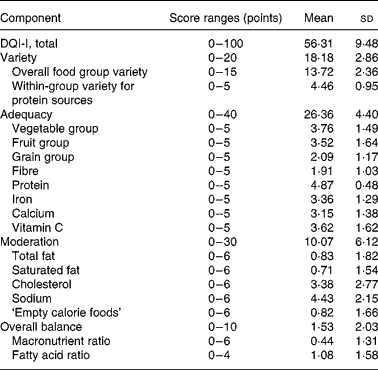
The DQI-I was modified to assess the Andalusia diet, following the Tur et al. Reference Tur, Romaguera and Pons26 modification of the method developed by Kim et al. Reference Kim, Haines, Siega-Riz and Popkin25. Notably, whereas Kim et al. Reference Kim, Haines, Siega-Riz and Popkin25 established a fat intake that was ≤ 20 % of total energy, Tur et al. Reference Tur, Romaguera and Pons26 proposed a higher level ( ≤ 30 %) for the consumption of fats in the Mediterranean region. The present version of the index also included use of Spanish recommended daily intakesReference Ortega, López-Sobaler, Requejo and Andrés37 and a change in the criterion for classifying ‘empty-calorie foods’. The DQI-I focuses on four aspects of a high-quality diet (variety, adequacy, moderation and overall balance). Specific diet components are assessed under each category. These categories help users to identify aspects of their diet that may need improvement. The score for each category is the sum of the scores for each component in that category. The total DQI-I score (range 0–100 points) is the sum of the scores for the four categories (see Table 1).
Diet Quality Index-International (DQI-I) scores and components
Variety
Variety was evaluated both as overall variety and as variety of protein sources. The maximum overall variety score was achieved by intake of at least one serving per day from each of the five food groups (meat/poultry/fish/egg, dairy/beans, grains, fruit, and vegetables). The score for the variety of protein sources (meat, poultry, fish, dairy, beans and eggs) was based on intakes of more than half the serving size per day, using data gathered by the FFQ. Portions were based on portion-weight tables for each food group and household measures38. The scoring system is described in Table 2.
Components of the Diet Quality Index (DQI-I) and percentage of sample in component subcategories

* Based on 7118 kJ (1700 kcal)/9211kJ (2200 kcal)/11 304 kJ (2700 kcal).
† Based on the recommended daily intakes for Spanish peopleReference Ortega, López-Sobaler, Requejo and Andrés37.
Adequacy
This category evaluates the adequacy of intake of those dietary elements that are required to protect against under-nutrition and deficiency disorders. The adequacy of fruit, vegetables, grain and fibre intake is dependent on the energy intake. Thus, for energy intakes of 7118 kJ (1700 kcal), 9211 kJ (2200 kcal) or 11 304 kJ (2700 kcal), the maximum score is assigned to a diet containing two, three or four portions of fruit and three, four or five portions of vegetables, respectively. Likewise, the highest score for grain and fibre categories was assigned to daily intakes of ≥ 6, ≥ 9 and ≥ 11 portions of grain and ≥ 20, ≥ 25 and ≥ 30 g fibre for the three energy intake levels, respectively. Protein intake was considered adequate when the proportion of total energy from protein was >10 %. Intakes defining the highest score for adequacy of iron, calcium and vitamin C were derived from the recommended daily intakes for Spanish peopleReference Ortega, López-Sobaler, Requejo and Andrés37, which vary according to age and gender.
Moderation
This category evaluates the intake of food and nutrients related to chronic diseases, which may need restriction. To emphasize the importance of moderation in fat intake, total fat intake in the DQI-I is evaluated using more stringent cut-off values than those found in other dietary indexes. In our modification of the DQI-I, a score of 6 points was assigned when total fat was ≤ 30 % of total energy/d, 3 points when 30–35 % of total energy/d and 0 points when >35 % of total energy/dReference Tur, Romaguera and Pons26 (Table 2). The intake of saturated fats was also evaluated as the percentage of energy from saturated fat. Intake levels of cholesterol and sodium were also recorded (Table 2). The ‘empty-calorie food’ component assesses how much a person's energy supply is dependent on low-nutrient density foods, which provide energy alone and supply scant nutrients. The DQI-I states that table sugar, alcohol, oil and similar are empty calorie foods (if the sum of nutrient densities considered across nutrients in a food is < 1, the food is considered an empty-calorie food). However, some of the foods classified as empty-calorie by Kim et al. Reference Kim, Haines, Siega-Riz and Popkin25 have nutritional value in the MDP and corresponding modifications were therefore made to the DQI-I. Thus, the following were only categorized in the MPD food pyramid as empty-calorie foods if their use was only ‘occasional and moderate’38: cold meats, pâté, butter, vegetable margarine, bacon, sugar, industrial pastries, sweets, chewing gum, snacks, soda pop and alcoholic drinks. The scoring of empty-calorie foods was also modified, assigning a score of 6 for consumption < 5 times per week, 3 points for 5–10 times per week, and 0 points for consumption >10 times per week (Table 2).
Overall balance
This category examines the overall balance of diet in terms of proportions of energy sources and fatty acid composition. Detailed cut-off values and corresponding scores as proposed by Tur et al. Reference Tur, Romaguera and Pons26 are described in Table 2.
Socio-demographic variables
Qualitative variables
Sex (male/female) and physical activity (active/sedentary) were considered as dichotomous variables. Physical activity was assessed from the following dichotomous variable in the questionnaireReference Mariscal35: ‘Practice sports about 2 days per week (yes/no)’. The following qualitative socio-demographic variables were also studied: who they live with (domestic situation), educational level of parents, work schedule of parents, who cooks, where they normally eat, time devoted to breakfast, lunch and evening meal, and the importance they assign to breakfast.
Quantitative variables
Age was categorized according to the Schofield classification for estimation of the BMRReference Schofield39. BMI was calculated from weight and height measurements, and obesity grade was based on the classification of Cole and co-workersReference Cole, Bellizzi, Flegal and Dietz40, Reference Cole and Henry41 and Kuczmarski et al. Reference Kuczmarski, Ogden, Grummer-Strawn, Flegal, Guo, Wei, Mei, Curtin, Roche and Johnson42, Reference Kuczmarski, Ogden and Guo43. The results were tested by using the Harris–Bennedict formula to calculate %fat values, finding a correlation between BMI and %fat of R 0·735 (P < 0·0001)Reference Mariscal35. Cut-off points for normal BMI values in study populations were based on the mean ± 2 sd (Z value). The significance level was 95 %. Subjects were classified as underweight (4 %), normal weight (73·3 %) or overweight (22·7 %).
Statistical analysis
Analyses were performed with SPSS version 12.0 (SPSS Inc., Chicago, IL, USA). Scores of the modified DQI-I and its four main categories were expressed as the mean and standard deviation score obtained for each component of the DQI-I, and the percentage of the population for each component subcategory was calculated. Student's t test, one-way ANOVA, and univariate and multivariate linear regression analyses were used to study the association between modified DQI-I scores and values of socio-economic, habit and body composition variables (significance of P ≤ 0·05).
Results
The study sample comprised 288 young people, 44·1 % females and 55·9 % males. The sex distribution of the sample did not significantly differ from the current sex distribution in the population of southern Spain44. The mean age was 12·88 (sd 2·78) years (range 6–18 years).
The mean total modified DQI-I score was approximately 57 % of the possible score (100 %). The highest score was for adequacy, followed by variety and moderation. The lowest score was for overall balance (Table 1). Regarding the adequacy, a large proportion of the population reported an intake of proteins, vitamin C, calcium, fruit, iron and vegetables that were 50 % higher than recommendations (Table 2). However, most of the young people consumed less than 50 % of the recommended intake of fibre and failed to meet recommended intakes of grain groups. Regarding the variety, 70·7 % daily consumed at least one serving from each food group or missed only one food group, and 72·2 % daily consumed three or more different sources of protein (Table 2). In the moderation category, only 5·0 and 4·1 % of the sample were within the limits set for fat and saturated fat, respectively. Cholesterol intake was ≤ 300 mg/d in 48·8 % of the population and >400 mg/d in 35·5 %. Around 60 % met the goal for sodium intake. Only 4·7 % of the population consumed empty-calorie foods less than five times a week. A very poor balance was found for energy-yielding nutrients and fatty acids.
Comparative analyses (Student's t test and ANOVA) of socio-economic, habit and body composition, with the modified DQI score as dependent variable, showed a significant relationship between score and: age (P = 0·009), with younger children obtaining a better mean DQI score; physical activity (P = 0·036), with better mean score for active than sedentary individuals; domestic situation (P = 0·025), with best score for those living with parents and siblings; education level of mothers (P = 0·029), with best scores for children of women with a university education; lunch location (P = 0·041), with significantly better scores for those eating at school versus other places; and breakfast (P = 0·025) and lunch (P = 0·049) duration, with better scores for those dedicating more time to these meals (Table 3). In a subsequent univariate linear regression analysis of socio-demographic variables, age (P = 0·007), physical activity (P = 0·036) and breakfast duration (P = 0·003) continued to show a significant relationship with DQI score. A multivariate analysis of these three variables was then performed, in pairs and in combination, in order to test for confounding factors. The duration of breakfast was again significantly associated with the DQI score (P = 0·029), whereas the association with physical activity was close to significance (P = 0·065) and there was no significant relationship with age (P = 0·084).
Association between Diet Quality Index (DQI-I) and socio-demographic variables

* Comparison of mean DQI scores among groups by ANOVA for polychotomous and Student's t test for dichotomous variables.
† Univariate linear regression analysis considering effect of single socio-demographic (independent) variable on DQI score (dependent variable).
Discussion
A modified DQI-I was used to evaluate the diet quality of a representative sample of young people in southern Spain.
The mean score of the study population was 56·31 % of the full score, lower than mean DQI-I scores reported in the USA and China and higher than mean scores observed in the Balearic IslandsReference Tur, Romaguera and Pons26. According to the criteria of Kim et al. Reference Kim, Haines, Siega-Riz and Popkin25, scores below 60 % indicate a poor-quality diet, but it is arguable whether DQI-I criteria for high-quality diets are wholly applicable to Mediterranean-type diets.
The highest scores in the present group were for adequacy and variety, as also found in the Balearic populationReference Tur, Serra-Majem, Romaguera and Pons22. However, the DQI-I assumes that a diet including various protein sources is also a feature of a good varied diet, which may be questionable in cultures where animal foods are routinely consumed. Moreover, southern Spain is undergoing a change in dietary patterns and therefore in traditional protein sources, which may increase the score for their diet in this aspect of variety. Therefore, it may be more appropriate in this setting to select another food group for this measure of variability, such as vegetables, fruit or grain.
Adequacy reflects compliance with prevailing recommendations to ensure a healthy diet. The diet of the present population was assigned a high score in this category for intake of protein, iron and calcium but a low score for intake of fruit, vegetables, grain and fibre.
According to scores obtained with this DQI-I, the Spanish diet lacks moderation and is highly unbalanced. Very poor scores were obtained for moderation in total fat and saturated fat consumption. The DQI-I sets strict standards, especially for fat intake, in line with US recommendations. However, although total fat intake in Mediterranean countries is similar to that in Northern Europe and North America, at around 38–40 %Reference Trichopoulou, Orfanos and Norat19–Reference Tur, Serra-Majem, Romaguera and Pons22, the incidence of CVD and diet-related cancer is lowerReference Gerber, Scali and Michaud29, Reference Serra-Majem, Ferro-Luzzi, Bellizzi and Salleras45. Importantly, olive oil is a central element of Mediterranean-type diets and makes a key contribution to its healthy properties. Moreover, studies in the Mediterranean area have demonstrated that the intake of vegetables is augmented by the consumption of olive oilReference Trichopoulos46, Reference Serra-Majem, Ngo de la Cruz, Ribas and Tur47. Nevertheless, the large amounts of olive oil traditionally consumed by Mediterranean populations worsen their diet index score because it is considered an immoderate intake of fat. It appears reasonable to suggest that dietary evaluations and guidelines should take account of the quality rather than the quantity of fat, aimed at reducing intake of saturated fat but not of olive oilReference Serra-Majem and Aranceta8, Reference Serra-Majem9. The DQI-I establishes moderate fat consumption as < 30 % of total energy, lower than the percentage found in the Spanish diet. In fact, only 5 % of the young Spanish population in the present study had a fat intake below 30 % of energy intake, even lower than the 14·5 % of the population in the Balearic Islands (14·5 %).
The original DQI-I categorizes olive oil and wine as empty-calorie foods with low nutrient density, but this is not appropriate to the Mediterranean diet. Olive oil contains a high proportion of MUFA, vitamin E and numerous antioxidant phenolic compoundsReference Owen, Giacosa, Hull, Haubner, Wurtele, Spiegelhalder and Bartsch48–Reference Briante, Febbraio and Nucci50. Besides alcohol, wine also supplies antioxidant phenolic compoundsReference Bianchini and Vainio51–Reference Pulido, Hernandez-Garcia and Saura-Calixto54. Therefore, in the present adaptation of the DQI-I, these items of high energetic value were only classified as empty-calorie foods when their use was only occasional and moderate, as recommended in the food pyramid for the Spanish population38. Further research is warranted to establish the most appropriate criteria for moderation in the diet of Mediterranean populations.
The diet of the study population also obtained a very low score for its overall balance, i.e. the proportionality in energy sources and fatty acid composition. However, the macronutrient ratios used to evaluate energy sources require that the percentage of energy from fat be ≤ 30 % and, as explained earlier, very few individuals met this goal. In the present sample, the mean ratio of PUFA and MUFA to SFA was 1·08, similar to findings in the other Mediterranean population in the Balearic IslandsReference Tur, Romaguera and Pons26. The higher consumption of olive oil, the usual source of unsaturated fat in the Mediterranean setting, leads to a much higher intake of MUFA than PUFA. In fact, current Spanish Nutritional Objectives recommend 20 % of total energy from MUFA and 5 % from PUFAReference Serra-Majem and Aranceta8, Reference Serra-Majem9. Further research is required to establish whether our adaptation of the DQI-I provides an accurate evaluation of the diet of young people in southern Spain or whether further adjustments are required.
The use of a single diet quality score for international comparisons is problematic. For dietary recommendations to be relevant and suitable for a given population, they should take account of prevailing food patterns in that populationReference Serra-Majem and Aranceta8, Reference Serra-Majem9, Reference Aranceta, Serra-Majem, Ribas and Perez-Rodrigo14, Reference Aranceta15, Reference Tur, Romaguera and Pons26, Reference Gerber, Scali and Michaud29, Reference Drewnowski, Henderson, Shore, Fischler, Preziosi and Hercberg55, Reference Popkin, Zizza and Siega-Riz56.
The present results suggest that age, physical activity, domestic situation, mother's educational level, the place where lunch is usually eaten, and the time taken to eat breakfast and lunch may be factors with an influence on the optimal dietReference Aranceta, Perez-Rodrigo, Ribas and Serra-Majem57. In the multivariate analysis, physical activity level and breakfast duration emerged as independent factors. Sedentary young people not only consumed less energy but had a worse diet compared with active youngsters, and this combination clearly increases the risk of obesity and related diseasesReference Someshwar, Someshwar and Perkins58. Interestingly, older children dedicated less time to breakfast, suggesting that age may be a confounding factor and that it is the time devoted to taking breakfast that has a positive effect on diet qualityReference Aranceta, Serra-Majem, Ribas and Perez-Rodrigo14, Reference Aranceta15, Reference Aranceta, Perez-Rodrigo, Ribas and Serra-Majem57. Children should be taught the value of breakfast at an early age in order to improve their diet in later years.
Acknowledgements
This work was supported by grants from the Spanish Ministry of Education and Science (FPU programme). The authors thank Richard Davies for his assistance with the English version.



