

Introduction
By the eighteenth century, as Adrien Delmas has noted, the European denigration of “any non-alphabetic manifestation of writing” had become pervasive, leading to a corresponding devaluation of the textual traditions of the Americas, Africa, and Asia (Reference DelmasDelmas 2016, 193). The recent surge of interest in “world philology,” focusing on the textual histories of these regions, seeks to correct this deficiency with the goal of advancing philology as a “truly universal (not ‘universalistic’) knowledge form … that takes globalization seriously as a form of knowledge” (Reference PollockPollock 2016, 14; see also Reference Pollock, Elman and ChangPollock, Elman, and Chang 2015; Reference DayehDayeh 2016; Reference RestallRestall 2003; Reference Van Doesburg and SwantonVan Doesburg and Swanton 2011). This renewed emphasis on the textual heritages of Asia, Africa, and Mesoamerica corresponds to a recent call to re-center anthropology’s engagement with the study of texts “as the philological record from which to document and explore language, culture, and intellectual life on their own terms” (Reference Webster, Woodbury and EppsWebster, Woodbury, and Epps 2017, 1).
Yet developing a philological understanding of the South American knotted cord texts known as khipus within this setting has proven to be challenging. During the Inka Empire (ca. AD 1400–1532), a highly organized and bureaucratic state with a population of approximately fourteen million, khipus recorded biographies, missives, and calendars, as well as economic and census information. For over four hundred years after the Spanish defeat of the Inkas in 1532, Andeans continued to make khipus. This extended period of post-Inka khipu activity, which appears to have been especially prevalent in the Central Andes (see Reference SalomonSalomon 2017; Reference SalomonSalomon 2004), testifies to the resilience and adaptability of these three-dimensional corded texts (Reference Salomon, Baines, Cooper and HoustonSalomon 2008). Khipus formed one of the most widely used and longest lasting of all Native American technologies of communication in the Western hemisphere.Footnote 1 However, despite recent advances in decipherment, our knowledge of khipu history and philology suffers from significant gaps (see Reference Mackey, Quilter and UrtonMackey 2002; Reference BrokawBrokaw 2010; Reference ClindanielClindaniel 2019; Reference HylandHyland 2014; Reference Hyland, Ware and ClarkHyland, Ware, and Clark 2014; Reference HylandHyland 2016; Reference HylandHyland 2017). Post-Inka khipus, which exhibit considerable regional variation in form, have been particularly poorly understood.
To further the study of khipu philology, this article will analyze a unique form of hybrid khipu/alphabetic texts known as “khipu boards” which were first developed by the Mercedarian religious order in the sixteenth century. Based on original archival research, this article first examines the historical development of khipu boards, which by the nineteenth century were used throughout the highlands. Ethnographic research reveals that villagers created khipu boards in the Central Andean community of San Pedro de Casta, Peru, until the 1950s. Casta officials allowed the authors access to the village’s carefully guarded ritual manuscript, the Entablo, which describes how khipu boards were used in the community’s most important ceremony, the Champería. The Entablo, regarded by villagers as their sacred bible, provides a rare insider’s perspective on khipus and khipu boards. Although it does not address khipu coding per se, the Entablo reveals new insights into the relationship between khipus and gender, place, and knowledge. This article explores the social and symbolic nature of khipus as expressed in the Entablo, augmented by interviews with contemporary villagers. It concludes with a consideration of how insights into the cultural meanings of these post-Inka khipus may apply to earlier periods.
History of the Khipu Board
Khipus (also quipus) were composed of multicolored cords made of cotton or animal fiber, many of which have knots indicating numbers in a base-ten system. In characteristic Inka-style khipus, multiple pendant cords hung down from a “top cord”; pendant cords might also have had “subsidiary” cords tied onto them. Post-Inka khipus include a variety of single-cord khipu types, such as those of San Cristóbal de Rapaz (Reference SalomonSalomon 2017) and the funerary khipus of Cuspón (Reference Tun and NúñezTun and Zubieta Núñez 2016).Footnote 2 In a khipu board, which is a kind of post-Inka khipu, single multicolored khipu cords pass through small holes in a wooden tablet rather than being tied to a top cord. The khipu board, also called a padrón or entablo, consisted of a board covered with a sheet of paper on which were written the names of individuals. Next to each name was a hole out of which hung a khipu cord associated with the person.Footnote 3
Until now, the most complete eyewitness account of the living khipu board tradition came from the Peruvian anthropologist Julio Tello, who described how khipus boards were used in Casta’s annual water ritual, the Champería (Reference Tello and MirandaTello and Miranda 1923, 532–535). This ceremony is dedicated to cleaning and repairing irrigation canals, and, on a more cosmic level, to ensuring the flow of water, abundance, and life for the community. Tello wrote that on the ritual’s first full day, the men came together at a place along the canal where they sat in a semi-circle. Then the functionaries set up the khipu board and “by means of cords of different colors, that pass through a hole next to each name, and by knots, [they] note … not only the lack of attendance and quality of the work done, but also all that the authorities demand of the worker as indispensable accessories to the work: special clothing, wallkis [ritual bags], shukank’a [a bone for taking lime], ishku puru [a decorated gourd with lime], tools, and even the greater or lesser enthusiasm of each person, with the purpose of presenting [the board] to the senior men.”Footnote 4 In Tello’s account, the multicolored cords on the khipu board recorded both objects—the essential ritual items—and the type of work done by each individual, along with an evaluation of how well the labor was performed.
Tello published the following drawing of the Casta khipu board that he observed in 1922 (Figure 1). When the Hylands showed Tello’s drawing to the Casta authorities, the president commented, “These are our khipus, the khipus of our community!” (Estos son nuestros khipus, los khipus de nuestro pueblo!). Despite assistance from community members, neither the Hylands nor Bennison have been able to locate any extant khipu boards in Casta today. However, this nineteenth-century khipu board from the Central Andean village of San Francisco de Mangas is similar to those used in Casta (Figure 2).
Tello’s drawing of the Casta khipu board. Redrawn by Eleanor Hyland.

The khipu board of Mangas. Photo by Sabine Hyland.

These khipu cords recorded each individual’s contributions of labor and goods to village celebrations in Mangas, just as the Casta khipu boards did. Originally most of the 181 holes in the Mangas khipu board held a khipu cord; now, due to deterioration, only 87 holes have a cord. These remaining khipus contain over seventeen different colors that either stand alone or are combined into over twenty color combinations, resulting in over thirty-seven color patterns. The cords also vary in ply direction (that is, whether the final twist is to the left or to the right), and some are braided. Knot direction indicates the moiety affiliation of the individuals inscribed on the board (Reference Hyland, Ware and ClarkHyland, Ware, and Clark 2014). There are also three levels of difference in the thickness of the cord, which are mainly sheepswool: the thick, coarse wool is known locally as jerga, the medium as trama, and the thinnest as hilasa. It is a distinction not just of size but more importantly of texture, from coarse to medium to very soft. The complexity of the khipu cords in terms of color, color combinations, ply direction, knot direction, and thickness/texture indicate a high level of sophistication and variability in their messages (see Figure 3).
Cords of different thickness and texture, Mangas khipu board. The thinnest threads (e.g., the purple, blue, and white cord) are soft, while the thickest (e.g., the pink cord) are rough. Photo by Sabine Hyland.

The padrón—without cords—was first developed in Spain in the late fifteenth century. It was a wooden board on which the priest or his assistant wrote down the names of parish members. During Lent, each person on the padrón was required to go to confession, after which he or she was issued a chit, or cédula de confesión, which allowed the person to partake in the Easter Eucharist. The system was meant to encourage penance and participation at Mass; it also served as a proof of residence and provided a way for authorities to keep track of the population (Reference ThomasThomas 2001, 70–79).
The wooden tablet of the padrón hung in churches, usually in the doorway. Some contemporary authors compared the padrones to the stone tablets of the law given to Moses as described in the biblical book of Exodus. When the Catholic Church was established in Peru in the sixteenth century, priests were ordered to make wooden padrones for their parishioners in the rural Indian parishes known as doctrinas.Footnote 5 By the 1770s the padrones were also referred to as entablos in the Peruvian pastoral visitation reports from the Huacho diocese.
Members of a Roman Catholic religious order, the Mercedarians, first attached khipu cords to the padrón in the sixteenth century. In his instructions for how his fellow Mercedarians should evangelize native parishes, Friar Diego de Porres declared that missionaries must place in each church a “khipu” and “tabla”—which means a tablet or flat board—to indicate the observances that the Indians were obliged to make during feast days, including attendance at Sunday Mass (Reference Porres and BarrigaPorres [1572–1579] 1953; Reference BrokawBrokaw 2010). To demonstrate that individuals had carried out their obligations, the khipu cord was pulled tightly to the board so that only the end knot showed; if a person had neglected their obligations, the cord hung down loosely from the board (Reference Hassaurek and GardinerHassaurek [1866] 1967, 176).
This Mercedarian khipu board tradition continued into the twentieth century in San Pedro de Pari (Ondores), which had been founded as a doctrina by the Mercedarians in the sixteenth century. In 1958, Federico Kaufmann Doig observed two khipu boards hanging in the sixteenth-century colonial church in the village (Reference Kaufmann DoigKaufmann Doig 1983, 60–61). Villagers’ names were inscribed on these large rectangular wooden boards; next to each name was a hole through which a khipu cord hung. Community members had used the khipu boards to record participation in ceremonial activities, according to Kaufmann Doig. The archaeologist emphasized that this form of record keeping with cords and wooden boards arose in the colonial period. Indeed, pastoral visitations in Pari in 1770 and 1775 included transcriptions of all the names on each of the Pari khipu boards, revealing the historical continuity of these objects, and suggesting the vital role they played in community life.Footnote 6
By the late seventeenth century, khipu boards in Mercedarian doctrinas often indicated the kind and quantity of tithes owed by each parishioner. A survey of pastoral visitations from the seventeenth and eighteenth centuries in the Central Andean diocese of Huacho reveals that the tithing system varied from parish to parish depending on established custom and the nature of the local economy.Footnote 7 In some doctrinas, parishioners gave one-seventh of their annual produce as tithes; however, this form of tithing required the priest’s assistants to be present at each farmer’s harvest to ensure compliance. More commonly, each parishioner was charged a sum of money on the basis of their marital and racial status, which was then paid in crops or livestock. Usually the priest calculated the amount of produce owed according to the current market price, so the quantity varied from year to year. Individuals who had performed a service for the priest, such as being a fiscal (native treasurer), cook, servant, cantor, water carrier, guide, muleteer, and so on, did not have to give any other form of tithe.
A description of a typical Mercedarian tithing regime can be found in the report of the 1666 episcopal visitation carried out in Quipán in the Mercedarian doctrina of Huamantanga. Every year on November 1, a friar seated himself in the doorway of the Quipán church, holding the wooden padrón and calling out the tithes owed by each of the assembled parishioners. The Quipán farmers paid their tithes in bushels of dried potatoes, the amount depending on race and marital status. Additionally, married herders paid one sheep for every seven they owned, but if they had more than seven, they paid an additional four reales per head; on the patronal feast, parishioners gave meat, bread, vegetables, and firewood to the priest; and villagers provided a servant, a senior and junior fiscal, a woman to carry water, a mule, and a guide.Footnote 8 The khipu cords on the Mercedarian padrones recorded this tithing information for each person—how much they owed of different crops, or animals, or what labor service they had provided. This is very similar to the kinds of information encoded on the khipu cords of the Casta padrón—goods and labor. In doctrinas where the padrón did not have cords, the additional tithe information for each person was kept in a cuaderno de aranceles (notebook of fees).
Not much is known about how the khipu boards expanded beyond Mercedarian doctrinas, but by the nineteenth century khipu boards had traveled far. In Ecuador to the north, for example, the US ambassador witnessed their use in 1863 (Reference Hassaurek and GardinerHassaurek [1866] 1967, 176), and described the flogging meted out to those who failed to fulfill the obligations noted on the cords of the padrón. He wrote:
The names of the Indians, men and women, of the parish, are inscribed on three or four wooden tablets, with a handle to each. In front of each name is a small hole, through which a string is drawn, with a knot on each end. The names on the tablet are read off by the alcalde, and each individual meekly responds, ‘Aquí estoy, mi amo’ (‘here I am, my master’). If the knot attached to a name is found hanging outside, it is a sign that its owner failed to attend the last rehearsal of the Doctrina Cristiana. … As soon as the name of the offender is called, he is required to step forward and to lie down flat on the ground, where he receives three lashes.
The Codex Martínez Compañón, a series of watercolors depicting daily life in the Diocese of Trujillo between 1779 and 1790, appears to represent a similar scene.Footnote 9 The painting titled “Sunday Padrón in the accounting ceremony” (Padrón de los domingos en huairona) shows a secular priest holding a rectangular board covered with two rows of lines, presumably representing the names on the padrón, with an empty hole after each name. On the ground lies a pile of loose cords, while in the foreground a person is whipped as a punishment for not carrying out his obligations. In the following plate (54), “Saturday Padrón of the Indian widows” (Padrón de los sábados de las indias viudas), a standing gentleman displays a rectangular wooden board inscribed with two rows of black squiggles representing names. After each of the first eight names there is a red circle, apparently showing a knot pulled close to the board to denote that these widows had fulfilled their obligations. Seven Andean women, several of whom are smiling, sit calmly on the ground.
The Peruvian scientist Mariano Rivero y Ustáriz also observed khipu boards in the highlands. In 1857 he noted that in some Andean parishes khipu cords are attached to a tablet “to indicate the number of inhabitants, with distinctions by sex and age, and the absences of the parishioners on the days of teaching Christian doctrine” (para indicar el número de habitantes, con distinción de sexos y edades, y las ausencias que hacen los feligreses en los días de enseñanza de la Doctrina Cristiana) (Reference Rivero y UstárizRivero y Ustáriz 1857, 84).
The Ministry of Culture storehouse in Ayacucho, Peru, possesses a previously unknown example of such a padrón: a large rectangular khipu board approximately 97.8 cm high and 21.6 cm wide. Each side has two rows of names, with a hole before each one; although some of the holes are now empty, 103 woollen cords remain. Remnants of three layers of paper cling to each side. The handwriting indicates that this padrón probably dates to the nineteenth century, while the surnames reveal that it likely came from the villages of Huancupa or Sarhua. Its beige and brown khipu cords bear occasional red marks and are simpler than those of Mangas (Figure 4).Footnote 10
Section of the Ayacucho khipu board, Ministry of Culture, Ayacucho, Peru. Photo by Sabine Hyland.

In Chile, the ethnohistorian Alberto Días Araya discovered a nineteenth-century khipu board that retains 109 cords in an array of colors—red, blue, yellow, brown, and cream (Díaz Araya, personal communication, March 25, 2020). Although it is unclear how the khipu board technology proliferated, evidence suggests that they were a common feature of native parishes in the Andes by the nineteenth century.
The Entablo of San Pedro de Casta, Peru
While khipu boards in Casta pertain to the past and now exist only in the memories of the elderly, the Entablo manuscript continues to be revered as a sacred text. The Entablo, written in a simple notebook, describes the activities of each day of the annual water ceremony (Figure 5).
Cover of the Entablo. Photo by Sabine Hyland.

A marginal note in the text refers to it as “this book, so legendary, about all the interior customs of our community … [which] coincide with many laws from the Inkaic era” (Este libro tan legendario de todos los costumbres ynteriories de nuestra comunidad … coincide ademas muchas leyes de la era incaica; f. 1r; f. 19v). It was written in 1921, with later additions in 1926, 1939, 1947, and 1952. The title, Entablo, is a pun referring both to the “agreement” that the book represents, and the entablos or khipu boards that structure the entire ceremony. This sacred text provides an insiders’ view of what khipu boards are and how they ought to be used. The last mention of khipu boards occurs in the 1939 addendum, but the memories of villagers indicate that they were employed until the 1950s. Several elderly women now in their early seventies remembered khipu boards being used in the Champería when they were children.
In 2015, in response to the Hylands’ questions about the presence of khipu boards in the village, Casta authorities formally granted permission for them to study the manuscript, photograph it, and write about it. Bennison, whose doctoral fieldwork was carried out in the neighboring community of San Damián, conducted fieldwork in Casta in 2019. She also was allowed to read and photograph the manuscript, which is kept in a locked cupboard in the office of the village authorities. The Entablo’s writing has faded and can be difficult to read; Bennison and the Hylands have agreed to provide the community with an accurate transcription in return for access to the sacred text.
The Entablo begins with an explanation of why it was written: “In light of [our] many … disagreements … [the officials], from the Lieutenant down to the last camachico, do not fulfil their obligations and duties.” Therefore, it was agreed to write down the responsibilities of this ceremony, and to “submit ourselves to this regime because it’s the fundamental basis for the water source by which we live, and which quenches our thirst from birth until the last moment of our death” (En vista de muchos controles y desacuerdos en las obligaciones comensando desde el teniente asta el último que es el camachico no cumplen con sus obligaciones y deberes… todos nos sometimos a este regim por ser la base fundamental por el caño de donde vivimos y saciamos nuestra sed desde que nace hasta que llegue la última hora de nuestra muerte; f. 3r). One Casteño told the Hylands that all one would ever need to know was written in this book. The Champería ceremony begins on the first Sunday evening in October and continues through the following Sunday.Footnote 11 On the first evening, the elected ritual officials and the ritual specialist known as the Yachak (the “One who knows”) perform secret rites at the site of Mashka (Lookout), a ruined pre-Columbian settlement four kilometers from Casta along the principal irrigation canal (Reference Tello and MirandaTello and Miranda 1923). There the Yachak calls out to Huallallo and the other beings who guard the well-being of the community, and, after hearing their voices in the echoing reply, gives offerings to the Waka-mallko (Progenitor being), a large stone that overlooks the ruins. During the next two days, Monday and Tuesday, the community repairs and cleans the canals. Villagers participate in sacred rituals on Wednesday morning, followed by a horse race in the afternoon. On Thursday there are more ceremonies and the water valves are opened, allowing the life-giving liquid to flow through the irrigation channels. Friday and Saturday are devoted to reviewing the khipu boards to determine whether everyone has participated fully in the event, with punishments meted out to those who were delinquent. The following two days consist of feasting, singing, and other closing events. Throughout this main section of the Entablo, the activities are described day by day.
The most extensive portion of the manuscript was written in 1921 and concludes with the signatures of all the adult males. A brief addition dated to October 10, 1926, concerns the distribution of alcohol throughout the ceremony. The next section, dated January 8, 1939, provides additional information about the obligations of the officials and their wives. It also includes several paragraphs on the duties of mayordomos, fiscales, and cantors during Ash Wednesday, Lent, and Holy Week. The following section notes briefly that the authorities met on May 5, 1947, to determine the repairs needed for the Carhuayumac canal. The final formal entry, dated January 7, 1952, describes some of the ritual objects used in the secret ceremonies, such as the triangular stone representing the sami (life force) of the community, and the tuft of white cotton or wool signifying the clouds that indicate whether it will rain. All of these four additional sections end with the signatures of those present and/or in charge of the meeting. The last page contains a chart noting the fees owed by various villagers for grazing their animals on communal land.
Khipu Boards in the Water Ritual
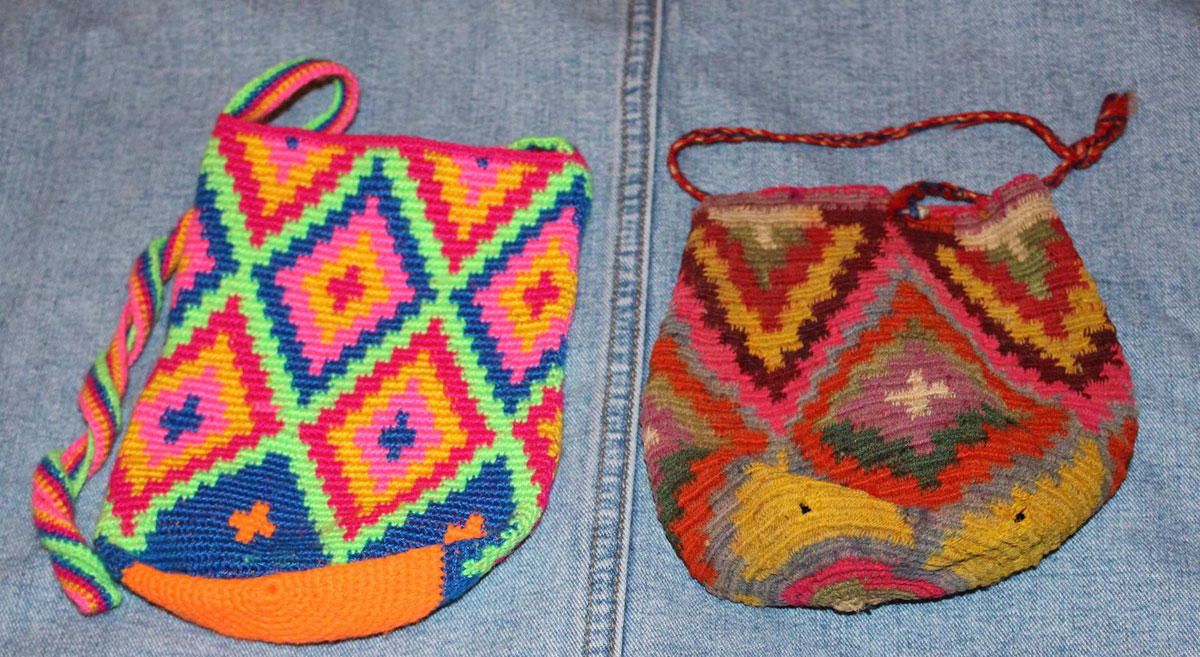
Tello and Miranda’s article on Casta mentions only one khipu board in the Champería; however, according to the Entablo, at least three distinct khipu boards were used throughout the ceremony. The first khipu board in the text is called the Padrón de Wallki; it bears the name wallki for the ritual bags (wallki) worn by the men during the ceremony. This is the same khipu board described by Tello and Miranda, which tracks whether each man has all his ritual objects and equipment and also indicates the work required of each village official, including their participation in secret rituals. Even today there is an accounting of whether each man has the items in his wallki—coca leaf, a small gourd with lime for chewing the coca, a small lime spoon, cigarettes, and special herbs—that must be present for the ceremony to be effective (Figure 6). Wallkis are made by wives, and the bags with the most stitches are the most admired. The wallki is worn around the neck, while a larger ritual bag containing alcohol is carried over the shoulder.
A recent wallki (left) and one from the 1970s (right) of goat hair collected by Sarah Bennison. Photo by Sabine Hyland.
The Entablo explains that the “Padrón de Wallki” was set up for the men at a place that was revered “since very ancient times” (desde tiempos muy antiguos; f. 5r) by the main canal on Monday when work commences. The text states:
In this place, while the workers are in this peace and tranquility, they begin the padrón of the wallkis and of the hand-made gourds [for lime] … that demonstrate the manual labor of each person … consist[ing] of a small, well-wrought bag with threads of different colors and little gourds that are also well made … and like … the instrument the Chirisuya or oboe, everyone who knows how is obliged to play … under the pain of being reprimanded and punished. (Entablo f. 5v)Footnote 12
Chirisuya is the Andean word for the Spanish oboe whose music forms an integral part of the ceremony, creating harmony and a feeling of good will. This khipu board, the first described in the text, was brought out again Tuesday in the midmorning when the men had gathered at the site of Chacchadera (place for the ritual chewing of coca leaves) to review the day’s obligations (f. 7r). The Padrón de Wallki did not appear again in the ceremony until the end when the authorities determined whether each person had fulfilled the duties indicated on the khipu boards.
The second khipu board was the general khipu board—the “General Padrón of those who attended the communal labor” (Padrón general de los asistentes a la faena, f. 6r). This was displayed for the first time on Monday on the shores of Lake Chuswa, where everyone had gathered for lunch. The general khipu board designated the names and obligations of all the able-bodied villagers, men and women, who were required to work on the canal cleaning and repair. It was brought out again early on Tuesday morning at the site of Mashka, when flares called the villagers to go over their upcoming work for the day. Later on Tuesday, everyone reunited at the site known as Laco, where they rested and drank, and the General Padrón was set up once more. The functionaries then walked along the canal to see whether the work required by the khipu board was completed satisfactorily by each person.
The third khipu board, known as the Padrón of the Twenty Pitchers (Padrón de los veinte cántaros) was prepared on Tuesday evening in the house of the official known as the Lieutenant. This khipu board, which was created with the assistance of grains of maize arranged in lines on a ritual cloth on the floor,Footnote 13 indicated the type and quantity of alcohol prepared by the women (f. 7v). The women on the padrón were divided by moiety: Yacapar and Yañac.
On Wednesday the married women and widows of the Yacapar moiety distributed beer according to the obligations noted on the Padrón of the Twenty Pitchers. After consuming the pitchers of beer, villagers walked to the site of Mashka, singing special songs (hualinas) along the way. Once in Mashka, the community recited prayers in front of a standing cross, including two Our Fathers, two Hail Marys, and the Rosary, culminating in the glorious Marian mysteries: the assumption of Our Lady into heaven, and the crowning of Our Lady as Queen of Heaven. The Entablo explains that by praying, “[we] commend ourselves to the male saints and female saints in the court of heaven so that by means [of our orations] our divine providence attends to [our petitions]” (encomendandose a los santos y santas de la corte del cielo para que por medio dellos los atienda nuestra divina providencia; f. 10v).
On Thursday, the community gave offerings to the high lakes, parading around them while singing special songs to the tune of the Andean oboes. The officials released the water in the irrigation canals, and as the liquid flowed, a banquet was provided by the shores of Lake Chuswa. When the meal was finished, all of the youth stood while a blessing was prayed. Then, rejoicing in the reception of the water, flares were fired and the women of Yañac distributed the alcohol according to the Padrón of the Twenty Pitchers (f. 12v).
On Friday and Saturday the khipu boards took center stage as officials reviewed each person’s labor and meted out the appropriate punishments, mainly lashes with a whip, to those who had not complied with their obligations. On each of these two days the community members gathered in the plaza of Cuhuay, a ruined settlement that in 1921 lay fifty meters east of Casta (as the population has grown the plaza is now within the village). In the seventeenth century, Spanish extirpators destroyed the stone waka (revered being) who stood in the plaza, and who was revered as the village’s protector, replacing the deity with a large cross (Reference Tello and MirandaTello and Miranda 1923, 482–483). There in the Cuhuay plaza officials set up a large table covered with a white tablecloth, a straw cross, and an earthenware jar for beer; next to this was a small table holding the items for administering punishments: a cruppers strap, a pair of scissors, and a woollen rope.Footnote 14 The people of the Yacapar moiety sat on the eastern half of the plaza, those of Yañac took their place on the western half, and those with affiliations to both moieties sat on a pile of straw in the middle. The officials then consulted the Padrón General, and those whose actions were found wanting were reprimanded and punished publicly. One elderly woman told Bennison that she remembered seeing the khipu board set up next to the stone cross in Cuhuay plaza when she was a girl (Figure 7).
Stone cross in the Cuhuay plaza with tables set up for the reckoning of accounts. The khipu board used to be set up next to the cross. Photo by Sarah Bennison.

Men were judged on Friday and women on Saturday. The addenda of 1939 clarified that the Yachak—that is, the ritual specialist—must be in charge of going over the khipu boards and determining who has not complied with their obligations. On both days, after the rendering of the khipu board accounts and the subsequent punishments of those found delinquent, officials presented a written list of community members ranked in order of how well each person contributed to the Champería. Those who came at the bottom of the list owed fines, which were determined in the succeeding days. Finally, on Monday, the last day of the celebration, the people marched through the streets, singing to the music of the Andean oboes “with a very distinctive joy which ends this present memory of our customs [which come to us] from the time of our foundation” (con una alegría muy distinta con lo que se dió término la presente memoria de nuestras costumbres desde los tiempos de su fundasión; f. 17v).
Gender, Place, and Knowledge
It is notable that the khipu boards in the Champería are divided by gender: the Padrón of Wallki for men, the Padrón of the Twenty Pitchers for women, and the General Padrón for both. Having an entire khipu board dedicated to women’s contributions of homemade alcohol reveals the importance attributed to this aspect of women’s labor. The prominence given to women’s distribution of chicha recalls the irrigation-canal-cleaning ceremony described in a seventeenth-century manuscript composed in San Damián, a community very close to Casta (Reference Salomon and UriosteSalomon and Urioste 1991). In this early (ca. 1605) account, the highlight of the ceremony occurred when a woman representing Chuqui Suso, the beautiful earth-being (waka) who owned the water sources, distributed beer to all the villagers, assisted by the women. As she poured out the drink, she prayed, “This is our mother’s beer,” drawing the recipients into a reciprocal relationship with the goddess which, if properly attended to, would keep the life-giving waters flowing.
The Andean worldview has often been called hydraulic, meaning that water, fluids, and energy must flow throughout the worlds and among all kinds of entities for life to continue (Reference ClassenClassen 1993, 15). The ritual distribution and consumption of alcohol plays a key role in keeping these celestial and worldly waters flowing (Reference Jennings and BowserJennings and Bowser 2009). When the Entablo states that, after the women of Yacapar shared the beer and prayers were made to Our Lady, “by means of this, the divine providence will attend to us,” it echoes the cosmic pact of Chuqui Suso and the village women who poured out her beer. The Padrón of the Twenty Pitchers memorialized the Casta women’s contribution to this outflowing of fluids, good cheer, and fertility. Would there likewise have been a “khipu of twenty pitchers” that inscribed women’s labor for water rituals in the Inka era or earlier?
The khipu boards of Casta were not only gendered but were associated also with different places in the landscape. The Padrón de Wallki was first set up in a site along the Huanca canal that had been revered since “ancient times,” and then later at the place where the coca leaves were ritually chewed as an offering to the wakas. The general khipu board and the Padrón of the Twenty Pitchers were brought out repeatedly at the site of Mashka, where a tall stone revered as the Progenitor Being overlooks an ancient plaza and ruined village. The final accounting with the khipu boards was performed at the Cuhuay plaza, located at the site of an ancient shrine to the local deities (Reference Tello and MirandaTello and Miranda 1923, 482–483). In Huarochiri, as elsewhere in the Andes, power is “concretised in living and meaningful places” (Reference Swenson, Jennings and JenningsSwenson and Jennings 2018, 2) in such a way that history, myth, personhood, and knowledge are inscribed in salient locations like Mashka (Reference Wilkinson, D’Altroy, Swenson and RoddickWilkinson and D’Altroy 2018). This power is not distributed evenly across the landscape; as Mannheim and Salas have noted, “In Quechua terms there are neither sacred places nor profane ones. There are powerful places, vastly more powerful than humans, and as such they receive privileged attention” (Reference Mannheim, Salas and BrayMannheim and Salas 2015, 63).
It was clearly intentional that khipu boards were set up for public display in the most powerful spots in the local landscape. In all of these places, the entities who guard the fertility of the soil and the well-being of the people witnessed the community’s capacity to work together and clean the canals without internal strife. The khipu boards, by noting the labor, ritual objects, and other contributions of each person, provided testimony before the wakas that harmony had prevailed as the hard, sweaty labor was distributed fairly among people, households, genders, and moieties. It is emphasized today that each person must perspire as they work during the Champería, expending their sweat just as the rains will fall and the water will flow in the canals. The labor that produces this human perspiration was recorded in the twisting textile lines of the khipu cords. In the Andes, thread and yarn are often compared to the movement of water in a stream or waterfall; it is not difficult to imagine that the khipu cords themselves were like lines of flowing water by each name.
The Casta padrón was also considered to represent an esoteric and ancient knowledge beyond its ostensible meanings. The Entablo refers to the Padrón de Wallki and the ritual objects it records as “curiosities” (curiosidades) (f. 5v), a term whose Andean meaning refers to the knowledge, power, and wisdom of ritual experts such as healers and Yachaks (Reference BennisonBennison 2016, 273). A “curiosidad” can be understood as a highly skilled practice informed by ancestral knowledge—often relating to the landscape—which is conducive to production, community cohesion, and the maintenance of effective relationships. It is in keeping with the khipu board’s status as a “curiosidad” that it must be interpreted by the Yachak, the expert in communication with the wakas, those beings of stone, earth, wood, and pigment who control the forces of productivity, water, and fertility.
The signs that the Yachak reads are multidimensional and must be understood haptically as well as visually. For example, in the secret divination ceremony performed on Sunday evening at the beginning of the Champería, the Yachak interprets patterns of both color and texture on maize kernels, using sight as well as the sense of touch. The kernels represent the ritual’s functionaries, such as the very soft and tender white kernel, kapia, for the kamachico official; if the maize is not soft, it is not kapia. In his divination, the Yachak must feel the kernels as well as visually identify their color patterns. The same is true of the khipu cords on the padrón, which exhibit a tri-partite system of soft (hilasa), medium (trama), and rough (jerga), in addition to complex color patterns (see Figure 3). In Casta’s neighboring village of Collata, two eighteenth-century khipus likewise coded information in part through the sense of touch, on the basis of haptic distinctions among different types of animal fibers with the same colors (Reference HylandHyland 2017).
Sound is also an element in how the Entablo expresses the khipu boards’ actions during the water ritual.Footnote 15 In two different passages in the text, the khipu board acts on its own volition, both times calling for a rest in the activities: “the padrón will call for a rest of those present” (el padrón llamará al descanso a todos los concurrantes; f. 15r), and “the padrón calls for a rest” (el padrón llama al descanso; f. 16r). Llamar, to call out, is an auditory verb that reflects the speech of those who interpret the cords; it also recalls the Entablo’s earlier linking of the khipu board with the musical instruments, the oboes. Zoila Mendoza (Reference Mendoza2017) has argued that what she calls “the Andean sensory model … the unity of … hearing, sight and bodily movement [or touch] … [is] … the keystone of Andean forms of knowledge/memory.” This combination of three supposedly separate senses—sound, sight, and touch—is essential, she argues, for meaning and authenticity in the Peruvian Andes. As she writes, “for the case of the Andes the intrinsic relationship that exists among the kinesthetic, visual, and auditory experiences goes beyond the ritual context and is central to … knowledge and memory” (Reference MendozaMendoza 2017, 132). Khipu boards, as described in the Entablo, brought together all three senses, thereby legitimating the wisdom contained in the cords. As a form of inscription that fits Mendoza’s model of the Andean multisensorial triad, khipu cords deepened cognition, experience, and religious affect.
Khipus and Ushay (Harmony)
In addition to bringing together the three senses, the use of khipus promoted the ideal of harmony, or “ushay” in a manner similar to that of the Chirisuya, or oboe, with which the padrones were grouped in the text. Oboes, like khipus, harmonize any discordant feelings or hostilities within the community, helping to create the “very distinctive joy” that characterizes the ceremony. The Entablo refers repeatedly to the chirisuya’s role in promoting the sense of amity and happiness that is required of all participants in the ritual. Rebecca Stone has described how the Quechua concept of ushay, which means balance, harmony, and beauty, similar to the Diné notion of hózhó, is “a final overarching idea and ideal in Andean cultures” (Reference Stone and MuseumStone 2017, 12). Creating balance among opposing forces is seen as the supreme “universal property that all people, animals, things, and artworks seek to achieve” (Reference Stone and MuseumStone 2017, 12). The chirisuya’s tunes help guide the participants to this experience of ushay, that particular sense of happiness that villagers are expected to feel.
Khipus and khipu boards likewise fostered the sense of “ushay.” The khipu boards of Casta ensured that everyone contributed fairly, avoiding the simmering resentments and anger that could arise if an individual or moiety failed to do their part. Marco Curatola and José Carlos de la Puente (Reference Curatola, Puente, Curatola and Puente2013) have analyzed how the public audits of khipus in the colonial period were noisy affairs in which different lineages (ayllus) and moieties vociferously asserted their contributions and rights. The goal of each khipu audit was for all those involved to “reach a just and satisfactory consensus” (llegar a un acuerdo justo y satisfactorio; Reference Curatola, Puente, Curatola and PuenteCuratola and de la Puente 2013, 220; see also Reference SalomonSalomon 2004), resulting in abiding feelings of unity and delight. The spirit of harmony and good will that prevailed after a successful khipu accounting is “ushay”—the same “very distinctive joy” which characterizes the Champería and which the oboe’s music helps to create.
The Entablo’s Relevance to Earlier Khipus
By explaining how khipu boards were used in the local water festival, the Entablo grants a unique insiders’ view of this type of post-Inka khipu. What insights does this text provide into the nature of khipu philology, and are these understandings applicable to pre-Inka khipus? Among the areas where the Entablo presents crucial information are: (1) the multiplicity of khipus in a single work event; (2) the gendering of khipus; (3) the relationship of khipus to the land and ushay; and (4) khipu multidimensionality and Andean concepts of knowledge.
The Entablo’s explanation for the role of khipu boards in the Champería draws our attention to the multiplicity of khipus that may have been needed for a single work event. That is, it is often assumed that a single labor event, lasting anywhere from a day to a year, such as cleaning irrigation canals, harvesting, herding, and so on, produced one khipu to record either the labor (e.g., work days) or the resulting goods produced (e.g., animals, loads of crops, pieces of textiles, and so forth) for each group. Yet in the Entablo we see that a basic labor task—cleaning and repairing the irrigation canals—required essential ritual gear and participation in secret ceremonies, as well as the distribution of alcohol. In the case of Casta’s Champería, three separate khipu texts—the General Padrón, the Padrón of Wallki, and the Padrón of Twenty Pitchers—recorded the different kinds of information generated by the ritual. Likewise, it may well be that during a communal agricultural task in pre-Hispanic Peru, khipus to denote ritual items and alcohol would have been made alongside khipus recording the people’s labor. It is also possible that information on ritual activities and drink might have been recorded in sections of a single khipu that was otherwise devoted to indicating labor and/or produce.
In the Inka Empire, when a subject group presented its tribute to representatives of the government, it was a highly ceremonial affair with feasting, drinking, and offerings (Reference Morris and ThompsonMorris and Thompson 1985). Presumably the Inka khipu specialists would have created a khipu account of this event that recorded the tribute items given; the Entablo suggests that they probably also made khipus to represent the food, drink, and ceremonial items that were indispensable to the symbolically charged exchange that occurred when tribute was handed over (see Reference GoseGose 2000). Much of our understanding about the items recorded on khipus comes from so-called paper khipus, that is, transcriptions of khipu testimony read aloud in colonial Spanish courts as part of legal disputes over tribute (Reference Murra, Mackey, Sánchez, Radicati, Pastor and ValverdeMurra 1990; Reference Pärssinen and KiviharjuPärssinen and Kiviharju 2002–2005; Reference MedranoMedrano 2019). Because the cases involved financial disputes, only economic information was read off the khipus and presented to the court. However, if ritual information related to production were contained in these khipus, or on ancillary khipus, it likely would have been excluded from the litigants’ testimony, given the colonial prohibition of non-Catholic religious activities.
The Entablo also reveals the degree to which khipus may be gendered, with some encoding information only from males, some denoting data only from females, and others combining material relevant to both men and women. The symbolic importance of women’s contributions, particularly of chicha beer, may have been expressed visually in Inka khipus. For example, on the Inka khipu VA16636 (Berlin Ethnologisches Museum) the pendant cords hang from a wooden bar on which is carved a person holding a drinking vessel. While the exact context of this ritual drinking is unknown, the Entablo’s description of the Padrón of the Twenty Pitchers forces us to consider the possibility that the individual could be a female offering and/or consuming drinks.
Throughout the Entablo’s description of the water festival, we see the degree to which important, public khipus may be associated with powerful places in the landscape and with the wakas related to these sites. It is likely that this tie between khipus and salient sites existed in the pre-Hispanic period; however, given the much greater numbers of khipus that were used in the Andes prior to the spread of alphabetic writing, there may have been a greater distinction in the past between powerful khipus that served as focal points in major rituals and were set up in key locations, and the more mundane khipus for everyday acts of record keeping. The Entablo also expresses the role of khipu boards in harmonizing possible conflicts among people and groups within the village, helping to create a communal sentiment of happiness and balance in a manner similar to the Andean oboes. It is difficult to know how closely these values adhered to earlier khipus; hopefully further research will clarify whether these ideals of harmony pertained only to modern khipus, or were relevant to important colonial and pre-Hispanic khipus as well.
Finally, the multidimensional coding of the cords on the khipu board, which must be interpreted through both sight and touch, corresponded to a traditionally Andean concept of knowledge. When a third sense, sound, was added with the public reading of the khipus, the knotted cord texts expressed the tripartite sensuality through which knowledge has been formed in the Andes, deepening the legitimacy and emotional impact of the information contained therein. It is likely that this is at least partly responsible for the khipus’ persistence for so many centuries after the introduction of alphabetic script to South America. While two dimensional alphabets and Arabic numerals have certain advantages, they lack the multisensorial authority and epistemology of cord-based texts.
Conclusion
Khipus have a history of over one thousand years in the Andes (ca. 850–1950 AD), making them one of the longest-lasting traditions of inscription in the Americas. The Entablo, a sacred text from the village of San Pedro de Casta, provides unique insights into how the post-Inka khipu texts known as khipu boards functioned within the community’s most important annual ceremony. Just as European alphabetic texts, such as medieval codices, possess social and cultural significances beyond the study of their specific content, so, too, do khipus and other Native American systems of inscription have symbolic and ritual roles within their societies. Post-Inka khipus, which often can be studied in conjunction with the words of their creators, present us with the opportunity to advance philological inquiries into the nature of corded texts, illuminating how this three-dimensional writing may have been understood throughout its millennium of use.
Acknowledgements
This research was funded by the National Geographic Society, the Leverhulme Trust, the John Simon Guggenheim Foundation, and the University of St. Andrews. The authors would like to thank the Ayacucho Ministry of Culture, the community of San Pedro de Casta, Rebeca Arcayo Aguado, Gina Maldonado, Di Hu, Tiffany Tung, Christine Lee, Alberto Díaz Araya, and three anonymous reviewers.




 Open access

