




Introduction
In 1619, diplomats from the Dutch Republic and England signed a treaty asserting that employees of their East India Companies would now render “all aid, friendship and reciprocal correspondence, all necessary offices and duties between friends and neighbours so closely allied.”Footnote 1 They declared “oblivion and amnesty of all excesses, offences and misunderstandings” between their members.Footnote 2 When they acquired new forts “by the industry and communal forces of the two companies,” they would be “equally possessed, guarded, and maintained jointly with the garrisons of one and the other company, which shall be in equal number, or else they shall be shared equally between the two companies.”Footnote 3 For most of their trade, “the Company of England will enjoy a third part of all the traffic… and those of the United Provinces will have the other two.”Footnote 4 The treaty created a partnership and a cartel between two companies usually thought of as separate concerns.
This article investigates imperial projects, such as the 1619 treaty, that provide a new angle on the Dutch and English empires during the early period of European exploration. Although the empires would become enormously powerful in the following centuries, to the point where the statement that “the sun never sets on the British Empire” became commonplace, these empires began in more experimental forms. Different adventurers and projectors proposed imperial projects to the Dutch and English governments, raised money through sometimes private, sometimes public means, and founded a wide variety of companies that traded and claimed territory in different ways around the world. What was the relationship between the Dutch and the English empires in this period, and what was their nature? Why did Dutch and English people pursue collaborative imperial ventures?
Most work addressing these questions frames itself around trade competition between the Dutch and English empires. Historians of Anglo-Dutch relations tell a story of increasing economic rivalry throughout the seventeenth century.Footnote 5 Many works on the Dutch East India Company (VOC) and Dutch West India Company (WIC) share themes of competition between the Dutch and the English in imperial settings around the world.Footnote 6 On the English side, historians who mention Dutch involvement in English imperial ventures tend to conclude that it was not important to the overall development of the English empire.Footnote 7 However, some historians have taken the Anglo-Dutch relationship seriously in the story of imperial development. Several recent works emphasize the importance of Anglo-Dutch collaboration to specific parts of the English and the Dutch empires.Footnote 8 Michiel van Groesen goes the furthest, arguing that “the Dutch and English perspectives on the West Indies were inextricably intertwined, and cannot be properly understood in imperial isolation.”Footnote 9 This article builds on the work of these scholars, as well as calls by scholars such as Cátia Antunes and Kate Ekama for historians of early Dutch expansion to integrate the histories of empire in the east and west.Footnote 10 It suggests that bringing together the stories of a variety of Anglo-Dutch trading companies and regions can extend these conclusions further.
The article finds that the early days of imperial expansion were full of Anglo-Dutch ventures, so much so that a full accounting of the beginnings of European empire requires their inclusion. The article tells the story through seven case studies of imperial projects, beginning with the first years of Dutch and English expansion in the late sixteenth century and ending with the absorption of one joint Anglo-Dutch venture into the English East India Company (EIC) just before the outbreak of the First Anglo-Dutch War. First, Anglo-Dutch cooperation in the Amazon region in the last decades of the sixteenth century led to a venture in 1616 in which Englishmen partnered with the Dutch mayor of Vlissingen to found a new colony in Guiana. Second, a group of relatives living in the Dutch Republic and England formed a new Anglo-Dutch trading company in 1606. It pursued ventures in places as far-flung as Barbados, Madagascar, and China, and eventually clashed with both the Dutch and English East India Companies. Third, assorted entrepreneurs proposed new Anglo-Dutch West India Companies to the English crown at least six times, including in 1618, 1620, 1623, 1625, 1637, and 1641. Fourth, the Dutch Republic and England signed the 1619 treaty forming a cartel between their East India Companies. Fifth, Dutch adventurers brought proposals for different Anglo-Dutch or Scottish-Dutch East India Companies to the English crown in both 1618 and 1638. Sixth, the English Providence Island Company solicited Dutch investment and Dutch settlers in the early 1630s. The company negotiated to sell its entire colony to the Dutch West India Company in 1639. Finally, the English Adventurers for Irish Land turned to Dutch partners in 1644. Figure 1 shows each venture marked as a dot in one of its central locations.
Locations of Anglo-Dutch Imperial Ventures around the World.

The map shows how the efforts spanned the globe. These collaborative ventures do not feature as heavily in traditional histories of empire as the later triumphs of the Dutch and English East India Companies, but they are part of the same story.
Recent scholarship has used the theme of collaboration to evaluate the nature of empire in the early modern period. Historians have explored the role of transnational or cosmopolitan figures who crossed boundaries between empires including the Dutch and English, arguing that these figures show that the concept of empire was a porous one.Footnote 11 A number of recent works have studied imperial entanglements more broadly, including individuals serving foreign crowns and the relationship between foreign companies and states.Footnote 12 Scholarship on figures such as the Finnish adventurer Hendrik Caerloff, who changed affiliations and worked for a multitude of different powers over the course of his life, shows the flexibility of these relationships.Footnote 13 Other books have addressed the transimperial elements of the trade in enslaved people, often involving the Spanish asiento.Footnote 14 In addition to the works mentioned earlier that engage with Anglo-Dutch imperial cooperation in specific parts of the empires, several recent publications have addressed the importance of Dutch entanglement with the Scandinavian, Iberian, and French empires in the early modern period.Footnote 15 Fredrik Hyrum Svensli writes that “the Dutch and Danish maritime empires developed as a result of inter-imperial entanglements and continuous processes of negotiation and bargaining.”Footnote 16 Wim Klooster writes of the empires of Portugal, Spain, and the Dutch Republic that on “four continents - Europe, Africa, Asia, and the Americas - the three powers mutually constituted each other.”Footnote 17 These claims can be expanded as historians continue to excavate the records of trading companies and colonies.
The Anglo-Dutch story is part of this larger story of inter-European transimperial cooperation, but this article proposes that it deserves particular attention. More scholarship has addressed the transimperial elements of Dutch expansion than of English expansion. Some scholarship has addressed the deep financial entanglement between the Dutch Republic and England in this period, with Dutch financiers serving as one of the most important financial resources for the Stuart kings.Footnote 18 This article shows that Anglo-Dutch imperial collaboration in the first half of the seventeenth century was intertwined with Anglo-Dutch financial collaboration, and that it was extremely widespread and intensive. It included a large number of ventures, spanning the entire globe, and it involved a proportionally large fraction of the great Dutch and English trading companies. It also included ventures on every level of formality and legality. Studying the full range of these planned and actualized ventures produces an answer to the question of why Dutch and English people pursued collaborative empire.
This article argues that they did so largely because they sought profit and wanted to frame their efforts around the Protestant cause, rather than national glory. Profit was a recurring theme in the planning documents for the ventures. The 1619 treaty discussed sharing the “common profit” in conjunction with the “common expense,” using the term’s arithmetic meaning.Footnote 19 A 1637 proposal for a new West India Company with Dutch collaboration included in its title “with demonstration of the profits and benefits, which his said royal Majesty hath to expect by the said company,” potentially including a broader definition of profits. Most of the ventures explicitly discussed the money they would make for their investors. These goals were not separate, as money could be used to support the Protestant cause, either in practice or in suggestion. Many Dutch and English people at the time saw fighting Catholics, particularly Catholic Spain, as an important part of the Protestant cause, and it was common for them to talk about each other as Protestant neighbours and allies in this mission. Plans to capture Spanish trade in imperial settings around the world could contribute both financially and symbolically. Dutch and English people pursuing profit through imperial ventures could brag about aiding the Protestant cause by partnering with each other and framing their projects around these objectives.
It is important to note that the seven case studies in this article are ones for which records remain. It is not only possible but likely that Dutch and English people proposed other collaborative imperial ventures for which historians do not currently have evidence. The records for some of the case studies are fragmentary, particularly those for the assorted Guiana ventures. Many of the other records are mediated through the East India Companies, which provide a specific institutional perspective. Others are scattered throughout collections of petitions, draft proposals in British archives, and the notarial collections of Dutch cities. More traditional sources, such as the colonial document collections at the Dutch Nationaal Archief and the British National Archives and the diplomatic correspondence of the English ambassador in The Hague, also contribute records. The article uses all of these to piece together the Anglo-Dutch elements of these ventures.
It is also important to state that while the article examines several instances of collaboration, not all Dutch and English imperial actors wanted to work together. Dutch and English people argued and competed all around the world at the same time as they worked to cooperate. In fact, disagreements between the groups filled the registers of the trading companies. Since complaints about neighbours are some of the most common materials in correspondence the world over, these records may have contributed to older histories’ emphasis on Anglo-Dutch competition. An important implication of these findings is that early modern English and Dutch ideas of empire were expansive, including both competition and collaboration. The article emphasizes the strength and the variety of the cooperation, but that does not negate the simultaneous competition around the world. The seven case studies will show the range of Anglo-Dutch collaborative imperial ventures that coexisted with Anglo-Dutch competition.
Guiana Ventures
The first case study shows that Dutch and English people were already collaborating on imperial ventures for profit by the late sixteenth century. A range of attempts at trade and settlement on what the Dutch called the Wild Coast, some more successful than others, involved different elements of Anglo-Dutch cooperation. The English adventurer Sir Walter Raleigh pursued several of these projects, beginning with two in 1595 and 1596. Raleigh repeatedly promoted imperial ventures to the Americas as ways to capture the source of Spain’s wealth. A document Raleigh drafted to propose a later venture to Guiana argued that King Henry VII of England should have taken Christopher Columbus up on his offer to explore on England’s behalf in the fifteenth century. Had Columbus come to Henry VII with as much experience as Raleigh had by the 1610s, Raleigh argued, Henry would have agreed, and “I assure myself that the Castilians had never been lord and monarchs of the West Indies.”Footnote 20 Raleigh described the riches the Potosí silver mines had brought the Spanish crown. He pointed out that had the mines held gold instead of silver, they would have brought them ten times as much wealth.Footnote 21 For this reason, he proposed further expeditions to Guiana, which was said to hold gold in the interior.
Many imperial projects in Guiana included Anglo-Dutch elements through relationships with Raleigh. One of his closest associates was Lawrence Keymis, a Flemish adventurer originally from Ghent.Footnote 22 Keymis participated in Raleigh’s 1596 venture to Guiana. After a later expedition, Raleigh wrote to his wife that Keymis had found a gold mine in the interior, but he had chosen not to pursue it. One of the reasons Keymis gave was that “it were a folly to discover it, for the Spaniard.”Footnote 23 He did not want to open a mine with English resources, only to have Spanish forces later take it over and use it to benefit the Spanish empire. Another expedition with a connection to Raleigh set out in late 1597. The founder, Nicolaes de Haen, hired Abraham Cabiljau as the clerk for the voyage.Footnote 24 Cabiljau’s family was originally Flemish, and he would later become involved in Dutch-Swedish imperial collaboration, but when he moved to Amsterdam in 1591 he reported that he came from England.Footnote 25 Cabiljau wrote a famous account of the voyage, in which he said that the expedition followed instructions from Raleigh to try to find gold mines.Footnote 26 A decade later, the English diplomat Thomas Roe led a venture with partial funding from Raleigh that set out in 1610 and established a new colony on the Amazon.Footnote 27 Joyce Lorimer has speculated about how and when Roe’s effort started to incorporate Dutch elements.Footnote 28 A description in 1614 said that Roe had returned twice in the meantime and that some twenty men remained, and a friend wrote to Roe in 1618 that some of Roe’s men had just returned successfully in a Dutch ship and sold tobacco in the Dutch Republic and in England.Footnote 29 Dutch and English people partnered with each other in different ways throughout these voyages.
Dutch merchants had been trading to Guiana independently as well since the late sixteenth century. Their ventures picked up in the 1610s, many led by merchants from Zeeland.Footnote 30 The merchant Jan de Moor, who served sixteen terms as mayor of Vlissingen, had funded earlier efforts to Guiana. He petitioned the Admiralty of Zeeland in 1614 for a new project.Footnote 31 De Moor’s partners in his trading company included Engel Leunissen; Arend Jacobsz. van Lodensteijn; and Pieter Courten and Pieter Boudaen Courten, of the Anglo-Dutch Courten family. I will discuss the Courtens in greater depth in the next section of the article. All these men were leading merchants in Zeeland. In 1616, they launched the new Anglo-Dutch project from the city of Vlissingen, which the English government had just returned after holding it and the other “cautionary towns” as security for loans to the States General during the Dutch Revolt. Many of the former garrison members joined the new venture to Guiana rather than returning to England, and others joined them.
The new Anglo-Dutch colonists set out in two groups. Pieter Adriaensz. Ita, who would later gain fame for capturing Spanish ships in 1628, led one from Vlissingen, while Aert Adriaensz. Groenewegen led the second from Walcheren.Footnote 32 Groenewegen, who had previously served the Spanish in South America, had then worked for the Courten trading family, and Pieter Courten’s brother William contributed to setting out Groenewegen’s ship.Footnote 33 The English adventurer John Scott wrote about how this was the sixth attempt at permanent European settlement in Guiana, but the first to last because of “the good liking of the natives, whose humours” Groenewegen “perfectly understood.”Footnote 34 Scott’s narrative of Guiana settlements is one of the most commonly used sources for descriptions of these ventures. However, he was writing half a century later, so readers use his account with caution. He recorded that the colony grew large amounts of tobacco and other valuable crops: supposedly, the first ship of goods the Anglo-Dutch settlers sent back to Europe sold for £60,000.Footnote 35 Portuguese forces forced the settlers out in 1623, but Dutch settlers returned soon after under the auspices of the WIC.
Guiana continued to be a site of cooperation between Dutch groups and those from the British Isles in the following years. The WIC employed both English and Irish sailors for future efforts, including those who had previously served in Thomas Roe’s Guiana venture.Footnote 36 The Irishman Bernard O’Brien wrote that the Zeeland chamber of the WIC had commissioned him in 1629 to lead “a company of Irish, English, French and Dutch soldiers” out to Guiana.Footnote 37 Jan de Moor himself became a director of the WIC, and he would go on to work closely with Kiliaen van Rensselaer, the famous New Netherland patroon; his rights to trade in the area eventually reverted to the WIC.Footnote 38 In this case, as in most of the others, collaboration coexisted with intermittent Anglo-Dutch tension. In 1635, King Charles I of England received reports of the WIC supporting a group of Irish rebels who set themselves up in South America. The reports said that the leader was “like to bring… quarrel and bloodshed both between the nations and among ourselves… their intent is to raise unto themselves a plantation there exempt from English government and maintained against it by the Dutch.”Footnote 39 However, the threatened anti-English project did not take off.
Early Dutch and English ventures on the Wild Coast frequently included collaborative Anglo-Dutch elements. The founders of the ventures promoted Guiana as a place to potentially trade, find gold, and steal from Spanish America, all goals to which Anglo-Dutch cooperation could contribute. This section has described five different examples of collaborative ventures, most of which were small in scope. The 1616 settlement stands out as particularly noteworthy: it featured English adventurers working with a Dutch company, while many other examples in this article will feature Dutch adventurers working with English companies. While all five ventures proposed and pursued in this section focused on South America as a promising region for imperial expansion, the next section will turn to an even more geographically extensive project.
The Courten Association
The second case study is the trading company which became the Courten Association, a company that practiced Anglo-Dutch collaboration from Europe to the West Indies and from the East Indies to Africa.Footnote 40 Beginning in 1606, three Dutchmen, William Courten, Sr., his brother Pieter Courten, and their brother-in-law John de Moncy, traded between England, the Dutch Republic, and the Mediterranean, and then branched out to the West Indies. William and Pieter had both been involved in the 1616 Guiana venture described in the previous section. They later added John’s stepson, and William and Pieter’s nephew, Pieter Boudaen Courten. William Courten was a particularly important Anglo-Dutch figure because of his work as a financier. His loans to the English crown over the years totalled over a hundred thousand pounds.Footnote 41 For scale, the sum would have compared to a large fraction of annual tax revenue in this period. John de Moncy was also a lender to the crown, as was Pieter Courten.Footnote 42 These men were part of a much larger trend, in which Charles granted imperial trading privileges in lieu of repaying his debts. William Courten served the English crown not just through loans and through his trading companies, but also as a drainage investor. He coordinated the financing for Dutch investment in the fen drainage at Hatfield Chase.Footnote 43 Of forty-five investors in the project, forty-three were Dutch and two were English.Footnote 44 In coordinating the investments, Courten combined multiple forms of what people at the time called projecting.Footnote 45 Paul Slack has written about the focus on projecting and improvement in the seventeenth century, which included agrarian improvement, such as fen drainage, as well as concepts of colonization as improvement.Footnote 46 Vera Keller has also written about colonial interloping as projecting.Footnote 47 The Courten ventures included a variety of far-flung imperial projects, with different levels of sponsorship from the English crown.
One of the Courten group’s first imperial ventures was to the Caribbean, where they funded a colony in Barbados in 1627. While primary sources from Courten trading companies and business ventures are scarce, records from the EIC and later court cases about inheritance provide some information about their projects. A later description dating to the inheritance dispute recounted of the Barbados venture’s inception that William was “informed by Sir Peter Courten his brother, and other his correspondents in Zeeland; that some of their men of war sent out upon private commissions against the Spaniards in the West-Indies, had discovered an island not inhabited by any nation, of a good soil, and very fit for a plantation.”Footnote 48 Like Raleigh’s, some of the Courtens’ ventures were framed around stealing from the Spanish in the Americas. Their representatives claimed Barbados in partnership with the Powell family and in the name of the Earl of Pembroke, but the Earl of Carlisle, a previous favourite of James I’s, claimed the same territory.Footnote 49 After multiple excursions to the island and an extended dispute, Carlisle held the patent.Footnote 50 The Courten heirs estimated decades later that by losing Barbados, the family had lost £60,000.Footnote 51 While still attempting to fight the loss legally, they expanded their trade to the East Indies; a later estimate calculated that William invested £150,000 in the East Indies venture.Footnote 52 William Courten died in 1636 and left everything to his son, also named William Courten. William Courten, Jr. had also loaned money to the crown, and he put all his hopes into the East Indies trade.
William, Jr. reorganized the company as the Courten Association, retaining its Anglo-Dutch nature. Charles I invested £10,000 in the Courten Association, in exchange for which he received 10% of the proceeds, while Courten and company invested £120,000.Footnote 53 The official patent for the Courten Association stated that “His Majesty finding in his royal wisdom and observation a decay of trade in the present East India Company, was pleased to hearken to a proposition” by an alternate venture.Footnote 54 It went on to clarify that “in case the East India Company should fail, this will be an overture of a fair and profitable trade, wherein diverse ships may be employed, much of His Majesty’s commodities of the kingdom vended, and His Majesty’s customs continued.”Footnote 55 The emphasis on profit was explicit in this case. The investors included many of the most prominent Dutch merchant strangers in England, such as Nicolas Corcellis, Dirick Hoste, and Adam Lawreyns.Footnote 56 Another major investor was Paul Pindar, the great government financier, who partnered with Dutch merchant strangers in London on a variety of projects.Footnote 57 William also collaborated with Englishmen on the Courten Association, including Endymion Porter, Thomas Kynaston, Samuel Bonnell, John Weddell, and Nathaniel Mountney.Footnote 58 The company’s leadership and investors were both Dutch and English.
Both the English and the Dutch East India Companies saw the Courten Association as a competitor. EIC ships seized Courten Association ships near the Red Sea in 1637.Footnote 59 Shortly after, the VOC did the same thing, seizing and impounding two of the association’s ships and goods estimated at £140,000.Footnote 60 The financial blow led the association to consider selling the entire company to the EIC.Footnote 61 When the Courten Association sent out new ships in 1641, the VOC seized them again.Footnote 62 The VOC ships took the Courten ships to Batavia and confiscated all their goods. The EIC then seized another Courten Association ship in 1644 and impounded the bullion it was carrying. Courten and his heirs argued about the money they had lost for decades, and the family is now best known for its protracted legal struggles.Footnote 63 A tribunal in the Dutch Republic finally addressed their case in 1650, but it did not settle the claims.Footnote 64 Courten’s grandson was still trying to sue in the 1670s.
The Courten Association is an example of a fully realized Anglo-Dutch imperial venture, showing both the expansive possibilities and the limits of an Anglo-Dutch trading company. Despite its financial difficulties, it survived with the support of Charles I, who continued to back the Association even when the EIC asked him to stop. He wanted to earn his 10% of its profits, and he wanted to have another successful trading company in his pocket when he was struggling with the leaders of the EIC. The Courten Association continued to trade throughout the 1640s, restructuring as the Assada Company under investor Maurice Thompson’s leadership. The company participated in colonization attempts on Madagascar in the 1640s which Alison Games has described in detail.Footnote 65 After much negotiation, the company eventually merged with the EIC.Footnote 66 This means that the EIC’s later triumphs built on the Courten Association’s Anglo-Dutch foundations as well as solely English ones - and as well as the further Anglo-Dutch East India Company collaboration the fourth section will describe. The Courten Association is also a prominent example of Dutch people partnering with the English crown for imperial ventures. The next sections will show that this would turn out to be one of the most prevalent forms of Anglo-Dutch imperial collaboration.
Anglo-Dutch West India Company Proposals
The third case study shows the range of Anglo-Dutch projects adventurers brought to the English crown for sponsorship in the Atlantic. Throughout the early seventeenth century, various groups tried to found new West India Companies. John Appleby has written about how some of the efforts in the late 1610s and 1620s were solely English, but others, including in 1618, 1620, 1623, and 1625, hoped to collaborate with Dutch forces.Footnote 67 The Englishman Robert Heath submitted a petition for a joint Anglo-Dutch West India Company the year he became Attorney General, in 1625. His petition suggested that the English adventurers “join with the Hollanders, to join their forces and take their fortunes with them” in the West Indies.Footnote 68 Heath had several interests in common with William Courten, including an interest in projecting. He would be one of the main partners in the Great Level, a larger fen drainage project in the mid-seventeenth century.Footnote 69 He also proposed improvement projects for other aspects of the countryside, petitioning in 1641 for a commission to make the river Darwent in Darbyshire navigable.Footnote 70 His suggestion for Anglo-Dutch imperial collaboration was similarly ambitious. Joint West India Companies were a popular topic among the English privy council in the 1620s. In 1623 or 1624, Edward Conway suggested in a document that “the merchants and country of England” should “join with the States of Holland in their West India voyage” for a “feasible enterprise.”Footnote 71 He was proposing a more formal collaboration.
A decade later, his son, the second Viscount Conway and Killulta, became one of the members proposed for a committee to discuss yet another English West India Company plan. Conway and Killulta wrote to John Coke, one of the Secretaries of State, that “I heard much talk of a West India company to be erected in England” and that “there is not anything I should have a better affection to if it be well directed.”Footnote 72 The other potential members included Lord Maltravers, the diplomat Thomas Roe, Dudley Diggs, John Wolstenholme, and John Pennington.Footnote 73 Two other proponents were the Earl of Arundel, Maltravers’s father, and the Earl of Pembroke, both known for their investment in early colonial projects. Thomas Roe completed a great deal of the planning work, but he referred to Arundel as “the principal mover” of the project.Footnote 74 Roe wrote to Charles Louis, the Prince Elector Palatine, that “my Lord Marshal and Chamberlain [the Earls of Arundel and Pembroke]… laid the charge upon me, to make a frame” for the English West India Company project, “and promised to employ their best power, and credit to advance it.”Footnote 75 Charles Louis would appear in multiple attempts at Anglo-Dutch West India Companies, both as a potential leader and as a symbolic figure. After Spanish allies seized the Palatinate, his family’s hereditary territory in Germany, in the Thirty Years’ War, Dutch and English people often centred efforts against Spain and for the Protestant cause on the Palatinate’s restitution. Such efforts included anti-Spanish West India Company plans.
The group wanted to model the 1637 plan on the Dutch WIC. Roe asked Charles Louis “by your authority with the Prince of Orange, to procure me a brief model of the form, and government, and relations of that Company in Holland.”Footnote 76 Charles Louis told his mother, Elizabeth of Bohemia, that the king “desired me to get the form of the founding of the West India Company here [in the Dutch Republic], how continued and how governed at this present.”Footnote 77 Roe wrote to Arundel two months later that he had successfully “gotten from Holland a copy of the first octroy [charter], of the several additions, privileges, and proceedings of the Society of the United Provinces, which I have set to translate, and from which we shall take much light for the distribution, and home direction of this intended company.”Footnote 78 He and his colleagues conceived the project in anti-Spanish terms, which included potentially collaborating with Dutch forces in the West Indies. Roe wrote about his hopes for joint war against Spain with the Dutch, saying that they wanted “a resolution, to make, either alone, or united with the Hollanders, a force, able to fight with the [West] Indian fleets, for that must be done.”Footnote 79 His original planning document started with the sentence “there is no other way, advantageous, and profitable, to make a war upon the King of Spain, but in the West Indies.”Footnote 80 It predicted that “the falling off of the Indies, and cutting the liver vein, that supplies the body of Spain with such immense sums of money, will humble them, and give a general peace, and security, so much longed for, to all Christendom.”Footnote 81 For Roe, the two goals, profit and harm to Spain, were intertwined.
The new West India Company idea was tied up in the Anglo-Franco-Dutch treaty negotiations of 1637, and in the end, the company did not come to fruition because their anti-Spanish treaty did not. Roe had written during the planning of the company that “if the treaty succeed not, all will fall to ground; and this company, and a war of subjects cannot stand, with a peace continued between the crowns” of England and Spain.Footnote 82 Planning paused, but it resumed a few years later under the aegis of Johannes de Laet, a WIC director and New Netherland patroon. When Charles Louis wrote to Elizabeth of Bohemia about looking into the model of the WIC, he wrote that the information “I doubt not will be best got at Leiden of Monsieur de Laet.”Footnote 83 De Laet had mentioned his hopes for further colonization when he dedicated the 1633 edition of his history of the West Indies to Charles I.Footnote 84 De Laet wrote to Roe in late 1640 that he was pleased Roe had been elected to Parliament, “so that you can best expound this proposition of mine” to the other members.Footnote 85 The proposition was another company, to which he referred in his frequent letters as “the American Company.” De Laet wrote to Boswell that the company would be “in the name of” the Prince Elector Palatine.Footnote 86 This time, Charles Louis would be the official leader of the company.
The American Company was even more explicitly anti-Spanish than the 1637 effort had been. In the parliamentary debate on the subject, “it was voted both lawful and honorable to invade the King of Spain in his territories in the West Indies.”Footnote 87 The main organizers were Richard Cave, the Earl of Warwick, and Thomas Roe.Footnote 88 The Anglo-Dutch financier Philip Burlamachi invited Frederik Hendrik, the Prince of Orange, to join them. He wrote to François van Aerssen, Frederik Hendrik’s secretary, that “Parliament pushes hard to set up a society for these quarters [the West Indies] there in this kingdom. If it would be of consequence, His Excellency can in his prudence consider it.”Footnote 89 Financial considerations combined with efforts for the Protestant cause in Frederik Hendrik and Charles’s decision to marry their children to each other in 1641. The American Company idea depended on both the Orange-Stuart marriage and the idea of joint war against Spain.
In the end, the 1637 and 1641 efforts failed just as the 1618, 1620, 1623, and 1625 efforts had. All six were proposals for English trading companies that would fight the Spanish in the Caribbean in collaboration with Dutch forces. The recurring popularity of this vision shows that many English and Dutch people saw the others as natural partners in anti-Spanish ventures, sometimes connected to the cause of the Palatinate. It was common for adventurers at this time to frame proposals in terms of helping the Palatine cause. In 1637, the Earl of Arundel and Endymion Porter, one of the leaders of the Courten Association, were part of plans for a colony in Madagascar under the leadership of Charles Louis’s brother Rupert.Footnote 90 In 1638, one of Elizabeth of Bohemia’s secretaries, Theobald Maurice, addressed a petition to Charles I saying that he had invented a new method for preserving salmon: could Charles please grant him a patent on his method so that he could invest the profits from it in a new colony in the West Indies in Charles Louis’s name?Footnote 91 The Prince Elector Palatine and his brothers were popular figures for these ventures not only because they represented the Protestant cause symbolically, but also because they were perpetually in need of money. A successful colonial venture could supply their family and various armies in their name with reliable funds. However, a successful Anglo-Dutch West India Company, potentially led by a Dutch entrepreneur, would bring much-desired profits to England in general. As the fifth case study will show, Dutch adventurers would not only propose Anglo-Dutch West India Companies, but also a variety of Anglo-Dutch East India Companies, covering all parts of the globe with the plans for their projects.
The 1619 Treaty
While many joint Anglo-Dutch imperial ventures, as above, never left the planning stage, the fourth case study shows the most official and highest-level instance of implemented Anglo-Dutch imperial collaboration. In the early seventeenth century, England and the Dutch Republic held a series of conferences to try to settle their differences and collaborate on trade in the East Indies. Their ambassadors met in 1613-4, 1615, and 1618-9 to discuss colluding and to some degree merging their East India Companies. Merging competing trading companies into one monopolistic company was a proven strategy: as mentioned earlier, the Assada Company eventually merged with the EIC, and the English Levant Company had formed from a merger of the earlier Turkey Company and Venice Company. The most famous example is the case of the voorcompagnieën that were brought together to create the VOC. However, Kate Ekama has described how the merger of the voorcompagnieën was less smooth and less complete than some histories claim.Footnote 92 A later attempt to merge the VOC and WIC in 1644-5 similarly ran into difficulties.Footnote 93 In 1619, the English ambassadors were initially hesitant to consider merging to any degree with the VOC, producing lists of objections such as “the difficulty and impossibility to make an estimation” of the two companies’ current financial positions.Footnote 94 However, they noted that the Dutch representatives’ response was that the new arrangement would make so much money, none of these problems would matter.Footnote 95 A memorandum that the Dutch ambassadors drew up later did in fact make an estimate: it thought that uniting the two companies’ coffers would create a starting fund of somewhere between £120,000 and £150,000 for the next voyages.Footnote 96 Initial investment in the VOC had been over six million guilders, or £600,000, but initial investment in the EIC had been only £70,000. The proposed fund for the next voyages was larger than that with which the EIC had started in 1600.
An important element of all the discussions was fighting the Spanish and Portuguese (combined at the time under the Iberian Union) forces in the East Indies. Writings from the Anglo-Dutch negotiations centred around the Spanish and Portuguese threat, despite the ongoing Twelve Years’ Truce between Spain and the Dutch Republic. A Dutch memorandum from 1615 suggested that they seize Portuguese ships in order to “fight them with their own means if they continue to make war on us… against the articles of the truce.”Footnote 97 Fighting the Iberian powers also strengthened the Dutch Republic and England’s claims to being the protectors of the Protestant cause. A letter from the States General to the Dutch ambassadors in England during the 1613 negotiations mentioned that “the common good of the countries is not only directed to the preservation of their reputation, but also for the security, service and benefit of the same.”Footnote 98 While some members of the EIC felt as strongly as their Dutch equivalents about fighting Spain, King James I of England did not. The instructions to the English ambassadors in 1614 specified that they “be very careful not to assent or agree to any thing propounded, or offered unto you, that shall be prejudicial to the treaty of peace made with our brother the King of Spain.”Footnote 99 A list of important questions the English ambassadors asked of the Dutch included “whether it be likely that a trade could be maintained in the Indies without defending the islanders against the Spaniard.”Footnote 100 Some in England did not want to get pulled into a war with Spain by bellicose Dutch merchants. In all the Anglo-Dutch ventures in this article, one or multiple parties framed their efforts in terms of the Protestant cause, often including fighting Spain. In this case, certain members of both negotiating groups did so.
Of the conferences, the 1618-9 one was the most productive: by the end, the Dutch Republic and England had signed a treaty that essentially formed a cartel between their East India Companies. Not only did they declare that “commerce and traffic shall be free in the East Indies, both for the Company of England and for that of the United Provinces,” but they “shall try to reduce by common effort in the Indies all merchandise to a reasonable price.”Footnote 101 Back in Europe, they would sell the goods that they had bought so cheaply at “a certain price below which it will not be lawful for some or others to sell them.”Footnote 102 These sentences in the treaty served as a textbook definition of collusion, through which they could maximize their profits. An important element of the treaty was that they would share expenses and profits: England would invest and earn one third, while the Dutch Republic would invest and earn two thirds.Footnote 103 They also agreed on mutual exclusion of outsiders, which included English and Dutch interlopers, specifying that the King of England and the States General should not “authorize the erection of any other society to interfere with the traffic and navigation of the said Indies, during the term of this treaty.”Footnote 104 They would establish a Common Council of Defence, made up of four Dutch representatives and four English, to coordinate military efforts.Footnote 105 The diplomats in Europe who negotiated the terms felt optimistic about Anglo-Dutch cooperation and the implementation of the treaty.
However, representatives of the companies in the East Indies did not feel the same Anglo-Dutch unity. They had spent the years of the negotiations competing, clashing, and sending complaints about each other to Europe. The Director-General and then Governor-General of the VOC, Jan Pietersz. Coen, wrote home regularly about his frustrations that the less established EIC took advantage of the VOC’s accomplishments. In 1615, he wrote to the Delft and Amsterdam Chambers of the VOC that “it is to be feared that we will have to watch with great sorrow as the English pursue the fruits of our labour, done at Your Excellencies’ expense.”Footnote 106 He complained about the behaviour of the EIC merchants, repeating in almost every letter that the English “have committed various insolences against us.”Footnote 107 The English made similar claims about the Dutch. The diplomat Thomas Roe wrote home to the EIC directors that the Dutch “wrong you in all parts and grow to insufferable insolencies… You must speedily look to this maggot; else, we talk of the Portugal, but these will eat a worm in your sides.”Footnote 108 The English complaints also reflected the Dutch strength in the region in comparison to the English. A group of EIC representatives wrote that they “already found [the Dutch], so far as their means doth extend, busy intenders unto all parts and places of our trade and commerce.”Footnote 109 One factor wrote home that “these butterboxes are grown so insolent that if they be suffered but a whit longer, they will make claim to the whole Indies, so that no man shall trade but themselves or by their leave; but I hope to see their pride take a fall.”Footnote 110 Representatives in the East Indies knew that negotiations between the companies were ongoing in Europe, but they continued to send home their complaints.
Even after they received news about the signing of the treaty, the companies’ employees, particularly those of the VOC, hesitated to trust their new partners. One letter from the head of the VOC’s regional office at Sangora complained about the Englishmen’s “shameless lies” as well as their “audacity and clumsy arrogance,” even though later in the letter the author was “pleased to understand the praiseworthy peace between both companies.”Footnote 111 Coen and his fellow administrators tried to understand the decision to sign the treaty, writing that “it is obvious to us how much the state of the United Netherlands values the good friendship, correspondence, and association of the crown of England. But Your Excellencies have been overly hasty.”Footnote 112 A few months later, Coen and other colleagues reiterated that “it was high time, as Your Excellencies very well said, that agreement was found with the English nation, but to give therefore a third of all the trade in the Moluccas, Amboyna and Banda, seems rather a lot to us.”Footnote 113 They felt that the EIC had received more advantages than the VOC had in the treaty. In Batavia, Coen and the local EIC president signed an agreement that “neither of us, ourselves nor anyone for us, shall buy or cause to [be] bought or procure any pepper to any of our Company at or above the rate of 8 rials, eight per picul.”Footnote 114 They were trying to administer the specific details of the cartel arrangement the treaty laid out. However, they struggled with implementation, and they had to sign another agreement a year later to better regulate the trade and “to ward off all confusion and misunderstandings.”Footnote 115 The two companies also created a joint Fleet of Defence. Coen reported on the accomplishments and travails of the fleet’s first few voyages, but he expressed frustration when “the English failed to furnish the full number of ships of defence.”Footnote 116 As he asked earlier in the letter, “how shall we deal with such people?”Footnote 117 The implementation of the treaty’s articles proved more difficult on the ground than the diplomats in Europe had expected.
The attempted implementation of the treaty slowed and then stopped after the event in 1623 that became known as the Amboina Massacre. To simplify a complex story, representatives of the VOC accused representatives of the EIC of conspiring with Japanese soldiers.Footnote 118 After interrogations under torture and trials, they executed ten Englishmen, ten Japanese men, and one man who was described as Portuguese, but was likely of mixed heritage.Footnote 119 Alison Games has argued that attempts to implement the 1619 treaty’s provisions contributed to the tensions that led up to the Amboina Massacre, particularly the choice in 1621 to require Dutch and English traders to cohabitate in Cambello, Hitu, and Luhu.Footnote 120 Her work emphasizes that while people reacted strongly to the Amboina Massacre when they learned about it in 1623 and 1624, the event’s symbolic importance only grew stronger over the following thirty years.Footnote 121 As the previous sections of this article showed, Anglo-Dutch competition and cooperation coexisted throughout the early seventeenth century. After 1623, Englishmen struggling with Dutch trade competition and other violence could call back to the Amboina Massacre when they wanted to underscore English victimhood and Dutch cruelty.
However, despite the breakdown in Anglo-Dutch relations in the East Indies after the Amboina Massacre in 1623, some kept hold of the idea of cooperation based on the 1619 treaty. A letter to the English Attorney General in late 1624, so months after the news of the massacre reached England, discussed building new forts in the East Indies “according to the treaty.”Footnote 122 It was not just people at home in Europe who thought in these terms. VOC administrators described discussions with EIC representatives about housing in 1624 in which both groups justified their positions by reference to different articles of the treaty.Footnote 123 Officers of the EIC wrote in 1625 that despite their troubles, “it is our meanings to proceed… for a firm and constant agreement: that hereafter all the business of India may be managed by a joint consent, for the mutual good of the respective companies.”Footnote 124 Although the practice of the companies’ trade in the East Indies had separated again after the Amboina Massacre, the 1619 treaty left a legacy out of proportion to its actual degree of implementation. It became the foundation for decades of Anglo-Dutch imperial cooperation. One of the terms of the treaty was that it would last for twenty years, meaning that it officially expired in 1639. However, figures proposing Anglo-Dutch ventures would continue to call back to it even after its supposed expiration date, often in the context of fighting Spanish forces together. The next section of this article will show how others used the treaty to pursue different imperial aims.
Anglo-Dutch East India Company Proposals
The fifth case study provides three further examples of proposed Anglo-Dutch imperial collaboration in the East Indies. In 1618, the Dutchman Isaac le Maire brought new Anglo-Dutch proposals to the English government. Le Maire was an inveterate schemer who proposed new trading companies throughout the end of the sixteenth century and beginning of the seventeenth. He had been one of the founders of the Brabant Company in 1599, and he became one of the largest original shareholders in the VOC when the voorcompagnieën combined in 1602. However, he had to step down as a director in 1605 after accusations of fraud, including accusations that he had falsified expense accounts.Footnote 125 In 1607 and 1609, he collaborated with King Henri IV of France on plans for a French East India Company. He was also involved in a business venture that engaged in short selling of shares in advance of the ten-year accounting of the VOC.Footnote 126 Le Maire founded the Austraalsche Compagnie, or Australian Company, in 1614. He claimed that the company was not an interloper on the VOC’s monopoly because its ships would travel around Cape Horn rather than the Cape of Good Hope. At one point, the VOC directors petitioned the States of Holland about the Australian Company, arguing that granting Le Maire a patent for it would impede the ongoing negotiations for the union of the VOC and the EIC that would culminate in the 1619 treaty.Footnote 127 The Australian Company sent out a first voyage, led by Isaac le Maire’s son Jacob, but the representatives of the VOC stopped its ships when they arrived in the East Indies and claimed them for itself.
Le Maire travelled to England in 1618 and proposed a new Anglo-Dutch East India Company to King James I of England and his privy council. He suggested that the company pursue the Cape Horn route to the East Indies, as opposed to the classic route around the Cape of Good Hope.Footnote 128 He also proposed a union with James Cunningham’s Scottish East India Company.Footnote 129 The Scottish East India Company was itself a partially Anglo-Dutch venture. The writer Samuel Purchas described it as “a new Company commixt of English, Scottish and Zeelanders,” which struggled to get off the ground as Englishmen and other Dutchmen from Zeeland were fighting over Greenland at the same time.Footnote 130 Joseph Wagner has written about the Dutch elements of the company, identifying Lucas Corcellis as the company’s treasurer.Footnote 131 Wagner suggests that there may have been more Dutch investment in the Scottish East India Company than previously thought. Edmond Smith has written about how James I was impressed by Le Maire’s propositions, but instead of hiring le Maire, he requested that the merchant Thomas Smith act on them instead.Footnote 132 The English privy council was not interested in hiring Le Maire in 1618, but a similarly adventurous Dutchman proposed something similar two decades later.
Anthony van den Heuvel petitioned in 1638 to create an Anglo-Dutch East India Company, promising that if hired by the English crown, he could obtain a payout from the VOC for depredations against the English in the East Indies. The idea of the new company was to earn profit to make up for these past losses. The phrasing of the petition was cautious: it suggested that “if they cannot procure Englishmen to underwrite for so much [£160,000 or £200,000] within three months then to admit aliens into their society,” most likely Dutch investors.Footnote 133 As in the previous ventures, Charles I was giving trading privileges to those who had loaned him money. The financier Philip Burlamachi was part of the negotiations, and early on, the planners met “to consider how Mr. Courten may be joined to the said company without prejudice or discouragement to him or his adventurers.”Footnote 134 This venture was another venue to repay the lenders who kept the crown financially solvent during the Personal Rule.
The financial struggles of the EIC in this period prompted this new effort. Burlamachi wrote that he had heard that the EIC was thinking of wrapping up its current joint stock and starting another, but he expected “difficulty in raising such capital as is needed for the continuation of the trade.”Footnote 135 He suggested that “it would not be bad to tell Sr. Van den Heuvel that he should not lose heart in his first design,” given these difficulties.Footnote 136 In a later letter, Burlamachi relayed Van den Heuvel’s argument that if the EIC were to give up its trade in the East Indies, its privileges should be given to a new company according to the description in the proposition he had submitted.Footnote 137 Van den Heuvel had specified that he could raise investments from “His Majesty’s subjects, his friends, and others,” including members of the old EIC.Footnote 138 The “others” could include his previous suggestion that “aliens,” or Dutchmen, could contribute to the company. Van den Heuvel stressed that it was “more than time” that the EIC decided what to do.”Footnote 139 If they did not set out new ships, “the Hollanders having alone in their hands all the traffic will make themselves masters of it.”Footnote 140 The gap left in the East Indies by the absence of the EIC’s annual ventures could provide an opportunity for an Anglo-Dutch company, but if they waited too long to found it, they could find themselves locked out of the East Indies trade. Like the 1619 treaty, this proposal sought to counter Anglo-Dutch imperial competition with a new plan for cooperation.
The venture also connected to an ongoing effort to quantify the damage the VOC had done to English trade in the East Indies since the old treaties. Charles assigned the problem to William Boswell, the English ambassador in The Hague, along with Van den Heuvel. In trying to address this issue, they framed it in terms of acting on the 1619 treaty. In discussion with EIC leaders, Charles said that he would “vouchsafe to take up and renew the former treaty with the Hollanders, upon the same foot and conditions as formerly… according to the intentions and agreement anno 1619.”Footnote 141 Although that treaty expired in 1639, they continued to talk about it as though it were indefinite. Burlamachi wrote in 1639 that “the accord with the Dutch Company is necessary, not only for the restitution that is claimed, but principally for a settlement that must be put in place in the future, according to roughly what was agreed in the years 1619, 1622 and 1623.”Footnote 142 He specified that “the originals of these treaties he [van den Heuvel] desires to take to Holland, in order to show the States how the Company has abused them.”Footnote 143 By this point, the English spent much more time talking about the 1619 treaty than the Dutch did.
The English ambassador Boswell wrote dozens of letters promoting Van den Heuvel’s experience with the VOC and potential value to the English crown for a new imperial venture. However, Van den Heuvel’s true motivation for coming to England may have been to avoid the scandal he had left behind in the Dutch Republic. He had earned a reputation as “‘a nefarious scoundrel’” in the East Indies.Footnote 144 Furthermore, he had achieved the position of Governor of Ambon in 1633 by falsely accusing his predecessor of financial misconduct.Footnote 145 A report said diplomatically that Van den Heuvel was “subject to ‘many human weaknesses.’”Footnote 146 Most famously, he was involved in the harsh and extremely unpopular punishment of Pieter Cortenhoeff and Sara Specx. Sara was the mixed-race daughter of Jan Pietersz. Coen, and she was only twelve years old. When she was caught having relations with Pieter, who was fifteen, Coen had her flogged and Pieter beheaded. Many criticized Van den Heuvel for his complicity.Footnote 147 For all these reasons, he faced sanctions from the VOC when he returned to the Dutch Republic. Partway through the Anglo-Dutch East India Company planning process, Charles I had to write to the Prince of Orange and the States General on Van den Heuvel’s behalf. In the end, neither the hoped-for VOC payment nor the new trading company came to fruition.
The Anglo-Dutch East India Company plans provide two more examples of Dutchmen turning to the English crown for sponsorship of new colonial ventures, both partly because of their unsavoury reputations in the Dutch Republic. James I and Charles I of England were interested in both projects as ways to combat competition between the Dutch and English East India Companies and thereby profit more. The efforts for joint East India Companies also connected to the efforts for joint West India Companies. In a letter to Van Aerssen in 1641, Burlamachi wrote that if the negotiations Boswell and Van den Heuvel had started for restitution in the East Indies concluded successfully, it would facilitate the American Company project as well.Footnote 148 The next case study will return to the West Indies to address further Anglo-Dutch collaboration there.
The Providence Island Company and the Dutch West India Company
The sixth case study started as an English colony and turned to Dutch support when it ran into financial trouble, another example of profit driving Anglo-Dutch imperial collaboration. A group of men in England who shared strong Calvinist values founded the Providence Island Company (PIC) with goals that aligned closely with those of the New England colonies, in which several of them also participated. William Jessop, the secretary of the company, wrote to a sailor that “I hope that those in your island have pious and sincere ends to direct their actions and conduct… so they may so build up with both hands a frame for religious government.”Footnote 149 Lord Saye and Sele, one of the directors, described an ideal governor for the island as “a godly and able man” who would “establish religion and justice.”Footnote 150 Dutch people participated in the venture from the beginning, both as original investors and as settlers. One of the original investors was Abraham Corcellis, brother of Nicolas Corcellis.Footnote 151 The project would only become more Anglo-Dutch over time.
During the early years of the colony, the members also shared one of its islands with Dutch people: they called the island Association, but the Dutch knew it as Tortuga. The island changed hands several times over the course of the 1630s, but Dutch and English people, mostly privateers, continued to live there regardless. The PIC noted that Tortuga was “a mixed plantation consisting of English Dutch and French.”Footnote 152 In 1635, David Pietersz. de Vries, an idiosyncratic WIC explorer, rescued fifty English refugees fleeing Tortuga after a Spanish attack.Footnote 153 The Englishmen on the island had previously written to the PIC that if they could not get protection from them, “they would put themselves under the protection of the Dutch.”Footnote 154 De Vries eventually brought the refugees back to Tortuga, where they reunited with their Dutch neighbours, and asked them “whether they did not again want to occupy the island.”Footnote 155 The turnover of the island shows how impermanent Caribbean settlements could be, and also shows how informal Anglo-Dutch imperial collaboration could be there.
As the PIC developed, its leaders tried to expand their Dutch collaborations. The directors stated that they wanted “to encourage other Adventurers to join with us,” by which they indicated Dutch as well as English groups.Footnote 156 They hoped that Dutch allies could help with the company’s financial situation, writing that “the planters find not themselves able to maintain so great a charge: but may be able with the king’s leave to put it of the Hollan to some others.”Footnote 157 They crossed out “the Hollanders” before writing the full phrase, but it was their first thought. When in financial difficulties, they hoped to open up to further Dutch collaboration.
While the PIC opened to Dutch trade, the Dutch WIC was opening its trade as well. The WIC’s original charter in 1621 had given it a monopoly on Atlantic trade. In the years that followed, a rivalry between proponents of two imperial visions - broadly, settlement versus trade - kept open the question of freedom of trade.Footnote 158 In 1629, the States General ratified New Netherland’s Freedoms and Exemptions, which set up the patroonship system of proprietary colonies and opened up the WIC’s monopoly on the fur trade in locations without WIC agents.Footnote 159 Jaap Jacobs has written about the similarities between this document and the Conditions and Articles the Zeeland chamber of the WIC granted to Abraham van Pere in 1627 for a patroonship in Berbice, as well as the Freedoms and Exemptions the same chamber granted in 1628 for patroonships more broadly on the Wild Coast.Footnote 160 In 1630, the Heren XIX declared that all Dutchmen could trade on the coast of Brazil, subject to certain regulations.Footnote 161 In 1635 the WIC opened up the Caribbean to trade by Dutchmen, but its proclamation also said “but they will not for any reasons be able to sail to the coast of Africa nor to New Netherland,” and it reserved areas where the company was actively trading.Footnote 162 Joris van den Tol has written about how this effectively reinstated the WIC’s monopoly in Brazil, in the context of the ongoing debates on the subject of Brazilian trade between the different chambers of the WIC.Footnote 163 The pace of pronouncements did not slow from there.
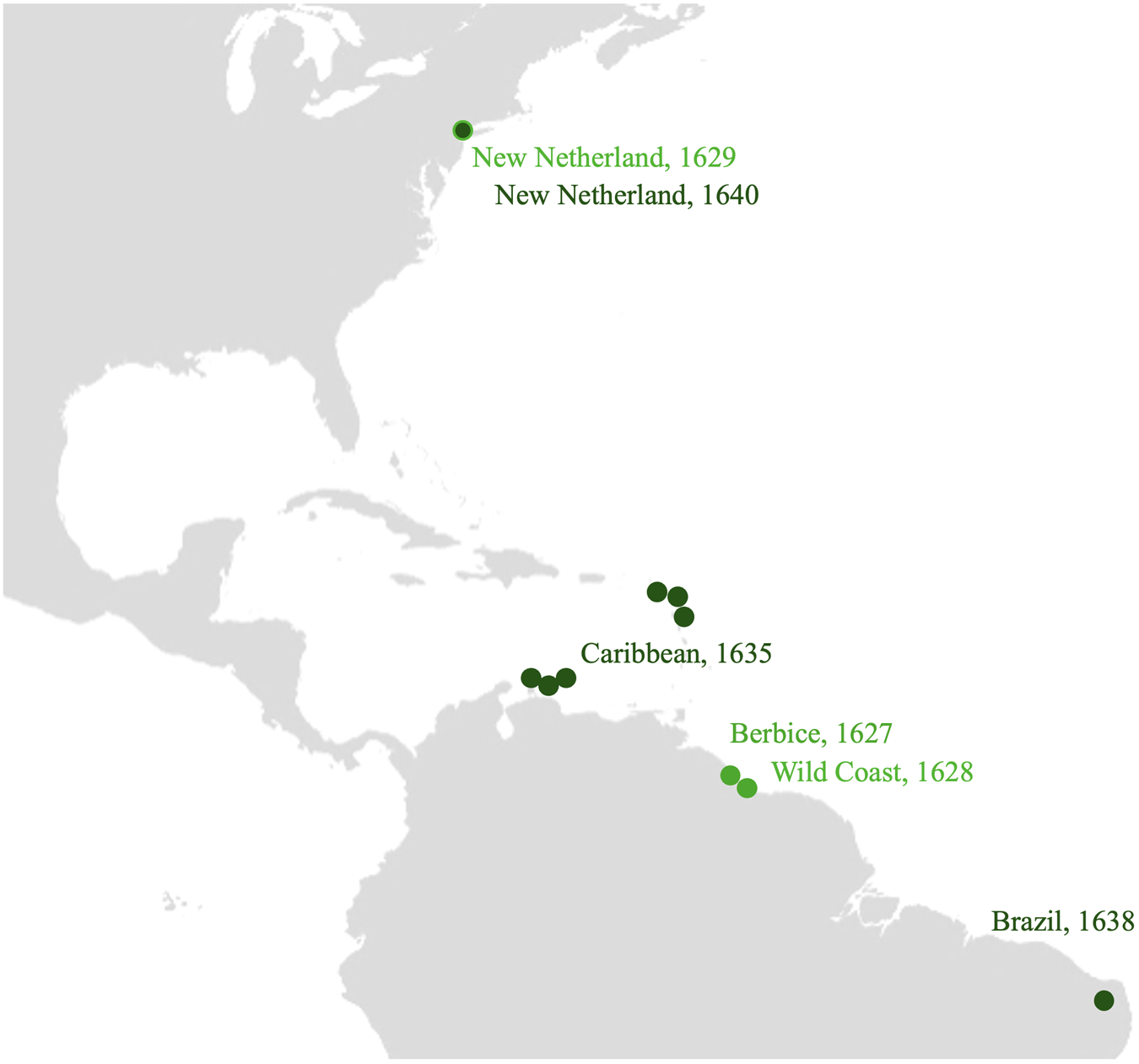
The States General officially reinstated the WIC’s monopoly in December 1636, setting off months of intensive lobbying both within the Dutch Republic and from Brazil.Footnote 164 A 1638 pamphlet advocated free (private) trade within WIC charter limits, especially Brazil.Footnote 165 A year and a half later, the debate concluded with the decision to reserve the trade in certain goods to the WIC, but to allow all WIC shareholders to trade freely in Brazil, and even to allow them to license others for the trade.Footnote 166 The States General, concerned about underpopulation of New Netherland, passed a resolution in 1638 to “invite all good inhabitants of these Netherlands,” not just those affiliated with the WIC, to settle there.Footnote 167 Between 1638 and 1640 the WIC debated relinquishing its monopoly on the fur trade, opening up the rest of the New Netherland trade not only to patroons, but also to all colonists.Footnote 168 Johannes de Laet, of the American Company, contributed to the drafting of the 1640 Freedoms and Exemptions in his role as a member of the Heren XIX.Footnote 169 English settlers then earned the right to trade at will in New Netherland in 1641.Footnote 170 Figure 2 shows this progress over time, marked by year.
Colonial Locations Where the Dutch West India Company Lifted Elements of Its Monopoly, 1629-40. The lighter shaded dots indicate permission for patroonships, while the darker shaded dots indicate declarations of whole or partial free trade.

In both the Dutch and the English cases, financial pressure prompted these changes. The PIC struggled financially for its entire existence, and this was a particularly challenging period for the WIC as well. As they opened their trade, both the WIC and the PIC moved in the direction of privateering, particularly against Spanish forces.
When the PIC continued to struggle financially, its leaders took a step further toward their Dutch partners and proposed selling the entire company. Edmund Moundeford, one of the directors, wrote to Simon D’Ewes, a fellow director, that “we finding our strength too weak, longer to support so great a burden, the company were resolved to sell it to the States of Holland.”Footnote 171 In 1637, the notes of the general court recorded that the Earl of Holland was negotiating a treaty with “the Hollanders,” including with the Dutch ambassador in England.Footnote 172 His correspondents later offered the sum of £70,000.Footnote 173 Two and a half years later, the general court recorded “some propositions having been made to the Company about the sale of Providence to the West India Company of Holland.”Footnote 174 The Earl of Warwick, another of the PIC directors who was both a strong Calvinist and a close collaborator of the king’s, wrote to the company’s agent in the Dutch Republic that “we are content to hearken unto [the proposition] if the terms may be proportionable.”Footnote 175 Holly Brewer has discovered deeper connections between the PIC and the Stuart crown that help explain why the directors were prevented from selling the colony in these years.Footnote 176 However, the PIC directors did consider various Dutch institutions to be appropriate potential inheritors of the company they had built.
Like the early English ventures in Guiana, this early English venture in the Caribbean cultivated close relationships with Dutch forces. Many English colonies in North America also relied on Dutch support, particularly in the tobacco trade, but the Providence Island Company took it a step further when it considered selling an entire colony. The negotiations for the potential sale built on preexisting Anglo-Dutch financial relationships. The PIC’s agent in the Dutch Republic was John Webster, an English merchant who was an active member of the business community in Amsterdam. His brother Henry was a member of the English Merchant Adventurers at Rotterdam, and the two of them collaborated on business ventures, sometimes involving the VOC.Footnote 177 Webster had also worked with Robert Hunt, one of the governors of Providence Island, on Anglo-Dutch moneylending projects in 1633.Footnote 178 The Earl of Warwick wrote to Webster about “all your courteous respects and favours formerly shown.”Footnote 179 When the directors considered selling the company, they asked for his “friendly advice and assistance as in your discretion you shall think most conducing to the good of this Company.”Footnote 180 The following section will dive further into the connections between Anglo-Dutch financial and imperial ventures.
The Adventurers for Irish Land
The final case study shows that Anglo-Dutch imperial collaboration framed around profit and the Protestant cause occurred not only in the East and West Indies, but also in Europe. By the mid-seventeenth century, Englishmen had been pursuing projects they saw as imperial in Ireland for years: the Ulster plantation project began planning in 1609, and James I chartered it in 1613. Paul Slack has described how these projects fit into broader themes of improvement just as colonial projects overseas did, and in fact could seem more appealing to investors than improvement further abroad.Footnote 181 A new project began in 1642. The Adventurers for Irish Land raised money to defeat the Irish rebellion, which had begun in 1641, and to seize the land of Irish Catholics as their reward. Most of the members of the project were English, with some Dutch merchant strangers included.Footnote 182 David Otger and Nicolas Corcellis were two such Dutchman in the company.Footnote 183 The Adventurers wanted the company to be Anglo-Dutch, inviting Dutch investments both in their initial fund and in an ordinance in early 1643, but only Dutchmen in London invested at first.Footnote 184 The venture would not become truly Anglo-Dutch until 1643.
When the Adventurers ran into difficulties raising as much money as they had hoped for, they turned to Dutch partners. Dutch people had been following the Irish rebellion from the beginning, and the Dutch pamphlet literature recorded widespread antipathy to the Irish Catholics.Footnote 185 The Adventurers for Irish Land took advantage of shared Anglo-Dutch ideas of the Protestant cause to raise support for their venture in the Dutch Republic. The company’s membership overlapped heavily with the membership of the Providence Island Company, the leaders of which were now among the leaders of the parliamentary forces fighting the king in the Wars of the Three Kingdoms. Parliament commissioned three Dutch merchant strangers, along with the Englishman Maurice Thompson, to procure from the Dutch Republic “money, victuals, arms, and ammunition, upon loans and contributions, transporting of them to any parts and places in Ireland.”Footnote 186 The three Dutchmen were Nicolas Corcellis, Dirick Hoste, and Adam Lawreyns; all three, as well as Maurice Thompson, were investors in the Courten Association.
Dutchmen in the States General, the States of Holland, and the States of Zeeland agreed to hear their petitions, saying that they did so because of their concern for their fellow Protestants in Ireland. The States of Holland showed their sympathy for “the wretched and deplorable condition” of their “poor afflicted religion-relatives” in Ireland, and the States of Zeeland were also concerned about the “distressed Protestants.”Footnote 187 The States of Zeeland delegated their collaboration to Pieter Boudaen Courten, Jeronimo Willemsz. Aschman, Jan de Dorper Coorne, and John van Borne, four merchants from Middelburg. Pieter Boudaen Courten was William Courten’s cousin, with whom he was still disputing questions of inheritance. The States of Holland delegated their collaboration to Jonas Abeels, Charles Looten, William Watson, and Thomas Cave, two Dutchmen and two Englishmen living in Amsterdam. Watson had worked with John Webster, the Providence Island Company’s agent in the Dutch Republic.Footnote 188 This fundraising paralleled another Anglo-Dutch fundraising project in the Dutch Republic connected to John Webster’s brother Henry, one of the Merchant Adventurers. Thomas Leng has written about how the Company of Merchant Adventurers was the largest single lender to Parliament in the Wars of the Three Kingdoms.Footnote 189 Notably, the Merchants Adventurers’ support for Parliament contrasted with that of many other groups in the Dutch Republic, whose support for the English royalists Helmer Helmers has documented in detail.Footnote 190 The fundraising effort for the Adventurers for Irish Land sidestepped some of these political divisions by focusing on the Protestant cause.
The effort for the Irish Protestants was a financial success. The Amsterdam delegates reported in August 1644 that they had loaded seven ships to Ireland with grain and other foodstuffs.Footnote 191 In September, they reported chartering a ship to “Jockhal in Ireland,” as well as one to Cork.Footnote 192 In December, they chartered one to Duncannon.Footnote 193 They tracked the cargo of each ship, including items like rye, oats, peas, barley, cheese, salt, butter, and wheat.Footnote 194 Parliament later estimated the total contribution from all over the Dutch Republic at £31,218.Footnote 195 Parliament expressed its gratitude for their contributions, declaring that they made “acknowledgement of their pious and charitable sense of the miserable condition of their distressed brethren in Ireland, in their benevolence for the relief of those Protestants, who had so highly suffered through the most horrid cruelties of those bloody rebels.”Footnote 196 As the project had worn on, the imperial element had faded somewhat. There is no evidence of any of the Dutch donors receiving title to land in Ireland. However, donating to the cause did give them influence on the current government of England. The pursuit of profit loomed large alongside the Protestant cause in this case, as in all the others.
Conclusion
The seven sections of this article show the range of possibilities of Anglo-Dutch imperial experiments in the late sixteenth and early seventeenth century. While Dutch and English people competed and expressed frustrations with each other in colonial locations around the world, this competition always coexisted with Anglo-Dutch imperial collaboration. Each of the seven case studies shows that the leaders of the collaborative projects conceived of them as ways to pursue profit. Many of them also framed their projects in terms of the Protestant cause, which could encompass the fight against the Catholics in Ireland, the restitution of the Palatinate in Germany, and war against Spain all over the world. Some saw the Protestant cause as a shared Anglo-Dutch mission. These Anglo-Dutch ventures join the growing field of study of transimperial ventures in the early modern period. Among the field, the Anglo-Dutch case stands out for the number and range of joint imperial projects involved. The case also included ventures varying across the spectrum of formality. Diplomats for the Dutch Republic and England themselves, as states, signed the 1619 treaty, making it one of the most official instances of transimperial cooperation among the European empires of the period. At the other end of the spectrum were the Dutch and English privateers who shared the island of Tortuga in loose affiliation with the Providence Island Company. In the middle was the Courten Association’s charter from the English crown, along with the Dutch adventurers who proposed other imperial projects to the Stuart kings. An incredible diversity of imperial projects contained Anglo-Dutch elements.
While all seven case studies took steps toward Anglo-Dutch imperial collaboration, only five took physical form. Why did so many planned projects, nine in this article, fail to materialize? The answer is that a large fraction of imperial ventures in general never left the planning phase in this period. The records of the States General and of the English privy council are full of adventurers proposing companies, many of which only appear once. Even among companies that did get off the ground, many failed after a shorter or longer time in business. However, the same men were willing to try again after multiple failures. This underlines the point that Dutch and English people were constantly experimenting with different imperial projects. Another question is why so many of these projects involved trade in the Americas, including the frequent attempts at a joint Anglo-Dutch West India Company as well as the Guiana ventures, the Providence Island Company, and earlier iterations of the Courten Association. Anglo-Dutch merchants saw the Americas as ripe for new projects, as there were a patchwork of smaller companies trading there but nothing as dominant as the large companies in the East Indies. There was also a stronger thread of Anglo-Dutch tension in the East Indies due to clashes between the East India Companies.
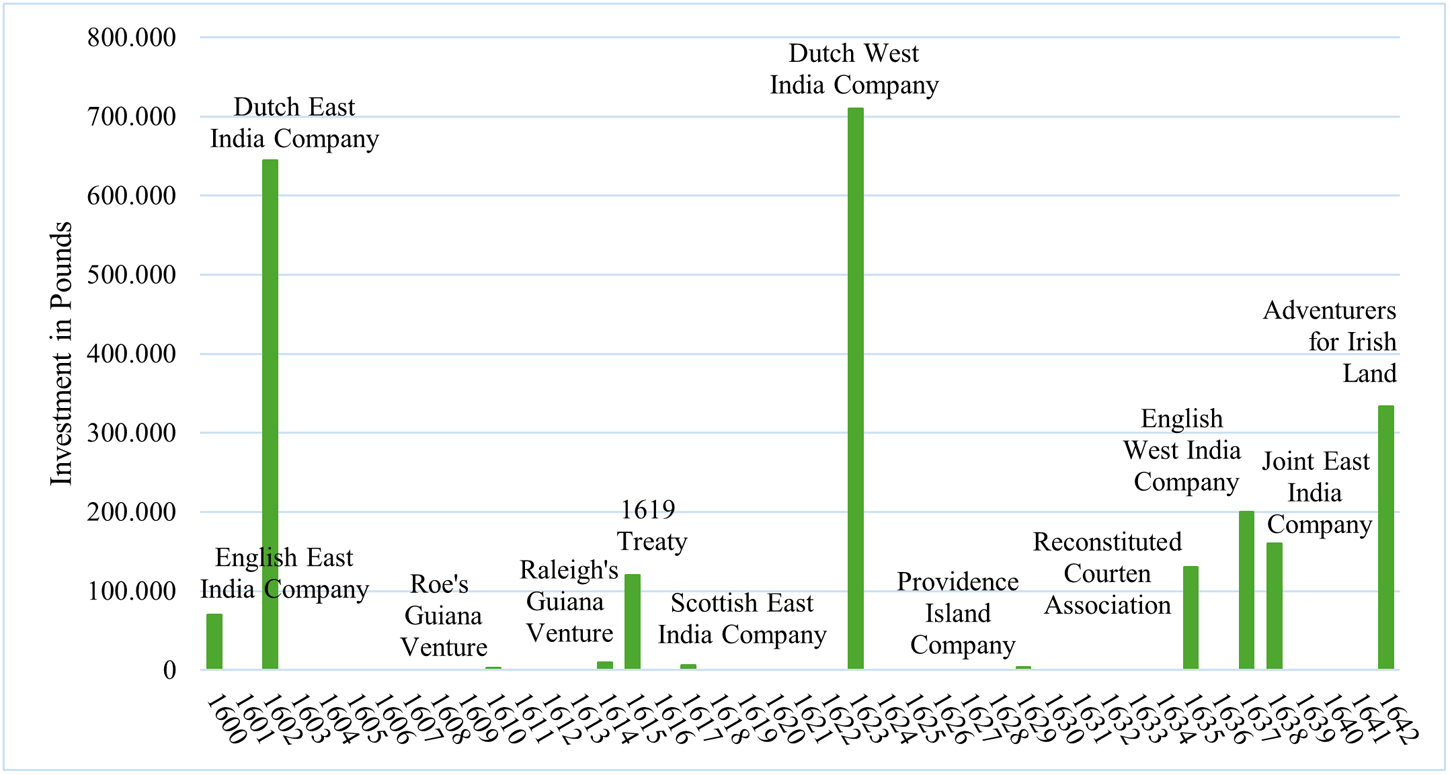
Although the projects discussed in this article varied in longevity, the money their founders invested shows how seriously they took them. Figure 3 shows the initial or proposed initial investment in each of the joint Anglo-Dutch ventures for which I have found numbers.Footnote 197
Initial or Proposed Investment in Dutch, English, and Joint Imperial Ventures, 1600-42. Sources: Commonplace Book of Sir Stephen Powle, 16 February 1609 [1610], Bodleian Tanner MS 168, iv; Raleigh, An estimate of the chardge, FSL G.b.10, f. 112; Memoire des commoditéz de l’union, 1615, NL-HaNA 1.10.35.02/40, f. 137; Wagner, “The Scottish East India Company of 1617,” 583; Kupperman, Providence Island, 295; Nicholas to Porter, 30 July 1636, TNA CO 77/6, f. 49; Reasons to move his Majesty, undated within 1637, TNA CO 77/6, f. 129; Propositions for a West Indya Company, 18 September 1637, TNA CO 1/9, f. 146v; Proposicons for a new Company, June 1638, TNA CO 77/6, f. 173; Brown, Empire and enterprise, 8, 87.

The graph shows that many of the projects were funded on a larger scale than the initial investment in the EIC, which had been only £70,000. It demonstrates that the size of the initial investment did not determine the level of success of the companies. The EIC officially lasted until 1874, and its structures in India which the British government took over lasted even longer. However, at the time, none of the Dutch and English people founding imperial ventures knew which would last and which would not, and on multiple occasions they began with larger investments than the EIC had. The graph also emphasizes how much more money was initially invested in the VOC and the WIC than in any of the other ventures. The disparity reflects the wealth of the Dutch Republic and of Dutch merchants in the early seventeenth century, a wealth of which the English figures described in the article were well aware. Dutch wealth helps explain why, in general, collaborative Anglo-Dutch imperial projects were more closely associated with the English government than with the Dutch. Several of the examples in the article, particularly the cases of the Providence Island Company and the Adventurers for Irish Land, began as English projects and sought out Dutch collaboration when they needed more money. The EIC was particularly interested in forming a cartel with the VOC because the VOC was larger in 1619, and it traded in more locations. Dutch entrepreneurship also contributes to this trend, as many of the planned East and West India Company projects featured Dutch adventurers bringing a proposal to the English crown.
These findings suggest a new perspective on the early English empire. Recent scholarship has debated the nature of the English empire in its formative years. Many point to the distance early English ventures kept from the crown, and their leadership by small groups of men, to differentiate them from projects like the British Raj in India in the nineteenth and twentieth centuries. However, considering the multitude of transimperial Anglo-Dutch ventures in the early seventeenth century points to a different distinction. Both companies closely affiliated with the English crown and those with more independent leadership chose to collaborate with Dutch forces. As one studies them, such projects begin to outnumber the imperial projects that appear to be solely English. Further scholarship on Dutch contributions to English imperial projects in Guinea, Plymouth, and Barbados only strengthens this conclusion.Footnote 198 In the end, almost every English imperial project in the late sixteenth and early seventeenth century contained Anglo-Dutch elements. This article finds that the early English empire was, in many ways, an Anglo-Dutch empire.
Acknowledgements
I am grateful to the Ax:son Johnson Institute for Statecraft and Diplomacy, the H. Henry Meeter Center at Calvin University, and the Omohundro Institute at the College of William & Mary for support that allowed me to conduct this research. I would like to thank Boone Ayala, David Como, Anna Conner, Katharine Gerbner, Deborah Hamer, Adrian Johns, Claire Jones, Nell Klinger, Maureen McCord, Steve Pincus, and the two anonymous reviewers for many helpful comments and suggestions. I would also like to thank the participants at the Newberry Library’s British Studies Seminar, the New Netherland Institute’s New Netherland Seminar, and the University of Minnesota’s Atlantic Seminar for their valuable feedback on the article draft.
Elizabeth Hines is an Ax:son Johnson Institute for Statecraft and Diplomacy Postdoctoral Fellow at Johns Hopkins University’s School for Advanced International Studies.


 Open access

