


Introduction
Ottoman-era archaeology in Greece emerged through regional surveys (e.g. Kolovos & Vionis Reference Kolovos and Vionis2019; Moudopoulos-Athanasiou Reference Moudopoulos-Athanasiou2022), while the ‘postcolonial turn’ foregrounded the meanings and values of material structures and culture for local populations (e.g. Anderson Reference Anderson2015). The architecture of the era is now better researched, predominantly through the lens of the vernacular. Yet, the discourse tends to be de-Ottomanised, as it is placed within the context of national heritage and within the framework of the so-called ‘traditional’ architecture (albeit not without exceptions, see Marinov Reference Marinov, Dontchev Daskalov, Mishkova, Marinov and Vezenkov2017).
In 2020, a crafts research collective together with local stakeholders (see Acknowledgements) organised a workshop in the settlement of Aristi in Zagori, north-west Greece (Figure 1), with the aim of restoring a part of its vernacular architecture—a dry-stone cobbled pathway that had been neglected in recent decades (Moudopoulos-Athanasiou & Sklavounos Reference Moudopoulos-Athanasiou, Sklavounos, Svensson, Sörlin and Saltzman2022). If archaeologists and architects are procedurally equal but temporally opposed, using the same tool (trowel) to reveal the forms of the past and to fabricate the forms of the future (Ingold Reference Ingold2013: 10), our approach revealed that through ‘making’—and dealing with the material culture of the recent past—we gain knowledge in both temporal directions.
Map of the study area. Elevation in metres above sea level (figure by Faidon Moudopoulos-Athanasiou).

In contrast to the source-oriented field of Ottoman studies, these types of hands-on projects can inform and enrich heritage discourses because they prioritise the perspectives of material culture and human–nature interactions. In 2023, the Zagori Cultural Landscape was added to the UNESCO World Heritage List, and such projects may act as pilot studies for tracing material culture, and more broadly heritage, beyond archives and monumental architecture. Concurrently, the emphasis on dry-stone culture enhances our understanding of local intangible heritage and informs archaeologists about deposition processes, while simultaneously complementing the evolving field of mountain archaeology beyond static interpretations (e.g. Galaty et al. Reference Galaty, Tafilica, Lee and Lafe2013; Given Reference Given2023; Orengo Reference Orengo and Garcia-Molsosa2023).
Crafting and discovering
Topsoil
While removing the topsoil to reveal the extent of the remaining cobbled pathway, we discovered a series of artefacts that provided relative dates for the various architectural remains (Figure 2). This process revealed fragments of imported nineteenth-century vessels, as well as nineteenth–twentieth-century nails and twentieth-century rubbish (Figure 3a & b).
Architectural drawing of the pathway, showing the remains uncovered during the project (features coloured by date) (figure by Grigoris Koutropoulos).

a & b) artefacts collected from the topsoil; c) the imported coins; d) diagnostic fragments of sixteenth-century brown/green sgraffito and painted wares from workshops in Epirus and central Greece (photographs courtesy of Reappearances Project/BOULOUKI).

Together with the debris that covered the pathway, these artefacts offer insights into ruination practices. Gradually, the nineteenth-century infrastructure became a place for the deposition of unwanted material culture. Evidence of fire further suggests that the area acted as a place for burning old material; the used nails, formerly attached to wooden components, remain as a trace of such practices.
Dry-stone walls
The project also included reconstruction of the retaining dry-stone walls and the adjacent gateway to a private courtyard. These features were disassembled and then restored. In the foundations of the gateway, we discovered an assemblage of nineteenth-century coins from Russia, Korea and China (Fujian and Hubei provinces) (Figure 3c), placed there as part of a rite of good fortune. The provenance of these coins accords with local oral histories; émigré members of the household resided in the Russian Empire and engaged in trade with the Russian army. The coins themselves are tangible traces of the well-documented post-eighteenth-century mobility of elite individuals from Zagori (Moudopoulos-Athanasiou & Sklavounos Reference Moudopoulos-Athanasiou, Sklavounos, Svensson, Sörlin and Saltzman2022: 303–4). They also open avenues to broader narratives of object biographies: the same family donated the bell housed in the nineteenth-century belfry and a 1920s gramophone that is preserved in the village school.
The cobbled pathway on its eastern side was placed on a terrace 2m above the lower level. The removal of the dry-stone retaining wall for reconstruction revealed the profile of a second cobbled pathway that had been covered by debris before the extant pathway was rebuilt during the nineteenth century (Figure 4).
Profile showing the ancient cobbled pathway and the location of the material culture discovery (photograph by Faidon Moudopoulos-Athanasiou).

This points to the continuous use of the pathway as a communication route within the settlement through time. Below the profile of that second pathway, we discovered fragments of sixteenth-century brown/green sgraffito and painted wares from workshops in Epirus and Central Greece, respectively (Figure 3d).
These fragments hint at the unknown pre-eighteenth-century architectural and economic history of Zagori, as the villages were drastically reshaped from the 1750s onwards due to incoming émigré wealth. The depth of this strata, retained by the dry-stone wall (see Figure 4), points to the intensity of this transformation. It also provides a glimpse into the rich historical archaeology layers such settlements can offer when research and local development occur together on a small scale.
Between archaeology and architecture
These insights into the intense development of the 1750s in the condensed space of a mountain village also shed light on reconfigurations of the settlement fabric and transformation of its built environment through time. Namely, we discovered that the 1958 fountain (see Figure 2) was placed on top of a collapsed structure. Uncovered material culture (a coin of Sultan Abdülmecit I (1823–1861) and the decorated part of a flintlock pistol) point to the use of the structure in the second half of the nineteenth century, while its abandonment is placed in the early twentieth century, according to oral history (Moudopoulos-Athanasiou & Sklavounos Reference Moudopoulos-Athanasiou, Sklavounos, Svensson, Sörlin and Saltzman2022: 305–6).
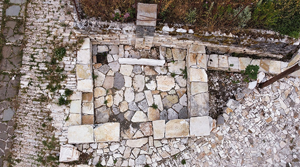
If the modern view tends to conceive ‘traditional’ settlements as suspended in time, scraping the surface of modernity reveals the dynamic character of earlier ways of building that could embrace many different eras at once. Rather than isolating and trying to clearly expose the different historical phases we identified, the approach we adopted followed the example of pre- and early-modern ways of building, interweaving times and uses into a continually renewed present. Thus, the unearthed foundations of the ruined structure served as the basis for building a small public square, in the centre of which the settlement's renewed fountain found its place (Figure 5).
Photographs of the foundations before (above) and after (below) restoration as a public space (photographs by Faidon Moudopoulos-Athanasiou).

Positioned at the crossroads of archaeology and architecture, this approach enabled us to understand important transformations of the built space within the Ottoman era, while creating an entry point into this place's rich historical depths. The value of this interdisciplinary approach is in its potential to amplify scientific insights without undermining lived experience. On the contrary, such experience is enhanced and acknowledged as a framework from which to explore the built world in its diachrony; it is more dynamic than the conservationist vision of the ‘traditional’ village allows and more animated than a source-based approach relying on sixteenth-century archival sources.
Acknowledgements
In 2020, the interdisciplinary research collective BOULOUKI and the Aristi Youth Club organised the workshop ‘Reappearances: places of origin as a foundation for the development of participatory models for the restoration and promotion of cultural landscapes’. The team included four experienced craftsmen from the region of Epirus, each of whom worked closely with three younger apprentices in guiding 20 participants (students, young professionals and locals). The project benefited significantly from the expertise and dedication of collaborators and volunteers, as well as the generous in-kind support provided by local restaurants and hotels.
Funding statement
The project was supported by the Greek Ministry of Culture, the District of Epirus and through crowdfunding.



