




Introduction
Animal baiting, the pitting of dogs against other animals such as bulls and bears for public entertainment, was extremely popular in Early Modern England (c. AD 1500–1700) (see online supplementary material (OSM) 1). While less researched, images and records also document Early Modern baiting in other European countries. In Sweden, bear baiting with dogs, and fights between bears and other animals, were popular from at least the 1500s onwards (Berg Reference Berg1965), and similar fights were staged throughout the Grand Duchy of Lithuania (Samojlik et al. Reference Samojlik, Selva, Daszkiewicz, Fedotova, Wajrak and Kuijper2018). In Germany, the Fechthaus at Nuremberg was built in 1628 as a broad entertainment venue, which included fencing, theatrical productions and bear baiting (Schlueter Reference Schlueter2013; Rice Reference Rice2017), and baiting also occurred in Berlin (Scheutz Reference Scheutz2020). In Austria, a circular amphitheatre—the ‘Hetztheater’—was built in Vienna in 1755, where bulls, bears and other animals were baited and forced to fight (Scheutz Reference Scheutz2020). In Italy, carnival in Venice included bull baiting, as reported by the Venetian merchant sailor Alessandro Magno in 1562 (translated in Dawson Reference Dawson1964). A contemporaneous engraving in Franco (Reference Franco1610) shows, among other bloodsports, both bear and bull baiting surrounded by crowds in a piazza. Bear baiting also occurred in India and Pakistan, where it was probably introduced by the British during the eighteenth century (Abbas Reference Abbas and Kammerer2015; Kavesh Reference Kavesh and Kim2018).
In London, baiting took place from c. 1540–1682 in formalised arenas on Bankside in Southwark. Most studies of London entertainment for the period focus on theatre, perhaps due to the modern preoccupation with Shakespeare, whose company was resident at the Globe playhouse from 1599. However, this area is rich in both archival and archaeological evidence that reveals more than dramatic performance. Philip Henslowe (builder of the Rose playhouse on Bankside in 1587) and his son-in-law, the actor and proprietor Edward Alleyn, left extensive documentation of their theatrical and bear-baiting activities. These survive in the collections of Dulwich College, an independent school in Greater London, and include their notes and correspondence as joint-appointed Overseers and Rulers of “our bears, bulls and mastiff dogs” (Dulwich College Archives (DCA) MSS002-005), providing animal baiting for the crown and administering bear licences across England. Multiple excavations on Bankside over the past 35 years have uncovered the remains of the playhouses, baiting arenas and animals involved in this entertainment industry (see Table 1), including those owned or administered by Henslowe and Alleyn.
Excavations on Bankside with Early Modern animal remains included in this study. Site descriptions are given in OSM 1. Bear garden (BG) numbers follow those outlined in Bowsher (Reference Bowsher2012) and their locations in relation to the site footprints are shown in Figure 2.

* PSE02 and PRU05 are very small assemblages and were not included in our zooarchaeological analysis, although two bear specimens from PSE02 were included in the isotope analyses. An isolated bear cranium held at Dulwich College is also included in the zooarchaeological and isotope analyses.
Here, using an interdisciplinary approach combining archival, zooarchaeological and stable isotope data, we examine what species were present on Bankside during the period of formalised baiting and what we can learn about their lives and deaths. From this, we create a model for identifying, or excluding, bear-baiting assemblages in the archaeological record. As a widespread Eurasian sport, this model can be expanded to other countries where baiting took place. Critically, our model identifies how baiting assemblages differ from those from the predominantly dramatic playhouses, hunt kennels or dog fighting arenas. Ultimately, the Bankside data provide a model that can be utilised where the detailed documentation associated with Early Modern London are lacking.
Baiting on Bankside: terminology and archaeological background
The commercial entertainment ecology of Bankside is perhaps best understood under the umbrella concept of a ‘playhouse’ or ‘playing place’ (Davies Reference Davies2023a). Certain spaces termed ‘playhouses’ in fact functioned partly as baiting spaces; the Hope playhouse was predominantly an animal arena, while the Rose may have accommodated different types of play or sport in its history (Greenfield Reference Greenfield and Holland2007). At the time, people also used ‘bear garden’, ‘bear house’ or equivalent synonyms to circumscribe places where baiting most regularly and predominantly occurred. Arenas such as these were built from at least c. 1540 onwards on Bankside. Perhaps the most famous Bankside baiting location of its day was known as the ‘Paris Garden’ after the former manor in which one of the more enduring arenas was located. Bear gardens denote more than a closed or circumscribed architectural structure and rather refer to a wider patch of animal-related ‘recreational’ spaces that included ponds and kennels (Figure 1; Davies Reference Davies2023a). Accordingly, a ‘bear garden’ hosted animal blood sport contests, but also suggested a location where owners and proprietors kept the animals involved. As a result, the zooarchaeological assemblages presented in this article were formed in urban areas where multiple intersecting and/or parallel activities were taking place, adding complexity to our analysis and to our understanding of such assemblages (as also discussed by Zierden et al. Reference Zierden, Agha, Jones, Poplin and Reitz2009; Reitz & Zierden Reference Reitz and Zierden2023).
Bankside on the 1550s Agas Map showing two animal baiting arenas, ponds and kennels with dogs (reproduced with permission from Jenstad Reference Jenstad2020).

Numerous archaeological excavations on Bankside have focused on the Early Modern playhouses and bear gardens (Table 1, Figure 2, OSM 1). Brief zooarchaeological analyses of some assemblages are published in site monographs or articles, such as those from the Rose and the Globe (Rielly Reference Rielly, Bowsher and Miller2009), Benbow House (Liddle Reference Liddle, Mackinder and Blatherwick2000), New Globe Walk (Liddle Reference Liddle, Mackinder, Blackmore, Bowsher and Phillpotts2013) and Empire Warehouse (Capon & Rielly Reference Capon and Rielly2020), but others have only received evaluation or assessment level treatment. Due to the proximity of the different arenas and the nature of the excavations, it is not always straightforward to attribute specific contexts to individual bear gardens, and Table 1 outlines our current understanding of the different deposits. For this study we examined relevant archives, brought together zooarchaeological material from across Bankside, recorded the assemblages using standardised methods, characterised the animals present and examined their diets using stable isotope analyses.
Map of Bankside with relevant sites and locations of the different playhouses and bear gardens, numbered according to Bowsher (Reference Bowsher2012). Site code abbreviations are explained in Table 1. Note that EMH12 had the same footprint as EWH08 and BGU08 (source: Museum of London Archaeology).

Materials and methods
Animal bones were recorded using diagnostic zones (as described in OSM 1, section 1.2.1), and number of identified specimens (NISP), minimum number of individuals (MNI) and minimum animal units (MAU) were calculated. A total adjusted NISP of 3481 specimens from nine sites (11 excavations) was included in the study (Table 1; see also OSM 1, section 2.1). For dietary analyses, collagen was extracted from 106 bone and two dentine samples using a modified Longin protocol (Brown et al. Reference Brown, Nelson, Vogel and Southon1988) and analysed for carbon (δ13C) and nitrogen (δ15N) stable isotopic ratios. We split the material between dramatic-playhouse contexts (those related to the Rose and the Globe) and baiting arenas (all other contexts) for most of the analyses. This approach allowed us to look for features that define the different types of activity that took place at these sites. Note that the Hope was used as both a playhouse and a baiting arena. Over time, activities at the Hope became dominated by baiting (see OSM 1 section 1.1), and the site is considered a baiting assemblage here. Methods are described in full in OSM 1 (section 1.2) and sample sizes per method are available in OSM 2.
Results and discussion
Species representation
In post-medieval England, zooarchaeological assemblages are generally dominated by cattle (Bos taurus) and sheep/goat (Ovis/Capra sp.) with smaller proportions of pigs (Sus scrofa) (Holmes Reference Holmes2017; Albarella Reference Albarella2019), reflecting a focus on beef, mutton and pork as the main dietary meat components. Most of the assemblages on Bankside are very different to this (Capon & Rielly Reference Capon and Rielly2020). There are clear differences in the percentage NISP and MNI for the main species found in the Early Modern playhouse and bear-garden contexts (Figure 3). Dramatic-playhouse deposits are dominated by domestic livestock (sheep/goat and cattle), most likely resulting from food waste, whereas bear-garden assemblages contain high proportions of equid (Equus sp.) and dog (Canis familiaris) remains with a clear (although relatively small) presence of brown bear (Ursus arctos). The zooarchaeological remains therefore reflect the different activities that took place in these spaces, and match the archival accounts that record dogs, cattle, bears and horses being baited on Bankside (Dawson Reference Dawson1964; OSM 1 section 2). The only taxon known to have regularly been present and not currently identified archaeologically are monkeys (probably Macaca sp.). These were used as ‘Jack-an-apes’, a form of horse baiting with monkeys as riders and there are multiple references to the practice in eyewitness accounts (e.g. Dawson Reference Dawson1964). The bear-garden assemblages, therefore, present an unusual pattern for the period, when compared with those found at nearby playhouses.
Proportional number of identified specimens (%NISP) and minimum number of individuals (%MNI) from playhouse and bear-garden contexts on Bankside (figure by Elizabeth Wright).

Dog remains were found in large quantities in multiple contexts, some of which were interpreted as pond fills that may relate to a “pond for dead dogs” associated with one of the bear gardens in archival accounts (Mackinder et al. Reference Mackinder, Blackmore, Bowsher and Phillpotts2013: 14). The dog bones were generally found disarticulated, but body-part data (OSM 2) indicate that whole skeletons were originally deposited. An under-representation of foot remains, along with a small number of cutmarks on dog hind-limb bones suggests that skinning may have taken place before the deposition of at least some individuals, although sieving did not take place during all excavations on Bankside so this pattern could, in part, be related to this. Dog skinning was prevalent in medieval England, but evidence for the practice is rarer at post-medieval sites (Holmes Reference Holmes2017; Albarella Reference Albarella2019). If it was taking place on Bankside, it would indicate links between baiting and other trades such as tanning in this area of London.
The equid remains (most likely horses) are dominated by very old individuals—determined through tooth wear and extra bone growth on bone surfaces and around joints, which all increase with age (see e.g. Bartosiewicz & Gál Reference Bartosiewicz and Gál2013: 107–8). Tooth- and cut-marks on the bones indicate gnawing and butchery (Tables S12 & S13) and suggest that the equids were from the knackers yard, and fed to other animals living on Bankside. Large assemblages of equid remains from elderly individuals, along with evidence of butchery and gnawing, are seen elsewhere, in other Early Modern contexts—for example, at Witney Palace, Oxfordshire (Wilson & Edwards Reference Wilson and Edwards1993), and Dudley Castle in the West Midlands (Thomas & Lacock Reference Thomas and Lacock2000). Excavators interpret these assemblages as horses butchered to provide meat for hunting hounds by knackers—a trade specialised in preparing fallen and dead livestock for non-human consumption. According to Markham (Reference Markham1633), this was a well-established Early Modern practice and fits with the archaeological evidence we have identified.
Dog size
The relative size of the dogs against the bear would have been a key part of the baiting spectacle. Our log ratio results show that the dogs from both bear-garden and playhouse contexts on Bankside were all large and much less variable in size than dogs from contemporary sites in London (Figure 4a). Our calculations indicate that most of the Bankside dogs had a shoulder height of 0.6–0.8m. This size, equivalent to a modern large German Shepherd or Great Dane, was relatively rare across the wider English and Irish population (Figure 4b). For example, the shoulder heights of dogs from the contemporary kennels of the Common Hunt in London are described as ranging between 0.3 and 0.5m, with one outlier at 0.65m (MacQuarrie et al. Reference Macquarrie, Blackmore, Yeomans, Pipe and Betts2019), while those from Witney Palace were between 0.38 and 0.52m (Wilson & Edwards Reference Wilson and Edwards1993; see OSM 1 section 2.3 for more information).
Log ratio histograms for postcranial widths and lengths of dog bones (a) from Bankside compared to contemporary sites in London. The standard is marked with a black line and the mean with a green line. b) Comparison of estimated shoulder height (m) for Early Modern Bankside dogs with contemporary sites from England and Northern Ireland. For information on the standard, methods and data sources see OSM 1 (figure by authors).

An initial assessment of dog postcranial bone shape (see OSM 1 section 2.3) indicates that there is no clear shape specialisation in the dog remains from Bankside compared to dogs from contemporaneous sites in London, suggesting that size was the main criterion in the selection of baiting dogs. A particular type of dog was clearly being selected for the activities taking place on Bankside, likely mastiffs. Early Modern writers recognised the particular size of the mastiff, described as “vast, huge, stubborn, ugly, and eager, of a heavy and burdenous body, and therefore but little swiftness, terrible and frightful to behold” (Topsell Reference Topsell1607, sig. Q3r; OSM 1 section 3). Alessandro Magno, visiting Bankside in 1562, commented that the dogs were like those used for bull baiting in Venice, which suggests they were a widespread ‘type’ (Dawson Reference Dawson1964). However, this ‘type’ may not have been like the dogs that we know as mastiffs today, since ‘mastiff’ was something of an umbrella term used to describe large, well-built dogs that were used for guarding, physical labour and baiting (Topsell Reference Topsell1607).
Dog and bear age
We might expect the dogs used in baiting to die quickly and at a young age, but zooarchaeological analysis indicates that dog remains from all sites were skeletally mature (Figure 5), and tooth wear data suggest the majority died when they were between two and three years old (Figure S6, Table S8). More dogs seem to have died at a younger age in bear-garden-related contexts compared to dramatic-playhouse contexts, but there is no evidence of very young dogs (<6 months of age) in any area. This suggests either that areas with breeding kennels have not yet been excavated or that breeding was not taking place on Bankside and that most baiting dogs were brought to the arenas as adults. Archival records show that dogs were taken or collected from around England for baiting in London. Surviving letters from owners protest against having their dogs removed, but the King's licence to the ‘Master of the Bears’ specifically allowed this practice (DCA MSS002-005; MSS002-008; MSS002-017). We are currently investigating whether breeding can be identified in the Bankside population using stable and radiogenic isotopes and ancient DNA and this will be the focus of a future publication.
Dog age data according to epiphyseal fusion (a) and tooth wear (b), split between bear-garden and playhouse contexts. See OSM 1 for methods and OSM 2 for %MNI graphs (figure by Elizabeth Wright).

While there is no direct archival evidence for the age of bears, recurrence of famous bear names approximately 14 years apart suggests longevity for some individual bears (DCA MSS002-009; Dekker Reference Dekker1609). Contemporaries involved in the trade and acquisition of these animals distinguished between bears of different ages; some referred to ‘cubs’ with the potential to become ‘great bears’ (DCA MSS002-039), and one 1590 document listed Bankside bears as “one young he bear, one old she bear, five great bears and two bears” (The National Archives C146/8581; OSM 1 section 3).
Due to the relative scarcity of bear bones present at the sites (n = 37), we combine bear epiphyseal fusion data from the bear-garden and dramatic-playhouse contexts (Figure 6). Bears mature at a slower pace than dogs, and some bone fusion does not take place until an individual is nine years old (Weinstock Reference Weinstock2009). Previous studies of the bears from Bankside reference ‘young’ bears (e.g. Bowsher & Miller Reference Bowsher and Miller2009; Mackinder et al. Reference Mackinder, Blackmore, Bowsher and Phillpotts2013), but our results demonstrate that all of the earliest fusing skeletal elements were fully fused, indicating that all animals were at least four years old (Figure 6, Table S9).
Proportion of fused epiphyses in the combined assemblage (n = 41) of bear bones from bear-garden and playhouse contexts. For ageing methods see OSM 1 (figure by Elizabeth Wright).

Our work indicates that the dogs and bears living on Bankside were largely adult or subadult. There is no evidence for the presence of elderly dogs, but the situation is less clear for bears. The dogs were at a prime age for physical activity, and the lack of older dogs raises the question of what happened to animals when they were perhaps no longer suitable for use in entertainment. If some animals did survive to an older age it is possible that they were ‘retired’ elsewhere, or perhaps killed in another location; no zooarchaeological or archival evidence is identified for the killing of older dogs on Bankside itself. After death, some of the animals were skinned or butchered. Bear skins are known to have been kept and traded in the period, although they may not have been from baited animals (Davies Reference Davies2023b).
Evidence of trauma
Dekker (Reference Dekker1609, sig. B2r) gives a graphic description of the injuries incurred by dogs during bear baiting, saying “they commonly were crushed, & either were carried away with ribs broken, or their skins torne & hanging about their eares”. Our zooarchaeological evidence corroborates this, with evidence of trauma, mostly healed fractures, on nine dog bones (Figure 7; Table S10). Injuries are particularly prevalent on ribs (n = 4) and crania (n = 4), with healed fractures on the frontal bones just above the eye sockets on four individuals. For two individuals this was found on both the left and right sides. Four individuals with cranial trauma (15%; 4/27 according to MNI) and one with evidence of trauma to the mandible (4.5%; 1/22 according to MNI) were identified (see Table S11)—it was not possible to calculate the frequency for other elements that were ‘non-countable’, such as ribs. Nevertheless, the presence of dogs at multiple Bankside sites with fractures, particularly on the crania, suggests that these injuries were related to some aspect of baiting. One injury—a healed circular wound above the left eye (Figure 7c), is perhaps indicative of a puncture made by a bear or dog canine. Other wounds look like the result of a generic blow to the head or ribs. All but one show signs of healing, indicating the dogs survived for at least some time after receiving the injuries. The rib and fibula fractures shown in Figure 7, for example, would have taken a minimum of six weeks to heal, and remodelling likely took longer (Payne pers. comm.).
Examples of trauma on dog remains from Bankside: a) rib with healed fracture (NGW00, context 63); b) fibula with healed fracture (NGW00, context 63); c) cranium with healed puncture wound above left orbit (EMH12, context 403); d) cranium with injury above right orbit (EMH12, context 605) (photographs: a & b) by Elizabeth Wright; c & d) © Museum of London/John Chase; inset to d) by Kevin Rielly).

Puncture wounds are most likely to have been caused by interaction with other animals (Park Reference Park1987; Losey et al. Reference Losey, Jessup, Nomokonova and Sablin2014), such as a bite from a bear or another large dog. Depression fractures could have been caused by fighting, but physical discipline by humans can also result in similar injuries (Park Reference Park1987; Losey et al. Reference Losey, Jessup, Nomokonova and Sablin2014), and the combination of rib and cranial injuries have previously been used to identify animal abuse in both modern and archaeological dogs (Munro & Thrusfield Reference Munro and Thrusfield2001; Binois et al. Reference Binois, Wardius, Rio, Bridault and Petit2013). Work on modern dog fights shows that fractures to the orbital and periorbital regions are more likely in spontaneous fights between a big dog against a little dog than in spontaneous and deliberate fights between two medium-sized dogs (Intarapanich et al. Reference Intarapanich, Touroo, Rozanski, Reisman, Intarapanich and McCobb2017). This may indicate that the cranial injuries in the Bankside assemblage are more likely to be the result of baiting activity (where the bear would take the role of the ‘big dog’) than of dog fighting. A second possible source of the cranial injuries is the sticks or staves used by the bearward and others to allow for a measure of control during the fight, as mentioned in an account of baiting from Cheshire in 1612 (Baldwin et al. Reference Baldwin, Klopper and Mills2007: 19–22).
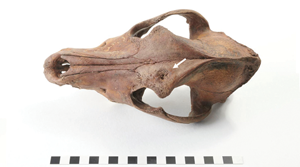
Bear cranial material is particularly scarce in the Bankside assemblages, with only one complete specimen now in the collection at Dulwich College. No injuries were recorded on this cranium, but there are references to ‘blind bears’ in archival documents (Lewis Reference Lewis and Grimm2023). This suggests that, along with fractures, blinding or eye injuries would also have been common for both bears and dogs in the arena.
The injuries sustained by the dogs and bears on Bankside, although brutal and painful, are present on a relatively small number of remains and would not have resulted in instant death. It is likely that there was a deliberate effort to prevent life-threatening injuries so that these expensive animals would not need to be replaced. The rare instance of a bear noted in a Lancashire probate inventory in 1622 values the animal at £12—the most valuable entry in the inventory of a wealthy landowner, which also included substantial interior fixtures and fittings such as beds (Davies Reference Davies2023b). This puts bears at considerably greater value than horses. A survey of inventories from the Shropshire plain between 1562 and 1653 suggests a mean valuation of £1 7shillings 1½pence for a horse in the early seventeenth century; even particularly desirable horses were worth a fraction of the value of a bear (Edwards Reference Edwards1988). It is also likely that there was a particular benefit in keeping the bears alive so that they could build a named ‘brand’ and bring in larger crowds (Davies Reference Davies2023a & Reference Daviesb).
Diet
Archival sources provide limited information on the diets of the animals kept on Bankside (OSM 1 section 3), but wider zooarchaeological evidence also informs our understanding. The large proportion of equids, combined with evidence for butchery and gnawing on these remains, indicates that they were most likely being fed to the dogs and bears (Capon & Rielly Reference Capon and Rielly2020; OSM 1 section 2). Evidence of butchery and gnawing on the dog and bear remains suggests that these animals were also fed to each other (OSM 1 section 2.6).
To further investigate the diet of animals living on Bankside in the Early Modern period, we analysed δ13C and δ15N values of bone collagen from 49 dog, 31 equid, 20 bear and eight cattle samples. All results are reported as a mean plus or minus one standard deviation. The δ13C results are cattle -21.9±0.84‰; equid -22.6±0.61‰; dog -20.6±0.94‰; bear -20.6±0.54‰. The δ15N results are cattle 6.4±2.1‰; equid 5.9±0.94‰; dog 11.0±1.3‰; bear 10.8±0.69‰. Results from both dramatic-playhouse and bear-garden contexts were combined because the data obtained from the two groups overlapped completely (OSM 1 section 2.6).
The isotope data show a clear separation between herbivores (equids and cattle) and omnivores (dogs and bears) (Figure 8). Dogs and bears had isotopically similar diets, which appear to have been protein rich. Both are more than a trophic enrichment factor above the herbivorous species (1.0±0.3‰ for δ13C and 4.2±1.4‰ for δ15N (Bocherens Reference Bocherens2015)), indicating an unknown additional factor in the diet. Archival sources have hinted at some of the other food items (such as apples) but do not provide much specific information (OSM 1 section 3).
δ13C and δ15N stable isotope values from bone collagen of animal remains recovered from Early Modern sites on Bankside (figure by authors, contains BGS Isotope data © UKRI).

Two dogs do have similar δ13C and δ15N values to the equids and cattle. Neither of these dogs differed in stature from the other dogs analysed, and both are from bear-garden-related contexts. One sample (BOB075, EHW08(15)) is from the unfused proximal humerus of an individual less than 15 months old, and the other (BOB052, NGW00) is from an adult tibia. These two animals clearly had diets that differed from the majority of dogs living on Bankside, but we cannot determine why. Consideration of contemporary accounts, the presence of gnawed equid remains, and our stable isotope analyses therefore indicate that the bears and most of the dogs had similar diets and were likely eating horse meat alongside other dietary items.
Conclusion
Integration of zooarchaeological, stable isotope and archival data has allowed us to address the titular question of what a bear-baiting assemblage may look like, determining a range of features that can be used to support or exclude the identification of bear baiting in faunal assemblages. Clear differences in species composition are found between assemblages associated with dramatic playhouses and with bear gardens, the latter dominated by dog and equid remains. The dogs tended to be two or three years in age and of a limited size range, though much larger than those used for hunting, with an estimated shoulder height of 0.60–0.80m. The dog remains display injuries from survivable trauma, mostly located on the cranium and thorax (e.g. rib fractures). The equid remains are from older individuals, and likely reflect the wider Early Modern practice of feeding dogs (particularly those used for bloodsports) with equid meat. As a result, the presence of knackered equid remains alone is not enough to infer baiting, but the presence of gnawed horse bones, and very large dogs with cranial and rib injuries is strongly indicative. Bear remains may be present, but not in large numbers, and reflect subadult or adult individuals, not cubs. Where dogs and bears are housed in proximity to each other, they may have isotopically similar diets.
While species representation differs across Bankside, other features of the ‘baiting assemblage’ are consistent across the area. The presence of the same kind of large dog is particularly instructive and may reflect the complexity and fluidity of the wider area of Bankside as a ‘playing place’. The bear gardens may have housed the dogs and represented the ‘hub’ of baiting activity, but these dogs were clearly taking part in activities (baiting and otherwise) across Bankside, demonstrating the interconnectivity of these different spaces.
Animal baiting was finally banned in England in 1835 (Griffin Reference Griffin2005). While the idea of such deliberate animal cruelty is now hugely distasteful, baiting was a hugely popular entertainment in its time. There has been little study of the practice (with the notable exceptions of Griffin Reference Griffin2005; Fudge Reference Fudge2006), but it deserves attention, as an integral part of Early Modern entertainment and as an insight into changing human-animal relationships over the past 500 years. Although Bankside is unique in the wealth of documentary archives associated with it, baiting is known to have occurred widely elsewhere. The criteria described here should enable researchers to either identify or exclude bear baiting when examining zooarchaeological assemblages, even if accompanying documentation is lacking.
Acknowledgements
We thank the Museum of London Archaeology (MOLA) and the Museum of London Archaeological Archive (LAARC) for providing access to material, Alan Pipe for providing data from previous studies and comparative sites, Erik Ersmark for the reference to baiting in Sweden and Richard Payne (Member of the Royal College of Veterinary Surgeons) for discussion of bone fractures.
Funding statement
This work was funded by the UK Arts and Humanities Research Council project (AH/T006552/1) ‘Box office bears: animal baiting in Early Modern England’.
Online supplementary material (OSM)
To view supplementary material for this article, please visit https://doi.org/10.15184/aqy.2024.228 and select the supplementary materials tab.


 Open access

