



By the age of 10–11 years, one in three English children are now classified as being either overweight or obese( Reference Boodhna 1 ). In England, only 21 % of boys and 16 % of girls aged between 5 and 15 years achieve physical activity (PA) guidelines, and time spent being sedentary appears to be increasing( Reference Scholes and Mindell 2 ). It is widely believed that this lack of PA has become a major contributor to children’s positive energy balance( Reference Almond, Biddle and Bull 3 ).
Seated media activities, including television viewing, computer use and playing computer games, are thought to reduce the time children spend undertaking sports and other PA( Reference Cummings and Vandewater 4 – Reference Marshall, Gorely and Biddle 8 ). For children aged ≤11 years, associations have been found between sedentary activities such as television viewing and computer use and the spontaneous intake of unhealthy foods and drinks( Reference Pearson and Biddle 9 – Reference Thivel, Tremblay and Chaput 11 ). The more recently introduced active video games, however, require physical movement from the player. Linked to a television set via a console, active games need the player to physically interact with on-screen images through a tracking device within a camera (The EyeToy; Sony Computer Entertainment®), a handheld controller (Nintendo Wii™; Nintendo©) or a webcam device (Xbox 360 Kinect; Microsoft). As such, these video games might present an appealing way to increase children’s PA and thus offset any spontaneous energy intake (EI)( Reference Mathieu and Kakinami 12 ). Recent laboratory-controlled investigations have indeed established that active video game play can increase children’s energy expenditure (EE) 3-fold, in comparison with sedentary pursuits (watching television or playing seated video games)( Reference Graf, Pratt and Hester 13 – Reference Lanningham-Foster, Jensen and Foster 16 ). Some active game play has been shown to elicit an intensity of 5 MET (metabolic equivalents of time; moderate PA), with games such as ‘EyeToy Knockout’ (PlayStation 2; Sony)( Reference White, Schofield and Kilding 17 – Reference Maddison, Mhurchu and Jull 18 ). Moreover, 15 min of Nintendo Wii Fit jogging (Nintendo©) has been found to elicit an average of 5·35 MET in obese childrenReference O’Donovan, Roche and Hussey (19) . Such findings suggest that active video games have the potential to contribute significantly to levels of EE and help children meet the recommended moderate to vigorous physical activity (MVPA) levels.
To the authors’ knowledge, Mellecker et al.( Reference Mellecker, Lanningham-Foster and Levine 20 ) were the first to explore acute EI during active gaming in children. During two, 1-h laboratory gaming sessions (seated and activity enhanced), snacks were made available ad libitum to 9–13-year-old children. No significant differences in snack consumption were found between the seated and activity-enhanced video gaming conditions. During both trials, Mellecker et al.( Reference Mellecker, Lanningham-Foster and Levine 20 ) found that the mean EI was on average 66 % above resting levels. This suggests that the additional PA elicited by the active gaming bout may not actually offset the EI in this group. No measures of appetite were explored, however, and EE was not estimated, failing to provide insight into any potential mechanisms for these changes in EI.
In relation to seated gaming, there have also been no differences reported in appetite when compared with resting conditions, in both male adolescents (aged 15–17 years)( Reference Chaput, Visby and Nyby 21 ) and boys (aged 9–14 years)( Reference Branton, Akhavan and Gladanac 22 ). In the adolescent group, EE and ad libitum EI were significantly higher than after resting( Reference Chaput, Visby and Nyby 21 ), whereas the food intake of the younger boys (9–14 years) was lower after 30 min of seated video game play v. the identical period of resting( Reference Branton, Akhavan and Gladanac 22 ). Nonetheless, when EE was subtracted from EI, both groups were found to be in positive relative EI( Reference Chaput, Visby and Nyby 21 , Reference Branton, Akhavan and Gladanac 22 ). The findings of paediatric gaming studies thus far, however, suggest that active game play might be a healthier substitute for seated media activities.
To date, the effects of active gaming on appetite and EI have not been explored in 8–11-year-old boys. Furthermore, all of the previous studies have been strictly laboratory-controlled, and the gaming protocols used did not resemble the active game play of young children. We have recently published data describing the active gaming practices of 7–11-year-old children from Newcastle upon Tyne (North East England, UK)( Reference Allsop, Rumbold and Debuse 23 ) to enable active gaming interventions to be designed that are representative of young people’s habitual gaming practices.
The primary aims of the present study were therefore to explore acute EI and appetite sensations during active gaming and seated gaming, in 8–11-year-old boys. Secondary aims were to measure PA, estimate both EE and relative EI, and establish time to eating onset.
Methods
Design
A randomised, cross-over design was used to compare acute EI and appetite sensations of 8–11-year-old boys during four gaming bouts each separated by 1 week, using methods identified in a previous study( Reference Allsop, Rumbold and Debuse 23 ). The four gaming bouts were as follows: (1) 90-min seated gaming, no food or drink offered; (2) 90-min active gaming, no food or drink offered; (3) 90-min seated gaming with food and drink offered ad libitum; (4) 90-min active gaming with food and drink offered ad libitum. The boys were stratified according to school year into two groups of two so that a total of four boys were tested on each occasion. They were randomly assigned to a different gaming bout every week either with or without food. This meant that food and drinks were available to all four boys at the same time so that appetite sensations were not influenced by the sight of food and another boy eating. By the end of 4 weeks, they had completed each of the four trials.
Ethical approval for the study was granted by the University of Northumbria, Faculty of Health and Life Sciences Ethics Committee. Written informed consent was obtained from both the parent (or main carer) and from the child, before data collection.
Participants
To recruit 8–11-year-old boys, consent was obtained from head teachers of two primary schools located within the city of Newcastle upon Tyne (North East England, UK of matching achievement levels)( 24 ). The researchers distributed recruitment packs to all eligible boys who expressed an interest in participating, and they were asked to take this home. The pack contained a letter addressed to their parent/main carer with a full explanation of the study and consent forms for them and their child to sign and return to school. Signed consent was received for twenty-two boys, and twenty-one of these (mean age 9·8 (sem 0·9) years) took part in and completed the study. The boy who did not complete the study was excluded because of the parent being unable to standardise his EI. Boys were excluded from participating when injury or illness prevented them from being able to play active video games or if they had intolerances or allergies to the foods provided in the study.
Preliminary measures
Before the first gaming bout, the researchers visited the school to meet the children and their parent or main carer. The purpose of the visit was to familiarise the boys (and where applicable their parent or main carer) with the gaming consoles, the games, the gaming session format, the self-reported weighed food diaries and visual analogue scales (VAS) used to measure appetite sensations. A demonstration of the right hip placement of accelerometers (Actigraph LLC© GT3X+) to enable measurement of PA during the gaming bouts was also provided. The boys were asked to complete a food preference questionnaire during the familiarisation session to ensure that the foods and drinks offered during the study were not disliked by them. The boys were also familiarised with the appetite and mood VAS and completed the Dutch Eating Behaviour Questionnaire (DEBQ) for children, as a measure of dietary restraint( Reference van Strien and Oosterveld 25 ).
Anthropometric measurements were taken, with stature and seated height measured to the nearest 0·01 m using a Harpenden Portable Stadiometer (Holtain Limited). Body weight was measured to the nearest 0·1 kg using portable SECA scales (SECA). Waist circumference was measured to the nearest 0·01 m with a non-elastic flexible tape at each boy’s natural waist while standing, as an indicator of central adiposity( Reference McCarthy, Jarrett and Crawley 26 ).
Protocol
Each boy was provided with a self-report, weighed food diary and a set of food weighing scales (Salter©) to use before all intervention days. With the help of their parent or main carer, they were asked to weigh and record all foods and drinks that they consumed from 17.00 hours the evening preceding, until after they had consumed breakfast on the morning of each intervention day. A photocopy of this food diary was provided to each parent, and they were asked to replicate their child’s food and drink intake before each gaming bout on 3 further intervention days. The boys were also asked to abstain from all physical education at school on the day of the study and PA from 17.00 hours the evening preceding.
The boys attended school as normal at 08.55 hours. If any of the boys usually consumed a snack during their morning break (10.40 hours), they were provided with this in each intervention week by the research team. The snack was dependent on the personal food intake of the boy and was the same each week. At lunchtime (12.00 hours) in the 1st week, each boy consumed a packed lunch prepared by the research team, which comprised their preferred food and drink items. The food and drink items consumed were weighed and recorded by the research team so that an identical lunch could be provided in each of the three subsequent visits.
Gaming sessions took place at the end of the school day (15.15 hours) on school premises as an after-school club and commenced at 15.30 until 17.00 hours. The gaming sessions were implemented for 90 min, as we found this to be the average time 7–11-year-old children spent playing active gaming consoles( Reference Allsop, Rumbold and Debuse 23 ). The boys were tested in sub-groups of four, with each of the four intervention arms taking place on the same school day of each week, for 4 consecutive weeks.
Gaming interventions
The design of the individual gaming bouts was based on the data that we have published, which described the active gaming practices of 7–11-year-old children from Newcastle upon Tyne( Reference Allsop, Rumbold and Debuse 23 ). Thus, the gaming console used for the active gaming bouts was Nintendo Wii™ and the game used was Nintendo Wii™ Sports tennis (Nintendo©). During each gaming bout, two boys played Nintendo Wii™ Sports tennis and two played the seated game. The seated game used was ‘Mario and Sonic at the London 2012 Olympic Games’, played on Nintendo 3DS (Nintendo©). The pair who were assigned to the Nintendo Wii™ played together against the computer, whereas the two boys who played the Nintendo 3DS played individually against the computer. In doing this, peer influence related to winning or losing( Reference Smith 27 ) was avoided along with any subsequent effects on EI.
The food and drink items provided during the gaming sessions were also based on the previous findings( Reference Allsop, Rumbold and Debuse 23 ) and were 130 g apples (raw, slices and cored), 50 g crisps (potato chips (ready salted; Walkers©)), 250 ml semi-skimmed milk, 350 ml Robinsons apple and blackcurrant squash (no added sugar). All food items were pre-weighed by the researchers to the nearest gram using electronic portable scales (Salter©), and all drinks were measured to the nearest millilitre. The crisps and apple were placed in clear plastic bags and the milk and squash were placed in coloured drinks bottles so that volumes were not identifiable. They were all numerically coded by the researchers and placed at a station designated to each individual boy. All of the foods and drinks were offered ad libitum. The researchers noted each bag or bottle taken by the boys and then weighed or measured anything left over so that amounts consumed could be calculated and recorded. If further food and drink items were required during the gaming bouts, additional portions were served.
To estimate EI from the food and drink items served, individual food labels, an online resource (www.asda.com) and Microdiet (Downlee Systems©), were used. For each boy, exercise EE was subtracted from the amount of energy consumed during each gaming bout to calculate relative EI. When the gaming bouts commenced, the time of the first eating episode for each boy was recorded.
Appetite
Hunger, fullness and prospective food consumption were assessed using paper-based VAS. ‘How full do you feel now?’ anchored by very full (0) and not full at all (100), and prospective food consumption ‘How much would you like to eat now?’ anchored by a lot (0) and nothing at all (100). The boys were requested to place a vertical mark along the 100 mm horizontal lines at set times, before, during and after gaming cessation on all intervention days. Scales were collected at baseline (0 min: 15.30 hours), 30 min (16.00 hours), 60 min (16.30 hours), at the end (90 min: 17.00 hours), 15 min post gaming (17.15 hours) and 30 min post gaming (17.30 hours).
Physical activity assessment
During every gaming bout, the PA levels of each boy were measured by accelerometry using an Actigraph LLC© GT3X+ worn on the right hip( Reference Rowlands 28 ). The majority of accelerometer research favours placement on the right hip, as there is evidence to support this as being the optimum site( Reference Reilly, Penpraze and Hislop 29 , Reference Ward, Evenson and Vaughn 30 ). Furthermore, when 11–17-year-old children played Nintendo Wii™ Sports tennis, right hip accelerometer placement was found to have a closer relationship with EE than when positioned on the right or left wrist( Reference Graves, Ridgers and Stratton 31 ). The boys wore the accelerometer between 15.30 and 17.00 hours on each gaming intervention day, with PA counts recorded at 10 s epochs. At the end of every gaming session, the data were downloaded using Actilife version 6 data analysis software (ActiGraph Ltd) and interpreted using recommended child-appropriate activity cut-off values( Reference Evenson, Catellier and Gill 32 ). Activity counts were integrated into 60 s epochs using the child-appropriate cut-offs of Evenson et al.( Reference Evenson, Catellier and Gill 32 ) so that they could then be converted into mean MET using the algorithm of Sasaki et al.( Reference Sasaki, John and Freedson 33 ) within the Actilife version 6 software. The following MET thresholds recommended for use with children were used to categorise data based on PA intensity: sedentary<1·5 MET; light 1·5 to <4 MET; moderate 4 to <6 MET; vigorous >6 MET( Reference Trost, Loprinzi and Moore 34 ).
Energy expenditure
For each boy, Henry’s body mass, stature and sex-specific equations were used to calculate BMR( Reference Henry 35 ). EE was then calculated as recommended by Ridley et al.( Reference Ridley, Ainsworth and Olds 36 ), as follows: MET×BMR (MJ×min/d)×90 min gaming=MJ. This particular method of EE estimation accounts for age, sex, body mass (kg) and stature (m), unlike other prediction equations, which use only one or two of these physiological characteristics( Reference Trost, Loprinzi and Moore 34 , Reference Corder, Brage and Mattocks 37 – Reference Trost, Way and Okely 39 ).
Statistical analysis
Means with their standard errors are presented for all data. VAS ratings for subjective appetite sensations (hunger, prospective food consumption and fullness) were calculated as time-averaged AUC for the gaming (15.30–17.00 hours) and post-gaming period (17.00–17.30 hours) (120 min). PASW Statistics (version 18.0; SPSS Inc.) was used for all statistical analyses. One-way repeated-measures ANOVA were used to detect differences between mean PA, EE and baseline appetite values. Two-way repeated-measures ANOVA (trial×time) were used to detect differences in appetite sensations, and following a significant interaction effect simple main effects analyses were used. This approach enabled comparison between the four gaming bouts across all time points. A Bonferroni correction was made when significant differences were identified. EI, percentage of macronutrient intake (carbohydrate, fat and protein), relative EI and time to eating onset were analysed using dependent t tests. For significant differences found in the t test analyses, Cohen’s d effect size was calculated and interpreted against the effect size categories of ≤0·20=small effect, approximately 0·50=moderate effect and ≥0·80=large effect( Reference Cohen 40 ). Statistical significance was set at P<0·05 for all analyses.
Results
Population characteristics
Preliminary measurements established mean stature 1·39 (sd 0·06) m; body mass 35·5 (sd 7·6) kg; waist circumference 64·3 (sd 8·4) cm; and BMI 18·4 (sd 3·65) kg/m2 of the boys. According to UK age and sex-specific BMI centiles( Reference Cole, Freeman and Preece 41 ), the majority of the boys were classified as having a healthy body mass (71·4 %), 14·3 % were classified as overweight and 14·3 % were classified as obese. The mean maturity offset was −1·0 (sd 1·0) years from peak height velocity, indicating that the boys were of similar maturation status. In addition, all boys were identified as being unrestrained eaters according to the DEBQ( Reference van Strien and Oosterveld 25 ), with a mean dietary restraint score of 1·7 (sd 0·5) categorised as being average for boys of this age (1·53 (sd 1·95))( Reference van Strien and Oosterveld 25 ).
Appetite
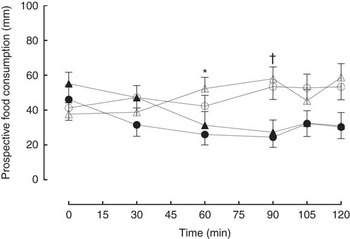
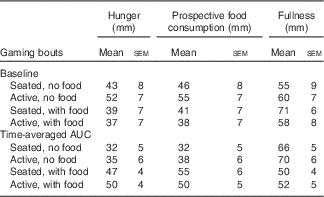
All values for appetite are displayed in Table 1. There were no detectable differences in mean baseline appetite sensations (hunger, prospective food consumption or fullness) between any of the four gaming conditions, as illustrated in Table 1. The time-averaged AUC appetite values, however, revealed significant differences between gaming conditions. Participants felt more hungry during seated gaming without food compared with when they were both seated (P=0·006) and active gaming with food (P=0·009). More specifically, they felt more hungry at 30, 60 and 90 min during the above gaming conditions, as indicated in Fig. 1. In relation to prospective food consumption, the participants felt that they wanted to eat more during seated gaming without food, compared with during seated gaming with food (P=0·002) and active gaming with food (P=0·008). They felt they wanted to eat more during the above gaming conditions at 60 and 90 min, as shown in Fig. 2. They felt less full during seated gaming without food than during seated gaming with food (P=0·003). They also felt less full during active gaming without food compared with when they were both seated (P=0·002) and active gaming with food (P=0·014). The boys felt less full during the above gaming bouts at 60 min, as illustrated in Fig. 3.
Hunger sensations for all participants. * At 30 min, participants felt less hungry during seated gaming with food (○) compared with seated gaming without food (●, P=0·010). * At 60 min, they felt less hungry during active gaming with food (△) compared with seated gaming without food (●, P=0·025). † At 60 min they felt significantly more hungry during active gaming without food (▲) in comparison with both seated (○, P=0·049) and active gaming with food (△, P=0·013). * At 90 min, participants felt significantly less hungry during active gaming with food (△) compared with both seated (●, P=0·032) and active gaming without food (▲, P=0·029). Values are means (n 21), with their standard errors.

Prospective food consumption for all participants. * At 60 min participants wanted to eat significantly more when seated gaming without food (●) compared with during active gaming with food (△, P=0·030). † At 90 min, participants wanted to eat significantly more when seated gaming without food (●) compared with seated gaming with food (○, P=0·042). Values are means (n 21), with their standard errors.
Fullness sensations for all participants. * At 60 min, the participants felt significantly less full when seated gaming without food (●) than when seated gaming with food (○, P=0·011) † and active gaming with food (△, P=0·011). They also felt more full during ‡ active gaming with food (△) compared with during active gaming without food (▲, P=0·023). Values are means (n 21), with their standard errors.

Baseline and time-averaged AUC appetite sensations for all gaming bouts (Mean values with their standard errors)
Physical activity (MET) and energy expenditure (MJ)
All values for PA (MET) and EE are displayed in Table 2. Active gaming elicited only light PA, and seated gaming was sedentary. The PA (MET) during active gaming with food were significantly greater than seated gaming with food (P<0·001, effect size 0·6). Similarly, the PA (MET) during active gaming without food were significantly greater than seated gaming without food (P<0·001, moderate effect size 0·7). As expected, no differences were found between active gaming with and without food (P=1·000) and between seated gaming with and without food (P=0·389).
Physical activity (PA), energy expenditure (EE), energy intake (EI), relative EI and time to eating onset for all participants for each gaming bout (Mean values with their standard errors)

MET, metabolic equivalents of time.
* PA were greater during active gaming without food than during seated gaming without food (P<0·001).
† PA were greater during active gaming with food than during seated gaming with food (P<0·001).
‡ EE was significantly greater during active gaming without food than during seated gaming without food (P<0·001).
§ EE was significantly greater during active gaming with food than during seated gaming with food (P<0·001).
∥ Relative EI was significantly lower during active gaming with food than during seated gaming with food (P=0·031).
¶ Time of eating onset was significantly longer during active gaming with food (P=0·017).
Energy intake (MJ), relative energy intake (energy intake–energy expenditure (MJ)) and time to eating onset (min)
All values for EI, relative EI and time to eating onset are displayed in Table 2. No significant differences were found in total EI (MJ) between the seated and active gaming bouts in which the foods and drinks were offered (P=0·238). Mean relative EI (MJ) was significantly greater after seated gaming in comparison with active gaming (P=0·031, effect size 0·3). The average time to eating onset (min) was significantly longer during active gaming with food, in comparison with seated gaming with food (P=0·017, effect size 1·0).
Discussion
The present study found no differences in the acute ad libitum EI of 8–11-year-old boys during 90 min of active gaming when compared with seated gaming. Despite the lack of difference in EI, it took considerably longer for the first eating episode during active gaming to occur (17·10 min v. seated gaming 6·90 min). Sensations of hunger, fullness and prospective food consumption appeared to be influenced by whether food was made available during the gaming bouts. This was illustrated by the boys feeling more hungry, less full and wanting to eat more during the gaming conditions without food. Furthermore, there were no differences in appetite between the seated and active gaming bouts with food.
To the best of our knowledge, this is the first study to have investigated acute ad libitum EI during active gaming using a genuine active game, in 8–11-year-old boys. The lack of difference in EI and macronutrient intake between active and seated gaming found in the present study is consistent with findings in adults when playing Nintendo Wii™ and Xbox 360 Kinect( Reference Lyons, Tate and Ward 42 ). In the previously cited study, EI during active gaming when compared with seated gaming was also not significantly different. Over the 1-h gaming periods, the adults consumed an average of 3·13 (sem 2·26) MJ when seated v. 2·32 (sem 2·08) MJ when active.
The only comparison that can be made with paediatric active gaming studies might be with the study by Mellecker et al.( Reference Mellecker, Lanningham-Foster and Levine 20 ), during which 9–13-year-old children played a seated video game or an enhanced activity gaming device. In their investigation, the total energy consumed by the children during the seated gaming bout was equivalent to 1·57 MJ/h and during active gaming it was 1·60 MJ/h. When calculated per hour, the values of Mellecker et al.( Reference Mellecker, Lanningham-Foster and Levine 20 ) were similar to those found in the present study (1 h of seated gaming 1·92 MJ; 1 h of active gaming 1·53 MJ). However, in the present study, EI during seated gaming was higher and during active gaming was lower than found by Mellecker et al.( Reference Mellecker, Lanningham-Foster and Levine 20 ). The differences in EI findings between the previously cited study( Reference Mellecker, Lanningham-Foster and Levine 20 ) and those determined at present might be because of the former study being conducted in the unfamiliar setting of the laboratory and with the active gaming being a seated gaming device played while walking on a treadmill. As such the active gaming format might not have been as stimulating or challenging for the children as an actual active video game. Our intention with the use of Nintendo Wii™ Sports tennis and the primary school settings was to provide an intervention in an environment in which the participants were more accustomed to than the laboratory.
Total EI during 90 min of seated gaming was calculated to be 2·88 MJ, and for active gaming it was calculated to be 2·30 MJ. The daily estimated average requirement (EAR) for energy for UK males aged 9 years (the average age of the present study population) is 7·70 MJ( Reference Jackson 43 ) and the EI due to seated and active gaming was calculated to be 34 and 27 % respectively, of daily EAR. Relative EI, which was estimated for seated and active gaming by subtracting the value for estimated EE from EI, was 2·42 (sem 0·33) MJ and 1·64 (sem 0·27) MJ, respectively. As such EI during active gaming with food was not offset by the greater estimated EE. Instead, a positive relative EI was produced by both games, which could contribute to a state of positive energy balance. The consumption of food or drinks by children during active gaming therefore should not be encouraged. Furthermore, the estimated EE from active gaming was equivalent to only light PA, and thus in contrast to the findings of O’Donovan et al.( Reference O’Donovan, Roche and Hussey 19 ) it would not contribute to children’s MVPA.
Because of this present study being an acute investigation, the EI of the boys was not monitored after the gaming bouts had ended (17.00 hours), and thus it is not known whether compensation for the gaming EI occurred later. The only paediatric study( Reference Gribbon, McNeil and Jay 44 ) thus far to have investigated compensation because of active gaming EE also did not establish any difference in EI in a post-gaming meal, when compared with 1 h of resting and seated gaming. At the end of the active gaming trial, however, the participants in the previously cited study were established as being in negative energy balance, which was then compensated for 24 h later by an increase in EI( Reference Gribbon, McNeil and Jay 44 ). However, the previous study offered the food ad libitum following the active gaming in a post-trial test meal and not during the conditions, as in the present study, and this might explain the difference in findings. In the current study, it is possible that the boys compensated for the extra EI during both gaming trials at a later time, either by a down-regulation in EI or by an increase in EE. If no compensation occurred, however, such substantial levels of energy surplus could contribute to a state of positive energy balance, which could be clinically meaningful with regard to weight status, particularly when a reduction of only 0·46–0·69 MJ/d might be all that is required to reduce the energy gap to bring about a decrease in body weight in children( Reference Wang, Gortmaker and Sobol 45 ).
In 15–19-year-old adolescents, EI was monitored following seated gaming for the remainder of the day, but no compensation was found to have occurred for the extra food consumed( Reference Chaput, Visby and Nyby 21 ). In relation to an increase in EE it is possible for children to compensate and increase EI 72 h later to try and restore energy balance( Reference Rumbold, St Clair Gibson and Allsop 46 ). As such, future research that examines compensation post active gaming is warranted.
In relation to appetite, the boys felt significantly more hungry, less full and wanted to eat more during the gaming conditions without food, in comparison with the gaming conditions with food. However, appetite sensations were no different between active and seated gaming with food. Thus far, only two other paediatric studies have investigated the acute effects of active gaming on subjective appetite( Reference Gribbon, McNeil and Jay 44 , Reference Chaput, Schwartz and Boirie 47 ), and both of these reported similar findings to the present study. The appetite sensations of healthy male adolescents were no different during 1 h of resting, seated gaming and active gaming( Reference Gribbon, McNeil and Jay 44 ) or in obese adolescents during 1 h of resting, seated gaming, active gaming and cycling( Reference Chaput, Schwartz and Boirie 47 ). As such, appetite and EI do not appear to be coupled because of active or seated gaming as they are with exercise( Reference Thivel and Chaput 48 ).
These findings are also similar to those of seated gaming when compared with resting conditions( Reference Chaput, Visby and Nyby 21 , Reference Branton, Akhavan and Gladanac 22 ). Both of the cited studies also observed no significant differences in appetite sensations, whereas EI obtained from an ad libitum post-gaming meal differed in the two populations( Reference Chaput, Visby and Nyby 21 , Reference Branton, Akhavan and Gladanac 22 ). In 11–13-year-old boys, EI was found to be significantly lowered by 0·25 MJ after 30 min of seated gaming( Reference Branton, Akhavan and Gladanac 22 ), whereas 15–19-year-old adolescents consumed similar amounts following seated gaming and resting( Reference Chaput, Visby and Nyby 21 ). It should be noted, however, that in the more recent study of 11–13-year-old boys, a glucose pre-load was administered at the start of the session, which might have suppressed subsequent food intake( Reference Branton, Akhavan and Gladanac 22 ).
The lack of difference in appetite sensations and EI between seated and active gaming with food observed in the present study population and during seated gaming in 15–19-year-old adolescents could be that both seated and active gaming might lead the boys to over-consume without an increase in appetite sensations, as previously reported with television watching( Reference Temple, Giacomelli and Kent 49 ). As such, both active and seated gaming might have the same distractive effect as television, which appears to cause fullness sensations to be ignored, resulting therefore in an over-compensation in EI for gaming EE. Whether this over-compensation is because of the mental-stress-induced reward system( Reference Dallman 50 ) or an impairment in satiety signalling has not yet been established( Reference Chaput, Visby and Nyby 21 , Reference Marsh, Ni Mhurchu and Maddison 51 ). Future active gaming research with children might therefore consider the objective measurement of appetite hormones alongside VAS because of the latter being a subjective measure.
To the best of our knowledge, this is the first paediatric study to investigate the influences of active gaming on acute appetite sensations and EI. The strengths of the study were that it used an intervention designed from actual survey findings that had established the active gaming practices of 7–11-year-old children. In addition, the gaming bouts were implemented in a school-based setting, as an after-school club, thus creating a more relaxed and familiar environment for participants, in contrast to that of a laboratory. Such a free-living and holistic design has evolved from our latest paediatric exercise and appetite research( Reference Rumbold, St Clair Gibson and Allsop 46 ).
A limitation of the study was that only Nintendo Wii™ Sports tennis was used during the two, 90-min active gaming sessions. We felt, however, that it was important for the boys to play the same game to enable accurate comparison of the individual gaming bouts. Furthermore, the Nintendo Wii™ Sports tennis game uses both upper and lower limbs during play, which should allow for greater body movement and thus higher activity counts and EE( Reference Maddison, Mhurchu and Jull 18 , Reference Graves, Stratton and Ridgers 52 ). The authors also recognise that the prediction of EE from MET obtained by accelerometry is not without error, particularly in children( Reference Ridley, Ainsworth and Olds 36 , Reference Nilsson, Brage and Riddoch 38 ). The accelerometers were placed on the right hip, however, and there is evidence to support this as being the optimum location( Reference Rowlands 28 , Reference Reilly, Penpraze and Hislop 29 ). Furthermore, in 11–17-year-old boys, the PA (MET) recorded from hip placement during a 15-min play of Nintendo Wii™ Sport tennis were shown to have the closest relationship to EE than other body sites tested, which were the right and left wrists( Reference Graves, Stratton and Ridgers 52 ). We considered it important, however, to implement the active gaming sessions in a manner that was most true-to-life, outside of the laboratory with two boys playing against one another. For this it was necessary to measure PA by accelerometry and thus estimate EE. Subsequent estimations of relative EI therefore will also not be without error. Therefore, we believe this study to have been exploratory in nature, and we encourage researchers to use the paediatric responses to active gaming presented in this manuscript to help power future studies.
To conclude, the availability of food had a significant effect on appetite sensations during the gaming bouts. However, there were no differences in the acute EI or appetite sensations of 8–11-year-old boys between 90-min of active video gaming with food and 90 min seated video gaming with food. Acute EI because of eating and drinking during active gaming was calculated as 37 % (2·88 (sem 0·32) MJ) and during seated gaming it was 30 % (2·30 (sem 0·28) MJ) of daily EAR (based on 9-year-old boys). The relative EI estimated to have been produced from active gaming and acute ad libitum EI was 1·64 (sem 0·27) MJ and for seated gaming it was 2·42 (sem 0·33) MJ, which might contribute to positive energy balance. Appetite and EI responses to active and seated gaming require further exploration, in order to establish whether the observed acute over-compensation in EI is offset by subsequent EI and EE, after a gaming session has ended.
Acknowledgements
The authors thank all of the schools, the children and their parents who participated in this study. The authors are grateful to Ashleigh Keenan, Ryan Cosgrove and Mairead Fowler for assistance with data collection.
The project received no external funding.
S. A., P. L. S. R., D. D. and C. J. D.-R. designed the study, S. A. and B. P. G. led and carried out the data collection and all authors contributed to data analysis, interpretation and writing of the manuscript.
The authors declare no conflicts of interest.



