





Introduction
The most troublesome weeds of rice in the midsouthern United States include barnyardgrass and Palmer amaranth (Amaranthus palmeri S. Wats.), as well as hemp sesbania [Sesbania herbacea (P. Mill.) McVaugh] (Van Wychen Reference Van Wychen2020). Because rice is managed as an upland crop during the early vegetative growth stages, weed control prior to flooding can be difficult (Bagavathiannan et al. Reference Bagavathiannan, Norsworthy and Scott2011). Barnyardgrass can be especially difficult to manage in rice, because its C4 photosynthetic pathway allows it to outcompete C3 rice in the high light and temperature environments where rice is often grown (Mitich Reference Mitich1990).
Applying clomazone preemergence or delayed-preemergence (DPRE) is standard in Mississippi rice production as a result of its effectiveness against barnyardgrass (Bond et al. Reference Bond, Barapour, Bowman, Dodds, Irby, Larson, Pieralisi, Reynolds and Zurweller2022). However, herbicide options after DPRE have become limited for barnyardgrass control because resistance to fenoxaprop, imazethapyr, propanil, quinclorac, and imazamox has been confirmed in Mississippi (Heap 2023).
Propanil, a photosystem II–inhibiting herbicide, has been utilized in rice since the 1960s (Smith Reference Smith1965). Photosystem II–inhibiting herbicides inhibit the electron transport chain in photosystem II (Shaner Reference Shaner2014a). The symptomology on barnyardgrass following propanil application first appears as chlorosis, which is followed by foliar desiccation and necrosis. Rice can tolerate propanil because of increased production of aryl acylamidase. Smith (Reference Smith1965) reported 87% control of barnyardgrass with propanil at 5.6 kg ha–1. Between 1988 and 1993, 98% of rice hectares were treated with at least a single application of propanil (Carey et al. Reference Carey, Hoagland and Talbert1996). By 1990, failure to control barnyardgrass with propanil was reported. Seed collection from barnyardgrass surviving 11.2 kg ha–1 of propanil confirmed metabolic resistance to propanil in barnyardgrass (Carey et al. Reference Carey, Hoagland and Talbert1995). Growers began mixing residual herbicides with propanil for improved control of propanil-resistant barnyardgrass, but when quinclorac was released in 1992, it was widely utilized for control of propanil-resistant barnyardgrass (Talbert and Burgos Reference Talbert and Burgos2007).
Quinclorac belongs to the synthetic auxin herbicide site of action (Shaner Reference Shaner2014b). Auxinic herbicides mimic the hormone indole-3-acetic acid, a naturally occurring auxin in control of plant growth and development. In barnyardgrass, quinclorac is translocated via the phloem and xylem (Lovelace et al. Reference Lovelace, Talbert, Hoagland and Scherder2007). This results in chlorosis and elongation of newly expanding leaves followed by necrosis. Historically, soil-applied quinclorac provided ≥86% control of barnyardgrass (Street and Mueller Reference Street and Mueller1993), and quinclorac controlled two-leaf barnyardgrass ≥90% (Baltazar and Smith Reference Baltazar and Smith1994). However, quinclorac-resistant barnyardgrass was confirmed by 1998 in Louisiana and 1999 in Arkansas (Heap 2023; Lovelace Reference Lovelace, Hoagland, Talbert and Scherder2009). At approximately the same time as reports of quinclorac-resistant barnyardgrass, imidazolinone-resistant rice was developed and commercialized (Croughan Reference Croughan1994).
Imidazolinone-resistant rice was created through seed mutagenesis, which is the technique of exposing seed to chemicals or radiation and creating mutants (Croughan Reference Croughan1994). Acetolactate synthase–inhibiting herbicides inhibit the conversion of pyruvate to leucine, isoleucine, and valine (Ray Reference Ray1984). Imazethapyr and imazamox are absorbed into the foliage of barnyardgrass and translocated via the phloem (Shaner Reference Shaner2014c). Within a few days, barnyardgrass growth is inhibited, and meristematic areas appear chlorotic, followed by foliar chlorosis and necrosis. Klingaman et al. (Reference Klingaman, King and Oliver1992) reported 99% control of barnyardgrass with imazethapyr at 70 g ha–1. Due to poor management of the imidazolinone-resistant technology, imazethapyr-resistant barnyardgrass was identified only 6 yr after its commercialization (Heap 2023; Wilson et al. Reference Wilson, Norsworthy, Scott and Gbur2014). However, additional options still exist for barnyardgrass control in rice (Bond et al. Reference Bond, Barapour, Bowman, Dodds, Irby, Larson, Pieralisi, Reynolds and Zurweller2022).
In 2018, Corteva Agriscience released a new herbicide as an alternative for barnyardgrass control in rice known as florpyrauxifen-benzyl (Anonymous 2017). It belongs to a new herbicide family, the arylpicolinates, within the synthetic auxin site of action. Florpyrauxifen-benzyl at 30 g ai ha–1 provided >96% of 152 barnyardgrass accessions collected in Arkansas prior to herbicide commercialization (Miller et al. Reference Miller, Norsworthy and Scott2018). Additional research documented no visible injury to rice and no antagonism when many common rice herbicides (2,4-D, acifluorfen, bentazon, bispyribac, carfentrazone, cyhalofop, fenoxaprop, halosulfuron, imazethapyr, penoxsulam, propanil, quinclorac, saflufenacil, and triclopyr) were mixed with florpyrauxifen-benzyl in Arkansas (Miller and Norsworthy Reference Miller and Norsworthy2018). In Mississippi, visible injury of 32% to ‘CL151’ rice and >97% control of barnyardgrass was reported when florpyrauxifen-benzyl at 29 g ha–1 was applied with quizalofop at 119 g ai ha–1 (Sanders et al. Reference Sanders, Bond, Lawrence, Golden, Allen and Bararpour2019). No yield loss was reported from applications of florpyrauxifen-benzyl plus quizalofop compared with quizalofop alone. However, cases of failed barnyardgrass control have been reported following applications of florpyrauxifen-benzyl. Therefore, the objectives of this research were to evaluate (i) barnyardgrass control with postemergence rice herbicides following sublethal treatments of florpyrauxifen-benzyl utilized to simulate a failed herbicide application, and (ii) barnyardgrass control with florpyrauxifen-benzyl following sublethal treatments with postemergence rice herbicides.
Materials and Methods
Two field studies were conducted at the Mississippi State University Delta Research and Extension Center in Stoneville, MS, to characterize barnyardgrass control with a sequential herbicide application following simulated failures of initial herbicide treatment. Soil was a Sharkey clay (Very-fine, smectitic, thermic Chromic Epiaquerts) with a pH of 7.5 to 8.2 and approximately 2.4% organic matter. Year and global positioning system coordinates for both studies are presented in Table 1.
Global positioning system (GPS) coordinates, planting date, initial herbicide application, and harvest date in the initial and sequential florpyrauxifen-benzyl study conducted at the Mississippi State University Delta Research and Extension Center in Stoneville, MS.
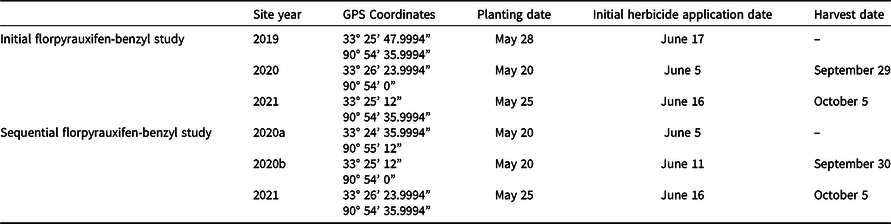
Rice cultivar, ‘CL153’ (Horizon Ag, Memphis, TN) was seeded at 83 kg ha–1 (356 seed m–2) to a depth of 2 cm using a small-plot grain drill (Great Plains 1520, Great Plains Mfg, Inc., Salina, KS; Table 1) in both studies all site years. Plots contained eight rows of rice spaced 20 cm apart and 4.6 m in length and were separated by a 1.5-m border on either end containing no rice. Nitrogen fertilizer was applied at 168 kg ha–1 as urea (46-0-0) immediately prior to flooding (Norman et al. Reference Norman, Wilson, Slanton, Smith and Dilday2003). Rice was flooded to a depth of 6 to 10 cm at the one- to two-tiller stage. All herbicide treatments were applied using a CO2-pressurized backpack sprayer equipped with flat-fan nozzles (AirMix 11002 nozzle, Greenleaf Technologies, Covington, LA) set to deliver 140 L ha–1. Barnyardgrass densities at time of initial application in both studies for all site years ranged from 10 to 22 m–2, and heights were 10 to 20 cm.
Data collection included visible estimates of barnyardgrass control 7 d after initial herbicide treatment (DA-I) in the initial florpyrauxifen-benzyl study and 21 d after final treatment (DAFT) in both studies. Visible barnyardgrass control was assessed on a 0 to 100% scale, with 0 being no control and 100 equaling complete control (Frans et al. Reference Frans, Talbert, Crowley and Camper1986). Rice height in centimeters was also measured from five random plants in each plot 21 DAFT. Plant heights recorded from treated plots were divided by the average height of rice in the nontreated plots and multiplied by 100 to calculate relative heights. At crop maturity, rice was harvested with a small-plot combine (Zurn USA; Zurn USA Inc., Brooklyn Park, MN) at a moisture content of approximately 20%. Grain weights and moisture contents were recorded, and rough rice grain yields were adjusted to a uniform moisture content of 12% before being converted to kilograms per hectare. Data were subjected to ANOVA using the PROC GLIMIX procedure in SAS v. 9.3 (SAS Institute Inc., Cary, NC) with site year and replication (nested within site year) as random effects (Blouin et al. Reference Blouin, Webster and Bond2011). Estimates of the least square means at 5% significance level were used for mean separation.
Initial Florpyrauxifen-benzyl Study
The field study to evaluate barnyardgrass control with labeled rice herbicides following a simulated failure of florpyrauxifen-benzyl treatment was designed as a randomized complete block with a two-factor factorial arrangement of treatments and four replications. Factor A was initial treatment of florpyrauxifen-benzyl (Loyant; Corteva Agriscience, Indianapolis, IN) at 0 or 15 g ha–1 when rice reached the two- to three-leaf stage. Labeling recommends florpyrauxifen-benzyl be applied at 29 g ha–1 for barnyardgrass (Anonymous 2017), so treatment at 15 g ha–1 was designed to simulate a failed herbicide application. Factor B was sequential herbicide treatments and included no herbicide, imazethapyr at 105 g ha–1, quinclorac at 420 g ha–1, bispyribac-Na at 28 g ai ha–1, and cyhalofop at 314 g ai ha–1 applied 7 or 14 DA-I (Table 2).
Herbicides and rates for initial and sequential florpyrauxifen-benzyl studies from 2019 to 2021.

Sequential Florpyrauxifen-benzyl Study
The field study to evaluate barnyardgrass control with florpyrauxifen-benzyl following a simulated failure of a labeled rice herbicide treatment was designed as a randomized complete block with a two-factor factorial treatment structure and four replications. Factor A consisted of initial herbicide treatment at one half of the labeled rates and included no herbicide, imazethapyr at 53 g ha–1, quinclorac at 210 g ha–1, bispyribac-Na at 14 g ha–1, and propanil at 2,240 g ha–1 to simulate failed herbicide applications (Table 2). Factor B was florpyrauxifen-benzyl timing and included florpyrauxifen-benzyl at 0 and 29 g ha–1 applied 7 or 14 DA-I.
Results and Discussion
Initial Florpyrauxifen-benzyl Study
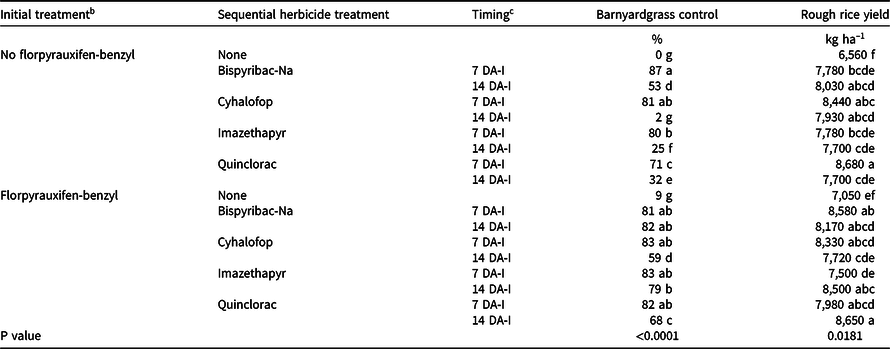
Barnyardgrass control treated with an initial treatment of florpyrauxifen-benzyl at 15 g ha–1 prior to the other postemergence herbicides was ≥24% (data not presented). By 21 DAFT, barnyardgrass control was greater with each sequential treatment at 7 DA-I compared with 14 DA-I with no initial application of florpyrauxifen-benzyl (Table 3). Cyhalofop 7 DA-I, provided 81% control of barnyardgrass 21 DAFT compared with 2% barnyardgrass control when applied 14 DA-I. However, following the initial treatment of florpyrauxifen-benzyl, barnyardgrass control was only improved when treated with a 7 DA-I treatment of quinclorac or cyhalofop. This was likely a result of the size of barnyardgrass at the time of the 14 DA-I herbicide applications. Mitich (Reference Mitich1990) reported barnyardgrass exhibits rapid growth over a wide range of environments. Barnyardgrass treated with a sequential postemergence herbicide at 7 d following initial florpyrauxifen-benzyl application, had control ranging from 81% to 83%. Barnyardgrass control 21 DAFT was not reduced with prior exposure to florpyrauxifen-benzyl compared with no prior exposure.
Barnyardgrass control 21 d after final treatment and rough rice yield in the initial florpyrauxifen-benzyl study conducted at Stoneville, MS, from 2019 to 2021. a
a Data were pooled over three experiments. Means followed by the same letter within a column are not different at P ≤ 0.05).
b Florpyrauxifen-benzyl was applied at 15 g ai ha–1; imazethapyr was applied at 105 g ai ha–1; quinclorac was applied at 420 g ai ha–1; cyhalofop was applied at 314 g ai ha–1; bispyribac-Na was applied at 28 g ai ha–1.
c Abbreviation: DA-I, days after the initial herbicide treatment.
Rice height 21 DAFT was not influenced by treatments imposed in this study (data not presented). Rough rice yield was reduced when rice treated with quinclorac was delayed from 7 to14 DA-I with no initial application of florpyrauxifen-benzyl (Table 3). Lancaster et al. (Reference Lancaster, Norsworthy and Scott2018) suggested that correctly timed sequential applications influenced barnyardgrass control more than herbicide rate, further emphasizing the importance of timely herbicide applications due to the rapid growth of barnyardgrass (Mitich Reference Mitich1990). In contrast, rough rice yield was greater when sequential imazethapyr treatment was delayed until 14 DA-I with prior exposure to florpyrauxifen-benzyl. Barnyardgrass control in cotton (Gossypium hirsutum L.) was increased by delaying sequential applications of glyphosate plus glufosinate 14 d (Coffman Reference Coffman2019). Although data from the current work offer insight for barnyardgrass control options, it is important to remember to diversify herbicide modes of action and utilize complete herbicide programs for season-long broad-spectrum weed control (Sanders et al. Reference Sanders, Bond, Lawrence, Golden, Allen and Bararpour2020).
Sequential Florpyrauxifen-benzyl Study
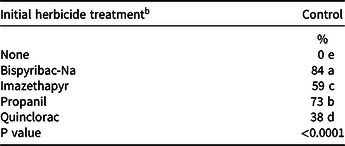
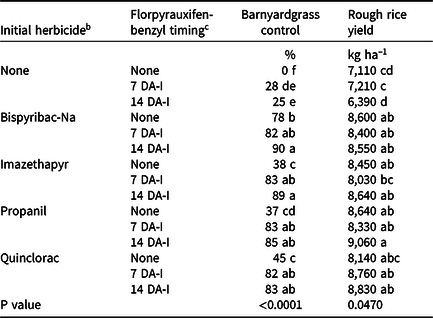
Prior to sequential florpyrauxifen-benzyl treatment, a half rate of bispyribac-Na exhibited the greatest barnyardgrass control of 84%. Barnyardgrass control following all other initial treatments was ≤73% (Table 4). An interaction of initial herbicide treatment and sequential florpyrauxifen-benzyl timing was detected for barnyardgrass control 21 DAFT (Table 5). With all initial herbicide treatments except bispyribac-Na, barnyardgrass control 21 DAFT was lowest with no sequential florpyrauxifen-benzyl treatment. Although no differences in barnyardgrass control 21 DAFT were detected whether florpyrauxifen-benzyl was applied 7 or 14 d after initial application of any herbicide utilized as an initial treatment, 85% or greater control was only achieved when florpyrauxifen-benzyl application was delayed until 14 DA-I (Table 5). Coffman (Reference Coffman2019) reported similar increased barnyardgrass control, when delaying a second application of glyphosate plus glufosinate until 14 DA-I.
Barnyardgrass control 7 d after initial herbicide treatment (DA-I) in the sequential florpyrauxifen-benzyl study conducted at Stoneville, MS, from 2020 to 2021. a
a Data were pooled over three experiments. Means followed by the same letter are not different at (P ≤ 0.05).
b Imazethapyr was applied at 52.5 g ai ha–1; quinclorac was applied at 210 g ai ha–1; cyhalofop was applied at 157 g ai ha–1; bispyribac-Na was applied at 14 g ai ha–1.
Barnyardgrass control 21 d after final treatment and rough rice yield in the sequential florpyrauxifen-benzyl study conducted at Stoneville, MS from 2020 to 2021. a
a Data were pooled over three experiments. Means followed by the same letter within a column are not different at P ≤ 0.05).
b Florpyrauxifen-benzyl was applied at 30 g ai ha–1; imazethapyr was applied at 52.5 g ai ha–1; quinclorac was applied at 210 g ai ha–1; cyhalofop was applied at 157 g ai ha–1; bispyribac-Na was applied at 14 g ai ha–1.
c Abbreviations: DA-I, days after the initial herbicide treatment.
Rice height 21 DAFT was not affected by either factor included in the study (data not presented). Rough rice yields were greater when an initial herbicide treatment prior to application of florpyrauxifen-benzyl was applied, with the exception of florpyrauxifen-benzyl 7 d after initial application of imazethapyr and quinclorac with no sequential florpyrauxifen-benzyl (Table 5). Sanders et al. (Reference Sanders, Bond, Lawrence, Golden, Allen and Bararpour2019) reported similar findings with no difference in rough rice yield when florpyrauxifen-benzyl was included in herbicide applications targeted at two- to three-leaf or four-leaf to tillering barnyardgrass.
Practical Implications
Results from these field studies demonstrate barnyardgrass control options 7 and 14 d after simulated failed applications of florpyrauxifen-benzyl, as well as barnyardgrass control with florypyrauxifen-benzyl 7 and 14 d after simulated failed applications of bispyribac-Na, imazethapyr, propanil, or quinclorac. When considering herbicide options following failed applications of any herbicide for barnyardgrass control, it is important to consider environmental factors and potential herbicide resistance issues in herbicide selection. Minimizing factors affecting barnyardgrass control can aid in herbicide selection.
With confirmed barnyardgrass resistance to fenoxaprop, imazamox, imazethapyr, propanil, and quinclorac in Mississippi (Heap 2023), it is important to consider historical issues in a given area. In a low-soil-moisture environment, options like bispyribac-Na may provide greater control of barnyardgrass, whereas in a high-soil-moisture environment cyhalofop may be more beneficial for control of barnyardgrass.
Acknowledgments
The authors would like to thank the Mississippi Rice Promotion Board for partial funding of this research. Material is based on work supported by the National Institute of Food and Agriculture, U.S. Department of Agriculture, Hatch project under accession number 153290. No competing interests have been declared.


 Open access

