


Introduction
The Middle Neolithic in Britain (c. 3400–2800 cal BC) can be seen as a transitional period, with a shift from the construction of rectangular and linear monuments (such as long barrows, bank barrows and cursus monuments) to a circular archetype (Bradley Reference Bradley2012). Key to understanding this transformation is a small group of monuments termed ‘proto-henges’ (Cleal et al. Reference Cleal, Walker and Montague1995: 31) or ‘formative henges’ (Harding Reference Harding2003: 130). Typically, these monuments have a markedly circular shape; measuring 80–110m in diameter, they consist of a ditch flanked either by two banks or just an inner bank and crossed by narrow entrances (Burrow Reference Burrow, Leary, Darvill and Field2010: 184). All of those excavated were used for the interment of the dead, usually cremations but also inhumations, yet contain relatively little other material such as pottery or flint artefacts.
These Middle Neolithic circular monuments appear to herald the start of a preference for building round monuments, including stone circles, timber structures and earthwork henges. They were built at a time when relatively few large-scale monuments were constructed, in comparison to the earlier and later Neolithic, and yet their segmented ditches and the patterns of deposition at some sites—for example, the placement of animal bone in ditches—hark back to practices at earlier causewayed enclosures (Cleal et al. Reference Cleal, Walker and Montague1995: 113–14). The chronology of these proto-henges is therefore essential to understanding the trajectories of changing ceremonial and funeral monuments in Britain. Three similar monuments form key comparators: Flagstones in Dorset, the earliest phase of Stonehenge in Wiltshire, and Llandygái ‘Henge’ A in Gwynedd, all of which have been partially excavated. Although the enclosure at Stonehenge has been precisely dated by a programme of radiocarbon dating and Bayesian modelling (Darvill et al. Reference Darvill, Marshall, Pearson and Wainwright2012) and there are 10 radiocarbon dates available on cremation burials from Llandygái ‘Henge’ A and its associated segmented pit circle (see below), only six radiocarbon dates are available for Flagstones, obtained on material from the 1986–1987 excavations (Smith et al. Reference Smith, Healy, Allen, Morris, Barnes and Woodward1997: tab. 1; see online supplementary material (OSM) Table S1). Three of these dates provide a broad estimate that the monument was constructed in the later fourth or early third millennium cal BC. Here, we present a new chronology for Flagstones, seeking to answer key questions about this monument and the broader category of proto-henges.
Layout of the site
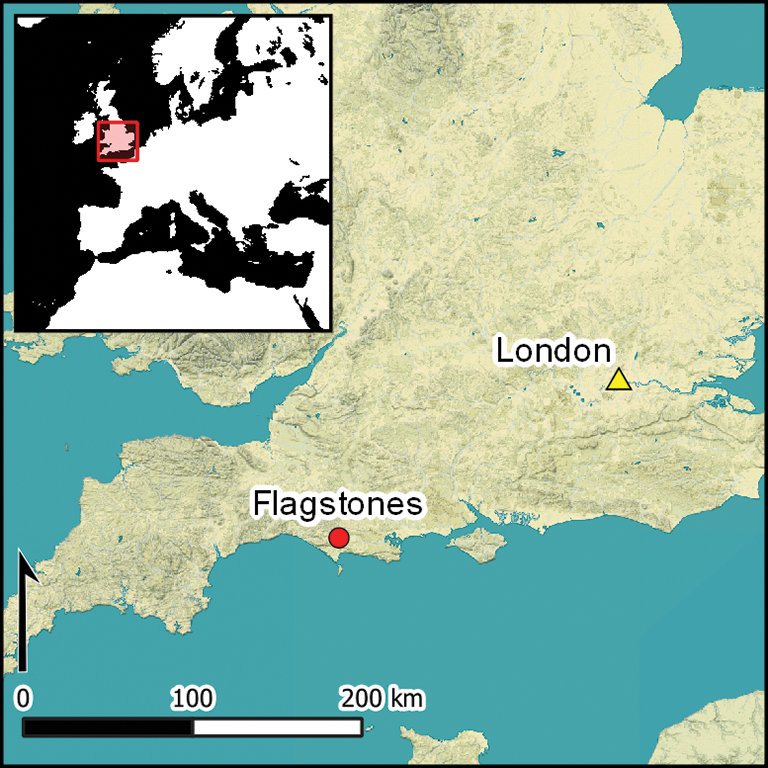
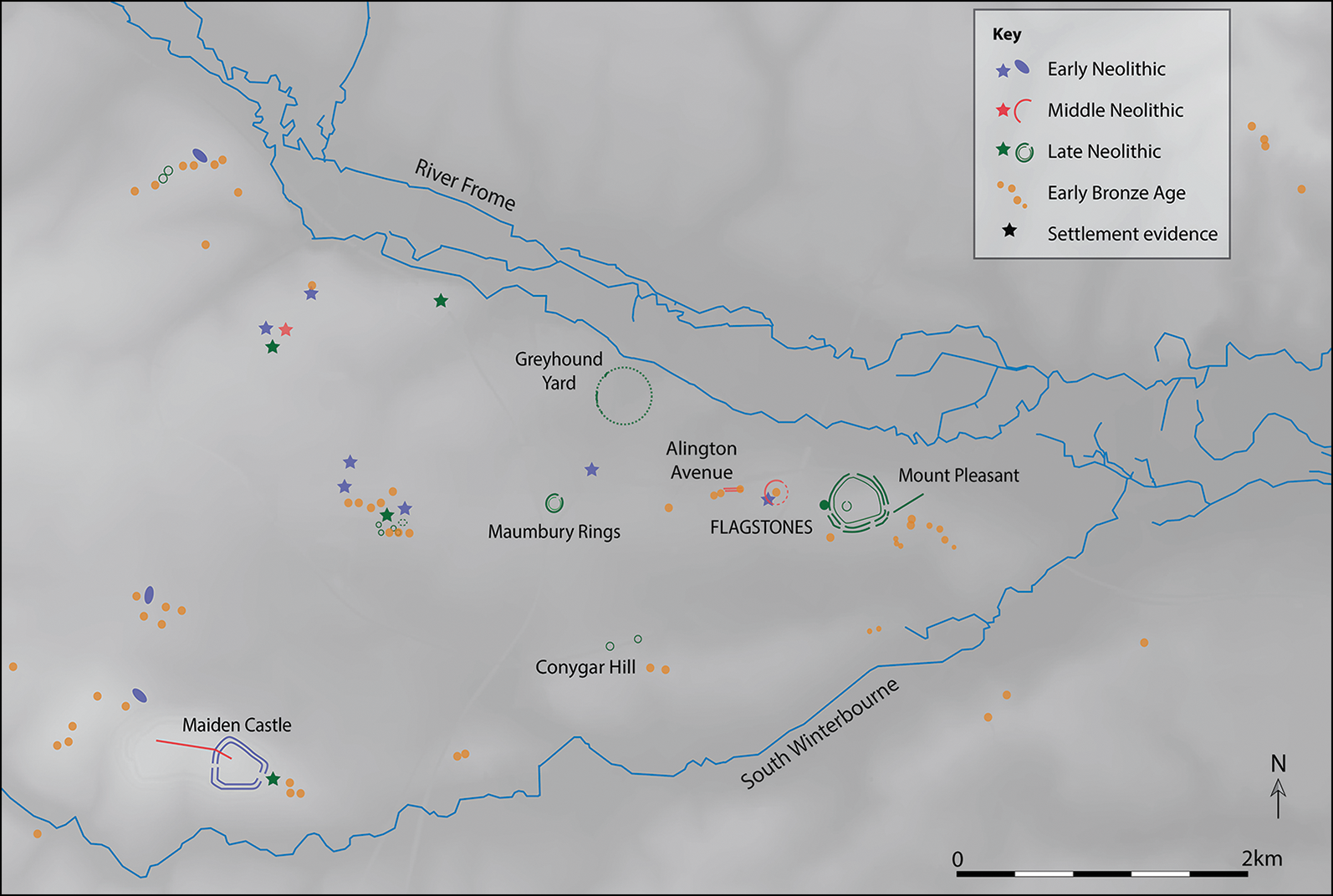
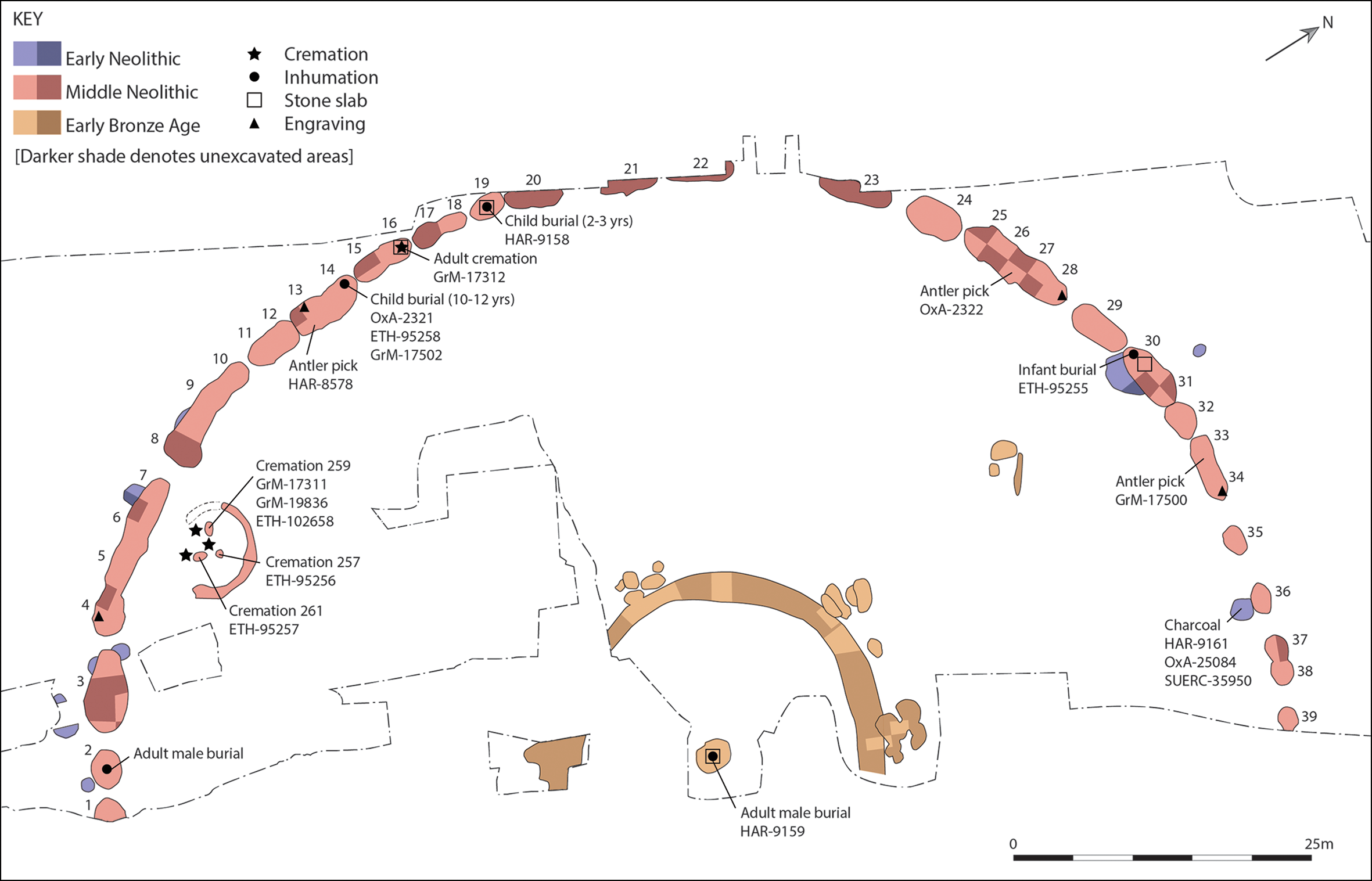
Flagstones is a 100m-diameter, circular enclosure of unevenly spaced and partially intercutting pits, created in an area of previous Early Neolithic activity. It is located in Dorchester, in the county of Dorset in south-west England (Figures 1 & 2; Smith et al. Reference Smith, Healy, Allen, Morris, Barnes and Woodward1997). There is no direct evidence for enclosure banks. However, pit fills contain equal amounts of chalk rubble from both sides, suggesting that the upcast from the pits was used to form both an inner and outer bank. The first key question for the research was, what date was this enclosure constructed? At least four burials were placed on the base or in the primary fills of the enclosure pits: a cremated adult under a large sarsen stone, and the inhumations of three young children, one of which was under a large slab of calcareous sandstone (Smith et al. Reference Smith, Healy, Allen, Morris, Barnes and Woodward1997: 37). Three further cremations of adults were interred in pits within a penannular ditch (shaped like a ring with a small gap in its circumference) in the south-west part of the enclosure (Figure 2; Smith et al. Reference Smith, Healy, Allen, Morris, Barnes and Woodward1997: 41). Over what period was Flagstones used for burial? The enclosure lies at the centre of a major monument complex in the Dorchester area, which developed over 2000 years during the Neolithic and Early Bronze Age. Parts of this complex are now well dated (Whittle et al. Reference Whittle, Healy and Bayliss2011: 164–93; Greaney et al. Reference Greaney2020). The inner ditch of the causewayed enclosure at Maiden Castle was constructed in 3660–3635 cal BC (7% probability; Table S2) or 3570–3525 cal BC (88% probability) and the major henge monument of Mount Pleasant was built in 2615–2495 cal BC (95% probability: Table S4). Where does Flagstones fit within the chronology of this wider complex? Looking more broadly at ‘proto-henges’, how does the date of the construction and funerary use of Flagstones compare to Stonehenge and Llandygái, and to other comparable monuments, including small, penannular or circular enclosures associated with cremations?
Map showing the location of Flagstones within the wider Dorchester area; other Neolithic and Early Bronze Age monuments and settlement evidence in the area is also shown (figure by Susan Greaney).
Plan of the excavated, western half of the Flagstones enclosure (after Smith et al. Reference Smith, Healy, Allen, Morris, Barnes and Woodward1997: fig. 22; figure by Susan Greaney).
Radiocarbon dating and chronological modelling
The overall objective of our research was to provide a robust chronology for the construction and use of Flagstones, and the associated funerary activity. The Bayesian paradigm is particularly well-suited for representing and managing prior knowledge and scientific data (e.g. radiocarbon dates), making it especially attractive to archaeologists seeking a coherent method to integrate information from multiple sources (Buck & Juárez Reference Buck and Juárez2024). Hence our radiocarbon dating programme was developed within the Bayesian framework for chronology construction outlined by Buck and colleagues (Reference Buck, Cavanagh and Litton1996).
Sample selection was undertaken using the iterative process for implementing Bayesian chronological modelling on archaeological sites as described by Bayliss and Marshall (Reference Bayliss and Marshall2022). We aimed, where possible, to maximise the number of stratigraphic relationships between deposits included in the modelling. Radiocarbon dating, however, does not date contexts directly—it dates samples. Therefore, calibrated radiocarbon dates can only be constrained by the stratigraphic sequence if the samples were freshly deposited in the context from which they were retrieved. The key archaeological task is thus to determine whether a given sample is likely to have been residual (or, less commonly, intrusive) in its context (Bayliss Reference Bayliss2015; Bayliss & Marshall Reference Bayliss and Marshall2022: 29–47).
The Harris matrix of deposits excavated during the 1986–1987 investigation at Flagstones therefore provided the fundamental basis of our radiocarbon sampling strategy. From the excavation archive at Dorset Museum, human bone (both unburnt and calcined), probably deposited shortly after the death of the individual concerned, and antler tools, likely used to dig the enclosure and then discarded on the base of the pits, were selected for sampling. Inference in the use of the antler tools is most secure when use-wear such as battering on the posterior side of the beam, burr or coronet of the antler pick is identifiable (Bayliss & Marshall Reference Bayliss and Marshall2022: 29–47). Six other radiocarbon determinations (on charcoal, antler and human bone) had been obtained in the 1980s (Smith et al. Reference Smith, Healy, Allen, Morris, Barnes and Woodward1997: 38), and two further dates on charcoal from two of the pre-enclosure pits have been recently obtained as part of a project to date early Neolithic ceramics (Barclay et al. Reference Barclay2018).
A total of 23 radiocarbon measurements (antler, n = 7; calcined human bone, n = 7; unburnt human bone, n = 6; and charcoal, n = 3) are now available relating to activity at Flagstones (Table S1). Technical details of the results, the methods used to produce them, and the archaeological prior information included in the modelling are provided in the OSM. The Bayesian chronological modelling software OxCal 4.4 (Bronk Ramsey Reference Bronk Ramsey2009) and the internationally agreed calibration curve for the northern hemisphere (IntCal20; Reimer et al. Reference Reimer2020) were used for building the chronology. The OxCal CQL2 file for the model shown in Figure 3 is defined by keywords and brackets on its left-hand side. The highest posterior density (HPD) intervals, displayed in italics in the text below and in the supplementary tables, describe the posterior distributions.
Probability distributions of dates from Flagstones. Each distribution represents the relative probability that an event occurs at a particular time. For each of the dates two distributions have been plotted: one in outline, which is the result of simple radiocarbon calibration, and a solid one, based on the chronological model used. Distributions other than those relating to individual samples correspond to aspects of the model. For example, the distribution ‘StartFunerary’ is the estimated date when funerary activity began. The large square brackets down the left-hand side, along with the OxCal keywords, define the overall model exactly (figure by Peter Marshall).
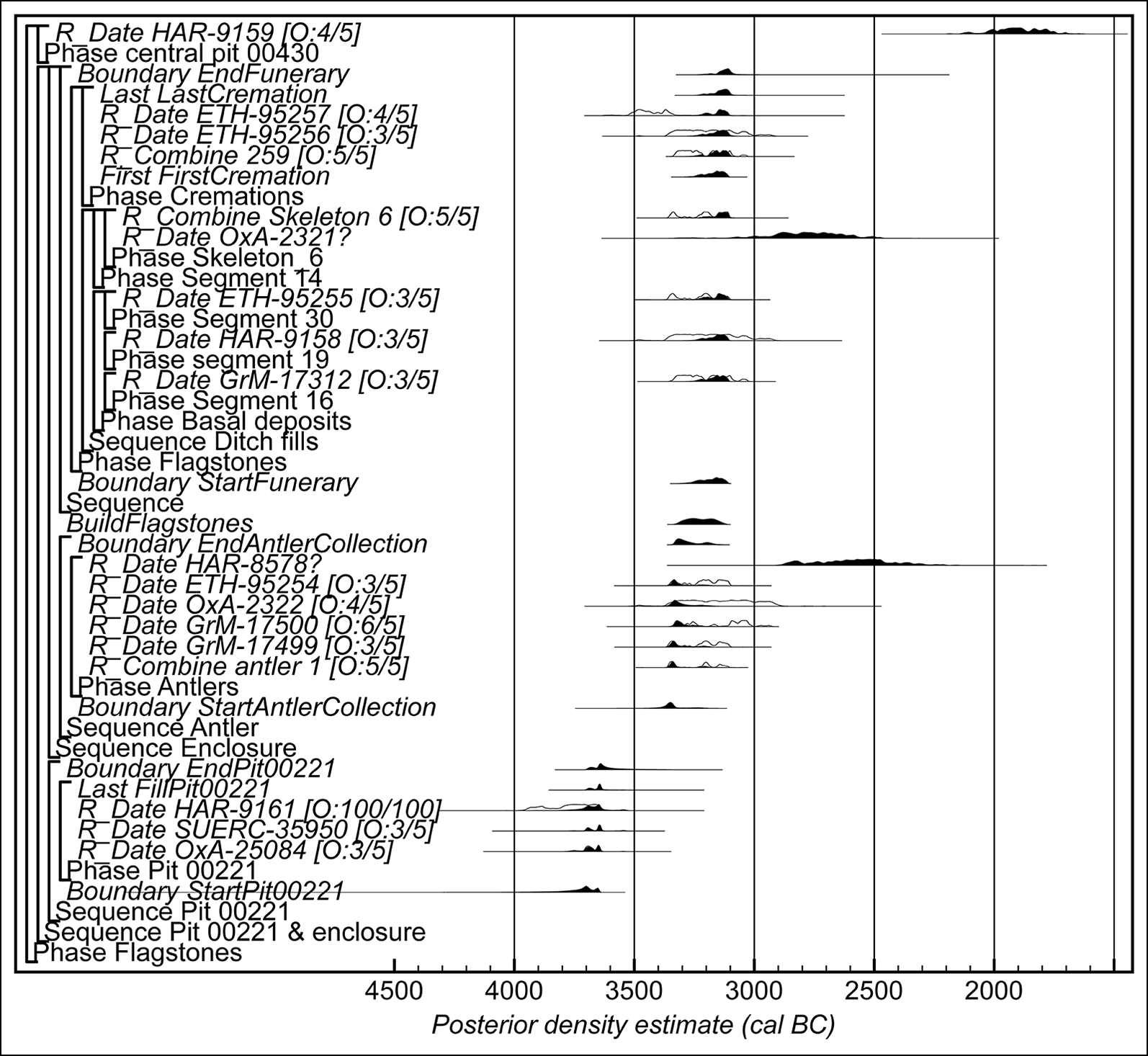
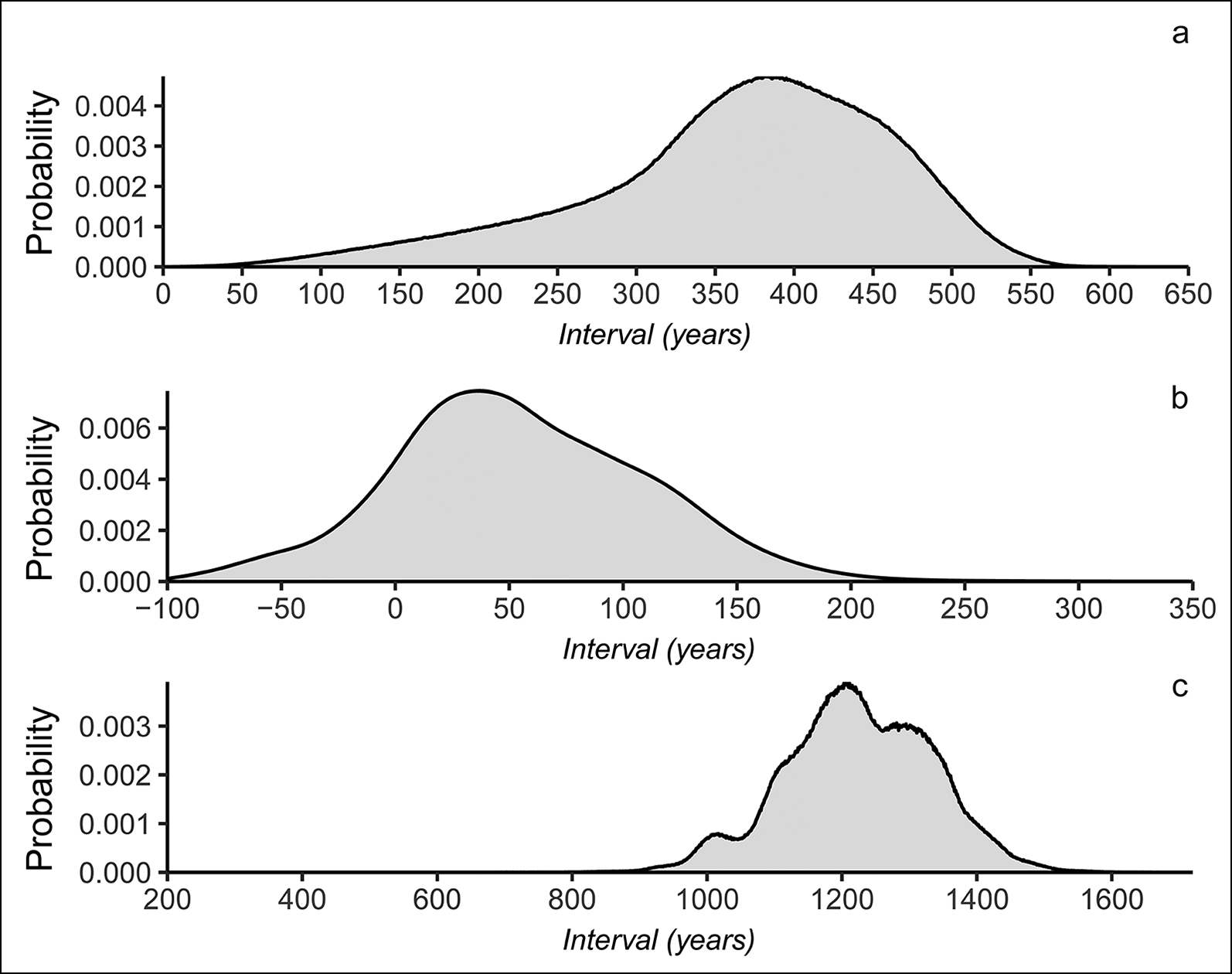
The model shown in Figure 3 treats the dated samples as deriving from three single, continuous and relatively constant periods of activity: first, Early Neolithic pit digging; second, antler collection for the digging of the main enclosure; and third, funerary activity (see Figure S1). The model suggests that Early Neolithic pit digging took place in the second quarter of the fourth millennium cal BC. Following a gap of 315–545 years (95% probability; Figure 4a), probably 365–495 years (68% probability), the circular enclosure (we have assumed it was a unitary construction) was finished in 3315–3130 cal BC (95% probability; BuildFlagstones; Figure 5), probably 3285–3215 cal BC (41% probability) or 3210–3160 cal BC (27% probability). The relatively imprecise estimate for this event stems from the comparatively flat portion of the calibration curve (IntCal20) between c. 3300 and 3100 BC. Although annual measurements on single tree-rings from 3450–3050 BC have revealed considerably more structure (Brehm et al. Reference Brehm2021: fig. 1), the ‘plateau’ visible in IntCal20 is still present (Figure S22) and appears to be a hurdle to determining a more precise estimate for the date of the Flagstones enclosure.
Intervals between episodes of activity at Flagstones, derived from the model defined in Figure 3: a) interval between the infilling of an early Neolithic pit (EndPit00221) and the construction of the circular enclosure (BuildFlagstones); b) duration of funerary activity; and c) interval between the end of Neolithic funerary activity (EndFunerary) and the interment of a young adult male in the centre of the enclosure (HAR-9159) (figure by Peter Marshall).
Probability distributions of dates for key events at Flagstones derived from the model defined in Figure 3 (figure by Peter Marshall).
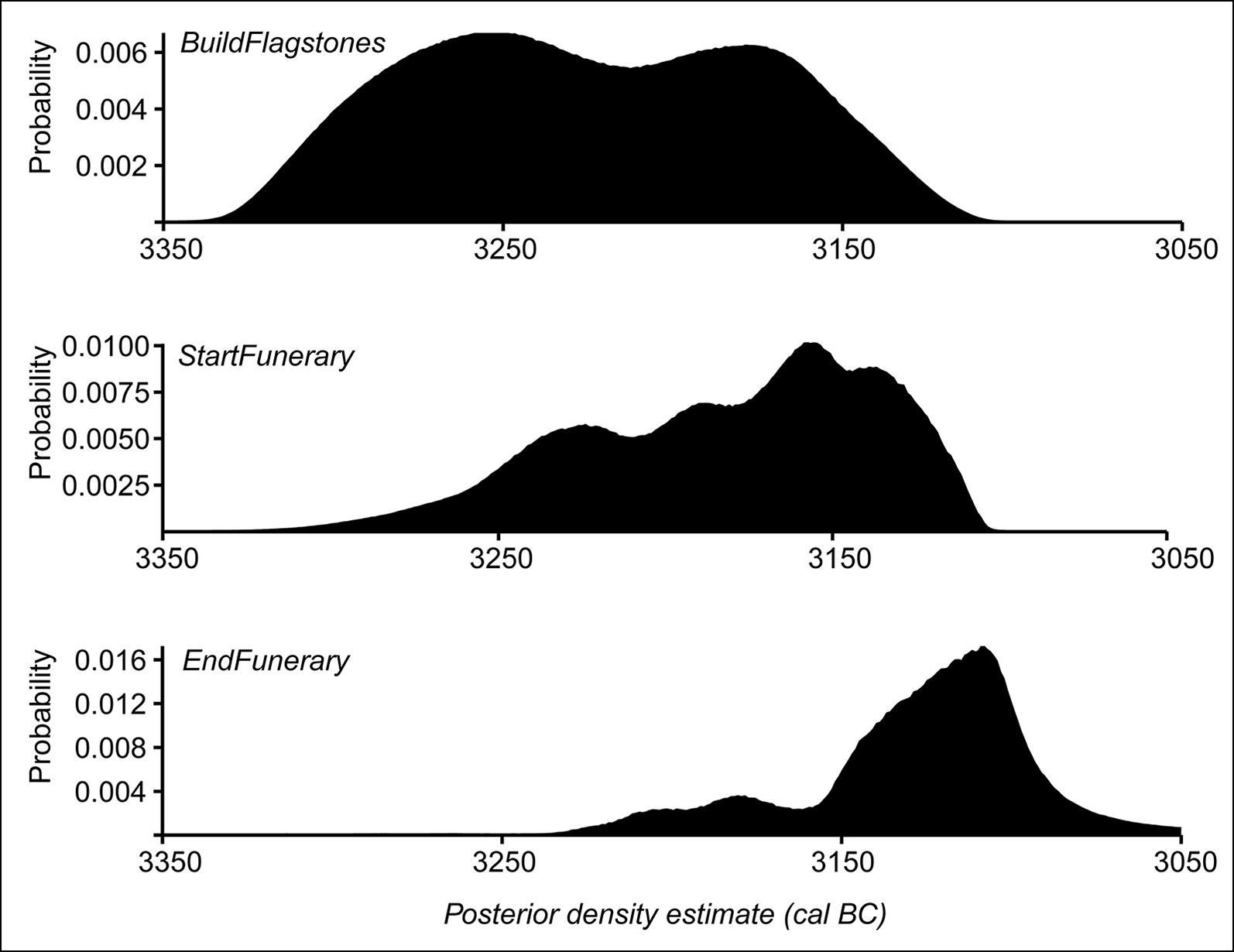
Inhumations and cremations were deposited concurrently within the pits of the circular enclosure and inside the smaller, penannular ditch at the end of the fourth millennium cal BC (Figure 3). Funerary activity is estimated to have begun in 3265–3105 cal BC (95% probability; StartFunerary; Figure 5), probably 3230–3220 cal BC (4% probability) or 3205–3120 cal BC (64% probability), and finished in 3220–3065 cal BC (95% probability; EndFunerary; Figure 5), probably 3150–3090 cal BC (68% probability). This activity was relatively short-lived, with an estimated duration of 1–170 years (95% probability; Figure 4b), probably 1–110 years (68% probability). The funerary activity closely coincides with the construction of the enclosure. Perhaps the burials were interred at the same time as part of an initial dedication of the site, investing the new enclosure with the presence of the dead. Such a hypothesis is supported by the position of the burials at the base of the pits; only the child burial in Segment 14 was interred after the accumulation of the primary silts.
Following a hiatus in burial activity lasting more than a millennium (Figure 4c), a young adult male was inhumed beneath a large sarsen stone at the centre of the enclosure, which was then covered by a mound of chalk derived from an encircling ditch (Smith et al. Reference Smith, Healy, Allen, Morris, Barnes and Woodward1997: 39). Despite the long timespan involved, the burial of this person under a large sarsen closely parallels some of the earlier funerary activity at the site.
A shifting ceremonial focus
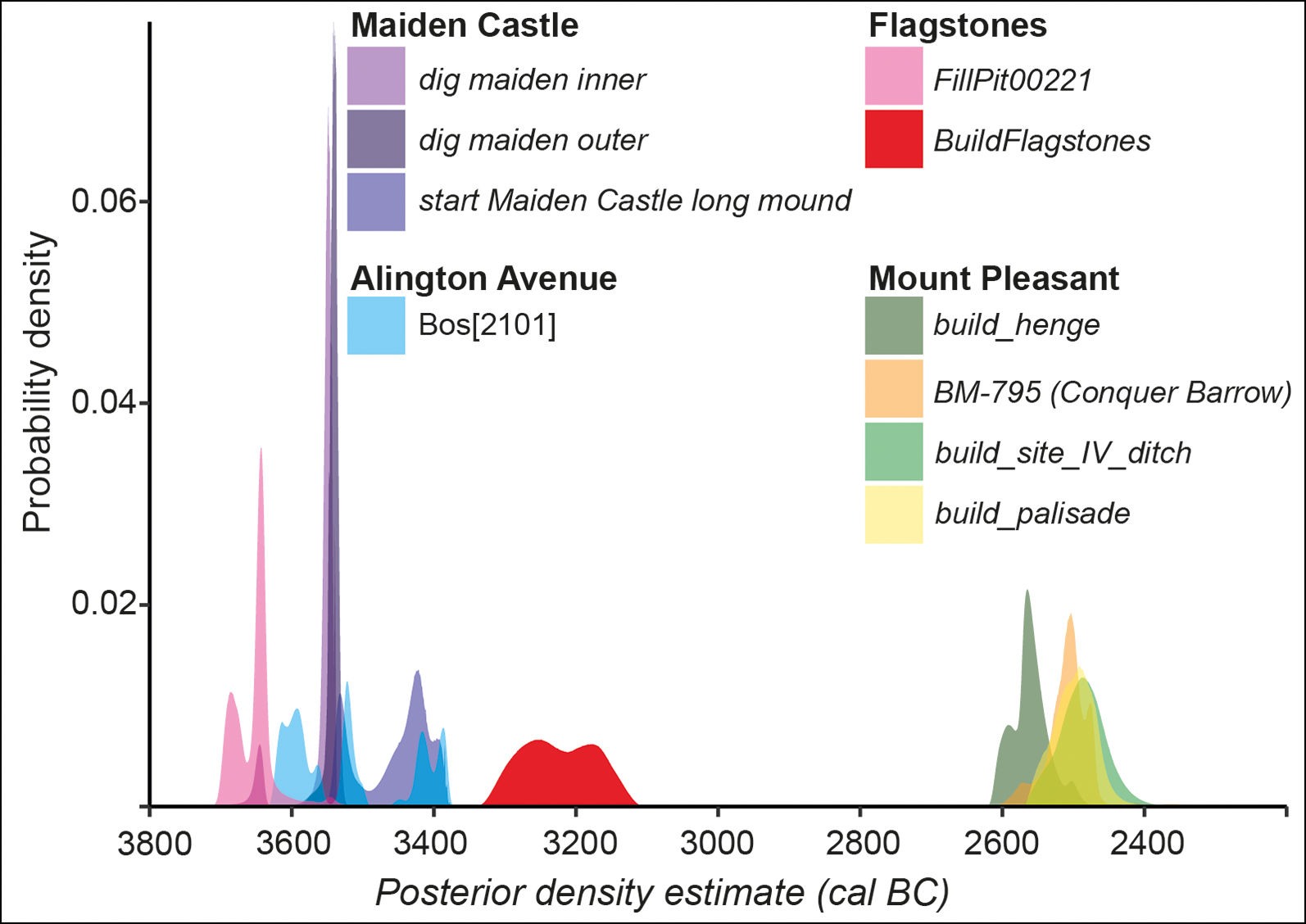
The construction of Flagstones can now be placed within the ‘timescape’ of the wider Dorchester monument complex (Figure 1). The earliest construction in the area was the causewayed enclosure at Maiden Castle, and several large and complex monuments, including Mount Pleasant henge, were constructed towards the end of the Late Neolithic, in the centuries either side of 2500 cal BC (Greaney et al. Reference Greaney2020). Flagstones was constructed 100–375 years (95% probability; Figure S11c), probably 145–295 years (68% probability) after the long mound at Maiden Castle, which was built over the circuits of the earlier causewayed enclosure.
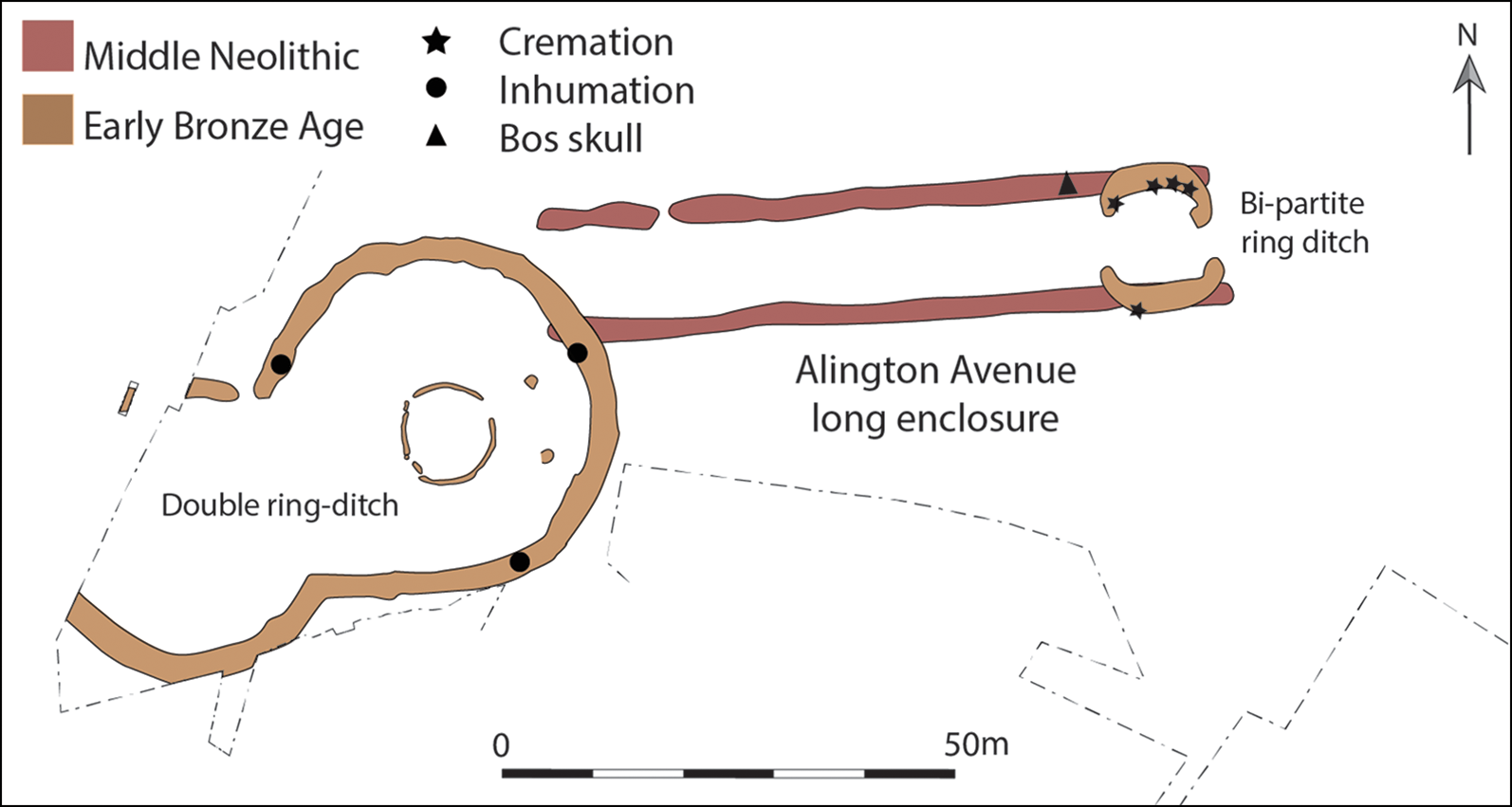
The Maiden Castle long mound is one of several linear monuments in the area, including the long mounds and cursus monuments at Long Bredy and Broadmayne, which bracket the highest part of the South Dorset Ridgeway (Tilley Reference Tilley2010: 211), and Alington Avenue, a long enclosure about 160m to the west of Flagstones (Figure 6; Davies et al. Reference Davies, Bellamy, Heaton and Woodward2002). This latter monument was laid out along a low ridge of land running roughly east–west, parallel with the River Frome to the north (Figure 1). New radiocarbon dates on an inverted and partially articulated cattle skull from the base of the northern ditch of this long enclosure suggest that it was constructed shortly before 3625–3380 cal BC (95% probability), and probably before 3605–3405 cal BC (68% probability; Table S3). Alington Avenue was therefore built 110–470 years (95% probability; Figure S11a) and probably 225–445 years (68% probability) before nearby Flagstones. It was also probably built (73.9%) before the long mound at Maiden Castle although the bimodal and multi-modal distributions (Figure S11b) make certainty about this problematic. Alington Avenue was the first major construction within the lowland river valley area, representing a shift in ceremonial focus away from the upland Maiden Castle area. The low ridge would become the focus for monument construction in the Late Neolithic period, including the construction of an enormous henge enclosure at Mount Pleasant, built 555–770 years (95% probability), probably 600–725 years (68% probability), after the construction of Flagstones (Figure S11d).
Plan of Alington Avenue long enclosure and associated later ring ditches (after Davies et al. Reference Davies, Bellamy, Heaton and Woodward2002: fig. 4, figure by Susan Greaney).
By this time, the monuments at Maiden Castle, Alington Avenue and Flagstones would have been weathered and eroded earthworks. Aside from a scatter of worked flint, the lack of later Neolithic material found during excavations at Flagstones (Smith et al. Reference Smith, Healy, Allen, Morris, Barnes and Woodward1997: 38) suggests that not only was the site left unmodified, but it may have been generally avoided. The ditches of Alington Avenue did contain a small quantity of later Neolithic pottery sherds, animal bones and flint (Davies et al. Reference Davies, Bellamy, Heaton and Woodward2002: 17) suggesting that such avoidance did not apply equally to both monuments. Although these monuments were left unchanged, their presence structured later activity, with Mount Pleasant, Greyhound Yard and Maumbury Rings all being built at a close but discrete distance. These new monuments perhaps gained some of their legitimacy by being located close to earlier earthworks. It is possible these actions represent continuity of memory and understanding, but they may equally result from the reinterpretation of older monuments to fit contemporary needs.
The Flagstones enclosure was constructed far closer in time to Early Neolithic monuments—including the Maiden Castle causewayed enclosure and long mound and the long enclosure at Alington Avenue—than to the henge monument at Mount Pleasant (Figure 7). Although Flagstones had novel features, including a circular plan and the incorporation of cremation burials, the pit-dug nature of its construction shows continuity with earlier traditions. It was built in a place with an established history, with at least two pits (00221 and 00274) containing Early Neolithic pottery of South-Western form (Barclay et al. Reference Barclay2018: 5–6). A further cluster of shallow pits in the south-west part of the site appear to have been dug shortly before the enclosure and may have held standing stones (Smith et al. Reference Smith, Healy, Allen, Morris, Barnes and Woodward1997: 30, 46). These features may have influenced the layout of the enclosure (Figure 2).
Probability distributions of key construction events in the Dorchester complex (figure by Peter Marshall).
The earliest circular enclosure?
Flagstones is closely comparable to the first phase of activity at Stonehenge but are the two monuments the same date, as might be assumed? The segmented circular ditch flanked by internal and external banks at Stonehenge was constructed in 2980–2720 cal BC (95% probability; DitchConstructed; Figure S12) and probably in 2940–2800 cal BC (68% probability). Flagstones is therefore 70–285 years (95% probability), probably 110–225 years (68% probability), earlier than Stonehenge. This is surprising, given the considerable similarities between the two monuments. However, it is possible that the so-called ‘curated’ animal bones from the ditch terminals at Stonehenge (Cleal et al. Reference Cleal, Walker and Montague1995: 529), which pre-date the ditch's construction, may be remnant or residual bones derived from deeper terminal pits that formed part of an earlier enclosure, perhaps similar to the intercutting pits that form the enclosure at Flagstones.
Could Flagstones be described as the earliest circular enclosure in Britain? If so, it would represent a radical departure from previous linear and less regular causewayed enclosures. It is certainly the earliest large circular enclosure to be precisely dated, as Llandygái ‘Henge’ A has not been directly dated and the ditch at Stones of Stenness, Orkney, often claimed to be the earliest henge, dates to 3035–2895 cal BC (95% probability; Bayliss et al. Reference Bayliss, Marshall, Richards and Whittle2017: fig. S10 (rerun with IntCal20)), probably 3005–2990 cal BC (6% probability) or 2970–2905 cal BC (62% probability). Several other potentially early large circular enclosures have not been excavated or have seen only limited investigation. For example, Ysceifiog in Flintshire, Wales, is a slightly irregular henge with an internal bank measuring 88–101m in diameter with a probable Middle Neolithic pit grave (see Burrow Reference Burrow, Leary, Darvill and Field2010 for this and a range of other candidates). The Priddy Circles in Somerset, each measuring 168–180m in diameter, remain poorly dated (Lewis & Mullin Reference Lewis and Mullin2011). The 365m-diameter circular segmented ditch surrounding Duggleby Howe in North Yorkshire dates to the later Neolithic (Gibson et al. Reference Gibson2014: 33), although it may have been preceded by an earlier ditch or circuit of pits following the same line, from which the material for the primary mound was derived.
Circular cemeteries
During the Middle Neolithic, there was a general shift from inhumation towards cremation as the preferred funerary rite, although considerable variation occurred in both the form and location of burials. While communities in the far north and parts of the west of Britain continued to inter their dead within passage tombs, elsewhere burials can be found under mounds (Gibson et al. Reference Gibson2009), within ring ditches or circular enclosures (Willis Reference Willis2021), associated with stone or timber settings (Noble et al. Reference Noble, Brophy, Hamilton, Leach and Sheridan2017), or occasionally placed in isolated pits (Roberts et al. Reference Roberts2020).
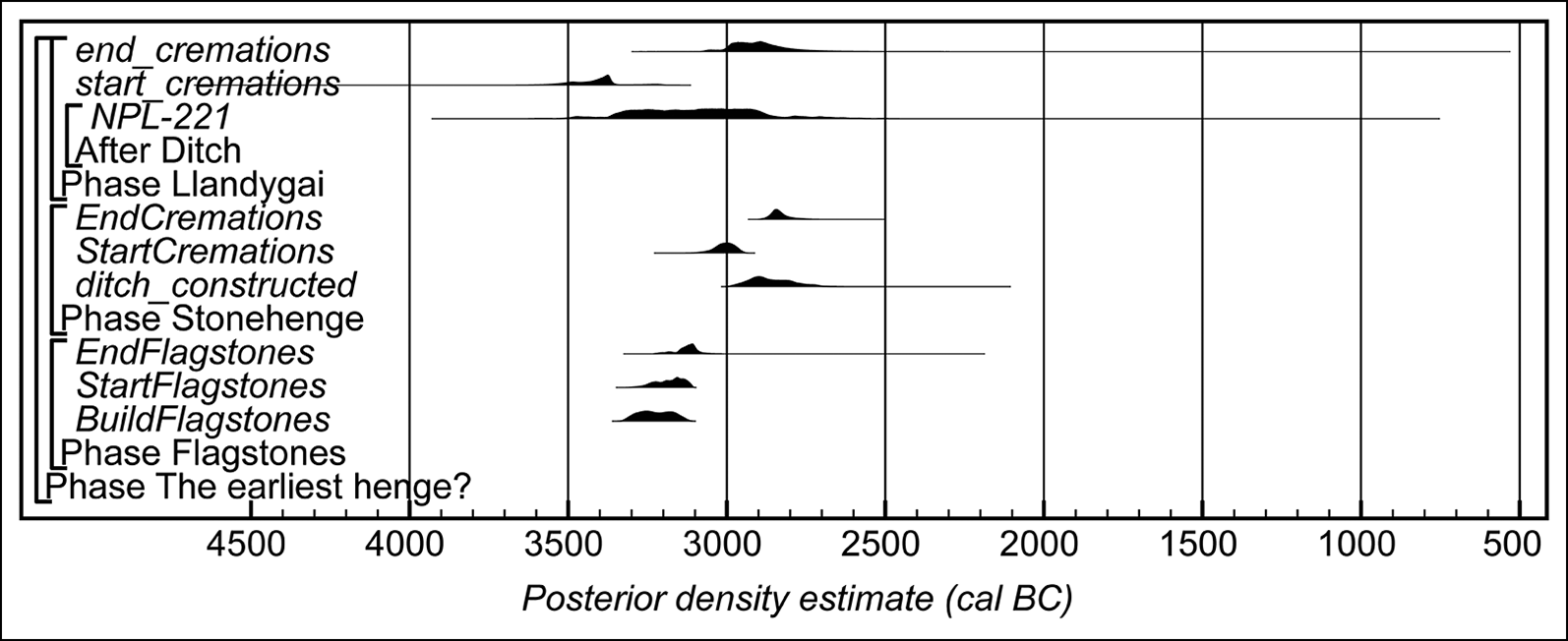
The placing of burials into the ditch and interior of Flagstones parallels funerary practices at other proto-henges. At Stonehenge, the cremated remains of at least 60 people were placed within and alongside the Aubrey Holes (a ring of 56 pits), into the ditch and on the bank (Willis et al. Reference Willis2016; Willis Reference Willis2021). The earliest of these cremation burials are estimated to include individuals who died in 3075–2945 cal BC (95% probability; StartCremations; Figure S12), probably in 3035–2970 cal BC (68% probability), while the latest include individuals who died in 2890–2765 cal BC (95% probability; EndCremations; Figure S12), probably in 2870–2715 cal BC (68% probability).
At Llandygai ‘Henge’ A, 22 cremation deposits were placed into the segmented pits of a 9m oval enclosure directly outside the entrance to the main ‘henge’ and another cremation was found in a pit within the 80m-diameter enclosure (Lynch & Musson Reference Lynch and Musson2004). Modelling of radiocarbon dates on these cremations and other samples shows that burial started in 3655–3345 cal BC (95% probability; Figure S15), probably in 3510–3465 cal BC (15% probability) or 3455–3360 cal BC (53% probability), and ended in 3075–2715 cal BC (95% probability; Figure S15), probably in 3000–2850 cal BC (68% probability). Although ‘Henge’ A is not directly dated and a Neolithic date has been questioned (Gibson Reference Gibson2018), contemporaneity of construction and burial activity is suggested by the position of the smaller segmented enclosure directly outside the single entrance, as well as by finds from the enclosure ditch and the placement of the inner cremation on an axial line.
Comparison of the dating available from Stonehenge, Llandygái and Flagstones (Figure 8) shows that both the construction of the enclosure at Flagstones and the funerary activity there took place earlier than the same activities at Stonehenge. The cremation remains of an adult alongside inhumations of children at Flagstones may represent an early phase of the transition to cremation funerary rites.
Probability distributions of dates for the construction of three large circular enclosures and their associated funerary activity: Flagstones (derived from the model described in Figure 2), Stonehenge (see Figures S12–14) and Llandygái (see Figure S15) (figure by Peter Marshall).
Ever decreasing circles
The approximately 12m-diameter penannular ditch inside Flagstones that encloses three cremation pits fits into a wider pattern of small enclosures associated with cremation burials that are located either within or just outside large circular enclosures. All but one of the cremations at Llandygái were in the segmented smaller enclosure outside the entrance. At Stonehenge, the ‘north barrow’ is an approximately 10m-diameter penannular ditch that pre-dates the main enclosure and is associated with at least one cremation (Cleal et al. Reference Cleal, Walker and Montague1995: 96; Bowden et al. Reference Bowden, Soutar, Field and Barber2015: 27).
Many small, circular ditched enclosures dating from the Middle and Late Neolithic periods have been found unrelated to larger enclosures. These are often described as ‘hengiform’ monuments, a term deliberately avoided here, as there is no traceable association with henges; following Loveday and colleagues (Reference Loveday, Jones and Palmer2020: 5), the term ‘ringform’ is preferred. Such monuments can be either penannular or bipartite, comprising pits, segments or continuous ditches, sometimes with multiple circuits, and are often associated with burials (either inhumations or cremations). These ringforms are found particularly in ‘cursus-focused’ complexes in southern and eastern Britain. The pit circle at Monkton-Up-Wimborne, close to the Dorset Cursus and broadly contemporaneous with Flagstones, surrounded a large pit that contained the burials of four children and an adult female. A 6.9m-deep shaft dug from within this pit contained a variety of placed deposits, including a chalk block decorated with motifs reminiscent of Irish megalithic art (Green Reference Green, French, Lewis, Allen, Green, Scaife and Gardiner2007).
Given that there are now nine well-dated examples of these ringforms associated specifically with cremation burials in their primary phase (Figure 9; see OSM for archaeological details and dates), a review and modelling of this sub-set of monuments has been undertaken, to set the example within Flagstones enclosure into its wider context. This builds on the previous work of Noble and colleagues (Reference Noble, Brophy, Hamilton, Leach and Sheridan2017) and Willis (Reference Willis2021) who provide a synthesis of the chronology of these monuments, and on an unpublished gazetteer of ringforms compiled by Roy Loveday (pers. comm.).
Location of circular ditched enclosures associated with Middle Neolithic cremations included in the chronological comparison (figure by Susan Greaney).
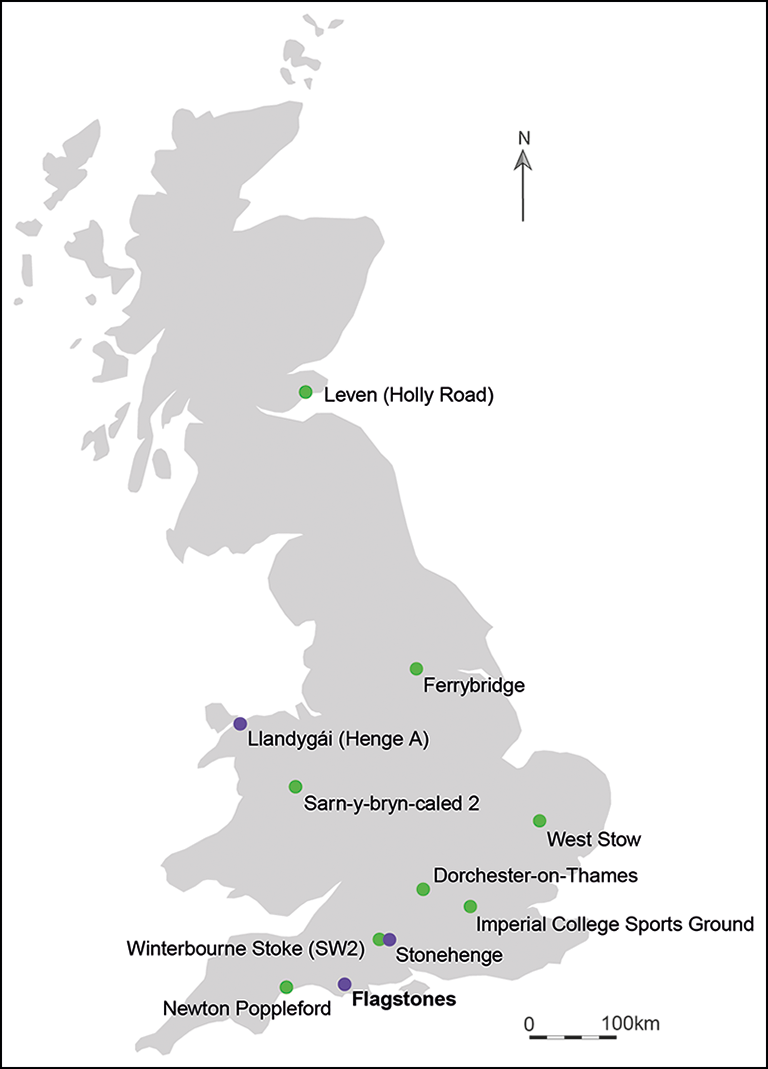
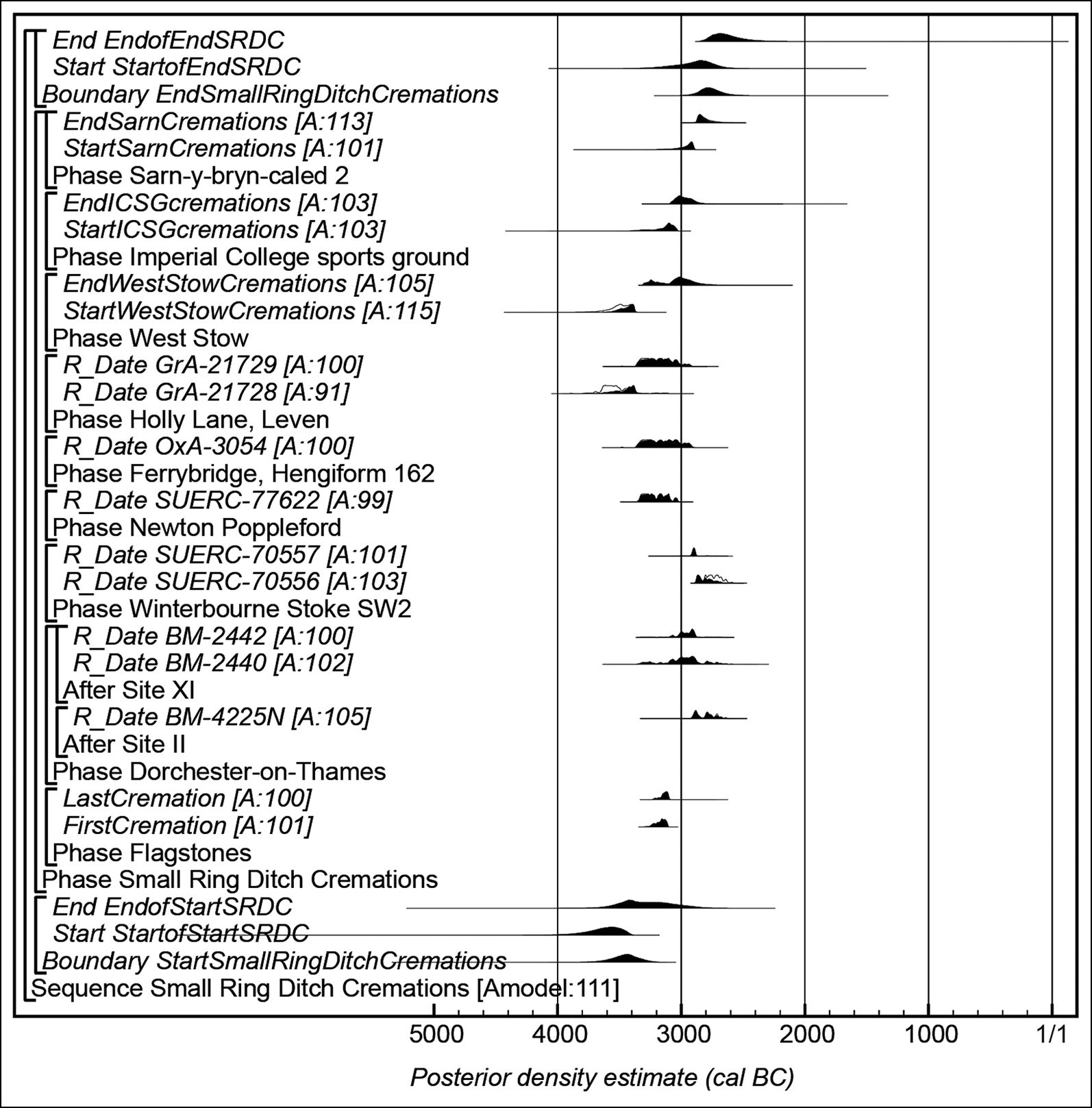
Figure 10 shows a model for the dating of cremations associated with ringforms. Overall, this activity started in 3960–3400 cal BC (95% probability; StartofStartSRDC), probably in 3700–3455 cal BC (68% probability), but the timescale of this start was drawn out, occurring over 1–875 years (95% probability; Figure S21). These monuments continued to be built until 3265–2605 cal BC (95% probability; StartofEndSRDC; Figure 10), probably 3020–2715 cal BC (68% probability). The creation of small circular enclosures associated with cremations was therefore a widespread and long-lasting practice of the Middle Neolithic, the association with larger circular enclosures such as Flagstones representing a mature, or even late, stage in the development of this tradition.
Probability distributions of dates from cremations associated with small ringforms. Distributions other than those relating to individual samples have been taken from models defined in Figures 3 (Flagstones), S16 (West Stow), S19 (Imperial College Sports Ground) and S20 (Sarn-y-Bryn-Caled 2). The format is identical to that of Figure 3 (figure by Peter Marshall).
Discussion
The construction of Flagstones enclosure and its associated funerary activity, now dated to the thirty-third or thirty-second centuries cal BC, can be placed at the end of a sequence of earlier Neolithic activity in the Dorchester complex (Figure 7). Despite the circular form of the enclosure representing a dramatic shift away from linear constructions such as Alington Avenue, the segmented and intercutting pits, deposition of burials within the ditches and location in an area of previous activity all point to continuities of community and practice. It was the large and perfectly circular form of the earthwork enclosure and the interment of an adult cremation burial that were the innovative aspects of this monument.
The first phase of Stonehenge, if this monument did indeed begin as a circuit of pits, may date to a similar period, although chronological models based on currently available evidence place the construction of Stonehenge a couple of centuries later. These two enclosures and their associated burials can be seen as foundational monuments in their local settings, fundamentally influencing the local development of major monument complexes during the later Neolithic. While Stonehenge sees later elaboration, Flagstones does not; instead, it structures later activity, with monuments built close by.
The Flagstones enclosure draws on the wider existing practice of interring burials at small ringform monuments, but where did the idea of a much larger circular enclosure come from? Bradley (Reference Bradley2012: 104–9) argues that its origins should be sought in eastern Ireland, specifically the Boyne Valley, where concentrically organised passage graves were superseded by more open circular enclosures. The revised chronology presented here shows that Flagstones was contemporaneous with the construction and funerary use of developed passage tombs in the Boyne Valley, such as Knowth and Newgrange (Schulting Reference Schulting2014; Schulting et al. Reference Schulting, Bronk Ramsey, Reimer, Eogan, Cleary, Cooney, Sheridan, Eogan and Cleary2018), as well as at the Mound of the Hostages in Tara (O'Sullivan et al. Reference O'Sullivan, Scarre and Doyle2013). At this latter site, the practice of burying children but cremating adults parallels funerary activity at Flagstones. Connections to this region are underlined by the presence of curvilinear engravings on the vertical chalk sides of some of the pits at Flagstones (see Figure 2; Woodward Reference Woodward1988). Until more precise dating of Irish henges, ‘embanked enclosures’ and other forms of circular ditched enclosures is available, it is not possible to pinpoint origins or sources of inspiration. In any case, these overlapping practices may have emerged as the result of interactions between southern Britain and eastern Ireland. Lying only 8km from the south coast, the Dorchester area must have been well-connected to seaways and land routes along which such ideas might have travelled. The dynamic period between 3200 and 3000 cal BC saw major monument construction and ritual gatherings in the Boyne Valley, and substantial settlements, gathering places and monuments in Orkney and elsewhere in Britain. Carlin (Reference Carlin2017) argues for a sustained period of connectivity between eastern Ireland and northern Britain in this period; southern Britain can now be added to this tangled network of interactions. It was these connections that enabled the rapid spread of Grooved Ware pottery styles from the far north of Scotland to various parts of Britain and Ireland in the period 3200 to 2900 cal BC (Copper et al. Reference Copper, Whittle and Sheridan2024). Although no pottery of this type was recovered from excavations at Flagstones, a finely decorated dished cup with knotted cord decoration which belongs to the early Woodlands style of Grooved Ware pottery (Piggott Reference Piggott1938: 75–76; Cleal et al. Reference Cleal, Walker and Montague1995: 360–61) was found in the garden of an adjacent house in the nineteenth century and is likely to be associated with the site; an almost identical artefact was found in association with a cremation at Stonehenge.
Conclusion
The people who constructed Flagstones adopted the widespread practice of placing cremations within small circular monuments but they also created an innovative larger monument, with funerary practices, art and artefacts that suggest long-distance connections, most strongly to Ireland. This new style of monument acted as an anchor within the development of the Dorchester complex and its form may have been directly replicated at Stonehenge. It is likely that the development of other proto-henges in western and northern Britain followed their own trajectories. Burrow (Reference Burrow, Leary, Darvill and Field2010: 193) argues that this type of monument needs an appropriate name of its own, rather than being associated with the broad, and somewhat problematic, category of henges (Gibson Reference Gibson and Gibson2012), now clearly a distinctly later phenomenon. The problem might lie more with our wish to create neat typologies out of diverse and disparate interconnected practices. Tracing those lines of connection, and the networks of shared ideas and practices, is now an imperative task that must be underpinned by robust and precise chronologies.
Acknowledgements
Thank you to Jon Murden, Richard Breward and the volunteers at Dorset Museum for facilitating access to their archive, and for giving permission to sample their collections. Thanks are also extended to Simon Mays for identifying the calcined human bone, to Josh Pollard for discussions on the potentially earlier date of Stonehenge and to Roy Loveday for providing access to his ringform gazetteer. Both Alasdair Whittle and Josh Pollard made useful comments on an earlier draft and feedback from two anonymous referees helped to improve the article; thanks to all of them.
Funding statement
This article contains research by Susan Greaney which was funded by an Arts and Humanities Research Council (AHRC) PhD studentship award (1502811), through the South, West & Wales Doctoral Training Partnership. The radiocarbon dates obtained from ETH Zürich and the Centre for Isotope Research, University of Groningen, were funded by Historic England.
Data availability statement
The authors confirm that the data supporting the findings of this study are available within the online supplementary material.
Online supplementary material (OSM)
To view supplementary material for this article, please visit https://doi.org/10.15184/aqy.2025.28 and select the supplementary materials tab.


 Open access

