

No dictionary of a living tongue can ever be perfect, since while it is hastening to publication, some words are budding, and some fading away. . .
Samuel Johnson, Dictionary of the English Language, 1755
1 Introduction
The aim of this article is threefold:
• to investigate the use of uh and um in written English (journalistic prose);
• to add to the study of the ongoing colloquialization of written English;
• and in doing so, to contribute to the discussion of the status of uh and um as words, and the process of word-formation.
Uh and um are the usual transliterations of the vocalizations [ə(ː)] and [ə(ː)m] in American English; er and erm have been standard in non-rhotic British English but uh and um are now common also in that variety. Surprisingly, er also appears in rhotic American English, presumably an adoption from British English.
Colloquialization of written language, defined as ‘the shift to a more speech-like style’ by Leech et al. (Reference Leech, Hundt, Mair and Smith2009: 239), has usually been defined in terms of grammatical variables, such as the increased use of semi-modals like have to and the decline of must, greater use of progressive forms, the substitution of that- for wh-relatives, the use of contracted negatives and verb forms and the use of not-negation rather than no-negation, to list some of the most frequently treated phenomena. The study of colloquialization has occasionally been extended to the use of discourse and pragmatic markers in writing, as in Tottie & Hoffmann's (Reference Tottie, Hoffmann, Bowen, Mobärg and Ohlander2009) study of the use of tag questions in British written material, and Rühlemann & Hilpert's (to appear) study of inserts, especially well, based on the TIME Magazine Corpus from 1923 to 2006 (Davies Reference Davies2007–). Rühlemann & Hilpert show an increased use of typical spoken inserts as discourse markers in writing especially since the 1990s, and, interestingly, a clear difference in the functions of well between spoken and written language. The authors also present some quantitative data on other discourse markers, including uh, um and you know.
The present article has a related purpose, focusing on the use and functions of uh and um in written language, consisting of American journalistic prose. But there are major differences between my approach and that of Rühlemann & Hilpert as regards subject matter, goal and methodology. First of all, unlike well and other discourse markers like you know or I mean, uh and um are not pragmaticalized uses of previously existing lexical items with well-defined meanings. Uh and um are transliterations of vocalizations, and their status as words is a matter of discussion. My aim is to clarify this status by comparing their use in spoken and written English.
Secondly, Rühlemann & Hilpert look at the total frequencies of the markers they study, expressed as occurrences per million words. They do not distinguish between the parts of text that are clearly written by journalists and parts that are – or are purported to be – quotations from speech, usually enclosed between quotation marks or preceded by colons. The status of quoted speech is problematic, as we cannot know if it is quoted verbatim and thus equivalent to actual spoken language, or whether it represents a writer's conception of spoken language, possibly based on literary examples. And when it is obvious that texts do include verbatim quotations, this is not what is usually meant by colloquialization. For this reason, the present study is based exclusively on actual journalistic prose, and tokens of uh and um occurring between quotes, after colons, or otherwise indicated to be from quoted speech, have been excluded from searches. Comparisons with speech will be based on empirical studies of spontaneous conversation from the Santa Barbara Corpus of Spoken American English, henceforth SBC. Quoted speech deserves separate treatment in future work, based on greater knowledge of both genuine spoken language and actual writing.
This article is organized as follows: section 2 discusses the classification of uh and um according to functions and wordhood, and section 3 presents the corpus material and methodology used for this article. Section 4 compares Rühlemann & Hilpert's findings from the TIME Corpus with results from the same corpus based on only actual journalistic prose, and section 5 presents the results of a study of the use of er, uh and um in the Corpus of Contemporary American English, COCA (Davies Reference Davies2008–). Section 6 treats register differences as a preparation for an account of distributions of the three variants in section 7 and discourse-pragmatic functions in section 8. Section 9 discusses differences between the use of uh and um in speech and writing. Section 10 discusses the status of uh and um as words in speech and writing, and section 11 contains a summary and concluding remarks.
2 Classifying uh and um: are they words?
Uh and um have been variously classified as dys- or disfluencies, hesitations, hesitation markers, fillers, filled pauses, etc., depending on the theoretical orientation of writers – phoneticians, psycholinguists, grammarians and others. Typically, dictionaries do not list meanings for uh and um but say that they are ‘[u]sed to express hesitation or uncertainty’ or ‘used to express doubt or uncertainty or to fill a pause when hesitating in speaking’ (American Heritage Dictionary, italics added.)Footnote 2 Grammars have also taken different approaches: some altogether ignore uh and um, like Huddleston & Pullum (Reference Huddleston and Pullum2002). Carter & McCarthy (Reference Carter and McCarthy2006) treat them (in the guise of er and erm) together with other ‘filled pauses. . . such as like, well, you know’. Biber et al. (Reference Biber, Johansson, Leech, Conrad and Finegan1999: 52f.) include er and erm, classified as hesitators, in the ‘relatively newly recognized category’ of inserts, without necessarily acknowledging their status as words.
The pragmatic functions of uh and um in conversation have been analyzed in various ways; the function as floor-holders was emphasized by the early psycholinguists Maclay & Osgood (Reference Maclay and Osgood1959) and conversation analysts (e.g. Sacks et al. Reference Sacks, Schegloff and Jefferson1974), followed by writers on pragmatics (Mey Reference Mey2001; Levinson Reference Levinson1983) and grammarians (e.g. Biber et al. Reference Biber, Johansson, Leech, Conrad and Finegan1999: 1054),Footnote 3 a view that has been questioned by Tottie (Reference Tottie2015a). They have been characterized as pragmatic particles (Fischer Reference Fischer and Fischer2006) or pragmatic markers (Edmondson Reference Edmondson1981), and Tottie (Reference Tottie, Kaltenböck, Lohmann and Keizer2016) compares them to bona fide pragmatic markers such as well, you know, I mean and like. Uh and um are thus slippery customers; there is no consensus on either their description or function.
So are they words? As pointed out by Biber et al. (Reference Biber, Johansson, Leech, Conrad and Finegan1999: 51) ‘the definition of “word” is far from straightforward’. Whole volumes have been written on the lexicon without discussing or giving a definition – see e.g. Aitchison (Reference Aitchison2012), and dictionaries rarely define the concept. Psycholinguists disagree about the status of uh and um: Corley & Stewart (2008) argue that uh and um cannot be words because they are not intentionally produced, but Shillcock et al. (Reference Shillcock, Kirby, McDonald and Brew2001) found that uh and um form part of the mental lexicon, based on the correlation of semantic and phonological distance found in experiments. Clark & Fox Tree (Reference Clark and Tree2002) argue that uh and um are not mere symptoms of hesitation but conventional words, and that they function as interjections that signal upcoming delays (i.e. silent pauses), or themselves constitute delays. Clark & Fox Tree base their classification of uh and um as interjections on a definition from Wilkins (Reference Wilkins1992: 124) that this author himself defines as ‘unorthodox’:
A conventional lexical form which (commonly and) conventionally constitutes an utterance on its own, (typically) does not enter into construction with other word classes, is (usually) monomorphemic, and (generally) does not host inflectional or derivational morphemes.
The usual expressive or emotional function is missing from Wilkins’ definition – see OED s.v. interjection 2a. Furthermore, uh and um do not normally constitute an utterance on their own. If cliticization is counted, it also enters into constructions with other word classes, and, but and other short words.Footnote 4
The claim that uh and um are interjections has been refuted by O'Connell & Kowal (Reference O'Connell and Kowal2005) and Tottie (Reference Tottie, Dion, Lapierre and Cacoullos2015b). Analyzing television interviews and material from SBC, respectively, these authors found that a large proportion of instances of uh and um are not followed by delays, that most silent pauses are not announced by uh or um, and that therefore the function as announcements of upcoming delays cannot be used as support for the status of uh and um as words with this particular function in spoken language.
Returning to the fundamental question of a general definition of wordhood, Biber et al. (Reference Biber, Johansson, Leech, Conrad and Finegan1999: 51) offer a description rather than a definition, pointing out that words ‘resist insertions’, and that their independence
is shown phonologically by the fact that they may be preceded and followed by pauses; orthographically by their separation by means of spaces or punctuation marks; syntactically by the fact that they may be used alone as a single utterance; and semantically by the possibility of assigning to them one or more dictionary meanings.
Interestingly, however, the definition given by the latest edition of the Oxford English Dictionary, OED online, cuts the Gordian knot of defining ‘word’ (s.v. III.12) by appealing to speaker intuition. The entry has been updated from that of earlier editions and is quoted below, with the novel part italicized:
An element or unit of speech, language, etc. . . . 12. Any of the sequences of one or more sounds or morphemes (intuitively recognized by native speakers as) constituting the basic units of meaningful speech used in forming a sentence or utterance in a language (and in most writing systems normally separated by spaces); a lexical unit other than a phrase or affix; an item of vocabulary, a vocable.
If we follow the OED and take the intuition of native speakers as the arbiter of wordhood of uh and um, it is clear, even in the absence of a formal vote, that most speakers (but not all linguists) do not consider uh and um to be bona fide words with meanings and codified uses, but as undesirable noise unintentionally produced by speakers (see Erard Reference Erard2007). Intentionality thus appears to play an important part for the definition of uh and um as words, and the medium of use – speech or writing – therefore becomes an important criterion, as written language is normally voluntarily produced.
Clark & Fox Tree (Reference Clark and Tree2002) point out in a footnote that uh and um are used deliberately in chatrooms and emails, and that this supports their classification as words. Rose (Reference Rose2011) examined their use in the hybrid genre of blogs, pointing out the intentionality of their use in this medium. As demonstrated e.g. in Tottie (Reference Tottie, Dion, Lapierre and Cacoullos2015b), there is even stronger support for regarding uh and um as words when they appear in print, where they must also have been inserted by writers for specific purposes. Examples (1)–(6) below are taken from headlines and articles culled from newspapersFootnote 5 and impressionistic reading. (Boldface is added throughout for highlighting, and ellipses are used when examples have been abbreviated. Original ellipses in quoted examples are flagged as such. In quoted speech from SBC ellipses denote silent pauses.)
(1) Obama is more, um, seasoned. Barack Obama's . . . closely shorn hair appears to be increasingly gray. (Washington Post 2008)
(2) An ode to opera's, uh, operation. As . . . Baroque-era composers become increasingly popular, more people wonder about the castrati – the emasculated singers . . . (L. A. Times 2005)
(3) [The actor Ben Affleck goes to sleep during a performance of Shakespeare.] The Oscar-winning screenwriter and actor seemed to be, um – how can we put this delicately? – meditating during most of the first act. (Boston Globe 1999)
(4) Senator Richard Shelby of Alabama . . . claimed that ‘the market will view these firms as . . . implicitly backed by the government.’ Um, senator, the market already views those firms as having implicit government backing, because they do . . . (Paul Krugman, op-ed column, New York Times 2010)
In (1)–(3) the function of uh and um is that of ironic euphemism, ‘putting it delicately’, and in (4), um is used for disagreement in a vocative sentence. Polite avoidance of unpleasant realities like graying hair, castration, sleeping at the theatre and disagreement is a common factor in all of these examples. This is not an exclusively American phenomenon; British magazines and newspapers also provide examples of er and erm in similar uses, as shown by (5) from sports pages and (6) from a film review. Again, we have ironic euphemism here: the Liverpool soccer players mentioned in The Independent have clearly not gone on to finals or semi-finals, and the Guardian headline is beating around the bush on a sensitive topic.
(5) The Liverpool players, er, have the evening off. (The Independent 2010)
(6) Attila: hot babes, baths and, erm, birth control. This 2001 made-for-TV movie does get very silly at times, but it does make a surprisingly good fist of the history of the infamous Hun king . . . (The Guardian 2010)
Uh and um are definitely not (filled) pauses in (1)–(6). They fulfil the criteria for wordhood in writing of being separated from other items by spaces and/or punctuation marks, and they appear to have meaning, or at least communicative functions. (See Biber et al. 1099: 51.) They must also have been intentionally produced. We may thus regard them as words in these examples, but this raises several questions. How frequent are uh and um overall in writing? Can they also have functions other than those proposed for (1)–(6)? What word class should they be assigned to? Classifying um as an interjection might work for (4), but hardly for the other tokens, although the answer hinges on the definition of interjections.
Finally, are uh and um two separate words, or are they variants of a single lexeme? Clark & Fox treat them as separate words based on their distribution in the London–Lund Corpus of British English, where uh was found to flag short pauses and um flagged longer pauses. However, Tottie (Reference Tottie, Dion, Lapierre and Cacoullos2015b: 48) found no such distinction in American English from SBC and therefore found it justified to regard uh and um as variants of a single lexeme dubbed UHM. The single-lexeme view appears even more appropriate for written language, where the lengthening criterion is absent. Henceforth, I will use the abbreviation EHM to subsume er, uh and um in written language, regarding it as one variable with three variants. I will use er, uh and um when discussing the individual variants. When referring to the vocalizations in spoken language as one variable, I will use UHM.
3 Material and method
Some information on the use of uh and um in twentieth-century writing already exists. Jucker (Reference Jucker, Taavitsainen, Kytö, Claridge and Smith2015a) reports on results from an investigation of the Corpus of Historical American English (COHA, Davies Reference Davies2010–) but is based largely on examples of represented speech from fiction. Rühlemann & Hilpert's (to appear) study of colloquialization is based on the TIME Magazine Corpus (Davies Reference Davies2007–), consisting of 100,000,000 words published 1923–2006. The main focus of that study is the use of well in writing, but the authors also include data on er, uh and um, beginning in the 1920s, showing a great increase in frequency from the middle of the century and culminating in the 1990s. However, Rühlemann & Hilpert searched for all tokens of er, uh and um surrounded by commas, including those that were surrounded by quotes and were thus (at least supposedly) quoted from direct speech. As I wished to restrict my study to language originally written to be read, i.e. journalistic prose, I therefore examined the TIME corpus anew, eliminating, by means of mostly manual sorting, all tokens that occurred within quotation marks or were otherwise marked as spoken, e.g. immediately following a colon.Footnote 6
This was also the time-consuming method used for further work on the Corpus of Contemporary American English, COCA (Davies Reference Davies2008–), which is the main source of the present work. COCA now comprises over 530,000,000 words from 1990 to 2015, from five different genres (Spoken, Fiction, Magazines, Newspapers and Academic), but I restricted myself to the two ‘agile’ genres (as defined by Hundt & Mair Reference Hundt and Mair1999), viz. Magazines and Newspapers. The research for this article was completed before the release of data from mid 2012 to 2015, and as 2012 was incomplete, my corpus was COCA 1990–2011.Footnote 7 The combined Magazine and Newspaper subcorpus amounted to over 182 million words.
In my search I included uh and um but not instances of uh that were part of uhˈuh (‘yes’) ˈuhuh (‘no’) or the ‘mild alarm cry’ (uh-oh.) The item er – an anomaly in usually rhotic American English – was also included as it turned up with surprising frequency, but erm did not appear.Footnote 8
A diachronic approach to EHM development is taken in sections 4 and 5, but sections 7 and 8 will give a synchronic survey of placement and uses of EHM because of the limitation of the material.
4 Journalistic prose in the TIME corpus
Rühlemann & Hilpert (to appear) found a small number of tokens of EHM in the early decades of the TIME corpus, as shown in figure 1, quoted from their article. They show a substantial increase from the 1940s to the 1950s, and then again to the 1960s, and a steady rise after that.Footnote 9 Many of their examples must have occurred in quotations from speech, however, and were not excluded by their computerized search. The fact that Rühlemann & Hilpert's search was based on searching only for tokens that were surrounded by commas, including those occurring in quoted speech, led to the inclusion of examples like (7), where six instances of Um make up a song title. All the um tokens from the 1960s came from (7), but the method of collection missed the first and the last one because they were not preceded or followed by commas as required by the algorithm.
(7) The sledgehammer refrains of Wayne Fontana and the Mind Benders’ Um, Um, Um, Um, Um, Um can be heard parting the walls of a Yokohama teahouse.
The frequency per million words of er, uh and um in the TIME corpus according to Rühlemann & Hilpert (to appear)

All seven uh tokens from the 1970s were from quoted speech, as in (8) and (9):
(8) Erlichmann added: ‘Before I get too far out on that, uh, I want to talk to an attorney.’
(9) ‘Oh, uh, that's all right,’ smiled Kennedy, ‘I, uh, I've heard the question before too.’
In my manual search for examples, which was not restricted to those surrounded by commas, I did not find any non-quoted instances until the 1960s. In the entire decade I found only three tokens, shown in (10), with both er and uh, and (11), with one token of uh. Note that in (10) er and uh are juxtaposed with well:
(10) [Buddhist] monks had decided to ‘fast . . . to protest . . .’ . . . Beside the fasters were handy slices of fruit and glasses of pale, cold tea, prompting a young monk to explain that liquid was ‘allowed.’ As for the fruit – well, er, uh, no comment. (TIME 1965)
(11) Armenti[è]res is a [French town with a single claim to fame]: its mademoiselle, heroine of . . . World War I ditties, most of them dirty . . . Armenti[è]res last week began a fund-raising campaign for a statue in mademoiselle's, uh, honor. (TIME 1965)
The total number of instances of EHM occurring in journalistic prose in TIME from the 1960s to the middle of the 2000s was 166, as shown in table 1.Footnote 10
Tokens of EHM, number of words per decade and frequencies pmw in non-quoted text in the TIME corpus
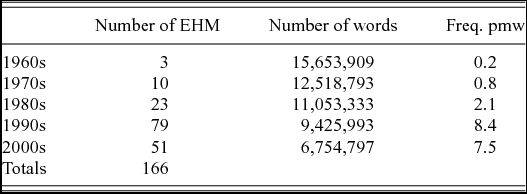
Figure 2 shows the frequency per million words (pmw) of EHM for the five decades when it occurred in journalistic prose. The frequency was 0.2 pmw in the 1960s and 0.8. in the 1970s, rising to 2.1 pmw in the 1980s and then steeply to 8.4 pmw in the 1990s, but the frequency then goes down somewhat in the 2000s to 7.5 pmw. The differences between the first three decades are significant (1960s–70s p<.04, 1970s–80s p<.014, 1980s–90s p.<0001) but not that between the 1990s and 2000s; the development thus approaches an S-curve. The rise closely follows that shown in Rühlemann & Hilpert (to appear), if all variants in figure 1 are added up. However, their totals for e.g. the 2000s amount to over 12 tokens pmw and are thus about 1.6 times higher than that for only journalistic prose, 7.5 pmw, most likely due to the difference between our methodologies and their inclusion of quoted speech.
The frequency of EHM pmw in the TIME corpus from the 1960s to the 2000s
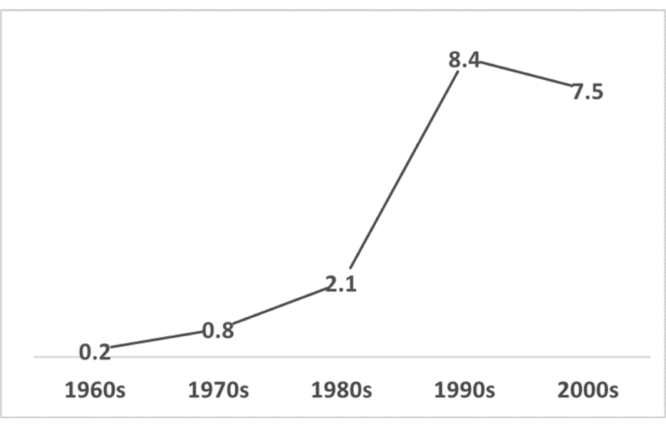
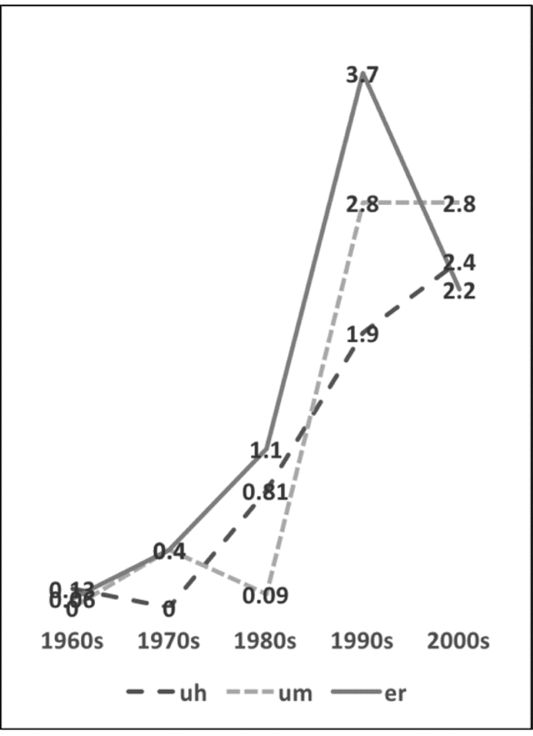
Figure 3 shows the distribution of the variants er, uh and um over time. Interestingly, the British-type er is especially frequent in the 1980s and 1990s before losing ground in the 2000s, but the typically American variants uh + um show a steady rise and jointly outrank er in the 2000s.
The frequency of er, uh and um pmw per decade in non-quoted text in the TIME corpus
5 The distribution of er, uh and um in COCA
The search of newspapers and magazines in COCA 1990–2011 yielded a total of 630 tokens of EHM. In order to follow the development more closely, I divided the material into four blocks of five years each (1990–4, 1995–9, 2000–4, 2005–9) plus one ‘rump’ period consisting of the two years 2010–11. Figure 4 shows the frequencies pmw in the five time blocks.
Frequencies of EHM pmw in COCA newspapers and magazines 1990–2011
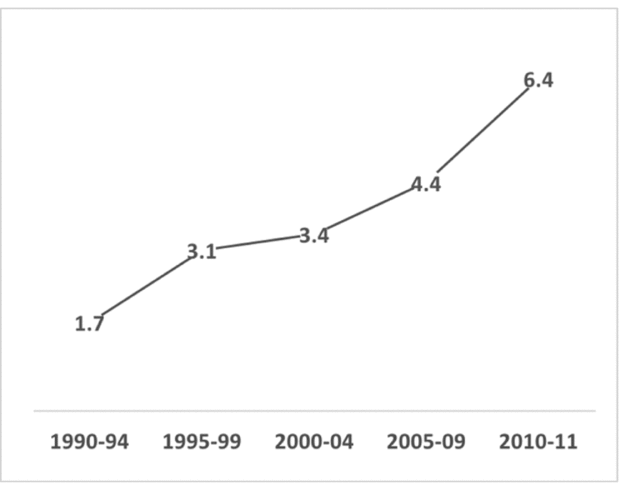
After a modest start in the early 1990s with 1.7 pmw in 1990–4, the frequency of EHM rose to 3.1 in the second time band and to 3.4 pmw in the 2000–4 time band. By the last period, 2010–11, the frequency is 6.4 pmw, or 3.76 times as high as in the first period, but still not as high as the 8.4 pmw high in TIME, recorded in the 1990s. Overall, the frequencies are much lower than those for TIME magazine for the same time periods. Adding up the five-year periods to decades in COCA, the differences between TIME and COCA in overlapping time periods are shown in figure 5.
Comparing frequencies pmw of EHM in TIME and COCA in the 1990s and 2000s
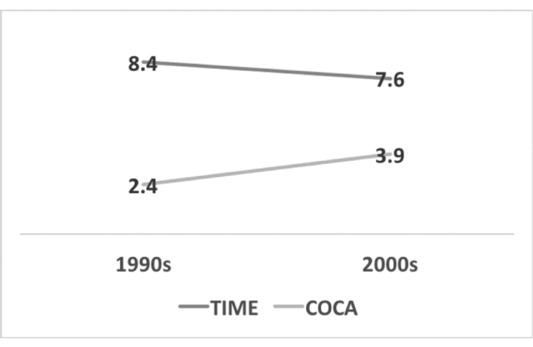
The difference between the frequency of EHM in TIME magazine and COCA is striking, with 8.4 pmw in TIME in the 1990s vs 2.4 in COCA, and 7.6 pmw in TIME vs 3.9 in COCA in the 2000s. TIME is known for its particular style, which may account for its much higher EHM frequency, but there are also differences between newspapers and magazines in COCA. The reasons for these discrepancies need to be discussed.
6 EHM in newspapers and magazines – a question of register?
The frequencies of EHM turned out to differ between the two subcorpora in COCA. In the total sample, 60 percent of the 630 tokens appeared in the Magazine subcorpus, and 40 percent in the News corpus. Over time the proportions changed from almost a fifty–fifty distribution in the first period to about a quarter from News and three-quarters in Magazines in the last period, as shown in figure 6.
Percentages of EHM in newspapers and magazines in COCA 1990–2011
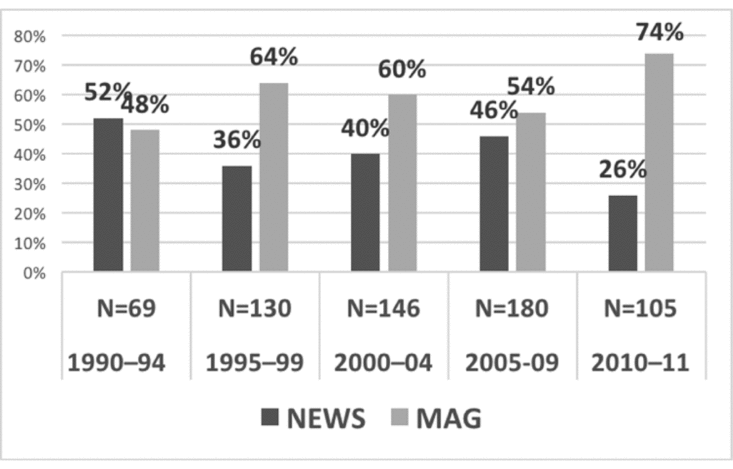
It is necessary to take these proportions with a grain of salt, however, because of the changing composition of the two subcorpora. The COCA sample of newspapers remained constant in the sense that for most of the sampling period, it comprises the same ten sources: in addition to Associated Press, the newspapers were The Christian Science Monitor, New York Times, San Francisco Chronicle, Washington Post, USA Today from 1990, with The Atlanta Journal-Constitution added in 1991, the Chicago-Sun-Times and the Houston Chronicle in 1992 and The Denver Post in 1994.
The selection of magazines has undergone greater changes over time, and neither the domains nor the publications remain the same. In the 1990 sample there are nine domains, viz. African American, Children, Entertainment, Financial, Home/Food/Health/Garden, News and Opinion, Science/Tech, Social Sciences/Fine Arts, and Sports/Outdoors. In 2011 there are ten: Financial is now absent, but two new domains, Religion and Women/Men/Fashion, have been added. In the 1990 sample, there are 35 different publications, and in 2011, there are 51. Twelve are identical to the 1990 sample, but they make up just over a quarter of the 2011 sample.
The addition of the domain Women/Men/Fashion is especially important for the study of EHM. In this domain we find Cosmopolitan, Esquire, Harper's Bazaar, Ms., Redbook, Parenting and Today's Parent; the presence of the lightweight publications Cosmopolitan and Redbook is noteworthy because of their profiles and the large number of tokens they supply. Cosmopolitan advertises itself on the internet as ‘The Women's Magazine for Fashion, Sex Advice, Dating Tips’ and Redbook promises its readers articles on ‘Anti Aging, Beauty, Fashion Under $100, Sex . . .’ Furthermore, the publications in the domain Sports/Outdoors have changed character: in the first periods, the serious-minded environmentalist magazines Conservationist, National Parks, Sierra and Wilderness dominated. National Parks remains in 2011 but the additions are more oriented towards outdoor sports and equipment than to nature preservation: Backpacker, Bicycling, Motor Boating and Skiing are good examples. Men's Health and Shape, both focusing on looks and lifestyle, are among the additions to the Home/Food/Health/Garden domain.Footnote 11 These and other changes in COCA would certainly be good material for a study of cultural changes in the years around the turn of the millennium in the vein of Leech & Fallon (Reference Leech and Fallon1992), but that is beyond the scope of the present work.
Although there are certainly differences between the two types of publications, News and Magazines, it is probably register that is the most important factor in the use of EHM. In newspapers, tokens of EHM are not used in news reporting or editorials but tend to appear in reviews, comment columns and sports pages; in magazines, those which comprise similar registers dominate. A detailed study of register and colloquialization including other types as well is necessary before generalizations can be made. For the current purpose, it will suffice to treat newspapers and magazines jointly.
7 The use of EHM in COCA
COCA does not supply information about occurrences in headlines or photo captions, but the manual inspection showed that the vast majority are from running text. A total of 88 percent of all tokens of EHM occur in statements, and the remaining 12 percent in either imperatives or questions. The use of EHM tokens can be correlated to their appearance in either sentence-medial or sentence-initial position.
7.1 EHM position and following focused element
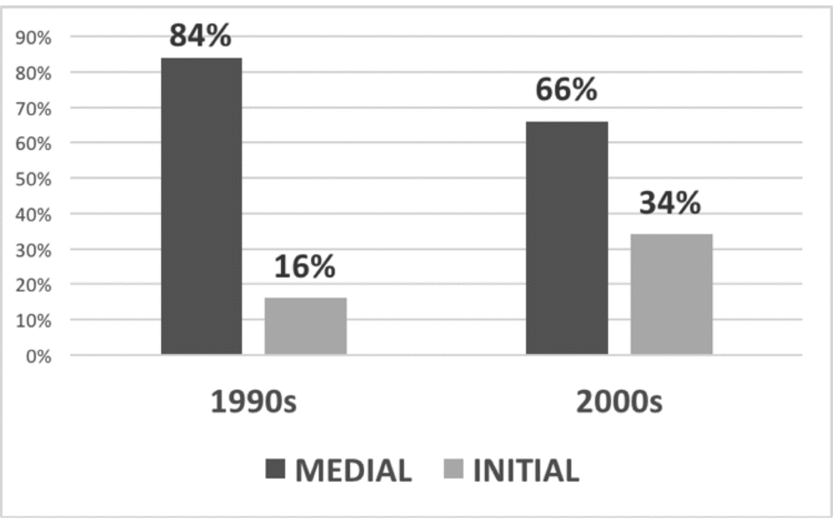
The placement of EHM is most often sentence-medial; thus 453/630 (72 percent) of the tokens occur in this position and 174/630 (28 percent) in initial position. (Three tokens appeared in sentence-final position and will be disregarded here.) The proportion of medial EHM is higher in the earliest periods – over 80 percent – and goes down in the later ones, but medial position always prevails and is never lower than 61 percent, as shown in table 2.
The position of EHM in COCA
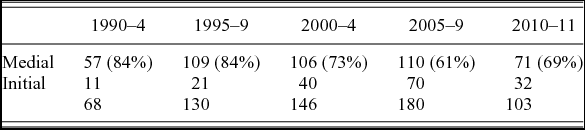
If only full decades are counted, as shown in figure 7, the proportional increase of EHM in initial position is significant (p< 0001, chi-square 18.39, 1 df.)
The proportional increase of EHM in initial position in COCA from the 1990s to the 2000s
7.2 Sentence-medial EHM
Typical examples of medial EHM are given in (12)–(14). In order to illustrate the versatility of the variants, they will all be included for most example types, in the order er, uh, um.
(12) . . . contributors . . . tend to be on the, er, um, old-ish side. (New York Times 2010)
(13) You just . . . lived the life. Which was, uh, strenuous. (Rolling Stone 1992)
(14) . . . you have what it takes to enter . . . um, the winner's circle? (Men's Health 2000)
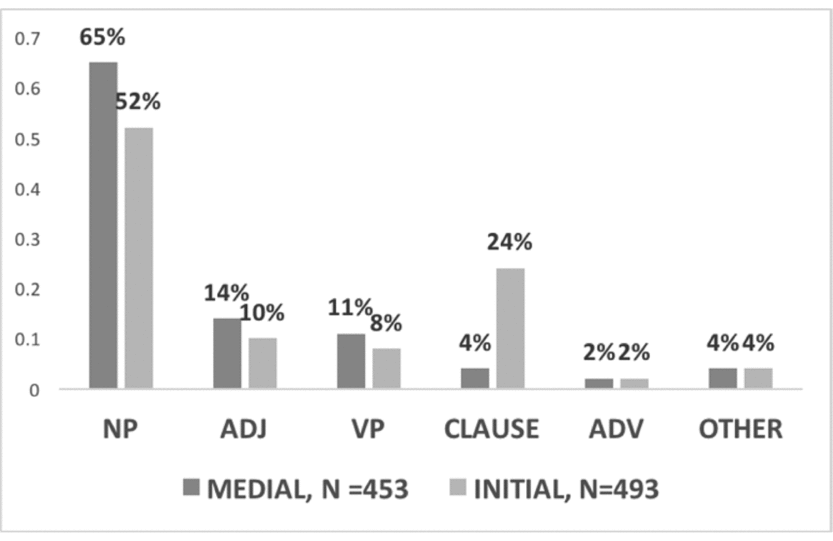
The element following EHM is focused. A large majority of tokens of medial EHM (65 percent) precede noun phrases, as in (12) and (14) above, but the classification is based on the individual lexical item that is focused. Thus examples like (12), where an initial adjective carries the focus, are classified as having pre-adjectival EHM. Some 14 percent precede adjectives, either stand-alone as in (13), or as parts of NPs, as in (12).Footnote 12
A total of 11 percent precede a verb or verb phrase, as in (15), and the remaining 10 percent precede clauses, as in (16), pragmatic markers or response signals.
(15) I mumble that I'm, uh, just shopping. (Southern Living 1995)
(16) . . . among the things yet to be discovered by researchers is [,] um [,] how sleep works, exactly. (Men's Health 2006)
7.3 Sentence-initial EHM
Initial EHM precedes a clause in the great majority of tokens (79 percent), as in (17)–(19), and it is a proposition that is focused:
(17) . . . three strikes always mean you are out. Er, make that fuori. Here in Italy . . . (Christian Science Monitor 2004)
(18) Uh, that's hogwash. (Sporting News 1997)
(19) Um, what does your wife think about that? (Redbook 2010)
Other types include response signals (9 percent) and noun phrases (6 percent), as in (20) and (21), and an assortment of adverbs, pragmatic markers, etc.
(20) Drop pounds simply by drinking two 8-ounce glasses of water before each meal. Uh, sure. (Cosmopolitan 2011)
(21) I could have . . . uh, rotten excuse. I just wish I didn't suck. (Rolling Stone 1996; orig. ellipses)
The difference in following elements between sentence-medial and sentence-initial EHM emerges clearly from figure 8 – medial EHM significantly precedes NPs (p < .0001, chi-square 15.31, 1 df), and initial EHM significantly precedes clauses (p < .0001, chi-square 71.19, 1df). The other differences were not significant.
Elements following medial and initial EHM
8 The discourse-pragmatic functions of EHM
The pragmatic or discourse function of EHM was usually possible to determine thanks to the availability of larger co-texts in COCA. Almost without exception it is the writer's attitude to the message, either previous or following, which is signaled to the readers by metalinguistic means.Footnote 13
There turned out to be almost total correlation between placement and function. In sentence-medial position, EHM usually expresses writers’ attitude to the content of their own subsequent text, as previously shown in (10) and (11) above. EHM in initial position expresses the writer's attitude to a previous message or assumption, usually something said or written by a different person, as in (17)–(20) above. A more fine-grained analysis is given below.
8.1 Sentence-medial EHM
Virtually all the instances of medial EHM can be classified as having some kind of ‘tongue-in-cheek’ function, as in (22)–(24), i.e. implying that something should not be taken seriously.Footnote 14 Euphemism is frequent, and it also sometimes signals irony, as in (24):
(22) . . . happy hour at your neighbor's makes your speech, er, unrecognizable . . . (Chicago S-T 2001)
(23) I failed to mention recently the, uh, unusual ensemble that Tim Hudson wore . . . (Atlanta J-C 2008)
(24) . . . former boxing champ . . . Holyfield agreed to show his dancing, um, skills. (USA Today 2000)
Functional subcategories often shade into each other, and it is therefore impossible to make completely water-tight exclusive classifications. I have tried to organize them in order of frequency, but overlaps are unavoidable. Intentional self-correction, where first one word is used, and then another is substituted, is a large subtype of the tongue-in-cheek category, accounting for 106 tokens in the corpus, or almost a quarter of the total number of medial instances. Examples are given in (25)–(27), but notice that puns, another subcategory which is further exemplified in (33)–(35) below, also occur here, as in (26) and (27). Whereas the overall distribution of EHM variants is fairly even in medial position with about a third of each, the typical variant used for self-correction is er. Er accounts for 88 percent of these examples, often with some type of word-play, as in (26) and (27).
(25) Both dental chairs have eastern views of the lake with some interesting signage to distract the victim, er, patient. (Chicago S-T 1994)
(26) [A] stack of sheetrock [fell] on his foot . . . And a scar, er, star was born. (Atlanta J-C 2011)
(27) The mayor's hair was down at the hair (er, air) show. (SanFranChron 2006)
Self-correction with uh is rare; it occurs only eleven times, whereas self-correction with um is virtually non-existent, with only two instances. Examples are given in (28) and (29).
(28) But no one in the traveling party saw any sign of the thugs, uh, Klan members, (Atlanta J-C 1994)
(29) Black would have had good cause to be terse or, um, ticked. (Sporting News 2008)
Another tongue-in-cheek subcategory (9 percent of sentence-medial tokens) is that where the writer is ‘putting things delicately’. This type is common when body parts, sex or body functions are referred to and the writer does not wish to be specific, as in (30)–(32):
(30) Amneris is no Snow White . . . with costumes to make her physical allure, er, jump out at you. (Atlanta J-C 1998)
(31) Last bit of advice: Get your dress cleaned to destroy any other evidence that might have, uh, leaked out. (Cosmopolitan 1998)
(32) [A] sudden bear made a huge crash in the forest. One guy, um, taking care of business, came running back into camp . . . (TIME 1997)
Puns are also sometimes (in 5 percent of all cases) signaled by EHM, as in (33)–(35):
(33) Sties are red swellings on the margin of the eyelid that can be not only painful but a real, er, eyesore. (Men's Health 1994)
(34) The monks used to bake bread to earn a living, until they realized they weren't making any, uh, dough. (Men's Health 1998)
(35) [T]hey don't show . . . just a basic black dress – an omission that's, um, redressed in Amy Holman Edelman's [book] The Little Black Dress . . . (Newsweek 1997)
The subtype consisting of repetition for rhetorical effect accounts for a small proportion of cases (2 percent), as shown in (36) and (37), with punning on literal and metaphorical meaning in (37):
(36) . . . from a white T-shirt to a cashmere sweater . . . Black denim is, uh, black. (Men's Health 2000)
(37) Literally walking in other people's shoes may give kids valuable experience in, um, walking in other people's shoes. (Parenting 2010)
In a few cases variants, eh, uh or um appear together, as in (38), where well is thrown in for good measure:
(38) Despite the neat glass roof, the vehicle is, um, er, well . . . a little ugly.Footnote 15 (Boys’ Life 2002; orig. ellipses)
8.2 Sentence-initial EHM
Tokens of sentence-initial EHM account for 174/630 tokens (27 percent). Er is unusual in initial position with only 11 percent of the total, whereas uh and um make up 45 and 44 percent, respectively. But er can be used in all the pragmatic functions identified below, as is clear from (39), (42) and (45). In all of these functions, EHM conveys the writers’ negative or contradictory attitude to a previous message or assumption, either their own or that of another speaker or writer.
In (39)–(41) EHM is used in statements to refute a prior assertion:
(39) [Basketball player tries to explain an injury.] Er, wrong. Normally, you can't walk after tearing up your knee like that. (USA Today 1992)
(40) This year's unit was supposed to be the school's most talented since the Razorbacks entered the SEC in 1992. Uh, that's hogwash. (Sporting News 1997)
(41) And if you're building a kit cabin . . . it's tempting to believe it will be easy. Um . . . reality check time. (Outdoor Life 1994; orig. ellipses)
Statements often occur in (usually negative) answers to rhetorical questions, as in (42)–(44):
(42) Sounds harmless, right? Er, not really. (Cosmopolitan 2011)
(43) Anything good about getting older? Uh . . . no. (Rolling Stone 2008; orig. ellipses)
(44) Did anyone else hook up on the set? Um, not to my knowledge. (People 2008)
Initial EHM is also used in questions to make fun of previous assumptions – expressed by authors or others, as in (45)–(47):
(45) [T]he narrative arc is elaborated with the addition of nuanced emotional subtext that . . . er, what am I talking about? (NY Times 2007; orig. ellipses)
(46) [The] novel . . . comes equipped with a . . . dust jacket promising ‘This Book Will Chill You,’ and offering your money back if it doesn't. Uh, what was that address again? (SanFranChron 1994)
(47) ‘One [competition] down and six to go,’ [swimmer Phelps] said by the pool. Um, did he fail math in high school? He means seven to go, right? (Chicago S-T 2004)
Summing up, all three variants can thus be used in both initial and medial position and all of the functions identified in sections 7 and 8.Footnote 16 This supports regarding EHM as a single variable with three variants, even though er is dispreferred in initial position and strongly preferred for medial self-correction. It seems likely that self-correction is the context where er was first used in American English as a calque of British English usage, and that this construction persisted, but historical evidence from both British and American English is required for this to be confirmed.
9 Differences between UHM in speech and EHM in writing
Although the use of EHM contributes to the colloquialization of written English, making it ‘more speech-like’, there are differences between the functions served by EHM in writing and by UHM in speech. The main reason for this fundamental difference is the conditions of production: UHM is normally an unintentional phenomenon in online spoken language but highly intentional in written language, where writers use EHM to achieve a stylistic effect, and to convey an attitude. The main function of EHM in writing is metalinguistic: EHM is used to highlight a preceding or following proposition or lexical element, and to produce a humorous, ironic and/or polite effect. The use of EHM thus entails that a marker of authorial stance is introduced, and that increasing subjectivity is allowed in the written medium, ‘expression of self and the representation of . . . a locutionary agent's perspective or point of view in discourse’, in the words of Finegan (Reference Finegan, Stein and Wright1995: 1).
As mentioned in section 2, there has been much debate concerning the functions of UHM in spoken language, and especially floor-holding or signaling upcoming pauses have been suggested. The position here is that the basic use of hesitators – not just UHM but also often routinized uses of you know, like, etc. – is to help speakers plan their upcoming speech. This view is taken by the early psycholinguists Howell & Vetter (Reference Howell and Vetter1969), who state that uh and um are used for ‘monitoring and verbal planning’, and more explicitly by Carter & McCarthy (Reference Carter and McCarthy2006: 903), who note that a ‘filler [e.g. uh or um] . . . can indicate the speaker's online process of thinking and planning’ and that fillers are items ‘whereby speakers fill their silences while planning their speech in real time or while hesitating’ (ibid.: 12). Fischer (Reference Fischer and Fischer2006: 432) argues that ‘[h]esitation markers, such as uh and um . . . indicate a current process: “I am thinking”’, and Götz (Reference Götz2013: 110) asserts that ‘[f]illed pauses (FPs) are probably the most frequently used planning strategy in both native and nonnative speech’. Based on empirical research of SBC, Tottie (Reference Tottie2014, Reference Tottie2015a, Reference Tottie, Dion, Lapierre and Cacoullos2015b, forthcoming) subscribes to this view, and has argued for the term planner, also adopted by Jucker (Reference Jucker, Taavitsainen, Kytö, Claridge and Smith2015a, Reference Jucker2015b).
An illustrative example of a speaker hesitating in order to plan is given in (48), where a woman has a rather long turn telling the story of her move between apartments in New York in a dinner-table conversation; long turns characteristically have a high incidence of UHM. (Lines mark intonation units, commas continuing intonation and periods final intonation. The symbol = denotes lengthening of a preceding vowel; X denotes unclear words; two dots denote a pause shorter than 0.3 seconds; three dots denote longer pauses. Brief simultaneous speech has been removed here for clarity. Names of source texts from SBC are given in italics.)
(48)


(49) and (50) offer a clue to what could be the origin of the written uses of EHM in sentence-medial position: word-search. In (49) Wess is looking for a word, and in (50) Roy is giving examples of animals threatened by extinction:
(49)
(50)


Word-search is not a very frequent function of UHM in spoken language (Tottie forthcoming). However, it is a salient one, and it does offer a parallel and a possible source for the medial use in writing. This is also suggested for well as a discourse marker in written English by Rühlemann & Hilpert: ‘it seems possible to argue that the word-search function is the model after which the word-choice function is crafted. That is, well is used as if the writer were searching for the appropriate wording.’ As if is important here: in writing, the word-search is make-believe. The writer pretends to be searching for a word and pretends to hesitate before making an ironic, funny, somewhat derogatory or naughty choice. But note that in the context of writing, hesitate does not mean ‘pause because of uncertainty’. It has a strong connotation of reluctance or unwillingness, reluctance to be tactless, to hurt or insult someone.Footnote 17 This use was not found in the c. 175,000 words of conversational speech from forty SBC texts examined by Tottie (Reference Tottie2014, Reference Jucker2015b, forthcoming), but it is certainly possible to imagine such instances. Jucker (Reference Jucker2015b: 66) provides a discussion and gives an example from fiction; genuine spoken examples can also be found on the web, as shown by (51)–(53):Footnote 18
(51) What was your boss like? Heather: Well she wasn't er wasn't very easy . . ., she was a bit er difficult very difficult to get on with . . .
(The London Bubble Theatre, www.londonbubble.org.uk/page/stories/)
(52) We were in the middle of this, um, difficult situation between Venezuela, Colombia and Ecuador . . . (US Institute of Peace interview)
(53) Um we realise this is a very um difficult area and it's one that we did inherit, the skills crisis from the Howard government, we're focussed on that . . .
(Transcript of interview with Justine Elliot, Minister for Ageing, www.abc.net.au/4corners/content/2009/s2586025.htm)
This type is dependent on situation or register. Clearly, when word choice is a delicate matter, UHM is a useful hedging device; notice the collocation with difficult in (51)–(53).
There are also similarities between the uses of sentence-initial EHM in writing and spoken English uses. A frequent use of turn-initial UHM in speech is in answers to questions – for instance, they account for 26/68, or over a third of turn-initial instances in the first quarter of SBC (see Tottie Reference Tottie2015a). A good example is (54), recorded in a college class where the instructor asks students how their parents were affected by the Vietnam War. Notice the co-occurrence with well in a couple of cases – something that is also found in writing, as e.g. in (10) and (38) above. (Square brackets indicate simultaneous speech.)
(54)
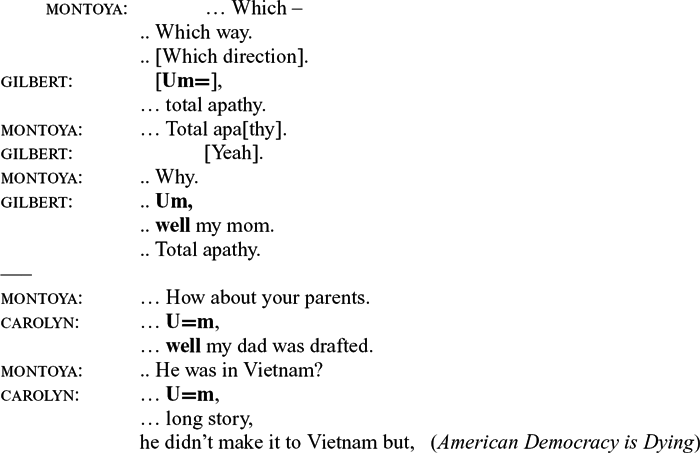
This type of use is a probable source of sentence-initial EHM in writing. However, whereas speakers hesitate to produce answers to questions because they are uncertain of what to say or how to say it, writers merely pretend to hesitate, out of reluctance to say something tactless or hurtful. Again, it is the metalinguistic, jocular or critical attitude that fundamentally distinguishes the function of sentence-initial EHM in writing from that of UHM in typical speech, just as is the case with medial EHM.
10 UHM and EHM as words
The preceding data provide ample evidence that EHM – in any of its incarnations as er, uh or um – is a word in written language, and that its use has increased over recent decades in magazines and newspapers. But if EHM is a word in written language, how did it go from being a mere filler or filled pause in speech to being a full-fledged word in writing?
I would suggest that in speech, UHM is on a cline of lexicalization, with one end being represented by anduh and butuh and similar examples of monosyllabic words whose last consonant is lengthened with vocalizations, like when uh, then uh, had uh, etc.; speakers are probably not likely to perceive cliticized uh or um as an independent word. The other end of the cline is that where UHM occurs not only between words, but between (silent) pauses, thus fulfilling the phonological criterion for wordhood (e.g. Biber et al. Reference Biber, Johansson, Leech, Conrad and Finegan1999: 51). The vocalizations uh and um, most likely in their lengthened forms, are then perceived as words in the mental lexicon, especially when they are used for word-search and in answers. UHM becomes a conscious word choice and can be co-opted for use in writing. Lexicalization thus takes place in speech, and probably also pragmaticalization, i.e. the use for metalinguistic purposes, irony etc. As Dr Johnson says in the preface to his Dictionary, used as an epigraph to this work, ‘some words are budding’, and UHM is such a nascent word. The term emergent word, suggested by Grieve et al. (Reference Grieve, Nini and Guo2016) – but not applied by them to UHM/EHM – also appears appropriate.
This would then be one of the rare cases of word-formation called coinage or root creation, i.e. lexicalization occurring without any kind of prior traditional word-formation process taking place (see Brinton & Traugott Reference Brinton and Traugott2005:43).Footnote 19 It would also qualify as a case of ‘motivated’ root creation (McArthur Reference McArthur1992: 876f.), similar to that of echoic words such as splash, vroom, zap etc.Footnote 20 Speakers become aware of the particular specialized uses of UHM in cases of word-search and in answers, and as writers, they use them for related purposes.
If UHM/EHM is thus a word, it should be possible to assign it to a word class, or rather, to separate word classes depending on the different functions it has in typical speech and in writing. The word-class assignment in speech was discussed above, and the classification as an interjection was criticized. The wider insert category proposed by Biber et al. (Reference Biber, Johansson, Leech, Conrad and Finegan1999: 1082) is accommodating though somewhat diffuse. It is defined as ‘stand-alone words which are characterized in general by their inability to enter into syntactic relations with other structures’. It does include interjections as one of its subclasses, but there are two others: response forms and hesitators, the latter being where uh and um fit in. Interestingly, the authors acknowledge that ‘it may be questioned whether some inserts are words at all . . . this applies to . . . hesitators (such as mm, uh)’. The fuzziness of this class is thus especially suitable for nascent words like spoken UHM.
An appropriate categorization for EHM in writing must be based on different criteria. The function of expressing attitude is typically a frequent one of adverbs, and EHM is therefore best characterized as a stance adverb (see Biber et al. Reference Biber, Johansson, Leech, Conrad and Finegan1999: 557f.). Biber et al. further subdivide the stance adverbs into subcategories: epistemic, attitude and style adverbs. Attitude adverbs express a speaker's or writer's attitude towards a proposition, like e.g. (un)fortunately, and style adverbs ‘comment on the manner of speaking’ and are exemplified by frankly, honestly, etc. EHM shares characteristics of both of these classes. (55) is a particularly interesting example, as medial uh collocates here with the multi-word style adverbial shall we say; see the example from Quirk et al. (Reference Quirk, Greenbaum, Leech and Svartvik1985) with so to say in (56), where the single quotes suggest an ironical stance:
(55) They don't think twice about an outfit's, uh . . . shall we say, improbability. (Harpers Bazaar 2008; orig ellipses)
(56) They have not, so to say, ‘combined’ their efforts (Quirk et al. Reference Quirk, Greenbaum, Leech and Svartvik1985: 618)
As pointed out by Quirk et al. (Reference Quirk, Greenbaum, Leech and Svartvik1985) adverbials ‘lend themselves very conveniently to incorporating metalinguistic comment into a sentence whose purpose is not itself merely metalinguistic’ – and style disjuncts – their preferred term for style adverbs – do this ‘peculiarly well’.
Compare also (57), from Quirk et al. (Reference Quirk, Greenbaum, Leech and Svartvik1985: 616), with (4), repeated here for convenience, and (58), both with initial um. In this use, um functions as an attitude adverbial.
(57) If I may say so / With respect, none of you are competent to make the legal judgment required. (Quirk et al. Reference Quirk, Greenbaum, Leech and Svartvik1985: 616)
(4) Senator Richard Shelby . . . claimed that . . . ‘[t]he market will view these firms as . . . implicitly backed by the government.’ Um, senator, the market already views those firms as having implicit government backing, because they do. . . (Paul Krugman, op-ed column, New York Times 2010)
(58) is less respectful, but also an expression of a negative attitude:
(58) Raid[er]s coach Tom Cable says he wants interim tag dropped from title. Um, Tom, everyone but Al's hairdresser is interim. (Denver 2008)
Summing up, I thus propose that EHM is a stance adverb, with the special function of style adverb/disjunct when it is used in medial position with a metalinguistic function.
11 Summary and conclusion
Based on the TIME corpus and the COCA, uh, um and er were shown to be increasingly frequent in written American English consisting of journalistic prose, with the first few tokens appearing in the mid 1960s and then a rising frequency culminating in the 1990s and early 2000s, and at higher rates in magazines than in newspapers. Their appearance in writing definitely qualifies them as words, whereas their status in spoken language is better described as a continuum with low-to-high degrees of wordhood.
The variants er, uh and um could be shown to be interchangeable in all the different pragmatic functions in writing, and it is therefore justified to regard them as variants of one lexeme, EHM for convenience. Placement was either sentence-initial or sentence-medial, 28 vs 72 percent, respectively, with some variation over time. In the sentence-initial slot, EHM preceded a clause in 80 percent of the tokens, and in medial position, EHM preceded mostly noun phrases (65 percent) and adjectives (14 percent).
The overall pragmatic function of EHM in writing is to express the writer's stance. With EHM in initial position, writers usually voice disagreement with or disapproval of the (implicit or explicit) preceding proposition, as in Uh, that's hogwash – initial EHM can be classified as an attitude adverb. Medial EHM can be classified as a style adverb and is most often used with a metalinguistic ‘tongue-in-cheek’ function, conveying writers’ attitude to an upcoming item in their own text, as in [He showed his] dancing, um, skills. Although all three variants er, uh, and um appeared in all pragmatic functions distinguished, and were in fact fairly equally distributed in most of them, er was dominant in (medial) instances of self-correction, as in a scar, er, star was born, but dispreferred in initial position.
Although EHM gives a colloquial flavor to the written message, there is more at stake than merely using a spoken expression for the same function as it has in typical speech. EHM serves very different functions in the two media. Spoken UHM is unintentionally used (along with pauses) for online planning of upcoming speech, as demonstrated by means of examples from the Santa Barbara Corpus, but written EHM is used intentionally by writers to highlight their attitude either to a preceding or following proposition or expression.
These differences have consequences for determining the status of UHM/EHM as a word. Considering what is now known about their use, it appears that UHM is a nascent or ‘budding’ word in speech, and that some uses (word-search and answering) are picked up by speakers for use in writing for related functions. Word-class categorization must be different for spoken and written uses – thus the somewhat fuzzy category of inserts appears to be the most suitable for spoken UHM, but for written EHM, the category of stance adverb is indicated, with the subcategories attitude adverb appropriate for initial uses and style adverb for medial uses.
More work needs to be done, on both written and spoken uses of uh and um, in American English as well as other varieties, from many different perspectives and in different disciplines. Researching quoted language in journalistic prose and fictional dialogue as well as comic strips would certainly give interesting insights into popular as well as scholarly views of their function. The puzzling use of the transliteration er in American English deserves historical work. But for now, this has to be, um, the last word.



