



Introduction
Over the past 20 years, increased interest in the archaeology of salt has given rise to a proliferation of publications authored by a growing number of specialists focusing on the production of salt in prehistoric Europe. Nonetheless, there remain many aspects of ancient salt that are far from fully understood, particularly the economic and social implications of the production and exchange of salt, as well as the specific technologies employed in its extraction and processing.
Salt was an important commodity in ancient, as in modern, times, vital for human and animal health and as a means of preserving food. Its acquisition was therefore essential, particularly for areas that lacked their own salt resources, and it thus formed an important element of prehistoric economies. There are several ways of obtaining salt, depending on local resources: by evaporating salt water, either from the sea or from salt springs and streams, through boiling the liquid in clay containers (briquetage); by mining rock outcrops, either in deep shafts and adits or by quarrying where rock salt outcrops; or by a variety of techniques using halophytic vegetation (Harding Reference Harding2013: 28–35). In the area under discussion here—Transylvania and the adjacent part of western Ukraine—a particular technology was used, based on large wooden troughs. This has been dubbed the ‘trough technique’, and our concern here is to establish exactly how this technique might have worked.
In 2013, we published a detailed account of our work, up to 2012, on salt archaeology in the Carpathian region, including Ukraine, Slovakia and Poland, as well as Romania (Harding & Kavruk Reference Harding and Kavruk2013). That research comprised excavation of the site of Băile Figa (Figa Spa) near Beclean (Bistriţa-Năsăud county) in north-eastern Transylvania, as well as surveys in the adjacent counties of Cluj and Mureş. Excavation has continued at Figa under the direction of Valerii Kavruk (Kavruk et al. Reference Kavruk, Buzea, Kovács and Zăgreanu2014, Reference Kavruk2015, 2019). As research has progressed, particularly through excavation in a previously little-explored part of the Băile Figa site, as well as through new radiocarbon dates and experimental work, further information has become available and new interpretations made possible.
The Băile Figa site and other trough finds
The Băile Figa site lies in a bowl-like depression approximately 1 × 0.5km in extent, located on the second terrace of the river Someş south of Beclean in Bistriţa-Năsăud county, Transylvania. It is the site of a salt stream and salt springs that rise to the surface above a salt dome, such domes (diapirs) being common in many parts of Transylvania. The importance of the area for the archaeology of salt was first recognised in 2005, when we saw a remarkable wooden trough from Figa during a visit to the museum in nearby Bistriţa; survey and excavation at Figa have taken place since 2006 (Figure 1). Radiocarbon dates on that trough (Figure 2, no. 1) and on timbers recovered from the stream in 2006 show that the site at least partly dates to the Bronze Age.
Băile Figa, district Beclean, Romania: plan of the site showing the excavation trenches (figure courtesy of the National Museum of the Eastern Carpathians).

Wooden troughs from Băile Figa: 1) Trough 1; 2) Trough 6; 3) Trough 7 (figure courtesy of the National Museum of the Eastern Carpathians).

The trough comprises a hollowed, horizontal tree trunk with a series of holes perforated in its base; the holes were filled with wooden pegs, and in one of these a length of cord was present. The trough is identical in form to a number of previously discovered examples from three other sites: one found in 1817 near Tisalovo in the Transcarpathian region of western Ukraine (sometimes called the northern Maramureş), usually known by variants of its Hungarian name, Királyvölgy (Preisig Reference Preisig1877; Harding Reference Harding2011); a possible further nearby (approximately 20km distant) find at Aknaszlatina (its Hungarian name, or Solotvino in Ukrainian); three troughs found in the 1930s at Valea Florilor, south-east of Cluj, Romania (Maxim Reference Maxim1971; Wollmann & Ciugudean Reference Wollmann and Ciugudean2005; and a piece of a trough, along with a wooden gutter, is said to have come from the salt mine at Dej, 50km north of Cluj (Wollmann Reference Wollmann1996: 246, 417 pl. XVI, no. 4 bottom; Wollmann & Ciugudean Reference Wollmann and Ciugudean2005: 101 pl. III, no. 4).
Excavations at Băile Figa have yielded a further six troughs, and several more fragments, of different sizes and in varying states of preservation (see the online supplementary material (OSM)). In addition, comparable troughs or trough fragments have been discovered at three other sites near Beclean: Caila (Harding & Kavruk Reference Harding and Kavruk2013: 139–41), Săsarm (Kavruk & Chiricescu Reference Kavruk and Chiricescu2013: 52–54, fig. 23) and Blăjenii de Jos (unpublished). The total number of troughs currently known is thus 13, plus fragments, with at least three further examples known from the literature but unavailable for study (Harding & Kavruk Reference Harding and Kavruk2013: 194–95).
The trough technique is known only from Transylvania and Transcarpathian Ukraine (within the Carpathian ring), but it seems likely that it would also have been used in adjacent areas, notably in Maramureş and western Moldavia (in north-western and north-eastern Romania, respectively), where there are large salt deposits and many indications of ancient salt working. To date, there is no evidence for the use of the technique in the adjacent part of south-eastern Poland and Slovakia, but this may reflect preservation conditions and a lack of systematic research.
In addition to the troughs, a number of other wooden features and objects occur regularly in the repertoire of finds from these sites, most notably wattle-and-plank fences, small shovels and mallets, as well as pieces of wood with channels that were probably intended to conduct water or brine to or from the production location. All of the above are present at Figa and most are also recorded at Királyvölgy and Valea Florilor. In addition, ladders are known from Figa and Királyvölgy, presumably to allow the workers to access the rock salt at the bottom of the deep shafts.
Recent investigations at Băile Figa
Since 2012, investigations at Băile Figa have concentrated almost entirely on Sonda (Trench) XV in the central part of the salt stream that runs across the depression. This is the location from which the original trough (no. 1) was recovered in 2005. Since then, a series of installations have come to light (Figure 3). The most remarkable feature lies in the centre of the trench and consists of a deep, conical pit, 1.1 × 1.2m wide and 1.8m deep, dug through the salty mud and down into the rock salt. The pit is lined with post-and-wattle walls and is surrounded by a roughly circular wattle fence, 2.1 × 1.95m in diameter (centre right on Figure 3). The base of the pit is cut by an apparently artificial channel approximately 0.2m wide and over 0.8m deep. Below, we refer to this lined pit feature as a well, though we are unsure as to its precise function. Nearby in the trench, massive upright posts arranged in two parallel lines, and a fence of vertical oak planks (some of them reused trough fragments), were discovered, as well as a further four troughs, plus several trough fragments. All these features were presumably used together in the salt production process. Other wooden objects from the trench include T-shaped sledgehammers or mallets, wedges, grooved or channelled pieces, V-shaped objects and a ladder, plus stone waisted hammers.
Băile Figa, Sonda XV, plan. The troughs found in the trench are numbered 1 and 4–7; the wicker-lined well-like feature is on the right; 3 is a ladder; 2 and 13 (near the well) are wooden mallets (figure courtesy of the National Museum of the Eastern Carpathians).

The troughs and associated finds
The known troughs come from at least seven sites, and are listed in Table 1 and described in detail in the OSM (see Figures S1–S7). All the troughs are made from substantial tree trunks, of a variety of wood species (pine for Figa no. 1, alder for no. 3, oak for nos 4, 5 & 6, beech for no. 7). In each case, a trunk between 1.30 and 3.50m long was laid horizontally, hollowed out and holes perforated through the base. These holes were fitted with tubular or square-sectioned pegs, each perforated with a narrow, vertical hole. The troughs also differ in a number of other significant details, discussed below.
Details of wooden troughs found in Romania and Ukraine. Numbers in parentheses indicate surviving dimensions and number of perforations on incomplete troughs. The troughs from Săsarm and Blăjenii de Jos are fragmentary, while the number of holes in the Aknaszlatina/Solotvino trough (10 holes, based on a drawing) is uncertain. Only one of the finds from Valea Florilor has been described.

Trough ends
While most troughs are damaged or fragmentary, where an indication of the form of both ends of a trough is present, it is possible to distinguish different configurations (Figure 4):
• Troughs closed at both ends, with no holes perforated through these end walls (Valea Florilor, Solotvino (?));
• Troughs closed at both ends with holes at both ends, plugged with stoppers (Figa no. 6);
• Troughs closed at both ends with a hole at one end and with several pieces of wood inserted to act as a stopper (Figa no. 7);
• One end of the trough is open (Figa no. 3, possibly others); and
• Uncertain because of damage (Figa nos 1, 2, 4 & 5 and fragments; Blăjenii de Jos, Caila, Săsarm, Dej, and Királyvölgy).
In order to contain liquid, both ends should be closed, so it is unclear why there were different configurations. In some cases this may simply be a question of damage, as with Figa no. 1 and probably several others. In the case of Figa no. 7, it seems that the damaged end was cut off and repaired in antiquity, while for Figa no. 6 it may be that the oak trunk had a soft core, leading to the need for reinforcement with additional stoppers. It is apparent that the makers of the troughs went to considerable lengths to repair them, presumably due to the time and labour needed to make new troughs.
Diagram showing the different configurations of the trough ends: A) closed both ends; B) one end closed, one open; C) both ends perforated and plugged with stoppers; D) one end perforated and plugged, the other closed (figure courtesy of the National Museum of the Eastern Carpathians).

Trough holes
The number of holes perforated through the trough bases depends on the size of the latter. In those examples that are complete or nearly fully preserved, the number varies from 7 to 19. The drawing of the Valea Florilor trough, which was apparently complete, shows 14 perforations. The most notable difference observable in the holes is their shape: round or square/rectangular. Based on the available radiocarbon dates, the earlier troughs have round holes, the later ones square. It is possible that round pegs might come loose more, or slip through the hole, whereas square-sectioned pegs could be hammered in and remain more firmly in place; in other words, trial and error may have led to a change in design.
Pegs and bungs (cords and rods)
All the troughs which are at least partially preserved were found with associated pegs (Figure 5). Each peg was formed from a piece of wood, usually elder, between 80 and 160mm long, with a narrow hole bored through the length of the core. Some pegs are cylindrical, corresponding to the round holes in the trough bases, but most are roughly square in cross-section. Some pegs also have collars, presumably to prevent the pegs from slipping through the trough holes.
Diagram showing different peg and bung types: 1) round, simple; 2) round with collar; 3) peg with collar, short stick (rod) with cord wound around the bottom; 4) peg without collar, short stick (rod) with vegetable matter wound round the top; 5) peg with collar, long pointed stick (rod) (figure courtesy of the National Museum of the Eastern Carpathians).

The holes through the pegs were, in turn, filled using a variety of bungs. One of the pegs from Trough no. 1 was found to contain a length of twisted cord. Other pegs were plugged with sharpened wooden rods, where complete ranging between 0.40 and 0.65m. The shorter wooden rods are associated with cylindrical pegs, the longer with square pegs. Some of these rods were wrapped in a plant binding, either hemp or wood fibre (bast), and inserted into the pegs. In turn, these rods were secured in place vertically by means of horizontal clamps made of split sticks (Figure 6). As our experiments demonstrate (see below), the wooden rods inserted into the pegs could be moved up and down to regulate the flow of liquid.
Top) sticks (rods) used as bungs, some showing cord or vegetable matter wound round them; centre) split stick (rod) used to fix bungs in place; bottom) diagram showing an overhead view of the split sticks (rods) holding the bungs in place (figure courtesy of the National Museum of the Eastern Carpathians).

Dating
Radiocarbon dates on eight troughs (Figure 7) indicate a production period of some 600 years, between c. 1500 and 900 cal BC, with various changes in the precise forms of the troughs, especially the basal holes, over that timespan (Harding & Kavruk Reference Harding and Kavruk2013: 196). Troughs 2 and 3, from Sonda I at the southern edge of the Băile Figa site, are significantly earlier (with dates spanning the sixteenth and fifteenth centuries cal BC) than those from Sonda XV (Troughs 1, 4 & 5). The troughs from Caila and Királyvölgy date to the eleventh and tenth centuries cal BC. Dates on Trough 4 are inconsistent: one suggests the eleventh and tenth centuries cal BC, while the other falls in the ninth century cal BC.
Radiocarbon dates for troughs from Figa and other sites discussed in the text (dates calibrated in OxCal v4.4.4, using the IntCal20 atmospheric curve; Reimer et al. Reference Reimer2020; Bronk Ramsey Reference Ramsey2021) (figure courtesy of the National Museum of the Eastern Carpathians).

In addition to the troughs, dates were obtained for a ladder from Sonda XV (Figure 3, no. 3), with a radiocarbon date of 1006–928 cal BC (at 68% probability) or 1055–898 cal BC (at 94.9% probability) (RoAMS: 1444.114), and for the wattle from the well, giving a date range lying squarely in the tenth century cal BC (five dates with a combined probability of 83 per cent that the age lies between 1002 and 889 cal BC; Kavruk et al. Reference Kavruk2019). The combined dating from the troughs and other features from Sonda XV indicates a period of construction and use in the tenth century cal BC.
Dendrochronological investigations by Karl-Uwe Heußner (German Archaeological Institute, Berlin) on three split trough pieces that formed part of the fence give felling dates of 995, 996 and 980 BC (Heußner Reference Heußner2014). These dates fall in the later phase of Bronze Age activity at Băile Figa (Harding & Kavruk Reference Harding and Kavruk2013: 118, fig. 4.57) and show that broken troughs were recycled for other purposes during that period.
Reconstructing the mode of operation
Precisely how all these various objects functioned together is a matter of continuing speculation. One hundred and fifty years ago, Preisig (Reference Preisig1877) offered what has usually been considered the most plausible explanation: that water was channelled into the troughs and allowed to drip onto a rock salt surface, slowly dissolving it and creating funnel-shaped depressions and cracks which allowed the rock to be split into lumps that could be detached for processing. This suggestion had its origin in the discovery at Királyvölgy of a block of rock salt with preserved funnel-shaped depressions, as shown in a historical photograph taken when the finds, including the block, were displayed in Budapest in 1909 (Vezető 1909; Harding Reference Harding2011). A block of rock salt also featured in the newspaper report of the Aknaszlatina (Solotvino) find (though this may be the same find as Királyvölgy, represented schematically).
As we demonstrate below, this explanation remains plausible, though it does not account for all the features of the troughs. Other possible methods of use include the following:
• the troughs were filled with brine which dripped through the basal holes, either into containers or other troughs, or onto a surface such as a piece of textile, where, in warm weather, the salt would crystallise and could be collected;
• the troughs were filled with brine and heated stones added to boil, evaporate and concentrate the brine, which could then be tapped off;
• troughs were arranged in a sequence, so that the brine passing through them would become progressively more concentrated, while at the same time removing insoluble heavy mineral impurities;
• the troughs were filled with salty mud and then salty water was added, the brine filtering through the mud—a process attested ethnographically (Harding Reference Harding2013: 35–37).
In attempting to assess these different possibilities, the evidence from Figa provides a number of potentially significant indicators, as well as a number of challenges. These include the hardness of the rock salt, making it difficult to imagine that the stone tools found at Figa could have been used to break off lumps of rock; the absence of stones subjected to heat or fire; the presence of numerous wattle-and-plank fences associated with the troughs, which were obviously an integral though unclear part of the process; the fact that the troughs seem to occur in pairs or groups; and the absence of any sign of the processing of either rock or crystal salt. We therefore undertook a series of experiments to evaluate the various hypotheses.
Experiments with troughs
We started, in 2007 to 2009, our first attempts at reconstructing the method by which the troughs might have been used, to see if Preisig's suggested method was plausible. Our first replica troughs were made from spruce; working over a couple of days, we allowed water to run through pegs inserted into the trough's basal holes (Buzea Reference Buzea, Harding and Kavruk2013). While the results were promising, this experiment was conducted on a small scale; moreover, we had not used the correct type of wood for the trough, and we encountered problems getting the pegs to work efficiently. We resumed the experiments in 2017, aiming to address questions concerning not only the functioning of the troughs but also the replication of construction processes and monitoring of the results:
• To create holes and cracks in rock salt surfaces, breaking up the blocks to allow the salt to be collected, by suspending the troughs above the surface and allowing fresh water to drip down on to it;
• To filter the brine in order to increase the salt concentration; to filter brine mixed with mud to obtain a clear brine; or allow fine sludge to settle on the bottom of the trough and then filter it through pegs and bungs (rods or twisted cords);
• To concentrate the brine through boiling by immersing hot stones into the filled trough, allowing the residues to settle on the bottom and then decanting the brine through pegs and cords in the trough base;
• To dilute (wash) the salty sludge with fresh water, using conical baskets of twigs with an open bottom (funnel-shaped baskets) to obtain brine from the salty mud—a process known from modern ethnographic contexts;
• To make a well of wooden poles and woven twigs for storing the fresh water needed for the experiments, or for the storing of brine;
• To obtain fine salt from brine by the evaporation of water and crystallisation of salt on a board exposed to sunlight.
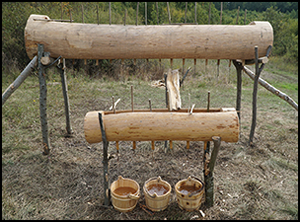
We describe the first three of these experiments here. We made three replica troughs. The first, with both ends closed, is modelled on Figa's Trough 7; it is made of beech, is 2.9m long, with a capacity of approximately 200l. The second, modelled on Trough 3, is made of oak and has one end open and the other closed, with a capacity of 40–50l. Like the original, it is 1.8m long with 15 circular holes in the base. The third is modelled on Trough 6 and made of spruce; it is somewhat circular in cross-section, 1.3m long, with both ends closed and has a capacity of approximately 25l. We also fashioned a range of pegs from elder wood, and rods for plugging them. Wooden buckets were used to collect filtered and decanted brine and poles used to support the troughs in position (Figure 8, top). Other objects were made of hazel and oak for the sticks (rods), willow for the baskets, and oak, hornbeam and beech for the poles and stakes to support the troughs.
Top) experimental troughs set up over the rock salt; bottom) depressions formed in the rock salt after water was allowed to drip onto it (figure courtesy of the National Museum of the Eastern Carpathians).

The experiments took place over several weeks in 2017 and 2018, and were conducted mainly by Buzea, with the assistance of skilled workers from the village of Figa. We assessed two potential methods of operating the troughs: first, using the basal holes of the troughs to direct dripping water onto an exposed rock salt surface, allowing it to be broken up (as suggested by Preisig Reference Preisig1877); and second, various methods of using the troughs to concentrate and purify brine.
To assess the first of the possibilities, we positioned the troughs above exposed rock salt surfaces, filled them with fresh water, and allowed the water to drip through the basal holes in the troughs; the holes were plugged with tubular pegs into which we had inserted rods wrapped with twisted cord. Over a few hours, between 10 and 20 depressions were created in the rock salt surface, 100 to 150mm apart and 70 to 120mm deep (Figure 8: bottom). Each depression generated between one and three cracks in the surrounding rock salt, approximately 1m long and 50 to 100mm deep. The holes and cracks enabled us to insert wooden wedges. Using heavy wooden mallets (Figure 9A), the wedges were pushed down to a depth of approximately 200mm. Finally, using hooked timbers, lumps of rock salt could be detached from the substrate (Figure 9B). The larger pieces were then easily broken up with stone hammers, similar to the waisted hammers known from the literature. In this way, small pieces of rock salt, as well as wet and soft fine salt, were easily separated from the outcrop; some 50kg of fine salt were collected in 30 minutes during the experiment.
Top) hammering wedges into the channels formed; bottom) tools used in the experiment (bucket, hafted stone hammer, scoop), and the rock salt collected (figure courtesy of the National Museum of the Eastern Carpathians).

Turning to the second of our two main hypotheses for the possible use of the troughs, we experimented with different methods to purify and concentrate brine. First, we filled a trough with salty mud and brine and let the latter filter through the mud via the basal holes of the trough, plugged with pegs and rods, either into a container situated below or into a second trough where it was filtered again (Figure 10A). This process might explain how several troughs could be used in sequence and it achieved some concentration of the brine, but insufficient to validate the effectiveness of the approach.
Top) troughs set up for the filtering experiment; bottom) view of the trough interior with the bungs inserted and held in place by split sticks (rods) (figure courtesy of the National Museum of the Eastern Carpathians).

Our second experiment involved heating the brine in the troughs. Hot stones, heated in an open fire, were immersed in the brine, bringing it to the boil. The boiling continued until the salt began to crystallise. The trough, full of concentrated brine, was then left for several hours. The insoluble impurities of the brine settled according to their specific weight: the lightest floated to the top, while the heaviest (metals and minerals) settled on the bottom. Between the sediment on the bottom of the trough and that floating at the top was a thick layer of clean brine. The sediment at the bottom was never more than 30mm thick. The collars of the pegs that were inserted into the holes projected more than 30mm, so the upper edge of the pegs remained above the sediment. By raising and lowering the rods that were inserted into the hollow pegs (Figure 10B), the brine was directed via channel-shaped pieces of wood into the next trough to allow the process to be repeated, further concentrating the brine. The rods in the hollow pegs were fixed in position by sticks split along their lengths, set transversely over the trough opening.
Salt concentration after different procedures
Samples of brine were taken at various stages of the processes outlined above. Thirty-seven of these samples were analysed, using two methods: pycnometry, to measure density (i.e. the volume of solids in the liquid), and chemical (gravimetry), to measure the salt concentration achieved through evaporation. The analyses were conducted by Viorica Vasilache at the Alexandru Ioan Cuza University in Iași.
Unprocessed brine from the spring at the southern end of the site typically has a salt concentration of approximately 33 per cent, the figure varying according to the time of year and amount of recent precipitation. Decanting this unprocessed brine once through the trough pegs, using various methods of bunging, did not increase the salt concentration; in fact, it slightly reduced it to 26–27 per cent. In contrast, our second approach, putting a mix of salty mud and brine into the trough and filtering, produced a concentration of 18 per cent. The strongest concentration of the brine, however, was achieved by adding hot stones to the filled troughs; in this way, the concentration increased to as much as 35 per cent, though varied considerably depending on when the samples were taken—specifically the amount of time the brine had been allowed to cool. It therefore appears that the hot stone technique is a more effective method of concentrating brine than attempting to do so by repeated decantation, which only produced clean, not more concentrated, brine. Using hot stones was, however, laborious and only resulted in a very modest increase in salt concentration. An additional consideration is that the concentration of unprocessed brine varies according to the weather. The experiments were conducted when the weather was dry and the brine was already comparatively concentrated; it is possible that, during wet weather, when the natural brine is less concentrated, this method might be more effective.
Returning to the two main hypotheses for the possible use of the troughs—to assist in the breaking up of rock salt surfaces versus the concentrating of brine—the former seems to be far more convincing, even if this result does not rule out the additional use of the troughs to produce pure, filtered brine, which might then be concentrated by other means.
Conclusions
While none of the experiments conclusively verifies any of the potential processes, the results do enable us to exclude some of them at Băile Figa, and therefore presumably also at other sites that used the trough technique. First, the possibility that brine would become more concentrated simply by passing from one trough to another is not supported by our results. There was no measurable increase in brine concentration; indeed, in some experiments, the concentration decreased. Second, the only method that resulted in an increase in salinity was the adding of hot stones to the brine. The lack of any archaeological evidence for stones being used for such a purpose, and the difficulty of managing the boiling water and removing the salt crystals, however, argue against this hypothesis.
We therefore conclude that, while the troughs could have been used in a variety of ways—and we admit that our experiments cannot be regarded as conclusive—one of the most likely methods is that originally suggested by Preisig (Reference Preisig1877): the use of the troughs to drip water onto rock salt surfaces to break them up and allow the salt to be collected for further processing. The presence of multiple troughs from the same location suggests that the intention was to maximise output by using several simultaneously. An important factor here, however, is that the dripping technique only works with fresh water, not with brine. This has implications for sites where fresh water was not easily available, an aspect that we shall address in future experimental work.
Our experiments demonstrate that the use of troughs could facilitate the collection of a large amount of salt in a relatively short time (excluding the time needed to make the troughs and set them up). Using such a process, it is likely that the quantities of salt thus produced could be made available to communities both local and distant; in other words, the salt could have been distributed throughout the Carpathian Basin and, in particular, reached the saltless areas of the Danube basin, especially the Great Hungarian Plain. We have touched on the question of the salt trade in our earlier work (Harding & Kavruk Reference Harding and Kavruk2013: 212–17); a dense network of mainly riverine trade traversed Transylvania and adjacent areas in the medieval and early modern periods—a pattern which is also plausible for prehistory.
We may therefore ask why the trough technique, which is demonstrably so efficient, was not adopted more widely across Europe. We currently do not know the answer to this question but surmise that in the hot summers of the Mediterranean area such elaborate technologies were perhaps unnecessary, as solar evaporation was sufficient, while further north, the briquetage tradition was firmly established as the principal means of producing salt. It is possible that the availability of rock salt at an easily accessible depth was perhaps the critical factor: in Northern and Western Europe, such rock is often deep underground, so that it was only possible to use brine springs and streams, whereas in the Carpathian region, rock salt is often found at or near the surface.
Salt production in ancient Europe was an important and well-developed industry. Processing methods varied across the continent according to local resources and possibilities. Briquetage was by far the most widely used technique, found not only in Central and Northern Europe but also along some Mediterranean shores, notably in Italy. Quarrying or mining of rock salt obviously depended on the rock being accessible. The trough technique discussed here in the context of Bronze Age Transylvania seems to have been highly productive, and arguably the source of salt both for local communities and for more distant populations who lacked access to salt of their own. So far, this technique is known only from Transylvania and western Ukraine. While there are many sources of salt in Romania, southern Poland and adjacent parts of Slovakia and Ukraine, at present it is unclear—with some exceptions—how that salt was produced, though we anticipate that further evidence of the trough technique may emerge in these areas. Whichever the specific usage of the wooden troughs in salt production, it remains true that Transylvania and neighbouring areas were able to supply salt to large areas of Central and Eastern Europe during the Bronze Age.
Acknowledgements
The experimental work was supported by the EthnosalRo3 project (http://ethnosalro.uaic.ro) directed by Marius Alexianu (Alexandru Ioan Cuza University, Iași), to whom we are most grateful. Viorica Vasilache, also of the Alexandru Ioan Cuza University in Iași (ARHEOINVEST, Interdisciplinary Platform Laboratory of Scientific Investigation and Cultural Heritage Conservation) conducted the analysis of the brine composition. Many people have worked with us at Băile Figa, including a number of skilled workers from Figa village; to all of them we express our gratitude. We are also grateful to two anonymous reviewers for their helpful suggestions.
Funding statement
The 2017 experimental work was supported by a grant from the Romanian Ministry of Research and Innovation, CNCS–UEFISCDI (project no. 151/2017, PN-III-P4-ID-PCE-2016-0759).
Supplementary materials
To view supplementary material for this article, please visit https://doi.org/10.15184/aqy.2023.57.


 Open access

