





Increasing food consumption due to the rapid increase in the world population, limited energy resources and inefficient use of existing resources brings the concept of sustainability to the agenda. The food production, supply and consumption chains significantly impact the natural environment, and ensuring healthy and sustainable nutrition for the growing world population is becoming increasingly challenging(Reference Serra-Majem, Tomaino and Dernini1). Environmental pollution, climate change, environmental stress, biodiversity loss and increases in nutrition-related diseases pose challenges for society and the food system. The global population is expected to reach 10 billion by 2050(Reference Chapman, Power and Netzel2), making accessing adequate and healthy food difficult. Concerns are raised about the effects of the quantity and quality of food consumed on human health. In particular, obesity, diabetes, cardiovascular diseases and other chronic diseases associated with overnutrition and poor food quality are on the rise worldwide(Reference Verma and Hussain3). Consequently, sustainable and higher-quality foods must be produced for a healthy planet and a growing global population(Reference Chapman, Power and Netzel2,Reference Liu, Li and Wang4) .
Sustainable diets, defined as diets with low environmental impacts that contribute to food security and healthy living for future generations, have the opportunity to improve environmental health. Some foods (e.g., red meat and animal products) contribute more to diet-related environmental factors than other foods, and diets containing high amounts of these foods have higher negative environmental impacts than plant-based diets(Reference Whittall, Warwick and Guy5). Sustainable food consumption significantly improves global nutrition/health standards while reducing human environmental footprints. Food systems need to be transformed to achieve the United Nations 2030 Sustainable Development Goals, which include safe and nutritious food, improved health and better management of agricultural systems and natural resources(Reference Conrad, Drewnowski and Belury6). Calculating the impact of current dietary patterns on environmental sustainability is critical for more sustainable food systems.
The effect of the national diet on environmental factors was assessed in Türkiye(Reference Ilhan, Yenicag and Yalcin Pehlivan7). This study aimed to determine the change in food consumption within the national diet over the years. It also assessed how these changes contributed to greenhouse gas emissions (GHGE) and water footprint (WF). This is the first study to assess changes in diet-related environmental factors (GHGE and WF) nationally in Türkiye over the years.
Materials and methods
This descriptive study assesses the national diet’s GHGE and WF using data from the 2010 and 2017 Türkiye Nutrition and Health Survey (TNHS). The sample size was 9012 individuals (3390 males, 5622 females) for TNHS 2010 and 12318 individuals (5516 males, 6802 females) for TNHS 2017. The TNHS 2010 and 2017, conducted by the Turkish Ministry of Health, have representative sample sizes for Türkiye. The appropriateness of the study for the use of TNHS data was approved by the decision of the Hacettepe University Non-Interventional Clinical Research Ethics Committee with the registration number GO 19/1177. In addition, the necessary permission was obtained from the Ministry of Health (E-49654233-604.02).
Dietary intake assessment
Individual food consumption was assessed by 24-h recall in the TNHS 2010 and 2017. In TNHS 2010, the 24-h recall was taken for one day(8), while in TNHS 2017, it was taken twice with an interval of 2 weeks (10–14 d) in line with the recommendation of the European Food Safety Authority(9). On the first day, the interview was performed face-to-face; on the second day, the individuals were scheduled for face-to-face or telephone interviews(10). The ‘Food and Nutrition Photo Catalog: Measurements and Quantities’ was used to determine the quantities of food and beverages consumed(Reference Rakıcıoğlu, Tek, Ayaz and Pekcan11). ‘Standardized Recipes’ were used to determine the amounts of foods included in the meals consumed(Reference Merdol12). The diet’s GHGE and WF were calculated based on the gram amounts of the foods consumed.
Greenhouse gas emissions
The diet-related GHGE calculation was made using the database developed by Heller et al.(Reference Heller, Willits-Smith and Meyer13). Again, the carbon footprint value of the consumers was determined by using the CO2 equivalent (CO2eq) values per kg specified in the database for each food through the current consumption amount and the type of food consumed. In calculating GHGE, the values of similar foods were used for foods not available in the databases.
Water footprint
The diet-related WF was calculated using the database developed by Hoekstra et al.(Reference Mekonnen and Hoekstra14,Reference Mekonnen and Hoekstra15) . The WF of individuals was determined by using the WF value per ton specified in the database for each food based on the amount of consumption and type of food consumed. Again, blue, green and grey WF were calculated for each individual based on the foods consumed daily. The individual assessments’ results determined the entire sample’s total WF and the percentage distributions according to blue, green and grey WF. In calculating the WF, the values of similar foods were used for foods unavailable in the databases.
Statistical analysis
The SPSS23 package programme was used for statistical analysis. The suitability of the data for normal distribution was examined with histogram and detrended plot graphs, kurtosis and skewness/asymmetry coefficients, coefficient of variation and Kolmogorov–Simirnov or Shapiro–Wilks tests considering the number of data. An independent samples t-test was used to evaluate the statistical significance of the difference between the means of two normally distributed variables, and the Mann–Whitney U test, which is the nonparametric equivalent of the test, was used to evaluate the differences between the means of non-normally distributed variables.
Results
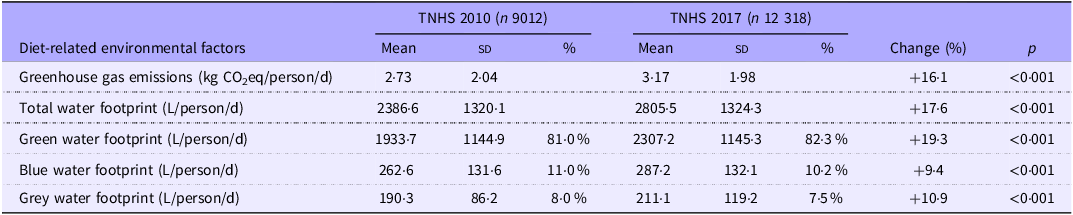
Table 1 shows the changes in GHGE and WF of the national diet in Türkiye over the years. According to TNHS data, GHGE increased by 16·1 %, total WF by 17.6 %, green WF by 19·3 %, blue WF by 9·4 % and grey WF by 10·9 % in 2017 compared to 2010 (p < 0·001).
The greenhouse gas emissions and water footprint of the national diet in Türkiye by year

Abbreviations: TNHS, Türkiye Nutrition and Health Survey.
Mann–Whitney U test (p < 0.05).
%, n: Greenhouse gas emissions and water footprint contribution percentage.
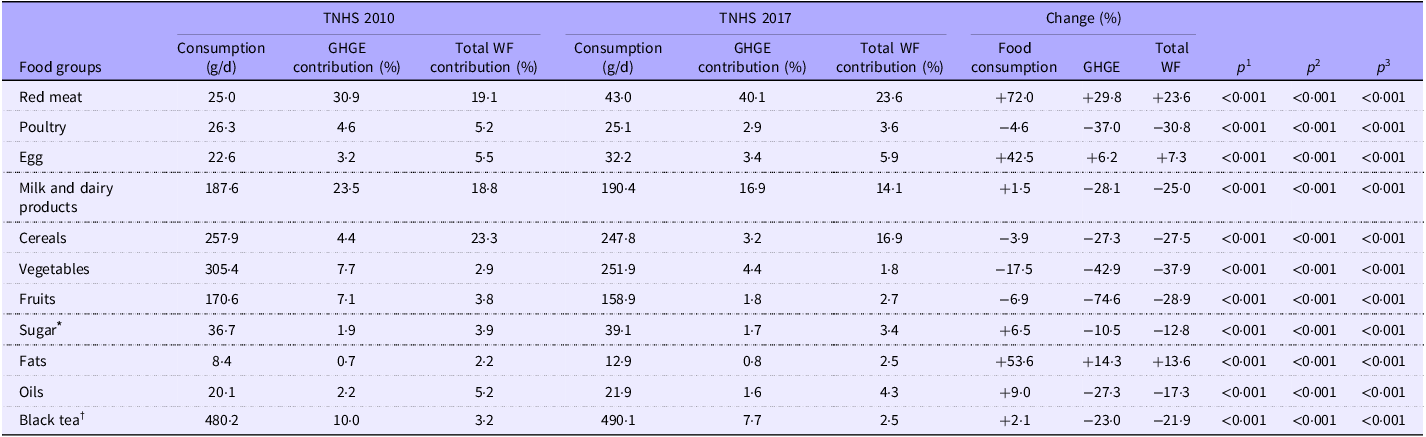
According to the TNHS 2010 and 2017 conducted at the national level, daily red meat consumption was 25·0 g/d and 43·0 g/d, egg consumption was 22·6 g/d and 32·2 g/d, respectively, and fat consumption was 8·4 g/d and 12·9 g/d, respectively. In 2010 and 2017, consumption of red meats (72 %), eggs (42·5 %) and fats (53·6 %) increased significantly (p < 0·001). However, the most significant decreases were observed for fresh vegetables (TNHS 2010:305·4 g/d; TNHS 2017:251·9 g/d) and fruits (TNHS 2010:170·6 g/d; TNHS 2017:158·9 g/d) (–17·5 % and –6·9 %, respectively) (p < 0·001) (Table 2).
Daily consumption of foods and their contribution to greenhouse gas emissions and total water footprint

Abbreviations: TNHS, Türkiye Nutrition and Health Survey; GHGE, Greenhouse gas emissions; WF, Water footprint.
Independent samples t test (p < 0.05). p 1: (Consumption: TNHS 2010–2017), p 2: (Greenhouse gas emissions contribution: TNHS 2010–2017), p 3: (Total water footprint: TNHS 2010–2017).
* Sugar, confectionery, chocolates, jams, honey, wafers, biscuits, crackers, cakes and pastries.
† mL/d.
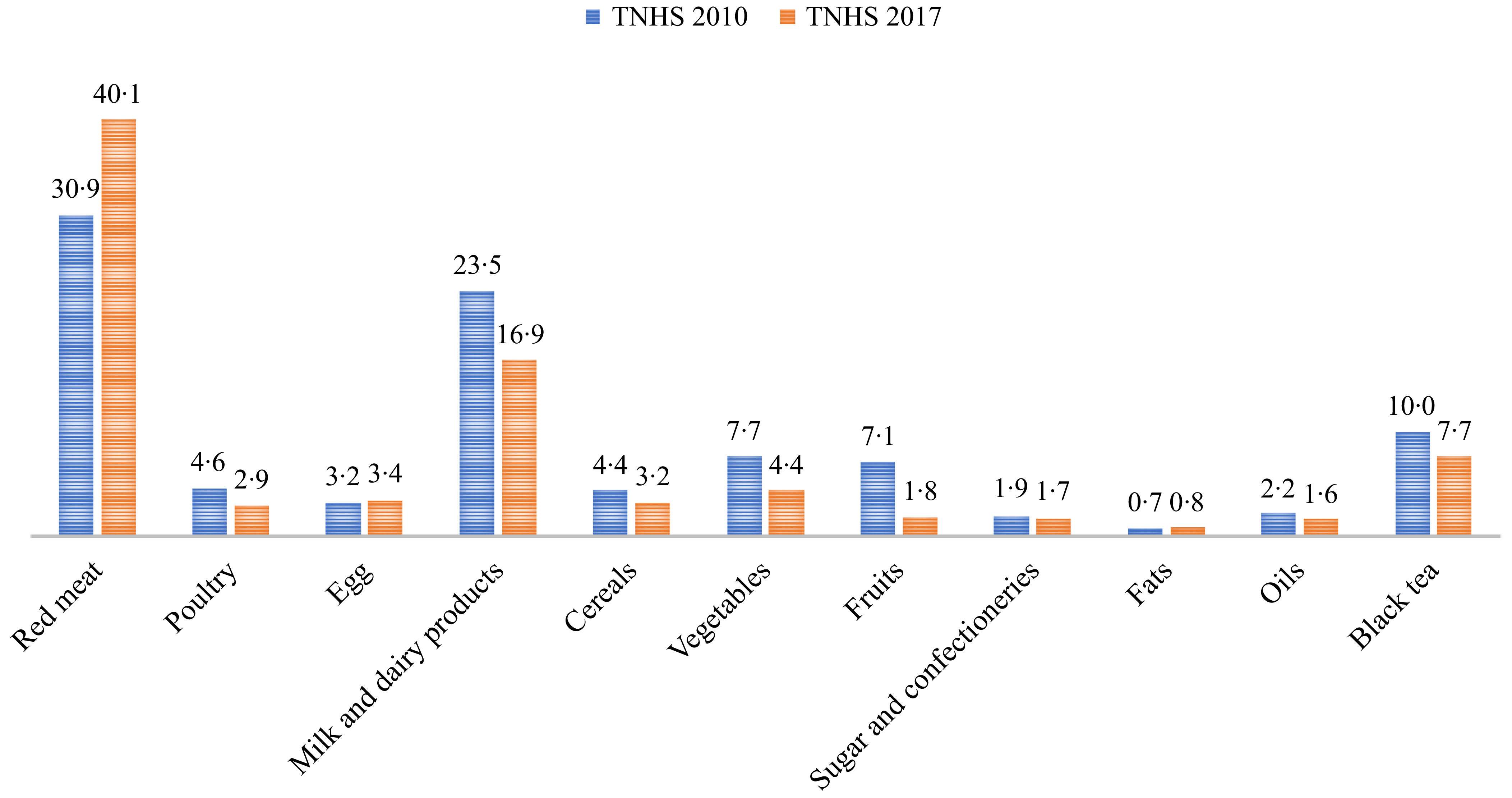
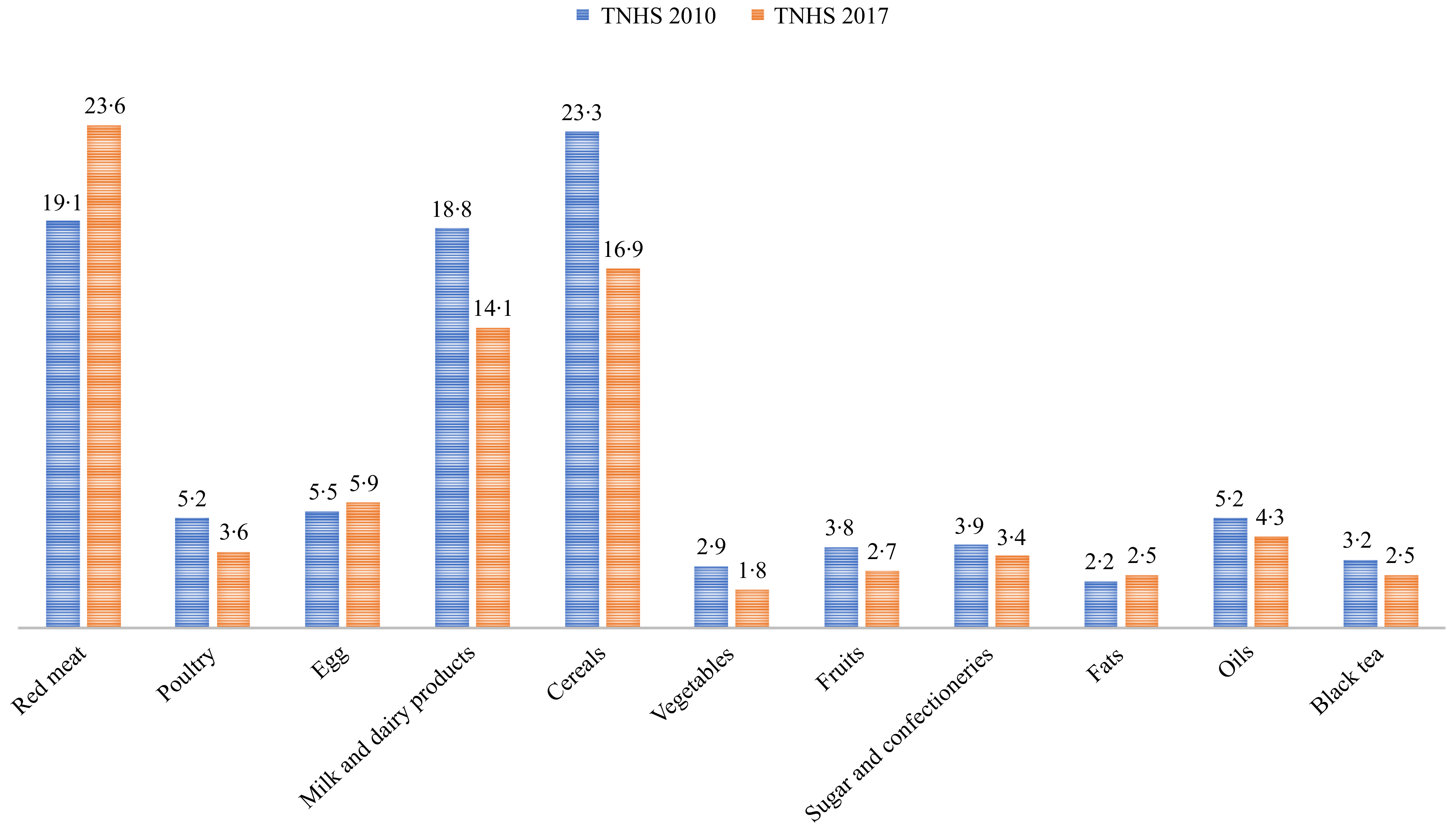
Table 2, Figures 1 and 2 show the daily consumption amounts of foods, their contribution to GHGE, total WF and the changes in these values according to the TNHS 2010 and 2017. In TNHS 2010, red meats (30·9 %) and dairy products (23·5 %) made the highest contribution to GHGE, while fats (0·7 %) and sugar and confectionery (1·9 %) made the lowest contribution. In TNHS 2017, red meats (40·1 %) and dairy products (16·9 %) made the highest contribution to GHGE, while fats (0·8 %) and oils (1·6 %) made the lowest contribution (p < 0·001) (Figure 1). According to TNHS 2010 data, cereals (23·3 %) and red meats (19·1 %) made the highest contribution to the total WF, while fats (2·2 %) and vegetables (2·9 %) made the lowest contribution. In TNHS 2017, red meats (23·6 %) and cereals (16·9 %) made the highest contribution to the WF, while vegetables (1·8 %), fats (2·5 %) and black tea (2·5 %) made the lowest contribution (p < 0·001) (Figure 2).
Contribution of foods to greenhouse gas emissions by year (%).

Contribution of foods to total water footprint by year (%).

In 2010 and 2017, red meats (GHGE: +29·8 %; total WF: +23·6 %) and fats (GHGE: +14·3 %; total WF: +13·6 %) were the foods that increased their contribution to GHGE and total WF the most. Fruits and vegetables (–74·6 % and –42·9 %, respectively) were found to have a decreasing contribution to GHGE. Vegetables and poultry were the foods with the greatest decreases in their contribution to the total water footprint, declining by 37·9 % and 30·8 %, respectively (p < 0·001) (Table 2).
Discussion
The change in the environmental impact of the national diet consumed in Türkiye in 2010 and 2017 was assessed by calculating the contribution of foods to GHGE and WF based on their daily consumption amounts. This is the first study to assess the change in the environmental impact of the national diet in Türkiye through individual food consumption.
Although the GHGE of the Turkish national diet increased in 2017 compared to 2010 (2·73 ± 2·04 kg CO2eq/d and 3·17 ± 1·98 kg CO2eq/d), they are below the world average compared with other country studies where diet-related environmental factors were calculated with similar methods (Table 1). GHGE values are 3·01 kg CO2eq/d in Spain(Reference González, Bonet and de Pablo16), 3·4 kg CO2eq/d in Australia(Reference Ridoutt, Baird and Hendrie17), 4·51 kg CO2eq/d in Vietnam(Reference Nguyen, Biesbroek and Le18), 4·67 kg CO2eq/d in Chile(Reference Gormaz, Cortés and Tiboni-Oschilewski19), 5·0 kg CO2eq/d in the Netherlands(Reference Vellinga, van de Kamp and Toxopeus20), 5·2 kg CO2eq/d in Italy(Reference Mertens, Kuijsten and van Zanten21) and 5·48 kg CO2eq/d in Argentina(Reference Arrieta and Gonzalez22). In addition, the total WF of the national diet in Türkiye increased significantly in 2017 compared to 2010 (2386·6 ± 1320·1 L/person/d and 2805·5 ± 1324·3 L/person/d, respectively) (Table 1). Nevertheless, the total WF of the diet is also lower than in Brazil (3478·4 L/person/d)(Reference Travassos, da Cunha and Coelho23), in Iran (4110 L/person/d)(Reference Sobhani, Rezazadeh and Omidvar24), in Chile (4177 L/person/d)(Reference Gormaz, Cortés and Tiboni-Oschilewski19) and in Mexico (6619·5 L/person/d)(Reference Lares-Michel, Housni and Aguilera Cervantes25). Despite the increase in animal-based food consumption in Türkiye over the years, the fact that the national diet is based on cereals has contributed to GHGE and total WF values below the world average. In Türkiye, the population’s staple foods are bread (179·8 g/d) and other cereal products (73·6 g/d)(10).
The results of food consumption surveys show that red meat in the diet worldwide is the most significant contributor to GHGE and total WF(Reference Heller, Willits-Smith and Meyer13,Reference Travassos, da Cunha and Coelho23,Reference Lares-Michel, Housni and Aguilera Cervantes25,Reference Auclair and Burgos26) . Depending on the country where the research was conducted, dairy products(10,Reference Lares-Michel, Housni and Aguilera Cervantes25,Reference Auclair and Burgos26) , corn products(Reference López-Olmedo, Stern and Bakhtsiyarava27), rice or legumes(Reference Travassos, da Cunha and Coelho23) may be the second most important contributors to GHGE. According to TNHS 2010 and 2017 data, red meat and dairy products are Türkiye’s first and second most significant contributors to GHGE. While cereals and red meats were the first and second most significant contributors to the total WF in 2010, red meats and cereals were the first and second most significant contributors to the total WF in 2017. This change was driven by an increase in the consumption of red meats (72 %) and a decrease in the consumption of cereals (−3·9 %) in 2017 compared to 2010 in Türkiye (Figures 1 and 2).
Studies on the assessment of the environmental impacts of diet have primarily focused on the contributions of red meat, dairy products and cereals(Reference Heller, Willits-Smith and Meyer13–Reference Mekonnen and Hoekstra15). Unlike other countries, black tea is Türkiye’s third most significant contributor to GHGE (Table 2, Figure 1). Black tea is a traditional Turkish beverage. Daily black tea consumption was 480·2 mL in TNHS 2010 and 490·1 mL in TNHS 2017. Black tea consumption contributed 10·0 % and 7·7 % to GHGE and 3·2 % and 2·5 % to total WF for TNHS 2010 and 2017, respectively (Table 2). Considering the high prevalence of anaemia in Türkiye(10), consuming black tea away from meals may be recommended for anemia, and drinking light tea may be recommended to reduce the effect of diet-related environmental factors.
Consumption of red meat and other animal-based foods contributes to unhealthy diets by increasing saturated fat and salt intake(Reference Castañé and Antón28). Furthermore, many studies have shown that diets rich in animal-based foods have negative environmental impacts with high GHGE and water and land use(Reference Alexander, Brown and Arneth29,Reference Behrens, Kiefte-de Jong and Bosker30) . Therefore, reducing the consumption of animal-based foods has been proposed as the primary method to reduce environmental impacts. Guy et al.(Reference Guy, Bray and Appleton31) researched the impact of twelve different dietary patterns on health, environment and cost. They showed that dietary patterns in which meat consumption was reduced and/or meat was replaced with legumes or eggs were the most efficient regarding health, environment and cost. In Türkiye, per capita red meat consumption increased approximately 2·3-fold between 1961 and 2019(32). In TNHS 2017, it was also found that red meat consumption increased by 72 % compared to TNHS 2010, and this increase increased red meat’s contribution to GHGE and total WF by 29·8 % and 23·6 %, respectively (Table 2). The increasing consumption trend of animal-based proteins such as red meat, chicken and eggs in Turkish cuisine can be effective in terms of sustainability(10). Considering the high prevalence of anemia in Türkiye(10), avoiding or reducing animal food consumption may also contribute to micronutrient deficiencies such as iron, zinc, calcium and vitamin B12 (Reference Derbyshire33,Reference Arslan, Aydın and Gerboğa34) . Therefore, a holistic approach is required during assessment.
In a study conducted in Türkiye, GHGE was estimated as 4·12 kg CO2eq/d and WF as 4442 L/d according to the recommendations of the 2015-Türkiye Dietary Guidelines(Reference Kemaloglu, Oner and Soylu35). In this study, the change in the environmental impacts of the national diet in Türkiye was assessed based on actual individual food consumption records. Compared to the TNHS 2017 results, the GHGE and total WF calculated based on individual consumption recommendations were estimated to be about 30 % and 58 % higher, respectively. This difference in GHGE and WF values demonstrates the importance of accurately assessing the environmental impacts of a country’s national diet based on actual individual food consumption records rather than recommendations.
There is growing interest in changing the types of food consumed to improve sustainable nutrition and health. Many researchers are trying to replace protein-rich animal products such as meat, fish, eggs and milk with alternative protein sources produced by plants, edible insects, microbial fermentation and cell cultures(Reference McClements36). This change in dietary habits can significantly reduce GHGE, pollution, biodiversity loss and land and water use(Reference Parodi, Leip and De Boer37). However, the impact of the 2017 dietary profile in Türkiye on environmental factors suggests that there is no need for a radical change at this time. To prevent the negative environmental impacts of possible increases in animal-based food consumption in the future, it would be helpful to inform the public about the environmental impacts of diet and organise nutrition education programmes to explain the possible effects of dietary changes on environmental health.
The study’s strength is that it uses the 2010 and 2017 TNHS data, which are representative of Türkiye, and assesses changes in the environmental factors of the national diet over the years through individual food consumption. However, this study has several limitations. Since no national nutrition survey was conducted between 2010 and 2017 or after 2017, it has become impossible to assess changes over shorter periods. This gap limits the manuscript’s relevance to current policymaking, especially given dietary changes post-COVID-19 and economic crises. Second, 24-h recalls were used to assess diet-related environmental factors. The main limitation of the 24-h recall is its reliance on respondents’ memory, both to identify the foods and beverages consumed and to estimate their quantities. Another important limitation of food consumption records is under- or over-reporting of consumption. Third, the databases used to assess diet-related GHGE and WF have limitations. There is no database specific to Türkiye for assessing diet-related GHGE. Fertilisers, pesticides, irrigation systems and energy types used in agricultural practices and food production vary from country to country. Failure to account for these differences can lead to overestimating or underestimating diet-related environmental indicators such as GHGE and WF. In addition, limited information on the location of irrigated areas in countries, the country’s need for irrigation and the lack of detailed information on country-specific data are limitations of GHGE and WF calculation databases.
Conclusion
Although Türkiye’s national diet’s GHGE and total WF values are below the world average, they increased in 2017 compared to 2010. Traditional dietary recommendations should be made based on each region’s climate, natural resources and cultural structure to promote a healthy and sustainable diet. After 2017, following significant events such as the COVID-19 pandemic and the economic crisis all over the world, the fact that a new national nutrition survey was not conducted in Türkiye for eight years until 2025 makes it difficult to understand the current situation and make recommendations. Organising nutrition education that emphasises the possible effects of changes in society’s diet on environmental health and foods that increase GHGE and WF will inform the public and raise awareness about the environmental impacts of diet. This initiative will contribute to promoting sustainable nutrition.
Acknowledgements
All authors have read and agreed to the published version of the manuscript.
The authors received no financial support for the research and/or authorship of this article.
A.I. and N.R. contributed to conception and design of the research; A.I. conducted data analysis; A.I. and N.R. contributed to interpretation of the data and manuscript draft; N.R. critically revised the manuscript; all authors read and approved the final manuscript.
The authors declare no conflict of interest concerning this article.

 Open access

