





1. Introduction
It is one thing to describe a tone system (or indeed, any phonological pattern), and another thing entirely to provide a theoretical analysis. This has proven to be the case in analysing the postlexical tone rules of Poko, a Skou language spoken in Sandaun Province in Papua New Guinea. First described by McPherson & Dryer (Reference McPherson and Dryer2021), Poko’s tone system is complex, with three phonemic tone levels in addition to toneless syllables and floating tones. At the postlexical level, toneless syllables strive for tonal specification and floating tones seek appropriate hosts. Phrase-medial apocope renders all stems monosyllabic, increasing the pressure on the tonal space. Though McPherson & Dryer describe these postlexical tonal operations, formal analysis reveals challenges in the data that cannot be accounted for in constraint-based theories with global evaluation, like traditional Optimality Theory (OT; Prince & Smolensky, [1993] Reference Prince and Smolensky2004) or even Harmonic Grammar (Legendre et al. Reference Legendre, Miyata and Smolensky1990a,Reference Legendre, Miyata and Smolenskyb). An incremental framework, such as traditional Harmonic Serialism (HS; Prince & Smolensky [1993] Reference Prince and Smolensky2004; McCarthy Reference McCarthy2000, Reference McCarthy, Baković, Itô and McCarthy2006, Reference McCarthy, Blaho and Bye2008, Reference McCarthy, McCarthy and Pater2016) is likewise not enough, as it fails to impose left-to-right directionality, which is crucial to account for the behaviour of floating tones.
In this article, we show that the analysis of Poko postlexical tone requires directional HS (Lamont Reference Lamont2022b), in which changes are made incrementally (as in traditional HS) and constraints are evaluated directionally; in the case of Poko, this directional evaluation must proceed from left to right. We introduce the pattern of interest in §3 and the theoretical arguments in §4. The complex patterns emerge from an interplay of cross-linguistically attested tonal phenomena, such as the OCP, a dispreference for non-final rising tones, the avoidance of complex contours and tone raising before L. Nevertheless, these common pressures have been phonologised in unique ways in Poko, as we demonstrate below.
The article is structured as follows: §2 provides background on the Poko language, the data sources and the lexical tone system. §3 first provides an overview of the mechanics of HS and its directional application (§3.1), then lays out the main patterns of postlexical tone, looking at floating H tones (§3.2), LH and LM rising tones (§3.3) and the behaviour of toneless stems (§3.4); in these sections, we demonstrate the challenges facing a traditional constraint-based implementation. §4 focuses on the theoretical arguments for the incremental directional approach against alternative analyses, and §5 concludes.
2. Background on Poko
2.1. The Poko(-Rawo) language
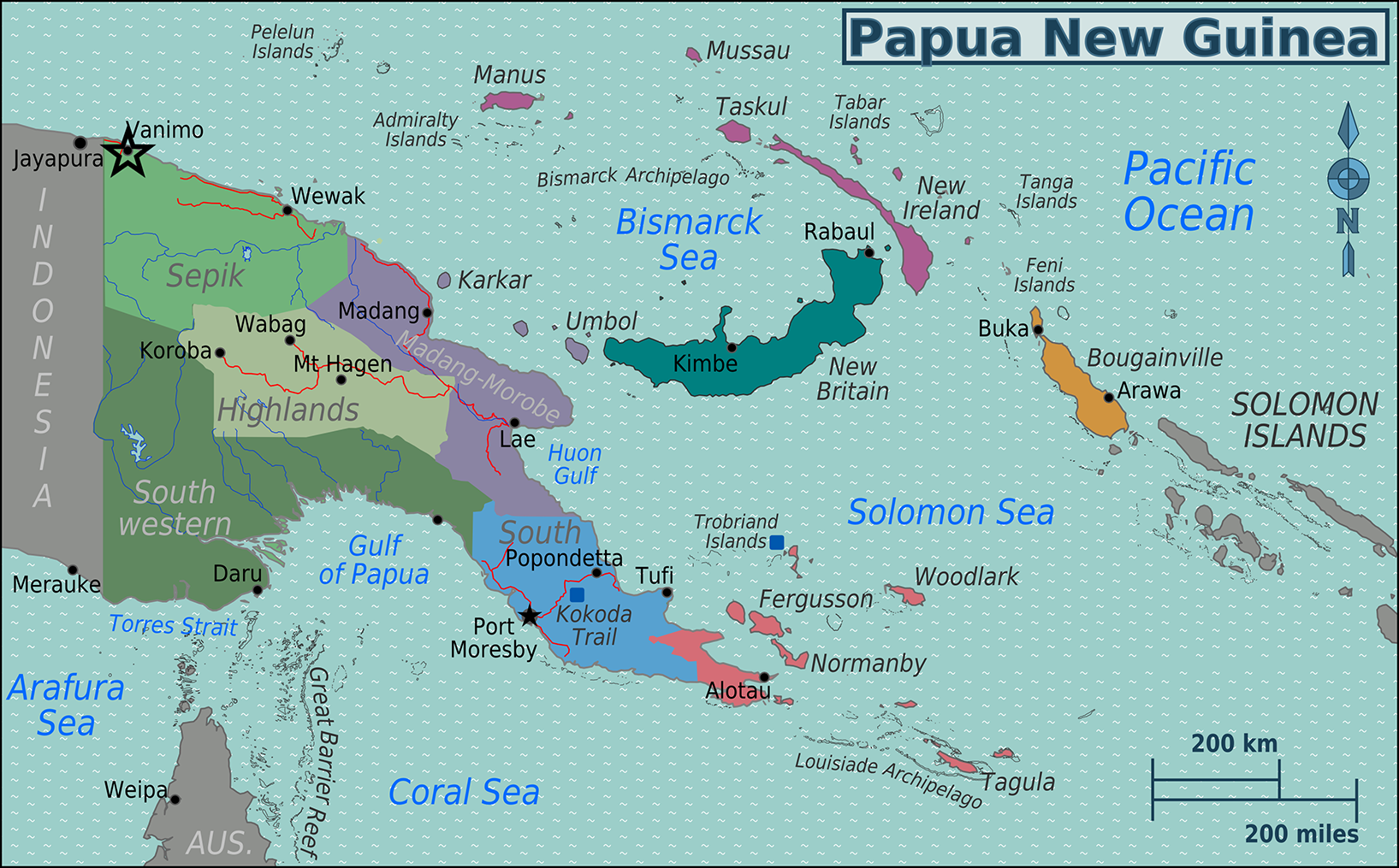
Poko, also known as Poko-Rawo, is a Skou language spoken in Sandaun Province of Papua New Guinea, near the border with West Papua; see the map in Figure 1. The name derives from villages in which it is, or was, spoken – it is no longer spoken in Rawo, where speakers have switched to Tok Pisin, and this shift is rapidly taking place in Poko as well. At the time of writing, there are likely no more than 100 speakers of the language (McPherson & Dryer Reference McPherson and Dryer2021).
A map of Papua New Guinea, with a star indicating the area where Poko is spoken (near the town of Vanimo). (Burmesedays, CC BY-SA 3.0, via Wikimedia Commons).
All of the data in this article are drawn from the first author’s primary field notes and those of Matthew Dryer and Lea Brown, who have worked on Poko for over 20 years. The majority of the tonal data are drawn from work with a single male speaker, Didicus Mari (born ca. 1982), though preliminary work with other speakers confirms the data patterns. For more background on the tonal corpus, see McPherson & Dryer (Reference McPherson and Dryer2021).
We provide a brief overview of the segmental and morphological structure of Poko that will be relevant to our discussion of postlexical tone. First, we analyse all stems in Poko as being either mono- or disyllabic. Any longer words either are transparently compounds or have segmental and tonal hallmarks of being compounds (consonant clusters, complex tone melodies, etc.).Footnote 1 Stems are also all vowel-final underlyingly, but the final vowels of disyllabic stems undergo apocope in phrase-medial position. For example:Footnote 2

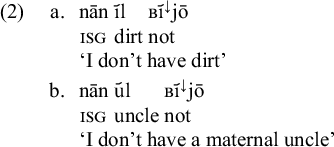
With some exceptions, discussed in §3, these so-called reduced medial forms display tonal stability (Goldsmith Reference Goldsmith1976), with the tone of the erstwhile final vowel reassociating to the preceding syllable. This means that in reduced forms of disyllables, certain tonal contrasts, such as that between  and
and  , are neutralised, as shown in (2) for
  ‘dirt’ vs.
  ‘uncle’. This neutralisation could partially explain the lack of minimal pairs between
  and
and  .
.
Poko morphology is very isolating, with the exception of a typologically unusual system of infixing subject agreement in verbs (prefixing in monosyllabic verbs); see McPherson & Dryer (Reference McPherson and Dryer2021) for examples. Both nominal and verbal compounds are attested, but from a tonal perspective there is no difference between a compound and a sequence of words. The same postlexical rules discussed in §3 apply in both configurations.
2.2. Poko tone system
The Poko tone system is based on three contrastive tone levels: low (L), mid (M) and high (H). Syllables can also be tonally underspecified ( $\varnothing $
), receiving tonal specification at the postlexical level from adjacent words, boundary tones or default tone insertion; see §3.4 for further discussion. These contrastive tones combine to create the basic lexical tone melodies shown, with examples, in (3). In addition to the underlying form, the table gives the pronunciation of each melody in isolation. Here,
$\varnothing $
), receiving tonal specification at the postlexical level from adjacent words, boundary tones or default tone insertion; see §3.4 for further discussion. These contrastive tones combine to create the basic lexical tone melodies shown, with examples, in (3). In addition to the underlying form, the table gives the pronunciation of each melody in isolation. Here,  and
and  words are highlighted in grey, as this contrast is neutralised in phrase-final position. We will return to the behaviour of the floating H tone in §3.2 and §4.

On disyllabic words, we find another melody,  . Stems with this melody, for instance
  ‘jungle’, appear in isolation as
  , but their postlexical behaviour reveals the presence of the floating H, as detailed in §3.2. In addition, disyllabic stems show contrastive association of two-tone melodies. While the most common pattern is shown in the table above, with each tone associating to a syllable, we find a handful of lexical items in which both tones are associated with the first syllable, leaving the second syllable toneless. For instance, we can contrast MH-toned
  ‘picture’ above with MH. $\varnothing $
-toned /bu᷄lu/ ‘mother’. Similarly, we can contrast LM-toned /rùbā/ ‘eagle sp.’ with
$\varnothing $
-toned /bu᷄lu/ ‘mother’. Similarly, we can contrast LM-toned /rùbā/ ‘eagle sp.’ with  -toned
  ‘cassowary’. Finally, we have found one example of a probable
  stem in the compound
  ‘meat’, where the second stem can be contrasted with
  ‘top’. As mentioned in §2.1, this association contrast is neutralised in reduced stems, where tonal stability reassociates the tone of the deleted final vowel to the left.
As described by McPherson & Dryer (Reference McPherson and Dryer2021) and McPherson (Reference McPherson, Kubozono, Itô and Mester2022), Poko’s lexical melodies all consist of zero to two tones, and there is a curious gap for level L and level H melodies. When we look at the combination of two tones, we find that H is never initial and L is never final, as shown in (4). This is true even of floating tones: floating L is always initial and floating H is always final.
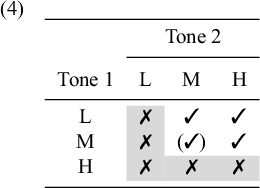
Note that MM shows a checkmark in parentheses, as it is indeterminate whether level M melodies consist of one multiply linked M autosegment or a sequence of two. Regardless of the autosegmental make-up, level L and level H melodies are unattested.
McPherson (Reference McPherson, Kubozono, Itô and Mester2022) argues that while Poko’s tone melodies are reminiscent of alignment patterns, they cannot be accounted for with traditional alignment constraints, since Align-L(L) and Align-R(H) would allow level  and
and  melodies so long as they extend to the appropriate edge. Anti-alignment constraints (Buckley Reference Buckley1994, Reference Buckley2009; Downing Reference Downing1994; Inkelas Reference Inkelas, Kager, Hulst and Zonneveld1999) fare better, but permit unattested sequences like
  or even
  , where the L tone does not extend to the right edge. Instead, McPherson argues that Poko’s melodies are the result of so-called ‘edge’ constraints that keep specific tones from being first or last in a particular domain. Specifically, NonInitial(H) penalises melodies with an initial H tone, and NonFinal(L) penalises melodies with a final L tone. Both the associated TBUs of the stem and the autosegmental tone melody are domains of evaluation for these constraints. For instance, the unattested sequence
  would be ruled out by a stem-level edge constraint NonFinal(L)-stem, since L is the final tone associated with the stem; at the melodic level, however, H is final, and the constraint is satisfied.
  (or equally
  ) would be ruled out by both stem-level and melody-level non-finality constraints for L. See McPherson (Reference McPherson, Kubozono, Itô and Mester2022) for further discussion.
As a simplification, we assume a stratal phonology (Kiparsky Reference Kiparsky1982; Bermúdez-Otero Reference Bermúdez-Otero, Oostendorp, Ewen, Hume and Rice2011, Reference Bermúdez-Otero and Trommer2012, Reference Bermúdez-Otero, Hannahs and Bosch2018), with Poko’s attested lexical melodies determined at the stem level. We do not claim that the constraint rankings between levels are necessarily different, but set aside stem level phonology to limit the scope of the present article. As noted in §1, our analysis assumes serial intrastratal derivations; see Calamaro (Reference Calamaro2017) for work on stratal HS. A rich base candidate with only L or H tone would be repaired through M tone epenthesis, as M is the least marked tone in Poko phonology. In other words, an input  would be repaired to the melody LM and an input
  would be repaired to MH, obeying non-finality for L tones and non-initiality for H tones.
The fact that a melody can contain no more than two tones is argued to be the result of the constraint in (5). As we will see below, this constraint remains active in the postlexical phonology.

Poko’s lexical melodies are somewhat unusual, especially the absence of simple melodies  and
and  . We might, however, understand them as an extreme response to the OCP: for the marked tones L and H, the lexical melodies are configured such that an OCP violation can never arise. It is possible that these lexical melodies are a result of diachronic pressure to avoid OCP violations in the evolution of Poko tone. Comparison with other Skou languages suggests that this could be the case. For instance, in the Skou language (also known as Tumawo), H is realised as MH before another H tone, which itself may undergo downstep, and Donohue (Reference Donohue and Kaji2003) describes this as a means of avoiding two identical pitch contours on adjacent syllables (though from a strictly autosegmental perspective, MH–H would still represent an OCP violation). Further evidence for OCP sensitivity comes from the postlexical tone rules, where the data patterns show that this is still an active force, at least for L tones.
For more details on the analysis of lexical tone, see McPherson (Reference McPherson, Kubozono, Itô and Mester2022).
3. Postlexical tone
The focus of this article is what happens to the lexical tone melodies when they combine. Interestingly, we find no evidence of morphological or syntactic boundaries in Poko’s postlexical tonology. The rules of tonal realisation are the same regardless of whether the morphemes in question are separate phonological words or compounds; likewise, we find no independent evidence of phonological phrasing in longer utterances. The postlexical phonology here can therefore be understood as applying to any combination of words or morphemes without reference to prosodic boundaries.
A general phonetic effect we will see in the following sections is peak delay (Myers Reference Myers1999; Akinlabi & Liberman Reference Akinlabi, Liberman, Gerlach and Grijzenhout2000; Xu Reference Xu2001), in which the f0 peak of a rising tone is often realised at the beginning of the following syllable rather than on the rising tone’s TBU. For instance, a phrase like nān  ‘I ate tulip (an edible green)’ (shown with phonological tones) is often realised as [nān ka᷄ na᷇], with the highest point of the MH rise on the beginning of the following word. This effect is gradient and sensitive to speech rate, and thus we analyse it as an aspect of phonetic implementation rather than as a phonological effect (i.e., we do not treat it as a phonological shift of the rise-final tone).
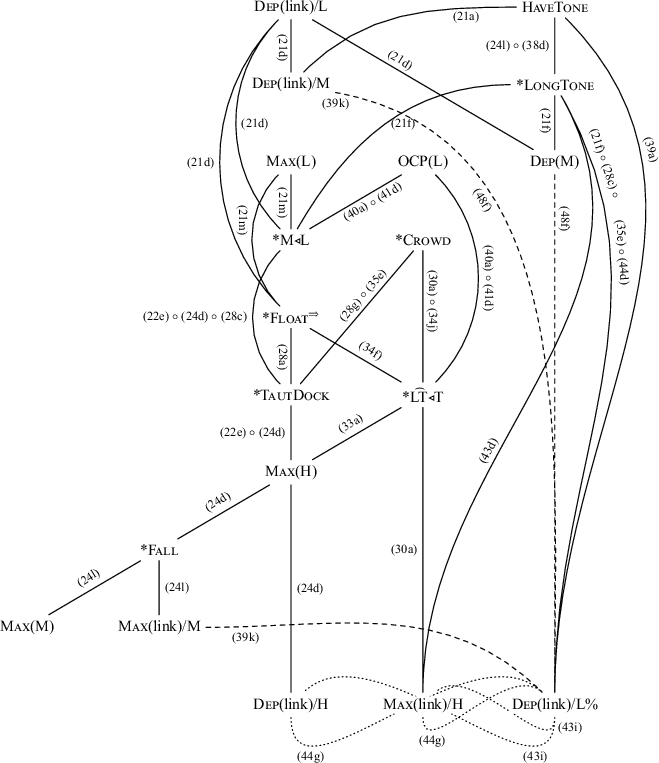
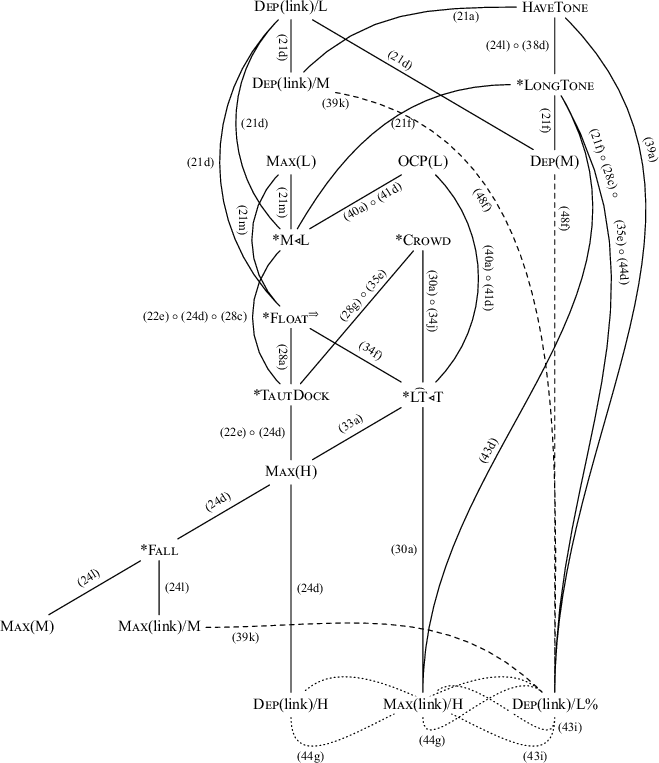
In the following subsections, we first examine the behaviour of Poko’s floating tones: floating L tones, which appear only at the left edge of a stem, and floating H tones, which appear only at the right edge of a stem (§3.2). We then turn to LM and LH rising tones, both of which are dispreferred in all but phrase-final position (§3.3). Finally, we look specifically at what happens to toneless stems when they do not take either a floating tone or a tone from a rising contour (§3.4). Here, we see the surfacing of a  boundary tone which goes unrealised in the presence of lexical tone. While many of the data patterns can be captured in parallel OT or traditional HS, the behaviour of floating H tones in particular defies either framework and points to the need for directional HS; we address these patterns and fully flesh out the directional analysis in §4. For the sake of continuity, we present HS tableaux throughout the following section. A full set of tableaux is provided in the Supplementary Material, and the Hasse diagram in Figure 2 summarises the constraint ranking. Before presenting the analysis of Poko, we briefly introduce HS and directional constraints in §3.1.
Hasse diagram. Dashed lines represent disjunctive rankings; dotted lines represent variable rankings. Referenced tableaux are in the Supplementary Material.
3.1. (Directional) Harmonic Serialism
Like parallel OT, HS is a constraint-based formalism where candidates generated from an input compete to best satisfy a hierarchy of strictly ranked constraints. HS restricts Gen to applying only one operation at a time, requiring multiple derivational steps to model mappings with multiple changes. Over the course of a derivation, optimal candidates are passed recursively back into the Gen–Eval loop until the faithful candidate is optimal. At that point, the derivation converges and returns the optimal candidate as the surface form.
We assume a standard set of operations, following McCarthy (Reference McCarthy, Baković, Itô and McCarthy2006, Reference McCarthy, Blaho and Bye2008), McCarthy et al. (Reference McCarthy, Mullin, Smith, Botma and Noske2012) and Lamont (Reference Lamont2022b,Reference Lamontc, Reference Lamont2025): Gen can insert a single autosegmental link, as in (6a), or delete one, as in (6b); it can delete a tone, as in (6c), or insert a tone and simultaneously associate it to a tone-bearing unit, as in (6d). Following Gietz et al. (Reference Gietz, Jurgec and Percival2023), we further allow Gen to shift a tone to an adjacent tone-bearing unit in one step, as in (6e). We do not claim that the analysis of post-lexical tone in Poko requires a shift operation, but we allow it in order to simplify derivations; see Lamont (Reference Lamont2025) for critical discussion.

Each operation in (6) violates either one or two faithfulness constraints; following Yip (Reference Yip2002) and Lamont (Reference Lamont2025), we model faithfulness by penalising the insertion or deletion of autosegmental associations with the constraints in (7a) and (7b), and the insertion or deletion of tones with the constraints in (7c) and (7d). Inserting an autosegmental link violates Dep(link)/H; removing one violates Max(link)/H. Deleting a H tone linked to a tone-bearing unit violates both Max(link)/H and Max(H), while deleting a floating H tone only violates the latter. Inserting and associating a H tone violates both Dep(link)/H and Dep(H), and shifting a H tone violates both Dep(link)/H and Max(link)/H. There are tone-specific versions of each of these four faithfulness constraints for each of the three tones in Poko: for example, Max(H), Max(M) and Max(L). Other constraints used in the analysis of Poko are defined in text as they become relevant; the Supplementary Material presents the full set with their definitions.

Because Gen is restricted, it is only possible to apply operations if they are optimal in a given step, differentiating the local predictions of HS from the global predictions of parallel OT (McCarthy Reference McCarthy, Baković, Itô and McCarthy2006, Reference McCarthy, Blaho and Bye2008). As an illustration, consider the mappings in (8), based on similar phenomena in Barasana (Tucanoan; Gomez-Imbert & Kenstowicz Reference Gomez-Imbert and Kenstowicz2000; Gomez-Imbert Reference Gomez-Imbert and Kaji2001; Hyman Reference Hyman, Avelino, Coler and Wetzels2016; Lamont Reference Lamont2023b). This language disallows words with multiple H tone spans, and so adjacent H tone spans fuse, as in (8a), and non-adjacent ones are repaired by deletion, as in (8b).

The phonotactic constraint OCP(H) in (9) formalises the ban on multiple H tone spans by penalising pairs of H tones that are adjacent on the tonal tier; as with the faithfulness constraints, there are tone-specific versions of the OCP in the analysis of Poko. For this example, we allow Gen to fuse adjacent H tone spans (see Takahashi Reference Takahashi2019 and Mooney Reference Mooney2022 for discussion of fusion in HS), which violates the faithfulness constraint Uniformity. Note that as defined, OCP(H) penalises multiple H tones, not multiple H-toned TBUs.

The tableau in (10) illustrates the derivation of fusion. Throughout this article, tableaux are presented in a hybrid format where both the severity of violation and its comparison to the winner are recorded (Prince Reference Prince2002; Brasoveanu & Prince Reference Brasoveanu and Prince2011). In the first step of the derivation, the faithful candidate, (10a), fatally violates OCP(H) and loses to an unfaithful candidate that fuses the H tones, (10c). Deletion, as in candidate (10b), is dispreferred because Max(H) dominates Uniformity. As the arrow along the side of the tableau indicates, the optimal candidate serves as the input to the next step, where the derivation converges. Because the faithful candidate does not violate any phonotactic constraints, there is no motivation to make any further changes.

When the H tone spans are separated by a tone-bearing unit, it is instead optimal to delete one, as illustrated in (11); we address the question of which high tone deletes below. Assuming Gen can only fuse adjacent tone spans, it does not produce a fusion candidate. Instead, the only operation that improves on OCP(H) is to delete one of the H tones, as in candidate (11b). If one tone were to spread in this step, as in (11c), fusion would be optimal in the next step. However, because Eval does not anticipate later steps, it is not possible to spread now in order to fuse later. This is unlike parallel OT, where the consequences of arbitrarily many changes are considered together.

Our analysis of postlexical tone in Poko adopts HS exactly because it exhibits mappings that require local optimisation. These mappings overapply H tone deletion, making them recalcitrant to analysis in parallel models (Chen Reference Chen, Hermans and Oostendorp1999; Vaux Reference Vaux, Vaux and Nevins2008; Vaux & Myler Reference Vaux, Myler, Hannahs and Bosch2018). As in (12), all floating H tones delete in a sequence of /MH/ stems. We argue that this can be modelled only if the floating tones delete one-by-one from left to right. If the grammar could delete multiple tones simultaneously, as in parallel OT, it would incorrectly retain high tones, mapping forms like  onto
onto  instead of the attested
  . This is because the grammar prefers to dock floating high tones rather than delete them.

Before we can convincingly make this argument, it is necessary to establish the analysis of postlexical tone in Poko, which we devote the rest of this section to. We return to the examples above in §4.
It is worth briefly introducing another technical mechanism relevant to §4, namely directional constraints (Eisner Reference Eisner2000, Reference Eisner, Isabelle, Charniak and Lin2002; Lamont Reference Lamont2022b). Traditional constraints, as in the tableaux above, count loci of violation and prefer candidates with fewer total loci to those with more total loci. Directional constraints instead record where loci occur relative to the input. Like counting constraints, they prefer candidates without loci to those with loci, but compare violating candidates in terms of where loci occur, preferring either loci further to the left or ones further to the right. Among other things, directional constraints are useful in breaking ties between candidates with equal numbers of loci (Lamont Reference Lamont2022a). For example, which H tone deletes in the example above can be decided by a directional constraint that penalises H tones, *H. The winning candidate in (10) preserves the leftmost H tone, implying that H tones further to the right are strictly worse than ones further left. This is modelled by evaluating *H right-to-left (indicated with a superscript arrow $^\Leftarrow $
), as illustrated in (13).
$^\Leftarrow $
), as illustrated in (13).  returns a violation vector with as many positions as there are tones in the input plus one to accommodate prothetic tones; note that positions are still numbered from left to right. The faithful candidate, (13a), has H tones at positions 2 and 1, and is dispreferred to the winner, (13b), which only has a H tone at position 1. Deleting the other H tone (as in (13c)) is dispreferred by
  because a locus at position 2 is strictly worse than one at position 1 in the same way that a violation of OCP(H) is strictly worse than a violation of Max(H).

As in (14), if *H were instead evaluated left-to-right (indicated with $^\Rightarrow $
), it would be optimal to delete the earlier H tone (candidate (14c)). The faithful candidate, (14a), is again dispreferred because it has violations at both positions 1 and 2. *H
$^\Rightarrow $
), it would be optimal to delete the earlier H tone (candidate (14c)). The faithful candidate, (14a), is again dispreferred because it has violations at both positions 1 and 2. *H $^\Rightarrow $
disprefers H tones further to the left, and disprefers deleting the second H tone (as in (14b)).
$^\Rightarrow $
disprefers H tones further to the left, and disprefers deleting the second H tone (as in (14b)).

In §4, we argue that the constraint against floating tones, *Float (defined in (16)), is evaluated left-to-right in Poko. This forces floating tones to delete left-to-right, accounting for the pattern in (12). While directional constraints do not provide a general solution to iterative overapplication (see Lamont Reference Lamont2022b: 73–75), they correctly model the pattern in Poko. Other postlexical phenomena are consistent with *Float simply counting loci, as they involve comparisons between candidates that satisfy *Float and those with one violation. To simplify the presentation throughout this section, we abbreviate violation vectors with a single locus as ‘(1)’; tableaux in §4 and in the Supplementary Material present the violation vectors in full.
3.2. Floating tones
Recall from §2 that Poko tone melodies can contain an initial floating L, a final floating H, or both. Broadly speaking, at the postlexical level, L tones in Poko are faithful to their lexical association (or lack thereof). That is, a stem that emerges from the lexical level with a floating L will retain the floating L at the postlexical level, and stems with lexically associated L tones will leave the L tone associated. We will turn to the behaviour of L tones in  and
and  rising tones in §3.3, but for now, consider monosyllabic LM stems, which take the lexical melody
  , or
, or  .Footnote 3 This is due to a ban in the lexical phonology on LM contour tones (L and M associated with a single syllable), and thus monosyllabic stems leave the L tone floating. As in many languages, the floating L triggers downstep on the following M tone. Thus, we can contrast
  [dā] ‘eat (3sg)’ and
 ‘go (3sg)’.
All floating L tones in Poko appear at the left edge of a morpheme, which means that any rightward association is tautomorphemic, penalised by Dep(link)/L and the constraint in (15):

Though *TautDock is not strictly necessary for understanding the behaviour of L tones, we include it in the tableau below for sake of completeness.
L tones thus remain floating in the output, showing that Dep(link)/L and Max(L) must dominate *Float:

The constraint HaveTone, defined in (17), penalises toneless syllables. This constraint drives epenthesis of default M tones, as in (18); its role and motivation are discussed further in §3.4.

The tableau in (18) demonstrates a sequence of a toneless stem  ‘dog’ followed by the
  stem
stem  ‘go (3sg)’. For consistency, we also include the L% boundary tone in all tableaux, though it only docks to toneless syllables; see §3.4 for further discussion. Because some constraints like *TautDock refer to morphological identity, we use colours to represent morphemic identity. Colours are assigned independently in each derivation and do not imply any relations between derivations. The colour palette, taken from Okabe & Ito (Reference Okabe and Ito2008), was chosen because of its accessibility to colourblindness. As mentioned previously, *Float carries the directional arrow $^\Rightarrow $
, because in our ultimate analysis (§4) it is evaluated left-to-right.
$^\Rightarrow $
, because in our ultimate analysis (§4) it is evaluated left-to-right.

This tableau demonstrates that the floating L tone in the input remains floating in the output, even though it has a toneless syllable to its left. This is due to the ranking of Dep(link)/L above Dep(M) and Dep(link)/M, which penalise the insertion of a default M tone, and can be seen by comparing losing candidate (18c) to winning candidate (18f). We will return to the behaviour of toneless stems in §3.4. The L tone cannot dock tautomorphemically, as in candidate (18d), because this is penalised by both Dep(link)/L and *TautDock. The ranking of Max(L) above *Float means that the floating tone is preserved (as in (18f)) rather than deleted (as in (18b)). The derivation converges in the second step with no further changes. We will turn to other constraints that appear in this tableau, such as *M $\triangleleft $
L, later in this subsection. Note that the boundary L% tone does not violate *Float or any of the constraints above; this is discussed in §3.3.
$\triangleleft $
L, later in this subsection. Note that the boundary L% tone does not violate *Float or any of the constraints above; this is discussed in §3.3.
Unlike floating L tones, floating H is not allowed to remain floating in the postlexical component. It must either find a place to dock or be deleted. The grammar prefers to dock H tones, and deletes them only to avoid tautomorphemic docking or tonal crowding. H tone deletion is itself dispreferred when it would create a sequence of a M tone followed by a L tone. In that case, tautomorphemic docking is tolerated.
We begin with /MH/ stems in phrase-final position, as in (19):

All floating H tones in Poko appear at the right edge of stems, as in (19). As we can see, the floating H tone is barred from docking leftward onto the stem that introduced it (in this context), and so instead it deletes. This gives us evidence for the following ranking:

This ranking is illustrated in the following tableau:

The faithful candidate (21a) leaves the H floating and is ruled out by *Float. Associating the H tone leftward onto rī, as in candidate (21c), violates *TautDock, since the floating H is part of the same morpheme (as indicated by the matching colours); this candidate also incurs a violation of lower-ranked Dep(link)/H for adding an association line to a H tone. Thus candidate (21b), in which the H tone is deleted, is chosen as the winner, since Max(H) is ranked below both of these other constraints.
If a  stem is followed by a toneless stem or a plain /M/ stem (not
  , as we’ll see shortly), the floating H docks rightward onto the first syllable of the following stem. As (22b) shows, H is able to overwrite a M tone in Poko:

In (22a), we see the floating H from rīH ‘pig’ dock rightward onto the toneless stem ne ‘make (1sg)’, rendering it H-toned (though H tones are realised as [MH] in phrase-final position because of peak delay). A comparable situation holds in (22b), though in this case, the H tone overwrites the M tone on nā ‘eat (1sg)’.
These configurations provide evidence for a constraint penalising falling contours:

When a floating H docks onto a M-toned syllable, it does not create a HM contour (on the surface); instead, it overwrites the M tone. In fact, any falling contour tones, including HM, are unattested in Poko,Footnote 4 and thus the constraint *Fall is ranked high in the language to rule them out. Because the M tone deletes, we know that Max(H) must outrank Max(M). This constraint ranking is illustrated in the following tableau, which requires three steps to converge.

In the first step, faithful candidate (24a) is ruled out by *Float. Deleting the floating tone, as in candidate (24b), incurs a violation of Max(H), and tautomorphemic docking of the floating tone in candidate (24c) incurs a violation of *TautDock. Both of these constraints outrank Dep(link)/H and *Fall, violated by candidate (24d), and hence candidate (24d) is optimal, despite its falling contour tone. In the second step, however, this falling tone is repaired. Simply delinking either tone, as in candidates (24h) and (24i), reintroduces a floating tone, and these candidates are ruled out by the high-ranked *Float. Shifting the H back onto rī, as in candidate (24j), incurs a violation of *TautDock. Thus, the only option is to delete one of the two tones, and since Max(H) outranks Max(M), candidate (24g) is optimal, and the analysis converges on this candidate in the third and last step, as it incurs no violations. Note that candidate (24j) illustrates our assumption that Gen can shift a tone in one step, following Gietz et al. (Reference Gietz, Jurgec and Percival2023) (though see Lamont Reference Lamont2025 for critical discussion).
On a disyllabic stem, the floating H docks to the first syllable only, yielding H. $\varnothing $
on toneless stems (though see §3.4 for the behaviour of phrase-final toneless syllables, as in (51) and (53)) and H.M on /M/ stems; we can see, then, that at the postlexical level, restrictions against initial H tones are no longer active.
$\varnothing $
on toneless stems (though see §3.4 for the behaviour of phrase-final toneless syllables, as in (51) and (53)) and H.M on /M/ stems; we can see, then, that at the postlexical level, restrictions against initial H tones are no longer active.

The floating H tone can only dock onto plain /M/ stems. If the following stem is either /MH/ or /MH/, the floating tone goes unrealised. There are two ways we can understand this effect: If a H tone can immediately overwrite M (as in parallel OT), then this looks like an OCP effect, wherein overwriting a M tone leaves it adjacent to another H. If it must first create a HM contour (as shown above in HS), then we can understand this as an effect of *Crowd, a constraint from the lexical phonology, which militates against stems carrying three or more tones. Examples of floating H deletion with MH-toned stems are shown in (26):

Under the HS analysis pursued here, *TautDock blocks the leftward docking of the floating H, and *Crowd prevents it from docking to the following syllable. Without further recourse, it deletes, as illustrated in the following tableau.

Faithful candidate (27a) is ruled out by *Float; candidate (27c) is ruled out by *TautDock; and candidate (27d), which associates the floating H to the following MH-toned word, is ruled out by *Crowd, since three tones are associated with a single stem (and in this case, syllable). Thus, candidate (27b) is optimal, in which the floating H tone deletes, and the analysis converges in the second step.
So far we have seen that the grammar prefers to associate floating H tones to the following word and deletes them to avoid crowding. Leftward tautomorphemic docking is tolerated only when deletion would create a sequence of a M tone followed by a L tone. While this sequence is penalised, it is not otherwise repaired by the grammar. Leftward tautomorphemic docking occurs if the floating H tone is followed by a L tone, whether that L tone is associated or floating. In this case, the floating H docks leftwards onto the stem that introduced it, creating a MH contour, as shown in (28):

The creation of the MH contour is one of the diagnoses of a floating L tone.
We saw above that *TautDock outranks Max(H), so why should tautomorphemic docking be possible in this context? We propose a relatively low-ranked constraint against ML sequences (cf. the *MX/XM constraint of Lionnet Reference Lionnet2022a,Reference Lionnet, Jurgec, Duncan, Elfner, Kang, Kochetov, O’Neill, Ozburn, Rice, Sanders, Schertz, Shaftoe and Sullivanb):

At first glance, this may appear to be a rather ad hoc constraint. However, we argue that it may have more typological grounding than first meets the eye. Many languages display variations on tone raising before L tones. For instance, in Yorùbá, H tones are raised to a superhigh level before L (Laniran & Clements Reference Laniran and Clements2003). A comparable effect is found in Ibibio (Coombs Reference Coombs2013) and Thai, with Gandour et al. (Reference Gandour, Potisuk and Dechongkit1994) and Potisuk et al. (Reference Potisuk, Gandour and Harper1997) suggesting that H raising in Thai takes place to maximise the perceptual distance between H and L. Nevertheless, Gussenhoven (Reference Gussenhoven2004) points out that Thai H raising also occurs before a floating L tone, meaning that the process must have been phonologised, as it is not just sensitive to a surface tone sequence. Another phonological effect of pre-L raising is found in Bamileke, where M raises to H before a floating L tone (Hyman Reference Hyman2017, Reference Hyman, Urua and Egbokhare2020). From a diachronic angle, Akanlig-Pare & Kenstowicz (Reference Akanlig-Pare and Kenstowicz2002) suggest that pre-L raising of H tones may be the origin of synchronic H in Buli’s three-tone system (with other proto-H becoming the language’s M tone).
From the range of examples cited in the literature, it seems clear that there is some perceptual grounding for pre-L raising. None of these studies, however, propose formal constraints for why tones should raise before L, even in the phonologised cases. For Poko, we hypothesise that ML may be confusable with MM (given declination), so it is preferable to avoid these sequences. However, its only effect in the language is preventing the deletion of a H tone by allowing it to dock leftwards. In other words, *M $\triangleleft $
L must be ranked below Dep(H) or Max(M)/Max(L), since we never find tone insertion or deletion to avoid a ML sequence; for an example of M insertion before a floating L tone, see the tableau in (18) above. In short, ML sequences are tolerated unless the input provides a H tone to break it up. The tableau in (30) shows how *M
$\triangleleft $
L must be ranked below Dep(H) or Max(M)/Max(L), since we never find tone insertion or deletion to avoid a ML sequence; for an example of M insertion before a floating L tone, see the tableau in (18) above. In short, ML sequences are tolerated unless the input provides a H tone to break it up. The tableau in (30) shows how *M $\triangleleft $
L can force tautomorphemic docking:
$\triangleleft $
L can force tautomorphemic docking:

As expected, the floating H tone in candidate (30a) is ruled out by *Float, but the deletion candidate (30b), which has won in so many configurations thus far, results in a violation of *M $\triangleleft $
L. Because this constraint outranks *TautDock, candidate (30c) with tautomorphemic docking is selected as the output. Candidate (30d) is ruled out by *Crowd. While we show *M
$\triangleleft $
L. Because this constraint outranks *TautDock, candidate (30c) with tautomorphemic docking is selected as the output. Candidate (30d) is ruled out by *Crowd. While we show *M $\triangleleft $
L in the top tier of constraints in this tableau, it should be noted that there are no ranking arguments between *M
$\triangleleft $
L in the top tier of constraints in this tableau, it should be noted that there are no ranking arguments between *M $\triangleleft $
L and either *Float or *Crowd. The crucial ranking is *M
$\triangleleft $
L and either *Float or *Crowd. The crucial ranking is *M $\triangleleft $
L
$\triangleleft $
L $\gg $
*TautDock.
$\gg $
*TautDock.
The tableau in (31) illustrates the tolerance of ML sequences when a floating tone is not present. Here, the /MH/ kākH ‘his’ is swapped out for plain /M/ nān ‘my’, yielding ‘my bamboo’.

Faithful candidate (31a) wins despite its violation of *M $\triangleleft $
L. Deleting the M tone as in candidate (31b) creates a new toneless syllable, in violation of HaveTone. Deleting the L tone as in candidate (31c) likewise creates a toneless initial syllable on ìlí in addition to violating Max(L). H tone insertion, as in candidate (31d), violates Dep(H). The same would be true if a floating H were inserted, and so in the interest of space, we have omitted this candidate.
$\triangleleft $
L. Deleting the M tone as in candidate (31b) creates a new toneless syllable, in violation of HaveTone. Deleting the L tone as in candidate (31c) likewise creates a toneless initial syllable on ìlí in addition to violating Max(L). H tone insertion, as in candidate (31d), violates Dep(H). The same would be true if a floating H were inserted, and so in the interest of space, we have omitted this candidate.
While we have focused our discussion on more common /MH/ stems, the same behaviour holds for floating H tones on /L $\varnothing $
H/ stems. For instance:
$\varnothing $
H/ stems. For instance:

In phrase-final position, as in (32a), the floating H tone deletes, leaving ↓M. In (32b), the floating H docks to a following toneless stem. Finally, in (32c), we see tautomorphemic docking before L-initial niasi, yielding ↓MH.
To summarise this section, we have seen that floating L tones in the postlexical phonology remain floating, because of the high-ranked constraints Dep(link)/L, Max(L) and *Fall. Floating L has the surface effect of triggering downstep on a following M tone. Floating H tones, on the other hand, are not allowed to emerge from the postlexical component, because *Float outranks Max(H) and *TautDock. If followed by a toneless or /M/ stem, they dock rightwards. If followed by a L tone, they dock leftward – tautomorphemically – because of the constraint *M $\triangleleft $
L, but if phrase-final, they simply delete because *TautDock outranks Max(H). If followed by a /MH/ or /MH/ stem, the floating H tone deletes because of *Crowd. In a sequence of two /MH MH/ stems, both floating H tones delete, an output that is harmonically bounded in parallel OT and that creates a divergent tie in regular HS. In §4, we show how directional HS (Lamont Reference Lamont2022b) is able to arbitrate which of the two floating H tones must delete first.
$\triangleleft $
L, but if phrase-final, they simply delete because *TautDock outranks Max(H). If followed by a /MH/ or /MH/ stem, the floating H tone deletes because of *Crowd. In a sequence of two /MH MH/ stems, both floating H tones delete, an output that is harmonically bounded in parallel OT and that creates a divergent tie in regular HS. In §4, we show how directional HS (Lamont Reference Lamont2022b) is able to arbitrate which of the two floating H tones must delete first.
3.3. Rising tones LH and LM
In this section, we turn to the behaviour of rising tones in the postlexical phonology. Cross-linguistically, rising tones are more marked than falling tones (Zhang Reference Zhang2000, Reference Zhang2002; Yip Reference Yip2004), and when they do occur, they tend to be restricted to final position (word-final, phrase-final, etc.; Leben Reference Leben1973; Yip Reference Yip1989, Reference Yip2002; Zhang Reference Zhang2001, Reference Zhang2002, Reference Zhang2003). From a lexical perspective, Poko is unusual in having only rising contours (LH and MH), because of the edge constraints that keep L to the left and H to the right. At the postlexical level, however, we observe the effects of markedness constraints against rising tones.
There are three possible rising contours to address, given the lexical tone distribution: MH, LH and LM. Of the three, MH is not subject to any restrictions at the postlexical level; it always surfaces faithfully as [MH]. Thus, we set it aside here. In the remainder of this section, we discuss LH and LM rising tones in turn. The grammar avoids LH and LM contours when another tone follows. M tones delete from LM contours unless doing so would create a sequence of L tones. H tones shift onto following syllables unless doing so would violate *Crowd, in which case they are instead deleted, unless that would create a sequence of L tones.
We begin with LH contours, which show many parallels to the floating H tones of the last subsection. LH contour tones are found at the output of lexical phonology on monosyllabic stems, and they are created at the postlexical level when disyllabic stems lose their final vowel. As in many languages, however, they are only fully realised in phrase-final position (Zhang Reference Zhang2004); in other positions, they are redistributed, simplified, or – barring a phonological repair – phonetically truncated. For example, we can compare the two phrases in (33):

In (33a), the LH rising tone is at the end of a phrase and appears as a rising tone. In (33b), however, another word follows, and the LH rise is instead realised as L. We will see further examples of rising tone simplification and redistribution below. Thus, we posit the following constraint (cf. similar constraints in Hyman Reference Hyman, Riad and Gussenhoven2007: §3):

Note that MH contours are excluded, given the specification of L͡T, that is, contours beginning with L. The constraint is formulated to make reference to the tonal tier rather than the segmental tier (e.g., final syllable and final TBU) to account for the fact that before toneless syllables, we find variation in whether the rising tone remains on its original syllable (with peak delay meaning the H peak of the rising tone isn’t reached until the start of the toneless syllable) or whether the H tone shifts fully onto the following syllable. For instance:

This variation is significant to the analysis for two reasons. First, it indicates that the L% boundary tone is a tone per se; for discussion of boundary tones in tonal languages, see Downing & Rialland (Reference Downing and Rialland2017). If it were not, we would expect H shift to compete with M tone insertion to avoid a toneless syllable, as in (18). Second, it indicates that the constraints regulating lexical tones are distinct from those regulating the boundary L%.Footnote 5 Recall that the ranking of Dep(link)/L precludes linking floating lexical L tones, as shown in (18). Allowing the L% to link implies that it is invisible to this and other constraints including *L͡T $\triangleleft $
T. In our analysis, it is visible only to the faithfulness constraint Dep(link)/L%.
$\triangleleft $
T. In our analysis, it is visible only to the faithfulness constraint Dep(link)/L%.
We model the variation as a free ranking between Dep(link)/H, Max(link)/H and Dep(link)/L%; see Kimper (Reference Kimper2011) for discussion of variation in HS. The tableau in (36) illustrates the output option in which the rising tone is retained and L% links to the final toneless syllable.

In this first option, HaveTone is satisfied by linking the L% boundary tone. M epenthesis, as in candidate (36d), is more highly penalised, as is spreading or shifting H tone. If the relative ranking of faithfulness constraints on H association and L% association are swapped, though, then shifting the H tone to the toneless syllable becomes preferable, as shown in (37):

Here, the boundary tone is eschewed in favour of shifting the H from the rising tone; for further discussion of the behaviour of L%, see §3.4.
Reminiscent of floating H tones, before a /M/ stem, the H of the rise will shift onto the following syllable. If the following stem is monosyllabic, the M tone is replaced (recall that Max(H) $\gg $
Max(M)), whereas on disyllabic stems, the M remains on the second syllable:
$\gg $
Max(M)), whereas on disyllabic stems, the M remains on the second syllable:

In these cases, the rise cannot be retained, since it is now followed by a lexical M tone and hence violates *L͡T $\triangleleft $
T. Note in the following example that bīsìlí ‘eel’, and indeed all trisyllabic words, are analysed as compounds, though their morphological make-up is now opaque.Footnote 6
$\triangleleft $
T. Note in the following example that bīsìlí ‘eel’, and indeed all trisyllabic words, are analysed as compounds, though their morphological make-up is now opaque.Footnote 6

As in the case of floating H before M, the derivation takes three steps to converge. In the first step, the H from the rising tone shifts onto the following M. It cannot remain, as in faithful candidate (39a), because of * $\triangleleft $
T. Deleting either the L or H (candidates (39b) and (39c), respectively) violates Max(L) or Max(H), which are ranked above faithfulness constraints relevant to H tone association. Deleting M, as in candidate (39d), at first glance would seem to be preferable, given the low ranking of Max(M), but this creates a violation of high-ranked HaveTone and is ruled out. Candidates (39e) and (39f) are ruled out because they create new floating tones, and candidate (39g) is ruled out by Dep(link)/L. Thus, the H tone shift in candidate (39h) is optimal, despite creating a falling HM contour. This contour is repaired in the second step by M deletion, and the analysis converges in the third step.
$\triangleleft $
T. Deleting either the L or H (candidates (39b) and (39c), respectively) violates Max(L) or Max(H), which are ranked above faithfulness constraints relevant to H tone association. Deleting M, as in candidate (39d), at first glance would seem to be preferable, given the low ranking of Max(M), but this creates a violation of high-ranked HaveTone and is ruled out. Candidates (39e) and (39f) are ruled out because they create new floating tones, and candidate (39g) is ruled out by Dep(link)/L. Thus, the H tone shift in candidate (39h) is optimal, despite creating a falling HM contour. This contour is repaired in the second step by M deletion, and the analysis converges in the third step.
Before a /MH/ or a /MH/ stem, LH simplifies to L; the H deletes, just as we saw for floating tones in this environment. In the case of LH, retaining the rising tone is not an option because of * $\triangleleft $
T, but the H cannot shift because of *Crowd. Instead, it deletes:
$\triangleleft $
T, but the H cannot shift because of *Crowd. Instead, it deletes:

A tableau for this configuration is shown in (41):

Faithful candidate (41a) violates * $\triangleleft $
T and is ruled out. Deleting or delinking L tones is heavily penalised, ruling out candidates (41b) and (41d). Delinking the H from the rising tone creates a floating tone, in violation of *Float, which outranks Max(H). Similarly, shifting it to the following syllable violates more highly ranked *Crowd. Thus, H deletion, as in candidate (41c), is optimal, and the analysis converges in the second step.
$\triangleleft $
T and is ruled out. Deleting or delinking L tones is heavily penalised, ruling out candidates (41b) and (41d). Delinking the H from the rising tone creates a floating tone, in violation of *Float, which outranks Max(H). Similarly, shifting it to the following syllable violates more highly ranked *Crowd. Thus, H deletion, as in candidate (41c), is optimal, and the analysis converges in the second step.
In another parallel to floating H tones, non-final rising tones are retained before a L tone, whether floating or associated. On the surface, they are truncated to something closer to [LM], but we assume this to be a phonetic effect rather than a phonological change: phonetic analysis shows that the peak does not reach the same height as the H of /MH/ or /MH/ in the same pre-L environment, but it is higher than the shallow rise of /LM/. Unlike with the floating H tones, which were retained before L tones because of *M $\triangleleft $
L, the retention of the LH rising tones is an OCP effect: if the H of the LH rise were deleted, a sequence of two L tones would be created.
$\triangleleft $
L, the retention of the LH rising tones is an OCP effect: if the H of the LH rise were deleted, a sequence of two L tones would be created.

A tableau for this form is shown in (43):

Winning candidate (43a) violates * $\triangleleft $
T, but no repair of this violation is preferable. Deleting either tone, as in candidate (43b) or (43c), violates higher-ranked Max constraints. Delinking either tone, as in candidates (43d) and (43e), violates *Float. And finally, the H tone from the rise cannot be shifted onto the following word because of *Crowd; recall that this will be an issue for any L-initial word in Poko, as there are no simple /L/ stems. Thus, the rise is maintained, despite being non-final.
$\triangleleft $
T, but no repair of this violation is preferable. Deleting either tone, as in candidate (43b) or (43c), violates higher-ranked Max constraints. Delinking either tone, as in candidates (43d) and (43e), violates *Float. And finally, the H tone from the rise cannot be shifted onto the following word because of *Crowd; recall that this will be an issue for any L-initial word in Poko, as there are no simple /L/ stems. Thus, the rise is maintained, despite being non-final.
We now turn to LM contour tones. Recall from §2 that LM contour tones are banned at the lexical level in Poko. Monosyllabic /LM/ stems are realised as [LM] to avoid the creation of the contour, while disyllabic stems are realised as [L.M]. Thus, no monosyllabic LM contours enter the postlexical phonology. However, when disyllabic [L.M] stems undergo apocope, a LM contour can be created. Faithfulness to the association of L tones thus leads to different postlexical outcomes for monosyllabic /LM/ stems, which enter the postlexical phonology as [LM] (i.e., with a floating L), and disyllabic /LM/ stems, which enter the postlexical phonology as [L.M] (i.e., with an associated L).
While Poko bans LM contour tones on monosyllabic stems, it appears that reduced disyllables may offer a little leeway. When followed by a toneless stem, the M tone does not shift, as in (44), where the LM surfaces on the noun [i᷅j ne] *[ìj nē]. Instead, the LM contour is realised with peak delay, just as a LH rise is in the same environment (see (33)) when the H tone does not shift.

The reason that M tones don’t shift while H tones do comes down to the relative rankings of Dep(link)/H vs. Dep(link)/M and Max(link)/M. Dep(link)/L% is dominated by at least one of the faithfulness constraints to M tone association, while Dep(link)/H is unranked with respect to it, meaning that in the case of a LM contour it is better to link the boundary L% to the final toneless syllable than to shift the M. This is demonstrated in the tableau in (45). In the case of LH contours, the two options are equally optimal, as seen in (35).
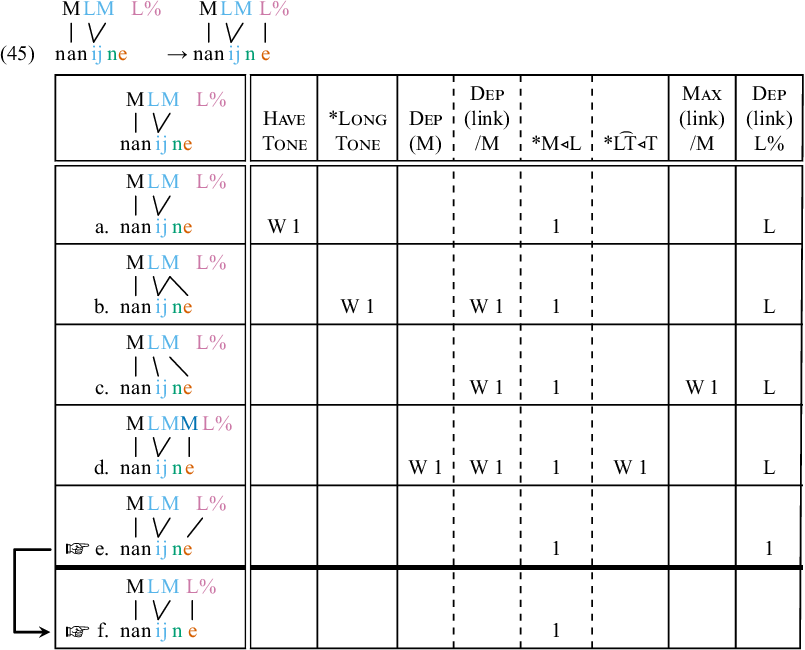
Faithful candidate (45a) leaves a toneless syllable, in violation of high-ranked HaveTone. Spreading the M to the final syllable, as in candidate (45b), violates *LongTone, defined in (46), which penalises tones linked to multiple syllables, and M tone epenthesis in candidate (45d) violates Dep(M). The M-tone shift candidate (45c) violates Dep(link)/M, and because this outranks Dep(link)/L%, candidate (45e), which retains the LM contour, is optimal.

Like LH rises, though, LM contour tones are barred from non-final position by * $\triangleleft $
T. If a disyllabic /LM/ stem is followed by /M/, /MH/ or /MH/, then the M tone deletes, leaving only L:
$\triangleleft $
T. If a disyllabic /LM/ stem is followed by /M/, /MH/ or /MH/, then the M tone deletes, leaving only L:

A tableau for the form in (47a) is shown in (48):

Faithful candidate (48a) is ruled out by * $\triangleleft $
T. Max(L) rules out candidate (48b). Candidates (48e) and (48f) create floating tones and are eliminated by *Float. Shifting the L from LM to the preceding syllable violates Dep(link)/L. This leaves two M deletion candidates, candidates (48c) and (48d). Deleting the following M tone (rendering the LM final on the tone tier) creates a toneless syllable in violation of HaveTone, so candidate (48c), which simplifies LM to L, is optimal.
$\triangleleft $
T. Max(L) rules out candidate (48b). Candidates (48e) and (48f) create floating tones and are eliminated by *Float. Shifting the L from LM to the preceding syllable violates Dep(link)/L. This leaves two M deletion candidates, candidates (48c) and (48d). Deleting the following M tone (rendering the LM final on the tone tier) creates a toneless syllable in violation of HaveTone, so candidate (48c), which simplifies LM to L, is optimal.
In the same environment, monosyllabic LM stems remain [LM], pronounced as a downstepped M, since there is no contour tone to violate * $\triangleleft $
T.
$\triangleleft $
T.
If followed by a L tone, the LM rise is retained, as in (49), where the noun /u᷅n/ surfaces faithfully before a verb with an initial L tone [u᷅n] *[ùn]:

This is the only possibility, given OCP(L) and faithfulness to L tones. For monosyllabic stems, the L is already floating, and it remains so in this environment.Footnote 7 A tableau for (49) is shown in (50):

Faithful candidate (50a) is selected as the winner, despite the violation of * $\triangleleft $
T (as well as *M
$\triangleleft $
T (as well as *M $\triangleleft $
L, which is left unrepaired when present in the input). Candidate (50b) deletes the L of the LM contour and is ruled out by Max(L). Candidate (50c) instead deletes the M tone, but this creates a violation of OCP(L). Candidates (50d) and (50e) delink the L and M tones respectively, creating floating tones that are penalised by *Float. Candidate (50f) shifts the L tone to the preceding M stem, in violation of Dep(link)/L. Candidate (50g) shifts the M to the following /LH/ word, in violation of *Crowd.
$\triangleleft $
L, which is left unrepaired when present in the input). Candidate (50b) deletes the L of the LM contour and is ruled out by Max(L). Candidate (50c) instead deletes the M tone, but this creates a violation of OCP(L). Candidates (50d) and (50e) delink the L and M tones respectively, creating floating tones that are penalised by *Float. Candidate (50f) shifts the L tone to the preceding M stem, in violation of Dep(link)/L. Candidate (50g) shifts the M to the following /LH/ word, in violation of *Crowd.
To summarise this section, Poko is typologically unusual in having only rising and no falling contours lexically. At the lexical level, we find MH and LH contours, but no LM, which instead surface as LM on monosyllables. At the postlexical level, we find typologically expected constraints on non-final L-initial rising tones, but because of high-ranked faithfulness constraints to L tone, L can never be deleted or delinked to satisfy them. MH surfaces in all environments, but LH and LM cannot be followed by another tone. A LM contour tone remains unchanged if followed by a toneless stem, while LH optionally shifts its H tone portion onto the toneless syllable; it obligatorily shifts its H onto a following /M/ stem, whereas LM simplifies to L in this environment. Both LM and LH simplify to L before /MH/ and /MH/, and both retain their rises before a following L tone because of OCP(L).
3.4. Toneless stems
The last topic to cover in the postlexical tonology of Poko is the behaviour of toneless stems. In the last two subsections, we have seen the interactions between floating tones and rising tones and these toneless stems, but we complete this picture here with a discussion of toneless stems in other environments.
In brief, if a toneless stem does not receive a tone from a neighbouring stem, then either it is filled in with a default M (in non-final position) or the boundary L% tone docks to it (in final position). We consider the non-final case first.

In (51a), we see a toneless stem between two /M/ stems. In this environment, it surfaces as M. This could be interpreted in a number of ways, from default M insertion, to M spreading, to simple phonetic interpolation between the surrounding M points. However, in (51b), we see ‘dog’ before a L tone, and still its realisation remains a level M rather than the ML fall that would be expected from interpolation. /M/ and toneless stems are likewise indistinguishable after a H-final word (both realised with an initial H pitch from peak delay followed by a level M stretch). Thus, the data point to a default M tone epenthesis process for toneless stems to satisfy the constraint HaveTone, rather than either M-tone spreading or interpolation. A tableau for (51a) is shown in (52).

Faithful candidate (52a) is ruled out by HaveTone, as the toneless stem remains toneless. Neither of the adjacent M tones can spread to it (candidates (52b) and (52c)) because of the constraint *LongTone. Thus, a default M is inserted in candidate (52d), in violation of lower-ranked Dep(M) and Dep(link)/M, and this output is optimal. Recall that in Poko, H and L tones are never epenthesised, indicating high-ranked Dep(L) and Dep(H).
In phrase-final position, toneless stems interpolate from the endpoint of the preceding tone to L, a pattern we interpret as the effect of a L% boundary tone. For example:

In (53a), preceded by a M tone, the toneless stem da ‘dog’ interpolates from M to L because of peak delay. In (53b), preceded by a MH stem, interpolation goes from the H peak to L. An autosegmental representation of boundary tone insertion for (53a) is shown in (54), along with a tableau:

As in the last tableau, faithful candidate (54a) is ruled out by HaveTone, and candidate (54b), in which the preceding M tone spreads to the toneless stem, is ruled out by *LongTone. In this case, M epenthesis (candidate (54c)) is suboptimal, since Dep(link)/L% is dominated by Dep(M) or Dep(link)/M. Thus, the docking of the final L% boundary tone, as in candidate (54d), is the optimal way of resolving HaveTone in phrase-final position.
Note that only a toneless stem will prompt the association of the L% boundary tone. As there is no constraint against floating L% tones, associating one to a vowel that already has a specified lexical tone will incur a violation of Dep(link)/L%, with no harmonic improvement on any other constraint. This is illustrated in (55) with the convergence step for the phrase nān da nā ‘I ate a dog’:

This tableau essentially adds a candidate to the convergence step for the tableau in (52), but since the input to that step incurs no violations, the violation of Dep(link)/L% proves fatal.
In sum, at the output of the postlexical level, all syllables will carry a tone, either lexical or intonational. If preceded by a floating H tone, the toneless syllable will always take this H. If preceded by a LH rise, the H will shift, though optionally if the toneless syllable is phrase-final. In phrase-final position, the final L% boundary tone can satisfy HaveTone, while in all other environments, a default M is epenthesised.
3.5. Summary of the analysis
To summarise the postlexical phonology, floating L tones remain floating, while floating H tones do not. The grammar prefers to associate the latter, but deletes them when association is blocked. Rising tones are dispreferred in non-final position, with M tones deleting from LM and H tones either shifting in LH or deleting when shift is blocked. Any syllables left toneless either take an epenthetic M tone or are associated with the boundary L% tone.
The Hasse diagram in Figure 2 summarises the constraint ranking.
4. Floating tones must delete one-a-time, left-to-right
As the previous section demonstrates, the postlexical phonology prefers to link floating H tones if a suitable host is available, as in (24), and deletes them only to avoid violating constraints like *TautDock, as in (21). Up to this point, we have only considered inputs with one floating tone. When we examine inputs with multiple floating H tones, as in (56), repeated from (12), we find that all delete:

We show in this section that these data cannot be modelled by parallel constraint-based frameworks like parallel OT (McCarthy & Prince Reference McCarthy and Prince1993b; Prince & Smolensky, [1993] Reference Prince and Smolensky2004) or Harmonic Grammar (Legendre et al. Reference Legendre, Miyata and Smolensky1990a,Reference Legendre, Miyata and Smolenskyb), and must be modelled in HS. Furthermore, because the floating H tones must delete from left to right, the data motivate the use of directional constraints (Eisner Reference Eisner2000, Reference Eisner, Isabelle, Charniak and Lin2002; Lamont Reference Lamont2022b).
As in the HS analysis, the preference to link floating H tones rather than delete them motivates ranking Max(H) above Dep(link)/H, Max(M) and Max(link)/M in parallel OT. This is illustrated in the tableau in (57). Equivalently, in HG, this preference requires the weight of Max(H) to be greater than the sum of the weights of the other three faithfulness constraints. Because the crucial comparisons in this and the following tableau are between candidates that satisfy *Float, its specific evaluation is not relevant.

This ranking incorrectly predicts that mappings should minimise H tone deletion in all contexts, generating the wrong output for inputs with multiple floating H tones, as the tableau in (58) illustrates. In the attested surface form (58c), both underlying H tones delete. Under this ranking, however, (58c) loses to (58b), which preserves the first H tone by deleting both underlying tones of /rīH/.

Because Max(H) is the dominant faithfulness constraint, this grammar can only model mappings that minimise H tone deletion. For the attested output to be optimal, Max(H) must be dominated by one of the three other faithfulness constraints, yielding a ranking paradox. This is illustrated by the support in (59). A support is a list of winner–loser pairs and their required ranking arguments (Tesar & Prince Reference Tesar and Prince2003; Brasoveanu & Prince Reference Brasoveanu and Prince2011). In this example, the winners are the attested surface forms of  and
and  , and the losers are the candidates that satisfy *Float in the previous two tableaux. There is clearly no ranking of these constraints that simultaneously produces the attested surface forms of both inputs. Likewise, in HG, for the attested surface form of
  to be optimal, the weight of Max(H) must be less than half of the sum of the weights of the three other faithfulness constraints. It cannot simultaneously be greater than the sum of their weights, as
  requires, and there is no possible weighting consistent with both.

The unattested form *[kāk rí] is problematic for parallel frameworks because it is the global optimum and therefore expected to surface. As discussed in §3.1, HS derivations cannot produce global optima when the requisite intermediate forms are not locally optimal. In the first step of the derivation in (60), the leftmost H cannot be associated and must delete, as in candidate (60b): associating to the left as in (60e) fatally violates *TautDock, and associating to the right as in (60f) fatally violates *Crowd because /rīH/ is already associated with two tones. Rightward association would be possible after the deletion of one of these tones, but it is not optimal to delete either of them in this step. Deleting the associated M tone as in (60d) fatally violates *HaveTone and fails to improve on *Float. This and following tableaux show the full violation vectors assigned by *Float. The input to the derivation has floating tones at positions 2 and 4; note that the positions are defined over the tonal tier to accommodate floating tones. In our analysis, the decision to delete the leftmost floating H tone is made by *Float itself. As discussed in §3.1, we evaluate this constraint directionally, left-to-right, meaning that it disprefers H tones to their successors. In the first step of the derivation, the faithful candidate (60a) and candidate (60c), which deletes the second floating H tone, are dispreferred because they have floating tones at position 2. The optimal candidate (60b) has a floating tone at position 4, deleting the leftmost H tone. That the faithful candidate has more tones overall is irrelevant to its comparison with the winner. The rest of the derivation is identical to that in (21): the floating H tone deletes to satisfy *Float as in (60h), with linking dispreferred by *TautDock, which rules out candidate (60i).

It is crucial that the derivation deletes the H tones from left to right. If the rightmost floating H tone were deleted first, *Crowd could not prevent rightward association, as the tableaux in (61) illustrate. In this derivation, *Float is evaluated right-to-left, dispreferring floating tones to their predecessors. In the first step, it is optimal to delete the rightmost H tone, as in (61c), because this candidate’s violation at position 2 is strictly better than the violation at position 4 shared by the faithful candidate (61a) and the intended winner (61b). Having removed its floating H tone in the first step, the noun is no longer associated with two tones in the second step, and additional association does not violate *Crowd. Consequently, the rest of the derivation is identical to that in (24): because H tone deletion is dispreferred to association, even when it creates a falling contour, the floating H associates (candidate (61f)), triggering the deletion of the M tone in the following step (candidate (61i)).

Without evaluating *Float directionally, the grammar would not be able to distinguish between candidates that delete floating tones with this constraint set, as the tableau in (62) illustrates. Each of the unfaithful candidates improves on *Float by deleting one of the three underlying H tones, but neither *Float nor Max(H) distinguishes them: all three incur two violations of the former and one violation of the latter.

This tie is divergent (Pruitt Reference Pruitt2009): the surface form depends on which candidate is chosen in this and following steps, as Figure 3 illustrates. The only path to the attested output is to delete the H tones from left to right (indicated with the thicker lines); any other path incorrectly retains one or two H tones.
All derivations from /kākH + rīH + dōH/ with ties broken by random choice; thicker lines trace the attested derivation.
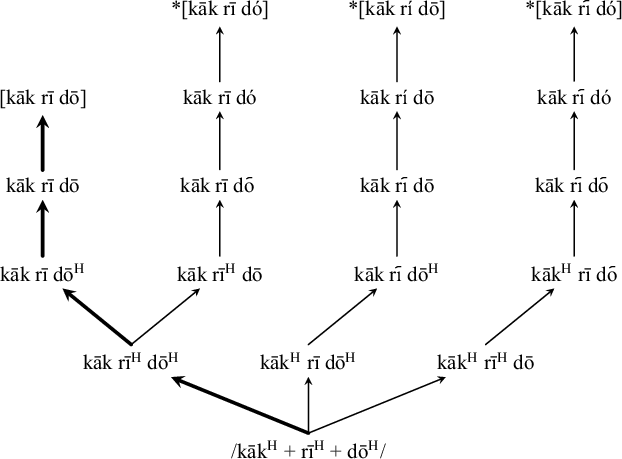
As illustrated in (60), this is not a problem when *Float is evaluated directionally; directional constraints provide a general solution to tied candidates (Lamont Reference Lamont2022a). Without them, some constraint must be added to the analysis to break the tie in (62). For it to be a general solution, the constraint must prefer that the leftmost floating H tone is deleted in all circumstances. Allowing for longer sequences of /MH/ melodies, such a constraint cannot be defined over any contiguous substructure with a fixed number of elements. For example, penalising [MH M] substructures works as a tie-breaker for short inputs like  , but not for longer inputs like
  . This is illustrated by the tableaux in (63).

A tie-breaking constraint that counts loci must instead be defined over non-contiguous substructures, as alignment constraints are (McCarthy & Prince Reference McCarthy, Prince, Booij and Marle1993a; McCarthy Reference McCarthy2003). We identify Align-R(H, U, M) as an empirically adequate option: it assigns every H tone as many violations as there are M tones that separate it from the right edge of the utterance (U). The second argument must have an arbitrarily wide scope because, as discussed in §3, the postlexical phonology of Poko is not sensitive to morphosyntactic or prosodic structure. In a sequence of n /MH/ melodies, this constraint assigns the leftmost H tone $n-1$
violations, the second H tone
$n-1$
violations, the second H tone $n-2$
violations, and so on. Deleting the leftmost H tone removes the largest number of violations, and so it is preferred. While empirically adequate, such an approach suffers from known problems associated with non-local alignment constraints (McCarthy Reference McCarthy2003; Lamont Reference Lamont2021). For one, the total number of violations grows quadratically in the length of the input, which requires more computation than constraints over contiguous substructures (Biró Reference Biró2003). This is one theoretical problem directional constraints were designed to solve (Eisner Reference Eisner2000, Reference Eisner, Isabelle, Charniak and Lin2002). They have been shown to make more accurate typological predictions than alignment constraints, solving a number of empirical problems (Lamont Reference Lamont2022b, Reference Lamont2023a). For another, it is analytically unnecessary to evaluate the entire utterance in order to identify the leftmost H tone. As discussed above, to evaluate *Float directionally, only the leftmost underlying floating tone must be considered. In brief, while it is possible to model the postlexical phonology of Poko without directional constraints, doing so uses fewer constraints and raises fewer analytic questions.
$n-2$
violations, and so on. Deleting the leftmost H tone removes the largest number of violations, and so it is preferred. While empirically adequate, such an approach suffers from known problems associated with non-local alignment constraints (McCarthy Reference McCarthy2003; Lamont Reference Lamont2021). For one, the total number of violations grows quadratically in the length of the input, which requires more computation than constraints over contiguous substructures (Biró Reference Biró2003). This is one theoretical problem directional constraints were designed to solve (Eisner Reference Eisner2000, Reference Eisner, Isabelle, Charniak and Lin2002). They have been shown to make more accurate typological predictions than alignment constraints, solving a number of empirical problems (Lamont Reference Lamont2022b, Reference Lamont2023a). For another, it is analytically unnecessary to evaluate the entire utterance in order to identify the leftmost H tone. As discussed above, to evaluate *Float directionally, only the leftmost underlying floating tone must be considered. In brief, while it is possible to model the postlexical phonology of Poko without directional constraints, doing so uses fewer constraints and raises fewer analytic questions.
5. Conclusion
In this article, we have fleshed out an analysis of postlexical tone in Poko. The language displays many typologically common tonal patterns, such as a dispreference for non-final rising tones (Cahill Reference Cahill2004; Zhang Reference Zhang2004; McPherson Reference McPherson2016), an avoidance of tautomorphemic docking of floating tones (Wolf Reference Wolf2007; McPherson Reference McPherson2016), OCP effects (Myers Reference Myers1997; Yip Reference Yip2002; inter alia) and an avoidance of toneless syllables (Bickmore Reference Bickmore1999; Cahill Reference Cahill2004; Sande Reference Sande2019). It also shows unique twists on some of these patterns, such as a ban on three or more tones on a single stem (rather than a TBU, as in Hyman & VanBik’s Reference Hyman and VanBik2004 *Complex), or patterns of pre-L tone raising (Gandour et al. Reference Gandour, Potisuk and Dechongkit1994; Laniran & Clements Reference Laniran and Clements2003; Gussenhoven Reference Gussenhoven2004; Hyman Reference Hyman2017, Reference Hyman, Urua and Egbokhare2020), demonstrated in Poko by the avoidance of a M–L sequence only when an underlying H tone could be retained to break them up. Another less common feature found in Poko is the greater markedness of L than H: Poko is an example of an ‘equipollent and privative’ tone system (Hyman Reference Hyman2012), with phonologically active H, M and L in addition to toneless syllables. While in most languages H is more marked than L (Maddieson Reference Maddieson and Greenberg1978), in Poko this pattern is reversed, as evidenced by greater faithfulness to L tones than H tones in the postlexical phonology; a similar reversed pattern of markedness is also seen in some tone systems of Amazonia (Hyman Reference Hyman, Avelino, Coler and Wetzels2016), among others.
We have shown that a serial model of phonology is required to capture these postlexical tone patterns, since global evaluation (as in parallel OT or HG) faces a ranking/weighting paradox when faced with multiple floating H tones. Further, the floating tone data point to a need for directional constraint evaluation (Eisner Reference Eisner2000, Reference Eisner, Isabelle, Charniak and Lin2002; Lamont Reference Lamont2022b), with *Float evaluated from left to right to avoid the creation of divergent ties, which in turn predict incorrect surface forms. Directional HS (Lamont Reference Lamont2022b) is able to correctly generate all surface forms in Poko without recourse to problematic alignment constraints.
Papuan tone systems remain relatively underdocumented compared to tone systems in Africa, Asia or Mesoamerica; see Donohue (Reference Donohue1997) for an overview. There are likely dozens if not hundreds of undescribed tone systems like Poko whose data patterns add further nuance to tonal typology or challenge our theoretical models. Phonological theory depends upon careful language documentation and description, just as data collection and analysis is enriched when guided by linguistic theory. Through Poko postlexical tone, we offer a case study of this symbiosis and highlight the need for continued efforts towards the documentation, description and theoretical analysis of the world’s underdocumented languages.
Supplementary material
The supplementary material for this article can be found at https://doi.org/10.1017/S0952675726100268. The supplementary materials for e include a complete list of constraint definitions as well as a full set of tableaux for all examples were discussed in this article.
Acknowledgements
We would first and foremost like to thank Didicus Mari for sharing his language with us. Thanks also to Matthew Dryer and Lea Brown for their years working with Poko and the opportunity to work on the tone system. For their comments on the article, we are grateful to the two anonymous reviewers for Phonology as well as the associate editor and editor, and to Yuni Kim, Nicholas Rolle, and audiences at MIT, AMP 2023, and UCL for feedback on earlier versions of this work. All remaining errors are of course our own.
Author contributions
Data analysis: A.L.; Data collection and analysis: L.M.; Responding to reviewer comments: L.M. and A.L.; Writing the manuscript: L.M. and A.L. For questions and comments on the work, readers are encouraged to contact both authors equally.
Funding statement
This material is based upon the work supported by the National Science Foundation under awards nos. BCS-0004327, BCS-0756075 and BCS-1500751, and the Endangered Language Documentation Program under award no. MDP0038.
Competing interests
The authors declare no competing interests.
 or a compound of two toneless stems
  . In the absence of any evidence either way, we will analyse all trisyllabic words as compounds for the sake of consistency.



 Open access

