




Introduction
The challenges for teachers as curriculum designers have been highlighted over the past few decades as international curriculum specification in many countries has become more generic and less specific in nature (Voogt & Roblin, Reference VOOGT and ROBLIN2012; Sinnema, Nieveen, and Priestley, Reference SINNEMA, NIEVEEN and PRIESTLEY2020). While this move to genericism has provided increased opportunities for the development of extended teacher professionalism in that teachers are required to flesh out generic, outcomes-based curricula statements, it has also created extra challenges for teachers as the range of roles they are expected to fulfill has grown. For example, in New Zealand, teachers are afforded a high level of autonomy in determining what is to be taught and how to do it. The National Curriculum in that country is intended as a guide for teachers and does not prescribe particular content but highlights the intended outcomes in general statements. Generic competences and soft skills are also emphasised in the curriculum (Ministry of Education, 2007). Lack of official and commercial texts and resources places extra demands on teachers to become curriculum designers and makers in addition to their roles as pedagogues and evaluators of teaching and learning.
Wales and Scotland have followed a similar path to New Zealand in advocating curricular autonomy, while in England there appears to be more tightly prescribed curriculum content (Sinnema, Nieveen, Priestley, Reference SINNEMA, NIEVEEN and PRIESTLEY2020). Despite these differences, there is a growing expectation that teachers must be competent curriculum designers. For example, Amanda Spielman (England’s Office for Standards in Education (Ofsted) Chief Inspector) suggests a successful curriculum is one which includes ‘well-taught and appropriately sequenced content, thoughtfully designed assessment practice and consideration of an appropriate model of progression’ (Spielman, Reference SPIELMAN2018). Spielman goes on to cite three approaches to curriculum development that have emerged in the English context: knowledge-led, knowledge-engaged and skills-led. In this paper, we discuss the impact of a curriculum design model called the Curriculum Design Coherence Model (CDC Model – Rata, 2019) which we describe as concept-led and knowledge-rich. The CDC Model proposes that deep learning requires deep design coherence before teaching and that this coherence is generated by three interrelated design dimensions: (i) the ‘surfacing’ of epistemic structure, (ii) the use of subject concepts and (iii) the interrelationship between ‘knowledge-that’ (propositional, conceptual and declarative knowledge) and ‘know-how-to’ (applied knowledge). Subject conceptsFootnote 1 provide a cohering mechanism in linking subject concepts and content (knowledge-that) to applied competencies (know-how-to). Beginning design with subject concepts counteracts an over-emphasis on content and outcomes in favour of developing a deep design approach. An emphasis on subject concepts also provides a mechanism for the explicit bringing together of knowledge-that and know-how-to to counteract the possible dominance of skills over knowledge or vice versa – the bifurcation of knowledge and skills. The interrelationship between generalisable concepts, particular content and applied competencies drawn by the model indicates a knowledge richness. This ‘deep design’ provides a blueprint for pedagogical enactment through a process or praxis-oriented approach (Elliott, Reference ELLIOTT1995).
The knowledge-rich school project
The CDC Model was the centrepiece for the Knowledge-Rich School Project which began at the University of Auckland in New Zealand in 2018. Under the intellectual leadership of Elizabeth Rata (Reference RATA2019; Reference RATA2021), 30 teachers were involved from a variety of school types. To date, three papers and a book chapter have been published about the development of model (Rata, Reference RATA2019; McPhail, Reference MCPHAIL2020a; Rata, Reference RATA2021; Rata & McPhail, Reference RATA, MCPHAIL, Fox, Alexander and Aspland2020). The model is also being trialed in England (Pountney, Reference POUNTNEY2020) and South Africa (Naidoo & Mabaso, Reference NAIDOO and MABASO2020). Although the design outcomes using the model have clear implications for pedagogy, the model initially results in a conceptual map for a lesson, topic or programme design, not a pedagogical plan for implementation (see explanation of the model below).
In this paper, two music teacher participants and one member of the research team report on the on the impact the model has had on music design practice. The data on which the paper draws come from the most recent iteration of an initial topic design by the teachers – Sally and Mary. The two teachers have shared their unit iterations and reflections at workshops and also participated in an interview undertaken by a research assistant.
In the next section of the paper, we provide some more information on the project and a concise summary of the key elements of the CDC Model before describing how it was put to use in a song writing unit.
The research project methods and theory
The project was structured as a series of workshops in which teachers presented and critiqued materials prepared using the model. The aim was to investigate the veracity of the model as a mechanism for assisting the development of teacher curriculum design expertise. The project was guided by the following research question: Is the Curriculum Design Coherence Model an effective tool to design curricula that: (i) creates deep curriculum coherence, (ii) develops teacher curriculum expertise and (iii) contributes to student learning and understanding? In the first year the workshops included an introduction to the model, but in subsequent years as new teachers joined the project, preparatory sessions were provided where teachers worked with members of the research team individually to prepare a topic.Footnote 2 Teachers have used the model at the topic, lesson and course or programme level (e.g. in designing a maths course for years 7–10) (see Rata, Reference RATA2021).
Analysis of data in relation to the first two research sub-questions was undertaken at regular post-workshop researcher evaluation meetings. Qualitative data analysis was carried out using the model’s elements to guide the evaluation of the materials teachers produced. In our analysis meetings, we studied the data to find out how the teachers understood and responded to the requirements of each element of the model. We focused on the theoretical logic of the model, its usefulness and its challenges in use as identified by the participating teachers. As a result, a number of adjustments have been made to the modelFootnote 3 . The third research sub-question (see above) was not directly addressed in this project and will be the focus for future research work. There is some indication, however, in the case reported below that use of the model improved teaching and direction and that student engagement and outcomes benefited from this.
We considered the use of the elements of the model for our analysis as a valid approach because the model itself is underpinned by well-justified realist theories derived from epistemology (Kant, Reference KANT1781; Ryle, Reference RYLE1946; Winch, Reference WINCH2017), sociology (Bernstein, Reference BERNSTEIN2000; Durkheim, Reference DURKHEIM and Thompson1998), psychology (Vygotsky, Reference VYGOTSKY1986), cognitive science (Sweller, van Merriënboer, & Paas, Reference SWELLER, VAN MERRIËNBOER and PAAS2019) and evolutionary psychology (Geary & Berch, Reference GEARY, BERCH, Geary and Berch2016). For example, we theorise that deep learning develops when a learner comes to understand a subject or topic as a network of interrelated disciplinary-derived concepts (Bernstein, Reference BERNSTEIN1999; Winch, Reference WINCH2017). This interrelationship of concepts enables us to perceive structure, make connections, generalise and think abstractly (Geary & Berch, Reference GEARY, BERCH, Geary and Berch2016; Vygotsky, Reference VYGOTSKY1986). We argue therefore that curriculum design for deep learning begins by considering the conceptual structure of the subject or topic chosen for teaching (Erickson & Lanning, Reference ERICKSON and LANNING2014; author). This is Element 1 of the model.
Deep learning also involves coming to understand and utilise the relationship between theoretical and applied knowledge by being able to put conceptual knowledge to use in new contexts (Hattie & Donoghue, Reference HATTIE and DONOGHUE2016; Winch, Reference WINCH2017). As Vygotsky (Reference VYGOTSKY1986) argues, this deep learning is derived through a focus in the classroom on disciplinary-derived subject knowledge that is not only valuable intrinsically, but that has the potential to transform students’ thinking and their understanding of their own socio-cultural world – the development of critical thinking. The socio-cultural knowledge of students is pivotal in bridging the initial gap between the world of the home and the more esoteric world of the school (Nordgren, Reference NORDGREN and Chapman2021).
The model also draws on the cognitive science literature to define deep learning as a permanent change in the cognitive architecture of the mind (Geary, Reference GEARY and Roberts2012; Sweller, van Merriënboer, & Paas, Reference SWELLER, VAN MERRIËNBOER and PAAS2019). This is achieved by coming to understand concepts and their interconnections as a concept acquires its meaning largely from its relationship to other concepts within an epistemic structure (e.g. the concept chord takes on more meaning when related to the concept of chord progression). This cognitive growth relies on the development of ‘cognitive schema’, the mental structures that organise knowledge and guide cognitive processes. We propose that there is a significant relationship between the type of knowledge students come into contact with and the development of cognitive schema (Geary & Berch, Reference GEARY, BERCH, Geary and Berch2016), hence the primary place of epistemically structured conceptual knowledge in the CDC Model. Content, competencies and evaluation all follow from the cohering mechanisms of generalising subject concepts (McPhail, Reference MCPHAIL2020a).
While curriculum design and implementation are clearly interdependent, we suggest that these two components first need to be separated in design before being reconnected in practice (Bruner, Reference BRUNER1977). In other words, we argue that teachers must have a clear idea of what it is they want to teach – both the concepts and the content – before planning how the knowledge or skills can be taught.
In summary, the research methods in this study included (i) an introduction to the model, (ii) the application of the model design by teachers to a chosen topic or programme, (iii) some individual discussion between teachers and research team members in applying the model in design, (iv), the sharing of the results as worked examples at workshops, (vi) individual teacher interviews and (vii) post-workshop researcher analysis and evaluation meetings. The project is in its final of a workshop-style format in 2021.
It is important to acknowledge at this point that the CDC Model takes what might be described as a ‘strong’ epistemological approach to knowledge and subsequently design. We acknowledge that the realist theories of ontology and epistemology on which it draws (see references listed above) are certainly contested by post-modern approaches to curriculum design, particularly so in music education. For example, most recent scholarship argues that the interests and needs of students should provide the impetus for curriculum theorisation and realisation (see for example Allsup, Reference ALLSUP2016; Green, Reference GREEN2008; MacDonald, Reference MACDONALD2016; Sarath, Myers, & Shehan-Campbell, Reference SARATH, MYERS and SHEHAN2017; Wright, Reference WRIGHT2019). We do not disagree with the need for the development of criticality, but we take a different view concerning how that criticality is best developed in students. This can be summarised by Young’s (Reference YOUNG2013) suggestion that in relation to current orthodoxy – i.e. ‘is this curriculum meaningful to my students?’ – we should also ask ‘what are the meanings that this curriculum gives my students access to?’.
To this end, while we note that while musicianship (our aim for music education) is at its core a procedural form of ‘knowing-in-action’ (Elliott, Reference ELLIOTT1995), our approach argues that conceptualisation is at the heart of developing critical musicality in a formal educational setting. For this development we need to call on diverse concepts to bring understanding and criticality to experience (what Ofsted terms tacit knowledge (Ofsted, 2021)). The CDC Model, therefore, provides one possible means to develop criticality by a focus on conceptual and abstract thinking in tandem with applied knowledge. We argue that this combination of knowledge forms (along with others, for example see Ofsted, 2021) is most likely to provide students with the intellectual means to think beyond the world of experience should they chose to do so.
The CDC Model
The model aims for curriculum coherence by placing generalising disciplinary-derived subject concepts (or subject concepts for short) at the centre of the design process. Part of the rationale for this is that disciplinary concepts are part of an epistemic structure or ‘system of meaning’ and that ‘surfacing’ this structure will lead to more coherent design. Moreover, coming to know this system of meaning (parts and whole) enhances cognitive development (Geary & Berch, Reference GEARY, BERCH, Geary and Berch2016). Sufficiently abstract subject concepts are powerful tools for learning because of their generalisability. They can be connected to a variety of content and can cross cultural boundaries (Green, Reference GREEN2003; Hijleh, Reference HIJLEH2012; Swanwick, Reference SWANWICK1988).
Subject concepts also act as cohering mechanisms as conceptual knowledge and applied knowledge are brought together by being linked through subject content and then to competencies (applied knowledge). We call the combination of subject concepts and subject content ‘knowledge-that’ and applied knowledge ‘know-how-to’ (Winch, Reference WINCH2017). Most importantly, the model theorises that deep learning occurs by connecting knowledge-that and know-how-to.
The model is designed as a series of sequential elements (see Figure 1), but the design process is iterative. Starting with a topic for study (for example, The Blues, Chant, Reggae),Footnote 4 Element 1 (Select and sequence subject concepts from a subject topic proposition) suggests that the teacher brainstorm as many subject concepts as they can associated with the topic. It may be that initially a form of ‘back-engineering’ is required as the teacher works from a topic’s likely outcomes to identify the concepts (knowledge-that) embedded within those outcomes. This mapping can be a means of explaining the topic to yourself. Once a number of concepts have been identified, then a process somewhat analogous to coding in qualitative research ensues where the teacher brings order to the list of concepts by organising them into categories with concept headings (‘superordinate’ and ‘subordinate’ concepts). The concept lists create an overall ‘concept map’ for the topic and the means by which students will learn to think and understand within the topic.
The CDC Model.
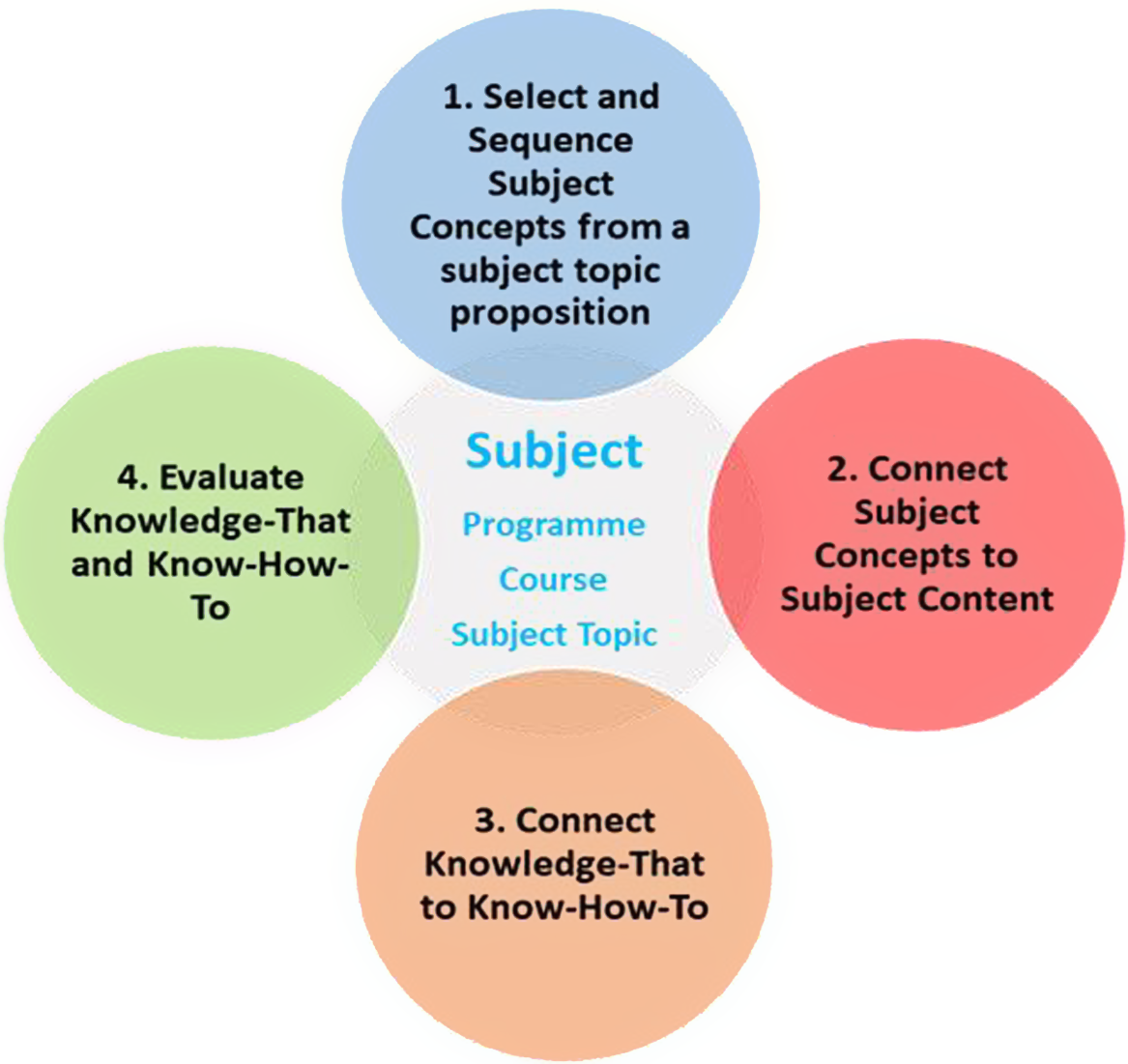
A further component of Element 1 is devising a topic proposition. The proposition concisely states what the lesson, topic, course or programme is about and identifies the superordinate subject concept(s). The concept(s) begin to elaborate the deeper meaning of the topic thereby beginning the process of design coherence. The function of the proposition is to propose (claim, assert or state) what the nature of the relationship is between the topic and the concepts (Rata, Reference RATA2021). For example, the proposition of the topic discussed below is ‘a song for children is a musical form that communicates meaning through the combination of simple lyrics, melody, and harmony’.
Writing a proposition cannot usually be achieved until the teacher has played around with the concept mapping, as the proposition needs to highlight the superordinate concepts for the topic and propose a relationship between the topic and the concepts. Some teachers in the project were unconvinced by the necessity for a proposition and found it overly formalised, along with the approach of the model overall (McPhail, in press). Nevertheless, the proposition can act as a fulcrum for design – a reference point for what is to be taught and evaluated. Teachers working with the model have found the first element (concept mapping and writing a proposition) particularly challenging as for many teachers it requires thinking about a topic (and by inference the subject of music itself) in a different way; as a series of interrelated concepts rather than as content or activities. In the New Zealand context, which has an approach to education dominated by ‘know-how-to’, the very act of reconceptualising curriculum design as firstly conceptual could be seen as an act of criticality.
Element 2 (Connect topic concepts to subject content) develops the key distinction that the model makes between subject concepts and subject content. Having established the key concepts contained in the topic (or lesson or programme), the teacher can now decide which content best actualises the concepts, what content will best bring the concepts to life and demonstrate their particularity. For example, for the song writing unit described below the teachers needed to find songs to act as exemplars that clearly demonstrated the key concepts they identified in their proposition about songs for children: communicates meaning (didactic or humorous), simple lyrics, rhythms, melody and harmony. There are three criteria for guiding content selection through justification, and examples of this are outlined below.
Element 3 (Connect knowledge-that to know-how-to) indicates the theoretically pivotal relationship between knowledge-that and know-how-to. This relationship, along with the coherence provided by subject concepts, is the key mechanism for deep learning. Knowledge-that alone can be innate and too abstract for learners and know-how-to unconnected to knowledge-that can be a form of limiting instrumentalism (Wheelahan, Reference WHEELAHAN2010). Where the two are brought together, there is the potential for deep and cumulative learning. Concepts create linking mechanisms for moving between diverse, context-specific instances of content and know-how-to and the world of generalisation and abstraction (Hugo, Reference HUGO2013). The model proposes a focus on two key competencies that aim to highlight the connection between knowledge-that and know-how-to: performance competenciesFootnote 5 and judgement competencies. These two competencies are outlined more fully below in relation to the song writing unit
In Element 4 (Evaluating knowledge-that and know-how-to), we return to the proposition statement to consider what key subject concepts and competencies need to be assessed. The purpose of evaluation is to measure the level of student achievement. This is done by evaluating the degree of understanding students demonstrate between know-how-to and knowledge-that. In this element, three competencies – recall, skill and technique and intelligent know-how-to are highlighted. These too are elaborated in the school music case study below.
The teachers at work: curriculum making with the CDC Model
The design stage
Sally and Mary are both very experienced music teachers and at the time of this research were team-teaching music classes for middle school students aged 10–12 years. They considered the project an opportunity to enliven their teaching practice and after attending an initial introduction to the model they ‘were excited about how much synergy there appeared to be with the CDC Model and Kodály music education’, Kodály being the predominant approach used in the Junior – Middle School music courses at their school.Footnote 6 Sally and Mary had taught a unit ‘writing a song for young children’ with their students before and decided to use that unit in the research project; ‘we were curious as to whether this approach would lead to more success in the learning outcome for this unit’. The unit involved students writing a song for children in small groups.
Using Element 1: ‘select and sequence subject concepts from a subject topic proposition’
Sally and Mary, along with most teachers involved in the project, found Element 1 initially particularly challengingFootnote 7 . This element requires that teachers look at a topic at the deep level of generalising subject concepts and make the often hidden or taken for granted ‘knowledge-that’ underpinning outcome statements and learning intentions visible:
What do the students need to know to enable them to write their song? The list that evolved was comprehensive and covered most of ‘the elements of music’. It helped us to identify what we needed to put more focus on than in the previous year of learning, and the pre-tasks and activities that would set the students up for success.
Figure 2 shows the proposition and concepts Sally and Mary eventually settled on for this unit with the concepts organised and grouped relationally under a topic proposition. Concepts are indicated by italics.
Element 1 – Topic proposition and superordinate and subordinate concepts for the topic ‘writing a song for children’.

Using Element 2: ‘connect generalising topic concepts to subject content’
Having established a conceptual map of the topic, the teachers now moved on to consider what content would best actualise the concepts. Content is not only finding suitable exemplars for singing and directed listening but also involves identifying what materials and processes will enable the connection between concepts and content to be made. In this case, content includes a focus on writing of lyrics and simple rhythms, tunes and chord progressions (see Figure 3). There are three justifying criteria for choosing the content: (i) the most apposite content for actualising the concepts (epistemic justification); (ii) content that in some way shows the development of the concept (socio-epistemic justification) and (iii) content that may be socio-politically important for example inclusion of songs in Te Reo Māori (the Māori language) (socio-political justification)Footnote 8 . Figure 3 shows the chosen content and the justifications according to the three criteria. In relation to this element, Sally and Mary noted ‘connecting the content to the concepts students needed to know was a critical part of the process. It challenged us to scrutinise content to find the best fit for purpose’.
Element 2 – Key content chosen to actualise the concepts for the topic ‘writing a song for children’.

Using Element 3: ‘connect ‘knowledge-that’ to ‘know-how-to’
For this element, the teachers considered the key competencies that students would need to develop to enable them to write a song for children. This is the part of the design process where the already identified concepts and apposite content (knowledge-that) are connected to the development of know-how-to or applied knowledge. This bringing together of the two forms of knowledge is achieved by considering two types of competencies – performance competencies: using techniques and skills to apply the concepts and content – and judgement competencies: students being able to recognise and explain the use of the techniques and skills in using the subject concepts. Figure 4 indicates the competencies Sally and Mary wanted to develop in this unit.
Element 3 – Connecting knowledge-that with know-how-to-to for the topic ‘writing a song for children’.

Using Element 4: ‘evaluating knowledge-that and know-how-to’
Recall, skills and techniques and intelligent-know-how-to are the three competencies assessed in this element. Recall comprises students using key concepts and terms in their classroom talk. Skills and techniques comprise students showing understanding of the subject concepts as they apply them in know-how-to activities, i.e. in their songs. Intelligent-know-how-to occurs when students are able to explain what they have done, why they did it and to evaluate the outcome. This demonstrates the degree to which students have understood and combined knowledge-that and know-how-to for deep learning in the topic (Figure 5).
Element 4 – Evaluating knowledge-that and know-how-to.

Discussion
The design in action
Sally and Mary took the CDC design and applied it to a song writing task. Working through Element 1 they had clarified the generalising concepts that would be put to work in the unit. They decided to teach the concepts embedded in a series of clearly defined and sequenced achievable ‘mini-tasks’. They noted that this was ‘due to the thinking we had done using the model’. The sequence comprised lyric writing, rhythm writing, melody writing, devising a chord progression, notating the song, performing, recording and exchanging – learning a song written by a different group. During the teaching and learning process, the teachers worked with the students, giving feedback on how to proceed with each mini-task before moving to the next step. Some groups managed to do the whole song in one fell swoop, whilst others needed a lot of help.
The teachers were able to draw on knowledge the students already possessed. In regard to rhythm notation, the students had been introduced earlier to stick, staff and lead sheet notation so the majority of students were reasonably fluent with this simple form of music reading and writing. Whilst the provision of stick notation and lead sheet were part of the task, not everyone in every group managed to be 100% accurate in their notation.
The students were also well versed in pentatony and had been introduced to the diatonic major scale (after Kodály using M2, m2, M3, m3 terminology). Having sung lots of songs they (on the whole) instinctively composed balanced melodies for this task. In relation to harmony, playing and singing using the Ukulele is a key part of the previous year’s course, so this prior learning was also available to be called on. The concept of a ‘chord stack’ is introduced as a new concept in Y8 where students sing chords in sol-fa and accompany themselves on the ukulele. Consequently, the students have physical, aural and intellectual familiarity with chord progressions using I, IV, V (vi) (C, F, G, a). In the song writing unit, the students demonstrated their knowledge by (largely) choosing the right chord to go with their melodies. The teachers were able to talk about passing notes as an adjunct when this was appropriate.
The Song in My Garden (see Figure 6) was written by a typical group of students with minimal editorial help. It demonstrates that they understood the nature of lyrics for children, a simple but catchy and repetitive melody with a limited range, and agreement between harmony and melody. Feedback from the students included the observation that they did not think they would be able to write and record a song and were proud of their achievements. They particularly liked hearing other groups performing their work.
Lead sheet for In my garden by the sea using sol-fah and rhythm stick notation.

Teacher reflection
Both teachers think the results achieved in the iteration of the unit after implementing the model were better: ‘I think that because we set down the criteria much more clearly as a result of using the model, the students achieved greater success’. This supports our proposition that the distinction between generalising subject concepts and content helped the teachers in moving from a content list and outcomes approach to one where concepts and content could be more meaningfully connected for a deeper level of learning. By thinking concretely about what the students actually needed to know, Sally and Mary believed they were able to scaffold a much more coherent approach to the skill building they wanted to provide for their students. As experienced teachers, the model assisted in clarifying what was significant in design rather than creating major changes. Thinking conceptually highlighted the way in which key subject concepts return in a spiral curriculum up the years of the school but with increasing sophistication and with increasingly varied content (Bruner, Reference BRUNER1977).
Overall Sally and Mary suggest:
We haven’t found ourselves greatly changing what we do so much as scrutinising our purpose and content. Consequently, we are being much clearer about our reasons and expected outcomes for teaching music to core classes. We want them to be lifelong learners, give them transferable skills, be intelligent consumers of music – which will give them greater understanding and joy.
As a result of using the model, Sally and Mary suggest:
The [song writing] task takes less time as each increment is more clearly defined, prepared, and evaluated. This is directly due to the thinking we have had to do in order to use the model. We’ve found that students’ excitement doesn’t wane because they don’t get stuck or bored, and they have the impetus to aspire to a higher level of editing and polish. By breaking the tasks into clear achievable components at every stage every group meets with success. It’s also much more fun to teach.
Conclusion
There are little doubt aspects of the CDC Model that are challenging for teachers. In New Zealand, where teachers are curriculum implementers and assessors, it seems almost unfair to expect them to have to design the curriculum as well. However, Sally and Mary found the model helpful within the context of curriculum design and implementation autonomy in New Zealand:
The NZ Curriculum is very broad and lends itself readily to the taste and expertise of the teacher. This is a blessing and a curse. But, a major strength of the CDC model is in the scrutiny it requires in the justification of material and topics. The model sparked off a whole new depth of responsibility which emerged in the process of planning and scaffolding.
Moreover, working this way ultimately led to a deeper engagement with the essence of their subject and with the useful distinction between design and pedagogy:
One of the biggest challenges was teasing out the distinction between what is to be taught and how it is taught. The workshops showed us the need to articulate our subject’s concepts, specialist vocabulary, content, and competencies as a starting point for cohesive planning. We found ourselves working backwards, retro connecting the concepts and competencies our students would need to be secure with before they could have success at the learning task.
Design for deep and cumulative learning requires teachers to be or to become subject experts – to have a panoramic view of their subject (Winch, Reference WINCH2017). As well as this they need highly developed pedagogic content knowledge (PCK), that specialist knowledge that allows them to adapt the design for realisation in the classroom (Shulman, Reference SHULMAN1987). The findings of the Knowledge Rich School Project suggest to us that teachers want to have more knowledge about knowledge (McPhail, Reference MCPHAIL2020b) and found using a concept-based approach increased their sense of professional identity as curriculum makers and that using the model provided them with a different way of looking at curriculum design from the current New Zealand skill-based orthodoxy.
As teachers, we found ourselves reflecting on our profession and on our content bias and subject knowledge. It was a deep dive into what it means to be a teacher and what an enormous responsibility we have as custodians and curators of learning and knowledge for the next generation.
There is a danger, however, that in its idealised form, the model can appear like a template demanding obedience. However, when used as a stimulus for creative thinking about curriculum design, it can provide a stimulus for critical thinking. For example, the three criteria for content selection encourage the teacher to justify their content selection in both epistemological and socio-political terms, asking does this content have sufficient conceptual depth for learning and is it music that opens students’ experiences to current wider values of society such as cultural inclusion. It also asks the teacher, where possible, to share with students how knowledge changes over time despite some fundamental concepts and practices remaining constant across time and cultures. Ideally, our curriculum choices will be able to achieve both socio-political and epistemological ends.
The next step in the Knowledge Rich School Project is to explore how topics and programmes that we have designed might be realised in a pedagogy of practical engagement. For example, although the CDC Model’s first element refers to concepts, this does not mean that concepts should always be taught explicitly before competencies and content – it all depends on the learning context. The important point is to understand the particular affordances of the different knowledge forms and the importance of their interconnection. By undertaking deep design, we argue that teachers should be better placed to make pedagogical decisions that will impact positively on students’ access to cumulative and deep learning experiences.


 Open access

