





1. Introduction
The study of pragmatic borrowing – the use of borrowed words and expressions from a source language (SL) into a recipient language (RL) affected by cultural, social, or cognitive factors – is increasingly prominent in linguistics (Andersen et al. Reference Andersen, Furiassi and Mišić Ilić2017:71). As English is a worldwide lingua franca, the studies regarding pragmatic borrowing from this language (Peterson Reference Peterson, Hoegaerts, Liimatainen, Hekanaho and Peterson2022) have become the focus of various investigations in typologically different languages. Studies have described, for instance, the use of okay in Finnish (Koivisto & Sorjonen Reference Koivisto, Sorjonen, Emma Betz, Mondada and Sorjonen2021), oh wait in Spanish (Balteiro Reference Balteiro2018), please in Mandarin Chinese (Jia Reference Jia2024), or acronyms such as OMG in Serbian (Ilić Reference Ilić2017).
The increasing importance of social media (van Dijck Reference Dijck2013) and digital social interaction (Koivisto et al. Reference Koivisto, Virtanen and Vepsäläinen2023) makes it necessary to investigate how speakers of different linguistic backgrounds use a foreign expression in a digital environment as well. Social media platforms are always changing, but nevertheless, they maintain their property of connecting people from across the world through language. In this digital scenario, English is also a prominent language (Squires Reference Squires2010). Hence, English words and acronyms are commonly used on social media platforms by users from around the world who do not necessarily speak English as their native language (Aleksic-Maslac et al. Reference Aleksic-Maslac, Vasic and Poropat Darrer2010). Since some of these expressions convey the writer’s stance in digital interactions, they constitute cases of pragmatic borrowing (Ilić Reference Ilić2017, Jia Reference Jia2024).
In the present work we describe the use of the English acronym wtf (‘what the fuck’) in three different languages on the social media platform X. We do so by comparing the uses of wtf in American English (the SL), and Finnish and Chilean Spanish (the RLs)Footnote 1 – the latter two our respective native languages – from a Conversation Analytical and Interactional Linguistic perspective. Previous research has already shown that wtf is a common expression in digitally mediated interactions (Squires Reference Squires2010:475). Even though there are some mentions of wtf in previous studies (see Nurmikari Reference Nurmikari2013, Bergen Reference Bergen2016, Recktenwald Reference Recktenwald2017), it has not been chosen as the main topic of research on interactions, discussions on digital platforms, or pragmatic borrowing.
Following the methodological approaches of Interactional Linguistics (Couper-Kuhlen & Selting Reference Couper-Kuhlen and Selting2018) and Digital Conversation Analysis (Koivisto et al. Reference Koivisto, Virtanen and Vepsäläinen2023), we manually annotated occurrences of wtf in the three languages. This was done in order to observe the functional adaptation of the acronym from the source language (SL) into the recipient languages (RLs). With this procedure, we aim to provide a novel and fine-grained analysis for a case of pragmatic borrowing of a netspeak acronym, in non-synchronous text-based interactions, and to shed light on an interesting interactional phenomenon. The research question we seek to answer is: What are the differences and similarities in the use of the acronym wtf between the SL American English and the RLs Finnish and Chilean Spanish in interactions on the social media platform X?
Our motivation for working with American English, Finnish, and Chilean Spanish is that comparative linguistic studies considering these three languages are scattered. As we will discuss in Section 2.1, Finnish, (American) English, and (Chilean) Spanish are genetically, typologically, and geographically distant languages. As such, comparing them makes it possible to find recurring phenomena that relate language and interaction on a more general level (Haakana et al. Reference Haakana, Laakso, Lindström, Haakana, Laakso and Lindström2009:15–17). In line with previous research on pragmatic borrowings (Ilić Reference Ilić2017, Peterson Reference Peterson2017, Balteiro Reference Balteiro2018, Jia Reference Jia2024), we expect a functional adaptation of the pragmatic functions of wtf from the SL into the RLs. This adaptation can result in a functional broadening – where the discourse marker acquires a new function while retaining its original one – or a functional narrowing – where it loses one or more of its functions – or a functional shift – where it modifies or replaces its original function with a new one (Andersen Reference Andersen2014:24).
The paper is structured as follows. In Section 2 we present the theoretical background. Section 3 comprises the characterization of the data – interactions in the social media platform X – and the method for studying pragmatic borrowings. In Section 4 we present the general results from the annotation process and analyze representative instances of the use of wtf in the three languages. In Section 5 we discuss the main findings. In Section 6 we conclude our research results.
2. Theoretical background
2.1 Different languages, different cultures
Chilean Spanish is a Romance language spoken in South America, whereas American English is a Germanic language spoken in North America, and Finnish is the most-northerly spoken Finno-Ugric language in the Scandinavian region (Dryer & Haspelmath Reference Dryer and Haspelmath2013). Given these distances, significant cross-linguistic structural diversity is expected (Huisman et al. Reference Huisman, Majid and Van Hout2019). For instance, at the phonological level, Finnish has fewer consonants than English and Spanish; conversely, Spanish has fewer vowels than Finnish, which has fewer than English (Maddieson Reference Maddieson2013a, Reference Maddieson2013b). In terms of morphology, the languages present different case systems on nominal categories: whereas Finnish has fourteen morphologically marked case paradigms (Helasvuo Reference Helasvuo2001), English only encodes two (Quirk et al. Reference Quirk, Greenbaum, Leech and Svartvik1985) and Spanish none (Iggesen Reference Iggesen2013). Therefore, the adoption of an expression from one of these languages into the others can be expected to present some kind of functional adaptation (Andersen Reference Andersen2014, Reference Andersen2017).
Finns, Americans, and Chileans also have different communicative styles. Studies have shown that Finns present less personal proclivity towards initiating a talk with a stranger than Americans and Hispanics (Fant Reference Fant1989, Sallinen-Kuparinen et al. Reference Sallinen-Kuparinen, McCroskey and Richmond1991). Also, the three cultures rely to varying degrees on contextual information to communicate. American and Finnish are low-context cultures, as they base their communication on explicit statements in conversation more than other cultures (Kim et al. Reference Kim, Yigang and Heung Soo1998, Nishimura et al. Reference Nishimura, Nevgi, Tella and Kallioniemi2008). In contrast, Chilean culture has high-context features, since communication depends to a greater extent on shared knowledge, inferences, and implicit statements (Dozier et al. Reference Dozier, Husted and Timothy McMahon1998, Osland & Florenthal Reference Osland and Florenthal2009).
Previous research on linguistic resources that help in maintaining the communication process has found striking similarities even between typologically distinct languages (Wiltschko Reference Wiltschko2021, Dingemanse Reference Dingemanse2024, Dingemanse & Enfield Reference Dingemanse and Enfield2024). Thus, despite the communicative differences, we expect to find both similarities and differences in the use of our chosen languages on the social media platform X.
2.2 Conversation Analysis and Interactional Linguistics: a comparative method
Describing the use of an expression in three different languages requires a framework that enables comparison while acknowledging the unique characteristics of each language. On the one hand, Conversation Analysis allows the researcher to make interpretations about language use and the actions from naturally occurring conversations (Mondada Reference Mondada2012, Sidnell & Stivers Reference Sidnell and Stivers2012). On the other hand, Interactional Linguistics is a suitable approach for understanding how different parts of language shape and are shaped by interaction (Lindwall & Mondada Reference Lindwall and Mondada2025). This field focuses on the linguistic resources employed by participants to regulate communication, including discourse markers (Couper-Kuhlen & Selting Reference Couper-Kuhlen and Selting2018).
From an Interactional Linguistic point of view, the surrounding context of discourse markers – ‘sequentially dependent elements which bracket units of talk’ (Schiffrin Reference Schiffrin1987:31) – is a fundamental aspect of their interpretation (Maschler & Schiffrin Reference Maschler, Schiffrin, Tannen, Hamilton and Schiffrin2015:191). Therefore, the annotation of their positions in the communication process is a key step for their description (Fox Reference Fox2007:302–304). Moreover, recent research in this regard has found correlations between the positions – with respect to the interaction sequence and within the utterance – and the functions performed by discourse markers (Mushin et al. Reference Mushin, Joe Blythe, Caroline de Dear, Possemato and Stirling2023).
The digitalization of communication (van Dijck Reference Dijck2013) has made it necessary to expand the empirical scope of Conversation Analysis into social media platforms. In these contexts, a single message can consist of several turn constructional units (TCUs) by ‘packaging’ the information (Hutchby & Tanna Reference Hutchby and Tanna2008). Conversely, a single TCU can be ‘chunked’ into several messages in instant messaging (Markman Reference Markman and Darics2015). Nevertheless, these interactions adhere to conventional conversational structures, making them part of the possible areas of exploration for Digital Conversation Analysis (Koivisto et al. Reference Koivisto, Virtanen and Vepsäläinen2023).
2.3 Swearing in different languages and cultures
Swearing is a socio-communicative practice used to express frustration, anger, or emotional emphasis, either in response to an emotional trigger experienced by the speaker or to provoke an emotional reaction in others (Bergen Reference Bergen2016, Mohammadi Reference Mohammadi2020). Swearing happens through the use of expressions often related to sex or excretion, that can be perceived as inappropriate or offensive in any given social context (Beers Fägersten Reference Beers Fägersten2012:3). These expressions vary culturally, diaphasically, and diatopically, as cultural norms influence the way and the context in which speakers of a given community express their emotions to others (Wierzbicka Reference Wierzbicka1999, Hwang & Matsumoto Reference Hwang, Matsumoto and Chen2017). As such, swear expressions serve to affirm affiliation within social groups and to establish boundaries for language use (Dewaele Reference Dewaele2004).
Swearing in another language has been shown to have pragmatic implications. Multilingual speakers tend to prefer foreign forms of expression when evaluating both highly emotional and less emotional scenarios (Mohammadi Reference Mohammadi2020). In addition, speakers may use their second language to create emotional distance from what they have said (Dewaele Reference Dewaele2004). This practice aligns with the speakers’ self-reports that emotional experiences are less intense if processed in a second language than in the first language (Bond & Lai Reference Bond and Lai1986, Javier & Marcos Reference Javier and Marcos1989). Thus, the use of a foreign swear word as a pragmatic loan, as wtf, is always influenced by the environment and social meanings (on damn in Finnish, see Vaattovaara & Peterson Reference Vaattovaara and Peterson2023).
2.4 The acronym wtf
According to Squires (Reference Squires2010), acronyms are one of the most prominent stylistic features in digital interaction writing. They can be used by social media users from various linguistic backgrounds, independently from their contact situation with English (Aleksic-Maslac et al. Reference Aleksic-Maslac, Vasic and Poropat Darrer2010, Jia Reference Jia2024). Some common acronyms that are used online worldwide are, for example, YOLO (‘you only live once’), OMG (‘oh my god’), LOL (‘laugh out loud’), and LMAO (‘laughing my ass off’).
The phrase what the fuck – and its acronym wtf – is a swear expression in English that signals disbelief and surprise (Bergen Reference Bergen2016, Andersen Reference Andersen2017, Recktenwald Reference Recktenwald2017:78). An equivalent phrase in Chilean Spanish is ¿qué chucha?, and mitä vittua? in Finnish. However, unlike what the fuck, the Chilean and Finnish equivalents have not developed a widespread use as acronyms in digital, text-based interactions. Similar to other cases where a foreign expression is adopted in complementary distribution with a native expression (Peterson Reference Peterson2017), it is plausible that the use of wtf in these recipient languages arose from pragmatic and social motivations embedded within the communicative styles of the digital social platform.
3. Data and methods
The study takes advantage of tweets gathered from the social media platform X, which is a global social network that is used widely around the world by various types of users, including politicians and institutions. The interaction on X is mostly conducted by writing short messages as conversations that are made public, through which one can spread information easily and engage with it (Marwick & Boyd Reference Marwick and Boyd2011:116–117). In addition to plain text, X has certain distinctive affordances, such as retweets (sharing of tweets), hashtags, emojis, photos, GIFs, and videos. The affordances can be used to express stances and opinions, handle relationships between users, topicalizing events or opinions under discussion, address an ambient audience, and build an online identity and social networks (Marwick & Boyd Reference Marwick and Boyd2011, Zappavigna Reference Zappavigna2015).
The data consist of tweets that include the acronym wtf. The collection was done twice, using the input wtf in the search bar for the most recent tweets, first on 2 August and then on 12 August 2024. The tool ‘lang:’ was used to filter the results for languages (Finnish, English, and Spanish).Footnote 2 In addition, and given that swearing, as an emotional expression, is a culture-specific practice (Wierzbicka Reference Wierzbicka1999, Hwang & Matsumoto Reference Hwang, Matsumoto and Chen2017), we also used the tool ‘near:’ to filter for location (Finland, United States, and Chile). These filters allowed us to retrieve a significant number of instances of wtf in the targeted languages that were later automatically retrieved in an Excel spreadsheet using the software Bardeen AI. Afterwards, we selected tweets that met two basic requirements: (i) the tweet was written in the target language (Finnish, American English, or Chilean Spanish), and (ii) the entire interactional sequence was visible at the time of the collection.
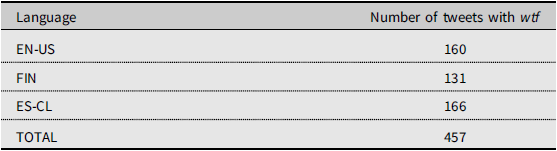
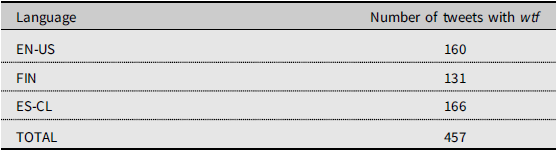
A total of 457 occurrences of wtf met our requirements. As a consequence of the different frequencies of use of wtf in the three languages, the Finnish dataset was made up of tweets posted between 2017 and 2024, the Chilean Spanish dataset of tweets between 8 and 12 August 2024, and the American English dataset of tweets posted the same day as the first collection, 2 August 2024. Table 1 shows the number of occurrences divided into American English (EN-US), Finnish (FIN), and Chilean Spanish (ES-CL).
Number of occurrences of wtf collected for each language
We applied the criteria proposed by Andersen (Reference Andersen2014:23) to this dataset, adjusting it for occurrences of a pragmatic borrowing in digital-mediated interaction.
-
1. Syntactic integration: syntagmatic relations that wtf establishes with the surrounding words.
-
2. Interactional position: wtf is used in an initiative or a responsive tweet.
-
3. Tweet placement: place of wtf with respect to the propositional material of the message (tweet-initial, tweet-middle, tweet-final, or as a stand-alone expression).
-
4. Topic under discussion: political or economical affairs, personal situations, pop-related events (shows, video games, etc.).
-
5. Scope and orientation: information that wtf scopes over, whether backwards or forward in the interaction.
These criteria allowed us to systematically describe the use of wtf in the three languages from a unified perspective. By applying them, we were able to distinguish differences and similarities across the instances of use. In the next section we present an analysis of the instances that make up our corpus. In particular, we will focus on the use of wtf as a discourse marker.
4. Analysis
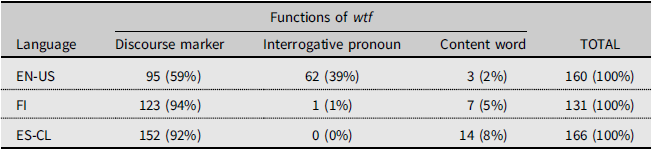
In this section we show how wtf is used in American English, Chilean Spanish, and Finnish tweets on X. We first analyzed the use of wtf in each language based on the syntagmatic relations that the acronym established with the surrounding words in the same tweet. This step aimed to identify the pragmatic functions performed by wtf. We differentiate three main functions: a discourse marker, an interrogative pronoun, and a content word, as shown in Table 2.
Functions performed by wtf based on its immediate context of use
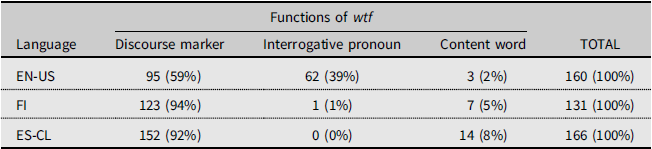
Cases of wtf classified as content words were the most infrequent across the three languages. In these cases, the acronym was used as an adjective – as in ‘There are enough legit WTF moments with Biden that you don’t need to invent them’ – or as a noun – as in ‘Here’s a WTF: Lex Luger and Scott Hall are older than Michael Hayes.’ Since these are words that contribute to the propositional meaning of the utterance rather than directly performing a pragmatic function, they were excluded from further analysis in this study.
When wtf was used as an interrogative pronoun, the acronym participated in conveying the illocutionary force of a question as well as the writer’s affective stance. The acronym affected the word order of the host sentence, as in ‘Wtf are they doing with my tax dollars?’ This usage was common in English, not attested in Spanish, and observed only once in Finnish.Footnote 3
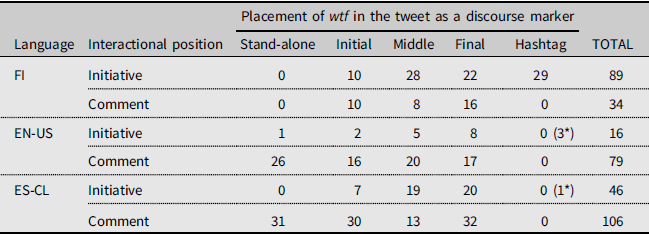
As a discourse marker, the acronym stated a writer’s negative emotive stance and surprise towards contextually salient information, as in ‘WTF. How was that approved by the DMV’ (see example (1)). These uses were the most frequent ones and observed in the datasets of all three languages, where the acronym appeared at the fringe of sentences – whether at the beginning, end, or in between them – and conveyed the illocutionary force of an exclamation. As discourse markers perform different functions depending on their interactional position (Fox Reference Fox2007:301–307, Maschler & Schiffrin Reference Maschler, Schiffrin, Tannen, Hamilton and Schiffrin2015:200, Mushin et al. Reference Mushin, Joe Blythe, Caroline de Dear, Possemato and Stirling2023:182), the description of these cases was based on their interactional position and their placement in the tweet, summarized in Table 3.
Distribution of wtf used as a discourse marker. Cases in positions marked with a star were subsequently found in a targeted search
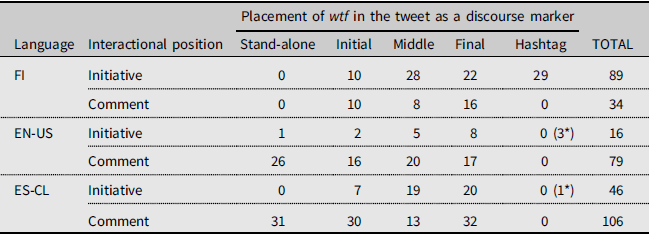
Across all three languages, wtf was used in almost all positions, with varying frequencies of use. A subsequent search was done in order to confirm the absence of wtf in certain positions: as a stand-alone expression in Finnish and as a hashtag in Chilean Spanish and American English. Only the latter two were found in this search, and are marked with a star in Table 3.
Wtf was used as a stand-alone expression most commonly as comments in American English and Chilean Spanish. The Finnish dataset was the only one that did not show this use. Conversely, most cases of wtf as a hashtag were found in Finnish, at the end of the message, separated from the main text by some character. In addition, the uses of the acronym at the beginning, middle, or end of messages were attested in all three languages. In the next subsections, we present the analysis of representative instances of the acronym wtf organized according to its placement within a message.Footnote 4
4.1 Wtf initiating a responsive tweet
In this section we show cases of wtf being used at the beginning of responsive tweets. In this position, and similar to the cases of a stand-alone expression, wtf functions as a response token that reacts to the information provided by the other interactant in a prior tweet. Furthermore, we show that tweets that begin with wtf can express either affiliation or disaffiliation towards the stance displayed in the previous tweet.
We start with a tweet in American English. Example (1) shows a tweet where Mark has posted a photo of a black car with the license plate ‘HARD R’. With the photo, he has written a message which reveals the location (Cecil County, MD = Maryland) and his interpretation of the license plate, which he evaluates as ‘Super Racist’. This interpretation arises from the phrase formed on the black car’s license plate, HARD R, which refers to the racial slur ‘nigger’. The term specifically points to the version of the slur ending in -er, which is strongly associated with explicitly racist usage.
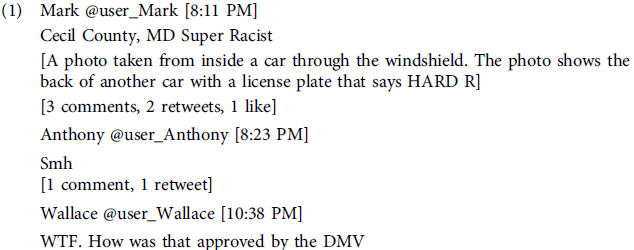
Mark’s tweet shows a critical stance towards the license plate by pointing out that it is racist. Anthony responds to Mark with the acronym smh (‘shaking my head’, a way of expressing consternation in netspeak) that evaluates the situation as something difficult to approve, showing affiliation towards Mark’s opinion. After that, Wallace responds to Mark’s post with a tweet that begins with WTF. The acronym is detached from the rest of the tweet by the use of a full point. After the acronym, Wallace displays disbelief by questioning how the Department of Motor Vehicles (DMV) let this happen. With this question Wallace goes further in his sanction against the existence of this license plate. The negative stance already shown by Mark and Anthony is thus supported by Wallace. In light of the entire tweet, the tweet-initial WTF expresses a negative affective stance that is affiliative with Mark and Anthony’s evaluation by disapproving of the existence of the racist license plate.
A similar use of tweet-initial wtf can be found in Finnish. Example (2) shows an exchange that takes place at the time of a big demonstration in Helsinki by the environmental movement Elokapina (‘Extinction Rebellion’). The newspapers wrote in advance that the movement would be closing a main highway entrance from the city of Espoo to the capital city, Helsinki. Pekka has posted a photo that shows a police car blocking the highway.
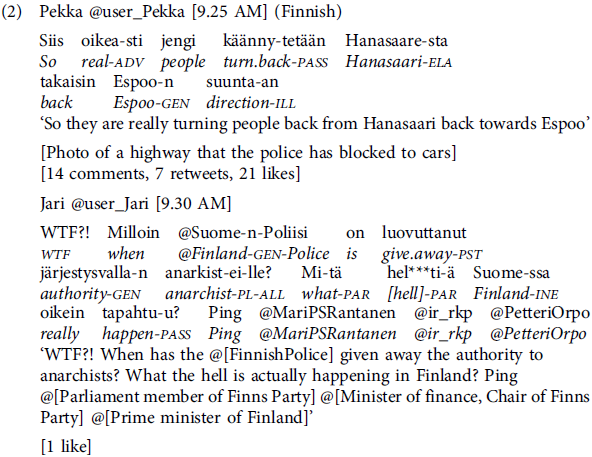
With the photo, Pekka writes that cars driving towards Helsinki are being turned back to Espoo from Hanasaari, a place along the highway between two cities. The word oikeasti (‘really’, ‘for real’) gives an impression of Pekka either having read the news about it in advance or questioning the roadblock. This tweet thus shows a critical stance towards the roadblock. Jari then comments with a tweet that starts with WTF?!, written with capital letters, a question mark, and an exclamation mark. Here, the acronym functions as an initial response to what Pekka has written, resembling the use in (1). WTF shows affective stance but leaves open whether Jari affiliates with Pekka’s stance (see also Nurmikari Reference Nurmikari2023).
The stance is shown in the latter part of the tweet. WTF?! is followed by two sentences in question format. The first one brings forward a thought that the Finnish police have given away the authority to anarchists, referring to the demonstration participants. In the next sentence, Jari shows a surprised stance towards what is happening in Finland, including an expletive expression mitä hel***tiä (‘what the hell’). Both of these interrogative sentences show that the actions of the police are objectionable. This tweet as a whole resembles a second assessment or a reformulation (Pomerantz Reference Pomerantz, Maxwell Atkinson and Heritage1984, Sorjonen Reference Sorjonen, Heritage and Sorjonen2018:252), shedding light on the critical stance of Jari.
Furthermore, Jari tags three influential politicians to the tweet. This makes the whole tweet look like a question that is waiting for an answer from the politicians and emphasizes the problem he has in accepting the events on the highway. However, the politicians have not answered, as it is typical of X that discussions between citizens and politicians or other known people and institutions are asymmetrical (Dayter Reference Dayter2014: 93).
In Chilean Spanish, wtf is used in tweet-initial position to respond to previous posts as well. In (3) Fernanda states her sadness for not having a verified account, in a tweet that includes a crying emoji. She has thousands of followers and therefore a large social network on X. Although obtaining the verified mark has recently become monetized, it is still perceived as a symbol of social status on X, as earning the badge typically requires having a certain number of followers. Fernanda’s social status is further shown in the metadata as her tweet got a few hundred likes. Lautaro responds to this tweet with an initial WTF in capital letters, followed by the question ‘and who’s this nobody?’
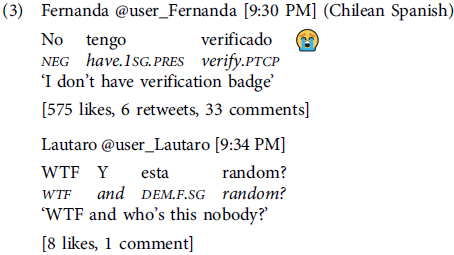
Lautaro’s question serves to discredit Fernanda’s affective stance, as the use of the Anglicism random in Spanish slang, when used as an adjective, is synonymous with the English term nobody. This evaluation sharply contrasts with the number of likes received by Fernanda’s tweet, making it a potential direct insult based on her status as an influencer. Additionally, Lautaro does not respond directly to Fernanda’s statement. The absence of emojis in his response contrasts with the initial tweet and further highlights Lautaro’s disaffiliation towards Fernanda’s negative affective stance towards not having a badge.
These three cases show that wtf functions as a response token towards the previous tweet when used at the beginning of a responsive tweet. This function is similar in American English, Finnish, and Chilean Spanish, and shows the writer’s negative affective stance, leaving open whether the responsive tweet as a whole will be affiliative or disaffiliative (see also Nurmikari Reference Nurmikari2023). The latter part of the tweet reveals more affective cues that are needed to interpret the writer’s stance towards their interlocutors.
4.2 Wtf initiating an initial tweet
Wtf can also start an initiative tweet that does not relate to any prior message. In these cases, wtf functions as a stance marker reacting to an event described later in the same tweet, sometimes accompanied by digital multimodal resources, such as images. Example (4) from English shows a tweet that starts with WTF and is followed by a critical statement about American Republican Senator Mitch McConnell.

Pam criticizes McConnell for his role in the alleged Supreme Court crisis. As in previous examples, the tweet consists of various expressive devices that are repeatedly used across the message. Capital letters, exclamation marks, and swear words help to construct Pam’s negative emotive stance towards the politician. In this context, wtf does not react to another message as in the previous examples. Instead, it is used to show an affective stance towards an event that is described in the same tweet: that Senator McConnell ‘destroyed’ the Supreme Court. This event is the central trigger of evaluation in the tweet as the rest of the sentences show: ‘now Democrats are going to fix it for good’, ‘you and Rep are to blame for the mess’ and ‘FVCK YOU MCTURTLE’. These sentences are framed as direct consequences for the alleged responsibility of the Senator in the Supreme Court crisis and align with the negative emotiveness expressed with wtf.
In (5) we show a structurally similar use in Finnish. Mari’s tweet was posted in October, when in Finland it is usually getting colder and the winter is approaching. In this case, too, the event that triggers the evaluation is referred after the use of wtf in the beginning of the tweet.
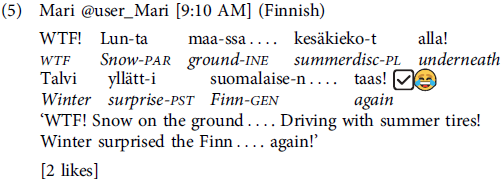
The tweet begins with WTF! written with capital letters and an exclamation mark to show affect. The acronym is accompanied by an observation: there is snow on the ground. After that Mari mentions summer tires (in Finland people need special winter tires). It is, however, unclear from the context whether she is referring to her own car or someone else’s. The next part of the tweet, Talvi yllätti suomalaisen (‘Winter surprised the Finn’) refers to common headlines that often appear with the first snowfall or frost, as people have not prepared by changing their tires or driving more cautiously, and accidents tend to happen. Humor is included with the word taas (‘again’), as Mari portrays people as being surprised every year about the same thing. In the light of the whole tweet, the tweet-initial WTF! is a response to an event outside X. However, Mari’s way of writing throughout the tweet can be interpreted as spoof reported speech, resembling news headlines about people’s carelessness when driving. In this interpretation, WTF! then looks like reported speech as well, showing a surprised stance by a fictive, random driver.
In (6), from Chilean Spanish, wtf is also used at the beginning of an initiative tweet. Here Constanza refers to the odd attitude of one of the participants of the reality show Big Brother in Chile. She criticizes a comment Pato made in the show about his preferences for girls that he dates. This critique is complemented with skull emojis, a common resource that portraits mortal danger and expresses strong negative stance.
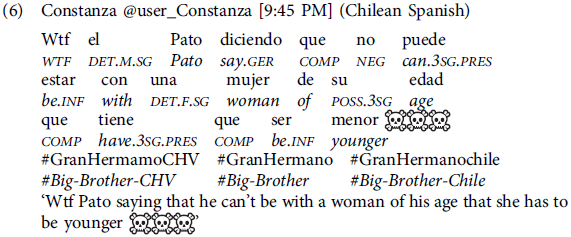
The use of the initial wtf reflects Constanza’s negative stance towards a situation in the reality show described in the sentence: Pato’s preference for dating girls younger than him. This is complemented by emojis and various hashtags referring to the show, which allows the reader to relate the topic of the tweet to a TV program. The tweet-initial wtf thus functions similarly to the English and Finnish examples above, initiating a tweet and showing a negative affective stance that is then explained more thoroughly in the latter part of the tweet.
In this section we have analyzed cases in which wtf, when used at the beginning of an initial tweet, functions as a cue for affect and shows the writer’s stance to something other than another person’s tweet. The affective content conveyed by the discourse marker in these cases serves to evaluate situations or events described in the sentences that follow the use of the acronym.
4.3 Wtf at the middle of a tweet and between sentences
Wtf is also used in the middle of tweets in English, Finnish, and Chilean Spanish. As in previous cases, the acronym functions as a stance marker of disbelief. From the cases we have analyzed, English exhibits a higher degree of syntactic integration of wtf into the sentence. Such integration often occurs by linking the acronym with the rest of the sentence through a discourse connective. Mathilda’s response in (7) illustrates this. She answers Nick Carter’s question with a tweet that begins with laughing emojis and opposes the phrase I love you with WTF written in capital letters.
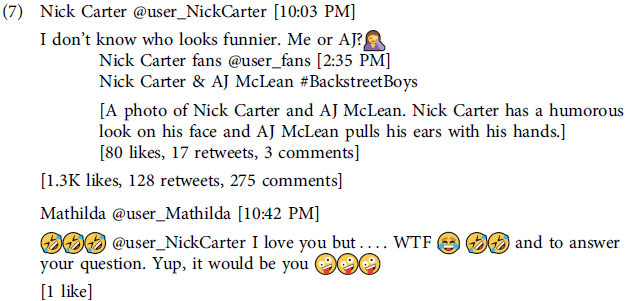
Nick Carter, a famous singer from the band Backstreet Boys, retweeted a post including a photo of him and his bandmate AJ McLean, asking who looks funnier in the photo. Mathilda’s answer begins with praise for Carter but continues with WTF and laughing emojis. The opposition between the praise and the use of wtf shows a possible case of irony in expressing negative affective stance. The repeated use of laughing emojis frames the evaluation as something hilarious, thus affiliating with Nick’s question about who looks funnier.
Mathilda continues the message with an actual answer to Nick’s question by affirming that he indeed looks funnier than AJ. The assessment ends with happy-face emojis, aligning with the comic purpose of the initial tweet. This message is composed of several TCUs and therefore represents a case of information packaging (Hutchby & Tanna Reference Hutchby and Tanna2008), in which WTF is used as a boundary between such TCUs (Maschler & Schiffrin Reference Maschler, Schiffrin, Tannen, Hamilton and Schiffrin2015).
Wtf used as a discourse marker in the middle of tweets is also attested in Finnish and Spanish. Example (8) shows a tweet in Finnish where wtf is used in a tweet that includes two sentences. Wtf is placed after the end of one sentence and before the beginning of another. Kalle has posted a picture of a Moomin mug featuring three Hattifatteners, white cylinder-shaped creatures that are usually regarded as scary characters in the Moomin stories by the Finnish author Tove Jansson. On the mug, the creatures are sitting casually on chairs, having coffee.
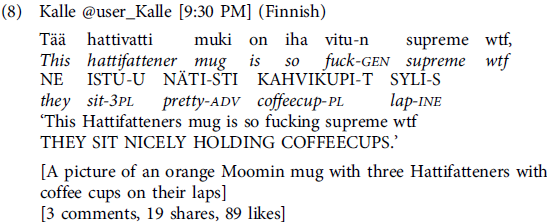
Kalle describes the mug as ihan vitun supreme wtf (‘so fucking supreme wtf’). The word supreme is another loan from English that is usually not used in Finnish. In this tweet, wtf is not an immediate answer to a previous tweet or some other event. On the contrary, Kalle has written wtf further within the tweet, constructing affect together with the phrase ihan vitun supreme. Hence, the context actually leaves open whether wtf is meant as another adjective in that phrase or as a more independent unit that is placed at the end of a sentence after the adjective phrase (ihan vitun supreme wtf / ihan vitun supreme + wtf).
The next sentence is separated by a comma from the rest of the tweet. If wtf is seen as independent from the previous words, it looks like an affective cue that is placed in between two main clauses. The second sentence written in capital letters then tells what is shown on the mug, portraying a strong expression of perhaps surprise or joy towards the friendly-looking Hattifatteners. Based on the other cases of wtf that we have analyzed, it seems that wtf is here used as a discourse marker in between sentences. The message seems clear to the readers of the tweet, since it has received multiple likes, shares, and comments.
Wtf being used in the middle of the tweet as a discourse marker is also observed in Chilean Spanish. In (9), Sandra has posted an initiative tweet asking why their followers are so handsome, and later expressing her inability to kiss everyone. Catalina posts a response expressing her agreement about the fandom’s handsomeness, in which she uses wtf in between the sentences that make up her tweet.
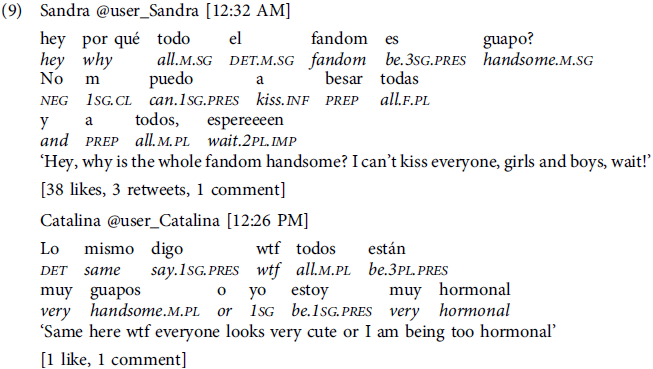
In the first message Sandra expresses surprise about the appeal of the fandom, a comment that is endorsed by Catalina’s response, which begins with Lo mismo digo (‘same here’). Following the use of wtf in the same tweet, Catalina expresses her astonishment at the fandom’s appeal. Given that the initial and final clauses of the tweet do not show any type of syntactic dependency with wtf, we interpret that the acronym acts as a discourse marker in between two sentences. Since these sentences deal with the same topic, it is difficult to interpret whether wtf is scoping the first or the second sentence of the tweet. Despite this underspecificity, the use of the discourse marker helps in the construction of Catalina’s disbelief about the fandom’s beauty. This tweet, which conveys Catalina’s endorsement of Sandra’s opinion, closes an exchange characterized by use of devices that express agreement and affiliation.
In this section we have shown cases of wtf used in the middle of messages and in between sentences as a discourse marker. In all three languages, whether in an initiative or a responsive tweet, the acronym expresses an emotive evaluation towards information shared by the same writer, that could be placed before or after the acronym. English was the only language that showed the use of discourse connectives (see example (7)) to link the sentences in which the acronym appeared.
4.4 Wtf at the end of a tweet
Wtf is also used as the last element of the main text. In this position, wtf evaluates the situation described in the same tweet, a function that is attested in all three languages. In (10) we see such a case in English. Amy writes about the high temperatures around California. The tweet starts with the phrase It’s so crazy, which directs the reader to interpret Amy having a stance of astonishment. After this phrase she describes high temperatures in the cities of Inglewood (80 Fahrenheit = 26.7 ºC) and Hollywood (89 Fahrenheit = 31.7 ºC).
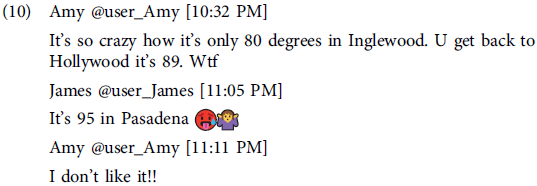
Amy mentions that when getting back to Hollywood (approximately 400 kilometers away), the temperature goes higher. At the end of the tweet, after a full point, Amy uses wtf. In this position, wtf is a reaction to what Amy has written herself, showing a negative affective stance towards the high temperatures. James answers Amy’s tweet by saying that it is even hotter in Pasadena, and adding a sweating emoji to support this view. Amy confirms her stance in her response to James in the last message: she does not like these high temperatures.
In (11), wtf occupies the same final position in a Finnish tweet. Anna tweets about a dream she had. The dream was about her doing math in order to change the end result of ‘Avengers: Endgame’, a popular movie from 2019. At the end of the tweet she uses wtf written together with the rest of the tweet, without any punctuation marks.
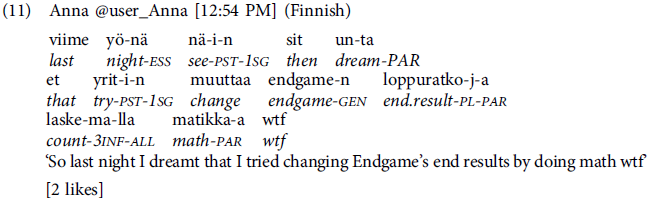
Also here wtf evaluates what was said earlier by the same writer. By using wtf in tweet-final position, Anna emotionally distances herself from the content of the dream, showing surprise towards it. In other words, by using wtf, Anna expresses an affective stance toward her own dream after describing it, providing the reader with a cue to interpret the dream as something unexpected.
The use of wtf in a final position is also attested in Chilean Spanish. In (12) Rodrigo uses wtf at the end of his responsive tweet. The initiative tweet comes from an institutional report from a TV news program. The tweet announces that Mario Desbordes, a right-wing politician, will be the only right-wing candidate for mayor of Santiago, capital of Chile. This comes after Aldo Duque, another candidate from the same political spectrum, withdrew from the race.
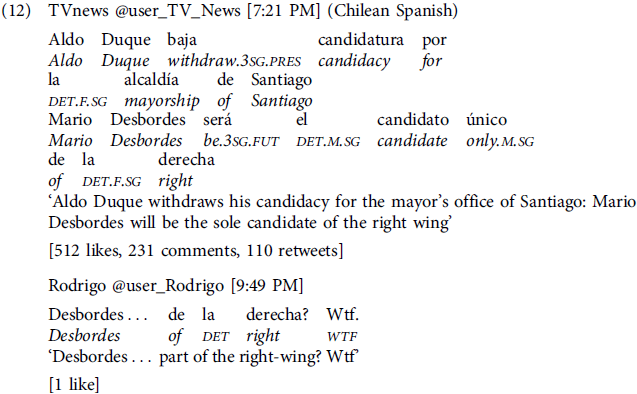
Rodrigo comments on the news broadcaster’s tweet by repeating the name Desbordes, topicalizing it. After this, he writes a question that expresses his disbelief about Mario Desbordes belonging to the right-wing. This stance is emphasized with the use of ellipsis, which in this context can be interpreted as a representation of doubt or surprise. The question that comes after the ellipsis denotes the user’s negative stance towards this news, considering that Mario Desbordes is a well-known right-wing politician. The expression of this negative stance is strengthened with the final wtf, that serves to evaluate the situation and to express the user’s difficulty to accept the nomination of Desbordes as a representative for the right-wing political spectrum.
In this subsection we presented examples of wtf being used at the end of tweets in English, Finnish, and Chilean Spanish. We showed that, regardless of its interactional position – whether in an initiative or a responsive tweet – wtf functions as a stance marker toward the event or situation described in the same tweet.
4.5 Wtf as a hashtag
Wtf can be made into a hashtag, #wtf. According to previous research on X, hashtags are most commonly placed at the end of tweets (Zappavigna Reference Zappavigna2015:287). The use of #wtf was attested in all three languages, with most cases corresponding to the Finnish dataset. Example (13) shows this use in a Finnish tweet. Sami writes about judges being figuratively at sea, but without more context it is now left open what the tweet refers to. It might concern, for example, a sports game or a TV competition, since tweets often relate to current events that might not be recognizable afterwards, especially without topical hashtags (see Wikström Reference Wikström2014).
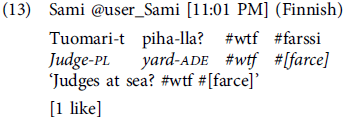
After the question Tuomarit pihalla? (‘Judges at sea?’) Sami has written #wtf to portray astonishment and unexpectedness. Wtf functions here, similarly to tweet-final uses, to show an affective stance towards what is described in the main text of the tweet. However, as a hashtag, it speaks to an implicit X audience especially (Zappavigna Reference Zappavigna2015:275, Marwick & Boyd Reference Marwick and Boyd2011). In addition, #wtf is followed by another hashtag, #farssi (‘#farce’), which conveys a negative affective stance and shows a problem in acceptance towards the judges’ actions. A person reading this tweet at the time of its publishing might understand the context and what the tweet refers to: it has received one like.
As mentioned in Section 4, our search initially did not match instances of wtf as a hashtag in American English or Chilean Spanish. A targeted search for these instances, nevertheless, did find occurrences. There were three cases in American English – written way before our first search, in 2013, 2014, and 2018 – and one in Chilean Spanish – written only after our first search. One of the cases of this use in American English can be seen in example (14), which shows an initiative tweet that did not have replies, retweets, or likes. Alan posts two sentences that hold a relationship of causation: America is near to its end because it has fallen in love with soccer.

As in (13), it is difficult to know exactly the context in which the tweet in (14) was written. Still, the sentences written by Alan, alongside the two hashtags #wtf and #goooaaal, lead us to assume that the user is being ironic about how bad it is for Americans to become football fans. Moreover, the second hashtag functions as a device for the writer’s affiliation towards football fans, as the hashtag refers to the common shout of celebration in this sport. The use of wtf as a hashtag, similar to the previous case in Finnish, topicalizes the writer’s stance of disbelief towards what is described in the main text of the tweet.
Case (15) of Chilean Spanish presents a similar function to those described for Finnish and American English. The user Franco posts a screenshot of the new movie Shrek 5 with a meme below it that says, ‘Why do you have to ruin everything I love?’ The main text of the tweet demonstrates a negative evaluation of the user towards how Shrek looks in the new movie.
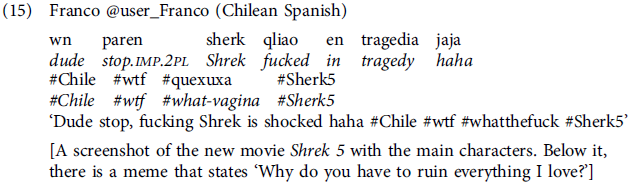
With this tweet Franco makes fun of Shrek’s appearance and expresses amusement with written laughter jaja (‘haha’). In addition, two hashtags, #wtf and #quexuxa (a Chilean slang phrase that is similar to what the fuck), topicalize the astonishment of the user towards the situation described in the tweet. The negative evaluation is made evident with the text inside the meme, which exposes that the new movie ruined something that the user used to like.
The use of the hashtag #wtf in the cases shown above expresses the writer’s affective stance towards the situation described in the tweet. In this sense, the hashtag functions similarly to the cases in which the acronym wtf appears at the end of a tweet, as described in Section 4.4. However, unlike in those cases, #wtf enables users to topicalize their stance and at the same time create affiliation with other users (Wikström Reference Wikström2014) who might express a similar state of disbelief by, for example, tweeting about it.
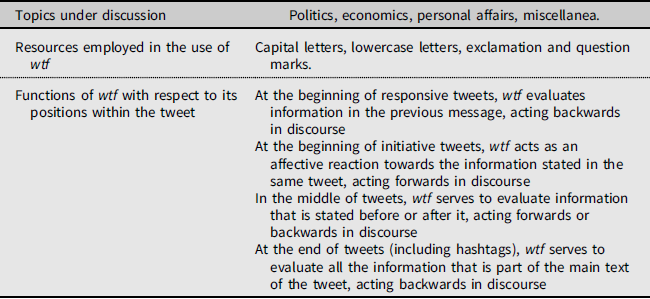
In the preceding subsections we have shown a correlation between the position of the discourse marker wtf and the information that it evaluates. In all three languages the acronym was used in contexts where users discussed a wide range of topics: politics, economics, personal affairs, the weather, and other miscellanea. The affective stances were portrayed with the use of lexical items, capital letters, and exclamation marks, and by explaining personal opinions more closely. Table 4 summarizes these findings.
Summary of the findings on the use of wtf in tweets written in Finnish, American English, and Chilean Spanish
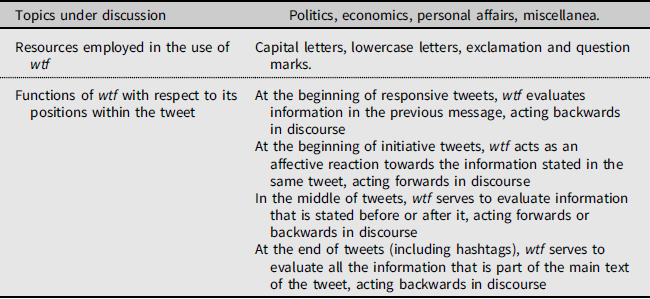
Table 4 shows the similarities across the three languages. The positions in which the acronym was used correlated with the information evaluated by it. In this sense, even though differences were found across languages in terms of frequencies of use (see Table 3), no differences were found in the functions the acronym performed in each position.
5. Discussion
In this paper we have compared the uses of wtf, an acronym derived from what the fuck, commonly used in digitally mediated interactions (Squires Reference Squires2010). As we have shown, it has been conventionalized on X as a swear expression within the digital interactions in three culturally and typologically different languages. Our work aimed to describe the differences and similarities in the use of wtf between these languages. In this sense, our data did not demonstrate cultural differences in the uses of wtf between Chilean users, as part of a high-context culture (see Dozier et al. Reference Dozier, Husted and Timothy McMahon1998, Osland & Florenthal Reference Osland and Florenthal2009), and American and Finnish users, as part of low-context cultures (see Kim et al. Reference Kim, Yigang and Heung Soo1998, Nishimura et al. Reference Nishimura, Nevgi, Tella and Kallioniemi2008). One possible explanation is the restricted modality through which the interactions of our corpus were carried on: digital, non-synchronous, text-based interactions. Hence, an interesting future exploration could be to observe the uses of foreign swear expressions in face-to-face interactions, in order to find possible differences in the use of multimodal cues in the three languages. Moreover, the spoken use of the acronym wtf, pronounced letter by letter, is worth looking into, both in English and any RLs that include loans from English.
In all three languages, wtf was used to portray the writer’s disbelief, surprise, and a problem in acceptance in a wide range of topics: politics, economics, weather conditions, pop culture, relationships, etc. Resources such as question and exclamation marks, capital letters, and evaluative lexical items were usually employed to strengthen an emotional stance. In this sense, a more systematic description of topics and resources will be needed to contrast the findings of previous research on how swearing with a foreign expression carries less emotional force than an expression from the native language (Dewaele Reference Dewaele2004, Hwang & Matsumoto Reference Hwang, Matsumoto and Chen2017, Mohammadi Reference Mohammadi2020). We hypothesize that, given the existence of similar native expressions, wtf might have less illocutionary force as an affective cue in the RLs than in its SL (Andersen Reference Andersen2014, Peterson Reference Peterson2017).
As a discourse marker – the function that was the focus of this investigation – in all three languages, the different positions of the acronym were related to the evaluation of different elements of the ongoing interaction. This observation aligns with the importance of determining the position of discourse markers to describe their function (Fox Reference Fox2007, Andersen Reference Andersen2014, Maschler & Schiffrin Reference Maschler, Schiffrin, Tannen, Hamilton and Schiffrin2015, Mushin et al. Reference Mushin, Joe Blythe, Caroline de Dear, Possemato and Stirling2023). Such importance strengthens the idea that even non-synchronous, text-based interaction adheres to general conversational conventions (Hutchby & Tanna Reference Hutchby and Tanna2008, Markman Reference Markman and Darics2015, Koivisto et al. Reference Koivisto, Virtanen and Vepsäläinen2023). As social media is a rich venue for naturally occurring conversations in multiple languages, more cross-linguistic comparisons on different phenomena are worth looking into, both on X and other digitally mediated social platforms.
6. Conclusion
In this paper we have compared the uses of wtf in the social media platform X between the SL American English and two RLs, Finnish and Chilean Spanish. Studying a linguistic resource in digital text-based interactions enabled a fruitful comparison of three genetically, typologically, and geographically distant languages with different communicative styles. It also allowed us to observe the extent to which communicative differences hold in an online environment, something that is increasingly relevant for the study of social interaction (van Dijck Reference Dijck2013, Koivisto et al. Reference Koivisto, Virtanen and Vepsäläinen2023). From a Conversation Analytic perspective, the analysis focused on the social media affordances and the interaction between participants. From an Interactional Linguistic point of view, it focused on the syntagmatic relations of wtf and its positions within tweets. These observations allowed us to describe the functions of the acronym and the affective attitudes it conveyed in the interaction.
Among these typologically different languages (Quirk et al. Reference Quirk, Greenbaum, Leech and Svartvik1985, Helasvuo Reference Helasvuo2001, Iggesen Reference Iggesen2013), the acronym wtf presented more syntactic integration in the source language than in the recipient languages. English was the one that presented the most varied uses of wtf: as an interrogative pronoun, a discourse marker, a noun, or an adjective. The Finnish and Chilean Spanish datasets presented a more restricted use of wtf, as only one case in Finnish was considered to be an interrogative pronoun. In this sense, we observed a functional narrowing of wtf, since the acronym lost some of its functions when used in the RLs.
As a discourse marker, wtf was mostly used in similar positions – tweet-initial, tweet-middle, and tweet-final – in all three languages. However, the Finnish data revealed no use of wtf as a stand-alone response but instead more use as the hashtag #wtf than the other two languages. Moreover, wtf revealed an affective stance of astonishment and a problem in acceptance, but did not evaluate the content more closely. Instead, the writer’s affective stance is to be interpreted from a wider context, such as the whole tweet in which it is written. When the acronym is written as the hashtag #wtf, it speaks to the social media audience especially, inviting the reader to align and share values and opinions.
Finnish, Chilean Spanish, and American English are three languages from three distant cultures. Comparing them in this fine-grained study has given new insights into the study of pragmatic borrowing. It is observed that the English acronym wtf, as a discourse marker, is used similarly in two different RLs, Finnish and Chilean Spanish, which was unexpected considering their typological and cultural differences. The major difference found was that American English was the only language that presented a conventionalized use of the acronym as an interrogative pronoun. Thus we argue that wtf has gone through functional narrowing when applied as a pragmatic loan in Finnish and Chilean Spanish tweets. With this study we demonstrated that even drastically different languages can be compared in terms of the interactional sequence and affective use, on an online platform, revealing differences and striking similarities.
Acknowledgements
This research was partially funded by the Chilean National Agency of Research (ANID)/Becas Chile 72220098. We thank the editors for their constructive comments and the three anonymous reviewers for their valuable recommendations on the first version of this paper. Their feedback significantly improved the quality of the final version.
In her PhD research (2024), Nurmikari examined the affective use of Finnish repair lexemes eiku (‘no I mean’), mitä, täh, häh (‘huh’), and anteeks(i) mitä (‘sorry what’) on Twitter (X). She applied Conversation Analysis to study written interactions online. The results showed that Finnish repair lexemes can be used in different parts of a tweet and different sequential positions across Twitter and even as hashtags. The position of a repair lexeme affects its interpretation that often relates to affective stance rather than repair.
Competing interests
The authors declare none.

 Open access

