


Introduction
Over the last decades, declining fertility and increasing singlehood have led to a growing number of middle-aged and older adults with fewer family members. These demographic shifts, which primarily affect the availability of nuclear family ties, that is, partners and children, pose new challenges for older adults’ wellbeing and access to informal support systems (Brown and Lin Reference Brown and Lin2012; World Health Organization (WHO) 2015). Family networks are projected to shrink globally (Alburez-Gutierrez et al. Reference Alburez-Gutierrez, Williams and Caswell2023), and the proportion of adults aged 50 or older reporting unmet care needs due to the absence of close family members is expected to rise significantly in the coming decades (Wu et al. Reference Wu, Margolis, Verdery and Patterson2024). At the same time, families are not only shrinking but also becoming more complex, increasing the number of potentially available members, such as step-children and step-parents, yet often weakening family relationships and supportive behaviours (Patterson et al. Reference Patterson, Schoeni, Freedman and Seltzer2022).
Previous research has highlighted the micro-level implications of ‘kinlessness’, commonly defined as having neither a partner nor children, which places individuals at risk of ageing alone with limited support (Carney et al. Reference Carney, Fujiwara, Emmert, Liberman and Paris2016; Verdery et al. Reference Verdery, Margolis, Zhou, Chai and Rittirong2019). As social networks become mostly family-based with age, unpartnered childless adults have fewer opportunities for social interaction and connectedness, which in turn may lead to lower levels of health and subjective wellbeing (Mair Reference Mair2019; Verdery et al. Reference Verdery, Margolis, Zhou, Chai and Rittirong2019). Middle-aged and older adults with neither a partner nor children report significantly lower levels of physical and mental health and subjective wellbeing compared to partnered older people and parents (Margolis and Verdery Reference Margolis and Verdery2017; Tosi and van den Broek Reference Tosi and Van den Broek2025; Wright and Brown Reference Wright and Brown2017; Grundy et al. Reference Grundy, den Broek and Keenan2019; Zhou et al. Reference Zhou, Verdery and Margolis2019; Arpino et al. Reference Arpino, Meli, Pasqualini, Tomassini and Cisotto2022; Margolis et al. Reference Margolis, Chai, Verdery and Newmyer2022). Nevertheless, older adults without a partner or children may rely on alternative relationships, such as friendships, that may be good substitutes in terms of support and companionship (e.g. Albertini and Kohli Reference Albertini and Kohli2009; Mair Reference Mair2019). Moreover, having a partner and children is not inherently beneficial for older adults, as those who are estranged from or have no contact with family members may receive limited support, similar to those without a partner or children (Albertini and Arpino Reference Albertini and Arpino2018; Arránz Becker and Hank Reference Arránz Becker and Hank2022; Patterson and Margolis Reference Patterson and Margolis2023). Because parent–child interactions may be directly related to psychological states, providing a sense of security and belonging (Berkman et al. Reference Berkman, Glass, Brissette and Seeman2000), sporadic in-person contact with children is found to be associated with higher risks of social isolation and depression and lower levels of subjective wellbeing among older parents (Koropeckyj‐Cox Reference Koropeckyj‐Cox2002; Djundeva et al. Reference Djundeva, Dykstra and Fokkema2019; Teo et al. Reference Teo, Choi, Andrea, Valenstein, Newsom, Dobscha and Zivin2015; Tosi and Grundy Reference Tosi and Grundy2019).
Despite the extensive research on family structures, intergenerational relationships and subjective wellbeing, at least three significant gaps remain. First, much of the existing literature examines family structure (based on the presence or absence of partners and children) and parent–child relationships as separate phenomena, failing to explore their combined impact on wellbeing (Patterson and Margolis Reference Patterson and Margolis2023). Integrating family structure with parent–child contact frequency may reveal whether having less-frequent contact with children is more or less detrimental than having no children at all, or whether frequent contact with children may compensate for the absence of a partner in terms of subjective wellbeing. One of the few existing studies combining family structure and parent–child relations shows that parents who have sporadic contact with their children have similar levels of subjective wellbeing compared to childless adults (Albertini and Arpino Reference Albertini and Arpino2018), highlighting the importance of considering both the quality (in terms of contact frequency) and the quantity (in terms of the presence/absence) of family ties. Thus, we define family structure types by incorporating the presence/absence of a partner and children – in line with previous studies on ‘kinlessness’ (e.g. Verdery et al. Reference Verdery, Margolis, Zhou, Chai and Rittirong2019; Margolis et al. Reference Margolis, Chai, Verdery and Newmyer2022) – with parent–child contact frequency to analyse their associations with happiness among middle-aged and older adults.
Second, we contribute to previous research on parent–child relationships by distinguishing between different forms of communication – that is, face-to-face, phone and digital contact – between older parents and their adult children (Peng et al. Reference Peng, Silverstein, Suitor, Gilligan, Hwang, Nam, Routh, Barbosa Neves and Casimiro2018). Although in-person contact remains the primary way for older parents and adult children to share experiences and activities, the growing prevalence of digital tools is reshaping the nature of intergenerational interactions. As digital communications, via video calls, instant messaging apps and social media, have increased in popularity, these have become a complement to more traditional forms of communication, fostering intimate but physically distant relationships between family members (Peng et al. Reference Peng, Silverstein, Suitor, Gilligan, Hwang, Nam, Routh, Barbosa Neves and Casimiro2018; Hwang et al. Reference Hwang, Fu, Brown and Silverstein2024; Tosi and Arpino Reference Tosi and Arpino2025). Thus, new digital forms may reinforce the more traditional form of parent–child contact, such as in-person and telephone interaction, potentially promoting better subjective wellbeing among older parents (Danielsbacka et al. Reference Danielsbacka, Tammisalo and Tanskanen2023; Laumert Reference Laumert2025). This is an important area for further exploration, as findings remain mixed on whether digital contact is associated with improved wellbeing (e.g. Teo et al. Reference Teo, Choi, Andrea, Valenstein, Newsom, Dobscha and Zivin2015).
Third, we analyse these associations among middle-aged and older men and women across Nordic, Western, Southern and Eastern European countries using cross-sectional data from the tenth round (2020–2022) of the European Social Survey (ESS). While previous studies documented the rising trend in the prevalence of ‘kinlessness’ among middle-aged and older adults worldwide (e.g. Verdery et al. Reference Verdery, Margolis, Zhou, Chai and Rittirong2019; Pittavino et al. Reference Pittavino, Arpino and Pirani2025), cross-country variations in the association between ‘kinlessness’ and wellbeing are rarely examined. Evidence suggests that having neither a partner nor children is associated with lower wellbeing among older adults living in family-centred societies, such as Eastern and Southern European countries, as they rely more on informal support (Carr Reference Carr2019; Mair Reference Mair2019). Thus, we analyse whether family structure types – derived from the integration of the presence of partners and children with the frequency and type of parent–child contact – are associated with subjective wellbeing across different European country clusters.
Literature review
Family structure and subjective wellbeing
The hierarchical compensatory model suggests that partners and children are primary sources of support and wellbeing because they represent long-term commitment that is difficult to substitute with other ties, such as those with relatives, friends, neighbours or formal organizations (Cantor Reference Cantor1979; Penning Reference Penning1990). Partners and children are primary sources of emotional, social and practical support, contributing to greater life satisfaction and better health outcomes (Berkman et al. Reference Berkman, Glass, Brissette and Seeman2000; Antonucci et al. Reference Antonucci, Ajrouch and Birditt2014; Mpofu et al. Reference Mpofu, Zhan, Yin and Brock2024). Studies consistently show that married individuals or those in long-term partnerships experience lower levels of loneliness and depression compared to their unmarried counterparts, due, in part, to the companionship, reciprocal control over unhealthy behaviours and mutual care-giving roles that partners provide (Van Baarsen et al. Reference Van Baarsen, Smit, Snijders and Knipscheer1999; Stokes and Moorman Reference Stokes and Moorman2018; Grundy et al. Reference Grundy, den Broek and Keenan2019; Freedman et al. Reference Freedman, Wolff, Sawhill, Stevenson, Sawhill and Stevenson2020; Srivastava et al. Reference Srivastava, Debnath, Shri and Muhammad2021). Since partners have long-term internalized commitment towards each other, having a partner is often considered a key source of practical and emotional support, fostering later-life wellbeing and happiness (e.g. Koropeckyj‐Cox Reference Koropeckyj‐Cox2002; Tosi and van den Broek Reference Tosi and Van den Broek2025; Tosi and Grundy Reference Tosi and Grundy2021).
The presence of children also offers older adults the opportunity for social engagement and practical assistance during times of need (Kohli and Albertini Reference Kohli and Albertini2009; Deindl and Brandt Reference Deindl and Brandt2017; Hünteler and Hank Reference Hünteler and Hank2025). Consistent with this view, studies show that middle-aged and older adults without children are more likely to experience social isolation, loneliness, adverse physical and mental health outcomes and lower levels of subjective wellbeing compared to parents (Dykstra and Keizer Reference Dykstra and Keizer2009; Wright and Brown Reference Wright and Brown2017; Mair et al. Reference Mair, Ornstein and Chen2020; Penning et al. Reference Penning, Wu and Hou2024). As social networks tend to shrink and become more family-centric with age (Cornwell et al. Reference Cornwell, Laumann and Schumm2008; Verdery and Campbell Reference Verdery and Campbell2019), childless adults face reduced opportunities for social participation, support and interaction compared to those with children (Carstensen et al. Reference Carstensen, Isaacowitz and Charles1999; Margolis et al. Reference Margolis, Chai, Verdery and Newmyer2022). Adult children may be a particularly important source of support and social integration for middle-aged and older adults who cannot turn to a partner. Recently, scholars have argued that the rapidly growing group of older adults who have neither a partner nor a child is at risk of becoming so-called elder orphans, that is, older individuals who live alone and have an inadequate support system (Carney et al. Reference Carney, Fujiwara, Emmert, Liberman and Paris2016; Carr and Utz Reference Carr and Utz2020). Hence, we hypothesize that middle-aged and older adults with neither a partner nor a child have the lowest level of happiness compared to those in other family structure types (i.e. having either a partner or a child or both) (kinlessness hypothesis).
Parent–child contact and wellbeing
The convoy model emphasizes that not only family structures but also the quality of their ties has significant implications in promoting emotional and practical support, feelings of reassurance, and wellbeing in later life (Antonucci et al. Reference Antonucci, Ajrouch and Birditt2014). Numerous studies highlight the importance of face-to-face interactions with children in enhancing mental health and subjective wellbeing among middle-aged and older adults (e.g. Bengtson Reference Bengtson2001). For example, Teo et al. (Reference Teo, Choi, Andrea, Valenstein, Newsom, Dobscha and Zivin2015) find that middle-aged and older adults who have face-to-face contact with their adult children less than once a month have an 11.5 per cent higher likelihood of developing depressive symptoms, over a two-year follow-up period, compared to those with more regular contact. Similarly, Tosi and Grundy (Reference Tosi and Grundy2019) show that infrequent meetings with children are associated with increases in depressive symptoms, particularly for unpartnered fathers. Face-to-face contact is particularly effective for enhancing subjective wellbeing and providing practical support, with those maintaining close relationships and frequent interactions with their adult children reporting higher levels of life satisfaction and mental health compared to older adults with infrequent contact (Arránz Becker and Hank Reference Arránz Becker and Hank2022; Zhang et al. Reference Zhang, Gong, Tang and Li2025).
While in-person interaction remains central, the rise of digital tools – such as messaging apps and video calls – has created new opportunities for maintaining intergenerational connections, particularly when physical presence is not possible (Fingerman et al. Reference Fingerman, Huo and Birditt2020). According to Danielsbacka et al. (Reference Danielsbacka, Tammisalo and Tanskanen2023), digital communication often complements rather than replaces face-to-face interactions, creating a hybrid model that balances immediacy and accessibility. Digital tools, together with phone calls, may provide a means of frequent communication, helping to sustain emotional bonds over the lifecourse and reducing loneliness and isolation during negative external events, such as the Covid-19 pandemic (Arpino et al. Reference Arpino, Meli, Pasqualini, Tomassini and Cisotto2022; Canale et al. Reference Canale, Marino, Lenzi, Vieno, Griffiths, Gaboardi, Giraldo, Cervone and Massimo2022; Cohn-Schwartz et al. Reference Cohn-Schwartz, Vitman-Schorr and Khalaila2022). Although certain types of care, such as assistance with showering or eating, require in-person contact, digital communication and phone calls can help foster emotional connections, providing reassurance and a sense of belonging (Peng et al. Reference Peng, Silverstein, Suitor, Gilligan, Hwang, Nam, Routh, Barbosa Neves and Casimiro2018; Danielsbacka et al. Reference Danielsbacka, Tammisalo and Tanskanen2023; Tosi and Arpino Reference Tosi and Arpino2025). However, evidence on the association between parent–child digital contact and subjective wellbeing is mixed, with some studies showing no protective benefits (Teo et al. Reference Teo, Choi, Andrea, Valenstein, Newsom, Dobscha and Zivin2015; Newson et al. Reference Newson, Zhao, Zein, Sulik, Dezecache, Deroy and Tunçgenç2024) and others suggesting positive effects of using messaging apps and video and phone calls in reducing loneliness and social isolation during the Covid-19 pandemic (Chan Reference Chan2018; Gabbiadini et al. Reference Gabbiadini, Baldissarri, Durante, Valtorta, De Rosa and Gallucci2020; Canale et al. Reference Canale, Marino, Lenzi, Vieno, Griffiths, Gaboardi, Giraldo, Cervone and Massimo2022; Balki et al. Reference Balki, Holland and Hayes2023; Hall et al. Reference Hall, Dominguez and Mihailova2023). It remains unclear, therefore, whether the emotional depth and non-verbal cues of face-to-face communication are critical in fostering meaningful connections associated with happiness and life satisfaction, or whether digital communication can replace the personal touch that one can experience in face-to-face interactions (Dickinson and Hill Reference Dickinson and Hill2007). Gong et al. (Reference Gong, Sit, Wong, Lai, Ho, Wang and Lam2022) suggest that digital tools serve as valuable supplements, showing that middle-aged and older adults having in-person contact and using instant messaging apps to communicate with children had higher levels of happiness and life satisfaction compared to those having face-to-face contact only. Hence, we hypothesize that having either frequent in-person, phone or digital contact (i.e. via video calls, instant messaging apps and social media) with an adult child is associated with higher levels of happiness than having less frequent parent–child interactions (contact hypothesis).
Integrating family structure with parent–child contact
When considering family structure – defined by the presence or absence of a partner and children – alongside parent–child contact frequency, it is reasonable to expect that infrequent face-to-face, phone or digital contact with children is less detrimental to subjective wellbeing than being childless. In fact, while the positive well-being effects may partly stem from support provided by adult children - including emotional and practical help that requires having contact either in person or via phone or digital tools (Guo et al. Reference Guo, Xu, Liu, Mao and Chi2016; Freedman et al. Reference Freedman, Wolff, Sawhill, Stevenson, Sawhill and Stevenson2020) - the mere existence of adult children may also promote feelings of security, self-realization and life satisfaction (Dykstra and Keizer Reference Dykstra and Keizer2009; Deindl and Brandt Reference Deindl and Brandt2017). Patterson and Margolis (Reference Patterson and Margolis2023) show that, although living at distance from children reduces the opportunity for interaction and support exchanges, older adults who have no geographically near children are not disadvantaged in terms of mental health compared to those living close to their families. Older adults who have sporadic face-to-face interactions with their adult children may rely on other forms of practical support, like friends (Nocon and Pearson Reference Nocon and Pearson2000; Mair Reference Mair2019; Thompson et al. Reference Thompson, Smith, McNeill and Pollet2024), while maintaining close relationships with children via phone or digital contact. Conversely, the small proportion of older parents who have no interactions through any form of contact (face-to-face, phone and digital) may exhibit similar levels of subjective wellbeing as those without children (Albertini and Arpino Reference Albertini and Arpino2018). Albertini and Arpino (Reference Albertini and Arpino2018) suggest that the influence of children on subjective wellbeing can be understood as a continuum, ranging from childlessness or no contact with children to large and close family networks, with those who have infrequent contact with their children positioned somewhere in between. Thus, we hypothesize that the happiness of middle-aged and older adults with infrequent contact with their children lies between that of childless adults and those who maintain frequent contact with children (continuum hypothesis).
Heterogeneity by gender and country
The effects of family structures and parent–child contact on subjective wellbeing may be contingent on both gender and country contexts. Women typically maintain broader and more diverse social networks and tend to play a more central role in family relationships, fostering contact and support exchanges with their children (Mair Reference Mair2013a, Reference Mair2019). In contrast, men tend to rely more heavily on spousal relationships for social interactions and support (e.g. Koropeckyj‐Cox Reference Koropeckyj‐Cox2002; Grundy et al. Reference Grundy, den Broek and Keenan2019), making them particularly vulnerable to poorer wellbeing when a partner is absent or contact with children is sporadic (Margolis et al. Reference Margolis, Chai, Verdery and Newmyer2022; Tosi and van den Broek Reference Tosi and Van den Broek2025; Sun and Schafer Reference Sun and Schafer2023). Hence, we hypothesize that middle-aged and older men without a partner or children and those with infrequent contact with children are more likely to report lower levels of happiness compared to their female counterparts (gender differences hypothesis). While we expect a stronger negative effect of partner and child absence on men’s wellbeing, the emotional impact of weakened parent–child relationships may also be consequential for women. Infrequent contact with children may be associated with worse wellbeing for women than men because women are often expected to maintain close familial ties, acting as kinkeepers – a role that, when disrupted, can threaten their sense of psychological wellbeing (Agllias Reference Agllias2013). Jessee and Carr (Reference Jessee and Carr2025) show that disconnection from adult children is associated with greater psychological distress among older women, particularly those in stable marriages.
Family structures and the availability of support systems vary considerably across countries. Research suggests that in individualistic countries the reliance on non-familial ties such as friends is normative and compensates for the absence of a partner and/or children (Mair Reference Mair2013a, Reference Mair and Phellas2013b). For instance, older adults in Nordic and Western Europe are more likely to develop ‘friend-oriented’ networks and less likely to have frequent contact with their adult children compared to their counterparts in Southern and Eastern Europe (Dykstra and Fokkema Reference Dykstra and Fokkema2012; Djundeva et al. Reference Djundeva, Dykstra and Fokkema2019). This adaptation is underpinned by cultural norms that place less emphasis on the family as a key source of emotional support and self-realization (Mair Reference Mair and Phellas2013b). Conversely, Southern and Eastern European countries exhibit stronger familistic cultures, where family is considered the primary source of support for older adults (Tomassini et al. Reference Tomassini, Kalogirou, Grundy, Fokkema, Martikainen, Broese van Groenou and Karisto2004; Djundeva et al. Reference Djundeva, Dykstra and Fokkema2019; Tosi and Grundy Reference Tosi and Grundy2018). Moreover, previous research showed how in family-centred countries adult children are more responsive to the needs of their parents compared to individualistic ones, and having children and close familial bonds is more strongly associated with wellbeing (Kalmijn and Saraceno Reference Kalmijn and Saraceno2008; Grundy et al. Reference Grundy, den Broek and Keenan2019). These findings indicate that, in family-centred countries, individuals without familial ties may lack adequate alternative support systems, potentially contributing to lower levels of happiness. Consistent with this background, we hypothesize that the absence of a partner and children or having infrequent contact with children has stronger negative effects on happiness in Southern and Eastern Europe than in Nordic and Western European countries (country differences hypothesis).
Methods
Data and sample
We use data from the tenth round of the ESS, a cross-sectional survey that maps different life aspects, including family relationships and subjective wellbeing. The overall ESS sample is representative of residential populations aged 15+ in each country living in private households, regardless of nationality and citizenship or language. The tenth wave was carried out over a longer period than a usual ESS round (2020–2022), due to the Covid-19 pandemic and covers 31 countries. Due to the impact of the Covid-19 pandemic at Round 10, a total of 9 (Austria, Cyprus, Germany, Israel, Latvia, Poland, Serbia, Spain, Sweden) countries switched to a self-completion approach (web and paper), while 22 countries (Belgium, Bulgaria, Croatia, Czechia, Estonia, Finland, France, Greece, Hungary, Iceland, Italy, Ireland, Lithuania, Montenegro, North Macedonia, Netherlands, Norway, Portugal, Slovenia, Slovakia, Switzerland, United Kingdom) used ESS’s usual face-to-face fieldwork approach. Sample weights are used in all the analyses reported here to account for different sampling procedures and data collection methods (see analytical strategy). Additional analyses on the subsample of the 22 countries that collected data through face-to-face interviews are reported in the Supplementary Materials and confirm the consistency of the findings presented here (Tables E1–E3).
The analytic sample is restricted to 30 European countries, excluding Israel as the only non-European country, and respondents aged 50+ (n = 31,806 respondents). Among the group of parents, we exclude those with minor children (below age 18), thus excluding 4,601 individuals (14.46 per cent) of the age-selected sample. This choice is driven by the fact that adult children play a more relevant role in providing support and social integration to older parents than younger (dependent) children (e.g. Zhang and Grant Reference Zhang and Grant2023). Moreover, we exclude 2,943 individuals (9,25 per cent of the age-selected sample) who have missing information on the variables used in the analysis. Therefore, the final sample includes 24,262 middle-aged and older adults living in 30 European countries.
Measures
Our dependent variable, that is, the happiness scale, is based on responses to the question ‘Taking all things together, how happy would you say you are?’. The answer categories range from 0 (extremely unhappy) to 10 (extremely happy). Happiness is a crucial dimension of quality of life and a validated measure of subjective wellbeing, reflecting the emotional component of subjective wellbeing (Diener et al. Reference Diener, Oishi and Tay2018). As a robustness check, we also ran sensitivity analyses using life satisfaction as an alternative outcome, capturing the cognitive dimension of wellbeing. Results were similar across both measures, as discussed in the results section.
Central to our research is the variable regarding respondents’ family structure, which is derived from the presence or absence of a partner and children (both biological and non-biological). Household composition – derived from the household roster and respondents’ marital status – is utilized to capture the presence or absence of a partner living in the same household. Our data do not allow us to identify non-co-residing partners; however, previous studies indicate that the proportion of non-co-residing partners among middle-aged and older Europeans is only 3–4 per cent (de Jong Gierveld Reference de Jong Gierveld2009; Hu and Coulter Reference Hu and Coulter2025). Additionally, to ascertain whether an individual has one or more children, household roster composition is combined with variables on whether individuals have ever had a child living in the household. Therefore, individuals having a child are those who currently live with, or have lived with one or more children, including step-children or non-biological children, but not those raised in institutes, foster families or by other family members. Despite this limitation in the used data, we consider these children who were raised by other parental figures to be less-effective sources of support and companionship for middle-aged and older adults. Moreover, recent estimates report a rate of 0.03 per cent of children raised in institutions or foster families in Europe (UNICEF and Eurochild 2021).
Consistent with the literature on kinlessness (Margolis et al. Reference Margolis, Chai, Verdery and Newmyer2022), we distinguish among four family structure types: (1) those who have a partner and children; (2) those who have a partner but no children; (3) those who have children but no partner; and (4) those who have neither a partner nor children. We then integrate the four family structure types with parent–child contact frequency (see Table 1). In the dataset used, contact frequency is measured based on interactions between parents and a randomly selected child aged 12 or older (the one whose birth date is closest to the interview date). For our analysis of parent–adult child relationships, we focus on a randomly selected child aged 18 or older, assuming that they are representative of overall parent–child interactions. The original answer categories, ranging from ‘never’ to ‘daily’, were classified into frequent (‘more than weekly’) contact and infrequent (‘once a week or less’) contact. This operationalization is consistent with previous research on parent–child relations and childlessness (Albertini and Arpino Reference Albertini and Arpino2018).
Descriptive statistics, weighted results
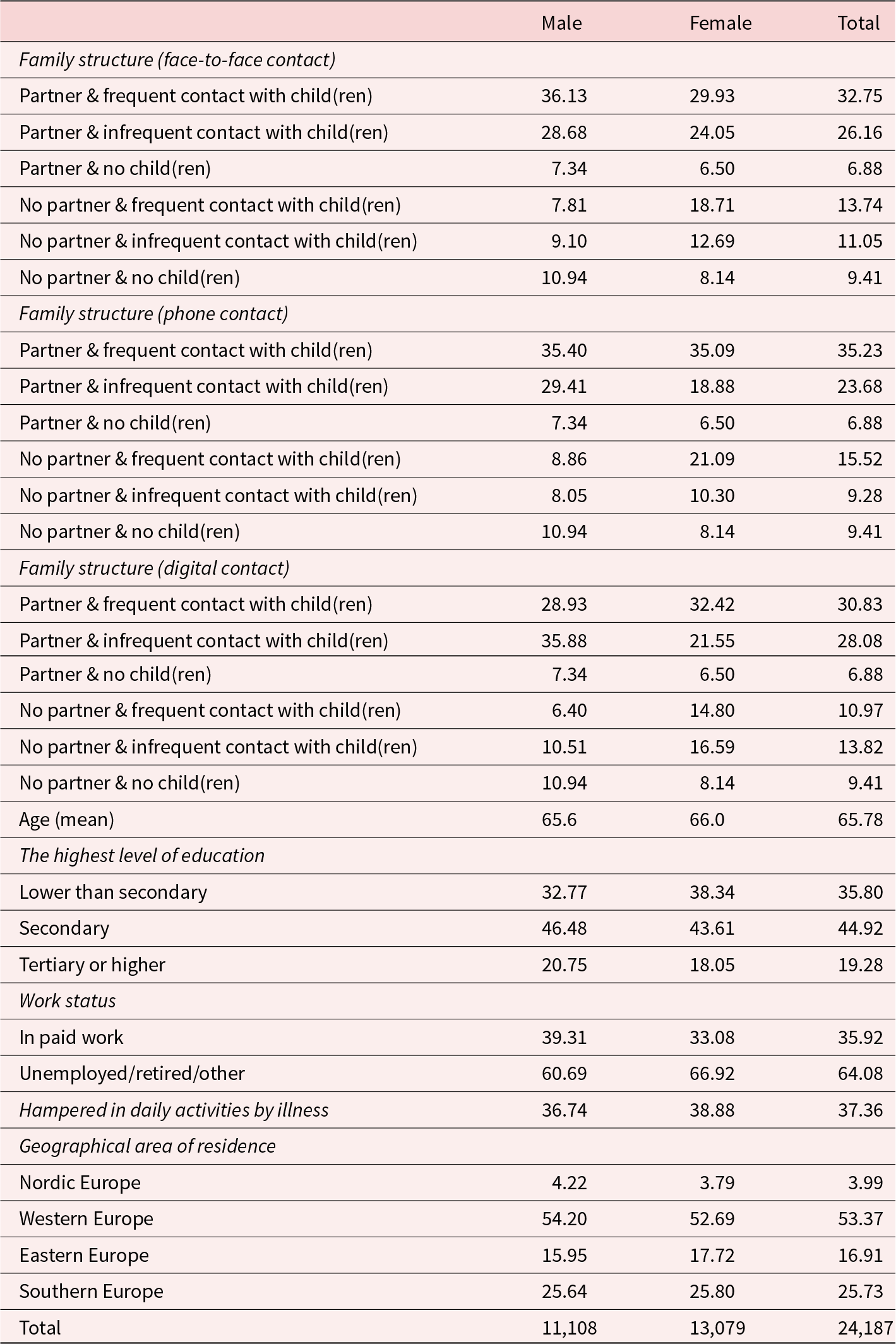
With regard to contact type, parents were asked about the frequency of speaking with their randomly selected child (1) in person, (2) via phone, (3) via video calls and (4) via text, message or apps. We examine in-person, phone and digital contact (video calls and app messages). Thus, we create three independent variables for face-to-face, phone and digital contact, as a combination of contact frequency and family structure types distinguishing: (1) having ‘partner and frequent contact with children’, (2) having ‘partner and infrequent contact with children’, (3) having ‘no partner and frequent contact with children’, (4) having ‘no partner and infrequent contact with children’, (5) having ‘partner and no children’ and (6) having ‘no partner and no children’.
We use a set of socio-demographic characteristics, that is, gender, age (in quadratic terms) and country of residence (29 dummies). As indicator of socio-economic condition, we account for highest educational attainment at the time of interview (lower than secondary, secondary, tertiary or higher) and working status (in paid work, unemployment/retired/other). We also use a dummy for being hampered in daily activities (yes, no) to control for serious health needs that may affect both contact frequency and happiness levels. In the analysis on country differences we classify European countries in four clusters, that is, Nordic (Finland, Iceland, Norway, Sweden), Western (Austria, Belgium, France, Germany, Ireland, the Netherlands, Switzerland, United Kingdom), Eastern (Bulgaria, Croatia, Czechia, Estonia, Hungary, Latvia, Lithuania, Montenegro, North Macedonia, Poland, Serbia, Slovakia, Slovenia) and Southern (Cyprus, Greece, Italy, Portugal, Spain) countries. This classification, although somewhat reductive, aligns with previous studies on kinlessness and parent–child relations (e.g. Margolis et al. Reference Margolis, Chai, Verdery and Newmyer2022) and those distinguishing between more and less family-oriented societies (Van Vlimmeren et al. Reference Van Vlimmeren, Moors and Gelissen2017).
Analytical strategy
After providing descriptive statistics for our sample of middle-aged and older adults, the analytical strategy follows two steps. First, we estimate ordered logistic regression models with robust standard errors on self-reported happiness for face-to-face (Figure 1), phone (Figure 2) and digital contact (Figure 3). We analyse these three types of contact separately, without aiming to disentangle the effect of one form of contact from another. Indeed, these contact types partly overlap: for example, most partnered respondents who meet their children frequently also report frequent phone (72.8 per cent) and digital (59.3 per cent) contact (see Tables D1–D3 in Supplementary Materials). Ordered logistic regression is used to account for the latent scale of happiness, as suggested in previous studies on kinlessness, health and subjective wellbeing (e.g. Margolis et al. Reference Margolis, Chai, Verdery and Newmyer2022). Similar results were found using linear regression models (see Tables G1–G4 in Supplementary Materials). These models allow us to test our kinlessness hypothesis, that is, whether adults without a partner or children have the lowest level of happiness, and the contact hypothesis, that is, whether adults with infrequent contact with children have lower levels of happiness compared to those with frequent contact. Moreover, this analysis enables us to assess whether middle-aged and older men with infrequent face-to-face, phone or digital contact with children are more likely to report higher levels of happiness than childless older adults (continuum hypothesis). We estimate the predicted probabilities of reporting happiness levels above 7, presented in Figures 1–4. Additionally, we calculate the marginal effects using pairwise comparisons (PC), and these results are reported in the text. We present separate models for men and women and formally test gender differences with interaction terms (see full estimates in Tables A1–A3 in Supplementary materials) (gender differences hypothesis).
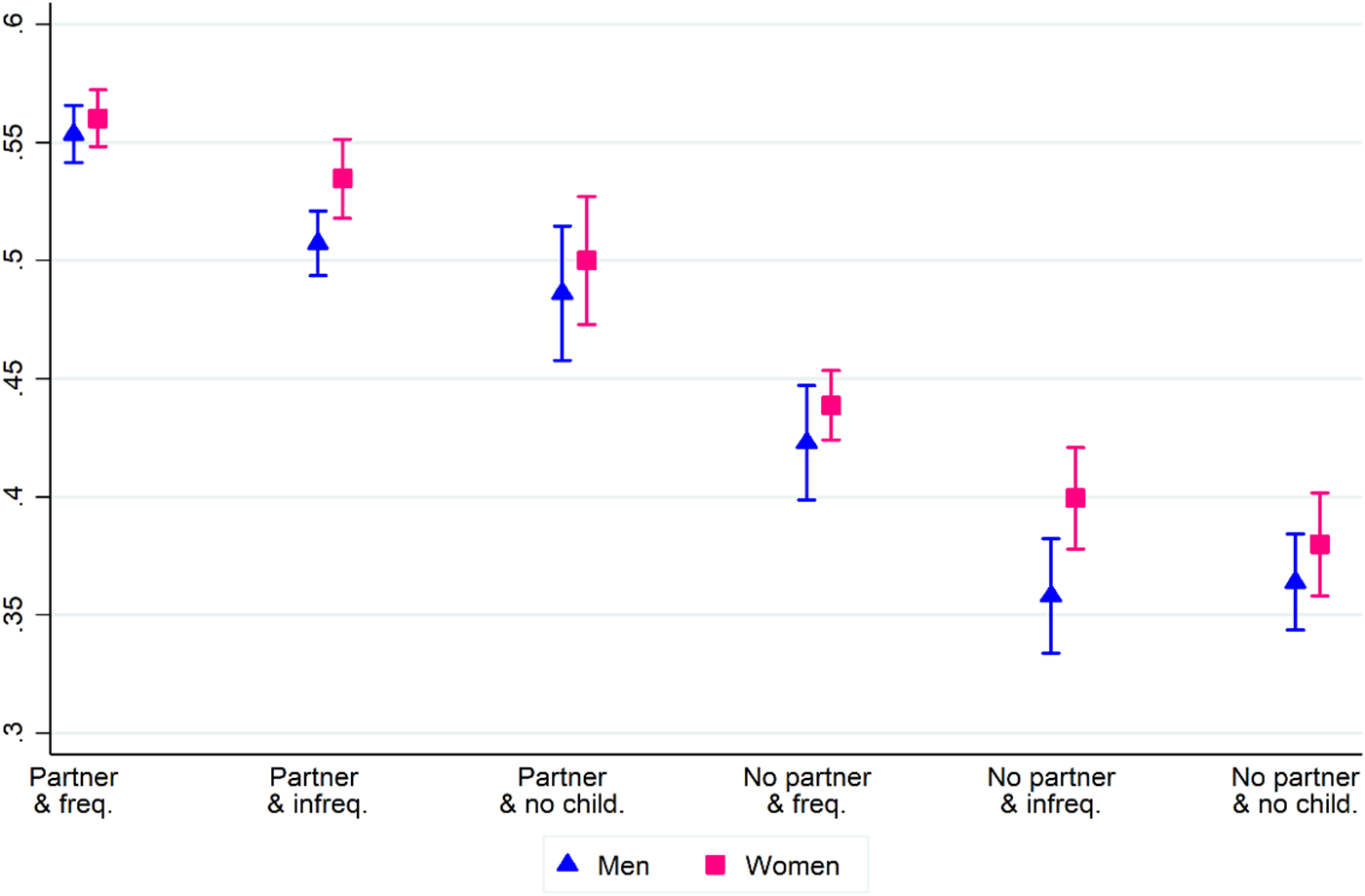
Predicted probabilities of reporting high happiness (≥8) by gender, family structure types and face-to-face parent–child contact.

Predicted probabilities of reporting high happiness (≥8) by gender, family structure types and phone parent–child contact.
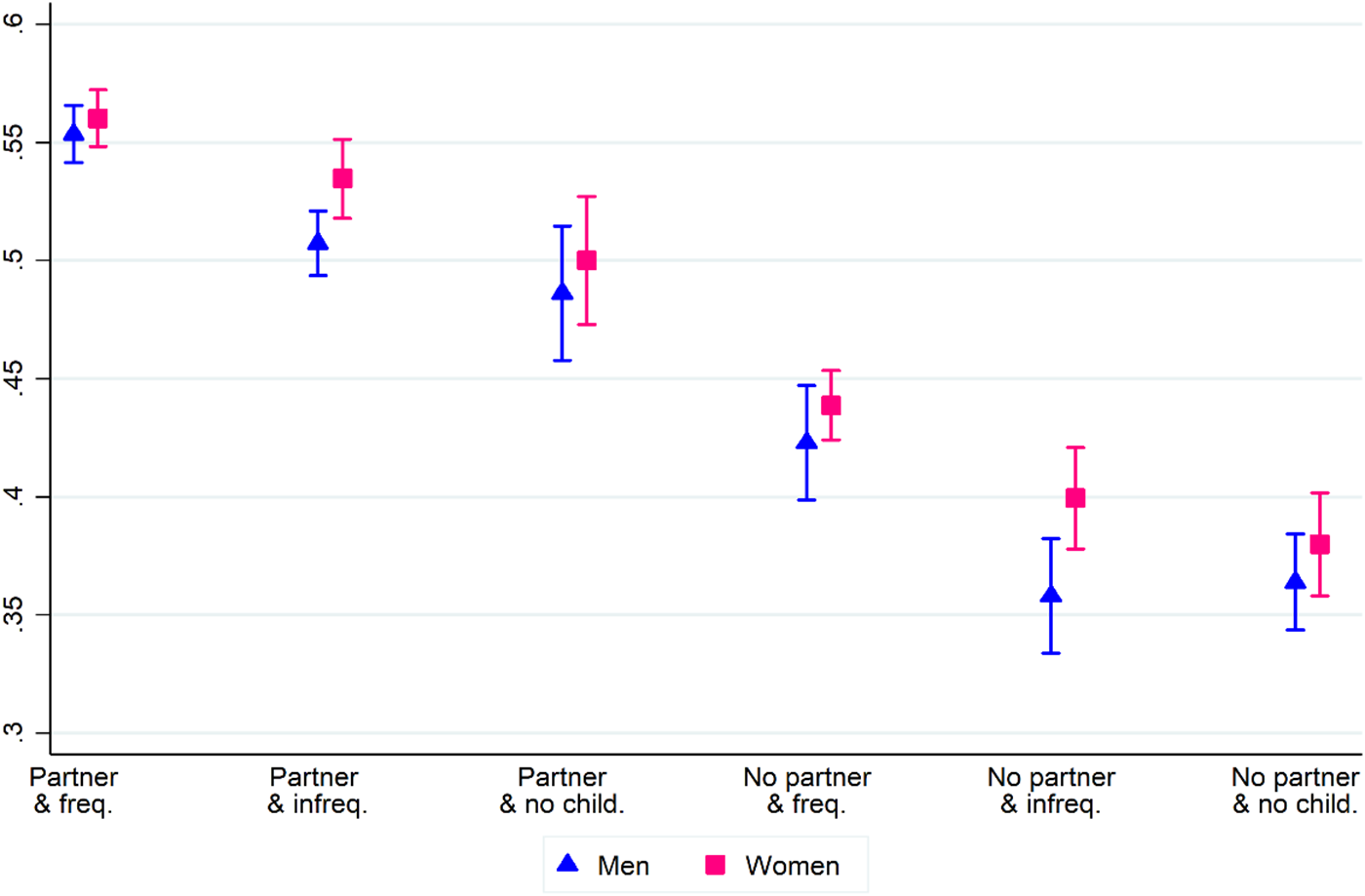
Predicted probabilities of reporting high happiness (≥8) by gender, family structure types and digital parent–child contact.
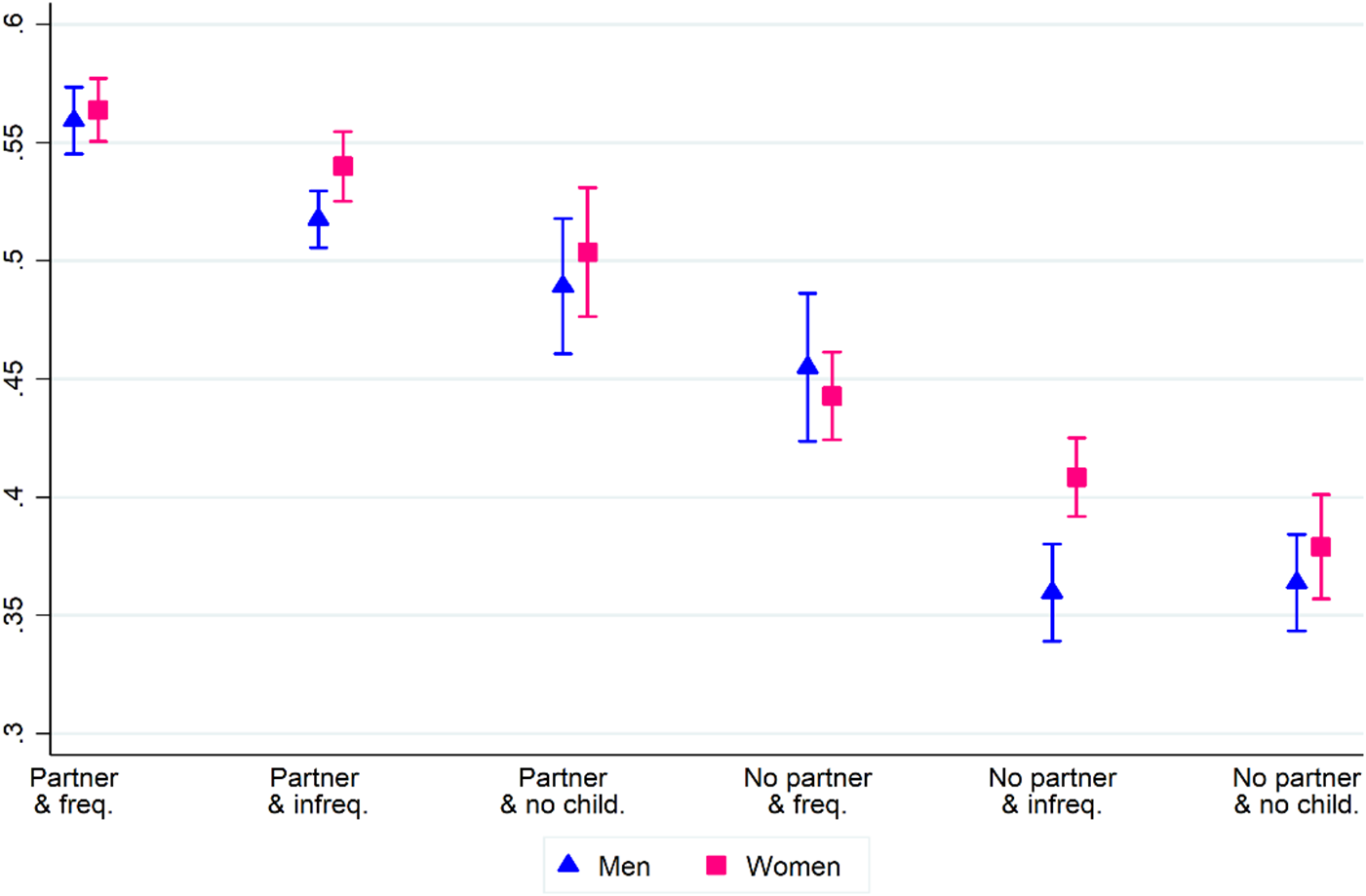
Second, to test our country differences hypothesis, we present separate models for four country clusters (i.e. Nordic, Southern, Eastern and Western Europe). Due to the small sample size, we estimate these models including both men and women and combining face-to-face, phone and digital contact types, that is, having frequent contact in at least one form of communication (see Table A6 in Supplementary Materials for interactions country clusters). All models present weighted estimates to correct for differential selection probabilities within each country as specified by sample design, for non-response, for non-coverage and for sampling error related to the four post-stratification variables (Kaminska Reference Kaminska2020).
Results
Descriptive results
Table 1 presents descriptive statistics for family structure and contact type, gender, age cohorts, educational attainment, employment status, health limitations and geographic region of residence. The proportion of adults who have a partner and frequent contact with their children is higher for face-to-face and phone (32.7 per cent and 35.2 per cent, respectively) than for digital contact (30.8 per cent), while the proportion of those having a partner and infrequent contact with children is higher for digital (28.1 per cent) than for face-to-face and phone (26.2 per cent and 23.7 per cent, respectively) contact. Also, 26.7 per cent of middle-aged and older adults are unpartnered and have frequent phone calls with children, while 11.0 per cent have frequent digital interactions. Approximately 7.0 per cent have a partner but no children, while 9.4 per cent have neither a partner nor a child – which is consistent with previous research on kinlessness (Verdery et al. Reference Verdery, Margolis, Zhou, Chai and Rittirong2019).
When comparing male and female subsamples, the percentage of partnered men having frequent contact through face-to-face meetings is slightly higher compared to that of partnered women (36.1 per cent vs 30.0 per cent; Chi^2 = 975.63; p value = 0.000). The proportion of unpartnered men with infrequent contact with children is higher than that of female counterparts, particularly in digital contact (36.0 per cent vs 21.5 per cent; Chi^2 = 1200.00; p value = 0.000). Finally, among older adults without a partner but with children, women consistently show higher percentages compared to men for face-to-face, phone and digital contact.
Multivariate results
We present ordered logistic regression models on happiness scores by gender, family structure and contact type (face-to-face, phone and digital) in Figures 1, 2 and 3, respectively. These figures illustrate the predicted probability (p.p.) of reporting a high happiness score (8 or above) across various family structure types and parent–child contact frequencies. A clear gradient in happiness levels is observed, ranging from individuals living with a partner and having frequent contact with children to kinless individuals. Consistent with the kinlessness hypothesis, middle-aged and older women without a partner or children exhibit a lower probability of high happiness scores compared to other family structure types. Focusing on Figure 1 (face-to-face contact), kinless women report significantly lower levels of happiness compared to unpartnered women with infrequent (PC = −0.044; p < 0.01) and frequent contact with children (PC = −0.048; p < 0.001), those with a partner but no children (PC = −0.121; p < 0.001), partnered women who have infrequent contact with children (PC = −0.165; p < 0.001) and women with a partner and frequent contact (PC = −0.179; p < 0.001). This pattern is consistent across all contact types but shows gender differences: differently from women, kinless men exhibit similar probabilities of high happiness as unpartnered men with infrequent child contact. Furthermore, across all contact types, women without partners but with sporadic child contact report higher happiness levels compared to their male counterparts (PC = 0.058, 0.041, 0.049; all p < 0.001 for face-to-face, phone and digital contact, respectively), partially supporting the gender differences hypothesis.
Figure 1 shows that middle-aged and older adults with a partner but no children exhibit lower levels of happiness among both men and women, compared to parents having frequent or infrequent face-to-face contact with children (PC = −0.044, p < 0.001 for both mothers and fathers). Conversely, individuals with a partner and frequent contact with children have similar levels of happiness as those with infrequent contact – which is in contrast with the contact and continuum hypotheses. We find no significant differences among partnered individuals with frequent versus infrequent face-to-face contact, nor among unpartnered women with different levels of contact with children. For unpartnered men only, face-to-face contact frequency matters. Individuals without a partner and with infrequent face-to-face contact with children report lower happiness levels compared to those who have frequent in-person interactions with their children (PC = −0.060; p < 0.001). Notably, frequent contact with children does not fully compensate for the absence of a partner, as unpartnered adults with frequent contact still report lower happiness levels than those with a partner and no children (PC = −0.061; p < 0.001).
Figure 2 presents predicted probabilities of reporting high happiness levels by gender, family structure types and parent–child phone contact. Similar to Figure 1, Figure 2 shows lower levels of happiness for the group of people living without a partner compared to partnered individuals. The lowest probability of reporting high happiness is occupied by those having neither a partner nor a child (p.p. = 37.1, 95 per cent CI = 35.0; 39.2 for men; p.p. = 37.5, 95 per cent CI = 35.4; 39.7 for women) and unpartnered parents with infrequent phone contact with children (p.p. = 36.5, 95 per cent CI = 33.9; 38.9 for men; p.p. = 39.5, 95 per cent CI = 37.3; 41.6 for women). Compared to unpartnered adults with infrequent phone contact with children, those with frequent contact report higher levels of happiness (PCs = −0.065; −0.039; p < 0.001 for men and women respectively). Contact frequency matters also for partnered adults, with a higher probability of reporting high happiness for fathers and mothers with frequent phone contact than for those with sporadic phone calls with children (PC = −0.046: p < 0.001 for men; PC = −0.026; p < 0.05 for women). This supports the contact hypothesis but not the continuum hypothesis, as fathers with infrequent phone contact with children have a similar happiness level to those with no children at all.
Figure 3 presents results on the association between family structure, digital contact and happiness. The results are similar to those observed for phone parent–child contact, with kinless adults (p.p. = 37.1, 95 per cent CI = 34.9; 39.2 for men; p.p. = 37.5, 95 per cent CI = 35.3; 39.7 for women) and those with no partner and infrequent interactions (p.p. = 36.4, 95 per cent CI = 34.3; 38.6 for men; p.p. = 40.7, 95 per cent CI = 38.9; 42.4 for women) having the lowest happiness scores. Therefore, the results partially support our kinlessness hypothesis, as they show lower levels of happiness for kinless adults than for those in other family structure types, except for middle-aged and older adults without a partner and with infrequent contact with children.
Partnered men with frequent digital interactions report higher levels of happiness compared to those with infrequent digital contact with children (PC = −0.042; p < 0.001) or those with a partner but no children (PC = 0.070; p < 0.001). Unpartnered men with frequent digital contact report higher happiness levels than those without a partner and with infrequent contact with children (PC = −0.095; p < 0.001), whereas infrequent digital contact is associated with similar happiness levels to having no children at all. Again, this pattern is observed for men and only partially for women. Partnered and unpartnered women with frequent digital contact exhibit slightly, but non-significant, higher levels of happiness than those with infrequent contact with children. Thus, we find support for the contact hypothesis for men but only partly for women. Moreover, as observed for phone contact, both unpartnered men and women with infrequent contact with children have comparable levels of happiness as unpartnered individuals without children. Consequently, we find no support our continuum hypothesis, as childless adults do not have lower levels of subjective wellbeing than those with infrequent contact with their children.
With regard to gender differences, the sizes of the coefficients associated with partnered individuals with infrequent contact are similar, and when we formally tested gender differences using interaction terms (see Table A5 in Supplementary Materials), significant gender differences were found only with regard to unpartnered parents with infrequent contact with children. Infrequent contact (face-to-face, phone and digital) is associated with a larger decline in happiness score for unpartnered men than unpartnered women. Thus, we find support for the gender differences hypothesis with regard to those with sporadic contact with children but not kinless men and women.
Country differences
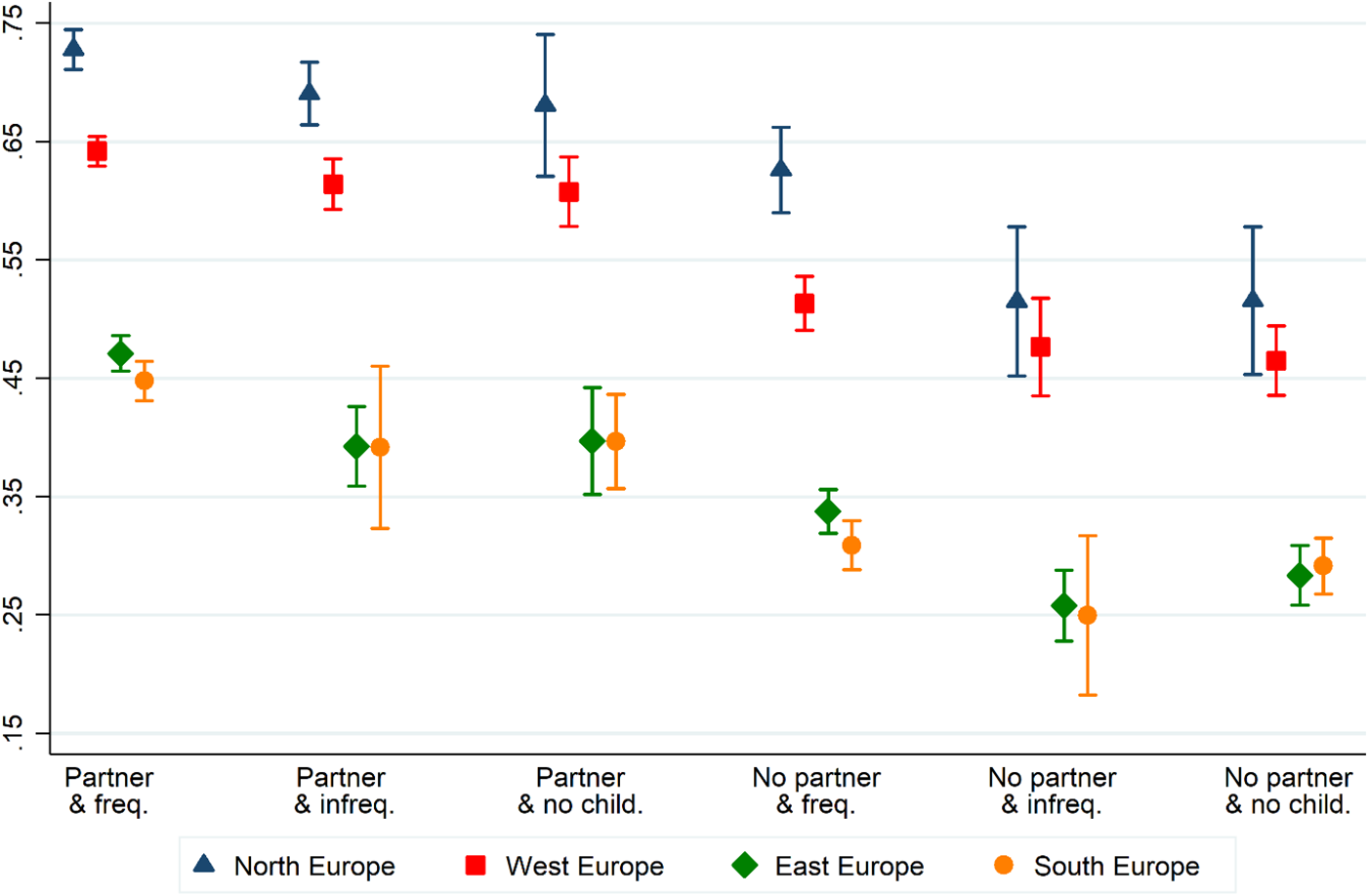
In Figure 4 we test whether there are differences in the association between family structure types and happiness score across four different geographic areas (i.e. Nordic, Western, Eastern and Southern European countries). Due to sample size constraints, we combine the analysis of face-to-face, phone and digital contact for both men and women. For each individual, we consider only the contact type (face-to-face, phone or digital) that occurs most frequently in their interactions with children. The results show that in Western and Eastern countries having a partner but no children or having a partner and infrequent contact with children is significantly associated with lower happiness, compared to partnered parents with frequent contact with children. There are some exceptions: in Southern Europe partnered older adults with infrequent contact with children and in Nordic Europe those with a partner but no children tend to report similar levels of happiness compared to those with partners and frequent contact with children. However, when considering the interaction between country clusters and our family structure variable (see Table A6 in Supplementary Materials), which accounts for all types of contact, the interaction coefficients are not significant, indicating that the happiness level of unpartnered adults living in Nordic Europe does not differ significantly from that of those living in the rest of Europe.
Predicted probabilities of reporting high happiness (≥8) by country cluster, family structure types and parent–child contact.
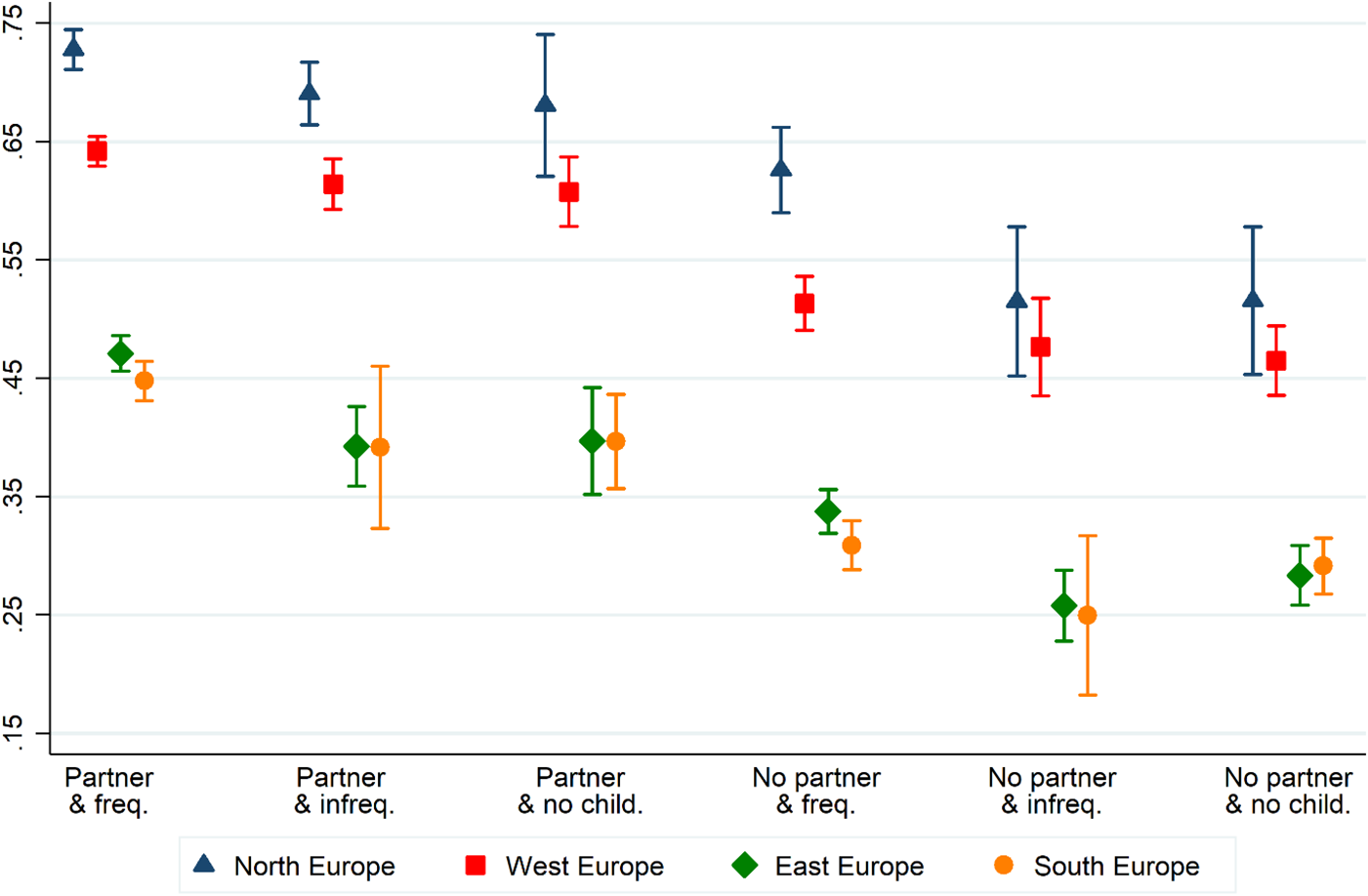
In each country group, happiness levels tend to be lower for unpartnered than for partnered individuals. Within the group of unpartnered individuals, parent–child contact frequency matters, with those having infrequent interactions being disadvantaged as much as those having no partner and no children in terms of happiness. The probability of reporting high happiness is equal to 53.1 per cent, 48.6 per cent, 26.5 per cent and 20.8 per cent, respectively, for unpartnered adults with infrequent contact with children and is equal to 52.1 per cent, 47.8 per cent, 27.9 per cent and 26.5 per cent, respectively, for kinless adults living in Northern, Western, Eastern and Southern countries. Contrary to our country differences hypothesis, the association between family types and happiness score holds in each country cluster without any marked difference between country clusters.
Robustness checks and additional analyses
We conducted several additional analyses to test the robustness of our results against various modelling decisions. First, recognizing that happiness is just one of many indicators of subjective wellbeing (e.g. Krys et al. Reference Krys, Haas, Igou, Kosiarczyk, Kocimska-Bortnowska, Kwiatkowska, Miu-Chi Lun, Maricchiolo, Park, Poláčková Šolcová, Sirlopú, Uchida, Vauclair, Vignoles, Zelenski, Adamovic, Akotia, Albert, Appoh, Arévalo Mira, Baltin, Denoux, Domínguez-Espinosa, Esteves, Gamsakhurdia, Fülöp, Garðarsdóttir, Gavreliuc, Boer, Igbokwe, Işık, Kascakova, Klůzová Kráčmarová, Kosakowska-Berezecka, Kostoula, Kronberger, Lee, Liu, Łużniak-Piecha, Malyonova, Eduardo Barrientos, Mohorić, Mosca, Murdock, Fariza Mustaffa, Nader, Nadi, Okvitawanli, van Osch, Pavlopoulos, Pavlović, Rizwan, Romashov, Røysamb, Sargautyte, Schwarz, Selim, Serdarevich, Stogianni, Sun, Teyssier, van Tilburg, Torres, Xing and Harris Bond2023), we replicated our main analyses using life satisfaction scale as the dependent variable (Tables B1–B3 in Supplementary Materials). For both male and female sub-samples, and considering face-to-face, phone and digital contact, no relevant differences emerge compared to our main results on happiness.
Second, we estimated alternative models specifying an additional category for parents with no contact at all with their children. As recent research highlights the potential psychological distress associated with parent–child disconnectedness (Jessee and Carr Reference Jessee and Carr2025), this distinction allows us to disentangle sporadic interactions from having no face-to-face, phone or digital contact. Results (Figure C1 in Supplementary Materials) show a consistent gradient in happiness by contact intensity: those with no partner and no contact report the lowest happiness (p.p. = 27.3, 95 per cent CI = 19.2; 35.5), compared not only to those with infrequent contact (p.p. = 36.2, 95 per cent CI = 35.1; 37.4) but also to those without a partner or children (p.p. = 37.3, 95 per cent CI = 35.6; 38.8). Nonetheless, the large confidence intervals around these estimates suggest caution in drawing strong conclusions.
Third, we estimated ordered logistic regression models assessing the likelihood of reporting a high happiness score among older adults aged 65 and above (Tables F1 and F2 in Supplementary Materials). As in our main analysis, we observe that, compared to the reference category, older adults without a partner or children tend to report the lowest happiness score. Consistent with our main results, kinless men and those without a partner but with infrequent contact exhibit the lowest and comparable levels of happiness. Due to a significant reduction in sample size, some differences in the findings emerge, particularly in models conducted within each country cluster, where the sample is more limited.
Fourth, since marital status has been widely recognized as an important factor influencing individual wellbeing (Hank Reference Hank2007; Margolis and Verdery Reference Margolis and Verdery2017; Mair et al. Reference Mair, Ornstein and Chen2020), we conducted a more detailed classification of individuals without a partner – distinguishing between those who are separated, divorced or widowed – to examine its impact on happiness levels among men and women (Table H1 in Supplementary Materials). Interestingly, among individuals without a partner but with children, widowed individuals tend to report lower happiness levels compared to those who are divorced or separated, especially among men (coef. = −0.91; 95 per cent CI = −1.07, −0.74). Thus, the negative association between un-partnering and wellbeing is mainly driven by widowhood. In contrast, among those without a partner or children, no significant differences emerge in the categories of marital status.
Discussion
We started this study by noting that recent demographic changes, such as declining fertility and union stability, have increased the proportion of middle-aged and older adults at risk of ‘ageing alone’ due to the absence of close family members. Consistent with previous studies (Verdery and Campbell Reference Verdery and Campbell2019; Zhou et al. Reference Zhou, Verdery and Margolis2019; Margolis et al. Reference Margolis, Chai, Verdery and Newmyer2022), our results show that middle-aged and older adults with neither a partner nor a child have lower levels of subjective wellbeing compared to adults who have both. These differences in subjective wellbeing are partly due to the absence of a partner, as partners have long-term internalized commitment towards each other and are key sources of practical and emotional support, fostering later-life wellbeing (e.g. Grundy et al. Reference Grundy, den Broek and Keenan2019). Conversely, having children is not necessarily linked to better wellbeing; rather, its impact depends on the relationships that parents have with them (Albertini and Arpino Reference Albertini and Arpino2018; Quashie et al. Reference Quashie, Arpino, Antczak and Mair2021; Patterson and Margolis Reference Patterson and Margolis2023). In fact, our findings show that the happiness levels of unpartnered fathers who have infrequent contact with their adult children is comparable to those of childless men. The lowest happiness level is reported by kinless men and those without a partner and with infrequent interactions with children. These findings are in contrast with Patterson and Margolis (Reference Patterson and Margolis2023) while consistent with Albertini and Arpino (Reference Albertini and Arpino2018), suggesting that having children is not inherently beneficial for older adults but depends on the quality of the relationships and the frequency of the contact. In light of this, our kinlessness hypothesis that adults without a partner or children have the lowest level of happiness compared to other family structure types is only partly supported, as having no children appears to be comparable to having infrequent contact with them in terms of subjective wellbeing among men. The happiness gradient of children does not appear to follow a continuum from childlessness to close parent–child relationships – as suggested by Albertini and Arpino (Reference Albertini and Arpino2018) – but rather tends to reflect a dichotomous distinction between regular interactions and estrangement or childlessness.
We also contribute to the literature on parent–child relationships by analysing contact frequency and distinguishing among face-to-face, phone and digital contact. Consistent with our contact hypothesis, middle-aged and older men with frequent (‘more than weekly’) phone or digital contact with children tend to report higher happiness levels compared to those who have infrequent interactions with children. This aligns with previous studies showing that the quality of parent–child relationships and the frequency of contact are associated with a lower likelihood of depression (Teo et al. Reference Teo, Choi, Andrea, Valenstein, Newsom, Dobscha and Zivin2015; Tosi and Grundy Reference Tosi and Grundy2019) and higher levels of wellbeing (Merz et al. Reference Merz, Consedine, Schulze and Schuengel2009). Zhang et al. (Reference Zhang, Gong, Tang and Li2025) show that older adults with ‘tight-knit’ relationships with their adult children experience a slower decline in cognitive functioning compared to those who are alienated from their offspring. However, contrary to previous findings, we find that frequent face-to-face contact is not associated with higher levels of subjective wellbeing among partnered men and women. This may reflect increases in face-to-face contact driven by physical and/or mental health declines, or by feelings of anxiety surrounding this type of interaction with children during 2020–2022. Conversely, our results show a positive association between phone and digital contact and subjective wellbeing. Only a few studies support the beneficial effect of digital parent–child contact on subjective wellbeing and loneliness (Chan Reference Chan2018; Canale et al. Reference Canale, Marino, Lenzi, Vieno, Griffiths, Gaboardi, Giraldo, Cervone and Massimo2022; Balki et al. Reference Balki, Holland and Hayes2023). Thus, our results provide new evidence to shed light on the role of digital communication technology, showing higher levels of subjective wellbeing for those who have indirect contact, via either phone calls or digital tools. This suggests that digital tools provide opportunities for exchanging emotional support, advice and companionship, which benefit the wellbeing of middle-aged and older adults, particularly men.
With regard to gender differences, parent–child contact appears to be more consequential for unpartnered men than for unpartnered women. Prior studies indicate that men tend to rely more on their partners for emotional and social support and experience greater negative effects when they have no partner (e.g. Grundy et al. Reference Grundy, den Broek and Keenan2019; Penning et al. Reference Penning, Wu and Hou2024) – a gap that may be mitigated by the relationship with children (Tosi & van den Broek Reference Tosi and Van den Broek2025; Tosi & Grundy Reference Tosi and Grundy2021). The results of this study show that the absence of a partner cannot be not fully compensated, as unpartnered parents with frequent contact with children still have lower subjective wellbeing than those with a partner. Moreover, unpartnered fathers tend to suffer more from having sporadic contact with children compared to unpartnered mothers, suggesting a gendered cumulative effect of un-partnering and parent–child estrangement. This is consistent with some previous findings (Tosi and Grundy Reference Tosi and Grundy2019) while in contrast with others (Agllias Reference Agllias2013; Jessee and Carr Reference Jessee and Carr2025).
Regarding heterogeneities by country context, we find no marked differences between Nordic-Western and Southern-Eastern countries. Contrary to our expectations regarding larger wellbeing effects of family structure and parent–child contact in Eastern and Southern European countries, the coefficients associated with kinless adults and unpartnered adults with infrequent contact with children appear to be larger in Nordic European countries. Thus, we find no support for the hypothesis that having neither partners nor children is associated with lower wellbeing in countries where older adults rely more on family ties. A possible explanation based on cultural traits suggests that in more individualistic societies, such as those in Northern Europe, intergenerational contact tends to be more selective and contingent on personal closeness, making its absence more consequential for wellbeing (Mair Reference Mair2013a). In contrast, in more familistic cultures characterized by stronger normative expectations of intergenerational solidarity and filial obligation, parent–child contact tends to be more widespread, experienced as a duty and taken for granted (Carr and Utz Reference Carr and Utz2020; Kalmijn and Saraceno Reference Kalmijn and Saraceno2008).
When interpreting these results, at least three limitations should be considered. First, the data presented here refer to a particular historical period between 2020 and 2022 when the Covid pandemic affected parent–child relationships and older adults’ wellbeing. However, we are confident in the generalizability of our findings, as they align with previous studies on the wellbeing effects of kinless adults (Tosi & van den Broek Reference Tosi and Van den Broek2025) and parent–child relationships (Merz et al. Reference Merz, Consedine, Schulze and Schuengel2009). Additionally, our supplementary analyses (Tables E1–E3) confirm the robustness of the results even when focusing on a sub-sample of countries with pre-pandemic interviews. Second, we acknowledge concerns regarding endogeneity, as early life circumstances, such as poor health, may influence both older adults’ family structures and wellbeing outcomes. The use of cross-sectional data limits our ability to establish causal relationships, as individuals with better health and higher levels of wellbeing may be more likely to exhibit stronger and more enduring parent–child relations. Also, childless older adults may be selected by several unobserved confounders, such as values and attitudes towards parenthood and family life. Our control variables, including a dummy for being hampered in daily activities, aim to account for this bias; however, the low explanatory power of the models suggests that other unobserved variables are relevant, and we acknowledge that our findings remain associational in nature. Third, we distinguish among face-to-face, phone and digital contact by categorizing individuals into two different family structure types. However, considering the interactions between these forms of contact would better reflect the reality of older adults who experience either sporadic digital or face-to-face contact, or infrequent contact in both forms. Unfortunately, the sample size is not large enough to fully test the complex interplay between these forms of parent–child interaction.
Despite these limitations, our findings highlight the importance of considering both the presence/absence of children and the quality of their relationships in the analysis of middle-aged and older parents’ wellbeing. While having no partner seems hard to compensate for, having no children yields similar levels of subjective wellbeing as having only sporadic contact with them, indicating that the benefits associated with offspring stem from social relationships. Contrary to the notion of childlessness as a harmful condition, our findings show that emotional benefits stem from active engagement – whether through face-to-face, phone or digital forms of contact. Such beneficial relationships may manifest through various forms of interaction, fostering a positive view of new communication technologies and their potential to enhance the wellbeing of older adults in future ageing societies.
Supplementary material
The supplementary material for this article can be found at https://doi.org/10.1017/S0144686X2610066X.
Financial support
This work was supported by the Ministry of University and Research (MUR) and the Next Generation EU, Missione 4, Componente 1 CUP C53D23008870001 (PRIN2022PNRR P2022XX9AF Beyond the nuclear family: Extended kinship and mental health in Italy – KinHealth).





 Open access

