





Introduction
There is ample research evidence to suggest that first language (L1) literacy skills and second language (L2) reading comprehension are strongly inter-related (for a recent meta-analysis, see Jeon & Yamashita, Reference Jeon, Yamashita, Jeon and In’Nami2022). Difficulties with L1 literacy skills and smaller capacity of working memory (WM) capacity are also known to be underlying causes of specific learning differences (SpLDs) that have been shown to have an impact on L2 learning outcomes, including the development of L2 reading skills (for a review, see Kormos, Reference Kormos2017; Sparks, Reference Sparks2022). L2 learners with SpLDs tend to experience negative emotions, such as anxiety, in L2 learning (Ganschow et al., Reference Ganschow, Sparks, Anderson, Javorsky, Skinner and Patton1994; Ganschow & Sparks, Reference Ganschow and Sparks1996, Piechurska-Kuciel, Reference Piechurska-Kuciel, Kormos and Kontra2008), and the cumulative effect of cognitive and affective factors might prevent these students from performing to the best of their abilities in tests of L2 reading comprehension (Motteram, Dawson & Schneider, Reference Motteram, Dawson and Schneider2023). The complex and inter-related role of L1 literacy, domain general cognitive skills, and affective variables in text comprehension is also recognised in recent multi-componential views of L1 (Joshi & Aaron, Reference Joshi and Aaron2012; Kim, Reference Kim2020) and L2 reading (Jeon & Yamashita, Reference Jeon, Yamashita, Jeon and In’Nami2022). Yet, little is known about how L2 reading anxiety and low-level L1 skills might jointly influence L2 reading outcomes among secondary school learners of L2 English who are an under-researched population compared to university students and younger children. Understanding the role of L1 literacy skills as measured on a continuum, rather than using a specific cutoff point for establishing a binary categorisation of SpLDs such as dyslexia, is also important from a social justice perspective that views cognitive diversity as a fundamental aspect of human existence (Singer, Reference Singer1998).
Furthermore, studying L2 reading fluency yields relevant insights for language testing, particularly for understanding whether and how the timed nature of L2 reading tests might present a systematic disadvantage for certain test taker populations, including those with SpLDs. Although certain workplace and academic contexts might place limitations on how much time individuals have available for reading a text, in many settings reading is an untimed activity. In tests of L2 reading skills, candidates with SpLDs are frequently granted time extension to help them compensate for their slower text processing skills. However, research evidence for the benefits of time extension in L2 contexts is scarce and inconclusive (for a review, see Kormos & Ratajczak, Reference Kormos and Ratajczak2019), and it is unclear whether giving more time to test takers with SpLDs increases their scores or decreases their test-taking anxiety.
In this this paper, I report a study that aimed to gain a better insight into these understudied areas of L2 reading. The research investigated how L1 reading comprehension and L1 low-level skills, such as word-level decoding and rapid automated naming skills, together with WM capacity and reading-related anxiety, predict L2 reading comprehension among Hungarian secondary school students. In this project, I also examined how these L1 literacy-related and cognitive variables are associated with the time needed for participants to complete the reading comprehension test to better understand how extended time could be used as a universal design feature to make L2 reading tests fair and accessible for all students, not just those with disabilities. The results obtained have implications for research on time adjustments for students with SpLDs and for supporting students who might experience challenges in L2 reading comprehension.
Review of literature
In this section, first I will briefly define and describe L1 literacy-related disabilities and explain how using continuous predictor variables that underly L1 literacy-related difficulties can contribute to expanding research in the field of L2 acquisition and assessment. The following section of the review will offer an overview of multi-componential theories of L1 and L2 reading that highlight the importance of cognitive as well as affective factors in reading comprehension and its development. As the current research also investigates reading speed, previous studies on factors that contribute to L2 reading fluency and available research on the potential benefits of time extension for individuals with SpLDs, who tend to have slower reading speed, are also reviewed.
Conceptualisations of L1 literacy-related disabilities
Reading-related literacy difficulties are often caused by underlying different cognitive functioning that fall under the umbrella term, specific learning difficulties, or, as they are called in the UK, SpLDs. The 5th edition of the Diagnostic and Statistical Manual of Mental Disorders (DSM-5, American Psychiatric Association, 2013) brings together various subtypes of SpLDs under an overarching umbrella term, specific learning disorders. These subtypes include word-level decoding problems (dyslexia); higher-level text comprehension problems (specific reading comprehension impairment); difficulties in the writing domain, such as challenges with spelling, punctuation, and grammatical accuracy; and clarity of expression and coherent organisation of ideas (dysgraphia) as well as numeracy-related difficulties (dyscalculia). DSM-5 also acknowledges that word- and text-level comprehension problems can co-occur. Although official figures show great variation, SpLDs are estimated to affect 5%–20% of the population (Wagner et al., Reference Wagner, Zirps, Edwards, Wood, Joyner, Becker and Beal2020). DSM-5 lists weaknesses in the areas of WM, executive functioning (planning, organising, strategising, and paying attention), processing speed, and phonological processing as key characteristics of SpLDs.
To counter the above-mentioned medical and deficit-based perspectives, MacKay (Reference MacKay2006) proposed the use of term specific learning difference to describe students who experience barriers in academic learning domains due to dyslexia, autism, and attention-deficit hyperactivity disorder. The application of this terminology is also in line with the United Nations Convention on the Rights of Persons with Disabilities that defines disability as a socially constructed barrier, which “may hinder full and effective participation in society on an equal basis with others” (United Nations, 2006, p. 4). SpLDs are thus viewed as differences in individuals’ abilities that might create difficulties in particular aspects of learning if their environment does not accommodate their needs (Sewell, 2020). The more recent social justice perspective considers SpLDs as part of the naturally occurring diversity of human cognitive development and functioning. This conceptualisation recognises the diversity of the lived experiences and identity of neurodiverse individuals (Kapp, Gillespie-Lynch, Sherman & Hutman, Reference Kapp, Gillespie-Lynch, Sherman and Hutman2013). Both the terms SpLDs and neurodiversity highlight that cognitive characteristics and abilities of L2 learners can be varied and that establishing specifically defined cutoff points for identifying L1 literacy-related disabilities can be difficult. Therefore, it is important and informative to view and examine the underlying cognitive characteristics and predictors of these disabilities as they are distributed on a continuum rather than using predefined binary categories of disabled versus non-disabled samples of L2 learners.
Multi-componential view of L2 reading
There is a considerable overlap between the basic cognitive factors that account for L1 and L2 language and literacy development, and L1 skills serve as an important foundation for L2 development (Jeon & Yamashita, Reference Jeon, Yamashita, Jeon and In’Nami2022). Like the common underlying processes framework (Geva & Ryan, Reference Geva and Ryan1993) and the linguistic interdependence hypothesis (Cummins, Reference Cummins1979), Sparks and Ganschow’s (Reference Sparks and Ganschow1993) linguistic coding differences hypothesis assumes that the fundamental cognitive reasons for low achievement in L2 are similar to those factors that can explain L1 literacy problems. Nevertheless, there is conflicting evidence whether struggling L2 learners also face challenges in their L1 literacy and whether L1 reading problems are associated with L2 learning challenges. One of the key reasons why the relationship between L1 and L2 reading is not straightforward is that “L2 reading is a complex construct composed of various cognitive, linguistic, conative, and affective variables” (Jeon & Yamashita, Reference Jeon, Yamashita, Jeon and In’Nami2022, p. 31). On the one hand, L2 reading is influenced by language-specific versus language general skills and abilities. On the other hand, L2 reading skills, just as L1 reading ability, are predicted by a variety of affective and socio-cultural variables (e.g., Joshi & Aaron, Reference Joshi and Aaron2012, and Kim, Reference Kim2020, describe the dynamic inter-relationship between socio-emotional factors and cognitive determinants of L1 reading comprehension). The model postulates that in addition to domain general cognitive skills (e.g., WM and central executive functions), domain-specific linguistic knowledge, word-level decoding skills, oral text comprehension, reading fluency, genre- and content-related background knowledge, socio-emotions, and reading affect (e.g., motivation, attitude, self-concept, and anxiety) predict L1 reading comprehension. Jeon and Yamashita’s (Reference Jeon, Yamashita, Jeon and In’Nami2022) meta-analysis of predictors of L2 reading proposes a similar multi-componential view of L2 reading comprehension, which is the theoretical framework that also underlies this study.
At the foundational level of language-related predictors of L2 comprehension, a potential variable that also accounts for L1-related reading difficulties, such as dyslexia, is phonological awareness (Wagner & Torgesen, Reference Wagner and Torgesen1987). Phonological awareness consists of two components: syllabic knowledge, which is the ability to segment words into syllables and manipulate the syllables in words (e.g., deleting or adding syllables), and phonemic knowledge, which is the ability to segment words into sounds, differentiate sounds from each other, and manipulate sounds (e.g., deleting, adding, and substituting sounds). The development of phonological awareness and L1 reading skills is parallel, and for this reason phonological awareness tends to reach a ceiling and becomes a less useful indicator of reading outcomes (Landerl et al., Reference Landerl, Ramus, Moll, Lyons, Ansari and White2013). Its predictive role is taken over by word naming speed (for a review, see Kirby et al., Reference Kirby, Georgiou, Martinussen and Parrila2010), which is a measure of ability to access appropriate lexical representations under time constraints. In the field of L2 reading, Erdos, Genesee, Savage & Haigh (Reference Erdos, Genesee, Savage and Haigh2014) found that both phonological awareness and rapid automated naming in L1 were predictors of word- and text-level reading comprehension problems of children in L2 French, and similar results were obtained by Tong, Tong & McBride-Chang’s (Reference Tong, Tong and McBride-Chang2015) study with Chinese L2 English learners. Jeon and Yamashita’s (2014, Reference Jeon, Yamashita, Jeon and In’Nami2022) meta-analyses of L2 reading research showed a medium-sized effect of phonological awareness in L2 reading, but they also noted that participants of the studies included in the meta-analyses were mostly children.
There is relatively strong evidence for the potential predictive role of L1 text comprehension in L2 reading outcomes. Jeon and Yamashita’s (Reference Jeon, Yamashita, Jeon and In’nami2014, Reference Jeon, Yamashita, Jeon and In’Nami2022) meta-analyses demonstrated a moderate to strong relationship between L1 and L2 reading skills. Several studies have also provided evidence that L2 learners with SpLDs, particularly those with an official dyslexia identification, demonstrate L2 reading comprehension difficulties. von Hagen, Kohnen & Stadie’s (Reference von Hagen, Kohnen and Stadie2021) meta-analysis concluded that there is a significant effect of L1 reading difficulties on L2 word-reading regardless of similarities and differences between the target language and the L1 of the participants, onset of L2 instruction, and the age of the students. In Kormos and Mikó’s (Reference Kormos, Mikó, Kormos and Csizér2010) study, Hungarian L2 learners with SpLDs obtained lower scores on a sentence comprehension test than their peers matched for age and the number of years of English language instruction. Studies by Geva and Massey-Garrison (Reference Geva and Massey-Garrison2013) in Canada; Crombie (Reference Crombie1997) in Scotland; Sparks and Ganschow (Reference Sparks and Ganschow2001) in the United States; and Košak-Babuder, Kormos, Ratajczak, Pižorn (Reference Košak-Babuder, Kormos, Ratajczak and Pižorn2019) in Slovenia found that participants with official dyslexia identification performed significantly below the level of their peers in a test of L2 reading comprehension.
However, L1 literacy-related difficulties do not provide a full explanation for lower-level L2 reading skills. For example, Alderson, Haapakangas, Huhta, Nieminen and Ullakonoja (Reference Alderson, Haapakangas, Huhta, Nieminen and Ullakonoja2014) found that 15% of weak readers in L2 English were strong readers in their L1 Finnish. Ferrari and Palladino’s (Reference Ferrari and Palladino2007) research with Italian children also demonstrated that L1 reading skills might not fully explain achievement in L2 reading. Furthermore, Kormos, Košak Babuder & Pižorn’s (Reference Kormos, Košak Babuder and Pižorn2019) analysis showed that 5% of dyslexic Slovenian L2 learners of English belonged to the above average L2 reader group and 15% of participants in the below average L2 reader group did not have official dyslexia identification. While von Hagen et al.’s (Reference von Hagen, Kohnen and Stadie2021) meta-analysis provides some evidence for the significant effect of L1 literacy-related difficulties on L2 reading, current studies reveal that after a few years of L2 learning and with L1 literacy instruction, the role of L1 word-level reading difficulties in L2 reading becomes less pronounced, while L1 text comprehension difficulties might have a longer lasting effect on the understanding of written L2 texts.
A potentially important domain-general predictor of L2 reading ability is WM capacity, which activates and maintains short-lived memory items active for further processing (Barrouillet, Bernardin, Portrat, Vergauwe & Camos, Reference Barrouillet, Bernardin, Portrat, Vergauwe and Camos2007). As readers draw on their WM resources to keep already comprehended information active, updating it with new information being read and monitoring comprehension, reduced WM capacity can be a potential cause of reading comprehension problems and might result in incomplete or inaccurate understanding of the information conveyed (Cain, Oakhill & Bryant, Reference Cain, Oakhill and Bryant2004). Several meta-analyses in the L2 reading domain have provided evidence for the potential influence of WM on L2 text comprehension. Linck, Osthus, Koeth and Bunting’s (Reference Linck, Osthus, Koeth and Bunting2014) meta-analysis suggested a small effect, while Shin’s (Reference Shin2020) and Jeon and Yamashita’s (2014, Reference Jeon, Yamashita, Jeon and In’Nami2022) meta-analyses demonstrated a moderate effect of WM on L2 reading comprehension. Jeon and Yamashita (Reference Jeon, Yamashita, Jeon and In’Nami2022) argue that one of the reasons for the somewhat smaller effect size detected in these meta-analyses despite the hypothetically important role of WM capacity in text comprehension might be the moderating role of L2 proficiency. Indeed, in a recent study, Shahnazari (Reference Shahnazari2023) found that WM had a significant link to L2 reading comprehension at lower level of proficiency but not at the higher level. For higher-proficiency L2 readers, word-level decoding and sentence processing skills might be more automatised, hence might require less conscious effort, unlike for less proficient L2 learners for whom these lower-level text decoding processes might be consuming considerable amount of WM and attentional resources (cf. Perfetti, Reference Perfetti2007; Segalowitz & Segalowitz, Reference Segalowitz and Segalowitz1993).
According to the multicomponent approach to L2 reading, affective factors such as anxiety might also influence L2 text written text comprehension (cf. Jeon & Yamashita, Reference Jeon, Yamashita, Jeon and In’Nami2022). L2 reading anxiety as a situation-specific construct was first conceptualised by MacIntyre (1999) as “the worry and negative emotional reaction aroused when [reading in] a second language” (p. 24). Teimouri, Goetze and Plonsky’s (Reference Teimouri, Goetze and Plonsky2019) systematic review of the relationship between L2 reading outcomes and L2 reading anxiety has shown a significant negative relationship between these two constructs. L2-related anxiety has been found to negatively impact cognitive processes of L2 reading (Rai et al., Reference Rai, Loschky, Harris, Peck and Cook2011) and metacognitive strategy use during L2 reading (Lien et al., Reference Lien2016). Based on the multi-componential view of L2 reading, Hamada and Takaki (Reference Hamada and Takaki2021) hypothesised that L2 reading anxiety is a multi-dimensional construct because feelings of worry and stress can be evoked by different aspects of L2 reading. They designed a questionnaire measuring three different aspects of L2 reading anxiety: (1) cognitive anxiety (relating to lower (e.g., word-decoding) and higher-level reading processes (e.g., inferencing), (2) metacognitive anxiety tapping into the strategic aspects of L2 reading (e.g., problem-solving strategies), and (3) classroom-related factors (e.g., fear of evaluative factors). Their structural equation model confirmed the three-dimensional structure of L2 reading anxiety, and the results of the study demonstrated a strong relationship between L2 reading ability (measured by the reading component of the TOEIC test) and cognitive and metacognitive L2 reading anxiety.
Students with SpLDs often experience anxiety in academic contexts (Novita, Reference Novita2016). Regarding L2 learning, in Piechurska-Kuciel’s study (2008), Polish secondary school students with SpLDs reported significantly higher levels of foreign language anxiety than their peers with no SpLDs. In a series of studies Ganschow and colleagues (Ganschow et al., Reference Ganschow, Sparks, Anderson, Javorsky, Skinner and Patton1994; Ganschow & Sparks, Reference Ganschow and Sparks1996) also found a significant link between L2-related anxiety and L1 literacy–related skills. However, no previous research has examined the relationship between L2 reading anxiety and low-level L1 skills or how L2 reading anxiety might predict L2 reading fluency.
L2 reading fluency and time extension in the assessment of L2 reading skills of L2 learners with SpLDs
Time extension is one of the most frequently granted special arrangements for L2 learners with SpLDs in reading assessment, as they might decode written texts and accompanying comprehension tasks more slowly and may need to reread information to remember it due to WM limitations. Special arrangements can be classified based on how they provide a valid and accessible test experience for test takers with disabilities. Accommodations aim to make the test accessible to groups of test takers with disabilities while ensuring that the construct validity of the test is not compromised and the accuracy of the interpretations of the achieved performance scores is maintained (Elliott, Kettler, Beddow & Kurz, Reference Elliott, Kettler, Beddow and Kurz2011). The term modifications is used when adjustments to the test content or presentation change the construct validity of the test design (Sireci, Li & Scarpati, Reference Sireci, Li and Scarpati2003). Time extension is generally classified as an accommodation because time-pressured processing is generally not viewed as an integral part of the L2 reading construct. Although L2 reading fluency might be considered as a measure of the automatised nature of L2 reading processes, it is rarely measured as a sub-construct of L2 reading ability in tests of reading comprehension.
Proficient L2 reading ability involves both accurate and fluent text comprehension. According to Kuperman et al. (Reference Kuperman, Siegelman, Schroeder, Acartürk, Alexeeva, Amenta and Usal2023), “reading fluency is a multifaceted ability, informed by skills in decoding, word recognition, morphological and syntactic segmentation, reading experience, and domain-general cognitive skills” (p. 8). The relationship between L2 text comprehension and L2 reading fluency has been found to be somewhat ambiguous. Based on models of L1 (Perfetti, Reference Perfetti2007) and L2 processing (e.g., Segalowitz, Reference Segalowitz2010), automaticity, in other words, the speed and effortlessness with which L2 learners can access vocabulary and grammatical knowledge to successfully encode written texts, is assumed to influence accurate L2 comprehension. Jeon and Yamashita’s (Reference Jeon, Yamashita, Jeon and In’Nami2022) meta-analysis also found a strong association between L2 oral reading fluency and L2 reading comprehension. However, it is possible that reading fluency only plays an important role in understanding written L2 texts in the case of lower-proficiency L2 learners because their lower-order text decoding skills are not yet automatised. Therefore, these lower-order text decoding processes consume substantial attentional capacity, and fewer resources remain for higher-order comprehension such as inferencing (Perfetti, Reference Perfetti2007; Segalowitz & Segalowitz, Reference Segalowitz and Segalowitz1993). In contrast, for higher-proficiency L2 learners whose decoding processes are automatised, there might not be a significant link between reading fluency and L2 written text comprehension. This hypothesis was confirmed in Kuperman et al.’s (Reference Kuperman, Siegelman, Schroeder, Acartürk, Alexeeva, Amenta and Usal2023) large-scale international study of university students from different L1 backgrounds that found that L2 reading fluency as measured using eye-tracking tools explained only a small proportion of variance in L2 reading comprehension (see also Busby & Dahl, Reference Busby and Dahl2021). Siegelman et al.’s (Reference Siegelman, Elgort, Brysbaert, Agrawal, Amenta, Arsenijević Mijalković and Kuperman2024) analysis of a similar international university student dataset using reading rate (number of words read per minute) showed that faster L2 readers scored lower on text comprehension. Their findings also revealed that L2 reading comprehension scores and L2 reading fluency were predicted by different factors. Reaction time in lexical decision and time segmentation tasks played a more important role in L2 reading fluency than L2 vocabulary and grammar knowledge, which had a stronger influence on text comprehension scores. The dissociation between L2 reading comprehension and reading fluency observed in their study might be due to the potential impact of domain general cognitive processing speed on reading rate (Kuperman et al., Reference Kuperman, Siegelman, Schroeder, Acartürk, Alexeeva, Amenta and Usal2023).
Similar to research findings on reading rate and fluency, the results of studies on the impact of time extension on text comprehension scores are somewhat contradictory. In the field of L1 literacy research, Gregg and Nelson’s (Reference Gregg and Nelson2012) meta-analysis demonstrated the positive impact of extended testing time for individuals with SpLDs. However, Cahan, Nirel and Alkoby’s (Reference Cahan, Nirel and Alkoby2016) subsequent analysis of research findings highlighted that extending test time might also advantage test takers with no SpLDs, demonstrating that approximately half of this group could improve their L1 literacy test scores with additional time. The degree of benefit gained from extra testing time appears to be influenced by how speeded the test is. According to Lewandowski, Lovett, Parolin, Gordon & Codding’s (Reference Lewandowski, Lovett, Parolin, Gordon and Codding2007) study, test takers with SpLDs show greater improvements on scores from time extension on moderately speeded tests, while their peers typically complete the tasks within the given time frame. On tests with ample time allowance, both groups can generally finish within the limits, whereas on highly speeded tests, extended time tends to benefit students with and without SpLDs equally (Spenceley & Wheeler, Reference Spenceley and Wheeler2016).
In the field of L2 research, Kormos and Ratajczak (Reference Kormos and Ratajczak2019) investigated the performance of 14-year-old Hungarian learners of English with varying L1 literacy profiles on a digital L2 reading comprehension test under both standard and extended timing conditions. They evaluated L1 literacy skills through a test of L1 reading comprehension and a standardised assessment of Hungarian word and non-word reading, phonological awareness, and rapid naming. A composite factor score based on these L1 literacy tests was created to determine if L2 learners with lower L1 literacy scores benefited more from extended time than their peers with higher L1 literacy scores. The study revealed that participants did not perform better under extended timing, and additional time did not confer an advantage to L2 learners with low-level L1 skills indicative of dyslexia. These findings might be explained by the relatively short reading passages and generous standard timing already provided by the test. Kormos and Ratajczak (Reference Kormos and Ratajczak2019) also measured the time students took to complete the test and concluded that providing approximately 50% more time than the average test completion time could enable most test takers to better demonstrate their knowledge in similar L2 reading assessments. In a related study investigating the accessibility and fairness of a large-scale English language and numeracy test in Singapore, Motteram et al. (Reference Motteram, Dawson and Schneider2023) carried out qualitative interviews with various stakeholders. Their findings suggested that granting extended time could assist test takers in managing anxiety, which may either be a consequence of or associated with disabilities.
As can be seen in the review of studies on L2 reading fluency and the role of time extension for students L1 reading–related difficulties in tests of L2 reading, research in this area is scarce and the existing findings are inconclusive. Regarding the role of lower-level L1 skills in L2 reading that can be predictive of dyslexic-type reading difficulties, most research has focused on either younger children or higher-level university students, and very few studies exist that have investigated the predictors of reading speed on tests of L2 reading comprehension. Therefore, my study aimed to address the following research questions (RQs): RQ1. How do L1 text comprehension, L1 low-level skills, WM, and L2 reading anxiety predict L2 reading comprehension accuracy of Hungary secondary school students? and RQ2. How do L2 and L1 text comprehension, L1 low-level skills, WM, and L2 reading anxiety are related to time spent completing an L2 reading test?
Method
Participants
Ninety-six Hungarian secondary school students between ages 15 and 18 (mean = 16.1 years; SD = 0.94 years) participated in the study. Their level of proficiency (based on teachers’ reports of on school placement and achievement tests) ranged from intermediate to advanced corresponding to B1 to C1 level on the Common European Framework of Reference (Council of Europe, 2001). The students had been learning English between 3 and 10 years, but those with shorter instruction period took part in intensive language teaching programs. The students studied in four secondary schools in different parts of Budapest, the capital of Hungary. Schools were selected so that they would represent students from different socio-economic status, urban areas (outskirts, inner city), and school types (public, private, and church-affiliated). Fifty-two students were male and 44 female. All participants spoke Hungarian as their L1 but approximately 5% of the students also used languages other than Hungarian at home. None of the students had spent a substantial amount of time (more than 3 months) in an English-speaking country.
Instruments
The L2 reading test was a freely downloadable sample of the Cambridge First Certificate English for Schools test (B2)Footnote 1 (https://www.cambridgeenglish.org/exams-and-tests/first-for-schools/preparation/). This test was chosen because it is age appropriate and has been developed and validated for the same target group of test takers as the participants of the study. It consisted of three reading tasks and contained altogether 22 items. The first task input was a narrative text and contained 6 multiple-choice questions. In the second task, students had to choose which sentence fitted the gap in six paragraphs of an informative text (6 items altogether). Participants had to select the correct option from seven sentences. In the third task, participants read a text in which four people gave their views on an issue, and they had to decide which person expressed a given opinion (10 items).
The L1 reading test consisted of two tasks, one in which students had to respond to a variety of multiple-choice and short-answer items related to an informational text (10 items altogether) and an excerpt from a short story (narrative text, 13 items). These tasks were taken from two Hungarian national diagnostic L1 literacy tests that were developed by the Educational Research Institute of the Hungarian Ministry of Human Resources and Education. The texts were selected from two different years (2014 and 2016) based on their psychometric characteristics published for the prior national administration and taking into account topic relevance for the given age group.
To gain insights into participants’ L1 low-level skills, I used a software called 3DM-H (https://kogentum.hu/3DMH), which is an internationally recognised and nationally standardised computer-based assessment tool (Vaessen et al., Reference Vaessen, Bertrand, Tóth, Csépe, Faísca, Reis and Blomert2010). 3DM-H is a Hungarian adaptation of the Dutch computerised cognitive test battery 3DM (Blomert & Vaessen, Reference Blomert and Vaessen2009). The 3DM-H is a test intended for professional use and is accessible for academic research teams and institutions specialised in the diagnostics of SpLDs and consists of 11 sub-test components. Based on previous findings regarding the use of this test (Kormos & Ratajczak, Reference Kormos and Ratajczak2019), I originally selected the word-level reading test to examine word-decoding skills, a phoneme deletion test to assess phonological awareness and rapid automated naming, to tap into lexical retrieval and information processing speed. However, during the piloting phase, participants performed at ceiling in the phoneme deletion test, the real and rare word-reading parts of the word-level reading test. Therefore, these tests were not administered in the main study, and only tests of non-word reading and rapid automated naming were used. In the word reading test, participants had to read a list of pseudowords that conformed to the phonotactic regularities of Hungarian but were non-existing words. The participants’ task was to read as many words correctly as possible within 30 s. In the rapid automated naming task, they had to name a series of (a) letters, (b) numbers, and (c) common objects and animals as fast as possible.
Participants’ WM was measured using a backward digit span test, which was administered with the help of the Inquisit Lab software (https://www.millisecond.com/download/library/v6/digitspan/digitspan_visual/digitspanvisual/digitspanvisual_backward.manual). In this test, participants listened to sequences of digits in increasing length and had to recall them in reverse order. Based on participants’ recall accuracy, they were presented either with a shorter or longer digit sequence. The assessment consisted of 14 trials. The measure of WM was the two error maximal length.
For assessing L2 reading–related anxiety, five items tapping into cognitive anxiety related to lower- and higher-level reading processes were adapted from Hamada and Takaki’s (Reference Hamada and Takaki2021) reading anxiety questionnaire. Item 1 referred to the perceived effect of anxiety on remembering the information just read, item 2 to word recognition, items 3 and 8 to gist comprehension, and item 4 to background knowledge. These five items were meant to assess anxiety related to the input reading text. Five new items were written to measure how anxious students feel in relation to time pressure during reading (items 6 and 9) and answering reading comprehension questions (items 7, 8, and 10). These items were intended to tap into anxiety related to reading time and reading response tasks. All items were 5-point Likert-scale items (Appendix A lists all items of the questionnaire).
Procedures
Ethical approval for this study was granted by the research ethics committee of Lancaster University. Informed consent was obtained from all participants and their parents. All instruments were piloted on a sample of 30 students 5 months prior to the main study. The piloting helped me refine the research instruments and establish the optimal timing of test administration.
The L2 and L1 reading comprehension tests were group-administered on day 1 of the study using a pen and paper version of the tests. Group sizes for test administration were around 15–20 students who were supervised by the author and a trained research assistant. Based on the piloting, students were told that they had 35 min to complete the L2 reading test, but if they needed a few more minutes, they would be allowed to have extra time. Each student was given a handheld digital timer and was taught how to use it before the test began. Students were instructed to start the timer when they commence the reading test and stop it immediately as they finished. They had to note down the time they took to complete the test and not reset the timer so that the test administrators could also check that the correct time was noted when they collected the test papers. The time of the test was measured in seconds. All students finished the test within 40 min (see Table 1 for the exact maximum test completion figure). After a 15-min break, students completed the L1 reading comprehension test. Based on the piloting, students were allocated 45 min to read and respond to the test items which was sufficient for all participants to finish this test. The time participants took to complete the Hungarian L1 reading comprehension test was not measured.
Descriptive statistics of the variables of L2 reading score, L2, reading time, and L1 reading score

On day 2, students performed the backward digit span task on computer workstations in the school. They were supervised by the author and a trained research assistant. It took around 10 min for students to finish this test. On day 3, the 3DMH test was administered individually by a trained research assistant. The three tasks of 3DMH took approximately 15 min.
Scoring and statistical analyses
The L1 and L2 reading comprehension questions were scored by a trained research assistant using the official answer key of the test. The maximum possible score for both tests was 22 points. A random sample of 10 tests was checked for scoring accuracy by the author. The backward digit span test was evaluated by the Inquisit lab software. The L1 low-level literacy skills tests were scored using the 3DMH interface by a trained and experienced research assistant following the guidelines of the 3DMH manual. The number of accurately read pseudowords within 30 s was the measure of L1 non-word reading ability and the response times needed to name digits, letters, and objects were the measures of naming speed. Item-based correct versus incorrect scores constituted the data for the L1 and L2 reading comprehension test.
Exploratory factor analyses were conducted for the variables measuring reading anxiety and L1 low-level skills, and the 10 items of the reading anxiety questionnaire were subjected to principal component analysis. The Kaiser-Meyer-Olkin value was .886, exceeding the recommended value of .6 (Kaiser, Reference Kaiser1970) and Bartlett’s test of sphericity reached statistical significance (p < .001) supporting the factorability of the correlation matrix. A two-component solution explained 64.31% of the variance, with five items measuring anxiety forming the reading input anxiety factor (eigenvalue = 5.185, variance explained: 51.85%, Cronbach α = .844) and five items forming a combined reading time and response task–related anxiety (eigenvalue = 1.246, variance explained: 31.09%, Cronbach α =.852) (see Appendix A for the factor loadings). The four components of the L1 low-level skill test were also analysed using principal component analysis, which indicated that these four tests (pseudoword reading fluency and the three rapid automated naming tasks) formed one factor (Kaiser-Meyer-Olkin value = .765, Bartlett’s test of sphericity p < .001). This combined single factor solution had an eigenvalue of 2.365 and explained 59.11% of the variance (see Appendix B for the factor loadings). Based on the results of the factor analysis, I created composite factor scores using regression factor scores (Tabachnick & Fidell, Reference Tabachnick and Fidell2001) for the variables of L1 low-level skills, reading input anxiety, and reading time– and response task–related anxiety. Composite scores were also calculated for the L1 and L2 reading comprehension tests by adding up the total correct item responses for these test (L1 reading test Cronbach α =.777; L2 reading test α =.802Footnote 2).
For examining the effects of L1 text comprehension, L1 low-level skills, backward digit span, reading input anxiety, and reading time– and response task–related anxiety (RQ1), generalised (logistic) linear mixed-effects modelling (GLMM) was used. This analysis, which aimed to estimate the probability of correct responses in the L2 reading test, was conducted with the help of lme4 package (Bates, Mächler, Bolker & Walker, Reference Bates, Mächler, Bolker and Walker2015) in R statistical software, version 4.4.0 (R Core Team, 2024). The accuracy of individual test items (either correct [1] or incorrect [0]) was the outcome variable. As the study had item-level accuracy data that followed a binomial distribution, GLMM was an appropriate statistical procedure to apply to model the probability of getting an L2 reading comprehension item right considering random variation of participants and items. The GLMM was first run with a maximal random effects structure to minimise the rate of type I error (Barr, Levy, Scheepers & Tily, Reference Barr, Levy, Scheepers and Tily2013), including the random intercepts of individual participants and individual items nested in the reading tasks. However, the proposed model with the maximal random effects structure failed to converge. Therefore, the random slopes were excluded. The final model only included the random intercepts of individual items and participants:
 $$ {\displaystyle \begin{array}{l}\mathrm{Reading}\ \mathrm{score}\sim \mathrm{L}1\hskip.3em \mathrm{reading}\times \mathrm{L}1\hskip.3em \mathrm{low}\hbox{-} \mathrm{level}\ \mathrm{skills}+\mathrm{Backward}\ \mathrm{digit}\ \mathrm{span}\\ {}\hskip10em +\mathrm{Reading}\ \mathrm{input}\ \mathrm{anxiety}\ \mathrm{repetition}\\ {}\hskip10em +\mathrm{Reading}\ \mathrm{response}\ \mathrm{time}\ \mathrm{anxiety}+\left(1|\mathrm{Item}\right)\\ {}\hskip10em +\left(1|\mathrm{Participants}\right).\end{array}} $$
To answer RQ2, multiple regression analysis was conducted. First, a standard multiple regression was run including all the predictor variables simultaneously to examine their joint contribution to the variability in L2 reading time. Because L2 reading ability might potentially mediate the effects of the other predictor variables, a hierarchical multiple regression analysis was also run controlling for the effect of L2 reading comprehension. This allowed for the examination of the predictive effects of L1 text comprehension, L1 low-level skills, backward digit span, reading input anxiety, and reading time– and response task–related anxiety on L2 reading time while keeping L2 reading ability constant. As the results of the first two models and the GLMM analysis indicated a possible interaction between L1 and L2 reading ability, a third regression model was also run including an interaction effect of L1 and L2 reading test scores. The assumptions of multiple regression in terms of normality, outliers, the independence of error terms (the Durbin-Watson tests), and multicollinearity among predictor variables (variance inflation rate [VIF]) were checked (Plonsky & Ghanbar, Reference Plonsky and Ghanbar2018). Effect sizes were interpreted based on Plonsky and Oswald’s (Reference Plonsky and Oswald2014) guidelines.
Results
Predictors of L2 reading performance
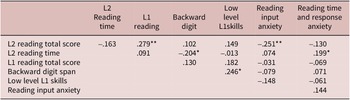
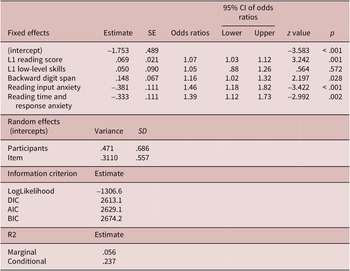
To answer the first RQ, namely how L1 text comprehension, L1 low-level skills, WM, and reading anxiety are related to L2 reading comprehension accuracy, GLMM analysis was conducted. Table 1 summarises the descriptive statistics for the dependent and independent variables of the study, and Table 2 describes their inter-corelations. The GLMM result (Table 3) shows that participants with L1 comprehension score 1 SD higher than the group mean were 1.07 times more likely to score correctly on the items of the L2 reading test than those with an average L1 comprehension score (β = 0.069, p = 0.001). Participants’ L1 low-level skills did not contribute significantly to L2 reading text comprehension (β = 0.050, p = 0.572). Participants with backward digit span 1 SD higher than the group mean were 1.16 times more likely to score correctly on the L2 reading test items than those with an average L1 backward digit score (β = 0.148, p = 0.028). Participants with reading-input anxiety 1 SD higher than the group mean were 1.46 less likely to respond accurately in the reading test than those with the average reading-input anxiety score (β = −0.381, p < 0.001). Similarly, participants with reading response– and reading time–related anxiety 1 SD higher than the group mean were 1.39 times less likely to answer accurately in the L2 reading test than those with average reading time– and reading response–related anxiety score (β = −0.333, p = 0.002). The GLMM model accounted for 23.76% of the variance associated with L2 reading comprehension accuracy (calculated using delta formula; Nakagawa et al., 2017). The random effects contributed to most of the variance (18.13%), suggesting that a considerable amount of variation in individuals’ L2 reading accuracy was due to random differences between participants and test items. The rest of the variance in L2 reading comprehension accuracy (5.63%) was accounted for by the predictor variables. In sum, the GLMM analysis suggests that L1 text comprehension, backward digit span, reading input anxiety, and reading time– and response task–related anxiety are significant predictors of L2 reading performance, while L1 low-level skills do not seem to significantly contribute to variance in the accuracy of responses in the L2 reading test.
Correlations of L2 reading score, L2 reading time, L1 reading score, working memory, L1 low-level skills, and reading anxiety factor scores

* p<.05; ** p<.01.
GLMM results: Predictors of L2 reading comprehension accuracy

Predictors of L2 reading time
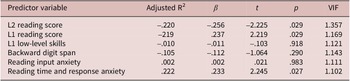
To examine how L2 and L1 text comprehension, L1 low-level skills, backward digit span, reading input anxiety, and reading time– and response task–related anxiety are related to time spent completing the reading test (RQ2), first a standard multiple regression analysis that included all the predictors was run. As L2 reading ability might moderate the effects of all the other predictor variables, a hierarchical regression analysis was conducted in which the effect of L2 reading comprehension was controlled. The statistical power of these models (N = 96; maximum of six predictors) to detect a medium effect size was .809, which is above the sufficient threshold (>.80) in L2 research (Larson-Hall, Reference Larson-Hall2010). These models met the assumptions of normality, outliers, the independence of error terms, and collinearity among the predictor variables. In the first model, established with standard multiple regression analysis, L2 reading score, L1 reading score, and reading and response time anxiety emerged as significant variables contributing to L2 reading time (see Table 4). According to this model, which explained 14% of the variance in L2 reading time (F [6, 90] = 2.388, p =. 035), participants with higher L2 reading scores and lower levels of reading time and response anxiety completed the test within shorter times, while those with higher L1 reading comprehension scores took longer to finish the test. Based on Plonsky and Oswald’s (Reference Plonsky and Oswald2014) criteria, the significant predictors all had a medium-sized effect on L2 reading time.
Model of L2 reading time using standard multiple regression analysis

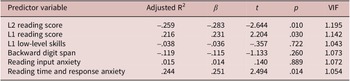
The hierarchical regression model with the L2 reading score controlled explained 12.8% of the variance in L2 reading time (F [3, 93] = 4.40, p =. 006). As can be seen in Table 5, when L2 reading ability was kept constant, L1 reading comprehension and reading time and response anxiety remained significant predictors of L2 reading time with medium size effect (Plonsky & Oswald, Reference Plonsky and Oswald2014).
Model of L2 reading time using hierarchical regression analysis

Because the effect of L1 and L2 reading comprehension was opposite, even though both the correlational analysis and the GLMM analysis showed that they were positively related to each other, it was important to test if there is a possible interaction between the effects of L1 and L2 reading on L2 reading time. Therefore, a third regression model was run in which the interaction effect of L1 and L2 reading scores was also added. However, to preserve statistical power, only the predictor of reading time and response anxiety that showed a significant effect in previous models was included. As can be seen in Table 6, this model explained 14.5% of the variance in L2 reading time (F [4, 92] = 4.46, p =. 002). However, it is important to note that there was a relatively high level of multicollinearity because the interaction term was derived from the two variables of L1 and L2 reading scores. Nonetheless, this third regression model still provides useful insights into the nature of the interactive effect of L1 and L2 reading on L2 reading time and suggests that L1 reading ability alone might not significantly contribute to L2 reading time. Instead, participants with a combination of high L1 reading and L2 reading ability are the ones who complete the L2 reading test faster, while those with high L1 reading ability but lower L2 reading ability tend to be slower (see also Figure 1 for visualisation).
Multiple regression model of L2 reading time, including the interaction between L1 and L2 reading

The effect of the interaction of L2 and L1 reading on predicted L2 reading time.

Discussion
Predictors of L2 reading performance
The first RQ of the study asked how L1 text comprehension, L1 low-level skills, backward digit span, reading input anxiety, and reading time– and response task–related anxiety predict L2 reading comprehension accuracy of Hungarian secondary school students. The results of the GLMM modelling showed that except for L1 low-level skills, all the other predictor variables contributed significantly to the variance in the accuracy of responses in the L2 reading test. The significant predictive roles of L1 text comprehension, WM, reading input anxiety, and reading time– and response–related anxiety lend evidence to multi-componential models of L2 reading comprehension (e.g., Jeon & Yamashita, Reference Jeon, Yamashita, Jeon and In’Nami2022) and highlight the relevance of foundational L1 text comprehension skills (Cummins, Reference Cummins1979; Geva & Ryan, Reference Geva and Ryan1993; Košak-Babuder et al., Reference Košak-Babuder, Kormos, Ratajczak and Pižorn2019; Sparks & Ganschow, Reference Sparks and Ganschow1993), cognitive factors such as WM capacity (Linck et al., Reference Linck, Osthus, Koeth and Bunting2014; Jeon & Yamashita, 2014, Reference Jeon, Yamashita, Jeon and In’Nami2022), and affective factors such as reading-related anxiety (Hamada & Takaki, Reference Hamada and Takaki2021; Teimouri et al., Reference Teimouri, Goetze and Plonsky2019) for L2 written text comprehension.
Previous research conducted mostly with younger children found that L1 word decoding abilities and word naming speed were significant contributor variables to L2 text comprehension (e.g., Jeon & Yamashita’s [Reference Jeon, Yamashita, Jeon and In’Nami2022] meta-analysis and studies by Kormos et al. [Reference Kormos, Košak Babuder and Pižorn2019] with Slovenian L2 learners of English and Tong et al. [Reference Tong, McBride, Shu and Ho2018] with Chinese learners). The lack of significant effect of L1 low-level skills observed in the study sample might be explained by the diminished role of L1 word-level reading ability and rapid-automated naming as L1 literacy skills develop (Landerl et al., Reference Landerl, Ramus, Moll, Lyons, Ansari and White2013), which is also apparent in the lack of significant correlations between L1 low-level skills and L1 reading comprehension. Furthermore, the differences might also be due to the fact that previous research with children used shorter input texts and tended to measure lower-level sentence comprehension skills rather than higher-level text comprehension abilities, such as inferencing, which several test items in this study assessed.
It is noteworthy that according to the GLMM model, WM capacity explained a significant proportion of variance at B1-C1 level of reading ability in the presence of other predictors, although when considered in isolation in the correlation analysis, the link between backward digit span and L2 reading test score was not significant. The correlational analysis in Table 2 also reveals a significant relationship between L1 low-level skills and WM capacity confirming research findings on SpLDs that show that lower working WM is often associated with L1 word-level decoding difficulties (Jeffries & Everatt, Reference Jeffries and Everatt2004). It is possible that this shared variance might have amplified the effect of WM in L2 reading comprehension in the GLMM model. From the perspective of SpLDs, the findings suggest that lower-level L1 text comprehension skills together with smaller WM capacity might also result in L2 reading difficulties. However, the joint variance these factors explain in the L2 reading accuracy model is relatively small, indicating that other core L2 knowledge-related variables (Hulstijn, Reference Hulstijn2015), such as L2 vocabulary and syntactic knowledge (Jeon & Yamashita, Reference Jeon, Yamashita, Jeon and In’Nami2022), which were not assessed in the current study, might complement or compensate for the impact of SpLDs.
Another relevant finding of the study is that anxiety related to processing the L2 reading text, time pressure, and the response tasks was associated with L2 reading scores. The directionality of this relationship is difficult to establish based on the data, but one might hypothesise that those with lower L2 reading ability exhibit elevated levels of stress and worry when it comes to understanding L2 written texts under time pressure and responding to L2 comprehension questions. While previous research by Hamada and Takaki (Reference Hamada and Takaki2021) has demonstrated the effect of cognitive processing anxiety in L2 reading, the current study is novel in showing the potential impact of anxiety specific to reading time constraints and worries related to answering reading test items independently of cognitive processing anxiety in L2 reading. The correlational analysis (see Table 2) also reveals that these two facets of L2 reading anxiety seem to be unrelated to L1 reading scores or low-level L1 skills and WM capacity that might be indicative of SpLDs. This finding does not seem to provide support for Ganschow et al.’s (Reference Ganschow, Sparks, Anderson, Javorsky, Skinner and Patton1994) and Ganschow and Sparks’ (Reference Ganschow and Sparks1996) assumption that underlying L1 processing difficulties are the key reasons for the emergence of L2-related anxiety.
Predictors of L2 reading time
Several regression models were run to investigate how L2 and L1 text comprehension, L1 low-level skills, WM, and reading anxiety were related to time spent completing the reading test (RQ2). The standard multiple regression analysis (Table 4) showed that L2 reading scores contributed positively to L2 reading test completion time. This model was not in line with recent findings by Kuperman et al. (Reference Kuperman, Siegelman, Schroeder, Acartürk, Alexeeva, Amenta and Usal2023) and Siegelman et al. (Reference Siegelman, Elgort, Brysbaert, Agrawal, Amenta, Arsenijević Mijalković and Kuperman2024) that demonstrated either no association between L2 reading scores or an inverse relationship between L2 reading ability and reading rate among international university students. The language proficiency of our sample may have been somewhat lower than that of the participants in Kuperman et al.’s (Reference Kuperman, Siegelman, Schroeder, Acartürk, Alexeeva, Amenta and Usal2023) and Siegelman et al.’s (Reference Siegelman, Elgort, Brysbaert, Agrawal, Amenta, Arsenijević Mijalković and Kuperman2024) studies. This could explain why participants’ potentially lower L2 reading ability, which likely involves more effortful and conscious word- and sentence-level decoding, might have led to slower test completion in this study (cf. Perfetti, Reference Perfetti2007; Segalowitz & Segalowitz, Reference Segalowitz and Segalowitz1993). However, it is important to consider the impact of L2 reading ability on reading time jointly with the role of L1 literacy. Interestingly, in the current study, participants with lower L1 text comprehension scores completed the L2 reading test faster according to the standard multiple regression model (Table 4) and to the model in which L2 reading ability was controlled for (Table 5). As the correlation analysis clearly indicated a positive relationship between L1 and L2 reading skills, I hypothesised that there might be an interaction between the effects of L1 and L2 reading ability on test-taking time. Indeed, the final regression model reported in Table 6 demonstrated that L2 reading ability alone did not predict L2 reading test time, and instead those with concurrently low L1 and L2 reading ability completed the test slower (see also Figure 1). Participants with high L1 literacy skills but with average L2 abilities tended to take a more cautious approach and seem to have read the text more carefully and deliberated longer on their answers in the L2 reading test.
Although the correlational analysis (see Table 2) showed that higher WM ability was associated with faster test completion, none of the regression models demonstrated that L1 low-level skills or WM capacity would be predictors of L2 reading test time. As these underlying linguistic and cognitive abilities might be indicative of SpLDs, some parallels with research on the impact of time extension on test performance can be drawn. Similar to the results of this study, Kormos and Ratajczak (Reference Kormos and Ratajczak2019) found that young Hungarian L2 learners with a profile indicative of SpLDs did not perform better under extended timing conditions than in the standard test administration context. Taking all these results together, one might hypothesise that the speed of reading the L2 text input and responding to the comprehension questions do not seem to be integral components of the L2 reading construct once lower-level text decoding processes are automatised. The findings also imply that the benefits of extended time beyond a comfortable pace of test completion might be limited for L2 learners who have a profile that might be indicative of reading-related disabilities. Therefore, as a first step towards more accessible and fair assessment, L2 reading tests should be generously and flexibly timed so that everyone can complete them at their own pace. This would also be beneficial for L2 learners with SpLDs and might reduce the need to apply for time extension in assessments of L2 reading skills.
Furthermore, the findings reveal that participants experiencing high levels of L2-reading anxiety related to input processing, time pressure, and response items completed the test within longer time. In the field of disability studies, Lang et al. (Reference Lang, Elliott, Bolt and Kratochwill2008) and Feldmann et al. (Reference Feldman, Kim and Elliott2009) reported that both disabled and non-disabled students experienced lower levels of anxiety and decreased negative emotions in tests under extended timing conditions than under timed conditions. Motteram et al. (Reference Motteram, Dawson and Schneider2023) also found that an important emotional impact of time extension in L2 assessment is the reduction of exam-related stress and worry. The findings of previous studies, as well as the results of the regression models in the current study, highlight that to alleviate feelings of test anxiety, it is crucial that all test takers, regardless of disabilities, have sufficient time for completing test of L2 reading comprehension.
Limitations and future directions
The current study has several limitations. First, in line with the social justice perspectives of diversity, the study did not classify participants in terms of SpLDs. Therefore, this research yields insights into the role of L1 low-level and text comprehension skills and WM in L2 reading test performance and test taking time based on a continuous distribution of these abilities. Further research using either preexisting official identification of SpLDs or validated instruments and identification tools would be needed to gain a better understanding of how test-timing affects the test-taking processes, experiences, and performance of L2 learners with disabilities. A larger sample size of participants would also allow for analysing the inter-relationship of the effect of L1 low-level skills, L1 reading comprehension, WM, and reading-related anxiety with structural equation modelling. In this study we only measured the total time participants took to complete the L2 reading test. Future studies could apply more sophisticated eye-tracking methodology to examine how L2 text-reading fluency might be impacted by SpLDs and how the speed of responding to different types of reading tasks (e.g., multiple-choice versus short-answer questions) might vary as a function of reading-related disabilities. To improve the generalisability of findings on the potentially high-stakes issue of time extension in L2 assessment, multi-site replication studies are needed with diverse research samples, particularly from non-Western, less industrialised, poorer, and less educated contexts (Andringa & Godfroid, Reference Andringa and Godfroid2020). More research would also be needed to examine how L2 learners with intersecting disabilities (e.g., SpLDs and attention and hyperactivity/autism) and L2 learners with disabilities from different socio-economic and ethnic backgrounds are affected by the timed nature of L2 reading assessment.
Conclusion
The study reported in this paper investigated how L1 reading comprehension and L1 low-level skills, together with WM capacity and reading anxiety, are related to the accuracy of responses and completion time in a test of L2 reading. The data obtained from Hungarian secondary school learners of L2 English showed that L1 reading comprehension scores, backward digit span, and anxiety related to processing the L2 reading text, time pressure, and the response tasks were significant predictors of L2 reading test performance, while L1 low-level skills did not significantly contribute to L2 reading accuracy. The findings also highlighted that although L1 literacy–related difficulties and reading-related anxiety might explain some variance in performance in L2 reading tests, the influence of other core-linguistic abilities, such as L2 vocabulary and grammatical knowledge, that were not measured in this study might override their effect. These results provide indirect support for previous research that had demonstrated that not all learners with SpLDs might experience challenges with L2 learning (Alderson et al., Reference Alderson, Haapakangas, Huhta, Nieminen and Ullakonoja2014; Ferrari & Palladino, Reference Ferrari and Palladino2007; Kormos et al., Reference Kormos, Košak Babuder and Pižorn2019) and that establishing strong foundations in L1 literacy can foster the development of L2 skills (Cummins, Reference Cummins1979; Geva & Ryan, Reference Geva and Ryan1993). Therefore, teachers should support and enhance literacy in all the languages students use, including reading skills in children’s home languages and the target/additional language(s) learned/used at school. The study also revealed that higher levels of reading-related anxiety were associated with slower reading and that L2 learners with lower levels of L1 and L2 reading ability completed the reading test within longer time. These findings offer empirical support for considering test time primarily as a universal design feature of tests of L2 reading rather than a special adjustment that is only available for disabled test takers. Thus, it is essential that L2 learners are given sufficient time to complete high-stakes reading tests as well as lower-stakes summative and formative classroom-based assessment of reading skills.
Appendix A

Appendix B. Factor loading for the low-level L1 skills test





 Open access

