





1 Introduction
A fundamental result in the study of holomorphic vector bundles is the construction of the moduli space of stable vector bundles. Seshadri [Reference Seshadri43] and Newstead [Reference Newstead37, Reference Newstead38] gave the first construction of such a moduli space for vector bundles over a curve, while Mumford [Reference Mumford35] introduced semistability in the sense of geometric invariant theory (GIT) to study this moduli space and established its structure as a global GIT quotient. These moduli spaces also have an analytic interpretation: the Hitchin-Kobayashi correspondence of Donaldson, Uhlenbeck and Yau [Reference Donaldson12, Reference Uhlenbeck and Yau46] states that a holomorphic vector bundle on a compact Kähler manifold is slope-stable if and only if it admits a Hermite-Einstein connection, thus establishing an equivalence between an algebro-geometric stability condition and the solvability of a geometric PDE. Fujiki–Schumacher [Reference Fujiki and Schumacher20] and Lübke–Okonek [Reference Lübke and Okonek31] later directly constructed the moduli space of Hermite-Einstein vector bundles over a fixed compact Kähler manifold using analytic techniques. These moduli spaces remain a central object of study to this day, and we refer to Greb-Sibley-Toma-Wentworth [Reference Greb, Sibley, Toma and Wentworth23] for recent work containing a discussion of analytic and algebraic compactifications.
Motivated by the Hitchin-Kobayashi correspondence and the construction of the moduli space of stable vector bundles, we extend these results to the context of proper holomorphic submersions which are not necessarily isotrivial. We recall that a holomorphic vector bundle
$F\to B$
 induces a proper holomorphic submersion by considering its projectivisation
$\mathbb {P}(F) \to B$
induces a proper holomorphic submersion by considering its projectivisation
$\mathbb {P}(F) \to B$
 .
.
More precisely, let
$\pi _Y:(Y, H_Y) \to (B,L)$
 be a proper holomorphic submersion, where B is a smooth projective manifold with an ample line bundle L and
$H_Y$
be a proper holomorphic submersion, where B is a smooth projective manifold with an ample line bundle L and
$H_Y$
 is a relatively ample line bundle over Y. The base
$(B,L)$
is a relatively ample line bundle over Y. The base
$(B,L)$
 is considered fixed throughout. The stability condition we impose on such a submersion is given by a stability condition on the fibres, defined in terms of K-stability, and a global condition on the fibration, given in terms of a canonical choice of a relatively Kähler metric, called an optimal symplectic connection.
When all the fibres admit a constant scalar curvature Kähler metric (hence are K-polystable), Dervan and Sektnan [Reference Dervan and Sektnan9] introduced optimal symplectic connections as solutions to a geometric PDE on the fibration, which produces a canonical relatively Kähler metric. In particular, when the fibration is obtained as the projectivisation of a stable holomorphic vector bundle, an optimal symplectic connection is precisely induced by and induces the Hermite-Einstein connection on the vector bundle [Reference Dervan and Sektnan9, §3.5]. Similarly, on isotrivial fibrations, the optimal symplectic connection condition becomes the Hermite-Yang-Mills condition on an associated principal bundle [Reference McCarthy33].
In [Reference Ortu40], the author generalised the notion of optimal symplectic connections to smooth fibrations whose fibres may not have a constant scalar curvature Kähler metric (cscK), but instead are analytically K-semistable, that is, they degenerate to cscK manifolds. Allowing K-semistable fibres is essential for the construction of the moduli space of fibrations with an optimal symplectic connection. Indeed, when deforming a fibration with cscK fibres, one cannot expect that the fibres remain cscK. Analytic K-semistability, on the other hand, is an open condition, and this allows us to study the local behaviour of families of fibrations with an optimal symplectic connection. Our main result is the following.
Theorem 1.1. Let G be a fixed complex Lie group. There exists a moduli space
$\mathcal {M}$
 that parametrises holomorphic submersions over a fixed base B such that
-
1. the fibres are analytically K-semistable, and the degenerations vary holomorphically in B;
-
2. the connected components of the identity of the groups of automorphisms of the fibres of the relatively cscK degenerations are all isomorphic to G;
-
3. they have a discrete relative automorphism group;
-
4. they admit an optimal symplectic connection.
The space
$\mathcal {M}$
 is a Hausdorff analytic complex space and it carries a Weil-Petersson type Kähler metric.
In the statement, the relative automorphism group of a fibration
$Y \to B$
 is the group of automorphisms of Y that preserve the projection onto B. Moreover, the first two assumptions are essential in the definition of an optimal symplectic connection, and thus the group of automorphisms of the fibres of the relatively cscK degeneration is considered to be a fixed datum in our construction of the moduli space.
We now explain briefly the optimal symplectic connection condition. The assumption that the fibres are analytically K-semistable means that they each admit a degeneration to a cscK manifold. We further assume that these degenerations vary holomorphically in B, so that we have a family
$(\mathcal {X}, \mathcal {H}) \to B \times S$
 , parametrised by
$S \subseteq \mathbb {C}$
, parametrised by
$S \subseteq \mathbb {C}$
 , such that
$(\mathcal {X}_s, \mathcal {H}_s) \to B$
, such that
$(\mathcal {X}_s, \mathcal {H}_s) \to B$
 is isomorphic to
$(Y, H_Y) \to B$
is isomorphic to
$(Y, H_Y) \to B$
 for
$s\ne 0$
for
$s\ne 0$
 and at
$s=0$
and at
$s=0$
 we have a fibration
$(X, H_X) \to B$
we have a fibration
$(X, H_X) \to B$
 with cscK fibres. Applying a relative version of Ehresmann’s fibration theorem, Y and X are isomorphic as smooth manifolds. The Chern classes
$c_1(H_Y)$
with cscK fibres. Applying a relative version of Ehresmann’s fibration theorem, Y and X are isomorphic as smooth manifolds. The Chern classes
$c_1(H_Y)$
 and
$c_1(H_X)$
and
$c_1(H_X)$
 , viewed as cohomology classes on the underlying smooth manifold, are equal because they are integral classes. Thus we can take the perspective of fixing the underlying symplectic fibration and deforming the complex structure. We also fix the complex structure of the base and assume that the deformations keep the projection to B holomorphic.
A relatively symplectic form
$\omega $
 on
$(Y, H_Y)\to (B,L)$
on
$(Y, H_Y)\to (B,L)$
 induces a splitting of the tangent bundle of Y into a vertical part, defined as the tangent bundle to the fibres, and a horizontal part, defined using orthogonality with respect to
$\omega $
induces a splitting of the tangent bundle of Y into a vertical part, defined as the tangent bundle to the fibres, and a horizontal part, defined using orthogonality with respect to
$\omega $
 . In the language of symplectic geometry,
$\omega $
. In the language of symplectic geometry,
$\omega $
 is called a symplectic connection. A relatively Kähler form
$\omega $
is called a symplectic connection. A relatively Kähler form
$\omega $
 is an optimal symplectic connection on
$(Y, H_Y)$
is an optimal symplectic connection on
$(Y, H_Y)$
 if it satisfies the geometric PDE

In this expression
$F_{\mathcal {H}}$
 and
$\rho _{\mathcal {H}}$
and
$\rho _{\mathcal {H}}$
 are curvature quantities which depend on
$\omega $
are curvature quantities which depend on
$\omega $
 ,
$\nu $
,
$\nu $
 is a curvature quantity that depends on the infinitesimal change in the complex structure and
$\lambda>0$
is a curvature quantity that depends on the infinitesimal change in the complex structure and
$\lambda>0$
 is a constant. The map
$p_E$
is a constant. The map
$p_E$
 is the projection onto the global sections of the real vector bundle
$E \to B$
is the projection onto the global sections of the real vector bundle
$E \to B$
 whose fibre over b is the vector space of holomorphy potentials with respect to the relatively cscK complex structure of X, defined in §2.2. Thus, the left-hand side is a smooth function on Y; in particular, the equation should be interpreted as a second-order elliptic PDE on the vector bundle E.
We construct the moduli space
$\mathcal {M}$
 by gluing local charts around fibrations that admit an optimal symplectic connection. If
$(Y,H_Y) \to (B,L)$
by gluing local charts around fibrations that admit an optimal symplectic connection. If
$(Y,H_Y) \to (B,L)$
 is such a fibration, the local moduli space around Y is given as the quotient

where
$W_Y$
 is the complex space of deformations of Y which also admit an optimal symplectic connection, and we quotient by the action of the discrete group
$\mathrm {Aut}(\pi _Y)$
is the complex space of deformations of Y which also admit an optimal symplectic connection, and we quotient by the action of the discrete group
$\mathrm {Aut}(\pi _Y)$
 of relative automorphisms, which is finite.
The definition of
$W_Y$
 essentially involves two steps. The first step, established in §3.1, consists of finding a locally closed analytic space which parametrises all small deformations of the complex structure of Y that admit a degeneration to a fibration with cscK fibres. To do so, we combine the theory of deformations of cscK manifolds and the theory of deformations of fibrations, developed by the author in [Reference Ortu40]. More precisely, we consider a fibration
$(Y, H_Y) \to (B,L)$
essentially involves two steps. The first step, established in §3.1, consists of finding a locally closed analytic space which parametrises all small deformations of the complex structure of Y that admit a degeneration to a fibration with cscK fibres. To do so, we combine the theory of deformations of cscK manifolds and the theory of deformations of fibrations, developed by the author in [Reference Ortu40]. More precisely, we consider a fibration
$(Y, H_Y) \to (B,L)$
 with an optimal symplectic connection and a degeneration to a fibration
$(X,H_X)\to (B,L)$
with an optimal symplectic connection and a degeneration to a fibration
$(X,H_X)\to (B,L)$
 with cscK fibres. A fibration version of Kuranishi’s theorem allows us to parametrise the compatible vertical deformations of the complex structure of X with a complex space
$V_\pi $
with cscK fibres. A fibration version of Kuranishi’s theorem allows us to parametrise the compatible vertical deformations of the complex structure of X with a complex space
$V_\pi $
 of harmonic
$(0,1)$
of harmonic
$(0,1)$
 -forms with values in the
$(1,0)$
-forms with values in the
$(1,0)$
 -vertical tangent bundle. Working locally in B, we then establish that the deformations of Y which degenerate to a relatively cscK fibration form a locally closed analytic subvariety
$V_\pi ^+$
-vertical tangent bundle. Working locally in B, we then establish that the deformations of Y which degenerate to a relatively cscK fibration form a locally closed analytic subvariety
$V_\pi ^+$
 of
$V_\pi $
of
$V_\pi $
 . We explicitly construct the relatively cscK degeneration using techniques from GIT; although we do not use it directly, our construction is related to the Byałinicki-Birula decomposition [Reference Białynicki-Birula3, Reference Jelisiejew and Sienkiewicz29]. This is the key new step in our construction, not present in other constructions of moduli spaces.
The second step, established in §3.2, consists of proving that, in a small open neighbourhood
$W_Y$
 of the point associated to Y in
$V_\pi ^+$
of the point associated to Y in
$V_\pi ^+$
 , all fibrations admit an optimal symplectic connection. The proof of this essentially relies on the implicit function theorem and employs the linearisation of the equation studied in [Reference Ortu40] with respect to the complex structure. It is at this step that we use the assumption that the relative automorphism group, that is, the group of automorphisms which commute with the projection to the base, is discrete. Moreover, the optimal symplectic connection condition guarantees that the moduli space is Hausdorff, as the Hermite-Einstein condition does for the moduli space of simple vector bundles [Reference Fujiki and Schumacher20].
While our work concentrates on the analytic aspects of the moduli space of holomorphic submersions, it is natural to ask if it is possible to give an algebro-geometric construction based on stability. In fact, there exists a notion of stability of fibrations developed by Dervan, Sektnan [Reference Dervan and Sektnan10], and Hallam [Reference Hallam24], which comes from K-stability and is equivalent to slope stability when the fibration is the projectivisation of a vector bundle. An algebro-geometric construction would lead to the structure of a variety on the moduli space rather than the structure of a complex space, and would naturally allow singular fibres. Such a moduli space would parametrise certain stable fibrations which degenerate to a fibration whose general fibre is K-polystable. Moreover, the automorphism group of the general fibre of the degeneration should be fixed. When singular fibres are present, we expect that the stability of the fibration should be interpreted in terms of the existence of solutions to the PDE (1.1) on the smooth locus having a prescribed behaviour near the singularities.
Recently, Hashizume and Hattori [Reference Hashizume and Hattori25] have constructed a moduli space of adiabatically K-stable fibrations over a curve where the generic fibre is Calabi-Yau, using algebro-geometric techniques. Adiabatic K-stability [Reference Hattori26] is a condition defined on a fibration with K-polystable fibres over a twisted K-polystable base, and is related to Dervan-Sektnan’s stability of fibrations and the existence of optimal symplectic connections. In the special case where the fibres are all smooth, our moduli space constitutes an alternative construction of Hashizume-Hattori’s moduli space. However, our construction of the moduli space of optimal symplectic connections does not require any condition on the base of the submersion and allows the fibres to have automorphisms. For example, the projectivisation of a stable simple vector bundle over a K-unstable base is not adiabatically K-stable, yet it admits an optimal symplectic connection, thus it is represented by a point in our moduli space. This observation is based on a discussion with M. Hattori, whom we gratefully thank.
Outline
In Section 2 we give preliminary definitions and results on deformations of cscK manifolds and we describe the deformation theory of submersions with cscK fibres. We then explain briefly the theory of optimal symplectic connections. In Section 3 we construct the moduli space of holomorphic submersions admitting an optimal symplectic connection. Then in Section 4 we describe a Weil-Petersson type Kähler metric on the moduli space, along with a natural line bundle.
2 Preliminaries
This section recalls some basic definitions and properties of Kähler manifolds and introduces the theory of optimal symplectic connections. Let
$(M,L)$
 be a compact Kähler manifold of complex dimension n with an ample line bundle L, and let
$\omega \in c_1(L)$
be a compact Kähler manifold of complex dimension n with an ample line bundle L, and let
$\omega \in c_1(L)$
 be a Kähler form. The scalar curvature of
$\omega $
be a Kähler form. The scalar curvature of
$\omega $
 is the function on M defined as the contraction of the Ricci curvature:

where

We will be interested in Kähler metrics with constant scalar curvature, where the constant is a topological constant given by the intersection product

Let
$g_J$
 be the Riemannian metric on M induced by J and
$\omega $
be the Riemannian metric on M induced by J and
$\omega $
 . A smooth function h on M is called a holomorphy potential if the
$(1,0)$
. A smooth function h on M is called a holomorphy potential if the
$(1,0)$
 -part of the Riemannian gradient of h, denoted
$\nabla _gh$
-part of the Riemannian gradient of h, denoted
$\nabla _gh$
 , is a holomorphic vector field. Consider the operator
$\mathcal {D} : C^\infty (M, \mathbb {C}) \to \Omega ^{0,1}(T^{1,0}M)$
, is a holomorphic vector field. Consider the operator
$\mathcal {D} : C^\infty (M, \mathbb {C}) \to \Omega ^{0,1}(T^{1,0}M)$
 defined by

The Lichnerowicz operator is the operator
$\mathcal {D}^*\mathcal {D}$
 , where the adjoint is defined with respect to the
$L^2(g)$
, where the adjoint is defined with respect to the
$L^2(g)$
 -inner product. The Lichnerowicz operator is a fourth-order elliptic operator, and its kernel, which by ellipticity is the kernel of
$\mathcal {D}$
-inner product. The Lichnerowicz operator is a fourth-order elliptic operator, and its kernel, which by ellipticity is the kernel of
$\mathcal {D}$
 , coincides with the space of holomorphy potentials on M.
2.1 Deformation theory of cscK manifolds
In this section, we describe the deformations of the complex structure of a Kähler manifold with constant scalar curvature, following the notation of Székelyhidi [Reference Székelyhidi44, §3], [Reference Székelyhidi45, §6]. A similar description was also treated by Brönnle [Reference Brönnle5, Part 1], and the author [Reference Ortu41].
Let
$(M, \omega )$
 be a symplectic manifold. Define the infinite-dimensional manifold

We denote by
$\mathscr {J}^{\mathrm {int}}$
 the complex subspace of integrable almost complex structures. The tangent space at a point
$J \in \mathscr {J}$
the complex subspace of integrable almost complex structures. The tangent space at a point
$J \in \mathscr {J}$
 can be identified with

Recall that a vector field
$\xi _h$
 is Hamiltonian with respect to
$\omega $
is Hamiltonian with respect to
$\omega $
 if there exists
$h \in C^\infty (M, \mathbb {R})$
if there exists
$h \in C^\infty (M, \mathbb {R})$
 such that
$\omega (\xi _h, \cdot )= -\mathrm {d} h $
such that
$\omega (\xi _h, \cdot )= -\mathrm {d} h $
 . On a Kähler manifold we can characterise a Hamiltonian vector field with Hamiltonian function h as
$\xi _h =J\nabla ^g(h)$
. On a Kähler manifold we can characterise a Hamiltonian vector field with Hamiltonian function h as
$\xi _h =J\nabla ^g(h)$
 , where
$\nabla ^gh$
, where
$\nabla ^gh$
 is the Riemannian gradient of h.
Let
$\mathscr {G}$
 be the group of Hamiltonian symplectomorphisms of
$(M,\, \omega )$
be the group of Hamiltonian symplectomorphisms of
$(M,\, \omega )$
 . Then
$\mathscr {G}$
. Then
$\mathscr {G}$
 acts on
$\mathscr {J}$
acts on
$\mathscr {J}$
 by pull-back. The Lie algebra of
$\mathscr {G}$
by pull-back. The Lie algebra of
$\mathscr {G}$
 can be identified with the space of smooth functions on M with mean value zero, denoted
$C_0^\infty (M)$
can be identified with the space of smooth functions on M with mean value zero, denoted
$C_0^\infty (M)$
 . The following theorem is due to Fujiki [Reference Fujiki19] and Donaldson [Reference Donaldson13].
Theorem 2.1. The action
$\mathscr {G} \curvearrowright \mathscr {J}$
 is Hamiltonian with moment map

Therefore, cscK metrics on M correspond to
$J \in \mathscr {J}^{\mathrm {int}}$
 such that
$\mu (J) = 0$
such that
$\mu (J) = 0$
 . The function
$\mathrm {Scal}(\omega ,J) - \widehat {S}$
. The function
$\mathrm {Scal}(\omega ,J) - \widehat {S}$
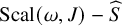 is the Hermitian scalar curvature if J is nonintegrable, which coincides with the Riemannian scalar curvature in the integrable case. We view it as an element in
$C_0^\infty (M)^*$
is the Hermitian scalar curvature if J is nonintegrable, which coincides with the Riemannian scalar curvature in the integrable case. We view it as an element in
$C_0^\infty (M)^*$
 by identifying
$\mathrm {Lie}(\mathscr {G})$
by identifying
$\mathrm {Lie}(\mathscr {G})$
 with its dual.
Let J be an integrable compatible complex structure on
$(M,\omega )$
 , and denote by
$\mathcal {K}_J(\omega )$
, and denote by
$\mathcal {K}_J(\omega )$
 the set of Kähler metrics in the same Kähler class of
$\omega $
the set of Kähler metrics in the same Kähler class of
$\omega $
 with respect to J, that is,

For fixed
$J \in \mathscr {J}$
 , consider the infinitesimal action of
$\mathscr {G}$
, consider the infinitesimal action of
$\mathscr {G}$
 on
$\mathscr {J}$
on
$\mathscr {J}$
 , defined by the operator

where
$\xi _h$
 is the Hamiltonian vector field with function h; let
$P^{\mathbb {C}}$
is the Hamiltonian vector field with function h; let
$P^{\mathbb {C}}$
 be its extension to
$C_0^\infty (M, \mathbb {C})$
be its extension to
$C_0^\infty (M, \mathbb {C})$
 . The following proposition (see also [Reference Székelyhidi45, §6.1]) justifies the fact that instead of moving the Kähler metric inside the Kähler class with respect to a fixed J, one can think of
$\omega $
. The following proposition (see also [Reference Székelyhidi45, §6.1]) justifies the fact that instead of moving the Kähler metric inside the Kähler class with respect to a fixed J, one can think of
$\omega $
 as fixed and move the complex structure.
Proposition 2.2 [Reference Donaldson14, p.17]
For every
$\omega _\phi \in \mathcal {K}_J(\omega )$
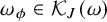 there exists an
$f \in \mathrm {Diff}_0(M)$
there exists an
$f \in \mathrm {Diff}_0(M)$
 such that
$f^*\omega _\phi = \omega $
such that
$f^*\omega _\phi = \omega $
 and
$(M, \omega _\phi , J)$
and
$(M, \omega _\phi , J)$
 is isomorphic to
$(M, \omega , f^*J)$
is isomorphic to
$(M, \omega , f^*J)$
 . In particular, there is a map F that sends a Kähler potential
$\phi $
. In particular, there is a map F that sends a Kähler potential
$\phi $
 to
$F_{\phi }(J) = f^*J$
to
$F_{\phi }(J) = f^*J$
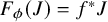 . The differential at
$0$
. The differential at
$0$
 of F is given by

Although a complexification of
$\mathscr {G}$
 does not genuinely exist, we can think of the image of the map F as an infinitesimal complexified orbit of the action of
$\mathscr {G}$
does not genuinely exist, we can think of the image of the map F as an infinitesimal complexified orbit of the action of
$\mathscr {G}$
 on
$\mathscr {J}$
on
$\mathscr {J}$
 . The proposition says that a variation of the Kähler form in a given Kähler class for J fixed corresponds to a variation of the complex structure J in the same
$\mathscr {G}^c$
. The proposition says that a variation of the Kähler form in a given Kähler class for J fixed corresponds to a variation of the complex structure J in the same
$\mathscr {G}^c$
 -orbit, for
$\omega $
-orbit, for
$\omega $
 fixed.
The following result characterises P as the adjoint operator of the differential of the scalar curvature when varying the complex structure.
Lemma 2.3 [Reference Donaldson13, §4]
Let Q be the differential of the scalar curvature map (2.1) at a point
$J \in \mathscr {J}$
 . Then if
$\alpha \in T_{J}\mathscr {J}$
. Then if
$\alpha \in T_{J}\mathscr {J}$
 and
$\varphi \in C^\infty (M)$
and
$\varphi \in C^\infty (M)$
 ,
,

so
$P^* = 2Q$
 , and
, and

We next let
$(M, L)$
 be a compact Kähler manifold with an ample line bundle L, and assume that
$\omega \in c_1(L)$
be a compact Kähler manifold with an ample line bundle L, and assume that
$\omega \in c_1(L)$
 has constant scalar curvature with respect to the complex structure J. The deformations of J compatible with
$\omega $
has constant scalar curvature with respect to the complex structure J. The deformations of J compatible with
$\omega $
 can be considered as elements of the vector space

on
$T_J\mathscr {J}$
 . Let K be the stabilizer of J with respect to the action of
$\mathscr {G}$
. Let K be the stabilizer of J with respect to the action of
$\mathscr {G}$
 on
$\mathscr {J}$
on
$\mathscr {J}$
 . Then K is the group of Hamiltonian isometries of
$(\omega , J)$
. Then K is the group of Hamiltonian isometries of
$(\omega , J)$
 . The complexification
$K^{\mathbb {C}}$
. The complexification
$K^{\mathbb {C}}$
 is the connected component of the identity of the group of automorphisms of M which lift to L, denoted
$\mathrm {Aut}_0(M, L)$
is the connected component of the identity of the group of automorphisms of M which lift to L, denoted
$\mathrm {Aut}_0(M, L)$
 . The group K (as well as its complexification) act on
$\widetilde {H}^1$
. The group K (as well as its complexification) act on
$\widetilde {H}^1$
 by pull-back, and the origin is a fixed point of the action.
The following theorem is a symplectic version of Kuranishi’s theorem [Reference Kuranishi30] and an infinite-dimensional version of Luna’s slice theorem [Reference Luna32]: it provides a parametrisation of compatible infinitesimal deformations of J. A proof that takes into account the compatibility with the symplectic structure is explained in [Reference Chen and Sun7, Lemma 6.1].
Theorem 2.4. There exists a ball around the origin
$V \subset \widetilde {H}^1$
 and a K-equivariant embedding

such that
$\Psi (0) = J$
 and
and
-
1. the $\mathscr {G}^c$
 -orbit of every integrable complex structure near
$J_0$
intersects the image of
$\Psi $
;
-orbit of every integrable complex structure near
$J_0$
intersects the image of
$\Psi $
; -
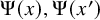
2. If $x, x' \in V$
are in the same orbit for the complexified action of K, and
$\Psi (x)$
is integrable, then
$\Psi (x), \Psi (x')$
are in the same
$\mathscr {G}^c$
-orbit; -
3. $\mathrm {Scal}(\omega , \Psi (x))$
is an element of the Lie algebra of K.




In particular, a moment map for the action of K on V is given by

The Kuranishi space is the base of a deformation family
$\mathcal {M} \to V$
 centred at J.
Definition 2.5. We say that the deformation family is complete if, for another deformation family
$\mathcal {M}_1 \to V_1$
 , there exists a map

such that
$\mathcal {M}_1 = \tau ^*\mathcal {M}$
 . Moreover, if the differential of
$\tau $
. Moreover, if the differential of
$\tau $
 at the origin is unique we say that the deformation family is versal, and universal if
$\tau $
at the origin is unique we say that the deformation family is versal, and universal if
$\tau $
 itself is unique.
We remark that Kuranishi’s theorem [Reference Kuranishi30] also gives the existence of a versal deformation family centred at J which is complete for nearby complex structures.
2.2 Fibrations
In this section, we collect some results on Kähler metrics on holomorphic submersions. Let
$\pi _X:X \to B$
 be a holomorphic submersion of compact complex manifolds. Let n be the dimension of B, m the dimension of the fibres, so
$\mathrm {dim}(X)=n+m$
be a holomorphic submersion of compact complex manifolds. Let n be the dimension of B, m the dimension of the fibres, so
$\mathrm {dim}(X)=n+m$
 . We also assume that the spaces
$H^0(X_b, T^{1,0}X_b)$
. We also assume that the spaces
$H^0(X_b, T^{1,0}X_b)$
 of holomorphic vector fields on
$X_b$
of holomorphic vector fields on
$X_b$
 are isomorphic as Lie algebras for all b.
Definition 2.6. A line bundle
$H_X$
 on the total space X of the submersion
$\pi _X$
on the total space X of the submersion
$\pi _X$
 is said to be relatively ample if its restrictions to the fibres of
$\pi _X$
is said to be relatively ample if its restrictions to the fibres of
$\pi _X$
 are ample. Similarly, a representative
$\omega \in c_1(H_X)$
are ample. Similarly, a representative
$\omega \in c_1(H_X)$
 is called a relatively Kähler metric if its restrictions to the fibres of
$\pi _X$
is called a relatively Kähler metric if its restrictions to the fibres of
$\pi _X$
 are Kähler metrics.
Let
$\omega $
 be a relatively Kähler metric on X and
$\omega _B$
be a relatively Kähler metric on X and
$\omega _B$
 a Kähler metric on B. We can define a Kähler metric on X by taking the relative Kähler metric
$\omega $
a Kähler metric on B. We can define a Kähler metric on X by taking the relative Kähler metric
$\omega $
 and adding a large multiple of the pull-back of the base metric:

The relative symplectic form
$\omega $
 determines a splitting of the tangent space

where
$\mathcal {V}_x = T_x X_{\pi (x)}$
 is the tangent space to the fibre
$X_x$
is the tangent space to the fibre
$X_x$
 , and
, and

In the context of symplectic fibrations
$\omega $
 is called a symplectic connection [Reference McDuff and Salamon34, Chapter 6] and the splitting (2.6) induces a splitting on all tensor bundles.
In local computations, we make the following notational conventions:
-
$\{ w^1, \dots , w^m \}$
denote vertical holomorphic coordinates; indices are denoted with the letters
$a, b, c, \dots $
; -
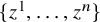
$\{z^1, \dots , z^n\}$
denote holomorphic coordinates on the base; indices are denoted with the letters
$i, j, k, \dots $
; -
$\{\zeta ^1, \dots , \zeta ^{n+m}\}$
denote holomorphic coordinates on the total space; indices are denoted with the letters
$p,q,r, \dots $
.





Lemma 2.7. Let
$\alpha $
 be a covariant
$2$
be a covariant
$2$
 -tensor of type
$(1,1)$
-tensor of type
$(1,1)$
 . Then

where
$\Lambda _{\omega _k}$
 denotes the contraction with the Kähler metric
$\omega _k$
denotes the contraction with the Kähler metric
$\omega _k$
 ,
$\Lambda _{\omega _B}$
,
$\Lambda _{\omega _B}$
 the contraction with the (pull-back of the) base metric
$\omega _B$
the contraction with the (pull-back of the) base metric
$\omega _B$
 and
$\Lambda _{\mathcal {V}}$
and
$\Lambda _{\mathcal {V}}$
 the contraction with the vertical part of the relatively Kähler metric
$\omega $
the contraction with the vertical part of the relatively Kähler metric
$\omega $
 .
.
Proof. At each point
$x \in X_b \subset X$
 , the matrix
$[\omega _k]$
, the matrix
$[\omega _k]$
 is block-diagonal:

Therefore in local coordinates around the point x

The horizontal part of
$\omega _k$
 , denoted
$\omega _{k, \mathcal {H}}$
, denoted
$\omega _{k, \mathcal {H}}$
 splits as
$\omega _{\mathcal {H}}+ k\omega _B$
splits as
$\omega _{\mathcal {H}}+ k\omega _B$
 , where
$\omega _{\mathcal {H}}$
, where
$\omega _{\mathcal {H}}$
 is the horizontal part of
$\omega $
is the horizontal part of
$\omega $
 . Let
$[\omega _{k, \mathcal {H}}]$
. Let
$[\omega _{k, \mathcal {H}}]$
 ,
$[\omega _{\mathcal {H}}]$
,
$[\omega _{\mathcal {H}}]$
 and
$[\omega _B]$
and
$[\omega _B]$
 be the matrices of coefficients of the two-forms
$\omega _{k, \mathcal {H}}$
be the matrices of coefficients of the two-forms
$\omega _{k, \mathcal {H}}$
 ,
$\omega _{\mathcal {H}}$
,
$\omega _{\mathcal {H}}$
 and
$\omega _B$
and
$\omega _B$
 respectively. We can write

where
$\mathrm {Id}$
 is the identity matrix and the base form
$\omega _B$
is the identity matrix and the base form
$\omega _B$
 induces a Riemannian metric on the horizontal tangent bundle, so its inverse is well defined. The inverse of the matrix
$[\omega _{k,\mathcal {H}}]$
induces a Riemannian metric on the horizontal tangent bundle, so its inverse is well defined. The inverse of the matrix
$[\omega _{k,\mathcal {H}}]$
 can be expanded in inverse powers of k as

This implies the claim.
Let us now restrict to the case when the fibres of X each admit a cscK metric. The following lemma explains that one can define a relatively Kähler metric on the total space which is relatively cscK.
Lemma 2.8 [Reference Dervan and Sektnan9, Lemma 3.8]
For any
$b \in B$
 , let
$\omega _b$
, let
$\omega _b$
 be a cscK metric on the fibre
$X_b$
be a cscK metric on the fibre
$X_b$
 in the class
$c_1(H_X|_b)$
in the class
$c_1(H_X|_b)$
 . Then there exists a
$\omega \in c_1(H_X)$
. Then there exists a
$\omega \in c_1(H_X)$
 which is relatively cscK.
Under the relatively cscK assumption, we now explain how the function space
$C^\infty (X, \mathbb {R})$
 splits in a way that takes into account the fibration structure. We begin by considering the vertical Lichnerowicz operator,

defined fibrewise as
$\left ( \mathcal {D}_{\mathcal {V}}^*\mathcal {D}_{\mathcal {V}} \varphi \right )|_{X_b} = \mathcal {D}_b^*\mathcal {D}_b \varphi |_{X_b}$
 . It is a real operator since the fibrewise metric is cscK. By integrating a function
$\varphi \in C^\infty (X, \mathbb {R})$
. It is a real operator since the fibrewise metric is cscK. By integrating a function
$\varphi \in C^\infty (X, \mathbb {R})$
 over the fibres of
$\pi $
over the fibres of
$\pi $
 , we define a projection

Its kernel is given by the space
$C^\infty _0(X, \mathbb {R})$
 of functions that have fibrewise mean value zero. A key step in the study of optimal symplectic connections is that we can further split this space as follows.
Consider the real vector bundle
$E \to B$
 [Reference Dervan and Sektnan9, §3.1], whose fibre over
$b \in B$
[Reference Dervan and Sektnan9, §3.1], whose fibre over
$b \in B$
 is the real finite-dimensional vector space
$\mathrm {ker}_0(\mathcal {D}_b^*\mathcal {D}_b)$
is the real finite-dimensional vector space
$\mathrm {ker}_0(\mathcal {D}_b^*\mathcal {D}_b)$
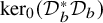 of holomorphy potentials on the fibre
$X_b$
of holomorphy potentials on the fibre
$X_b$
 with mean-value zero with respect to
$\omega _b$
with mean-value zero with respect to
$\omega _b$
 . It is well defined as a vector bundle since we assume that the complex dimension of the space
$H^0(X_b, T^{1,0}X_b)$
. It is well defined as a vector bundle since we assume that the complex dimension of the space
$H^0(X_b, T^{1,0}X_b)$
 of holomorphic vector fields on
$X_b$
of holomorphic vector fields on
$X_b$
 is independent of b [Reference Hallam24, Proposition 2.16]. The space of smooth global sections of E, denoted by
$C^\infty (E)$
is independent of b [Reference Hallam24, Proposition 2.16]. The space of smooth global sections of E, denoted by
$C^\infty (E)$
 , is given by the kernel over the fibrewise mean-value-zero functions of the vertical Lichnerowicz operator
$\mathcal {D}_{\mathcal {V}}^*\mathcal {D}_{\mathcal {V}}$
, is given by the kernel over the fibrewise mean-value-zero functions of the vertical Lichnerowicz operator
$\mathcal {D}_{\mathcal {V}}^*\mathcal {D}_{\mathcal {V}}$
 .
.
Remark 2.9. In [Reference Hallam24, Lemma 2.7], Hallam used the Cartan decomposition for the space
$\mathfrak {h}(X_b)$
 of holomorphic vector fields of the fibre to show that
$E_b$
of holomorphic vector fields of the fibre to show that
$E_b$
 can be also viewed as the vector space of all Kähler potentials
$\varphi _b$
can be also viewed as the vector space of all Kähler potentials
$\varphi _b$
 on
$X_b$
on
$X_b$
 of mean-value zero for which
$\omega _b + i\partial \bar {\partial }\varphi _b$
of mean-value zero for which
$\omega _b + i\partial \bar {\partial }\varphi _b$
 is still cscK.
We can split
$C^\infty _0(X)$
 as
as

where
$C^\infty (R)$
 is the fibrewise
$L^2$
is the fibrewise
$L^2$
 -orthogonal complement with respect to the fibre metric
$\omega _b$
-orthogonal complement with respect to the fibre metric
$\omega _b$
 , that is, for all
$\varphi \in \mathrm {ker}_0 \mathcal {D}_b^*\mathcal {D}_b$
, that is, for all
$\varphi \in \mathrm {ker}_0 \mathcal {D}_b^*\mathcal {D}_b$
 ,
$\psi \in C^\infty (R)$
,
$\psi \in C^\infty (R)$


So we obtain

We denote by
$p_E : C^\infty (X) \to C^\infty (E)$
 the projection.
Definition 2.10. We denote by
$\mathcal {K}_E$
 the space of functions
$\varphi \in C^\infty (X)$
the space of functions
$\varphi \in C^\infty (X)$
 such that
$\omega + i \partial \bar {\partial }\varphi $
such that
$\omega + i \partial \bar {\partial }\varphi $
 is still a fibrewise cscK metric.
In particular, if we change the relatively cscK metric
$\omega $
 to
$\omega + i\partial \bar {\partial }\varphi $
to
$\omega + i\partial \bar {\partial }\varphi $
 with
$\varphi \in \mathcal {K}_E$
with
$\varphi \in \mathcal {K}_E$
 , the vector bundles
$E(\omega )$
, the vector bundles
$E(\omega )$
 and
$E(\omega +i\partial \bar {\partial }\varphi )$
and
$E(\omega +i\partial \bar {\partial }\varphi )$
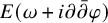 are isomorphic. The following result [Reference Dervan and Sektnan11, Lemma 4.20] relates the space
$\mathcal {K}_E$
are isomorphic. The following result [Reference Dervan and Sektnan11, Lemma 4.20] relates the space
$\mathcal {K}_E$
 to the vector bundle
$E\to B$
to the vector bundle
$E\to B$
 .
.
Lemma 2.11. Let
$\varphi _t : [0, 1] \to \mathcal {K}_E$
 be a smooth path. Then for all t

that is to say that, up to a function on the base,
$\dot {\varphi _t}$
 is a fibrewise holomorphy potential with respect to
$\omega +i\partial \bar {\partial }\varphi _t$
is a fibrewise holomorphy potential with respect to
$\omega +i\partial \bar {\partial }\varphi _t$
 .
.
2.3 Optimal symplectic connections
Let
$(Y, H_Y)\to (B,L)$
 be a holomorphic submersion with a relatively ample line bundle
$H_Y \to Y$
be a holomorphic submersion with a relatively ample line bundle
$H_Y \to Y$
 . In this section we recall the theory of optimal symplectic connections [Reference Ortu40]. The following assumptions restrict the class of admissible fibrations to those whose fibres satisfy a stability property defined in terms of K-stability. More precisely we assume that:
-
(i) the fibres $Y_b$
are analytically K-semistable, which means by definition that they each admit a degeneration to a cscK manifold
$X_b$
. We also assume that the deformation is compatible with the fibration structure in the following sense: there exists a holomorphic map
$\varpi :(\mathcal {X}, \mathcal {H}) \to (B, L) \times S$
, parametrised by a disk S, such that for
$s\ne 0$
, the family
$(\mathcal {X}_s, \mathcal {H}_s) \to B$
is isomorphic to the original fibration
$\pi _Y:(Y, H_Y) \to B$
and the central fibration at
$s=0$
is a family
$\pi _X:(X, H_X) \to B$
whose fibres are cscK; -
(ii) the automorphism groups $\mathrm {Aut}_0(X_b, H_b)$
of the fibres are all isomorphic.









The first hypothesis is a stability assumption. We will refer to the submersion
$X \to B$
 as the relatively cscK degeneration of
$Y\to B$
as the relatively cscK degeneration of
$Y\to B$
 . The second hypothesis holds if and only if the spaces
$H^0(X_b, T^{1,0}X_b)$
. The second hypothesis holds if and only if the spaces
$H^0(X_b, T^{1,0}X_b)$
 are isomorphic as Lie algebras, which we assumed in §2.2 to define the vector bundle
$E\to B$
are isomorphic as Lie algebras, which we assumed in §2.2 to define the vector bundle
$E\to B$
 . It is needed to define optimal symplectic connection and it is a key hypothesis for the construction of the moduli space.
A relative version of Ehresmann’s theorem [Reference Ortu40, Proposition 4.5] implies that X and Y are diffeomorphic. Let M denote the underlying smooth manifold. Since the Chern classes are integral classes we have that
$c_1(H_X)$
 coincides with
$c_1(H_Y)$
coincides with
$c_1(H_Y)$
 as cohomology classes on M. Since Y is a small deformation of X, the cohomology class
$c_1(H_X)$
as cohomology classes on M. Since Y is a small deformation of X, the cohomology class
$c_1(H_X)$
 is of type
$(1,1)$
is of type
$(1,1)$
 on Y, so
$\omega $
on Y, so
$\omega $
 is a
$(1,1)$
is a
$(1,1)$
 -form with respect to the complex structure of Y [Reference Huybrechts28, §6.1]. By Moser’s theorem [Reference Cannas da Silva6, Theorem 7.2], we can modify the complex structure of Y by a small diffeomorphism so that
$\omega $
-form with respect to the complex structure of Y [Reference Huybrechts28, §6.1]. By Moser’s theorem [Reference Cannas da Silva6, Theorem 7.2], we can modify the complex structure of Y by a small diffeomorphism so that
$\omega $
 restricted to the fibres of
$\pi _Y$
restricted to the fibres of
$\pi _Y$
 is compatible with the restriction of the complex structure. Thus we can assume that
$\omega $
is compatible with the restriction of the complex structure. Thus we can assume that
$\omega $
 is relatively Kähler on Y.
Therefore we can view
$Y\to B$
 and
$X\to B$
and
$X\to B$
 as the same relatively symplectic fibration
$(M, \omega ) \to B$
as the same relatively symplectic fibration
$(M, \omega ) \to B$
 with two different integrable almost complex structures J and I where
$(\omega , I)$
with two different integrable almost complex structures J and I where
$(\omega , I)$
 is relatively cscK and
$(\omega , J)$
is relatively cscK and
$(\omega , J)$
 is just relatively Kähler. The family
$\mathcal {X} \to B\times S$
is just relatively Kähler. The family
$\mathcal {X} \to B\times S$
 corresponds to a family of complex structures
$\{J_s\}$
corresponds to a family of complex structures
$\{J_s\}$
 on
$(M, \omega ) \to B$
on
$(M, \omega ) \to B$
 , such that for
$s \ne 0$
, such that for
$s \ne 0$
 ,
$J_s$
,
$J_s$
 is isomorphic to J and
$J_0$
is isomorphic to J and
$J_0$
 is isomorphic to I.
The definition of optimal symplectic connections involves various curvature quantities and a description of the complex structure of Y as a deformation of the one on X. To describe the deformations of the complex structure I, we begin by considering the space
$\mathscr {J}_\pi $
 of almost complex structures compatible with
$\omega $
of almost complex structures compatible with
$\omega $
 and such that
$\mathrm {d}\pi \circ J = J_B \circ \mathrm {d}\pi $
and such that
$\mathrm {d}\pi \circ J = J_B \circ \mathrm {d}\pi $
 . The tangent space at I to
$\mathscr {J}_\pi $
. The tangent space at I to
$\mathscr {J}_\pi $
 can be identified with

where
$\omega _F$
 is the vertical part of
$\omega $
is the vertical part of
$\omega $
 . In local holomorphic coordinates an element
$\alpha \in T_{J}^{0,1}\mathscr {J}_\pi $
. In local holomorphic coordinates an element
$\alpha \in T_{J}^{0,1}\mathscr {J}_\pi $
 is written as

where [Reference Ortu40, Lemma 4.1]

Consider the map

which is the relative version of the map (2.2). Let
$\widetilde {H}^1_{\mathcal {V}}$
 be the kernel of the elliptic operator

where the adjoint is computed with respect to any Kähler metric on X which restricts to
$\omega _F$
 vertically. The operator
$\square _{\mathcal {V}}$
vertically. The operator
$\square _{\mathcal {V}}$
 is fibrewise elliptic because
$P_{\mathcal {V}}P_{\mathcal {V}}^*$
is fibrewise elliptic because
$P_{\mathcal {V}}P_{\mathcal {V}}^*$
 is elliptic in the fibre direction, and globally elliptic because
$(\bar {\partial }^*\bar {\partial })^2$
is elliptic in the fibre direction, and globally elliptic because
$(\bar {\partial }^*\bar {\partial })^2$
 is. The space
$\widetilde {H}^1_{\mathcal {V}}$
is. The space
$\widetilde {H}^1_{\mathcal {V}}$
 is the space of integrable first-order deformations of I. Let
$K_\pi $
is the space of integrable first-order deformations of I. Let
$K_\pi $
 be the group of biholomorphisms of I which restrict to an isometry on each fibre, with respect to the fibrewise metric defined by
$(\omega , I)$
be the group of biholomorphisms of I which restrict to an isometry on each fibre, with respect to the fibrewise metric defined by
$(\omega , I)$
 . The group
$K_\pi $
. The group
$K_\pi $
 acts on
$\widetilde {H}^1_{\mathcal {V}}$
acts on
$\widetilde {H}^1_{\mathcal {V}}$
 by pull-back. The following theorem is a fibrewise version of Theorem 2.4.
Theorem 2.12 [Reference Ortu40, Theorem 4.7]
There exists a neighbourhood of the origin
$V_\pi \subset \widetilde {H}^1_{\mathcal {V}}$
 and a
$K_\pi $
and a
$K_\pi $
 -equivariant map

such that:
-
1. $\Phi (0) = I$
; -
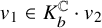
2. If $v_1, v_2 \in V_\pi $
and
$v_1 \in K_b^{\mathbb {C}}\cdot v_2$
, and if
$\Phi (v_1)$
is integrable, then
$\Phi (v_1)$
and
$\Phi (v_2)$
are isomorphic and for all
$b \in B$
the complex structure
$\Phi (v_1) |_{X_b}$
is in the same
$\mathscr {G}_b^c$
-orbit as
$\Phi (v_2) |_{X_b}$
; -
3. For any $J \in \mathscr {J}_\pi $
integrable close to I, there exists
$J'$
in the image of
$\Phi $
such that, for all b,
$J_b'$
is in the same
$\mathscr {G}_b^c$
-orbit as
$J_b$
; -
4. $\mathrm {Scal}_{\mathcal {V}}\left (\omega _X, \Phi (x)\right ) \in C^\infty (E, I)$
.





We now describe the curvature quantities involved in the definition of optimal symplectic connections. The symplectic connection
$\omega $
 determines the following curvature quantities:
-
(i) the symplectic curvature is a two-form on B with values in the fibrewise Hamiltonian vector fields defined for $v_1, v_2 \in \mathfrak {X}(B)$
as $$ \begin{align*} F_{\mathcal{H}}(u_1, u_2) = [u_1^\sharp, u_2^\sharp]^{\mathrm{vert}}, \end{align*} $$where $u_j^\sharp $
denotes the horizontal lift. Let
$\gamma $
be the map which associates to a fibrewise Hamiltonian vector field its fibrewise Hamiltonian function with fibrewise mean value zero. Thus we consider
$\gamma ^*(F_{\mathcal {H}})$
, which is a two-form on B with values in
$C^\infty _0(Y, \mathbb {R})$
, and we pull it back to Y;
-
(ii) the curvature $\rho $
of the Hermitian connection induced by
$(\omega , I)$
on the top wedge power
$\bigwedge \nolimits ^{m}\mathcal {V}$
. We will primarily consider its purely horizontal part
$\rho _{\mathcal {H}}$
; -
(iii) the curvature of the deformation family $\nu $
, which is defined as follows. On each fibre
$X_b$
of the relatively cscK degeneration
$X \to B$
, let
$\widetilde {H}^1_b$
be the deformation space (2.3) and
$V_b$
the Kuranishi space described in Theorem 2.4. Let
$v_b \in \widetilde {H}^1_b$
and denote by
$\mathbf {v}_b$
a vector field on
$V_b$
such that
$\mathbf {v}_b\vert _{0} = v_b$
. For any
$f \in \mathfrak {k}_b$
let $$\begin{align*}A_f v_b := -(\mathcal{L}_{\mathrm{grad}^\omega f} \mathbf{v}_b)\vert_0. \end{align*}$$Define $\nu _b$
as $$ \begin{align*} \langle \nu_b(v_b), f \rangle = \frac{1}{2}\Omega_0(A_f v_b, v_b). \end{align*} $$In particular, $\nu _b$
is the moment map for the action of the group
$K_b$
on the tangent space at the origin to
$V_b$
. Therefore we can define a global section
$\nu $
of the vector bundle
$E \to B$
of relatively holomorphy potentials of
$X \to B$
, as (2.10) $$ \begin{align} \nu(b) = \nu_b(v_b). \end{align} $$Given $x \in V_\pi $
,
$v \in \widetilde {H}^1_{\mathcal {V}}$
, we will write
$\nu _x(v)$
when we want to underline the dependence of the map
$\nu $
on the complex structure
$\Phi (x)$
and on the deformation v.


Definition 2.13 [Reference Ortu40, Definition 3.3]
A relatively Kähler metric
$\omega $
 on
$Y \to B$
on
$Y \to B$
 is called an optimal symplectic connection if

for a positive number
$\lambda $
 . In the following, we will use the notation
$\Theta (\omega , J) = \Delta _{\mathcal {V}}(\Lambda _{\omega _B} \gamma ^*(F_{\mathcal {H}}))+ \Lambda _{\omega _B}\rho _{\mathcal {H}}$
. In the following, we will use the notation
$\Theta (\omega , J) = \Delta _{\mathcal {V}}(\Lambda _{\omega _B} \gamma ^*(F_{\mathcal {H}}))+ \Lambda _{\omega _B}\rho _{\mathcal {H}}$
 .
.
Equation (2.11) is a second-order elliptic equation on the vector bundle
$E \to B$
 . It arises by expanding the scalar curvature of the Kähler metric
$(\omega _k, J_s)$
. It arises by expanding the scalar curvature of the Kähler metric
$(\omega _k, J_s)$
 in inverse powers of k and powers of s and then relating the two parameters to obtain a single expansion. The left-hand side of (2.11) is then the projection onto
$C^\infty (E(\omega , I))$
in inverse powers of k and powers of s and then relating the two parameters to obtain a single expansion. The left-hand side of (2.11) is then the projection onto
$C^\infty (E(\omega , I))$
 of the sub-leading order term of such an expansion. The equation with
$\nu =0$
of the sub-leading order term of such an expansion. The equation with
$\nu =0$
 is the condition for an optimal symplectic connection in the sense of [Reference Dervan and Sektnan9], where all the fibres are required to be cscK.
The linearisation of the equation at a solution is given by the operator [Reference Ortu40, §5.3]

on
$C^\infty (E)$
 , where

and

The adjoint is computed with respect to
$\omega _F + \omega _B$
 . Here
$\nabla _{\mathcal {V}}^{1,0} \varphi _E$
. Here
$\nabla _{\mathcal {V}}^{1,0} \varphi _E$
 is a section of the holomorphic tangent bundle; the vertical part of
$\bar {\partial } \nabla _{\mathcal {V}}^{1,0} \varphi _E$
is a section of the holomorphic tangent bundle; the vertical part of
$\bar {\partial } \nabla _{\mathcal {V}}^{1,0} \varphi _E$
 vanishes since
$\varphi _E \in C^\infty (E)$
vanishes since
$\varphi _E \in C^\infty (E)$
 and the horizontal part is denoted by the expression (2.12). The operator (2.12) can be described as follows [Reference Dervan and Sektnan9, §4.3]: let
$\mathcal {D}_k^*\mathcal {D}_k$
and the horizontal part is denoted by the expression (2.12). The operator (2.12) can be described as follows [Reference Dervan and Sektnan9, §4.3]: let
$\mathcal {D}_k^*\mathcal {D}_k$
 be the Lichnerowicz operator with respect to the Kähler metric
$\omega _k$
be the Lichnerowicz operator with respect to the Kähler metric
$\omega _k$
 . It admits a power series expansion in negative powers of k:

where
$\mathcal {L}_0$
 is the vertical Lichnerowicz operator
$\mathcal {D}_{\mathcal {V}}^*\mathcal {D}_{\mathcal {V}}$
is the vertical Lichnerowicz operator
$\mathcal {D}_{\mathcal {V}}^*\mathcal {D}_{\mathcal {V}}$
 . Then for
$\varphi , \psi $
. Then for
$\varphi , \psi $
 fibrewise holomorphy potentials

This means that the operator
$\mathcal {R}^*\mathcal {R}$
 can actually be seen as
$p_E \circ \mathcal {L}_1$
can actually be seen as
$p_E \circ \mathcal {L}_1$
 restricted to
$\mathcal {C}^\infty _E(X)$
restricted to
$\mathcal {C}^\infty _E(X)$
 . The kernel of
$\mathcal {R}$
. The kernel of
$\mathcal {R}$
 , thus of
$\mathcal {R}^*\mathcal {R}$
, thus of
$\mathcal {R}^*\mathcal {R}$
 , consists of fibrewise holomorphy potentials which are global holomorphy potentials on X with respect to
$\omega _k$
, consists of fibrewise holomorphy potentials which are global holomorphy potentials on X with respect to
$\omega _k$
 , and it is independent of k. The operator (2.13) is described as

where
$\varphi , \psi \in C^\infty (E)$
 . A function
$\psi \in C^\infty (E)$
. A function
$\psi \in C^\infty (E)$
 is in the kernel of A if and only if
$\psi $
is in the kernel of A if and only if
$\psi $
 is a fibrewise holomorphy potential with respect to all
$J_s$
is a fibrewise holomorphy potential with respect to all
$J_s$
 , that is,
$\psi \in C^\infty (E, J_s)$
, that is,
$\psi \in C^\infty (E, J_s)$
 . Thus the kernel of
$\widehat {\mathcal {L}}$
. Thus the kernel of
$\widehat {\mathcal {L}}$
 consists of those functions
$\psi \in C^\infty (E, J_0)$
consists of those functions
$\psi \in C^\infty (E, J_0)$
 such that
$\bar {\partial }_s (\nabla _{s, \mathcal {V}}^{1,0}\psi )= 0$
such that
$\bar {\partial }_s (\nabla _{s, \mathcal {V}}^{1,0}\psi )= 0$
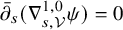 for all s.
Remark 2.14. Although we are considering only integral Kähler classes, this is not essential. Indeed, we expect that all our results should hold if
$c_1(H_X)$
 and
$c_1(L)$
and
$c_1(L)$
 are replaced respectively by a relative Kähler class and a Kähler class that do not come from holomorphic line bundles. For details, see [Reference Ortu39, Remark 3.2].
3 Construction of the moduli space
Consider a submersion
$Y\to B$
 that degenerates to a relatively cscK holomorphic submersion
$X\to B$
that degenerates to a relatively cscK holomorphic submersion
$X\to B$
 , as described in §2.2. We prove that the set of deformations of
$Y \to B$
, as described in §2.2. We prove that the set of deformations of
$Y \to B$
 that still degenerate to a relatively cscK fibration forms a locally closed subvariety of the relative Kuranishi space. Throughout, by subvariety we mean complex analytic subvariety. The relatively cscK degeneration of a deformation might differ from
$X\to B$
that still degenerate to a relatively cscK fibration forms a locally closed subvariety of the relative Kuranishi space. Throughout, by subvariety we mean complex analytic subvariety. The relatively cscK degeneration of a deformation might differ from
$X\to B$
 , but the group of automorphisms of the fibre is fixed and should be considered a fixed datum in the construction of the moduli space. We then prove that, when the relative automorphism group is discrete, the solutions to the optimal symplectic connection equation (2.11) form an open set inside the locally closed subset of admissible deformations. This allows us to define a local moduli space of optimal symplectic connections. Finally, we glue the local moduli spaces and we prove that we obtain a global Hausdorff complex analytic space
$\mathcal {M}$
, but the group of automorphisms of the fibre is fixed and should be considered a fixed datum in the construction of the moduli space. We then prove that, when the relative automorphism group is discrete, the solutions to the optimal symplectic connection equation (2.11) form an open set inside the locally closed subset of admissible deformations. This allows us to define a local moduli space of optimal symplectic connections. Finally, we glue the local moduli spaces and we prove that we obtain a global Hausdorff complex analytic space
$\mathcal {M}$
 which parametrises optimal symplectic connections.
3.1 Openness of the setting
Given a fibration
$\pi _Y: (Y, H_Y) \to (B, L)$
 with analytically K-semistable fibres, we have introduced in (i) the assumption that there exists a degeneration of
$\pi _Y$
with analytically K-semistable fibres, we have introduced in (i) the assumption that there exists a degeneration of
$\pi _Y$
 to a fibration
$\pi _X : (X, H_X) \to (B, L)$
to a fibration
$\pi _X : (X, H_X) \to (B, L)$
 such that the fibres of
$\pi _X$
such that the fibres of
$\pi _X$
 are cscK. We have explained in §2.2 that we can consider
$Y\to B$
are cscK. We have explained in §2.2 that we can consider
$Y\to B$
 and
$X\to B$
and
$X\to B$
 as the same symplectic fibration
$\pi : (M, \omega ) \to B$
as the same symplectic fibration
$\pi : (M, \omega ) \to B$
 , and the degeneration as a deformation of a complex structure J to I, where
$(\omega , I)$
, and the degeneration as a deformation of a complex structure J to I, where
$(\omega , I)$
 has fibrewise constant scalar curvature. The goal of this section is to understand for which deformations
$J'$
has fibrewise constant scalar curvature. The goal of this section is to understand for which deformations
$J'$
 of J we can still find a relatively cscK degeneration
$X'$
of J we can still find a relatively cscK degeneration
$X'$
 , and to construct such a degeneration.
We begin by working locally in B. Let
$\mathcal {U} \subseteq B$
 be a coordinate open subset of B. The fibre over the origin of
$\mathcal {U}$
be a coordinate open subset of B. The fibre over the origin of
$\mathcal {U}$
 , denoted
$M_0$
, denoted
$M_0$
 , has a constant scalar curvature metric
$(\omega _0, I_0)$
, has a constant scalar curvature metric
$(\omega _0, I_0)$
 . Let K be the group of Hamiltonian isometries of
$(\omega _0, I_0)$
. Let K be the group of Hamiltonian isometries of
$(\omega _0, I_0)$
 and let
$\widetilde {H}^1_0$
and let
$\widetilde {H}^1_0$
 be the vector space (2.3) parametrising first-order deformations of
$(M_0, \omega _0, I_0)$
be the vector space (2.3) parametrising first-order deformations of
$(M_0, \omega _0, I_0)$
 . Since
$(\omega _0, I_0)$
. Since
$(\omega _0, I_0)$
 has constant scalar curvature, the complexification of K is the group

We will employ the following definition of GIT-stability for the action of a reductive group on an affine space [Reference Newstead38, §3] [Reference Hoskins27, §4.5, §4.6].
Definition 3.1. Let
$\mathbb {A}^d$
 be an affine space of dimension d and G a reductive affine group acting on it. Let
$(z_1, \dots , z_d)$
be an affine space of dimension d and G a reductive affine group acting on it. Let
$(z_1, \dots , z_d)$
 be a system of coordinates on
$\mathbb {A}^d$
be a system of coordinates on
$\mathbb {A}^d$
 . The space
$\mathbb {A}^d$
. The space
$\mathbb {A}^d$
 can be embedded in the projective space
$\mathbb {P}^d$
can be embedded in the projective space
$\mathbb {P}^d$
 as a coordinate chart with the map

We extend the action of G to an action on
$\mathbb {P}^d$
 by acting trivially on the first coordinate. Let
$x \in \mathbb {A}^d$
by acting trivially on the first coordinate. Let
$x \in \mathbb {A}^d$
 and let
$\widehat {x}$
and let
$\widehat {x}$
 be its image in
$\mathbb {P}^d$
be its image in
$\mathbb {P}^d$
 . We say that x is
-
(i) semistable if there exists a nonconstant homogeneous polynomial in $[z_0: \dotsc : z_d]$
on
$\mathbb {P}^d$
which is G-invariant and does not vanish at
$\widehat {x}$
; -
(ii) polystable if it is semistable and its orbit is closed;
-
(iii) stable if it is semistable, its orbit is closed and its stabiliser is finite.



In particular, the polynomial
$P(\mathbf {z}) = z_0$
 is a G-invariant homogeneous polynomial that does not vanish at any point of
$\mathbb {A}^d$
is a G-invariant homogeneous polynomial that does not vanish at any point of
$\mathbb {A}^d$
 . So every point of
$\mathbb {A}^d$
. So every point of
$\mathbb {A}^d$
 is semistable.
Remark 3.2. The fact that every point is semistable holds because we defined the action on
$\mathbb {P}^d$
 to be trivial on the first homogenous coordinate. In principle, one can choose to extend the action in a nontrivial way and can still define stability as above, but unstable points might appear. We do not treat this case here, so we have included the trivial extension of the action in the definition of stability.
We apply the definition of stability to the vector space
$\widetilde {H}^1_0$
 . The complex structure
$I_0$
. The complex structure
$I_0$
 corresponds to the origin in the Kuranishi space
$V_0$
corresponds to the origin in the Kuranishi space
$V_0$
 , which is fixed by the action of G. Therefore its orbit is closed and its stabiliser is the group G itself, so it is a polystable point. A key result for our construction is the following.
Lemma 3.3 [Reference Hoskins27, Corollary 4.31]
The closure of the orbit of every point in
$\widetilde {H}^1_0$
 contains a unique polystable orbit.
Let
$V_0$
 be the subspace of the Kuranishi space which parametrises integrable almost complex structures; it is a locally closed analytic subspace of
$\widetilde {H}^1_0$
be the subspace of the Kuranishi space which parametrises integrable almost complex structures; it is a locally closed analytic subspace of
$\widetilde {H}^1_0$
 because it is defined by the vanishing of the Nijenhuis tensor. Thus the family
$X \to B$
because it is defined by the vanishing of the Nijenhuis tensor. Thus the family
$X \to B$
 can be described locally over
$\mathcal {U}$
can be described locally over
$\mathcal {U}$
 as a family
$\{ x_b \}$
as a family
$\{ x_b \}$
 in
$V_0$
in
$V_0$
 . The family
$Y \to B$
. The family
$Y \to B$
 can be described locally over
$\mathcal {U}$
can be described locally over
$\mathcal {U}$
 as a family
$\{ y_b\mid b \in \mathcal {U} \}$
as a family
$\{ y_b\mid b \in \mathcal {U} \}$
 of points such that for each b the closure of the G-orbit of
$y_b$
of points such that for each b the closure of the G-orbit of
$y_b$
 contains the polystable point
$x_b$
contains the polystable point
$x_b$
 [Reference Chen and Sun7, Theorem 1.3].
The key step in the construction is the following: by our hypothesis ii, the automorphism group of
$(M_b, H_b)$
 is isomorphic to G for all
$b \in B$
is isomorphic to G for all
$b \in B$
 . Therefore the points
$\{ x_b \mid b \in \mathcal {U} \}$
. Therefore the points
$\{ x_b \mid b \in \mathcal {U} \}$
 are all fixed by the action of G and are hence polystable. By Lemma 3.3,
$x_b$
are all fixed by the action of G and are hence polystable. By Lemma 3.3,
$x_b$
 is the only polystable orbit in the closure of the orbit of
$y_b$
is the only polystable orbit in the closure of the orbit of
$y_b$
 . Let
$V_0^+$
. Let
$V_0^+$
 be the set of all semistable points that have a fixed point in the closure of their orbit, it follows that the map

that maps a semistable point to the corresponding fixed point is well-defined. Note that the action of G on
$V_0^+$
 is effective, since by definition if
$x \in V_0^+$
is effective, since by definition if
$x \in V_0^+$
 , then the closure of the orbit of x is in
$V_0^+$
, then the closure of the orbit of x is in
$V_0^+$
 .
.
Lemma 3.4. The set
$V_0^+$
 is an analytic subvariety of
$V_0$
is an analytic subvariety of
$V_0$
 and the map (3.1) is holomorphic.
Proof. The space
$V_0$
 is an open subset of the vector space
$\widetilde {H}^1$
is an open subset of the vector space
$\widetilde {H}^1$
 . Let d be the dimension of
$\widetilde {H}^1$
. Let d be the dimension of
$\widetilde {H}^1$
 , so each point
$z \in V_0$
, so each point
$z \in V_0$
 has coordinates

Let us begin with the case when G is isomorphic to a complex torus
${(\mathbb {C}^*)}^r$
 . The fixed points of the action can be described by the vanishing of the coordinates

thus they form an analytic subspace of
$V_0$
 .
.
By the Hilbert-Mumford criterion [Reference Mumford, Fogarty and Kirwan36, Theorem 2.1], a point
$y_j$
 is semistable if it is semistable for the action of every 1-parameter subgroup of the group G. Let
$\rho (t): \mathbb {C^*} \hookrightarrow G$
is semistable if it is semistable for the action of every 1-parameter subgroup of the group G. Let
$\rho (t): \mathbb {C^*} \hookrightarrow G$
 be a 1-parameter subgroup. The action of
$\rho (t)$
be a 1-parameter subgroup. The action of
$\rho (t)$
 can be written as
$(t^{a_1}, \dots , t^{a_d})$
can be written as
$(t^{a_1}, \dots , t^{a_d})$
 , where the numbers
$a_j$
, where the numbers
$a_j$
 are the weights of the action. Then
$V_0$
are the weights of the action. Then
$V_0$
 splits into a sum of weight spaces
$V_0^{\mathrm {pos}} \oplus V_0^{\mathrm {fix}} \oplus V_0^{\mathrm {neg}}$
splits into a sum of weight spaces
$V_0^{\mathrm {pos}} \oplus V_0^{\mathrm {fix}} \oplus V_0^{\mathrm {neg}}$
 , where
$\rho (t)$
, where
$\rho (t)$
 acts on
$V_0^{\mathrm {pos}}$
acts on
$V_0^{\mathrm {pos}}$
 with positive weights, on
$V_0^{\mathrm {neg}}$
with positive weights, on
$V_0^{\mathrm {neg}}$
 with negative weights and fixes the subspace
$V_0^{\mathrm {fix}}$
with negative weights and fixes the subspace
$V_0^{\mathrm {fix}}$
 . A semistable point that has a fixed point in the closure of its orbit is described by the following condition: if a coordinate in
$V_0^{\mathrm {pos}}$
. A semistable point that has a fixed point in the closure of its orbit is described by the following condition: if a coordinate in
$V_0^{\mathrm {pos}}$
 is nonzero, then all coordinates in
$V_0^{\mathrm {neg}}$
is nonzero, then all coordinates in
$V_0^{\mathrm {neg}}$
 vanish. Applying this condition to all 1-parameter subgroups yields a set of polynomial equations that define the semistable points in
$V_0^+$
vanish. Applying this condition to all 1-parameter subgroups yields a set of polynomial equations that define the semistable points in
$V_0^+$
 . Thus, the semistable points correspond to an analytic subset of
$V_0$
. Thus, the semistable points correspond to an analytic subset of
$V_0$
 . The map F is the projection onto the set described by
$\{ z_{i_1} = \dots \ = z_{i_h} = 0\}$
. The map F is the projection onto the set described by
$\{ z_{i_1} = \dots \ = z_{i_h} = 0\}$
 , thus it is holomorphic.
Let now G be any reductive group, and let y be a semistable point and x be a polystable and fixed point in the closure of its orbit. The fixed points of G form a vector subspace
$V_0^{\mathrm {fix}}$
 also in this case. Moreover there exists a 1-parameter subgroup
$\lambda _x : \mathbb {C}^* \hookrightarrow G$
also in this case. Moreover there exists a 1-parameter subgroup
$\lambda _x : \mathbb {C}^* \hookrightarrow G$
 such that

It follows that the map
$y \mapsto x$
 is the projection onto the vector subspace of fixed points for
$\lambda _x$
is the projection onto the vector subspace of fixed points for
$\lambda _x$
 , hence it is holomorphic. Consider the composite map

where the first map is the projection onto the vector subspace of fixed points for
$\lambda _x$
 and the second map is the projection onto the subspace of fixed points for the whole group G. The map is holomorphic because it is a composition of holomorphic projections. We prove that it coincides with the map (3.1). Let
$\widetilde {x}' = \lim _{t\to 0} \lambda _x(t)\cdot y'$
and the second map is the projection onto the subspace of fixed points for the whole group G. The map is holomorphic because it is a composition of holomorphic projections. We prove that it coincides with the map (3.1). Let
$\widetilde {x}' = \lim _{t\to 0} \lambda _x(t)\cdot y'$
 . Then

The unique polystable orbit contained in
$\overline {G\cdot \widetilde {x}'}$
 is also a polystable orbit in
$\overline {G\cdot y'}$
is also a polystable orbit in
$\overline {G\cdot y'}$
 , so it must coincide with the fixed-point orbit
$\{x'\}$
, so it must coincide with the fixed-point orbit
$\{x'\}$
 . Thus flowing along the orbit of
$\widetilde {x}'$
. Thus flowing along the orbit of
$\widetilde {x}'$
 amounts to projecting onto the subspace of fixed points, and so the map (3.2) maps any point
$y'$
amounts to projecting onto the subspace of fixed points, and so the map (3.2) maps any point
$y'$
 to the fixed point
$x'$
to the fixed point
$x'$
 in the closure of its orbit.
Remark 3.5. The map (3.1) is analogous to the one given by the Byałinicki-Birula decomposition [Reference Białynicki-Birula3, Reference Jelisiejew and Sienkiewicz29].
Let
$V_\pi $
 be the Kuranishi space of the fibration
$X \to B$
be the Kuranishi space of the fibration
$X \to B$
 defined in Theorem 2.12. Consider the subspace

We remark that
$V^+_\pi $
 depends on the complex structure of the reference fibration
$X\to B$
depends on the complex structure of the reference fibration
$X\to B$
 and its deformation
$Y\to B$
and its deformation
$Y\to B$
 . We denote by
$\mathscr {J}^+_\pi $
. We denote by
$\mathscr {J}^+_\pi $
 the image of
$V_\pi ^+$
the image of
$V_\pi ^+$
 via the relative Kuranishi map (2.9).
Lemma 3.6.
$V_\pi ^+$
 is a locally closed complex analytic subvariety of
$V_\pi $
is a locally closed complex analytic subvariety of
$V_\pi $
 .
.
Proof. Let
$\mathcal {U}_1$
 and
$\mathcal {U}_2$
and
$\mathcal {U}_2$
 be two open coordinate subsets of B with nonempty intersection and let
$0_1$
be two open coordinate subsets of B with nonempty intersection and let
$0_1$
 be the origin of
$\mathcal {U}_1$
be the origin of
$\mathcal {U}_1$
 and
$0_2$
and
$0_2$
 be the origin of
$\mathcal {U}_2$
be the origin of
$\mathcal {U}_2$
 . Denote by
$I_1$
. Denote by
$I_1$
 and
$I_2$
and
$I_2$
 the complex structures of the fibres
$X_{0_1}$
the complex structures of the fibres
$X_{0_1}$
 and
$X_{0_2}$
and
$X_{0_2}$
 , and
$G_1$
, and
$G_1$
 ,
$G_2$
,
$G_2$
 their groups of automorphisms. By assumption,
$G_1$
their groups of automorphisms. By assumption,
$G_1$
 and
$G_2$
and
$G_2$
 are isomorphic, and we will denote them by G. Recall that the Kuranishi space is versal and more specifically that it is a complete deformation space for the nearby fibres. We use the versality of the Kuranishi map to glue the spaces
$V_1^+$
are isomorphic, and we will denote them by G. Recall that the Kuranishi space is versal and more specifically that it is a complete deformation space for the nearby fibres. We use the versality of the Kuranishi map to glue the spaces
$V_1^+$
 and
$V_2^+$
and
$V_2^+$
 constructed in Lemma 3.4 to a variety
$V^+$
constructed in Lemma 3.4 to a variety
$V^+$
 and prove that
$V_\pi ^+$
and prove that
$V_\pi ^+$
 is obtained as the intersection of said variety with the relative Kuranishi space
$V_\pi $
is obtained as the intersection of said variety with the relative Kuranishi space
$V_\pi $
 . More precisely, versality of the Kuranishi space means that there is a map

not necessarily unique.
The map
$\tau _{21}$
 can be taken to be G-equivariant. In fact, the G-equivariance can be traced back to the proof of Kuranishi’s Theorem 2.4. The map
$\tau _{21}$
can be taken to be G-equivariant. In fact, the G-equivariance can be traced back to the proof of Kuranishi’s Theorem 2.4. The map
$\tau _{21}$
 is defined using the implicit function theorem, which can be applied to a K-equivariant map to provide an implicit inverse function which is K-equivariant. Since G is the complexification of K, we obtain that
$\tau _{21}$
is defined using the implicit function theorem, which can be applied to a K-equivariant map to provide an implicit inverse function which is K-equivariant. Since G is the complexification of K, we obtain that
$\tau _{21}$
 is G-equivariant. The equivariance also implies that the image of
$V_2^+$
is G-equivariant. The equivariance also implies that the image of
$V_2^+$
 is
$V_1^+$
is
$V_1^+$
 , so we can restrict
$\tau _{21}$
, so we can restrict
$\tau _{21}$
 to
to

Moreover, the map
$\widetilde {\tau }_{21}$
 has an inverse that is constructed by reversing the roles of
$V_1$
has an inverse that is constructed by reversing the roles of
$V_1$
 and
$V_2$
and
$V_2$
 , so it is an isomorphism. In fact, although the map
$\tau _{21}$
, so it is an isomorphism. In fact, although the map
$\tau _{21}$
 is not canonical, the restriction to
$\widetilde {\tau }_{21}$
is not canonical, the restriction to
$\widetilde {\tau }_{21}$
 is fixed by the reference K-semistable fibration
$Y\to B$
is fixed by the reference K-semistable fibration
$Y\to B$
 . Each Kuranishi space
$V_b$
. Each Kuranishi space
$V_b$
 is a complex subspace of the vector space
$\widetilde {H}_b^1$
is a complex subspace of the vector space
$\widetilde {H}_b^1$
 , described as the kernel of the elliptic operator
$P_bP_b^*+(\bar {\partial }_b^*\bar {\partial }_b)^2$
, described as the kernel of the elliptic operator
$P_bP_b^*+(\bar {\partial }_b^*\bar {\partial }_b)^2$
 (2.3). So we can use the isomorphism
$\widetilde {\tau }_{21}$
(2.3). So we can use the isomorphism
$\widetilde {\tau }_{21}$
 to glue the spaces
$V_b^+$
to glue the spaces
$V_b^+$
 to a subvariety
$V^+$
to a subvariety
$V^+$
 of the kernel of the fibrewise elliptic operator

Therefore the intersection

is a locally closed subvariety of
$V_\pi $
 .
.
The following lemma shows that we can glue the local fibration constructed in Lemma 3.4 to a global fibration over B.
Lemma 3.7. Let
$Y'=(M, \omega , J')\to B$
 be a fibration with complex structure
$J'$
be a fibration with complex structure
$J'$
 represented by
$y'\in V^+_\pi $
represented by
$y'\in V^+_\pi $
 . Then
$Y'$
. Then
$Y'$
 degenerates to
$X'=(M, \omega , I') \to B$
degenerates to
$X'=(M, \omega , I') \to B$
 such that
-
1. $(\omega , I')$
is relatively cscK; -
2. the groups $\mathrm {Aut}(X^{\prime }_b, H_b')$
are isomorphic for all
$b \in B$
.


Proof. Let
$\mathcal {U} \subseteq B$
 be an open coordinate subset. By the relative Kuranishi Theorem 2.4, for each
$b\in \mathcal {U}$
be an open coordinate subset. By the relative Kuranishi Theorem 2.4, for each
$b\in \mathcal {U}$
 there exists a point
$y^{\prime }_b \in V_0$
there exists a point
$y^{\prime }_b \in V_0$
 such that
$\Phi _0(y^{\prime }_b)$
such that
$\Phi _0(y^{\prime }_b)$
 is in the same
$\mathcal {G}^c$
is in the same
$\mathcal {G}^c$
 -orbit of
$J^{\prime }_b$
-orbit of
$J^{\prime }_b$
 . The fact that the map (3.1) is holomorphic implies that we can find polystable points
$\{x^{\prime }_b\}$
. The fact that the map (3.1) is holomorphic implies that we can find polystable points
$\{x^{\prime }_b\}$
 such that
$\{\Phi _0(x^{\prime }_b)\}$
such that
$\{\Phi _0(x^{\prime }_b)\}$
 are a holomorphic family of cscK complex structures over
$\mathcal {U}$
are a holomorphic family of cscK complex structures over
$\mathcal {U}$
 that are deformations of
$\{J^{\prime }_b\}$
that are deformations of
$\{J^{\prime }_b\}$
 . Then we can construct a local relatively cscK fibration from the pullback diagram

where
$p_{\mathcal {U}} : \mathcal {M}_{\mathcal {U}} \to V_0$
 is Kuranishi’s versal family and
$i(b) = x_b'$
is Kuranishi’s versal family and
$i(b) = x_b'$
 .
.
Now we glue the local fibrations to a fibration
$X'\to B$
 . Let
$\mathcal {U}_1$
. Let
$\mathcal {U}_1$
 ,
$\mathcal {U}_2$
,
$\mathcal {U}_2$
 and G be as in Lemma 3.6. The associated Kuranishi maps are denoted respectively by
$\Phi _1:V_1\to \mathscr {J}$
and G be as in Lemma 3.6. The associated Kuranishi maps are denoted respectively by
$\Phi _1:V_1\to \mathscr {J}$
 and
$\Phi _2:V_2\to \mathscr {J}$
and
$\Phi _2:V_2\to \mathscr {J}$
 .
.
For
$b \in \mathcal {U}_1 \cap \mathcal {U}_2$
 , consider the complex structure
$J_b'$
, consider the complex structure
$J_b'$
 . Since
$J_b'$
. Since
$J_b'$
 can be regarded as a deformation of both
$I_1$
can be regarded as a deformation of both
$I_1$
 and
$I_2$
and
$I_2$
 , there exist points
$y^{\prime }_{b,1} \in V_1$
, there exist points
$y^{\prime }_{b,1} \in V_1$
 and
$y^{\prime }_{b,2} \in V_2$
and
$y^{\prime }_{b,2} \in V_2$
 such that

The diagram (3.3) produces two fibrations
$X_1' \to \mathcal {U}_1$
 and
$X_2' \to \mathcal {U}_2$
and
$X_2' \to \mathcal {U}_2$
 . In order to glue the local fibrations, we need to prove that there is an isomorphism

and that it satisfies the cocycle condition

on a triple intersection
$\mathcal {U}_1\cap \mathcal {U}_2\cap \mathcal {U}_3$
 of open subsets of B. In particular, the first condition produces a global compact complex manifold
$X'$
of open subsets of B. In particular, the first condition produces a global compact complex manifold
$X'$
 , while the cocycle condition implies that
$X'$
, while the cocycle condition implies that
$X'$
 admits a submersion onto B.
To prove the existence of the isomorphism
$\phi _{12}$
 we use again the fact that the Kuranishi space induces complete deformations on the nearby fibres. The map

is such that
$\mathcal {M}_2 = \tau _{21}^*\mathcal {M}_1$
 . In particular, we have the following diagram

If we show that the diagram is commutative, that is,
$\tau _{21}\circ i_2 = i_1$
 , then

The commutativity follows from the fact that the map
$\tau _{21}$
 is G-equivariant. Indeed the points
$i_1(b)$
is G-equivariant. Indeed the points
$i_1(b)$
 and
$i_2(b)$
and
$i_2(b)$
 are defined as the fixed-point limits of semistable orbits. Moreover, an equivariant map between two spaces on which there is an action of the same group G sends fixed points to fixed points and the closure of the orbit of
$i_1(b)$
are defined as the fixed-point limits of semistable orbits. Moreover, an equivariant map between two spaces on which there is an action of the same group G sends fixed points to fixed points and the closure of the orbit of
$i_1(b)$
 to the closure of the orbit of
$i_2(b)$
to the closure of the orbit of
$i_2(b)$
 .
.
We now show the cocycle condition. Let
$\mathcal {U}$
 be a triple intersection
$\mathcal {U}_1\cap \mathcal {U}_2\cap \mathcal {U}_3$
be a triple intersection
$\mathcal {U}_1\cap \mathcal {U}_2\cap \mathcal {U}_3$
 and consider the following diagram

On
$V_3$
 we have two families pulled-back from
$V_1$
we have two families pulled-back from
$V_1$
 , namely
$\tau _{31}^* \mathcal {M}_1$
, namely
$\tau _{31}^* \mathcal {M}_1$
 and
$ (\tau _{21}\circ \tau _{32})^*\mathcal {M}_1$
and
$ (\tau _{21}\circ \tau _{32})^*\mathcal {M}_1$
 . They induce two distinct families on
$\mathcal {U}$
. They induce two distinct families on
$\mathcal {U}$
 , pulled-back using
$i_3$
, pulled-back using
$i_3$
 . Although in general it is not true that
$\tau _{31}$
. Although in general it is not true that
$\tau _{31}$
 is equal to the composition
$\tau _{21}\circ \tau _{32}$
is equal to the composition
$\tau _{21}\circ \tau _{32}$
 , the commutativity of the arrows proved above implies that

Therefore the two families
$\tau _{31}^* \mathcal {M}_1$
 and
$ (\tau _{21}\circ \tau _{32})^*\mathcal {M}_1$
and
$ (\tau _{21}\circ \tau _{32})^*\mathcal {M}_1$
 coincide.
3.2 Openness of the space of optimal symplectic connections
Let
$Y \to B$
 be a fibration with K-semistable fibres, and assume that it degenerates to a fibration
$X \to B$
be a fibration with K-semistable fibres, and assume that it degenerates to a fibration
$X \to B$
 with cscK fibres, in the sense of §2.2. Let
$Y'\to B$
with cscK fibres, in the sense of §2.2. Let
$Y'\to B$
 be a deformation of
$Y \to B$
be a deformation of
$Y \to B$
 in
$\mathscr {J}^+_\pi $
in
$\mathscr {J}^+_\pi $
 . Then
$Y'\to B$
. Then
$Y'\to B$
 admits a degeneration to
$X' \to B$
admits a degeneration to
$X' \to B$
 , whose fibres are cscK, as explained in §3.1. The goal of this section is to show that if Y admits an optimal symplectic connection, then
$Y'$
, whose fibres are cscK, as explained in §3.1. The goal of this section is to show that if Y admits an optimal symplectic connection, then
$Y'$
 also does.
We denote by I the complex structure of X, by J the complex structure of Y, and we assume that
$Y \to B$
 is represented by
$v_0 \in V_\pi $
is represented by
$v_0 \in V_\pi $
 . We also assume that
$(\omega , J)$
. We also assume that
$(\omega , J)$
 is an optimal symplectic connection. As before, let
$V_\pi ^+$
is an optimal symplectic connection. As before, let
$V_\pi ^+$
 be the subvariety of
$V_\pi $
be the subvariety of
$V_\pi $
 which describes the family of complex structures
$\mathscr {J}_\pi ^+$
which describes the family of complex structures
$\mathscr {J}_\pi ^+$
 .
.
Proposition 3.8. For every
$\varphi \in \mathcal {K}_E(I)$
 there exists
$f \in \mathrm {Diff}_0(M)$
there exists
$f \in \mathrm {Diff}_0(M)$
 such that
$f^*\omega _\varphi = \omega $
such that
$f^*\omega _\varphi = \omega $
 and
${(M, \omega _\varphi , I)\to B}$
and
${(M, \omega _\varphi , I)\to B}$
 is isomorphic to
$(M, \omega , f^*I)\to B$
is isomorphic to
$(M, \omega , f^*I)\to B$
 .
.
Proof. Let us consider a potential
$\varphi \in \mathcal {K}_E(I)$
 and a path
$\{ \varphi _t\}$
and a path
$\{ \varphi _t\}$
 in
$\mathcal {K}_E(I)$
in
$\mathcal {K}_E(I)$
 from 0 to
$\varphi $
from 0 to
$\varphi $
 . [Reference Hallam24, Theorem 3.3] guarantees that this path exists and that it is smooth. We define the relatively cscK metrics

and the Kähler metrics

where the
$\partial , \bar {\partial }$
 operators are taken with respect to the relatively cscK complex structure I. From Proposition 2.11, we have that
$\dot {\varphi }_t \in C^\infty (E(\omega _{t}, I))\oplus C^\infty (B)$
operators are taken with respect to the relatively cscK complex structure I. From Proposition 2.11, we have that
$\dot {\varphi }_t \in C^\infty (E(\omega _{t}, I))\oplus C^\infty (B)$
 , for all t. Thus the fibrewise Hamiltonian vector fields

are well-defined. Consider the vertical vector fields

Then fibrewise

Let
$\{f_t, t\in [0,1]\}$
 be the isotopy of the time-dependent vector field
$\xi _t$
be the isotopy of the time-dependent vector field
$\xi _t$
 , that is, the collection of diffeomorphisms of M such that

Since
$\xi _t$
 is vertical,
$f_t \in \mathrm {Diffeo}(M, \pi )$
is vertical,
$f_t \in \mathrm {Diffeo}(M, \pi )$
 . Recall the following property [Reference Cannas da Silva6, §6.4], for a smooth family
$\sigma _t$
. Recall the following property [Reference Cannas da Silva6, §6.4], for a smooth family
$\sigma _t$
 of tensors:

where
$\xi _t$
 and
$f_t$
and
$f_t$
 are a time-dependent vector field and its isotopy, respectively. Applying it to
$\omega _{t}$
are a time-dependent vector field and its isotopy, respectively. Applying it to
$\omega _{t}$
 gives the fibrewise relation

which implies

Define
$J_t = f_t^*I$
 . Then, for
$t=1$
. Then, for
$t=1$
 , the two metrics
$g(\omega _X, f_1^*I)$
, the two metrics
$g(\omega _X, f_1^*I)$
 and
$g(\omega _X+2i\partial \bar {\partial }\varphi , I)$
and
$g(\omega _X+2i\partial \bar {\partial }\varphi , I)$
 are fibrewise isometric, that is,

as relative Kähler manifolds with fibrewise constant scalar curvature.
Thus, given an integrable relatively cscK complex structure I in
$\mathscr {J}_\pi $
 , we have a map

which locally parametrises all integrable complex structures in the same diffeomorphism class of I that are fibrewise cscK with respect to the fixed
$\omega $
 . Its differential at the origin is

where, again by Proposition 2.11,
$\dot {\varphi } \in C^\infty (E(\omega , I)) \oplus C^\infty (B)$
 .
.
Now let
$v_0 \in V_\pi $
 be the deformation of the complex structure which generates the family
$Y \to B$
be the deformation of the complex structure which generates the family
$Y \to B$
 and let
$\Phi $
and let
$\Phi $
 be the relative Kuranishi map (2.9). Then we can extend the map (3.5) to a map

Its differential at the origin computed at
$\dot {\varphi } \in C^\infty (E(\omega , I)) \oplus C^\infty (B)$
 is
is

Definition 3.9. We denote by
$\mathcal {P}$
 the set of triples
$(\varphi , x, v) \in C^\infty (M)\times TV_\pi $
the set of triples
$(\varphi , x, v) \in C^\infty (M)\times TV_\pi $
 such that
$\varphi \in \mathcal {K}_E(\Phi (x))$
such that
$\varphi \in \mathcal {K}_E(\Phi (x))$
 and x is
$K_\pi ^{\mathbb {C}}$
and x is
$K_\pi ^{\mathbb {C}}$
 -polystable. The optimal symplectic connection operator is the map

In this expression
$E(\varphi , x)$
 is the vector bundle of fibre holomorphy potentials with respect to the Kähler structure
$(\omega , F_\pi (\varphi , \Phi (x)))$
is the vector bundle of fibre holomorphy potentials with respect to the Kähler structure
$(\omega , F_\pi (\varphi , \Phi (x)))$
 and
$\nu _{\varphi ,x}$
and
$\nu _{\varphi ,x}$
 is the map (2.10) computed with respect to the complex structure
$F_\pi (\varphi ,\Phi (x))$
is the map (2.10) computed with respect to the complex structure
$F_\pi (\varphi ,\Phi (x))$
 .
.
We now compute the differential of
$\mathcal {G}$
 along the
$\varphi $
along the
$\varphi $
 -variable computed at
$(0,0,v_0)$
-variable computed at
$(0,0,v_0)$
 . We write

and we split the computation into two separate lemmas.
Lemma 3.10. Let
$\varphi \in C^\infty (E(\omega , I)) \oplus C^\infty (B)$
 . The differential along the first variable of
$\mathcal {G}_1$
. The differential along the first variable of
$\mathcal {G}_1$
 is
is

Proof. Let
$\{J_t\}$
 be a family of relatively cscK complex structures compatible with
$\omega $
be a family of relatively cscK complex structures compatible with
$\omega $
 , such that
$J_0 = I$
, such that
$J_0 = I$
 and consider the scalar curvature of
$(\omega _k, J_t)$
and consider the scalar curvature of
$(\omega _k, J_t)$
 ,
,

Let
$\alpha = \partial _{t=0} J_t$
 , and define

From Lemma 2.3 we obtain

We need to compute the sub-leading order term of
$Q_k$
 along the differential of the map
$F_\pi $
along the differential of the map
$F_\pi $
 (3.5)
(3.5)
Let us consider
$\alpha = \bar {\partial } \left (\mathrm {grad}^\omega {\varphi _E}\right )^{1,0}_{\mathcal {V}}$
 , where
$\varphi _E \in C^\infty _E(X)$
, where
$\varphi _E \in C^\infty _E(X)$
 is a fibrewise holomorphy potential. Then

where
$\mathcal {R}(\varphi _E) = \bar {\partial }_B \mathrm {grad}_{\mathcal {V}} \varphi _E$
 and the adjoint is computed with respect to
$\omega _F + \omega _B$
and the adjoint is computed with respect to
$\omega _F + \omega _B$
 . As explained in §2.3, the operator
$\mathcal {R}^*\mathcal {R}$
. As explained in §2.3, the operator
$\mathcal {R}^*\mathcal {R}$
 can actually be seen as
$p_E \circ \mathcal {L}_1$
can actually be seen as
$p_E \circ \mathcal {L}_1$
 restricted to
$\mathcal {C}^\infty (E(\omega ,I))$
restricted to
$\mathcal {C}^\infty (E(\omega ,I))$
 . Its kernel consists of fibrewise holomorphy potentials which are global holomorphy potentials on X with respect to
$\omega _k$
. Its kernel consists of fibrewise holomorphy potentials which are global holomorphy potentials on X with respect to
$\omega _k$
 .
.
A local coordinate expression for
$\alpha $
 is
is

In particular, since the potential
$\varphi _E$
 is a fibrewise holomorphy potential, the component of
$\alpha $
is a fibrewise holomorphy potential, the component of
$\alpha $
 with the covariant index of vertical type vanishes. Therefore, using Lemma 2.7,

A similar computation also holds if we consider, instead of a potential
$\varphi $
 in
$C^\infty (E(\omega , I))$
in
$C^\infty (E(\omega , I))$
 , a map
$\varphi \in C^\infty (E(\omega , I))\oplus C^\infty (B)$
, a map
$\varphi \in C^\infty (E(\omega , I))\oplus C^\infty (B)$
 , so that
$\alpha =\bar {\partial }(Y_\varphi )^{1,0}_{\mathcal {V}}$
, so that
$\alpha =\bar {\partial }(Y_\varphi )^{1,0}_{\mathcal {V}}$
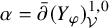 . This choice amounts to considering an element in the image of the differential of the map
$F_\pi $
. This choice amounts to considering an element in the image of the differential of the map
$F_\pi $
 (3.5). In this case

where
$\mathcal {L}_0(\varphi )=\mathcal {L}_0(\varphi _B) =0$
 , since
$\varphi _B$
, since
$\varphi _B$
 is constant when restricted to a fibre, so we obtain the same equation as (3.8). To obtain the correct coefficient in the claimed expression note that

Lemma 3.11. Let
$\varphi \in C^\infty (E(\omega , I)) \oplus C^\infty (B)$
 . The differential along the first variable of
$\mathcal {G}_2$
. The differential along the first variable of
$\mathcal {G}_2$
 is
is

Proof. We compute

where
$\nu _t$
 is the map
$\nu $
is the map
$\nu $
 computed with respect to the complex structure
$f_t^*\Phi (0)$
computed with respect to the complex structure
$f_t^*\Phi (0)$
 . Now,
$f_t$
. Now,
$f_t$
 is the isotopy of the vector field
$\xi _t = (I\mathrm {grad}^{\omega _t}\dot {\varphi }_t)_{\mathcal {V}}$
is the isotopy of the vector field
$\xi _t = (I\mathrm {grad}^{\omega _t}\dot {\varphi }_t)_{\mathcal {V}}$
 , where
$\dot {\varphi }_t$
, where
$\dot {\varphi }_t$
 is in
$C^\infty (E_t)\oplus C^\infty (B)$
is in
$C^\infty (E_t)\oplus C^\infty (B)$
 and
$\dot {\varphi }_0 = \varphi $
and
$\dot {\varphi }_0 = \varphi $
 . In the expression of
$\xi _t$
. In the expression of
$\xi _t$
 we are fixing the complex structure I and varying the Kähler form
$\omega _t$
we are fixing the complex structure I and varying the Kähler form
$\omega _t$
 . In particular,
$\xi _t$
. In particular,
$\xi _t$
 is a fibrewise holomorphic vector field with respect to I. This implies that
$f_t^*I = I$
is a fibrewise holomorphic vector field with respect to I. This implies that
$f_t^*I = I$
 , so
$\nu _t = \nu $
, so
$\nu _t = \nu $
 . Therefore

Using the expression (3.6) we obtain

The right-hand side can be written as
$-\mathcal {A}^*\mathcal {A}(\varphi )$
 following the description (2.14). The minus sign follows from the relation

where
$\nabla _{\mathcal {V}}$
 is the vertical Riemannian gradient.
We define the operator

where
$\mathcal {P}^{2,l}$
 is the space defined in Definition 3.9, but the functions are considered to be in the Sobolev space
$W^{2,l}(X)$
is the space defined in Definition 3.9, but the functions are considered to be in the Sobolev space
$W^{2,l}(X)$
 instead of smooth.
Proposition 3.12. Let
$\pi _X: X \to B$
 be a holomorphic submersion with a fibrewise cscK structure
$(\omega , I)$
be a holomorphic submersion with a fibrewise cscK structure
$(\omega , I)$
 and let
$\pi _Y:Y\to B$
and let
$\pi _Y:Y\to B$
 be a deformation of
$X\to B$
be a deformation of
$X\to B$
 with complex structure J. Let
$V_\pi $
with complex structure J. Let
$V_\pi $
 be the Kuranishi space based at I and let
$v_0 \in V_\pi $
be the Kuranishi space based at I and let
$v_0 \in V_\pi $
 represent the complex structure J. Assume that
-
(i) $(\omega , J)$
is an optimal symplectic connection; -
(ii) the relative automorphism group
$$\begin{align*}\mathrm{Aut}(\pi_Y) := \{f \in \mathrm{Aut}(Y, H_Y) \mid f \circ \pi = \pi\} \end{align*}$$is discrete.
-
(iii) the group $\mathrm {Aut}(X_b, H_b)$
is independent of B, and will be denoted G.



Then for any small deformation v of
$v_0$
 in
$V_\pi ^+$
in
$V_\pi ^+$
 there exists
$x \in V_\pi $
there exists
$x \in V_\pi $
 such that
$(\omega , \Phi (x))$
such that
$(\omega , \Phi (x))$
 is relatively cscK, and a Kähler potential
$\varphi $
is relatively cscK, and a Kähler potential
$\varphi $
 such that

is an optimal symplectic connection with respect to the complex structure
$J'$
 corresponding to v, where the
$\partial $
corresponding to v, where the
$\partial $
 ,
$\bar {\partial }$
,
$\bar {\partial }$
 operators are with respect to
$\Phi (x)$
operators are with respect to
$\Phi (x)$
 .
.
Proof. The proof consists of proving that the operator 3.9 is an elliptic operator with a trivial kernel so that we can apply the implicit function theorem. We note that this can be done even though
$V_\pi ^+$
 may be a singular complex space. Indeed, let
$\mathcal {X} \to B\times V_\pi ^+$
may be a singular complex space. Indeed, let
$\mathcal {X} \to B\times V_\pi ^+$
 be a family of holomorphic submersions such that the fibre over
$0 \in V_\pi ^+$
be a family of holomorphic submersions such that the fibre over
$0 \in V_\pi ^+$
 is
$X \to B$
is
$X \to B$
 . By the Kuranishi theorem [Reference Kuranishi30, p.149] we can locally consider a smooth trivialisation of the family over
$V_\pi ^+$
. By the Kuranishi theorem [Reference Kuranishi30, p.149] we can locally consider a smooth trivialisation of the family over
$V_\pi ^+$
 such that the complex structures of the fibrations
$\mathcal {X}_x \to B \times \{x\}$
such that the complex structures of the fibrations
$\mathcal {X}_x \to B \times \{x\}$
 form a smooth family
$\{J_s\}$
form a smooth family
$\{J_s\}$
 .
.
As before, let I denote the complex structure of X. As we assume that
$(\omega , I, v_0)$
 is an optimal symplectic connection,
$\mathcal {G}(0,0, v_0) = 0$
is an optimal symplectic connection,
$\mathcal {G}(0,0, v_0) = 0$
 . The derivative with respect to the first component, given by Lemma 3.10 and 3.11, is

The hypothesis on the automorphism group implies that the kernel of the linearisation is empty, so the implicit function theorem guarantees that there exists a path

such that locally around
$(0,0,v_0)$


The function
$\varphi (x,v)$
 is smooth by the standard theory of regularity of solutions to elliptic partial differential equations, applied to the operator
$\mathcal {G}$
is smooth by the standard theory of regularity of solutions to elliptic partial differential equations, applied to the operator
$\mathcal {G}$
 [Reference Besse2, Theorem 41]. Therefore, solutions to (3.10) produce optimal symplectic connections.
3.3 The moduli space of optimal symplectic connections
Let
$(Y, H_Y) \to B$
 be a relatively K-semistable holomorphic submersion with a degeneration to a relatively cscK fibration
$(X, H_X)\to B$
be a relatively K-semistable holomorphic submersion with a degeneration to a relatively cscK fibration
$(X, H_X)\to B$
 . Assume that we have a relatively Kähler metric
$(\omega , J)$
. Assume that we have a relatively Kähler metric
$(\omega , J)$
 on Y that is an optimal symplectic connection. Let W be the subset of the Kuranishi space
$V_\pi $
on Y that is an optimal symplectic connection. Let W be the subset of the Kuranishi space
$V_\pi $
 that corresponds to fibrations satisfying the hypotheses of Proposition 3.12. Then W is an open subset of the locally closed analytic subvariety
$V_\pi ^+$
that corresponds to fibrations satisfying the hypotheses of Proposition 3.12. Then W is an open subset of the locally closed analytic subvariety
$V_\pi ^+$
 described in §3.1 by Proposition 3.12.
Lemma 3.13 [Reference Fujiki18, Corollary to Proposition 2]
The group
$\mathrm {Aut}(\pi _Y)$
 is a subgroup of
$\mathrm {Aut}(Y, H_Y)$
is a subgroup of
$\mathrm {Aut}(Y, H_Y)$
 with finitely many connected components.
In particular, under our assumption
$\mathrm {Aut}(\pi _Y)$
 is a finite discrete group. Let
$V_{\pi _Y}$
is a finite discrete group. Let
$V_{\pi _Y}$
 be the Kuranishi space of the fibration
$\pi _Y$
be the Kuranishi space of the fibration
$\pi _Y$
 and let

be the map given by completeness of the Kuranishi space. If we denote
$\tau ^{-1}W =: W_Y$
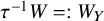 , then
$W_Y$
, then
$W_Y$
 is a locally closed subvariety of
$V_{\pi _Y}$
is a locally closed subvariety of
$V_{\pi _Y}$
 .
.
Let
$\mathcal {Y} \to B \times W_Y$
 be the Kuranishi family of fibrations which admit an optimal symplectic connection, with central fibration
$Y \to B$
be the Kuranishi family of fibrations which admit an optimal symplectic connection, with central fibration
$Y \to B$
 . The quotient

is a local complex space and it is Hausdorff since it is the quotient of a variety by a finite group. We now explain that we can glue the quotients (3.11) to obtain a global Hausdorff moduli space
$\mathcal {M}$
 of fibrations that admit an optimal symplectic connection.
Remark 3.14. The moduli space
$\mathcal {M}$
 depends on the group
$ G= \mathrm {Aut}_0(X_b, H_b)$
depends on the group
$ G= \mathrm {Aut}_0(X_b, H_b)$
 . In other words,
$\mathcal {M}$
. In other words,
$\mathcal {M}$
 parametrises fibrations
$\pi _Y:Y \to B$
parametrises fibrations
$\pi _Y:Y \to B$
 such that they have a discrete relative automorphism group and such that they degenerate to a relatively cscK fibration whose fibres have G as their automorphism group.
The following result builds on [Reference Fujiki and Schumacher22, Proposition 6.5] and [Reference Fujiki and Schumacher21, Lemma 3.8].
Lemma 3.15. Let
$\mathcal {Y}$
 and
$\mathcal {Y}'$
and
$\mathcal {Y}'$
 over
$W_Y$
over
$W_Y$
 be two families of fibrations that admit an optimal symplectic connection. The group of isomorphisms between
$\mathcal {Y}$
be two families of fibrations that admit an optimal symplectic connection. The group of isomorphisms between
$\mathcal {Y}$
 and
$\mathcal {Y}'$
and
$\mathcal {Y}'$
 that preserve the fibration structure, denoted
$\mathrm {Isom}_{W_Y}(\mathcal {Y}, \mathcal {Y}', B)$
that preserve the fibration structure, denoted
$\mathrm {Isom}_{W_Y}(\mathcal {Y}, \mathcal {Y}', B)$
 , is proper over
$W_Y$
, is proper over
$W_Y$
 .
.
Proof. Let
$y_t \to \bar {y}$
 be a convergent sequence in
$W_Y$
be a convergent sequence in
$W_Y$
 and consider a family of isomorphisms
$f_t: \mathcal {Y}_{y_t} \to \mathcal {Y}^{\prime }_{y_t}$
and consider a family of isomorphisms
$f_t: \mathcal {Y}_{y_t} \to \mathcal {Y}^{\prime }_{y_t}$
 preserving the projection onto B. Such isomorphisms are fibrewise isometries with respect to the underlying fibrewise Riemannian metrics. Therefore there exists a subsequence
$\{f_{t_k}\}$
preserving the projection onto B. Such isomorphisms are fibrewise isometries with respect to the underlying fibrewise Riemannian metrics. Therefore there exists a subsequence
$\{f_{t_k}\}$
 which converges in the
$C^m$
which converges in the
$C^m$
 -topology to a fibrewise
$C^m$
-topology to a fibrewise
$C^m$
 -isometry
$f: \mathcal {Y}_{\bar {y}} \to \mathcal {Y}^{\prime }_{\bar {y}}$
-isometry
$f: \mathcal {Y}_{\bar {y}} \to \mathcal {Y}^{\prime }_{\bar {y}}$
 [Reference Fujiki and Schumacher21, Lemma 3.8]. Moreover, f is a biholomorphism because it is the limit of biholomorphic maps. Therefore the convergence takes place in
$\mathrm {Isom}_{W_Y}(\mathcal {Y}, \mathcal {Y}', B)$
[Reference Fujiki and Schumacher21, Lemma 3.8]. Moreover, f is a biholomorphism because it is the limit of biholomorphic maps. Therefore the convergence takes place in
$\mathrm {Isom}_{W_Y}(\mathcal {Y}, \mathcal {Y}', B)$
 , which is then proper over
$W_Y$
, which is then proper over
$W_Y$
 .
.
The global definition of
$\mathcal {M}$
 relies on the following lemma, whose proof follows from [Reference Arbarello, Cornalba and Griffiths1, XI.6].
Lemma 3.16. Let
$\mathcal {Y} \to B \times W_Y$
 be a family of fibrations that admit an optimal symplectic connection. For any points
$y,w \in W_Y$
be a family of fibrations that admit an optimal symplectic connection. For any points
$y,w \in W_Y$
 , the fibrations
$Y_y \to B$
, the fibrations
$Y_y \to B$
 and
$Y_w \to B$
and
$Y_w \to B$
 are isomorphic if and only if there exists an element
$g \in \mathrm {Aut}(\pi _Y)$
are isomorphic if and only if there exists an element
$g \in \mathrm {Aut}(\pi _Y)$
 such that
$g(w) = y$
such that
$g(w) = y$
 .
.
Proof. We can prove the lemma for the entire relative Kuranishi space
$V_{\pi _Y}$
 . The statement follows from:
-
(i) For any $y\in V_{\pi _Y}$
, the automorphism group
$\mathrm {Aut}(\pi _{Y_y})$
is contained in
$\mathrm {Aut}(\pi _Y)$
; -
(ii) For any $y\in V_{\pi _Y}$
there exists an
$\mathrm {Aut}(\pi _{Y_y})$
-invariant open neighbourhood
$\mathcal {U}_y$
such that any isomorphism between fibres of
$\mathcal {Y}\vert _{\mathcal {U}_y}\to \mathcal {U}_y$
is induced by an element of
$\mathrm {Aut}(\pi _{Y_y})$
.


We begin by proving (ii). Assume by contradiction that there exist two sequences
$\{y_n\}$
 and
$\{w_n\}$
and
$\{w_n\}$
 both converging to y. Assume that there exist
$g_n$
both converging to y. Assume that there exist
$g_n$
 in
$\mathrm {Aut}(\pi _{Y_y}) \setminus \mathrm {Aut}(\pi _Y)$
in
$\mathrm {Aut}(\pi _{Y_y}) \setminus \mathrm {Aut}(\pi _Y)$
 such that
$g_n\cdot w_n =y_n$
such that
$g_n\cdot w_n =y_n$
 . Then by Lemma 3.15 there exists
$g \in \mathrm {Aut}(\pi _{Y_y})$
. Then by Lemma 3.15 there exists
$g \in \mathrm {Aut}(\pi _{Y_y})$
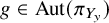 such that
$g_n \to g$
such that
$g_n \to g$
 . Up to replacing
$g_n$
. Up to replacing
$g_n$
 with
$g_n g^{-1}$
with
$g_n g^{-1}$
 and
$w_n$
and
$w_n$
 with
$g^{-1}w_n$
with
$g^{-1}w_n$
 we may assume that g is the identity of
$\mathrm {Aut}(\pi _{Y_y})$
we may assume that g is the identity of
$\mathrm {Aut}(\pi _{Y_y})$
 . Consider the map

By Theorem 2.12, this is a local biholomorphism at
$(\mathrm {id},y)$
 . So we have
$F(\mathrm {id},y_n) = F(g_n,w_n)$
. So we have
$F(\mathrm {id},y_n) = F(g_n,w_n)$
 . Hence
$g_n = \mathrm {id}$
. Hence
$g_n = \mathrm {id}$
 , a contradiction.
The claim (i) then follows exactly as in [Reference Arbarello, Cornalba and Griffiths1, p.204]. We report the proof for completeness. Set

Then I is equal to
$\mathrm {Isom}(\mathcal {Y},\mathcal {Y},B)$
 . Up to shrinking
$W_Y$
. Up to shrinking
$W_Y$
 we can assume that any connected component
$I'$
we can assume that any connected component
$I'$
 of I intersects
$\{0\}\times \mathrm {Aut}(\pi _Y)$
of I intersects
$\{0\}\times \mathrm {Aut}(\pi _Y)$
 . Let
$\widehat {I} = \{(y,g) \in I' \mid g \in \mathrm {Aut}(\pi _Y)\}$
. Let
$\widehat {I} = \{(y,g) \in I' \mid g \in \mathrm {Aut}(\pi _Y)\}$
 . Then
$\widehat {I}$
. Then
$\widehat {I}$
 is nonempty and Zariski-closed. It follows from (ii) that
$\widehat {I}$
is nonempty and Zariski-closed. It follows from (ii) that
$\widehat {I}$
 contains an open set. Then
$\widehat {I}=I'$
contains an open set. Then
$\widehat {I}=I'$
 , which concludes the proof.
To glue the charts (3.11), we use the completeness of the Kuranishi space. Let
$Y_1 \to B$
 be another relatively K-semistable fibration which admits an optimal symplectic connection and is close to
$Y\to B$
be another relatively K-semistable fibration which admits an optimal symplectic connection and is close to
$Y\to B$
 . Then the Kuranishi theorem gives a map

such that a family
$\mathcal {Y}_1 \to B \times V_{\pi _{Y_1}}$
 is isomorphic to the pull-back via
$\tau $
is isomorphic to the pull-back via
$\tau $
 of
$\mathcal {Y} \to B\times V_{\pi _Y}$
of
$\mathcal {Y} \to B\times V_{\pi _Y}$
 . Consider the composition of this map with the inclusion
$i : W_{Y_1} \to V_{\pi _{Y_1}}$
. Consider the composition of this map with the inclusion
$i : W_{Y_1} \to V_{\pi _{Y_1}}$
 :
:

Let
$y_1 \in W_{Y_1}$
 . Then
$y_1$
. Then
$y_1$
 represents a fibration with an optimal symplectic connection, that is, the image of
$y_1$
represents a fibration with an optimal symplectic connection, that is, the image of
$y_1$
 via the Kuranishi map is a complex structure
$J_{y_1}$
via the Kuranishi map is a complex structure
$J_{y_1}$
 such that
$(\omega , J_{y_1})$
such that
$(\omega , J_{y_1})$
 is an optimal symplectic connection. Therefore, there is a representative y of
$J_{y_1}$
is an optimal symplectic connection. Therefore, there is a representative y of
$J_{y_1}$
 in
$V_{\pi _Y}$
in
$V_{\pi _Y}$
 which belongs to
$W_Y$
which belongs to
$W_Y$
 , so
, so

Lemma 3.16 allows us to pass to the quotient and obtain an isomorphism

which is uniquely determined (while
$\alpha $
 itself might not be). Indeed, the inverse is constructed by reverting the roles of Y and
$Y_1$
itself might not be). Indeed, the inverse is constructed by reverting the roles of Y and
$Y_1$
 . Therefore, we can use it to glue the local charts to give
$\mathcal {M}$
. Therefore, we can use it to glue the local charts to give
$\mathcal {M}$
 the structure of a complex space.
Proposition 3.17. The space
$\mathcal {M}$
 is a Hausdorff complex space with at most countably many connected components.
Proof. The countability follows from [Reference Fujiki and Schumacher21, Theorem 7.3]. We prove the Hausdorff property. Let
$\mathcal {Y} \to B \times W_Y$
 and
$\mathcal {Y}_1\to B\times W_{Y_1}$
and
$\mathcal {Y}_1\to B\times W_{Y_1}$
 be two families of fibrations which admit an optimal symplectic connection. Let
$y_t \to \bar {y}$
be two families of fibrations which admit an optimal symplectic connection. Let
$y_t \to \bar {y}$
 be a sequence in
$W_Y$
be a sequence in
$W_Y$
 and
$y_{1t} \to \bar {y}_1$
and
$y_{1t} \to \bar {y}_1$
 be a sequence in
$W_{Y_1}$
be a sequence in
$W_{Y_1}$
 and assume that
$Y_{y_t}$
and assume that
$Y_{y_t}$
 is isomorphic to
$Y_{1,y_{1t}}$
is isomorphic to
$Y_{1,y_{1t}}$
 as fibrations over B. Following the proof of [Reference Fujiki18, Proposition 10], we show that
$Y_{\bar {y}}\to B$
as fibrations over B. Following the proof of [Reference Fujiki18, Proposition 10], we show that
$Y_{\bar {y}}\to B$
 is isomorphic to
$Y_{1,\bar {y}_1}$
is isomorphic to
$Y_{1,\bar {y}_1}$
 . Let
. Let

and let
$\widehat {\mathcal {Y}} \to B\times \widehat {W}$
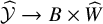 and
$\widehat {\mathcal {Y}}_1 \to B \times \widehat {W}$
and
$\widehat {\mathcal {Y}}_1 \to B \times \widehat {W}$
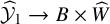 be the pull-back of
$\mathcal {Y}$
be the pull-back of
$\mathcal {Y}$
 and
$\mathcal {Y}_1$
and
$\mathcal {Y}_1$
 using the projections of
$\widehat {W}$
using the projections of
$\widehat {W}$
 onto the first and second component respectively. Consider

It follows from the properness of
$\mathrm {Isom}(\widehat {\mathcal {Y}}, \widehat {\mathcal {Y}}_1, B)$
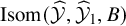 that
$\Sigma $
that
$\Sigma $
 is a locally closed analytic subvariety of
$\widehat {W}$
is a locally closed analytic subvariety of
$\widehat {W}$
 . Therefore
$(\bar {y}, \bar {y}_1) \in \Sigma $
. Therefore
$(\bar {y}, \bar {y}_1) \in \Sigma $
 , which concludes the proof.
We have proved the following.
Corollary 3.18. There exists a Hausdorff complex space
$\mathcal {M}$
 which parametrises holomorphic submersions over a fixed base admitting an optimal symplectic connection, with discrete relative automorphism group and fixed vertical automorphism group of the relatively cscK degeneration.
Remark 3.19. The hypothesis that the vertical automorphism group of the relatively cscK degeneration is fixed is key in the definition of an optimal symplectic connection and in the construction of §3.1, and removing it would require a deeper, and challenging, generalisation of the theory of optimal symplectic connections.
Another natural generalisation of Corollary 3.18 would be to consider the moduli space of fibrations whose group of relative automorphisms is not discrete. In this case, we expect that the local charts of the moduli space should be given by a GIT quotient of the complex space of deformations of Y which also admit an optimal symplectic connection by the group
$\mathrm {Aut}(\pi _Y)$
 , reflecting the behaviour of the moduli space of cscK manifolds constructed by Dervan-Naumann [Reference Dervan and Naumann8], and using the techniques introduced by the author in [Reference Ortu41] on the moment map interpretation of the optimal symplectic connection equation.
Remark 3.20 (Examples)
The projectivisation of a stable, simple holomorphic vector bundle is represented by a point of our moduli space: in this sense,
$\mathcal {M}$
 generalises the moduli space of stable holomorphic vector bundles.
More generally, we can consider an isotrivial fibration, that is, a fibration whose fibres are all holomorphic, of which projectivised vector bundles are a special case. McCarthy constructed an example [Reference McCarthy33, Example 3.9] of an isotrivial fibration
$X \to B$
 which admits an optimal symplectic connection, whose model fibre
$X_0$
which admits an optimal symplectic connection, whose model fibre
$X_0$
 is given by the Mukai-Umemura threefold. Such a fibration has a trivial group of relative automorphisms, so it is represented by a point in our moduli space
$\mathcal {M}$
is given by the Mukai-Umemura threefold. Such a fibration has a trivial group of relative automorphisms, so it is represented by a point in our moduli space
$\mathcal {M}$
 .
.
Deformations of such a fibration, obtained by deforming the model fibre
$X_0$
 as described in [Reference Donaldson15, §5.3], could generate other examples. In general, however, constructing explicit examples of fibrations admitting an optimal symplectic connection is challenging, because most cases where the relatively K-polystable degeneration is known and can be described explicitly have singular fibres.
4 A Weil-Petersson type Kähler metric
In this section, we define a Kähler metric on the moduli space of fibrations admitting an optimal symplectic connection. We do so by describing a relative version of the theory of Weil-Petersson type metrics developed by Fujiki and Schumacher for cscK manifolds [Reference Fujiki and Schumacher22, Sections 8, 9]. In particular, we first define the Weil-Petersson metric locally on the sets
$W_Y$
 and subsequently we extend the definition to the charts
$W_Y/\mathrm {Aut}(\pi _Y)$
and subsequently we extend the definition to the charts
$W_Y/\mathrm {Aut}(\pi _Y)$
 and then to the moduli space
$\mathcal {M}$
and then to the moduli space
$\mathcal {M}$
 . To define the Kähler metric, we give
$\mathcal {M}$
. To define the Kähler metric, we give
$\mathcal {M}$
 the induced reduced structure.
We start by recalling that the notions of a smooth Hermitian metric and of a smooth Kähler metric are well posed on a complex space [Reference Fujiki and Schumacher22, Definitions 1.1, 1.2]. Consider a family of holomorphic submersions that admit an optimal symplectic connection, denoted by
$\mathcal {Y} \to B \times W_Y$
 , and let
$Y\to B$
, and let
$Y\to B$
 be the central fibration. Let
$\omega _t$
be the central fibration. Let
$\omega _t$
 be also the optimal symplectic connection on
$Y_t \to B$
be also the optimal symplectic connection on
$Y_t \to B$
 . For each k sufficiently large,
$\omega _{t,k} = \omega _t + k\omega _B$
. For each k sufficiently large,
$\omega _{t,k} = \omega _t + k\omega _B$
 is a Kähler form on
$Y_t$
is a Kähler form on
$Y_t$
 , and we denote by
$\omega _{t,F}$
, and we denote by
$\omega _{t,F}$
 its purely vertical part, which does not depend on k. Let
$\mathcal {Y} \to W_Y$
its purely vertical part, which does not depend on k. Let
$\mathcal {Y} \to W_Y$
 be the composition with the second projection.
From Theorem 2.12, for each
$t \in W_Y$
 there is an injective map

that identifies a vector
$\alpha $
 in the Zariski tangent space
$T_tW_Y$
in the Zariski tangent space
$T_tW_Y$
 with a
$(0,1)$
with a
$(0,1)$
 -form valued in the
$(1,0)$
-form valued in the
$(1,0)$
 -tangent bundle of
$Y_t$
-tangent bundle of
$Y_t$
 , which we will also denote by
$\alpha $
, which we will also denote by
$\alpha $
 . The map (4.1) is equivariant with respect to the action of
$\mathrm {Aut}(\pi _Y)$
. The map (4.1) is equivariant with respect to the action of
$\mathrm {Aut}(\pi _Y)$
 . Therefore we can define an inner product on
$T_tW_Y$
. Therefore we can define an inner product on
$T_tW_Y$
 by pulling back the
$L^2$
by pulling back the
$L^2$
 -product on
$\Omega ^{0,1}(\mathcal {V}^{1,0}_{Y_t})$
-product on
$\Omega ^{0,1}(\mathcal {V}^{1,0}_{Y_t})$
 induced by the Hermitian metric associated to
$\omega _{t,F} + \omega _B$
induced by the Hermitian metric associated to
$\omega _{t,F} + \omega _B$
 . For any
$\alpha , \beta \in T_tW_Y$
. For any
$\alpha , \beta \in T_tW_Y$
 , its imaginary part is given by

where we denote by
$\Lambda $
 the contraction of the covariant part and by
$\mathrm {Tr}$
the contraction of the covariant part and by
$\mathrm {Tr}$
 the trace of the contravariant part. We give the following definition.
Definition 4.1. The relative Weil-Petersson metric on
$W_Y$
 , denoted by
$\Omega _{WP}$
, denoted by
$\Omega _{WP}$
 , is the two-form
$\{\Omega _{t}\}_{t \in W_Y}$
, is the two-form
$\{\Omega _{t}\}_{t \in W_Y}$
 .
.
Using the compatibility of the deformations with the Kähler form, we write the trace in coordinates as

Therefore the integral (4.2) can be written as the sum

Remark 4.2. The first term can be split over
$Y_t$
 as
as

In particular, it vanishes when
$\alpha $
 and
$\beta $
and
$\beta $
 each restrict to the trivial deformation on the fibres. This is the case when
$\mathcal {Y}\to B \times W_Y$
each restrict to the trivial deformation on the fibres. This is the case when
$\mathcal {Y}\to B \times W_Y$
 is a family of holomorphic submersions with rigid fibres, for example. In particular, in the case of projectivised stable vector bundles, we recover the Weil-Petersson metric studied by Schumacher–Toma [Reference Schumacher and Toma42, p. 103].
We next prove that (4.2) is closed and positive definite. Consider for each
$t\in W_Y$
 a k-dependent inner product on
$\widetilde {H}^1_{\mathcal {V}}(Y_t)$
a k-dependent inner product on
$\widetilde {H}^1_{\mathcal {V}}(Y_t)$
 , defined using the Kähler form
$\omega _{t,k}$
, defined using the Kähler form
$\omega _{t,k}$
 of
$Y_t$
of
$Y_t$
 :
:

The collection
$\{\Omega _{k,t}\} =: \Omega _k$
 is the Weil-Petersson type Hermitian metric defined by Fujiki-Schumacher [Reference Fujiki and Schumacher22, Definition 7.2] for any family of smooth polarised varieties. Using Lemma 2.7, we can write in local holomorphic coordinates

The expansion in powers of k of
$\omega _{t,k}$
 reads
reads

Then

Then the two terms in the sum (4.2) are the first and third coefficients of this expansion.
We next describe a fibre integral formula for the Weil-Petersson metric on
$W_Y$
 . Let
$\omega _{\mathcal {Y},k}$
. Let
$\omega _{\mathcal {Y},k}$
 be the relatively Kähler metric on
$W_Y$
be the relatively Kähler metric on
$W_Y$
 such that its restriction to each
$Y_t$
such that its restriction to each
$Y_t$
 is the Kähler metric
$\omega _t + k\omega _B$
is the Kähler metric
$\omega _t + k\omega _B$
 , where
$\omega _t$
, where
$\omega _t$
 is an optimal symplectic connection on
$Y_t \to B$
is an optimal symplectic connection on
$Y_t \to B$
 . Let also
$\rho _{\mathcal {Y},k}$
. Let also
$\rho _{\mathcal {Y},k}$
 be the curvature of the Hermitian structure induced by
$\omega _{\mathcal {Y},k}$
be the curvature of the Hermitian structure induced by
$\omega _{\mathcal {Y},k}$
 on the relative anticanonical bundle

where
$\mathcal {V}_{\mathcal {Y}/W_Y}$
 denotes the vertical tangent bundle of the fibration
$\mathcal {Y}\to W_Y$
denotes the vertical tangent bundle of the fibration
$\mathcal {Y}\to W_Y$
 . We first recall the following result [Reference Fujiki and Schumacher22, Theorem 8.1].
Proposition 4.3. The k-dependent
$(1,1)$
 -form
$\Omega _k$
-form
$\Omega _k$
 can be written as a fibre integral over the map
$\mathcal {Y} \to W_Y$
can be written as a fibre integral over the map
$\mathcal {Y} \to W_Y$
 :
:

By expanding
$\Omega _{k}$
 in powers of k, we can find a fibre integral formula for the Weil-Petersson metric (4.2). Since the base B is fixed, the relative metric
$\omega _{\mathcal {Y},k}$
in powers of k, we can find a fibre integral formula for the Weil-Petersson metric (4.2). Since the base B is fixed, the relative metric
$\omega _{\mathcal {Y},k}$
 can be written as

where the restriction of
$\widehat {\omega }$
 to each
$Y_t$
to each
$Y_t$
 is the optimal symplectic connection
$\omega _t$
is the optimal symplectic connection
$\omega _t$
 . Then
$\rho _{\mathcal {Y},k}$
. Then
$\rho _{\mathcal {Y},k}$
 can be expanded in powers of k as

where the second line follows from the fact that
$\widehat {\omega }^m\wedge \omega _B^n$
 is a volume form. The
$k^{-1}$
is a volume form. The
$k^{-1}$
 -term is exact, because the two volume forms
$\omega _{\mathcal {Y},k}^{m+n}$
-term is exact, because the two volume forms
$\omega _{\mathcal {Y},k}^{m+n}$
 and
$\widehat {\omega }^m\wedge \omega _B^n$
and
$\widehat {\omega }^m\wedge \omega _B^n$
 both induce the class
$c_1(-K_{\mathcal {Y}/W_Y})$
both induce the class
$c_1(-K_{\mathcal {Y}/W_Y})$
 . Moreover,
$\det (\widehat {\omega })$
. Moreover,
$\det (\widehat {\omega })$
 is the relative determinant of
$\widehat {\omega }$
is the relative determinant of
$\widehat {\omega }$
 and
$i\partial \bar {\partial } \log \det (\widehat {\omega })$
and
$i\partial \bar {\partial } \log \det (\widehat {\omega })$
 is the curvature of the Hermitian metric induced by
$\widehat {\omega }$
is the curvature of the Hermitian metric induced by
$\widehat {\omega }$
 on the relative anticanonical bundle
$-K_{\mathcal {Y}/B\times W_Y}$
on the relative anticanonical bundle
$-K_{\mathcal {Y}/B\times W_Y}$
 . To compute the expansion of the vertical scalar curvature, we use the expression [Reference Ortu40, Proposition 5.4] for the scalar curvature of
$\omega _k$
. To compute the expansion of the vertical scalar curvature, we use the expression [Reference Ortu40, Proposition 5.4] for the scalar curvature of
$\omega _k$
 , which we report here.
Proposition 4.4. The scalar curvature of
$\omega _k$
 on the submersion
$Y\to B$
on the submersion
$Y\to B$
 admits an expansion

where:
-
(i) $\widehat {S}_b$
is the average scalar curvature of the fibres; -
(ii) $\alpha $
is the Weil-Petersson metric on B induced by the relatively cscK degeneration
$X \to B$
.


Since
$\widehat {\omega }$
 is an optimal symplectic connection when restricted to each
$Y_t$
is an optimal symplectic connection when restricted to each
$Y_t$
 , using the proposition 4.4 the vertical scalar curvature of
$\omega _{\mathcal {Y},k}$
, using the proposition 4.4 the vertical scalar curvature of
$\omega _{\mathcal {Y},k}$
 admits an expansion as

where
$\widehat {\alpha }$
 is a closed two-form on B. Then the leading order term of (4.5) is

The sub-leading order term is the sum of the four integrals

We can use this expansion to prove a fibre integral formula in our setting.
Lemma 4.5. The Weil-Petersson metric
$\Omega _{WP}$
 (4.2) can be written as the fibre integral

Proof. It follows from [Reference Fujiki and Schumacher22, Lemma 8.5] applied to the family
$\mathcal {Y}\to B\times W_Y$
 that the two-form defined as the collection of the integrals

is equal to
$I_1$
 . Indeed, working locally in
$D \subset B\times W_Y$
. Indeed, working locally in
$D \subset B\times W_Y$
 , Fujiki and Schumacher prove that one can trivialise the family
$\mathcal {Y}$
, Fujiki and Schumacher prove that one can trivialise the family
$\mathcal {Y}$
 over D as
$Y_{0,0}\times D$
over D as
$Y_{0,0}\times D$
 such that the horizontal distribution induced by
$\widehat {\omega }$
such that the horizontal distribution induced by
$\widehat {\omega }$
 is preserved. Then, given a family
$\{\beta _t\}$
is preserved. Then, given a family
$\{\beta _t\}$
 of vertical deformations of the complex structure of
$Y_{0,0}$
of vertical deformations of the complex structure of
$Y_{0,0}$
 which represent the family
$Y_{0,0}\times D \to D$
which represent the family
$Y_{0,0}\times D \to D$
 , [Reference Fujiki and Schumacher22, Lemma 8.5] gives the equality

where
$\partial _t\beta _t$
 is the map (4.1).
Lemma 4.6. The two-form
$\Omega _{WP}$
 is closed and positive-definite on
$W_Y$
is closed and positive-definite on
$W_Y$
 .
.
Proof. Since the map (4.1) is injective, the integral (4.2) is positive. To prove closedness, we show that the terms
$I_0$
 ,
$I_2$
,
$I_2$
 ,
$I_3$
,
$I_3$
 and
$I_4$
and
$I_4$
 in Lemma 4.5 are closed. The terms
$I_0$
in Lemma 4.5 are closed. The terms
$I_0$
 and
$I_2$
and
$I_2$
 are closed because they are the fibre integrals of a closed form. The term
$I_4$
are closed because they are the fibre integrals of a closed form. The term
$I_4$
 can be written as

where
$\rho _B$
 is the Ricci form of
$\omega _B$
is the Ricci form of
$\omega _B$
 . In particular
$(\rho _B - \widehat {\alpha })\wedge \omega _B^{n-1}$
. In particular
$(\rho _B - \widehat {\alpha })\wedge \omega _B^{n-1}$
 is a top-degree form on B, hence it is closed. So
$I_4$
is a top-degree form on B, hence it is closed. So
$I_4$
 is closed. Analogously,
$I_3$
is closed. Analogously,
$I_3$
 is closed.
Let
$h_{WP}(W_Y)$
 be the Hermitian metric on the tangent bundle to
$W_Y$
be the Hermitian metric on the tangent bundle to
$W_Y$
 induced by the two-form
$\Omega _{WP}$
induced by the two-form
$\Omega _{WP}$
 .
.
Theorem 4.7. The Hermitian metric
$h_{WP}(W_Y)$
 induces a global Kähler metric on the moduli space
$\mathcal {M}$
induces a global Kähler metric on the moduli space
$\mathcal {M}$
 .
.
Proof. The theorem follows from the fact that the action of the finite group
$\mathrm {Aut}(\pi _Y)$
 is induced by an automorphism of the Kuranishi family, so the Weil-Petersson metric
$h_{WP}(W_Y)$
is induced by an automorphism of the Kuranishi family, so the Weil-Petersson metric
$h_{WP}(W_Y)$
 is invariant for the action of
$\mathrm {Aut}(\pi _Y)$
is invariant for the action of
$\mathrm {Aut}(\pi _Y)$
 . Therefore, it defines a metric on the quotient
$W_Y/\mathrm {Aut}(\pi _Y)$
. Therefore, it defines a metric on the quotient
$W_Y/\mathrm {Aut}(\pi _Y)$
 .
.
Remark 4.8. We have defined a Weil-Petersson metric on
$W_Y$
 that is independent of the adiabatic parameter k. This is reasonable from the point of view of describing the moduli space of fibrations using the optimal symplectic connection alone, which is only relatively Kähler. However, it is possible that a different kind of Weil-Petersson-type metric could be defined by taking a sequence of Kähler metrics that depend on k, where the adiabatic construction plays a bigger role.
4.1 The determinant line bundle for the Weil-Petersson metric
We construct a line bundle on
$W_Y$
 , and hence on the moduli space, such that the Weil-Petersson metric represents its first Chern class. To do so, we appeal to the theory of Deligne pairings [Reference Elkik16], [Reference Elkik17], [Reference Boucksom, Hisamoto and Jonsson4, §1]. Let
$M \to B$
, and hence on the moduli space, such that the Weil-Petersson metric represents its first Chern class. To do so, we appeal to the theory of Deligne pairings [Reference Elkik16], [Reference Elkik17], [Reference Boucksom, Hisamoto and Jonsson4, §1]. Let
$M \to B$
 be a flat, projective morphism between complex analytic spaces of relative dimension d and consider
$d+1$
be a flat, projective morphism between complex analytic spaces of relative dimension d and consider
$d+1$
 line bundles
$L_0, \dots , L_d$
line bundles
$L_0, \dots , L_d$
 on M. The push-forward of the intersection product of
$L_0, \dots , L_d$
on M. The push-forward of the intersection product of
$L_0, \dots , L_d$
 is an isomorphism class of line bundles on B, represented by the cohomology class

The Deligne pairing of
$L_0, \dots , L_d$
 , denoted by
$ \langle L_0 , \dots , L_d \rangle _{M/B} $
, denoted by
$ \langle L_0 , \dots , L_d \rangle _{M/B} $
 , is a canonical choice of a line bundle on B such that (4.8) is its first Chern class. The construction is symmetric, multilinear and functorial. Moreover, if
$h_0, \dots , h_d$
, is a canonical choice of a line bundle on B such that (4.8) is its first Chern class. The construction is symmetric, multilinear and functorial. Moreover, if
$h_0, \dots , h_d$
 are Hermitian metrics on
$L_0, \dots , L_d$
are Hermitian metrics on
$L_0, \dots , L_d$
 respectively, the theory provides a metric
$\langle h_0, \dots , h_d\rangle _{M/B}$
respectively, the theory provides a metric
$\langle h_0, \dots , h_d\rangle _{M/B}$
 on
$\langle L_0 , \dots , L_d \rangle _{M/B} $
on
$\langle L_0 , \dots , L_d \rangle _{M/B} $
 . Denoting by
$\omega _0, \dots , \omega _d$
. Denoting by
$\omega _0, \dots , \omega _d$
 the curvature forms of
$h_0, \dots , h_d$
the curvature forms of
$h_0, \dots , h_d$
 respectively, the curvature of
$\langle h_0, \dots , h_d\rangle _{M/B}$
respectively, the curvature of
$\langle h_0, \dots , h_d\rangle _{M/B}$
 is given by the fibre integral

The fibre integral formula for the Weil-Petersson metric on
$W_Y$
 of Lemma 4.5 is a special case of the expression (4.9). To describe it as the curvature form of a line bundle on
$W_Y$
of Lemma 4.5 is a special case of the expression (4.9). To describe it as the curvature form of a line bundle on
$W_Y$
 , we first recall the following result of Fujiki and Schumacher for the k-dependent Weil-Petersson metric [Reference Fujiki and Schumacher22, Theorem 11.1], which we write using the Deligne pairing notation.
Proposition 4.9. The k-dependent Weil-Petersson type Kähler metric
$\Omega _{k}$
 represents the first Chern class of the line bundle

where the constant

is the average scalar curvature of Y, and hence of each
$Y_t$
 , with respect to the metric
$\omega + k\omega _B$
, with respect to the metric
$\omega + k\omega _B$
 .
.
We use Proposition 4.9 to prove the following.
Proposition 4.10. There exists a line bundle
$\mathcal {D}(Y)$
 on
$W_Y$
on
$W_Y$
 whose first Chern class is represented by the Weil-Petersson metric (4.2), given as the sum of the line bundles

defined using the Deligne pairing.
Proof. Let
$ \widehat {\mathcal {H}} \to \mathcal {Y} $
 be the relatively ample line bundle induced by each relative polarisation
$H_t \to Y_t$
be the relatively ample line bundle induced by each relative polarisation
$H_t \to Y_t$
 . More precisely, we consider the fibration
$\mathcal {Y} \to W_Y$
. More precisely, we consider the fibration
$\mathcal {Y} \to W_Y$
 as the composition of

so
$\widehat {\mathcal {H}}$
 is relatively ample with respect to the first projection. Moreover, since the base B is fixed, we can pull-back L to
$\mathcal {Y}$
is relatively ample with respect to the first projection. Moreover, since the base B is fixed, we can pull-back L to
$\mathcal {Y}$
 and consider it as a line bundle on
$\mathcal {Y}$
and consider it as a line bundle on
$\mathcal {Y}$
 . So we can define a relatively ample line bundle
$\mathcal {L}_k$
. So we can define a relatively ample line bundle
$\mathcal {L}_k$
 over
$\mathcal {Y}$
over
$\mathcal {Y}$
 as
as

whose fibre over
$Y_t$
 is
$\mathcal {L}_k\vert _{t} = H_t \otimes kL$
is
$\mathcal {L}_k\vert _{t} = H_t \otimes kL$
 . Its first Chern class contains the relative metric
$\omega _{\mathcal {Y},k}$
. Its first Chern class contains the relative metric
$\omega _{\mathcal {Y},k}$
 , where
$\widehat {\omega }$
, where
$\widehat {\omega }$
 is in
$c_1(\widehat {\mathcal {H}})$
is in
$c_1(\widehat {\mathcal {H}})$
 . We define a line bundle
$\mathcal {D}(Y)$
. We define a line bundle
$\mathcal {D}(Y)$
 on
$W_Y$
on
$W_Y$
 by using the fibre integral formula (4.7) and the expansion in powers of k of the line bundle (4.10). Expanding in k the intersection product
$\mathcal {L}_k^{n+m}$
by using the fibre integral formula (4.7) and the expansion in powers of k of the line bundle (4.10). Expanding in k the intersection product
$\mathcal {L}_k^{n+m}$
 ,
$\mathcal {L}_k^{n+m+1}$
,
$\mathcal {L}_k^{n+m+1}$
 and the expression (4.10) we obtain that the Weil-Petersson metric
$\Omega _{WP}$
and the expression (4.10) we obtain that the Weil-Petersson metric
$\Omega _{WP}$
 represents the first Chern class of the line bundle
$\mathcal {D}(Y)$
represents the first Chern class of the line bundle
$\mathcal {D}(Y)$
 given as the tensor product of the line bundles
$\mathcal {D}_0(Y),\mathcal {D}_2(Y),\mathcal {D}_3(Y), \mathcal {D}_4(Y)$
given as the tensor product of the line bundles
$\mathcal {D}_0(Y),\mathcal {D}_2(Y),\mathcal {D}_3(Y), \mathcal {D}_4(Y)$
 above. Indeed, by expanding the expression (4.10) in powers of k we see that the sum of the leading order term and the sub-leading order term is given by

where
$\mathcal {D}_1(Y)$
 is given by

However, its first Chern class is represented by the term (4.6), which does not appear in the fibre integral formula for the relative Weil-Petersson metric of Lemma 4.5. This concludes the proof.
We have constructed a line bundle
$\mathcal {D}_Y$
 on
$W_Y$
on
$W_Y$
 whose first Chern class is the Weil-Petersson metric
$\Omega _{WP}$
whose first Chern class is the Weil-Petersson metric
$\Omega _{WP}$
 . Let now
$p : W_Y \to \mathcal {M}$
. Let now
$p : W_Y \to \mathcal {M}$
 be the composition of the maps

where the first map is the quotient by the group action and the second map is the inclusion of a local chart in the moduli space. It follows from Lemma 3.16 that the orbits of the
$\mathrm {Aut}(\pi _Y)$
 -action on
$W_Y$
-action on
$W_Y$
 correspond to isomorphic manifolds in the family
$\mathcal {Y} \to W_Y$
correspond to isomorphic manifolds in the family
$\mathcal {Y} \to W_Y$
 . Therefore the line bundle
$\mathcal {D}(Y)$
. Therefore the line bundle
$\mathcal {D}(Y)$
 is invariant for the action of
$\mathrm {Aut}(\pi _Y)$
is invariant for the action of
$\mathrm {Aut}(\pi _Y)$
 and thus descends to a line bundle
$\widetilde {\mathcal {D}}(Y)$
and thus descends to a line bundle
$\widetilde {\mathcal {D}}(Y)$
 on the quotient
$W_Y/\mathrm {Aut}(\pi _Y)$
on the quotient
$W_Y/\mathrm {Aut}(\pi _Y)$
 .
.
Theorem 4.11. There exists a line bundle
$\mathcal {F}$
 on the moduli space
$\mathcal {M}$
on the moduli space
$\mathcal {M}$
 such that its restriction to each chart
$W_Y/\mathrm {Aut}(\pi _Y)$
such that its restriction to each chart
$W_Y/\mathrm {Aut}(\pi _Y)$
 is isomorphic to
$\widetilde {\mathcal {D}}(Y)$
is isomorphic to
$\widetilde {\mathcal {D}}(Y)$
 .
.
Proof. Let
$W_{Y_1}/\mathrm {Aut}(\pi _{Y_1})$
 and
$W_{Y}/\mathrm {Aut}(\pi _{Y})$
and
$W_{Y}/\mathrm {Aut}(\pi _{Y})$
 be two local charts of
$\mathcal {M}$
be two local charts of
$\mathcal {M}$
 with nonempty intersection. Then using completeness of the Kuranishi space there exists an isomorphism
$\widetilde {\alpha }: W_{Y_1}/\mathrm {Aut}(\pi _{Y_1}) \to W_Y/\mathrm {Aut}(\pi _Y)$
with nonempty intersection. Then using completeness of the Kuranishi space there exists an isomorphism
$\widetilde {\alpha }: W_{Y_1}/\mathrm {Aut}(\pi _{Y_1}) \to W_Y/\mathrm {Aut}(\pi _Y)$
 (3.12) which preserves the relative polarisation (4.11) and the submersions onto the base B. By functoriality of the Deligne pairings, the pull-back
$\widetilde {\alpha }^*\widetilde {\mathcal {D}}(Y_1)$
(3.12) which preserves the relative polarisation (4.11) and the submersions onto the base B. By functoriality of the Deligne pairings, the pull-back
$\widetilde {\alpha }^*\widetilde {\mathcal {D}}(Y_1)$
 is then isomorphic to
$\widetilde {\mathcal {D}}(Y)$
is then isomorphic to
$\widetilde {\mathcal {D}}(Y)$
 . Therefore, on the intersection of
$W_Y/\mathrm {Aut}(\pi _{Y})$
. Therefore, on the intersection of
$W_Y/\mathrm {Aut}(\pi _{Y})$
 and
$W_{Y_1}/\mathrm {Aut}(\pi _{Y_1})$
and
$W_{Y_1}/\mathrm {Aut}(\pi _{Y_1})$
 there is a morphism of line bundles
$\chi : \widetilde {\mathcal {D}}(Y_1) \overset {\sim }{\to } \widetilde {\mathcal {D}}(Y)$
there is a morphism of line bundles
$\chi : \widetilde {\mathcal {D}}(Y_1) \overset {\sim }{\to } \widetilde {\mathcal {D}}(Y)$
 . Let
$\varphi _Y : \widetilde {\mathcal {D}}(Y) \to W_Y/\mathrm {Aut}(\pi _{Y}) \times \mathbb {C}$
. Let
$\varphi _Y : \widetilde {\mathcal {D}}(Y) \to W_Y/\mathrm {Aut}(\pi _{Y}) \times \mathbb {C}$
 and
$\varphi _{Y_1} : \widetilde {\mathcal {D}}(Y_1) \to W_{Y_1}/\mathrm {Aut}(\pi _{Y_1}) \times \mathbb {C}$
and
$\varphi _{Y_1} : \widetilde {\mathcal {D}}(Y_1) \to W_{Y_1}/\mathrm {Aut}(\pi _{Y_1}) \times \mathbb {C}$
 be local trivialisations and, on the intersection,

The map
$\psi _{Y_1Y}$
 , viewed as a function on
$\mathbb {C}$
, viewed as a function on
$\mathbb {C}$
 , is invertible, with inverse
$\psi _{YY_1}$
, is invertible, with inverse
$\psi _{YY_1}$
 . Indeed, the map
$\chi $
. Indeed, the map
$\chi $
 is an isomorphism because
$\widetilde {\alpha }$
is an isomorphism because
$\widetilde {\alpha }$
 is. The same argument proves that the cocycle condition holds.
The following corollary is a consequence of Theorem 4.11 and of [Reference Fujiki and Schumacher22, Proposition 1.7].
Corollary 4.12. Any compact analytic subspace of
$\mathcal {M}$
 is projective.
Acknowledgments
I am grateful to my supervisors, Ruadhaí Dervan and Jacopo Stoppa, for many enlightening discussions and for their encouragement. I also thank Eloise Hamilton, John Benjamin McCarthy and Gábor Székelyhidi for explaining to me much of the GIT theory contained in Section 3.1, and Carlo Scarpa and Lars Martin Sektnan for helpful comments. Part of this work was conducted while visiting Ruadhaí Dervan at the University of Cambridge and at the University of Glasgow, supported by his Royal Society University Research Fellowship.
Competing interests
The author has no competing interest to declare.
Financial support
This work is part of my PhD thesis, funded by a PhD scholarship from SISSA, Trieste. I also received financial support from Ruadhaí Dervan’s Royal Society University Research Fellowship URF/R1/201041.

 Open access

