


Introduction
With ageing policies like ‘ageing in place’ gaining prominence, and an increasing number of family members providing care to older adults at home, researchers have turned their attention to the interconnections between home and care-giving. This article combines the sociology of home and assemblage theory of care to investigate care-giving practices and their effects on the home as a place of belonging, intimacy, safety and control.
The concept of ageing in place has gained international prominence as governments promote home-based care as cost-effective and preferred by older adults (Vasunilashorn et al. Reference Urwin, Lau, Grande and Sutton2012; Wiles et al. Reference Vasunilashorn, Steinman, Liebig and Pynoos2012). However, existing research focuses on individual outcomes whilst overlooking the complex socio-material dynamics that enable care-giving at home. This study addresses this gap by examining how family care-giving practices shape and are shaped by the home environment.
The article explores care-giving through a relational lens, focusing on the embodied, routine and frequently overlooked caring actions shaped by the interplay between human bodies, physical objects and the spaces they inhabit. Care is regarded not as inherently good or bad but as emergent based on how different elements are assembled to provide and/or enable care.
By taking a ‘materialities of care’ perspective (Buse et al. Reference Buse, Martin and Nettleton2018), this article attends to the aspects of care-giving that have often gone unnoticed but are important in enabling care, highlighting the social, material, relational and affective dimensions of how the home – often taken for granted or backgrounded as a static setting – transpires for care-giving.
Singapore’s ageing-in-place policies reflect global trends positioning family-based home care as preferable to institutional alternatives, with 85 per cent of older Singaporeans living with their family (Chan et al. Reference Chan, Malhotra, Manap, Ting, Visaria, Cheng, Goh, Tay, Lee and Maulod2018). However, policy emphasis on ageing in place assumes that homes naturally function as conducive care environments, overlooking how transforming domestic spaces into intensive care sites affects both care-givers and recipients. Family care-giving also runs along gendered familial lines with mostly daughters taking on the responsibility as primary care-givers (Malhotra Reference Lyonette and Yardley2021). Women also provide care-giving as wives and mothers, looking after other members of their own family. In Singapore, family, marriage and housing are closely intertwined, supported by a public housing system that ensures home ownership for eligible marriages, thus contributing to stability of the ‘family nucleus’ institution (Teo 2010; Chua and Wong Reference Chua, Wong, Rebecca Lai and Ha2018). Through tax rebates, financial incentives, employment benefits and other subsidies, Singaporean women have been strongly encouraged to bear children, look after the family and be at work all at the same time.
To help with household chores and care-giving tasks, many Singaporean households employ live-in female migrant domestic workers (MDWs) from neighbouring Southeast Asian countries as a ‘relatively cheap labor force with virtually zero limits on work hours or tasks’ (Teo 2010, p. 347). The demand for MDWs was projected to increase from 198,000 in 2011 to 300,000 by 2030 as the population ages (National Population and Talent Division Reference Mortenson, Sixsmith and Beringer2012) where almost one in five households with at least one member over the age of 65 employed migrant domestic workers in 2018 (Singapore Ministry of Manpower Reference Schulz, Beach, Czaja, Martire and Monin2019). Further, MDWs offer a ‘market solution’ to family care-giving through the commodification of care labour, reproducing class, ethno-national and gender hierarchies. Engendered by government policies, the responsibilities for care-giving and childbearing are regarded as women’s work, and family formation and keeping the family together and going are important enough to be considered matters of public interest that warrant state attention and resources but also private matters to be managed by and within the family (Teo 2010).
Within this broader social and policy context of care as a matter of family responsibility, Singaporean discourses of care-giving regularly invoke ‘filial piety’ or the importance of caring for one’s aged parents, which entails financial support and physical presence in various forms from sharing meals to co-residence or living together. Nursing homes as an alternative thus carry ‘strong negative connotations of abandonment, neglect, and ingratitude’ (Chia Reference Chia2020, p. 10), in part due to the perceived low quality of care that these facilities can offer. The social failures of care-giving, coloured by shame, guilt and remorse, are borne by family members, including care-givers and recipients. Constituted by filial piety, the family nucleus and the gendering of care, Singapore’s cultural emphasis on family responsibility shades care-giving in discourses of obligation and self-sacrifice that compromise state demands for citizens’ continued participation in the workforce as a necessity towards financial independence and/or personal achievement of middle-class ‘success’. While filial piety discourse traditionally emphasizes adult children as primary care-givers, there is increasing prevalence of spousal care-giving in Singapore due to changing living arrangements, smaller family sizes and the geographic mobility of adult children who may live overseas or in different parts of the country. Singapore’s approach to eldercare shares similarities with other East Asian societies in emphasizing filial piety, yet differs through its reliance on and integration of MDWs, creating a distinctive three-tier arrangement involving family care-givers, MDWs and limited formal services. This hybrid model, supported by housing policies that encourage multigenerational living, creates a particular dynamic around home as a site of care.
Family care-giving is complex as it involves not just the practical and emotional aspects of providing care but navigating circumstances, and building, sustaining and repairing interconnections between people, things, practices and processes in the context of home. This evokes ‘assemblage thinking’ about ‘the actors and relations bound up in any act of care and who, in short, make care possible’ (Power Reference Parreñas2019, p. 764).
Conceptual background
Studies of family care-giving have documented both challenges and benefits for care-givers. Research demonstrates significant economic value whilst highlighting burdens including poor physical and mental health, chronic stress, sleep disturbances and impacts on quality of life (Bremmers et al. Reference Bremmers, Fabbricotti, Gräler, Uyl-de Groot and Hakkaart-van Roijen2024; Kirvalidze et al. Reference Kirvalidze, Hanson, Magnusson, Dahlberg, Wimo, Morin and Calderón-Larrañaga2025). However, care-givers also report positive aspects including enhanced relationships, personal growth, meaning making and satisfaction from fulfilling filial obligations (Lyonette and Yardley Reference Lupton and Lewis2003; Carbonneau et al. Reference Carbonneau, Caron and Desrosiers2010). Taking into account the benefits as well as the challenges of care-giving, multi-modal intervention strategies have been developed to address the practical and psycho-emotional needs of care-givers (Schulz et al. Reference Rowe and Kahn2020).
From a social gerontological perspective, theories of successful ageing, ageing in place and the lifecourse approach emphasize environmental and social contexts in shaping ageing experiences (Elder Reference Elder1994; Rowe and Kahn Reference Rouse, Maulod, Lee and Malhotra1997; Wiles et al. Reference Vasunilashorn, Steinman, Liebig and Pynoos2012). However, care-giving conceptualized as dyadic, domestic and performative provides a limited framework for care-giving that fails to grasp place and relationship dynamics or render those debilitating feelings of ‘being stuck’ in space–time continua (Milligan and Wiles Reference Malhotra2010; Bowlby Reference Bowlby2012) when care-givers must synchronize their lives around unpredictable care demands. Care-givers can find themselves immobilized within care-giving arrangements through both temporal and spatial constraints: the consumption of time and energy that trap them in repetitive cycles, and spatial entrapment within domestic environments, both of which limit their agency, mobility and life choices.
By examining the social, material, relational and affective dimensions of care-giving, this article explores ways in which the home transpires for care-giving. It extends a growing body of work that examines the impacts of time stress, fragmented time and multi-tasking on care-givers’ health, social and economic outcomes (Urwin et al. 2023). Social geographers studying care work and relations have considered the implications of time and space, highlighting the spatiotemporal nature of care routines, the multiple scales of care at individual, community and societal levels, and the socio-political logics that shape care-giving (Ho et al. Reference Ho, Zhou, Liew, Chiu, Huang and Yeoh2021). Medical researchers studying home treatments of diseases such as haemophilia and asthma have also attended to the place-making effects of chronic disease management, where ‘often inconspicuous socio-material elements (such as medication, control visits, phone calls, doses and daily routines), which are embedded in everyday life (of both the clinic and the home) … participate in producing the effect of treatment but also the effect of home’ (Langstrup Reference Langstrup2013, p. 1008).
Home as a dynamic relational process
Home represents more than just physical location – it constitutes a dynamic, relational process imbued with emotions and meanings generated through everyday routines and practices including family care-giving. Under care-giving circumstances, home gains new meanings that may include experiences of displacement or ‘homelessness’ despite physical presence (Su, Reference Su2024). ‘Affective atmospheres’ (Duff Reference Duff2016) – the moods, feelings and intensities generated by interactions and movements of human and non-human actors in specific places – are also significant factors that shape home.
The social and material effects of home on family care-giving are direct. Spatial proximity creates fundamentally different care-giving experiences, with proximate care-givers experiencing greater commitment and ‘process time’ demands, where recipients’ unpredictable needs claim priority and intertwine recipients’ and care-givers’ lives (Davies Reference Davies1994). Care-givers navigate these temporal challenges through spatial strategies, manipulating ‘time–space geographies’ and practising ‘time–space zoning’ to separate life domains within temporal and spatial boundaries (Hallman and Joseph Reference Hallman and Joseph1999). Time–space geographies refer to how care-givers coordinate their movements and activities across different locations and times to manage care responsibilities, whilst time–space zoning involves creating distinct temporal and spatial boundaries between care-giving duties and personal activities. Bowlby (Reference Bowlby2012) argues that care is organized through time–space practices and ‘caringscapes’ which shape the possibilities and limits of care-giving, characterizing care-giving as continuous, relational and emergent sets of activities, feelings and responsibilities rather than discrete tasks in specific places or times. The notion of care-giving as interconnected, interdependent and irreducible can help to raise questions like how care-givers make time, reconfigure space and/or coordinate tasks, offering potentially richer insights into the stress and difficulty of care-giving than questions like ‘how many hours are spent on care task Y?’.
Technologies like surveillance cameras, which enable remote monitoring, could extend care into inexhaustible time, blurring boundaries and increasing burnout risk (Mortenson et al. Reference Milligan and Wiles2016). Conversely, setting boundaries between personal and shared family spaces could provide care-givers with some measure of control and facilitates respite by reorganizing rooms, interactions and activities around the house to accommodate and/or manage care. These practices configure ‘micro-landscapes of care’ (Milligan and Wiles Reference Malhotra2010) where the home environment shapes both care provision and care-givers’ experiences of home itself. Thus, this article conceives of home as ‘relationally configured and performed’ (Andrews et al. Reference Andrews, Evans and Wiles2013, p. 1339) – a process that highlights the roles, practices and relations of care-giving, transcending traditional views of home as a ‘natural’ resource for or static background of care-giving.
Care assemblages
Through assemblage theory, care-giving emerges as an interpersonal endeavour comprising moral, emotional and practical dimensions within ‘webs of care’ (Ho et al. Reference Ho, Zhou, Liew, Chiu, Huang and Yeoh2021). These assemblages incorporate planning, arranging and directing of care tasks involving different people, things, processes and relationships that shift relationally across spaces and times. Webs of care underscore entanglements between people, things and relations where ‘relational encounters are negotiated in the context of macrostructures that might create tension or enhance well-being in the lives of older adults, affecting their vulnerability or resilience at particular time-spaces’ (Ho et al. Reference Ho, Zhou, Liew, Chiu, Huang and Yeoh2021, p. 1464).
By focusing on choreography – the arrangement and configuration of people, practices, things and relations – this article reveals how ‘human and nonhuman agents came together to generate states of wellbeing or distress’ (Lupton and Lewis Reference Lupton, Scrimshaw, Lane, Rubinstein and Fisher2022, p. 2) by constituting care through complex networks of people, digital technologies, spaces and material objects. Choreography implies agency within and across webs of care, encompassing acts of sense-making, conceptualization and improvisational practices that emerge from these dynamic assemblages.
Significant gaps remain in understanding how care-giving practices actively reshape home environments and vice versa, with most studies in gerontology treating home as a static setting rather than a dynamic, relational process due to conceptual limitations of space as ‘a featureless, neutral surface on which life unfolds’ (Andrews et al. Reference Andrews, Evans and Wiles2013, p. 1341), and place as ‘a fixed, parochial center of meaning resulting from social inscription (such as a house, village, city or retirement community)’ (pp. 1347–1348). This article examines how family care-giving practices shape and are shaped by the home environment in Singapore, specifically exploring how care-givers navigate the spatial and temporal dimensions of care-giving and understanding how socio-material arrangements enable or constrain care. It focuses on how care assemblages involving family members, MDWs and technologies reconfigure the meaning and experience of home.
This article addresses three key questions through five case studies: how do family care-giving practices reshape the home environment and vice versa in the Singapore context? What roles do socio-material arrangements play in constituting care assemblages? What are those analytical themes which encapsulate the dynamics of care-giving and home? These case studies facilitate an inductive process that brings together theoretical concepts of home and care assemblages to complement existing care-giving studies by examining the broader socio-material assemblages that extend beyond care-giver–recipient dyadic frameworks.
Methodology and methods
Study design and methodology
Informed by assemblage theory and sociology of home, this study employed a qualitative design to examine relationships between family care-giving practices and home environments in Singapore. A case-study methodology was adopted to prioritize care-givers’ lived experiences that provided an in-depth understanding of how care assemblages operate within specific contexts while allowing for cross-case comparison (Bennett Reference Bennett, Sprinz and Wolinsky-Nahmias2004). Case studies were used to capture the complexity of care-giving – the uncertainties, tensions, instabilities and fluidity that characterize practices, peoples and places. They highlight particularities that make one situation or experience different from another.
Participant recruitment and selection
Data come from a qualitative study (‘Quali-T’) informing a pilot intervention for enhancing positive aspects of care-giving in Singapore (Rouse et al. Reference Power2025). Quali-T participants were in turn recruited from the ‘Caregiving Transitions among Family Caregivers of Elderly Singaporeans (TraCE)’ study, which surveyed 278 care-giver–recipient dyads from 2019 to 2023.
The inclusion criteria for Quali-T study participants were primary family care-givers for older adults (65 years old and above) with care needs; who have provided care for at least 6 months; able to participate in English, Mandarin or Malay interviews, and willing to participate in 2 interview sessions 12 months apart. The exclusion criteria were cognitive impairment affecting informed consent ability and/or temporary care-giving arrangements of less than 6 months.
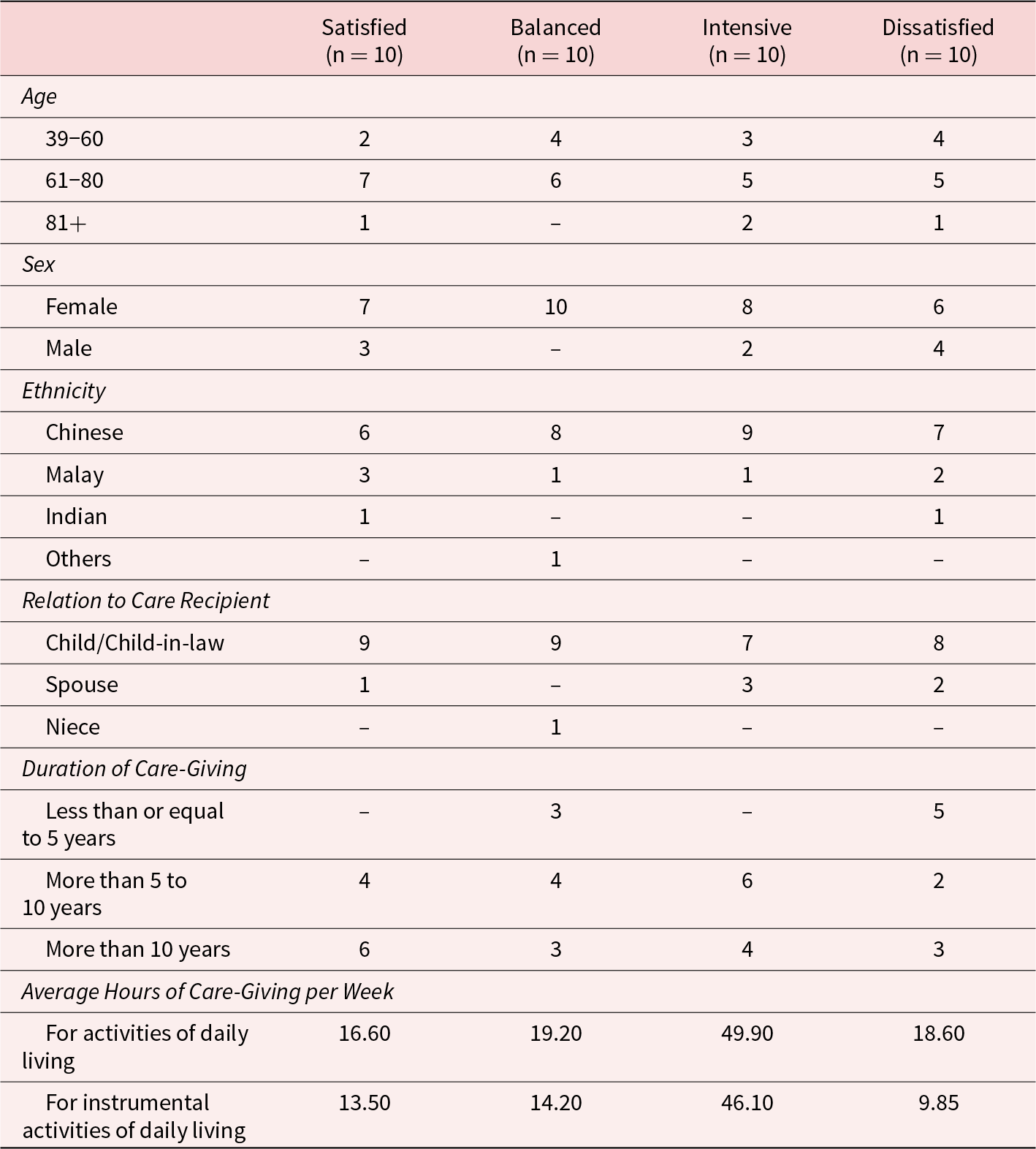
The final sample comprised 40 family care-givers: 25 daughter–parent, 9 son–parent, and 6 wife–husband dyads, predominantly Chinese female care-givers (see Table 1). All participants provided written informed consent. The study was approved by the NUS Institutional Review Board (Reference No. NUS-IRB-2021-566). Written informed consent was obtained from all study participants.
Profile of care-givers in the Quali-T study
Data collection
Forty in-depth, semi-structured interviews were conducted at two time points (2022 and 2023). Face-to-face interviews lasting two to three hours took place in participants’ homes or preferred locations. The author conducted 13 of these 40 interviews. Sample questions included: ‘can you describe a typical day of care-giving?’; ‘what arrangements have you made to manage care tasks?’; and ‘how do you coordinate with other family members and helpers?’. All interviews were audio recorded and professionally transcribed, and participants were assigned case numbers for confidentiality. Summarized fieldnotes were written after each interview.
Data analysis
All transcripts were imported into NVIVO for inductive and iterative analysis (Bryant and Charmaz Reference Bryant and Charmaz2019) oriented to meanings and narratives of care-giving practices. Analysis was informed by existing literature on care assemblages and sociology of home to identify emerging themes.
The analytical process involved several iterative stages: close reading of transcripts and fieldnotes to familiarize with the data; developing conceptual codes that captured sociological dimensions of care-giving practices including boundary making, surveillance practices, family decision-making, employer–MDW dynamics, care scheduling, navigating care systems and institutions and so on. These conceptual codes move beyond descriptive categories to capture the underlying social processes, power relations and structural forces that shape care-giving experiences in the Singapore context.
The analysis was informed by assemblage theory and the sociology of home, examining how care-givers navigate the spatial and temporal dimensions of care work. Particular attention was paid to the socio-material arrangements that constitute care assemblages, including the roles of technology, MDWs, family dynamics and spatial practices within the home environment. To ensure rigour, the analytical process involved continuous reflexive engagement with the data, where emerging themes such as socio-economic leverages and care-giver identity were tested against the broader dataset and existing theoretical frameworks.
Case study construction
Case studies were constructed from individual participant narratives. Each case study stands alone as a unique narrative yet speaks to the themes of proximity, leverage and distributed agencies while showcasing the family structures, socio-economic circumstances and care arrangements that are typical of Singaporean home environments and settings. The case studies were selected to illustrate how various people, things, practices and regimes constituted care assemblages, and how specific challenges have been addressed, providing an understanding of the dynamics between care-giving and home.
Case studies
The five case studies presented in this article were selected from the broader sample of 40 care-givers to showcase how proximity, leverage and distributed agencies operate across different family structures, socio-economic circumstances and care arrangements. Table 1 provides an overview of the key characteristics of each case study participant, including their demographic profile, care recipient details, living arrangements and support structures.
Gek: an outsider at home
Gek,Footnote 1 a woman in her late sixties, found herself at the epicentre of care-giving woes when her 95-year-old mother, Madam Tan, was diagnosed with dementia in 2012. Despite her single status and siblings living separately, Gek moved in with Madam Tan, which disrupted existing familial equilibrium and generated tensions.
Her youngest brother’s co-residence became a focal point of resentment due to financial and care-giving disparities. House ownership was an unspoken tension – Madam Tan wanted to leave it to her unmarried youngest son whilst other siblings contemplated selling to pay for care-giving expenses. Moving in did not achieve the desired social and psychological closeness. Gek keenly experienced her status as an ‘outsider’, feeling her efforts unacknowledged. As Madam Tan’s health deteriorated, stress extended beyond familial bonds, affecting Gek’s personal life. She abandoned social pursuits and averaged three to four hours’ disrupted sleep nightly. Strains reached breaking point, prompting Gek to leave home for four days seeking respite.
In 2019, Gek employed an MDW from Myanmar, bringing relief but also new challenges. The helper faced stress as Madam Tan’s condition worsened and contemplated quitting. Gek’s worry about losing her helper underscored the fragility of this support. Gek’s care-giving shifted towards managing the helper by promising higher salary and active involvement in care-giving. This was afforded by a complex interplay of socio-economic factors and local labour laws disadvantaging MDWs who would most likely incur a debt to access employment (Platt et al. Reference Platt, Baey, Yeoh, Khoo and Lam2017). The MDW had signed a two-year employment contract with Gek, and it was not viable for her to leave without incurring financial penalties even if she wanted to.
Gek’s account revealed the intricate web of relationships and sacrifices within the context of the family, and MDWs’ indebtedness in the local-global chain of care. The delicate balance occurring at multiple scales between personal sacrifice and familial dynamics, external support and socio-economic exploitation weaved a narrative of resilience and complexity in care-giving.
Esther: setting spatial boundaries
For Esther, a woman in her mid-sixties, care-giving was an opportunity to express filial piety and bond with her 90-year-old mother Madam Goh, after a fall resulting in a fractured hip in 2015. Esther then decided to leave her job as an educator-manager in the early childhood sector and become a full-time care-giver for Madam Goh. As the only unmarried child amongst her six siblings, Esther felt responsible for looking after her mother, but she also bore resentment for leaving a beloved job. Even though they had an MDW to help with the household chores and care-giving, there were language barriers between the MDW and her mother, and personal differences which made living together a challenge. Frictions and discomfort ensued when such ‘intimate labor’ involving ‘interpersonal rituals, bodily information, awareness of personal vulnerabilities’ (Yeoh et al. Reference Yeoh, Liew, Ho and Huang2023, p. 622) disrupted the status quo. All these tensions surfaced unspoken regrets, grudges and unhappiness, straining the mother–daughter relationship, which was further aggravated by Covid-19 restrictions and challenges.
Madam Goh’s poignant words ‘It is better for me to die than to rely on you’ encapsulated the emotional turmoil in their relationship. Esther felt stuck in the present care-giving situation and was unable to fulfil her own needs for a social life and aspirations to return to the workforce. The home became a battleground, prompting Esther to create physical boundaries that established her room as an ‘enabling place’ for rest and recovery.
This spatial demarcation afforded Esther a haven for reflection, prayer and engagement with external support networks. As Esther explained: ‘I need my own space, somewhere I can go to pray and think. When things get too difficult with Mum, I go to my room and close the door to be alone sometimes. It’s the only place that’s really mine’. She described how this spatial boundary became essential: ‘In my room, I can call my church friends, meditate, read my Bible, and just be by myself for a while. Without that space, I think I would have broken down completely’. Her room was a tangible expression of self-care, offering respite from care-giving. By establishing physical boundaries around her personal space, Esther created a threshold she could retreat to when stress or conflicts became overwhelming, demonstrating how care-givers negotiate both physical and emotional spaces. But these boundaries were not impermeable. Esther said: ‘I would pray for a peaceful night of sleep because sometimes I could hear my mother groaning in pain in her room, or when my helper knocks on my door in the middle of the night, and we need to bring her to the hospital’s Emergency Department’.
Ruth: family-centric care-giving
Ruth, a woman in her late fifties, exemplified a family-centric approach to care-giving for her mother, Madam Wong, diagnosed with dementia at 80. Despite not residing with Madam Wong, Ruth orchestrated a comprehensive care assemblage involving siblings, an MDW and community resources.
Ruth’s care-giving philosophy, ‘Our priority is to make sure that Mom is happy and well looked after’, underscored the centrality of Madam Wong’s wellbeing. The familial care assemblage operated on multiple fronts, with each sibling contributing uniquely. The MDW, integral for day-to-day care-giving, handled personal and home care, while siblings managed medical appointments and provided emotional support. Ruth’s children, who were in their youth, helped to check in on Madam Wong when Ruth and her husband went on overseas vacation. Coordinating all the care tasks, roles and responsibilities through a WhatsApp group, Ruth emphasized the importance of regular family interactions. The Zoom sessions and physical gatherings at one of the siblings’ homes or sometimes at a restaurant became avenues for connection and emotional support.
Madam Wong’s participation in activities at the care centre provided some respite for Ruth and the MDW. The senior centre gave regular updates on Madam Wong’s wellbeing and behaviour, and organized talks on dementia for care-givers. The centre also checked in on care-givers’ physical and mental health:
We are blessed to get a slot at the care centre which is just about 100 metres away. When we realized that Mom was just watching TV alone at home, we encouraged her to go to [the] care centre where she could interact with other people and participate in activities like singing, mah jong, karaoke sessions, or the staff will read them the news. Lena [MDW] will bring her there and this also gives her [Lena] a bit of respite – at least you know she is not with Mom the whole day long.
Ruth’s narrative highlighted the distributed agencies for care-giving, showcasing the collaborative efforts between the siblings, the MDW and community care providers. The success of this care assemblage lay in its adaptability and responsiveness to the evolving needs of Madam Wong as well as in leveraging a network of support to care for each other, while strengthening family relationships.
Pang: care challenges in a taxi driver’s world
Pang, a taxi driver in his mid-fifties, grappled with care-giving for his 90-year-old mother, Madam Lee, who lived with him. As the youngest and unmarried amongst six siblings, Pang thought that it was natural to care for their mother given his marital status, sense of autonomy at work, and relatively carefree lifestyle.
Pang organized his work and life around caring for Madam Lee, driving 12 hours daily between 2am and 2pm, seven days weekly. After Madam Lee’s fall in 2018 when her cries went unanswered for hours, Pang felt guilty because he was away at work. Subsequently, an MDW was hired and surveillance cameras were installed to monitor Madam Lee’s movements, fearing another fall. He said: With the cameras, I can see what she is doing. Sometimes when I am at work, I will take a look; if not, I have no idea what is happening [at home]’. The cameras made care possible outside of home by enabling distance monitoring that extended Pang’s presence and constituted monitoring as mundane but material care practice (Buse et al. Reference Buse, Martin and Nettleton2018). Monitoring is a standard procedure and process within the health-care setting to ensure that patients’ condition can be evaluated and for timely and appropriate interventions to be administered. Through the application of devices and technologies, monitoring offers a sense of control over the vagaries and erratic nature of (physical) bodies’ (Lupton Reference Lupton2013, p. 262). The live-feed videos of his mother at home appearing on his phone screen may have provided Pang with a sense of control. But it also heightened his anxiety and obsession over his mother’s safety. When probed how he divided his time between work and keeping tabs on his mother at home, Pang replied:
I’ll take a look at what she’s doing every half an hour [from the mobile phone]. I’m worried about what might happen to her [whether she might fall again] because she can be careless’.
Passive surveillance could deepen the physical and emotional demands of care-giving and add to the grueling work schedule that had taken a toll on Pang’s health. He suffered chronic pain in the lower back, shoulders and fingers due to the long hours of driving, but avoided medical treatment due to economic opportunity costs and financial burden concerns. I do not have much health or medical insurance as a taxi driver. If I see a doctor and they tell me that I have this or that illness … isn’t that worse?’, he said.
Preoccupied with work and care-giving, Pang had no personal time’ and no friends’. He cherished lunch time spent eating, chatting and watching television with Madam Lee. This arrangement provided regularity and structure for Pang but did not necessarily improve Madam Lee’s condition or alleviate her frustration at being wheelchair-bound and confined at home since the fall incident in 2018.
Pang’s role as a care-giver intertwined with the challenges of maintaining financial stability and the demands of his work. While the flexibility of taxi driving provided more time with Madam Lee during the day, it also brought along a set of health issues including chronic pain and physical exhaustion. With surveillance cameras and by maintaining a regular schedule, Pang sought to establish a sense of control and stability at home.
Pang felt that there was nothing else he could do to improve care for Madam Lee given current circumstances. The routineness of daily life assured Pang, and he did not see a need for other support, respite or services to change the status quo.
Mei: being alone together
Mei, a woman in her mid-eighties, felt lonely and isolated caring for her husband, Mr Ong, who had been diagnosed with mild dementia. Her son and daughter-in-law had moved in to live with them, whilst another married daughter lived elsewhere. The relationship between Mei and her children was weighed down with tension and instability. Mei’s daughter rarely visited or called, and Mei found it difficult to talk to her son and daughter-in-law about Mr Ong and her needs, especially about money matters. Mei worried about upsetting them if she asked for financial assistance, thus striving for self-sufficiency with Mr Ong’s modest pension, which provided for his medical bills and their daily needs. But she had to forgo expenses like taxis, eating out, socializing and holiday trips previously enjoyed.
Stuck at home, Mei maintained constant vigilance over Mr Ong, always keeping him within sight. Mirrors were strategically placed throughout the house to enable surveillance from different locations:
I have mirrors everywhere in the house, so I can watch him from the living room while he is eating at the dining table or sleeping in the bedroom. I will know when he gets up to walk or try [to] do something, then I will go over to assist. I am afraid he might fall, and that will be very troublesome.
Even with MDW help, Mei felt constantly stressed out: It is tiring to watch [over] him every day. I get very frustrated sometimes. Even when I get angry with him, he is unable to understand’. She was adamant about not sharing her feelings with her children, fearing troubling’ or annoying’ them. Despite ownership of the house being transferredto her son and daughter-in-law, communication between them remained fraught and Mei seemed unable and unwilling to articulate her needs or desires to them. The tedium of care-giving and the ennui that underscored it had profoundly affected Mei’s wellbeing. Living or merely surviving in a space–time vacuum, Mei led a bare life’ devoid of recognition, affection and connection (Chiappori Reference Chiappori2022).
Discussion: proximity, leverage and distributed agencies in care assemblages
This study set out to address three questions: how family care-giving practices reshape home environments and vice versa in Singapore; what role socio-material arrangements play in constituting care assemblages; and what analytical themes encapsulate these dynamics. The findings reveal home to be an active component in care assemblages continuously reconfigured through care-giving practices, as demonstrated by Gek’s experience of becoming an outsider at home’ and Esther’s spatial boundary-making. Care emerges through complex configurations of human actors (family members, MDWs), technologies (surveillance cameras, digital platforms), spatial arrangements and structural forces (labour laws, housing policies), exemplified by Ruth’s coordinated family network and Pang’s technology-mediated care-giving. Three overarching themes emerged from the analysis – proximity, leverage and distributed agencies – which reveal how care-givers navigate spatial and temporal dimensions of care-giving while managing power relations and coordinating multiple resources, illustrating home as a dynamic relational process. Home was a central feature of care-giving as care-givers made references to and drew upon various notions of home when talking about their roles, activities, experiences and challenges in care-giving. Far from being a static setting or inert background, the home exerted an active presence, shaping and being reshaped by care-giving needs and practices, situating and anchoring care-givers’ experiences and feelings of satisfaction, safety and belonging, or anger, frustration and isolation.
Proximities: navigating physical and emotional closeness
Proximity was a recurring motif in these care-giving narratives, manifesting in the physical and emotional closeness between care-givers and care recipients. Gek’s decision to move in with Madam Tan achieved physical proximity but unraveled tensions rather than intended care. Similarly, Mei’s co-residence with her adult children did not translate into care-giving support or familial intimacy, and instead compelled constant vigilance over her husband.
For Esther, care-giving opportunity revealed strains in the mother–daughter relationship over differences in daily routines. She navigated the emotional landscape through spatial boundaries by making her room a haven that provided solace and distance from conflicts with her mother. The spatial demarcation was negotiated by the need for both proximity as well as distance in care-giving.
In Ruth’s case, proximity was distributed across family members and external support networks. While Ruth herself did not live with her mother, Madam Wong, the family-centric care assemblage ensured that proximity was not solely physical. The digital space, in the form of Zoom meetings, became a bridge that maintained emotional proximity even when physical presence was challenging. The senior activity centre nearby provided another space for Madam Wong’s engagement and social interaction.
Pang’s care-giving unfolded within the confines of his taxi driver’s world, where it extended into his work time and spaces. The installation of surveillance cameras, in this context, became a technological means to bridge the physical distance during work hours. When at home, eating lunch and watching television together were a time for Pang to catch up and bond with his mother. Although Pang’s unconventional but regular work schedule provided more daytime proximity with Madam Lee, the precarity generated by his work situation, economic constraints and health concerns threatened to unravel or undermine the delicate care assemblage.
Spatial proximity creates fundamentally different care-giving experiences and temporal realities for care-givers. The case studies have shown how there were shared but also distinct practices, challenges and opportunities that distance created and afforded such as care arrangements and coordination (Baldassar et al. Reference Baldassar, Wilding, Baldock and Paoletti2007), digital technologies for care (Nedelcu and Wyss 2016) and global care chains (Parreñas Reference Nedelcu and Wyss2001). The case studies demonstrate that distant and proximate care-giving exist on a continuum rather than as discrete categories, entailing coordination work, various forms of leverage and navigation around familial expectations. While environmental gerontology emphasizes the importance of person–environment fit’ (Lawton and Nahemow Reference Lawton, Nahemow, Eisdorfer and Lawton1973), this article argues that physical proximity alone does not guarantee positive care-giving outcomes but rather the need to recognize that place is a process and operates at different scales and sites’ (Wiles et al. Reference Vasunilashorn, Steinman, Liebig and Pynoos2012, p. 365).
The temporal choreography of care also reveals an underexplored dimension of care assemblages: sleep and rest management. Cases like Gek’s disrupted sleep, Pang’s night shifts and Mei’s constant vigilance demonstrate how care assemblages reshape temporal rhythms of home, creating temporal precarity’ where care-givers’ biological needs become subordinated to recipients’ unpredictable demands. This temporal dimension warrants further investigation, particularly in terms of how technologies extend care into previously restful spaces and times.
Leverage: negotiating power dynamics and resources
Leverage, defined as a strategic advantage or influence over others, showcased the power dynamics and various modes of negotiations within care assemblages. Gek’s narrative is rife with instances of leveraging – financial incentives to retain a helper, negotiating care-giving tasks and attempting to balance the power dynamics within the family. Gek’s ability to offer a higher salary to the helper demonstrated a form of economic leverage, highlighting the complex interplay between socio-economic factors and care-giving sustainability. Here, leverage was enabled by local labour laws governing the relationship between employers and MDWs, rendering MDWs invisible by their exclusion from labour standards and regulations that seek to protect workers’ interests, safety and dignity in workplaces. Instead, MDWs come under a separate legislature that views their work as a matter of family arrangement within a private domestic space. As a result, employers often ignore official rules for regular off days, salary payments following minimum wage recommendations … insurance provision, and the like, made worse by the inability or unwillingness of authorities to enforce it’ (Ng Reference Ng2022, p. 2). Situated within global precarity chains’ under conditions of unequal level of economic development between sending and receiving nations’ (Parreñas Reference Nedelcu and Wyss2001, pp. 369–370), these laws reproduce indebtedness amongst migrant domestic/care workers.
Gek’s leverage occurred in a social context where outsourcing of care is presumed. Although MDWs can terminate employment with their employers at any time for various reasons including demanding care-giving duties, which leaves family care-givers in the lurch, this decision is not easily taken. Frequently, MDWs find themselves trapped in debt bondage after being required to pay placement fees that surpass legal limits – a practice that is commonplace in Singapore and Hong Kong. Lee and Petersen (Reference Lee and Petersen2006) noted that employment agencies typically disguise these charges as loans and instruct employers to redirect workers’ monthly wages to finance companies or agents. More recent evidence suggests that these practices persist, with non-governmental organizations reporting that migrant workers in Singapore remain vulnerable to forced labour including debt bondage: many foreign workers assume large debts to recruitment agencies or individual recruiters in their home countries and sometimes in Singapore’ (Transient Workers Count Too (TWC2) Reference Teo2017), notwithstanding Singaporean laws limiting agency fees and enforcement of these laws on those who exceed them.
Esther exercised leverage through the management of spatial boundaries. By demarcating physical and symbolic boundaries of personal space, her room became a strategic enabling resource that supported capacities and agencies for care-giving. This spatial negotiation was a source of empowerment for Esther, facilitating self-care where she could reach out to her church community for fellowship and emotional support that preserved self-esteem and gave hope for a future beyond care-giving. Esther’s narrative illustrates that leverage within care-giving can take various forms beyond the socio-economic realm.
Ruth’s story unveils yet a different facet of leverage – collaborative family efforts and mutual care for each other. Ruth’s stated purpose, Our priority is to make sure that Mom is happy and well looked after’, emphasized a shared goal that became a powerful lever. Family members, the MDW and community care services contributed uniquely, leveraging individual strengths and resources. The distributed agencies within the care assemblage effected a synergy that showcased collaboration as a powerful leverage for care-giving.
While financial costs of care-giving were a shared concern amongst care-givers, it was more evident in Pang’s case where his work situation, economic constraints and health issues shaped the leverage (or lack of) for care-giving. Pang’s job as a taxi driver afforded some flexibility for care-giving, but the demanding work schedule affected his health, and he had been struggling for years with minimal health-care and medical leave insurance. Pang’s situation demonstrated how care-giving can seep from home into workspaces, affecting the prioritization of/between financial stability, health and wellbeing, and providing care. Work–life–care-giving balance is a class privilege’ (Teo Reference Teo2016). For Pang and other daily-rated workers, including gig workers such as private-hire drivers and delivery riders, maintaining a stable (stream of) income often comes at a cost of care and household responsibilities, and one’s health. The specific challenges they face to achieve ‘work–life–care-giving balance’ have only recently gained some attention in public discussions, which have pushed employers to improve work conditions and human resource policies including the provisioning of health-care leave and insurance.Footnote 2 Other potential sources of leverage include access to social and community resources, and external support systems to empower care-givers like Pang.
Distributed agencies: collaborations across networks
Distributed agencies highlight the diverse socio-material resources, practices and mechanisms that constituted and held care assemblages together. In Gek’s case, the helper from Myanmar and other family members were key agents in the care assemblage, managed through leverages and proximities.
Esther’s story emphasized the importance of external connections in navigating the challenges of care-giving. As her narrative demonstrated, reaching out to a wider community of friends for emotional support depended on demarcating physical and emotional spaces at home for privacy to pray, reflect and connect with others.
For Pang and Mei, the installation of video cameras and strategically placed mirrors around the house transformed care-giving into a technologically mediated activity of surveillance, which provided a Panopticon sense of stability and control (Mortenson et al. Reference Milligan and Wiles2016). The practice instilled watchfulness as part of care-giving, transforming the home into a place filled with potential risks of fall incidents that could occur anywhere at any time. In both cases, surveillance was performed with the intention to protect and safeguard care recipients. It was also performed in anticipation of potential incidents and preparation for quick and immediate interventions, putting the home in a constant and heightened state of emergency.
For Ruth, on the other hand, home represents the central organizing point of a comprehensive care network even though she did not reside with her mother. Ruth orchestrated care from her own home whilst ensuring that her mother’s home remained a place where coordinated family care could occur. Home encompassed both physical and digital spaces that enabled emotional proximity and bonding, thus maintaining family connections across different locations. The collaborative care environment was constituted by the MDW, the nearby senior care facility and various spaces including a WhatsApp group where siblings coordinated care responsibilities. Thus, home is an adaptable network of relationships and spaces that can respond to evolving care needs, rather than a fixed concept defined by one’s place of residence.
The case studies challenge the notion of ageing in place as simply maintaining older adults in existing homes, by revealing the home as a continuous negotiation of spatial, temporal and relational arrangements. While current policies focus on discrete interventions like environmental modifications and service delivery, this article argues that the success of care-giving depends not so much on these interventions as on the interplay of proximity, leverage and distributed agencies. Gek’s experience of becoming an ‘outsider at home’ despite co-residence demonstrates that spatial proximity alone is insufficient.
Ageing-in-place policies must move beyond housing-centric approaches emphasizing physical environment modifications, service delivery and care-giver support as discrete interventions (Wiles et al. Reference Vasunilashorn, Steinman, Liebig and Pynoos2012), and towards considering how care assemblages can be sustained over time. Ruth’s distributed family model illustrates ageing in place as ageing within supportive networks rather than a specific location. The prominence of MDWs highlights a critical gap in ageing discourse, raising questions about the sustainability and ethics of care arrangements that enable ageing in place for some whilst perpetuating vulnerability for others.
‘A place of normality’: navigating proximity, tensions and affective resources
The endeavour to transform home into ‘a place of normality’ amidst the evolving needs of care recipients, competing priorities and a dearth of material resources and social support remains a significant challenge for care-givers (Boccagni and Kusenbach Reference Boccagni and Kusenbach2020). This struggle is exemplified by care-givers like Gek, who sought to establish physical proximity by moving in with her mother to provide care. However, Gek’s action, aimed at fostering a care-giving environment, instead ignited tensions with other family members. Her experience highlighted the complexity of achieving a sense of normality within the home, demonstrating that physical presence or closeness alone does not guarantee conducive care-giving spaces.
Similarly for Esther, despite the greater physical proximity and more time at home, she found that these factors did not necessarily enhance the care-giving experience. The demarcation of personal space was a strategy that transformed her room into an affective place for personal prayer, reflection and emotional support from her Christian community, inducing ‘emotions and embodied feelings and sensations … composed with other affects and other bodies and always shared and distributed’ (Lupton Reference Lupton, Scrimshaw, Lane, Rubinstein and Fisher2022, p. 108). Esther found sustenance for care-giving through her Christian faith and spatial practices that reinforced her sense of being in this world (or situation) but not of it.
For Pang, meanwhile, the sense of control and stability that surveillance cameras and a routinized daily life afforded had intensified care-giving as it seeped into his work and personal spaces and times. All these materialities that instantiated care-giving were integral to home as well as Pang’s identity as a care-giver. Here, monitoring as a care practice was not merely ‘embodied spatially’, that is, related to what people do and how they move, act and engage with(in) their surroundings, but an ‘emplacement’ that developed and deepened connections over time through repeated practices and lived experiences (Buse et al. Reference Buse, Martin and Nettleton2018, p. 247).
This article calls for a broader understanding of care-giving by attending to the spatiotemporal practices of care-givers and examining their implications. Singapore’s unique policy environment shapes distinctive care assemblages through the normalized integration of MDWs as live-in care providers, creating particular power dynamics and ‘market solutions’ that differ from the formal service models or extended family networks found in other societies. Government housing policies encouraging multigenerational living create spatial challenges requiring creative negotiations, while cultural expectations of filial piety combined with women’s workforce participation generate tensions around proximity and leverage that are less pronounced in other contexts.
Strengths and limitations
This study’s strength lies in its focus on the often-overlooked socio-material dimensions of care-giving. The theoretical framework combining care assemblages and sociology of home provides a novel lens for understanding care-giving complexity beyond individual efforts or dyadic interactions. However, several limitations must be acknowledged. The predominantly Chinese female sample limits generalizability across Singapore’s ethnic diversity and to male care-givers’ experiences. The focus on family care-givers meant missing perspectives of care recipients, MDWs and health-care professionals who are integral to care assemblages. The case study approach, while providing depth, limits breadth compared to larger survey studies.
Recommendations for policy, practice and research
Policies would need to recognize care-giving as collective endeavours involving multiple actors, technologies and spaces rather than solely as an individual and/or a family responsibility. Beyond enabling older adults to age at home or age in place, policies could focus on strengthening care networks by improving employment protection for MDWs, providing better care-giver support and enhancing community services that integrate with family networks. Home as a dynamic relational process also requires more flexible housing design enabling not just physical modifications but integration with community infrastructures that support care-giving and care-givers themselves.
Health-care and social service practitioners should adopt assessment tools that consider the full complexity of care-giving arrangements characterized by proximity, leverage and distributed agencies rather than individual deficits or dyadic relationships. By recognizing spatial boundaries and temporal rhythms, practitioners could provide better support for care-givers in creating ‘enabling places’ for respite and self-care. Interventions should also address the technological mediation of care, helping families navigate the benefits and risks of surveillance technologies.
Future research should examine multiple perspectives across ethnic communities, including voices of care recipients and MDWs. Longer-term ethnographic approaches would better capture the evolving nature of care-giving relationships and spatial arrangements over time. On the other hand, comparative studies with other societies would help to better distinguish Singapore-specific findings from broader insights about home-based care and informal care-giving. An area that has emerged from this study that is worth further study is how technologies create ‘temporal precarity’ for care-givers by extending care-giving into previously restful spaces and times.
Ethical issues
While concerns about MDW employment conditions, including debt bondage and inadequate labour protections, have been raised, most employers understand the importance of MDWs and exercise responsibility to ensure their safety and wellbeing, seeking to build trusting relationships. However, without clearer guidance based on fundamental labour and human rights principles, many issues risk being treated as private family matters rather than legal concerns. This is particularly problematic for psychological or emotional abuse, salary withholding and rest deprivation, which are difficult to monitor and adjudicate but constitute serious violations of workers’ rights.
Conclusion
Through five Singaporean case studies, this article demonstrates how care-givers choreograph care through proximities, leverages and distributed agencies transforming domestic spaces into viable care assemblages. The study’s contribution lies in applying assemblage theory to understand socio-material dimensions of care-giving, revealing how care-giving practices actively reshape home environments and vice versa. By focusing on the ‘materialities of care’ from surveillance cameras to strategically placed mirrors, digital communication platforms and spatial boundaries, this article showcased how these elements constituted care in relational and emergent ways. The identification of proximity, leverage and distributed agencies as key mechanisms in care assemblages offers a framework for understanding the complexity of care-giving arrangements – it moves beyond dyadic models to encompass interconnected networks comprising family members, MDWs, technologies and spatial arrangements that make care possible. Findings reveal that care-giving involves the co-occurring process of homemaking where care, dignity and belonging coexist, underscoring a need for policies to support the intricate choreography of enabling ageing at home and/or in places.
Financial support
Funding support was obtained from the Temasek Foundation, Singapore (TFI2021-DUKE-NUSTSAO-01). Approved by NUS IRB: NUS-IRB-2021-566. Any opinions, findings and conclusions or recommendations expressed in this article are those of the author and do not necessarily reflect the views of the Temasek Foundation.
Ethical standards
Artificial intelligence was used to edit the manuscript for clarity.

 Open access

