




Introduction
The interpretation of Greek and Roman anatomical descriptions is a complex task. Dense technical jargon, reliance on lost visual aids, and attempts to convey sensory experience through limited linguistic tools all contribute to the challenge. Furthermore, some anatomical structures described by ancient authors are not readily identifiable in the human body. For instance, Aristotle famously describes a three-chambered heart (instead of four), and Galen locates a non-existent complex network of arteries, the retiform plexus (diktuoeidēs plegma), at the base of the human brain.Footnote 1 In the past, such inaccuracies puzzled scholars, who struggled to explain how past luminaries could have erred so blatantly. Recent scholarship has thankfully moved beyond simply identifying and explaining these instances as ‘errors’, focusing instead on understanding the historical circumstances that made these descriptions plausible for their authors and audiences.Footnote 2
This paper brings to light another rarely noticed and similarly ‘problematic’ anatomical description: the ‘lower cavity’ of the gastrointestinal tract. Greco-Roman medical texts from the fourth century BCE onward consistently reference two ‘cavities’ (koiliai), an upper and a lower. The ‘upper cavity’ (anō koilia) is readily identified with the stomach. However, the ‘lower cavity’ (katō koilia) lacks a clear anatomical correlate. While early uses of the term might generally refer to the abdomen, after the fourth century BCE, most Greek sources treat it as a distinct anatomical structure within the human gastrointestinal tract. In fact, this bipartite understanding of the digestive system became deeply embedded in subsequent Roman and later anatomical thought.
In this paper, I trace the history of this anatomical idea. The first half examines the reasons for its emergence. In Section 2, I provide evidence documenting its prevalence among fourth-century BCE Greek physicians and philosophers. In Section 3, I argue that three factors contributed to the consolidation of this bicameral understanding of human gastrointestinal anatomy: an older terminological distinction between an ‘upper’ and a ‘lower’ cavity, the new availability of animal dissection data, and the ‘cooking’ theory of digestion.
The second half of the paper examines how this notion survived outside its original context, persisting through three major changes: in anatomical terms, anatomical ideas, and physiological theories. Section 4 explores the idea’s presence in Galen’s works in the second century CE, showing its endurance despite significant shifts in gastrointestinal terminology. In Section 5, I turn to the sixteenth century CE, demonstrating how early modern anatomists maintained this notion while challenging its anatomical underpinnings. Finally, Section 6 focuses on the seventeenth-century philosopher–physician Francis Glisson, who upheld this notion despite being aware of earlier anatomical criticisms, and despite holding a fundamentally different understanding of digestive physiology than his predecessors. In the conclusion, I reflect on the survival of peripheral anatomical ideas and propose that the ‘lower cavity’ persisted precisely because of its marginal status, allowing it to adapt to changing frameworks without attracting critical scrutiny.
The consolidation of the bipartite model
Our earliest Greek medical texts, compiled in the so-called Hippocratic Corpus, do not provide a coherent anatomical account of the gastrointestinal tract. Typically, this labyrinth of tissue, cavities, and tubes was denoted by general terms such as ‘the intestines’ (ta entera), ‘the entrails’ (ta kola), or ‘the cavity’ (hē koiliē).Footnote 3 When the Hippocratic authors employed the division between an upper and lower cavity, it usually referred to the division of the whole torso, or ventral cavity, between the chest and the abdomen, separated by the diaphragm. This began to change in the fourth century BCE, as an important semantic shift occurred in the usage of this division. Now, it no longer primarily referred to a topological division of the torso, but to two distinct anatomical structures within the gastrointestinal tract. The most extensive evidence for this change comes from Aristotle.
In his Meteorology, he states that the upper cavity is the site of heat-induced cooking (pepsis) of food (trophē), while leftover substances excreted from the digestive process undergo putrefaction (sēpsis) in the lower cavity.Footnote 4 ‘Upper cavity’ thus no longer refers to the chest, but to an organ into which food is conveyed and then stored for elaboration, i.e. the stomach. By analogy, we should assume that whatever its identity, the ‘lower cavity’ also no longer refers to the whole abdomen, but to a cavernous anatomical structure within it.
This schema is developed in Aristotle’s description of internal human anatomy in the History of Animals.
T1 ‘The human cavity (koiliē) resembles that of a dog, as it is not much larger than an intestine, but rather appears as a somewhat wide intestine. After this comes a single intestine, coiled and fairly broad. The lower cavity (katō koiliē) resembles that of a pig, for it is wide, and the section extending from it to the anus is thick and short.’Footnote 5
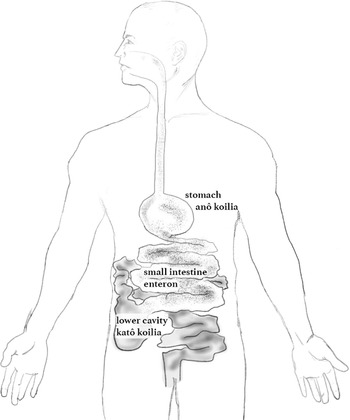
In this passage, Aristotle refers to four structures within the human gastrointestinal tract. The first structure, located directly below the oesophagus, is termed ‘cavity’ and corresponds to what Aristotle refers to elsewhere as ‘the upper cavity’, the stomach. This is followed by a coiled tube, which he identifies as the intestine. Subsequently, there is a second, or lower, cavity, which connects to the anus via another short intestine (Figure 1).
A schematic representation of the gastrointestinal tract according to Aristotle’s History of Animals.

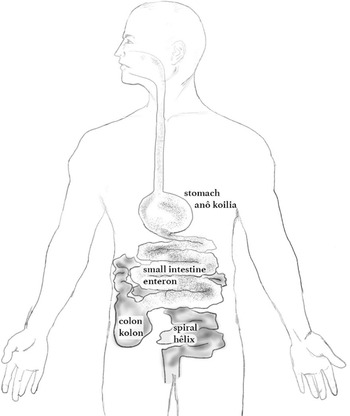
Thus, a certain parallelism emerges between the stomach and this lower cavity, as both are cavernous structures designated for storing substances with an intestinal tube extending from them. This parallel appears again in Aristotle’s other anatomical description of the gastrointestinal tract, in the third book of Parts of Animals. There, he employs somewhat different terms to convey a similar picture: there is a second cavity, this time called ‘the colon’ (to kolon), from which a convoluted intestine called ‘the spiral’ (hē hēlix) extends, thus mirroring the upper cavity and the intestine that extends from it (Figure 2).Footnote 6 In this text, moreover, Aristotle provides an important physiological role and a teleological justification for this intestinal anatomy: digested food is stored in the lower cavity/colon to ensure that no unabsorbed nutrients are left in it and then passes into the coiled spiral ‘so that nature might manage (timieuētai hē phusis) the flow of residue and it will not occur all at once (mē athroos ēi)’.Footnote 7
A schematic representation of the gastrointestinal tract according to Aristotle’s Parts of Animals.

We find similar anatomical ideas in the fragmentary remains of the works of Diocles of Carystus, a fourth-century BCE physician. Despite the scarcity of information about his life and intellectual milieu, Diocles’s contributions to Greek medicine have been widely acknowledged in both ancient and modern times.Footnote 8 His efforts in systematising anatomy and physiology bear remarkable similarities to those of Aristotle and his student-collaborator Theophrastus, suggesting a probable exchange of ideas between Diocles and the Lyceum.
In his scattered comments on gastrointestinal anatomy, Diocles refers to what Aristotle termed ‘the (upper) cavity’ as ‘the (upper) stomach’ ([anō] gastēr), while reserving the term ‘lower cavity’ for the corresponding area lower in the intestinal tract. Adding to the terminological complexity, Diocles uses ‘cavity’ (koilia) to denote the entire ventral cavity, encompassing both the upper stomach and the lower cavity – a region Aristotle himself named gastēr (see Table 1).Footnote 9 The first fragment I examine here, extracted from a treatise on health maintenance regimens, outlines the ideal conditions for waking:
T2 ‘Usually, it is good to wake up when food has already moved from the upper stomach to the lower cavity (methestēkotōn ēdē tōn sitiōn ek tēs anō gastros epi tēn katō koilian). It occurs in the best way, shortly before sunrise, in people who are young and in the prime of life, ten minutes before sunrise and in summer, five. In older people, it occurs closer to sunrise than it does for young people in winter and summer.’Footnote 10
Fourth-century BCE terms for gastrointestinal anatomy

In this text, Diocles associates the optimal time for waking up with the progression of ingested food from the ‘upper stomach’ to the ‘lower cavity’. He notes that the specific moment before sunrise when digestion concludes differs among individuals. This variance is particularly evident when comparing the elderly with the young, but even among the youth, it fluctuates with the changing seasons. Diocles’s observations assume an anatomical scheme of the gastrointestinal tract similar to the one seen in Aristotle above. The upper stomach thus serves as a reservoir for unprocessed food, whereas the lower cavity is a depository for digested material.Footnote 11
In a second fragment, Diocles explores the aetiology of flatulence in the stomach within a broader discussion of abdominal ailments.
T3 ‘One should assume that those people who are called flatulent have excessive heat in the vessels carrying food from the stomach, and that the blood in them has congealed. It is clear that there is an obstruction around these vessels since the body does not receive food, but it remains in the stomach unprocessed (en tēi gastri diamenein akatergaston). Earlier [sc. before flatulence], these blood vessels took in [food], while most of the material was secreted to the lower cavity (ta de polla apokrinantōn eis tēn katō koilian).’Footnote 12
The fragment suggests that flatulence arises from an obstruction surrounding the blood vessels near the stomach, preventing them from receiving and absorbing food. The obstruction occurs due to excessive heat in the stomach area, which causes the blood in these vessels to congeal. This blockage leads to food accumulating in the stomach, unlike the typical process where these vessels absorb nutrition while secreting residues into the lower cavity, presumably via the connecting intestinal tract. While the precise physiological mechanisms described in this fragment remain unclear,Footnote 13 T3 again displays the views encountered in T1 and T2: the digestive tract comprises two interconnected cavities, an upper and a lower. The upper stomach houses undigested food while the lower cavity serves as a reservoir for disposable residues, with a connecting intestinal tube between them. There is also a hint of another physiological principle common to him and Aristotle, on which I elaborate below, namely that digestion occurs when the body’s innate heat cooks the food in the upper cavity.
Thus, an anatomically consistent but terminologically diverse picture emerges from the fourth-century BCE sources we examined so far. As G.E.R. Lloyd observed, the state of anatomical terminology throughout antiquity was ‘a situation bordering on terminological anarchy’, with no institutional guidelines or universally recognised norms. Thus, this remarkable similarity of anatomical content can be obscured by differences in terms.Footnote 14 Aristotle’s koilia is equivalent to Diocles’s gastēr, and Diocles’s katō koilia corresponds to Aristotle’s kolon (See Table 1 below).
We should bear the fluctuating state of Greek anatomical terminology in mind when approaching our next source, taken from Mnesitheus of Athens, another fourth-century BCE physician who is generally, though not uncontroversially, considered Diocles’s younger contemporary.Footnote 15 Here, for the first time, we encounter a direct acknowledgement of the confusing nature of gastrointestinal anatomical terms and the ideas they describe. The quotation is part of a general anatomical survey:
T4 ‘Those with a swollen abdomen, their upper cavity is full and large, while the intestines are small (plērēs toutōn ē men anō koilia megalē, entera de mikra). This is why many such people suffer from ailments around their upper cavity, whether full or hungry. Let no one think that I speak of an upper and a lower cavity without knowing that humans have only one stomach (monokoilios). But a thick lower intestine lies underneath it – this is indeed what I call the lower cavity (to de katō enteron upokeitai pachu, touto dē legō katō koilian).’Footnote 16
T4 highlights the fact that during the period in question, the fourth century BCE, the notion of a secondary, lower cavity within the gastrointestinal tract was not universally recognised, and its precise definition may have been unclear to many. Mnesitheus addresses a potential point of confusion arising from his use of the terms ‘upper’ and ‘lower’ cavities. His concern is that readers might mistakenly infer that he considers humans not to be monokoilioi, that is, to possess multiple stomachs, like ruminants. This misunderstanding stems from another ambiguity in Greek anatomical terminology, where the various stomachs of ruminants were also referred to as koliai (cavities), together with a host of other anatomical structures that could have also been reasonably described as cavities.Footnote 17 To clarify this point, Mnesitheus, likely drawing upon terms from previously mentioned authors, emphasises that humans are categorically monokoilioi, meaning they possess only a single stomach, i.e. a single cavity below the oesophagus for digesting food. In the context of this adjective, however, ‘cavity’ specifically denotes the stomach or the ‘upper cavity’. Although humans have just this one type of cavity, Mnesitheus asserts the existence of a second, lower one, which he identifies as the thick intestine situated beneath the stomach.Footnote 18
The audience of Mnesitheus’s defence, whether laypersons unfamiliar with the technical connotations of ‘lower cavity’ or fellow physicians who contested his terminology, remains uncertain. However, it seems that such relatively recent nomenclature was part of an emerging attempt by various thinkers and professionals to accurately describe and name a hitherto uncharted area of the body’s interior. This is consistent with how Aristotle broached the subject of this lower cavity, referring to it as ‘that which is called the kolon’ (to kaloumenon kolon). In technical Greek literature, qualifiers such as the middle-passive participle kaloumenon often flag specialised terms, signalling to the reader that these terms diverge from their everyday usage.Footnote 19 Thus, we have evidence suggesting that this anatomical differentiation, while building on the prior segmentation of the torso into upper and lower cavities, was a technical distinction introduced by professional physicians and natural philosophers during the fourth century BCE.
Why two cavities?
The prevalence of bipartite descriptions of the human gastrointestinal tract among fourth-century BCE physicians and philosophers raises the question of what led these authors to think of the digestive system in this way. This question is particularly striking since such a model is notably absent from earlier medical texts like the Hippocratic Corpus, and more significantly, because human anatomy lacks any structure resembling the second cavity described in these accounts. I propose that this anatomical model emerged from the intersection of two key developments in fourth-century BCE Greek medicine. First, the rise of systematic animal dissection provided anatomists with observations of certain animals, particularly pigs, whose digestive tracts actually do display a more pronounced bipartite structure. Second, and crucially, this particular anatomical model gained wide acceptance because it aligned with broader theories of digestion physiology that were gaining prominence during this period. That is, while ancient anatomists encountered various animal digestive systems that could have served as models for human anatomy, the bipartite structure observed in some proved especially compelling because it corresponded with emerging physiological frameworks.Footnote 20
The rise of comparative animal dissection in fourth-century BCE Greek medicine and natural philosophy had far-reaching effects on Greek biomedical thought. Footnote 21 The reasons for this shift, being part of a broader and formative change in the intellectual Zeitgeist of Greek thinkers in this period, lie beyond the scope of this paper.Footnote 22 What is significant, however, is that all the authors surveyed in Section 2 above demonstrated a serious interest in mapping the human body’s interior with unprecedented descriptive and terminological precision, relying on insights probably gained from such dissections. The attempt to map the gastrointestinal tract, as evidenced above, was part of this undertaking. Thus, new anatomical ideas emerging in this period are better examined in relation to this novel investigative endeavour.Footnote 23
Our sources make clear, however, that in fourth century BCE Greece, physicians and philosophers did not perform human dissections. Instead, they reconstructed internal human anatomy primarily through extrapolation from animal dissections. The most compelling testimony comes from Aristotle. In the introduction to his survey of human anatomy in the first book of the History of Animals, he admits: ‘The internal parts (ta entos) of humans are mostly unknown. So, we must examine them in reference to the parts of other animals with a similar nature (echei paraplēsian tēn phusin)’.Footnote 24
This reliance on animal models is particularly significant for understanding the bipartite description of the digestive system. The human digestive system lacks any structure that could be considered a true second cavity comparable to the stomach—the small intestine is markedly smaller in diameter, and the large intestine is essentially a wide tube rather than a stomach-like cavity with a coiled intestine extending from it. However, such bipartite structures are observable in many other animals.
Here, Aristotle provides another valuable clue. In T1, he draws specific comparisons between human and animal anatomy, noting that the human upper cavity resembles that of a dog, while the lower cavity resembles that of a pig.Footnote 25 He elaborates on this comparison by observing that both humans and pigs share wide (plateia) lower cavities.Footnote 26 Modern anatomical knowledge helps illuminate why Aristotle might have drawn this parallel. In pigs, the initial portion of the large intestine—what we now identify as the caecum and parts of the ascending colon—differs markedly from the small intestine in both size and structure. This section is substantially larger, wider, and more distinctly articulated than the preceding intestinal tract (see Figure 3). Beyond this enlarged portion, the intestine narrows into a coiled tube before connecting to the thick, straight rectum. It is not hard at all to conceive of the porcine caecum and the stomach as a pair of protruding, inflated cavities in an otherwise more or less uniform intestinal tract. This anatomical pattern is not unique to pigs but appears in various other non-human animals, including horses.Footnote 27
Left: Porcine large intestine, view from above. C = The first bulky part of the large intestine, which was identified as the lower cavity (katō koilia), the colon (to kolon), or the blind intestine (to tuphlon enteron) in the examined authors. D = the part identified by Aristotle as ‘the spiral’ (hē hēlix). Right: Porcine large intestine, side view. Adapted with permission from Singh, op. cit. (Footnote note 27), Fig. 34.12.B, D.

I propose, therefore, that fourth-century BCE anatomists mapped an anatomical feature observable in some animal bodies, namely a gastrointestinal anatomy that lends itself to a bipartite description, onto their imagined reconstruction of internal human anatomy. Besides explaining the observational basis of the lower cavity, having the animal, and specifically porcine, model in mind also helps explain why Aristotle used the term ‘spiral’ in Parts of Animals (see Figure 2) to describe the narrowing and twisting tube connecting the lower cavity to the anus. The term precisely captures the winding path of the latter part of a porcine large intestine.
Animal dissections made a bipartite gastrointestinal model available, but why was it adopted for human anatomy when other animal models showed different arrangements? I propose that this particular model prevailed, at least in part, because it aligned with emerging physiological theories about digestion. While these theories existed in rudimentary form earlier, they gained a new prominence and coherent expression in the fourth century BCE. The key ideas of this digestion theory were that digestion occurs through the action of internal bodily heat, producing both nutrients and a variety of residues, and that each type of residue requires its own proper place in the body.Footnote 28
From the earliest days of Greek speculation about the body, analogies between internal anatomical structures and artificial containers were ubiquitous. The body was thought of as assembled from vessels, cups, containers, and receptacles, not unlike their clay, skin, and glass counterparts.Footnote 29 This overarching conception of the body significantly influenced all areas of medico-biological thought. For example, the author of the Hippocratic treatise Humors used processes observed in real-life containers, such as seepage or percolation, to explain the passage of food from the stomach into the rest of the body: ‘As a new water jar seeps through but keeps [liquids] when older, so the stomach lets food pass and holds sediments as a vessel’.Footnote 30 This container-based understanding of the body naturally gives rise to the idea that in properly functioning bodies, each substance has its own designated receptacle. Perhaps the most famous early articulation of this notion is found in the Hippocratic Diseases 4, where vital bodily functions are attributed to the interplay of phlegm, blood, bile, and water, with their natural sources (pēgai) identified as the head, heart, liver, and spleen, respectively.Footnote 31 Diocles’s explanation of flatulence in T3 also reflects similar reasoning: naturally, there exists one location for incoming food and another for excrement.
This ‘physics of the container᾽, as Robert Joly termed it, provided a flexible framework for various physiological and anatomical theories.Footnote 32 Within this framework, physicians and philosophers could then specify, each according to their view, which cavities exist in the body, what substances they contain, and how these substances move and transform. Yet Aristotle, Diocles, and Mnesitheus shared a specific view of how bodily materials are produced during digestion and placed it within the framework of the body as a set of containers with a proper place for each natural substance. They all maintained that the body’s innate heat cooks or digests (pettein) food, dividing it into nutritious material and residues (perittōma)—the latter term notably absent from earlier medical texts.Footnote 33 This process mirrors common observations of heat’s effects on materials, where heating creates two distinct layers: a useful portion and refuse. Aristotle explicitly draws this parallel, comparing digestion to how milk separates into curd and whey.Footnote 34
Aristotle also offers the clearest account of this new understanding of natural residue production. He defines residue (perittōma) as the surplus (hupoleimma) of food—specifically, those components of ingested food that the body does not absorb after a process of heat-induced elaboration.Footnote 35 In his view, faeces are just the first of several residues produced as food moves through the body. He thus applies this same model of heat-induced separation between thicker and thinner layers to explain how the body generates most of its substances, including bile, phlegm, milk, marrow, and semen, with each process yielding both nutritional elements and residues. Although long physiological descriptions by Diocles and Mnesitheus do not survive, they employed the new term perittōma with a similar meaning, as suggested by what appear to be direct quotations rather than later interpolations.Footnote 36 Given that the term is both new and theoretically charged, it is yet another testimony for a common theory of digestion shared by the three.
The idea that digestion works through heat-induced separation between nutriment and residues, coupled with the broader conception that each substance in the body requires its own designated container, made the anatomical model of two digestive cavities compelling. This connection between physiological theory and anatomical understanding is most clearly articulated in Aristotle’s Parts of Animals:
T5 ‘There must be different places for undigested food and residue (te apeptou kai tou perittōmatos), and there should also be a place where the food changes (en ōi metaballei). So, one part will hold incoming food, while the other useless residue. And just as there is a different time for each process, they should also differ in their places.’Footnote 37
Aristotle subscribes to the notion that each bodily substance has a natural container or receptacle, such that two substances entail the existence of two separate containers. He also employs two theoretically specific terms to describe food before and after digestion. The food in the stomach is ‘undigested or ‘uncooked’, while faeces are residues. Thus, Aristotle postulates a ‘proper place’ (oikeios topos) for each residue, a site for both their generation and storage.Footnote 38 Drawing analogies from pairings like ‘stomach: food’ and ‘bladder: urine’, it seems reasonable that observing wide and cavernous caeca in animals would lead to the conclusion that it serves as a similar cavity, specifically for dry excrement. Conversely, it is reasonable to suppose that, like uncooked food and urine, the dry residues of the body will have a cavity proper to them.
Given the complex and variegated nature of intestinal anatomy in different animals, it is hard to imagine that the bipartite description would gain such wide purchase on the anatomical imagination of fourth-century BCE physicians and philosophers were it not aligned with the theoretical exigencies of their theories.Footnote 39 The anatomical observation of somewhat pronounced second cavities in animal gastrointestinal tracts reinforced physiological theories postulating a proper cavity for each substance, including faeces. Conversely, these physiological theories directed observers to identify and emphasize certain anatomical features in animals that might otherwise have gone unremarked. Once one knew to look for a second cavity because theoretical principles suggested it should exist, it became readily identifiable in enough animals to substantiate its anatomical reality and support inferences about human anatomy.
To conclude this first part of the paper, we see that by the end of the fourth century BCE, a new understanding of the human gastrointestinal tract emerged, which rested on three complementary legs. First, there was an older terminological tradition where the torso housed or was divided into an upper and a lower cavity. Second, observations originating from animal dissection facilitated the identification of animal caeca as a lower cavity also in humans. Finally, there was a physiological view that the caecum functions as a residue receptacle, storing it and sometimes even digesting some of it, as does the stomach. In the following sections, I will show how this idea survived in later centuries, although these three legs gradually faltered. First, Galen will abandon the terminology but keep the anatomy and physiology. Later, Vesalius will dismiss the anatomical basis of this vision but nonetheless adopt its physiological premises. Finally, in the seventeenth century, the bipartite description will outlive shifts in its physiological underpinnings.
Galen’s new terminology
The Hellenistic period witnessed an exponential accumulation of Greek knowledge about the body. The process was fuelled by several factors, including the increasing systematicity of animal dissections conducted upon a wider array of animals and, for the first time in antiquity, the practice of human dissections and probably also vivisections. This enabled the differentiation of internal substructures previously barely distinguishable to the naked eye.Footnote 40 Such a shift in anatomical knowledge also considerably impacted the understanding of the gastrointestinal system. Two prominent figures in Hellenistic medicine, Herophilus of Chalcedon and Erasistratus of Ceos, made significant contributions in this area. Herophilus identified the ‘duodenum’, the first straight and uncoiled section of the small intestine extending from the stomach, naming it the ‘twelve-finger part’ (dōdekadaktulon enteron). Erasistratus, for his part, provided the earliest recorded reference to the jejunum or ‘the fasting’ (nēstis) as the second anatomical subdivision of the small intestine, distinguished by its numerous coils.Footnote 41
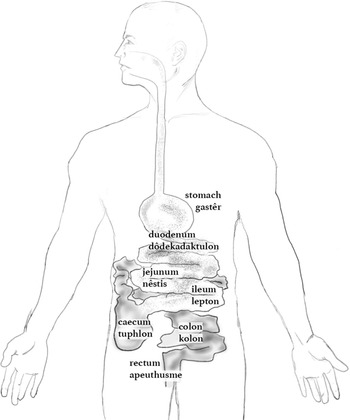
Changes in this period likely led to the adoption of a new anatomical nomenclature for the gastrointestinal tract during the Roman era, though the fragmentary nature of the evidence necessitates some speculation. Be that as it may, both Rufus of Ephesus (first century CE) and Galen of Pergamon (second and third centuries CE), our primary sources for anatomical terminology in the Roman period, utilise a new division of the intestinal tract into six parts: duodenum, jejunum, ileum (or thin intestine), colon, caecum, and rectum (Figure 4).Footnote 42 The ‘lower cavity’ does not appear as a proper name for any of the parts of the intestine.
A schematic description of the gastrointestinal tract according to Galen.

However, although the influx of anatomical knowledge derived from animal and human dissections led to abandoning the ‘upper cavity’ and ‘lower cavity’ terminology, it did not eliminate the bipartite conception of the gastrointestinal tract. For example, while Galen avoids the term ‘lower cavity’ as a reference to a swollen pouch in the large intestine that functionally resembles the stomach, he surprisingly posits the existence of such an organ in the first section of the large intestine, referring to its as ‘that which is called the blind intestine’, or caecum.
T6 ‘The caecum is, in fact, like some thick stomach suitable for the reception of residues (oion gastēr tis esti pacheia eis hupodochēn perittōmatōn epitēdeios), and the colon is analogous to it. In most birds, the caecum is double (ditton esti) because of their strong [sc. digestion] activity. Even if something has escaped absorption in the passage through the thin intestine, it is all completely extracted during the longer stay (epi pleon monē) in the caecum. And since the activity of the parts around the stomach and intestines are strong in almost all birds, there are two deposits of residues (apotheseis tōn perittōmatōn egenonto dittai), so nothing undrained (anexikmaston) might be left behind if the food passed through quickly, and the evacuation might occur all at once and not continuously and in small amounts (athroan eisapax, mē sunechōs kai kata brachu). But nature, having made one caecum for all humans and all terrestrial animals, placed it on the right side of the loin […].’Footnote 43
Galen does not discuss the lower cavity here. However, he describes the same anatomical structure that I proposed should be identified as such—the caecum.Footnote 44 His depiction of this part of the intestine is consistent with how sources from the fourth century BCE portray the lower cavity. Galen characterises it as a receptacle akin to the stomach, highlighting both its anatomical and functional–physiological similarities. That is, unlike other intestinal sections that primarily act as conduits for waste, the caecum, much like the stomach, is adapted for prolonged retention of faeces. This suggests, in its turn, an anatomical structure more akin to a cavity than a narrow tube.
Furthermore, Galen echoes the same teleological justification for this structure that we encountered earlier in Aristotle. This is unsurprising given Galen’s deep familiarity with Aristotle, his commitment to teleological reasoning, and even further elaboration of the ‘cooking’ theory of digestion and the logic of residue production.Footnote 45 Although Galen refers to a gastēr and a tuphlon enteron, the relationship he describes between them mirrors that of an anō koilia or anō gastēr to its lower counterpart.
Moreover, the persistence of this bipartite description serves as a reminder that human dissection was never the standard practice in Greco-Roman antiquity. Although our sources acknowledge that both Herophilus and Erasistratus engaged in such procedures, it remains evident that even they relied heavily on animal models for understanding human anatomy.Footnote 46 It is also clear that the vast majority of Galen’s first-hand dissection experience came from animals.Footnote 47 Unlike fourth-century BCE sources, who worked with multiple and often unreported animal anatomical models when discussing human anatomy, Galen formulated a developed hierarchy of reliable animal sources for human anatomy. His preferred model organism was the monkey (pithēkos).Footnote 48 This term refers, in all probability, to the Barbary macaque.Footnote 49 As with pigs, the caecum of the Barbary macaque is significantly larger than that of humans.Footnote 50 Therefore, it is reasonable to consider it a somewhat enlarged stomach. When combined with the heat-based digestion model and reinforced by the prestige of Aristotle’s authority, Galen had compelling grounds to adhere to the bipartite conceptualisation. Thus, the bipartite understanding of the gastrointestinal tract persisted through the significant transformations Greek medicine underwent between the classical and Roman periods, supported by similar theoretical commitments and zoocentric dissection practices.
Early modern anatomy
In late antiquity, Galen’s anatomical and physiological thought underwent progressive systematisation and regularisation by successive generations of teachers and commentators. The resulting medical theory, which came to be known as ‘Galenism’, was accepted by most physicians in the Byzantine, Arabic, and Latin medical traditions.Footnote 51 The significant variations between the different systematisations of Galen’s immense corpus need not concern us here. Suffice it to say that with regard to both the anatomy of the gastrointestinal tract and the physiology of digestion, there were no radical deviations from what we have briefly described above until the early modern period.
Sixteenth-century Europe, and particularly Italy, witnessed the revival of human and animal dissection on a scale unseen since the heyday of Ptolemaic Alexandria.Footnote 52 The emerging evidence from dissections, especially those conducted on human bodies, drew renewed attention to Galen’s description of the gastrointestinal tract. This was particularly the case in light of Andreas Vesalius’s (1514–64) explicit critique of Galen in his seminal 1543 work On the Fabric of the Human Body (De humani corporis fabrica libri septem). However, even shortly before this, Italian anatomists grappled with the challenge of reconciling Galen’s account with their first-hand experience, since it increasingly suggested the absence of an intestinal structure ‘like some stomach’. To understand this controversy, it is crucial to recognise that Galen’s description not only ascribes a structure to the human body that early modern anatomists failed to find—a stomach-like caecum—but it also overlooks a structure they readily identified: the vermiform appendix (commonly known simply as the appendix), a worm-like extension of the large intestine unique to humans.Footnote 53
A reasonable approach to resolving this discrepancy was to equate the ‘blind intestine’ Galen observed in animals with the human vermiform appendix. For instance, in his 1536 Introduction to Anatomy (Liber introductorius anatomiae), Venetian anatomist Niccolò Massa (1489–1589) commences his ninth chapter on the caecum by replicating Galen’s anatomy and physiology. He describes the caecum as storing faeces ‘so that its power might extract complete nourishment from the food. This intestine occupies the space on the right between the kidney and the thigh’. However, Massa’s personal observations diverge from Galenic orthodoxy. He notes the variability in the size of this structure across different bodies and then concedes:
T7 ‘And its size [sc. of the caecum] is not the same in everyone, as it is less in some and more in others […] [In some] its size exceeds that of the stomach […] I myself have dissected many (ego seccaui multos) in whom I did not find this large intestine. Indeed, it seemed to be the same substance as the colon (idem substantia cum colo). But in these [bodies], I found a certain hanging substance of the size of one finger in length, and in thickness like the thickness of the pen with which I write. And since this appendage is not found in those who have a manifest and ample intestinal sac [sc. caecum], I often thought that this appendage is the intestinal sac that was rendered inoperative in infancy.’Footnote 54
In essence, Massa attempts to reconcile dissection evidence with Galen’s descriptions, treating the vermiform appendix and the manifest caecum found in animals as analogous structures. Notice that Massa still operates under the assumption that the normative human body possesses an enlarged Galenic caecum, the underdevelopment of which sometimes results in what we now identify as the vermiform appendix. This is another reminder of Galen’s influence as an early modern anatomical authority.Footnote 55
Six years later, Vesalius’s critique extends Massa’s argument both in substance and anti-Galenic rhetoric:Footnote 56
T8 ‘I know what most people say about the caecum these days. They are surely deceived by the fact that Galen somewhere numbers the caecum among [the parts of the] large intestines, and it is described by him and the anatomists who have followed him as no less than a large pouch and like another stomach (neque aliter quam amplus quispiam saccus, ac ueluti alter quidem esset uentriculus). But nonetheless, what I think should be called the caecum in humans is shorter than all the other [parts of the] intestines and by far narrower and tighter than the tightest parts of all the other intestines, and is more like a thick worm coiled into circles than an intestine (et crassiori lumbrico in orbes conuoluto potius quam intestine simile)… Galen attributes to it a size and a use which it seems to certainly lack, describing his tailed apes (caudata simia) with this appendage rather than humans. Furthermore, had Galen, the greatest admirer of nature, ever observed human intestines as he had those of dogs, he would have described this protruding appendix at the beginning of the human colon, its contiguity with the ileum, and the shape of the colon very differently.’Footnote 57
Vesalius rejects the notion that some humans possess a Galenic caecum while others have an appendix. He argues that no human has an actual blind intestine akin to ‘another stomach’ (ueluti alter quidem uentriculus). Galen’s misdescriptions are attributed to his excessive reliance on animal bodies for understanding human anatomy. Vesalius, therefore, chooses outright rejection over reconciling the traditional bipartite conception with newly uncovered anatomical evidence.Footnote 58
In T8, Vesalius asserts that in human anatomy, the term ‘blind intestine’ (caecum intestinum) should refer to what we today call the appendix and not to the caecum. Although ultimately rejected by anatomists, this suggestion was debated during early modernity. Gabriele Fallopio (1523–62), in his Anatomical Observations (Observationes anatomicae), explicitly concurs with Vesalius, adding only minor details.Footnote 59 Conversely, Realdo Colombo (1516–59) rejects the identification of the animal caecum with the human appendix, arguing instead that these are distinct structures, with the human caecum being very small and inconspicuous. Juan Valverde (c. 1525–c. 1587), in his 1560 Research on the Composition of the Human Body (Historia de la composicion del cuerpo humano), dismisses the debate as irrelevant semantic squabbles.Footnote 60 However, all the authors agree that Galen’s descriptions of human bodies are inadequate. This not only shows Vesalius’s significant influence on subsequent early modern anatomical discussions, but it also highlights the enduring impact of the Greco-Roman bipartite descriptions in negotiating anatomy during this era, when inherited traditions, the original context of which was long gone, were combined with new technologies, techniques, and observations in articulating the insides of the human body.
Finally, the rejection of Galen’s depiction of the caecum did not yet prompt a revision of his broader physiological theories. Vesalius remains largely aligned with Galenic digestive principles, even after critiquing Galen’s anatomical description of the digestive tract.Footnote 61 Just pages after arguing that the caecum and the stomach are nothing alike, Vesalius adopts a now familiar intestinal physiology and teleology:Footnote 62
T9 ‘[The large intestine] mainly helps so that we do not evacuate continuously but at long intervals (ne continuo, sed per longa interualla). For these [intestines] are furnished as a kind of stomach (tanquam uenter aliquis) for dry excrements, as the bladder is for urine. And for this reason, some have called them the lower stomach (inferiorem uentrem).’Footnote 63
While rejecting the caecum’s anatomical resemblance to the stomach, Vesalius embraces broader functional similarities between the large intestine and the stomach as receptacles and storage organs. His physiology of the large intestine explicitly echoes Galen’s idea of a ‘second stomach’ (tanquam uenter aliquis; compare to ‘oion gastēr tis’ in T6) and Aristotle’s teleological reasoning that the lower cavity exists to prevent continuous evacuation. As I have argued, this view was originally rooted in the anatomical observation of the caecum’s cavity in non-human animals that naturally led to comparisons with the stomach. However, Vesalius’s own anatomical observations revealed the intestinal tract as a complex, winding maze without a clear and articulated cavity below the stomach. Despite this divergence from Galenic anatomy, Vesalius retains the idea of the ‘second stomach’ in his understanding of intestinal function.
Francis Glisson and new ideas about digestion
The concept of a ‘second stomach’ demonstrated remarkable resilience amidst not just shifting anatomical terminology and knowledge but also changing physiological theories. In the seventeenth century, dominant perspectives on digestion underwent a significant transformation. Although Galen acknowledged the role of acidity and fermentation in digestion, he primarily attributed the process to innate bodily heat.Footnote 64 Early in the sixteenth century, the polymath Paracelsus (c. 1493–1541) and the Dutch physician–chemist Jan Baptist van Helmont (1580–1644) began redefining digestion not as cooking but as acid-based fermentation (fermentatio).Footnote 65 Consequently, the body was reimagined not as a kitchen processing food but as a chemical or alchemical laboratory transforming substances. Thus, not only was the anatomical framework underpinning the bipartite model of the gastrointestinal tract dismantled, but so too was the accompanying physiological theory.
As a final example, I will briefly consider one figure from this period, the anatomist and natural philosopher Francis Glisson, who served as the Regius Professor of Physic at Cambridge from 1636 until he died in 1677.Footnote 66 Like many of his contemporaries, Glisson adhered to a fermentative digestion theory. His extensive anatomical knowledge and familiarity with previous anatomical literature made him acutely aware of the small size of the human caecum. Nevertheless, in his final publication from 1677, titled Treatise on the Stomach and Intestines (Tractatus de ventriculo et intestinis), he explicitly argues against a previous suggestion by Italian anatomist Fabricius d’Acquapendente (1533–1619) that the small size of the caecum in humans renders it functionless.Footnote 67 Glisson presents a comprehensive defence of the caecum’s functionality as a secondary or auxiliary stomach, albeit in non-human animals.Footnote 68
He begins his discussion of the caecum by addressing the elephant in the room, the ‘diversitatis ratio’—the reason why the human caecum is relatively tiny compared to its significantly larger counterparts in other animals. He explains that while humans consume easily digestible food, necessitating only one stomach (unus ventriculus sufficit), animals with a coarser diet require additional digestive mechanisms. Ruminants possess multiple stomachs, whereas non-ruminants utilise ‘another cavity serving as a stomach’ (alia cavitas quasi ventriculo vicaria). In animals with an enlarged caecum, a division of labour exists between the stomach and the caecum: ‘[W]atery and raw chyle is extracted from the stomach and small intestines, whereas fatty and succulent chyle is derived from the caecum’. Thus, this concept of a secondary stomach persisted well into the seventeenth century.
Conclusion
Initially, in the fourth century BCE, an anatomical understanding of the human gastrointestinal tract as having two cavities emerged from a convergence of three elements: a specific terminology that paired the stomach with a lower cavity, an anatomical perception derived primarily from animal dissection, and a physiological theory of digestion as cooking that required distinct receptacles for food and residues. The interaction between these elements was complex—anatomical observations of enlarged caeca in animals like pigs provided a structural basis that aligned with theoretical requirements for separate containers in the body, while the terminology of ‘cavities’ helped articulate this understanding.
In Galen’s work, while the terminology shifted away from explicit reference to two cavities, the anatomical and functional parallels between the stomach and caecum remained. The early modern period brought a more dramatic transformation, as Vesalius’s human dissections challenged the anatomical basis of the ‘second stomach’. Yet even as anatomists like Vesalius rejected the existence of a stomach-like caecum in humans, they preserved the functional analogy between the large intestine and the stomach as storage organs. Finally, in Glisson’s work, we see how this conception could be reframed within new theories of digestion while being restricted primarily to non-human anatomy.
The existence of the ‘lower cavity’ as an operative anatomo-physiological idea was always dynamically negotiated between three complementary poles: the animal body, the human body, and the authoritative texts of the past (Aristotle and others for Galen, Galen and Aristotle for the early moderns). More to the point, the animal body and the authoritative texts that transposed it onto the human frame have exerted a remarkable influence on the way human anatomy was imagined, even in the face of systematic human dissections. Messa, Vesalius, and Glisson, and to a limited extent also Galen, give witness to the malleability of the human body before the other poles of this triangle. Each in his own way, shaped by their idiosyncratic relationship to past authorities, access to human and non-human dissection subjects, and personal agendas, attempted to resolve the tension between the unobservability of a ‘stomach-like’ anatomical structure in human bodies and its existence in authoritative descriptions and some animal bodies.Footnote 69 Anatomical knowledge in premodern medicine was not simply a matter of observation versus authority, or human versus animal anatomy. Rather, it emerged from a continuous process of negotiation between these different sources of knowledge.Footnote 70
Finally, I would like to suggest a possible reason for this peculiar idea’s longevity. The ‘lower cavity’ is far from being the only defunct scientific notion in the long history of Western science. As Hasok Chang observes, ‘The history of science appears as a graveyard of dead epistemic objects.’Footnote 71 Luminiferous ether, phlogiston, caloric, ‘Hippocratic’ humours, and Empedoclean elements all lie as remnants of obsolete scientific theories. Two characteristics are common to these examples: they are defunct epistemic objects, and they were once grand, contentious, and pivotal in their respective fields. Their emergence and decline trace the trajectories of their associated paradigms and worldviews. Conversely, some concepts, such as temperature, weight, and up and down, which are too fundamental to vanish together with the dominant theory through which they are explained and used in each period, consistently acquire new interpretations and significances as time passes.Footnote 72 However, our subject—the bipartite gastrointestinal tract—does not share the prominence of either category. It was neither crucial enough in Aristotelian, Galenic, or Vesalian systems to figure prominently in debates about them, nor was it essential to any subsequent systems that followed. This relative obscurity allowed the idea of a ‘second stomach’ to circulate freely, almost as if by inertia, detached from its original context. It was not perceived as threatening enough to warrant outright rejection, and it retained a semblance of credibility due to its historical presence and widespread acceptance. At the end of the day, ‘living off the grid’ might be one of the best strategies for surviving, even thriving, in the dangerous marshes of the history of science and medicine.
Acknowledgements
This paper is based in part on the author’s MA dissertation, written at the Department of Classical Studies at the Hebrew University of Jerusalem under the supervision of Orly Lewis and funded by the European Research Council (ERC) under the European Union’s Horizon 2020 research and innovation programme (Project ATLOMY, GA 852550). The author thanks both Project ATLOMY and the Jack, Joseph and Morton Mandel School for Advanced Studies in the Humanities at the Hebrew University of Jerusalem for generous support during the research for this paper. The author thanks Orly Lewis, Marco Vespa, Pavel Gregorić, Donna Shalev, and Orna Harari for their comments on the dissertation and previous versions of the paper. The author thanks Elsevier Health Sciences for permission to reproduce Figure 3, Aviv Keshet for all other figures and illustrations in the paper, and Tim DeBold for his editorial services.
Financial support
Research for this paper was funded by the European Research Council (ERC) under the European Union’s Horizon 2020 research and innovation programme (Project ATLOMY, GA 852550; PI Orly Lewis) and by the Jack, Joseph and Morton Mandel School for Advanced Studies in the Humanities at the Hebrew University of Jerusalem.



 Open access

