


Lactase non-persistence (LNP) is as an autosomal recessive trait leading to down-regulation of lactase activity in the intestinal mucosa and to maldigestion of lactose( Reference Sahi, Isoloski and Jussila 1 ). Milk and some dairy products contain lactose, a disaccharide hydrolysed by the enzyme lactase-phlorizin hydrolase to glucose and galactose in the brush border of the small intestine. LNP is widespread throughout the world and plays an important role in the everyday work of general practitioners, gastroenterologists and paediatricians( Reference Apley and Naish 2 ).
The diagnosis of lactase persistence (LP) and LNP has by definition been based on the measurement of lactase, sucrase and maltase activities and the lactase to sucrase ratio in intestinal biopsies( Reference Messer and Dahlqvist 3 ). This is an invasive technique that is not suitable for primary exploration of abdominal complaints or for large-scale population studies of the effect of LNP on anthropometric or nutritional variables.
Enattah et al. identified in 2002 the position of the LP-associated allele as a single nucleotide polymorphism C > T located 13·9 kb upstream of the first ATG of LCT. The single nucleotide polymorphism is located in intron 13 of the MCM6 gene. Homozygosity for the C allele (LCT-13910 CC) shows for all practical purposes a complete association with LP in populations of European descent( Reference Enattah, Sahi and Savilahti 4 , Reference Rasinperä, Kuokkanen and Kolho 5 ). Molecular epidemiological studies have shown that the prevalence of LNP assessed by genotyping is consistent with previously published phenotypically determined epidemiological data in more than seventy countries( Reference Järvelä 6 ). Different test methods in the diagnosis of LNP, including the standard physiological tests, are useful at different levels of health care organisation or symptomatology( Reference Arola 7 ).
The majority of heterozygous individuals, having intermediary levels of lactase activity in intestinal biopsies, are traditionally thought to produce sufficient lactase to be classified by the standard physiological tests as LP( Reference Nilsson and Johansson 8 ), but pre-2002 studies can hardly be regarded as conclusive. One of the aims of this study was to look for a potential gene–dose effect of the LCT-13910 C > T polymorphism with respect to some nutritional variables in children and adolescents.
Milk and other dairy products are major dietary sources of Ca in Western diets( Reference Rafferty and Heaney 9 ) and the diet of LNP individuals may be restricted as regards milk intake. The main hypothesis tested in this study was that LNP might influence the intake of Ca and vitamin D through its effects on milk consumption, since there is mandatory fortification of milk with vitamin D in Sweden. We were also interested in seeing whether milk avoidance, which is partly a lifestyle and behavioural/attitudinal variable, was associated with the LCT-13910 C > T polymorphism.
Methods
Population
Blood samples were obtained from 684 children (334 girls and 350 boys) belonging to the Swedish part of the European Youth Heart Study, which is a cross-sectional school-based study of risk factors for future CVD among children 9–10 years old and adolescents 15–16 years old. Mean ages in the Swedish sample were 9·6 years and 15·6 years, respectively. Sampling procedures and participation rates have been described previously( Reference Wennlof, Yngve and Sjöstrom 10 ).
Height, weight, hip and waist circumference were directly measured by standardised procedures. BMI was calculated as weight/heightReference Apley and Naish 2 (kg/m2). The consumption of milk was assessed by an interviewer-mediated 24-h recall. A qualitative food record completed on the day before the interview served as checklist for the data obtained by 24-h recall. A food atlas was used to estimate portion sizes. Dietary data were processed by StorMats (version 4.02; Rudans Lättdata) and analysed using the Swedish National Food database (version 99.1). Total Ca intake was calculated in mg/d and vitamin D intake was calculated in μg/d.
For the genetic analysis genomic DNA was isolated from the EDTA whole blood samples from the individuals with the QIAamp DNA Blood Mini Kit spin procedure. The DNA fragment spanning the -13910-C/T polymorphic site was genotyped by pyrosequencing, using a PSQ96 SNP reagent Kit and a PSQ 96MA system (Pyrosequencing AB) PSQ96MA 2.0.1 software. The procedure has been previously described in detail( Reference Nilsson and Johansson 8 ).
Statistical analysis
Statistical analyses were performed with the Statistical Package for Social Sciences (SPSS, version 13.0 for Windows; SPSS Inc., Chicago). The data are presented as means and standard deviations in Table 1. The Student's t test for differences was used to compare the LCT-13910 TT and LCT-13910 CT and CC genotypes concerning nutritional and anthropometric data. Data were checked for normality. Quantitative effects of the LCT-13910 C > T genotype on the selected anthropometric and food intake related variables were tested in three-way ANOVA models with the fixed factors age group (children/adolescents), sex (girls/boys) and LCT-13910 C > T genotype with the levels TT/CT v. CC. A qualitative variable ‘complete milk avoidance’ (yes/no) was generated from the continuous variable, intake of milk (g/d), present in the dietary survey. The OR for complete milk abstinence was tested separately in children and adolescents by logistic regression with sex and LCT-13910 C > T genotype with the levels TT/CT v. CC as covariates.
Anthropometric and nutritional variables according to the LCT-13910 C > T genotype
(Mean values and standard deviations)

ANOVA was used with genotype CT/TT v. CC, sex and age group as factors and dichotomous categories (*P < 0·05, **P < 0·001).
Mendelian randomisation
Since the carriage of the LCT-13910 C > T polymorphism is subject to random assortment of maternal and paternal alleles at the time of gamete formation, associations between LCT genotypes and our observational data should not be subject to reverse causality. This is a basic assumption of Mendelian randomisation( Reference Davey Smith and Ebrahim 11 , Reference Davey Smith and Ebrahim 12 ), which examines causal effects of modifiable exposures on disease in genetic epidemiology. A functional genetic variant, in our study LCT-13910 C > T polymorphism, acts as a proxy for modifiable lifetime exposure patterns (milk consumption). The LCT-13910 C > T polymorphism is known to influence milk consumption( Reference Swallow 13 ). According to Mendel's second law of independent assortment, the inheritance of one trait is independent of the inheritance of other traits. Thus, associations between genetic variants and outcome are not generally confounded by behavioural, physiological or environmental exposures, and observational studies of genetic variants have similar properties to intention-to-treat analyses in randomised controlled trials( Reference Davey Smith and Ebrahim 11 , Reference Davey Smith and Ebrahim 12 , Reference Ebrahim and Davey Smith 14 , Reference Lewis 15 ).
This study was conducted according to the guidelines laid down in the Declaration of Helsinki and all procedures were approved by the Research Ethics Committees of Örebro County Council and Huddinge University Hospital. Parents and 15-year-olds gave specific written informed consent to participate in the present study.
Results
Distribution of the LCT-13910 C > T genotype showed that the CT and TT genotypes, which are associated with LP, were found in 273 and 317 subjects, respectively. The genotype LCT-13910 CC, associated with LNP, was found in ninety-four subjects. The baseline characteristics including selected anthropometric and milk intake-related variables of these three genotypes are shown in Table 1. There were no statistically significant differences between the genotypes CT and TT in any of the selected variables. Intermediary phenotypes for LCT-13910 C > T heterozygous subjects were thus not observable with respect to these anthropometric and food intake data in the studied population. In subsequent analyses the effect of the LCT-13910 C > T polymorphism was tested by using two levels: TT/CT v. CC.
As shown in Table 1, the LCT-13910 CC genotype was associated with statistically significantly lower levels of the following variables: milk intake, energy intake from milk and Ca intake. No statistically significant interactions of the LCT-13910 C > T genotype with age and sex for the selected variables were found. Height, weight, BMI, hip circumference and waist circumference as well as total daily energy intake and vitamin D intake did not differ significantly between the LCT-13910 C > T genotypes in these ANOVA models.
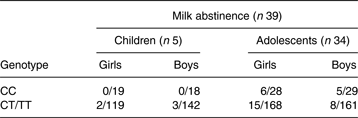
The odds for milk avoidance due to the subjects' LCT-13910 C > T genotype was tested (Table 2). Only five children avoided milk, and none of these had the CC genotype. Among adolescents, milk avoidance was more frequent (n 34): the OR for subjects with LNP compared with LP subjects was 3·2 (95% CI 1·5, 7·3, P = 0·003), with sex and LCT-13910 C > T genotype as covariates in the model. Milk protein allergies were not reported in the studied population.
Frequency distribution for complete milk avoidance by LCT-13910 C > T genotype and sex among the studied children and adolescents
Discussion
The main finding was that LNP subjects had a lower milk consumption, a lower daily energy intake based on these products and a lower Ca intake. These differences did not translate into any difference in total daily energy intake. Furthermore, no signs of increased indicators of body fat in LP individuals could be observed.
No evidence was found for a gene–dose effect of the LCT-13910 C > T mutation in the studied sample. An intermediary phenotype could not be identified with respect to the studied nutritional and anthropometric variables (Table 1), in accordance with the traditional view of ‘lactose intolerance’ as a recessive trait. However, we cannot rule out such a gene–dose effect in adults, in subjects of other populations, or with respect to other possible LCT-dependent phenotypes not yet studied. Hence, further studies are needed to verify the absence or presence of a gene–dose effect.
The other main finding was that the LCT-13910 C > T polymorphism influences complete milk avoidance among adolescents (Table 2). The lower milk intake of LNP adolescents could be a cause of concern as trends of replacement of milk by soft drinks have been reported, and appear to be detrimental to bone health( Reference Whiting, Vatanparast and Baxter-Jones 16 , Reference Tolonen, Laaksonen and Mikkilä 17 ). Milk constitutes a basic source of dietary Ca in most Western diets, and adequate Ca intakes are directly related to the consumption of these food items. Frequently, milk is being replaced as a beverage of choice by sweetened and carbonated soft drinks and juices( Reference McGartland, Robson and Murray 18 , Reference Storey, Forshee and Anderson 19 ). In addition, limiting milk in the diet might in some cases lead to the necessity for dietary adjustments beyond meeting only Ca requirements. The critical role of Ca in human health has been recognised for many years, as reflected by a long history of Ca recommendations( Reference Mertz 20 ). LP children and adolescents consumed significantly more milk than LNP subjects, and LP did not reveal any tendency towards increased BMI or other indicators of obesity. This observation has been confirmed by an earlier study performed by the authors on the same sample using body fat percentage as a variable( Reference Almon, Patterson and Nilsson 21 ).
Vitamin D intake was in both LNP and LP subjects below the recommended intakes issued by the Swedish National Food Agency (updated 9 October 2012). The Swedish National Food Agency's recommended intake for vitamin D is 7·5 µg per d for the studied sample of children and adolescents. Independently of genotype, age group or sex all subjects did not meet recommended intakes for vitamin D (Table 1).
Limitations of this study are sample size and age of onset of LP that can show a wide regional and ethnic variation. Genetically programmed down-regulation of lactase-phlorizin hydrolase synthesis has been observed starting from the second year of life. The majority of Thai children manifest LNP by the age of 2 years and in black populations genetically determined lactose intolerance manifests between 1 and 8 years. In white populations, it is rarely seen before 5 years of age( Reference Simoons 22 , Reference Keusch, Troncale and Thavaramara 23 ).
In this study two different age groups were compared, 9-year-old children (mean age 9·6 years) and 15-year-old adolescents (mean age 15·6 years). Thus, it can be assumed that the majority of children and almost all adolescents with the LCT-13910 CC genotype had developed manifest LNP at the time of inclusion in this study. However, the correlation between manifest LNP and self-reported ‘lactose intolerance’ has been suggested earlier to be poor in a few other studies( Reference Gugatschka, Dobning and Fahrleitner-Pammer 24 – Reference Lehtimäki, Hemminki and Rontu 26 ).
Almost all children and many adolescents with the CC genotype consumed some amount of milk even though having LNP status. This is compatible with many studies showing that LNP subjects can tolerate a certain amount of lactose intake per d( Reference Savaiano, Boushey and McCabe 27 – Reference Scrimshaw and Murray 29 ). Other individuals do not consume milk and dairy products because of health reasons such as milk protein allergies, perceived ‘lactose-intolerance’, taste preferences or dietary culture and fashion.
Mendelian randomisation was used in this study. The main assumption in this study is that LP (lactose tolerant) individuals consume on average significantly more milk than LNP (lactose intolerant) individuals throughout their lifetime, and not only at the moment dietary intakes were assessed. If this assumption is correct, the LCT-13910 C > T polymorphism can be used as a proxy measure for lifetime exposure to milk and dairy intake patterns. Cultural influences on milk consumption might be able to override the discomforts consequent on milk ingestion in lactose-intolerant individuals. This, nevertheless, could not be observed in our sample. Neither have we been able to observe this in another sample representative of the general population of the Canary Islands in Spain( Reference Almon, Alvarez-Leon and Engfeldt 30 ).
In summary, LNP in children and adolescents is associated with reduced intake of milk and particularly Ca. This reduced intake did not affect the studied anthropometric variables with respect to indicators of body fat. Reduced intake of Ca could be compensated by consumption of dairy products with lower amounts of lactose than milk. Heterozygous subjects did not show an intermediary phenotype. Estimated vitamin D intake unexpectedly did not differ between LP and LNP subjects, although milk is regularly fortified with vitamin D in Sweden. Independently of genotype, age and sex, overall daily vitamin D intake was below recommended intakes.
Acknowledgements
This study was supported by grants from Örebro Läns Landstings Forskningskommitté and by Nyckelfonden, Örebro, Sweden. Stockholm County Council, Sweden is acknowledged for the collection of blood samples. We are grateful to Associate Professor Olle Carlsson for statistical advice. There are no conflicts of interest to declare. R. A. wrote the paper. M. S. provided the data from the European Young Heart Study. T. K. N. performed the genetic analyses. M. S., T. K. N. and R. A. analysed the data and designed the study. All authors read and approved the final manuscript.


 Open access

