

Introduction
Raising the retirement age across developed economies has been a key policy initiative that has contributed to a reversal of the trends of early retirement that emerged in the latter part of the twentieth century (Ebbinghaus and Hofäcker Reference Ebbinghaus and Hofäcker2013). Greater numbers of employees now expect, and are expected to, work up to and past the state pension age and will experience different end-of-career patterns than previous generations. For their part, employers need to respond to the changing workplace landscape by developing practices that sustain older workers’ employability throughout their working lives (Van der Heijden et al. Reference Van der Heijden, De Lange, Demerouti and Van der Heijde2009).
Over the past years, scholarly research has investigated determinants of employee retirement (for a meta-analysis, see Topa et al. Reference Topa, Moriano, Depolo, Alcover and Morales2009) and a growing body of empirical work has focused on the employer's impact in shaping retirement behaviours (Barnes, Smeaton and Taylor Reference Barnes, Smeaton and Taylor2009; Conen, Henkens and Schippers Reference Conen, Henkens and Schippers2012; Loretto and White Reference Loretto and White2006; McNair, Flynn and Dutton Reference McNair, Flynn and Dutton2007; Taylor and Walker Reference Taylor and Walker1998; Vickerstaff, Cox and Keen Reference Vickerstaff, Cox and Keen2003). However, empirical studies also need to address the role of different organisational actors in age management and in the retirement process. Although it is widely acknowledged that line manager or supervisor support is important in achieving positive older workers’ outcomes (Armstrong-Stassen and Schlosser Reference Armstrong-Stassen and Schlosser2010; Van Solinge and Henkens Reference Van Solinge and Henkens2014), up to now, only a limited body of research has focused on how line managers themselves respond to employee retirement scenarios. Significantly, a small number of studies suggest that managers are extremely reluctant to discuss retirement plans with older workers, even though those employees may in fact be willing to work longer if asked (Henkens, Van Solinge and Cozijnsen Reference Henkens, Van Solinge and Cozijnsen2009; Mountford Reference Mountford2011; Van Dalen et al. Reference Van Dalen, Henkens, Henderikse and Schippers2010). It is therefore important to understand in greater depth the dynamics of this area of the managerial role, and in this contribution we extend the literature by examining manager openness to involvement in the employee retirement process in terms of how manager psycho-social characteristics, their decision-making environment and situational characteristics they face (older employee attributes) influence their perspective.
Specifically, this paper reports a study of managers in the university sector of the United Kingdom (UK) in which vignettes are used to simulate older employee situational factors. The approach contributes to a growing body of research within the gerontological field that is based on vignettes, pioneered by Professor Kène Henkens and his team at the Netherlands Interdisciplinary Demographic Institute. The vignette approach has the advantages of allowing systematic consideration of factors that may influence manager cognition, reducing the risk of social desirability bias in manager responses and allowing the research to access a much greater variety of scenarios than would be available to managers in real life. In the next section, we will discuss the complexities of manager involvement in employee retirement and then describe the study's theoretical framework. Following the Methods section which describes the study, the Results section presents the analysis of the influence of manager psycho-social characteristics, decision-making environment and older employee situational factors on manager decision preferences. The final section discusses and reflects on these findings and draws out practical implications.
Manager involvement in employee retirement
Manager involvement in employee retirement might appear contradictory. Until relatively recently, retirement was considered to be a largely individual and private affair (Henkens, Van Solinge and Cozijnsen Reference Henkens, Van Solinge and Cozijnsen2009) that did not fall naturally within the normal remit of the supervisor–subordinate management relationship (Mountford Reference Mountford2011). Organisationally fixed mandatory retirement ages typically determined the upper limits of retirement timing and these arrangements were supported by social norms which often constructed retirement as a well-deserved individual entitlement (Ebbinghaus Reference Ebbinghaus2006; Hanisch and Hulin Reference Hanisch and Hulin1990). However, public policy to extend working life, changes in retirement regulations, such as the abolition of the mandatory retirement age in the UK in 2011, and the relaxation of social norms have disaggregated retirement pathways (Altman Reference Altman2015) and have resulted in fewer restrictions in relation to the timing, speed and specific nature of workers’ retirement (Wang Reference Wang2012). Contemporary retirement is increasingly characterised by a more gradual transition between work and non-work, a phase that may span over an extended period of time during which individuals may reduce their income, work fewer hours and reduce their psychological attachment to work (Shultz and Wang Reference Shultz and Wang2011). It follows that employees expect employers to respond to their needs by allowing them to tailor their end-of-career working patterns. In this process, line managers will inevitably be exposed to decision-making in these individualised arrangements.
However, the changes in the retirement landscape entail greater ambiguity for managers who may find themselves unclear about the scope and boundary of their role. The literature has identified many ways in which supervisors can influence retirement decisions (Henkens, Van Solinge and Cozijnsen Reference Henkens, Van Solinge and Cozijnsen2009). Managers can influence older workers directly through the opportunities made available – or denied – through their discretionary influence on flexible retirement arrangements and idiosyncratic deals. Managerial support can influence the work climate and culture (such as the tolerance of age stereotypes): in particular, supervisory social support has been found to increase the likelihood of later retirement (Armstrong-Stassen and Schlosser Reference Armstrong-Stassen and Schlosser2010). Managerial involvement in decisions around retirement can be proactive (e.g. by initiating discussions about future plans) but it may also be reactive (such as responding to a specific request for part-time working from the employee). For managers, understanding older employees’ retirement preferences and intentions assists operational management as well as succession planning. Managers could benefit significantly if they were able to encourage a skilled and valuable employee to delay retirement or work flexibly or to encourage less-desirable employees to retire. Effective skills in handling retirement-related conversations have the potential to contribute to strategies to help contribute to managing the workforce.
However, involvement in these discussions can be risky. Age discrimination legislation can make explicit dialogue about retirement arrangements with employees complex and potentially hazardous as direct and overt questions about individuals’ retirement intentions might be understood by employees as discriminatory. Public guidance to employers (e.g. from the Advisory, Conciliation and Arbitration Service in the UK) about managing retirement advocates that employer and employee should hold regular discussions about a range of workplace matters, inter alia, possible participation in training and career development programmes, aims and aspirations, and future plans. This type of advice emphasises that discussions should be conducted in an atmosphere of trust, and that supervisor's questions must not be discriminatory. Achieving the appropriate balance in such conversations requires skilful managerial competence, and many managers may conclude that it would be safer to avoid initiating or responding to any conversations at all around retirement plans.
In recent years, the scholarly research of Henkens and his associates have made a significant contribution to the development of the vignette methodology to understand the content of managerial decision-making pertaining to older workers in the Netherlands. They have variously studied supervisors’ evaluation of the early retirement of their subordinates (Henkens Reference Henkens2000), the effects of negative stereotypes of older workers on managers’ preferences for retaining older workers (Henkens Reference Henkens2005), the influence of employer-level characteristics and employee attributes on manager recommendations for early retirement (Henkens, Van Solinge and Cozijnsen Reference Henkens, Van Solinge and Cozijnsen2009), recruitment of early retirees (Karpinska, Henkens and Schippers Reference Karpinska, Henkens and Schippers2011, Reference Karpinska, Henkens and Schippers2013a), manager retention and re-hire decisions (Karpinska, Henkens and Schippers Reference Karpinska, Henkens and Schippers2013b; Ouder Mulders et al. Reference Ouder Mulders, Van Dalen, Henkens and Schippers2014) and training opportunities for older workers (Karpinska et al. Reference Karpinska, Henkens, Schippers and Wang2015).
However, this strand of research has not yet explored empirically the central question of whether managers are actually open to any involvement with employee retirement. Prior research suggests that managers tend to be reluctant to discuss retirement plans with older workers (Henkens, Van Solinge and Cozijnsen Reference Henkens, Van Solinge and Cozijnsen2009; Mountford Reference Mountford2011; Van Dalen et al. Reference Van Dalen, Henkens, Henderikse and Schippers2010). We assume that insights into managers’ perspectives on their role in relationship to retirement decision-making and the antecedents influencing their judgements may help them to inform theory and practice.
Theoretical framework and hypotheses
In examining manager openness to involvement in retirement, we will focus on two sets of explanatory variables that relate to the manager context: manager psycho-social characteristics and their decision-making environment. We will also examine the situational contingency the manager faces by including older employee situational factors (simulated in this study through vignettes) into the study. In the following sections, the theoretical grounding for the development of the hypotheses to be tested in this empirical study is outlined.
Manager psycho-social characteristics
Compared with some other management activities, managing retirement is a relatively infrequent and so less familiar activity for managers. Since knowledge is represented as exemplars which correspond to instances of experience (Nosofsky Reference Nosofsky1988), a manager's knowledge of a domain will vary according to the structure of his or her prior experiences (Litchfield and Gentry Reference Litchfield and Gentry2010). As a consequence, managers’ experience of managing older workers may influence their overall attitude towards involvement in an older worker's retirement decision-making process. Less-experienced managers will have few real-life exemplars to draw on and so be less able to recognise the role they might have in employee's retirement. However, as their experience of managing older employees and retirement situations grows, the scope for potential discretionary influence and intervention will become more apparent. This led us to expect that experience of managing older workers will be positively associated with higher openness to involvement in employee retirement (Hypothesis 1).
Managers’ own retirement intentions may also shape their attitude to employee retirement. Powerful social norms have prescribed what is considered to be appropriate retirement behaviour and timing (Radl Reference Radl2012; Settersten Reference Settersten and Settersten2003; Tordera, Potočnik and Peiró Reference Tordera, Potočnik and Peiró2009). Managers, along with other organisational members, are likely to have internalised preconceptions about the age at which retirement should occur in others (Karpinska, Henkens and Schippers Reference Karpinska, Henkens and Schippers2013b; Lawrence Reference Lawrence1996) as well as hold preferences for their own earlier or later retirement. Psychological research shows that individuals seek to understand the perspective of others by initially anchoring on their own perspective (Tversky and Kahneman Reference Tversky and Kahneman1974), and only subsequently account, serially and effortfully, for differences between themselves and others (Epley et al. Reference Epley, Keysar, Van Boven and Gilovich2004; Tversky and Kahneman Reference Tversky and Kahneman1974). This line of reasoning suggests that managers will anchor their attitudes to employee retirement from the position of their own retirement attitudes (Taylor and Walker Reference Taylor and Walker1998). We therefore predicted that managers’ later retirement expectations will be positively associated with higher openness to involvement in employee retirement on the grounds that they will have a better understanding of and recognise the possibilities of not conforming to social norms of retiring at an ‘expected’ age (Hypothesis 2).
Manager decision-making environment
Middle-level managers operate in complex organisational contexts in which their decision-making and scope for manoeuvre is typically constrained by organisational policies. The devolution of human resource decisions to middle-level managers has been a key theme in the Human Resource Management literature (Ahlstrom, Hall and Taylor Reference Ahlstrom, Hall and Taylor2008; Bond and Wise Reference Bond and Wise2003; Colling and Ferner Reference Colling and Ferner1992; Cunningham and Hyman Reference Cunningham and Hyman1999; Hales Reference Hales2006; Teague and Roche Reference Teague and Roche2012). In medium to larger organisations, middle managers normally have little involvement in the development of core employment policy. However, they are frequently influential in the contextualisation and implementation of organisational policy at the local level, e.g. deciding whether part-time work or flexible working is feasible locally (Flynn Reference Flynn2010). Because influence over local policy is expected to increase managers’ knowledge of the domain as well as foster a sense of legitimacy to act, we expected that a stronger perception of influence in local retirement policy will be positively associated with higher openness to involvement in employee retirement (Hypothesis 3).
Even without influence over policy-making, managers may feel able to exercise discretion in implementing policy. A sense of discretion can be interpreted as a feeling of empowerment and the ability to take decisions within organisational constraints (Hambrick and Finkelstein Reference Hambrick and Finkelstein1987), a leadership capacity which allows organisations to respond and adapt to changing demands and circumstances (Espedal Reference Espedal2015; Hambrick and Finkelstein Reference Hambrick and Finkelstein1987) and to avoid rigidity. Furunes, Mykletun and Solem (Reference Furunes, Mykletun and Solem2011) noted that in order to act, managers must have both scope for intervention (latitude) and must perceive that they are able to exert influence within the constraints faced (Phillips et al. Reference Phillips, Berman, Elms and Johnson-Cramer2010). In the context of openness to involvement in employee retirement, managers who feel empowered to use discretion in managing older workers will be more likely to have a sense of agency to become involved in employee retirement. We therefore predicted that a higher perceived level of discretion in the management of older workers will be positively associated with higher openness to involvement in employee retirement (Hypothesis 4).
Finally, the development of a sense of decision latitude can derive from reading organisational signals and is more likely to be enacted when managers consider that their decisions will be supported by the organisation generally, and their own managers specifically. So it is hypothesised that a higher perceived sense of support in decision-making from managers’ own superiors will be positively associated with higher openness to involvement in employee retirement (Hypothesis 5).
Older employee situational factors
Research on decision-making suggests that people make decisions and judgements in part by the cues that are present in the situation in which choices are made, that is, situational factors (Cottrell Reference Cottrell1942; De Ridder and Kerssens Reference De Ridder and Kerssens2003; Steg et al. Reference Steg, Bolderdijk, Keizer and Perlaviciute2014), and employee-level factors have been examined in a number of other studies of managerial assessments of older workers (Henkens, Van Solinge and Cozijnsen Reference Henkens, Van Solinge and Cozijnsen2009; Karpinska, Henkens and Schippers Reference Karpinska, Henkens and Schippers2013b; Ouder Mulders et al. Reference Ouder Mulders, Van Dalen, Henkens and Schippers2014). Managers are likely to be sensitive to the potential losses (or gains) for the organisation of an individual employee's retirement, and it follows that they will shape the content of their advice, support and opportunities offered to a potential retiree, to achieve a desirable outcome, either for the organisation, or for the employee. As managers are inherently reluctant to become involved in employees’ retirement decisions (Henkens, Van Solinge and Cozijnsen Reference Henkens, Van Solinge and Cozijnsen2009; Mountford Reference Mountford2011; Van Dalen et al. Reference Van Dalen, Henkens, Henderikse and Schippers2010), the research question arises as to which older employee situational factors are sufficiently important to influence manager openness to involvement in employee retirement. We will discuss below four relevant employee situational factors: work performance, difficulty of replacement, retirement attitude and work attitude.
Research has emphasised that employee work performance is highly salient to managers in their retirement evaluations and that managers will be more likely to prefer to retain an older employee who performs well than one who performs poorly (Henkens Reference Henkens2005; Rosen and Jerdee Reference Rosen and Jerdee1982). Rosen and Jerdee (Reference Rosen and Jerdee1982) found that retirement recommendations were not rated as desirable by managers for high-performing employees. Henkens (Reference Henkens2000) found that against a backdrop of strong overall preferences for early retirement of older workers, supervisors’ preferences for earlier retirement were less strong if the retirement of older workers was expected to result in loss of valuable know-how and experience. As employee performance is broadly associated with organisational functioning, we predicted that employee performance would be sufficiently salient to managers that it would be associated with manager openness to involvement in employee retirement (Hypothesis 6).
Decisions relating to older workers are associated with broader labour market considerations (Henkens, Van Solinge and Cozijnsen Reference Henkens, Van Solinge and Cozijnsen2009) and the general ageing of the population is predicted to result in shortfalls in working-age employees, implying that employers will need to focus on retaining existing older staff and their skills (Altman Reference Altman2015; Barnes, Smeaton and Taylor Reference Barnes, Smeaton and Taylor2009). However, employees are not a homogenous population and individual employees offer different combinations of uniqueness and strategic value to organisations, requiring variations in the management strategies used to retain them (Lepak and Snell Reference Lepak and Snell2002). Research has already demonstrated that managers are sensitive to prevailing labour market conditions in making decisions relating to retirement-related recommendations (Henkens, Van Solinge and Cozijnsen Reference Henkens, Van Solinge and Cozijnsen2009; Karpinska, Henkens and Schippers Reference Karpinska, Henkens and Schippers2013b; Ouder Mulders et al. Reference Ouder Mulders, Van Dalen, Henkens and Schippers2014). Applied to manager openness to involvement, where a potential retiree's skills could be replaced readily in the labour market, there would be little need for any specific managerial involvement. However, in cases where the potential retiree possesses unique skills or knowledge that are difficult to replace, managers are likely to assume greater involvement in their retirement and be motivated to encourage the employee to continue working. Therefore, we expected that the difficulty of replacement of an employee is associated with manager openness to involvement in employee retirement (Hypothesis 7).
Finally, we considered an older employee's attitudes to retirement and work as potential determinants of manager openness to involvement in employee retirement. Aspirations vis-à-vis retirement vary; some older workers greatly look forward to retiring as a positive life transition (positive retirement affect) whereas others fear retirement (negative retirement affect) as the ‘beginning of the end’ or as a loss of a valued identity (Hornstein and Wapner Reference Hornstein and Wapner1985). Work attitudes for older workers are complex. The work motivation literature suggests that older workers may hold different types of at-work motivation than younger workers, e.g. preferring generative and intrinsically rewarding tasks over financial reward (Kanfer and Ackerman Reference Kanfer and Ackerman2004). These differences in types of motivation may be interpreted by some managers as lower overall motivation to work and the age stereotype literature has shown that indeed managerial perceptions of older workers often assume poor or low work motivation (Ng and Feldman Reference Ng and Feldman2012).
Prior studies indicate that managers rate employee attitudes to retirement and work as important factors when making decisions (Henkens, Van Solinge and Cozijnsen Reference Henkens, Van Solinge and Cozijnsen2009; Rosen and Jerdee Reference Rosen and Jerdee1982). There are various reasons why these retirement and work preferences may be taken into account by managers. Although attitudes to retirement and work may be perceived as motivational issues and may well be quite distinct from one another (Newman, Jeon and Hulin Reference Newman, Jeon, Hulin and Wang2012), managers may interpret them as being the mirror image of one another: that is, an employee who looks forward to retirement may be assumed to have low motivation to work; and a person who does not look forward to retirement may be assumed to enjoy work. A somewhat different line of reasoning behind these relationships is that managers may also hold loyalties to employees and may feel responsible for facilitating employees’ own life aspirations (Ahlstrom Reference Ahlstrom2013). So, in line with previous studies (Henkens, Van Solinge and Cozijnsen Reference Henkens, Van Solinge and Cozijnsen2009; Karpinska, Henkens and Schippers Reference Karpinska, Henkens and Schippers2013b), we predicted that an employee's retirement attitude (whether they look forward to retirement or not) will be associated with manager openness to involvement in employee retirement (Hypothesis 8) and that an employee's work attitude (whether they enjoy work or not) will be associated with manager openness to involvement in employee retirement (Hypotheses 9).
Methods
Sample and procedure
To test the proposed hypotheses, data were collected from managers (individuals holding the role of Dean, Head of Department or Subject Leader; Mercer Reference Mercer2009) in the university sector in the UK. This sector was selected because of its hierarchical structure incorporating multiple managerial layers, and the relative transparency of relationships (via university websites), which facilitated access to possible participants. In the UK, mandatory retirement ages were abolished in 2011 and employers can no longer fix an age at which employees must retire.
One thousand participants were invited to participate via e-mail and were directed to an on-line survey tool. The initial response rate was 21.5 per cent, originating from 29 UK universities. A total of 129 managers (14.3% of the valid total) were included in the data analysis. A high number of incomplete responses was noted, arising perhaps from the fact that respondents lacked familiarity with vignette-style questions which limited their scope for response. Eighty-eight (68.2%) were aged over 50 years and 34 (26.4%) of the analysed sample were female.
In Part 1 of the data collection instrument, managers were asked to provide data about themselves. In Part 2, managers were invited to consider eight vignettes (described below) which were allocated randomly by the survey software and so each respondent responded to a different set of vignettes. The data formed a within-subjects (hierarchical) structure with managers at the upper level and vignettes at the lower level. The multi-level approach was necessary to account for the clustering of vignettes within managers.
Measures
Experience of managing staff over 65
Managers were asked to complete a questionnaire about their own experience of older workers and their own retirement intentions. To assess their experience of managing older employees, we asked respondents (managers) whether they had experience or not of managing staff over 65 (‘normal’ age of retirement). The reference category was no experience of managing staff over 65.
Manager retirement intention
Managers were asked about their own retirement intentions by identifying with three possible classifications: no decision about retirement; I am not intending to continue to work past 65; and I am intending to continue to work past 65. The reference category was no intention of retiring past 65.
Influence
Managers were asked the question: ‘How much influence do you have over the retirement policies and procedures in your department?’ The item was measured on a Likert-type rating scale with 1 = not at all and 5 = very high.
Discretion
Managers were asked the question: ‘How much discretion do you have over the way you manage the retirement process of your older workers (e.g. the provision of individualised employment arrangements)?’ The item was measured on a Likert-type rating scale with 1 = not at all and 5 = very high.
Decision-making support
Managers were asked two questions relating to the level of support they would expect to receive from their own managers. These were: ‘How supportive would your own line manager be in helping you find ways to enable older workers to extend their working lives?’ and ‘To what extent would your own line manager support your decision-making over retirement timing and provide flexible working arrangements?’ Both items were measured on a Likert-type rating scale with 1 = not at all and 5 = extremely. The reliability coefficient was 0.784.
Correlational analyses were conducted to ensure that each of the above measures uniquely contributed a substantive proportion of model variance. In addition to the experimental variables, we controlled for manager age (categorised as under 50 years or 50 years and over), gender and number of staff members managed.
To simulate older employee situational factors, brief descriptions of hypothetical employees (vignettes) were developed using a factorial design (Aguinis and Bradley Reference Aguinis and Bradley2014). The vignette approach is a quasi-experimental method which allowed the examination of a wider range of scenarios than would occur in the real-life experience of a given manager, and allowed sufficient variation in the data for predictor variables to be analysed independently and for interactions to be investigated. This method is considered to be appropriate to investigate human judgements in the social context (Rossi Reference Rossi, Rossi and Nock1982; Wallander Reference Wallander2009) and has been used in similar earlier scholarly research of this nature (Henkens, Van Solinge and Cozijnsen Reference Henkens, Van Solinge and Cozijnsen2009; Karpinska, Henkens and Schippers Reference Karpinska, Henkens and Schippers2011; Ouder Mulders et al. Reference Ouder Mulders, Van Dalen, Henkens and Schippers2014).
All categorical variables have been modelled as dummy variables. The variables used in the factorial design were good/poor employee work performance (reference: poor), easy/difficult to replace employee (reference: easy to replace), positive/negative/unknown employee retirement affect (reference: positive retirement affect) and positive/negative employee work enjoyment (reference: does not enjoy work). In addition to the primary variables, we also included a number of controls based on prior studies: employee gender (reference: male), good/poor health (reference: good health) and senior (professor)/lower (lecturer) job grade (reference: senior) as controls. Health was included because it has been consistently found to be a significant predictor of individual retirement decisions (Topa et al. Reference Topa, Moriano, Depolo, Alcover and Morales2009). The four principal variables, in conjunction with the remaining control variables, were used to create 192 distinct vignettes (arising from each and every combination of levels of the six binary variables and one three-level variable, 3 × 26). A sample vignette, including instructions, is included in the Appendix.
In line with the hypotheses, the outcome measure openness to involvement was considered, which elicited responses relating to the degree of involvement which the manager perceived him/herself to have in the hypothetical employee's retirement scenario ranging from 1 (no role) to 5 (definitely have a role). Responses were scored using an interval scale for all valid vignettes.
The data formed a multi-level (hierarchical) structure with older employee situation variables (captured in the vignettes) at the lower level of the structure and manager-level variables (collected directly from manager respondents) at the upper level. The multi-level approach was necessary in the current context to account for the clustering of the vignettes within respondents (i.e. managers). The manager- and employee-level variables were analysed in a series of multi-level multiple regression models, each including specified controlling variables. For each variable considered, parameter significance was determined. The magnitude of the effect of a one unit change on the outcome measure in all statistically significant variables, plus associated 95 per cent confidence intervals (95% CI), was also assessed.
For multi-level models, the likelihood ratio statistic, and its related statistic for the comparison of nested models, that is, the model χ2 statistic, were determined by numerical algorithms and were not considered to be reliable in the available specialised multi-level modelling software (Rasbash, Browne and Goldstein Reference Rasbash, Browne and Goldstein2009). Hence decisions relating to parameter inclusion or exclusion were made using Wald test criteria. All parameter values were derived using the Iterative Generalised Least Squares procedure available in the MLwiN multi-level modelling software.
To test whether the vignette methodology was appropriate for the occupational group, it was piloted face-to-face using an independent sample of 20 academic managers. The piloting process confirmed that the scenarios could be imagined easily by respondents, that they were clear and that the vignettes were successful in eliciting responses. The pilot respondents also indicated that responding to eight vignettes was manageable.
Results
Descriptive data
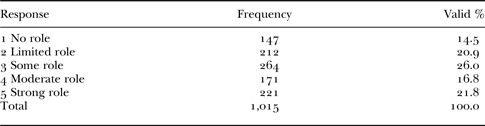
Respondent characteristics are summarised in Table 1 and the frequency and proportions of responses for the outcome variable are shown in Table 2. In nearly two-thirds of the ratings (656; 64.6%), managers indicated that they perceived some/moderate/strong role in the employee's retirement.
Manager characteristics
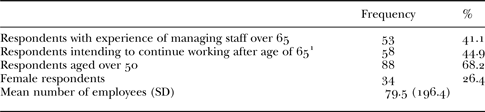
Notes: N = 129. 1. Includes six respondents aged over 65.
Frequency of outcome responses
Preliminary correlational analysis revealed that none of the explanatory variables considered was excessively correlated with any other of the explanatory variables, although some substantive rank correlation was observed between the discretion and influence variables (p = 0.487).
Multi-level multiple logistic regression models
P-Values, parameter estimates and associated 95% CI for manager psycho-social characteristics, manager decision environment and older employee situational factor variables, while controlling for manager age, gender and number of staff members, are summarised in Table 3.
p-Values, parameter estimates and associated 95 per cent confidence intervals (95% CI) for primary variables: effect of manager psycho-social characteristics, manager decision-making environment, older employee situational factors and controlling variables (based on 1,015 vignette responses)
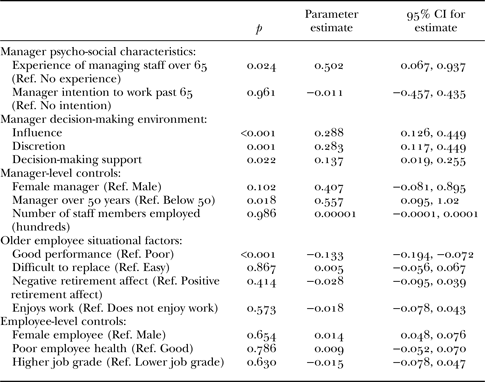
Note: Ref.: reference category. All values are quoted to 3 decimal places except where this would involve rounding estimates to zero.
Manager variables
Managers’ experience of managing workers aged 65 or more was significantly related to openness to involvement (p = 0.024). The parameter estimate for experience of managing workers aged 65 was 0.502 (95% CI = 0.067 to 0.937), indicating that, at best estimate, after having controlled for manager age, gender and number of staff members, a one unit increase in the experience score was associated with a 0.502 point increase in openness to involvement scores. With our data, Hypothesis 1 was therefore supported. No evidence was found to show that managers’ own intention of working past the age of 65 years was significantly related to their openness to involvement scores (p = 0.961) and so Hypothesis 2 was rejected.
Regarding the decision-making environment, managers were more likely to be open to involvement in employee retirement when they were able to exert influence over policy (p < 0.001). The parameter estimate for influence scores of 0.288 (95% CI = 0.126 to 0.449) indicated that, at best estimate, after having controlled for manager age, gender and number of staff members, a one unit increase in the influence score was associated with a 0.288 point increase in openness to involvement scores. This supports Hypothesis 3. Likewise, managers’ discretion scores were significantly related to their openness to involvement scores (p = 0.001). The parameter estimate for discretion scores of 0.283 (95% CI = 0.117 to 0.449) indicated that at best estimate, controlling for manager age, gender and number of staff members, a 1 point increase in discretion scores was associated with a 0.283 point increase in openness to involvement scores. Hypothesis 4 was therefore supported as well. Managers who could expect support from their own managers in decision-making were more likely to be open to involvement in employee retirement (p = 0.022). The parameter estimate for supportiveness scores of 0.137 (95% CI = 0.019 to 0.255) indicated that, at best estimate, controlling for manager age, gender and number of staff members, a 1 point increase in supportiveness scores was associated with a 0.137 point increase in openness to involvement scores. With this outcome, Hypothesis 5 was also supported.
A number of control variables were included in the analysis. The gender of a manager was not significantly related to their openness to involvement scores in a model containing control variables only (p = 0.102). In a similar vein, the number of staff members was not a significant predictor for openness to involvement (p = 0.986). On the other hand, manager age was significantly related to their openness to involvement scores in a model containing control variables only (p = 0.018). The parameter estimate for the age variable of 0.557 (95% CI = 0.094 to 1.02) indicated that at best estimate, controlling for gender and number of staff members, a 1 point increase in age was associated with a 0.557 point increase in openness to involvement scores.
Considering older employee situational factors, we found that employee performance was negatively related to the openness to involvement score (p < 0.001). The parameter estimate of −0.133 (95% CI = −0.194 to −0.072) for employee performance score indicated that, at best estimate, controlling for manager age, gender and number of staff members, a 1 point increase in employee performance was associated with a −0.133 point decrease in openness to involvement. This outcomes provides support for Hypothesis 6. However, none of the remaining three older employee situational factor variables (ease of replacement, retirement affect and attitude to work) was significantly associated with openness to involvement, and so Hypotheses 7, 8 and 9 were not supported. Moreover, none of the employee-level controlling variables was significantly related to the openness to involvement variable.
Discussion
This research contributes to the growing body of knowledge which focuses on employers’ and managers’ responses to the new retirement landscape by focusing on managers as meso-level actors in the retirement process. Specifically, it focused on identifying the manager psycho-social characteristics, their decision-making environment and older-employee situational factors that are associated with manager openness to involvement in employee retirement. Although previous studies have suggested that supervisors prefer not to interfere with retirement issues and are hesitant to raise a discussion on extending working life with their employees (Henkens, Van Solinge and Cozijnsen Reference Henkens, Van Solinge and Cozijnsen2009), the empirical findings in this study did not find a high level of reluctance to become involved in employee retirement. In nearly two-thirds of the scenarios, managers in this study felt that they had some role to play in their employees’ retirement process.
One of the central premises of the study, derived from anchoring theory (Tversky and Kahneman Reference Tversky and Kahneman1974), was that managers would anchor their decision preferences regarding involvement with employee retirement from the position of their own psycho-social characteristics (Epley et al. Reference Epley, Keysar, Van Boven and Gilovich2004). Some support was found for this: having greater experience of managing older staff was found to be associated with greater levels of openness to involvement in retirement. It is likely that more experienced managers will have a wider pool of real-life employee retirement exemplars and so have more readily available decision-making schemas upon which to draw. Their wider experience can be expected to heighten their awareness and sensitivity to the ambiguities that older employees face in making retirement decisions and is likely to reinforce a sense of their own legitimacy in having a degree of involvement. By contrast, we did not find any association between managers’ own retirement intentions and their level of openness to involvement of the employee. It might be conceivable that a so-called ‘instrumental style of leadership’ plays an important role here (Van der Heijden et al. Reference Van der Heijden, De Lange, Demerouti and Van der Heijde2009). Under circumstances of high employee performance, it is in the manager's interest that the employee's expertise is utilised within the department that he or she is heading, thus, restraining the employee from early retirement. All in all, the ‘here-and-now’ functioning of subordinates determines the performance of the supervisor him- or herself (Van der Heijden et al. Reference Van der Heijden, De Lange, Demerouti and Van der Heijde2009).
Interestingly, the manager's age control variable was significantly associated with manager openness to involvement. Consistent with anchoring theory, older managers reported significantly more openness to involvement in employee retirement than their younger counterparts. Being further from retirement themselves, younger managers are less likely to be aware of retirement issues generally, and are also less likely to have reflected on their own retirement choices. To imagine the retirement complexities of an older employee, they would have to engage effortful perspective-taking (Parker and Axtell Reference Parker and Axtell2001) or possibly reliance on age-related stereotypes. An alternative explanation may be that younger managers may find it difficult to engage in conversations with their employees about retirement given the disparity in their respective ages. Older managers are more likely to be aware of both general and personal issues relating to retirement and so be better able to engage in affective perspective-taking, that is, imagining another person's feelings and thoughts about the implications of retirement (Sullivan, Mikels and Carstensen Reference Sullivan, Mikels and Carstensen2010).
An important contribution of the study is the inclusion of the manager's own decision-making environment because managerial decisions are taken in an organisational context. The findings show that manager's influence over retirement policy, as well as the level of discretion he/she perceives, were significantly and positively associated with higher openness to involvement in employee retirement. Previous research from the work–life balance literature has found that managers actively use discretion to achieve organisational justice outcomes, specifically, seeking to minimise injustice and achieve fairness (Daverth, Cassell and Hyde Reference Daverth, Cassell and Hyde2016). It is likely that similar processes operate in the context of employee retirement. Discretion allows managers to act to achieve what they judge to be a fair or just outcome, for either the older worker or for the organisation. Where managers are able to exert discretion in terms of the work-options available, they are more likely to have the confidence to make finely balanced and appropriate judgements which achieve fair and just outcomes for both the individual and the organisation. In these circumstances, they are more likely to adopt an engaging leadership style to establish a consensual process of collaboration with the employee to achieve the mutually beneficial outcomes and hence have a greater propensity for involvement in employee retirement. Supporting other studies that highlight the importance of line manager support in people management (Casper et al. Reference Casper, Fox, Sitzmann and Landy2004, Reference Casper, Harris, Taylor-Bianco and Wayne2011; Warren and Johnson Reference Warren and Johnson1995), our study found that managers who felt supported in their decision-making were more likely to report openness to involvement. These findings reinforce the importance of the quality of manager's own working environment in sensitising managers to their role in retirement management.
In addition to the decision-making context, the study included employee situational factors to investigate whether the specific nature of the situation a manager faced influenced their reported openness to involvement. Although the literature suggests that managers are sensitive to an employee's personal circumstances, such as their attitude to work and retirement in other areas of decision-making relating to older employees (Henkens, Van Solinge and Cozijnsen Reference Henkens, Van Solinge and Cozijnsen2009; Karpinska, Henkens and Schippers Reference Karpinska, Henkens and Schippers2013b), no support was found for their predictive validity in the present study, nor did we find support for any influence of the ease of replacement of the employee. Instead, the sole situational factor which appeared to negatively influence a manager's openness to involvement was employee performance.
Limitations
This study has a number of limitations. First, a vignette design requires participants to assess hypothetical situations, implying that the artificiality of vignettes does limit the external validity of the results (De Ridder and Kerssens Reference De Ridder and Kerssens2003). That is to say, we cannot assume that the responses recorded in an on-line simulation correspond with those that would have been taken in real situations where the contingencies would inevitably be more complex. Moreover, respondents might have made a range of assumptions in their responses to the vignettes, for example, in relation to the specific needs of the retiree or to the level of assistance the retiree might want from the employee. Given the self-report nature of our data, it was not possible to probe respondents on the rationale for their responses.
A second limitation of the vignette design is that it necessarily limits the number of variables that can realistically be included in the model. In the present study, 192 scenarios were created. The implication of the factorial structure is that each additional two-level variable would double the number of scenarios. It falls to future studies to incorporate other variables, such as leadership style or manager personality, into the model.
A third limitation is the use of the university sector sample. Even though research into academic careers suggests that those type of careers are increasingly influenced by management policies (Baruch et al. Reference Baruch, Dany, Davense and Pralong2014), it can be argued that academic organising structures are distinct from other forms of working environment. For example, in universities, high value is placed on individual autonomy and so there may be greater scope for idiosyncratic deals in comparison with other occupational sectors. That is to say, the dynamics of management may be different and the authority of managers may be less prevalent in certain institutions than is the case in other sectors. The single occupational group in this study therefore limits the generalisability of the findings to other populations and working groups.
Practical implications
These findings suggest that openness to involvement in employee retirement is largely a function of the manager's experience and the nature of his/her own decision-making environment. At the level of practice, these findings have important implications for employers. As the working population ages, organisations need to recognise the changing role of managers in relation to end-of-career trajectories and the subtle influences that managers may have on the opportunities that are available to employees. Without specific management development training, the psycho-social characteristics of the manager may well influence the actions of managers. Managers may need to be trained on the changing nature of retirement, what they may and may not discuss in conversations with employees, and need to be sensitised to their own potential for enabling or hindering the extended working lives of their employees. Additionally, the decision-making environment of managers themselves is particularly important. Line managers need appropriate support for their role in the area of retirement. For employees, the findings illustrate that there is variation amongst managers in their attitudes towards managing in the context of retirement which may present an obstacle for those employees wishing to extend their working lives. Older workers wishing to work longer may need to be proactive in the events leading up to discussions with managers about the options that are available and should not assume that managers will necessarily take that initiative.
The focus of this paper has been on perspectives towards managing older workers and has only integrated the employee perspective indirectly. Future research in this scholarly area could therefore usefully focus on the dyadic relationship between managers and older employees to examine further dynamics that influence managerial judgements.
Acknowledgement
This research was funded by NETSPAR Research Grant 2012/DP 05/2013-019.
Appendix
Instructions
Below are eight scenarios describing hypothetical staff members who are eligible to retire, but have not yet made up their mind about the timing of their retirement. You are asked to imagine that you have already had a meeting with each of them to discuss their circumstances. The scenarios describe what you know about their situation following the discussion. For each scenario, you are offered three possible courses of action that you might take and are asked to select the one that corresponds most closely to your preferred course of action. The scenarios are all different but sometimes the differences are only very slight, so please read them carefully.
Sample vignette
Mary [gender] is a Professor [grade]. She enjoys work [work enjoyment]. She is in good health [health]. She is looking forward to retirement [retirement affect]. Lately, Mary's work performance has been good [work performance]. If she were to retire now, she would be relatively easy to replace [difficulty of replacement].
As Mary's line manager, to what extent do you think you have a role to play in the timing of the retirement?



 Open access

