




1 Introduction
For a topological dynamical system $(X, T)$
and a sequence of integers
$(X, T)$
and a sequence of integers $(a_n)$
we can consider the sequence of iterates
$(a_n)$
we can consider the sequence of iterates $(T^{a_n}y)$
for a point
$(T^{a_n}y)$
for a point $y\in X$
, which we call the orbit along
$y\in X$
, which we call the orbit along $(a_n)$
. The question of the distribution of such sparse orbits has enjoyed a lot of recent activity, particularly for the sequence of primes or sequences
$(a_n)$
. The question of the distribution of such sparse orbits has enjoyed a lot of recent activity, particularly for the sequence of primes or sequences $(P(n))$
of values of polynomials
$(P(n))$
of values of polynomials ${P\in {\mathbb {Z}}[X]}$
. If
${P\in {\mathbb {Z}}[X]}$
. If $(X, T)$
is uniquely ergodic, one naturally considers equidistribution of the sparse orbits, that is, the property that for any
$(X, T)$
is uniquely ergodic, one naturally considers equidistribution of the sparse orbits, that is, the property that for any $y\in X$
and
$y\in X$
and $F\in C(X)$
the averages
$F\in C(X)$
the averages
 $$ \begin{align} \frac{1}{N}\sum\limits_{n<N}F(T^{a_n}y) \end{align} $$
converge to $\int _X F\, d\mu $
, where
$\int _X F\, d\mu $
, where $\mu $
is the unique T-invariant measure on X. This is, however, sometimes too restrictive because of local obstructions (that is, because
$\mu $
is the unique T-invariant measure on X. This is, however, sometimes too restrictive because of local obstructions (that is, because $(a_n)$
might not be well distributed in residue classes modulo integers), and the more interesting question is whether the sequence of averages (1) is convergent for every
$(a_n)$
might not be well distributed in residue classes modulo integers), and the more interesting question is whether the sequence of averages (1) is convergent for every $y\in X$
. Recall that by the work of Bourgain and Wierdl, this is true for almost every
$y\in X$
. Recall that by the work of Bourgain and Wierdl, this is true for almost every $y\in X$
if
$y\in X$
if $(a_n)$
is the sequence of primes, as well as if
$(a_n)$
is the sequence of primes, as well as if $a_n=P(n)$
for a polynomial
$a_n=P(n)$
for a polynomial $P\in\mathbb{Z}[X]$
(see [Reference Bourgain1, Reference Wierdl9]).
$P\in\mathbb{Z}[X]$
(see [Reference Bourgain1, Reference Wierdl9]).
Our goal will be to examine these properties, as well as the density of the sparse orbits, in the class of Toeplitz systems, mainly in the case $a_n=P(n)$
for
$a_n=P(n)$
for $P\in {\mathbb {Z}}[X]$
.
$P\in {\mathbb {Z}}[X]$
.
In [Reference Frączek, Kanigowski and Lemańczyk3], the authors consider the distribution of orbits along primes in Toeplitz systems, focusing on the so-called regular Toeplitz systems, which are in particular strictly ergodic. The authors also treat polynomial orbits, and find an example of a Toeplitz system $X_x$
where averages (1) converge for the sequence of primes for every starting point, but not for
$X_x$
where averages (1) converge for the sequence of primes for every starting point, but not for $(n^2)$
with
$(n^2)$
with $y=x$
.
$y=x$
.
We prove a similar result distinguishing orbits along two different polynomials.
Theorem 1.1. Let $k, l>1$
be distinct integers. Then there exists a regular Toeplitz system
$k, l>1$
be distinct integers. Then there exists a regular Toeplitz system $X_x$
over the alphabet
$X_x$
over the alphabet $\{0, 1\}$
such that for every continuous map
$\{0, 1\}$
such that for every continuous map $F:X_x\to {\mathbb {C}}$
and
$F:X_x\to {\mathbb {C}}$
and $y\in X_x$
, the limit
$y\in X_x$
, the limit
 $$ \begin{align*} \lim_{N\to\infty}\frac{1}{N}\sum_{m<N}F(\sigma^{m^l}y) \end{align*} $$
exists, but the limit
 $$ \begin{align*} \lim_{N\to\infty}\frac{1}{N}\sum_{m< N}G(\sigma^{m^k}x) \end{align*} $$
does not exist for the continuous function $G(y)=(-1)^{y(0)}$
.
$G(y)=(-1)^{y(0)}$
.
Moreover, if l is odd, and $q|k$
and
$q|k$
and $q\nmid l$
for some prime q, we can ensure that the orbit
$q\nmid l$
for some prime q, we can ensure that the orbit $(\sigma ^{m^l}y)$
of any point
$(\sigma ^{m^l}y)$
of any point $y\in X_x$
is equidistributed in
$y\in X_x$
is equidistributed in $X_x$
with respect to the unique
$X_x$
with respect to the unique $\sigma $
-invariant measure on
$\sigma $
-invariant measure on $X_x$
.
$X_x$
.
This is the first known example of a minimal topological dynamical system $(X, T)$
where sequences of averages (1) converge for all
$(X, T)$
where sequences of averages (1) converge for all $y\in X$
for
$y\in X$
for $a_m=m^l$
, but fail to converge for
$a_m=m^l$
, but fail to converge for $a_m=m^k$
, where
$a_m=m^k$
, where $k, l>1$
.
$k, l>1$
.
The main difficulty in finding such an example is that there are only a few classes of systems where we have any control over averages along polynomials. Until recently, essentially the only known way of doing this relied on variants of the van der Corput inequality. This method can only be used in systems with some algebraic structure, such as nilsystems. Moreover, it does not seem to be able to distinguish one polynomial from another—in all known cases where the method can be applied, it applies to all polynomials.
A new approach relying on rigidity is developed in the article [Reference Kasprzak5], resulting in particular in a class of weakly mixing systems where all square orbits are equidistributed. The method does not, however, give control over averages along polynomials of higher degree.
We are successful in considering Toeplitz systems in particular because they are quite simple systems—one can think of them as limits of finite systems, where averages (1) can be very well understood by number-theoretic methods.
In §3 we construct the system in Theorem 1.1 in the case $k\nmid l$
, adapting methods from [Reference Frączek, Kanigowski and Lemańczyk3]. One result needed to establish the last sentence of the theorem in this case is postponed to §5.
$k\nmid l$
, adapting methods from [Reference Frączek, Kanigowski and Lemańczyk3]. One result needed to establish the last sentence of the theorem in this case is postponed to §5.
The case $k|l$
is much more subtle—we deal with it in §4, using the Weil bound to estimate the number of solutions
$k|l$
is much more subtle—we deal with it in §4, using the Weil bound to estimate the number of solutions $(x, y)\in \mathbb {F}_p\times \mathbb {F}_p$
to equations of the form
$(x, y)\in \mathbb {F}_p\times \mathbb {F}_p$
to equations of the form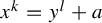 $x^k=y^l+a$
.
$x^k=y^l+a$
.
In §5.5 we turn to discussing the density of polynomial orbits in Toeplitz systems. Our Theorems 5.5 and 5.2 essentially characterize all cases when such density occurs, in terms of the integers modulo which the polynomial is a permutation. In regular Toeplitz systems this characterization gives the following theorem.
Theorem 1.2. Let $X_x$
be a regular Toeplitz system and let
$X_x$
be a regular Toeplitz system and let $P\in {\mathbb {Z}}[X]$
. If the orbit
$P\in {\mathbb {Z}}[X]$
. If the orbit $(\sigma ^{P(n)}y)$
is dense in
$(\sigma ^{P(n)}y)$
is dense in $X_x$
for some y, then the orbits
$X_x$
for some y, then the orbits $(\sigma ^{P(n)}y)$
are equidistributed in
$(\sigma ^{P(n)}y)$
are equidistributed in $X_x$
for all
$X_x$
for all $y\in X_x$
.
$y\in X_x$
.
Hence, any examples where the $(P(n))$
-orbits are dense, but not equidistributed, cannot be regular. Let us mention that strict ergodicity of a Toeplitz system does not imply its regularity—a suitable counterexample is given in [Reference Iwanik and Lacroix4].
$(P(n))$
-orbits are dense, but not equidistributed, cannot be regular. Let us mention that strict ergodicity of a Toeplitz system does not imply its regularity—a suitable counterexample is given in [Reference Iwanik and Lacroix4].
We adapt this example in Theorem 5.8, showing that regularity cannot be replaced by strict ergodicity in Theorem 1.2.
2 Preliminaries and facts
2.1 Toeplitz systems
For simplicity we will only consider Toeplitz systems over the binary alphabet $\{0, 1\}$
. We call
$\{0, 1\}$
. We call $x\in \{0, 1\}^{{\mathbb {Z}}}$
a Toeplitz word if for every
$x\in \{0, 1\}^{{\mathbb {Z}}}$
a Toeplitz word if for every $a\in {\mathbb {Z}}$
there exists an
$a\in {\mathbb {Z}}$
there exists an $\ell \in {\mathbb {Z}}^+$
such that
$\ell \in {\mathbb {Z}}^+$
such that $x(a)=x({a+k\ell })$
for each
$x(a)=x({a+k\ell })$
for each $k\in {\mathbb {Z}}$
. The orbit closure
$k\in {\mathbb {Z}}$
. The orbit closure $X_x$
of x in
$X_x$
of x in $\{0, 1\}^{{\mathbb {Z}}}$
is then a minimal topological dynamical system. Every Toeplitz word x admits a sequence
$\{0, 1\}^{{\mathbb {Z}}}$
is then a minimal topological dynamical system. Every Toeplitz word x admits a sequence $(n_t)$
satisfying
$(n_t)$
satisfying $n_t|n_{t+1}$
such that if
$n_t|n_{t+1}$
such that if
 $$ \begin{align*} \mathrm{Per}_{n_t}(x):=\{a\in{\mathbb{Z}}:\: x(a)=x(a+kn_t)\text{ for all }k\in{\mathbb{Z}}\}, \end{align*} $$
then
 $$ \begin{align} \bigcup_{t\geq0}\mathrm{Per}_{n_t}(x)={\mathbb{Z}}. \end{align} $$
We call the system $X_x$
regular if the density of
$X_x$
regular if the density of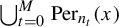 $\bigcup _{t=0}^M\mathrm {Per}_{n_t}(x)$
converges to
$\bigcup _{t=0}^M\mathrm {Per}_{n_t}(x)$
converges to $1$
. This condition implies strict ergodicity (see [Reference Downarowicz2, Theorem 13.1]).
$1$
. This condition implies strict ergodicity (see [Reference Downarowicz2, Theorem 13.1]).
In [Reference Frączek, Kanigowski and Lemańczyk3] the authors present the following general way of constructing Toeplitz systems.
Definition 2.1. Let $(n_t)$
be a sequence of natural numbers satisfying
$(n_t)$
be a sequence of natural numbers satisfying $n_t|n_{t+1}$
, and
$n_t|n_{t+1}$
, and ${x_t\in \{0, 1, ?\}^{n_t}}$
. We call the pair of sequences
${x_t\in \{0, 1, ?\}^{n_t}}$
. We call the pair of sequences $(n_t), (x_t)$
viable if:
$(n_t), (x_t)$
viable if:
-
• the word $x_{t+1}$
is a concatenation of
$n_{t+1}/n_t$
copies of
$x_t$
, with possibly some question marks replaced with 0s or 1s (in other words, whenever
$x_t(i)\ne ?$
for some
$t\in {\mathbb {N}}$
and
$i\in [0, n_t-1]$
, then
$x_s(j)=x_t(i)$
for all
$s\geqslant t$
and
$j\equiv i\ \pmod {n_t}$
satisfying
$j\in [0, n_{s}-1]$
);
$x_{t+1}$
is a concatenation of
$n_{t+1}/n_t$
copies of
$x_t$
, with possibly some question marks replaced with 0s or 1s (in other words, whenever
$x_t(i)\ne ?$
for some
$t\in {\mathbb {N}}$
and
$i\in [0, n_t-1]$
, then
$x_s(j)=x_t(i)$
for all
$s\geqslant t$
and
$j\equiv i\ \pmod {n_t}$
satisfying
$j\in [0, n_{s}-1]$
); -
• for any
$i\in \mathbb {N}$
there exists t such that
$x_t(i), x_t(n_t-i)\ne ?$









To such sequences $(n_t), (x_t)$
we associate the sequence
$(n_t), (x_t)$
we associate the sequence
 $$ \begin{align*} ?_t=\lvert \{i\in [0, n_t-1]: x_t(i)=?\}\rvert. \end{align*} $$
It is not difficult to see that the following fact is true.
Fact 2.1. Let $(n_t), (x_t)$
be viable. Then the word
$(n_t), (x_t)$
be viable. Then the word $x\in \{0, 1\}^{\mathbb {Z}}$
defined as
$x\in \{0, 1\}^{\mathbb {Z}}$
defined as
 $$ \begin{align*} x(i)=\begin{cases} x_t(i) &\text{for } i\geqslant 0\\ x_t(n_t+i) &\text{for } i<0 \end{cases} \end{align*} $$
is Toeplitz (here t is the smallest index for which the relevant symbol is not ‘?’). All Toeplitz words can be obtained this way. Additionally, if $?_t=o(n_t)$
, then
$?_t=o(n_t)$
, then $X_x$
is regular.
$X_x$
is regular.
Definition 2.2. Fix an integer $k>1$
. For all
$k>1$
. For all $N,n, a\in {\mathbb {Z}}$
, let
$N,n, a\in {\mathbb {Z}}$
, let
 $$ \begin{align*} \rho_k(N;n,a)=\lvert \{1\leq m\leq N:m^k=a\ \mod n\}\rvert \end{align*} $$
and
 $$ \begin{align*} \rho_k(n):=\max_{a\in {\mathbb{Z}}}\rho_k(n;n,a). \end{align*} $$
We have the following result.
Theorem 2.2. [Reference Frączek, Kanigowski and Lemańczyk3, Theorem 6.8]
Suppose that $X_x$
is a Toeplitz system such that
$X_x$
is a Toeplitz system such that
 $$ \begin{align*} ?_t=o(n_t/{\rho_k(n_t)}). \end{align*} $$
Then, for every continuous map $F:X_x\to {\mathbb {C}}$
and
$F:X_x\to {\mathbb {C}}$
and $y\in X_x$
, the limit
$y\in X_x$
, the limit
 $$ \begin{align*} \lim_{N\to\infty}\frac{1}{N}\sum_{m< N}F(\sigma^{m^k}y) \end{align*} $$
exists.
We will also need the following definition.
Definition 2.3. We denote
 $$ \begin{align*} R^k_n=\{0\leqslant a<n: a\equiv m^k\ \pmod{n} \text{ for some } m\in{\mathbb{Z}}\} \end{align*} $$
and
 $$ \begin{align*}\widetilde{R^k_n}=\{a\in R^k_n: \gcd(a, n)=1\}.\end{align*} $$
We now briefly describe the method used in [Reference Iwanik and Lacroix4] to construct a non-regular strictly ergodic Toeplitz system. As opposed to the previous construction, it can detect strict ergodicity. We will use it in the proof of Theorem 5.8.
Let $(n_t)$
be a sequence of positive integers such that
$(n_t)$
be a sequence of positive integers such that $n_t|n_{t+1}$
, and let
$n_t|n_{t+1}$
, and let $W_t\subset \{0, 1\}^{n_t}$
satisfy the following:
$W_t\subset \{0, 1\}^{n_t}$
satisfy the following:
-
(1) each word in
$W_{t+1}$
is a concatenation of
$n_{t+1}/n_t$
words from
$W_t$
; -
(2) the word
$\omega [0, n_t-1]\in W_t$
is the same for all
$\omega \in W_{t+1}$
; -
(3) the word
$\omega [n_{t+1}-n_t, n_{t+1}-1]\in W_t$
is the same for all
$\omega \in W_{t+1}$
.






Then we can pick any $\omega _t\in W_t$
and let
$\omega _t\in W_t$
and let $x\in \{0, 1\}^{{\mathbb {Z}}}$
be given by
$x\in \{0, 1\}^{{\mathbb {Z}}}$
be given by
 $$ \begin{align*} x(i)=\begin{cases} \omega_t(i)\quad &\text{for } i\geqslant 0\\ \omega_t(n_t+i)\quad &\text{for } i<0, \end{cases} \end{align*} $$
where t satisfies $|i|<n_t$
. Notice that by conditions (2) and (3) the sequences
$|i|<n_t$
. Notice that by conditions (2) and (3) the sequences $(\omega _t(i))$
and
$(\omega _t(i))$
and $(\omega _t(n_t+i))$
respectively are constant wherever they are defined.
$(\omega _t(n_t+i))$
respectively are constant wherever they are defined.
It is not difficult to see the truth of the following fact.
Fact 2.3. The word x constructed above is Toeplitz. Any Toeplitz word can be obtained this way.
Let $B\in \{0, 1\}^\beta $
and
$B\in \{0, 1\}^\beta $
and $C\in \{0, 1\}^{\gamma }$
, where
$C\in \{0, 1\}^{\gamma }$
, where $\beta |\gamma $
. The word C can be split into
$\beta |\gamma $
. The word C can be split into $\gamma /\beta $
words of length
$\gamma /\beta $
words of length $\beta $
; by
$\beta $
; by $\operatorname {\mathrm {ap}}(B, C)$
we denote the frequency of appearances of B among these words. To be precise,
$\operatorname {\mathrm {ap}}(B, C)$
we denote the frequency of appearances of B among these words. To be precise,
 $$ \begin{align*} \operatorname{\mathrm{ap}}(B, C)=\frac{\beta}{\gamma}\lvert \{i\in [0, \gamma/\beta-1]: C[i\beta, (i+1)\beta -1]=B\}\rvert. \end{align*} $$
Theorem 2.4. [Reference Iwanik and Lacroix4, Theorem 1.1]
In the above notation, the system $X_x$
is strictly ergodic if and only if for any s and any
$X_x$
is strictly ergodic if and only if for any s and any $B\in W_s$
there exists a number
$B\in W_s$
there exists a number $\nu (B)$
such that
$\nu (B)$
such that
 $$ \begin{align*} \operatorname{\mathrm{ap}}(B, C)\to \nu(B) \end{align*} $$
uniformly in $C\in W_t$
as
$C\in W_t$
as $t\to \infty $
.
$t\to \infty $
.
2.2 Permutative polynomials
Due to the conclusion of Corollary 5.3, we will consider the following definition.
Definition 2.4. We say that a polynomial $P\in {\mathbb {Z}}[X]$
is a permutation modulo n if
$P\in {\mathbb {Z}}[X]$
is a permutation modulo n if ${P:{\mathbb {Z}}/n{\mathbb {Z}}\to {\mathbb {Z}}/n{\mathbb {Z}}}$
is a bijection. We say that P is permutative if it is a permutation modulo n for infinitely many
${P:{\mathbb {Z}}/n{\mathbb {Z}}\to {\mathbb {Z}}/n{\mathbb {Z}}}$
is a bijection. We say that P is permutative if it is a permutation modulo n for infinitely many $n\in {\mathbb {Z}}^+$
.
$n\in {\mathbb {Z}}^+$
.
Example 2.1. For $k\in {\mathbb {Z}}^+$
the polynomial
$k\in {\mathbb {Z}}^+$
the polynomial $P(x)=x^k$
is permutative if and only if
$P(x)=x^k$
is permutative if and only if $2\nmid k$
.
$2\nmid k$
.
By the Chinese remainder theorem, permutativity of P is equivalent to the statement either that P is bijective modulo infinitely many primes, or that for some prime p the polynomial P is bijective modulo all $p^k$
for
$p^k$
for $k\in {\mathbb {Z}}^+$
. The second condition can be stated in a more concrete way (for a proof see, for example, [Reference Lidl, Mullen and Turnwald7, Corollary 4.3]).
$k\in {\mathbb {Z}}^+$
. The second condition can be stated in a more concrete way (for a proof see, for example, [Reference Lidl, Mullen and Turnwald7, Corollary 4.3]).
Theorem 2.5. Let $P\in {\mathbb {Z}}[X]$
and let p be prime. The following conditions are equivalent:
$P\in {\mathbb {Z}}[X]$
and let p be prime. The following conditions are equivalent:
-
(1) P is a permutation modulo
$p^k$
for every
$k\in {\mathbb {Z}}^+$
; -
(2) P is a permutation modulo
$p^2$
; -
(3) P is a permutation modulo p, and
$p\nmid P'(x)$
for all
$x\in {\mathbb {Z}}$
.


A description of polynomials which are permutations modulo infinitely many primes is much more difficult. It relies on the following object,
Definition 2.5. For $n\in {\mathbb {Z}}^+$
and
$n\in {\mathbb {Z}}^+$
and $\alpha \in {\mathbb {Z}}$
we let the Dickins polynomial
$\alpha \in {\mathbb {Z}}$
we let the Dickins polynomial $D_n(\alpha , x)$
be the unique polynomial in
$D_n(\alpha , x)$
be the unique polynomial in ${\mathbb {Z}}[X]$
of degree n satisfying
${\mathbb {Z}}[X]$
of degree n satisfying
 $$ \begin{align*} D_n\bigg(\alpha, x+\frac{\alpha}{x}\bigg)=x^n+\bigg(\frac{\alpha}{x}\bigg)^n \end{align*} $$
for all $x\in {\mathbb {Z}}$
.
$x\in {\mathbb {Z}}$
.
Theorem 2.6. [Reference Turnwald8, Theorem 4]
Let $P\in {\mathbb {Z}}[X]$
be of degree n. Then the following conditions are equivalent:
$P\in {\mathbb {Z}}[X]$
be of degree n. Then the following conditions are equivalent:
-
(1) P is a permutation modulo infinitely many primes;
-
(2) P is a composition of finitely many degree 1 polynomials in
$\mathbb {Q}[X]$
and Dickins polynomials
$D_{n_i}(\alpha _i, x)$
for (not necessarily distinct) odd primes
$n_i$
and numbers
$\alpha _i\in {\mathbb {Z}}$
, where whenever
$3|n_i$
we have
$\alpha _i=0$
.


An analogue of the above result in the more general setting of rings of integers of number fields, proven in the cited article, is known as Schur’s conjecture.
3 Main result for
$k\nmid l$

Theorem 3.1. Let $k, l\in {\mathbb {N}}$
be such that
$k, l\in {\mathbb {N}}$
be such that $k\nmid l$
. Then there exists a regular Toeplitz system
$k\nmid l$
. Then there exists a regular Toeplitz system $X_x$
such that for every continuous map
$X_x$
such that for every continuous map $F:X_x\to {\mathbb {C}}$
and
$F:X_x\to {\mathbb {C}}$
and $y\in X_x$
, the limit
$y\in X_x$
, the limit
 $$ \begin{align} \lim_{N\to\infty}\frac{1}{N}\sum_{m< N}F(\sigma^{m^l}y) \end{align} $$
exists, but the limit
 $$ \begin{align} \lim_{N\to\infty}\frac{1}{N}\sum_{m< N}G(\sigma^{m^k}x) \end{align} $$
does not exist for the continuous function $G(y)=(-1)^{y(0)}$
. Moreover, if l is odd, and
$G(y)=(-1)^{y(0)}$
. Moreover, if l is odd, and $q|k$
and
$q|k$
and $q\nmid l$
for some prime q, we can ensure that the orbit
$q\nmid l$
for some prime q, we can ensure that the orbit $(\sigma ^{m^l}y)$
of any point
$(\sigma ^{m^l}y)$
of any point $y\in X_x$
is equidistributed in
$y\in X_x$
is equidistributed in $X_x$
with respect to the unique
$X_x$
with respect to the unique $\sigma $
-invariant measure on
$\sigma $
-invariant measure on $X_x$
.
$X_x$
.
Proof. First we replace k and l by two smaller numbers. Below by $\nu _p(n)$
for prime p and
$\nu _p(n)$
for prime p and $n\in {\mathbb {Z}}^+$
we mean the largest integer satisfying
$n\in {\mathbb {Z}}^+$
we mean the largest integer satisfying $p^{\nu _p(n)}|n$
.
$p^{\nu _p(n)}|n$
.
Lemma 3.2. There exist numbers $k'>l'\geqslant 1$
for which there are infinitely many primes p satisfying
$k'>l'\geqslant 1$
for which there are infinitely many primes p satisfying
 $$ \begin{align*} \gcd(p-1, k)=k'\quad\text{and}\quad\gcd(p-1, l)=l'. \end{align*} $$
If l is odd, and $q|k$
and
$q|k$
and $q\nmid l$
for some prime q, then we can take
$q\nmid l$
for some prime q, then we can take $l'=1$
.
$l'=1$
.
Proof. Since $k\nmid l$
, there exists a prime q for which
$k\nmid l$
, there exists a prime q for which $\nu _q(k)>\nu _q(l)$
(if the last sentence of the theorem statement is true, we can also assume
$\nu _q(k)>\nu _q(l)$
(if the last sentence of the theorem statement is true, we can also assume $\nu _q(l)=1$
). If
$\nu _q(l)=1$
). If $q=2$
, then we can set
$q=2$
, then we can set $k'=2l'=2^{\nu _2(l)+1}$
, and let p be any prime satisfying
$k'=2l'=2^{\nu _2(l)+1}$
, and let p be any prime satisfying
 $$ \begin{align*} \gcd(p-1, kl)=2^{\nu_2(l)+1}. \end{align*} $$
Otherwise we let $l'{\kern-1pt}={\kern-1pt}q^{\nu _q(l)}\cdot \gcd (l, 2)$
and
$l'{\kern-1pt}={\kern-1pt}q^{\nu _q(l)}\cdot \gcd (l, 2)$
and $k'{\kern-1pt}={\kern-1pt}q^{\nu _q(k)+1}\cdot \gcd (k, 2)$
, so that
$k'{\kern-1pt}={\kern-1pt}q^{\nu _q(k)+1}\cdot \gcd (k, 2)$
, so that ${k'/l'{\kern-1pt}\geqslant{\kern-1pt} q/2{\kern-1pt}>{\kern-2pt}1}$
. Then p just has to satisfy
${k'/l'{\kern-1pt}\geqslant{\kern-1pt} q/2{\kern-1pt}>{\kern-2pt}1}$
. Then p just has to satisfy
 $$ \begin{align*} \gcd(p-1, 2kl)=2q^{\nu_q(l)+1}. \end{align*} $$
In both cases there are infinitely many possible primes p by Dirichlet’s theorem about primes in arithmetic progressions.
We now recursively define the sequence $(n_t)$
by setting
$(n_t)$
by setting $n_0=1$
and letting
$n_0=1$
and letting ${n_{t+1}=n_tp_{t+1}}$
for a strictly increasing sequence
${n_{t+1}=n_tp_{t+1}}$
for a strictly increasing sequence $(p_t)$
of primes satisfying the condition in Lemma 3.2 and the following:
$(p_t)$
of primes satisfying the condition in Lemma 3.2 and the following:
 $$ \begin{align} \frac{\varphi(n_t)}{n_t}>\frac{9}{10}, \end{align} $$
 $$ \begin{align} \sum\limits_{t=1}^{\infty}\frac{8kn_t}{\sqrt{p_{t+1}}}<\frac{1}{10}, \end{align} $$
 $$ \begin{align} p_{t+1}>30n_t^k. \end{align} $$
We also define a sequence $x_t\in \{0, 1, ?\}^{n_t}$
. We start with
$x_t\in \{0, 1, ?\}^{n_t}$
. We start with $x_0=?$
. Having defined
$x_0=?$
. Having defined $x_t$
, we define
$x_t$
, we define $x_{t+1}$
as follows. First concatenate
$x_{t+1}$
as follows. First concatenate $n_{t+1}/n_t=p_{t+1}$
copies of
$n_{t+1}/n_t=p_{t+1}$
copies of $x_t$
, creating
$x_t$
, creating $x_{t+1}'$
. If the resulting word has the symbol ‘?’ at position i for
$x_{t+1}'$
. If the resulting word has the symbol ‘?’ at position i for
 $$ \begin{align} i\in [0, n_t-1]\cup [n_{t+1}-n_t, n_{t+1}-1]\cup ([0, n_{t+1}-1]\setminus \widetilde{R^k_{n_{t+1}}}), \end{align} $$
we change it to a 0 or 1 arbitrarily, creating $x_{t+1}"$
. Then, for
$x_{t+1}"$
. Then, for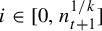 $i\in [0,n_{t+1}^{1/k}]$
, we fill the positions
$i\in [0,n_{t+1}^{1/k}]$
, we fill the positions $i^k$
which still contain ‘?’ with 0s for even t and 1s for odd t, creating
$i^k$
which still contain ‘?’ with 0s for even t and 1s for odd t, creating $x_{t+1}$
.
$x_{t+1}$
.
The pair $(n_t), (x_t)$
defined this way will be viable, since the first and last
$(n_t), (x_t)$
defined this way will be viable, since the first and last $n_{t-1}$
symbols of
$n_{t-1}$
symbols of $x_t$
are not ‘?’. Also, we have
$x_t$
are not ‘?’. Also, we have
 $$ \begin{align*} ?_t\leqslant |\widetilde{R^k_{n_t}}|=\prod_{i=1}^{t}|\widetilde{R^k_{p_i}}|=\prod_{i=1}^{t} \frac{p_i-1}{k'}=\frac{\varphi(n_t)}{(k')^t}, \end{align*} $$
where $?_t$
was defined in Definition 2.1. But
$?_t$
was defined in Definition 2.1. But $\rho _l(n_t)=(l')^t=o((k')^t)$
and
$\rho _l(n_t)=(l')^t=o((k')^t)$
and $\varphi (n_t)<n_t$
, so the conditions of Theorem 2.2 are satisfied, and the limit (3) exists. Also,
$\varphi (n_t)<n_t$
, so the conditions of Theorem 2.2 are satisfied, and the limit (3) exists. Also, $X_x$
is regular since
$X_x$
is regular since $?_t=o(n_t)$
.
$?_t=o(n_t)$
.
We now estimate $?_t$
from below. Notice that by the Chinese remainder theorem for any
$?_t$
from below. Notice that by the Chinese remainder theorem for any $a\in \widetilde {R^k_{n_t}}$
there are exactly
$a\in \widetilde {R^k_{n_t}}$
there are exactly $(p-1)/k'$
elements of
$(p-1)/k'$
elements of $\widetilde {R^k_{n_{t+1}}}$
congruent to a modulo
$\widetilde {R^k_{n_{t+1}}}$
congruent to a modulo $n_t$
. Hence, in
$n_t$
. Hence, in $x_{t+1}"$
there are at least
$x_{t+1}"$
there are at least
 $$ \begin{align*} \frac{p_{t+1}-1}{k'}?_t-2n_t \end{align*} $$
question marks. Taking into account the last step of the construction, we get
 $$ \begin{align*} ?_{t+1}\geqslant \frac{p_{t+1}-1}{k'}?_t-2n_t -{n_{t+1}}^{1/k}, \end{align*} $$
so that
 $$ \begin{align*} ?_{t+1}\cdot \frac{(k')^{t+1}}{\varphi(n_{t+1})}\geqslant ?_t\cdot \frac{(k')^{t}}{\varphi(n_{t})}-\frac{2k'n_t}{p_{t+1}-1}-\frac{(n_tp_{t+1})^{1/k}}{p_{t+1}-1}\geqslant ?_t\cdot \frac{(k')^{t}}{\varphi(n_{t})}-\frac{8k'n_t}{p_{t+1}^{(k-1)/k}}. \end{align*} $$
By induction and from (6) we obtain
 $$ \begin{align} ?_t\geqslant \frac{9}{10}\frac{\varphi(n_t)}{(k')^t}. \end{align} $$
We now estimate the number of kth powers whose positions contain question marks in $x_{t+1}'$
.
$x_{t+1}'$
.
Let $C_t=\lfloor {n_{t+1}}^{1/k}\rfloor =an_t+r$
for
$C_t=\lfloor {n_{t+1}}^{1/k}\rfloor =an_t+r$
for $a\in \mathbb {Z}$
and
$a\in \mathbb {Z}$
and $r\in [0, n_t-1]$
, where
$r\in [0, n_t-1]$
, where $a\geqslant 30$
by (7). Then
$a\geqslant 30$
by (7). Then
 $$ \begin{align*} |\{i<C_t: x_{t+1}'(i^k)=?\}|\geqslant a|\{i<n_t: x_{t+1}'(i^k)=?\}|. \end{align*} $$
But we know that $\rho _k(n_t; n_t, j)=(k')^t$
for any
$\rho _k(n_t; n_t, j)=(k')^t$
for any $j\in \widetilde {R_{n_t}^k}$
, and all the question marks in
$j\in \widetilde {R_{n_t}^k}$
, and all the question marks in $x_t$
are at positions coprime with
$x_t$
are at positions coprime with $n_t$
, so the above is at least
$n_t$
, so the above is at least
 $$ \begin{align*} a\cdot ?_t\cdot (k')^t\geqslant \frac{9}{10}\frac{C_t}{n_t}\cdot \frac{9}{10}\varphi(n_t)\geqslant \frac{7}{10} C_t \end{align*} $$
by (9) and condition (5). By construction we have
 $$ \begin{align*} &|\{i<C_t: x_{t+1}'(i^k)\ne ?\text{ and }x_{t+1}"(i^k)=?\}|\\ & \quad\leqslant 2n_t+|\{i<C_t: p_{t+1}|i\}| \leqslant 2n_t+\frac{C_t}{p_{t+1}}+1\leqslant \frac{1}{10}C_t \end{align*} $$
for large t. Therefore, in the last step of the construction of $x_{t+1}$
, we fill in at least
$x_{t+1}$
, we fill in at least $6C_t/10$
question marks, and so
$6C_t/10$
question marks, and so
 $$ \begin{align*} \frac{1}{C_t}\sum\limits_{m<C_t}G(\sigma^{m^k}x)=\frac{1}{C_t}\sum\limits_{m<C_t}(-1)^{x_{t+1}(m^k)}\geqslant \frac{1}{C_t}\bigg(\frac{6}{10}C_t-\frac{4}{10}C_t\bigg)= \frac{1}{5} \end{align*} $$
for even t, and
 $$ \begin{align*} \frac{1}{C_t}\sum\limits_{m<C_t}G(\sigma^{m^k}x)\leqslant -\frac{1}{5} \end{align*} $$
for odd t, and so the limit (4) does not exist.
Now let us assume that the last sentence in the statement of Theorem 3.1 is true, so that $l'$
is odd and coprime with all
$l'$
is odd and coprime with all $p-1$
for
$p-1$
for $p|n_t$
prime. Then the polynomial
$p|n_t$
prime. Then the polynomial $m^l$
is a permutation modulo each
$m^l$
is a permutation modulo each $n_t$
, so the orbit
$n_t$
, so the orbit $(\sigma ^{m^l}y)$
is equidistributed in
$(\sigma ^{m^l}y)$
is equidistributed in $X_x$
by Theorem 5.7.
$X_x$
by Theorem 5.7.
4 Main result for
$k|l$

We will now discuss the remaining case $k|l$
. In this case we will use a more delicate condition to guarantee equidistribution along lth powers. We present a more general result concerning arbitrary polynomials in
$k|l$
. In this case we will use a more delicate condition to guarantee equidistribution along lth powers. We present a more general result concerning arbitrary polynomials in ${\mathbb {Z}}[X]$
.
${\mathbb {Z}}[X]$
.
Lemma 4.1. Let $(x_t), (n_t)$
be a viable pair and
$(x_t), (n_t)$
be a viable pair and $P\in {\mathbb {Z}}[X]$
. Let
$P\in {\mathbb {Z}}[X]$
. Let $X_t\in \{0, 1, ?\}^{\mathbb {Z}}$
be the unique infinite
$X_t\in \{0, 1, ?\}^{\mathbb {Z}}$
be the unique infinite $n_t$
-periodic sequence which agrees with
$n_t$
-periodic sequence which agrees with $x_t$
on
$x_t$
on $[0, n_t-1]$
. Assume that we have
$[0, n_t-1]$
. Assume that we have
 $$ \begin{align} \sup_{a\in\mathbb{Z}}\lvert \{i\in [0, n_t-1]: X_t(P(i)+a)=?\}\rvert=o(n_t). \end{align} $$
Then for any continuous map $F:X_x\to \mathbb {C}$
and any
$F:X_x\to \mathbb {C}$
and any $y\in X_x$
the limit
$y\in X_x$
the limit
 $$ \begin{align} \lim_{N\to\infty}\frac{1}{N}\sum\limits_{m<N}F(\sigma^{P(m)}y) \end{align} $$
exists.
Proof. We follow the proof of [Reference Frączek, Kanigowski and Lemańczyk3, Theorem 6.8].
It suffices to show that for every continuous $F:X_x\to \mathbb {C}$
and every
$F:X_x\to \mathbb {C}$
and every $\varepsilon>0$
there exists
$\varepsilon>0$
there exists $N_\varepsilon $
so that for every
$N_\varepsilon $
so that for every $N, M>N_\varepsilon $
and every
$N, M>N_\varepsilon $
and every $r\in \mathbb {Z}$
, we have
$r\in \mathbb {Z}$
, we have
 $$ \begin{align} \bigg\lvert \frac{1}{N}\sum\limits_{m<N}F(\sigma^{P(m)+r}x)-\frac{1}{M}\sum\limits_{m<M}F(\sigma^{P(m)+r}x)\bigg\rvert<\varepsilon. \end{align} $$
Indeed, then the sequence of averages in (11) converges for all $y=\sigma ^r x$
, uniformly in the choice of
$y=\sigma ^r x$
, uniformly in the choice of $r\in \mathbb {Z}$
, and these points form a dense set in
$r\in \mathbb {Z}$
, and these points form a dense set in $X_x$
. Hence, not only does the limit (11) exist for all
$X_x$
. Hence, not only does the limit (11) exist for all $y\in X_x$
, but the convergence is uniform in
$y\in X_x$
, but the convergence is uniform in $y\in X_x$
.
$y\in X_x$
.
It is enough to consider only F depending on finitely many coordinates, since the set of such functions is dense in $C(X_x)$
with the supremum norm topology. So let us assume that whenever
$C(X_x)$
with the supremum norm topology. So let us assume that whenever $y, y'\in X_x$
agree on
$y, y'\in X_x$
agree on $[-C, C]$
for some
$[-C, C]$
for some $C\in {\mathbb {Z}}^+$
, we have
$C\in {\mathbb {Z}}^+$
, we have $F(y)=F(y')$
. We can also assume that
$F(y)=F(y')$
. We can also assume that $F:X_x\to [0, 1]$
.
$F:X_x\to [0, 1]$
.
Fix $\varepsilon>0$
and t such that the left-hand side of (10) is at most
$\varepsilon>0$
and t such that the left-hand side of (10) is at most $\varepsilon n_t/(2C+1)$
. Then fix
$\varepsilon n_t/(2C+1)$
. Then fix $r\in {\mathbb {Z}}$
and let
$r\in {\mathbb {Z}}$
and let
 $$ \begin{align*} A_a=\{i\in [0, n_t-1]: X_t(P(i)+a+r)=?\}, \end{align*} $$
and consider the set
 $$ \begin{align*} A=\bigcup_{a=-C}^{C}A_a. \end{align*} $$
Clearly $|A|\leqslant \varepsilon n_t$
, and if
$|A|\leqslant \varepsilon n_t$
, and if $i\notin A$
, then
$i\notin A$
, then
 $$ \begin{align*} F(\sigma^{P(i)+r}x)=F(\sigma^{P(i)+n_tj+r}x) \end{align*} $$
for any $j\in \mathbb {Z}$
. Therefore,
$j\in \mathbb {Z}$
. Therefore,
 $$ \begin{align*} \bigg\lvert\! \sum\limits_{m<kn_t}F(\sigma^{P(m)+r}x)-k\sum\limits_{m<n_t}F(\sigma^{P(m)+r}x)\bigg\rvert\leqslant 2k|A|\leqslant 2k\varepsilon n_t \end{align*} $$
for any $k\in \mathbb {Z}^+$
.
$k\in \mathbb {Z}^+$
.
Then, for any $N{\kern-1pt}>{\kern-1pt}(\varepsilon ^{-1}{\kern-1pt}+{\kern-1pt}1)n_t$
, we can write
$N{\kern-1pt}>{\kern-1pt}(\varepsilon ^{-1}{\kern-1pt}+{\kern-1pt}1)n_t$
, we can write $N{\kern-1pt}={\kern-1pt}kn_t{\kern-1pt}+{\kern-1pt}b$
for
$N{\kern-1pt}={\kern-1pt}kn_t{\kern-1pt}+{\kern-1pt}b$
for $k{\kern-1pt}>{\kern-1pt}\varepsilon ^{-1}$
and
$k{\kern-1pt}>{\kern-1pt}\varepsilon ^{-1}$
and ${b{\kern-1pt}\in{\kern-1pt} [0, n_t-1]}$
, and we have
${b{\kern-1pt}\in{\kern-1pt} [0, n_t-1]}$
, and we have
 $$ \begin{align*} \bigg\lvert \frac{1}{N}\sum\limits_{m<N}F(\sigma^{P(m)+r}x)-\frac{1}{n_t}\sum\limits_{m<n_t}F(\sigma^{P(m)+r}x)\bigg\rvert\leqslant \frac{b}{N}+\bigg(\frac{1}{N}-\frac{1}{kn_t}\bigg)\cdot N\\ +\,\bigg\lvert \frac{1}{kn_t}\sum\limits_{m<N}F(\sigma^{P(m)+r}x)-\frac{1}{n_t}\sum\limits_{m<n_t}F(\sigma^{P(m)+r}x)\bigg\rvert\leqslant 2\varepsilon+2\varepsilon=4\varepsilon. \end{align*} $$
Therefore, for $M, N>(\varepsilon ^{-1}+1)n_t$
the estimate (12) holds (with the constant
$M, N>(\varepsilon ^{-1}+1)n_t$
the estimate (12) holds (with the constant $8\varepsilon $
in place of
$8\varepsilon $
in place of $\varepsilon $
).
$\varepsilon $
).
We will also require the following number-theoretic result.
Lemma 4.2. Let p be prime and $k, l<p$
be positive integers. For any non-zero
$k, l<p$
be positive integers. For any non-zero $a\in \mathbb {F}_p$
we have
$a\in \mathbb {F}_p$
we have
 $$ \begin{align*} \lvert\lvert \{(x, y)\in\mathbb{F}_p\times\mathbb{F}_p: x^k-y^l=a\}\rvert-p\rvert\leqslant kl\sqrt{p}. \end{align*} $$
Proof. This is an application of the Weil bound for character sums:
Theorem 4.3. Fix a prime p, a monic polynomial $g\in \mathbb {F}_p[X]$
, an integer
$g\in \mathbb {F}_p[X]$
, an integer $d|p-1$
, and a multiplicative character
$d|p-1$
, and a multiplicative character $\chi $
of
$\chi $
of $\mathbb {F}_p$
of order d. Then, provided there is no polynomial
$\mathbb {F}_p$
of order d. Then, provided there is no polynomial ${h\in \overline {\mathbb {F}_p}[X]}$
such that
${h\in \overline {\mathbb {F}_p}[X]}$
such that $g=h^d$
, we have
$g=h^d$
, we have
 $$ \begin{align*} \bigg\lvert\! \sum\limits_{x\in \mathbb{F}_p}\chi(g(x))\bigg\rvert\leqslant (\deg g-1)\sqrt{p}. \end{align*} $$
For a discussion and proof see, for example, [Reference Kowalski6, Theorem 3.1].
We will apply this result to all non-trivial characters of $\mathbb {F}_p$
of order dividing k, and to the polynomial
$\mathbb {F}_p$
of order dividing k, and to the polynomial $g(x)=x^l+a$
. Notice that
$g(x)=x^l+a$
. Notice that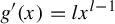 $g'(x)=lx^{l-1}$
, and
$g'(x)=lx^{l-1}$
, and $a\ne 0$
and
$a\ne 0$
and $p\nmid l$
since
$p\nmid l$
since $p>l$
, so g and
$p>l$
, so g and $g'$
are coprime. Therefore, g is not a power of any polynomial.
$g'$
are coprime. Therefore, g is not a power of any polynomial.
For any $i\in \mathbb {F}_p$
we have
$i\in \mathbb {F}_p$
we have
 $$ \begin{align*} |\{x\in \mathbb{F}_p: x^k=i\}|=1+\sum\limits_{\substack{\chi\ne 1 \\ \chi^k=1}}\chi(i). \end{align*} $$
Therefore, the number of pairs $(x, y)$
satisfying
$(x, y)$
satisfying $x^k=y^l+a$
is
$x^k=y^l+a$
is
 $$ \begin{align*} \sum\limits_{y\in\mathbb{F}_p}|\{x\in\mathbb{F}_p: x^k=g(y)\}|=\sum\limits_{y\in\mathbb{F}_p}\bigg(1+\sum\limits_{\substack{\chi\ne 1 \\ \chi^k=1}}\chi(g(y))\bigg). \end{align*} $$
This sum consists of the main term p and at most $k-1$
character sums, each bounded by
$k-1$
character sums, each bounded by $(l-1)\sqrt {p}$
by the Weil bound.
$(l-1)\sqrt {p}$
by the Weil bound.
In the proof of Theorem 3.1, in (8) we make sure that the only question marks in $x_t$
are at positions
$x_t$
are at positions $\widetilde {R^k_{n_t}}$
. In the case when
$\widetilde {R^k_{n_t}}$
. In the case when $k|l$
this set is too large to guarantee convergence of the averages along lth powers. In the following lemma we describe a set we will use instead.
$k|l$
this set is too large to guarantee convergence of the averages along lth powers. In the following lemma we describe a set we will use instead.
Lemma 4.4. Fix distinct positive integers $k|l$
, where
$k|l$
, where $k>1$
, and let n be squarefree such that all prime divisors p of n satisfy
$k>1$
, and let n be squarefree such that all prime divisors p of n satisfy $l|p-1$
and
$l|p-1$
and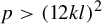 $p>(12kl)^2$
. Let
$p>(12kl)^2$
. Let $A\subset (\mathbb {Z}/n\mathbb {Z})^*$
be defined as
$A\subset (\mathbb {Z}/n\mathbb {Z})^*$
be defined as
 $$ \begin{align*} A=\{a\in((\mathbb{Z}/n\mathbb{Z})^*)^k: \lvert \{p|n: a\ \pmod{p}\notin (\mathbb{F}_p)^l\}\rvert>\ln\omega(n)\}. \end{align*} $$
Then
 $$ \begin{align} |A|>\frac{\varphi(n)}{k^{\omega(n)}}\cdot (1-2^{-\omega(n)/4}) \end{align} $$
and
 $$ \begin{align} \max_{i\in{\mathbb{Z}}/n{\mathbb{Z}}}|\{x\in {\mathbb{Z}}/n{\mathbb{Z}}: x^l\in A+i|<n\cdot (2/3)^{\ln\omega(n)}. \end{align} $$
Proof. Let
 $$ \begin{align*} A_p=\{a\in(({\mathbb{Z}}/n{\mathbb{Z}})^*)^k: a\ \pmod{p}\in (\mathbb{F}_p)^l\}. \end{align*} $$
Since n is squarefree and $k|p-1$
, we have
$k|p-1$
, we have $|(({\mathbb {Z}}/n{\mathbb {Z}})^*)^k|=\varphi (n)/k^{\omega (n)}$
. Since
$|(({\mathbb {Z}}/n{\mathbb {Z}})^*)^k|=\varphi (n)/k^{\omega (n)}$
. Since $l|p-1$
, and by the Chinese remainder theorem,
$l|p-1$
, and by the Chinese remainder theorem,
 $$ \begin{align*} \frac{|A_p|}{\varphi(n)/k^{\omega(n)}}=\frac{(p-1)/l}{(p-1)/k}\leqslant \frac{1}{2}.\end{align*} $$
Let $\mathcal {P}$
be the family of all subsets of
$\mathcal {P}$
be the family of all subsets of $\{p: p|n_t\}$
of size at least
$\{p: p|n_t\}$
of size at least $\omega (n)-\ln \omega (n)$
. From the above estimate and by the Chinese remainder theorem, for any
$\omega (n)-\ln \omega (n)$
. From the above estimate and by the Chinese remainder theorem, for any $P\in \mathcal {P}$
we have
$P\in \mathcal {P}$
we have
 $$ \begin{align*} \frac{k^{\omega(n)}}{\varphi(n)}\cdot \bigcap_{p\in P}A_p\leqslant \bigg(\frac{1}{2}\bigg)^{\omega(n)-\ln\omega(n)}, \end{align*} $$
and since $|\mathcal {P}|\leqslant \omega (n)^{\ln \omega (n)}$
, we have
$|\mathcal {P}|\leqslant \omega (n)^{\ln \omega (n)}$
, we have
 $$ \begin{align*} \frac{k^{\omega(n)}}{\varphi(n)}\cdot \bigcup_{P\in\mathcal{P}}\bigcap_{p\in P}A_p\leqslant \omega(n)^{\ln\omega(n)}\cdot\bigg(\frac{1}{2}\bigg)^{\omega(n)-\ln\omega(n)}\\ =\bigg(\frac{1}{2}\bigg)^{\omega(n)-\ln\omega(n)-\ln(2)(\ln\omega(n))^2}<\bigg(\frac{1}{2}\bigg)^{\omega(n)/4}. \end{align*} $$
But by definition we have
 $$ \begin{align*} A=(({\mathbb{Z}}/n{\mathbb{Z}})^*)^k\setminus\bigg(\bigcup_{P\in\mathcal{P}}\bigcap_{p\in P}A_p\bigg), \end{align*} $$
so we obtain (13).
Now assume that (14) does not hold, say for some $i\in \mathbb {Z}/n{\mathbb {Z}}$
. We first show that
$i\in \mathbb {Z}/n{\mathbb {Z}}$
. We first show that
 $$ \begin{align} |\{p|n: p\nmid i\}|>\ln\omega(n). \end{align} $$
Indeed, by our assumption the set $(A+i)\cap ({\mathbb {Z}}/n{\mathbb {Z}})^l$
is non-empty, so some
$(A+i)\cap ({\mathbb {Z}}/n{\mathbb {Z}})^l$
is non-empty, so some $a\in A$
satisfies
$a\in A$
satisfies $a+i\in ({\mathbb {Z}}/n{\mathbb {Z}})^l$
. Then
$a+i\in ({\mathbb {Z}}/n{\mathbb {Z}})^l$
. Then
 $$ \begin{align*} \{p|n: p|i\}\subset \{p|n: a\ \pmod{p}\in(\mathbb{F}_p)^l\}, \end{align*} $$
and by the definition of the set A this set has less than $\omega (n)-\ln \omega (n)$
elements.
$\omega (n)-\ln \omega (n)$
elements.
If $p|n$
and
$p|n$
and $p\nmid i$
, then by Lemma 4.2 we have
$p\nmid i$
, then by Lemma 4.2 we have
 $$ \begin{align*} |\{x\in \mathbb{F}_p: x^l\in (\mathbb{F}_p)^k+a\}|&\leqslant \frac{1}{k}|\{(x, y)\in \mathbb{F}_p\times\mathbb{F}_p: x^l=y^k+a\}|+l\\& \leqslant \frac{p}{k}+2kl\sqrt{p}\leqslant \frac{2}{3}p. \end{align*} $$
Here the first inequality follows from the fact that the number of kth roots modulo p of ${x^l-a}$
is exactly 0 or k unless
${x^l-a}$
is exactly 0 or k unless $x^l-a=0$
, which happens at most l times. The last inequality follows from
$x^l-a=0$
, which happens at most l times. The last inequality follows from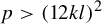 $p>(12kl)^2$
.
$p>(12kl)^2$
.
Since $A\subset (\mathbb {Z}/n{\mathbb {Z}})^k$
, and by the Chinese remainder theorem, we have
$A\subset (\mathbb {Z}/n{\mathbb {Z}})^k$
, and by the Chinese remainder theorem, we have
 $$ \begin{align*} |\{x\in {\mathbb{Z}}/n{\mathbb{Z}}: x^l\in A+i\}|\leqslant \prod_{p|n}|\{x\in \mathbb{F}_p: x^l\in (\mathbb{F}_p)^k+i\}|\leqslant \bigg(\frac{2}{3}\bigg)^{\ln\omega(n)}\cdot n, \end{align*} $$
where we bound each term in the product by $2p/3$
if
$2p/3$
if $p\nmid i$
and by p otherwise.
$p\nmid i$
and by p otherwise.
We are now ready for the main result of this section.
Theorem 4.5. Let $k, l\in {\mathbb {N}}$
be such that
$k, l\in {\mathbb {N}}$
be such that $k| l$
and
$k| l$
and $k>1$
. Then there exists a regular Toeplitz system
$k>1$
. Then there exists a regular Toeplitz system $X_x$
such that, for every continuous map
$X_x$
such that, for every continuous map $F:X_x\to {\mathbb {C}}$
and
$F:X_x\to {\mathbb {C}}$
and $y\in X_x$
, the limit
$y\in X_x$
, the limit
 $$ \begin{align} \lim_{N\to\infty}\frac{1}{N}\sum_{m< N}F(\sigma^{m^l}y) \end{align} $$
exists, but the limit
 $$ \begin{align} \lim_{N\to\infty}\frac{1}{N}\sum_{m< N}G(\sigma^{m^k}x) \end{align} $$
does not exist for the continuous function $G(y)=(-1)^{y(0)}$
.
$G(y)=(-1)^{y(0)}$
.
Proof. We first recursively define a sequence $(n_t)$
so that
$(n_t)$
so that $n_t|n_{t+1}$
, each
$n_t|n_{t+1}$
, each $n_t$
is squarefree, and all prime divisors p of
$n_t$
is squarefree, and all prime divisors p of $n_t$
satisfy
$n_t$
satisfy $l|p-1$
and
$l|p-1$
and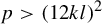 $p>(12kl)^2$
. Additionally, we set
$p>(12kl)^2$
. Additionally, we set $n_0=1$
and require
$n_0=1$
and require
 $$ \begin{align} \sum\limits_{t=0}^{\infty}\bigg(2^{-\omega(n_{t+1})/4}+ \frac{2n_t+\sqrt[k]{n_{t+1}}}{\varphi(n_{t+1})/k^{\omega(n_{t+1})}}\bigg)<\frac{1}{10}, \end{align} $$
 $$ \begin{align} \frac{\varphi(n_t)}{n_t}>\frac{9}{10} \end{align} $$
 $$ \begin{align} n_{t+1}>10n_t^k. \end{align} $$
Let $A_t\subset ({\mathbb {Z}}/n_t{\mathbb {Z}})^*$
be the set given by Lemma 4.4 for
$A_t\subset ({\mathbb {Z}}/n_t{\mathbb {Z}})^*$
be the set given by Lemma 4.4 for $n_t$
. We treat
$n_t$
. We treat $A_t$
as a subset of
$A_t$
as a subset of $[0, n_t-1]$
.
$[0, n_t-1]$
.
We also define a sequence $x_t\in \{0, 1, ?\}^{n_t}$
. We start with
$x_t\in \{0, 1, ?\}^{n_t}$
. We start with $x_0=?.$
Having defined
$x_0=?.$
Having defined $x_t$
, we define
$x_t$
, we define $x_{t+1}$
as follows. First we concatenate
$x_{t+1}$
as follows. First we concatenate $n_{t+1}/n_t$
copies of
$n_{t+1}/n_t$
copies of $x_t$
, creating
$x_t$
, creating $x_{t+1}'$
. We then fill all the positions
$x_{t+1}'$
. We then fill all the positions $i^k$
for
$i^k$
for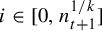 $i\in [0,n_{t+1}^{1/k}]$
which still contain ‘?’ with 0s for even t and 1s for odd t, creating
$i\in [0,n_{t+1}^{1/k}]$
which still contain ‘?’ with 0s for even t and 1s for odd t, creating $x_{t+1}"$
. If the resulting word has the symbol ‘?’ at position i for
$x_{t+1}"$
. If the resulting word has the symbol ‘?’ at position i for
 $$ \begin{align} i\in [0, n_t-1]\cup [n_{t+1}-n_t, n_{t+1}-1]\cup ([0, n_{t+1}-1]\setminus A_{t+1}), \end{align} $$
we change it to a 0 or 1 arbitrarily, creating $x_{t+1}$
.
$x_{t+1}$
.
The pair $(n_t), (x_t)$
defined this way will be viable. Let us now show that condition (10) is satisfied. Also, all question marks in
$(n_t), (x_t)$
defined this way will be viable. Let us now show that condition (10) is satisfied. Also, all question marks in $x_t$
are at positions in
$x_t$
are at positions in $A_t\subset \widetilde {R^k_{n_t}}$
, so
$A_t\subset \widetilde {R^k_{n_t}}$
, so
 $$ \begin{align*} ?_t\leqslant |\widetilde{R^k_{n_t}}|=o(n_t), \end{align*} $$
and so $X_x$
is regular.
$X_x$
is regular.
Fix t and $a\in \mathbb {Z}$
. Notice that
$a\in \mathbb {Z}$
. Notice that
 $$ \begin{align} \{i\in [0, n_t-1]: X_t(i^l+a)=?\}\subset\{i\in [0, n_t-1]: i^l+a\in A_t+n_t{\mathbb{Z}}\}, \end{align} $$
where we let $X_t\in \{0, 1, ?\}^{\mathbb {Z}}$
be the unique infinite
$X_t\in \{0, 1, ?\}^{\mathbb {Z}}$
be the unique infinite $n_t$
-periodic sequence which agrees with
$n_t$
-periodic sequence which agrees with $x_t$
on
$x_t$
on $[0, n_t-1]$
. By (14) the right-hand side of (22) has at most
$[0, n_t-1]$
. By (14) the right-hand side of (22) has at most $n_t\cdot (2/3)^{\ln \omega (n_t)}=o(n_t)$
elements. Therefore, by Lemma 4.1, we obtain convergence of averages (16).
$n_t\cdot (2/3)^{\ln \omega (n_t)}=o(n_t)$
elements. Therefore, by Lemma 4.1, we obtain convergence of averages (16).
We now estimate $?_t$
from below. By the Chinese remainder theorem
$?_t$
from below. By the Chinese remainder theorem
 $$ \begin{align*} \{i\in \widetilde{R^k_{n_{t+1}}}: x_{t+1}'(i)=?\}=?_t\cdot\prod_{\substack{p|n_{t+1}\\ p\nmid n_t}}\frac{p-1}{k}=?_t\cdot \frac{\varphi(n_{t+1}/n_t)}{k^{\omega(n_{t+1}/n_t)}}, \end{align*} $$
so from (13) we get
 $$ \begin{align*} \{i\in A_{t+1}: x_{t+1}'(i)=?\}\geqslant ?_t\cdot \frac{\varphi(n_{t+1}/n_t)}{k^{\omega(n_{t+1}/n_t)}}-\frac{\varphi(n_{t+1})}{k^{\omega(n_{t+1})}}\cdot 2^{-\omega(n_{t+1})/4} \end{align*} $$
and
 $$ \begin{align*} ?_{t+1}\geqslant ?_t\cdot \frac{\varphi(n_{t+1}/n_t)}{k^{\omega(n_{t+1}/n_t)}}-\frac{\varphi(n_{t+1})}{k^{\omega(n_{t+1})}}\cdot 2^{-\omega(n_{t+1})/4}-2n_t-\sqrt[k]{n_{t+1}}. \end{align*} $$
By induction we get
 $$ \begin{align*} \frac{?_{t}}{\vphantom{\frac{1^1_1}{3^2_2}}|\widetilde{R^k_{n_{t}}}|}=?_{t}\cdot\frac{k^{\omega(n_t)}}{\varphi(n_t)}\geqslant 1-\sum\limits_{s=0}^{t-1}\bigg(2^{-\omega(n_{s+1})/4}+ \frac{2n_s+\sqrt[k]{n_{s+1}}}{\varphi(n_{s+1})/k^{\omega(n_{s+1})}}\bigg)\geqslant \frac{9}{10}, \end{align*} $$
where we use (18).
Now we estimate the number of question marks we fill in when going from $x_{t+1}'$
to
$x_{t+1}'$
to $x_{t+1}"$
. First recall that all question marks in
$x_{t+1}"$
. First recall that all question marks in $x_t$
are at positions in
$x_t$
are at positions in $\widetilde {R^k_{n_t}}$
, and for all
$\widetilde {R^k_{n_t}}$
, and for all $a\in \widetilde {R^k_{n_t}}$
we have
$a\in \widetilde {R^k_{n_t}}$
we have
 $$ \begin{align*} |\{i<n_t: i^k\equiv a\ \pmod{n_t}\}|=k^{\omega(n_t)}, \end{align*} $$
so
 $$ \begin{align*} |\{i<n_t: X_t(i^k)=?\}|=?_t\cdot k^{\omega(n_t)}\geqslant \tfrac{9}{10}\varphi(n_t)\geqslant \tfrac{8}{10}n_t \end{align*} $$
by (19).
Let $C_t=\lfloor {n_{t+1}}^{1/k}\rfloor =an_t+r$
for
$C_t=\lfloor {n_{t+1}}^{1/k}\rfloor =an_t+r$
for $a\in \mathbb {Z}$
and
$a\in \mathbb {Z}$
and $r\in [0, n_t-1]$
, where
$r\in [0, n_t-1]$
, where $a\geqslant 10$
by (20). Then
$a\geqslant 10$
by (20). Then
 $$ \begin{align*} |\{i<C_t: x_{t+1}'(i^k)=?\}|\geqslant a|\{i<n_t: x_{t+1}'(i^k)=?\}|\geqslant \tfrac{8}{10}an_t\geqslant \tfrac{7}{10}C_t. \end{align*} $$
Therefore, when constructing $x_{t+1}"$
we fill in at least
$x_{t+1}"$
we fill in at least $7C_t/10$
question marks, and so
$7C_t/10$
question marks, and so
 $$ \begin{align*} \frac{1}{C_t}\sum\limits_{i<C_t}G(\sigma^{i^k}x)=\frac{1}{C_t}\sum\limits_{i<C_t}(-1)^{x_{t+1}(i^k)}\geqslant \frac{1}{C_t}\bigg(\frac{7}{10}C_t-\frac{3}{10}C_t\bigg)= \frac{2}{5} \end{align*} $$
for even t, and
 $$ \begin{align*} \frac{1}{C_t}\sum\limits_{i<C_t}G(\sigma^{i^k}x)\leqslant -\frac{2}{5} \end{align*} $$
for odd t, and so the limit (4) does not exist.
5 Density of sparse orbits
In this section we investigate the cases when a sparse orbit $(T^{a_n}y)$
along some sequence
$(T^{a_n}y)$
along some sequence $(a_n)$
is dense in a Toeplitz system
$(a_n)$
is dense in a Toeplitz system $X_x$
containing y.
$X_x$
containing y.
We first give the following definition.
Definition 5.1. Let $I\subset {\mathbb {Z}}$
, and let
$I\subset {\mathbb {Z}}$
, and let $x\in \{0, 1\}^{I}$
and
$x\in \{0, 1\}^{I}$
and $s\in {\mathbb {N}}$
. For
$s\in {\mathbb {N}}$
. For $\varepsilon \in \{0, 1\}$
by
$\varepsilon \in \{0, 1\}$
by $\operatorname {\mathrm {Per}}^{(\varepsilon )}_s(x)$
we denote
$\operatorname {\mathrm {Per}}^{(\varepsilon )}_s(x)$
we denote
 $$ \begin{align*} \{n\in{\mathbb{Z}}: (\text{for all } k\in{\mathbb{N}}) x(n+ks)=\varepsilon\text{ whenever }n+ks\in I\}. \end{align*} $$
Clearly $\operatorname {\mathrm {Per}}^{(\varepsilon )}_{s}(x)$
is a disjoint union of bi-infinite arithmetic sequences with difference s. Therefore, it is fully determined by its image under the quotient homomorphism
$\operatorname {\mathrm {Per}}^{(\varepsilon )}_{s}(x)$
is a disjoint union of bi-infinite arithmetic sequences with difference s. Therefore, it is fully determined by its image under the quotient homomorphism ${\pi _s: {\mathbb {Z}}\to {\mathbb {Z}}/s{\mathbb {Z}}}$
. Let us denote
${\pi _s: {\mathbb {Z}}\to {\mathbb {Z}}/s{\mathbb {Z}}}$
. Let us denote
 $$ \begin{align*} \operatorname{\mathrm{per}}^{(\varepsilon)}_s(x)=\lvert \pi_s(\operatorname{\mathrm{Per}}^{(\varepsilon)}_s(x))\rvert\in [0, s]. \end{align*} $$
Notice that
 $$ \begin{align*} \operatorname{\mathrm{Per}}_s(x)=\operatorname{\mathrm{Per}}^{(0)}_s(x)\cup \operatorname{\mathrm{Per}}^{(1)}_s(x), \end{align*} $$
and if $s'$
divides s, then
$s'$
divides s, then $\operatorname {\mathrm {Per}}_{s'}(x)\subset \operatorname {\mathrm {Per}}_s(x)$
.
$\operatorname {\mathrm {Per}}_{s'}(x)\subset \operatorname {\mathrm {Per}}_s(x)$
.
By an essential period of a Toeplitz word $x\in \{0, 1\}^{{\mathbb {Z}}}$
we mean such an s that
$x\in \{0, 1\}^{{\mathbb {Z}}}$
we mean such an s that $\operatorname {\mathrm {Per}}_s(x)$
is non-empty and does not coincide with
$\operatorname {\mathrm {Per}}_s(x)$
is non-empty and does not coincide with $\operatorname {\mathrm {Per}}_{s'}(x)$
for any
$\operatorname {\mathrm {Per}}_{s'}(x)$
for any $s'<s$
.
$s'<s$
.
It is easily checked that if $x'\in X_x$
is also Toeplitz, then x and
$x'\in X_x$
is also Toeplitz, then x and $x'$
have the same essential periods, and so it makes sense to talk about an essential period of a Toeplitz system
$x'$
have the same essential periods, and so it makes sense to talk about an essential period of a Toeplitz system $X_x$
.
$X_x$
.
Lemma 5.1. Let x be a Toeplitz word, and s any essential period of x. Then for any $y\in X_x$
we have
$y\in X_x$
we have
 $$ \begin{align*} y\notin \overline{\{\sigma^ny: n\in \mathbb{Z}\text{ and } s\nmid n\}}. \end{align*} $$
Proof. Assume without loss of generality that $0\in \operatorname {\mathrm {Per}}_s(x)$
but
$0\in \operatorname {\mathrm {Per}}_s(x)$
but $0\notin \operatorname {\mathrm {Per}}_{s'}(x)$
for any
$0\notin \operatorname {\mathrm {Per}}_{s'}(x)$
for any $s'<s$
, and assume that
$s'<s$
, and assume that $x(0)=0$
.
$x(0)=0$
.
First notice that for some N we have
 $$ \begin{align*} \operatorname{\mathrm{Per}}^{(0)}_s(x|_{[0, N]})=\operatorname{\mathrm{Per}}^{(0)}_s(x). \end{align*} $$
Indeed, for any $i\in [0, s-1]\setminus \operatorname {\mathrm {Per}}^{(0)}_s(x)$
there exists a natural number
$i\in [0, s-1]\setminus \operatorname {\mathrm {Per}}^{(0)}_s(x)$
there exists a natural number $N_i$
such that
$N_i$
such that $x(N_i)=1$
and
$x(N_i)=1$
and $N_i\equiv i\ \pmod {s}$
. It is enough to take
$N_i\equiv i\ \pmod {s}$
. It is enough to take
 $$ \begin{align*} N=\max\{N_i: i\in [0, s-1]\setminus \operatorname{\mathrm{Per}}^{(0)}_s(x)\}. \end{align*} $$
By minimality of $X_x$
, we can find a natural number M such that any word in
$X_x$
, we can find a natural number M such that any word in $\mathcal {L}_{X_x}$
of length M contains
$\mathcal {L}_{X_x}$
of length M contains $x|_{[0, N]}$
as a subword. We denote
$x|_{[0, N]}$
as a subword. We denote $x|_{[0, N]}=\nu $
.
$x|_{[0, N]}=\nu $
.
We will now show that
 $$ \begin{align*} d(y, \sigma^n y)\geqslant 2^{-M} \end{align*} $$
whenever $s\nmid n$
. This will clearly end the proof.
$s\nmid n$
. This will clearly end the proof.
Pick n such that the above inequality does not hold. Then $y|_{[0, M]}=y|_{[n, n+M]}$
; let us denote this word by
$y|_{[0, M]}=y|_{[n, n+M]}$
; let us denote this word by $\omega $
. We know that
$\omega $
. We know that $\omega |_{[k, k+N]}=\nu $
for some k, so
$\omega |_{[k, k+N]}=\nu $
for some k, so
 $$ \begin{align*} \operatorname{\mathrm{per}}^{(0)}_s(x)\leqslant \operatorname{\mathrm{per}}^{(0)}_s(\omega)\leqslant \operatorname{\mathrm{per}}^{(0)}_s(\nu)=\operatorname{\mathrm{per}}^{(0)}_s(x). \end{align*} $$
Here the first inequality follows from $\omega \in \mathcal {L}_{X_x}$
, the second from
$\omega \in \mathcal {L}_{X_x}$
, the second from $\nu \subset \omega $
, and the equality follows from the definition of
$\nu \subset \omega $
, and the equality follows from the definition of $\nu $
. In particular, both of the inequalities are actually equalities.
$\nu $
. In particular, both of the inequalities are actually equalities.
Since $\omega $
appears in
$\omega $
appears in $y|_{[0, n+M]}$
at positions starting with
$y|_{[0, n+M]}$
at positions starting with $0$
and n, we have
$0$
and n, we have
 $$ \begin{align*} \operatorname{\mathrm{Per}}^{(0)}_s(y|_{[0, n+M]})\subset \operatorname{\mathrm{Per}}^{(0)}_s(\omega)\cap (n+\operatorname{\mathrm{Per}}^{(0)}_s(\omega)), \end{align*} $$
but
 $$ \begin{align*} \operatorname{\mathrm{per}}^{(0)}_s(y|_{[0, n+M]})\geqslant \operatorname{\mathrm{per}}^{(0)}_s(x)=\operatorname{\mathrm{per}}^{(0)}_s(\omega) \end{align*} $$
since $y|_{[0, n+M]}\subset x$
. Hence,
$y|_{[0, n+M]}\subset x$
. Hence,
 $$ \begin{align*} \lvert \pi_s(\operatorname{\mathrm{Per}}_s^{(0)}(\omega))\rvert=\operatorname{\mathrm{per}}^{(0)}_s(\omega)\leqslant \lvert \pi_s(\operatorname{\mathrm{Per}}_s^{(0)}(\omega))\cap \pi_s(n+\operatorname{\mathrm{Per}}^{(0)}_s(\omega))\rvert. \end{align*} $$
The inequality must actually be an equality, and in particular we obtain
 $$ \begin{align*} \pi_s(\operatorname{\mathrm{Per}}_s^{(0)}(\omega))=\pi_s(n+\operatorname{\mathrm{Per}}^{(0)}_s(\omega)). \end{align*} $$
We have $\nu \subset \omega $
, but
$\nu \subset \omega $
, but $\operatorname {\mathrm {per}}^{(0)}_s(\nu )=\operatorname {\mathrm {per}}^{(0)}_s(\omega )$
, so
$\operatorname {\mathrm {per}}^{(0)}_s(\nu )=\operatorname {\mathrm {per}}^{(0)}_s(\omega )$
, so
 $$ \begin{align*} \pi_s(\operatorname{\mathrm{Per}}_s^{(0)}(\nu))=\pi_s(\operatorname{\mathrm{Per}}_s^{(0)}(\omega)-k)=\pi_s(n-k+\operatorname{\mathrm{Per}}^{(0)}_s(\omega))= \pi_s(n+\operatorname{\mathrm{Per}}^{(0)}_s(\nu)), \end{align*} $$
and so
 $$ \begin{align*} \operatorname{\mathrm{Per}}_s^{(0)}(\nu)=n+\operatorname{\mathrm{Per}}_s^{(0)}(\nu), \end{align*} $$
and by the definition of $\nu $
we get
$\nu $
we get
 $$ \begin{align*} \operatorname{\mathrm{Per}}_s^{(0)}(x)=n+\operatorname{\mathrm{Per}}_s^{(0)}(x). \end{align*} $$
But then $x(an+bs)=x(0)=0$
for all
$x(an+bs)=x(0)=0$
for all $a, b\in {\mathbb {Z}}$
, and so
$a, b\in {\mathbb {Z}}$
, and so $0\in \operatorname {\mathrm {Per}}_{\gcd (n, s)}(x)$
. We assumed that s is an essential period of 0, so we obtain
$0\in \operatorname {\mathrm {Per}}_{\gcd (n, s)}(x)$
. We assumed that s is an essential period of 0, so we obtain $\gcd (n, s)=s$
, so
$\gcd (n, s)=s$
, so $s|n$
.
$s|n$
.
Theorem 5.2. Let $X_x$
be a Toeplitz system with an essential period s, and pick
$X_x$
be a Toeplitz system with an essential period s, and pick $y\in X_x$
. If
$y\in X_x$
. If $(\sigma ^{a_n}y)$
is dense in
$(\sigma ^{a_n}y)$
is dense in $X_x$
for some sequence
$X_x$
for some sequence $(a_n)$
of integers, then
$(a_n)$
of integers, then $(a_n)$
gives a full set of residues modulo s.
$(a_n)$
gives a full set of residues modulo s.
Proof. Pick $i\in [0, s-1]$
. Since
$i\in [0, s-1]$
. Since $\sigma ^i y$
is in the closure of the orbit
$\sigma ^i y$
is in the closure of the orbit $(\sigma ^{a_n}y)$
and
$(\sigma ^{a_n}y)$
and $\sigma $
is a homeomorphism, we have
$\sigma $
is a homeomorphism, we have
 $$ \begin{align*} y\in \overline{\{\sigma^{a_n-i}y: n\in{\mathbb{Z}}^+\}}, \end{align*} $$
so by the previous lemma we have $s|a_n-i$
for some n.
$s|a_n-i$
for some n.
In particular, we obtain the following corollary.
Corollary 5.3. Let $(a_k)$
be a sequence of positive integers,
$(a_k)$
be a sequence of positive integers, $X_x$
be an infinite Toeplitz system, and
$X_x$
be an infinite Toeplitz system, and $y\in X_x$
. Assume that
$y\in X_x$
. Assume that $(\sigma ^{a_k}y)$
is dense in
$(\sigma ^{a_k}y)$
is dense in $X_x$
. Then there exists a strictly increasing sequence
$X_x$
. Then there exists a strictly increasing sequence $(n_t)$
of positive integers such that
$(n_t)$
of positive integers such that $n_t|n_{t+1}$
and
$n_t|n_{t+1}$
and $(a_k)$
gives a full set of residues modulo each
$(a_k)$
gives a full set of residues modulo each $n_t$
.
$n_t$
.
This easily implies that prime orbits are never dense in infinite Toeplitz systems. In fact, we can say this even about l-almost primes.
Definition 5.2. For $l\in \mathbb {Z}^+$
we denote
$l\in \mathbb {Z}^+$
we denote
 $$ \begin{align*} \mathbb{P}_l=\{n\in\mathbb{Z}^+: 1<\Omega(n)\leqslant l\}, \end{align*} $$
and we call elements of this set l-almost primes.
Theorem 5.4. Let $X_x$
be an infinite Toeplitz system and
$X_x$
be an infinite Toeplitz system and $y\in X_x$
, and fix
$y\in X_x$
, and fix $l\in {\mathbb {Z}}^+$
. The orbit
$l\in {\mathbb {Z}}^+$
. The orbit $\{\sigma ^{n}y: n\in \mathbb {P}_l\}$
is not dense in
$\{\sigma ^{n}y: n\in \mathbb {P}_l\}$
is not dense in $X_x$
.
$X_x$
.
Proof. Assume otherwise, and let $(n_t)$
be the sequence given by Corollary 5.3. Then
$(n_t)$
be the sequence given by Corollary 5.3. Then $\Omega (n_{l+2})>l$
, so
$\Omega (n_{l+2})>l$
, so $n_{l+2}$
does not divide any element of
$n_{l+2}$
does not divide any element of $\mathbb {P}_l$
, and so we reach a contradiction.
$\mathbb {P}_l$
, and so we reach a contradiction.
We now discuss the case of polynomial orbits. In this case Theorem 5.2 has a converse.
Theorem 5.5. Let $X_x$
be a Toeplitz system and
$X_x$
be a Toeplitz system and $P\in {\mathbb {Z}}[X]$
be a permutation modulo each essential period of
$P\in {\mathbb {Z}}[X]$
be a permutation modulo each essential period of $X_x$
. Then
$X_x$
. Then $(\sigma ^{P(n)}y)$
is dense in
$(\sigma ^{P(n)}y)$
is dense in $X_x$
for any
$X_x$
for any $y\in X_x$
.
$y\in X_x$
.
Proof. It is enough to show that this orbit visits each set of the form
 $$ \begin{align*}U=\{z\in X_x: z[-k, k]=\omega\}\end{align*} $$
for $\omega \in \mathcal {L}_{X_x}$
of length
$\omega \in \mathcal {L}_{X_x}$
of length $2k+1$
. Fix such an
$2k+1$
. Fix such an $\omega $
, and let
$\omega $
, and let $x[a, a+2k]=\omega $
. Then for
$x[a, a+2k]=\omega $
. Then for ${i\in [a, a+2k]}$
we let
${i\in [a, a+2k]}$
we let $p_i$
be the essential period of
$p_i$
be the essential period of $x_i$
in x. This way the word
$x_i$
in x. This way the word $\omega $
appears in x starting at positions
$\omega $
appears in x starting at positions $a+np$
for
$a+np$
for $n\in {\mathbb {Z}}$
and
$n\in {\mathbb {Z}}$
and $p=\operatorname {\mathrm {lcm}}\{p_i: i\in [a, a+2k]\}$
. Since the polynomial P is a permutation modulo each
$p=\operatorname {\mathrm {lcm}}\{p_i: i\in [a, a+2k]\}$
. Since the polynomial P is a permutation modulo each $p_i$
, it is also a permutation modulo p.
$p_i$
, it is also a permutation modulo p.
Now, since $y\in X_x$
, the word
$y\in X_x$
, the word $\omega $
must appear in y periodically with period p, say starting at positions
$\omega $
must appear in y periodically with period p, say starting at positions $a'+np$
for
$a'+np$
for $n\in {\mathbb {Z}}$
. If
$n\in {\mathbb {Z}}$
. If $b>0$
is such that
$b>0$
is such that $P(b)\equiv a'+k\ \pmod {p}$
, then
$P(b)\equiv a'+k\ \pmod {p}$
, then ${y[P(b)-k, P(b)+k]=\omega }$
, so
${y[P(b)-k, P(b)+k]=\omega }$
, so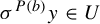 $\sigma ^{P(b)}y\in U$
.
$\sigma ^{P(b)}y\in U$
.
Theorem 5.6. Let P be a polynomial which is not permutative. Let $X_x$
be an infinite Toeplitz system, and
$X_x$
be an infinite Toeplitz system, and $y\in X_x$
. The orbit
$y\in X_x$
. The orbit $\{\sigma ^{P(n)}y: n\in {\mathbb {Z}}^+\}$
is not dense in
$\{\sigma ^{P(n)}y: n\in {\mathbb {Z}}^+\}$
is not dense in $X_x$
.
$X_x$
.
Proof. This follows directly from the definition of permutativity and Corollary 5.3.
Theorem 5.7. Let P be a permutative polynomial, and let x be a Toeplitz word such that $X_x$
is regular and P is a permutation modulo each essential period of
$X_x$
is regular and P is a permutation modulo each essential period of $X_x$
. Then for any
$X_x$
. Then for any $y\in X_x$
and any continuous
$y\in X_x$
and any continuous $F:X_x\to X_x$
we have
$F:X_x\to X_x$
we have
 $$ \begin{align*} \lim_{N\to\infty}\frac{1}{N}\sum\limits_{m<N}F(\sigma^{P(m)}y)=\int_{X_x}F\, d\mu \end{align*} $$
uniformly in y, where $\mu $
is the unique
$\mu $
is the unique $\sigma $
-invariant measure on
$\sigma $
-invariant measure on $X_x$
.
$X_x$
.
Proof. Let $(x_t), (n_t)$
be a viable pair producing the Toeplitz word x, and such that each
$(x_t), (n_t)$
be a viable pair producing the Toeplitz word x, and such that each $n_t$
is a least common multiple of some essential periods of
$n_t$
is a least common multiple of some essential periods of $X_x$
. This way P is a permutation modulo each
$X_x$
. This way P is a permutation modulo each $n_t$
. We proceed as in the proof of Lemma 4.1. It is enough to show that
$n_t$
. We proceed as in the proof of Lemma 4.1. It is enough to show that
 $$ \begin{align*} \lim_{N\to\infty}\frac{1}{N}\sum\limits_{m<N}F(\sigma^{P(m)+r}x)=\int_{X_x}F\, d\mu \end{align*} $$
uniformly in $r\in {\mathbb {Z}}$
. We again assume that F only depends on coordinates from
$r\in {\mathbb {Z}}$
. We again assume that F only depends on coordinates from $-C$
to C for some
$-C$
to C for some $C\in {\mathbb {Z}}^+$
, and that
$C\in {\mathbb {Z}}^+$
, and that $F:X_x\to [0, 1]$
. Fix t, and let
$F:X_x\to [0, 1]$
. Fix t, and let
 $$ \begin{align*} A_a=\{i\in [0, n_t-1]: X_t(i+a+r)=?\} \end{align*} $$
and
 $$ \begin{align*} A=\bigcup_{a=-C}^{C}A_a. \end{align*} $$
Then $|A|\leqslant (2C+1)?_t$
, and for
$|A|\leqslant (2C+1)?_t$
, and for $i\notin A$
we have
$i\notin A$
we have
 $$ \begin{align*} F(\sigma^{P(i)+a+r}x)=F(\sigma^{P(i)+a+r \pmod{n_t}}x), \end{align*} $$
so since $P+r$
is a permutation modulo
$P+r$
is a permutation modulo $n_t$
, we get
$n_t$
, we get
 $$ \begin{align*} \bigg\lvert\! \sum\limits_{m<n_t}F(\sigma^{P(m)+r}x)-\sum\limits_{m<n_t}F(\sigma^{m}x)\bigg\rvert\leqslant 2\cdot (2C+1)?_t, \end{align*} $$
and as in the proof of Lemma 4.1 we obtain
 $$ \begin{align*} \bigg\lvert \frac{1}{N}\sum\limits_{m<N}F(\sigma^{P(m)+r}x)- \frac{1}{n_t}\sum\limits_{m<n_t}F(\sigma^{m}x)\bigg\rvert\leqslant \frac{2\cdot (2C+1)?_t}{n_t}+\frac{n_t}{N}+\frac{n_t}{N-n_t} \end{align*} $$
for $N>n_t$
. Since
$N>n_t$
. Since
 $$ \begin{align*} \lim\limits_{t\to\infty}\frac{1}{n_t}\sum\limits_{m<n_t}F(\sigma^{m}x)=\int_{X_x}F\, d\mu, \end{align*} $$
we obtain the desired convergence, and it is clearly uniform in $r\in {\mathbb {Z}}$
.
$r\in {\mathbb {Z}}$
.
In particular, using Theorem 5.2, we obtain Theorem 1.2.
This theorem is no longer true if we remove the assumption of regularity—the method we used in §3 would give the relevant counterexamples. We will omit the details, and instead adapt [Reference Iwanik and Lacroix4, Example 2.3] to show that there are in fact strictly ergodic counterexamples (which we could not ensure with methods from §3).
Theorem 5.8. Let $P\in {\mathbb {Z}}[X]$
be permutative and let
$P\in {\mathbb {Z}}[X]$
be permutative and let $\deg P>1$
. There exists a strictly ergodic Toeplitz system
$\deg P>1$
. There exists a strictly ergodic Toeplitz system $X_x$
, for which each orbit
$X_x$
, for which each orbit $(\sigma ^{P(n)}y)$
for
$(\sigma ^{P(n)}y)$
for $y\in X_x$
is dense in
$y\in X_x$
is dense in $X_x$
, but the limit
$X_x$
, but the limit
 $$ \begin{align} \lim_{N\to\infty}\frac{1}{N}\sum_{m< N}G(\sigma^{P(m)}x) \end{align} $$
does not exist for the continuous function $G(y)=(-1)^{y(0)}$
.
$G(y)=(-1)^{y(0)}$
.
Proof. Let M be the absolute value of the leading coefficient of P. Since $d>1$
, by replacing
$d>1$
, by replacing $P(x)$
with
$P(x)$
with $\pm P(x+k)$
for some large k we can assume that
$\pm P(x+k)$
for some large k we can assume that ${P(n{\kern-1pt}+{\kern-1pt}1){\kern-1pt}-{\kern-1pt}P(n){\kern-1pt}>{\kern-1pt}n}$
and
${P(n{\kern-1pt}+{\kern-1pt}1){\kern-1pt}-{\kern-1pt}P(n){\kern-1pt}>{\kern-1pt}n}$
and $P(n)>Mn^d$
for
$P(n)>Mn^d$
for $n\geqslant 0$
. Let
$n\geqslant 0$
. Let $(n_t)$
be a strictly increasing sequence starting with
$(n_t)$
be a strictly increasing sequence starting with $n_0=1$
satisfying
$n_0=1$
satisfying $n_t|n_{t+1}$
such that P is permutative modulo each
$n_t|n_{t+1}$
such that P is permutative modulo each $n_t$
. By restricting to a subsequence, we can additionally assume that
$n_t$
. By restricting to a subsequence, we can additionally assume that $n_{t+1}>(M+1)(10n_t)^{d}$
and
$n_{t+1}>(M+1)(10n_t)^{d}$
and
 $$ \begin{align} \sum\limits_{t=0}^{\infty}\frac{2n_t}{n_{t+1}}<\frac{1}{5}, \end{align} $$
and that all $m_t:=n_{t+1}/n_t$
are of the same parity. We now recursively define sequences of words
$m_t:=n_{t+1}/n_t$
are of the same parity. We now recursively define sequences of words $B_t^{(0)}, B_t^{(1)}\in \{0, 1\}^{n_t}$
. We start with
$B_t^{(0)}, B_t^{(1)}\in \{0, 1\}^{n_t}$
. We start with $B_0=0$
and
$B_0=0$
and $B_0'=1$
.
$B_0'=1$
.
Given $B_t^{(0)}$
and
$B_t^{(0)}$
and $B_t^{(1)}$
, we let
$B_t^{(1)}$
, we let
 $$ \begin{align*} A_t=\{i\in [0, n_t-1]: B_t^{(0)}(i)\ne B_t^{(1)}(i)\}. \end{align*} $$
We let
 $$ \begin{align*} B_{t+1}^{(0)}=B_t^{(\varepsilon_t(0))}B_t^{(\varepsilon_t(1))}\cdots B_t^{(\varepsilon_t(m_t-1))} \end{align*} $$
for a sequence $\varepsilon _t\in \{0, 1\}^{m_t}$
satisfying the following:
$\varepsilon _t\in \{0, 1\}^{m_t}$
satisfying the following:
-
(1)
$\varepsilon _t(0)=0$
and
$\varepsilon _t(m_t-1)=1$
; -
(2) for
$i>n_t$
satisfying
$P(i)<n_{t+1}-n_t$
and
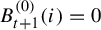
$P(i)\in A_t+n_t{\mathbb {Z}}$
we have
$B_{t+1}^{(0)}(i)=0$
if t is odd and 1 if t is even; -
(3)
$$ \begin{align*}|\{i\in [0, m_t-1]:\varepsilon_t(i)=0\}|=\begin{cases}m_t/2\quad&\text{if } m_t \text{ is even}\\ (m_t+1)/2\quad &\text{if } m_t \text{ is odd.}\end{cases}\end{align*} $$






Notice that the second condition can be satisfied, since for i in the specified range we have $P(i+1)-P(i)>n_t$
, and so the values of
$P(i+1)-P(i)>n_t$
, and so the values of $\lfloor P(i)/n_t\rfloor \in [1, m_t-2]$
are all distinct, and so we can pick each of the
$\lfloor P(i)/n_t\rfloor \in [1, m_t-2]$
are all distinct, and so we can pick each of the $\varepsilon _t(\lfloor P(i)/n_t\rfloor )$
separately and without interfering with condition (1). This way we specify the value of
$\varepsilon _t(\lfloor P(i)/n_t\rfloor )$
separately and without interfering with condition (1). This way we specify the value of $\varepsilon _t$
at no more than
$\varepsilon _t$
at no more than
 $$ \begin{align*} 2+\sqrt[d]{n_{t+1}}<3\frac{n_{t+1}}{\sqrt[d]{n_{t+1}}}<3\frac{n_{t+1}}{10n_t}<\frac{m_t}{2} \end{align*} $$
places, so we can now fulfil condition (3).
We then define
 $$ \begin{align*} B_{t+1}^{(1)}=B_t^{(\varepsilon_t'(0))}B_t^{(\varepsilon_t'(1))}\cdots B_t^{(\varepsilon_t'(m_t-1))}, \end{align*} $$
where $\varepsilon '(i)=1-\varepsilon (i)$
for
$\varepsilon '(i)=1-\varepsilon (i)$
for $i\notin \{ 0, m_t-1\}$
, but
$i\notin \{ 0, m_t-1\}$
, but $\varepsilon '(0)=0$
and
$\varepsilon '(0)=0$
and $\varepsilon '(m_t-1)=1$
.
$\varepsilon '(m_t-1)=1$
.
Letting $W_t=\{B_t^{(0)}, B_{t}^{(1)}\}$
, we construct
$W_t=\{B_t^{(0)}, B_{t}^{(1)}\}$
, we construct $x\in \{0, 1\}^{{\mathbb {Z}}}$
as in §2.1; by Fact 2.3 the word x is then Toeplitz. If the
$x\in \{0, 1\}^{{\mathbb {Z}}}$
as in §2.1; by Fact 2.3 the word x is then Toeplitz. If the $m_t$
are even, by induction we have
$m_t$
are even, by induction we have
 $$ \begin{align*} \operatorname{\mathrm{ap}}(B_t^{(\varepsilon)}, B_s^{(\varepsilon')})=\tfrac{1}{2} \end{align*} $$
for any $t<s$
and
$t<s$
and $\varepsilon , \varepsilon '\in \{0, 1\}$
. By Theorem 2.4 in this case
$\varepsilon , \varepsilon '\in \{0, 1\}$
. By Theorem 2.4 in this case $X_x$
is uniquely ergodic.
$X_x$
is uniquely ergodic.
If the $m_t$
are odd, by a similar computation to Example 2.3 in [Reference Iwanik and Lacroix4] we obtain
$m_t$
are odd, by a similar computation to Example 2.3 in [Reference Iwanik and Lacroix4] we obtain
 $$ \begin{align*} \operatorname{\mathrm{ap}}(B^{(\varepsilon)}_t, B^{(\varepsilon')}_s)=\frac{1}{2}\bigg(1\pm \frac{1}{m_tm_{t+1}\cdots m_{s-1}}\bigg), \end{align*} $$
where the sign is positive if $\varepsilon =\varepsilon '$
and negative otherwise. Hence, in this case for any
$\varepsilon =\varepsilon '$
and negative otherwise. Hence, in this case for any $t, \varepsilon , \varepsilon '$
we have
$t, \varepsilon , \varepsilon '$
we have
 $$ \begin{align*} \lim\limits_{s\to\infty}\operatorname{\mathrm{ap}}(B_t^{(\varepsilon)}, B_s^{(\varepsilon')})=\tfrac{1}{2}, \end{align*} $$
so by Theorem 2.4 the system $X_x$
is uniquely ergodic.
$X_x$
is uniquely ergodic.
All essential periods of $X_x$
are clearly divisors of some
$X_x$
are clearly divisors of some $n_t$
. By Theorem 5.5 we therefore see that
$n_t$
. By Theorem 5.5 we therefore see that $(\sigma ^{P(n)}y)$
is dense in
$(\sigma ^{P(n)}y)$
is dense in $X_x$
for any
$X_x$
for any $y\in X_x$
.
$y\in X_x$
.
All that remains is to see that the limit (23) does not exist.
We first estimate $|A_t|$
inductively: we have
$|A_t|$
inductively: we have $|A_0|=1$
, and
$|A_0|=1$
, and
 $$ \begin{align*} |A_{t+1}|\geqslant (m_t-2)|A_{t}|, \end{align*} $$
so
 $$ \begin{align*} \frac{1}{n_t}|A_t|\geqslant \prod_{s=0}^{t-1}\bigg(1-\frac{2n_t}{n_{t+1}}\bigg)\geqslant \frac{4}{5} \end{align*} $$
by (24).
Let us now estimate the number of $i> n_t$
that satisfy the assumption of condition (2). Since P is permutative, among any
$i> n_t$
that satisfy the assumption of condition (2). Since P is permutative, among any $n_t$
consecutive values of i precisely
$n_t$
consecutive values of i precisely $|A_t|$
satisfy
$|A_t|$
satisfy $P(i)\in A_t+n_t{\mathbb {Z}}$
. Let
$P(i)\in A_t+n_t{\mathbb {Z}}$
. Let $C_t=\max \{i\in {\mathbb {Z}}^+: P(i)<n_{t+1}-n_t\}$
. For large t we have
$C_t=\max \{i\in {\mathbb {Z}}^+: P(i)<n_{t+1}-n_t\}$
. For large t we have ${C_t>\sqrt [d]{n_{t+1}/(M+1)}>10n_t}$
, so
${C_t>\sqrt [d]{n_{t+1}/(M+1)}>10n_t}$
, so
 $$ \begin{align*} \lvert \{i{\kern-1pt}>{\kern-1pt}n_t: P(i){\kern-1pt}<{\kern-1pt}n_{t+1}-n_t\text{ and }P(i){\kern-1pt}\in{\kern-1pt} A_t+n_t{\mathbb{Z}}\}\rvert>|A_t|\cdot \frac{(C_t-2n_t)}{n_t}{\kern-1pt}>{\kern-1pt}\frac{4}{5}\cdot \frac{4}{5}C_t{\kern-1pt}>{\kern-1pt}\frac{3}{5}C_t. \end{align*} $$
Therefore, for large even t we have
 $$ \begin{align*} \frac{1}{C_t}\sum\limits_{m<C_t}G(\sigma^{P(m)}x)=\frac{1}{C_t}\sum\limits_{m<C_t}(-1)^{x_{t+1}(P(m))}\geqslant \frac{1}{C_t}\bigg(\frac{3}{5}C_t-\frac{2}{5}C_t\bigg)= \frac{1}{5}, \end{align*} $$
and for large odd t we have
 $$ \begin{align*} \frac{1}{C_t}\sum\limits_{m<C_t}G(\sigma^{P(m)}x)\leqslant-\frac{1}{5}, \end{align*} $$
and so the limit (23) does not exist.
Acknowledgments
I would like to thank Adam Kanigowski for introducing me to the study of sparse orbits in Toeplitz systems, and for helpful discussions and comments regarding this note. I would also like to thank the anonymous referee for their suggestions.

 Open access

