


Introduction
For a number of decades now there has been much scholarly discussion in the fields of cognitive behaviour and education about the benefits of pedagogical approaches that favour design over instruction – that is to say, learning experiences in which students actively design learning material instead of simply consuming material designed to transmit knowledge to them. This approach is best exemplified in Seymour Papert's concept of constructionism, which stresses the importance of ‘learning-by-making’ and, in the case of Papert's work in the fields of mathematics and computer science, using digital-media as a tool to achieve constructionist learning goals (Kafai, Reference Kafai1995; Papert, Reference Papert1980, Reference Papert1993). In this respect, the constructionist approach encourages learners to build knowledge out of their experiences, especially when they are constructing objects or artifacts. With the advent of social media platforms such as Youtube, Instagram, Twitter and TikTok, user-generated content has become the most commonly created and consumed form of media in many of our daily lives. Based on the fact that an entire generation born into a world of user-generated digital content will soon fill the seats of classrooms at colleges and universities worldwide, it seems more appropriate than ever to explore the benefits of constructionist learning approaches using digital media technologies in higher education.
In addition, the recent proliferation of consumer-grade virtual reality (VR) hardware has made a wide range of immersive experiences, locations, and environments more accessible than ever. This is especially beneficial for students of ancient history and archaeology who may not be able to examine archaeological materials and environments in person due to the prohibitive costs of travel, general inaccessibility of archaeological materials, and more recently due to the global pandemic. Even though VR technology offers seemingly limitless possibilities for the enhancement of teaching materials, it has not been widely adopted by instructors in the academy due to both its novelty and the technical skills required for its use – primarily the necessity of video game design and coding skills. Despite these challenges, the increased accessibility of VR and video game design technologies over the past few years has presented a perfect opportunity for students to learn about the ancient world in new and immersive ways.
As an educator in the field of Ancient History with technical knowledge of both game design and computer coding, I decided to seize this opportunity and conducted a pedagogical experiment in October of 2018 at York University, Toronto, Canada. This experiment was administered in the form of an assignment to third-year university students enrolled in a History course about the city in the Roman world. For this assignment, students conducted research on a variety of Roman public buildings in groups, built them using the Unity 3D game design software, and presented them to the class in VR. In doing so, they successfully created a built environment based on their research about Roman urban architecture, walked around the environment in virtual reality, and discussed their individual structures together with a sense of immersion and scale. The ultimate goal of this experiment, however, was to gauge the efficacy of the constructionist approach and of using game design software to teach students the fundamentals of Roman architecture. Through a qualitative analysis of the students' response papers, course evaluation comments, classroom observations, and the 3D renditions of Roman buildings that the participants constructed, the goal of this article is twofold: the first goal is to assess the pedagogical efficacy of constructionist approaches to teaching students about Roman architecture, specifically using VR and video game design technology. The second goal is to address the technical and pedagogical challenges of using game design software in the classroom and to propose ways in which this assignment can be improved in the future.
Constructionism and Video Game Design
Building upon Jean Piaget's concept of constructivism, Seymour Papert popularised the concept of constructionism, which argues that a good way to construct knowledge in one's own mind is to construct something in the physical world (Papert, Reference Papert1980; Piaget, Reference Piaget1957, Reference Piaget1964). This teaching philosophy stands in opposition to instructionism, a pedagogical philosophy in which the teacher transmits knowledge to the students who receive this knowledge passively (Kafai, Reference Kafai2006, pp. 36–37). Since the 1980s, a significant number of pedagogical experiments testing the constructionist model have been conducted (Gee, Reference Gee2004; Ke, Reference Ke2016). In many of these experiments, students have used video game design software in order to build games designed for teaching concepts, usually of a mathematical or scientific nature, to other students. For example, in the 1990s Yasmin Kafai's experiments had fourth grade students design video games to teach the concept of fractions to younger students (Kafai, Reference Kafai1995, Reference Kafai2006; Kafai and Burke, Reference Kafai, Burke, Rich and Hodges2017). More recently, Qing Li has used a similar approach to teach 7–11-year-old children about the laws of Newtonian physics through game design and Fengfeng Ke studied the effects of design-based learning on middle school students' disposition toward the subject of mathematics, with positive results (Ke, Reference Ke2014). Ke noted that after students designed their mathematical games, they had a more positive disposition toward the subject matter being taught (Ke, Reference Ke2014, p. 37). Li, likewise, noted that her students adopted a generally positive disposition toward the subject of Physics following the experiment. She also added that game design elements enhanced the learning of generic design skills and collaboration in addition to the assigned topic (Li, Reference Li2010, p. 40).
Other experiments have demonstrated that design-based learning improves problem solving and have also shown results supporting the constructionist learning approach. Separate studies conducted by Ben DeVane et al. and Matt Akcaoglu concluded that game design by itself is an effective tool for teaching complex problem-solving skills to pre-teen children, providing empirical evidence for some cognitive benefits of game design activities (Akcaoglu, Reference Akcaoglu2014, pp. 597–598; DeVane et al., Reference DeVane, Steward and Tran2016, pp. 45–47; cf. Kolodner et al., Reference Kolodner, Camp, Crismond, Fasse, Gray, Holbrook, Puntambekar and Ryan2003). Very few studies, however, have tested the efficacy of teaching topics in the humanities through game design or using constructionist approaches to teaching. Yunjo An's Reference An2016 study is one such example. In this study, seventh grade students used the Gamestar Mechanic software to build games on the topic of containing communism. While she observed that the students exercised positive attitudes and creative behaviours, they had trouble incorporating social studies content into their creations (An, Reference An2016, p. 562). Moreover, with the exception of some studies involving groups of teachers, the majority of constructionist teaching experiments involving game design software have involved pre-teen students as test subjects (Kafai et al., Reference Kafai, Franke, Ching and Shih1998; Li, Reference Li2012). There is a considerable gap, therefore, in scholarship exploring the efficacy of game design as a learning tool in the humanities at the university level. For that reason, the aim of this study is to assess the efficacy of the constructionist teaching approach and game design technology as a tool for teaching Ancient History at the university level. For the sake of this study, the discussion of ‘efficacy’ will be gauged based on the following questions:
(1) To what extent did students successfully design Roman public buildings in a way that reflected diligent research on their assigned building type? Did students successfully incorporate learning content in the design process?
(2) Did the assignment and its technical components meet the learning requirements and expectations of the students? Was it engaging? Did it create enthusiasm about the topic? Did the students demonstrate the necessary technical abilities to complete the assignment?
(3) To what extent did the design elements of the assignment obscure the focus on historical content? Does the incorporation of game design take anything away from learning Ancient History?
Methodology
The Unity 3D game engine was chosen for this experiment because of its intuitive object-manipulation functions, the depth of online support, and because I had previous experience using the SteamVR SDK (software development kit) in Unity 3D to build other VR projects. One of the drawbacks of this, however, is that Unity 3D is a professional grade video game engine, so the steep learning curve for the students was a risk that was taken in lieu of using a simplified game engine such as the ones used in other design-based learning studies discussed above. Other educational experiments involving game design typically use simplified game design software such as LOGO (Kafai, Reference Kafai1995), Gamestar Mechanic (An, Reference An2016), Kodu (Akcaoglu, Reference Akcaoglu2014; DeVane et al., Reference DeVane, Steward and Tran2016) or Scratch Studio (Ke, Reference Ke2014; Li, Reference Li2010, Reference Li2012). Although not a game engine by definition, some other educators have experimented with Minecraft: Education Edition as a design-based teaching tool (Craft, Reference Craft2016; Sáez-López et al., Reference Sáez-López, Miller, Vázquez-Cano and Domínguez-Garrido2015). Given the short amount of time, the students' role in using Unity 3D was limited to building 3D environments and did not involve the coding necessary to build the finished virtual reality program. Instead, I personally performed all of the necessary computer coding and design required to build the final program.
This experiment was conducted as a component of a third-year course offered at York University, Toronto, Canada. The course examines urbanism in the Roman world, the economic relation between cities and the countryside, and public spaces within the Roman city. There were 45 students enrolled in the course, which consisted of one weekly two-hour lecture and two one-hour tutorials (one for each half of the class). Over the course of six weeks, the experiment was administered to the class in the form of a graded group assignment, in which the class was split into ten groups and each group was assigned a generic Roman building to research. These included: a temple, portico, triumphal arch, aqueduct, bath complex, basilica, macellum, elite house, purpose-built brothel and a tavern.
Their task for the first three weeks was to conduct research on their respective public buildings, which involved both general readings about their building type and others that discussed particular examples. This initial research stage of the assignment was specifically designed to ensure that students properly integrated course content into their 3D creations. Once this stage was complete, the students would each be responsible for constructing a public building designed for a fictional Roman town in North West Europe, recently integrated into the Empire, and to have once been a hotbed of Druidic resistance. This way the students were not just to create generic structures, but ones that were appropriate to the local climate and political conditions.
During the fourth week, the students received a four-hour crash course in the Unity 3D game design engine. Each group was allowed the use of one computer that was loaded with both the Unity 3D game engine and the Rome Fantasy Pack asset package designed by Quantum Theory (http://www.qt-ent.com). This asset package contained a number of prefabricated architectural components, including walls, columns, pavement, floors, ceilings, roofs, small objects, statues, furniture and numerous textures. During this session the students were taught how to manipulate prefabricated game objects, use materials, textures and lighting to build 3D renditions of their assigned public buildings, a process much akin to building with LEGO pieces.
After the students were instructed in the use of the software, they spent the rest of the initial session working on their buildings and spent the following two tutorial sessions continuing their group work as well as additional work outside of class. Once the 3D buildings were completed, the individual files were consolidated and arranged in the form of a Roman city centre. I then built them into a virtual reality program that allowed the students to explore and discuss their respective buildings in VR during in-class group presentations. During these presentations, students were allowed to take turns using a single VR headset to explore the buildings in the Roman city they had collectively built, discussing their research assignments as the rest of the class viewed vicariously via a 2D projection. Along with the in-class presentations, each student was required to submit individual reports on the process of creating their structure. Each report included the following points of discussion: structure type, design decisions, challenges and technical recommendations. Since this was also the first assignment of the term, it was one aimed at ‘scene-setting’ the big debates and themes relating to Roman Urbanism before they engaged with more abstract material and concepts of the course. As a result, the assessment regime later in the course was not testing the retention of factual data about architecture by means of multiple-choice quizzes and the like. Instead, assessment was essay-based, which does not lend itself well to quantification.
For these reasons, the results of this experiment relied heavily upon these anonymised response papers, of which 17/45 were authorised for use in this study. The data from these responses will be used to supplement discussion about some of the individual buildings the groups produced, highlighting some of the successes and challenges the groups experienced during the design process. While this article will not be extensive enough to discuss every one of the students' creations, I have chosen to focus on designs in which the students experienced the most technical challenges. In addition to these individual responses and the 3D buildings produced during this experiment, student comments from the final course evaluations of the Fall 2018 term will be examined to explore student dispositions toward the use of game design and VR technology in the classroom and possible improvements for subsequent iterations of the same assignment in the future.
Results
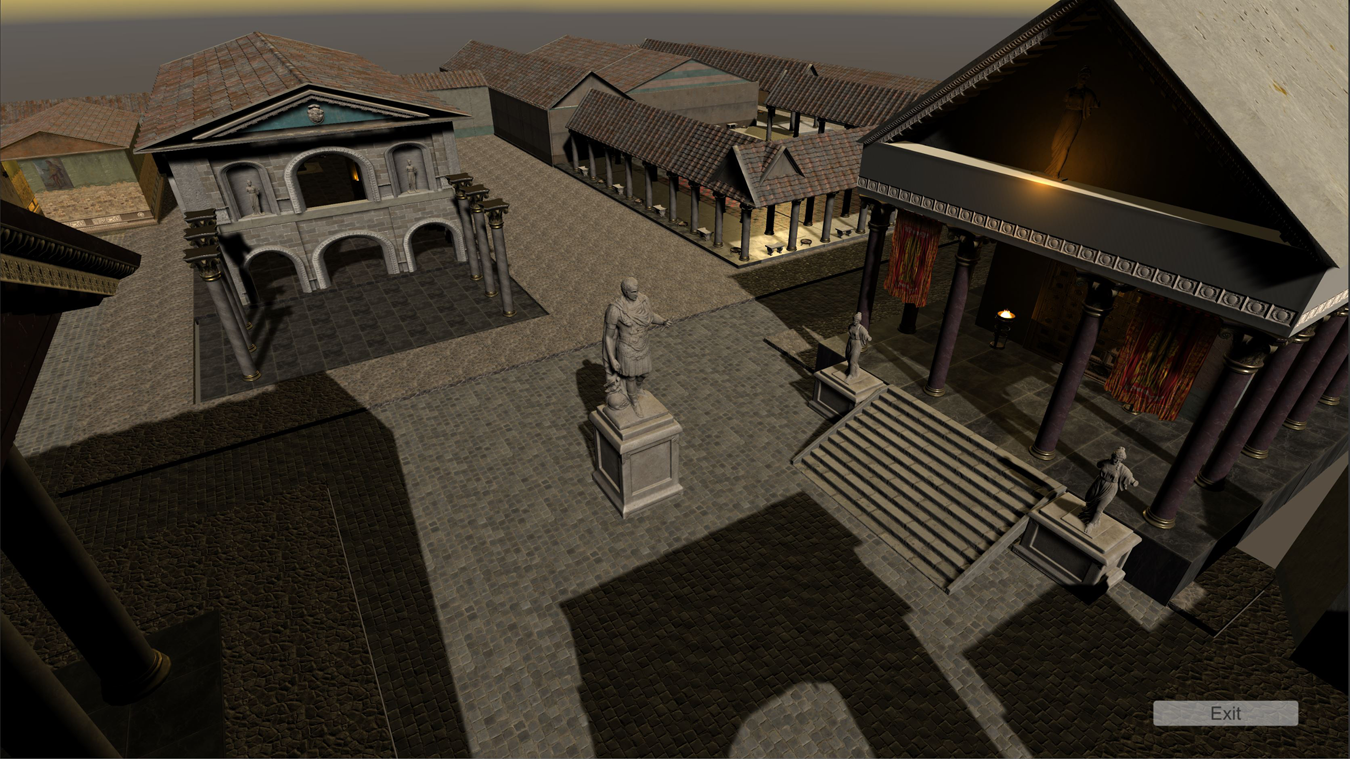
Following the Unity 3D tutorial and in-class design sessions, all of the assigned public buildings were arranged together to form the civic centre of a fictitious Roman frontier city of the students' own design (Figure 1). The city centre consisted of two main roads meeting at a public square in which a number of buildings were located at the centre and, depending on their function, others at the periphery (Figure 2). While all of the groups were successful in using the architectural pieces from the asset package to create their public buildings, they also encountered challenges along the way. Firstly, this discussion will address some of the general challenges that the students faced during the design process. Secondly, I will go on to discuss particular public buildings and the trajectory of the groups' experiences constructing them in Unity 3D.
The forum of the virtual Roman city.
Orthographic plan of the city with all of the public buildings labelled.

Based on the 17 individual student responses consulted for this study, the most common challenges the students experienced included: lack of certain architectural pieces in the asset package (limited assets), the need for more class time devoted to design, and the difficulty connecting architectural pieces together. In response to the lack of an apsidal architectural piece in the asset package, one student wrote that the package ‘lacked the specific architectural shapes that we needed to bring our vision to life… we encountered difficulty when trying to create the apsidal end of the caldarium’. Similarly, two of the students tasked with constructing the basilica wanted to add an apse to the end of the basilica but could not because there were no assets with which to construct an apse. In this respect, certain architectural elements commonly associated with generic Roman public buildings were not available and the students had to adapt, in some cases limiting their ability to recreate every architectural aspect of their assigned structures.
In addition, 16 students remarked that they would have benefitted if more time had been devoted to the design sessions, which were limited to six hours over the course of three weeks. It was clear from the outset that the steep learning curve of Unity 3D could negatively impact the experiment. One student wrote ‘I spoke to my friend whose degree is in video game design, and he told me he could have done what we did in over six hours, in just thirty minutes. The difference in knowledge of the program is that important’. Despite the steep learning curve of the Unity 3D game engine, some of the students acknowledged incremental improvement in their proficiency with the program over sessions. One student wrote ‘Once we were able to develop a basic degree of competence in Unity, we found the program quite intuitive and user friendly’. Another student from the group that constructed the triumphal arch also noted that ‘The more we worked on our project, the less challenging it became navigating through the program. At first it seemed very confusing, but we eventually got the hang of it to create a successful arch’. Although a number of the groups found the complexity of the Unity 3D engine to be challenging, there was significant evidence of incremental improvement over the course of the six-hour design session.
A number of the students also found it difficult to align and connect different architectural pieces in order to build a seamless building. In a number of the finished buildings students would sometimes overlap architectural pieces, but otherwise their finished structures were symmetrical and the architectural components fit together nicely. It seems as though alignment of architectural pieces was simply time-consuming for the students and not a technical issue. This issue, moreover, could have easily been resolved if the students had used the ‘vertex snapping’ function, a function which I forgot to include in the Unity 3D tutorial.
Despite these general challenges, none of the students found it impossible to complete the task of building their structure in Unity 3D and they were able to adapt to the challenges they experienced in their respective groups. Nevertheless, the learning curve associated with the Unity 3D game engine was one of the most daunting challenges the students had to face. Despite these common challenges, a number of the groups also demonstrated skills and design elements that exceeded the expectations of the experiment. Some of the finished 3D public buildings illustrate the students' design process, the challenges they experienced, and the ways in which the students overcame these challenges, in some cases exceeding the expectations of the experiment.
The group that was tasked with constructing the temple in the fictional city, for example, was able to integrate the research and design components of the assignment to good effect. The student response paper outlining the research and design process of the temple in the virtual city demonstrated a basic understanding of generic Roman temple styles, including prostyle, hexastyle, and pseudoperipteral architectural elements. The finished 3D temple that this group constructed reflects this research to a certain extent (Figure 3), but the students appear to have misinterpreted some specific architectural elements. Concerning the ‘design decision’ behind their temple, the student response claims ‘Our [sic] is a prostyle-hexastyle, meaning we have columns, specifically six, in front of our cella of our temple’. Upon inspection of the temple the group constructed, the group had, instead, constructed a hybrid tetrastyle-peripteral temple, with four columns along its façade instead of six. It seems, therefore, that rather than replicating the architecture of an existing Roman temple, they ended up creating a typology of their own. Nevertheless, the temple that the group constructed reflected a basic understanding of generic Greco-Roman temple architecture that was evident in both their research and design choices.
The front of the temple in the virtual city.

From a technical perspective, the students who built the temple also created parts of the temple using design components that were not included in the asset package. For the temple podium and architrave, for example, the students created primitive game objects (in this case basic cubes and rectangles) onto which they applied textures and materials that were included in the asset package. The asset package lacked certain architectural features, such as a temple podium or architrave, so the students met this challenge by creating a simple object and giving it a texture. This is one example of a way in which the students compensated for the limits of the architectural features offered by the asset package. Since this was a design technique that was only covered briefly during the Unity 3D introduction session, the students in this group went beyond the basic expectations of the design element of this experiment (i.e., to design Roman public buildings using prefabricated objects from the asset package). In terms of efficacy, this group succeeded in designing a temple that reflected a general understanding of Roman religious architecture and although there was a limited misunderstanding of certain architectural forms, in this case the difference between tetrastyle and hexastyle temples, these mistakes could easily be remedied through typical avenues of correction or feedback.
The students tasked with building the triumphal arch demonstrated a similar level of competence both in terms of the research and design process of their structure. The triumphal arch was perhaps one of the more difficult structures to build using the Rome Fantasy Pack asset package, especially since there were few prefabricated architectural components explicitly designed to build a triumphal arch. In order to accomplish this goal, the students built the basic elements of the arch (the piers and entablature) by creating primitive objects (rectangular cubes) of their own design, then adding prefabricated decorative elements, textures, and architectural components from the asset package (Figure 4).
Front of the triumphal arch at the entrance of the virtual forum.

The student response papers submitted by the group that was assigned the triumphal arch demonstrated a basic understanding of the cultural significance and architecture of Roman triumphal arches. None of the response papers indicated that a particular, real life, triumphal arch served as a prototype for the arch they created. Much like the group that was assigned the temple, however, it seems as though the students created a hybridised triumphal arch equally influenced by both the Arch of Titus and the Arch of Constantine. On the one hand, the students chose to build a single arch of roughly the same scale as the Arch of Titus and, following the Arch of Constantine, included statue figures at the top of each side. The students were clearly engaging with and learning from real life examples and ended up creating a generic building with hybridised elements.
The group that was responsible for the triumphal arch did, however, have some issues connecting research content with the structure they built, incorporating some conspicuously creative rationale for their design decisions. For example, the students from this group decided that ‘In AD 60…the Emperor married a woman from the town and an arch was dedicated to them and their marriage’. First and most obviously, the Emperor Nero was already married to Claudia Octavia in 60 CE and triumphal arches were never constructed to celebrate an emperor's marriage, let alone to a woman from a Gallic frontier town. The rationale for their structure, therefore, contained some anachronisms. Perhaps the students might have better understood the historical context of triumphal arches by researching a specific example in which the reason for construction is well known. Other groups had less trouble integrating research content into their designs, however.
The group that was assigned to construct the brothel was extremely effective in its design and was able to incorporate design decisions using the Lupanar at Pompeii as a design influence. The students specifically refer to this decision, indicating their intention to construct a purpose-built brothel. One student in this group wrote ‘one consistency we see throughout the various records of purpose-built brothels is the placement of erotic art and graffiti. We know for certain that there is one purpose-built brothel in Pompeii called [sic] Lupanar’. The design decisions of this group demonstrated the most effective use of research material to influence their design. The students in this group ensured that their design included architectural criteria for the identification of purpose-built brothels outlined by Andrew Wallace-Hadrill, providing a solid academic basis for their decisions (Wallace-Hadrill, Reference Wallace-Hadrill, Cornell and Lomas1995, pp. 51–54). Then they proceeded to design a purpose-built brothel that included masonry beds and explicit paintings of sexual scenes (Figure 5).
Interior hall of the purpose-built brothel with explicit wall paintings added by the students. Also note the four entrances to rooms with masonry beds.

Since the asset package did not include wall paintings depicting sexual imagery, the students were able to acquire images of wall paintings from the Lupanar in Pompeii and add them to image panes using the built-in functions of the Unity 3D engine. In order to accomplish this, the group required some additional instruction during the Unity 3D introduction session, but the students were able to add their own textures after a quick explanation. After the erotic paintings were added to the interior, the students responsible for the purpose-built brothel then went a step further to include a painting of Priapus on the exterior wall of the brothel, indicating the function of the building as a purpose-built brothel (Figure 6). The students also had some difficulty including masonry beds due to the limited number of prefabricated items in the asset package. The students viewed this, in addition to the lack of explicit wall paintings in the asset package, as their biggest challenge. Like other groups, however, they overcame these challenges by creating primitive objects (usually cubes or square panes) and applying other textures and images to them. The group that designed the virtual brothel was not only successful in effectively using the Unity 3D design engine, but they went beyond the simple use of prefabricated architectural elements and added their own artistic motifs to their creation with some additional instruction. Moreover, the students provided a rationale for the design decisions that was based on relevant scholarship, demonstrating a good balance between research and design.
Exterior of the purpose-built brothel in the virtual Roman city.

While all of the examples above demonstrate that the students who experienced technical challenges were more than capable of solving them, some groups were not as successful at fulfilling the research requirements of the assignment. In particular, the group that was assigned to build a public portico completely ignored the research component of the assignment and instead built what looks like a temple façade. A quick Google search of ‘Roman portico’ results in images of the porch of the Pantheon at Rome, which the students in this group clearly used as inspiration. There also appears to be confusion between the definition of a public portico and temple portico (architectural component) in the response written by students in this group. Despite the fact that all of the groups were successful in using the Unity 3D engine to meet the technical requirements of this assignment, the ‘portico’ designed for the virtual Roman city serves as an example of what happens when the research component of the assignment is completely ignored. Luckily, this was the only case in which this happened during the experiment. In this case, the students were supposed to build a public portico but instead built a temple façade (Figure 7).
The so-called ‘portico’ in the forum (centre).

Of the 45 students enrolled in the class, 30 of them provided written feedback when they filled out course evaluation sheets at the end of the term. Of the 30 respondents, 22 of them gave feedback concerning the Virtual City Project. Much of the feedback reiterates some of the technical difficulties the students experienced during their design process, but many of the responses also illustrate the extent to which the students found the assignment enjoyable. When asked to provide suggestions to improve the course, seven students gave the following feedback concerning the Virtual City Project:
‘The virtual assignment would have benefitted from having more in class time as the group assignment required the use of only one device.’
‘Less focus on the virtual reality technology in the individual report assessment.’
‘To continue to upgrade the Unity program, since it was an excellent experience. To make it easier to access content, introductory tutorials and actual building of the structure.’
‘The virtual reality assignment perhaps could've used another week of in class time, and perhaps placing more emphasis on the ideas behind your design, or perhaps a graded mini-essay for your choices for that design.’
‘Individual report (VR Project) more focused on course content rather than evaluating technology – never used before.’
‘I would definitely suggest keeping the virtual city assignment as that was probably the most fun assignment I have done during my time at university.’
‘The Virtual City Project was a fantastic idea that I enjoyed very much. However, unless you were familiar with the Unity software already, the project proved very challenging. A significant amount of personal time was needed to construct a viable, architecturally sound structure because the software inherently demanded a steep learning curve (especially for a history student). Perhaps more in-class time (i.e., maybe one more tutorial?) would have benefitted greatly…That said, I feel it was valuable and being able to virtually see how a Roman city is constructed was very fulfilling and I recommend doing the project again. Just a little more in-class help would be very beneficial.’
Based on this feedback, the students addressed many of the same issues that were mentioned in the personal response essays, most notably the need for more time for in-class design sessions and the difficulties of group work. Other suggestions indicate that the students found the Unity 3D engine difficult to learn, warranting more accessible tutorial material or longer instructional sessions. In two cases, students recommend keeping the Virtual City Project as a permanent course component with one student adding that it was ‘probably the most fun assignment I have done during my time at university’. The suggestions concerning the Virtual City Project are encouraging in the sense that the technical limitations that the students experienced, especially regarding the learning curve of the Unity 3D engine, can be remedied by adding more focus to the instructional sessions during subsequent iterations of the assignment. When asked for additional comments about the course, including labs or other features, 12 students responded with the following feedback about the Virtual City Project:
‘The virtual city project was interesting but not fleshed out enough to be worthwhile.’
‘Loved every minute of it, especially during the city project, as it helped me learn more about my structure more than I would have ever learned doing anything else. It was fun getting hands-on in creating the structure.’
‘The virtual city was a good idea for learning.’
‘The virtual city project was a stimulating and interesting change for a history course and provided a new and exciting way of learning and applying knowledge.’
‘The Unity program shows great promise in combination of technology and history!’
‘The virtual reality assignment was very fun and interesting and a great way to learn the content.’
‘The virtual reality aspect was cool but it was difficult to do as a group assignment because only one person could use the program, maybe if it was with partners it could work better. Not everyone got a chance to use the program, the program was also very time consuming to create the structure. Overall it was an interesting aspect of the course.’
‘The virtual reality aspect made the course very interesting.’
‘The virtual city project was creative and an engaging way of exploring Roman architecture.’
‘The first time in course history, we were able to use virtual reality as another segue into learning ancient Roman history and how this was used as an actual assignment to help stimulate my learning. We were in groups for this assignment and it was a really fun time.’
‘The Virtual Reality assignment worked quite well overall, generally speaking. The implementation and the reliance on group work comes with its usual drawbacks since humans are a mysterious beast, and the actual software we used to design our structures wasn't as extensive as I would have liked. I enjoyed the endgame aspect where all the groups could enjoy the structures they made.’
‘As the first group to be part of the virtual reality class of this course, I believe that was an exceptional project that would allow us to have fun as well as learn and be part of the building process of Ancient Rome. There were aspects of the course that the prof made humorous and that made for fun and interactive aspects of the course.’
‘The virtual reality project was very interesting and I feel like it should be integrated as a yearly part of this course.’
‘Greatly enjoyed the course, and would recommend it to anyone! The virtual reality assignment was definitely a unique portion to the course, and I'd love to see its use in other courses and other parts in history in general. The organization of the course I found very concise, with everything being well structured in terms of material and lectures.’
‘Having Harrison come in to help during VR classes was helpful.’
Aside from one comment in which a student wrote that the Virtual City Project was ‘not fleshed out enough to be worthwhile’, the other comments indicate that the students enjoyed the Virtual City Project. Another student wrote that the design element of the assignment ‘helped me learn more about my structure more than I would have ever learned doing anything else’. While many of these comments praise the design element of the assignment using Unity 3D, some of the comments also demonstrate that the students enjoyed the virtual reality aspect of the presentations. Despite some of the technical difficulties and limitations highlighted by the students, their disposition toward the course content and the experimental nature of the Virtual City Project was clearly positive and a number of the students also indicated that they would like to see the Virtual City Project included the next time the course is taught.
Conclusions
Although some of the groups were more successful than others in their designs, most of the groups, to one extent or another, met the efficacy criteria outlined in the introduction of this article. Discussion of the student response papers and my own observations of the virtual buildings have shown that all of the groups were able to successfully use the Unity 3D software without any catastrophic failures, but whether the students' creations reflected diligent research on their assigned building type is another matter. A number of previous studies involving constructionist teaching approaches have noted low levels of content integration among students tasked with designing computer learning games (An, Reference An2016; Craft, Reference Craft2016; Kafai, Reference Kafai1995; Kafai et al., Reference Kafai, Franke, Ching and Shih1998; Ke, Reference Ke2014). In these previous studies, however, the subjects were typically children or teenagers who had not developed post-secondary level research skills. Although some of the students involved in the Virtual City Project had difficulty integrating research content into their building designs, these issues were minimal with only one of the ten groups failing to meet this requirement.
The groups who built the temple and triumphal arch clearly demonstrated that they had done diligent research on generic elements of their respective buildings, but their creations ended up incorporating hybridised architectural elements in configurations that were uncommon or unheard of in the Roman world. Nevertheless, both groups demonstrated familiarity with both specific examples and generic aspects of their structure types. In the worst case, the group tasked with building the public portico did not successfully incorporate research content into their design at all. In the best case, however, the students assigned to design the purpose-built brothel made their design decisions based on their assigned readings and explained these decisions well in their report. In conclusion, most of the groups were able to successfully create public buildings that reflected good research on their assigned structure type. The students in this study, therefore, demonstrated that they were able to meet the technical requirements of the assignment and integrate research content into their creations.
In addition, course evaluation feedback indicates that the students showed a generally positive disposition toward both the design component of the assignment and the general course content. If anything, the results of the Virtual City Project have demonstrated that the students were clearly capable of using this technology to good effect and subsequent iterations of this assignment along with more feedback will allow for incremental improvement. It is hard to say, however, whether this approach is better for knowledge retention than the traditional research-based project typically assigned to students of this course. Traditionally, students in this course complete a group assignment in which they give group presentations on a specific public building from the Roman world (e.g., the Macellum of Pompeii, the Aqua Claudia, or the Basilica Julia), but the Virtual City Project did not allow for such specificity, especially due to the generic nature of the architectural pieces in the asset package and the steep learning curve of the Unity 3D software. This highlights the main limitation of this design-based teaching experiment, which is to say that students could only build generic representations of the structures they were assigned. The design element of the Virtual City Project came at the expense of time that could have been devoted to case specific research of Roman urban architecture. One possible solution to this would be to use a simpler design-based platform such as Minecraft: Education Edition, which other scholars have used to good effect for design-based learning in the classroom (Craft, Reference Craft2016; Sáez-López et al., Reference Sáez-López, Miller, Vázquez-Cano and Domínguez-Garrido2015). This would allow more in-class time to be allocated to learning historical content rather than new technical skills. That being said, having the class learn the basics of the Unity 3D software also introduced liberal arts students to transferable technical skills often limited to computer science courses. For many institutions that value interdisciplinary approaches to teaching and learning, the mixture of liberal arts and computer science skills is one of the benefits of this assignment that would be diluted by a shift to a more simplified, play-based, iteration of this assignment. For this last reason specifically, the Unity 3D engine offers students engaged in design-based learning the maximum benefit of such an assignment, despite its steep learning curve.
In future iterations of this assignment, it would be interesting to add computer programming and coding elements to the design process, allowing students to build their own programs for visualising, manipulating and exploring environments in 3D space. While there is currently a shortfall in computer coding literacy among the general university population, particularly in the liberal arts, it will not be long before proficiency in computer coding is a common skill. Scholars of computer and behavioural science have determined that children are entirely capable of learning to code at young ages and that coding provides cognitive benefits especially in terms of enhancing problem solving skills (Bers, Reference Bers2016; Bers et al., Reference Bers, González-González and Armas-Torres2019; Harel, Reference Harel1991; Kafai et al., Reference Kafai, Burke and Resnick2014; Papert, Reference Papert1980). In recent years, moreover, a number of countries across the world have begun to implement coding in public school curricula, including my home province of Ontario, Canada. These developments will certainly reduce the amount of time necessary to teach students how to use game design software such as Unity 3D in future years.
Despite the current limitations, the students involved in the Virtual City Project in the Fall term of 2018 were successful in building a virtual Roman city using Unity 3D and they enjoyed doing it. As might be expected, the students encountered some technical challenges, but these challenges did not prevent the students from accomplishing the goals of the assignment. Taking what has been learned from this initial experiment into consideration, there are hopes to administer the assignment the next time this course is taught. As far as efficacy is concerned, this experiment most definitely supports the constructionist teaching approach and, most importantly, it leaves room for further investigation and experimentation. In future iterations of this assignment, the students should keep using the Unity 3D engine despite its steep learning curve. It affords the students room to exceed the basic expectations of the assignment as a number of the groups demonstrated in the Virtual City Project. With more time allocated to learning the software many of the technical challenges the students faced can be addressed. The issue of content integration could also be remedied by assessment of the research component of each assignment followed by necessary corrections before the students begin designing their structures.
With a growing corpus of literature on the positive effects and uses of video gaming technology, we will definitely see more of it in classrooms and workplaces around the world. For example, Jane McGonigal's book Reality is Broken successfully illustrates the ways in which video games and the principles behind their design can make the world a better place (McGonigal, Reference McGonigal2011). Also Squire et al. (Reference Squire, DeVane and Durga2008), Christensen and Machado (Reference Christensen and Machado2010) and Rogers (Reference Rogers2011) provide additional case studies that exemplify the use of video games as a teaching tool in the classroom. Even in the fields of the liberal arts, scholars have been long discussing the benefits of VR and AR technologies for research and teaching, both of which share a symbiotic relationship with video game design software (Cargill, Reference Cargill2009; Hanson and Shelton, Reference Hanson and Shelton2008; Roth and Fisher, Reference Roth, Fisher, Kee and Compeau2019; Sanders, Reference Sanders2014; Schrader and Bastiaens, Reference Schrader and Bastiaens2012; Slater, Reference Slater2009). Hopefully this article has inspired others to use game design technologies as a tool for teaching or, at the very least, persuaded those who are sceptical to read further and consider the massive potential of this emerging digital humanities application.


 Open access

