


1. Introduction
Fernand Braudel long ago noted how ‘sugar, coffee, tea and alcohol have had a long-term and very important influence on history’ and ‘the lightning-swift manner in which tobacco in particular circled the globe and conquered the world’.Footnote 1 Numerous studies have subsequently shown that the sixteenth to the eighteenth centuries were an important period for the kind of commodity identified by Braudel, that is, psychoactive and potentially addictive comestibles which we term here intoxicants. Over the course of the early modern period, intoxicants like tobacco, cacao, coffee and tea entered European diets for the first time, becoming commodities of mass consumption in the process; previously exotic intoxicants such as sugar, opium and distilled spirits likewise transformed from luxury or restricted substances into more popular and commercialized products; and even fermented staples like wine and beer fuelled large capitalist undertakings. Part and parcel of these changes was that global networks of production and supply were established across the Atlantic and Indian Oceans; European alcohols were exported to colonies, trading posts and new indigenous markets; and rarified or unknown intoxicants at first trickled and then flowed into European ports and metropoles.Footnote 2 Indeed, so significant were these developments that they have been persuasively dubbed a ‘psychoactive revolution’.Footnote 3
This article starts with a simple question: what, if any, were the links between the onset of this psychoactive revolution and developments in epidemical medicine over the course of the long seventeenth century? The question is not as tangential as it might at first sound. Although often dismissed by historians as useless and tokenistic, physic nevertheless remained an important component of contemporary responses to plague in the hundred or so years after 1600. More importantly, and as this article argues, it underwent significant material changes which raise interesting questions about the consumption priorities and practices of male and female householders facing the threat or reality of pestilence on a recurring basis. In the meantime, many north-western Europeans experienced a transformation in their dietary options as intoxicants became more popularly available for the first time. And it so happens that some of the key developments in the materia medica of European plague medicine involved precisely those intoxicants which, in a matter of decades, were conquering the globe: most notably tobacco, sugar and opium.
The premise of what follows is that this conjunction between physic, intoxicants and consumerism is worth exploring. Two of the three new intoxicants which became prominent in combatting pestilence after 1600 – tobacco and sugar – are likewise integral to perhaps the most influential account of the seventeenth and eighteenth centuries.Footnote 4 According to Jan de Vries, not only did increasing numbers of householders decide to expend more of their income on (among other things) newly available intoxicants like sugar, tobacco, tea, coffee and distilled liquors in the decades after 1650 but they were willing to work more hours and in more diverse kinds of occupation to do so. That is, by encouraging household consumers to embrace new economic markets and market-orientated behaviour, intoxicants helped precipitate an ‘industrious revolution’ which, according to de Vries, was quite as significant in driving premodern economic change as colonial, commercial, technological or financial developments.Footnote 5
Our concern here is not with the perennial debate over whether it is consumer behaviour or control over the means of production and supply which best explains Europe’s comparative economic success, or ‘great divergence’, by the end of the eighteenth century.Footnote 6 (Though, as Braudel also noted, socio-economic processes at once ‘external’ and ‘internal’ to early modern Europe were clearly symbiotic – and reinforcing – rather than a zero-sum game.)Footnote 7 Rather, what follows critically engages with issues raised by de Vries’ theory of household economics to provide what we hope is a more nuanced and historicized understanding of early modern trends in European consumption. We do so by adopting a model of social practices that is more attuned to historical meanings, beliefs and values than that borrowed from economists by de Vries.Footnote 8 This allows us to explore and analyse the contemporaneous pressures and motivations driving consumption practices and to foreground the question of why men and women might have consumed what they did over the course of the long seventeenth century. Doing so makes it clear that consumption practices aimed at preventing or remedying infection from pestilence – which were themselves part of a more general ‘medical revolution’ – provided at least one set of reasons for consuming sugar, opium and tobacco and help to explain why the final century of the Second Great Pandemic in north-western Europe also experienced the early stages of the psychoactive revolution.Footnote 9
Periodization and geography are important to our discussion and need to be highlighted from the start. For de Vries, the industrious revolution is one of several long-term processes feeding into the evolutionary (as opposed to momentous) history of the ‘industrial revolution’ at the end of the eighteenth century. The quotidian uptake of sugar, tobacco, coffee, tea and distilled spirits was a prominent reason why male and female householders reorganized their working routines and consumption practices over the course of the long eighteenth century.Footnote 10 However, one premise of this article is that while tea and coffee were certainly commodities of the eighteenth century, the commodification of tobacco and sugar began significantly earlier than 1700 – or even 1650 – across certain parts of north-western Europe.
This insight is important in three respects. First, distinguishing the initial uptake of tobacco and sugar in the seventeenth century from the subsequent assimilation of coffee and tea in the eighteenth century necessarily raises the possibility of alternative and more mutable factors informing their consumption. It also opens a window on the popularization of opium, an ‘exotic’ intoxicant which is completely absent from de Vries’ story of industriousness, but which established itself in the materia medica of north-west Europeans at around the same time as sugar and tobacco.
Second, the initial popularization of sugar, tobacco and opium after 1600 encourages paying attention not merely to the evolutionary nature (or not) of industrialization but also to another major geohistorical process identified by Braudel: the shift of Europe’s economic centre of gravity, circa 1600, from the Mediterranean Sea to the North Atlantic and Baltic and North Seas.Footnote 11 Sugar and tobacco proved integral to this reconfiguration of economic power within Europe, and what follows accordingly focuses on four metropoles which, as major ports and/or urban centres, were crucial to turning the North Sea into what David Ormrod describes as a dynamic and ‘complete regional system in itself, with its own peripheral and semi-peripheral areas in the Baltic and eastern Europe’.Footnote 12 These were Amsterdam, Hamburg, London and Stockholm. This is not to suggest, of course, that the region and its cities were somehow hermeneutically sealed from other parts of Europe or, indeed, their own rural hinterlands. On the contrary, it is precisely because of their roles as hubs of communication and mobility in many different networks – provincial, national and global – that the metropoles play a significant role in this story.
Third, by focusing on these metropoles in the decades after 1600, pestilence becomes an obvious context for thinking about the popularization of sugar, tobacco and opium. As is well known, plague affected all four cities several times between 1600 and 1720; was physiologically indiscriminate (although social elites were able to distance themselves from infection easier than others); elicited major municipal and state interventions in both public and domestic life; and was a recurring biological and psychological threat even in the absence of physical outbreaks. Moreover, plague physic was by no means unusual in terms of prescribing intoxicants: for the most part, epidemical crises encouraged the amplification and adaptation of more general medical practices and tendencies. Somewhat ironically, therefore, the sheer scale and horror of pestilence makes it one of the best ways to explore how medical and dietary advice – conflated by contemporaries as dietetics – affected everyday practices and routines.
What follows accordingly suggests that during the long seventeenth century practices of epidemical physic were important in aiding and abetting the commodification of opiates, tobacco and sugar within four metropoles of the Baltic and North Sea region. This reflected the close correlation between the transnational movement of medical knowledge, intoxicants and the bacteria Yersinia pestis. Moreover, because physic was practised primarily in the household, it also points to the significance of domestic spaces and female agency in driving the initial stages of Europe’s psychoactive revolution. This in turn raises the very real prospect that household consumption in the name of physic was one route by which men and women became familiar, habituated and subsequently dependent on intoxicants in ways that belied their initial and legitimate use as prescribed medicines. Plague physic accordingly serves as a powerful case study for the more general spectre of addiction through prescription, or what contemporaries would most likely have understood as accustomization.Footnote 13 In this way, it helps to explain how psychoactive substances not only became embedded in the dietary regimes of individual households and their members but also came to lubricate new social practices and habits inter-generationally.
The argument is made in three stages. The first section engages with the praxeological undercarriage of de Vries’ theory of industriousness and points to plague physic as an important but neglected kind of household consumption practice during the long seventeenth century. The second section outlines the connections between the threat or experience of plague, the consumption of intoxicants and the contrasting trajectories of sugar, opiates and tobacco within printed medical discourse in the Baltic and North Sea region. The trends it identifies and their implications for household consumption practices were by no means experienced simultaneously or consistently across the area. Consumption in Stockholm and Hamburg – with their sumptuary laws, highly centralized state, traditional social structure and extra distance from global trade routes – contrasted with the more precocious and innovative consumption patterns in Amsterdam and London, especially before the eighteenth century. With local particularities in mind, it is possible to discern changes in the region’s intoxicant economy and medical practices that are indicative of closer interconnections than historians have appreciated. The final section considers some of the intriguing and potentially far-reaching ramifications of these developments. If intoxicants really did play a prominent and increasing role in plague physic, then it follows that they were consumed by women as well as men in domestic as well as public spaces. This intimates a largely neglected set of motivations – and potential consumers – helping to drive the psychoactive revolution; it points to households as spaces in which intoxicants might be taken excessively and in ways that risked accustomization; and it raises the prospect that the opioid crises of the modern era have longer genealogies than has been realized.
2. Plague physic and household consumption
De Vries’ theory of early modern consumption is based on the important insight that the household, as the primary unit of social organization in the premodern world, was also the primary institution of consumption, in particular that it was here that decisions were made about what was to be consumed (and how and by whom) and where. De Vries accordingly drew on the ‘new household economics’ to outline in schematic terms the stages involved in increasing household consumption. Central to this schema were ‘Z-commodities’: what social scientists would term (in slightly more accessible language) a ‘practice’, that is, ‘a routinized type of behaviour’ that ‘endures between and across specific moments of enactment’.Footnote 14 Thus, ‘Z-commodities’ were the bundles of goods that are ‘ultimately consumed’ after the selection, acquisition and processing of constituent materials and which were the focus of ‘preferences (or tastes)’ among household members, for example as the ingredients and material culture of meals (such as ‘breakfast’) or in the assemblages of furnishings and utensils that make up a typical room (such as a ‘study’ or ‘parlour’). Over the course of the long eighteenth century, male and female householders acquired a taste for consumption practices requiring ‘more purchased goods’ and so, to afford them, more ‘household labour’.Footnote 15 De Vries argued that informing these choices was a tendency for innovative consumerism that he first detects in the mid-seventeenth-century Dutch Republic and which was disseminated and theorized across north-western Europe thereafter.Footnote 16 At root, this tendency involved the valorization of Z-commodities that combined new or previously unavailable ‘little luxuries’ by middling and even lower-class householders in the name of ‘comfort’ and other kinds of material and emotional gratification and pleasure. This contrasted with the ‘old luxury’ of conspicuous consumption performed by medieval elites.Footnote 17 It was this emergent symbiosis between new Z-commodities, tastes, markets and labour that drove, in effect, the industrious revolution.
One of the Z-commodities epitomizing this process was the decision by north-western Europeans to combine Asian tea with Atlantic sugar. As Braudel no doubt would have done before him, de Vries admires the rendering of the apocryphal moment of Z-commodification by Sidney Mintz: how ‘the first sweetened cup of hot tea to be drunk by an English worker was a significant historical event, because it prefigured the transformation of an entire society, a total remaking of its economic and social basis’.Footnote 18 However, de Vries emphasizes that he ‘seeks to contextualise and thereby endogenize the process of consumer capital formation – to treat consumption innovations as flowing from accumulated experience and knowledge rather than appearing as an exogenously determined event’.Footnote 19 To this end he notes that the practice of combining sugar, tea and coffee probably evolved in the last two decades of the seventeenth century (though Samuel Pepys records drinking sugared coffee as a household guest of Lady Carteret in London as early as 1664) and became integral to two of the most important ‘consumption clusters’ of the eighteenth and nineteenth centuries: morning breakfast and afternoon tea.Footnote 20
In contrast to the sweetened caffeine first drunk by an apocryphal English worker at some point during the eighteenth century, the practices epitomizing the story of household consumption told here were published by the influential Dutch surgeon Ysbrand van Diemerbroeck in his 1646 treatise on how to combat plague.Footnote 21 Based on his experiences treating the pestilence in Nijmegen in the 1630s, the book consisted of 27 ‘case histories’ in which van Diemerbroeck recalled how he healed 11 patients, lost 18 and (as told in case history 17) repeatedly saved himself from morbid infection.
The 17th case history is a vivid description of a household consumption practice. Van Diemerbroeck recalled that ‘When Natharius Stuaet, a Scrivener, living near to the Strait Gate, and next door to the Dancing-School, was sick of the Plague, with a Looseness: I was sent for to see him’. The physician explained that ‘as soon as I came into his Chamber, I presently smelt a mighty stink, with which I was much moved: after a short time that I was with him, going out of his House again, forthwith I was very sick, much pained at Heart, so that I questioned not but that I had the Sickness’.Footnote 22 Van Diemerbroeck’s immediate response was to return to his household to self-medicate: ‘(laying aside all business) I went home, and took six Pipes of Tobacco, by which time all the former symptoms were gone, and I was as well as before: then going abroad (to see my Patients) I took one Drachm of Treacle, and then was presently well’.Footnote 23 On another occasion, van Diemerbroeck recalled that ‘on a time I visited a Baker and his Wife, who lay ill of a Pestilential Looseness … I was much altered by that great stink’. Resorting ‘as I used to do … to the taking of Tobacco’, van Diemerbroeck was ‘overwhelmed with so much sleep and pain, that (whether I would or no)’ he took an ‘Antidote’ to induce sleep. Later he was ‘wakened to visit some sick Men’ and ‘Vomited with great pain’. Eventually, ‘I arose, leaning upon my servant’s shoulder, I came to the Fire, then I took Tobacco’ and ‘when I had taken two or three Pipes, the giddiness of my Head vanished, but troubled a little at heart: then taking heart, fearing nothing, took half a Drachm of Treacle, and a good Draught of Burnt Wine, with some Cinnamon and Nutmeg, and then I went into the Air’. Now fortified and fearless, van Diemerbroeck remembered that ‘as I was walking [I] sweat very much, and so I continued till ten of the Clock at night, and then (without any pain at all) returned home as well as before, and was hungry enough at my Supper, at the close of which I took a Pipe of Tobacco’.Footnote 24
What van Diemerbroeck describes, then, are Z-commodities and household consumption practices that have been ignored not only by de Vries and other historians of early modern consumerism but also by most historians of psychoactive substances.Footnote 25 An important exception is Christine Fabbri’s work on the opiate theriac (known colloquially as treacle), although this focuses on the pre-1600 period and the therapeutic value of the drug.Footnote 26 To borrow the terminology of praxeology, van Diemerbroeck illuminates in unusual detail the materials (the ‘things, technologies, tangible physical entities, and the stuff of which objects are made’), the competencies (the skills, know-how and techniques required to act effectively or appropriately in relation to the practice) and the meanings (‘including symbolic meanings, ideas, and aspirations’) involved in epidemical medicine in general and plague physic in particular.Footnote 27 In so doing, he reveals the intersection within the household of tobacco and tobacco pipes, opiates (treacle), wine and spices (and no doubt glasses) requisite to this physic; a range of skills relating to the successful preparation and imbibing of these substances; an extensive body of knowledge drawn from humoral and experiential medicine; and a set of motivations dominated by sensory disquiet, emotional fear, corporeal pain and the very real prospect of imminent death.
As a dutiful doctor, van Diemerbroeck found his practice not limited to his own household; nor were the intoxicants he used restricted to tobacco, treacle and wine. He recorded visiting the homes of 20 men and 10 women ranging in status from maids and street sellers to surgeons and knights.Footnote 28 His cures included sudorific drinks to induce sweats; antidotes to draw out poison; apozems (drinks), electuaries (sugary medicines) and bolus (large pills) to consolidate cures; and juleps, cordials and broths to quench thirst and rebuild strength.
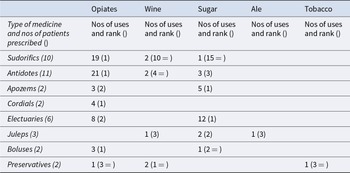
Table 1 shows that these remedies were dominated by opiates. Treacle, treacle water and other opiates like diascordium and mithridate were key ingredients of sudorific drinks, antidotes, cordials, electuaries and bolus. Sugary ingredients (conserves, confections, syrups and candies) also predominated, figuring in apozems, electuaries and juleps, with electuaries both sweet and narcotic. Van Diemerbroeck also used copious amounts of wine and vinegar as medicinal mixes: one of his favourite opiates – treacle water – was a distillate of two ounces of theriac and mithridate combined with three pints of canary wine and a pint and a half of sharp vinegar.Footnote 29 Small ale also served as a recuperative drink. This distribution of intoxicants is corroborated by the only systematic study of early modern plague literature to date. Lara Elyse Thorpe found that in recipes printed between 1550 and 1665 in England, opiates increasingly dominated both preservative and remedial medicine over the period, accounting for 35 per cent of the former and a remarkable 70 per cent of the latter in the 60 years after 1604. She also confirmed that sugar and wine were perennial staples and that aqua vitae began to be referenced in certain English remedies after 1603.Footnote 30
Table 1. Intoxicants in the plague physic of IJsbrand van Diemerbroeck

Notes: For types of medicine: the number in brackets () is the number of patients for whom the kind of treatment was prescribed by van Diemerbroeck. For intoxicants: the number is the number of recipes in which an intoxicant is used and the figure in brackets () is the ranking of usage out of all drugs in van Diermerbroeck’s materia medica. Opiates = treacle, treacle water, diascordium, mithridate; wine = vinegars, burnt white wine, burnt red wine; sugar = conserves, candies, confections, syrups.
Source: IJsbrand (Ysbrand) van Diemerbroeck, Several choice histories of the medicines, manner and method used in the cure of the plague (London, 1666).
Van Diemerbroeck’s case histories point to a very different kind of early modern household consumption to that delineated by de Vries. Materially, its practices were initially dominated by opiates, sugar, alcohol and tobacco rather than coffee, tea and chocolate; culturally, its rationale and meanings were derived from contemporary medical knowledge, which played a significant role in determining consumer decisions. This knowledge was rooted in three sets of concerns.Footnote 31 The first set of concerns involved preservation against contagion. Spatial policing through fumigation and disassociation was one aspect of this; equally important were dietetics and prophylactics. A person’s general regimen should be as balanced, cheerful and moderate as possible. It should also include comestibles that ward against infection. A second set of concerns involved remedial responses that might cure the pestilence or at least alleviate certain symptoms. Curatives tended to be sudorific, as alternative purges such as bloodletting and vomiting came to be regarded as too violent in the case of pestilence: antidotes that used their own poison to draw out the poison of the infection; analgesics to relieve chronic pain; ointments and plasters to treat buboes and other skin conditions; and fortifiers to revive spirits and energy.
These linked to a third set of concerns centring on the emotional trauma caused by either the threat or the reality of pestilence.Footnote 32 In both humoral and chemical medicine, what we would today understand as the psychological state of the person was regarded as a substantive factor in processes of contagion and debilitation. Within the Galenic tradition, fear and melancholy, like lack of sleep, disordered the person and could dispose them to infection.Footnote 33 Using a different terminology to describe similar ideas, Jan Baptist van Helmont and his followers conceptualized the ‘Archeus’ as an inner space between the spleen and the stomach which regulated a person’s natural state and which could be irritated by external phenomena – including fearful images and thoughts as well as dangerous matter – into engendering illness.Footnote 34 It was as much the job of physic to prevent the emotional downward spiral into plague as it was to combat its physiological effects. In the severe outbreak of 1710–1711, Stockholm’s householders were reminded of the advice of royal physician Andreas Palmcron from 1638: that a person should always ‘have courage, and if spirits became low, one should take a glass of wine or engage in amusing conversation in order to give strength to the heart’.Footnote 35 Hamburg’s city physician, Ernst Wilhelm Prangen, explained to its citizens in 1711 that ‘Nothing is better for preserving us [from pestilence] than a strong, unwavering and cheerful courage; in contrast nothing is more dangerous than fear, shock and cowardliness’.Footnote 36 And when Samuel Pepys saw red crosses on London doors in 1665 he was put ‘into an ill conception of myself and my smell, so that I was forced to buy some roll-tobacco to smell to and chew, which took away the apprehension’.Footnote 37
These substances, then, were taken for fear, illness and pain according to principles determined by contemporary medical theory and experience rather than moral and political economy or, indeed, novelty and status. Moreover, they were most likely consumed domestically rather than publicly and individually rather than in company. For example, in 1665 Thomas Willis recommended the ‘vulgar practice of putting Mithridate, or Treacle, or Tar in their Nostrils’ to ward against contagion in public – a practice originally recommended by Hamburg’s city physician in 1628 to people too poor to avoid leaving their house.Footnote 38 The absence of these kinds of practice from the historiography of consumerism and intoxicants is not, perhaps, so surprising: just as first-hand accounts of plague treatments are notoriously rare, so the ‘lack of instrumental success’ of premodern plague physic has meant that, from Daniel Defoe onwards, pandemic historians have tended to neglect it in favour of tracing more impactful social, governmental and religious responses.Footnote 39 According to Keith Thomas, it was alcohol that offered most consolation from the terrors of pestilence and the helplessness of physic in the face of it.Footnote 40 But this is to diminish the complexity of premodern medicine in terms of its attention to prevention rather than remedy, its concern with the emotional as well as the biological state of the person, and its role in a broader conception of dietetics in which not only environment, air and climate but also diet, sleep and sensory stability played a role in preserving health.Footnote 41 It is also to ignore the large amounts of narcotics that were recommended medicinally and which provided consolatory or fortifying effects rather than clinical utility.Footnote 42
The next section suggests that the neglect of plague physic by historians of consumerism and intoxicants overlooks suggestive connections between the threat and the outbreak of plague and demand for sugar, opiates and tobacco during the long seventeenth century. Furthermore, the evolving medical prescription disseminated across the Baltic and North Sea, especially by Dutch and English authorities, points to exactly the kinds of accumulation in ‘experience and knowledge’ that, as de Vries notes, encouraged innovation in household consumption practices. Moreover, it did so for all types of householder – the wealthier sorts who could also choose flight or isolation and the more vulnerable, poorer majority for whom ‘vulgar practices’ were the primary hope of preservation.Footnote 43
3. Epidemics, intoxicants and plague physic
The seventeenth century was a period of economic dynamism and urbanization for the metropoles of the Baltic and North Sea based primarily on intra-regional commerce and imperial expansion.Footnote 44 Over the century, Stockholm’s population grew from c.9,000 to c.57,000, Hamburg’s from c.36,000 to c.70,000, Amsterdam’s from c.54,000 to c.235,000 and that of London from c.200,000 to c.575,000 (making it the largest city in Europe).Footnote 45
The pattern of plague epidemics in the metropoles demonstrates the density of their respective urban networks and levels of mobility and commerce.Footnote 46 As the dominant urban and trading hub within this regional network, it is unsurprising that Amsterdam experienced significantly more epidemics than Hamburg, London or Stockholm or that its outbreaks tended to anticipate or coincide with contagion in the other cities.Footnote 47 Table 2 shows that pestilence in Amsterdam preceded epidemics in London and Hamburg in 1602–1605; there were outbreaks in Amsterdam, Stockholm and London in 1623–1625; an estimated 25,000 people died in Amsterdam and 10,400 in London in 1635–1636; plague returned to Stockholm and Amsterdam in the mid-1650s; and Amsterdam, London and Hamburg endured epidemics a decade later, between 1663 and 1665. In line with this, it was probably owing to improved quarantine protocols for ships arriving from infected places that the pandemic permanently receded after the mid-1660s.Footnote 48 The exception that to some extent proves the rule is 1710–1713, when the last outbreak of pestilence in the Baltic and North Sea region was carried to Stockholm and Hamburg by armies deployed in the Great Northern War rather than merchantmen and shipping routes and left Amsterdam and London unscathed. Likewise, although the terrible epidemic in Marseilles in 1722 provoked intense public trepidation across Europe, it seems that quarantining protocols contained the outbreak.
Table 2. Significant outbreaks of plague and estimated numbers of deaths in metropoles in the North and Baltic Seas, 1600–1713; X = possible outbreaks without reliable mortality figures

Sources: Figures for Amsterdam: Leo Noordegraaf and Gerrit Valk, De gave Gods. De pest in Holland sinds de late middeleeuwen (Amsterdam, 1996), 233–4; for London: Slack, Impact of plague, 151 (city and liberties in 1602–1605 and 1623–1625 and city, liberties and out-parishes for 1635–1636 and 1663–1665); for Stockholm: Karl-Erik Fransden, The last plague in the Baltic region, 1709–1713 (Copenhagen, 2009), 68; for Hamburg (figures are rough estimates and refer largely to overall mortality during epidemics, not just deaths from plague): Hermann G. Gernet, Mittheilungen aus der älteren Medicinalgeschichte Hamburg’s. Kulturhistorische Skizze auf urkundlichem und geschichtlichem Grunde (Hamburg, 1869), 279, 183; Johann Jakob Rambach, Versuch einer physisch-medizinischen Beschreibung von Hamburg (Hamburg, 1801), 295; Adolf Wohlwill, ‘Hamburg während der Pestjahre. 1712–1714’, Jahrbuch der Hamburgischen Wissenschaftlichen Anstalten 10 (1893), 41–2; Diederich Matthias Capell and Johann Nicolaus Gennagel, Kurtze Verzeichnis Derjenigen Pestilentzen und Ansteckenden Seuchen/ womit Die Stadt Hamburg, in vorigen Zeiten Von der Starcken Hand Gottes heimgesuchet worden. Dem beigefüget einige Anstalten und Verordnungen/ welche E. Hochedl. Hochw. Rath bei gegenwärtigen Gefährlichen Zeiten … Rühmlichst eingerichtet hat (Hamburg, 1712), unpaginated, PURL: http://resolver.sub.uni-hamburg.de/goobi/PPN1023162474, here 18.
It was in this era of relentless epidemics – and, almost as importantly, threats of epidemics – that sugar, tobacco and opium became popular and affordable market commodities across the region.Footnote 49 Two ‘sugar booms’ dramatically increased the regional supply and consumption of sugar in the decades before 1680. The first, centred on Amsterdam between the 1590s and 1630s, was fuelled by Portuguese slave production in Brazil; the second, initiated from the 1640s by the introduction of English slave production in first Barbados and then Jamaica, helped turn London into an international commodities market.Footnote 50 These ‘booms’ involved not only intensive trading in sugar between the four ports but also the establishment of major sugar-refining industries in Amsterdam, Hamburg and London.Footnote 51 Tobacco followed a similar trajectory. From the 1610s, Amsterdam became a centre for at once Atlantic imports (both Iberian and British), domestic cultivation, tobacco processing, pipe-making and Europe’s re-export trade.Footnote 52 By 1675, the Dutch grew an estimated 5 to 6 million pounds (lb) of tobacco annually, supplementing imports that had grown to 57 million lb per annum by 1670.Footnote 53 The economic model of imports, domestic cultivation and manufacture was adopted by Hamburg and belatedly Stockholm. The manufacture and re-export of sugar and tobacco in the Baltic and northern Germany helped Hamburg thrive economically in the seventeenth century despite the relative decline of its medieval industries, including beer brewing, and in Stockholm the cultivation and manufacture of tobacco became a key feature of Swedish political economy from the first decades of the eighteenth century.Footnote 54 In London, in contrast, domestic tobacco cultivation was outlawed in 1619 to protect the Chesapeake colonies, where it had become the mono-crop upon which the colony’s survival depended. Combined with imports from the Caribbean colonies, the supply of colonial tobacco increased to just over 3 million lb in 1638 and 28 million lb by 1685.Footnote 55
Although the trade in opiates and opium is more difficult to track owing to recording conventions (it was often listed among generic ‘apothecary goods’ or ‘drugs’), two corroborative trends are nevertheless discernible. First, treacle (i.e. theriac) was a well-established commodity across the region by the early seventeenth century: along with enormous supplies of sugar, it was a key component of the apothecaries’ stock in Hamburg during the plague of 1605; and treacle was London’s premier imported ‘exotic drug’ as ranked by value between the 1560s and the 1610s.Footnote 56 Second, over the course of the century this supply of opiates was supplemented and enhanced by imports of raw opium – from the 1610s into London (including cargo from Amsterdam, the Levant and India) and by the 1730s into Hamburg (when customs records first survive). These were trends that accorded with amounts of treacle and opium circulating in France, where an estimated 4,000 lb were imported annually from Smyrna into Marseille by the early eighteenth century.Footnote 57 In London, this made for a ‘level of imports in 1699–1701 … twenty seven times higher than a century earlier’, leading Patrick Wallis to conclude that the ‘consumption of imported medical drugs exploded in the seventeenth century and continued growing more gradually over the eighteenth century’. Taken together with lower pricing, proactive practitioners and knowledgeable patients, it also made for an ‘increase in the consumption of medicine that extended far beyond the elite’.Footnote 58
Like sugar and tobacco, then, opium became a popular commodity in the decades after 1600 rather than 1700. By de Vries’ own reckoning, 1.0 kilogram (kg) per capita of sugar was already consumed in England by the 1670s, rising to 2.6 kg per capita by 1700–1709, just as per capita consumption of tobacco was 0.42 kg by 1669 and 1.05 kg by 1698–1702.Footnote 59 This was in sharp contrast to coffee and tea. Per capita consumption of coffee was only 0.05 kg in 1699–1701 but had risen to 0.5 kg per capita by 1749–1751; tea was an import of no fiscal consequence at all in 1700 but had risen to per capita consumption of 0.28 kg by 1722 and 0.5 kg by 1750–1759.Footnote 60 Whereas the European assimilation of caffeine was clearly not a response to pestilence, the links between plague and the commodification of sugar, opiates and tobacco was very strong. Indeed, in the case of tobacco at least seven unusually large jumps in the volume of imports can be correlated with specific outbreaks of plague. Epidemics in London and Amsterdam in the mid-1620s coincided with English imports rising from around 100,000 lb in 1623 to over 400,000 lb in 1626 and to over 500,000 lb in 1628.Footnote 61 Outbreaks in the same cities a decade later saw English imports lurch from 500,000 lb in 1634 to over 3,000,000 lb in 1638, while in Amsterdam after 1636 there was considerable expansion of the manufacturing, import and re-export trade.Footnote 62 A similar jump occurred in England during the outbreak of 1665, with imports rising by 1 million lb between 1664 and 1669, but perhaps the clearest link between plague and supply was in the Baltic in the early eighteenth century. In Hamburg tobacco imports increased between 1623 and 1633, with the plague epidemic of 1628/29 in between.Footnote 63 In both Hamburg and its German hinterlands – where tobacco was well-established by 1650 – plague in 1663–1665 and in 1713 seems to have stimulated a second consumption rush in the city and its German hinterlands.Footnote 64 And in Stockholm the epidemic of 1710 precipitated the rapid expansion of domestic tobacco cultivation and manufacture along German and Dutch lines, with tobacco becoming one of the success stories of Swedish economic policy.Footnote 65
If household consumption practices were shaped by the intra-regional flow of bacteria and intoxicants, they were also informed by the exchange of ideas, skills and prescriptions: medical discourses about sugar, opium and tobacco that complemented and informed their material histories. Crucial to making this discourse intra-regional was print technology. Print enhanced the transnational communication and mobility of medicine’s educated elites – its traditional ‘republic of letters’ – through Latinate publication.Footnote 66 It enabled the translation and social dissemination of ‘elite’ knowledge into vernacular cultures – and vice versa – and the development of national medical cultures informed by the intra-regional flow of information.Footnote 67 It allowed all manner of authors to advertise their medical wares, skills, experiences and opinions for reading and purchasing publics.Footnote 68 And, perhaps most importantly, the burgeoning genre of medical advice literature – including plague tracts and recipes – provided individual households with certain amounts of agency and competency in terms of the materia medica and procedures they adopted.Footnote 69
All four cities shared in this print culture, though they did so in slightly different ways. The proximity of universities like Leiden and Utrecht meant that Amsterdam joined traditional centres like Padua and Paris as a hub of new medical knowledge during the seventeenth century. London was more notable for the precocity of its market in vernacular translations and popular genres: just as the English metropolis was the first European city to have its pharmacopeia translated from Latin into an (unauthorized) vernacular copy, in 1649, so was van Diemerbroeck’s tract on plague translated from Latin into an abridged English version even before it was translated into Dutch (in 1671).Footnote 70 This precocious interpenetration of Latinate and vernacular physic contrasted with Stockholm, where for most of the seventeenth century a cadre of educated and cosmopolitan practitioners, buttressed by royal authority, maintained their cultural and professional distance from the indigenous populace and from academic medicine at nearby Uppsala University. Even here, though, Diemerbroeck’s precepts were publicly shared and critiqued in the vernacular by physicians during the crisis of 1711 (a slightly sceptical Magnus Gabriel von Block noting that ‘Diemerbroeck smoked himself, and prescribed others to smoke tobacco, but only good leaves, and this must have been how he never was infected’).Footnote 71 This was different again to Hamburg, where medical expertise was aligned to civic rather than monarchical power, and where comparatively sophisticated and plentiful healthcare and poor relief structures depended upon high levels of voluntarism and vast amounts of charity from the city’s burghers.Footnote 72 And, as in Stockholm, Hamburg’s leading physicians recommended Diemerbroeck’s methods, including his resort to tobacco, in 1711.Footnote 73
Over the course of the century this intra-regional discourse witnessed significant innovations in the materia medica that made the consumption of intoxicants more rather than less likely during epidemics. Sugar was the least contentious and most functionally stable ingredient: a preserver, mixer and sweetener that even before the Brazilian and Barbadian sugar booms had been prescribed to help the prophylactics, electuaries, elixirs, cordials and fortifiers go down (though the booms, of course, helped make prescription practical for increasing numbers of households).Footnote 74 In Hamburg and Stockholm, where the taste for sugary medicines was especially pronounced, a popular prophylactic was Confectio Praeservatoria – little sugar cakes that were to be held in the mouth while venturing about in the city to ward off contagious air.Footnote 75 Two kinds of sugar cake were sold in Stockholm’s apothecaries during the epidemics in 1638, 1652 and 1710: one for the rich and one for ‘ordinary people’.Footnote 76
Opiates like diascordium, mithridate and especially treacle were as established as sugar and even more ubiquitous within plague physic. But as the operative rather than mixing agent in most remedies, opium underwent several innovations over the course of the century. First, the monopoly of Venice Treacle, marketed throughout the previous three centuries as the original and most efficacious opiate, was undermined: in London in the 1610s, for example, imports switched from theriac to raw opium at the same moment that local apothecaries began branding their own preparations as ‘London Treacle’.Footnote 77 Second, the predominance of theriac and other mild opiates in plague physic was challenged by two innovations. On the one hand, a European-wide network of practitioners influenced by Paracelsian methods promoted recipes for ‘laudanum’ – another opiate – as a more powerful and effective supplement, or even alternative, to treacle. The itinerant physician Angelo Sala, for example, extolled laudanum in his widely translated Opiologa in 1614 while based in the Hague (it was published in French and subsequently in English and Latin) and thereafter advised various German cities and princes on their opiate provision, including Hamburg.Footnote 78 On the other hand, and slightly later in the century, opium was repackaged in ‘propertied’ medicines that were marketed as branded products.Footnote 79 ‘Matthew’s Pill’, for example, was a diuretic and diaphoretic that had been created by the leading chemical physician George Starkey in the 1650s and first tested (as a form of self-experimentation) and then marketed by Richard Matthews.Footnote 80 Invoking the principles of the Flemish chemist Van Helmont, their collaborator George Kendall explained in 1664 that the achievement of the pill was its use of chemicals to enable the consumption of true opium by negating its poisonous effects.Footnote 81 He also rhapsodized about the curative powers of the narcotic in general and argued that, for all the criticisms of the medical establishment, ‘Opium is a principal ingredient[] in many of their prime medicines’.Footnote 82
This points to the third development in opium’s relationship to household consumption: its transformation in medical practice from a dangerous and remedial plague medicine into a veritable ‘universal panacea’ that was revered for its treatment of ailments ranging from sleeplessness, melancholy and delirium to diarrhoea, fever and pain.Footnote 83 The influential Dutch practitioner Paul Barbette eulogised in 1655 that ‘frequent and curious use’ had demonstrated that no other medicine ‘gives so present relief to the Patient as Opium’; he prescribed two grains of ‘laudanum opiate’ in his own ‘Prophylactic-water’.Footnote 84 In Stockholm, von Block recorded how a nursing mother was finally cured from the plague after having been given opium.Footnote 85 By the end of the century the physician Gideon Harvey was just one of many commentators noting his profession’s love affair with the erstwhile dangerous narcotic: their ‘doting’ on its ‘inviting Faculties’; the proliferation of hundreds of ‘secret’ preparations; and how ‘Whenever Mr. Doctor is to storm some great Distemper, Diacodium and Laudanum are advanced by him, as most trusty and faithful, to do the work’.Footnote 86
This diversification of opiate products and their percolation into more general medical practice coincided with the gradual accommodation of tobacco into official plague physic. As a herb new to Europeans in the sixteenth century, its uptake was initially legitimated, at least in metropolitan centres, by its perceived medical benefits, although mariners and soldiers likely encouraged more popular and less prescribed forms of consumption and by the turn of the seventeenth century commentators were complaining that elites were smoking recreationally rather than medically.Footnote 87 During this early phase of adoption, tobacco was never presented in print as a prophylactic or antidote to pestilence. It is likely, however, that consumers were already regarding it in those terms: the earliest public engagement with the practice may have been in 1611, Edmund Gardiner seeing ‘no reason why’ tobacco would not have as much success against ‘plague, and other poisonous sicknesses’ as indigenous herbs.Footnote 88 But this was by no means the expert view, and by the 1620s physicians were having to respond to the popular consumption of tobacco during epidemics by warning readers about its inefficacy. In 1625, for example, the physician Stephen Bradwell felt compelled to refute the ‘whisper’ that tobacco was ‘the only Antidote against the Plague’ and in 1639 James Primrose averred against the same ‘popular error’.Footnote 89 What is remarkable about Van Diemerbroeck’s case history, therefore, is that an internationally renowned expert on plague physic – one still cited as a key authority across the North Sea and Baltic region in the eighteenth century – should so emphatically endorse a popular rather than prescribed practice with the evidence of his own ‘experience’.Footnote 90 More, he explained his impulse to smoke on the grounds that few ‘tobacconists’ (smokers) had died in London in the 1625 outbreak (a claim disputed by others).Footnote 91
Following van Diemerbroeck’s very public emulation of common and unauthorized practice, medical discourse about tobacco and plague adjusted to the reality of popular consumption in two ways. First, just as influential physicians like Barbette now publicly acknowledged the potential utility of tobacco even if they did not like the smoke themselves, so other less distinguished proponents of its prophylactic qualities could note that ‘The truth hereof is in a great measure of late confirmed by the practice of the most eminent, now taken for this very reason, by the advice of the best of Physicians now extant, though not long since slighted and prohibited’.Footnote 92 Second, its utility for non-elite households – precisely those most vulnerable to infection by plague – was especially emphasized. In 1665, Gideon Harvey listed it as a ‘preservative of the poor’, noting that ‘To smoak Tobacco oft, especially Mornings and Evenings seems an excellent Preservative’, and the dissenting minister Richard Kephale advised those who could not afford the medicines of ‘the richer sort’ that ‘It is very good to take Tobacco, to eat Raisins of the Sun fasting, or to drink a pint of Malaga in a morning against the Infection’.Footnote 93 The sudden promotion of tobacco by medical experts in Amsterdam and London also occurred in Hamburg and Stockholm. Although von Block in Stockholm remained sceptical in 1638 – for all the power of Diemerbroeck’s testimony, he advised that ‘smoking tobacco is not enough if a person is living in a plague-stricken house’ – by 1711 his compatriot Johan Jacob von Döbeln could exclaim that ‘Tobacco is a precious preservative, and now is the opportunity for the womenfolk to get used to it’.Footnote 94 In the same year, Prangen invoked van Diemerbroeck and Barbette when recommending the medicinal benefits of tobacco to Hamburg’s citizenry.Footnote 95
4. Gender, accustomization and tastes
Döbeln’s prognosis at once anticipated the development of the post-plague Swedish tobacco industry and invoked the kind of mixed gender consumption generally required of mass commodification. In so doing, it echoed the bundle of goods found on Randall Chaddock in Chester, in north-west England, a hundred years earlier. In 1613, Chaddock was suspected of vagrancy and theft by the city authorities and forced to explain that he ‘hath little to live on, but hath bought and sold apples and tobacco, and other things’. On this occasion he ‘came to the town to buy tobacco, apples, starch, and treacle’, although he admitted that ‘he brought no money’.Footnote 96 What is striking about his statement is not only that a provincial peddler was trading in tobacco and treacle as early as 1613 but that the intoxicants were bundled together in a cache of starch (for washing) and apples (for food preparation) that was indicative of domestic – female – work and consumption.
The combination of goods in his ‘groceries’ bundle should not be surprising. The apparent connection between epidemics, the intra-regional circulation of sugar, opiates and tobacco, and vernacular advice literature about how to use them would suggest that seventeenth-century plague physic – and, indeed, physic more generally – had a significant impact on household consumption practices, including female consumption. When the Nottinghamshire surgeon Thomas Biggs petitioned the Privy Council in May 1620 to be allowed to harvest a crop of tobacco he had sowed (despite the recent ban on domestic consumption) he explained that he had invested in tobacco to supplement his income ‘because of late times [tobacco consumption] is so much practised in the county by ladies and other gentlewomen’.Footnote 97 A government enquiry into tobacco retail and consumption in 1630s England revealed that men and women of all sorts and occupations at once retailed the herb and consumed it in both public and domestic settings.Footnote 98 Neither did the development of more stable marketing infrastructures buck the trend. A systematic survey of inventories in the provincial city of Norwich shows that at least one grocer, Edward Warner, was selling treacle, tobacco and sugar in combination in 1626 (there was severe plague in Norwich and the south-east of England in 1625 as well as in London).Footnote 99 A sample of 23 grocers’ inventories between 1660 and 1729 demonstrates in turn that 100 per cent of provincial grocers sold sugar and tobacco and just under half of them sold ‘apothecaries wares’.Footnote 100 These were shops supplying households in general and women in particular.
The gendered nature of domestic sugar consumption is well known. Indeed, the syrups, cakes, cordials and confections so key to physic were in many respects the extension of sugary cooking and preparations performed by women. But the relationship of women to opium and tobacco is historiographically murky, albeit for different reasons. The early modern history of opium remains to be written – it is not just the sociology of its consumers that is obscure but most aspects of practices involving opiates. Premodern stories about tobacco, in contrast, have been largely predicated on the assumption that it was a masculine commodity which very few women in north-western Europe legitimately consumed – unless by snuffing – before the mass marketing of cigarettes in the twentieth century.Footnote 101
Yet, when viewed from the perspective of the eighteenth and nineteenth centuries, the ostensible absence of opiates and tobacco from early modern household consumption becomes puzzling. Virginia Berridge long ago outlined the social depth, gendered mix and quotidian nature of opiate use in England at the start of the nineteenth century and simply assumed that its consumption in previous centuries, certainly for medical purposes, was ‘widespread’.Footnote 102 More recently, osteological work has demonstrated that between 1700 and 1850 female smoking was much more prevalent in England than historians assumed. According to Anna Davies Barrett and Sarah Inskip, the teeth of skeletons buried in East Yorkshire (between 1700 and 1850), Coventry (between 1776 and 1680) and St James Gardens London (between 1788 and 1853) indicate that 33 per cent of women in a rural village, 39 per cent in a provincial city, and 44 per cent in the metropolis smoked habitually between 1700 and 1850.Footnote 103 Although equivalent analyses have not been done for the rest of the Baltic and North Sea region, per capita consumption as estimated from imports suggests that levels of smoking in post-plague England were similar to those in the Baltic and considerably lower than in Scandinavia and the Netherlands over the same period.Footnote 104 Certainly, recent archeological digs in central Stockholm have found thousands of tobacco pipes, the earliest dating from the first half of the seventeenth century.Footnote 105
The intra-regional equivalence of practices is suggested by other kinds of evidence. A dissertation in medicine from Uppsala in 1633 noted that ‘nowadays it is hardly possible to find a person who is not well versed in the art of smoking’.Footnote 106 The Stockholm physician von Block informed readers that ‘a rider’s wife … had heard of the great advantages of using tobacco against the plague, and had a pipe in her mouth morning and night’. He added that in this instance smoking could not prevent her becoming ill, and it was through his own prescriptions that he finally cured her.Footnote 107 The theologian Johann Christian Müller remembered that when he visited his brother’s family in Hamburg in 1744:
In the gardens we saw old women hoeing the grass. They had a short stump of a pipe in their mouths and their bouteille filled with brandy at their sides, from which they took frequent drags. The post official answered that I would see more of that in Hamburg soon enough, then almost all women there smoked.Footnote 108
These were most likely women working in the market gardens to the south-west of the city walls and hence women from a semi-rural and labouring milieu. But not only poorer, working women were fond of a pipe in Hamburg; the habit was also common among the middling sorts. Müller recalled:
Few days in each week passed without us receiving visitors or being guests in the homes of others. As our first visitors arrived, I saw two tea tables, upon the first of which lay large, long pipes, with Cardons, upon the other long pipes with small bowls stuffed with mild, yellow tobacco, of which I believed that they were there for the sake of enthusiasts. Little time passed before three or four tall ladies in raincoats and large hooped skirts entered the room; the men followed suit. The ladies sat down to the smaller pipes. They immediately reached for those that were already filled [with tobacco], smoked and spat, despite the men, and conversed with them for all they were worth.
When Müller ‘inquired of my sister[-in-law] after the guests had left, whether this was customary here, and why she did not smoke herself’, he was told that ‘she was never able to find pleasure in it, and that there were many others who held equally little thereof’.Footnote 109 A century earlier, Dutch painters likewise depicted female smokers in both public and domestic settings, and from different social strata. Historians have tended to stress the satirical intent of these images and the moralizing informing them, but this can obscure that there were clearly practices there to be satirized and moralized about in the first place.Footnote 110
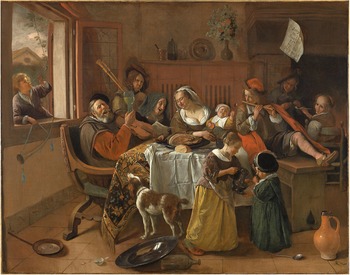
The mid-seventeenth-century images attributed to Gabriel Metsu and Abraham van Dyck are intimate portraits of a younger and an older Dutch woman smoking a pipe (see Figures 1 and 2).Footnote 111 They suggest a custom or habit that was private, absorbing, and domestic, and which spanned the generations. If Jan Steen’s The Merry Family (1668) is chiding the merry parents for their parental negligence (see Figure 3), the fact that their young sons and daughters can sneak puffs on pipes and drams of drink also indicates the quotidian domestication of tobacco and alcohol.Footnote 112

Figure 1. A woman seated smoking a pipe (1650 to 1667) after Gabriel Metsu,1629-1667); previously attributed to Gabriel Metsu. Manchester City Galleries.

Figure 2. An elderly woman smokes a pipe (17th Century), attributed to Abraham van Dyck (1635-1680).

Figure 3. Jan Steen, The Merry Family (1668), Rijksmuseum.
More normative was the doll’s house of the wealthy orphan Petronella Dunois (Figure 4). Miniaturizing in exquisite detail the rooms and contents of a typical bourgeois Amsterdam home circa 1676 showed smoking and pipes clearly as integral features of the dining and reception rooms.Footnote 113 This resonates with the way tobacco and snuff boxes became important to the construction of both female and male identities in the century and a half after 1650.Footnote 114 And while Jan Olis’s Elegantly Dressed Women Drinking and Smoking (1645) is morally ambivalent (see Figure 5), it nevertheless visualizes precisely the kind of bourgeois conversation scene recalled by Müller a century later.Footnote 115

Figure 4. Dollhouse by Petronella Dunois, anonymous, ca. 1676, Rijksmuseum.

Figure 5. Jan Ollis, Elegantly Dressed Women Drinking and Smoking (1645), Private Collection.
Viewed retrospectively, then, plague physic becomes not so much an anomalous or irrelevant moment in the material history of household consumption as one of the possible routes by which opiates and tobacco, along with sugar and wine, became fully assimilated into domestic spaces and practices. Women were integral to this assimilation because, along with preparing and consuming food and drink, they oversaw healing practices within households and often prepared as well as consumed the preventative, remedial and fortifying Z-commodities so prescribed.Footnote 116 Their contribution to domestic dietetics as well as diet – to a household’s emotional as well as dietary regimes – made them crucial in determining the prophylactics, remedies and fortifiers adopted and, if used faithfully, the physic that structured and ritualized the day.Footnote 117
Yet, they also contributed to the intoxicant economy in another, less observable way: through the habitual, illicit and potentially dependent forms of consumption that domestic consumption might habituate. Certainly, contemporaries were fully aware of the dangers of medical prescriptions becoming social dependencies – what might be styled (to use the medical language of the time) ‘accustomization’.Footnote 118 For example, despite sanctioning recourse to tobacco as a medical expert, van Diemerbroeck warned readers that ‘Narcotics are to be used as little as may be, for fear of accustoming the Patient too much to the use of them’. More, he demonstrated that the consequences of accustomization were anatomically proven: just as ‘in diseased Persons, especially such as took too much foul Tobacco in their Life-time, I have found it of a blackish Colour’, so in ‘one that was a Slave to Tobacco and Brandy, and afterwards died of a long Asthma, I found all the Lungs not only of a blackish Colour, but dried up to an indifferent hardness, with some small Ulcers scattered here and there’.Footnote 119
Across the region, expert proponents of tobacco were fully aware that it is ‘harmful if it is abused and used in abundance’.Footnote 120 The dangers of accustomization were elaborated in detail by Thomas Willis as early as 1665. Willis was an admirer of van Diemerbroeck and reputedly the wealthiest physician in England when he died in 1675. When confronted with plague in London in 1665, he advised that ‘taking of Tobacco in a pipe’ was an effective prophylactic and potential antidote, and that ‘the frequent use of Tobacco [was] doubtless in time of Plague … profitable to them that can take it’.Footnote 121 He was also clear that smoking had become a socially ubiquitous practice: ‘I need not trouble myself to tell you the original or usage of this invention, which is so commonly known and practised by men and women of all sexes, ages, and conditions’.Footnote 122 Noting the uptick in consumption during previous epidemics, he nevertheless acknowledged two ways in which resorting to narcotics was risky.Footnote 123 On the one hand, users became so inured to the substance that its effects diminished: ‘if’ tis not of so great virtue still amongst us, the reason is, because most Men have been accustomed to take it so excessively; wherefore it is grown so familiar to them, that it produces no alteration’.Footnote 124 On the other hand, the mental and bodily pleasures derived from narcotics could become the primary reason for consuming them. Despite the ‘very great disturbances in their Brain and Nerves’ initially experienced with opiates or smoke, ‘as soon as that custom is become usual and familiar to a man [by which he clearly meant men and women], it likewise grows very grateful, and affects the animal spirits with so much pleasure, that some men had rather abstain from meat or drink than from the use thereof’. This was because ‘smoking doth gently raise, and as it were tickle the animal spirits whenever they are dull and sluggish, and puts them into pleasant expansive motions, with which they are recruited and refreshed in a wonderful manner, as after drinking of Wine’.Footnote 125 But it was not just narcotics that risked accustomization. In Hamburg, physicians warned that sugar cakes should be consumed with ‘caution and modesty’ – and gradually – so that the physic did not become too pleasurable; as with opium and tobacco, the utility derived from sugar was lessened if it was used superfluously.Footnote 126
5. Conclusion
This article has argued that pestilence and medical responses to it contributed to the psychoactive revolution in the metropoles of the Baltic and North Sea during the long seventeenth century. This is unsurprising, perhaps, given that social catastrophes are increasingly linked by historians to the uptake of psychoactive substances: how, for example, the American taste for opiates was forged among soldiers in the 1860s Civil War and World War I became the midwife of the cigarette.Footnote 127 Developments in plague physic encouraged a taste for these substances at least two centuries earlier and among women as well as men. And whereas the stricter policing of public spaces during plague might suggest that pandemics militated against excessive and sociable consumption, so the importance of intoxicants to physic meant that the possibility of domestic and ‘private’ intoxication – and any longer-term habits of dependency that followed from accustomization to them – was quite as likely as the more visible pursuit of ‘public’ pleasures.
Viewed generally, therefore, the correlation between epidemics and material and discursive developments offers a useful reminder of the many and varied reasons why premodern people consumed what they did – choices based on dietetic advice and custom that are not always recognized in the social and especially economic historiography. Certainly, the threat of plague and its dietary consequences serves as a tangible and socially ubiquitous influence on ‘tastes’ to consider alongside other explanatory frameworks like emulation, fashion and frivolity. More specifically, the correlation between plague physic and intoxicants points to a range of materials, competencies and meanings that do not so much refute de Vries’ narrative of industriousness, or the conception of household economics upon which it rests, as complicate it culturally and deepen it temporally.Footnote 128 The intoxicating Z-commodities discussed by de Vries after 1700 were not the ones prescribed so intensely and repeatedly in the preceding hundred years; nor were they necessarily consumed in the pursuit of politeness, respectability or, ostensibly at least, comfort or pleasure. As importantly, the dangers of opiates, tobacco and sugar as articulated by contemporaries point to the issues of habituation and addiction – styled here ‘accustomization’ – largely elided by a focus on industriousness.
A convergence of these pre- and post-1700 trends in domestic consumerism practices occurred in 1722, when the very real prospect of an epidemic in Marseille reaching the rest of Europe prompted a huge surge in public discourse about plague and appropriate responses to it.Footnote 129 One London retailer based at the Anodyne Necklace without Temple Bar looked to commercially exploit the situation as comprehensively as possible. In a choreographed sequence of adverts, they recounted the horrors of 1665 before revealing some of the proven secrets of preservation and remedy. These secrets were a miscellany of printed advice from the 1660s which, in addition to extolling the remedial powers of opiates, served to introduce customers to the prophylactic commodities now sold at the Anodyne Necklace and other designated retailers as part of a ‘practical scheme’ – ‘Cephalick and Opthalmick Tobacco’ (to be smoked or snuffed); ‘Cleansing Sugar Plumbs’ to be sucked like sweets; and various citrusy drinks, tinctures and elixirs to be added to newer beverages that did not work against the plague and which were themselves suspected of inducing ‘Weaknesses, Tremblings, and other Paralytic affects’: tea, coffee, chocolate and drams.Footnote 130 Readers were advised to prepare tea with a little sugar and milk (‘for an innocent gratefulness to the Palate’) and coffee with sugar (‘double refined’) but without milk.Footnote 131 Accompanying sheets cited the ‘Great Diemerbroeck’ and the ‘Great Willis’ to demonstrate both the efficacy of smoking in time of plague (allegedly no ‘tobacconists’ died in 1665) and the sensory pleasures of smoking or snuffing this new tobacco, enhanced with additives, even without the threat of epidemics. The sugar plumbs had an ‘Appendix’ extolling their virtues all to themselves.Footnote 132
The adverts nicely capture the intermix of older and newer intoxicants now vying for consumer tastes not only in London but also in Amsterdam, Hamburg and Stockholm. They also demonstrate the remarkable commercial opportunities still afforded by pestilence: as a stimulant to product innovation and the repackaging of familiar substances; as a gateway to accustomization and longer-term consumption; and as an implacable challenge for the household economics of both rich and poor.
Acknowledgements
This article was researched as part of the ‘Intoxicating Spaces’ project (www.intoxicatingspaces.org) that was generously funded by the Humanities European Research Area (HERA). The project was a happily collaborative and stimulating experience and we’d like to thank the rest of the core research team – Dagmar Freist, Hana Hodacs, Toine Pieters, Leos Müller and especially James Brown – for their wisdom and support. A Leverhulme Major Research Fellowship gave Phil Withington the time to address the extremely helpful suggestions of the editors and anonymous reviewers and prepare the article for publication.
Competing interests
The authors declare none.
Funding statement
Open access funding provided by Utrecht University.