


Currently in England, over 2 million children live in poverty( 1 ) and there is concern that children from deprived households have poorer-quality diets( Reference Gregory, Lowe and Bates 2 ) and experience higher levels of ill health, including increased prevalence of obesity( Reference Bridges and Thompson 3 ). Successive governments have pledged to reduce child poverty with the intention of tackling the widening gap in health inequalities( 4 ). A recent review on addressing health inequalities calls for action including to ‘give every child the best start in life’( Reference Marmot 5 ). However, the recent downturn in the global economy has heightened concern for the well-being of children from financially disadvantaged families. As a result, the role of school food has assumed an elevated position with the introduction of nutrient-based standards( 6 ) aiming to enhance the nutritional quality of school meals and contribute to an improved diet. Children taking a free school meal (FSM) obtain a higher proportion of their daily energy and nutrient intakes from their school meal compared with those who pay( Reference Gregory, Lowe and Bates 2 ). Therefore an improvement in school meal standards would be of particular benefit in terms of health, well-being and reducing health inequalities( 7 , Reference Pike and Colquhoun 8 ).
In England, children from low-income families in receipt of state benefits are entitled to receive FSM. These provide vital financial support for low-income families and can be worth up to £1000 per year for a family with three children( 9 ). In order to receive a FSM the family has not only to qualify, but also to register, with the final step being the child choosing to take the meal. Recent data estimate that of the 1·5 million families entitled, only 1·2 million register and 1 million children actually consume their FSM( 9 ). In 2007, at the time of the present study, it was estimated that, in England, 334 000 pupils eligible for FSM were not registered and that a further 210 000 pupils registered for FSM did not take up their entitlement( Reference Harper and Wood 10 ). Therefore the number of families that meet the criteria for FSM but do not apply is of concern, as is the low uptake of FSM after registration.
Previous studies cite stigma, the uneasiness of parents and children and inadequate information regarding the claiming process as barriers to FSM uptake( Reference Dowler, Turner and Dobson 11 – Reference Colquhoun, Wright and Pike 13 ). In the UK, all pupils whether paying or taking a FSM are offered the same choices, age-related portion sizes and sit together in the school dining hall, with the only differentiation being in payment procedures which aim to protect the identity of those pupils taking a FSM. In areas where universal FSM have been piloted, a significant proportion (36 %) of children did not take up the offer of a school meal( Reference Colquhoun, Wright and Pike 13 ) indicating that broader contextual reasons (such as queuing, dining room environment) may influence the take-up of school meals, both free and paid( Reference MacLardie, Martin and Murray 14 ).
The present study was commissioned by Leeds City Council to inform the development of a School Meal Strategy and was undertaken when the food and nutrient-based standards were being implemented. The aim of the study was to explore the factors that influence registration for FSM as well as the take-up after registration and to identify examples of good practice to increase take-up. Findings reported here will be useful to local authorities, schools, caterers, nutritionists and dietitians in developing interventions to increase FSM uptake.
Methods
The research design consisted of two phases: an initial scoping review and qualitative research phase, followed by a second phase which involved designing, implementing and evaluating specific interventions. In the current paper results from the first phase of qualitative research are reported. Second-phase results are reported elsewhere( Reference Sahota, Woodward and Bowyer 15 ).
Sample of schools
The sample was selected using data supplied by the local authority, and consisted of four secondary schools (SS1 to SS4) and four primary schools (PS1 to PS4) with high FSM entitlement levels compared with the local authority as a whole. Schools were specifically selected in order to explore the reasons for differing uptake levels; therefore half of the schools had high uptake of FSM and half had low. The criteria-based sample included schools with different catering providers, varying levels of ethnic minority intake and, in secondary schools, different types of payment system. Table 1 shows the characteristics of participating schools.
Characteristics of participating schools
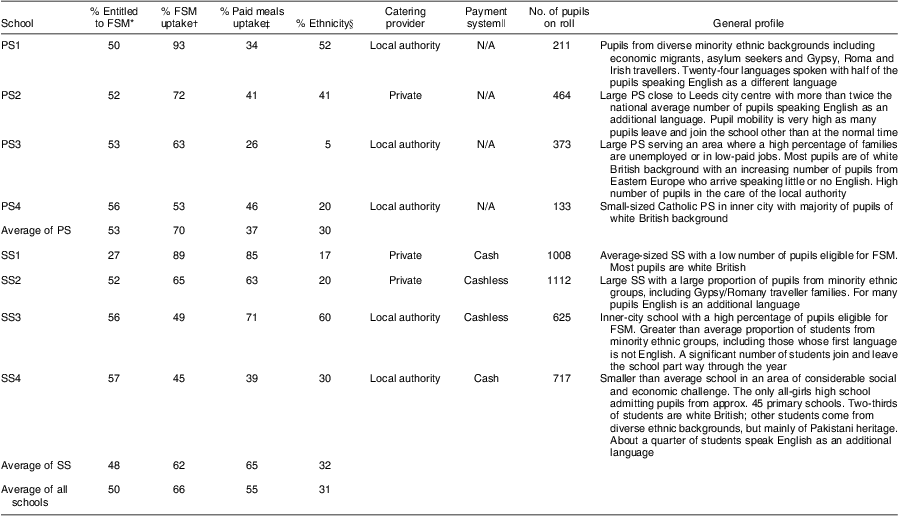
FSM, free school meal; PS, primary school; SS, secondary school.
*Percentage of pupils entitled to FSM per school.
†Of those entitled, percentage of pupils taking up their FSM.
‡Percentage of pupils not entitled to an FSM who choose to have a paid meal.
§Percentage of pupils from black and minority ethnic groups.
∥Payment system used by pupils: not applicable (N/A) as for PS as they collect payment via parents; cash or cashless systems operate in SS.
Data collection
Schools meeting the inclusion criteria received information describing the project and were invited to participate in the study. All individuals in the schools were invited to participate and the convenience sample was selected from those consenting. Data collection methods included an interview with the head teacher or person responsible for overseeing school meals plus the school meal administrator, and telephone interviews with parents of children registered for FSM. In secondary schools, eight focus groups (total twenty girls and nine boys) were undertaken with both paying and FSM pupils from Key Stages 3 (ages 11–14 years) and 4 (ages 14–16 years). In primary schools, a participatory classroom activity was undertaken with a Key Stage 2 class (ages 7–11 years). Participating pupils included those eating paid or free school meals and packed lunches. Table 2 illustrates the data collection methods.
Data collection methods
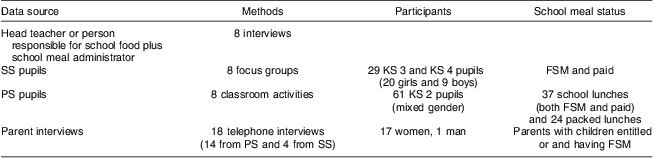
SS, secondary school; PS, primary school; KS, Key Stage; FSM, free school meal.
All interviews and focus groups were conducted over 2 months during normal school hours utilising interview schedules and standardised focus group guides developed using information from a literature scoping exercise. The key areas of exploration are presented in Table 3.
Factors to investigate during the exploratory research phase
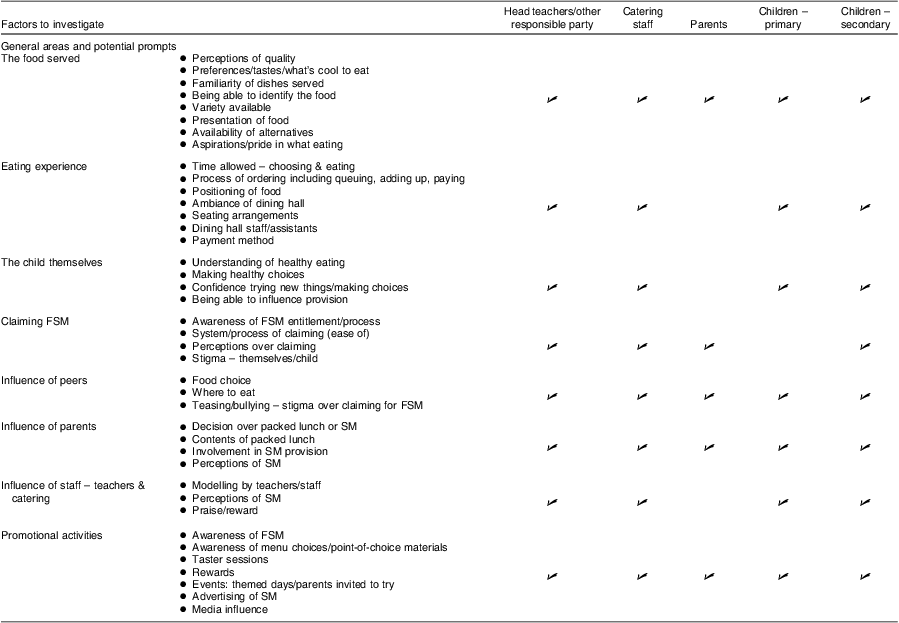
FSM, free school meal; SM, school meal.
The activity for primary-school children did not ask about FSM specifically as parents felt children would be unaware of these issues.
Data analysis
All interviews and focus groups were recorded, transcribed in full and analysed by one author (J.W.). Data were pooled by respondent type (pupil, parent or head teacher) school type (primary and secondary) and levels of FSM uptake (high and low). The analysis was data driven, with transcripts coded thematically with emerging themes identified and differences highlighted( Reference Tesch 16 ). Data source triangulation (head teachers, school administrators, parents and pupils) was employed to explore the factors influencing FSM uptake from different perspectives.
Results
Findings suggested that pupils’ reasons for taking school meals are complex and multifaceted, with a range of environmental, social and cultural factors affecting their decision. It is beyond the scope of the present paper to report on all of the findings from this project; however, a full report is available elsewhere( Reference Sahota, Woodward and Bowyer 17 ). Herein we report only on the key findings, illustrated by using representative quotes, covering the FSM claiming process, stigma, food quality and choice, and the dining environment.
The free school meals claiming process
Head teachers felt that the bureaucracy involved in claiming FSM may deter parents from applying, suggesting that low confidence levels meant parents were reluctant to request support with the claiming process from the school. They felt this might be further compounded by low literacy among parents, particularly where English is a second language. However, they also suggested that other factors might impede the claiming process including families’ desire to maintain independence, a sense of pride and their right to privacy without interference in personal circumstances:
‘I think there could be an element of literacy skills, if they don't have literacy/numeracy skills they might not be able to fill the forms in – so that knocks confidence doesn't it? They might not be able to go down and speak to somebody or use a telephone and they're too proud, pride isn't it? They won't come into school and ask for help, so they just, plod on.’ (Head teacher, PS4)
Head teachers felt that families who were socially isolated and marginalised may lack awareness of their entitlement. Some suggested that parents may not be aware of the nutritional benefits of a school meal and expressed disbelief that children brought a packed lunch when entitled to an FSM.
Head teachers of primary schools with high and low uptakes of FSM regarded some parents’ relationships with their children as a barrier to FSM take-up. They suggested that parents were unaware of the power they had over their children's choices and considered that children seemed to be in control of their parents:
‘We do have a lot of children whose parents hang off their child's every word … they seem to forget who the parent is.’ (Head teacher, PS3)
‘We have one or two children who are very, very good at manipulating mummy.’ (Head teacher, PS2)
Thus, from these head teachers’ perspectives, failure to claim FSM entitlement was in some cases indicative of wider weaknesses in terms of parenting styles and approaches.
Parents reported they were generally happy about claiming, although some felt other parents may not be or may lack the confidence to claim. They described the claiming process as relatively easy, often automatic in many cases as it was linked to entitlement to housing benefit. While some reported receiving help from the school with the claiming process, others felt schools did not actively encourage FSM uptake. Head teachers confirmed that in secondary schools involvement in encouraging uptake was generally minimal. Rather they focused upon administrative aspects and while some head teachers were prepared to interact with parents, others feared appearing patronising or insulting:
‘You need to be careful not to insult parents – because you could lose them.’ (Head teacher, SS4)
In contrast, primary schools were more proactive in promoting uptake because of the closer relationship they had with parents and families:
‘And there's a real nurturing, I think that a lot of our staff are involved at lunchtimes so that it's not just people who are shipped in at lunchtime to work with the children.’ (Head teacher, PS2)
Staff members were more willing to approach parents to discuss claiming FSM using mounting debt as an indicator. Thus, if parents were not paying for their child's school meals regularly, administrators might suggest claiming FSM, or even liaise with benefits services on parents’ behalf:
‘One of the biggest indicators of problems is if they start running up a bill. We try, we try very, very hard to put a limit on that, and suggest that they do go on to packed lunches until they've paid off the debt, because it doesn't do anybody any good, it doesn't do them or the school any good because ultimately we end up paying the bill. But there are some parents who, who are very private and don't really want to go down the road so they are going to avoid us, they don't want to, they can't afford to pay off the debt or they can't afford to pay the current week but they, they say things like I'll send the money in on whenever, then are going to avoid us and running up huge debts, whereas if we could sit down and discuss a strategy, which we do with some don't we?’ (Head teacher, PS2)
Staff assisted parents with form-filling, telephone enquiries and liaison with benefits services. Effective home–school relationships were regarded as crucial in promoting FSM uptake, as one primary-school administrator noted: ‘It's relationships that are the key, not processes’. These school administrators felt they knew their families well and as the first point of contact in schools they felt parents were not embarrassed to approach them. Effective working practices within the school, particularly between the administration, parent support staff and multi-agency partnerships with benefit services, were regarded as key in encouraging uptake of FSM.
Data also revealed head teachers’ concerns regarding their limited knowledge about FSM entitlements including the claiming process. They requested information for teachers and parents in a short format detailing the entitlement criteria and the claiming process.
Was stigma a concern?
In the present study, data indicated that parents of primary-school children did not regard stigma as an issue because pupils automatically received their meal without the need for a ticket or token. Thus, the potential for them to be identified as receiving FSM was negligible. Parents with children in secondary schools preferred the cashless payment system because it did not identify pupils on FSM. Head teachers also saw the benefit of cashless systems since they did not discriminate between paying and FSM pupils and consequently had the potential to eliminate stigma if it existed. Interestingly, while no respondents had witnessed or experienced bullying in school due to FSM entitlement, this was something that many respondents were alert to. Indeed, for some respondents, an awareness of the possibility of bullying was a direct result of their own or their children's experiences at school:
‘So we'd have money, and they'd have their token, so we knew full well they were on FSM … and they used to get picked on.’ (Parent PS1)
For the vast majority of parents, claiming FSM was not seen as a source of stigma or shame. Accounts tended to refer to FSM entitlement as a temporary stop gap or, in the majority of cases, as a normal part of life through references to the position of other parents and families:
‘Doesn't bother me, once I'm working I won't get them so it's fine.’ (Parent PS3)
‘Fine – don't feel embarrassed as there are lots of parents who claim therefore happy to do that.’ (Parent SS3)
FSM entitlement was not regarded as problematic because it was not out of the ordinary and therefore parents did not feel that their families were differentiated from others on this basis. However, despite the normalisation of FSM entitlement, some concerns were expressed for secondary-school pupils where the cashless system was regarded as crucial to ensure confidentiality and minimise the associated risk of stigma. Parents generally needed reassurance that their child would not be identified and anonymity would be maintained.
From head teachers’ perspectives, stigma was not evident in their schools and many suggested that this was a result of the cashless system. However, they pointed out that the lack of stigma attached to claiming or eating FSM may be a result of the homogeneity of the student population in terms of socio-economic status. Echoing the views of parents, the lack of variation in parental income meant that nearly half the school was claiming FSM and it was therefore seen as the norm. Nevertheless, the potential for stigma to become an issue was something that those operating a cash system were alert to:
‘We have a cash system so students who are entitled to a FSM have a card that says they're entitled to FSMs and you worry that this is highlighting them as students that are different but there doesn't seem to be any sort of stigma.’ (Head teacher, SS1)
Secondary-school pupils also stated that there was no stigma associated with claiming FSM, particularly when FSM was the norm:
‘No, it's not an issue at school, because plenty of people get council dinners at our school, plenty […] your friends are understanding about it.’ (Pupils SS3)
Food choice, quality and availability
In terms of overall attitudes to school meals, data highlighted the disparity between primary- and secondary-school pupils’ views with the former far more positive about healthier eating than the latter. Although all pupils were prepared to eat healthier options, secondary-school pupils felt the school meal standards were too limiting in terms of food choice, commenting that ‘the odd [occasional] bar of chocolate is not going to do you any harm’.
The following reasons drove primary- and secondary-school pupils to packed lunches and beyond the school gates for secondary pupils:
‘Because when there's nothing in school that you like you're thinking, oh I might as well go out of school and go to the chip shop or something like that.’ (SS3)
‘Some of the foods that you have each day you don't know what there is going to be, some you don't like.’ (SS4)
Choice, familiarity and taste of foods on offer appeared to be important factors in determining all pupils’ attitudes to school lunches, with many wanting to be able to make culturally ‘safe’ choices. Muslim pupils commented that there were insufficient Halal options and unclear signage. This undermined pupils’ confidence in the food since they could not be certain they were eating culturally appropriate food. Data showed that snack-style foods which could be eaten quickly without cutlery were preferred, thus reflecting secondary-school pupils’ preference to eat on the go in the short lunch break afforded to them.
Secondary-school pupils complained of small portion sizes and going home hungry was a key complaint voiced by many pupils. Boys in particular pointed out they were ‘growing lads’ and that ‘my mum gets annoyed because I come home and raid the fridge, I'm starving’ (SS1).
Parents were often unsure about the quality of food and some thought that school lunch was too healthy whereas others thought it was not healthy enough:
‘It's diabolical, it's okay being healthy but they're used to having chips, there are too many healthy options.’ (Parent PS1)
‘Healthier eating – she always goes for healthier option if she can but feels it's not affordable to get healthier food.’ (Parent SS1)
Parents felt that there was a lack of choice, too many unfamiliar foods particularly for ‘fussy eaters’, and that when children did not like what was offered, they would go without a meal. Many parents were unhappy that juice was not available at lunch and if children did not like water, they would go without a drink. Packed lunches were popular with parents because they catered for ‘fussy eaters’. They could be confident that the food was liked and would be eaten and therefore their child would not be hungry. Packed lunches also appealed as some options for school meals ran out towards the end of lunch, increasing the risk of their child not eating. Therefore, for parents, the advantages of packed lunches over school lunches were that packed lunches could be tailored to individual tastes and appetite and more easily monitored in terms of what was eaten.
Parents’ priority was to ensure that children did not go hungry and some suggested that the FSM allowance was insufficient to enable secondary-school pupils to purchase an appropriately sized meal. Consequently, parents had to subsidise the cost:
‘My older girl should have more than £1·75 at secondary school.’ (Parent SS3)
Indeed, data showed a wide variation in prices across the secondary schools. In one school a slice of pizza was £1·10; in another, two slices cost the same. The price of jacket potato, beans, salad plus a yoghurt and drink was £1·15 in one school and in another £2·45. This affected FSM uptake and pupils commented that ‘it's not that free’ and ‘can't get a decent amount of food’. Parents and pupils suggested that £2 to £3 would be a more suitable amount for a meal.
The dining environment
The dining environment emerged as a significant factor in shaping all pupils’ experiences of and attitudes towards school dining. Pupils’ accounts suggested that both the physical organisation of the space and the temporal structuring of lunchtimes within the school day negatively impacted upon their dining experiences. For example, short lunchtimes meant that primary-school pupils felt rushed and frequently elected to eat pudding before finishing their main course in a bid to vacate the space quickly. Their overriding concern was to ensure they had sufficient time to play with their friends and taking a packed lunch was a better option to maximise the length of their play time. Table 4 presents a selection of quotes relating to the dining environment.
Quotes on the theme of dining room environment

SS, secondary school.
In some schools pupils who bought a packed lunch could eat their meal immediately; this was appealing to some who stated ‘I just like to sit down straight away and eat’. In secondary schools, similar issues emerged with regard to the temporal organisation of lunchtime as the portable nature of packed lunches afforded greater opportunity to socialise in different spaces. However, in both primary and secondary schools the length of time spent queuing was by far the most unpopular element of the lunchtime experience. As one pupil noted:
‘I look at the food, sometimes it looks alright, and then I see the queue.’ (Pupil SS3)
In primary schools the rotation of different ‘sittings’ was felt to provide advantages and disadvantages. For example, pupils arriving at the end of lunchtime were offered fewer lunch options although they might be offered second helpings; while those coming in first enjoyed greater choice, but were never offered second helpings. In secondary schools the length of the queue drove pupils to seek alternatives to hot lunches, for example eating a cold lunch, eating during break times instead, or purchasing food from local shops. Thus, while the temporal organisation of school lunches produced different effects in primary and secondary schools, in both cases the limited opportunities for socialising with friends was a barrier to taking a school meal.
Pupils’ perceptions of lunchtime as a social time emerged as a significant theme in relation to the spatial organisation of school dining rooms. Frequently the aesthetics of school dining rooms meant that pupils were reluctant to spend time socialising within the space due to noise, lighting and a generally institutional feel. Pupils in both primary and secondary schools suggested that a more restaurant-like design with better decoration perhaps including displays and posters, music, better signage designed by pupils, tablecloths and flowers, and noise-abatement measures such as acoustic ceilings would improve the ambience of the space and encourage social interaction.
Seating arrangements were also significant, as two of the four primary schools segregated school lunch eaters from packed lunch eaters. For primary-school pupils, this segregation was second only to food choice in determining whether a pupil opted for school meals or brought a packed lunch since pupils were unable to sit next to friends who chose a different lunch option to them. In general, the perception was that packed lunches were more ‘fun’ than school lunches.
In secondary schools seating preferences did not emerge as strongly in the pupils’ accounts. However pupils favoured eating outside, but selecting a school meal made this impossible in all secondary schools in the present study sample.
Discussion
Findings from our study, which may be transferable to settings outside the UK, suggested that in addition to the procedural aspects of claiming and accessing FSM and the insufficient cost of a FSM for secondary-school pupils, the factors which determine whether children who were entitled to FSM took a school lunch were found to be the same as those affecting paying pupils. In line with findings from previous studies( Reference Storey and Chamberlin 12 ), allowances for FSM must remain in line with the cost of a paid meal and schools can improve uptake of paid and FSM by providing food that children desire. Thus findings conclude that the ‘best way of improving the uptake of FSMs is to increase the uptake of ALL school meals’( Reference Colquhoun, Wright and Pike 13 ).
Food choice, queuing and the social aspects of lunchtime such as eating with friends were major influencing factors. The social and environmental aspects of dining have become a focus of recent academic research( Reference Moore, Murphy and Moore 18 – Reference Daniel and Gustafsson 20 ), suggesting that nutritional concerns have preoccupied policy makers at the expense of children and young people's priorities for school dining. Changes to the temporal and spatial organisation of school dining should be considered to maximise uptake( Reference Pike and Colquhoun 8 ). Furthermore, similarities exist between barriers to school meals consumption and barriers to eating healthier foods such as fruit and vegetables( Reference Krølner, Rasmussen and Brug 21 , Reference McKinley, Lowis and Robson 22 ).
In our study stigma was not a major concern for pupils, staff or parents. Rather stigma was a possibility that parents and staff were alert to but did not have direct experience of. In part stigma was alleviated by the introduction of the cashless system, which other studies recommend( Reference Storey and Chamberlin 12 ).
A limitation of the study is that the sample included only those parents who had claimed their FSM entitlement and therefore were more familiar with and accepting of the process. Additionally, secondary-school pupils’ views were gathered via focus groups which may have reduced openness about feelings of stigma. Furthermore, the high level of entitlement to FSM within schools in the sample may have resulted in the normalisation of FSM uptake and consequently stigma was not found to be an issue. While this is a limitation of the study, it indicates that schools may wish to proactively engage in strategies to normalise FSM entitlement as an effective intervention against potential stigma. However, identifying factors influencing uptake in schools with low FSM entitlement levels warrants further research.
Conclusion
Findings from the present study suggest the following recommendations to increase FSM uptake.
-
1. Better understanding of the factors related to FSM uptake among school staff and improved communication with parents.
-
2. Minimal discrimination, maximum awareness and an easy claiming process.
-
3. A pupil-centred approach to improve the quality of school meals through providing adequate choice, taste and portion sizes.
-
4. Recognition of the importance of the social aspects of dining for pupils and facilitation of social interactions through the spatial (including flexible locations, e.g. outside) and temporal organisation of lunchtimes.
Acknowledgements
Sources of funding: Funding for this study was provided by Leeds City Council. Conflicts of interest: There are no conflicts of interest. Ethical approval: Ethical approval was provided by the Faculty of Health Ethics Committee at Leeds Metropolitan University. To acknowledge the contribution of parents a £10·00 High Street voucher was offered on completion of the telephone interview. Authors’ contributions: P.S. was responsible for the conceptual design of the study; primary and secondary data collection was undertaken by J.W. with analysis and interpretation by P.S., J.W. and R.M.; J.P. was responsible for overall editing of the manuscript with substantial input from R.M., P.S. and J.W.



