


Introduction
The threat of climate change to the wetland archaeological record, and the urgent need for solutions, is gaining increasing attention (Matthiesen et al. Reference Matthiesen, Brunning, Carmichael and Hollesen2022). However, while climate change will certainly impact wetlands, anthropogenic interventions were also recognised as critical problems more than 30 years ago, for peatlands especially (Coles Reference Coles, Wheeler, Shaw, Foit and Robertson1995). The loss and degradation of peatland archaeology was described as a ‘crisis’ (Brunning Reference Brunning2001; Coles & Olivier Reference Coles and Olivier2001), with calls for responses repeated a decade later (Gearey et al. Reference Gearey, Fletcher and Fyfe2014). This state of affairs has largely persisted; peatland sites continue to face threats suggesting preservation in situ is failing despite various responses (Table 1). Here, we consider four inter-related challenges for the preservation of peatland archaeology, some of which are shared with other wetlands (e.g. lacustrine, alluvial environments). Peatlands face specific threats but there are also potential solutions, in the context of policy developments in north-western Europe. There are approximately one million square kilometres of peatlands in Europe (10% of the total land area), around half of which are classed as ‘degraded’ (UNEP 2022), meaning any in situ archaeology is also at risk of degradation. Using England as a case study, we outline progress in strategy development, highlighting links with peatland rehabilitation programmes that offer potential for the protection of archaeology (e.g. England Peat Action Plan, DEFRA 2021). We suggest that these developments provide practical guidance for other countries and argue that preservation in situ as a passive strategy for European peatland archaeology is no longer fit for purpose. More resources now need to be found for sites that are threatened but cannot be actively managed. Alternatively, the inevitable loss of heritage must be accepted.
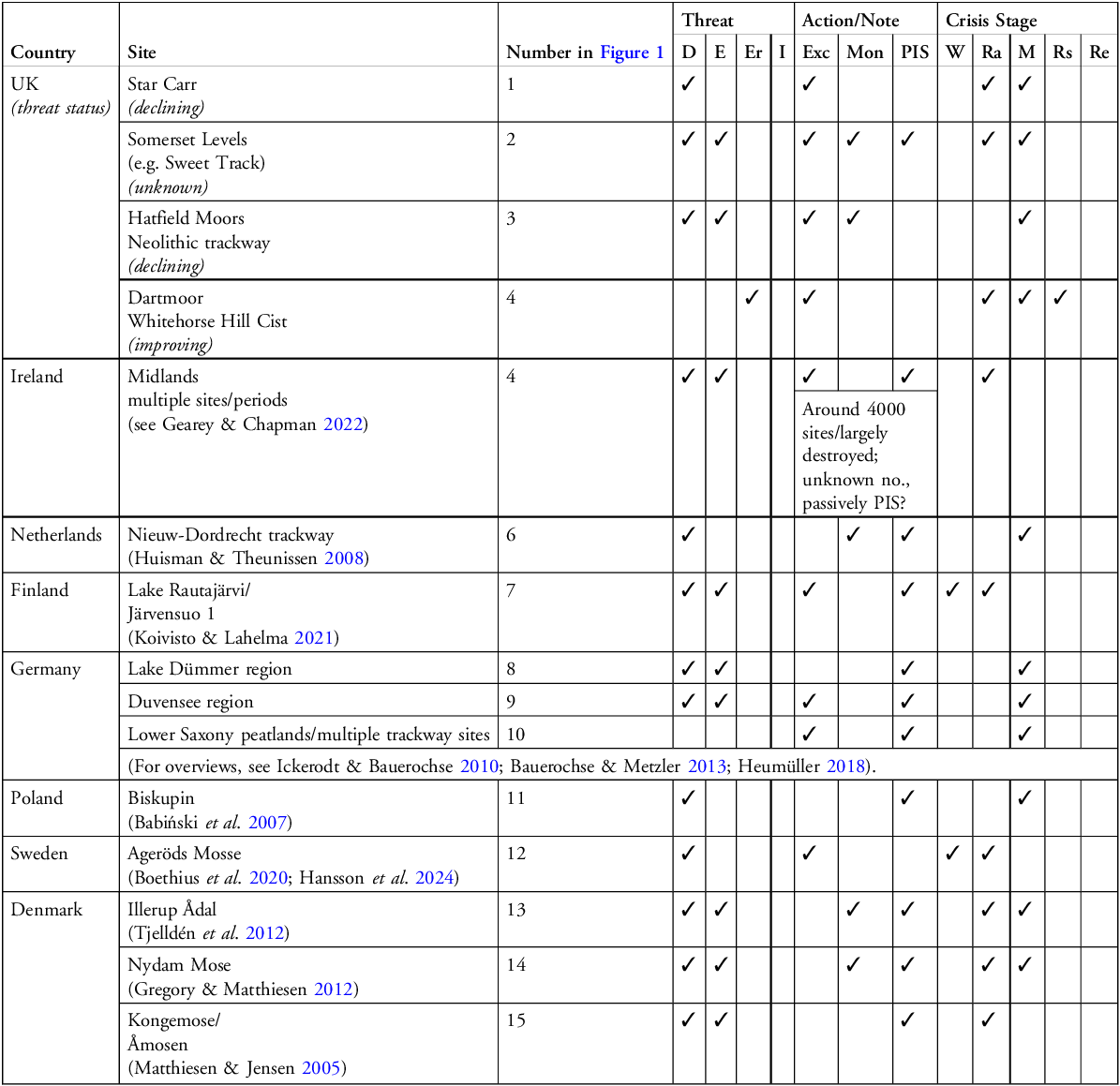
Selected European peatland archaeological sites; indicative examples.
Threat status for locations in England follows Historic England (https://historicengland.org.uk/listing/heritage-at-risk/); for other countries threat status is based on qualitative assessment.

Threat: D (drainage), E (peat extraction), Er (erosion), I (infrastructure; i.e. development/construction). Action(s): Exc (excavation/assessment excavation) = archaeological interventions/associated analyses; Mon (monitoring) = programmes of remote hydrological and burial environment data collection; PIS = preservation in situ; PIS? = passive/assumed preservation in situ. Crisis stages: W (warning); RA (risk assessment); (M) management; (Rs) resolution; (Re) recovery.
Peatland archaeology: value and threat
Peatlands often preserve remarkable archaeological sites and finds, especially organic material, including wooden structures and artefacts, leather, fibres and human remains (‘bog bodies’). Such archaeological material can be divided into three categories, sites and finds preserved beneath the peat (category 1: pre-peat archaeology), within the body of peat (category 2: intra-peat archaeology, including the palaeoenvironmental record) and on the surface of the peat (category 3: supra-peat; e.g. historical peat cuttings, etc.; Paulissen & van Beek Reference Paulissen and van Beek2024).
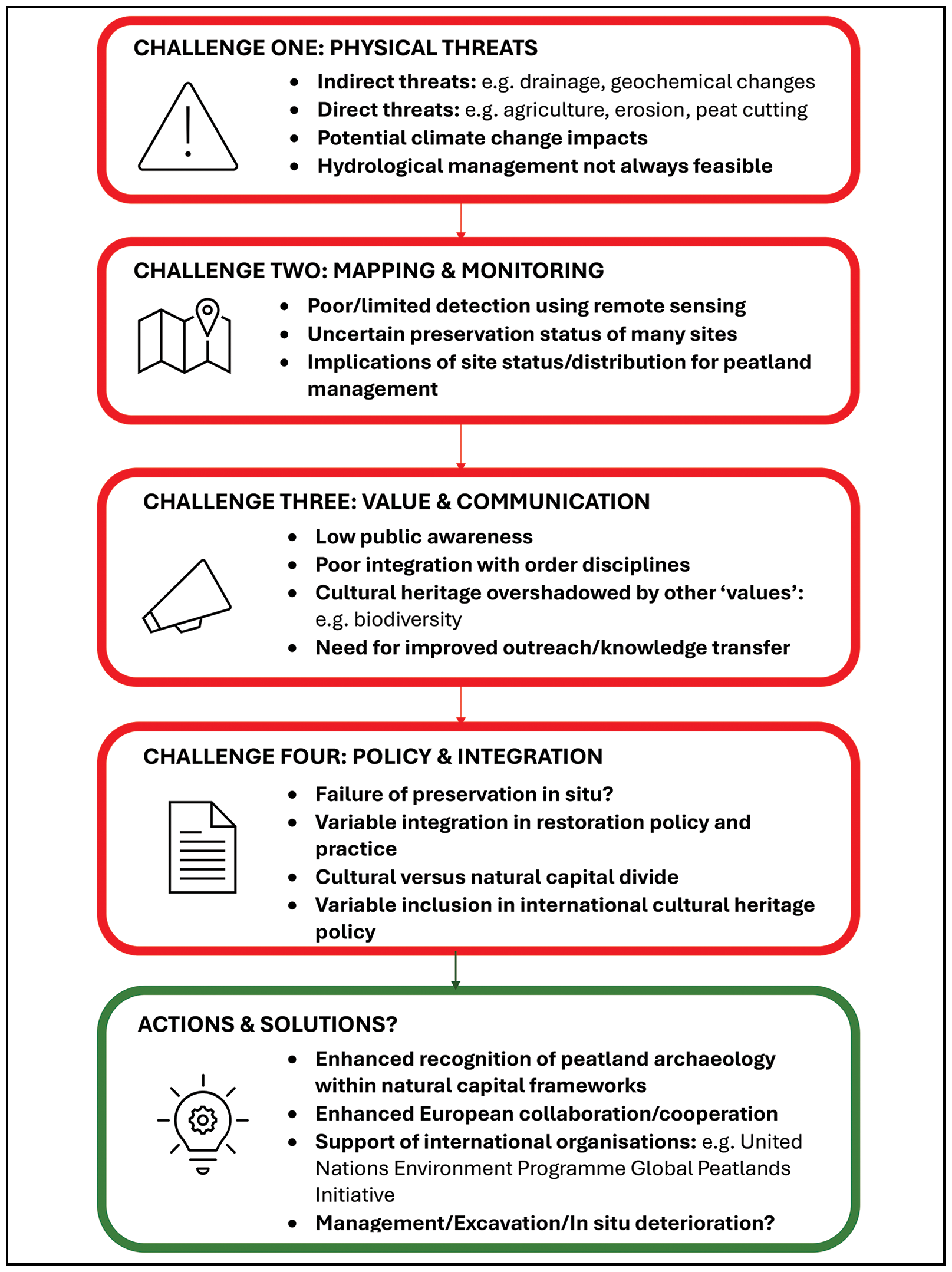
The categories are not mutually exclusive, but each presents different challenges in terms of known distribution, visibility and relative vulnerability to threats (see below). Category 3 is comparatively easy to identify (Paulissen & van Beek Reference Paulissen and van Beek2024), while categories 1 and 2 require specific investigative methods (see below). There is also an inherent irony in the fact that much category 1 and 2 archaeological material has been identified through drainage, agriculture and peat extraction, processes that destroy or damage sites (Table 1; see Figure 1). Following Brunning’s (Reference Brunning2001) identification of a ‘crisis’, we assign stages of ‘crisis management’ to peatland sites and landscapes (Table 1). While there has been progress in ‘response’ and ‘management’, many sites remain at ‘warning’ and ‘risk assessment’ stages. Why has it been so difficult to move towards ‘resolution’? We identify four inter-related challenges (see Figure 3).
Distribution of peatland (pink; after Tanneberger et al. Reference Tanneberger2017) and the locations of key sites mentioned in Table 1 (figure by authors).

Challenge one: threats, indirect and direct
Like other wetland deposits, peatland archaeological and palaeoecological remains can degrade through de-watering of the preservation environment and associated geochemical changes (e.g. Van Heeringen & Theunissen Reference Van Heeringen, Theunissen and Barber2007; Tjelldén et al. Reference Tjelldén, Kristiansen and Botfeldt2012; Davies et al. Reference Davies, Fyfe and Charman2015; Boethius et al. Reference Boethius, Kjällquist, Magnell and Apel2020). These can be defined as ‘indirect threats’ to distinguish these ‘silent’ processes from ‘direct threats’ such as destruction via agriculture, erosion and peat cutting (Figure 2; Gearey & Chapman Reference Gearey and Chapman2022). As Matthiesen and colleagues (Reference Matthiesen, Brunning, Carmichael and Hollesen2022) observe, climate change is part of the ‘perfect storm’ facing the peatland archaeological resource, but it is arguably impossible to assess the precise degree of threat (refining understanding of the crisis stage) without excavation and/or monitoring of preservation environments (Brunning Reference Brunning and Green2007; Van Heeringen & Theunissen Reference Van Heeringen, Theunissen and Barber2007).
Peatland archaeology threats and damage, some examples: top left) Flag Fen (Fenland, East Anglia) test pit (photograph courtesy of Birmingham Archaeo-Environmental) onto a Bronze Age woodlayer at base of dewatered peat; bottom left) Hatfield Neolithic Corduroy trackway (Lincolnshire, east England) with damage from drainage and peat extraction (photograph courtesy of Birmingham Archaeo-Environmental); right): excavations by Irish Archaeological Consultancy of later prehistoric trackway in industrially extracted peatland, Lisheen, Ireland, showing damage from drainage and peat cutting (photograph courtesy of Prof. H. Chapman).

There has been extensive research on potential impacts of de-watering on organic archaeology, but preservation environments are complex and hence mitigation is difficult (see Lillie Reference Lillie, Lillie and Ellis2007). The ‘easiest’ solution for sites threatened by indirect impacts is to block drains, raise water tables and re-wet remains (potential ‘resolution/recovery’, for example on part of the Sweet Track in the Somerset Levels; Brunning Reference Brunning2013). Yet this is often impracticable, due to the resources needed and the potential wider impacts on land use. Without hydrological management, archaeological remains are being left to ‘take their own chances’ leading to in situ deterioration (Tjellden et al. Reference Tjelldén, Kristiansen and Botfeldt2012).
Challenge two: mapping and monitoring
Complicating risk assessments/responses are the challenges involved in mapping intra- and pre-peat archaeology (e.g. Koivisto Reference Koivisto, Halinen, Mannermaa and Heyd2022). For example, around 95 per cent of peatlands in the Netherlands have been ‘reclaimed’, producing a relative wealth of (generally low-quality) archaeological data, but the archaeological potential of remaining peatlands is difficult to determine (e.g. van Beek et al. Reference van Beek, Maas and van den Berg2015). Some estimates of sites lost are available; around 4000 sites have been identified in Ireland’s midland peatlands but most have been destroyed with an unknown number passively preserved in situ (Table 1). In these waterlogged environments, the identification/mapping of sites through geophysical methods is generally of limited use (Armstrong in Gearey & Chapman Reference Gearey and Chapman2022), making non-invasive identification of intra-peat archaeology effectively impossible. Despite ‘hotspots’ of research and survey (Table 1), it is therefore not possible to provide quantitative estimates of the number of sites surviving in comparatively undisturbed areas of European peatlands. This ‘unknown potential resource’ is especially relevant in the case of peatland rehabilitation/restoration programmes, which have the potential to protect as well as inadvertently damage or destroy archaeology.
Challenge three: highlighting and communicating values and threats
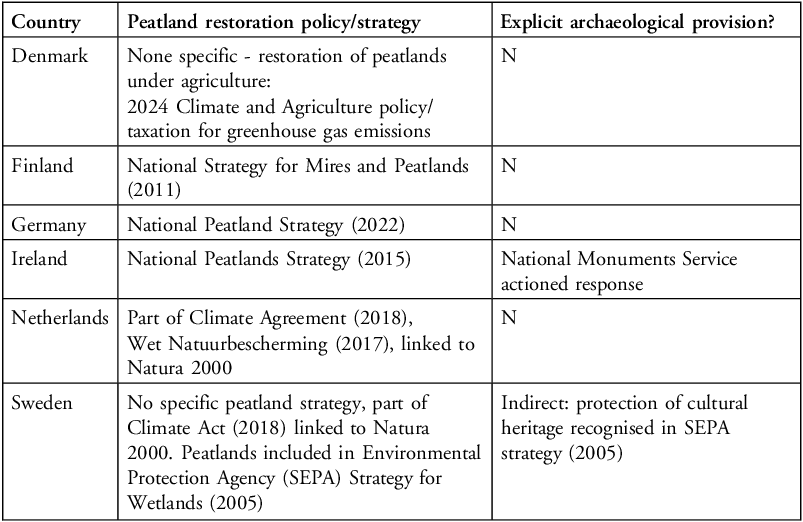
Despite some public recognition of peatland sites that might be regarded as ‘iconic’ (e.g. The Sweet Track), the vulnerability of organic archaeology (challenges one and two) is often imperfectly understood by communities of practice outside of archaeology, arguably providing a barrier to joint actions (Gearey et al. Reference Gearey, Fletcher and Fyfe2014; Paulissen & van Beek Reference Paulissen and van Beek2024). In addition, few countries have developed systems for formally categorising indirect threats (see Table 2), hindering communication and action across jurisdictions. The public perception of the ‘value’ of peatlands also rarely includes cultural heritage, largely focusing on the ‘natural’ heritage of flora and fauna (Flint & Jennings Reference Flint and Jennings2021; Paulissen et al. Reference Paulissen, van Beek, de Wit, Jacobs and Huisman2022). Enhanced knowledge transfer and communication to other professions and the public is thus essential (cf. Hansson et al. Reference Hansson, Kjällquist and Boethius2024).
Peatland restoration policies from selected European countries.

Challenge four: national and international policy frameworks
The preferred management approach for archaeological sites is preservation in situ (Council of Europe 1992; Coles & Olivier Reference Coles and Olivier2001), maintaining a passive awareness of the sites and the areas around them. The challenge for peatland archaeology lies in the related approaches to the management of ‘heritage assets’, protected nationally by specific policies and designations (e.g. in the UK: Scheduling, National Nature Reserves, Sites of Special Scientific Interest). As outlined above, however, these vehicles may be of limited use, especially for sites facing indirect threats.
Over the past two decades, peatlands have become recognised for ‘ecosystem services’ (ES; provision of ‘goods and services’ from ecosystem processes, or ‘Natural Capital’) leading to significant investment in peatland rehabilitation and restoration (e.g. Bain et al. Reference Bain2011; Gearey et al. Reference Gearey, Fletcher and Fyfe2014). In theory, restoration of degraded peatlands (i.e. rewetting) should benefit any in situ archaeology. In reality, this depends in part upon the explicit inclusion of archaeology in restoration projects to ensure that no inadvertent damage is caused by groundworks or hydrological changes (see challenge two). Tangible cultural heritage is often forgotten, or ‘relegated’ in peatland ES (Gearey et al. Reference Gearey, Fletcher and Fyfe2014). Since the publication of the Ramsar recommendation on peatland conservation (1996), national and international directives for restoration methods have multiplied (cf. Gardner et al. Reference Gardner, Caddell and Okuno2025). While the positioning and related documents of non-governmental or intergovernmental organisations (NGOs/IGOs) should be useful for lobbying, ultimately this only extends to what is included in definitions of ‘cultural heritage’. For example, the International Council on Monuments and Sites (ICOMOS) Climate Change and Heritage Working Group (2019) refers to intangible heritage ‘rights’ to cut peat and its associated deleterious impact on ES, including biodiversity. No mention is made of the direct threat to archaeology from peat cutting. The German National Peatland Strategy focuses on climate and biodiversity, with little reference to archaeology (Willenbockel Reference Willenbockel2024).
Pathways to a more positive prognosis: progress in England?
The protection of in situ archaeology for peatlands (and wetlands) has a long-standing agenda in the UK, comprising links between academic research, national policy and formal guidance, informed by major wetland surveys and related projects (e.g. Van de Noort et al. Reference Van de Noort, Fletcher, Thomas, Carstairs and Patrick2001; Brunning Reference Brunning2013). Although statutory mechanisms (e.g. scheduling) might not provide physical protection from indirect threats, they create a mechanism for categorisation (Table 1) and the prioritisation of excavation. Work by organisations such as the Southwest Peatlands Partnership has contributed to the inclusion of archaeology in upland peatland restoration (see Fyfe Reference Fyfe2006; Bray Reference Bray2015).
Lobbying and public-body support has seen the incorporation of archaeology in the ‘England Peat Action Plan’ and ‘Peat Pilot Strategy’ (DEFRA 2021). This formalises requirements for archaeological input, underpinned by guidance for peatland rehabilitation programmes (Historic England & Natural England 2022; Hazell et al. Reference Hazell, Brown and Hopwood-Lewis2023; for Scotland, see Mann Reference Mann2022). Support via the International Union for the Conservation of Nature (IUCN) UK Peatland Programme, includes a voluntary certification standard, providing a framework for landowners and projects to secure private investment through independently verified ‘carbon units’, defined as representing the equivalent of the reduction or removal of one tonne of carbon dioxide (Swickard & Nihard Reference Swickard and Nihart2013). Critically, archaeology has been directly linked to ecosystem restoration for climate-change mitigation. The requirement for archaeological assessment is formalised in the Peatland Code v.2.0 (IUCN 2023). From 2017–2023 the number of projects registered increased from zero to 337 across the UK (England, Scotland, Wales and Northern Ireland), with 118 projects validating or undertaking restoration (IUCN 2023). By 2025, mitigation via the ‘Peat Pilots’ scheme had identified around 2500 sites over 22 000ha of upland peat (desk-based/field survey; Kat Hopwood-Lewis, pers. comm.) further demonstrating the significant archaeological potential of UK peatlands. However, these sites are mainly ‘supra-peat’, with problems in the identification of intra- and pre-peat archaeology persisting (see above challenge two).
The Peatland Code is also voluntary and separate from UK policy for peatland restoration, yet it represents an important resource supporting the protection of archaeology (see challenge three). It does, however, stress the avoidance of ‘high potential’ peat deposits and is therefore a ‘passive’ form of management for predominantly upland areas under the UK Peat Pilot Strategy.
Key challenges for mitigation in European Union nations include a shortage of large-scale academic research programmes, insufficient wider-audience awareness of the importance of peatland archaeology and a lack of integration of archaeology into restoration/conservation policies/strategies (Paulissen & van Beek Reference Paulissen and van Beek2024; Table 2).
Conclusions and actions
Preservation in situ as a strategy for European peatland archaeology is no longer fit for purpose, with few sites close to ‘resolution’ (see e.g. High et al. Reference High, Milner, Panter, Demarchi and Penkman2016; Boethius et al. Reference Boethius, Kjällquist, Magnell and Apel2020; Hansson et al. Reference Hansson, Kjällquist and Boethius2024). Figure 3 provides a summary of the main challenges in the preservation of peatland archaeology. Progress has been made but further positive actions cannot be achieved without urgent collaboration with official bodies undertaking peatland restoration to develop practical solutions to ensure the protection of known and unknown sites in degrading peatlands. While archaeology should be included in peatland rehabilitation programmes and strategies, to date it has often been excluded (Gearey & Everett Reference Gearey and Everett2021). In broad policy terms, enhanced wider recognition of the ‘historic environment’ within Natural Capital frameworks should also be of higher priority (for the UK, see Sagger & Bezzano Reference Sagger and Bezzano2024). There are cautious reasons for optimism, however: calls to better align nature restoration and heritage management are gathering momentum in Germany (Bauerochse & Briel Reference Bauerochse and Briel2024).
Summary of challenges, possible actions and solutions for peatland archaeology (figure by authors).

We propose that European curatorial, academic and public bodies work together to build intra-disciplinary collaborations, recognising the urgency and linking into EU strategies and policies. The United Nations Environment Programme Global Peatlands Initiative provides an international forum for discussion and knowledge transfer and for communication with organisations undertaking peatland rehabilitation and restoration. At the time of writing, few heritage organisations are part of this network. The inclusion of archaeology in the Global Peatland Assessment (UNEP 2022) formalises the link between ecological and archaeological ‘values’ of peatlands, this could be more effectively mobilised so future restoration strategies better acknowledge peatlands as ecological and cultural assets.
Multidisciplinary partnerships and enhanced public engagement are key to building resilience; however, the uncomfortable likelihood is that some peatland sites may not be preservable in situ, without bespoke re-wetting programmes. We argue that all European sites now need to be categorised and prioritised for excavation. In situ deterioration is the only other realistic course. But we cannot sit and debate this for another three decades or the time to act will be gone, lost together with the fragile archaeological remains.
Acknowledgements
The authors thank Will Fletcher (Historic England) for providing valuable input on an earlier version of this article. Thanks also to two anonymous referees, whose comments helped improve this piece, and also the invaluable assistance of the editorial team.
Funding statement
The present research was supported by funding from the Joint Programming Initiative on Cultural Heritage (JPICH), programme ‘Heritage in Changing Environments’, for the project ‘WETFUTURES’ (Wetland Futures in Contested Environments: an inter- and transdisciplinary approach to wetland heritage in the Netherlands, United Kingdom and Ireland), grant no. 335-54-202.
Author contributions: CRediT Taxonomy
Benjamin Gearey: Conceptualization-Equal, Data curation-Equal, Formal analysis-Equal, Funding acquisition-Equal, Investigation-Equal, Methodology-Equal, Project administration-Equal, Visualization-Equal, Writing - original draft-Equal, Writing - review & editing-Equal. Rosie Gearey: Conceptualization-Equal, Data curation-Equal, Formal analysis-Equal, Investigation-Equal, Methodology-Equal, Visualization-Equal, Writing - original draft-Equal, Writing - review & editing-Equal. Benjamin Jennings: Conceptualization-Equal, Data curation-Equal, Formal analysis-Equal, Funding acquisition-Equal, Investigation-Equal, Methodology-Equal, Project administration-Equal, Visualization-Equal, Writing - original draft-Equal, Writing - review & editing-Equal. Roy van Beek: Conceptualization-Equal, Data curation-Equal, Formal analysis-Equal, Funding acquisition-Equal, Investigation-Equal, Methodology-Equal, Project administration-Equal, Visualization-Equal, Writing - original draft-Equal, Writing - review & editing-Equal.



 Open access

