




In variationist sociolinguistics, scholars have long critiqued the superficial treatment of gender (Bucholtz, Reference Bucholtz2002; Cheshire, Reference Cheshire, Chambers, Trudgill and Schilling-Estes2002; Eckert, Reference Eckert1989, Reference Eckert2014; Wodak & Benke, Reference Wodak, Benke and Coulmas1997). Gender differentiation emerged early on as a key sociolinguistic pattern in variationism: Fischer (Reference Fischer1958) found that girls in a New England village used the -ing variant in present progressives more than boys, and a “model” boy used it more than other boys. Early variationists replicated this linkage between gender and prestige when comparing women and men in community studies. For example, women were more likely to style-shift sharply toward a standard variant (Labov, Reference Labov1972:301) and led their male counterparts in incoming prestige forms (Trudgill, Reference Trudgill1972). Yet the adage that “women are more standard” was soon replaced by a new one: “women lead linguistic change,” due to findings that women often set the envelope of variation, making greater use of both vernacular and prestige forms depending on the sociolinguistic context (Eckert, Reference Eckert2014:531; Labov, Reference Labov1990).Footnote 1
Today, any variationist worth their salt can recite these phrases. Along with age, gender is the most common predetermined social factor built into variationist research design (Eckert, Reference Eckert2014:529). This is not a surprise given how reliably gender differentiation is identified. As Labov summarizes, “among the clearest and most consistent results of sociolinguistic research in the speech community are the findings concerning the linguistic differentiation of men and women” (1990:205). As a result, it is standard practice to assume that binary gender will be an axis of social distinction, yet the concept itself remains undertheorized and simplistically implemented by the discipline. In contrast, scholars whose research is explicitly focused on gender, sexuality, and language have long followed poststructuralists in exploring gendered diversity in language use (Hall, Reference Hall, Ehrlich, Meyerhoff and Holmes2014:233-36; Livia & Hall, Reference Livia and Hall1997; Zimman, Reference Zimman, Baxter and Angouri2021; Zimman, Davis, & Raclaw, Reference Zimman, Davis and Raclaw2014) and have made direct appeals to variationists for more nuance (Bucholtz, Reference Bucholtz2002; Eckert, Reference Eckert1989:247, Reference Eckert2014:529-31; Levon, Reference Levon2015:296). Many argue that a more sophisticated treatment of gender would require a shift away from large-scale community sampling and quantitative analysis. Instead, these scholars argue, the entry point should be ethnographic, with studies focused on how individual speakers take up variables and their social meanings to construct the social world around them, including but not limited to gender (Eckert & McConnell-Ginet, Reference Eckert and McConnell-Ginet1992).
While we support this shift in perspective, we recognize that many variationists–ourselves included–will continue to sample groups of speakers and operationalize social distinction for quantitative analysis. We aim to reinforce the calls for scholars of variation and change to update their conceptualization of gender and to demonstrate one way a more sophisticated treatment of gender can be operationalized. Further, we demonstrate how that treatment may challenge the received wisdom about gender differentiation in language use through a quantitative analysis of creaky voice in a gender-diverse population.
Unpacking the concept of gender is especially relevant when describing the sociolinguistic patterning of creak (also known as creaky voice, laryngealization, glottalization, or, especially in popular media, vocal fry) in English. Creak is a voice quality likened auditorily to “a rapid series of taps, like a stick being run along a railing” (Catford, Reference Catford, Abercrombie, Fry, MacCarthy, Scott and Trim1964:32) and “the sound of popping corn” (Henton & Bladon, Reference Henton, Bladon, Hyman and Li1988:10). Articulatorily, it involves slower, more contact-ful, more irregular vocal fold vibrations than modal voice, the crosslinguistically most common voice quality (Esposito & Khan, Reference Esposito and Khan2020:2). While creak is phonemic in many languages (Esposito & Khan, Reference Esposito and Khan2020:4-6), in English its uses include marking Intonation Phrase (IP) boundaries (Henton & Bladon, Reference Henton, Bladon, Hyman and Li1988:20; Wolk, Abdelli-Beruh, & Slavin, Reference Wolk, Abdelli-Beruh and Slavin2011:112) and the onsets of vowel-initial syllables (Dilley, Shattuck-Hufnagel, & Ostendorf, Reference Dilley, Shattuck-Hufnagel and Ostendorf1996:423; Garellek, Reference Garellek2014:106) as well as conveying sociolinguistic meanings, including those related to gender. While the earliest descriptions of creak in English pointed to greater use among men in England and Scotland (Henton & Bladon, Reference Henton, Bladon, Hyman and Li1988:20; Stuart-Smith, Reference Stuart-Smith, Foulkes and Docherty1999:218), the focus has since shifted toward its use by younger women in the US (Abdelli-Beruh, Wolk, & Slavin, Reference Abdelli-Beruh, Wolk and Slavin2014; Podesva, Reference Podesva2013: 435-7; Wolk et al., Reference Wolk, Abdelli-Beruh and Slavin2011; Yuasa, Reference Yuasa2010). The association of creak and young women's speech circulates outside of academia as well, with increased concern in the popular media around young women's “vocal fry,” characterized as a disorder-turned-fad (e.g., Fessenden, Reference Fessenden2011). Given that these discussions, within and outside of academia, have largely reinforced the gender binary in exploring creak, we find this to be an ideal test case to more carefully consider how a diverse sample of speakers may shed light on gender differentiation in language.
The gender binary
The treatment of gender within variationism assumes the gender binary, a societal system that maintains two distinct, oppositional categories of female and male. Much of the human social project is focused on constructing and maintaining difference through dichotomy (Gal & Irvine, Reference Gal and Irvine2019:112-37), and the gender binary is arguably one of the most powerful ideologies structuring modern society (Davis, Zimman, & Raclaw, Reference Davis, Zimman, Raclaw, Zimman, Davis and Raclaw2014:1). As such, it impacts researchers as much as research participants and can unwittingly shape who is studied, how they are categorized, and how their linguistic behavior is interpreted.
Critiques of the gender binary
Today, most variationists adopt the term gender, in alignment with critiques that the term sex perpetuates the essentialist notion that linguistic differences between women and men are linked to “natural” differences between biologically defined categories. In fact, both sex and gender are social constructs (Butler, Reference Butler1990:11) in which binary categories are imposed onto complex, continuous expressions of physiology, self-presentation, and identification (Zimman, Reference Zimman, Baxter and Angouri2021:70-73). Furthermore, critics argue that many variationists retain a “modified essentialist” approach (Cheshire, Reference Cheshire, Chambers, Trudgill and Schilling-Estes2002:443) and have simply replaced one term with another without recognizing the complex factors impacting gender differentiation in language (Bucholtz, Reference Bucholtz2002). In this paper, our use of gender is as an umbrella term, meant to encompass multiple, complex dimensions that are not easily teased apart: gender assignment at birth, physiology, socialization, presentation, and identification, as well as aspects of sexuality (see Bucholtz, Reference Bucholtz2002:37; Hall, Reference Hall, Ehrlich, Meyerhoff and Holmes2014:204).
A second critique of gender in variationism focuses on erasure, a semiotic process in which attending to one axis of distinction renders other differences invisible (Gal & Irvine, Reference Gal and Irvine2019: 20-21). The focus of any quantitative analysis of binary gender will inevitably be on differences between, not within, women and men. But the people captured by these labels are not all the same: “woman” and “man” are not monoliths but categories that are heterogeneous and locally realized (Eckert & McConnell-Ginet, Reference Eckert and McConnell-Ginet1992; Eckert & Podesva, Reference Eckert, Podesva, Baxter and Angouri2021:26). In addition, there is erasure of other aspects of identity (Levon, Reference Levon2015; miles-hercules, Reference miles-hercules, Barrett and Hall2022) that are co-constructed with gender, including those unmarked identifications packaged alongside “woman” and “man” like heterosexual, gender-normative, white, English-speaking, and middle-class with concomitant erasure of diversity within those aspects of social structure as well. A second type of erasure comes about through the exclusion of speakers, those who do not fit into the categories “woman” and “man” or sit on or cross their borders.
A third critique of gender in variationism centers on the ways aggregate patterns found in quantitative analyses are interpreted. While some analyses of gender differentiation point to tangible situational forces that impact individuals, including stylistic exposure or social network type (James, Reference James, Bergvall, Bing and Freed1996:99-102), a common interpretation is that binary gender differentiation emerges due to longstanding, structural power differentials. First adopted in sociolinguistics by Trudgill (Reference Trudgill1972:182-83), the argument that women's relative lack of access to independent material wealth fosters greater use of language as symbolic capital (Bourdieu, Reference Bourdieu1991:72-76) has remained popular. This perspective treats class as the central factor organizing linguistic variation and interprets gender difference as a byproduct of class differentiation (James, Reference James, Bergvall, Bing and Freed1996:106; Labov, Reference Labov1990). Eckert (Reference Eckert2014:530) has questioned whether large-scale gender differentiation has much to do with gender at all. In short, despite the ubiquity of gender findings in variationist analyses, there is no consensus as to what they mean.
We applaud these prior critiques but also wish to highlight the fact that they typically focus on problems with the treatment of the binary categories “woman” and “man” and, in this way, may unwittingly contribute to the maintenance and reification of the gender binary. We aim to bolster these critiques with a call to investigate patterns beyond the binary and to critically examine gender itself. To be clear, the gender binary should not be discarded; as long as social actors believe in it and organize their sociolinguistic practices around it, it is a crucial analytical tool (Davis et al., Reference Davis, Zimman, Raclaw, Zimman, Davis and Raclaw2014:10; Eckert, Reference Eckert2014:533). However, it should not be our only tool nor such a blunt one.
The early seminal studies in variationism were carried out at a time when the broader culture was more fully aligned with a binaristic view of gender; in recent years, our culture has shifted substantially toward an expanded view. As scholars of social life, we adapt to the contemporary social milieu, from changing our terminology to changing our focus with respect to the speakers and groups we research. This is both necessary for gender in our contemporary context and critical for correcting the historical exclusion of trans+ people from linguistics.
Trans+ voices
Recent years have seen an unprecedented and expanding visibility for trans, nonbinary, and gender-nonconforming people in the US. Numerous factors have contributed to an explosion of discussions of transgender and nonbinary people in the public arena, including the presence of well-known trans and nonbinary celebrities, laws and movements targeting trans people's bodily autonomy, and news coverage of violence against transfeminine individuals and trans people of color. These discussions often bring language and linguistic norms to the forefront.
Here we define the categories of identification that emerged in our research. Transgender people are those whose gender identities differ from the gender assigned to them at birth. The short form trans has current popularity as a label (Zimman & Hayworth, Reference Zimman and Hayworth2019:4-5). This term normally encompasses transgender women and men as well as nonbinary people, whose gender identities fall outside of the female/male binary. For the purposes of this article, which compares binary- and nonbinary-identified trans people, we use the term trans specifically in reference to trans women and trans men. With recognition that nonbinary individuals may also identify as trans, we use nonbinary to refer to people who identify as neither female nor male (e.g., agender), as both female and male (e.g., bigender or polygender), as genderfluid, or as otherwise subverting or surpassing the binary (e.g., genderqueer). In writing, we use trans+ as an umbrella term to encompass both categories and other gender-nonconforming individuals with recognition that terminology for this population is variable and evolving (Zimman & Hayworth, Reference Zimman and Hayworth2019). Cisgender, or cis, people are those whose gender identities align with the gender assigned to them at birth. Most speakers in sociolinguistic scholarship described as women/female or men/male are likely cisgender, but it is important to note that, unless they were explicitly asked, it is impossible to know this information. We adopt the labels employed by researchers, which are typically the unmarked, binary terms “women” and “men” and label speakers as “cis” or “trans” only when researchers explicitly supply this information.
Scholars have mirrored societal trends with a significant increase in publications describing trans and non-binary people's language (see Zimman, Reference Zimman, Hall and Barrett2020 for a review). However, to date there are few variationist studies that incorporate trans+ speakers in quantitative analysis (see Gratton, Reference Gratton2016; Hazenberg, Reference Hazenberg2016; Podesva & Van Hofwegen, Reference Podesva, Van Hofwegen, Levon and Mendes2016; Conrod, Reference Conrod, Barrett and Hall2020; Zimman, Reference Zimman2013, Reference Zimman2017a, Reference Zimman2017b, Reference Zimman, Baxter and Angouri2021). Hazenberg (Reference Hazenberg2016) constructed a six-cell stratified sample of thirty-one speakers, with cis straight women and men, queer women and men, and trans women and men, analyzing /s/-fronting and intensifiers. The findings were varied. Women and trans men both made less use of the intensifiers so and pretty compared to their cis counterparts, while for /s/ trans speakers and queer cis men occupied the middle of the straight/cis envelope of variation. A similar pattern for /s/ was found in Redding, California (Podesva & Van Hofwegen, Reference Podesva, Van Hofwegen, Levon and Mendes2016:180) in a corpus that included fifteen LGBT-identified speakers, including two trans women and two trans men. Zimman (Reference Zimman2013) analyzed a sample of five trans men, five gay cis men, and five straight cis men for /s/-fronting, mean fundamental frequency (f0), and creak. With respect to creak, Zimman found that the trans and gay cis men used creak at similar rates (42% and 39%, respectively), which was significantly more than the straight cis men (12%). We contribute to this small but growing body of work moving beyond the binary in a quantitative analysis of creak, a phonation type with a complex yet salient connection to gender.
Creak and gender in English
Creak was first described as a sociolinguistic variable in English in the UK, predominating in the speech of men (Henton & Bladon, Reference Henton, Bladon, Hyman and Li1988:20; Stuart-Smith, Reference Stuart-Smith, Foulkes and Docherty1999:218), a finding that has been replicated in more recent work on adolescents in Scotland (Beck & Schaeffler, Reference Beck and Schaeffler2015:3-4) and Outer London (Szakay & Torgersen, Reference Szakay and Torgersen2015:2). Because creak prototypically co-occurs with low f0, these findings were interpreted through a biological lens, since men use lower pitch than women in the aggregate. Thus, the earliest indexical connection between creak and gender linked it to men.
The early 2010s saw renewed interest in creak in English, and many studies reported an intriguing “flip.” Instead of men, women led in use of creak (Abdelli-Beruh et al., Reference Abdelli-Beruh, Wolk and Slavin2014; Podesva, Reference Podesva2013:433; Yuasa, Reference Yuasa2010), at least in the US. This scholarship mirrored the rise in salience of creak's use by young women in the popular media (Fessenden, Reference Fessenden2011). These sources likely worked together to forge a powerful indexical relationship between creak and gender, such that it has emerged as a signature “gender variable.” However, it is a testament to the power of the gender binary that creak is viewed this way, as the literature documents considerable intragender variation along other social axes, including socioeconomic stratification (Esling, Reference Esling1978:21), regional differentiation (Henton & Bladon, Reference Henton, Bladon, Hyman and Li1988:20; Szakay & Torgersen, Reference Szakay and Torgersen2015:3), and race/ethnicity (Szakay, Reference Szakay2012:387). Though the dominant ideology links creak to white (female) speakers, this is not fully supported by the literature. Some studies confirm this finding: Szakay and Torgersen (Reference Szakay and Torgersen2015:3) report that in Inner London, Anglo women use the most creak. However, Podesva (Reference Podesva2013:433) found no significant difference between Black and white women in Washington, DC. In New Zealand English, Szakay (Reference Szakay2012:387) reports that Māori (i.e., Indigenous) speakers were creakier than Pākehā (i.e., European-descended) speakers on the whole. And in the US, creak is widespread in Chicanx communities (Mendoza-Denton, Reference Mendoza-Denton2011).
Similarly, findings for age contradict the dominant perspective that younger speakers utilize the most creak. Some studies document the presence of creak in young people but with no comparator group to confirm age differentiation or change in apparent time (Szakay & Torgersen, Reference Szakay and Torgersen2015:1; Yuasa, Reference Yuasa2010), though Eckert and Podesva (Reference Eckert, Podesva, Baxter and Angouri2021:32) identify an apparent time increase led by young people. In contrast, both Stuart-Smith (Reference Stuart-Smith, Foulkes and Docherty1999:218) and Podesva (Reference Podesva2013:429) analyze an age-stratified sample, finding no age effect. In Szakay (Reference Szakay2012), age predicts creak in the opposite direction: older speakers are creakier, except for Māori men, who show change in apparent time toward increased creakiness (387).
In all, the perspective from the literature is that binary gender is only one axis of differentiation for creak in English; further, many studies contradict the widespread ideology that creak predominates in the speech of young, white women (Dallaston & Docherty, Reference Dallaston and Docherty2020). Despite this, the association between creak and women has emerged as a strong and salient indexical link and is continually reinforced by attention from the popular media. Some have interpreted the “flip” from male- to female-led usage as indicating that young women are adopting a masculine resource to their benefit (Yuasa, Reference Yuasa2010:331). Yet the notion that creak indexes masculinity, even when used by women, is further complicated by the link identified by Podesva (Reference Podesva2007:487-89) and Zimman (Reference Zimman2013:20) between creak and gay or gay-sounding men. If creak indexes femininity in contemporary American ideology, its use by nonheterosexual men fits the pattern where the use of features associated with women are available to index gay male identity. Alternatively, we could think of creak as flexible in its gendered indexicalities, perhaps in part because of the different ways it can impact speakers’ f0 range. Podesva (Reference Podesva2007:487-89) describes creak as functioning in combination with falsetto to create a highly expansive pitch range for one gay male speaker, but this is only one possibility. Trans+ speakers who are motivated to make auditory adjustments to their voices, for instance, may find creak is useful for accessing a lower f0 range. In addition, the laryngeal changes that result from taking testosterone, as some trans+ speakers do (Zimman, Reference Zimman2017a:357), may specifically impact the production of creak.
We align with the argument made in both Eckert and Podesva (Reference Eckert, Podesva, Baxter and Angouri2021:30) and Mendoza-Denton (Reference Mendoza-Denton2011:270) that creak should be decoupled from any inherently gendered social meaning. Further, we support Mendoza-Denton's critique of the “pervasive sociobiological theorizing” (2011:262) that has contributed to the continued attempts to link creak to gender. In sum, despite the focus on creak and gender as well as a powerful ideological link to femininity, there is a lack of consensus as to which gendered groups use more creak as well as what social actors may be accomplishing with this resource.
Methods
The data for the current study are drawn from a larger corpus of recordings made in 2014 in Portland, Oregon. Each ~1hr recording consisted of five production modules: (1) a casual interview; (2) a wordlist; (3) the Rainbow Passage (Fairbanks, Reference Fairbanks1960:127); (4), a dialog between characters with stereotyped personae; and (5) a closing interview with explicit discussion of gender and language. Speakers also participated in a perception task involving attitudinal judgments. Finally, we collected demographic information, including for gender. The bulk of this gender-diverse corpus is freely accessible to researchers, with permission.Footnote 2 Our analysis here looks only at (1) the casual interview, and (3) the Rainbow Passage reading, both examples of connected speech but differing in style.
Sample
We recruited native speakers of American English with a diverse range of gender identities. As this is not yet a well-established approach, we begin with a discussion of more typical methods of sampling and binning in the literature.
Gender binning
Most variationist studies make use of two bins for gender (female/women, male/men), assigned either by researcher designation or self-report. Consequently, for many studies that report patterns of gender differentiation, we have no idea whether the speakers in these bins are cis or trans or even identify with their assigned category. Whether because of methodology (e.g., rapid anonymous interviews) or inattention, many researchers still designate these categorizations without consulting participants. This practice perpetuates the gender binary through the assumption of two categories as well as the assumption that these categories are externally obvious to the researcher via semiotic cues from presentation, assessments of the body, or name.
With respect to self-report, many researchers collect macrodemographic information, including gender, often through a survey at the start or end of data collection. Likely most of these surveys have a single question for gender without inquiring whether respondents were assigned to that category at birth or whether they are typical members of that category in one or more ways. Some surveys provide a third forced-choice option (often “Other”) or allow participants to write in a label. In a community sample, participants who explicitly self-identify outside the binary are often excluded due to low n's, precluding quantitative analysis, or because gender-nonconformity is not a focus in the study such that the researcher moves forward with “uncomplicated” binary speakers for quantitative analysis.
The very practice of binning is certainly not ideal for capturing the complexity of any aspect of social identification, but it remains a core tool for modeling variation that can be refined to better reflect contemporary understandings of social categorization. When speakers embody the expected alignment of the binary gender they are assigned at birth, socialized into as children, and identify with at the time of data collection, these relevant factors are easily collapsed and may appear to be unnecessary complications. It is when we begin to include voices that diverge from this alignment that we see the importance of teasing apart the factors that may contribute to gender differentiation in language use. The following section outlines how we aimed to do this through our binning strategy.
Speakers
From a larger corpus, we analyze forty-three individuals who are diverse with respect to gender. Our original demographic form provided a free-response text box asking, “What is your gender identity?” We gathered further information from participants as this topic arose naturally during the interview. After the initial phase of data collection, we contacted participants with an optional, follow-up questionnaire with forced-choice questions about exposure to testosterone and gender assigned at birth, both of which have been shown to exert an influence over the voice (Zimman, Reference Zimman2017a). Our sample for analysis consists of those participants who provided this follow-up information. Our survey also asked for sexual orientation, but due to some empty cells (e.g., lesbians, bisexual men) we exclude this as a factor in the current analysis. We controlled for age by sampling “young” speakers (aged 18-35). We also hoped to explore variation for race/ethnicity and class but were less successful in sampling along these axes. The majority of our speakers are white and middle class, which is a significant and unfortunate limitation (Steele, Reference Steele, Hall and Barrett2021). Most speakers were living in the Portland metro area at the time of recording but came from across the US.
Table 1 presents the operationalized bins for gender assignment at birth (two levels: AFAB [assigned female at birth]; AMAB [assigned male at birth]), current gender identity (three levels: woman, man, nonbinary), and exposure to testosterone (two levels: yes, no), resulting in a sample with nine cells. Two cells are not well populated: of our trans men (i.e., AFAB, identify as men), only two indicated that they had not taken testosterone; the rest had. In addition, there were no women who reported taking testosterone; this is possible (e.g., bodybuilders) but not common. As such, we have eight gender bins.
Gender categorizations for the forty-three participants in our sample

Note that in our AMAB row, we do not differentiate for testosterone, as adult speakers in this category will likely have undergone a puberty in which testosterone enlarges the larynx (Beck & Schaeffler, Reference Beck and Schaeffler2015:4), lowering mean f0. However, not asking our AMAB speakers about their testosterone exposure was an oversight, as some speakers could have reported relevant experience with hormone blockers or other medications. Additionally, we neglected to ask participants about diagnoses that might have an impact on their hormones, such as Polycystic Ovarian Syndrome. While testosterone has a clear impact on f0, feminizing hormones like estrogen are not thought to produce significant change in the larynx.
To reiterate, the bulk of what has been reported for voice quality and gender is based on individuals presumed to occupy only two of the cells in Table 1: cis women (AFAB, identify as women, not taking testosterone) and cis men (AMAB, identify as men, likely exposed to testosterone since puberty). These two cells provide data comparable to prior literature on binary gender differentiation for creak. The three cells with trans individuals and the three cells with nonbinary individuals, however, are important additions to the literature, not just for creak but for developing models of inclusion for these understudied and marginalized trans+ populations in quantitative analysis.
Coding and analysis
Each sound file was transcribed orthographically and fed through the Forced Alignment and Vowel Extraction (FAVE) program suite (Rosenfelder, Fruehwald, Evanini, Seyfarth, Gorman, Prichard, & Yuan, Reference Rosenfelder, Fruehwald, Evanini, Seyfarth, Gorman, Prichard and Yuan2014), producing a text grid annotated orthographically and phonemically. Our transcribers then annotated the text grid using an intonational transcription system adapted from Mainstream American English Tones and Break Indices (Veilleux, Shattuck-Hufnagel, & Brugos, Reference Veilleux, Shattuck-Hufnagel and Brugos2006) to mark perceived prominence (e.g., pitch-accented syllables) and IP boundary tone types (e.g., L-L%). After segmental and prosodic transcription, two coders provided auditory judgments of each vowel for perceived voice quality. An example of this complex transcription and coding scheme is shown in Figure 1.
Text grid illustrating the coding of the phrase “no one ever finds it.”

Some researchers have relied on acoustics to code for creak in English, most commonly using measures of spectral slope, such as the amplitude difference between the first two harmonics (H1-H2) (Szakay, Reference Szakay2012:384-85; Szakay & Torgersen, Reference Szakay and Torgersen2015:2), in line with research on languages with phonemic creak (Esposito & Khan, Reference Esposito and Khan2020:7). But most of the related literature in English utilizes auditory coding (Henton & Bladon, Reference Henton, Bladon, Hyman and Li1988:16; Podesva, Reference Podesva2013:429; Yuasa, Reference Yuasa2010:323-24), often with supporting acoustic analyses on a subset of the data or through spot-checking. This is because creak, while prototypically achieved through glottal lowering and arytenoid narrowing, in fact has a wide range of phonetic characteristics (Esposito & Khan, Reference Esposito and Khan2020:7-8). As such, it is notoriously difficult to capture acoustically, with cues that are independent and continuous (Keating, Esposito, Garellek, Khan, & Kuang, Reference Keating, Esposito, Garellek, Khan and Kuang2011:1048-49). In Keating, Garellek, and Kreiman's (Reference Keating, Garellek and Kreiman2015:0821.1-0821.2) typology, prototypical creak is characterized by a low, irregular f0 with a shallow spectral slope, but other types of creak vary from this characterization. Given the lack of clear acoustic cues, we proceeded with auditory coding.Footnote 3
In our schema, each vowel was coded for a wide array of voice qualities, with the most frequent codes being for modal and creaky voice. Mean interrater reliability for voice quality coding was 86%. In situations where the two coders disagreed, a third resolved the discrepancy; if this did not resolve disagreement, the vowel was removed from analysis. Our methods yielded a dataset of 34,078 vowels, an average of 793 per speaker.
A series of mixed-effects logistic regression models using the lme4 package (Bates, Mächler, Bolker, & Walker, Reference Bates, Mächler, Bolker and Walker2015) in R were fit to the data. We collapsed the codes for voice quality into a binary response variable, creaky versus noncreaky. In all models, positive estimates indicate higher creak. The fixed effects were Style (two levels: interview, reading), IP Boundary Tone (four levels: High-Rising [HH], High-Plateau [HL], Low-Rising [LH], Low-Falling [LL]), Stress (two levels: unstressed, stressed), Pitch accentedness (two levels: unaccented, accented), Position-in-IP (two levels: IP-final, nonfinal), IP Initial Vowel (two levels: yes, no), and Gender. Word and Speaker were included as random intercepts.
We explored the operationalization of Gender in a variety of ways. In terms of binning, there were two main options given the information summarized above in Table 1. The first was to treat Assigned Gender + testosterone exposure (three levels: AFAB no testosterone, AFAB + testosterone, AMAB) and Gender Identity (three levels: women, men, nonbinary) as two separate interacting factors. Another option was a combined factor (eight levels: cis women, trans men, nonbinary AFAB, trans men on testosterone, nonbinary AFAB on testosterone, trans women, cis men, and nonbinary AMAB).
Before comparing these options, we attended to releveling. While R defaults to the alphabetically first factor of a categorical variable as the reference level, many scholars choose to select a more meaningful baseline. We resisted selecting any one category as “normative,” given our theoretical stance on gender diversity and so, instead, selected the category with the largest number of observations, a deliberately neutral choice, making our reference level for Assigned Gender AMAB, for Gender Identity nonbinary, and for the combined factor nonbinary AFAB on testosterone. For models with separate gender factors, we included an interaction term. We also explored the interaction of gender and style but did not explore interactions between linguistic and social factors due to space and modeling constraints. We assessed model fit through ANOVA comparisons in R.
Results
Due to space constraints, we do not discuss here the findings for prosodic factors, except to note that they align with the prior literature: creak is significantly more likely in syllables that are unaccented (Roessig, Winter, & Mücke, Reference Roessig, Winter and Mücke2022:4), onsetless IP-initially (Dilley et al., Reference Dilley, Shattuck-Hufnagel and Ostendorf1996:423; Garellek, Reference Garellek2014:106), IP-final (Abdelli-Beruh et al., Reference Abdelli-Beruh, Wolk and Slavin2014:187; Podesva, Reference Podesva2013:431), and in IPs ending in a low-falling (L-L%) or low-rising (L-H%) tone (Redi & Shattuck-Hufnagel, Reference Redi and Shattuck-Hufnagel2001:426). The full best-fit model is presented in the Appendix.
Gender
The main effect of gender is shown in Table 2 and demonstrates that gender is not a significant predictor of variation for creak.
Main effect of gender on creak

Of immediate note is that all groups have a high percent creak, with an overall average of 29%. However, given the prevalence of findings for binary gender differentiation in the prior literature on creak, the lack of a significant main effect for gender is quite notable. This was the case regardless of whether we operationalized gender as two variables with potential interactions (i.e., assigned gender at birth*current gender identity) or as a single eight-level variable, as shown here.
Style and Gender
Though gender does not predict creak on its own, there is a main effect of style, which interacts with gender, shown in Table 3.
Effect of Style and Gender on percent creak

There is a main effect of Style such that speakers use significantly more creak in the interview (31%) than in the reading passage (26%). In addition, there is a significant interaction of Style and Gender. While all groups use more creak in interview speech and less in the reading passage, the relative degree of difference between styles varies across groups. These patterns are visualized in Figure 2 with the reference level for Gender, nonbinary AFAB speakers on testosterone, presented on the far left.
Mean percent creak by Style and Gender.

One helpful comparison that highlights the interaction is between the two nonbinary AFAB speaker groups, those on testosterone, far left, and those not on testosterone, fourth from the left. Nonbinary AFAB speakers not on testosterone show a significantly smaller style shift by comparison. Other groups that also show a significantly smaller style-shift include cis men, cis women, trans women, and nonbinary AMAB speakers. Two groups, trans men on testosterone and trans men not on testosterone, demonstrate a style-shift that is not significantly different from nonbinary AFAB speakers on testosterone.
Discussion
Despite the prevalent link between creaky voice and gender in the scholarship and public sphere, gender is not a significant predictor of creak in our data. There is, however, a significant interaction of gender and style. Overall, speakers use more creak in interview speech than in the reading passage, and there are significant differences in the degree of shift based on gender. Nonbinary AFAB individuals on testosterone and trans men, regardless of hormonal status, pattern similarly across styles, more greatly differentiating interview speech from the reading passage. Notably, these speakers are all AFAB, but do not identify as women. In addition, two of these groups are composed of individuals who have elected hormone therapy to masculinize their bodies (the only two in our sample). Taken together, these results could suggest that individuals in these groups may be disinclined to use features linked ideologically with femininity when asked to perform a reading task. Despite different overall rates of creak (e.g., trans men not on testosterone are the creakiest in interview speech, at 39%, while trans men on testosterone are the least creaky, at 24%), one possible interpretation is that these speakers’ investment in moving away from normative femininity is evident in their style-shift patterns.
In contrast to the above groups, nonbinary AFAB individuals not on testosterone, trans women, nonbinary AMAB individuals, cis women, and cis men all demonstrate a significantly less substantial change in creak use when moving from interview speech to the reading passage. Given the range of assigned genders at birth, current gender identities, and exposure to testosterone during puberty, we hesitate to offer an interpretation that unites these groups in somehow attending “less” to creak in a more formal style. Using our speculative interpretation above for three groups who may be invested in a greater reduction in creak use in more formal styles, it may be simply that all the other groups adopt a traditional style-shift pattern that some individuals and speaker groups can amplify. In addition, Figure 2 offers an initial window into the range of variation within groups, with a number of outliers, suggesting the importance of looking within groups to the individual speakers who occupy them.
Turning to individuals
Despite some potential interpretations for the gendered style-shifting patterns, the speculation inherent in assigning motivations to bins of gendered speakers is a critique that we take seriously, as discussed above. The group-level variation highlighted in Figure 2 is strengthened when we turn to an examination of how individuals are arranged for overall use of creak, illustrated in Figure 3.
Percent creak for each individual in the sample, with colors representing gender groups.

Figure 3 underscores the lack of a main effect of gender on creak in the data: speakers from all groups are represented across the continuum, confirming within-group heterogeneity and bolstering our argument that quantitative scholars can and should supplement statistical findings with insight from analysis of individuals within these groups.
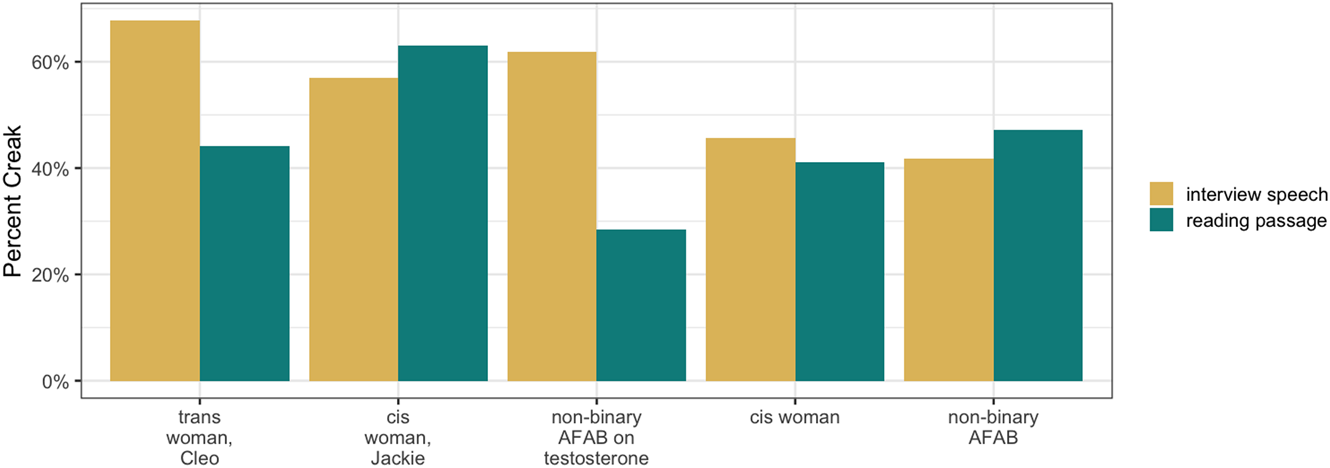
We elect here to focus on the creakiest speakers to demonstrate this approach. Figure 3 confirms that the highest rate of creak overall in the sample was produced by a cis woman, in line with prior research linking creak with cisfemininity. The ten creakiest speakers, however, are a diverse group including cis women, a trans woman, a trans man on testosterone, nonbinary AFAB individuals, nonbinary AMAB individuals, and a cis man. Figure 4 zooms in on the five creakiest speakers, with means grouped by style. We see both confirmation of the group-level style analysis (e.g., the nonbinary AFAB individual on testosterone shows a more substantial style-shift in the expected direction than others like trans woman Cleo) as well as disalignment in individual practice (e.g., both cis woman Jackie and the nonbinary AFAB individual show a higher mean in read speech). We move now to a presentation of how the two creakiest speakers adopt discursive practices related to affect (see Eckert & Podesva, Reference Eckert, Podesva, Baxter and Angouri2021:32-33) in interview speech that enhance our understanding of creak's socioindexical profile.
The five highest creak users overall, by style.
Individual discursive practice
We begin with Cleo, a 27-year-old white and Hispanic queer lesbian trans woman from the West Coast. She shows the traditional pattern for style-shift in Figure 4, decreasing her rate of creak in the reading passage, but in interview speech she is the creakiest speaker in our sample (68%). In a discursive analysis of Cleo's practices in interview speech, we identified within-style patterns that aligned with shifts in affect. Specifically, strong negative experiences and emotions were often accompanied by creak. Cleo spent a significant period of time in the interview describing negative experiences from her childhood that led her mother to pull her out of elementary school and begin homeschooling at an early age. Those negative experiences, which are dense with creak (Excerpt 1), contrast with Cleo's description of her experiences at college a few minutes later (Excerpt 2), which were much more positive. In all examples, creaky speech is bolded.
-
Excerpt 1: Cleo in elementary school
01CReasons for pulling me out of school were just an incompatibility between,
02Um, between my learning styles and the- the teaching styles
03 that are available within the,
04 Like, strict curriculum, standardized curriculum.
05 And uh.
06 I dunno, I had a lot of anxiety and stuff as a kid too.
07 Um.
08 So (it) just
09 made sense to pull me out of that situation
-
Excerpt 2: Cleo in college
01 C:Af- it took a year or two.
02 Um.
03 But then, yeah.
04 I- I really liked having,
05 different courses in different disciplines,
06 Int.:Mhm.
07 C:Um,
08 That it's just like,
09 Go sit down and think about this for a couple of hours,
10 And then take a break,
11 And then go think about this for a couple of hours,
12 And take a break.
Although Cleo is always quite creaky, the higher frequency of creak in Excerpt 1 is typical of many examples where negative experiences seem to trigger long stretches of particularly creaky speech. This practice also occurred among several other speakers in the sample.
Another related affective stance that patterns with creak is (dis)engagement. Jackie, a twenty-year-old queer cis woman from Southern California who is the creakiest speaker in the sample overall, exemplifies this patterning: as she recited her family history and early life, she used creak extensively, often for several IPs at a time. In Excerpt 3 she is coming to the end of such a stretch that included describing her high school activities (lines 1-10). Jackie then dramatically reduced her creak as she switched to a topic she is passionate about (lines 12-20): art, which she sometimes regrets not pursuing professionally. Only minimal creak occurs as she expresses her excitement about these subjects, primarily restricted to its most prototypical position, that is, at large prosodic boundaries. This analysis may also be useful in understanding why Jackie uses even more creak in read speech, which we can speculate she feels fairly dispassionate about.
-
Excerpt 3: Jackie
01 J:And,
02 I like helped build the steel structure underneath Rose parade floats every
03 weekend,
04 I:(Oh, wow.
05 J:Um,
06 I did a lot of like volunteering at the hospital,
07 I did that every week,
08 In high school.
09 Um.
10 Took art classes.
11 I:Mhm. What kind of art do you do?
12 J:Um,
13 I'm interested in sculpture?
14 Um, so.
15 I, um.
16 I learned how to weld,
17 Then like,
18 I was into metal casting,
19 And ceramics and,
20 I was really into mobiles for a while.
The role of affect may be important specifically because of its indexical link to gender (Mendoza-Denton, Reference Mendoza-Denton2011:266). Affect itself is gendered, and the ways in which individuals delve into different types of affect-laden topics could be one way creak accumulates gendered meaning. As a cis woman, Jackie's use of creak when less engaged could support the notion that cis women have stabilized with high rates of creak that they need not attend to; at the same time, she does make use of creak in social practice, departing from a baseline high rate as she expresses greater engagement. Cleo's analysis moves us beyond the group-level conclusions, as the use of creak to index negative affect is found across gendered groups and serves as a reminder that this linguistic resource, like others, will operate on the ground to index highly local and personal stances which may or may not come to be associated with gender or other larger social constructs.
Conclusions
Overall, we find that gender does not predict creak in our gender-diverse sample. All of our speakers produce extremely high rates of creak; the sample mean of 29% is higher than any reported in the related literature for English. While our sample of younger speakers is not directly comparable to other samples, it is worth noting that Podesva (Reference Podesva2013:430), with an overall rate of 19% creaky syllables, found no age affect in his stratified sample, and Yuasa's (Reference Yuasa2010:325) sample finding rates of 12.5% for women and 5.6% for men was also restricted to young speakers. These studies are slightly older, making it likely that creak is continuing to increase in young speakers of English, a finding confirmed in Eckert and Podesva (Reference Eckert, Podesva, Baxter and Angouri2021:29-30). Importantly, all of our speakers are quite creaky, regardless of gender.
The interaction of gender with style offers tentative support for the perspective that creak indexes cisfemininity in some cases, if we interpret the more dramatic change from interview to read speech in most of the speaker groups assigned female at birth who are not women (nonbinary AFAB individuals on testosterone, trans men, and trans men on testosterone) as evidence of these speakers’ modes of disalignment with cisfemininity. Importantly, these patterns were present only when comparing across styles, not in the groups’ overall rates for creak. In this way our results do not align with the binary takeaway from the prior literature, that women are creakier than men. That being said, it is important to note that, had we sampled just the cis women and cis men here, we would find a significant difference between these two groups. It is only when expanding the sample for gender that this pattern falls away. This is a crucial contribution of our analysis–the significant patterns change when we sample the full range for our social variable. By analogy, we might imagine if the standard practice was to sample only upper- and lower-class speakers, find a difference, and then conclude we had presented an accurate picture of socioeconomic differentiation. For gender, by focusing on the two largest, most dominant groups, we may identify extremes but fail to document the fine-grained patterns of variation present in society, patterns that have been critical to the advancement of sociolinguistic theory. We argue that the use of similarly diverse samples could have enormous import for variationist sociolinguistics, both in revisiting classic findings for gender differentiation and for new research.
At the same time, we recognize a few realities. First, the gender binary is well-established in the literature, and comparability across studies is important to the field. Some have even argued that understanding language and gender is not the point of including binary gender as a factor in variationist analysis; instead, the gross categorization allows us to replicate and test for general principles of sociolinguistic stratification and language change (Labov, Reference Labov1990:11). We do not reject this practice wholesale, but we believe responsible analysis of aggregate patterns requires more rigorous methods for collecting gender-related information, attention to the ethics of gender representation, and the exercise of caution and a critical mindset when interpreting these patterns.
Another reality is that community sampling can present challenges to building more diverse samples. While Eckert (Reference Eckert2014:533) suggests it may not yet be possible to move beyond the binary with large-scale sampling, we believe that in many situations it is, and increasingly so. We also recognize that variationists will continue to build samples for a range of purposes, and that binning will remain an important part of this process. We are not suggesting that all variationists should attend to gender at the expense of other research questions; rather, we offer recommendations that may allow scholars to easily incorporate more gender diversity into their best practices.
With respect to self-report, it was easy to add a few more questions to our demographic survey. We encourage the use of open-ended identification, before the introduction of forced-choice categories, even if post hoc coding makes analysis of this information cumbersome. This allows speakers to use whatever labels matter to them before being asked to bin themselves. Then, we recommend disentangling gender assigned at birth from current gender identity with two separate questions. It may still be the case that a sample only has robust n's for cis women and cis men.Footnote 4 But the presence of openly trans+ speakers will likely continue to increase in our samples, making it possible to, for instance, compare the influence of gender assignment at birth alongside current gender identity as potential predictors of variation. The theorization around these questions should be done with great care, however, to avoid the pitfall of naturalizing gender assignment or delegitimizing trans+ people's identities.
Though we explored one way of operationalizing gender here, using multiple variables and discrete bins, there are other promising options for operationalization, including the use of continua. Our results suggest that normativity, or typicality with respect to some category, may play a central role in variation. Participants could be asked first to self-identify their gender identity and then to place themselves on a continuum with respect to how strongly they identify with the label they provided or how “typical” of that type of person they see themselves as being. Just as analysts commonly explore different ways to operationalize macrodemographic categories like age, which can be modeled as a continuous variable or binned into meaningful life stages or generations, a continuous measure for gender could be modeled and compared to a binary variable across models, providing insight into explaining and interpreting gender differentiation.
Finally, we encourage other additions, which we were not able to explore sufficiently in our own study, including sexuality, sexual orientation, presentation, and expression, as well as the ways these factors intersect with other social factors. At the very least, intersectionality (Levon, Reference Levon2015) can be better explored through the standardization of modeling interactions in regression analyses. As a final note, we encourage cisgender researchers to seek out trans+ collaborators, which often means working with students, for in-group expertise and ethical guidance.
Our hope is to highlight the role sociolinguistic research has played in assuming and perpetuating the view that the gendered world is binary. In continuing to reinforce these ideologies, we do a disservice to the sociolinguistic world we purport to describe. Gender-diverse samples will push researchers to formulate specific hypotheses regarding how and why gender is relevant for explaining the distribution of linguistic features and to have better tools for interpretation. In addition, that interpretation can incorporate current theories and understandings of gender in contemporary society. We hope to have demonstrated that gender diversity can be incorporated into existing quantitative sociolinguistic methods, making it possible to move past a reflexive reproduction of the binaristic model used in the earliest days of sociolinguistic research.
We also demonstrated that a quantitative analysis of a gender-diverse sample produced different results than expected, with implications for the literature's perspective on creak and gender. By including trans+ speakers who identify both in and outside the binary, we find that gender on its own does not predict variation for creak. The significant interaction of gender and style points our lens to speaker practice: differential patterns for style-shifting, coupled with a closer look at how two highly creaky individuals make use of different affective meanings for creak, demonstrate how group-level quantitative data and individual qualitative data can work together to inform our sociolinguistic understanding. The sophistication that variationists bring to uniting the social and the linguistic, using powerful tools of quantification, is tremendous. We can extend this toolkit to social categories like gender, with potentially field-altering results. To echo Eckert (Reference Eckert2014:534): “Eventually, if we do our work well enough, our theories may dispense with some of those categories altogether.” Such a shift would not only advance our discipline's theoretical capacities directly but also transform it into a field that engages and empowers trans+ students, scholars, and communities.
Acknowledgments
We thank our research assistants (Mani Abreu, Kieran Chase, Lewis Esposito, Molly Krumholz, Miriam Gölz, Gregor McGee, Dean Schmeltz, and Ellery Sloane-Barton), the ninety-eight participants for sharing their time and experiences with us, Betsy Sneller for statistical consultation, and our anonymous reviewers. This research was funded by Reed College's Stillman Drake Fund and Faculty Summer Scholarship Award.
Appendix
Best Fit Model: Creaky ~ IP.Boundary.Tone + PitchAccented + Stress + IP.Final + IP.Initial.Vowel + Style*Gender + (1 | Word) + (1 | Speaker) Fixed effects:


 Open access

