


Introduction
Demographic and social changes affecting dependency ratios and care relations have posed new challenges regarding care for older people (Leichsenring and Sidorenko Reference Leichsenring, Sidorenko, Leichsenring and Sidorenko2024, 3).Footnote 1 At times, the question of how societies are to care for an increasing number of older adults – when fewer material and social resources are allocated to their care – is centred within alarmist narratives that construct ageing as an acute problem (Katz Reference Katz1992). Accordingly, national governments and international institutions have sought solutions to the perceived crisis of ageing populations (Davey and Glasgow Reference Davey and Glasgow2006).
A common policy response across countries has involved a strong focus on individual activity to slow down and even reverse the effects of ageing (Walker and Maltby Reference Walker and Maltby2012), often conceptualised as ‘active ageing’ (Timonen Reference Timonen2016). Activity – whether physical, psychological or social – has many related benefits for older adults, such as increased life satisfaction (e.g. Marsillas et al. Reference Marsillas, De Donder, Kardol, Van Regenmortel, Dury, Brosens, Smetcoren and Varela2017). Thus, the focus on ‘activity’ within the framework of active ageing is generally beneficial as it not only encourages older adults’ continued participation in society but also serves to challenge ageist narratives that depict them as passive or dependent (Boudiny and Mortelmans Reference Boudiny and Mortelmans2011). However, as this article demonstrates, the concept can become problematic when used as a political tool.
Previous research has shown that active ageing is often implemented in policy in narrow and restrictive ways. Activity is typically defined in terms of good health and independence (Boudiny Reference Boudiny2013) and instrumentalised forms of participation in society, such as continued employment, volunteering and (unpaid) informal caregiving (Clarke and Warren Reference Clarke and Warren2007). This framing tends to benefit older adults who are healthy, have socio-economic resources and are socially connected, as they are more likely to be able to meet the policy expectations.Footnote 2 For instance, the Finnish National Programme on Ageing 2030 (Ministry of Social Affairs and Health 2020a) encourages older adults to engage in voluntary work to promote wellbeing and reduce pressure on the formal care system. While well-intentioned, the programme appears to rest on assumptions of good health, independence and social connectedness, conditions not universally met. As a result, such policy approaches risk reinforcing inequalities by promoting narrow ideals of ageing that overlook everyday realities. More importantly, they may divert attention away from broader structural conditions – such as unequal access to care – and frame ageing as a matter of personal adjustment rather than systemic reform.
In this article, we build on previous research literature to conduct an empirical study on how ageing and care of the ageing population are constructed in Finnish national policy documents and to examine the effects of these constructions for older adults and their care. We take a critical approach to policy as discourse that determines how ageing is conceptualised, which has very real implications for how older people are governed in their everyday life (Alvesson and Kärreman Reference Alvesson and Kärreman2000). Thus, policy can itself be viewed as discourse with effects, but can also be understood as constituted by discourses (Bacchi Reference Bacchi2000). In this article, we use the term policy discourses as a shorthand for the discourses constructed in policy on and around ageing and care. While some studies have been conducted on ageing policy in Finland during the past few years, previous studies have mainly analysed municipal and local strategies (Kiuru et al. Reference Kiuru, Laulainen and Valokivi2024; Sihto Reference Sihto2022; Valokivi Reference Valokivi, Naskali, Harbison and Begum2019). Accordingly, it is important to examine national-level policy and its implications for how policy around ageing and care is developed and implemented. Furthermore, national policy feeds into broader societal discourses on ageing and care, highlighting the relevance of the analysis.
The aim of this article is to explore how older people and care for the ageing population are constructed in Finnish national social and healthcare policy documents. We examine the policy discourses constructed on ageing and care and their implications for older adults and their care using the approach ‘What’s the Problem Represented to Be’ (WPR), as developed by Carol Bacchi (Reference Bacchi1999). As Bacchi (Reference Bacchi1999) describes, WPR is a form of critical and post-structuralist policy analysis that enables the analysis of underlying assumptions embedded in policy and the following effects for discourse, subjectivities and material lives. Bacchi (Reference Bacchi2009) suggests approaching policy problems through proposed solutions by arguing that the presented solutions reveal the problems they are intended to address, allowing us to ask: what is the problem represented to be? In our analysis, we focus on identifying the solutions proposed for the care of an ageing population with the use of fewer resources, and analyse the implications these represented solutions have. We analyse 11 documents and limit the analysis to ageing policy concerning social and healthcare services, although we acknowledge that ageing policy is connected with many other areas of policy, such as employment and retirement (Seppänen and Koskinen Reference Seppänen, Koskinen and Niemelä2010) and digitalisation (Hearn et al. Reference Hearn, Niemistö and Sjögren2026).
The article contributes to the field of critical ageing research with a post-structuralist analysis of Finnish policy documents on ageing and care. The analysis reveals a strong focus on individual measures as a ‘solution’ to the constructed problem of an ageing population, while the responsibility of the state is largely absent from the policies. Throughout the article, we highlight the discrepancy between the individualised policy solutions to the represented problems of an ageing population and the narrative of a strong welfare state (Finnish Government 2023, 7). More broadly, the article makes a theoretical contribution to the literature on ageing by developing a three-level conceptual model, illustrating how conceptual debates, policy discourses and everyday life material realities interact. In doing so, the article addresses how older adults are governed through absence, capturing how power operates not only through what is stated in policy but also through what is left unsaid and unaddressed.
The article is structured as follows. First, we outline the case of Finland and policy on ageing and care within the country, followed by a short presentation of previous literature on ageing policy. In the methodology section, we describe the WPR approach in more detail, along with the material used and the analysis process. We present the findings along with quotes from the policy documents analysed. Thereafter, we discuss the relevance of the findings for Finnish, Nordic and broader international policy agendas, and conclude with further implications for policy and practice.
The case of Finland: policy developments on ageing and care
Of the Finnish population of about 5.6 million, about a third are aged 60 and above (Statistics Finland 2024a). In national forecasts, it is estimated that this group will grow significantly over the next 10 to 15 years (Statistics Finland 2024b), raising the question of how public resources should be distributed.
Finland is commonly characterised as a Nordic welfare state with strong support for public and universal services for its citizens (Kettunen Reference Kettunen2001). In practice, this has meant that the state has played a large role in the (re)distribution of welfare services and care. Although all Nordic countries represent the social democratic welfare model, they differ in how care is organised and provided (Kettunen Reference Kettunen2001). As the focus of this article is Finland, we here describe the Finnish system in some more detail.
The Finnish public social and healthcare system is primarily funded through taxation. While the state is responsible for drawing up guidelines concerning care for older people, the implementation of health and social care services has been delegated to newly established ‘wellbeing services counties’ (Ministry of Social Affairs and Health 2024a).Footnote 3 According to Finnish legislation (980/2012; 1301/2014), all older adults are entitled to low-cost health and social care services. Although many services are publicly funded, they are not entirely free of charge. Instead, the system operates through a mix of subsidies and regulated user fees, including annual cost ceilings (e.g. Hoppania et al. Reference Hoppania, Karsio, Näre, Vaittinen and Zechner2024; Tynkkynen et al. Reference Tynkkynen, Pulkki, Tervonen-Goncalves, Schön, Burström and Keskimäki2022). The services provided include a range of healthcare and social services, including the right to home care, services supporting mobility, financial support for informal carers, and institutional care (Ministry of Social Affairs and Health 2024b). Finnish older citizens are also entitled to monetary assistance paid through pensions.
While the formal care system (services provided by the state and wellbeing services counties) has had the main responsibility for supporting older adults, scholars have argued that the policy emphasis has, over recent years, shifted from social rights and obligations promoted within a Nordic welfare regime to individual participation, choice and responsibility in care (Anttonen and Häikiö Reference Anttonen, Häikiö, Newman and Tonkens2011a), consequently shifting the care responsibilities of the state onto individuals and families (Kröger and Leinonen Reference Kröger and Leinonen2012). While the country has developed a system for compensating informal carers (Ministry of Social Affairs and Health 2024c), there are many families who care for their relatives without monetary compensation.Footnote 4 It is estimated that there are around 50,000 official informal carers, yet 350,000 people care for their kin without a formal agreement (Finnish Institute for Health and Welfare 2025; Tillman et al. Reference Tillman, Kalliomaa-Puha and Mikkola2014). Moreover, over the years, voluntary work has received greater attention, highlighting the importance of (older) volunteers being expected to assist their peers to decreasen the strain on the welfare system (Kröger Reference Kröger and Szebehely2005).
Today, Finland could be described as a mixed welfare system, incorporating the private (market-based) and third sectors (family-based and voluntary-based) alongside the public sector as organisers of care. While the public sector remains the largest provider, delivering up to 70 per cent of care services, macro-level changes have come to shape how care is organised and provided. The trend of marketisation, taking off in the 1990s in Finland, increased opportunities for profitable private businesses and other actors to arrange care services (Anttonen and Häikiö Reference Anttonen and Häikiö2011b). This shift has been reflected in social policy and public institutions, with an increased focus on cost-effectiveness and efficiency in care provision, as in the other Nordic countries (Szebehely and Meagher Reference Szebehely, Meagher, Meahger and Szebehely2013; Vabø et al. Reference Vabø, Zechner, Stranz, Graff and Sigurðardóttir2022). These changes have been related to the neo-liberalisation of care, with its increased focus on market freedom, service-user choice and the idea of individual responsibility during ageing (Dahl Reference Dahl2012; Hoppania Reference Hoppania2019). This has affected public services in Finland through major cuts in care-related budgets and moves towards restructuring the healthcare and social service system (Hoppania et al. Reference Hoppania, Karsio, Näre, Vaittinen and Zechner2024). In addition, globalisation, digitalisation and European Union (EU) membership, to name only a few other macro-changes, have contributed to reform of the care system (e.g. Sjögren et al. Reference Sjögren, Niemistö, Hearn and Viallon2023).
Policies on ageing and care: activity in later life
Activity in later life has long been seen as a central policy measure to decrease and postpone older individuals’ care needs. International and national policies have stressed the importance of activity in later life through concepts such as active, healthy, productive and ‘successful’ ageing, of which active ageing remains the most prominent. Active ageing partly builds on such concepts as healthy and productive ageing (Walker Reference Walker2002) and is often presented as a policy tool to promote health, longer working lives and social participation for older people (Foster and Walker Reference Foster and Walker2013).
Active ageing is generally considered a more inclusive concept than that of ‘successful ageing’ – originally introduced by Rowe and Kahn (Reference Rowe and Kahn1987) to counteract ageist views of older adults as passive and dependent – a concept that was later heavily critiqued (Katz and Calasanti Reference Katz and Calasanti2015). However, in policy deployment, active ageing is often adopted in a narrow form that emphasises health and independence (Boudiny Reference Boudiny2013) and economically valuable activities such as work, volunteering and (unpaid) informal caregiving (Clarke and Warren Reference Clarke and Warren2007). Through its narrow usage in policy, it may have similar exclusionary implications as previously critiqued concepts (Foster and Walker Reference Foster and Walker2015; Timonen Reference Timonen2016; Walker and Maltby Reference Walker and Maltby2012). Policy makers and decision makers have, at times, been criticised for invoking research concepts in ways that do not always align with their wider and more complex theoretical development (Dillaway and Byrnes Reference Dillaway and Byrnes2009; Waddell et al. Reference Waddell, Van Doorn, Power and Statham2025).
In practice, measures implemented in (EU) policy to promote active ageing have sought to increase older people’s activity in different ways, predominantly by promoting health, economic participation and social participation (Timonen Reference Timonen2016). In the Nordic countries, similar policies have emphasised independence, health and ageing in place (Kiuru et al. Reference Kiuru, Laulainen and Valokivi2024), older individuals’ engagement in voluntary work (Blix and Ågotnes Reference Blix and Ågotnes2023) and assisting one’s family and social networks (Sihto Reference Sihto2022; Szebehely and Meagher Reference Szebehely and Meagher2018). Active ageing policies, however, often fail to consider the limitations of individual agency and the impact of social structures on everyday life (Boudiny Reference Boudiny2013). For example, individuals can seldom control their own lifecourse or ageing process, nor can they have an impact on broader demographic trends (Timonen Reference Timonen2016, 86). Indeed, opportunities to be active in later life are restricted by individual prerequisites, social structures and intersecting social categories (Katz and Calasanti Reference Katz and Calasanti2015; Minkler Reference Minkler1990), highlighting the need for a critical and intersectional perspective on policy development.
Methodology
In this article, we adopt the post-structuralist ‘What’s the Problem Represented to Be’ (WPR) approach developed by Carol Bacchi (Reference Bacchi1999), to focus on the assumptions underpinning policy and their implications for discourse, subjectivities and material life. We thus understand discourse in its broader sense, conceptualising it as at least partly determining social reality through the construction of discourse, subjects and objects (Alvesson and Kärreman Reference Alvesson and Kärreman2000). Yet, we do not deny that individuals can construct themselves in alternative ways, even if that focus is outside the scope of the current study. Additionally, while we view language use as having effects on everyday life, the effects may, as Alvesson and Kärreman (Reference Alvesson and Kärreman2000, 1133) put it, ‘be uncertain, weak and temporal in terms of constituting subjectivity, defining the possibilities of meaningful existence or something similarly powerful’. Thus, researchers need to critically reflect on their findings and their own positionality, which we have sought to do throughout the research process.
When describing WPR as a method, Bacchi (Reference Bacchi1999, Reference Bacchi2009) argues that policy does not simply respond to problems but actively constructs them. Yet, not all problems are as clearly articulated in policies. Bacchi (Reference Bacchi1999, Reference Bacchi2009) suggests that one can better understand how problems are represented by investigating the premises underlying the presented solutions. For example, if individual activity is depicted as a solution to the ‘care crisis’, what is presented as the underlying problem is the lack of individual activity, which in turn has certain implications for discourse and everyday life. The WPR approach is useful in examining the discursive limitations of policy, as one can compare the problems articulated through proposed solutions with the explicit problems articulated and examine whether they match or not (Rönnblom et al. Reference Rönnblom, Carlsson and Öjehag‐Pettersson2023).
Material and selection of policy documents
According to Bacchi and Goodwin (Reference Bacchi and Goodwin2016, 18), policy documents include reports, statistics and legislation. The analysis for this article builds on a multi-step analysis of a corpus of 42 governmental policy and related documents. We began with the analysis of seven documents used in a previous round of analysis on ageing, care and digitalisation, found through the Institutional Repository for the Government.Footnote 5 A broader search of this repository on the topics of ageing, care, welfare, digitalisation, and housing and the environment identified 35 additional documents relevant to the article. Of the total 42 documents, we excluded reports on research and projects, memoranda of governmental working groups and guidelines for professionals working in healthcare services for older adults (such as documents on improving oral health for the ageing population). We ended up with 22 documents published in the period 2002–2024 for an initial broad-scale analysis. By coding the 22 documents and mapping the content of them, we narrowed our focus to 11 documents from 2008 to 2024 that centred on the health and social care of older adults.Footnote 6 The final 11 texts include two pieces of legislation and nine strategic documents, recommendations and action plans. In Table 1 the documents are introduced by their title, content, publisher (responsible ministry), year of publication and abbreviation used in the presentation of the results.
Analysed documents by title, content, publisher, year of publication and abbreviation used in the presentation of the results

Analysis process
In the analysis of the selected documents, we examined how older people and their care are constructed, analysing the policy discourses constructed and their implications, by use of the WPR approach. Bacchi (Reference Bacchi2009, 48) has outlined six questions to guide the analysis, of which, due to the scope of the article, we have chosen fourFootnote 7 to focus on (marked in italics):
Q1 What is the problem represented to be?
Q2 What assumptions underpin this representation of the problem?
Q3 How has this representation of the problem come about?
Q4 What is not mentioned? Are there silences, contradictions?
Q5 What effects are produced by this representation of the problem?
Q6 How and where has this representation of the problem been produced, disseminated, defended? How has it or how could it be questioned and replaced?
The detailed analysis of the 11 documents was preceded by multiple readings of the documents, followed by coding the documents with the program Atlas.ti. First, the documents were coded by marking explicit proposed solutions to care for the ageing population. Similarly articulated problems were marked, to enable a later comparison of problems constructed and articulated problems (Rönnblom et al. Reference Rönnblom, Carlsson and Öjehag‐Pettersson2023). Having coded the presented solutions in the policy documents, we were able to explore more closely the underlying problem representations and assumptions. We noted, for example, that many documents presented health and individual activity as solutions, implying an underlying problem representation of older people being the problem themselves, especially individuals with declining health and/or activity. By examining the solutions, problem representations and assumptions in a wider context, we identified three dominant discourses on ageing and care: a discourse on individual responsibility; a discourse on the social responsibility of older adults; and a discourse on kinship. By examining the content of the discourses, we noted how the discourses construct certain ideals for older adults and their care that guide how older adults are expected to age ‘appropriately’. Within and between the discourses, we also identified silences and contradictions, and based on mapping the content of the discourses, we could theorise on the wider implications of the constructions. In the last stage of the analysis, we returned to the explicit problems articulated in the documents, comparing them with the identified problem representations. Interestingly, the analysis showed no noticeable difference over time in how the documents constructed older adults and their care.
Throughout the analytical process, we drew on previous literature and theory on ageing, older age and discourse, to interpret the findings. Therefore, the analysis process could be described as abductive, moving back and forth between theory and the empirical material (e.g. Stainton-Rogers Reference Stainton-Rogers2003). Next, we present our findings along with quotes from the policy documents. Some of the cited quotes were originally written in English; quotes that were originally in Finnish have been translated into English by the authors of this article.Footnote 8
Findings
This section begins with presenting the discourses we identified in the documents, followed by an analysis of the underlying constructed ideals concerning older adults and their care, and silences. We then address the (absent) interaction between policy, conceptual debates and everyday life material realities, as identified in the analysed documents, and lastly discuss the implications of the policies for older adults and their care.
Three dominant discourses on ageing and care in policy
The analysis of the policy documents reveals three dominant discourses on ageing and care: a discourse on individual responsibility; a discourse on the social responsibility of older adults; and a discourse on kinship. Although they overlap to some extent, we present the discourses one by one along with quotations from the analysed documents.
The discourse on individual responsibility centres on health and independence in later life. Maintaining health and independence in later life is presented as a solution to the unequal equation of increased care needs and decreased public resources, consequently framing older people as, by growing older, responsible for this crisis. Hence, they are the ones who should solve the crisis, by improving their health and independence. In the documents, health and functional ability are constructed as prerequisites for managing older people’s care needs: ‘Securing healthy ageing and functional ability is one of the most important precautionary measures in ageing Finland. Healthy ageing, in turn, means that older people can participate fully in society; it affects their quality of life, and their need for social and healthcare services’ (Ministry of Social Affairs and Health and Association of Finnish Local and Regional Authorities [STM] 2013, 5).
Better health and functional ability are constructed as solutions that will not only decrease service needs but also improve social participation and quality of life among ageing individuals. The policies construct poor health and low functional ability as individual issues that can be managed by older people embracing the vision constructed in policy: ‘The aim is to develop new innovative ways of supporting and motivating older people in promoting health, wellbeing and safety, for instance through improving nutrition, promoting lifelong learning, physical activity […]’ (Ministry of Social Affairs and Health [STM] 2024d, 28).
Older people are expected to take care of themselves and their health, and to be motivated to do so. While differences in health are acknowledged in the documents, for example by educational background and socio-economic status, how to address potential health differences is generally not discussed: ‘The greatest problems with functional capacity have been observed among those with little education, those doing physical work and those with a low income’ (Ministry of Social Affairs and Health [STM] 2020b, 15).
The role and responsibility of the state in relation to health is constructed as secondary. In order to support older people living at home, the state’s role in providing healthcare and social care services is reframed in terms of preventive and rehabilitative activities: ‘To promote living at home, operating models are needed that support preventive activities which maintain functional capacity, daily rehabilitation and independent coping’ (Ministry of Social Affairs and Health [STM] 2020b, 12).
In relation to health, the state is represented as a facilitator of health and independence rather than an intervening body when health issues arise. Instead of focusing on the responsibility of the state as the main provider of support for older adults (which might be the expectation of citizens of a welfare state), the responsibility of individuals is highlighted:
‘The task of the service system is to support, guide and motivate people to take responsibility of their own well-being and health’ (Ministry of Social Affairs and Health and Association of Finnish Local and Regional Authorities [STM] 2008, 22)
‘The questions of responsibility should be considered in a more varied way than now: the individual’s own responsibility and the responsibility of society do not exclude each other’ (Ministry of Social Affairs and Health and Association of Finnish Local and Regional Authorities [STM] 2017, 13)
In these quotes, the state and the individual are constructed as complementing each other, yet still with an emphasis on individuals themselves. Indeed, most presented solutions suggest that individuals themselves are mainly responsible for maintaining health and independence in later life – thus risking an overemphasis on individual responsibility for maintaining health and independence in later life.
The second identified discourse on the social responsibility of older adults promotes, in this usage, ‘productive’ activities, peer support and social participation in later life. Through this discourse, older people are expected to be active citizens in later life, mainly through working and volunteering. These forms of activities are presented as solutions to the care crisis, consequently framing older people’s lack of activity in relation to these as the represented problem. Working and volunteering are constructed as a form of social responsibility through which older adults can contribute to the care for (other, more dependent and perhaps older) older people: through increased paid labour (that contributes to the public taxation system and postpones pension payment) and through increased unpaid labour (that contributes to the care sector with unpaid work). However, we distinguish familial support from this discourse and identify it as a separate discourse on kinship, as described later.
The discourse on the social responsibility of older adults partly overlaps with the discourse on individual responsibility, with a broad focus on health as a prerequisite for activity and participation in society in later life:
‘If we see to it that the baby boom generation stays longer in the labour market and leads a healthy, active and independent life for as long as possible, we are able to rise to the challenge that the ageing of the population evokes and can strive to reassert fairness between generations.’ (Ministry of Social Affairs and Health [STM] 2011, 5)
Healthiness is constructed as a goal in its own right that will improve the lives of older people in many ways. Here, possible differences in health among ageing individuals are again noted:
‘When speaking about older people, we must be aware that we are talking about a very heterogeneous group of people whose lifestyles, preferences and functional capacity differ in quite a variety of ways and, there may not be all that many factors that link people of a certain age to one another.’ (Ministry of Social Affairs and Health [STM] 2021, 64)
However, when examining the solutions presented, the discussion of individual differences is largely absent among the group of older people. The policies mainly separate the group of older people into two categories according to their age, and frame these two groups as homogenous, as seen here: ‘Particularly young pensioners aged 65 to 79 are a significant resource for society’ (Ministry of Social Affairs and Health [STM] 2020b, 28).
Although differences within the group of older people are acknowledged, the policies reproduce age-related categories, such as the construction of a third (more functional) and fourth (less functional) age (Higgs and Gilleard Reference Higgs and Gilleard2015; Lumme-Sandt et al. Reference Lumme-Sandt, Nikander, Pietilä and Vakimo2020), in their solutions, consequently dividing older people into two groups based on their age, not other differentiations. Interestingly, most documents primarily address the younger-old in relation to activity. They are constructed as a central resource in the care for older adults in addition to formal public organisational care:
‘For the elderly, [older] volunteers are particularly needed for promoting well-being and good health, for instance, for leading exercise groups, outdoor activities or other hobby groups, or for providing instructions for the use of digital tools and services. […] Volunteers are also needed to tell them [older adults] about existing services, to accompany people to services, to advise them on the use of transportation and to direct them to participate in activities.’ (Ministry of Social Affairs and Health [STM] 2020b, 28)
Indeed, in the documents, many responsibilities that one would expect to belong to the state, for example sharing information about existing services, are pushed onto younger-old individuals. In addition to the activity of older individuals, the policies aim to highlight the importance of non-governmental organisations (NGOs) that could ‘assist’ the public sector in service provision: ‘Organisations and congregations play an important role in developing and implementing voluntary activities. […] The establishment and development of voluntary work requires functional cooperation structures between organisations and the public sector, with clearly agreed roles and responsibilities’ (Ministry of Social Affairs and Health [STM] 2020b, 29).
As the resources within the public sector are limited, NGOs are highlighted as ‘partners’ for developing and running voluntary work. However, NGOs are themselves often driven and run by volunteers, meaning that the responsibility for coordinating voluntary work for older adults may in turn be pushed onto voluntary activity of older adults themselves rather than governmental support.
The third discourse on kinship strengthens the shift of responsibility from the state to an individual level, mainly onto family members. Older individuals are expected to assist their personal networks (wider family and close ones) when needed and turn to these when their own care needs increase. The assistance concerns both direct help and support and the uptake and use of digital tools. Through this proposed solution, it is implied that the problem is individuals’ lack of activity in assisting their personal networks and difficulties with technology uptake. We identify this discourse as a distinct discourse, as the emphasis on and the assumption of the activity of family members and relatives are notable throughout the documents.
In the documents, family members are frequently addressed when talking about older people as service users or ‘clients’: ‘the need for services supporting the wellbeing, health, functional capacity, and independence of the ageing individual is investigated comprehensively, and if needed, together with their relative, close relative or guardian’ (§15 980/2012). ‘Private support networks are mapped when the need for services is evaluated or later on in the client relationship if needed’ (§43 1301/2014).
The policies assume that there are family members available and that they will take an active role in caring for older adults. Families and relatives are expected to contribute to the care of their ageing relatives and enable them to continue living at home: ‘In making a priority of living at home, it is important to support the prerequisites of family and friends to participate in the treatment and care of elderly people’ (Ministry of Social Affairs and Health [STM] 2020b, 45).
Thus, such policies assume that families are able to pitch in when it comes to caring for their ageing relatives and help them accordingly. Exactly what family members are expected to do is rarely elaborated on, except when talking of enabling technology uptake among older adults: ‘Providing information on technology-based services, technology and information security and supporting and guiding ageing/older people as well as their loved ones to acquire technology that supports their daily lives and functional capacity’ (Ministry of Social Affairs and Health [STM] 2024d, 52).
The policies thus rely on older persons’ abilities to acquire technological equipment and transfer the responsibility of technology uptake and use to older individuals and their family members. Technology is largely framed in a positive way and is constructed as a tool that older people and their personal networks can use to improve health (and independence). Interestingly, this text that talks about family activity in care for older people and their role in fostering technology uptake concerns families in general and does not specifically address official informal carers – that is, family members who have an official agreement with the wellbeing services county to care for their older relatives and who are compensated accordingly. Official informal carers are addressed separately in the documents, but less often than family: ‘Informal carers are an important resource in the care for older people. Their functional capacity and strategic support for them is beneficial for all’ (Ministry of Social Affairs and Health and Association of Finnish Local and Regional Authorities [STM] 2013, 42).
As shown, informal carers are constructed as a valuable resource in society – yet, at the same time, the policies construct unpaid family support as the norm and address uncompensated informal care far more often than official informal carers. Thus, family members who are not state-compensated informal carers are assumed to be providing invisible, taken-for-granted care for older adults.
In sum, the discourses construct older people as healthy, independent and active, who could and should manage without or with decreased state support, relying instead on peer volunteers or kin, when needed. We now move on to examine the identified discourses more closely.
Policy discourses: ideals constructed, silences and interaction with conceptual debates and everyday life material realities
The three identified policy discourses construct ideals that steer the expectations of care provision and recipiency in later life. Older adults are expected to be healthy and independent, contribute to society through work and/or volunteering and assist their relatives and close ones when needed. The policies consequently construct the ideal older adult as someone who meets these expectations. In contrast, older adults who require help and support are expected to be assisted by those who embody these ideals or by (other) kin (see Figure 1). While the policies acknowledge differences within the group of older people, older people are largely constructed in relation to static categories of being independent or dependent, even though there can be movements in both directions, as illustrated in Figure 1.
Policy discourses constructing the ideal (and dependent) older adult.

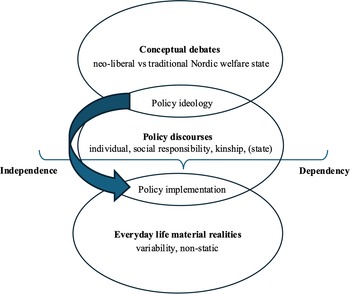
The ideals constructed through the policy discourses reflect a partial approach to ageing and care, with ideals that resemble narrow conceptualisations of healthy, ‘successful’ and active ageing. The policies imply a strong focus on and value of independence and different forms of activity in later life, and it is through portraying these as ultimately positive and as the ideal for older adults that the policies construct ‘dependency’ as the negative, avoidable scenario (see also Katz Reference Katz2000). Thus, it seems that the policies do not engage fully with the wider conceptual debates on the topics concerning older adults (e.g. Katz and Calasanti Reference Katz and Calasanti2015). The policies seem to have little regard for older people’s different needs, prerequisites and everyday material realities that may restrict older adults in achieving the constructed ideals. While policy should ideally engage with both conceptual debates and everyday life material realities, from and in our analysis, this is not the case. We propose a three-level conceptual model illustrating our case, as in Figure 2.
A three-level conceptual model on ageing and care.

Firstly, we argue that the neo-liberalisation of the welfare state has ideological consequences for how policy is perceived, planned, developed and executed. In the analysed policies targeting older adults, we can see the ideological push towards the pole of ‘independence’, implying the ideal for older adults being the ability to actively help other (older) adults. While citizens of a traditional Nordic welfare state would expect that the state would assist those in need of help and support (those constructed as dependent), the role of the state is largely silenced and absent from the policy discourses. Indeed, the policies construct ‘dependency’ as the avoidable scenario, especially dependency on public welfare services. Moreover, in the analysis we can see policy being disconnected from the reality that few older adults meet the ideal of being completely independent, as life situations are always subject to change in later life and the ageing process is non-linear and unpredictable (Erhag et al. Reference Erhag, Nilsson, Sterner and Skoog2022, 2).
Based on our analysis, the traditional Nordic welfare state seems to have transformed into a neo-liberal state that ‘values’ its citizens based on their health, independence and activity, and governs older adults through its absence and absent interaction with conceptual debates and everyday life material realities. Through the policy discourses, non-state-supported care provided by (older) individuals themselves is constructed as the norm in the care of older adults. This focus might, however, obscure the relative lack of independence or individual activity among older adults and also risk invisibilising, or keeping from the attention of policy, those who are left alone and with unmet care needs, who would need the support of the state. Indeed, the analysed policies seem to risk exclusion of the most vulnerable older adults rather than supporting them (Boudiny Reference Boudiny2013). We now move on to discuss the potential implications and effects of the dominant discourses and constructed ideals.
Implications of the discourses for older people and their care
The discourses identified in the policy documents construct health, independence and different forms of activity as ideals in care for older adults. These discourses tend to rely on a static view of reality that overemphasises individual abilities and choice in achieving the ideals constructed for later life. Such ideals constitute narrow approaches to healthy, ‘successful’ and active ageing, and seem to be constructed in relation to what are presented as objective standards, largely ignoring subjective experiences of ageing and later life (Mandville-Anstey et al. Reference Mandville-Anstey, Ward, Cameron, Browne and Foley2022). The very limitations that affect the ability to age according to the ideals are seldom discussed at a deeper level in the analysed policy documents, thereby silencing discussions on the prerequisites for and social barriers to ageing (Katz and Calasanti Reference Katz and Calasanti2015; Lamb Reference Lamb2014). Simultaneously, the discourses hide the responsibilities of the state (Kröger Reference Kröger, Jing, Kuhnle, Pan and Chen2019), which is portrayed primarily as a facilitator of healthy, ‘successful’ and active ageing through its focus on prevention, rehabilitation and early support in care for older adults (Kiuru et al. Reference Kiuru, Laulainen and Valokivi2024). We thus argue that the study demonstrates a shift in ageing policy, marking a transition from paradigms traditionally associated with the Nordic welfare state to neo-liberal frameworks that effectively obscure the state’s responsibility in the provision of care for older adults.
The policy documents construct non-compensated activity in later life as the norm for ageing individuals with the emphasis on volunteering and kinship. Ågotnes et al. (Reference Ågotnes, Moholt and Blix2023) point out how new forms of voluntarism risk blurring the boundaries between formal and (unpaid) informal care, increasing the emphasis on the latter, while diminishing the formal care responsibilities of the state. The same argument could be applied to family members who are expected to take up increased care responsibilities without monetary compensation. Shifting the responsibility to individuals to take care of the ageing population also risks obscuring situations where older individuals are left with unmet care needs. Indeed, it is those who comply with or come close to the ideals, as constructed through the policies, that benefit from this strongly individualised ageing policy, not all older adults, as life situations can be very different.
Moreover, the strong focus on individual responsibility for care poses a risk for those, often, if not exclusively, women, already burdened by caregiving and other responsibilities (Niemistö and Hearn Reference Niemistö, Hearn, Sandberg and Tienari2022). While alternative actors may assist the state in care provision, they cannot replace the state, especially in delivering extensive and long-term care. This critique also applies to the role of technology in the care of older adults. While older people and their peers are expected to incorporate technology into their everyday lives (Nilsson et al. Reference Nilsson, Andersson, Magnusson and Hanson2024), scholars highlight concerns about the implications of technology and digitalisation for care (Werny et al. Reference Werny, Reich, Leontowitsch and Oswald2024). In addition, reliance on technology risks playing down the unintended consequences of, for instance, technological malfunction (Hearn et al. Reference Hearn, Niemistö and Sjögren2026; Sjögren et al. Reference Sjögren, Niemistö, Hearn and Viallon2023; Valokivi et al. Reference Valokivi, Carlo, Kvist and Outila2023).
The discourses identified construct ideal scenarios for older adults (see also Timonen Reference Timonen2016): how they should live in later life, who they should assist and who they should turn to for help. The policy discourses convey an image of older people as active and agentic in their own lives – while activity and agency are bound not only by individual choice, will and motivation but also by prerequisites and structural barriers. As such, the discourses construct an ‘illusion’ of individual control, where ‘independence’ in later life is framed as the ideal and a positive achievement and being ‘dependent’ is framed as the avoidable outcome. However, both scenarios are depicted as outcomes of individual activity and choice (Boudiny Reference Boudiny2013; Cederström and Spicer Reference Cederström and Spicer2015). In terms of the subjectivities of older people, self-blame for not achieving ideals can lead to negative emotions and distress.
Finally, the proposed solutions in the policies analysed do not match the explicit problems articulated in the documents. While individual activity is constructed as the solution, the explicit problems in care for older adults are structural, including a lack of public funding and shortage of care staff. This mismatch can be conceptualised as a paradox of trying to solve structural problems with individual measures (Bacchi Reference Bacchi2009). In practice, this mismatch could affect the allocation of material resources in the care of older adults. Indeed, resources might be invested in practices that support independence in later life and the activation of individuals, rather than addressing the structural issues that affect care provision and access to care. Lestari et al. (Reference Lestari, Stephens and Morison2022) highlight how this type of resource allocation can restrict options for older individuals who need intensive and long-term care. Moreover, postponing care needs means that there might be a larger group of people needing extensive care at a later stage of life, raising the question of how to meet increased care needs in the future. The discussion on unmet care needs goes beyond the most active societal and political discussions on marginalisation and social exclusion (Walsh et al. Reference Walsh, Scharf and Keating2017), which in Finland have often focused on class and regionality, and feeds into the discussion on care poverty (Kröger et al. Reference Kröger, Van Aerschot and Puthenparambil2019), or, perhaps more accurately, care famine.
Concluding discussion and analytical, policy and practice implications
The aim of this article was to examine how older people and care for the ageing population are constructed in Finnish national social and healthcare policy documents. Using the post-structuralist WPR approach, we examined the policy discourses constructed on ageing and care and illustrated the implications for older adults and their care. The findings reveal that the analysed policies, perhaps unintentionally, (re)construct narrow versions or visions of healthy, ‘successful’ and active ageing as dominant ideals for older people and their care, with a strong emphasis on older adults’ independence and activity, and their non-dependence on welfare services. Consequently, older people are constructed as caregivers and care recipients, expected to take care of themselves and other older people, while the role and responsibility of the state is largely silenced in and even absent from the documents. The role of market-based actors is also largely absent from the analysed policy documents (cf. Burau et al. Reference Burau, Zechner, Dahl and Ranci2017). Indeed, this article suggests that individual activity is constructed as the solution to the care ‘crisis’, although the causes are mainly structural. However, policy makers may present the increased activity of individuals as a more appealing solution than direct cuts in public welfare provision (Blix and Ågotnes Reference Blix and Ågotnes2023).
The article highlights some shortcomings of current policy on ageing and care – in Finland, but also perhaps more widely. Even though narrow approaches to ageing and care in policy have been critiqued by many, current and neo-liberal ageing policy seems to (re)construct these in their presented policy solutions. Consequently, although there may have been a shift from the use of healthy and ‘successful’ ageing to active ageing as concepts used in policy, the use of seemingly more inclusive concepts as policy tools may have similar exclusionary implications. Moreover, while policies increasingly recognise the diversity of older people, the proposed solutions continue to reflect a very homogenous way of governing older people (Timonen Reference Timonen2016), disregarding the implications of intersecting social categories in later life (Katz and Calasanti Reference Katz and Calasanti2015).
Besides presenting an empirical study of policy documents, we have developed a theoretical model: a three-level conceptual model that illustrates how conceptual debates, policy and everyday life material realities interact or, at least, could or should interact. As shown through our analysis, Finnish ageing policy seems to be weakly connected to conceptual debates, more strongly connected to political ideals, and largely disregards prerequisites and implications for everyday life material realities. The developed model offers a framework for examining and analysing how ageing and care are constructed across different levels, bridging policy with theory and real-life discussions. Shifts in ideals often result in shifts in policy, as in our case illustrated as a transition from the Nordic welfare state ideals to neo-liberal frameworks, effectively obscuring the state’s responsibility in the provision of care for older adults, and strongly emphasising the individual responsibility of the self, peers and kin. Our analysis thus shows how older adults are largely goverened through absence, and illustrates how power can operate through silences and state withdrawl, not only proactive actions and regulations.
As with all research, there are limitations to consider. This article is based on a relatively small number of policy documents, and including other areas such as housing or digitalisation policy could have broadened the understanding of how older adults are governed through policy. At the same time, the smaller number of documents made it possible to conduct a more in-depth analysis. Future research could explore, for example, the intersection between policies and the breadth of policies at different levels, on a local level and internationally as well as at the national level. Moreover, it would be of interest to explore how older people themselves experience their everyday lives in relation to dominant ideals and how they position themselves.
The policy trends examined in this article are not unique to Finland; similar developments can be observed in other Nordic countries (Blix and Ågotnes Reference Blix and Ågotnes2023; Szebehely and Meagher Reference Szebehely and Meagher2018). Additionally, the policies are related to broader international policy agendas proposed by, for example, the World Health Organization and the EU (Leichsenring and Sidorenko Reference Leichsenring, Sidorenko, Leichsenring and Sidorenko2024, 4). The implications of developments in ageing policy are, however, seldom publicly discussed on a deeper level (Ågotnes et al. Reference Ågotnes, Moholt and Blix2023). While Finland is still widely represented as a typical Nordic welfare state, previous research and the current study raise questions about the state’s role and transformation in neo-liberal times (Hoppania Reference Hoppania2019; Kröger Reference Kröger, Jing, Kuhnle, Pan and Chen2019). Thus, we can ask if the welfare state is adequately fulfilling its purpose in relation to welfare. Individuals might try to fill in the holes of the leaking welfare state – but at what cost? We call for a greater public discussion about the responsibility of the welfare state and the consequences of current individualising policy discourses in a country that claims in law to promote universal services and social security for all.
This article, in line with previous research, calls for further interaction and discussion between research and policy on ageing and care. While scholars have drawn attention to the limitations of concepts such as healthy, active and ‘successful’ ageing, it seems that policy makers do not engage deeply with these debates. It is increasingly important to address older people as a heterogenous population in proposed policy discourses and solutions and everyday life material realities. Thus, we highlight the need to include older people and relevant organisations in decision-making on matters that concern them. This has been done in Finland, with an established Ombudsman for older people and regional older people’s councils. The inclusion of older people and relevant organisations in decision-making does not, however, guarantee that their voices are fully heard. That is why it is important that the voices of older adults continue to be (better and more fully) supported by governmental and non-governmental actors who work with questions related to ageing and care.
Acknowledgements
We would like to thank Editor-in-Chief Professor Sandra Torres, Associate Editor Professor Rodrigo Serrat and the two anonymous reviewers for their insightful and constructive comments, which significantly helped to develop this manuscript. This article is part of the international Joint Programming Initiative More Years Better Lives research project ‘Alone but connected? Digital (in)equalities in care work and generational relationships among older people living alone (EQualCare)’, funded by the Research Council of Finland. We wish to express our gratitude to JPI and the Research Council of Finland. Further, we thank project colleagues in Germany, Latvia and Sweden for their collaboration, and especially the consortium leader, Dr Miranda Leontowitsch. The first author would also like to thank the funders of her doctoral research.
Author contributions
All authors have contributed to the writing of the article. Author 1 is the lead author, mainly responsible for the empirical analysis and leading the writing of the manuscript. Authors 2 and 3 have been involved throughout in the analysis process, reading and discussing the findings, and have contributed to writing the article through revising, developing and editing its content and format.
Financial support
The EqualCare project was funded by the Research Council of Finland (ID: 345025) through the JPIMYBL international joint funding programme. The first author’s work was additionally supported by personal research grants from Miina Sillanpään Säätiö (application round 2021), the Swedish Cultural Foundation (ID: 176852) and Samfundet Folkhälsan Jan-Magnus Janssons Fond (application round 2024).
Competing interests
The authors declare no competing interests.
Ethical standards
The research has been conducted in accordance with ethical guidelines for research in humanities and social sciences. The research was granted ethical clearance by the national institution where the research was conducted (Hanken School of Economics, Helsinki, Finland); an ethical review was not deemed necessary by the institution. While AI-based tools were used as a dictionary and to assist in checking certain language formulations and translations during manuscript preparation, no generative AI was used to produce content or contribute to the writing of the manuscript.



 Open access

