




1. Introduction
Being held as delusional, whether in clinical or lay contexts of interaction, can occasion a lack of credibility or ‘credibility deficit’ (Fricker, Reference Fricker2009), given any underlying assumption of an experienced breach of reality. While in the clinical context, such experience may be formalised as part of symptoms embedded in diagnostic criteria, as in the case of the schizophrenia spectrum (APA, 2022), in the lay context, it may be more informally applied yet nevertheless bounded by the norms, structures, and habitualised dynamics of social relationships. In either respect, a person to whom delusion has been attributed can consequently find themselves ‘wronged in their capacity as a knower’ (Fricker, Reference Fricker2009, p. 20), in itself a cause of potential distress compounding any existing mental health issues, and possibly even creating new ones. Such experience can, moreover, be one that is deeply entrenched and persistent within a social system that supports it by default of habitualised action, complicating efforts on the part of those ascribed as delusional to extricate themselves and regain, or indeed, maintain their mental health.
While considerable work has been done on epistemic injustice and delusion which provides some account for the experience of testimonial injustice (as in Crichton et al., Reference Crichton, Carel and Kidd2017), this paper seeks to contribute a sociological inquiry that moves us beyond an understanding of the deflation of credibility as underpinned by negative perception to one in which we understand its operation as a frame. Drawing on the work of both Bateson (Reference Bateson and Bateson2000 [1955]) and Goffman (Reference Goffman1974), we take this to be an organising principle that defines communication and its interpretation within activity bounded by social structures. This is at the crux of advancing insight into the potentially distressing experience of frame trap, whereby the attribution of delusion is reinforced with its very resistance (Goffman, Reference Goffman1974; Nao, Reference Nao2020).
In the clinical context of healthcare, we analyse a first-person account of Eleanor Longden (Longden, Reference Longden2013a, Reference Longden2013b), after which we draw a contrast with the lay context of familial interactions to better interrogate the framing of delusional attribution. Given the potential relevance of frame trap also to concomitant intensification and indeed prolonging of distress, this paper aims to address an existing yet perhaps hitherto unseen need to investigate its workings to derive at an enhanced theoretical understanding of Fricker’s (Reference Fricker2009) epistemic injustice as well as its lived experience.
2. The clinical framing of psychotic delusion
In her much-viewed TED talk, Eleanor Longden (Reference Longden2013a) relays how sharing her voice-hearing experiences with a concerned friend propelled her into a series of help-seeking encounters with professionals that led to her being at war with herself internally as her voices became increasingly antagonistic. While she eventually came to view this intensifying distress as part of her personal healing process (Longden, Reference Longden2013b), here we consider the epistemological implications of her account of one particular session with a mental health professional to gain insight into an experienced lack of credibility, or credibility deficit (Fricker, Reference Fricker2009). Although not described by her in such terms, Eleanor Longden’s first-person account neatly encapsulates such experience as linked to the attribution of delusion within a clinical context, in this case subsumed within the symptom-based ontology of schizophrenia with which she had been diagnosed.
Having sought professional help during her student days, she recounts: ‘I was referred to a psychiatrist, who […] took a grim view of the voices’ presence, subsequently interpreting everything I said through a lens of latent insanity’ (Longden, Reference Longden2013a). She moves on to give an example of one such instance, in which she attempted to draw a psychiatric session to a timely close on the grounds that she needed to read the news at 6 o’clock. Although she was working for a campus media station at the time, the psychiatrist made a note in her clinical records that she was under the delusion of being a television news broadcaster (Longden, Reference Longden2013a, Reference Longden2013b).
Such injustice on the basis of testimony, or testimonial injustice (Fricker, Reference Fricker2009), has been observed in the psychiatric context as underpinned by highly prevalent negative stereotypes towards mental disorders, assumed to work as heuristic aids in credibility judgements (Crichton et al., Reference Crichton, Carel and Kidd2017). Correspondingly, these have been argued to occasion credibility deflation in the case of the patient whose accounts present ‘soft evidence’, while the medical expertise of health professionals, backed with seeming ‘hard evidence’, conversely results in credibility inflation (Crichton et al., Reference Crichton, Carel and Kidd2017; Kidd et al. Reference Kidd, Spencer and Carel2025). Often linked to problems of disadvantage, negative stereotypes play a role in the stigmatisation of mental health patients, making them morally accountable for their condition and actions (Fricker, Reference Fricker2009; Goffman, Reference Goffman1963). Those with psychiatric conditions of which delusion is a symptom may further have experience of cognitive impairment that feeds such stereotypes (Gosselin, Reference Gosselin2022), exacerbated also in the case of psychological harms of oppression (Kidd et al., Reference Kidd, Spencer and Carel2025). Nevertheless, the actual link between stereotypes such as those accompanying the ascription of delusion and ‘negative socio-epistemic experiences’ (Kidd et al., Reference Kidd, Spencer and Carel2025) such as feeling that one’s account does not, in fact, count may be assumed but somewhat underexamined at the level of theorisation.
Despite the quick uptake of the concept of epistemic injustice by philosophers of psychiatry (Kidd et al., Reference Kidd, Medina and Pohlhaus2017), this paper is premised on the view that it could be further sociologically elaborated to illuminate the maintenance and reinforcement of delusional attribution. In expounding epistemic injustice through her own experience of credibility deficit in psychiatric care, where a lack of appropriate uptake was seen to hinder epistemic agency, Gosselin (Reference Gosselin2022, p. 150) mentions ‘pre-existing frameworks’ on the part of clinicians, into which first-person accounts do not fit as they are disregarded as irrelevant or untrue. Here, we argue that potentially valuable insights can be derived from viewing such frameworks or indeed what Longden refers to as a ‘lens of latent insanity’ from within an elaborated framing theory. By framing we refer to an organising principle for the experience of situations and events (Goffman, Reference Goffman1974; Gordon and Tannen, Reference Gordon and Tannen2023), containing within its bounds a set of behavioural assumptions linked to a web of attributive associations by means of which we make sense of the world and what it is we are doing in it. Further, it allows us to place interactional encounters at the centre of such understanding (Gordon and Tannen, Reference Gordon and Tannen2023), applying framing at a theorised level also to elements of conversations that are relayed as epistemic injustice, or in ways that are commensurable with the experience of credibility deficit.
Longden’s clinical evaluation as delusional suggests that the frame of ‘schizophrenic’ was linked to psychotic delusion; and to the delusion of grandeur, or ‘grandiose delusion’ (American Psychiatric Association [APA], 2022), in particular – television presenting at 6 o’clock would have been prime-time viewing for the news on the BBC in the UK at that time, fronted by widely known and highly regarded presenters. Given that Longden’s personal account was discounted as truth in favour of a clinical alternative, the frame itself appears to have undermined her credibility. In other words, it occasioned a credibility deficit. We will here consider two aspects of framing that support the credibility deficit of those with clinical or lay attribution of delusion – its exclusiveness of alternative meanings or ways of arranging reality and its symptomatic inclusiveness of psychosis in the healthcare professional’s framing.
2.1. Framed exclusiveness and inclusiveness in psychotic delusional typing
As frames organise and contain our understanding of the world in particular ways that make sense to us, they are exclusive of alternative interpretations and explanations; at the same time, they are inclusive of other messages (Bateson, Reference Bateson and Bateson2000 [1955]) that support such understanding of what is going on and the way things work. While exclusiveness eliminates other connections or prevents them from being conceptually forged, inclusiveness makes salient a relationship between concepts. Simply put, frames make things either seemingly irrelevant to one another (through exclusiveness) or relative to one another (through inclusiveness). The exclusiveness of the schizophrenia spectrum’s frame can work to sideline a viable alternative from being ‘heard’ in the accounts of the diagnosed themselves; however, it is the inclusiveness of psychosis and psychotic delusion, in particular, that can work to entirely negate the very truth of their accounts.
In the case of the schizophrenia spectrum, its diagnostic framing might be considered inclusive of ready-made ‘subtypes’ of delusion, although these are not a prerequisite of its diagnosis, which can be based on other symptoms; further, delusion itself may be a symptom of several other diagnosed mental health disorders. Nevertheless, we will here consider the relevance of delusion to schizophrenia, as we ground our discussion in Eleanor Longden’s account. Subtypes of delusion include the grandiose type (e.g., APA, 2022), which can be considered relative to other subtypes that are peer classifications subsumed within the same spectrum of diagnosis. As the subtypes are subsumed within the spectrum of schizophrenia, either one of them, such as grandiose delusion, can easily bring into focus another subtype, such as paranoia or persecutory delusion (APA, 2022) through a salience of what can be termed an inclusive relativity. And either alone or combined together, these subtypes provide definition to the psychotic delusional frame as a common identifying characteristic subsumed within the classified symptoms of the spectrum.
The frame itself is, then, strengthened through both its exclusiveness and inclusiveness. We will here consider the way in which frame exclusiveness reinforces a clinically defined reality (2.1.1), while inclusiveness undermines the truth of the diagnosed (2.1.2), before turning our focus to the implications of such framing for lay attribution within the familial context (4).
2.1.1. Frame exclusiveness in support of a clinical view
In facilitating common interpretations and assumptions that conform to an existing, prevalent, and in this case, authoritative model of reality, frames at the same time hinder us from considering alternative explanations and possibilities due to their exclusiveness. As such, they can be particularly resistant to change. It is in this way that they tend towards reinforcement through re-application to the same typing of people and situations that are hence fitted to the existing mould, obscuring from mental view any evidence that is dissonant with existing beliefs. Thus, in the extreme case, diagnostic framing on the ‘schizophrenia spectrum’ (APA, 2022) that is taken to incorporate psychotic delusion in the case that the patient relays accounts that might be interpreted in this way may ironically bear some semblance to the definition of delusion itself as ‘fixed beliefs that are not amenable to change in light of conflicting evidence’ (APA, 2022). Fixedness is itself noted where beliefs are not necessarily considered delusional, such as ideologies (Upthegrove & S.A., Reference Upthegrove and Bortolotti2018). In the clinical context of medicalisation, such beliefs have themselves been considered a form of ideologisation (e.g., Scheff Reference Scheff1970). Longden observes that the somewhat disinterested psychiatrist in her student hangups suddenly developed an interest in her upon recounting her voice-hearing experience, which might suggest a diagnostically framed engagement with more rarefied concerns of their profession. Within this framed context of interpretation, however, any evidence to contradict such piqued interest in psychotic delusion may not come to light let alone be sought.
In Longden’s case, it may not further have been possible to present any counter-evidence in the case that she was unaware of having been labelled delusional at the actual time of the event. In conversation, people do not necessarily check whether the frame that has led themselves or others to organise their experience and interpretation of reality in a certain way might need to be readjusted. Generally, ‘the process of checking the accuracy of a frame often does not occur, as people […] do not openly communicate their interpretations’ (Sullivan, Reference Sullivan2009, p. 315), nor are they necessarily even aware of those of their conversation partners. Indeed, there may be an oversight of meaning-making on the part of the hearer who forecloses a ‘search for relevance’ (Sakakibara Reference Sakakibara2025) as part of reciprocal action in conversation. It appears to have been from her clinical records that Longden herself came to understand the discounting of her explanation.
Moreover, the potential for the diagnosed to provide ‘conflicting evidence’ may be forestalled by a diagnostic mindset that disallows alternative interpretations beyond the given frame of reference and is not prompted, either by self or other, to check it. Longden’s statement might, alternatively, have been taken as an indication of socio-occupational competence in so far as she was able to fulfil her role or job as a media presenter. In this way, it might have presented a possible sign of mental health improvement rather than evidence of psychotic delusion falling within a symptom framework of her diagnosed mental health disorder of schizophrenia. While the exclusiveness of the frame prevents such alternative from being perceived or considered, it is the inclusiveness of a contained frame of psychotic delusion that can further obviate any perceived need by others to confirm the accounts of the diagnosed with them or probe for further information in exploration of whether these might actually represent verifiable fact.
2.1.2. Frame-inclusiveness that negates the truth of the diagnosed
Eleanor Longden’s account further serves to illuminate the way in which diagnostic framing may invalidate a possible truth through its inclusiveness of psychosis. Given the verifiability of whether or not she was, in fact, broadcasting the news at 6 o’clock, her truth might be considered ‘the truth’ if true – not just an alternative truth that is discounted in a sweeping postmodernist denial of there being one at all. It is, much rather, a verifiable truth that extends beyond individual experience to that of others, leaving also traces behind of an event having occurred. Indeed, it is the truth of a person taking part in a scheduled public event mediated by technology involving the participation of others, for which there would be both physical and testimonial evidence were corresponding inquiries to be made.
Such observation on truth is not, however, in any way intended to imply that it would be feasible for a mental health professional to do such investigative work in the course of a professional encounter, or even afterwards. That being said, it is a truth that is shared with others in a way that should, all things being equal, safeguard its veracity as an accepted truth, for which reason it would not ordinarily be called into question or be considered delusional. Ironically, it is the very sharing of experienced reality that may often be the mental health benchmark against which people attributed with psychotic disorder are assumed to fall short. By such yardstick of mental fitness, an experientially shared truth would ordinarily be taken as evidence of non-psychosis, that is, a ‘normal’ state of mind.
Whether or not it represents a shared reality, the truth of the diagnosed may be discounted as untruth without any need to evidence the contrary even if by mere follow-up in interaction. This is due to the credibility deficit contained within psychotic delusion as an assumed breach with reality – one into which the diagnosed may consequently be assumed to lack any ‘insight’ (Galasiński, Reference Galasiński2010; Galasiński and Opaliński, Reference Galasiński and Opaliński2012), or ‘awareness’ of their illness (Amador et al., Reference Amador, Strauss, Yale and Gorman1991). The authority of the ready-made narratives or subtypes of delusion associated with a diagnosed disorder on the schizophrenia spectrum inclusive of psychosis thereby overrides the verifiable truth of the so-diagnosed.
Given that an apparent deficit of insight on the part of the diagnosed has been used to legitimise involuntary psychiatric treatment (Kinderman, Reference Kinderman2014), while its presence has conversely be taken to indicate compliance with treatment (Galasiński, Reference Galasiński2010), and hence acceptance of the clinically defined reality, it is easy to assume medical authority over what is real and unreal in the accounts of the diagnosed; indeed, mental health professionals may be expected or required to make such judgements in their diagnosis and treatment decisions. This may further be done in the diagnosed’s own apparent interests, namely, with a view to mental health improvement. In this way, both initial and ongoing clinical assessment may be supported by a narrative of medical ‘benevolence’ (Bateson et al., Reference Bateson, Jackson, Haley, Weakland and Bateson1999 [1956]). Whether it came from a place of benevolence or not, it would appear from her first-person account that Eleanor Longden was wronged in her ‘capacity as a knower’ (Fricker, Reference Fricker2009, p. 20), namely, on the basis of the type of person she had been categorised as – someone diagnosed on a schizophrenia spectrum with a symptom framework inclusive of psychotic delusion. In this sense, the recounted episode can be seen as a case of epistemic injustice (Fricker, Reference Fricker2009). Further, as Kidd et al. (Reference Kidd, Spencer and Carel2025, p. 509) note, ‘or those with psychiatric conditions, it is unlikely that these epistemic injustices only occur in healthcare environments, such as in a consulting room’.
3. The lay attribution of delusion
In the non-professional context of lay attribution of delusion, both individuals formally diagnosed with a mental health disorder in which delusion is included in the symptom framework – even if not diagnostically required – and those without a diagnosis may experience epistemic injustice through testimonial credibility deficit. In the latter case of non-diagnosis, they may nevertheless be perceived or classed as ‘delusional’ on the basis of lay evaluation and interpretation of accounts or behaviours. What interests us here is the way in which frames may operate even in the lack of formally defined diagnostic criteria applied in assessment by a clinical authority.
The social boundedness of informal conversations provide their own delimitations of what people are doing in interaction, the claims they appear to make, and how they may be interpreted and responded to. A focus on framing gives us the opportunity to extend our scope through sociological inquiry to consider, in particular, the interaction between both an epistemics of knowing and deontics of assessment. In this way, we can better understand how a frame trap of delusion might operate and indeed be set up. The concept of frame trap extends that of double bind, or ‘a situation in which no matter what a person does, he “can’t win”’ (Bateson et al., Reference Bateson, Jackson, Haley, Weakland and Bateson1999 [1956], p. 201) to incorporate stricture through friction or movement in resistance to character attribution (see Goffman, Reference Goffman1974; Nao, Reference Nao2020).
In the non-clinical context, moreover, credibility deficit may further be inflicted on what might be formally considered healthy minds, potentially contributing to the distress that could lead to a more conflicted state. Indeed, the experience of auditory and other hallucinations is relatively widespread among the general population itself, among whom it is not necessarily pathologised as a mental health issue (e.g., Beavan et al., Reference Beavan, Read and Cartwright2011; Cooke, Reference Cooke2014; Ohayon, Reference Ohayon2000; Kelleher, Reference Kelleher2016; McGrath et al., Reference McGrath, Saha, Al-Hamzawi, Alonso, Bromet, Bruffaerts, Caldas-de-Almeida, Chiu, de Jonge, Fayyad, Florescu, Gureje, Haro, Hu, Kovess-Masfety, Lepine, Lim, Mora, Navarro-Mateu, Ochoa and Kessler2015; Romme, Reference Romme and Baker1993). And as we know, delusions themselves are not inevitably the cause of distress (Bortolotti, Reference Bortolotti2018). Where diverging perceptions of reality do cause distress, these might, moreover, be understood in other terms by the experiencer or their social support network, such as a journey of personal growth, or religious or spiritual progress, such as awakenings. The doubting of the experiencer’s sanity by others may, on the other hand, be the cause of potential distress and is also portrayed as such within the popular literature on spiritual crises and awakenings (e.g., Taylor, Reference Taylor2011, Reference Taylor2017).
Such observation on distress also finds more secular resonance at grassroots level, including participation by mental health professionals, in the Hearing Voices Movement, which provides a support network to both the diagnosed and undiagnosed outside of the institutional remit of a mental healthcare system. Here, the ‘anxiety of being mad’ has been identified as one of the greatest problems described by ‘voice hearers’ (Romme and Morris, Reference Romme, Morris, Romme, Escher, Dillon, Corstens and Morris2009, p. 1), a term which encompasses experiencers of non-ordinary auditory as well as other perceptions. For this reason, the movement has recommended an approach to support that is open to a variety of perspectives on experiences that might medically accord with symptoms of psychosis (e.g., Baker, Reference Baker1993; Downs, Reference Downs2005). This allows ‘hearers’ to explore and define their experiences in their own words (Romme, Reference Romme, Romme, Escher, Dillon, Corstens and Morris2009). Guidelines issued to those setting up Hearing Voices Groups consequently underscore the importance of viewing their members as experts by experience.
Central to the validation of the experiencer’s expertise is the acknowledgement of the experience such as the hearing of voices itself as real (Downs, Reference Downs2005), if not necessarily the messages they would appear to convey (HVN, n.d.). The experiencer may, for example, be advised to accept them, listen to what they are saying, and document their occurrence in relation to what is and has been going on and how they feel about it, for example, through personal journalling (Romme and Escher, Reference Romme and Escher1993; Downs, Reference Downs2005; Coleman and Smith, Reference Coleman and Smith2017; HVN, n.d.). In this way, the voices are acknowledged to be part of the experiencer’s belief system (Downs, Reference Downs2005). Such acceptance is seen as key to the experiencer’s own perception of them as part of a journey of personal understanding and growth (see also Dixon et al., Reference Dixon, Sanderson, Alexander and Holt2018). By placing the person at the forefront of the experience, it echoes a shift in perspective that has further been adopted among medical professionals themselves. Eleanor Longden in fact ends the same TED talk in which she describes having been attributed as delusional with a nod of appreciation to another medical professional who told her ‘Don’t tell me what other people have told you about yourself. Tell me about you’ (Longden, Reference Longden2013a).
While such validation of the voices as real to the ‘hearer’ may mark the beginning of recovery in the case of distress, hearing voices or other sensory phenomena that may differ from what is taken to be the norm is not in of itself considered to be ‘necessarily negative’ or equated with mental ill health in the Hearing Voices Movement (Downs, Reference Downs2005, p. 8). Within such context of validation of the experience of auditory or other perceptions as truth, the experiencer is not presumed to be lacking insight into reality on the mere basis of having experienced them. Consequently, the experiencer does not lack credibility – far from it, they are an expert by experience.
In the lack of either a support network such as the Hearing Voices Movement or alignment with commonly held beliefs that fit into a shared cultural framework of understanding among a community, on the other hand, there may be no such validation of the experiencer’s perceptions, which may consequently be taken as symptomatic of a mental health issue. It also needs to be considered that a label used in mental health diagnosis such as delusion might offer the person who attributes this to someone else greater seeming authority of expertise from which to borrow. (This is an appeal which might even underpin its persistence within psychiatry and psychology, despite a recognised instability of diagnostic concepts [Boyle, Reference Boyle2007].) First-person accounts may hence be taken to lack credibility, with potentially widespread ramifications on social interactions and relations beyond the ‘delusional’ experience itself.
4. Lay attribution in the familial context
In the most immediate social context of family (for many people), where the beliefs underpinning such experiences are not shared by other members, there is considerable scope for lay attribution of delusion to be used to maintain existing and distributed beliefs, whether there is awareness of doing so or not. By this is meant that the framing of lay attribution thereby serves some purpose that works to support a member (or more) of the family’s own belief system and their own value and purpose within it. This may hence be largely intuitive or instinctive rather than constituting conscious or calculated actions, although it is also possible, of course, for this to be used with more strategic awareness, which, taken to extremes, would represent a form of epistemic malevolence (Baehr, Reference Baehr2010). Where credibility deficit may result from socially distributed reality maintenance of such kind that serves other members, it likely then comes at a cost to the person to whom delusion has been attributed, including the distress that can be compounded by frame trap. Nevertheless, claims can be made of care that support the self-image of the family unit, similarly to those of medical benevolence in a professional diagnostic context of mental healthcare (Bateson et al., Reference Bateson, Jackson, Haley, Weakland and Bateson1999 [1956]). Family member accounts might further also be honoured by professionals in an impulse to right the wrongs of a family blame game widely perpetrated in the past to provide explanatory accounts for schizophrenia, including the now notorious branding of the schizophrenogenic mother (Harrington, Reference Harrington2012). Indeed not blaming the family, may be part of identification as a good professional (Boyle, Reference Boyle2007).
On the other hand, professionals such as clinical psychologists have become aware of the importance of hearing the first-person accounts of those who have been diagnosed along the schizophrenia spectrum, resulting in greater efforts to avoid the ready labelling of delusional of their individual experiences (e.g., May, Reference May2007; Harper et al., Reference Harper, Cromby, Reavey, Cooke and Anderson2007). Such sensitisation to the potentially negative effects of attribution of a mental disorder can be situated against the academic backdrop of labelling theory (e.g., Link & Phelan, Reference Link, Phelan, Horwitz and Scheid1999; Scheff, Reference Scheff1974), with ongoing relevance to the mental health professions, although implications of frame trap as part of framing may be yet to be integrated. However, the question remains of how non-professionals such as family might deal with what might be considered ‘framing potential’ that delusion affords them in lay attribution of one of their members.
4.1. The ‘framing potential’ of delusion by family as lay authority
Specifically, ‘framing potential’ is here used to mean the potential to gain, maintain, or avoid loss of one’s (perceived) sense of social value and shared reality to the possible disadvantage of another, which builds on Nao’s (Reference Nao2020) earlier definition. Such potential is, then, achieved by adopting the frame as an organising principle for a social event or experience (Goffman, Reference Goffman1974; Branaman, Reference Branaman, Lemert and Branaman1997). Despite representing a cohering sense of reality, the frame that works in one person’s favour may at the same time disadvantage another, given that social value is comparative within a system of relations and hierarchy of roles which characterise familial structures, despite their lesser formality. Frames can be in competition with one another, and not everyone’s frame may be of equal value given status differentials that often underpin a distributed world view within the familial order. In the case of the disadvantaged other to whom delusion is attributed, an already lesser (perceived) social value in the hierarchy may be maintained or further diminished in the framing.
Nevertheless, there may be a lack of awareness of exploiting the framing potential of delusion to uphold one’s own reality and value within a socially cohering system such as that of the family. As our most mundane routines and practices harbour unexamined assumptions about the way the world works, as well as our own and other people’s roles within it, these realities run particularly deep (Berger & Luckmann, Reference Berger and Luckmann1991 [1966]). In other words, we may be less aware of the part we and other people play in constructing them than in more formal contexts of interaction, in which one adopts an institutionally defined role such as in changing company hierarchies and accompanying pay structures, or indeed in clinically defined encounters between a mental health professional and patient. While commonly enacted and recurring patterns of interaction facilitate ease of everyday familial life, they can also be potentially harmful and resistant to change, with the potential also therefore to contribute to the ongoing experience of mental distress.
‘Framing’ a family member with delusion can, then, serve to support a collaboratively constructed reality, whether this is in line with the experience of the so-attributed or whether it is in response to that person stepping out of alignment with a distributed and systemically cohering reality. In this way, the frame of delusion in particular may be employed as a stabilising force within the structure of the family to negate any divergence from perceived norms and practices. This both upholds and reinforces the reality and socially distributed value of its members.
In comparative keeping with the professional diagnostic context of Eleanor Longden’s account, we will here, in particular, explore the potential that attributing grandiose delusion to another family member holds to reassert the epistemic authority of knowing as well as the deontic authority of judging the acceptability of claims and behaviours. This can be seen as a means of stabilising organising principles, underpinned by an assumed ownership of knowledge and know-how which may be differentially distributed among the members within the socially cohering structure of the family. This may result in a form of distributive injustice where there is not necessarily a centralised authority as distributor (Coady, Reference Coady, Kidd, Medina and Pohlhaus2017).
4.2. Epistemic and deontic authority as a stabilising force
The clinical context of Eleanor Longden’s anecdote has given us some insight into the ease with which the subtype of grandiose delusion can be misapplied to a verifiable first-person account. While we might reasonably expect a psychiatrist’s diagnosis of psychosis to be professionally motivated, even if subject to diagnostic preferences (Cooke, Reference Cooke2014), a family without members in the mental health professions can be assumed to have alternative reasons, that is, non-professional ones, for lay attributing delusion to one of its members or indeed be unaware themselves of any motivations guiding underlying normative behaviours.
The reality that the family seeks to safeguard may further be one which supports an existing epistemic inequality among its members. Although not inevitably the case, this can be consonant with established familial roles that constitute a more widely shared socio-cultural reality and system of value distribution. As might be expected, parents can be expected to hold epistemic primacy over their children, who consequently have restricted epistemic rights (Liu, Reference Liu2023). Thus, members who are commonly assumed to inhabit higher status roles such as a parent or elder sibling may at the same time be perceived to be more knowledgeable, competent, and experienced. In other words, they are assumed to embody skills and to personify attributes that are functionally relevant to the workings (and hence ultimate survival) of the unit, supported also by age differentials if physically and mentally fit. Existing status differentiations thus have bearings on epistemic authority, namely, who is allowed (and often expected) to have and demonstrate knowing of a particular thing or activity, along with the associated skillsets.
Such assumptions do not, however, necessarily tally with the truth of what the constituent members of a family do or do not know, or can or cannot do. Interestingly, the linguist Deborah Tannen (Reference Tannen2010) has noted from interview data that even in old age adult siblings may assume the elder among them to have greater expertise or aptitude than they do, although age itself is no longer of developmental relevance. Her observations can be taken to suggest that family status and the assumed roles of siblings on the basis of relative age, that is, as elder or younger in relation to one another, can remain relevant throughout the course of their lives in a way that implicates epistemic authority. In such case, elder siblings might be said to have default epistemic rights that are naturalised within the everyday workings of the family, as are those of parents or other members assumed to hold authority.
It is worth bearing in mind, however, that the recurrent relational dynamics which act as a stabilising force within the family, thereby underpinning its structural cohesion, may privilege certain members irrespective of such familial roles. There may, then, also be other reasons for the normalisation of an unequal distribution of social and epistemic privilege and associated value as routinely played out on an everyday basis, such as through favouritism and/or scapegoating, or simply through the differentiated allocation of tasks among members that supports the overall workings of the family unit. Psychological issues such as low self-esteem or mental health of other family members or very human traits such as greed or jealousy might also have a bearing on whose voice is made on an everyday basis to ‘count’ more than others. Regardless of whether an inequality of epistemic rights results from more widely obtaining social norms of familial roles or not, and however functional or dysfunctional these might be considered to be, it is underpinned by normative assumptions that can be relatively stable within a cohering familial system in so far as it can be said to operate as a form of social organisation.
These assumptions concern what is normal and acceptable behaviour on the part of its constituent members, whereby certain people’s judgements may also be privileged over others. Those who hold epistemic authority are, moreover, allowed or even expected to judge the acceptability of the behaviour and actions of others as part of a ‘self’-regulating system, in which respective members play their parts. In this way, they have default deontic rights and responsibilities, allowing or indeed requiring them to determine what kind of behaviours are unacceptable in order to check and indeed pre-empt them. For example, in the case that parents receive demands from their children, they have been found to reestablish their deontic rights of authority by reentering into a shared understanding of their distribution (Tam, Reference Tam2021). In other words, differentiated roles with deontic rights define and constrain how people should or should not behave and what claims people can make that would implicate associated behaviours. While such judgements may be governed by more widely obtaining social norms, behaviours may also be considered unacceptable when they are perceived as a threat to the way things are (or the way they are perceived to be) and the way things are done (in accordance with what is perceived to be the best way) in that particular family. Crucially to our argument here, epistemic and deontic authority also places some members in a position to judge others’ apparent mental state of health and to label them accordingly, for example, in a way inclusive of delusion. And such frame in itself is reinforced through social boundedness of family relations.
Characterising someone in what are socially perceived as negative terms is core to the mechanism of frame trap. Goffman specifically draws a parallel within a clinical context between insanity, in which the very disagreement by a patient can be taken as confirmation of their diagnosis, and everyday conduct, stating that ‘the character we impute to another allows us to discount his criticisms and other professions of belief, transforming these expressions into “what can only be expected” of someone of that character’ (Goffman, Reference Goffman1974, p. 482). It is the deontics of family relationships that support lay judgement in a way that may parallel the professional assessment of diagnosis, as in the context described by Longden (Reference Longden2013a, Reference Longden2013b), with implications also on a distributed epistemics of what counts as truth.
4.3. Upholding ownership of knowing and know-how
Upholding territorial ownership of particular domains of experience or expertise may be key to the maintenance of a social system and its distributed roles founded in part on knowing and know-how. In this way, another member may be disallowed from seemingly ‘encroaching’ on territories of skills and knowledge which have already been claimed, and which may have become deeply entrenched in the family’s everyday reality. Territories of self have been noted to influence also interactional dynamics, namely, aspects of identity and experience that are seen as belonging to a person (e.g., Nao, Reference Nao2015; Maynard and Zimmerman, 1984), based on their ‘information preserve’ (Goffman, Reference Goffman1971). The differential distribution of epistemic authority can correspondingly be rationalised as the greater competence in particular domains by certain members, which may indeed be borne out by the regular practice (and demonstration) of the relevant skills, including potentially their embodiment in roles.
When another member of the family presents a potential challenge to the existing order of epistemic differentiation, their competences or achievements may correspondingly be invalidated or overlooked (or, in the case of greater ‘dysfunction’, routinely belittled), so that it indeed appears to be a madness for that person to say something in which an implicit claim is made to any particular skills or aptitudes, even if by simple mention of doing them (which implies an ability to do them). This may also be relevant where there is no territorial epistemic overlap yet the claim presents something that could be perceived to raise the social value of the individual member. In other words, the epistemically distributed workings of the family, as undergirded and sustained by a deontics of judgement, may undermine the credibility of one of its members, who might consequently find themselves lay-attributed with delusion, implicating in such case also grandiose delusion – they are making claims to knowing and know-how that are inflated or untrue.
A parallel can here be drawn with Longden’s account within the professional context of credibility deficit, in which she naively mentioned her broadcasting commitments to her psychiatrist to excuse her hasty departure from the session. While the psychiatrist made reference to her delusion of being a television news broadcaster in her medical notes (Longden, Reference Longden2013a, Reference Longden2013b), as consistent with the subtype of grandiose delusion, her talents as a presenter, among other things, have since been evidenced by the performance and popularity of her TED talk alone, quite apart from which, there would be no reason to doubt them. The preconception of psychotic delusion that can result from the frame-inclusiveness of schizophrenia, and the frame-inclusiveness of delusion itself of an assumed breach with reality, negates the possibility that she might indeed possess the requisite knowledge and skills to be a broadcasting presenter. While mental health professionals may not be strategically motivated to invalidate their client’s competences and achievements, it is here argued that a family that lay attributes delusion to one of its members may very well be, even if largely unaware of it, for the purpose of its own reality maintenance. This, moreover, hinges on a distribution, and its regulation, of social value that is upheld, in part, by epistemic authority and an assumption of associated deontic rights to claim it.
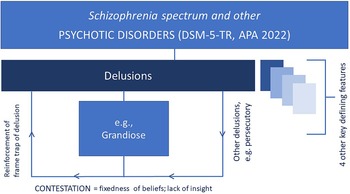
In the case that the person labelled delusional contests this attribution, it can be taken as a sign of the very fixedness of beliefs and lack of insight that is internally characteristic of such mental disorder, thereby reinforcing the framing itself through a frame trap. Further, in the context of the family, the motives for delusion itself as well as any perceived credibility deficit and testimonial injustice may be called into question, given that it lacks a professional context in which it is legitimised. Any contestation in which the motives of the attributors are overtly called into question then further runs the risk of the attribution of paranoia through inclusiveness of the framing of delusion, which makes relevant different subtypes that are parallel to that of grandiose delusion, that is, as peer or co-classifications. That is to say, the persecutory subtype of paranoia, in turn, reinforces the overarching frame of delusion, which also subsumes that of grandiosity. Figure 1 shows the workings of such frame trap within the classification of delusion, which has been added as part of the clinically diagnostic frame of schizophrenia, given its relevance to Longden’s account. (Note, however, that the delusion frame trap can work, as argued here, independently also in lay attribution of delusion.)
Delusional framing and frame trap.

Such frame trap consolidates the lesser epistemic status and social value of the so-attributed, continuing to place them at risk of ‘framing’ by its other members who hold greater deontic and epistemic authority. They may thus experience a vicious cycle in which their first-person accounts are discredited by the family that adopts the ‘organizing principle’ of delusion to uphold its own reality. Any resulting mental distress can be compounded by the everyday double bind of being delusional regardless of what one does or says, and further then, with a tightening of the trap in attempted resistance to such attribution, potentially resulting in the additional peer-delusional attribution of paranoia if motivations are contested. In this way the frame trap, and more specifically epistemic frame trap (Nao, Reference Nao2020), reinforces the inclusiveness of the frame of delusion, further negating the truth of the individual. It is such inclusiveness of the frame, and the salience of relativity of peer or co-classifications of delusion that underpin the reinforcement of credibility deficit and what Fricker (Reference Fricker2009, p. 20, Reference Fricker, Fantl, McGrath and Sosa2019) refers to as testimonial injustice.
Kidd et al. (Reference Kidd, Spencer and Carel2025, p. 522) propose that it would be worth ‘examining the epistemic privilege afforded to family members and friends of the ill person within the psychiatric healthcare system’. Here we have considered also the relevance this may hold to people who may not be within the psychiatric system, of which those engaged at grassroots level, such as the Hearing Voices Movement may be aware, yet who are otherwise under the radar. While it is not here argued that the experience of such epistemic frame trap leads to a disorder of mind that might itself be diagnosed, as within the schizophrenia spectrum, Bateson et al.’s (Reference Bateson, Jackson, Haley, Weakland and Bateson1999 [1956], p. 221) observation of the ‘helplessness, fear, exasperation, and rage’ displayed by patients who are placed in a double bind reminds of its potential to be the cause of considerable mental distress. This may be further compounded by stigmatisation (Bortolotti, Reference Bortolotti2022), fuelling the everyday actions and interactions that constitute double binds and frame traps.
5. Conclusion
The current paper extends Bateson’s (Reference Bateson and Bateson2000 [1955]) and Goffman’s (Reference Goffman1974) sociological theory of framing as an organising principle in order to illuminate the experience of credibility deficit in delusional attribution as part of the testimonial form of epistemic injustice (Fricker, Reference Fricker2009). Innovatively, it has done so through its theoretical examination of a first-person account of clinical diagnosis and with contrastive analysis of the context of familial lay attribution, which gives us better insight into the fuelling and reinforcement of credibility deficit by means of ‘frame trap’ (e.g., Goffman, Reference Goffman1974; Nao, Reference Nao2020). As this holds potential to compound any existing mental health issues or even contribute towards their development, it is argued to represent a meaningful and perhaps necessary site of exploration that adds to our existing understanding of testimonial injustice based on perceptions and negative stereotypes within philosophical psychiatry (e.g., Kidd et al., Reference Kidd, Spencer and Carel2025).
Specifically, we have expounded on the ‘lens of latent insanity’ to which Longden (Reference Longden2013a) refers within the context of her recounted clinical experience, as one which is operationalised by means of the frame-inclusiveness of delusion, whose exclusiveness simultaneously allows for the discounting of alternative explanations. It is, however, the inclusiveness of the frame, containing an assumed breach with reality, that is central to truth negation – any resistance to which may not only be futile but reinforce that very frame. We have considered this in respect of the delusion of grandiosity, including the context of family organisation in which there is a differential epistemic and deontic distribution among members to the potential disadvantage of the lay-attributed. Within these social bounds of framing, and without an obvious underpinning mandate and ethics of mental healthcare provision, the questioning of motives can further invoke paranoia as a peer or co-classification of grandiosity, subsumed within the broader classification of delusion. It is hence readily available through what has here been termed the salience of inclusive relativity of framing, further reinforcing the delusional frame trap.
The experience of credibility deficit and strictured ability within a frame trap, for someone to whom delusion has been attributed to define their own reality and to stake any claims to knowing and know-how within it, regardless of how evidentially real or communally shared it may be, raises questions with regard to how this may impact on mental health in the case of lay attribution, in particular. Beyond the anxiety of being mad itself (Romme and Morris, Reference Romme, Morris, Romme, Escher, Dillon, Corstens and Morris2009, p. 1), the double bind has also been noted to cause distress (Bateson et al.’s (Reference Bateson, Jackson, Haley, Weakland and Bateson1999 [1956]). As a frame trap further tightens the very frame of delusion through resistance, a dynamic not accounted for by the stalemate of a double bind itself, such reinforcement of delusion may be particularly pernicious. Within the lay context, there is a need to further consider the ‘framing potential’ that delusion holds (see also Nao, Reference Nao2020), or how the frame might be used, whether knowingly or not, to uphold distributed value within the family system, underpinned by differential epistemic and deontic rights, as well as how this may inhibit the knowledge and know-how to which individual members may lay claim. The realisation of such framing potential of delusion could negatively impact on a person’s sense of self-efficacy, competence, and purpose, which may adversely affect their mental health. In turn, this could trigger a vicious cycle in which they may be unable to make use and develop skills and abilities or entertain what would otherwise be considered realistic prospects of their future, let alone the positive illusions that can serve to support the attainment of more ambitious goals (Bortolotti, Reference Bortolotti2015).
As organising principles, frames are an epistemic stabilising force, underpinned also by an assumed social ownership of knowledge and know-how, affected by deontics of social organisation. We can see, particularly with respect to grandiose delusion, that its attribution can easily lead to a negation of skills and competences, as in Eleanor Longden’s account of presenting the news. Had this not been framed as delusion, it might rather have been seen as a sign of mental health improvement given its demonstration of socio-occupational competence. In this sense, delusional framing may not only be negatory of truth, through its inclusiveness of an assumed breach of reality, but negatory of self.
Acknowledgements
Marion Nao was engaged on the UKRI-funded project [MR/T021500/1] during this work, although the research in this paper is independent of that project.

 Open access

