

Similar to other scientific and humanities disciplines (Dallas Reference Dallas2016; Poole Reference Poole2016), archaeology is experiencing a Digital Curation Crisis (Kintigh and Altschul Reference Kintigh and Altschul2010; Majewski Reference Majewski2010, Reference Majewski, Childs and Warner2020; Nicholson et al. Reference Nicholson, Fernandez and Irwin2021; Thomson Reference Thomson2014; Witze Reference Witze2019). This crisis represents the precarious challenges in managing, preserving, and ensuring access to the vast and evergrowing body of digital objects (also commonly referred to as digital information) that are generated by archaeological and historic preservation and other research on cultural heritage (following the broad definition of tangible and intangible cultural heritage outlined by the United Nations Educational, Scientific, and Cultural Organization [UNESCO]). The rapid inclusion of field documentation technologies such as Geographic Information Systems (GIS), photogrammetry, 3D scanning, and remote sensing, among others, has exponentially increased the volume, velocity, and variety (Manyika et al. Reference Manyika, Chui, Brown, Bughin, Dobbs, Roxburgh and Byers2011) of data produced. A major challenge is that technologies once considered specialized or even novel have become commonplace in everyday field and laboratory practices. This has resulted in a massive digital footprint to curate and manage (i.e., the “data deluge” detailed by Sobotkova [Reference Sobotkova2018]). It is important to outline here that, for the sake of clarity, we utilize the terms “data” or “cultural heritage data” throughout this work, recognizing that cultural heritage projects produce information and have a responsibility to curate that information, all of which has the potential to become data. Data Management Plans (DMPs) are also becoming mandatory for several federal grant agencies (e.g., the National Science Foundation), which means that, for museum professionals, historic preservationists, and archaeologists (hereafter cultural heritage professionals), it is becoming increasingly important to be prepared to explain how these new data will be produced, and then permanently curated, in order to secure funding. Yet, there is still a lack of uptake of this knowledge or actual implementation of recommended digital preservation practices. This is compounded by the continuing financial cost of curating data, something that very few curating institutions (e.g., repositories, museums, libraries, Tribal archives, university archaeology laboratories) have accounted for (Richards et al. Reference Richards, Austin and Hardman2010).
The practice of the physical curation, conservation, and preservation of archaeological collections is on its way to being well-established, but as digital technologies become increasingly integral to archaeological practice, it is important for those in cultural heritage disciplines to take steps to ensure that intangible cultural heritage data are preserved ethically, responsibly, and sustainably in a manner comparable to that for tangible cultural objects, and hard-copy associated paper records and media, referred together hereafter as physical objects. Without the proper infrastructure and implementation of digital standards and long-term digital curation practices, cultural heritage data remain vulnerable to degradation, obsolescence, and ultimately loss. This means we are in danger of losing an entire generation of cultural heritage data owing to poor data management, underinvestment, and a lack of either interest or educational “how to.” As a result, cultural heritage professionals and curating institutions, whether they are acting as a data producer (i.e., cultural heritage professionals conducting projects) or as data preservationists (i.e., curating institutions or cultural heritage professionals preserving cultural heritage), are actively contributing to and compounding the Digital Curation Crisis.
Confronting the Digital Curation Crisis
As cultural heritage research becomes even more digitally oriented, active and deliberate choices must be made about digital preservation before, during, and after projects (e.g., scholarly research, cultural resource management [CRM], historic and other heritage preservation surveys, field schools, etc.).
These types of scenarios, as illustrated in Table 1, describe just a few common activities that underscore the general lack of ethical data literacy within cultural heritage disciplines (Kansa and Kansa Reference Kansa and Kansa2021). One common scenario is that many curating institutions accept newly excavated physical objects in tandem with digital objects, but they often do not account for the future resources and costs necessary for the care of digital objects. Another scenario is that when data are created, they are left on personal devices, and raw data (or images and other media) are not preserved with the rest of a collection. If data do come to a curating institution, they are often stored in formats that soon become obsolete (e.g., on CDs) or are inadequately described, making them inaccessible to the future (Cofield et al. Reference Cofield, Rivers, Childs and Majewski2024). Another frequent occurrence is that data generated during archaeological fieldwork can be at risk if files are transferred to a curating institution that is not specifically equipped to ensure the long-term preservation and upkeep of the data.
Common Scenarios That Contribute to and Compound the Digital Curation Crisis.

There are also misunderstandings across the discipline regarding digitization and backups. It has been common for archaeologists to digitize associated paper records and media such as archaeological excavation forms and photographic prints, for example, and then save those files to a local hard drive. While digitization is important, simply converting hard-copy associated records or media into digital formats does not guarantee their long-term preservation, accessibility, or usability (i.e., digitization does not equal digital preservation or digital curation). Neither is backing up data to an external hard drive or local server a true strategy for digital preservation (Clarke Reference Clarke2017:314). Speaking broadly, data generated during cultural heritage projects are continually at risk if there are no considerations or adequate long-term planning, infrastructure, and institutional support at all stages of the data creation and curation process (Benden and Taft Reference Benden and Taft2019; Childs and Benden Reference Childs and Benden2017; Nicholson et al. Reference Nicholson, Fernandez and Irwin2021). For example, should cultural heritage professionals submit digital objects associated with an archaeological collection to a curating institution that does not incorporate digital preservation? Should a curating institution accept digital objects with an archaeological collection if they cannot responsibly care for it? These are just a couple of the questions that we as a discipline need to address.
What these questions indicate, and what has become clear, is that many cultural heritage professionals often have no idea where to begin. A recent survey by Cofield and colleagues (Reference Cofield, Rivers, Childs and Majewski2024) illustrates this point. Their survey reveals that cultural heritage professionals, particularly in the United States, are floundering when it comes to planning for and enacting digital curation practices. This is despite efforts over the last two decades by organizations such as the Archaeological Data Service (ADS), the Alexandria Archive Institute, and the Center for Digital Antiquity (Doorn and Ronzino Reference Doorn and Ronzino2022; Kansa et al. Reference Kansa, Atici, Kansa and Meadow2019; Niven and McManamon Reference Niven and McManamon2011) disseminating knowledge on proper data stewardship. Other initiatives that promote the FAIR (Findable, Accessible, Interoperable, and Reusable; Kansa et al. Reference Kansa, Gupta, Martinez and Nicholson2025; Nicholson et al. Reference Nicholson, Kansa, Gupta and Fernandez2023; Wilkinson et al. Reference Wilkinson, Dumontier, Aalbersberg, Appleton, Axton, Baak and Blomberg2016) and CARE (Collective Benefit, Authority to Control, Responsibility, and Ethics; Carroll et al. Reference Carroll, Garba, Figueroa-Rodríguez, Holbrook, Lovett, Materechera, Parsons, Raseroka, Rodriguez-Lonebear and Rowe2020, Reference Carroll, Herczog, Hudson, Russell and Stall2021; Gupta et al. Reference Gupta, Martindale, Supernant and Elvidge2023) principles (Kansa et al. Reference Kansa, Gupta, Martinez and Nicholson2025) have emphasized to cultural heritage professionals the importance of ethical data management planning in research and mitigation. There are also established digital repositories with numerous resources and guidelines for digital curation (Archaeology Data Service [ADS] 2025a; The Digital Archaeological Record [tDAR] 2017; Open Context 2019).
This is not to say that there have been no efforts at encouraging cultural heritage professionals to think about digital curation, and much of what we detail here are not new concepts. Long-standing ethical guidelines from such professional bodies as the Society for American Archaeology Ethical Principles 1, 2, 5, 9, the Society for Historical Archaeology Ethical Principles 2, 3, 4, and the Register of Professional Archaeologists Codes and Standards 3.12, 3.19 and 3.20 lay important groundwork for developing plans to preserve digital heritage (Register of Professional Archaeologists 2025). There are also federal (i.e., 36 CFR Part 79) and state requirements that ensure all records (including digital objects) from archaeological and other cultural heritage investigations are preserved, curated, and properly accessible to stakeholders. Thus, digital preservation should be thought of as a mechanism for safeguarding cultural heritage, and cultural heritage professionals should proactively engage in digital curation activities.
One of the first ways to begin addressing the Digital Curation Crisis is for our community to work from the same baseline terminology and set of definitions. Currently, there is a lack of standardized terminology, definitions, and/or practical recommendations regarding the documentation and digital storage specifically for cultural heritage data. Nor are there clearly outlined benefits and recommendations for cultural heritage professionals to help them begin their own digital curation journey. In what follows, we present terminology and definitions for digital preservation in alignment with traditional terms associated with the physical curation of archaeological and other cultural heritage collections. Following this, we outline the benefits of digital preservation for different sectors and present actionable recommendations that cultural heritage professionals can institute. These benefits and recommendations detail the way that the effective and ethical stewardship of cultural heritage data requires deliberate planning, inclusive consultation, and adherence to recognized standards and best practices.
Practical Definitions
Because of the efforts of many individuals over the years (Benden and Taft Reference Benden and Taft2019; Childs and Stevenson Reference Childs, Stevenson and Stevenson2022; Childs and Warner Reference Childs and Warner (editors)2020; King and Samford Reference King and Samford2019; MacFarland and Vokes Reference MacFarland and Vokes2016; Meister Reference Meister2019; Nielsen-Grimm and Haynie Reference Nielsen-Grimm and Haynie2019; Parris Reference Parris2022; Roberts Thompson et al. Reference Thompson, Amanda, Thompson, Kappers, Schenk and Williams2019; Schiappacasse Reference Schiappacasse2019; Sullivan and Childs Reference Sullivan and Childs2003; Warner and Cofield Reference Warner and Cofield2024), the curation of physical objects is becoming not just a normalized part of archaeological research but also an important component of the training for students (Benden Reference Benden and Taft2019; Knoll and Huckell Reference Knoll and Huckell2019; Warner and Cofield Reference Warner and Cofield2024). We believe that utilizing key concepts and terminology associated with physical curation will create a parallel and relatable framework for the preservation of digital objects from cultural heritage projects (Figure 1 depicts some of these basic concepts). Below we outline and define key terms and concepts pertaining to the long-term stewardship, accessibility, ethical use, and sustainability of cultural heritage data, along with technical and organizational principles (Figure 2).
Broad overview parallelling digital and physical preservation.

Key terms for cultural heritage data and preservation.

Digital Stewardship
Digital Stewardship formalizes accountability for managing digital objects on behalf of others or for the best interests of an organization or community. It encompasses the people, organization, and processes required to ensure that the designated stewards are responsible for the digital objects (Wendelborn et al. Reference Wendelborn, Anger and Schickhardt2023). Stewards are tasked with understanding the importance of data management, applying best practices, and upholding the ethical and appropriate data sharing and data reuse (Strasser et al. Reference Strasser, Cook, Michener, Budden and Koskela2011).
Digital Preservation
Digital preservation is a broad set of managed activities (e.g., organizational policies and standards, process and workflows) along with actionable steps put into place to preserve digital objects for future access and (re)use. It includes planning for and the practical application of curating and managing digital objects for long-term preservation and use. Policies and standards should be designed to ensure that digital objects continue to be updated and usable as hardware and software evolve.
Digital Curation
This is the long-term and recurring process of collecting, managing, and preserving digital objects, along with the use of software and hardware that store the resources, and any associated metadata, while following FAIR+CARE principles (Gupta et al. Reference Gupta, Martindale, Supernant and Elvidge2023; Kansa et al. Reference Kansa, Gupta, Martinez and Nicholson2025; Nicholson et al. Reference Nicholson, Kansa, Gupta and Fernandez2023).
Digital Collections Management
Digital collections management is the range of processes and workflows that ensure digital curation and digital preservation occurs, including the standardization, development, organization, storage, and maintenance of digital objects to perpetuate the continued use of digital files and protect them from becoming obsolete, suffering from media failure, and/or physical loss.
DMPs
A DMP (also referred to as data management and sharing plans by some funding agencies within the United States) is a formal document that includes basic information on how researchers will handle data during and at the end of a project, what data will be collected and analyzed, what methodologies and standards will be applied, whether the data will be shared or made open access, and how and where data will be curated and archived (Doorn and Ronzino Reference Doorn and Ronzino2022). Various funding agencies have recently changed their policies to require data management and sharing plans (U.S. NSF Data Management and Sharing Plan). Overall, a DMP is a tool for effectively organizing data (e.g., digital objects, hard-copy associated records and media, and cultural objects) in order to minimize time and effort while maximizing productivity during each data life-cycle stage (Gajbe et al. Reference Gajbe, Tiwari and Singh2021). Similar to the purpose of a collections management policy, a DMP will detail the plan for long-term preservation and for how the information will be made accessible for reuse by others, considerations associated with the CARE principles and the Native American Graves Protection and Repatriation Act (NAGPRA), as well as any other local or professional guidelines and ethics. There are several online DMP tools for formats, content, tips, and tricks (e.g., DMP Tool; https://dmptool.org/).
Digital Standards
Digital standards outline best practices, processes, and workflows for digital curation and ensure that certain performance and security guidelines are met. These include protocols for:
• file server and archival backup storage: quarantined storage, online networked storage, and cloud storage
• file naming: a descriptive set of elements such as keywords, dates, identifying numbers, et cetera.
• acceptable file types: open and stable formats suitable for preservation
• file conversion and conversion maintenance
• metadata: administrative, descriptive, and technical information about digital assets
• file maintenance: established schedules for reviewing digital objects for assessment and migration, to mitigate media obsolescence
• security: user permissions to access, view, edit, or delete files
• usage license and copyrights: type of usage licenses (e.g., Creative Commons) identification of copyright holder, controlling entity of data, and conditions under which information can be reused.
Metadata
Metadata are “data about data” and consist of structured or standardized descriptive information that describe the information in an archive. Storing metadata with digital objects ensures that the information can be properly reused in the future (tDAR 2025a). If the digital object is associated with a physical counterpart, metadata play an important part in documenting that connection (Bollwerk et al. Reference Bollwerk, Gupta and Smith2024; Childs and Benden Reference Childs and Benden2017). Metadata provide critical context and include such information as authorship, dates, geographic location, cultural affiliation, file types, and points of contact. Metadata also should include unique identifiers (e.g., digital object identifiers or persistent identifiers) to track data submissions, define access rights, and document relationships between different elements within an archive. These particular identifiers are long-lasting, unique labels that reliably point to a digital object or line of data (Kansa and Kansa Reference Kansa and Kansa2022). Common examples include DOIs for publications and datasets, which are assigned by such organizations as Crossref and DataCite, and ORCID IDs for identifying people. Ultimately, metadata plays a central role in making data FAIR (Nicholson et al. Reference Nicholson, Kansa, Gupta and Fernandez2023).
Digital Provenance
Digital provenance is information that documents the origins and the processes by which digital objects arrived in the archive (Buneman et al. Reference Buneman, Khanna, Wang-Chiew, Van den Bussche and Vianu2001) and is an important component of the CARE principles. Provenance data may include information on (1) where the data came from, (2) which community to engage with regarding consent for use and future reuse, (3) (re)connecting communities with data to complement oral histories and historical traumas (Atalay Reference Atalay2020; Rowley Reference Rowley2020), and (4) decision-making about data use and reuse (Gupta et al. Reference Gupta, Martindale, Supernant and Elvidge2023).
Data Obsolescence
Data obsolescence is the inevitable aging of data and of software and hardware systems, creating challenges for sustainability as technologies, standards, formats, and resources evolve (Schulze et al. Reference Schulze, Arndt, Feuersenger, Kamilaris, Wohlgemuth, Karatzas and Athanasiadis2021). Digital repositories must continually upgrade systems and software to combat obsolescence and ensure long-term accessibility, supported by sustainable life-cycle practices and collaboration with service providers and depositors.
Digital Archival Backups
Digital archival backups are systematically curated digital objects, together with their associated metadata, that are intentionally preserved for long-term retention, often extending across decades or centuries. Their primary function is to satisfy legal, regulatory, and institutional requirements, while simultaneously ensuring the protection, sharing, and potential reuse of records. In contrast to operational or routine backups, which are optimized for rapid recovery of active data, archival backups focus on inactive but significant digital content. These materials are stored within managed digital repositories or institutional servers, where they are subject to data collection management frameworks and ongoing system upgrades designed to maintain integrity and accessibility over time.
Digital Objects
Digital objects (sometimes called digital information) include, but are not limited to, hard-copy materials (e.g., associated records, reports, images, datasheets, etc.) converted to digital medium (usually optically scanned) and born-digital materials:
• documents: PDFs, Microsoft Word, Text documents, LaTeX
• datasets: databases, spreadsheets, comma-separated values
• GIS: shapefiles, geodatabases
• Images: JPEG, TIFF, BMP, PNG, GIF
• 3D objects: lidar, remote sensing, sonar, photogrammetry
• multimedia: audio and video.
Recommendations for Beginning Digital Preservation
In the previous section, we provided definitions that align with commonly understood concepts and terms related to the archaeological curation of physical objects. As important as it is to have standardized definitions, it is equally important for cultural heritage professionals to have additional guidance so that they can begin or strengthen digital curation practices. The following section presents a series of recommendations designed to help cultural heritage professionals bridge established curatorial principles with emerging digital preservation needs. These recommendations highlight the ethical, technical, and financial responsibilities, along with practical steps for integrating inclusive and sustainable digital preservation practices.
Recommendation 1: Incorporate CARE
Cultural heritage professionals should address Indigenous Data Sovereignty as outlined in the call by CARE Principles, Society for American Archaeology Principle No. 5 (Society for American Archaeology 2025), and the Protocols for Native American Archival Materials (First Archivists Circle 2007) for cultural heritage professionals to responsibly and ethically preserve the digital objects from projects and extend these concepts to Indigenous and other descendant communities (for definitions of descendant communities, see Atalay Reference Atalay2012; Colwell-Chanthaphonh and Ferguson Reference Colwell-Chanthaphonh and Ferguson2008; Nash Reference Nash2003; Silliman Reference Silliman2008; Smith and Waterton Reference Smith and Waterton2009; Watkins Reference Watkins2003). Historically in the United States, there has been an exclusion of Indigenous and descendant communities from most stages of cultural heritage projects (Atalay Reference Atalay2006, Reference Atalay2012; Sillar Reference Sillar2005; Watkins Reference Watkins2005; Wilcox Reference Wilcox2010). These communities should be engaged with and included by cultural heritage professionals who are producing the data, as well as those charged with preserving the data. This can include, for example, involvement in aspects of data management planning and the decision-making process on what data are being produced and how their cultural heritage is being preserved and made accessible (Figure 3). This means inclusion not just at the initial stages of a project, but also throughout the life cycle of a project, which includes digital curation. This process begins with relationship building before the beginning of a project; however, if cultural heritage professionals are reading this now, and for the first time are considering this, it is not too late to reach out and include descendant community voices.
Example pathways for consultation.

Implementing Recommendation 1
Consultation is a continual conversation that does not stop once a collection is curated. Consulting on establishing individual- or institution-level digital preservation protocols and policies with Indigenous and descendant communities is ideal, and will enhance the consultation process during the later stages (Gupta et al. Reference Gupta, Martindale, Supernant and Elvidge2023; Neller Reference Neller, Childs and Warner2019). It is the role of the government agency to conduct legally mandated consultation (e.g., Section 106), but while consultation is considered a government-to-government process, the principles embodied in consultation should extend, as an ethical principle, to all those within the cultural heritage sectors, even they are if not legally mandated. For example, cultural heritage professionals from all sectors could include consultation from the project design, to data management planning phases, to the data collection, digital curation, and digital preservation phases. CRM firms could include consultation and engagement on their internal operational policies and standards, as well as publications and conference papers, whereas curating institutions could consult on aspects of their policies and standards, and on how digital objects are accessed and preserved. Included in Figure 3 are example pathways for consultation; however, there is no one way to consult, and consultation looks different across communities (Roberts Thompson et al. Reference Thompson, Amanda, Thompson, Garland, Butler, deBeaubien, Panther and Hunt2023).
Recommendation 2: Follow FAIR Guidelines
Cultural heritage professionals should understand and expand on the FAIR principles, including the individual elements that lead to their implementation. Established best practices in archival strategies should also be used when preparing digital objects for preservation, archiving, and reuse (Nicholson et al. Reference Nicholson, Kansa, Gupta and Fernandez2023; Niven and McManamon Reference Niven and McManamon2011).
Implementing Recommendation 2
Cultural heritage professionals should begin by reviewing and incorporating each of the elements of the FAIR data principles into their projects (i.e., [meta]data are assigned a globally unique and persistent identifier; Nicholson et al. Reference Nicholson, Kansa, Gupta and Fernandez2023; Wilkinson et al. Reference Wilkinson, Dumontier, Aalbersberg, Appleton, Axton, Baak and Blomberg2016) in order to make information truly reusable (Figure 4). Each letter of the FAIR acronym contains actionable elements and guidance for users, many of which focus on the development of metadata. Metadata are defined and described throughout FAIR (Nicholson et al. Reference Nicholson, Kansa, Gupta and Fernandez2023) and provide the foundation for humans and machines (i.e., search algorithms) to locate, access, integrate, and reuse data responsibly and effectively. For data to be Findable, metadata must include rich descriptions and persistent identifiers (Kansa and Kansa Reference Kansa and Kansa2022) and be indexed in searchable systems. To make data Accessible, metadata must support standardized retrieval protocols and clarify access conditions, even when the data are restricted or no longer available. Metadata also enables Interoperability by describing and using shared languages and standardized vocabularies that facilitate integration across systems and disciplines. Ultimately, this all ensures Reusability. Proper metadata document the provenance of the data and the relevant community standards, allowing researchers to replicate findings (Marwick Reference Marwick2025) or apply the data in new contexts by means of usage licenses or copyrights (e.g., Creative Commons, etc.). Creative Commons licenses are standardized in such a way that they offer legal permissions in advance for how data can be used in ways that respect authorship and ethical reuse.
FAIR data guidelines.

Recommendation 3: Preservation Begins with Data Producers
Cultural heritage professionals who are data producers should begin implementing digital preservation practices as a regular part of their workflow and navigation of the elements of the data life cycle (e.g., data collection, processing and analysis, interpretation, reporting, etc.).
This applies to everyone—students, faculty, researchers, CRM professionals, or any other related subdiscipline professional. Data producers are typically producing either new born-digital digital objects or digital objects from legacy collections. Regardless of what type of data is being produced, it is imperative that cultural heritage professionals recognize that digital objects need to be preserved for the long term, rather than stored in temporary digital environments (e.g., desktop files).
Implementing Recommendation 3
Understandably, many cultural heritage professionals are intimidated when confronted with the vast amounts of digital objects found languishing in multiple versions, formats, and locations from past research projects, conference presentations, and publications, or when contemplating how to start good digital preservation actions at the beginning of projects. To begin with, it is essential to think about how data are created and used, as that might dictate how digital objects could be interacted with in the long term. A faculty member who conducts a field school might create digital objects without a plan for their digital preservation, while a CRM firm might create digital objects knowing that the long-term responsibility of digital preservation will reside with the curating institution. The example workflow for cultural heritage sectors presented in Figure 5 is similar across subdisciplines but may differ slightly depending on the sector: academia, CRM, governmental agency, or curating institution. Regardless, if cultural heritage professionals are producing data, preserving data already created, or both, there are resources that can provide advice on how digital preservation can be implemented immediately.
Example workflow for cultural heritage data production and preservation.

Recommendation 4: Include Digital Preservation into a Collections Management Plan
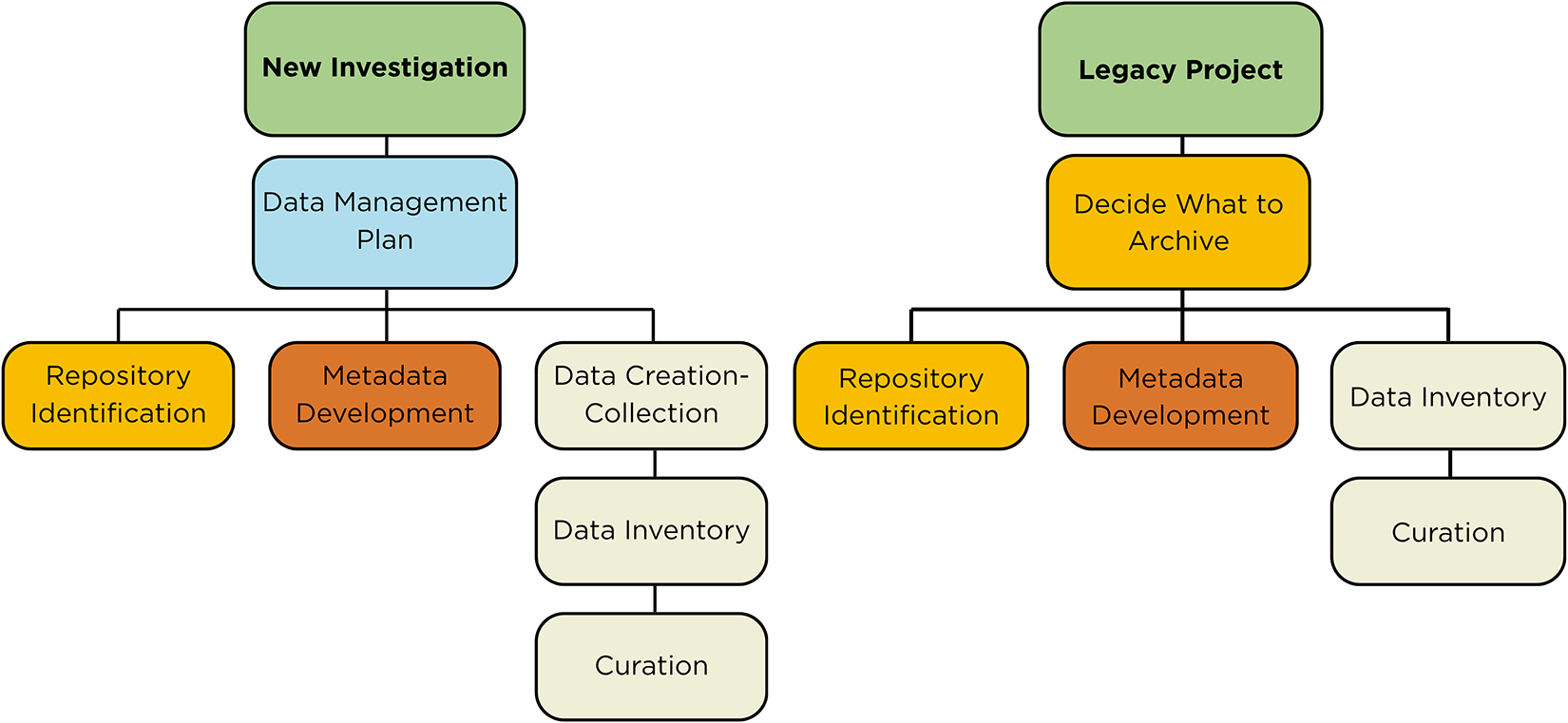
Much like data producers, cultural heritage professionals need to start data preservation. While an individual alone may act as a data preservationist for digital objects that they produced (e.g., academia), we do not recommend this, as it is not a long-term solution. In such cases as this, digital repositories are a good choice to ensure that research and personal archives are preserved for the future, beyond the life of the individual researcher (e.g., the retirement or death of the cultural heritage professional). Institutions that curate archaeological collections broadly have two categories of collections: legacy and newly generated collections. Each contain specific problems that can directly impact the implementation of digital preservation. Legacy collections often have physical objects that may or may not also have digital counterparts. Additionally, following ethical and CARE principles, there may be hard-copy records that should not be digitized or preserved. These digital, disparate files might exist on different staff laptops or external drives, and may or may not be readily identifiable. New collections may be submitted by different cultural heritage professionals (e.g., CRM firm, university faculty), resulting in a wide variety of file names, file types, and organizational schema.
Thinking about collections from these two categories can be a helpful first step in starting digital preservation (Figure 6). From here, data preservationists can begin adjusting policies, standards, and practices accordingly. Much like a DMP helps data producers, incorporating digital preservation into a collections management plan and incorporating digital curation standards will assist in structuring and organizing digital curation processes. For example, if a repository accepts a collection for curation, working with CRM firms on the intake requirements for digital objects up front (e.g., acceptable file formats, metadata, standards, naming conventions) will reduce the long-term costs associated with ingestion, migration, and/or cleanup.
Example digital preservation steps for new investigations and legacy projects.

Implementing Recommendation 4
Cultural heritage professionals who work at a curating institution and want to begin digital preservation need to recognize that accepting digital objects without a plan is not best practice. That being said, there is no one way for a curating institution, such as a repository, to begin taking on the responsibilities of a data preservationist. Collection histories, legal requirements, and the existing financial structure (or lack of same) all dictate the extent to which individuals can implement data preservation. While, for the sake of clarity, we have lumped digital objects here as either a legacy or newly submitted collection, it is important to acknowledge that archaeological data can be massive, in both scale and diversity. This is why we recommend taking a current inventory before implementing a digital preservation plan. A “needs assessment” can be helpful not just in estimating what staff and other infrastructure resources are required but also can help forecast what future digital objects might be submitted. From here, it is possible to seek funding opportunities through contracts, grants, and other partnerships, or to begin allocating existing staff and resources to implement that plan. Next steps may include, for example, securing files in a reliable storage solution (see also Recommendation 7 below), standardizing file formats and renaming files, keeping and tracking metadata, and instituting migration strategies. This is also the stage at which to consider how persistent identifiers will function. Will DOIs or other identifiers to facilitate interoperability and improve citation outcomes be assigned? Investigate who assigns these identifiers, and how the assignment process works. It is important to think about digital preservation as a continual care process and to be aware that implementation might not occur in a linear process. Newly submitted collections, if standards are enacted from the start of a project, may be farther along the digital preservation pipeline than a legacy collection that is undergoing inventorying and organization, in addition to the digitization of hard-copy records.
Recommendation 5: Incorporate Digital Preservation Costs into Budgets
Cultural heritage professionals who are data producers need to prepare for the costs of digital curation. As a discipline, archaeology invests substantial resources into generating information through compliance-driven projects and academic research (Altschul and Klein Reference Altschul and Klein2022). Currently, only a small fraction of research funding is allocated to digital stewardship. Mons (Reference Mons2020) has recommended that approximately 5% of overall research budgets be dedicated to data stewardship—a target that remains largely aspirational. What this means is that most data producers are not including costs for the care of digital objects. Just as the production of data involves considerable expenses—such as personnel, tools, vehicles, and computer hardware and software—so too do the curation and preservation of digital objects (Richards et al. Reference Richards, Austin and Hardman2010). We recommend that cultural heritage professionals begin to incorporate realistic digital curation costs into grant proposals and contracts, although we also recognize that government contracts are formalized to specific guidelines which may not leave much flexibility in archaeological bids (see Neumann et al. Reference Neumann, Sandford and Neumann2022:69–74). It is necessary then for cultural heritage professionals in government agencies to prioritize the inclusion of digital curation costs alongside physical curation in whatever ways they can.
Implementing Recommendation 5
For data producers, at first glance, implementing digital preservation costs into the beginning stages of projects and research design might seem simple; however, we want to point out some potential obstacles. One obstacle for data producers is deciding where the digital objects will be curated. For example, will curation occur alongside associated physical objects or will it be done separately, if the curating institution does not yet practice digital curation? Even if the physical curation facility does not accept digital objects, a potential solution is to utilize existing digital repositories, in tandem with a curating institution, and ensure that the collections are cross-referenced. Another obstacle might include challenges in determining the amount and types of data that will be produced during a project. If the volume can be estimated (e.g., the number of files and file sizes), then one way to determine the potential costs of digital preservation is to use existing cost calculators (ADS 2025b; tDAR 2025b). For example, if data producers were to look at the history of completed projects, whether a field school, or a Phase I, II, or III project, it would be possible to derive a general estimate of the types, number, and sizes of digital objects that are regularly being produced. Digital preservation costs for future projects can be estimated using the aforementioned calculators and then added to the anticipated cost of curation in future proposals. Entities (e.g., clients, government agencies, granting agencies, etc.) that fund the creation of these data need to bear the responsibility and be held accountable for the costs associated with their digital preservation. If government agencies, CRM clients, and funding organizations are committed to conducting ethical cultural heritage projects and the preservation of these irreplaceable resources, then covering the full cost of stewardship must be part of that commitment.
Recommendation 6: Plan for Digital Curation Costs
Most cultural heritage professionals at curating institutions who are actively preserving archaeological collections recognize the need to curate those physical materials. These individuals understand that there are costs associated with physical curation, including personnel, facilities, shelving, office and computer equipment, climate control systems, security infrastructure, and pest management. What is not well understood is that effective digital curation requires expert staff, cyberinfrastructure (servers, computers, and software), office space, and the equipment to ensure that digital objects are properly curated and made FAIR. These costs can be substantial if a curating institution is already struggling with maintaining staff and resources for physical curation. This could be even more difficult for repositories that do not, or are legally not allowed to, utilize fee-based curation. We understand the daunting nature of these issues, but this is directly parallel to how the curation crisis was acknowledged by cultural heritage professionals.
Implementing Recommendation 6
The reality is that cultural heritage professionals will continue to produce digital objects. Curating institutions need to begin to see themselves as data preservationists and incorporate the costs of digital preservation into their existing curation budget. Digital preservation costs should be thought of as a continuous responsibility with ongoing operational costs. Other factors such as training, policy, and standards development also need to be factored into costs. However, instituting financial support for digital curation can be done in phased and prioritized steps rather than attempting to do everything at once. For those curating institutions already charging for the curation of physical objects, one of the first actions that could be implemented is incorporating fees to support digital curation. If curating institutions do not charge for curation, it is time to begin doing so, if they are legally allowed to, for both physical and digital objects. For curating institutions that accept new collections without accompanying financial support, conversations with the controlling entity (e.g., government agencies) that are responsible for those collections might be a good first step. For example, partnering and sharing individual costs will help with the initial burden, and then, together, digital curation practices can be scaled up.
Recommendation 7: Deposit in a Trusted Repository
Our last recommendation is for both data producers and data preservationists. Dependent on legal restrictions being followed or proper permissions being obtained (or both) for culturally sensitive information from Indigenous or other descendant communities, it is important to utilize a recognized or, even better, a trusted digital repository for protecting digital archival backups. Cultural heritage professionals should consider using a digital repository that has a long-term sustainability plan and that understands the discipline’s preservation, cultural sensitivity, and access needs. A dedicated digital repository can fill in the gaps that a curating institution may have in terms of their ability to properly implement digital preservation, or act as a secure location until a curating institution develops systems to serve in a data preservation capacity.
Government agencies should consider mandating CRM firms (and their clients) and researchers to not only incorporate digital curation practices into the contract or research permit but also require that digital objects be submitted to a trusted digital repository alongside, or in connection with, the physical objects that are submitted to the curating institution. (See Table 2 in Nicholson et al. [Reference Nicholson, Kansa, Gupta and Fernandez2023] for a list of active digital repositories that house archaeological resources.) Cultural heritage professionals who are data producers but have not yet started proper digital preservation workflows should consider submitting a digital archival backup, or safety copy, of digital objects to a similar type of digital repository. This “splitting” of the collection should, however, only be done with adequate consideration and documentation (Cofield et al. Reference Cofield, Rivers, Childs and Majewski2024; Domeischel and Childs Reference Domeischel and Childs2024).
Implementing Recommendation 7
There are many options for creating secure and well-protected digital archival backups when beginning proper digital preservation. Deciding on where to create those backups may be linked to the government agency or granting agency requirements, or requirements laid out by the relevant Indigenous and descendant communities. Regarding “where to” digitally archive outside of a curating institution, Nicholson and colleagues (Reference Nicholson, Kansa, Gupta and Fernandez2023) present several options for cultural heritage professionals to choose from and recommend investigating domain-specific repositories, such as ADS, OpenContext, or tDAR, or generalists such as FigShare, Mendeley, or Zenodo. Vetted repositories can be found at the Registry of Research Data Repositories. Additionally, those in academia may also consider using their own institutional repository (although these are not domain-specific and often have limited visibility outside the designated university or institutional community). Another potential option for a digital archive backup is to integrate into their academic library system (for an example, see UC Cyber-Archaeology Data Repository). When choosing a digital repository, make sure it adheres to the FAIR guidelines for proper preservation (e.g., rich descriptive metadata, access controls, etc.).
The Benefits of Digital Preservation
Aside from the ethical aspects and, in some cases, the legal requirements of preserving “records” (e.g., 36 CFR 79), we need to ask what else can be done to incentivize this work. What other benefits do different sectors derive for doing this work, and what other mechanisms can be installed to ensure this work is done properly? Below we describe some of the potential benefits of digital preservation for different sectors of archaeology and cultural heritage: academia, government agencies, CRM, and Indigenous and descendant communities. In reality, however, the benefits cut across all components of cultural heritage professions.
Academia
Digital preservation provides an invaluable foundation for scholarly inquiry in academia (e.g., faculty research, archaeological field schools, etc.) by ensuring long-term access for the reuse of digital objects. Improved access to well-curated, digitally preserved archaeological datasets facilitates synthetic, comparative, and diachronic studies (i.e., across space and time; Altschul et al. Reference Altschul, Kintigh, Klein, Doelle, Hays-Gilpin, Herr and Kohler2018; Heilen Reference Heilen2020; Kansa and Kansa Reference Kansa and Kansa2022; Ortman Reference Ortman2019) that would otherwise be constrained (Mons Reference Mons2020). Long-term access and reuse of digital objects enables academics to formulate and substantiate big data or “grand challenge” questions (Cai and Zhu Reference Cai and Zhu2015; Kintigh et al. Reference Kintigh, Altschul, Beaudry, Drennan, Kinzig, Kohler and Limp2014a, Reference Kintigh, Altschul, Beaudry, Drennan, Kinzig, Kohler and Limp2014b; McCoy Reference McCoy2017) with increased precision by drawing in additional, complimentary datasets (see Neller [Reference Neller, Heckman, Bollwerk, Myers and Wells2024] for examples of datasets). Moreover, the systematic digital curation of data allows for reproducibility in research (Marwick Reference Marwick2025) and the application of novel analytical methods, thus advancing the rigor and scope of cultural heritage scholarship. We suggest that those in academia move beyond recognizing only peer-reviewed publications—particularly those in “high-impact” journals—and successful grant funding as the primary markers of scholarly achievement. It is essential to foster a culture that appropriately incentivizes the digital preservation of scholarly data, granting it recognition on a par with other forms of academic output. Preservation activities should be acknowledged and credited as integral components of the research enterprise and in gaining tenure.
Finally, the dissemination of digitally preserved datasets cultivates a collaborative research environment. Scholars who make their data publicly available and accessible (supplemental data tables in journals are available, but in our opinion they are not publicly accessible) often experience enhanced academic visibility and enjoy a higher likelihood of citation and collaborative authorship (Marwick Reference Marwick2017; McKiernan et al. Reference McKiernan, Bourne, Brown, Buck, Kenall, Lin and McDougall2016). This practice not only accelerates problem-solving through collective expertise but also promotes interdisciplinary engagement (Kerr Reference Kerr2020; Maggio Reference Maggio and Smith2018; Milek Reference Milek2018), linking archaeology with such fields as geology, ecology, and geoinformatics, along with the humanities.
CRM
In CRM, the digital preservation of cultural heritage data plays a vital role in regulatory compliance and long-term stewardship. US Federal Section 106 of the National Historic Preservation Act (NHPA) requires federal agencies to consider the effects of their projects on historic properties, and CRM firms meet these requirements by submitting final reports and specified digital deliverables (such as summary maps and artifact catalogs, among other things) to such agencies as State Historic Preservation Offices (SHPOs) and Tribal Historic Preservation Offices (THPOs). However, this minimum threshold may not consistently include the full range of digital objects generated during a project, encompassing spreadsheets, GIS files, databases, digital photograph logs and images, scanned field notes, and other ancillary data essential to analysis and interpretation. These materials, while not always explicitly required by contracts, are the backbone of ethical and responsible archaeological practice and future reuse. Without intentional strategies on the side of both CRM and curating institutions for preserving digital objects, essential knowledge can be lost over time, particularly with staff turnover or organizational changes. CRM firms and curating institutions may then be unable to locate, reconstruct, or explain datasets that were never systematically preserved. Digital curation practices can enhance a CRM firm’s institutional memory, improve operational efficiency, and position firms to respond more competitively to future projects, including those that require prior data integration or demonstration of robust digital stewardship. In a competitive marketplace where agencies increasingly expect long-term access to data, having a well-maintained internal archive becomes a mark of professionalism and reliability—one that can distinguish a firm and improve client relationships over time. Furthermore, standardized digital objects enhance communication by providing a common platform for analysis and interpretation. This not only conserves resources but accelerates the review and permitting stages, benefiting both all forms of CRM and project developers.
Government Agencies
For US federal and state government agencies and land managers (e.g., SHPOs and THPOs, National Parks Service, Bureau of Land Management, United States Forest Service, etc.), digital preservation from Section 106 and other compliance reviews present a transformative solution for streamlining those processes and enhancing operational efficiency. Referencing comprehensive and up-to-date data not only ensures regulatory consistency but also contributes to more informed decision-making in environmental and land-use planning. When data from publicly funded compliance and mitigation efforts are more findable and accessible, government bodies can better demonstrate accountability in the use of taxpayer dollars, which promotes transparency and equitable stakeholder engagement.
For NHPA and other compliance work, access to digital objects found in centralized repositories (e.g., WISAARD in Washington, AZSITE in Arizona, or GNAHRGIS in Georgia) allows agencies and CRM firms to conduct background literature reviews with far greater speed and precision. For instance, SHPOs and THPOs evaluate thousands of documents annually from CRM firms working on behalf of clients on a wide range of development projects (e.g., mining, transportation improvements, oil and gas development). This work often requires compiling information from multiple sources that were never formally published (i.e., “gray-literature”; Forman Reference Forman2008), but if this relevant supporting material is digitally housed in a manner that facilitates its findability and accessibility from rich descriptive metadata and a centralized server, staff can focus on making efficient determinations instead of searching through thousands of paper records. Similarly, if digital objects are readily available for gray-literature reviews, CRM firms can focus on performing assessments within the Area of Potential Effects (APE), where new information is genuinely needed. Access to these digital objects reduces the amount of time needed for permit evaluations, and turnaround times on development projects decrease, all while maintaining compliance with legal (e.g., 36 CFR 79) and ethical standards.
Curating Institutions
Curating institutions can benefit greatly from the incorporation of digital curation practices, for these practices support the preservation, conservation, and research integrity of digital objects over time, as well as education about them. Digital preservation is a sound strategy to protect, manage, and ensure the access to and the use of data while also meeting legal and ethical obligations. In an era when increasing volumes of cultural information exist only in digital formats, safeguarding these assets is as vital as protecting physical objects. By establishing structured workflows for storage, digital archive backups, and disaster recovery, curating institutions can protect irreplaceable digital objects from such threats as hardware failure and natural disasters. When embedded into long-term planning and resourcing, digital preservation strengthens an institution’s ability to respond to future challenges and adapt to changes in technology, policy, or user needs. Ultimately, digital curation is not simply a technical process, but a mission-aligned investment to ensure the accessibility, usability, and integrity of digital objects.
Indigenous and Descendant Communities
Historically, Indigenous and other descendant or stakeholder community voices have been excluded from conversations concerning cultural heritage data and what those communities might need or find important (Laluk et al. Reference Laluk, Montgomery, Tsosie, McCleave, Miron, Carroll and Aguilar2022). Given this, we offer an etic view of the potential benefits of digital preservation with specific regard to Indigenous communities; however, the points below are applicable to many other communities as well. From a non-Indigenous perspective, digital curation for Indigenous communities provides an opportunity for them to safeguard knowledge for future generations by asserting sovereignty over data derived from their communities, lands, and heritage (DeHass et al. Reference DeHass, Collins, Taitt, Raymond-Yakoubian, Doering, Ellanna and Hollinger2025; Gupta et al. Reference Gupta, Martindale, Supernant and Elvidge2023; Laluk et al. Reference Laluk, Montgomery, Tsosie, McCleave, Miron, Carroll and Aguilar2022). Digital preservation can significantly enhance community access to information, particularly data generated by non-Indigenous consultants assessing development impacts on cultural sites and on traditional lands. With access to this information, descendant communities can be better positioned to provide feedback that reflects their worldviews, cultural values, and sovereign rights in the context of development projects.
Moreover, digital preservation can support informed decision-making in threatening emergent situations like wildfires, hurricanes, and sea-level rise. The availability of site location data and contextual information in trusted repositories is important for assessing and mitigating potential impacts to heritage sites during and after such events (Sinsky Reference Sinsky2020). Similarly, access to archived digital objects can improve the capacity to document, monitor, and investigate incidents of cultural property crime and other forms of heritage damage (Welch et al. Reference Welch, Altaha, Cantley, Doelle, Herr, Kersel and MacDonald2019). The digital curation and preservation of cultural resources can offer opportunities to support and validate traditional narratives with scientific data (Thomas et al. Reference Thomas, Cossette, Benner, Camp and Robinson2025). Such scholarship is made possible by the aggregation and accessibility of legacy data through digital repositories such as ADS, the Digital Archaeological Archive of Comparative Slavery (DAACS), tDAR, and Open Context, along with platforms in which control of data is directly in the hands of a particular community (Rodriguez Reference Rodriguez2018).
Another way is to incorporate digital preservation standards into wider agreements (e.g., a Memorandum of Understanding [MOU]) that outline specific communities’ rules and protocols (e.g., cultural sensitivities, language, access, etc.), which helps create a community-led data ecosystem that protects their unique identities and histories. For example, specific information may not be publicly available, be redacted, or even be destroyed per community request. This is particularly relevant to NAGPRA and what digital objects exist already or are being actively created through consultation (we note that this is something that deserves wider and separate discussion). Other agreements may entail a transfer of control of data to the community. Ultimately, digital preservation can support more inclusivity, promote scientific transparency, and align culturally sensitive heritage management with equitable preservation practices, such as the FAIR+CARE principles, but only if the community wants data to be used in such ways (Stodden Reference Stodden2010; Tennant et al. Reference Tennant, Waldner, Jacques, Masuzzo, Collister and Hartgerink2016).
The Digital Curation Crisis Is Solvable
The Digital Curation Crisis represents a critical challenge in managing, preserving, and ensuring access to the growing body of digital objects generated from cultural heritage projects. Occurring alongside the long-recognized curation crisis of physical collections, this new crisis demands comparable attention and urgency. As archaeological and cultural heritage becomes even more digital, there must be active and deliberate choices about digital curation and digital preservation before, during, and after projects. This calls for a paradigm shift in which digital objects, whether born digital or digitized from hard-copy associated records, are thought of and cared for just as one would think of and care for the cultural objects recovered from the archaeological record. If as a discipline we claim that physical objects are culturally, intellectually, and intrinsically important (Holtorf Reference Holtorf, Layton, Stone and Thomas2001; Samuels Reference Samuels2008; Smith and Harris Reference Smith and Harris2001), then we should be treating digital objects with the same level of care. Yet, we also understand that instituting anything regarding digital curation is daunting, particularly if there has been a general lack of funding or resources (staff, cyberinfrastructure, etc.), but there is no doubt that doing so will benefit current and future generations.
The stakes are high, but the Digital Curation Crisis is eminently a solvable one. The definition of terms and recommendations presented here contains actionable steps that data producers and data preservationists can begin implementing. We also know that the challenges associated with the Digital Curation Crisis can arise at any stage of the data life cycle. One major consideration at the project’s outset is the ethical and legal concerns (e.g., who legally controls the data produced, who can access the data, the restrictions on sensitive data), which are frequently not addressed before data are collected, and this belatedly results in negotiations that can be difficult (although not impossible) to resolve prior to the curation of a project. In reference to Indigenous concerns and data sovereignty (Atalay Reference Atalay2019; Gupta et al. Reference Gupta, Martindale, Supernant and Elvidge2023), adherence to the CARE principles—starting with an early engagement of descendant communities in meaningful consultation and codesign of research goals, methods, and DMPs—allows cultural heritage professionals to clearly define who has authority over the data, how it will be used, and how communities can benefit from the research. By embedding these practices early on, potential conflicts or misunderstandings over ownership, access, and reuse of data can be minimized, fostering trust and collaborative stewardship from the outset.
All of us need to begin digital curation, even if it is on a small scale. It is important to then build on those foundations, from considerations of the costs of digital preservation at the outset of projects to implementing data-governance (e.g., FAIR+CARE) principles to ensure preservation of data for long-term access and reuse. Even small, incremental actions can make a lasting difference. The recommendations presented here should be thought of as flexible methods that can be incorporated into everyday practice, but to be successful in tackling the Digital Curation Crisis on a larger scale, a collective change across cultural heritage disciplines is needed. Digital curation is not simply a means of record-keeping, but a foundational process for ensuring more sustainable and informed digital curation and collections management of digital objects. By facilitating scholarly collaboration, streamlining processes, and enabling transparent, active, and continued engagement with Indigenous and other descendant communities, the concepts presented here can serve as a foundational tool for multidisciplinary and ethical stewardship of the past. Only through such coordinated, principled efforts can we preserve cultural heritage data for the benefit of current and future generations, ensuring it remains usable, meaningful, and justly governed.
Acknowledgments
We would like to thank members of the Society for American Archaeology Curation Interest Group who contributed to early conversations about the need to standardize terms regarding digital preservation and how cultural heritage professionals need to start working to fix the digital curation crisis. We appreciate the reviewers for their useful comments on drafts of this article. We would also like to extend thanks to the editor for patience and understanding throughout the publication process. We also would like to thank Ellie Minette for her assistance with the figures for this manuscript. No permits were required for this research.
Funding Statement
The authors received no financial support for the authorship of this article.
Data Availability Statement
No original data were used.
Competing Interests
Christopher Nicholson is employed at Arizona State University, which oversees the operation of the tDAR digital repository.



 Open access

