


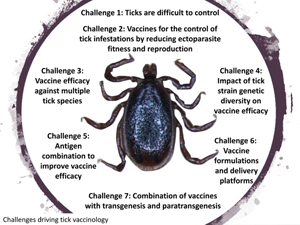



Challenge 1: ticks are difficult to control
Ticks and tick-borne pathogens constitute a growing problem with increasing social and economic concern worldwide (e.g. de la Fuente et al., Reference de la Fuente, Estrada-Peña, Rafael, Almazán, Bermúdez, Abdelbaset, Kasaija, Kabi, Akande, Ajagbe, Bamgbose, Ghosh, Palavesam, Hamid, Oskam, Egan, Duarte-Barbosa, Hekimoğlu, Szabó, Labruna and Dahal2023a). Ticks are difficult to control, and traditional control methods are mainly based on the use of chemical acaricides with partial success and drawbacks such as selection of resistant ticks and negative impact on animal health and production and environmental contamination (Agwunobi et al., Reference Agwunobi, Yu and Liu2021; Githaka et al., Reference Githaka, Kanduma, Wieland, Darghouth and Bishop2022; Gonzaga et al., Reference Gonzaga, Barrozo, Coutinho, Pereira E Sousa, Vale, Marreto, Marchesini, de Castro Rodrigues, de Souza, Sabatini, Costa-Júnior, Ferreira, Lopes and Monteiro2023). A number of reports of establishment of multiacaricides resistant ticks in different parts of the world (Bishop et al., Reference Bishop, Stutzer and Maritz-Olivier2023) and growing global public concern of environment pollution due to high use of chemical acaricides has posed serious challenges on continuation the use of conventional methods for tick management.
Under the One Health and sustainability perspective, vaccines are the most effective and safe intervention to reduce tick populations and risks associated with transmitted pathogens (de la Fuente, Reference de la Fuente2018; reviewed by Estrada-Peña et al., Reference Estrada-Peña, Mallón, Bermúdez, de la Fuente, Domingos, García, Labruna, Merino, Mosqueda, Nava, Cruz, Szabó, Tarragona and Venzal2022). However, although a number of reports of significant efficacy of other vaccine formulations have been reported (de la Fuente and Kocan, Reference de la Fuente and Kocan2003; de la Fuente and Contreras, Reference de la Fuente and Contreras2015; Bishop et al., Reference Bishop, Stutzer and Maritz-Olivier2023; Parizi et al., Reference Parizi, Githaka, Logullo, Zhou, Onuma, Termignoni and da Silva Vaz2023), only Bm86/Bm95-based vaccines TickGARD in Australia and Gavac in Cuba were registered and commercialized for the control of Rhipicephalus microplus tick infestations (de la Fuente et al., Reference de la Fuente, Almazán, Canales, Pérez de la Lastra, Kocan and Willadsen2007; Rodríguez-Mallon, Reference Rodríguez-Mallon2023). Currently, only Gavac (CIGB, Havana, Cuba; https://www.cigb.edu.cu/en/product/gavac-2/) and Bovimune Ixovac (Lapisa, La Piedad, Michoacán, Mexico; https://lapisa.com/productos/bovimune-ixovac) with Bm86 antigen are still commercially available in some Latin American countries.
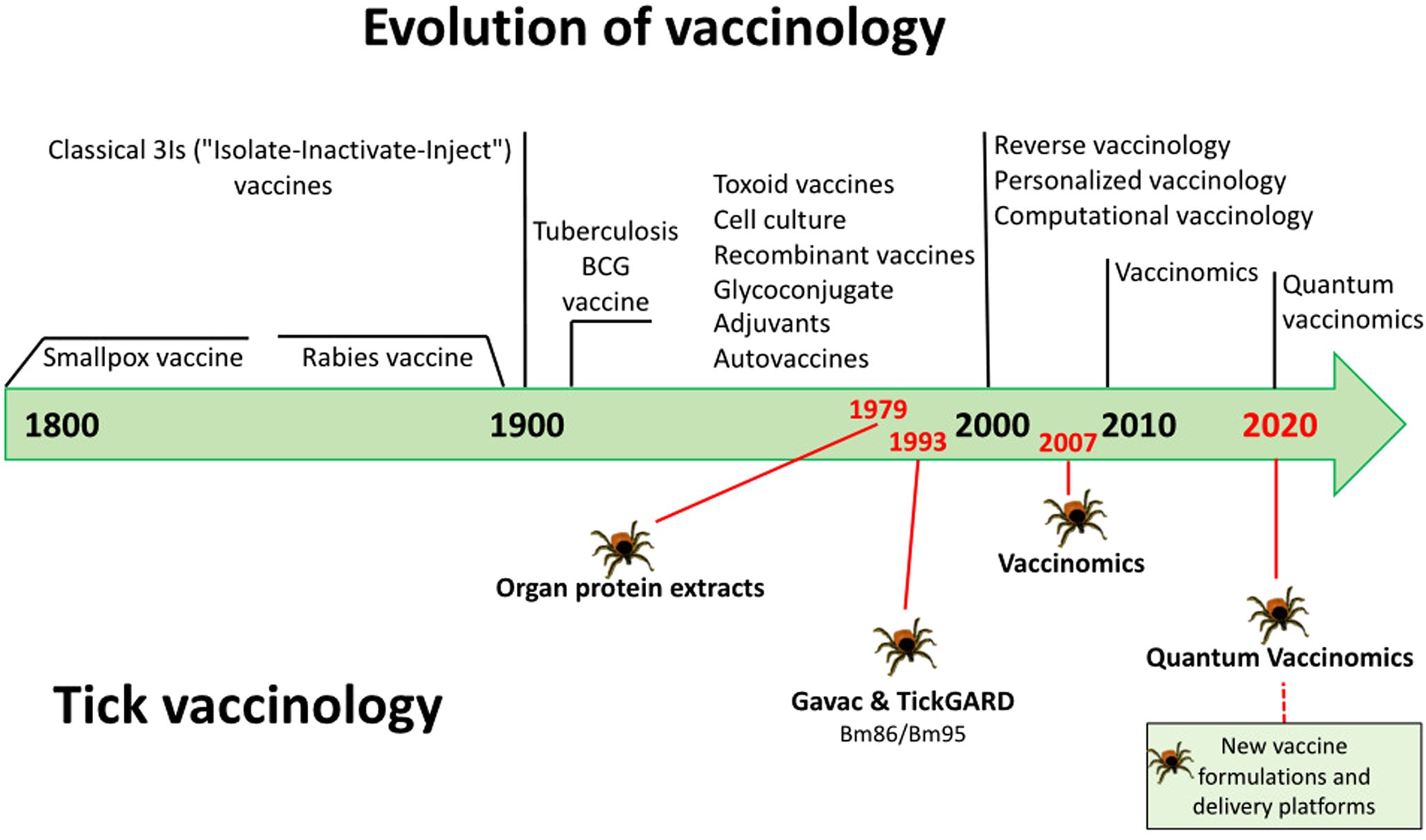
Based on the evolution of vaccinology (Andreano et al., Reference Andreano, D'Oro, Rappuoli and Finco2019), this review approached the evolution of tick vaccinology to face challenges and advance in the development of new effective anti-tick vaccines and other control interventions (Fig. 1).
Tick vaccine research in the context of the evolution of vaccinology. Key advances in tick vaccinology are highlighted in red with tick stickers.
Challenge 2: vaccines control tick infestations by reducing ectoparasite fitness and reproduction
The proof-of-concept of anti-tick vaccine was proposed by Allen and Humphreys (Reference Allen and Humphreys1979) using organ specific protein extracts. The first challenge was then approached with the discovery of R. microplus Bm86/Bm95 antigen and the development, registration and commercialization of TickGARD and Gavac vaccines for the control of cattle tick infestations (Willadsen et al., Reference Willadsen, McKenna and Riding1988, Reference Willadsen, Bird, Cobon and Hungerford1995; Rodríguez et al., Reference Rodríguez, Rubiera, Penichet, Montesinos, Cremata, Falcón, Sánchez, Bringas, Cordovés, Valdés, Lleonart, Herrera and de la Fuente1994; reviewed by de la Fuente and Kocan, Reference de la Fuente and Kocan2003; de la Fuente et al., Reference de la Fuente, Almazán, Canales, Pérez de la Lastra, Kocan and Willadsen2007; Rodríguez-Mallon, Reference Rodríguez-Mallon2023). The protective mechanism was associated with antibody production in response to vaccine and antibody-antigen interactions in the midgut lumen of ticks feeding on immunized host (Willadsen and Kemp, Reference Willadsen and Kemp1988). This interaction affected tick protein function, which translated into reduction in the number of ticks completing life cycle, weight, oviposition and fertility (de la Fuente and Kocan, Reference de la Fuente, Kocan, Sonenshine and Roe2014). Considering the role of cattle hosts in tick-borne diseases (TBD), these vaccines may not only reduce tick infestations and incidence of TBD in cattle but also in humans and other animal species (Chakraborty et al., Reference Chakraborty, Gao, Allan and Smith2023). However, due to significant variation in vaccine efficacy reported of 0–100% (de la Fuente and Kocan, Reference de la Fuente, Kocan, Sonenshine and Roe2014; Parizi et al., Reference Parizi, Githaka, Logullo, Zhou, Onuma, Termignoni and da Silva Vaz2023) against different strains of R. microplus, these vaccines have not been approved in most countries.
Challenge 3: vaccine efficacy against multiple tick species
Despite the advances on anti-tick R. microplus vaccines with Bm86/Bm95 antigens, conserved protective antigens across different tick genera needed to be identified. To address this challenge, Subolesin (SUB; originally named 4D8 and ortholog of Akirin) was discovered by expression library immunization in Ixodes scapularis mouse model (Almazán et al., Reference Almazán, Kocan, Bergman, Garcia-Garcia, Blouin and de la Fuente2003). The SUB-vaccine protective responses were not only mediated by anti-SUB antibodies entering tick cells by unknown mechanisms and blocking protein translocation to the nucleus to exert its regulatory function, but also through activation of other immune protective mechanisms (de la Fuente et al., Reference de la Fuente, Moreno-Cid, Canales, Villar, de la Lastra, Kocan, Galindo, Almazán and Blouin2011, Reference de la Fuente, Artigas-Jerónimo and Villar2021; Merino et al., Reference Merino, Almazán, Canales, Villar, Moreno-Cid, Estrada-Peña, Kocan and de la Fuente2011; Artigas-Jerónimo et al., Reference Artigas-Jerónimo, Comín, Villar, Contreras, Alberdi, Viera, Soto, Cordero, Valdés, Cabezas-Cruz, Estrada-Peña and de la Fuente2020). The immune response to SUB affects multiple biological processes, which translates in various hosts (e.g. cattle, deer, sheep, dog, rabbit, mouse, chicken) into reduction of fitness and reproduction of different tick species (e.g. Ornithodoros, Ixodes, Haemaphysalis, Amblyomma, Dermacentor, Hyalomma, Rhipicephalus) and other arthropod vectors (e.g. mosquito, sand fly, poultry red mite) and vector-borne pathogens (e.g. Anaplasma, Babesia, Borrelia, Plasmodium) (Artigas-Jerónimo et al., Reference Artigas-Jerónimo, Villar, Cabezas-Cruz, Valdés, Estrada-Peña, Alberdi and de la Fuente2018; Parizi et al., Reference Parizi, Githaka, Logullo, Zhou, Onuma, Termignoni and da Silva Vaz2023) (Table 1). The efficacy and effectiveness of vaccines with SUB antigens have been evaluated not only under pen-controlled conditions (Shakya et al., Reference Shakya, Kumar, Nagar, de la Fuente and Ghosh2014; Artigas-Jerónimo et al., Reference Artigas-Jerónimo, Villar, Cabezas-Cruz, Valdés, Estrada-Peña, Alberdi and de la Fuente2018), but also in field trials (Torina et al., Reference Torina, Moreno-Cid, Blanda, Fernández de Mera, de la Lastra, Scimeca, Blanda, Scariano, Briganò, Disclafani, Piazza, Vicente, Gortázar, Caracappa, Lelli and de la Fuente2014; Mendoza-Martínez et al., Reference Mendoza-Martínez, Alonso-Díaz, Merino, Fernández-Salas and Lagunes-Quintanilla2021). Under field conditions in vaccinated cattle and sheep, the results showed 63% of sheep tick infestations, 8-fold reduction in the per cent of infested cattle, 32–55% reduction in tick weight, reduction in acaricide treatments and in the prevalence of Anaplasma marginale tick-transmitted genotypes (Torina et al., Reference Torina, Moreno-Cid, Blanda, Fernández de Mera, de la Lastra, Scimeca, Blanda, Scariano, Briganò, Disclafani, Piazza, Vicente, Gortázar, Caracappa, Lelli and de la Fuente2014). Recently, SUB vaccine provided a 67% efficacy in cattle infested with R. microplus (Mendoza-Martínez et al., Reference Mendoza-Martínez, Alonso-Díaz, Merino, Fernández-Salas and Lagunes-Quintanilla2021) and 83–90% efficacy in cattle vaccinated with Rhipicephalus appendiculatus SUB and infested with R. appendiculatus, Rhipicephalus decoloratus and Amblyomma variegatum (Kasaija et al., Reference Kasaija, Contreras, Kabi, Mugerwa and de la Fuente2020).
Examples of the efficacy of animal immunization with SUB tick protective antigen
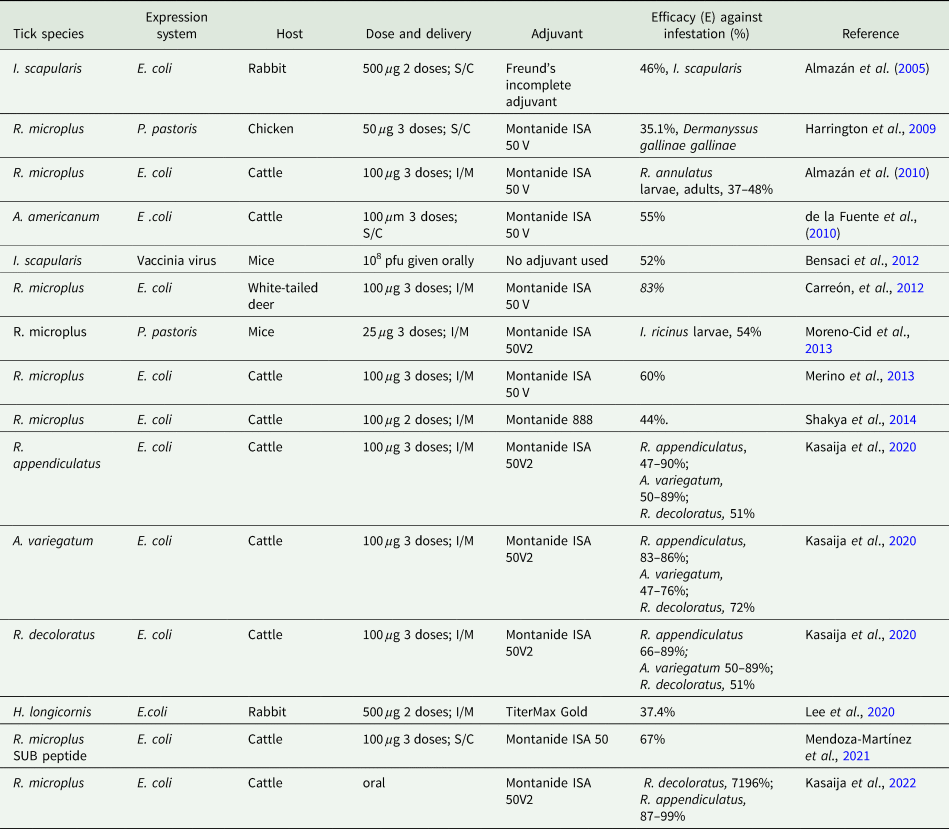
Abbreviations: S/C, subcutaneous; I/M, intramuscular; pfu, plaque forming units.
Taken together, these results support the efficacy of SUB vaccines against different tick genera and other arthropod vector species. Additionally, other antigens such as p29, Aquaporin, Metalloprotease, Potassium ion channels, Protease inhibitors, Calreticulin, P0, Ferritin 2 and Tropomyosin have shown protection against different tick species (de la Fuente and Kocan, Reference de la Fuente and Kocan2003; de la Fuente and Contreras, Reference de la Fuente and Contreras2015; Manjunathachar et al., Reference Manjunathachar, Kumar, Saravanan, Choudhary, Mohanty, Nagar, Chigure, Ravi Kumar, de la Fuente and Ghosh2019; Abbas et al., Reference Abbas, Jmel, Mekki, Dijkgraaf and Kotsyfakis2023; Parizi et al., Reference Parizi, Githaka, Logullo, Zhou, Onuma, Termignoni and da Silva Vaz2023; de la Fuente et al., Reference de la Fuente, Mazuecos and Contreras2023b; Nepveu-Traversy et al., Reference Nepveu-Traversy, Fausther-Bovendo and Babuadze2024).
Challenge 4: impact of tick strain genetic diversity on vaccine efficacy
Even if tick vaccine antigens such as SUB have shown efficacy against multiple tick species, the challenge related to strain genetic diversity and other factors needs to be considered. To face this challenge, a ‘personalized medicine’ approach was proposed considering regional, tick species/strains and host factors.
An example of this approach is the SUB antigen from R. appendiculatus, R decoloratus and A. variegatum, main tick species infesting Bos indicus and crossbred cattle in Uganda (Kasaija et al., Reference Kasaija, Contreras, Kabi, Mugerwa and de la Fuente2020). Vaccine formulations with antigens from these tick species were evaluated under controlled pen conditions in both cattle breeds to select R. appendiculatus-derived SUB as the antigen with higher cross-species protection (Kasaija et al., Reference Kasaija, Contreras, Kabi, Mugerwa and de la Fuente2020). This vaccine is now under field trial in Uganda (Kabi et al., Reference Kabi, Dhikusooka, Matovu, Mugerwa, Kasaija, Emudong, Kirunda, Contreras, Gortazar and de la Fuente2022). Other personalized SUB vaccines have been evaluated against different Indian tick species (Parthasarathi et al., Reference Parthasarathi, Kumar, Bhure, Sharma, Manisha, Nagar, Kumar, Nandi, Manjunathachar, Chigure, Shakya, Sankar, Fuente and Ghosh2023).
These results highlight the importance of personalizing vaccines considering tick, host and livestock farm management factors to improve effectiveness under field conditions.
Challenge 5: antigen combination to improve vaccine efficacy
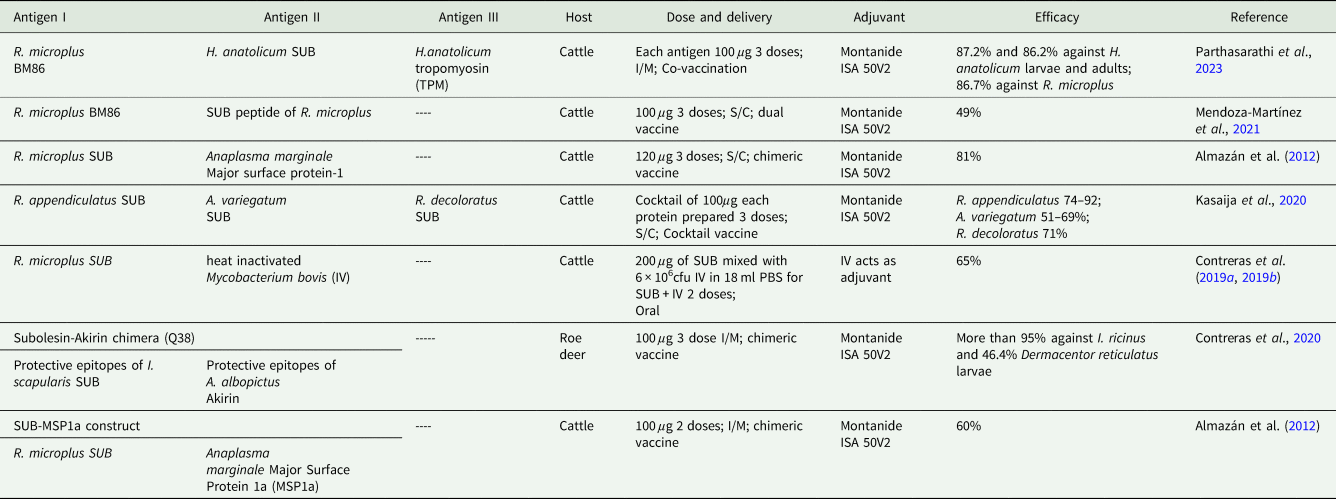
Antigen combinations have been considered to improve vaccine efficacy and results of experimental trials provided support for this approach (e.g. Vitellin-degrading cysteine endopeptidase (VTDCE), Boophilus yolk pro-cathepsin (BYC) and Glutathione S-transferase (GST-Hl), Parizi et al., Reference Parizi, Reck, Oldiges, Guizzo, Seixas, Logullo, de Oliveira, Termignoni, Martins and Vaz Ida2012; Bm86, SUB and Tropomyosin (TPM), Parthasarathi et al., Reference Parthasarathi, Kumar, Bhure, Sharma, Manisha, Nagar, Kumar, Nandi, Manjunathachar, Chigure, Shakya, Sankar, Fuente and Ghosh2023; Bm86 and P0 peptide, Rodríguez-Mallon et al., Reference Rodríguez-Mallon, Encinosa Guzmán, Bello, Domingos, Antunes, Kopacek, Santos, Velez, Perner, Ledesma Bravo, Frantova, Erhart, Rodríguez, Fuentes, Diago, Joglar, Méndez and Estrada2023) (Table 2). A comparatively higher efficacy was noted when compared with single antigen immunization. However, the main limitation of this approach is that protein-protein physical and immunological interactions may affect protective immune response in vaccinated hosts and thus additional experiments are required to eliminate the possible constraints in developing vaccine formulation using multiple antigens.
Examples of the efficacy of vaccination of animals with SUB combined with other tick/parasite antigens
To approach this limitation, the possibility of combining SUB DNA and protein in a vaccine formulation was considered (Hassan et al., Reference Hassan, Wang, Zhou, Cao, Zhang and Zhou2020). However, recent research has focused on quantum vaccinomics algorithms for the combination of antigen protective epitopes or immunological quantum (Artigas-Jerónimo et al., Reference Artigas-Jerónimo, Comín, Villar, Contreras, Alberdi, Viera, Soto, Cordero, Valdés, Cabezas-Cruz, Estrada-Peña and de la Fuente2020; Contreras et al., Reference Contreras, Kasaija, Kabi, Mugerwa and de la Fuente2022a, Reference Contreras, Artigas-Jerónimo, Pastor Comín and de la Fuente2022b). As recently proposed (de la Fuente et al., Reference de la Fuente, Mazuecos and Contreras2023b), in this approach, the prediction, identification and validation of protective epitopes is based on the combination of in vitro, in silico, in music and epitope mapping approaches with systems biology integration of omics datasets, artificial intelligence (AI) and Big Data (Villar et al., Reference Villar, Marina and de la Fuente2017; de la Fuente et al., Reference de la Fuente, Villar, Estrada-Peña and Olivas2018; de la Fuente and Contreras, Reference de la Fuente and Contreras2023).
Vaccinomics is based on the integrations of omics dataset for the identification of candidate vaccine protective antigens (Poland et al., Reference Poland, Kennedy, McKinney, Ovsyannikova, Lambert, Jacobson and Oberg2013; de la Fuente and Merino, Reference de la Fuente and Merino2013; Contreras et al., Reference Contreras, Villar, Alberdi and de la Fuente2016, Reference Contreras, Alberdi, Fernández De Mera, Krull, Nijhof, Villar and de La Fuente2017, Reference Contreras, Villar and de la Fuente2019a). The proposal of quantum vaccinomics originated from vaccinomics and the random processes such as immunoglobulin recombination events, direct correlation between atomic coordination and peptide immunogenicity and quantum dynamics of the immune response that has been subjected to optimizing evolution within living organisms supporting quantum immunology (reviewed by de la Fuente and Contreras, Reference de la Fuente and Contreras2021). Then, in reference to Albert Einstein quantum of light, immune protective epitopes were proposed as immunological quantum and quantum vaccinomics as the identification and combination of antigen immunological quantum for vaccine development (Artigas-Jerónimo et al., Reference Artigas-Jerónimo, Comín, Villar, Contreras, Alberdi, Viera, Soto, Cordero, Valdés, Cabezas-Cruz, Estrada-Peña and de la Fuente2020).
Antigens such as Q38 with SUB protective epitopes (Artigas-Jerónimo et al., Reference Artigas-Jerónimo, Comín, Villar, Contreras, Alberdi, Viera, Soto, Cordero, Valdés, Cabezas-Cruz, Estrada-Peña and de la Fuente2020; de la Fuente et al., Reference de la Fuente, Mazuecos and Contreras2023b) have shown protection against tick infestations and other arthropod vectors (Merino et al., Reference Merino, Antunes, Mosqueda, Moreno-Cid, Pérez de la Lastra, Rosario-Cruz, Rodríguez, Domingos and de la Fuente2013; Moreno-Cid et al., Reference Moreno-Cid, Pérez de la Lastra, Villar, Jiménez, Pinal, Estrada-Peña, Molina, Lucientes, Gortázar and de la Fuente2013; Contreras et al., Reference Contreras, San José, Estrada-Peña, Talavera, Rayas, Isabel León, Luis Núñez, García Fernández de Mera and de la Fuente2020; Letinić et al., Reference Letinić, Contreras, Dahan-Moss, Linnekugel, de la Fuente and Koekemoer2021) with correlation between SUB-reactive epitopes and vaccine efficacy (Contreras et al., Reference Contreras, Kasaija, Kabi, Mugerwa and de la Fuente2022a). The chimeric antigen RmSEI composed of R. microplus Subtilisin inhibitor 7 (RmSI-7), a Trypsin inhibitory like serine protease inhibitor, an interdomain region from the Kunitz inhibitor BmTI-A, and a cysteine-rich AMP-like Microplusin (RmSEI) was designed and showed anti-tick and antimicrobial activities (Costa et al., Reference Costa, Silva, Manzato, Torquato, Gonzalez, Parizi, da Silva Vaz Junior and Tanaka2023). This approach can also be used to combine tick with pathogen derived antigens (Shrivastava et al., Reference Shrivastava, Verma and Dash2020). Two multiepitopic peptides using amino acid sequences of ferritin-2 (FER2) and tropomyosin (TPM) vitellogenin receptor (VgR) were synthesized and tested against H. anatolicum infestations with more than 80% efficacy (Nandi et al., Reference Nandi, Manisha Solanki, Tiwari, Sajjanar, Sankar, Saini, Shrivastava, Bhure and Ghosh2023) (Table 2).
Quantum vaccinomics also considers immune mechanisms mediated by protein post-translational modifications such as carbohydrate alpha-gal (Galα1-3Galβ1-4GlcNAc) present in glycoproteins (Galili, Reference Galili2021) to address limitations of reductionists methods such as reverse vaccinology (Van Regenmortel, Reference Van Regenmortel2018; de la Fuente et al., Reference de la Fuente, Mazuecos and Contreras2023b). Accordingly, quantum vaccinomics covers some of the proposed top biotechnology trends in 2024 (https://www.startus-insights.com/innovators-guide/top-10-biotech-industry-trends-innovations-in-2021/) including AI, Big Data, gene editing, precision medicine, gene sequencing, biomanufacturing and synthetic biology.
In this way, quantum vaccinomics for protective antigen design considers vaccine efficacy and safety, geographic, environmental and population factors, host-tick-pathogen interactions and derived factors and host immunity for vaccinomics and adversomics.
Challenge 6: vaccine formulations and delivery platforms
Even when protective antigens are identified or designed, formulations and delivery are the key components of vaccine efficacy. Regarding tick control, recent advances in vaccine formulations targeting vector gut microbiota commensal bacteria was found effective (Mateos-Hernández et al., Reference Mateos-Hernández, Obregón, Maye, Borneres, Versille, de la Fuente, Estrada-Peña, Hodžić, Šimo and Cabezas-Cruz2020, Reference Mateos-Hernández, Obregón, Wu-Chuang, Maye, Bornères, Versillé, de la Fuente, Díaz-Sánchez, Bermúdez-Humarán, Torres-Maravilla, Estrada-Peña, Hodžić, Šimo and Cabezas-Cruz2021). Experimental manipulation of the microbiota has been achieved by antibiotic exposure or sterile-rearing conditions of the vector. Anti-microbiota vaccine impacted tick physiology by increasing tick weight during feeding and modulated tick microbiota composition and diversity in a taxon-specific manner. The impact of anti-microbiota vaccines on pathogen development was shown in Plasmodium relictum and the mosquito vector Culex quinquefasciatus (Aželytė et al., Reference Aželytė, Wu-Chuang, Žiegytė, Platonova, Mateos-Hernandez, Maye, Obregon, Palinauskas and Cabezas-Cruz2022), and recently it was reported that perturbations of tick microbiota can impact highly sensitive Borrelia spp. with departure from the modulation induced by the pathogen in the vector microbiota posing a high cost to the spirochete (Wu-Chuang et al., Reference Wu-Chuang, Hodžić, Mateos-Hernández, Estrada-Peña, Obregon and Cabezas-Cruz2021). However, these methods induce global changes in the microbiota and make the depletion of specific bacteria difficult. Recently, anti-microbiota vaccines were proposed as a precise tool for microbiota manipulation (Wu-Chuang et al., Reference Wu-Chuang, Hodžić, Mateos-Hernández, Estrada-Peña, Obregon and Cabezas-Cruz2021; Maitre et al., Reference Maitre, Wu-Chuang, Aželytė, Palinauskas, Mateos-Hernández, Obregon, Hodžić, Valiente Moro, Estrada-Peña, Paoli, Falchi and Cabezas-Cruz2022). Other advances including probiotics and formulations with high alpha-gal content (Cabezas-Cruz and de la Fuente, Reference Cabezas-Cruz and de la Fuente2017; Hodžić et al., Reference Hodžić, Mateos-Hernández, de la Fuente and Cabezas-Cruz2020; Bamgbose et al., Reference Bamgbose, Anvikar, Alberdi, Abdullahi, Inabo, Bello, Cabezas-Cruz and de la Fuente2021) and adjuvants with heat-inactivated alpha-gal-containing bacteria for oral vaccine administration (Contreras et al., Reference Contreras, Kasaija, Merino, de la Cruz-Hernandez, Gortazar and de la Fuente2019b; Kasaija et al., Reference Kasaija, Contreras, Kabi, Mugerwa, Garrido, Gortazar and de la Fuente2022). Oral vaccine formulations combining R. appendiculatus-derived SUB with heat-inactivated mycobacteria resulted in 96% and 99% efficacy against R. decoloratus and R. appendiculatus, respectively (Kasaija et al., Reference Kasaija, Contreras, Kabi, Mugerwa, Garrido, Gortazar and de la Fuente2022).
Tick vaccines have mainly been designed with recombinant antigens, but recent research includes advances in mRNA vaccines (Sajid et al., Reference Sajid, Matias, Arora, Kurokawa, DePonte, Tang, Lynn, Wu, Pal, Strank, Pardi, Narasimhan, Weissman and Fikrig2021; Boulanger and Wikel, Reference Boulanger and Wikel2023; Matias et al., Reference Matias, Cui, Tang, Sajid, Arora, Wu, DePonte, Muramatsu, Tam, Narasimhan, Pardi, Weissman and Fikrig2023). For antigen combination, chimeric antigens on microparticles and mRNA-lipid nanoparticles may be considered for vaccine delivery (Sajid et al., Reference Sajid, Matias, Arora, Kurokawa, DePonte, Tang, Lynn, Wu, Pal, Strank, Pardi, Narasimhan, Weissman and Fikrig2021; Matias et al., Reference Matias, Cui, Tang, Sajid, Arora, Wu, DePonte, Muramatsu, Tam, Narasimhan, Pardi, Weissman and Fikrig2023).
Challenge 7: combination of vaccines with transgenesis and paratransgenesis
Recently, Cas9-mediated gene editing was implemented in ticks by embryo injection and ReMOT Control (Sharma et al., Reference Sharma, Pham, Reyes, Chana, Yim, Heu, Kim, Chaverra-Rodriguez, Rasgon, Harrell, Nuss and Gulia-Nuss2022). The CRISPR-Cas molecular machines also provide interventions for paratransgenesis to manipulate tick microbiome and virome composition and function (Ramachandran and Bikard, Reference Ramachandran and Bikard2019).
More recently, Frankenbacteriosis was developed for paratransgenic manipulation of tick commensal Sphingomonas bacterium to reduce tick fitness and Anaplasma phagocytophilum pathogen infection (Mazuecos et al., Reference Mazuecos, Alberdi, Hernández-Jarguín, Contreras, Villar, Cabezas-Cruz, Simo, González-García, Díaz-Sánchez, Neelakanta, Bonnet, Fikrig and de la Fuente2023a, Reference Mazuecos, González-García and de la Fuente2023b; de la Fuente et al., Reference de la Fuente, Mazuecos and Contreras2023b).
Transgenesis and paratransgenesis may be combined with anti-tick vaccines and other control interventions including the proposed Suicidalbacteriosis in which tick commensal bacteria are manipulated to produce and secrete antigens protective against ticks and tick-borne pathogens to immunize hosts during blood feeding (de la Fuente et al., Reference de la Fuente, Mazuecos and Contreras2023b). For example, genetic manipulation of tick microbiome and virome composition and function may produce ticks more susceptible to tick vaccine induced host immune response thus improving vaccine efficacy for the control of tick infestations and vector capacity.
However, application of gene editing technology involves risks since it may produce off target deleterious mutations. A high frequency of off-target effects has been reported in human cells but low in mice and zebrafish (Hwang et al., Reference Hwang, Fu, Reyon, Maeder, Tsai, Sander, Peterson, Yeh and Joung2013; Yang et al., Reference Yang, Wang, Shivalila, Cheng, Shi and Jaenisch2013). Large genomes may contain identical or homologous DNA sequences to intended target DNA sequence. Gene editing technology may delete these unintended sequences causing mutations which may cause cell death or transformation. Efforts have been made to reduce off-target mutations, but further improvement is required. Another problem is efficient safe delivery of CRISPR-Cas9 into cell types that are hard to transfect. If there is a risk of transferring genes to other species, there is risk of transferring modified sequences. It is difficult to control dispersion of gene driven trait. Moreover, disappearance of whole populations targeted by gene drive may have serious consequences in the ecosystem equilibrium. All these risk factors demand careful assessment of each potential application and need for critical regulatory norms.
Conclusions and future directions
Tick vaccine antigens evolved from organ specific protein extracts to recombinant proteins to vaccinomics algorithms for designing chimeric antigens. Recent advances in tick vaccinology and future directions include discovery of novel protective antigens (de la Fuente and Contreras, Reference de la Fuente and Contreras2015; Abbas et al., Reference Abbas, Jmel, Mekki, Dijkgraaf and Kotsyfakis2023) including the application of AI and Big Data analytic techniques (de la Fuente et al., Reference de la Fuente, Villar, Estrada-Peña and Olivas2018), novel vaccine formulations and delivery platforms (Ndawula, Reference Ndawula2021; Tabor, Reference Tabor2021; Pereira et al., Reference Pereira, Ribeiro, Gonçalves, da Silva, Lair, de Oliveira, Boas, Conrado, Leite, Barata, Reis, Mariano, Santos, Coutinho, Gontijo, Araujo, Galdino, Paes, Melo, Nagem, Dutra, Silveira-Lemos, Rodrigues and Giunchetti2022), mRNA vaccines (Sajid et al., Reference Sajid, Matias, Arora, Kurokawa, DePonte, Tang, Lynn, Wu, Pal, Strank, Pardi, Narasimhan, Weissman and Fikrig2021; Matias et al., Reference Matias, Cui, Tang, Sajid, Arora, Wu, DePonte, Muramatsu, Tam, Narasimhan, Pardi, Weissman and Fikrig2023; Boulanger and Wikel, Reference Boulanger and Wikel2023), vaccinomics and quantum vaccinomics (Poland et al., Reference Poland, Kennedy, McKinney, Ovsyannikova, Lambert, Jacobson and Oberg2013; de la Fuente and Contreras, Reference de la Fuente and Contreras2021, Reference de la Fuente and Contreras2023; Contreras et al., Reference Contreras, Artigas-Jerónimo, Pastor Comín and de la Fuente2022b). Other methods include use of formulations with combined protective antigens (Ndawula and Tabor, Reference Ndawula and Tabor2020; Parthasarathi et al., Reference Parthasarathi, Kumar and Ghosh2021), probiotics and other formulations targeting tick microbiota (Cabezas-Cruz and de la Fuente, Reference Cabezas-Cruz and de la Fuente2017; Hodžić et al., Reference Hodžić, Mateos-Hernández, de la Fuente and Cabezas-Cruz2020; Mateos-Hernández et al., Reference Mateos-Hernández, Obregón, Maye, Borneres, Versille, de la Fuente, Estrada-Peña, Hodžić, Šimo and Cabezas-Cruz2020, Reference Mateos-Hernández, Obregón, Wu-Chuang, Maye, Bornères, Versillé, de la Fuente, Díaz-Sánchez, Bermúdez-Humarán, Torres-Maravilla, Estrada-Peña, Hodžić, Šimo and Cabezas-Cruz2021; Wu-Chuang et al., Reference Wu-Chuang, Mateos-Hernandez, Maitre, Rego, Šíma, Porcelli, Rakotobe, Foucault-Simonin, Moutailler, Palinauskas, Aželytė, Sǐmo, Obregon and Cabezas-Cruz2023). To improve vaccine efficacy, post-translational modifications such as alpha-gal have also been considered to improve vaccine efficacy (Hodžić et al., Reference Hodžić, Mateos-Hernández, de la Fuente and Cabezas-Cruz2020). Moreover, characterization of tick-host-pathogen interactions, immune protective and acaricide-resistance mechanisms (Bhowmick and Han, Reference Bhowmick and Han2020; Bishop et al., Reference Bishop, Stutzer and Maritz-Olivier2023; Waldman et al., Reference Waldman, Klafke, Tirloni, Logullo and da Silva Vaz2023), transgenesis and paratransgenesis for the genetic manipulation of commensal bacteria and ticks (Sharma et al., Reference Sharma, Pham, Reyes, Chana, Yim, Heu, Kim, Chaverra-Rodriguez, Rasgon, Harrell, Nuss and Gulia-Nuss2022; Mazuecos et al. Reference Mazuecos, Alberdi, Hernández-Jarguín, Contreras, Villar, Cabezas-Cruz, Simo, González-García, Díaz-Sánchez, Neelakanta, Bonnet, Fikrig and de la Fuente2023a; de la Fuente et al., Reference de la Fuente, Mazuecos and Contreras2023b) and combination of vaccines with other interventions such as natural plant and animal-derived compounds and cultural practices among other interventions (Showler and Saelao, Reference Showler and Saelao2022) were considered as possible alternatives. International collaborations with regions with high incidence of tick infestations and TBD (Estrada-Peña and de la Fuente, Reference Estrada-Peña and de la Fuente2023), personalized medicine approach based on regional, tick species/strains and host-driven variables (Kasaija et al., Reference Kasaija, Contreras, Kabi, Mugerwa and de la Fuente2020) are also proposed for sustainable management of the relevant vector.
Data availability statement
All data used in the study is disclosed in the paper and corresponding references.
Acknowledgements
We thank all our collaborators worldwide for their contribution to advance in tick vaccinology.
Authors’ contributions
JF and SG conceived and wrote the article.
Financial support
This research received no specific grant from any funding agency, commercial or not-for-profit sectors.
Competing interests
None.
Ethical standards
Not applicable.


 Open access

