

Why do certain citizens in autocratic regimes choose to support a political party? And what differentiates partisans who support the ruling party from those who support opposition parties? The choice to participate in everyday politics under authoritarianism has always been puzzling (Hermet, Rose, and Rouquié Reference Hermet, Rose and Rouquié1978). Whether in defense of the autocratic government or in support of the opposition, partisanship can seem irrational when the regime is specifically designed to insulate those in power from the will of the people. Electoral autocracies are especially puzzling because millions of citizens are regularly mobilized to participate every few years by both the ruling party and opposition parties, despite the fact that almost everyone already knows the outcome of the election beforehand. And yet, partisanship is clearly an important political cleavage in such regimes. It has been shown to predict political beliefs about democracy (Jöst, Vergioglou, and Jacob Reference Jöst, Vergioglou and Jacob2022) and trust in government (Letsa Reference Letsa2019; Tertytchnaya Reference Tertytchnaya2020)—perhaps even after a transition to democracy (Neundorf, Gerschewski, and Olar Reference Neundorf, Gerschewski and Olar2020)—and trust in the regime has been used to predict political behaviors such as voting (Reuter Reference Reuter2020), protest (Williamson Reference Williamson2021), and susceptibility to propaganda (Chapman Reference Chapman2021).
Yet, while there is a large and growing body of work that seeks to explain the paradox of participation in electoral autocracies (especially voting), we have very few theories that specifically focus on the origins of partisanship in these types of regimes. Centered primarily on support for the ruling party, the existing literature overwhelmingly points to individual characteristics to explain why certain types of people choose to participate in autocratic elections. Specifically, a number of studies have shown that people vote for ruling parties for economic reasons, in anticipation of a personal or community-based reward (Blaydes Reference Blaydes2011; Lust-Okar Reference Lust-Okar2006; Magaloni Reference Magaloni2006; Miguel, Jamal, and Tessler Reference Miguel, Jamal and Tessler2015). On the other hand, while there is little systematic research on opposition partisanship itself, the literature on support for democracy implies such partisanship may be largely ideological, stemming, perhaps, from higher levels of education (Croke et al. Reference Croke, Grossman, Larreguy and Marshall2016). Highly educated citizens are better situated to reject autocratic propaganda (Geddes and Zaller Reference Geddes and Zaller1989) and are also more likely to live more cosmopolitan lives, placing higher value on democracy and freedoms (Lipset Reference Lipset1959b), implying, perhaps, an inclination toward opposition support.
However, neither of these two sets of literature are focused specifically on partisanship, nor are they directly in conversation with one another. As a result, we lack a unified theory of partisanship under autocracy, leading to indeterminant predictions about who supports autocratic regimes and why. For example, one set of studies posits that high levels of socioeconomic status correlate with support for the ruling party because the middle class has better access to patronage networks (Frye, Reuter, and Szakonyi Reference Frye, Reuter and Szakonyi2014; Miguel, Jamal, and Tessler Reference Miguel, Jamal and Tessler2015), while another predicts that low levels of socioeconomic status should correlate with support for the ruling party because it is cheaper to “buy” the support of the poor (Blaydes Reference Blaydes2011). Alternatively, some theories of democratization posit that the poor are the most likely to oppose autocracy because of their economic interests (Acemoglu and Robinson Reference Acemoglu and Robinson2006; Boix Reference Boix2003), while others argue that the poor should be the most staunch defenders of the autocratic status quo because they fear economic upheaval (Lipset Reference Lipset1959a).Footnote 1 Most glaringly, however, political science is nearly silent on what differentiates partisans as a group from nonpartisans in the context of authoritarian regimes.
Recognizing the indeterminacy of the hypotheses proposed by the existing literature, this article presents a unified theory of partisanship in electoral autocracies. I argue that while existing frameworks of political behavior in autocracies focus on “snapshot” moments before elections to explain the choices of ordinary citizens, we must instead look to the broader social contexts of ordinary people to fully understand their political choices (Fokwang Reference Fokwang2016; Weghorst Reference Weghorst2022). Drawing on our understanding of partisanship in consolidated democracies (Green, Palmquist, and Schickler Reference Green, Palmquist and Schickler2002; Huckfeldt and Sprague Reference Huckfeldt and Sprague1995; Lazarsfeld Reference Lazarsfeld1948; Sinclair Reference Sinclair2012), as well as recent work by Laebens and Öztürk (Reference Laebens and Öztürk2021) in Turkey, I propose that it is more fruitful to view partisanship as a social identity than as a rationalist response to material incentives. If partisanship is like a social identity, I argue that the origins of these identities can be found in the process of political socialization within social networks. Following on this logic, I show that the best predictor of an individual’s partisanship (ruling party partisanship, opposition partisanship, or nonpartisanship) is not individual characteristics, such as education or socioeconomic status, but instead the political homogeneity of their social network. I argue further that this partisan homogeneity is not driven primarily by other forms of homophily, such as education or ethnicity. Finally, I show that partisan homogeneity is not entirely ecological; people do not primarily self-select into partisan networks because of their pre-existing political preferences. Instead, at least to some extent, people are influenced by their networks, and partisan contagion has the ability to turn people into specific types of partisans through the process of socialization.
I test this theoretical framework in Cameroon, an electoral autocracy in central Africa that has been holding regular multiparty elections since 1992, in which the ruling party has won every election, and the same President has remained in power since 1982. In addition to illustrating the process of political socialization using the qualitative life histories of 12 ordinary Cameroonians, I formally test the argument using data from an original public opinion survey fielded in 4 of Cameroon’s 10 regions. The survey asked respondents to list all of the people in their lives with whom they have “important conversations about life and current events” and then asked a series of questions about each of these discussion partners. The data show, first, that network partisan homogeneity has an outsized influence on individual-level partisanship. Second, this result holds even when controlling for prominent forms of network homophily. Finally, by looking exclusively at discussion partners whose relationship predates the respondent’s reported interest in politics, the data show that network ecology is not driven by partisan homophily itself. I contend that using a social identity theory framework can explain more variation in political behavior in autocratic regimes than a materialist framework alone.
Why does it matter if partisanship is a social identity or not? Conceptualizing partisanship in this way can help to make sense of all sorts of seemingly irrational behaviors in these types of regimes. For example, a sociological perspective can help to explain why many studies have found that citizens do not punish corruption or poor governance (Dunning et al. Reference Dunning, Grossman, Humphreys, Hyde, McIntosh and Nellis2020). Drawing this logic even further, it could help to explain high voter turnout for ruling parties in some of the poorest, most corrupt countries in the world, like Cameroon, Chad, Togo, and Uganda, where few citizens have access to patronage networks or social spending programs. Better understanding the origins of these identities and how they change over time may be central to explaining variation in voter turnout, regime support, and beliefs about democracy both over time as well as across different countries.
In addition to opening up new lines of inquiry, however, this article attempts to “normalize” the study of political behavior in the context of authoritarian regimes, which has overwhelmingly relied upon materialist explanations to rationalize the motivations of ordinary people. Understanding the more banal reasons why citizens participate is critical to de-exotifying politics in non-Western contexts, particularly autocratic ones. As Adam Przeworski (Reference Przeworski2022) has recently argued, the exotification of autocratic politics based on ideological assumptions about authoritarianism has led political scientists to make erroneous conclusions about politics in these types of regimes. Indeed, Thomas Pepinsky (Reference Pepinsky2017) has noted that despite headlines about repression and revolution, in fact, “Life in authoritarian states is mostly boring and tolerable.” This article responds to these arguments by investigating the day-to-day “ordinariness” of political participation in electoral autocracies. Everyday people wield an immense power in their ability to shape the ideas and beliefs of their friends and family, and oftentimes they do not even realize it. The cascading effect of political socialization is a largely silent process and yet potentially foundational in its potential to facilitate support for democratization in autocratic countries. Or, alternatively, to sustain the status quo.
SCOPE CONDITIONS: ELECTORAL AUTOCRACIES
The theory presented in this article pertains to electoral autocracies, the most common form of autocracy in the world today (Coppedge et al. Reference Coppedge, Edgell, Knutsen and Lindberg2022; Guriev and Treisman Reference Guriev and Treisman2022; Magaloni and Kricheli Reference Magaloni and Kricheli2010; Morse Reference Morse2012). Electoral autocracies are regimes that hold national-level, multiparty elections with an independent opposition, but where the likelihood of an opposition win is extremely unlikely because of structural impediments constructed by the regime (Schedler Reference Schedler2006). These impediments include gerrymandering, electoral fraud, the use of state resources for campaigning and propaganda, as well as harassment and intimidation of the opposition (Morgenbesser Reference Morgenbesser2020; Schedler Reference Schedler2002). Formally, the theory pertains to any country that has been consistently coded as an “electoral autocracy” by V-Dem’s “Regimes of the World” variable (Coppedge et al. Reference Coppedge, Gerring, Knutsen, Lindberg, Teorell, Altman and Bernhard2023)Footnote 2 for the past 10 years (2012–2022). Because this is a study of partisanship, I exclude regimes with no formal ruling party or where parties do not last more than one election cycle, as well as those that have experienced regime change within the past 10 years. A list of these cases is included in Supplementary Appendix A. Critical to the theory in this article, these regimes provide just enough freedom for ordinary citizens to associate with opposition parties—as well as enough freedom to make opposition partisanship a meaningful political division from ruling party partisanship—while simultaneously making it just difficult enough to do so that partisanship is heavily skewed toward the ruling party.
INDIVIDUAL-LEVEL APPROACHES TO UNDERSTANDING PARTISANSHIP UNDER AUTOCRACY
Following the proliferation of electoral autocracies since the 1990s (Levitsky and Way Reference Levitsky and Way2010), a growing literature has sought to explain the apparent puzzle of why ordinary citizens bother to get involved in autocratic politics. Given the apparent obviousness of the outcome of the election, why would anyone bother to support a party or vote in elections in the first place? Because, by definition, ruling parties dominate in electoral autocracies—and thus the large majority of partisans are ruling party partisans—this literature has heavily focused on why ordinary people choose to vote for ruling parties, especially when this means that they are supporting the very authoritarianism that presumably undermines their own rights and freedoms.Footnote 3
Overwhelmingly, the literature shows that people vote for the ruling party in expectation of a direct or community-based economic reward. For example, Blaydes (Reference Blaydes2011) and Magaloni (Reference Magaloni2006) demonstrate that electoral autocracies—specifically Mexico under the PRI and Hosni Mubarak’s Egypt—focus their social spending and infrastructure investments in ways that correlate with voting behavior. These regimes tended to invest more heavily in strongholds or swing districts, implying that ordinary citizens support the ruling party in expectations of these rewards. However, due to the limitations of the macro-level data, they cannot show whether or not vote choice at the individual level is actually affected by this logic of spending.
In contrast, studies by, for example, Lust-Okar (Reference Lust-Okar2006) and Miguel, Jamal, and Tessler (Reference Miguel, Jamal and Tessler2015) focus on the voter, arguing that ordinary citizens support candidates that they believe will offer them clientelist access to the regime, specifically through personal connections. Naturally, in an electoral autocracy, candidates with the best connections to patronage almost exclusively belong to the ruling party. Thus, most people vote for the ruling party in order to access personal benefits via clientelism. Taken together, these two hypotheses—that people support the ruling party in expectation of improved government spending in their district or personal clientelist exchange—are central to our understanding of political behavior in electoral autocracies. In fact, these explanations are so dominant in the literature that few other explanations have even been proposed, though a newer literature has begun to focus on some of the more ideological reasons people vote for ruling parties, specifically a sense of patriotism and civic duty (Letsa Reference Letsa2020; Reuter Reference Reuter2020).
A parallel literature has inversely proposed a different set of explanations as to why some people living in autocracies are more likely than others to prefer democracy (and therefore, by implication, oppose the autocratic regime). The core logic is that people prefer democracy for ideological reasons, stemming primarily from higher levels of education. This general idea was first articulated by Lipset (Reference Lipset1959a; Reference Lipset1959b), who famously argued that economic development was correlated with democracy because people with higher levels of education and socioeconomic status should be more likely to prefer democracy to authoritarianism. Of course, Lipset was not making an argument about partisanship under electoral autocracy, but his logic carries to the puzzle at hand: we might expect people with higher levels of wealth and education to support opposition parties because these parties campaign on platforms of democratization (Letsa Reference Letsa2019). Croke et al. (Reference Croke, Grossman, Larreguy and Marshall2016) make this argument most explicitly, finding that citizens with higher levels of education in Zimbabwe under the Mugabe regime were more likely to opt out of politics altogether (nonpartisanship) or support the opposition.Footnote 4 Recently, Rosenfeld (Reference Rosenfeld2020) has offered a compelling corrective to this theory, arguing that when the middle class is captured by the state, this relationship between socioeconomic status and opposition support disappears.Footnote 5
Taken together, these core hypotheses provide arguments for different sides of the same coin; the first about why some people might vote for ruling parties and the second about why some people would vote against them. However, neither provides a unified theory of vote choice in electoral autocracies. In other words, neither offers a compelling explanation for the inverse outcome, resulting in indeterminant predictions about whether or not socioeconomic status leads to support for the ruling party or support for the opposition. Further, despite the strong correlation between partisanship and both vote choice and support for democratization, very little of this literature directly considers partisanship itself. The lack of attention to partisanship in autocratic contexts is perhaps tied to an assumption that it is less meaningful than partisanship in democracies. Yet, if we are interested in understanding support for democracy itself, presumably such identities matter quite a bit (Jöst, Vergioglou, and Jacob Reference Jöst, Vergioglou and Jacob2022). Existing approaches tell us very little about the origins, meaning, or content of such identities.
A SOCIAL THEORY OF PARTISANSHIP
I argue that these individual-level explanations for participation in electoral autocracies cannot fully answer the question of partisanship because they miss the social context that has become key to our understanding of democratic politics (for an overview, see Campbell Reference Campbell2013). I propose that political socialization within social networks is central to understanding partisanship in electoral autocracies: what differentiates partisans as a group from nonpartisans is that they belong to social networks full of other people who support political parties and are therefore socialized to adopt the same partisan identities of their friends and families. The core argument of this article is that if “ruling party partisanship” and “opposition partisanship” are social identities built through a process of socialization, then a key observable implication will be that the best predictor of partisanship—both whether one is close to a party at all and whether one is close to the ruling party or an opposition party—is not education or access to patronage but the political nature of one’s social network.
Ordinary citizens tend to adopt the same identities of the other people in their social networks through the day-to-day interactions they have that influence their perceptions and beliefs (Tajfel Reference Tajfel1981). When people spend time with family and friends who bring value and meaning to their lives, they tend to take seriously their ideas, beliefs, and the meaning of their social identities. They are inclined to view the beliefs and identities of their loved ones through a positive lens and therefore approach these things with a more open mind than they would with a stranger or casual acquaintance. Although the qualitative data I present will lend some evidence to the argument that families play an outsized role in the adoption of partisan identities, parents are not the only source of political socialization in any given person’s life. I argue that political socialization—the “transmission” of a partisan identity—can occur between any close social contacts (Chazan Reference Chazan1978; Ventura Reference Ventura2001). However, the more homogenously partisan one’s social network, the more likely such transmission will occur.Footnote 6
This argument builds on several classic studies of partisanship and vote choice in democratic contexts, most specifically on Huckfeldt and Sprague’s (Reference Huckfeldt and Sprague1995) study of South Bend, Indiana, who find a high level of political congruence between discussion partners.Footnote 7 Using similar methods but with nationally representative samples, Sinclair (Reference Sinclair2012) shows a strong correlation between the partisanship of discussion partners and individual-level partisanship in the US. Further, using panel data, she finds considerable evidence that people even change parties when their social networks are discordant with their own partisanship, providing clear evidence that social networks influence the choice of partisan identity.Footnote 8
In addition to showing that political socialization within networks matters for understanding individual-level partisanship, I also argue that the partisan homogeneity of social networks itself is not driven by homophily (e.g., selecting into networks based on shared demographic characteristics, such as education or ethnicity, which are correlated with partisanship). In other words, it is plausible that because people seek relationships with people who are like themselves, the members of social networks may all possess similar levels of education (or ethnicity, socioeconomic status, etc.) and choose their political parties because of those characteristics and not because of political socialization or partisan contagion within networks. While most social networks feature some level of homophily based on education and other demographic factors, I show that these are not good predictors of individual-level partisanship.
Finally, building on the findings of Sinclair (Reference Sinclair2012) as well as Lazer et al. (Reference Lazer, Rubineau, Chetkovich, Katz and Neblo2010), I contend that not only is the most predictive feature of different networks partisanship itself (as opposed to, for example, education) but also that people are not exclusively self-selecting into partisan networks. In other words, network ecology—the origins of a social network—is not built upon shared partisanship. Instead, the mechanism that links partisan homogeneity of networks to individual partisanship is the process of political socialization; one’s partisanship is influenced and shaped by the people with whom one is already socializing. Evidence from democratic regimes suggests that political discussion with close contacts can and does change people’s political opinions (Beck Reference Beck2002; Beck et al. Reference Beck, Dalton, Greene and Huckfeldt2002; Klar Reference Klar2014; Mutz Reference Mutz2002), and I argue that this is the case in autocracies as well.
It is common sense that not only do we as humans choose to become close to people who are already like us but that as we become close to people, we also become more like them. Empirically, it is extremely difficult to pick apart these two separate processes (McPherson, Smith-Lovin, and Cook Reference McPherson, Smith-Lovin and Cook2001), and in fact Shalizi and Thomas (Reference Shalizi and Thomas2011) argue that it is functionally impossible to do so. But it is equally clear that the processes of network homophily and network contagion are not equivalent. For both individual and environmental reasons, some people are more likely than others to self-select into social networks that already look like them. Similarly, some people are more prone to social influence from their networks than are others. But for the purposes of this theory of partisanship, it is important to establish that partisan contagion can explain a high level of variation. If people are solely self-selecting into partisan networks, then clearly it is not the network that is causing partisanship, but vice versa.Footnote 9
CASE SELECTION: CAMEROON
I test this theory in Cameroon, a typical electoral autocracy for sub-Saharan Africa. Since independence from France and Britain in 1960–1 until its first multiparty elections in 1992, Cameroon was a single-party regime. By 1966, the first President, Ahmadou Ahidjo, had unified Cameroon’s multiparty system under the umbrella of his own political party, the Union nationale camerounaise (UNC) (Johnson Reference Johnson1970), and single-party elections were held every 5 years to re-elect Ahidjo and a national list of deputies to the National Assembly. Ahidjo stepped down from the Presidency in 1982, handing over power to his Prime Minister, Paul Biya. In 1985, as part of this succession process, Biya reorganized the UNC and renamed it the Rassemblement démocratique du peuple camerounais (RDPC), though it soon became clear that the RDPC was functionally equivalent to the UNC (Sindjoun Reference Sindjoun1999).
As pro-democracy protests swept sub-Saharan Africa in the early 1990s, an impressively large and unified protest movement hit Cameroon, mobilizing protests in its major cities and towns for months (Takougang and Krieger Reference Takougang and Krieger1998). Biya reluctantly conceded to legalizing opposition parties and set Cameroon’s first postcolonial multiparty elections for 1992. Paul Biya and the RDPC have won every election since 1992 with large majorities of the vote. As with any electoral autocracy, the regime has maintained its electoral advantage through various legal and extralegal channels. Access to the media (especially television broadcast) remains dominated by the state; the conflation between the ruling party and the state gives the RDPC unparalleled access to resources and campaign funding; gerrymandering continues to make winning structurally more difficult for the opposition (Albaugh Reference Albaugh2011; Takougang Reference Takougang2003). While vote choice in Cameroon has long been assumed to be tied to ethnic identities (Fonchingong Reference Fonchingong2005; Menthong Reference Menthong1998; Nyamnjoh Reference Nyamnjoh1999), partisanship has yet to be considered as a social identity itself in this context.
Thus, in the ways that are important to the argument in this article, Cameroon is a quite typical case of electoral autocracy. Most importantly, the regime has been around long enough—over 30 years—that the system has become predictable (Bombela and Daniel Reference Bombela and Daniel2023). For example, in a 2015 public opinion survey, 70% of Cameroonians reported that if an election were held tomorrow, the RDPC would “definitely win a clear majority of seats in the National Assembly” (Letsa Reference Letsa2020). At the same time, for the most part, ordinary citizens can support opposition parties without great risk to themselves, though highly visible support, such as protest, does increase this risk, especially since the outbreak of violence in the Anglophone regions in 2017 (Amin Reference Amin2021). It is possible that partisan socialization differs in cases of extreme repression, where any outward support for the opposition means risking life and limb.
QUALITATIVE EVIDENCE OF POLITICAL SOCIALIZATION
The theory presented in this article is primarily tested with original survey data collected in Cameroon, described in the following section. However, before formally testing the relationship between social networks and partisanship, I first present the stories of several Cameroonians who shared with me their reasons for supporting a political party. I collected their stories as a “plausibility check” on the concept of partisanship as a social identity and present them here in order to illustrate various processes of political socialization. These life histories do not focus on the full networks of the 12 subjects but instead on the mechanism linking individual identities to partisan homogeneity within networks: the process of political socialization.
Despite issues of generalizability, the qualitative data provide information on the process of political socialization that is extremely difficult to gather through large-n surveys. The nature of closed response options limits the ability of research subjects to share the life events and relationships that are at the heart of the construction of social identities. Even open-ended questions embedded in surveys are exceedingly limited in their ability to capture the relevant information necessary to understand how people come to support a political party. Most importantly of all, people themselves often are not cognizant of these processes. When asked outright why they support a party, people tend to draw upon superficial talking points—they report that they support a party “for change,” “for development,” or “for democracy.” Further, many people may find it socially undesirable to report that they have been influenced by other people, especially politically; even if unconsciously, we often like to think of ourselves as independent (Klar and Krupnikov Reference Klar and Krupnikov2016).
Thus, while the interviews provide rich detail of the proposed mechanism of political socialization, they are not representative of a larger sample of Cameroonians and are limited in their capacity to show a causal relationship between social networks and individual partisanship. However, if a significant proportion of the subjects had failed to identify key people in their lives who had influenced their political beliefs or had indicated that they had come to support a political party for clear ideological or economic reasons that were not tied to social considerations, it would cast considerable doubt upon the idea that partisanship is produced through socialization.
Thus, in the summer of 2022, I recruited 12 research subjects representing different types of partisanship—five ruling party partisans, five opposition partisans, and two nonpartisans—in three research sites across CameroonFootnote 10 to give an account of their early lives, how they came to learn about politics, and how they came to support one party or another (or no party at all, as the case may be). The life history portion of the interviews lasted between 1 and 2 hours. A short summary of the descriptive characteristics of each subject is presented in Table 1.Footnote 11 Short descriptions of all 12 subjects can be found in Supplementary Appendix B.
Description of the 12 Core Research Subjects
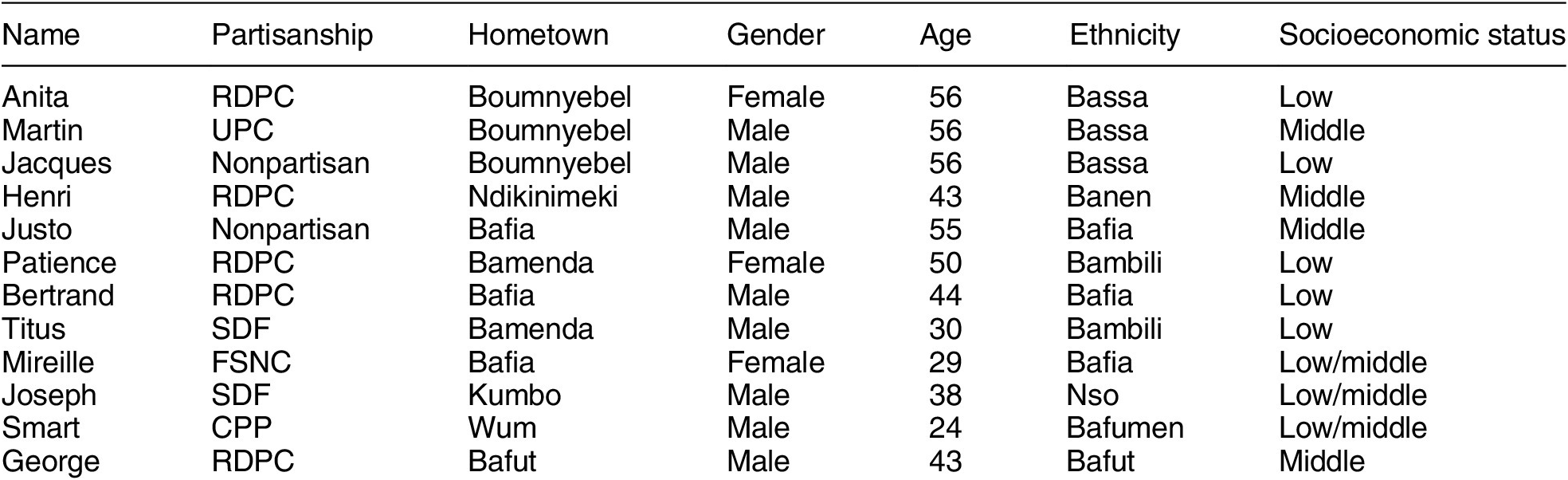
In sum, 9 of the 10 partisans clearly pinpointed people in their lives who “invited” them to join the party. For half of these partisans (Anita, Bertrand, Henri, Joseph, and Martin), this person was their father or a father-figure. For those who grew up without a father figure (Titus and Smart), it was friends who invited them later in life. Patience, Mireille, Jacques, and George all had nonpartisan parents; Jacques followed in the footsteps of his parents, while Patience and Mireille joined parties in their adulthood when they were invited by other important people in their lives. George was the only person I interviewed who joined a party—the RDPC—for purely materialist reasons.
Bertrand, a native of the RDPC stronghold Bafia, is the prototypical example of someone whose partisanship was strongly influenced by his family growing up (Jennings and Niemi Reference Jennings and Niemi1968). He was raised by his maternal grandfather, who had served in the French colonial army during WWII. At independence, his grandfather enthusiastically joined the UNC, serving as a Municipal Councilor for 25 years under first the UNC and then the RDPC after the 1985 transition. Bertrand reported that he idolized his grandfather; he was his grandfather’s namesake and “confidante.” There was no question in Bertrand’s mind that he would join—and eventually become active in—the RDPC, despite the fact that his own father, with whom he was not very close, was a Municipal Councilor for the largest opposition party in Cameroon, the Social Democratic Front (SDF). His father had even come to Bertrand to campaign for his vote, but Bertrand turned him down: “I was on my side and he was on his side, and I did not have any problem….[But] I did not vote for him because I had my aims in the RDPC and therefore I had nothing to do with the SDF” (June 21, 2022). Because of the disciplined stance of his beloved grandfather, Bertrand would support the RDPC no matter what—even if it meant voting against his own father.
Joseph, a lifelong supporter of the opposition SDF, described how two different uncles who had raised him influenced his choice. Ironically, both of these uncles were also members of the Cameroonian military. The first uncle (who Joseph lived with in Limbe for his primary education) was a marine, and the second (who he lived with in Yaoundé for his secondary education) was actually a gendarme.Footnote 12 Because they were in the military, it was impossible for them to express their political beliefs outside of the house: “we discussed politics only at home, like if we were watching debates on the television. So that’s what I learned from him. That’s what even pushed me to support the party then” (June 25, 2022). It was not until he left his uncle’s house that he could openly support the SDF by going to meetings and rallies. For Joseph, it was a point of pride that he could openly support the SDF; almost as if through his open support he was not just representing his own political beliefs and identity but also those of the uncles who raised him, on their behalf.
For those who did not grow up in partisan households, friends and colleagues tended to play a larger role in the process of political socialization. For example, Smart, an Anglophone graduate student at the University of Yaoundé II, reported that his father passed away when he was just 2 years old and was raised by a single mother. It was not until he came to university in 2018 that he became interested in politics. When I asked Smart whether most of his friends at university support the regime or the opposition, he replied: “I think 99 percent of those I speak to are against the system” (June 27, 2022). Within this environment, Smart said that his roommate’s friend, Zachariah, used to come to his dorm every time there was a political event or debate on TV. Eventually, Zachariah, a supporter of the opposition Cameroon Renaissance Movement (MRC), invited Smart to a meeting of Stand Up for Cameroon (a consortium of opposition parties) where Smart discovered the Cameroon People’s Party (CPP) and became a member. When I asked Smart, “Do you think if not for Zachariah or for your other friends, you would not have gotten involved in politics? Or do you think you would have gone anyways?” He replied, “No, I was already into it, I think without them. I do not do this for people. I have been politically orientated from the onset. I just needed someone to show me the way—what Zachariah did in 2018, and that was enough” (June 27, 2022).
Of the 10 partisans that I interviewed, George was the only one who did not explain his partisanship in terms of the social relationships in his life. He was an RDPC partisan for pragmatic reasons, hoping that by joining the party he could advance his own career as well as the economic prospects of his hometown. In his 30s, he decided to stand as president of the youth wing of the RDPC subsection in his hometown, Bafut, with the thought of running for mayor. When I asked George about the fact that Bafut normally elects its representatives from the opposition SDF, he replied, “Yes, it is normally for SDF, so we wanted a change because we realized that when we are under SDF, so many things, they do not come to us. So we wanted to change that. We wanted the government to realize that now in Bafut they have the ruling party that is working there seriously so that they can bring so many other opportunities for us” (June 27, 2022). Just as the literature would suggest, it was clear that George—a young, highly educated, middle-class man from a family of bureaucrats—joined the ruling party in order to make a name for himself by using the party to provide public goods for his community. It is not entirely clear what makes George different from the other subjects I interviewed, though it is probably important that George did not grow up in a partisan household.
Apart from George, however, it is difficult to hear the stories of these 12 autocratic citizens—who collectively represent a wide range of socioeconomic, ethnic, and educational backgrounds—and conclude that political socialization was not a critical factor in explaining their support for a party. The subjects each pointed to people in their lives who clearly played an important role in their personal process of political socialization. The following section will show that as one’s social network becomes more homogenously partisan, the more likely this process of socialization is to occur.
TESTING THE RELATIONSHIP BETWEEN SOCIAL NETWORKS AND PARTISANSHIP
In order to test the relationship between social networks and partisanship, I fielded an original 1,200-respondent public opinion survey in Cameroon in January 2021. This large-n survey was implemented in four of Cameroon’s 10 regions: the Centre, Littoral, Ouest, and Sud.Footnote 13 Within these regions, enumeration areas (EAs) were selected based on two primary criteria. First, whether the EA was in an electoral district that voted consistently for the ruling party, voted consistently for the opposition, or was competitive between the ruling party and the opposition. Second, EAs were selected to produce variation within these three categories between rural and urban areas.Footnote 14 The survey was administered by enumerators who were native to the region, though oral comprehension of French is extremely high in Cameroon, so translation to local languages was not necessary. The full sampling schedule can be found in Supplementary Appendix C. In addition, 138 households were double sampled, meaning two people were selected to be interviewed in these households instead of just one. This is controlled for in the modeling by using two-way clustering of the standard errors at both the EA and household level. I also include standard demographic controls for the respondent’s age, gender, religion, ethnicity, interest in politics, and whether they were sampled in an urban, semi-urban, or rural area.Footnote 15 All models in the main text are ordinary least squares regressions.
Dependent Variable: Partisanship
Premised on the assumption that partisanship is a social identity, I use the large-n survey to show that it is best predicted by partisan homogeneity within one’s social network. To measure partisanship, I borrow from the Afrobarometer’s standard measure of the concept: “Do you feel close to any particular political party?” If the respondent replied in the affirmative, they were then asked, “Which political party do you feel close to?” Of all 1,200 respondents, 48.6% said that they did not feel close to a party and were thus coded as nonpartisans; 49.5% reported that they did feel close to a party and were therefore coded as partisans. Twenty-three respondents refused to answer or responded that they did not know. Partisans were further split between those who reported feeling close to the RDPC (ruling party partisans), which accounted for 55.9% of all partisans (or 27.7% of the entire sample), and those who reported feeling close to an opposition party, which accounted for 41.9% of all partisans (or 20.8% of the full sample).Footnote 16 Thirteen respondents who reported that they felt close to a political party refused to report to which party they felt close.
Independent Variable: Partisan Homogeneity
To measure each respondent’s social network, I borrowed from the standard approach used in the American context, which asks survey respondents to name a discussion partner, and then asked a series of questions about that partner.Footnote 17 However, I build on the Americanist approach by encouraging respondents to list as many partners as they were able, thus actually mapping out fuller networks of social connections. The enumerator said to the respondent:
I want you to think about the people in your life with whom you have important conversations about life and current events. These people might be from your family, your friends, work, your neighborhood or village, or your church or mosque. I am going to ask you to give me their first name and then ask you a series of questions about each person. I am not interested in who these people are or in contacting them. I am only asking you about them because I want to know more about you and how you learn about current events. So, can you tell me the first names of every person in your life with whom you have conversations about life and current events?
The wording of this question was meant to minimize fears of sensitivity bias, as respondents in an autocratic regime might feel fearful about giving out the names of friends and family members if they believed that the goal of the survey was more nefarious than stated in the introduction. In total, 65.6% of the sample (787 respondents) provided the name of at least one discussion partner. Of these, 267 respondents provided information on one discussion partner, 263 gave two discussion partners, 121 gave three partners, 97 gave four partners, and 39 gave more than four. Regression results are robust to the exclusion of respondents who only named one discussion partner (Supplementary Appendix E).
Nonetheless, a large number of respondents (413 total) declined to report any information about their social networks. While there is some concern that this response bias is driven primarily by fear, the data actually suggest it is more likely driven by political interest. As reported in Supplementary Appendix F, which presents t-tests for correlates of this nonresponse, respondents who reported no interest in politics—as well as nonpartisans—were a lot less likely to report on their social networks. In contrast, there was no difference in response rates between ruling party partisans and opposition partisans. This suggests that social sensitivity—or nonresponse based on fear—was not the primary driver of nonresponse. If it were, we would expect higher levels of nonresponse among opposition partisans. Nonetheless, in Supplementary Appendix G, I use multiple imputation to address the issue of nonresponse, finding nearly identical estimates.
It is also important to note that this measure necessarily captures the “inner circles” of each respondent’s social network. In contrast, some sociological and anthropological studies have measured social networks much more liberally, in some cases considering a social network to include anyone you have met that you could recognize and know by name (de Sola Pool and Kochen Reference de Sola Pool and Kochen1978). However, though the acquaintances that form the weak ties of social networks may offer new information and opportunities to subjects (Granovetter Reference Granovetter1973), the theory of this article operates on the assumption that the process of socialization that produces identities like partisanship are most likely to emerge from close contacts (Harmon-Jones et al. Reference Harmon-Jones, Greenberg, Solomon and Simon1996; Jones and Volpe Reference Jones and Volpe2011). I assume that these close relations are more likely to facilitate processes of socialization than weak ties, such as interactions with your mail carrier, barista, or librarian. Such interactions may be frequent but are not usually characterized by closeness (Marsden and Campbell Reference Marsden and Campbell1984), which I assume is a key component to socialization (Cameron Reference Cameron2004).Footnote 18 Broader social networks, as observed among the 12 research subjects, are likely more politically heterogeneous (see Supplementary Appendix B).
Regardless, respondents were asked a series of questions about each of the discussion partners that they named (see Supplementary Appendix H), including how long they have known the person, how they are related, various demographic questions as well as their political beliefs. The two primary independent variables of this study, partisan homogeneity and opposition homogeneity, are based upon the questions: “Do you know whether Person X feels close to any political party?” If yes, “Which political party does Person X feel close to?” Of all the discussion partners mentioned, 65.6% were reported as feeling close to a party (partisans), and of those who felt close to a party, 44% were reported to being close to an opposition party (opposition partisans). To construct the measures of partisan homogeneity, average levels of generalized partisan homogeneity and opposition partisan homogeneity were created for each respondent’s entire discussion network (whether that was one person or seven people). For each discussion partner, generalized partisanship took a zero–one value; these values were then added up for each discussion network and divided by the total number of discussion partners reported by the respondent. Roughly 26% of respondents had zero partisan discussion partners, while 54% had only partisan discussion partners, and 20% of networks were mixed. The second measure captures type of partisanship—opposition partisan homogeneity—which was coded such that one represents an opposition partisan discussion partner and zero represents nonpartisan and ruling party partisan discussion partners. Roughly 59% of networks had no opposition partisans in them, 17% had only opposition partisans, and 24% were mixed.
Other Network Measures
In order to control for the effects of a network’s level of education, ethnicity, and proximity to patronage, several other questions were posed in regard to each of the discussion partners listed by the respondent. Similar to the measures of partisan homogeneity, an average was taken of each of these measures across each network. The average of these averages for the relevant measures, along with their standard deviations and minimum and maximum values, is listed in Table 2. The average number of discussion partners listed by a respondent was a little over two,Footnote 19 and the average level of education across discussion networks was the Brevet d’Études du Premier Cycle (BEPC)—a general education exam taken usually around 15 or 16 years of age. Second, a measure of “ethnic homogeneity” was constructed for each network, which measured the percentage of a respondent’s discussion network that matched the respondent’s own self-reported ethnicity. About 56% of these networks were entirely homogenous—the respondent reported that all of her discussion partners were the same ethnicity as her—20% were entirely heterogeneous, and 24% were mixed, with some co-ethnics and some non-co-ethnics.
Descriptive Statistics of Network Characteristics

Finally, in order to control for the network’s proximity to patronage, the respondent was asked whether or not they thought each discussion partner had a larger political influence on the community, with response options ranging on a four-point scale from “no influence at all” to “very strong influence.” Presumably a discussion partner who has an outsized political influence on the general community is more likely to be connected to sources of patronage.
Individual-Level Measures
To understand the relative importance of partisan homogeneity on partisanship, the survey also includes several variables designed to capture hypotheses for partisanship proposed by the literature. I include the respondent’s education as well as a measure of their socioeconomic status, which was constructed as a factor variable that includes an index of goods owned by the respondent’s household,Footnote 20 measures of the household’s source of drinking water and quality of their toilet or latrine, how many meals they usually eat per day, and how often they eat fish and also meat.
The survey also included several measures intended to capture the individual respondent’s proximity to patronage, vote-buying, and voter intimidation. In order to measure clientelist connections, I include two questions about contact with government: how often, if ever, the respondent has met or contacted their Municipal Councilor or their Mayor. Twenty-seven percent of the full sample reported having met their municipal councilor at least once before and 41% having met their mayor. Presumably, people who feel close to a party primarily in order to gain material advantage from the party would be most likely to be in contact with the local-level elected officials capable of providing these benefits.
The second set of measures captures the motivation of vote-buying. Instead of expecting a more personalized benefit for supporting the party—such as employment, access to schooling, or other private advantages—some people may feel close to a party simply because the party gives them a small gift during elections. As such, I include the responses to the question: “Have you ever received a gift or favor from a party activist, politician or candidate?” Twenty-three percent of the full sample report having received a gift or favor. In addition to patronage and vote-buying, I also include a general question about government spending patterns. The survey asked each respondent, “In your opinion, do you think that if voter turnout is high in your district, and everybody votes for the ruling party, the government will reward the district with resources like schools, health clinics or paved roads?” Roughly 58% of the sample “strongly” or “somewhat agreed” with this statement, while the remaining 42% “strongly” or “somewhat disagreed.” Finally, in order to capture a corollary motivation for partisanship, I also include a measure of voter intimidation. In line with the measure of vote-buying, the survey asked, “Has there ever been a time that you felt threatened by a party activist, politician or candidate?”Footnote 21 Only 3% of the full sample (34 respondents) reported ever feeling threatened.
MAIN RESULTS
Generalized Partisanship
To estimate the relationship between an individual’s partisanship and their social network’s partisan homogeneity, the first set of models takes generalized partisanship of the respondent as their dependent variable; a value of zero indicates that the respondent does not feel close to a party, while a one indicates that the respondent feels close to any party (ruling party or opposition party). Table 3 presents the results. Model 1a includes just the network variables: average partisanship across all discussion partners (generalized partisan homogeneity), the size of the respondent’s network, the network’s average level of education, its ethnic homogeneity, and its average level of community influence. The coefficient on generalized partisan homogeneity is substantively very large: holding other network characteristics constant at their sample means, the average respondent with zero partisan discussion partners has only a 30% chance of feeling close to a party themselves. In contrast, the effect of having only partisan discussion partners more than doubles the odds of the respondent feeling close to a party—the average respondent with a homogenously partisan network has a 72% chance of being a partisan themselves, a difference of 45 percentage points. No other network-level variable even begins to approach the importance of generalized partisan homogeneity when it comes to explaining individual-level partisanship.
Correlates of Generalized Partisanship
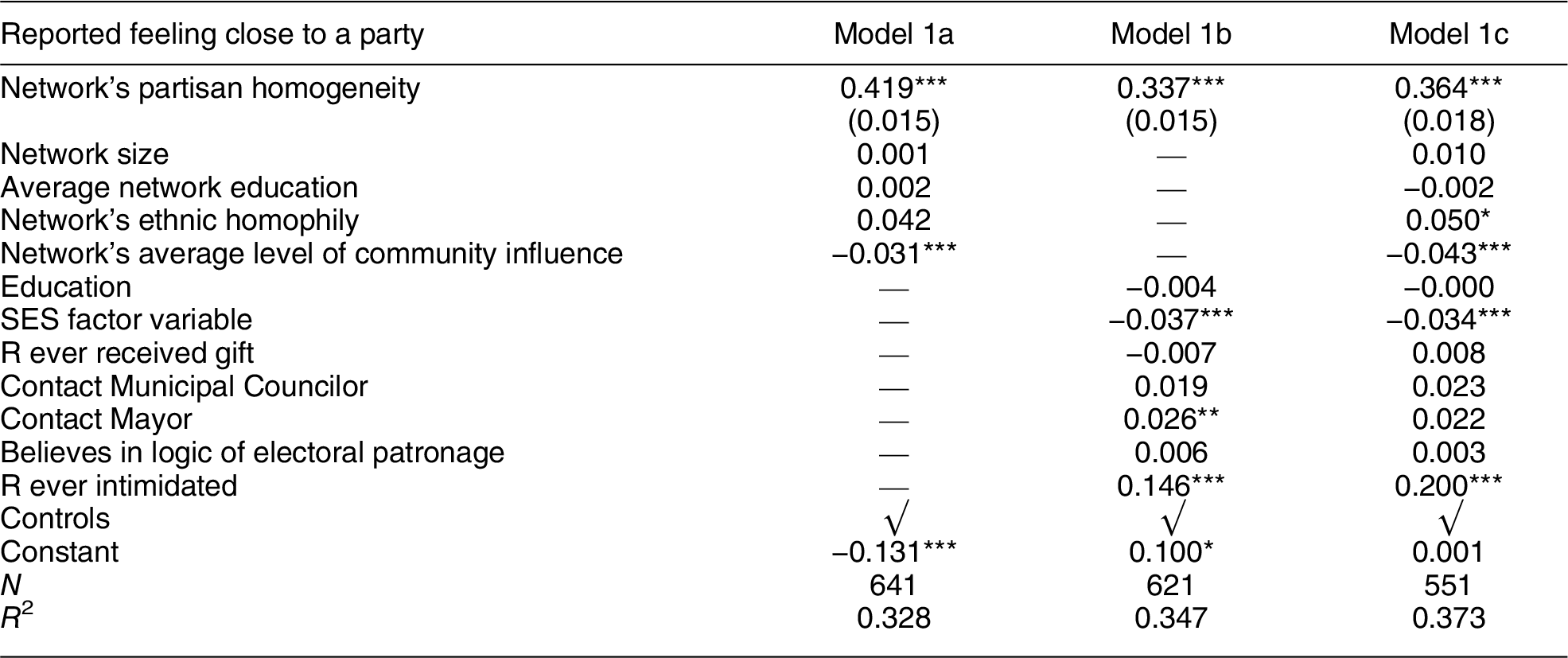
Note: Controls: political interest, age, gender, religion, ethnicity, urban/rural coefficients are not reported. Standard errors are given in parentheses. Two-way standard errors clustered at both the enumeration area and the household. Survey weights are included. * p < 0.10; ** p < 0.05; *** p < 0.01.
Model 1b includes the measure of generalized partisan homogeneity but compares it just to the individual-level variables from the existing literature: demographic factors as well as education, socioeconomic status, access to patronage, vote-buying, and experience with voter intimidation. The effect of generalized partisan homogeneity remains substantively large. However, many of the other factors also have significant relationships with generalized partisanship. There is a negative relationship between partisanship and socioeconomic status (although education seems less important). In addition, respondents who frequently contacted their mayor are slightly more likely to be partisans. Finally, someone who reported having been intimidated by a political party in the past is 71% likely to report feeling close to a party, compared to only 56% of respondents who have never been intimidated, a jump of 15%. However, this accounts for a very small subset of the sample—only 34 respondents in total (of 1,200) indicated that they have experienced voter intimidation, five of whom were nonpartisans.
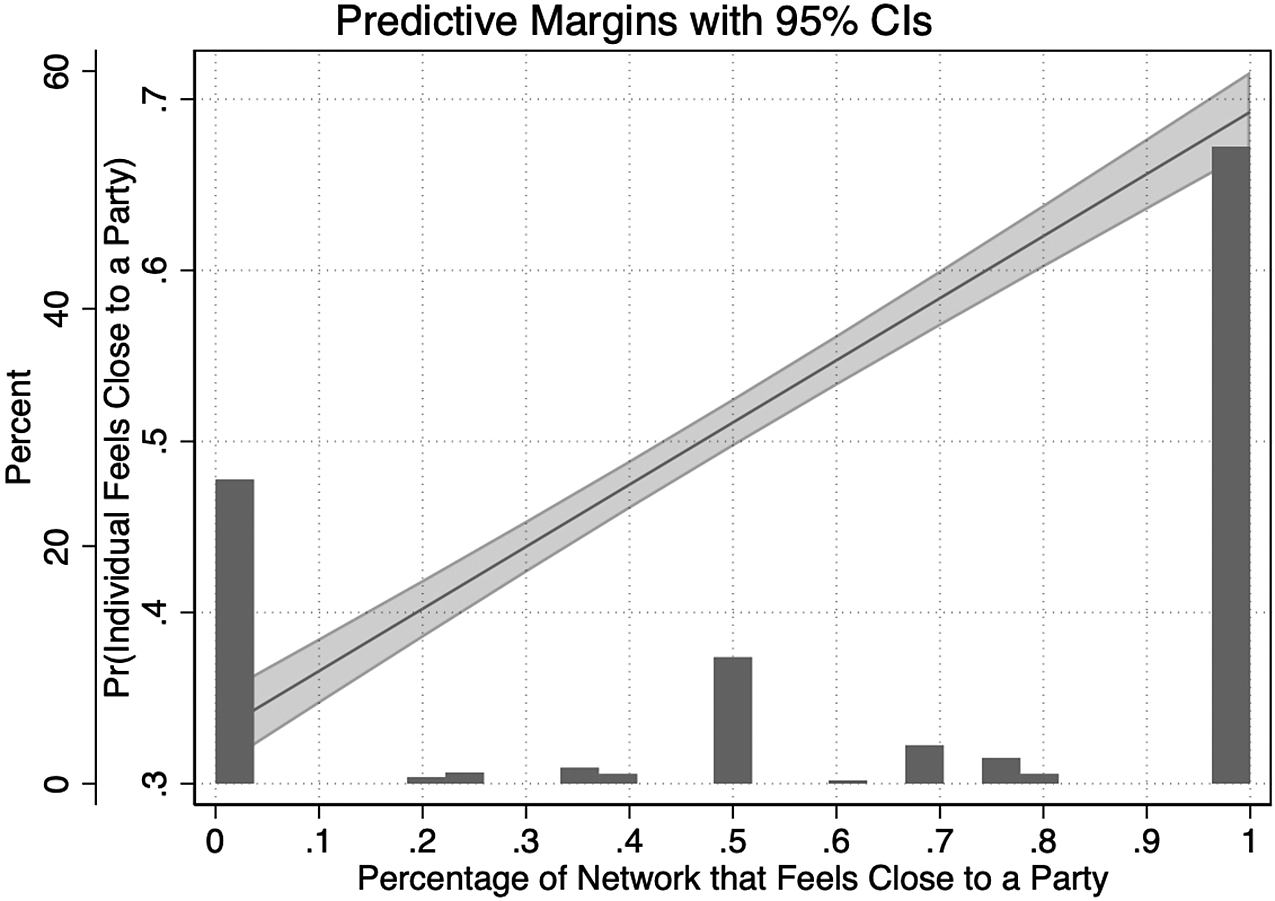
Finally, Model 1c combines all of the variables into one regression. Figure 1 presents the marginal effects of partisan homogeneity from Model 1c. The bars along the x-axis display the distribution of the independent variable: each network’s generalized partisan homogeneity. Very little changes were seen between Models 1a, 1b, and 1c: generalized partisan homogeneity remains the strongest predictor of the respondent’s own partisan status by quite a bit, while the estimates for most of the control variables remain stable.
Marginal Effect of Network’s Partisanship on Individual Partisanship with Distribution of Independent Variable Along X-Axis
Note: Predicted values derived from Model 1c. Full results reported in Table D.1 in Supplementary Appendix D. Predicted values for “Network’s Partisan Homogeneity” (displayed) estimated from 0 to 1 at 0.1 intervals. All other variables are held at their sample means.
Opposition Partisanship
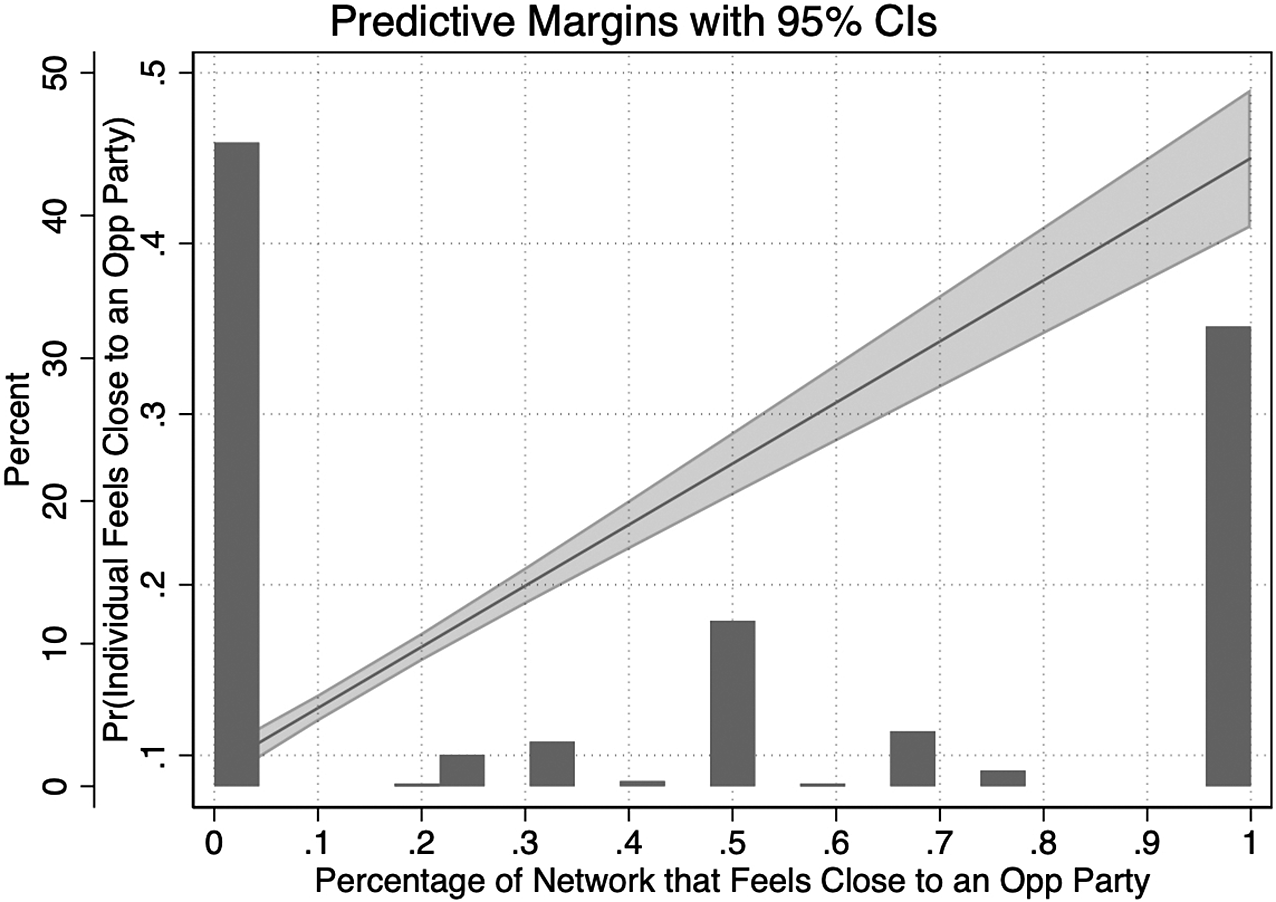
The relationship between a respondent’s opposition partisanship and their network’s opposition partisan homogeneity mirrors the relationship between individual-level generalized partisanship and average network-level partisanship. The models in Table 4 are identical to the models in the previous section, except that their dependent variable is opposition partisanship (where the zero category includes both ruling party partisans and nonpartisans) and their independent variable is each network’s average opposition partisan homogeneity. Again, far and away the biggest predictor of opposition partisanship is the percentage of one’s social network that supports an opposition party. Figure 2 presents the magnitude of this effect visually from Model 2c. Someone with zero opposition partisan discussion partners has only a 9% chance of supporting an opposition party themselves. In contrast, someone who is otherwise identical but who only discusses life and current events with opposition partisans has a 45% chance of also supporting an opposition party, an increase of 36 percentage points.
Correlates of Opposition Partisanship
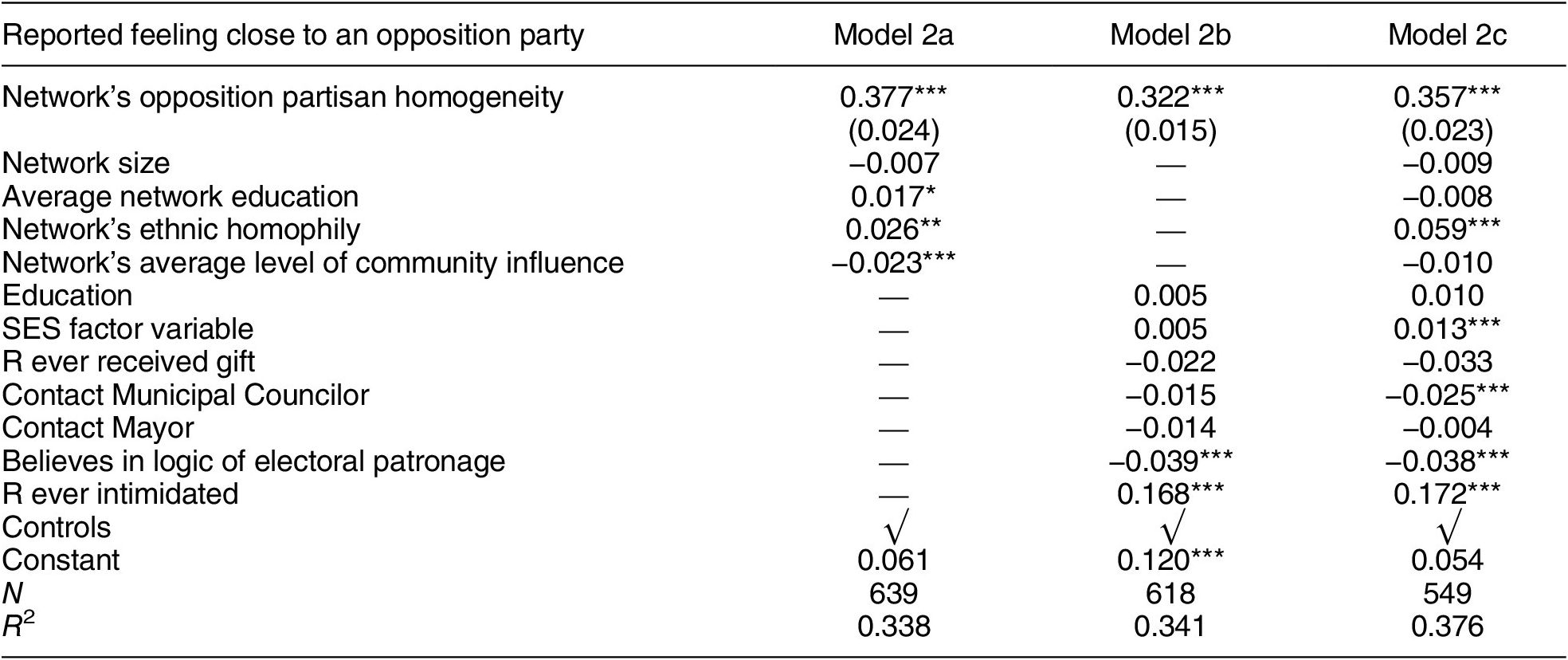
Note: Controls: political interest, age, gender, religion, ethnicity, urban/rural coefficients are not reported. Standard errors are given in parentheses. Two-way standard errors clustered at both the enumeration area and the household. Survey weights are included. * p < 0.10; ** p < 0.05; *** p < 0.01.
Marginal Effect of Network’s Opposition Partisanship on Individual Opposition Partisanship with Distribution of Independent Variable Along X-Axis
Note: Predicted values derived from Model 2c. Full results reported in Table D.2 in Supplementary Appendix D. Predicted values for “Network’s Opposition Partisan Homogeneity” (displayed) estimated from 0 to 1 at 0.1 intervals. All other variables are held at their sample means.
Controlling for the relevant confounders, the other factors that have a substantive effect on predicting opposition partisanship at the p < 0.01 level across all models are ethnic homophily, socioeconomic status, contact with a Municipal Councilor, belief in electoral patronage, and political intimidation. The networks of opposition partisans appear to be more ethnically homogenous than those of nonpartisans or ruling party partisans, and opposition partisans tend to have higher levels of socioeconomic status but are less likely to contact their municipal councilors, less likely to believe that voting for the ruling party will lead to local investments, and, unsurprisingly, more likely to have experienced political intimidation. These results lend evidence to the hypotheses proposed by Blaydes (Reference Blaydes2011) and Magaloni (Reference Magaloni2006) that ruling parties derive their support from promises of economic investment, though including these measures in the analysis does not affect the enormous magnitude of the effect of a network’s opposition homogeneity on individual partisanship.
Discussion
Taken together, it is clear from the data that partisan homogeneity is an enormously important predictor of individual partisanship. Whether or not someone feels close to a political party is strongly correlated with whether or not the people in one’s social network also support a party. Further, whether one supports the ruling party or an opposition party is also largely predicted by whether or not one talks primarily to opposition partisans or not. The data also make clear that there is no obvious confounder driving the partisan homogeneity of social networks, whether at the level of the individual or the network: none of control variables diminish the extremely strong correlation between both partisan homogeneity and individual partisanship. The final part of the analysis below shows further that not only is partisan homogeneity not driven by these common predictors of individual-level partisanship but that in general people do not entirely self-select into homogenous partisan networks. In other words, people do not select their discussion partners solely because of their partisanship.
NETWORK ECOLOGY
To what extent are these findings driven by ecological homophily (people create their social networks based on individual pre-existing partisan preferences) versus network contagion (peoples’ partisanship is influenced by their pre-existing social networks)? Although the large-n survey data cannot definitively adjudicate between these two processes, it does show that, at least to some extent, people’s partisanship is shaped by pre-existing social ties. The final statistical model mirrors Model 2c in Table 4 but analyzes only discussion partners who predate the respondent’s interest in the party they support.
When the respondent was originally asked whether or not they feel close to any political party, those who responded in the affirmative were further asked if they could recall approximately how old they were when they started feeling close to the party. Later in the survey, when asking about the respondent’s discussion partners, the survey also asked approximately how old the respondent was when they first met each discussion partner. Therefore, the final analysis only includes discussion partners whose relationship to the respondent predates their partisanship. In other words, it excludes people the respondent came to know after forming their partisan preferences, eliminating the possibility that the respondent felt close to a party and befriended a new discussion partner because they were copartisans.Footnote 22 Although many of these older relationships are family members, they are not exclusively so. In fact, 69% of the relationships that predate the respondent’s partisanship were reported as friends, neighbors, or work colleagues.
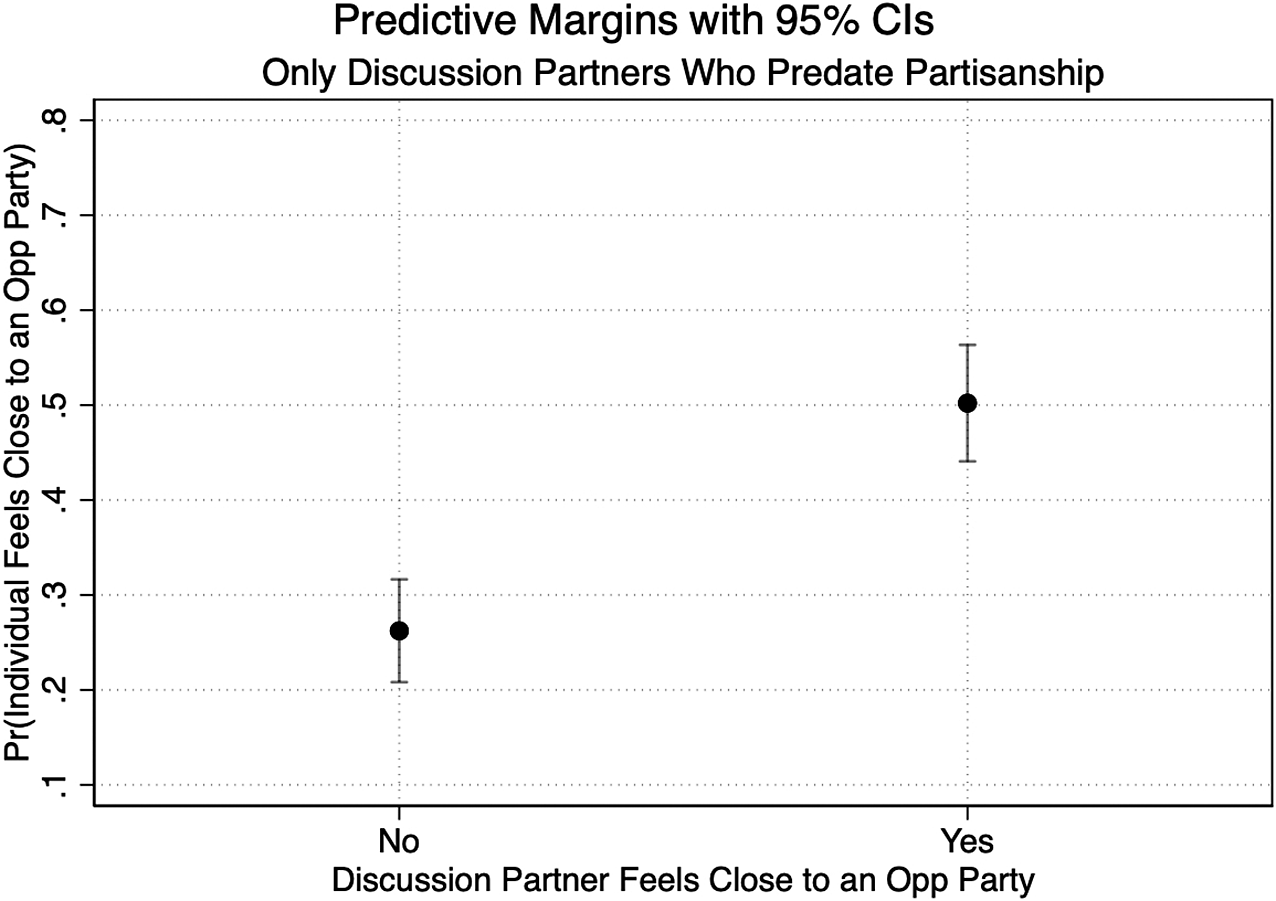
Controlling for all the measures from Model 2c, the effect of copartisanship remains high even when we look only at relationships that predate the respondent’s partisanship. Figure 3 shows the predictive margins of this relationship; the results of the full model are reported in Supplementary Appendix I. If the respondent’s discussion partner feels close to the ruling party, the respondent herself only has a 26% chance of feeling close to an opposition party. Everything else held equal; if the respondent’s partner instead feels close to an opposition party, the respondent has a 50% chance of also feeling close to an opposition party, a jump of 24 percentage points. Thus, at least in part, the social networks of these ordinary citizens are not being driven exclusively by partisan matching. Instead, as described in the qualitative data, there appears to be a process of political socialization occurring between friends and family. Partisan friends and family have the power to influence one another in politically salient ways.
Predictive Margins of Partisanship of Discussion Partner on Respondent’s Own Partisanship, Including Only Partners Who Predate Respondent’s Partisanship
Note: Predicted values derived from Model I.1, presented in Supplementary Appendix I. Predicted values for “Discussion Partner’s Partisanship” (displayed) estimated at 0 (ruling party partisan) and 1 (opposition partisan). All other variables are held at their sample means.
CONCLUSION
Why do people choose to participate in politics in autocratic regimes? While economic and ideological reasons are surely important to understanding partisanship, the data presented in this article make clear that we cannot explain political participation without understanding the social context of these individual-level factors. The partisan homogeneity of social networks clearly and strongly predicts individual-level partisanship no matter the model specification, even when we only consider relationships that predate the respondent’s choice to support a political party. Further, when we consider the life histories of ordinary Cameroonians, it is clear that many people only choose to support parties when they are invited to do so by important people in their lives. Thus, moving forward, studies of political behavior under autocracy should take social context into consideration.
This framework has important implications not just for understanding politics in electoral autocracies but also for explaining processes of democratization and autocratization. In the context of electoral autocracies, partisan divides might predict other aspects of public opinion, such as positions on public policy, beliefs about international actors, or even more fundamental issues, like attachment to a national identity or trust in other citizens. For example, ruling party partisans, who base their partisan identities, in part, on a sense of patriotism (Matovski Reference Matovski2021; Reuter Reference Reuter2020), may identify more strongly with a national identity, which, in turn, may impact a whole host of important outcomes—support for international conflicts, willingness to pay taxes, or hostility to migrants. Even where opposition parties are not organizationally linked to strikes, protests, or armed rebellion, their partisans may be laying the foundations for the development of oppositional identities within social networks that make the formation, salience, or growth of these other groups possible.
These findings have implications beyond the scope of electoral autocracies themselves. For example, taking partisanship seriously could potentially help to explain support for democracy following regime change (Neundorf, Gerschewski, and Olar Reference Neundorf, Gerschewski and Olar2020). Cleavages based in political identities can endure enormous amounts of political turmoil (Wittenberg Reference Wittenberg2006), laying the basis for continued partisan divides in the context of democratic competition. Understanding how these identities are formed and sustained may provide a roadmap for explaining democratic consolidation, or alternatively, in the face of extreme polarization, continued democratic breakdowns. This study seeks to open up new avenues of research in the study of authoritarianism on the origins, meaning, and implications of partisan divides in autocratic regimes so as to better understand how such divides can undergird—or undermine—autocratic consolidation.
SUPPLEMENTARY MATERIAL
To view supplementary material for this article, please visit https://doi.org/10.1017/S0003055424000261.
DATA AVAILABILITY STATEMENT
Research documentation and data that support the findings of this study are openly available at the American Political Science Review Dataverse: https://doi.org/10.7910/DVN/WCTOA8.
Acknowledgements
I would like to thank Eric Ileng and Cible Groupe for survey enumeration, as well as Modeste Aliguene, Norine Andreas Defo Kengne, Grace Emmanuel Etjeke Assiene, Gemuh Reynolds Nyenchem, Savannah Lemmons, and Erin Phillips for research assistance. I would also like to thank Patrice Bigombe, Nadine Machickou, Miguel Bityeki, Tchamabo Christine Marlise, and Aurelie Bida for logistical support during fieldwork in Cameroon. For feedback on previous drafts of this article, I thank Bryn Rosenfeld, Martha Wilfahrt, Yonatan Morse, Scott Williamson, Nicolas van de Walle, Dan Slater, Justine Davis, Michael O. Allen, Sam Handlin, and participants of the NYU Comparative Politics Workshop.
FUNDING STATEMENT
Funding for this project was made available by a West African Research Association Postdoctoral Fellowship, APSA Centennial Grant, The Vice President for Research and Partnerships of the University of Oklahoma Faculty Investment Program Grant, a College of International Studies Faculty Support Grant, and a University of Oklahoma African Studies Institute faculty support grant.
CONFLICT OF INTERESTS
The author declares no ethical issues or conflicts of interest in this research.
ETHICAL STANDARDS
The author declares the human subjects research in this article was reviewed and approved by the University of Oklahoma, and certificate numbers are provided in the Additional Supplementary Materials. The author affirms that this article adheres to the principles concerning research with human participants laid out in APSA’s Principles and Guidance on Human Subject Research (2020).


 Open access


Comments
No Comments have been published for this article.