





1 Introduction
In the interaction between high-power lasers and matter, the target is a core element alongside the laser pulse. It can take many forms, including solid, gas, liquid and cryogenic targets, and each form can have different configurations. By changing the type of target and the laser parameters, the interaction process can be tailored to generate specific laser-driven radiation. From the solid targets category, thin and ultra-thin films (from a thickness of the order of micrometres to under 10 nm) are undergoing a combination of interaction mechanisms, such as target normal sheath acceleration (TNSA)[ Reference Snavely, Key, Hatchett, Cowan, Roth, Phillips, Stoyer, Henry, Sangster, Singh, Wilks, MacKinnon, Offenberger, Pennington, Yasuike, Langdon, Lasinski, Johnson, Perry and Campbell 1 ], combined with relativistic-induced transparency (RIT) or radiation pressure acceleration (RPA). These processes can produce ultrashort (hundreds of picoseconds) proton beams with high directionality, laminarity and low transverse and longitudinal emittance[ Reference Roth and Schollmeier 2 ]. Enhanced coupling and improved energy conversion efficiency can be achieved using nano-structured targets, including nanowires[ Reference Rocca, Capeluto, Hollinger, Wang, Wang, Kumar, Lad, Pukhov and Shlyaptsev 3 ], gratings[ Reference Cerchez, Giesecke, Peth, Toncian, Albertazzi, Fuchs, Willi and Toncian 4 ], nanoparticles[ Reference Margarone, Klimo, Kim, Prokůpek, Limpouch, Jeong, Mocek, Pšikal, Kim, Proska, Nam, Stolcova, Choi, Lee, Sung, Yu and Korn 5 ] and foams[ Reference Rosmej, Gyrdymov, Andreev, Tavana, Popov, Borisenko, Gromov, Gus’kov, Yakhin, Vegunova, Bukharskii, Korneev, Cikhardt, Zähter, Busch, Jacoby, Pimenov, Spielmann and Pukhov 6 ], with their structural characteristics closely matched to the laser properties[ Reference Magureanu, Dincă, Jalba, Andrei, Burducea, Ghita, Nastasa, Gugiu, Asavei, Budriga, Ticos, Craciun and Ticos 7 ]. Laser-driven fusion, using ultra-intense laser pulses, has received significant interest lately due to its potential as a clean energy source, with several approaches under active investigation: the deuterium–deuterium reaction using deuterated nano-structured plastic targets[ Reference Calvi, Curtis, Tinsley, Hollinger, Kaymak, Pukhov, Wang, Rockwood, Wang, Shlyaptsev and Rocca 8 ], proton–boron fusion in both direct irradiation and pitcher–catcher configurations[ Reference Batani 9 ] and the use of nano-structured fuel for fusion[ Reference Ruhl and Korn 10 ].
For electron acceleration, compact laser–plasma accelerators (LPAs) overcome the limitations in conventional radio frequency (RF) accelerators by exploiting an inherent breakdown characteristic of plasma[
Reference Veksler
11
], that is, naturally occurring strong electric fields from charge separation $\left(10-100\ \mathrm{GeV}/\mathrm{m}\right)$
[
Reference Faĭnberg
12
, Reference Esarey, Schroeder and Leemans
13
] and its size[
Reference Joshi, Corde and Hogan
14
–
Reference Adli, Hogan and Joshi
16
] over the conventional accelerator. Examples range from the first proposal in 1979 by Tajima and Dawson[
Reference Tajima and Dawson
17
], through the first demonstrations of mono-energetic electron beams from gas jet targets[
Reference Mangles, Murphy, Najmudin, Thomas, Collier, Dangor, Divall, Foster, Gallacher, Hooker, Jaroszynski, Langley, Mori, Norreys, Tsung, Viskup, Walton and Krushelnick
18
–
Reference Faure, Glinec, Pukhov, Kiselev, Gordienko, Lefebvre, Rousseau, Burgy and Malka
20
], to the first demonstrated 1 GeV over 3.3 cm long capillary discharge[
Reference Leemans, Nagler, Gonsalves, Tóth, Nakamura, Geddes, Esarey, Schroeder and Hooker
21
] and more recent milestones, such as the 7.8 GeV acceleration achieved in a 20 cm long laser-heated capillary at the Berkeley Lab Laser Accelerator (BELLA) facility[
Reference Gonsalves, Nakamura, Daniels, Benedetti, Pieronek, de Raadt, Steinke, Bin, Bulanov, van Tilborg, Geddes, Schroeder, Tóth, Esarey, Swanson, Fan-Chiang, Bagdasarov, Bobrova, Gasilov, Korn, Sasorov and Leemans
22
], the generation of 10 GeV beams in a capillary just 10 cm long using nanoparticle-assisted gas cells[
Reference Aniculaesei, Ha, Yoffe, Labun, Milton, McCary, Spinks, Quevedo, Labun, Sain, Hannasch, Zgadzaj, Pagano, Franco-Altamirano, Ringuette, Gaul, Luedtke, Tiwari, Ersfeld, Brunetti, Ruhl, Ditmire, Bruce, Donovan, Downer, Jaroszynski and Hegelich
23
] and the latest reported single, quasi-mono-energetic peaks up to 9.2 GeV utilizing hydrodynamic expansion of optical field-ionized (HOFI) plasmas[
Reference Picksley, Stackhouse, Benedetti, Nakamura, Tsai, Li, Miao, Shrock, Rockafellow, Milchberg, Schroeder, van Tilborg, Esarey, Geddes and Gonsalves
24
]. Hence, it is clear that target development plays a crucial role in producing high-quality electron beams.
$\left(10-100\ \mathrm{GeV}/\mathrm{m}\right)$
[
Reference Faĭnberg
12
, Reference Esarey, Schroeder and Leemans
13
] and its size[
Reference Joshi, Corde and Hogan
14
–
Reference Adli, Hogan and Joshi
16
] over the conventional accelerator. Examples range from the first proposal in 1979 by Tajima and Dawson[
Reference Tajima and Dawson
17
], through the first demonstrations of mono-energetic electron beams from gas jet targets[
Reference Mangles, Murphy, Najmudin, Thomas, Collier, Dangor, Divall, Foster, Gallacher, Hooker, Jaroszynski, Langley, Mori, Norreys, Tsung, Viskup, Walton and Krushelnick
18
–
Reference Faure, Glinec, Pukhov, Kiselev, Gordienko, Lefebvre, Rousseau, Burgy and Malka
20
], to the first demonstrated 1 GeV over 3.3 cm long capillary discharge[
Reference Leemans, Nagler, Gonsalves, Tóth, Nakamura, Geddes, Esarey, Schroeder and Hooker
21
] and more recent milestones, such as the 7.8 GeV acceleration achieved in a 20 cm long laser-heated capillary at the Berkeley Lab Laser Accelerator (BELLA) facility[
Reference Gonsalves, Nakamura, Daniels, Benedetti, Pieronek, de Raadt, Steinke, Bin, Bulanov, van Tilborg, Geddes, Schroeder, Tóth, Esarey, Swanson, Fan-Chiang, Bagdasarov, Bobrova, Gasilov, Korn, Sasorov and Leemans
22
], the generation of 10 GeV beams in a capillary just 10 cm long using nanoparticle-assisted gas cells[
Reference Aniculaesei, Ha, Yoffe, Labun, Milton, McCary, Spinks, Quevedo, Labun, Sain, Hannasch, Zgadzaj, Pagano, Franco-Altamirano, Ringuette, Gaul, Luedtke, Tiwari, Ersfeld, Brunetti, Ruhl, Ditmire, Bruce, Donovan, Downer, Jaroszynski and Hegelich
23
] and the latest reported single, quasi-mono-energetic peaks up to 9.2 GeV utilizing hydrodynamic expansion of optical field-ionized (HOFI) plasmas[
Reference Picksley, Stackhouse, Benedetti, Nakamura, Tsai, Li, Miao, Shrock, Rockafellow, Milchberg, Schroeder, van Tilborg, Esarey, Geddes and Gonsalves
24
]. Hence, it is clear that target development plays a crucial role in producing high-quality electron beams.
For ion acceleration, liquid and cryogenic targets provide a renewable, reproducible medium suited for high-repetition-rate (HRR) laser–plasma interaction. Such systems offer continuous jet extrusion without debris, supporting sensitive optics, high vacuum and stable long-term operation.
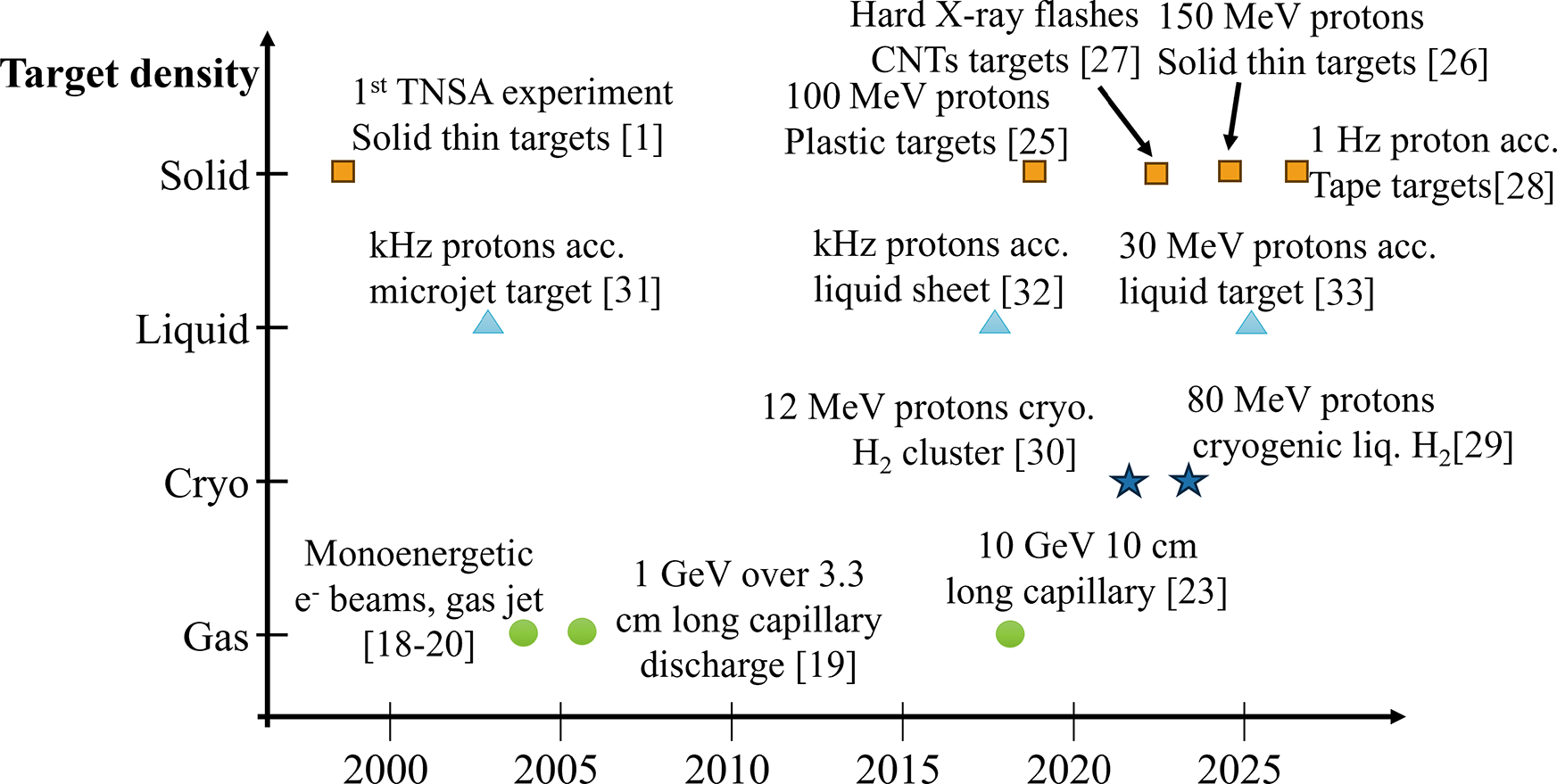
Current target fabrication challenges for single-beam high-power laser experiments are related to the reproducibility of the process, which is ensured by careful characterization after every fabrication step, to reduce the shot-to-shot variations and improve the understanding of the interaction; this is followed by the survival of the targets between shots and designing specific holders and frames suited for each type of laser system and interaction mechanism. Positioning and focusing systems in the experimental chamber are also critical components and continuously developing. Since the 2000s many target design approaches have been explored and the community is getting closer to full understanding of the science and the engineering of the parts for a specific outcome, with the help of the theory, experimental results and hydrodynamic and particle-in-cell (PIC) simulations, efforts that bring us closer to both the discovery of new physics and offering a smaller-scale alternative, yet with similar parameters to conventional accelerators. The main achievements in target fabrication for laser-driven particle acceleration are presented in Figure 1.
Timeline figure highlighting major milestones in target development and results.

2 Solid targets for ion acceleration and photon emission
2.1 Flat targets
The most reported type of solid target used in high-power laser experiments – particularly for proton acceleration – is thin, sub 0.5 μm flat foils, made of metals (such as aluminium or gold) or plastic[
Reference Higginson, Gray, King, Dance, Williamson, Wilson, Capdessus, Armstrong, Green, Hawkes, Martin, Wei, Mirfayzi, Yuan, Kar, Borghesi, Clarke, Neely and McKenna
25
], and they require a laser with high temporal contrast. However, thick foils from 0.5 μm and above (commercially available) do not necessarily need a high laser temporal contrast, as pre-pulses can be beneficial for plasma pre-expansion. When irradiated by an ultra-intense laser pulse, a pre-plasma forms at the front surface, and electrons are accelerated through the target. The resulting charge separation generates high electric fields that accelerate ions mostly in the direction normal to the target (thus, giving the name of the TNSA mechanism). These ions come from the contaminant layer on the surfaces of the target (mainly proton, carbon and oxygen ions from water and organic molecules)[
Reference Roth and Schollmeier
2
]. Both proton and deuteron beams accelerated by TNSA were obtained from a flat gold target onto which a nm-thick deuterium layer was deposited on the target rear by using a cryogenic system[
Reference Scott, Carroll, Astbury, Clarke, Hernandez-Gomez, King, Alejo, Arteaga, Dance, Higginson, Hook, Liao, Liu, Mirfayzi, Rusby, Selwood, Spindloe, Tolley, Wagner, Zemaityte, Borghesi, Kar, Li, Roth, McKenna and Neely
34
]. Aluminium foils, 3 μm thick, have demonstrated proton cut-off energy up to 31 MeV using the 1 PW laser at the Extreme Light Infrastructure–Nuclear Physics (ELI-NP) facility[
Reference Cernaianu, Ghenuche, Rotaru, Tudor, Chalus, Gheorghiu, Popescu, Gugiu, Balascuta, Magureanu, Tataru, Horný, Corobean, Dancus, Alincutei, Asavei, Dinca, Dreghici and Doria
35
]. However, improved laser contrast enables the use of thinner targets (tens of nanometres or less), which increases the proton cut-off energy through a combination of cascaded acceleration regimes. Experiments have reported proton energies up to 150 MeV[
Reference Ziegler, Göthel, Assenbaum, Bernert, Brack, Cowan, Dover, Gaus, Kluge, Kraft, Kroll, Metzkes-Ng, Nishiuchi, Prencipe, Püschel, Rehwald, Reimold, Schlenvoigt, Umlandt and Zeil
26
], while simulations predict values exceeding 200 MeV from 10 PW laser pulses at intensities of ${10}^{23}$
W/cm2.
${10}^{23}$
W/cm2.
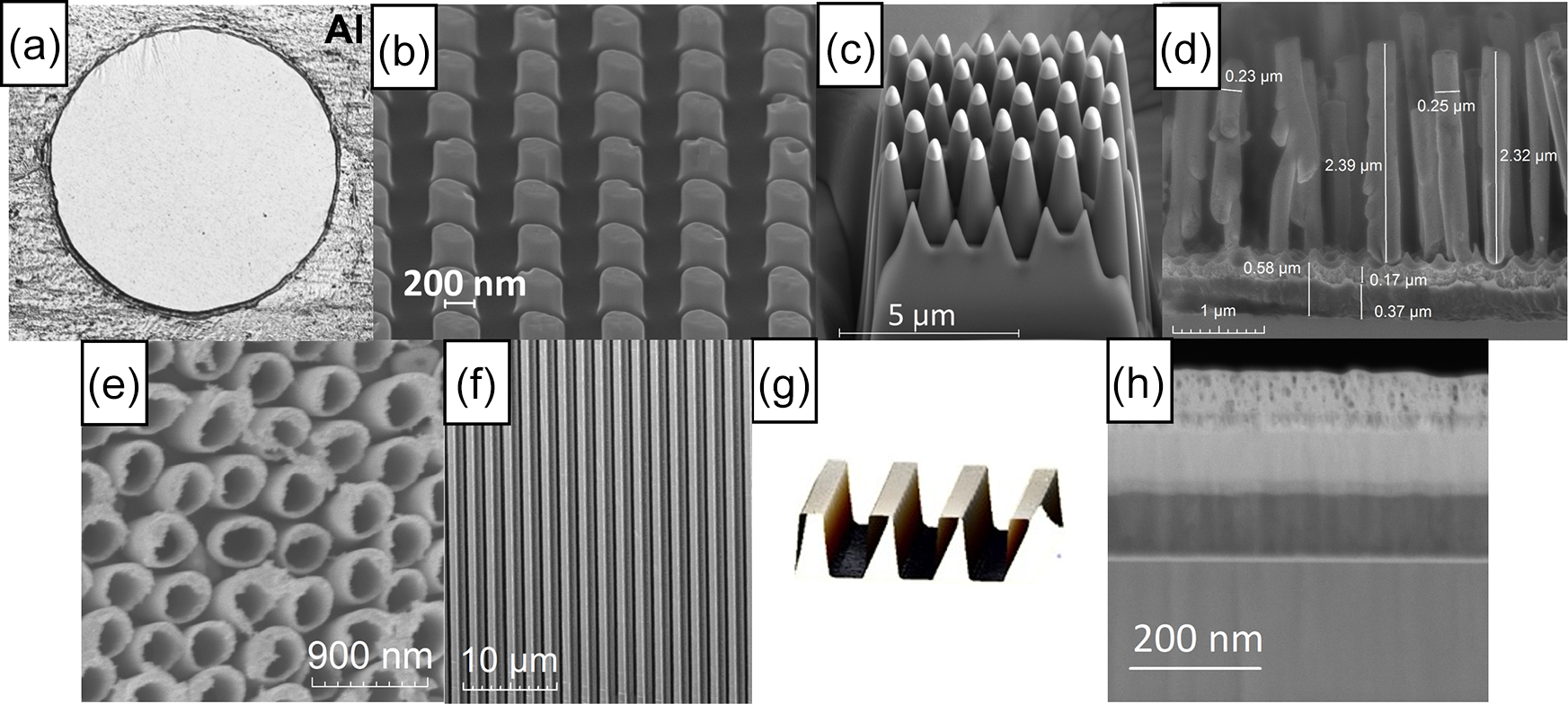
Exploratory science experiments that require a succession of single-shot events can make use of individual free-standing targets mounted on wheels or target matrices mounted in raster plates[ Reference Cernaianu, Ghenuche, Rotaru, Tudor, Chalus, Gheorghiu, Popescu, Gugiu, Balascuta, Magureanu, Tataru, Horný, Corobean, Dancus, Alincutei, Asavei, Dinca, Dreghici and Doria 35 , Reference Vladisavlevici, Vlachos, Dubois, Haddock, Astbury, Huerta, Agarwal, Ahmed, Apiñaniz, Cernaianu, Gugiu, Krupka, Lera, Morabito, Sangwan, Ursescu, Curcio, Fefeu, Pérez-Hernández and Ehret 36 , Reference Chagovets, Stanček, Giuffrida, Velyhan, Tryus, Grepl, Istokskaia, Kantarelou, Wiste, Martin, Schillaci and Margarone 37 ]. The fabrication process of thin free-standing metallic targets such as the ones depicted in Figure 2(a) involves thin film coating of the desired material on soluble substrates (e.g., NaCl) and mounting on a frame by a fishing–floating technique. At the ELI-NP Target Laboratory[ Reference Gheorghiu, Leca, Popa, Cernaianu and Stutman 38 , Reference Gheorghiu, Ionescu, Zai, Decebal, Burducea, Velisa, Vasile, Ianculescu, Bobeica, Popa and Leca 39 ], targets with mirror-like flatness, low roughness and high purity have been achieved for aluminium foils of thicknesses between 8 and 400 nm, and for gold foils between 10 and 400 nm, both on target holders with a hole diameter up to 500 μm (see Figure 2(a)). Plastic (CH, formvar) thin films are prepared by dip-coating or spin-coating from a liquid solution followed by a drying and fishing technique. The surface quality of the final target is highly dependent on the substrate quality[ Reference Cernaianu, Ghenuche, Rotaru, Tudor, Chalus, Gheorghiu, Popescu, Gugiu, Balascuta, Magureanu, Tataru, Horný, Corobean, Dancus, Alincutei, Asavei, Dinca, Dreghici and Doria 35 , Reference Gheorghiu, Ionescu, Ghenuche, Cernaianu, Doria, Popa and Leca 40 , Reference Gheorghiu, Cerchez, Aktan, Prasad, Yilmaz, Yilmaz, Popa, Willi and Leca 41 ].
Different types of solid targets fabricated within the ELI-NP Target Laboratory: (a) free-standing aluminium ultra-thin film (10 nm) on a 400 μm hole, (b) metallic nanorods, (c) silicon nano-pillars, (d) nanowires, (e) nanotubes, (f), (g) gratings and (h) the multilayer target.

2.2 Structured targets
Adding nano- or micro-structures on top of the flat foil increases the surface area, and thus the laser absorption on the target is enhanced[ Reference Gheorghiu, Cerchez, Aktan, Prasad, Yilmaz, Yilmaz, Popa, Willi and Leca 41 , Reference Bargsten, Hollinger, Capeluto, Kaymak, Pukhov, Wang, Rockwood, Wang, Keiss, Tommasini, London, Park, Busquet, Klapisch, Shlyaptsev and Rocca 42 ]. Examples of nano-structures are metallic nanowires and nanotubes (Figures 2(d) and 2(e)), which are being studied for X-ray emission[ Reference Kulcsár, AlMawlawi, Budnik, Herman, Moskovits, Zhao and Marjoribanks 43 ], proton acceleration[ Reference Vallières, Salvadori, Permogorov, Cantono, Svendsen, Chen, Sun, Consoli, D’Humières, Wahlström and Antici 44 ] and terabar pressure formation[ Reference Bargsten, Hollinger, Capeluto, Kaymak, Pukhov, Wang, Rockwood, Wang, Keiss, Tommasini, London, Park, Busquet, Klapisch, Shlyaptsev and Rocca 42 ]. For their fabrication, elaborated top-down and bottom-up methods are used, such as electrochemical deposition[ Reference Gheorghiu, Ionescu, Ghenuche, Cernaianu, Doria, Popa and Leca 40 , Reference Ionescu, Gheorghiu, Lupu, Zai, Magureanu, Dreghici, McCay, Molloy, Ahmed, Borghesi, Popa, Cernaianu, Doria, Tanaka and Leca 45 ], vapour–liquid–solid growth or optical (ultraviolet (UV) light) and electron beam lithography, followed by the reactive ion etching process[ Reference Dhindsa, Chia, Boulanger, Khodadad, LaPierre and Saini 46 ]. Another type of nano/micro-structure is the nano-pillar (Figure 2(c)), obtained with the focused ion beam (FIB) technique, which allows direct surface patterning by etching with a xenon ion beam, followed by in situ deposition of low- or high-Z materials (such as carbon or tungsten). Metallic nanorods and free-standing metallic gratings (gold and copper gratings), depicted in Figures 2(b), 2(f) and 2(g), have been manufactured using similar methods as for the top-down approach of the nanowire targets, where electron beam lithography was used to write the pattern on the sample surface, followed by the developing step of the exposed photoresist and dry etching of the unprotected areas by means of the reactive ion etching technique[ Reference Gheorghiu, Cerchez, Aktan, Prasad, Yilmaz, Yilmaz, Popa, Willi and Leca 41 ]. The self-supported periodic metallic gratings have been used in high-intensity ultrashort relativistic laser pulse experiments for electron acceleration and laser energy coupling investigations[ Reference Gheorghiu, Cerchez, Aktan, Prasad, Yilmaz, Yilmaz, Popa, Willi and Leca 41 ]. To accelerate carbon ion beams, foil targets made of amorphous carbon (a-C) or diamond-like carbon (DLC), as well as near-critical-density targets such as carbon foams or carbon nanotubes, are commonly employed[ Reference Chaudhary, Milluzzo, Mcilvenny, Ahmed, Mcmurray, Maiorino-Groeneveld, Polin, Romagnani, Doria, McMahon, Botchway, Rajeev, Prise and Borghesi 47 ]. Various fabrication techniques are utilized for DLC targets, including chemical or physical vapour deposition such as ion beam-assisted deposition processes, pulsed laser deposition, the ion beam-assisted deposition (IBAD) technique, the filtered cathodic vacuum arc (FCVA), ultra-high vacuum (UHV) RF or direct current (DC) sputtering and high-power impulse magnetron sputtering (HiPIMS)[ Reference Kitagawa, Yamada, Toyoda, Tsubakino, Matsuo, Takaoka and Kirkpatrick 48 – Reference Lin, Sproul, Wei and Chistyakov 51 ]. Regarding the fabrication of carbon nanotubes and low-density, low atomic number polymeric foams, chemical vapour deposition in a specialized high-temperature tubular furnace for carbon nanotubes is used at the ELI-NP facility. Meanwhile, organic (e.g., resorcinol formaldehyde) or inorganic aerogels (e.g., silica aerogels) targets are fabricated via a sol–gel approach followed by the CO2 supercritical drying method[ Reference Tamon, Kitamura and Okazaki 52 , Reference Liang, Sha and Guo 53 ].
Such near-critical-density targets (e.g., foams/aerogels) contribute to a better coupling with the laser pulse and can be tailored to produce electrons, by the direct laser acceleration (DLA) mechanism[ Reference Rosmej, Gyrdymov, Andreev, Tavana, Popov, Borisenko, Gromov, Gus’kov, Yakhin, Vegunova, Bukharskii, Korneev, Cikhardt, Zähter, Busch, Jacoby, Pimenov, Spielmann and Pukhov 6 ], with twice the proton energy and an increased bremsstrahlung yield compared with flat foils[ Reference Prencipe, Metzkes-Ng, Pazzaglia, Bernert, Dellasega, Fedeli, Formenti, Garten, Kluge, Kraft, Garcia, Maffini, Obst-Huebl, Rehwald, Sobiella, Zeil, Schramm, Cowan and Passoni 54 ], high-energy photons[ Reference Shou, Wang, Lee, Rhee, Lee, Yoon, Sung, Lee, Pan, Kong, Mei, Liu, Xu, Deng, Zhou, Tajima, Choi, Yan, Nam and Ma 27 ] or neutron sources for nuclear applications[ Reference Günther, Rosmej, Tavana, Gyrdymov, Skobliakov, Kantsyrev, Zähter, Borisenko, Pukhov and Andreev 55 ]. Carbon ions with energies up to 48 MeV per nucleon have been accelerated using double-layer targets made of carbon foam on DLC thin film and cascaded acceleration mechanism of RPA and TNSA, which initially ionizes the carbon ions from the near-critical-density foam by RPA followed by their acceleration through the DLC thin layer by TNSA. Tailoring the thickness and density of the foam and the thickness of the DLC film leads to finding an optimum for the acceleration process with a high-contrast fs laser pulse[ Reference Ma, Kim, Yu, Choi, Singh, Lee, Sung, Lee, Lin, Liao, Zhu, Lu, Liu, Wang, Xu, He, Chen, Zepf, Schreiber, Yan and Nam 56 ].
Multilayer design, used mostly for anti-reflective (AR) coatings, can be fabricated by alternative sputter deposition processes (RF, DC or HiPIMS) of different material layers, such as oxides, nitrides and metals (Figure 2(h)). In this case, an interconnected multi-chamber UHV system is the ideal solution to reducing interface contamination between layers and obtaining high-purity multilayered targets or optical coatings. For proton–boron fusion experiments, boron targets can be prepared either as thick films, boron nanoparticles or nano-structures[ Reference Turcu, Margarone, Giuffrida, Picciotto, Spindloe, Robinson and Batani 57 ], and are used directly as targets or as the proton catcher in the pitcher–catcher scheme, which involves another flat foil target for proton production. Using the alpha particles produced in the fusion reaction, radioisotopes are generated[ Reference Batani, Rodrigues, Bonasera, Cipriani, Consoli, Filippi, Scisciò, Giuffrida, Kantarelou, Stancek, Lera, Pérez-Hernández, Volpe, Turcu, Passoni, Vavassori, Dellasega, Maffini, Huault and Batani 58 ].
2.3 High-repetition-rate targets
For experiments that require large statistics or aim at generating a large throughput of secondary radiation, solid target delivery has to approach the HRR alongside quasi-continuous operation of PW-class laser systems. An example is the tape-drive target[ Reference McKenna, Ledingham, Spencer, McCany, Singhal, Ziener, Foster, Divall, Hooker, Neely, Langley, Clarke, Norreys, Krushelnick and Clark 59 , Reference Nayuki, Oishi, Fujii, Nemoto, Kayoiji, Okano, Hironaka, Nakamura, Kondo and Ueda 60 ]. Mechanical stability is crucial for precise operation; the tape oscillations have to be below the Rayleigh length of the focused laser pulse to keep the tape surface in focus[ Reference Ehret, de Luis, Apiñaniz, Henares, Lera, Pérez-Hernández, Puyuelo-Valdes, Volpe and Gatti 61 ] and rupture has to be avoided by choosing wide enough tapes that exceed the diameter of the through-holes remaining after the interaction, resulting from the energy deposition of recirculating electrons[ Reference Ehret, Apiñaniz, Henares, Lera, de Luis, Pérez-Hernández, Volpe and Gatti 62 ] and shocks[ Reference Caroll 63 ]. Also essential are robust electronic systems that withstand the extreme environment around a relativistic laser–plasma interaction. Strong auto-generated kA-scale return currents have to be mitigated[ Reference Ehret, Cikhardt, Bradford, Vladisavlevici, Burian, de Luis, Henares, Martín, Apiñaniz, Lera, Pérez-Hernández, Santos and Gatti 64 ]. The generation of TNSA ion beams at 1 Hz was demonstrated with 10 μm aluminium and 7 μm copper tapes[ Reference Ehret, Vladisavlevici, Bradford, Cikhardt, Filippov, Henares, Martín, de Luis, Pérez-Hernández, Vicente, Burian, García-García, Hernández, Mendez, Ruíz, Varela, Frías, Santos and Gatti 28 ] by employing a short-pulse PW-class laser. The repetition rate is currently limited by circuit interrupter systems, which are part of the electromagnetic pulse (EMP) protection of motors and controllers for the tape drive. Lower-energy short-pulse lasers with fewer EMPs allow for up to 100 Hz repetition rates[ Reference Xu, Streeter, Ettlinger, Ahmed, Astbury, Borghesi, Bourgeois, Curry, Dann, Dover, Dzelzainis, Istokskaia, Gauthier, Giuffrida, Glenn, Glenzer, Gray, Green, Hicks and Najmudin 65 ] and have shown good shot-to-shot stability. Laser-driven secondary sources have been demonstrated at various laser systems with different repetition rates while using a wide range of materials, that is, VHS tape[ Reference Noaman-ul-Haq, Ahmed, Sokollik, Yu, Liu, Yuan, Yuan, Mirzaie, Ge, Chen and Zhang 66 ], Kapton tape[ Reference Ehret, de Luis, Apiñaniz, Henares, Lera, Pérez-Hernández, Puyuelo-Valdes, Volpe and Gatti 61 , Reference Ehret, Cikhardt, Bradford, Vladisavlevici, Burian, de Luis, Henares, Martín, Apiñaniz, Lera, Pérez-Hernández, Santos and Gatti 64 ], plastic films[ Reference McKenna, Ledingham, Spencer, McCany, Singhal, Ziener, Foster, Divall, Hooker, Neely, Langley, Clarke, Norreys, Krushelnick and Clark 59 ] and metal foils[ Reference Ehret, Vladisavlevici, Bradford, Cikhardt, Filippov, Henares, Martín, de Luis, Pérez-Hernández, Vicente, Burian, García-García, Hernández, Mendez, Ruíz, Varela, Frías, Santos and Gatti 28 , Reference Nayuki, Oishi, Fujii, Nemoto, Kayoiji, Okano, Hironaka, Nakamura, Kondo and Ueda 60 , Reference Ehret, de Luis, Apiñaniz, Henares, Lera, Pérez-Hernández, Puyuelo-Valdes, Volpe and Gatti 61 , Reference Ehret, Cikhardt, Bradford, Vladisavlevici, Burian, de Luis, Henares, Martín, Apiñaniz, Lera, Pérez-Hernández, Santos and Gatti 64 , Reference Raschke, Spickermann and Toncian 67 – Reference Condamine, Jourdain, Hernandez, Taylor, Bohlin, Fajstavr, Jeong, Kumar, Laštovička, Renner and Weber 69 ]. Tape target systems allow not only for the supply of flat foils but also for structured targets and embedding[ Reference Forsman, Do, Haid, Keaty, Manuel, Lovelace, Williams, Carlson, Alexander, Condamine, Fauvel, Hernandez, Laštovička, Rubovič, Singh and Weber 70 ]. Complex, three-dimensional (3D) printed foam targets were produced by two photon polymerization technique on a tape, allowing for one shot every 3 minutes, limited by the alignment procedure of individually embedded foams.
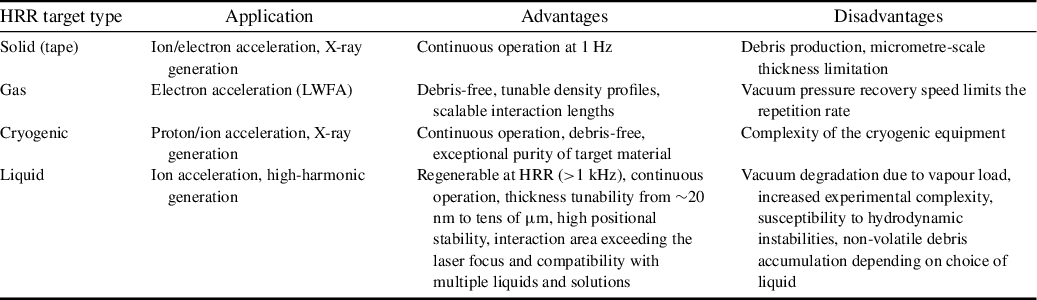
Automatic alignment technology is being developed to increase the repetition rate to one shot every minute[ Reference Collins IV, Jaris, Dahlke, Do, Kotian, Sabouri, Haid, McGuffey, Forsman and Manuel 71 ]. All solid metal targets are sources of debris, which is detrimental to beam transport elements and diagnostics[ Reference Vladisavlevici, Vlachos, Dubois, Haddock, Astbury, Huerta, Agarwal, Ahmed, Apiñaniz, Cernaianu, Gugiu, Krupka, Lera, Morabito, Sangwan, Ursescu, Curcio, Fefeu, Pérez-Hernández and Ehret 36 ]. Mitigation of debris is especially important for tape targets, which can emit hundreds of micrograms per interaction, and therefore several grams per day of operation. A high-speed spinning multi-disc debris reducing system was proposed by Chen et al. [ Reference Chen, Zhao, Xu, Peng, Ma, Gao, Chen, Liu, Xu, Pan, Liang, Song, Xu, Yan and Ma 72 ] and will be implemented at the 2 PW laser from Peking University, aiming to reduce the damage caused by the coating of the optical components. All HRR target approaches discussed in this manuscript are summarized in Table 1.
Comparison of high-repetition-rate (HRR) target approaches.

2.4 Summary and remarks
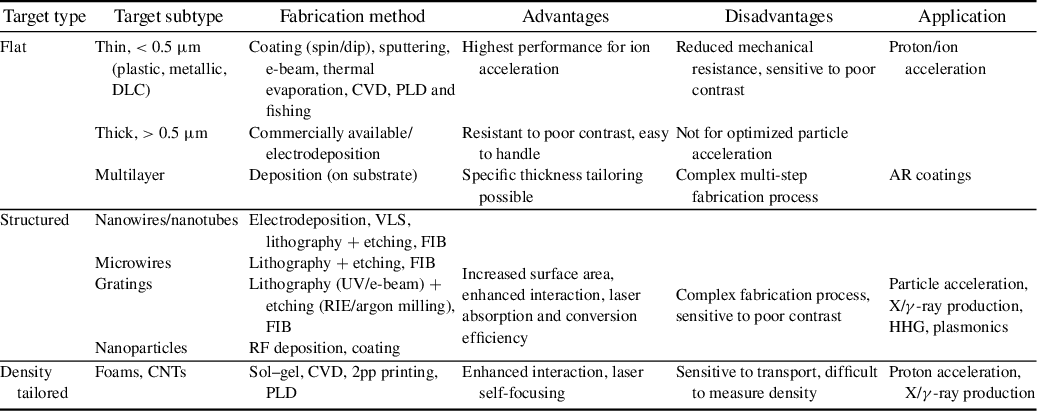
Solid target fabrication has a strong base in material science research and brings together different types of methods that combined with precise engineering lead to high reproducibility, constant geometrical parameters and a wide variety of possibilities (material, thickness, density, structuring). While flat targets pave the way for the particle acceleration processes, and rely on straightforward fabrication techniques, structured and near-critical-density materials enhance the laser–matter interaction by increasing the conversion efficiency, allowing the production of tailored radiation sources, while requiring extensive fabrication process development and careful experimental planning for clean temporal contrast of the laser pulse. For structured targets, 3D PIC and hydrodynamic studies would model the interaction in a realistic manner, although they require huge amounts of computational time, which is usually a limited resource, making the experimental approach an attractive and faster option. Therefore, detailed parameter studies are needed in order to discover the optimal target geometrical characteristics for each type of laser system, which require a wide range of readily available targets. Developing systems such as the tape target to reach a higher repetition rate begins to increase number of the data sets and, with that, the understanding of the process, and opens the path to application-oriented efforts. Such tape systems currently work at a repetition rate of more than 1 Hz with some limitations related to the thickness of the target, which is in the range of a few micrometres, and deal with the resulting debris. For more sophisticated targets, holders are yet to be developed, while for the debris, solutions as pellicles in front of the optics and rotating discs are explored. The solid target fabrication methods, along with advantages and disadvantages, as well as their applications, are summarized in Table 2.
Target fabrication methods and applications for single-shot experiments a .

a HHG, high-order harmonic generation; RIE, reactive ion etching; VLS, vapor liquid solid; PLD, pulsed laser deposition; CVD, chemical vapor deposition; FIB, focused ion beam; CNT, carbon nanotube; DLC, diamond-like carbon; AR, anti-reflective.
3 Gas targets for laser wakefield acceleration
Laser wakefield acceleration (LWFA) relies on the interaction of a relativistically intense laser pulse ( $I$
$I$ $>$
1018 W/cm2) with an underdense plasma, where the electron density,
$>$
1018 W/cm2) with an underdense plasma, where the electron density, ${n}_{\rm e}$
, is lower than the laser’s critical density,
${n}_{\rm e}$
, is lower than the laser’s critical density, ${n}_{\rm c}$
. As the laser pulse propagates and ionizes the gas, its relativistic ponderomotive force expels the electrons, leaving the relatively heavier ions stationary, thereby creating an electron plasma oscillation, that is, a wake behind the laser pulse. Strong electric fields resulting from the charge separation attract background electrons, trapping and injecting them into the ion cavity. The longitudinal field (
${n}_{\rm c}$
. As the laser pulse propagates and ionizes the gas, its relativistic ponderomotive force expels the electrons, leaving the relatively heavier ions stationary, thereby creating an electron plasma oscillation, that is, a wake behind the laser pulse. Strong electric fields resulting from the charge separation attract background electrons, trapping and injecting them into the ion cavity. The longitudinal field ( $\sim$
100s GV/m) accelerates the injected electrons to relativistic energies up to the dephasing limit, where the electrons outrun the acceleration phase. The underdense condition (
$\sim$
100s GV/m) accelerates the injected electrons to relativistic energies up to the dephasing limit, where the electrons outrun the acceleration phase. The underdense condition ( ${n}_{\rm e}/{n}_{\rm c}\ll 1$
) is essential to mitigate laser depletion and sustain wakefield generation over extended propagation lengths[
Reference Gibbon
73
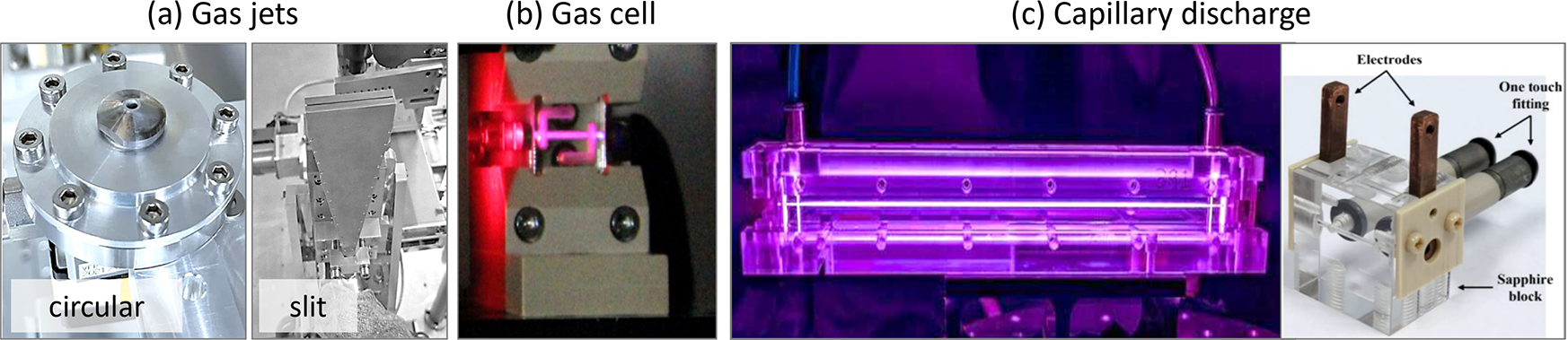
]. Hence, different gas targets or plasma sources, which are illustrated in Figure 3, are designed to achieve high-quality electron beam generation via LWFA. Each target type, for example, gas cells, gas jets and capillary discharge, offers distinct advantages and disadvantages in terms of density control, fabrication complexity and experimental flexibility, as summarized in Table 3.
${n}_{\rm e}/{n}_{\rm c}\ll 1$
) is essential to mitigate laser depletion and sustain wakefield generation over extended propagation lengths[
Reference Gibbon
73
]. Hence, different gas targets or plasma sources, which are illustrated in Figure 3, are designed to achieve high-quality electron beam generation via LWFA. Each target type, for example, gas cells, gas jets and capillary discharge, offers distinct advantages and disadvantages in terms of density control, fabrication complexity and experimental flexibility, as summarized in Table 3.
Types of gas targets in laser–plasma acceleration experiments. (a) Gas jets with circular or slit nozzles, (b) gas cell and (c) capillary discharge. Images taken from the ELI-NP facility and Refs. [Reference Gonsalves, Nakamura, Benedetti, Pieronek, Steinke, Bin, Bulanov, van Tilborg, Geddes, Schroeder, Daniels, Tóth, Obst-Huebl, van den Berg, Bagdasarov, Bobrova, Gasilov, Korn, Sasorov, Leemans and Esarey74–Reference Osterhoff, Popp, Major, Marx, Rowlands-Rees, Fuchs, Geissler, Hörlein, Hidding, Becker, Peralta, Schramm, Grüner, Habs, Krausz, Hooker and Karsch76].

Comparison of gas target types.

3.1 Gas jet
A gas jet system operates via a pulsed solenoid valve that controls gas flow through the convergent–divergent (de Laval) nozzle[
Reference Semushin and Malka
77
]. Gas jets are popular among the LPA community due to their relatively simple implementation and tunable gas density profile. These profiles can be tailored by coupling the gas flow to different nozzle geometries, such as circular[
Reference Hosokai, Kinoshita, Watanabe, Yoshii, Ueda, Zhidokov, Uesaka, Nakajima, Kando and Kotaki
78
], slit[
Reference Couperus, Köhler, Wolterink, Jochmann, Zarini, Bastiaens, Boller, Irman and Schramm
79
, Reference Miao, Shrock, Feder, Hollinger, Morrison, Nedbailo, Picksley, Song, Wang, Rocca and Milchberg
80
], shock-front[
Reference Buck, Wenz, Xu, Khrennikov, Schmid, Heigoldt, Mikhailova, Geissler, Shen, Krausz, Karsch and Veisz
81
], reaching the typical electron density, n
e $\sim$
1017–1020 cm–3. The diagnostics of inner plasma processes are straightforward due to their open geometry. However, a high gas flow burdens the vacuum systems and limits operation to a low repetition rate (
$\sim$
1017–1020 cm–3. The diagnostics of inner plasma processes are straightforward due to their open geometry. However, a high gas flow burdens the vacuum systems and limits operation to a low repetition rate ( $<$
1 Hz) to prevent the gas overloading. The density fluctuation in gas jets is typically higher compared to the gas cell and capillary discharge[
Reference Osterhoff, Popp, Major, Marx, Rowlands-Rees, Fuchs, Geissler, Hörlein, Hidding, Becker, Peralta, Schramm, Grüner, Habs, Krausz, Hooker and Karsch
76
].
$<$
1 Hz) to prevent the gas overloading. The density fluctuation in gas jets is typically higher compared to the gas cell and capillary discharge[
Reference Osterhoff, Popp, Major, Marx, Rowlands-Rees, Fuchs, Geissler, Hörlein, Hidding, Becker, Peralta, Schramm, Grüner, Habs, Krausz, Hooker and Karsch
76
].
3.2 Gas cell
A gas cell is an enclosed interaction chamber filled with gas in which the laser propagates through two apertures at the cell’s entrance and exit. These small apertures mitigate the leaks, allowing lower operational density compared to gas jets, in the range of approximately 1015–1019 cm–3, under the steady-state condition[ Reference Osterhoff, Popp, Major, Marx, Rowlands-Rees, Fuchs, Geissler, Hörlein, Hidding, Becker, Peralta, Schramm, Grüner, Habs, Krausz, Hooker and Karsch 76 ]. Simple gas cell design employs cylindrical capillaries embedded in a solid block, with gas inlets located on the side[ Reference Genoud, Cassou, Wojda, Ferrari, Kamperidis, Burza, Persson, Uhlig, Kneip, Mangles, Lifschitz, Cros and Wahlström 82 , Reference Audet, Hansson, Lee, Desforges, Maynard, Dufrénoy, Lehe, Vay, Aurand, Persson, González, Maitrallain, Monot, Wahlström, Lundh and Cros 83 ], while the square gas cells are assembled from polished, micro-machined sapphire plates that are held within a housing. The polished surfaces are transparent to laser transmission for probing the gas or plasma density diagnostics[ Reference Kirchen, Jalas, Messner, Winkler, Eichner, Hübner, Hülsenbusch, Jeppe, Parikh, Schnepp and Maier 84 – Reference Aniculaesei, Kim, Yoo, Oh and Nam 86 ]. However, these apertures and inner walls are susceptible to erosion and damage from laser misalignment and plasma, consequently requiring periodic replacement. Recent advancements in 3D-printing technology have significantly reduced the cost and time for nozzle fabrication, enabling the production of tailored and complex target geometries – such as hybrid jet–cell designs – that are otherwise infeasible to manufacture using conventional machining, thereby enhancing flexibility in LWFA experimental setups[ Reference Döpp, Guillaume, Thaury, Gautier, Phuoc and Malka 87 – Reference Andrianaki, Grigoriadis, Skoulakis, Tazes, Mancelli, Fitilis, Dimitriou, Benis, Papadogiannis, Tatarakis and Nikolos 91 ].
3.3 Capillary discharge
The capillary discharge shares similarities with gas cells, where gas is confined to a cavity. This allows uniform gas distribution and minimal turbulence. Typical operating densities range from approximately 1017 to 1019 cm–3. When the high-voltage pulse is applied across the electrodes inserted at both ends of the capillary, this triggers an electrical discharge through the gas, producing a fully ionized plasma with a parabolic electron density profile ${n}_{\rm e}={n}_{\mathrm{o}}+\Delta n{\left(r/{r}_{\mathrm{o}}\right)}^2$
that varies radially, peaking on-axis (
${n}_{\rm e}={n}_{\mathrm{o}}+\Delta n{\left(r/{r}_{\mathrm{o}}\right)}^2$
that varies radially, peaking on-axis ( $r=0$
) and gradually decreasing outward[
Reference Lee, Kwon, Nam, Cho, Jang, Suk and Kim
75
, Reference Kim, Jang, Uhm, Hwang, Lee and Suk
92
, Reference Kruchinin, Mondal, Sasorov, Zimmermann, Niekrasz and Molodozhentsev
93
]. Due to this density gradient, the refractive index
$r=0$
) and gradually decreasing outward[
Reference Lee, Kwon, Nam, Cho, Jang, Suk and Kim
75
, Reference Kim, Jang, Uhm, Hwang, Lee and Suk
92
, Reference Kruchinin, Mondal, Sasorov, Zimmermann, Niekrasz and Molodozhentsev
93
]. Due to this density gradient, the refractive index $\eta (r)$
is highest on-axis and diminishes radially, creating a focusing force along the capillary, maintaining laser focus over extended distances to overcome both diffraction and dephasing limitations. Hence, the first measurement of laser-produced electron beams in the GeV range through a hydrogen-filled capillary waveguide by Leemans et al.
[
Reference Leemans, Nagler, Gonsalves, Tóth, Nakamura, Geddes, Esarey, Schroeder and Hooker
21
] was demonstrated. However, this system demands sub-nanosecond synchronization between the gas injection and high-voltage discharge, significantly increasing the system’s complexity.
$\eta (r)$
is highest on-axis and diminishes radially, creating a focusing force along the capillary, maintaining laser focus over extended distances to overcome both diffraction and dephasing limitations. Hence, the first measurement of laser-produced electron beams in the GeV range through a hydrogen-filled capillary waveguide by Leemans et al.
[
Reference Leemans, Nagler, Gonsalves, Tóth, Nakamura, Geddes, Esarey, Schroeder and Hooker
21
] was demonstrated. However, this system demands sub-nanosecond synchronization between the gas injection and high-voltage discharge, significantly increasing the system’s complexity.
3.4 Modular targets
As single-stage targets approach their limits in acceleration length, the LPA community has shifted its attention to the development of the stackable, modular unit-cell design target system to increase the effective acceleration length[ Reference Kim, Pae, Cha, Kim, Yu, Sung, Lee, Jeong and Lee 94 – Reference Kroupp, Queller, Levine and Malka 99 ]. The approach demonstrated by Miao et al. [ Reference Miao, Shrock, Rockafellow, Sloss and Milchberg 98 ] uses a single-plenum modular unit-cell, specifically a 30-cm-long single-module supersonic slit nozzle fed by nine solenoid valves. This design enables the extensive stacking of acceleration stages to achieve metre-scale interaction lengths. On the other hand, Kroupp et al. [ Reference Kroupp, Queller, Levine and Malka 99 ] demonstrated an alternative approach: a single integrated system featuring a multi-slit nozzle valve with a five-independent plena design. Both designs are highly versatile, allowing tailored density profiles over a wide range of modulations through the selection of gas species and backing pressures, while supporting both synchronous sequencing and simultaneous single-puff operation. Despite the different architecture approaches, the smoothing effect could be a significant shift towards resolving gas density stability in jet-like targets, potentially making such designs more favourable in the community.
3.5 Summary and remarks
The selection of a gas target involves a fundamental trade-off among diagnostic accessibility, fluid control, plasma stability and the desired acceleration length. As the LPA community moves towards multi-GeV energy gains, the transition from monolithic, single-stage targets to complex, multi-stage systems has become a central research priority. The primary limitation across all traditional single-stage targets is the coupling of the injection and acceleration phases. Recent advancements suggest that the ‘game-changer’ resolving this lies in advanced fluid engineering and modularity. This approach incorporates design features specifically engineered to improve gas density stability in jet-like geometries. Hybrid complex internal geometries, achieved through 3D-printed targets, could be seen as potential hardware design improvements, which, combined with active feedback loops and machine learning for real-time density control, represent the next frontier in target development. Ultimately, the choice between target architectures remains dependent on the experimental goal: a single-unit integrated system might offer high-precision stability for injection studies, while modular assemblies provide the scalability necessary for the beyond-GeV frontier. This integration must minimize technical constraints, such as alignment procedures, vacuum pressure recovery speeds that affect repetition rates, the physical footprint and the mechanical complexity of the system within the vacuum chamber.
4 Cryogenic targets
4.1 Cryogenic liquid targets
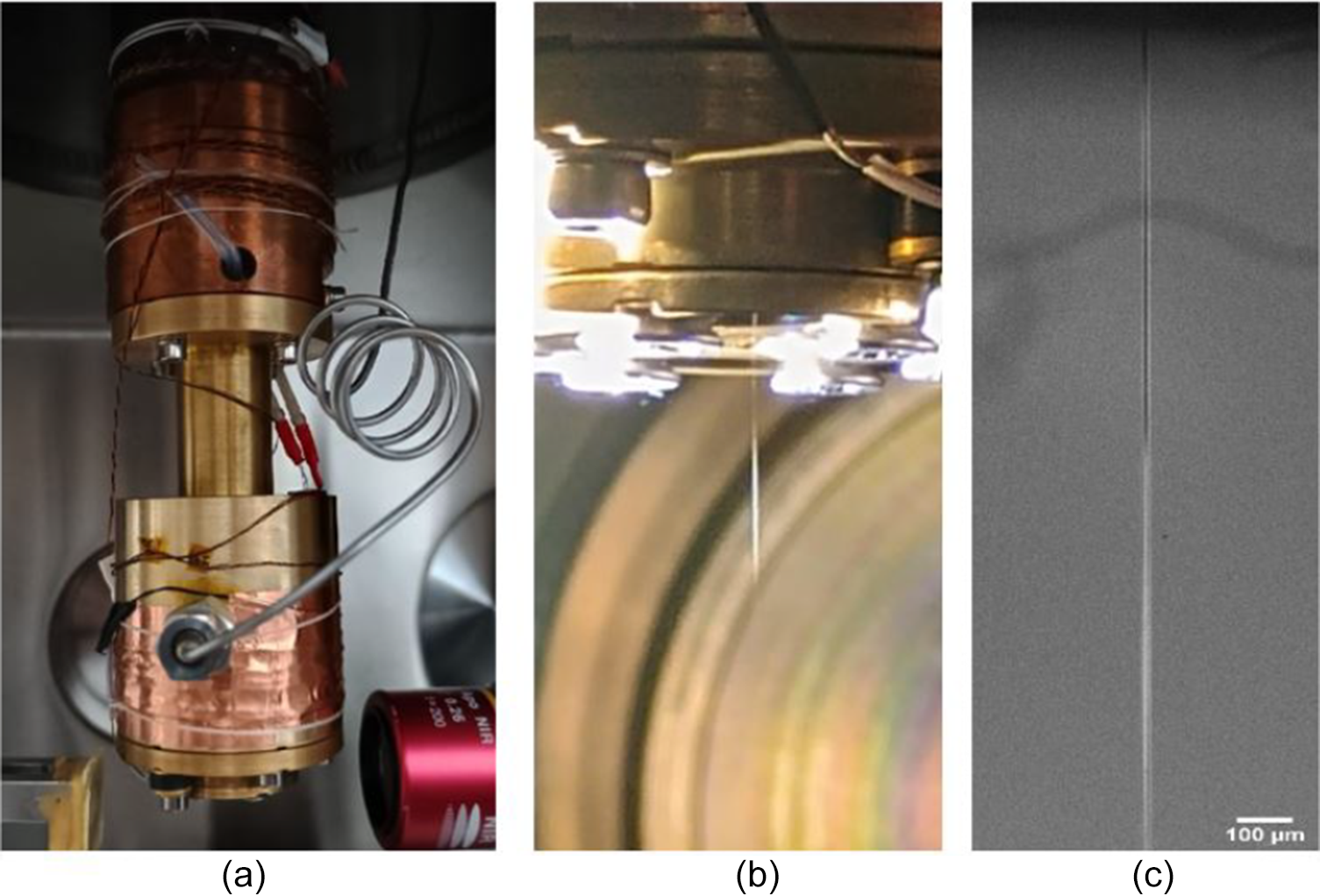
Liquid targets are well-suited for laser experiments at HRRs due to their unique combination of fast renewability and shot-to-shot reproducibility[ Reference Gamaiunova, Tryus, Grepl, Velyhan, Stancek, Kantarelou, Cirrone, Margarone, Giuffrida and Chagovets 100 ]. Among them, cryogenic liquid targets offer a continuous, debris- and contaminant-free source of accelerated ions, which is crucial for secondary beam quality and compatibility with sensitive optical components[ Reference Chagovets, Viswanathan, Tryus, Grepl, Velyhan, Stancek, Giuffrida, Schillaci, Cupal, Koubikova, Garcia, Manzagol, Bonnay, Souris, Chatain, Girard and Margarone 101 ]. In addition, such targets are favourable for simulations due to the very high purity of the target material. The cryogenic target system developed at the ELI Beamlines (BL) Cryogenic Laboratory is designed to support kHz laser operation. It is based on a closed-cycle helium-free cryocooler coupled with a custom cell capable of maintaining temperatures down to 4 K. A cold head placed inside a helium exchange gas volume ensures low vibration and efficient thermal coupling to a cold plate, which in turn supports a brass or copper condensation cell. The cell features an exchangeable nozzle with 5–25 μm apertures, determining the liquid jet diameter. The setup enables long-term, stable, high-purity, reproducible cryogenic liquid flow extrusion. Ongoing work focuses on expanding the range of liquefied gases[ Reference Chagovets 102 ] and minimizing spatial fluctuations of the jet. Cryojets of N2, Ar and Kr have already been obtained. Current efforts concentrate on optimizing the performance of the target. For instance, a stable 10 μm N2 column jet with adjustable velocity (5–20 m/s) was achieved at 70 K and 0.5–7 bar, while a chamber pressure level of 10–4–10–3 mbar remains suitable for laser-driven ion acceleration at HRRs (see Figure 4). With a 5 μm hydrogen jet and a petawatt-class laser, protons with energy up to 80 MeV were produced, using induced pre-pulses for plasma pre-expansion[ Reference Rehwald, Assenbaum, Bernert, Brack, Bussmann, Cowan, Curry, Fiuza, Garten, Gaus, Gauthier, Göde, Göthel, Glenzer, Huang, Huebl, Kim, Kluge, Kraft and Zeil 29 ].
(a) Assembled cryocell inserted into vacuum chamber. (b) Cylindrical cryogenic N2 jet with the thickness of 10 μm. (c) Overlay of 200 images of N2 10 μm jet flow giving lateral fluctuations ±7 μm 2 mm away from the nozzle.

4.2 Cryogenic cluster targets
From the point of view of practical application, high-purity proton beams with HRR operation are quite advantageous. At the National Institutes for Quantum and Radiological Science and Technology, Kansai Photon Science Institute (QST-KPSI), we have developed micrometre-sized hydrogen cluster targets, which can produce impurity-free, highly reproducible and robust proton beams[ Reference Jinno, Kanasaki, Asai, Matsui, Pirozhkov, Ogura, Sagisaka, Miyasaka, Nakanii, Kando, Kitagawa, Morishima, Kodaira, Kishimoto, Yamauchi, Uesaka, Kiriyama and Fukuda 30 – Reference Jinno, Tanaka, Matsui, Kanasaki, Sakaki, Kando, Kondo, Sugiyama, Uesaka, Kishimoto and Fukuda 103 ].
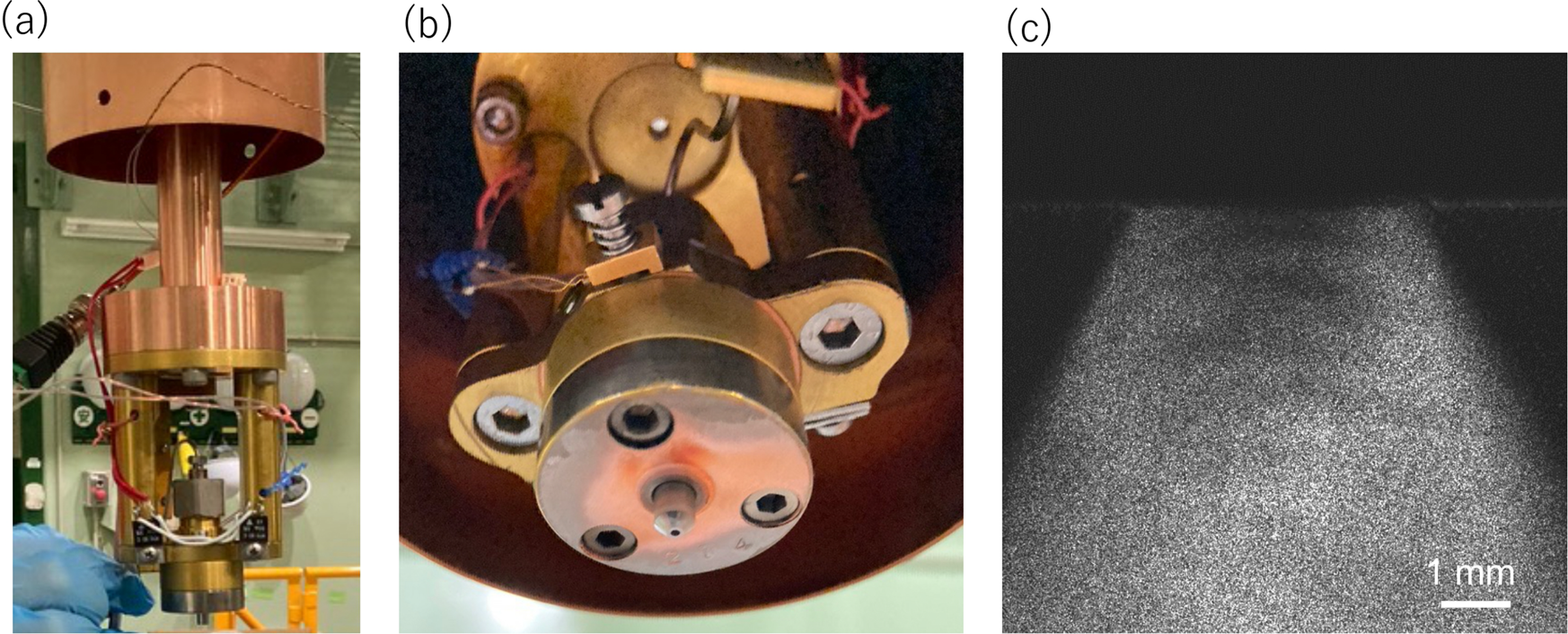
Micrometre-scale hydrogen clusters were produced by expanding supercooled (25 K), high-pressure (6 MPa) molecular hydrogen gas into vacuum through a conical nozzle connected to an Even–Lavie pulsed valve, which can be operated at 600 Hz with a strong pumping system ( $\gg$
1000 L/min).[
Reference Even
105
]. To cool the gas temperature, the pulsed valve was attached to a compact closed-cycle helium refrigerator (see Figure 5). The temperature of the pulsed valve and the nozzle was monitored using a silicon diode temperature sensor and stabilized using two high-power thick-film resistors connected to a temperature controller. The size distribution of the micrometre-scale hydrogen clusters was evaluated by Mie scattering measurements[
Reference Jinno, Tanaka, Matsui, Kanasaki, Sakaki, Kando, Kondo, Sugiyama, Uesaka, Kishimoto and Fukuda
103
, Reference Jinno, Kanasaki, Uno, Matsui, Uesaka, Kishimoto and Fukuda
104
]. Since the distance between each cluster is several micrometres, if a ‘skimmer’ is used, it is possible that laser pulses can hit one cluster with a short-focus off-axis parabola (OAP) (F/1.5–F/3) having a focus spot diameter of a few micrometres, although the probability of hitting is low. With a long-focus OAP (>F/10) having a focus spot diameter of tens of micrometres, the laser pulse can hit tens of clusters in one shot.
$\gg$
1000 L/min).[
Reference Even
105
]. To cool the gas temperature, the pulsed valve was attached to a compact closed-cycle helium refrigerator (see Figure 5). The temperature of the pulsed valve and the nozzle was monitored using a silicon diode temperature sensor and stabilized using two high-power thick-film resistors connected to a temperature controller. The size distribution of the micrometre-scale hydrogen clusters was evaluated by Mie scattering measurements[
Reference Jinno, Tanaka, Matsui, Kanasaki, Sakaki, Kando, Kondo, Sugiyama, Uesaka, Kishimoto and Fukuda
103
, Reference Jinno, Kanasaki, Uno, Matsui, Uesaka, Kishimoto and Fukuda
104
]. Since the distance between each cluster is several micrometres, if a ‘skimmer’ is used, it is possible that laser pulses can hit one cluster with a short-focus off-axis parabola (OAP) (F/1.5–F/3) having a focus spot diameter of a few micrometres, although the probability of hitting is low. With a long-focus OAP (>F/10) having a focus spot diameter of tens of micrometres, the laser pulse can hit tens of clusters in one shot.
(a) Cryogenic micrometre-scale hydrogen cluster target generation system. (b) Conical nozzle with orifice diameter of 250 μm having a conical angle of 5 degrees connected to an Even–Lavie pulsed valve. (c) Schlieren image of sprayed hydrogen cluster target in vacuum.

Multi-MeV high-purity proton acceleration by using a hydrogen cluster target irradiated with relativistic intensity laser pulses has been demonstrated with a long-focus OAP (F/10) with the J-KAREN-P laser system at QST-KPSI[ Reference Jinno, Kanasaki, Asai, Matsui, Pirozhkov, Ogura, Sagisaka, Miyasaka, Nakanii, Kando, Kitagawa, Morishima, Kodaira, Kishimoto, Yamauchi, Uesaka, Kiriyama and Fukuda 30 ].
As a future prospect, the 3D PIC simulation predicts the generation of directed proton beams over 100 MeV via the anisotropic Coulomb explosion[ Reference Jinno, Kanasaki, Uno, Matsui, Uesaka, Kishimoto and Fukuda 104 ] or collisionless shock dynamics inside the cluster coupled with the relativistically induced transparency effect[ Reference Matsui, Fukuda and Kishimoto 106 ]. Since the micrometre-scale clusters are less sensitive to the laser pre-pulses, it can be an attractive target for laser-driven ion acceleration aiming at over 100 MeV and other applications.
4.3 Summary and remarks
Cryogenic targets are a key enabling technology for HRR laser–matter interaction experiments because they offer debris-free operation and high material purity compared with conventional solid targets. They bridge the gap between conventional solid targets and gaseous media, offering solid-density interaction conditions with improved reproducibility and long-term stability. Within this category, two complementary approaches, cryogenic liquid targets and cryogenic cluster targets, address different experimental requirements. Cryogenic liquid targets provide a continuous, macroscopic, solid-density medium with well-defined geometry and excellent shot-to-shot stability, with access to light elements such as hydrogen as well as noble gases, resulting in high-purity proton beams. Compared to solid targets, they eliminate debris and surface contamination, while offering significantly higher effective densities than gas targets. These characteristics make them especially suitable for systematic ion-acceleration studies and for application-oriented experiments that demand long-term, HRR operation. Their main limitations stem from the complexity of cryogenic operation, residual jet instabilities, constraints on achievable target thickness and geometry, sensitivity to laser-induced hydrodynamic perturbations and vacuum compatibility, particularly at very HRRs. Cryogenic cluster targets constitute a complementary approach, enabling interactions with discrete, micrometre-scale overdense structures that are intrinsically robust against laser pre-pulses. They grant access to distinct acceleration mechanisms, including anisotropic Coulomb explosion and collisionless shock dynamics, and show strong potential for generating high-purity, high-energy protons. However, their stochastic spatial distribution reduces interaction reproducibility and limits precise control over the effective interaction volume. In summary, cryogenic liquid targets prioritize stability, reproducibility and scalability to HRRs, whereas cryogenic cluster targets emphasize robustness and access to novel laser–plasma interaction regimes. Future work should focus on enhancing flow stability and material versatility in liquid targets, and on improving control over cluster size, density and spatial distribution in cluster-based systems.
5 Liquid targets
Liquid targets are gaining prominence in HRR laser-driven experiments due to their regenerative nature and adaptable geometries. The implementations include jets, droplets and thin, laminar liquid sheets generated by the symmetric collision of two microjets[ Reference Thoss, Richardson, Korn, Faubel, Stiel, Vogt and Elsaesser 31 – Reference Taylor 107 ]. These liquid sheets typically exhibit a gradient in thickness, ranging from several micrometres near the collision point to below 200 nm at the periphery[ Reference Füle, Kovács, Gilinger, Karnok, Gaál, Figul, Marowsky and Osvay 114 ]. Several advanced nozzle designs were developed using single converging channel etched in glass[ Reference Crissman, Mo, Chen, Yang, Huyke, Glenzer, Ledbetter, Nunes, Ng, Wang, Shen, Wang and DePonte 115 , Reference Ha, DePonte and Santiago 116 ] or tungsten[ Reference Treffert, Glenn, Chou, Crissman, Curry, DePonte, Fiuza, Hartley, Ofori-Okai, Roth, Glenzer and Gauthier 117 ]. Gas-dynamic systems enabled ultra-thin continuous sheets with a thickness profile reaching as low as 20 nm[ Reference Koralek, Kim, Brůža, Curry, Chen, Bechtel, Cordones, Sperling, Toleikis, Kern, Moeller, Glenzer and DePonte 118 ]. All these nozzle configurations offer a large interaction area with excellent optical flatness[ Reference Faubel, Glenn, Jain, Gauthier and Glenzer 119 ] while providing a tunable thickness range that can be selected through vertical translation of the target. However, colliding-jet configurations require careful stabilization and alignment due to their high sensitivity to flow fluctuations[ Reference Peng, Cao, Liu, Shou, Zhao, Chen, Gao, Wang, Mei, Pan, Kong, Xu, Liu, Liang, Xu, Song, Chen, Wu, Zhang and Ma 120 ].
Thin laminar sheets are particularly well-suited for ion acceleration via TNSA due to their sub-micrometre thickness allowing the laser to efficiently generate hot electrons that transit the target and form a strong sheath field at the rear surface. This type of target has been adapted for high-intensity laser applications, such as MeV-range proton acceleration from water[
Reference Valdes, de Luis, Hernandez, Apiñaniz, Curcio, Henares, Huault, Perez-Hernandez, Roso, Gatti and Volpe
113
, Reference Treffert, Glenn, Chou, Crissman, Curry, DePonte, Fiuza, Hartley, Ofori-Okai, Roth, Glenzer and Gauthier
117
] and ethylene glycol[
Reference Morrison, Feister, Frische, Austin, Ngirmang, Murphy, Orban, Chowdhury and Roquemore
32
], recently demonstrating stable proton acceleration with cut-off energies up to 30 MeV over hundreds of shots, using 3 μm thick liquid sheets[
Reference He, Bachhammer, Balling, Biswas, Doyle, Gerlach, Hofrichter, Kharbedia, Liese, De Marco, Pohle, Praßelsperger, Schmidt, Schweiger, Kling, Karsch and Schreiber
33
]. High-flux proton beams with less than 1° divergence were demonstrated using self-guiding in low-density vapour[
Reference Streeter, Glenn, DiIorio, Treffert, Loughran, Ahmed, Astbury, Borghesi, Bourgeois, Curry, Dann, Dover, Dzelzainis, Ettlinger, Gauthier, Giuffrida, Glenzer, Gray, Green and Palmer
121
]. Irradiation of deuterated heavy water[
Reference Treffert, Glenn, Chou, Crissman, Curry, DePonte, Fiuza, Hartley, Ofori-Okai, Roth, Glenzer and Gauthier
117
] yielded 4.4 MeV deuterons[
Reference Treffert, Curry, Chou, Crissman, DePonte, Fiuza, Glenn, Hollinger, Nedbailo, Park, Schoenwaelder, Song, Wang, Rocca, Roth, Glenzer and Gauthier
122
], and enabled a laser-based neutron source with $1.8\times {10}^5$
neutrons/s[
Reference Stuhl, Varmazyar, Elekes, Halász, Gilinger, Füle, Karnok, Buzás, Kovács, Nagy, Mohácsi, Bíró, Csedreki, Fenyvesi, Fülöp, Korkulu, Kuti, Csontos, Geetha, Tóth, Szabó and Osvay
123
]. In ultrafast optics, liquid plasma mirrors achieved reflectivity up to 30%[
Reference Underwood, Gan, He, Murphy, Thomas, Krushelnick and Nees
124
] and enabled high-harmonic generation at HRRs[
Reference Kim, Kim, Park, Kwon, Yeom, Cho, Kwon, Yun, Sung, Lee, Luu, Nam and Kim
125
]. Flat liquid jets also served as terahertz sources with 0.05% conversion efficiency[
Reference Tcypkin, Ponomareva, Putilin, Smirnov, Shtumpf, Melnik, E, Kozlov and Zhang
126
]. These innovations highlight the versatility of liquid sheet targets in advancing HRR laser-driven particle and photon sources.
$1.8\times {10}^5$
neutrons/s[
Reference Stuhl, Varmazyar, Elekes, Halász, Gilinger, Füle, Karnok, Buzás, Kovács, Nagy, Mohácsi, Bíró, Csedreki, Fenyvesi, Fülöp, Korkulu, Kuti, Csontos, Geetha, Tóth, Szabó and Osvay
123
]. In ultrafast optics, liquid plasma mirrors achieved reflectivity up to 30%[
Reference Underwood, Gan, He, Murphy, Thomas, Krushelnick and Nees
124
] and enabled high-harmonic generation at HRRs[
Reference Kim, Kim, Park, Kwon, Yeom, Cho, Kwon, Yun, Sung, Lee, Luu, Nam and Kim
125
]. Flat liquid jets also served as terahertz sources with 0.05% conversion efficiency[
Reference Tcypkin, Ponomareva, Putilin, Smirnov, Shtumpf, Melnik, E, Kozlov and Zhang
126
]. These innovations highlight the versatility of liquid sheet targets in advancing HRR laser-driven particle and photon sources.
In contrast, microjets and droplets are generally thicker ( $>$
10 μm) and too dense for efficient direct relativistic electron acceleration, unless pre-expansion or specialized low-density schemes are employed. Backward-propagating electrons with energies up to 3 MeV were generated from water microjets by optimizing the pre-plasma gradient[
Reference Feister, Austin, Morrison, Frische, Orban, Ngirmang, Handler, Smith, Schillaci, LaVerne, Chowdhury, Freeman and Roquemore
127
]. Recent work demonstrated nanosecond-pulse boring through microjets to enable self-modulated wakefield acceleration[
Reference Ivanov, Shulyapov, Gorlova, Tsygvintsev, Krivokorytov, Tsymbalov, Volkov and Savelev
128
]. Droplets, in particular, serve as excellent mass-limited targets that can be synchronized with the laser shot. Droplets have been optically shaped into thin ‘sails’ to generate stable multi-MeV electron beams[
Reference Ivanov, Shulyapov, Tsymbalov, Tsygvintsev, Vichev, Krivokorytov, Volkov and Savel’ev
129
].
$>$
10 μm) and too dense for efficient direct relativistic electron acceleration, unless pre-expansion or specialized low-density schemes are employed. Backward-propagating electrons with energies up to 3 MeV were generated from water microjets by optimizing the pre-plasma gradient[
Reference Feister, Austin, Morrison, Frische, Orban, Ngirmang, Handler, Smith, Schillaci, LaVerne, Chowdhury, Freeman and Roquemore
127
]. Recent work demonstrated nanosecond-pulse boring through microjets to enable self-modulated wakefield acceleration[
Reference Ivanov, Shulyapov, Gorlova, Tsygvintsev, Krivokorytov, Tsymbalov, Volkov and Savelev
128
]. Droplets, in particular, serve as excellent mass-limited targets that can be synchronized with the laser shot. Droplets have been optically shaped into thin ‘sails’ to generate stable multi-MeV electron beams[
Reference Ivanov, Shulyapov, Tsymbalov, Tsygvintsev, Vichev, Krivokorytov, Volkov and Savel’ev
129
].
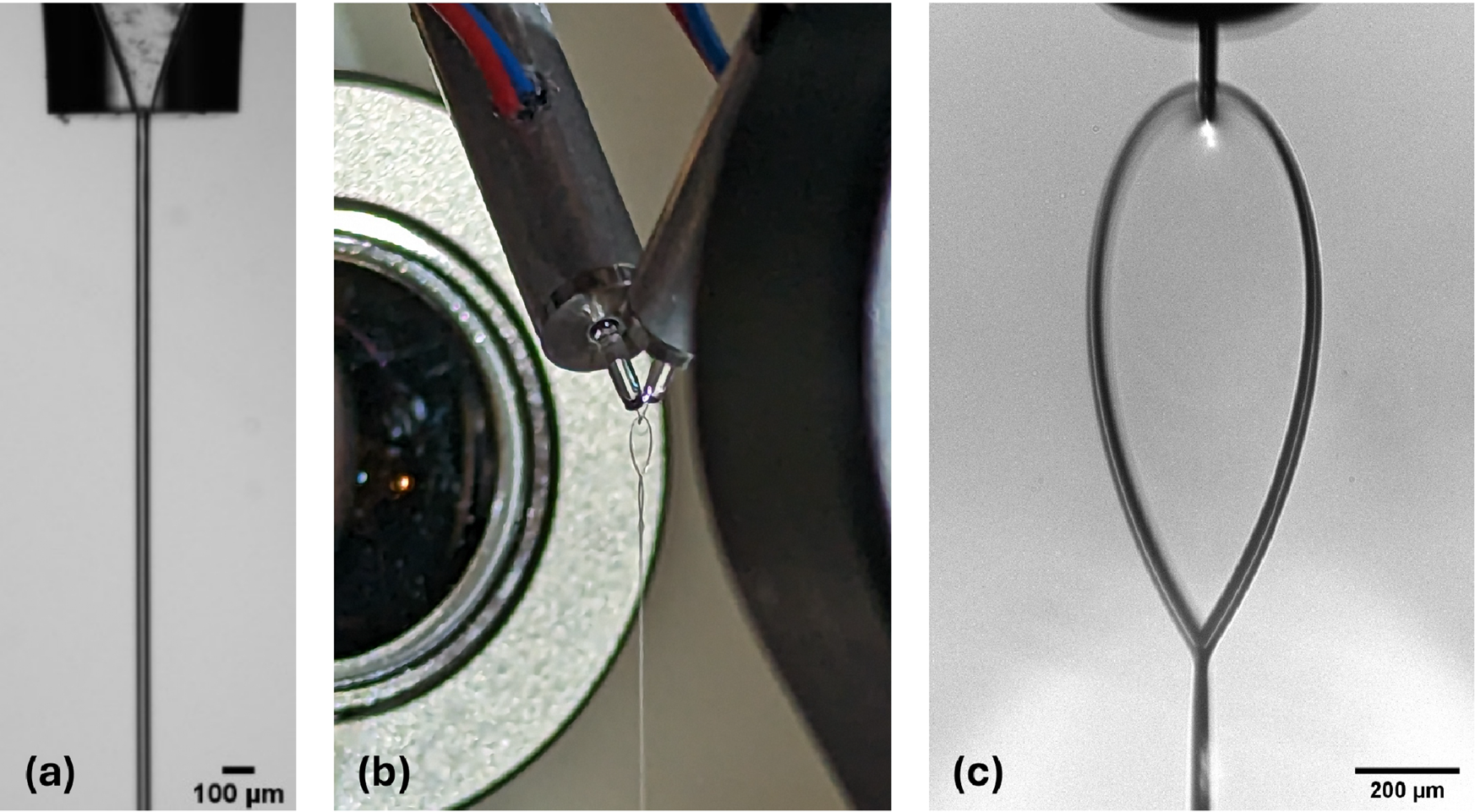
At the ELI-NP facility, a versatile liquid target system has been developed to support high-intensity HRR experiments. The setup enables the generation of microjets with diameters ranging from 20 to 70 μm, and droplet trains with diameters as low as 20 μm. Using a colliding-jet configuration, as shown in Figures 6(b) and 6(c), thin sheets can be obtained with thickness down to 1.4 μm as measured by the interferometry method. Microfluidic jets have been employed in the study of laser-driven shocks[
Reference Ursescu, Aleksandrov, Matei, Dancus, de Almeida and Stan
130
] and the liquid sheet target has demonstrated superior performance in plasma mirror applications compared to other HRR targets for the temporal characterization of chirped picosecond pulses[
Reference Popa, Nazîru, Lupu, Matei, Dumitru, Alexe, Dăncuş, Stan and Ursescu
131
]. Recent advancements in the setup, including improved flow stabilization and alignment control, have enabled reliable and stable target operation in vacuum environments down to ${10}^{-4}$
mbar, paving the way for its integration into high-power laser experiments.
${10}^{-4}$
mbar, paving the way for its integration into high-power laser experiments.
(a) Single liquid jet with 40 μm diameter. (b) Setup with colliding jets forming a chain of flat liquid sheets. (c) Liquid sheet formed from the collision of two 50 μm microjets.

The choice of liquid target geometry is dictated by the specific interaction physics and operational trade-offs. While microjets are easier to implement and align, laminar sheets provide the high optical quality and sub-micrometre thickness essential for surface-driven phenomena such as TNSA, although they remain more prone to flow disturbances. However, all liquid target implementations introduce additional challenges in vacuum operation by increasing the vapour load in the interaction chamber. Specialized catcher circuits are required to collect unused liquid and pump it out from the chamber in order to sustain long-term operation. Commonly used liquids such as water undergo boiling and rapid evaporative cooling at low pressures, leading to freezing and potential blockage of nozzles or catchers. These effects must be mitigated through careful alignment, temperature management or the use of non-volatile alternatives.
6 Conclusions
While fabrication of solid targets requires extensive studies to understand their material properties and, in many cases, long development periods, especially in the case of advanced structured targetry, their versatility allows for specific tailoring of the laser-driven radiation, particularly proton and carbon beams, along with bright photons, and delivery of consistent and reproducible results. Gas targets, on the other hand, offer design flexibility and cost-effectiveness while meeting sustainability requirements for next-generation accelerator facilities. Over the next 5–10 years, gas target development will evolve from static components into dynamic delivery systems capable of sustaining the experimental demands of next-generation facilities. While gas jets and cells offer simplicity, the future lies in hybrid modular architectures and jet–cell integrations that might utilize 3D-printed internal topologies to decouple injection from acceleration. Due to the versatility of gas-based targets, they are also considered as an alternative approach to solid targets for particle acceleration. It was reported that HRR proton acceleration was achieved from a hydrogen gas target using a novel method of target density tailoring, which involves milli-joule laser pulses and results in 50 $\%$
probability in 200 shots of obtaining 5 MeV proton energy from a 1.5 J on-target laser pulse[
Reference Seemann, Wan, Tata, Kroupp and Malka
132
]. The incorporation of active feedback loops and machine learning will be essential to achieve superior density stability, efficient heat dissipation and automated gas recycling for HRR operation. These advancements will enable metre-scale interaction lengths with precise longitudinal profile tailoring, providing the robust hardware platform required for LPAs. As modern laser facilities increasingly reach repetition rates in the range of tens to hundreds of Hz, and the need for societal applications arises, the traditional use of solid targets brings issues related to debris generation, limited target supply and alignment variability. Therefore, there is a growing need for alternative solid-density target solutions such as cryogenic, liquid and tapes that not only can sustain continuous operation, but also remain stable in geometry and alignment. This requirement is particularly important in the context of producing secondary radiation and particles, such as electrons, protons, ions or high-energy photons, where the characteristics of the generated beams are highly sensitive to the stability and uniformity of the target. Further research in the coming years will focus on the creation of thinner targets made of various materials, for all cryogenic, liquid and ribbon types, in order to allow access to different acceleration mechanisms while maintaining an HRR.
$\%$
probability in 200 shots of obtaining 5 MeV proton energy from a 1.5 J on-target laser pulse[
Reference Seemann, Wan, Tata, Kroupp and Malka
132
]. The incorporation of active feedback loops and machine learning will be essential to achieve superior density stability, efficient heat dissipation and automated gas recycling for HRR operation. These advancements will enable metre-scale interaction lengths with precise longitudinal profile tailoring, providing the robust hardware platform required for LPAs. As modern laser facilities increasingly reach repetition rates in the range of tens to hundreds of Hz, and the need for societal applications arises, the traditional use of solid targets brings issues related to debris generation, limited target supply and alignment variability. Therefore, there is a growing need for alternative solid-density target solutions such as cryogenic, liquid and tapes that not only can sustain continuous operation, but also remain stable in geometry and alignment. This requirement is particularly important in the context of producing secondary radiation and particles, such as electrons, protons, ions or high-energy photons, where the characteristics of the generated beams are highly sensitive to the stability and uniformity of the target. Further research in the coming years will focus on the creation of thinner targets made of various materials, for all cryogenic, liquid and ribbon types, in order to allow access to different acceleration mechanisms while maintaining an HRR.
Author contributions
Solid targets, S.I., C.G., M.E., V.L.; gas targets, V.L.J.P.; cryo-liquid targets, N.G., T.C., L.G.; cryo-cluster, Y.F.; liquid targets, S.P., D.U.; review and editing, all authors contributed equally.
Acknowledgements
This work was partially supported by Extreme Light Infrastructure–Nuclear Physics (ELI-NP) Phase II, a project co-financed by the Romanian Government and the European Union through the European Regional Development Fund, contract No. 1/07.07.2016, COP, ID 1334, and by the Romanian Ministry of Education and Research through Nucleu Projects (Grant Nos. PN 23210105 and 19060105) and through IOSIN funds for Facilities of National Interest; partial support by the Institute of Atomic Physics Romania through projects ELI-RO/DFG/2023 and ELI-RO/RDI/2024/026.001 ARNPhot is also acknowledged. This work is supported by Project ELI−RO/DFG/2025−013 IATP-NP 2.0 funded by the Institute of Atomic Physics, Romania. This work was supported by JSPS KAKENHI Grant (No. 25H00622) and JSPS Core-to-Core Program (No. JPJSCCA20230003).


 Open access

