




Introduction
The Vascones—mentioned in Classical sources including Ptolemy (Geographia 2.6.67; Garcia Gil & Molinero Hernando Reference Garcia Gil and Molinero Hernando2006) and Pliny (Naturalis Historia 3.3.24; Rackham Reference Rackham1942)—were a Late Iron Age cultural group that occupied the western Pyrenees, in the approximate area of present-day Navarre (Gorrochategui Reference Gorrochategui2020; Lanz Reference Lanz2020; Figure 1). The region is framed to the north by the Pyrenean Mountains and the Cantabrian coast and to the south by the Ebro River; the Bidasoa Valley provides access to the Atlantic Ocean to the north and Ebro Valley flows to the Mediterranean to the south-east. The Pyrenean foothills of Navarre have received little archaeological attention (Armendáriz Reference Armendáriz2013) and the Late Iron Age societies of this area remain poorly known. In particular, beyond insights from the Roman-period literature, very little is understood about the language, writing, identity and beliefs of these pre-Roman Vasconic communities (Andreu & Pérex Reference Andreu, Pérex and Andreu2009). Examples of epigraphy are especially rare and their precise identification and linguistic interpretation are matters of debate. The epigraphic corpus includes coins issued from local mints (Beltrán & Velaza Reference Beltrán, Velaza and Andreu2009), a mosaic inscription from the urban site of Andelo (Mezquíriz Reference Mezquíriz1991/1992), a fragmented bronze sheet (or plate) found at Aranguren (Beltrán & Velaza Reference Beltrán, Velaza, Adiego, Siles and Velaza1993) and a stone inscription found at Olite (Unzu & Velaza Reference Unzu and Velaza2013).
Map showing the location of Irulegi and other sites mentioned in the text (figure by authors).

Given this scarcity of evidence, it has been commonly assumed that the Vascones did not make use of it prior to the Roman occupation. Following the conquest, we see an increase in the epigraphic corpus (Gorrochategui Reference Gorrochategui1987, Reference Gorrochategui1994, Reference Gorrochategui1995a & Reference Gorrochategui, Hualde, Lakarra and Traskb, Reference Gorrochategui2009, Reference Gorrochategui2020; Beltrán & Velaza Reference Beltrán, Velaza, Adiego, Siles and Velaza1993; Velaza Reference Velaza and Beltrán1995, Reference Velaza2009, Reference Velaza and Igartua2012, Reference Velaza, Vallejo, Igartua and Castillerop2018). However, the Vasconic language appears to differ from other Palaeohispanic languages in that while the number of known inscriptions is very low, it seems to have persisted through the Roman, and subsequent Germanic, period (Gorrochategui Reference Gorrochategui2020), and—along with Aquitanian—could be related to present-day Basque. In contrast, while there are many more inscriptions in other Palaeohispanic languages (just over 100 in Tartessian, nearly 2500 in Iberian and approximately 300 in Celtiberian), these languages all became extinct under the pressure of Latin. In this context, the recent discovery at the Late Iron Age site of Irulegi of a Vasconic text inscribed on a bronze hand is an important find. In this article, we present this inscribed object and discuss its contribution to the study of the Vasconic language, writing systems and beliefs.
Context
The Irulegi hillfort at Lakidain in the Aranguren Valley is located at the summit of the mountain from which it takes its name. Its long sequence of occupation and excellent state of preservation make it one of the most significant fortified settlements in the western Pyrenees (Figure 2). Investigations at Irulegi began in 2007 with the excavation of the medieval castle (Aiestaran et al. Reference Aiestaran2020a, Reference Aiestaran2021). Since 2018, work has focused on the late prehistoric settlement located on a flat area of the hilltop, south-west of the castle (Figure 2b), with the aim of advancing our knowledge of Iron Age societies in the region (Aiestaran et al. Reference Aiestaran, Ruiz-González, Iriarte, Sesma, García, Mujika-Alustiza and Agirre-Mauleon2020b).
A: aerial photograph of the site of Irulegi; B: aerial photograph of the excavation area in the Iron Age settlement, with the location of the Irulegi hand in building 6000 (photographs by authors).

Beginning in the Late Bronze Age (late second and early first millennia BC), the social landscape of large parts of Europe was defined by an increasing tendency towards the occupation of elevated, easily defendable terrain (Collis Reference Collis1989; Cunliffe Reference Cunliffe2005; Moore & Armada Reference Moore and Armada2011; Armada & Grau-Mira Reference Armada, Grau-Mira, Haselgrove, Rebay-Salisbury and Wells2018). This trend is also visible in the Iberian Peninsula, including the western Pyrenees and the middle-upper Ebro Valley, particularly from the eighth century BC onwards (Ruiz-Zapatero Reference Ruiz-Zapatero1985; Lorrio Reference Lorrio2005; Torres-Martínez Reference Torres-Martinez2011; Almagro-Gorbea Reference Almagro-Gorbea2014). Irulegi is a good example of this, with privileged visual control over the surrounding territory, access to its resources, and control of communication routes through its position at a natural crossroads (Armendariz Reference Armendáriz2008).
The settlement at Irulegi was founded in the Middle–Late Bronze Age (fifteenth–eleventh centuries BC). Subsequent phases of occupation continued through until the first third of the first century BC, when the site was violently attacked, probably by the Roman army and abandoned (Aiestaran et al. Reference Aiestaran, Ruiz-González, Iriarte, Sesma, García, Mujika-Alustiza and Agirre-Mauleon2020b). The final phase of activity at Irulegi coincides with the Sertorian War (82–72 BC), and the destruction of the settlement should probably be interpreted within the context of this campaign, which arose from the first Roman civil conflict known as the Social War (91–88 BC). The dispute between governor Quintus Sertorius and Gnaeus Pompeius Magnus (Pompey the Great) eventually spread to a large part of the Iberian Peninsula, especially the Ebro valley (Ñaco del Hoyo & Principal Reference Ñaco Del Hoyo, Principal, Ñaco del Hoyo and López2017). The evidence for the destruction and abandonment of Irulegi has been documented through open-area excavations conducted in and around habitational structures 3000 and 6000 (Figures 2 & 3, see also online supplementary material (OSM), section 1).
Plan and schematic section of building 6000, with location of the Irulegi hand (figure by authors).

The artefact reported here was uncovered in stratigraphic unit (SU hereafter) 2000, located inside building 6000 (Figure 3). This deposit was recovered from the entrance of the building and consisted of clay-silt sediments with a high carbonate content, possibly derived from the buildings burned and collapsed thatched roof. The lower part of this deposit included pieces of burnt adobe and carbonised wood fragments. Evidence for widespread burning across the site, combined with the many weapons (Figure S1) recovered from the interior of the habitational structures and the quantity and variety of other finds found in primary contexts, strongly suggest that the site was intentionally destroyed by fire.
The material assemblages from primary contexts dating to the first quarter of the first century BC include coins, weapons, pottery, domesticated animal bone, metallurgical slags and burins for incising metal (see Figure S2). The ceramics include imported Campanian ware (or Etrurian and Calenian black-gloss A and B wares) dated between 150 and 80 BC (Rivera & Principal Reference Rivera, Principal and Rivera2013) and wheel-made and coarse wares whose fabric resembles Aquitania-Tarraconensis wares (Aguarod Reference Aguarod, Fernández, Morillo and Zarzalejos2017; Alonso-Olazabal et al. Reference Alonso-Olazabal, Martínez, Esteban, Izquierdo, Ortega, Cruz and Réchin2018). Other evidence for literacy at Irulegi comes from inside building 6000: two pottery sherds inscribed post-firing with graffiti and a bone stylus for writing on wax tablets (Figure 4).
Evidence of writing in the Irulegi Late Iron Age levels: a stylus, graffiti on two ceramic fragments and their inscriptions, and a coin issued by the Vasconic mint oTtikes (figure by authors).

Materials and methods
During excavation, all the artefacts recovered inside the habitational structures were georeferenced, including the artefact analysed here (Figure 5, nos. 1–4). The excavation of exceptional artefacts was also recorded with audio-visual media. Surface cleaning of the bronze hand from building 6000 was undertaken at the laboratories of the Department of Archaeology of the Government of Navarre (Figure 5, nos. 5–6) using a binocular loupe and a microscope. During the manual removal of the sediment to the hand's surfaces, it became apparent that the artefact bears an inscription. The hand was therefore scanned with a HP 3D Structured Light Scanner Pro S3 with a resolution of up to 0.06mm. The elemental composition of the bronze sheet was analysed at the Public University of Navarre by energy-dispersive X-ray spectroscopy using a ZEISS SmartEDX setup incorporated into a ZEISS EVO15 scanning electron microscope.
Sequence of photographs illustrating the excavation (1–4) and restoration (5–6) of the Irulegi hand (photographs by authors).

Analysis of the Irulegi hand
Description
The artefact, henceforth referred to as the Irulegi hand (Figure 6), comprises a bronze sheet with a patina, composed of 53.2 per cent tin, 40.9 per cent copper and 2.2 per cent lead (Figure 7). The sheet has been cut into the (slightly schematic) shape of a human right hand comparable in size to that of a (small) adult. The hand is 143.1mm long, 127.9mm wide, 1.09mm thick, and weighs 35.9g. The tips of the ring, middle and index fingers are no longer present. The front or palm-side of the hand is flat and without any raised or incised features. The back or dorsal side of the hand has a slightly raised outline and representations of fingernails on the two extant digits. The back of the hand is also inscribed with four lines of text (Figure 6). Close to the base of the hand is a 6.51mm-diameter hole, which was probably made by hammering a nail through the metal sheet to attach the object to a wooden support; an absence of abrasion marks around the hole indicates that it was not suspended (Figure 8d & e).
Photograph of the Irulegi hand and drawing based on the photograph and a scanned image of the hand (figure by authors).

Image of the area of the hand analysed and spectrum reflecting the elemental composition of the Irulegi hand through SEM-EDX (figure by authors).

Details of the Irulegi hand: a) identical oxidation patina on both the plate and the point; b) punched lettering on incised line; c) ornamental reduction on the perimeter; d) perforation of the lower palm viewed from the front and e) from the back; f–g) details of the fingers and nails; h) punched lettering on the sgraffito and scored guideline (above); i) the same letter with inverted colour (figure by authors).

Dating
Two fragments of animal bone, recovered from SU 2000 close to the Irulegi hand, returned calibrated radiocarbon dates of 146 BC–AD 67 and 334–2 BC, respectively (Table 1). These dates are in line with the typological dating of the associated artefacts, and we therefore infer a date for the deposition of the hand within the first century BC.
Radiocarbon dates of animal bones from SU 2000, calibrated with Intcal20 curve (Reimer et al. Reference Reimer2020).

Epigraphic description
The most remarkable feature of the Irulegi hand is the inscription engraved on the back (Figure 6). It consists of four lines of text, intended to be read by orientating the hand with the fingers pointing downwards and with the hole at the top. The text was laid out using three somewhat rough guidelines (see OSM section 2). Next, the four lines of text were incised using the sgraffito technique and the individual signs then highlighted using closely spaced lightly punched dots. The reconstruction of this sequence is clear: the dots are superimposed on the incised signs, and the incised signs cut the guidelines (Figure 8h & i).
The incised signs suggest a lack of planning. On lines 2 and 3, the widths of the final signs are narrower than the preceding ones suggesting a miscalculation of the available space; indeed, the final sign on line 2, an n, is inscribed above the line due to lack of space (Figure 6). In addition, several signs suggest a careless hand; for example, their strokes do not come together or they have been corrected. Similarly, the dots used to highlight the signs do not always respect the incised lines and several discrepancies can be detected (see OSM section 3). Nevertheless, the stippled text can be read as follows:
sorioneku ⋅
kunekebeekiŕateŕe/ /n
oTiŕtan ⋅ eseakaŕi
eŕaukon ⋅
Epigraphic and linguistic characteristics
Analysis with the scanning electron microscope (SEM) was unable to detect any trace of the instrument used to make the dots and incisions but a sharp iron tool such as a burin could have been used, and several examples of these tools were recovered from the same habitational structures as the hand (see OSM Figure S2). There is no evidence with which to determine whether the individual who incised the text with the sgraffito technique was the same person who then highlighted the signs with the dots (see OSM section 4). This two-step method has not previously been documented in punched Palaeohispanic inscriptions. The punched technique in bronze supports or sheets belongs to the Celtiberian epigraphic culture, while the sgraffito technique in lead supports or tablets is related to the Iberian epigraphic culture. The two-step method, with the use of both sgraffito and punched techniques in the same inscription, has not previously been documented in Palaeohispanic inscriptions. This two-step method is also unusual in Latin inscriptions: the only known example is a silver patera with an inscribed dedication found at Bourges (Chevrot & Troadec Reference Chevrot and Troadec1992: no. 115; Dondin-Payre et al. Reference Dondin-Payre, Gorrochategui and Navarro Caballeroin press).
The script used for the text on the Irulegi hand clearly belongs to the family of the Palaeohispanic semi-syllabaries, but the signs present some features that lead us to classify them as a distinct sub-system. Eighteen different signs can be discerned. Following Untermann's palaeographic classification (Untermann Reference Untermann1990: 246–47), they correspond to a2, e1, i1, o3/o1, u3, be1, ta1, te1, ka1, ke2, ki1, ko1, ku1, r1, ŕ3, n2, s1 and, finally, the T sign. It is worth emphasising the presence of two signs for the vibrants (a ‘trill’ sound – for less commonly used terms, please see OSM section 5. Glossary), which distances the graphic system from the one used in Celtiberian epigraphy and brings it closer to the Iberian varieties. On the other hand, only one unequivocal sibilant appears in the Irulegi text, s1, though this does not preclude the existence of other sibilants within the writing system. There is no discernible evidence for duality in the syllabograms of the occlusive series.
The presence of the T sign suggests that the script used on the Irulegi hand corresponds to a distinct Palaeohispanic subsystem. Until now, this sign has only been recorded in coin legends usually transcribed as oTtikes (Untermann Reference Untermann1975; BDHesp n.d.: Mon.42) and uTanbaate / uT (Untermann Reference Untermann1975; BDHesp n.d.: Mon. 46), both belonging to the group of the so-called ‘Vasconic mints’ (Beltrán & Velaza, Reference Beltrán, Velaza and Andreu2009). The identification of the first example of T in a non-numismatic text is highly significant, because it demonstrates that this sign was used in multiple epigraphic contexts and because it confirms the existence of a graphic subsystem that, considering its geographical distribution and the increasingly solid linguistic evidence associated with it, must be described as a ‘Vasconic script’. The relationship of this script with the remaining Palaeohispanic scripts require further study. Recent research suggests that the T sign might correspond to either a nasal (Velaza Reference Velaza2009: 617) or a pre-dorsal affricate (Orduña Reference Orduña2018); but so far there is no unanimous opinion and other values, such as a fortis lateral, cannot be ruled out.
Regarding the analysis of the text, the use of interpuncts has the function of establishing sections, syntagms or phrases that clearly encompass more than one word. The identification of individual words can be achieved on the basis of various means. First, the adjustment of the end of a word in order to retain the complete word on a single line, as demonstrated by the decision to engrave the final -n in ekiŕateŕen in the free space above the final sign in line 2, rather than continuing at the beginning of line 3. Hence, the end of line 3 is also likely to coincide with the end of a word. Second, the contiguous use of be and e as the fifth and sixth signs in line 2 suggests a word split between kunekebe and ekiŕateŕen. Third, the union of vowels forming rising diphthongs, such as -io- in sorion, -ea- in eseakaŕi and -ie- between eseakaŕi-eŕaukon indicates a word split between those vowels—supported by the comparison of sorion with the Basque words zori and (h)on, on the one hand, and of akaŕi with the Iberian parallel akari, on the other (see below).
None of the words identified can be directly related to Vasconic or Iberian anthroponyms. Although Sori (gen.) is found in Aquitanian, and it is possible to abstract *On from the anthroponyms Ombe and Onso, the termination -eku lacks onomastic parallels; the Iberian anthroponymic element sor/śor (Untermann Reference Untermann1990: § 7.108) is remote and improbable.
The remarkable similarity between the first word in the text, sorioneku, and the Basque word zorioneko—‘of good fortune’, a flection-derivation of the sequence zori ‘fortune’ + (h)on ‘good’—could be taken to be a coincidence, were it not for the evident symbolism of the artefact and its findspot at the heart of Vasconic territory. Both words are of early date within the Basque vocabulary; even the union of both elements is recorded in the oldest Basque documents (e.g. zorionean ‘fortunately’ used by both Joan Perez Lazarraga and Bernat Dechepare in the sixteenth century; Lakarra et al. Reference Lakarra, Manterola and Segurola2021: 580–1). Finding a final -u vowel where -o is generally found in Basque is unexpected. The antiquity of a word formation through the interposition of a union -e- between a consonant-ending word and the suffix -ko is similarly surprising. The sgraffito version, however, offers sorioneke. The reason for this difference is obscure; the final -(e)ke may be the ending of some Basque-Aquitaine divinities recorded in Latin inscriptions on altars, such as the theonyms Larrahe and Herauscorritsehe (Gorrochategui Reference Gorrochategui2020), if we admit that the aspiration /h/, or perhaps a (post)velar fricative / χ / (Manterola & Hualde Reference Manterola and Hualde2021), was indicated here by the only sign for velar consonants available in the system. This word, isolated in line 1, could mention the divinity, be it Good Fortune or another deity, to which the inscription would have been dedicated.
The existence of an interposition in line 3 makes it possible to isolate oTiŕtan. This could be interpreted as a toponym given the possible presence of a formative suffix ta [da] in its lexical structure, (which is identical to that of the well-known toponym iltiŕta = Ilerda) as well as the Vasconic locative -n desinence. Depending on the value given, it would be before the toponym Osserda or Ol(l)erda in its Latin transcription.
Among the rest of the words identified, eŕaukon is the most likely to be a verbal form, both because of its form and its final position. Its form recalls the Basque form of the past tense of the auxiliary verb zeraukon, used in eastern dialects; it is a form of *eradun—causative of *edun—‘to make have’ > ‘to give’, marginally used as an autonomous verb still in the sixteenth century, prior to its use as an auxiliary. The meaning of this verb would make sense in the case of a votive dedication, although several aspects are debatable.
Comparison with the Iberian evidence enables us to detect a hypothetical parallel in the term akari (with a different trill), present in two fragmentary sequences in the La Joncosa (Jorba, Barcelona) inscription (BDHesp n.d.: B.18.01) and two more in the Pico de los Ajos (Valencia) inscription (BDHesp n.d.: V.13.02), in an economic context that is very different from that of the Irulegi hand. In the Pico de los Ajos inscription the term is recorded after a personal name +ka and before the term śalir, referring to coinage or something similar, followed by a number (]tibeleśka:akariśalir VII).
The rest of the inscription on the Irulegi hand remains obscure, though some inferences may be made. If the text were apotropaic, ese could be considered as an expression of negation: in Proto-Basque *eze is a precedent for both ez ‘no’ and ze, an archaic form used in imperative and subjunctive constructions. The only sibilant securely recorded in the text is s, which, if ese is to correlate with *eze, would correspond to the Basque pre-dorsal laminal / s̻ /, written <z>: sori : zori and ese : ez. The text uses two symbols for the trills. Hence, if <r> in sori- corresponds to the Basque simple /r/, <ŕ> should correspond to the multiple. This, however, contradicts the proposal that eŕaukon is a form of *eradun, since the infix causative -ra- has no strong vibrant in Basque. It is very likely, instead, that the sign ŕ represented the most common vibrant in the Iberian signs, adopted as the unique vibrant by Celtiberian and transcribed in the Greco-Iberian alphabet by the normal rho.
One single nasal may be expected, the dental /n/ found mainly at the end of words or stems, as in -on-(eku). But it is not clear whether the -n- in kunekebe, in an intervocalic position within the stem, was lenis or fortis, with different results in Basque.
In sum, while some features remain obscure, especially in line 2, and there are problems in relation to the Basque words adduced as parallels, the inscription can be interpreted as a dedication to a divinity named at the beginning (sorioneke /-ku), with a dedication verb at the end (eŕaukon) whose object would go immediately before (ese-agaŕi). A place (oTiŕtan) may likewise be indicated, leaving the expression of the individual making the dedication and some other specification in the obscure line 2.
Discussion
The Irulegi hand must be considered as a well-integrated element within the cultural context of the settlement for three reasons. First, bronze is not an unusual material at the site and there are signs that the hand may have been manufactured in situ. Second, there is additional evidence of writing at Irulegi and from within the same structure from which the hand was recovered, including a stylus and two incised pottery sherds. Third, the location in which the hand was found suggests that it was nailed to a wooden support at the entrance of the building, to be displayed and read. The orientation of the text and the presence of a single hole for fastening further suggest that the hand was intended to hang with the fingers pointing downwards.
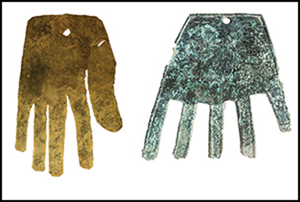
There are few parallels for the Irulegi hand in the archaeological record. The closest is undoubtedly the hand retrieved from the Iron Age site of El Puy de Alcalá in Alcubierre (Huesca), though this artefact is made of lead and is more slender and realistic than the one from Irulegi (Figure 9, no. 1).
Possible parallels to the Irulegi hand. 1) lead hand from El Puy de Alcalá (source: Museum of Zaragoza); 2a and 2b) La Vispesa monument (Tamarite de Litera, Huesca) (source: Museum of Huesca); 3) El Palao monument (Alcañiz, Teruel) (source: © Vicente Martínez Ferrer/https://historiasdelbajoaragon.wordpress.com).

Contemporaneous iconographic parallels from the lower Ebro Valley, include a monument from La Vispesa (Tamarite de Litera, Huesca), on which five hands are represented (Figure 9, 2a & b; Marco & Baldellou Reference Marco and Baldellou1976), and the El Palao monument (Alcañiz, Teruel), with a single hand (Figure 9, no. 3; Marco & Baldellou Reference Marco and Baldellou1976). In both cases, it is the back of the right hand that is depicted, as at Irulegi; the El Palao hand is also shown with the fingers pointing downwards (Garcés Reference Garcés2007).
These iconographic examples may relate to the custom, attributed by Classical Greek sources to the Iberians, of cutting off the heads and hands of defeated enemies to hang them either from the waist or at the entrance to settlements, houses or temples (Quesada Reference Quesada and de la Casa1994). Several examples of the display of decapitated heads during the Iron Age are known from the area of present-day Catalonia (Eulàlia & Rovira Reference Eulàlia and Rovira2019), whereas hands are only recorded on the two monuments mentioned above.
For Irulegi, it seems clear that the artefact represents a ritual hand, possibly rooted in an Iberian and Pyrenean cultural tradition. Representations of the back of open right hands, orientated in the same manner, have been found in Iron Age contexts only in the Vasconic and Iberian areas. Yet the hand, in its multiple forms, is a widespread symbol in many cultures worldwide. An example from Zafar (Yemen) provides a valuable point of comparison, although distant from Irulegi both in cultural and chronological terms. This copper alloy artefact represents a more lifelike hand produced through lost-wax casting in the second or third century AD (Figure 10, no. 1). A dedication to the god Talab Riyam is inscribed on the back of the hand in ancient South Arabian script and Sabaic language (Robin Reference Robin and Robin1985). The right hand is traditionally considered a powerful symbol of good fortune in the local culture and is widely represented in ancient South Arabian iconography as an apotropaic motif—a sign of the believers in their dedicatory statues and steles (MacGregor Reference MacGregor2010).
From left to right, comparison between the hands of Zafar, El Puy de Alcalá and Irulegi (not to scale) (photographs: 1. © Trustees of the British Museum (photograph no. 139443); 2. Museum of Zaragoza; 3. by authors).

Conclusion
The new inscription presented here provides support for a growing awareness that the ancient Vascones knew and made use of writing, at least to a degree. The small corpus presented in the introduction of predominantly numismatic usage is now complemented with a sensu lato religious inscription, possibly from a private context. This relatively modest example attests to the creation of a specific graphic subsystem derived from existing varieties of the Iberian script—in particular, a non-dual variety, datable to approximately the second century BC. Where and how such an adaptation occurred are aspects about which we currently know very little.
It has proved possible to find tentative Basque parallels for some words inscribed on the Irulegi hand. The use of sorioneku or sorioneke at the beginning of the text, isolated from what follows as an introduction admits comparison with Basque zori (h)on (‘good fortune’), and other elements, such as the verbal form eŕaukon or the locative in -n of a place-name, suggest that the inscription is in the Vasconic language, the longest and earliest known to date. Moreover, the semantics of these words and the layout of the text, together with the symbology of the support, are good reason for interpreting the inscription within the ritual or religious sphere, such as an offering, perhaps with an apotropaic objective.
The implications of the discovery of the Irulegi hand for the epigraphic and historical understanding of the Vasconic territory, as well as the possible linguistic connections between the Vasconic, Iberian and modern Basque languages, require further in-depth analysis. Given the scarcity of other firm evidence, the Irulegi hand and its inscription will henceforth constitute an indispensable starting point for the establishment of a linguistic map of the region and any debate on the origin and development of the Vasconic language and script.
Acknowledgements
The authors express their gratitude to the Municipality and neighbours of the Aranguren Valley for their financial support and exemplary collaboration, to the Government of Navarre for the assistance and help and to the Scientific-Technical Unit (UCTAI) of the Public University of Navarre for their support. The authors gratefully acknowledge the work of all the individuals who participated in the project, especially the excavation team and the Department of Archaeology of the Aranzadi Science Society. We would also like to thank Philip Banks for linguistic revision.
Funding statement
This article forms part of M. Aiestaran's PhD project funded by the UPV/EHU PIF 2019 programme, part of the ‘Consolidated Research Group on Prehistory: Human Evolution, Climate Change and Cultural Adaptation in Pre-Industrial Societies (GIZAPRE)’ (IT-1435-22). It is also part of the project ‘Written for the gods: Writing and rituality in the ancient Iberian Peninsula’ (PID2019-105650GB-I00) of the Consolidated Research Group LITTERA (2021SGR74) and the project ‘Edition of Palaeohispanic texts: Hispano-Gallian linguistical and onomastic studies (ETEPA)’ (PID2019-106606GB-C32) (Spanish Ministry of Science and Innovation) and Research Group IT-1534-22 of the Basque University System.
Supplementary material
To view supplementary material for this article, please visit https://doi.org/10.15184/aqy.2023.199.


 Open access

